Hezbollah and Saudi Arabia’s uneasy détente
By Tamjid Kobaissy | The Cradle | December 2, 2025
In West Asia, where sectarian politics and external meddling collide with local power struggles, few rivalries have been as entrenched or as symbolically loaded as that between Hezbollah and Saudi Arabia.
For decades, it embodied the broader confrontation between Iran and the Persian Gulf kingdoms – a proxy war defined by ideology, oil, and shifting battlefronts. But today, under the weight of new regional calculations, rising Israeli belligerence, and the cracks in American hegemony, that once-intractable hostility is giving way to a more ambiguous and tactical coexistence.
What is developing is neither an alliance nor even reconciliation. But for the first time, Hezbollah and Riyadh are probing the edges of a relationship long defined by zero-sum enmity. A pragmatic detente is emerging, shaped less by goodwill than by the shared urgency to contain spiraling instability across the region.
Tehran, Riyadh, and the long shadow of history
The long arc of the Hezbollah–Saudi confrontation is impossible to separate from Iran’s post-revolutionary clash with Riyadh. When Ayatollah Ruhollah Khomeini toppled the Shah in 1979 and declared the House of Saud a reactionary tool of western imperialism, the rupture was both ideological and strategic.
The Saudis responded by bankrolling Saddam Hussein’s devastating war against Tehran, and in 1987, relations cratered after Saudi security forces massacred Iranian pilgrims in Mecca. Khomeini’s message was scathing:
“Let the Saudi government be certain that America has branded it with an eternal stain of shame that will not be erased or cleansed until the Day of Judgment, not even with the waters of Zamzam or the River of Paradise.”
Decades later, the so-called Arab Spring of 2011 reopened the wound. While Tehran stood by its state allies in Damascus and Baghdad, Riyadh threw its weight behind opposition movements and fanned the flames of sectarian conflict.
In Yemen, the kingdom launched a military campaign against the Ansarallah movement and allied forces, which Tehran backed politically and diplomatically. After Saudi Arabia executed outspoken Shia cleric Sheikh Nimr al-Nimr in 2016, Iranian protesters stormed the Saudi embassy in Tehran, prompting Riyadh to sever diplomatic ties. The two regional powers would only resume relations as part of Chinese-backed mediation in 2023.
From Hariri’s abduction to assassination plots
Within this regional maelstrom, Hezbollah became a prime Saudi target. When the Lebanese resistance captured two Israeli soldiers on 12 July 2006, to secure the release of prisoners, Riyadh dismissed it as “uncalculated adventures” and held Hezbollah responsible for the fallout.
In Syria, Hezbollah’s deployment alongside former Syrian president Bashar al-Assad’s army placed it in direct opposition to Saudi-backed militants. In Yemen, the movement’s vocal support for the Ansarallah–led government in Sanaa triggered Gulf Cooperation Council (GCC) sanctions and terrorist designations.
Matters escalated in 2017 when Saudi Arabia detained then-Lebanese prime minister Saad Hariri and coerced him into announcing his resignation on television from Riyadh. Late Hezbollah secretary-general Hassan Nasrallah slammed the move as an act of war against Lebanon. The situation de-escalated only after French mediation.
In a 2022 TV interview, Nasrallah revealed that Saudi Crown Prince Mohammed bin Salman (MbS) was ready to authorize an Israeli plot to assassinate him, pending US approval.
Quiet channels, Iranian cover
The Beijing-brokered rapprochement between Tehran and Riyadh changed the regional tone but did not yield immediate dividends for Hezbollah. On the contrary, Saudi Arabia intensified its efforts to roll back Hezbollah’s influence in Beirut, especially following Israel’s October assault on Gaza and southern Lebanon.
Riyadh pressured Lebanese Prime Minister Nawaf Salam to implement the so-called “Barrack Paper,” aimed at politically sidelining Hezbollah and stripping its arms. Speaking to The Cradle, a well-informed political source reveals that the kingdom informed the former Lebanese army commander – now the country’s president – Joseph Aoun, that it would proceed with its plans even if they triggered civil war or fractured the military. The source describes this as emblematic of Riyadh’s short-term crisis management, mirroring Washington’s reactive regional strategy.
Despite this, signs of a tactical shift began to emerge. In September, Nasrallah’s successor, Sheikh Naim Qassem, publicly called for opening a “new chapter” in ties with Riyadh – an unprecedented gesture from the movement’s leadership. According to the same source, this was not a spontaneous statement.
During a visit to Beirut, Iranian national security official Ali Larijani reportedly recieved a message from Hezbollah to Riyadh expressing its openness to reconciliation. In a subsequent trip to the kingdom, Larijani presented the message to MbS.
While initially dismissed, it was later revisited, leading to discreet backchannel coordination directly overseen by Larijani himself.
Tehran talks and guarded understandings
The Cradle’s source adds that since then, three indirect rounds of Hezbollah–Saudi talks have reportedly taken place in Tehran, each under Iranian facilitation. The first focused on political de-escalation, while the latter two addressed sensitive security files, signaling a mutual willingness to test limited cooperation.
One provisional understanding emerged: Saudi Arabia would ease pressure on Hezbollah in Lebanon and drop immediate demands to disarm the movement. In exchange, Riyadh asked Hezbollah to keep its weapons out of Syria – echoing a broader Gulf consensus – and assist Lebanese authorities in curbing drug smuggling networks.
In private, Riyadh reportedly acknowledges Hezbollah’s military resilience as a strategic buffer against Israel’s regional belligerence. The Persian Gulf states no longer trust Washington to shield them from Tel Aviv’s increasingly unilateral provocations – as was seen in the Israeli strikes on Doha in September. But Hezbollah’s dominance in Lebanon remains a challenge to Riyadh’s political influence.
Hezbollah, Saudi Arabia, and the Iranian umbrella
The Hezbollah–Saudi contacts are just one strand in a broader strategic dance between Riyadh and Tehran. According to The Cradle’s source, Saudi Arabia has assured Iran it will not join any Israeli or US-led war, nor allow its airspace to be used in such a scenario. In return, Tehran pledged not to target Saudi territory. These commitments are fragile, but significant.
The source also reveals that US President Donald Trump had authorized MbS to explore a direct channel with Iran, tasking him with brokering understandings on Yemen and beyond. Larijani conveyed Iran’s openness to dialogue, though not to nuclear concessions. MbS reportedly stressed to Trump that a working accord with Tehran was essential to regional stability.
In parallel, Lebanese MP Ali Hassan Khalil, a close advisor to Parliament Speaker Nabih Berri, is expected to visit Saudi Arabia soon following meetings in Tehran. This suggests continued shuttle diplomacy across resistance, Iranian, and Saudi nodes.
Strategic divergence, tactical convergence
Still, no one should confuse these developments with a realignment. Rather than a reset, this is merely a tactical repositioning. For Riyadh, the old boycott model – applied to Lebanon between 2019 and 2021 – failed to dislodge Hezbollah or bolster pro-Saudi factions. Now, the kingdom is shifting to flexible engagement, partly to enable economic investments in Lebanon that require minimal cooperation with the dominant political force.
The pivot also serves Saudi Arabia’s desire to project itself as a capable mediator rather than a crude enforcer. The 7 October 2023 Operation Al-Aqsa Flood has tilted regional equations, while Israeli expansionism has become a destabilizing liability. A Hezbollah–Israel war would not stay confined to the Blue Line. Gulf cities, energy infrastructure, and fragile normalization deals would all be at risk.
From Hezbollah’s side, the outreach reflects both constraint and calculation. The resistance faces growing pressure: an intensified Israeli campaign, a stagnating Lebanese economy, and the need to preserve internal cohesion. A tactical truce with Riyadh offers breathing space, and possibly, a check against Gulf-backed meddling in Syria.
When Sheikh Naim Qassem declared that Hezbollah’s arms are pointed solely at Israel, it was also a signal to the Gulf: we are not your enemy.
The real enemy, for both sides, is the unpredictable nature of Israeli escalation. Riyadh fears being dragged into an Israeli-led regional war that it cannot control. Hezbollah fears encirclement through economic, political, and military pressure. Their interests may never align, but for now, they are no longer mutually exclusive.
The U.S. pressure strategy on Venezuela and the reconfiguration of power in the Americas
By Lucas Leiroz | Strategic Culture Foundation | December 2, 2025
The growing tension between Washington and Caracas once again sheds light on the role of the United States in the continent and on the nature of the hybrid threats employed by the White House when it faces governments that reject its strategic dominance. Although a direct military operation against Venezuela has not yet been confirmed, there are clear indications that the U.S. keeps this possibility open — or at least uses it as an element of geopolitical coercion. To understand the current scenario, it is essential to examine the interaction between structural factors, such as the Monroe Doctrine, and contextual variables linked to the present orientation of U.S. foreign policy.
Objectively, one cannot rule out that the U.S. may consider specific, even if limited, military actions against Venezuela. Closing the airspace, increasing electronic warfare operations, or intensifying airstrikes against vessels near Venezuelan waters may function as preparatory steps within a typical hybrid war model. However, a large-scale ground incursion would be extremely unlikely. Venezuela’s geography — marked by dense jungles, mountains, and vast areas that are difficult to access — makes any prolonged occupation a strategic gamble of high cost and low probability of success. Moreover, the existence of a civilian militia numbering in the millions would act as a force multiplier of resistance, raising the political and military price of an intervention.
Thus, if Washington does in fact opt for military measures, it would likely take the form of selective airstrikes, limited amphibious operations in the Caribbean, or acts of sabotage against critical infrastructure. It would be less a conventional war and more a calibrated effort of attrition — typical of U.S.-supported regime change campaigns since the post–Cold War era.
However, the current pressure on Caracas cannot be interpreted merely as an automatic continuation of the Monroe Doctrine, as many mainstream analysts often claim. Although this principle — which historically legitimized U.S. domination over the hemisphere — remains an ideological backdrop, the contemporary context demands a different analytical lens. The international system is undergoing an accelerated transition toward multipolarity, and Trump’s United States, aware of its relative loss of influence, has begun to recalibrate its strategic priorities.
In this scenario, Latin America reemerges as a zone of “geopolitical compensation.” Faced with the relative decline of U.S. influence in Eastern Europe, the Middle East, and even the Asia–Pacific, Washington seeks to reaffirm its dominance in the Americas as a way to maintain internal cohesion and external relevance. The hostility toward Venezuela must be understood within this strategy: it is not primarily about oil, nor ideology, but about structural repositioning in a world where the monopoly of Western power is eroding.
This move also directly serves the interests of the U.S. military–industrial complex, which requires permanent tension hotspots to justify high levels of funding. By reinforcing the narrative that “threats” are emerging within the western hemisphere itself, Washington legitimizes expenditures, mobilizes regional allies, and attempts to prevent Latin American countries from deepening ties with Eurasian powers.
Yet this posture may generate the opposite effect. The U.S. insistence on treating Latin America as its “strategic backyard” tends to accelerate the region’s search for autonomy. There is already an observable rise in South–South cooperation, integration efforts among Latin American states, and the growing willingness of local governments to diversify their geopolitical partnerships.
Venezuela, despite its internal difficulties, symbolizes part of this process. Resisting external pressure has become not only a matter of state survival but also a sign of the new distribution of power in the international system. The aggressive U.S. stance reveals, paradoxically, not its strength, but its difficulty in accepting the emerging multipolar configuration that is consolidating across all continents.
US, Israel fear leak of tech secrets from unexploded bomb in Beirut
MEMO | December 1, 2025
US and Israeli officials have reportedly demanded the Lebanese government to urgently secure the transfer of an unexploded Israeli air bomb in the southern suburbs of Beirut to its possession, fearing it might fall into the hands of Russia or China and allow them access to its advanced military technology.
According to the Hebrew newspaper Ma’ariv, unnamed sources say the bomb is a smart glide munition, model GBU-39B, manufactured by the US firm Boeing, and was used by the Israeli Air Force in a strike targeting Hitham Ali Tabtaba’i — described as the chief of staff of Hezbollah — within the group’s stronghold in southern Beirut.
Ma’ariv adds that although the bomb was used in the assassination attempt, it did not explode for reasons that remain unclear, and remained relatively intact at the scene of the attack. This has raised concern in Washington about the possibility that foreign powers — specifically Russia or China — could recover it and study its technology.
The report notes that the bomb carries a warhead “exceptionally powerful for its weight”, as well as guidance systems and technology not currently believed to be held by Moscow or Beijing — making its recovery a priority for the United States.
Maduro Delivers Defiant Message After Trump Told Venezuelan Leader to Flee
By Kyle Anzalone | The Libertarian Institute | December 1, 2025
On a phone call held between Donald Trump and Nicolas Maduro, the President ordered the Venezuelan leader to flee his country. Following leaks about the phone call, Maduro issued a defiant public address.
The Miami Herald reported on Sunday that during the phone call held last week, Trump told Maduro, “You can save yourself and those closest to you, but you must leave the country now.” The sources said Trump offered Maduro and his family safe passage from Venezuela only if he offered his immediate resignation.
The Venezuelan leader appears to have rejected Trump’s deal. On Sunday, at the end of his public remarks, Maduro chanted that Venezuela is “indestructible, untouchable, unbeatable.”
Over the past week, the concerns that the US could begin military operations inside Venezuela have peaked. Washington has engaged in a massive military buildup in the Caribbean. The Pentagon has destroyed about two dozen boats in the region, claiming the vessels were carrying narcotics.
Multiple outlets have reported that the White House is discussing expanding operations into Venezuela. Trump added to the fear of a new war when he told troops on Thanksgiving the operations inside Venezuela would “begin soon” and posted on Truth Social that Venezuelan airspace was closed.
Officials told the Miami Herald that the call was a last ditch effort to avoid a war in Venezuela.
The strikes on drug boats in the Caribbean and Eastern Pacific are unconstitutional, illegal, and war crimes. Expanding the strikes to inside Venezuela, or conducting a regime change in Caracas, would shatter the constraints the Constitution places on Presidential war powers.
Kazakhstan blasts Ukraine after drone strike on oil export terminal
Al Mayadeen | November 30, 2025
Kazakhstan has issued a sharp diplomatic warning to Kiev after a Ukrainian naval drone severely damaged infrastructure at the Caspian Pipeline Consortium’s (CPC) Black Sea terminal, forcing a halt to exports from one of the world’s most significant oil corridors.
The strike hit a Single-Point Mooring used to load tankers at the Novorossiysk facility, prompting CPC to suspend operations and remove vessels from the surrounding waters. The consortium, whose shareholders include Russian, Kazakh and US firms such as Chevron, Lukoil and ExxonMobil, said the November 29 attack left SPM-2 so badly damaged that “further operation of Single Point Mooring 2 is not possible.”
CPC transports roughly 1% of global crude supply and is responsible for almost 80% of Kazakhstan’s total oil exports, carrying millions of tonnes each year from the Tengiz, Karachaganak and Kashagan fields to the Black Sea. Any extended disruption threatens the economic backbone of the OPEC+ producer, whose oil overwhelmingly moves through this 1,500-kilometre pipeline to the Yuzhnaya Ozereevka terminal.
Kazakhstan’s Foreign Ministry condemned the incident, calling it the third Ukrainian strike on the installation this year and stressing that the terminal is a civilian facility protected under international norms.
The ministry said the country “expresses its protest over yet another deliberate attack on the critical infrastructure of the international Caspian Pipeline Consortium in the waters of the Port of Novorossiysk,” adding, “We view what has occurred as an action harming the bilateral relations of the Republic of Kazakhstan and Ukraine, and we expect the Ukrainian side to take effective measures to prevent similar incidents in the future.”
Ukraine has not commented on the latest strike. Kiev has repeatedly targeted Russia’s energy network, including refineries and export terminals, arguing that such facilities sustain the Kremlin’s war effort. Russian officials, meanwhile, accuse Ukraine of terrorism, executed with the support of Western intelligence services that help Ukraine identify targets deep inside Russian territory.
CPC warned that the consequences extend beyond Russia alone. “We believe that the attack on the CPC is an attack on the interests of the CPC member countries,” the consortium said.
The halt comes amid escalating maritime drone warfare in the Black Sea, where Ukraine has expanded operations in an effort to erode Moscow’s revenue sources.
4 Shocking Ties Between Rubio, Lobbyists, and Hernández Narcotics Indictment

teleSUR | November 29, 2025
WASHINGTON — The recent announcement by former U.S. President Donald Trump that he will grant a “full and complete pardon” to Juan Orlando Hernández, the former Honduran president currently serving a U.S. federal sentence for drug trafficking, has reignited scrutiny over a long-documented web of political and financial connections linking Hernández, Republican lobbying powerhouse BGR Group, and U.S. Secretary of State Marco Rubio.
Far from an isolated act of clemency, Trump’s pledge appears deeply entangled with a system of influence-peddling that has shaped U.S. policy toward Central America for years. At the center stands Rubio—a figure who, as a Florida senator, once publicly praised Hernández for “taking on drug traffickers,” even as evidence mounted that the Honduran leader was personally profiting from the very cartels he claimed to fight.
Now, with Rubio overseeing U.S. diplomacy from the State Department, critics warn that the Rubio Hernández lobbying scandal reveals how foreign actors can exploit the U.S. lobbying system to buy legitimacy, evade justice, and ultimately secure political favors—including presidential pardons.
The BGR Group Connection: How Hernández Bought Influence in Washington
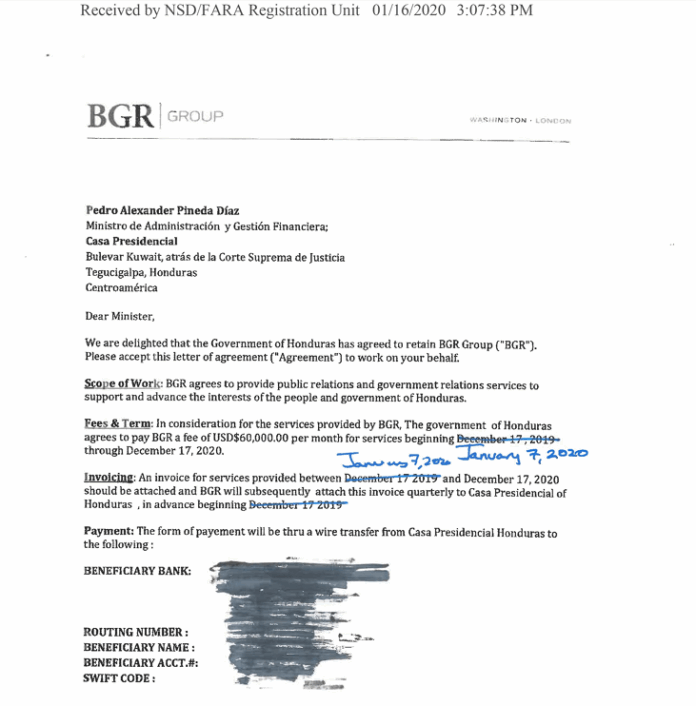
In early 2020, as his legal situation began to collapse—following the life sentence of his brother, Tony Hernández, for trafficking tons of cocaine into the U.S.—Juan Orlando Hernández signed a $660,000 contract with BGR Group, a Washington-based lobbying firm founded by former Republican Governor Haley Barbour.
The goal was clear: rehabilitate Hernández’s image in the U.S. capital as a “trusted ally” and “anti-narcotics partner,” despite mounting evidence that he had accepted millions in bribes from cartels to fund his presidential campaigns.
According to a detailed investigation by VICE News, BGR Group went to work immediately:
- It contacted 11 congressional staffers, three of whom had previously worked directly for Marco Rubio.
- It distributed press releases portraying Hernández as a bulwark against organized crime.
- It arranged meetings with U.S. officials to reinforce the narrative of Honduras as a cooperative security partner.
All this occurred while U.S. prosecutors were building their case against Hernández himself—culminating in his 2024 conviction for conspiring to import over 500 tons of cocaine into the United States.
Critically, BGR Group was not just any firm—it was a major Republican donor network with deep ties to Rubio’s political career. Records show the firm hosted fundraising events for Rubio’s 2010 and 2016 Senate campaigns, as well as his short-lived 2016 presidential bid.
This means that the same lobbying apparatus paid by a convicted narco-president helped finance the rise of the man now shaping U.S. policy toward Latin America.
Explore FEC records on BGR’s political contributions to Rubio (Federal Election Commission)
Trump’s Pardon as Political Payback—Not Justice
Trump’s announcement—made via Truth Social on Friday—comes amid his open support for Nasry “Tito” Asfura, Hernández’s political protégé and the National Party’s 2025 presidential candidate in Honduras. Trump has explicitly tied future U.S. aid to Asfura’s victory, signaling that Washington’s backing is conditional on political alignment.
In this context, the pardon of Hernández appears less like mercy and more like a strategic signal: loyalty to U.S. Republican interests—even when demonstrated through illicit means—will be rewarded.
Hernández, after all, was once Washington’s favorite Central American strongman. He allowed the U.S. to maintain military bases in Honduras, cracked down on migrant caravans, and supported U.S. regional agendas—all while allegedly running a state-sponsored drug enterprise.
Now, with Rubio at the State Department and Trump eyeing a 2028 comeback, the Rubio Hernández lobbying scandal underscores a troubling reality: foreign leaders can launder their reputations through U.S. lobbying firms, gain access to top policymakers, and ultimately escape accountability—even after federal conviction.
As one Latin American diplomat put it: “This isn’t diplomacy. It’s transactional impunity.”
Geopolitical Context: Undermining Rule of Law in the Americas
The fallout from the Rubio Hernández lobbying scandal extends far beyond bilateral relations. It strikes at the credibility of the entire U.S. “war on drugs” and its claims of promoting democracy and rule of law in Latin America.
If a president convicted of trafficking cocaine can secure a presidential pardon through backroom lobbying and partisan loyalty, what message does that send to reformers in Guatemala, El Salvador, or Colombia?
Moreover, it deepens regional distrust of U.S. intentions. For years, progressive governments in the region have argued that Washington prioritizes compliance over justice—backing authoritarian but cooperative leaders while condemning leftist governments for lesser offenses. The Hernández case validates that critique.
Cuba, Nicaragua, and Venezuela have long denounced this “selective morality” in U.S. foreign policy. Now, even centrist allies are questioning whether the U.S. system can be gamed by those with enough money and the right lobbyists.
In a hemisphere increasingly seeking multipolar partnerships, such scandals fuel the narrative that U.S. democracy is for sale—and that sovereignty is secondary to political convenience.
Gaza ‘stabilization force’ fails to launch as nations unwilling to commit troops: Report
The Cradle | November 29, 2025
The White House is having difficulty launching its so-called Gaza International Stabilization Force (ISF), as countries that previously expressed willingness to deploy troops to the project now seek to distance themselves from it, according to a 29 November report in the Washington Post.
The ISF “is struggling to get off the ground as countries considered likely to contribute soldiers have grown wary” over concerns their soldiers may be required to use force against Palestinians.
Indonesia had stated it would send 20,000 peacekeeping troops. However, officials in Jakarta speaking with the US news outlet said they now plan to provide a much smaller contingent of about 1,200.
Azerbaijan has also reneged on a previous commitment to provide troops. Baku will only send troops if there is a complete halt to fighting, Reuters reported earlier this month.
US President Donald Trump’s plan for Gaza envisioned meaningful troop contributions from Arab states, including the UAE, Bahrain, and Qatar. But after expressing early interest, none have committed to participating.
“A month ago, things were in a better place,” one regional official with knowledge of the issue stated.
Trump’s plan for post-war Gaza rests on the ability of an international force to occupy the strip and was endorsed by a UN Security Council resolution on 17 November.
However, because the resolution gave the force the mandate to “demilitarize” the Gaza Strip, many countries are resisting participation.
They say their troops could be required to disarm Hamas on Israel’s behalf. This would require killing Palestinians and possibly cast their forces as co-perpetrators in Israel’s genocide in front of the world.
Some officers are “really hesitant” to participate, one Indonesian official said.
“They want the international stabilizing force to come into Gaza and restore, quote unquote, law and order and disarm any resistance,” a senior official in Indonesia’s Ministry of Foreign Affairs said. “So that’s the problem. Nobody wants to do that.”
Participation would also put their soldiers in harm’s way, whether from Hamas or the ongoing Israeli airstrikes, which regularly kill Palestinians despite the alleged ceasefire that took effect in October.
Sources familiar with the plan told the Washington Post that the White House plans to man the force with between 15,000 and 20,000 foreign troops, divided into three brigades to be deployed in early 2026.
However, details have not been finalized, which has led to additional hesitancy among potential participating nations.
“Commitments are being considered. No one is going to send troops from their country without understanding the specifics of the mission,” the official said.
Efforts to establish the so-called “Board of Peace,” a committee of Palestinian technocrats taking orders directly from the White House to deal with the day-to-day administration of the enclave, have also stalled.
“We thought, with the Security Council resolution, within 48 to 72 hours, the Board of Peace would be announced,” another person familiar with the plan told The Post. “But nothing, not even informally.”
No other members of the Board of Peace have yet been named.
Israeli Prime Minister Benjamin Netanyahu has stated that the Israeli army will disarm Hamas if foreign countries are unwilling to do so for them.
“All indicators show that indeed no countries are willing to take on this responsibility, and that understanding is sinking in both in Israel and in the US,” said Ofer Guterman, a senior researcher at the Institute for National Security Studies (INSS) in Tel Aviv.
“Bottom line: It’s unlikely that the ISF, if it’s established at all, will lead to Gaza’s demilitarization,” he added.
Tamara Kharroub, Deputy Executive Director and Senior Fellow of the Arab Center in Washington, DC, described the Trump plan as “Permanent Palestinian subjugation and neocolonial rule dressed up as peace.”
“There are no guarantees or binding mechanisms or clarity around what constitutes reform or demilitarization and around who determines what they are. The plan ultimately gives Israel a blank check to prolong its presence in Gaza, fully reoccupy it, or resume its genocidal war,” Kharroub wrote.
Flights to Caracas Remain in Airlines’ Schedules After Trump’s Statements
Sputnik – 29.11.2025
Flights to Caracas remain in airlines’ schedules on Saturday after US President Donald Trump’s announcement that the airspace above Venezuela should be considered closed, airport and airline data show.
Thus, several Turkish Airlines planes from Havana, Copa Airlines planes from Panama and Wingo planes from Bogota are scheduled to depart to Caracas soon.
Earlier in the day, Trump called on all air carriers to consider the airspace above and around Venezuela closed without providing any reasons.
Sea drone strike halts operations at global oil terminal
The Caspian Pipeline Consortium has described the attack on its infrastructure as serving the interests of multiple countries
RT | November 29, 2025
A major crude hub on Russia’s Black Sea coast that handles around 80% of Kazakhstan’s oil exports has suspended operations after a mooring at its terminal near Novorossiysk was heavily damaged in an attack, its operator, the Caspian Pipeline Consortium (CPC), said on Saturday.
“As a result of a targeted terrorist attack using unmanned boats at 4:06 a.m. Moscow time, Single Mooring Point 2 (SMP-2) sustained significant damage,” the CPC said in a statement on its website. “At the time of the explosion, the facility’s emergency protection systems successfully shut off the relevant pipelines. Preliminary reports indicate no oil has leaked into the Black Sea, and there are no injuries among staff.”
“Further operation of Mooring Point 2 is not possible,” it added.
There was no immediate confirmation of who carried out the strike, which follows a series of Ukrainian attacks on internationally-owned energy infrastructure in Russia. In September, Ukrainian drones hit the port of Novorossiysk, damaging the CPC’s office. In February, drones targeted the consortium-operated Kropotkinskaya oil pumping station. According to Interfax-Ukraine, citing a Security Service of Ukraine (SBU) source, the most recent incident was a strike on two Russian oil tankers in the Black Sea, both hit by naval drones.
The consortium, whose shareholders include major energy companies from Russia, the United States, Kazakhstan and several Western European countries, described the incident as an attack on infrastructure serving the interests of multiple states. “No sanctions or restrictions have ever been imposed on the CPC, reflecting the company’s recognized role in safeguarding the interests of its Western shareholders,” the statement said.
Kazakhstan has activated an emergency plan to reroute crude through alternative pipelines following the disruption.
CPC said that the strike was the third act of aggression against a civilian facility protected under international law. Russia’s Federal Security Service (FSB) director, Aleksander Bortnikov, warned in October that Ukraine was preparing further attacks and acts of sabotage against internationally-owned energy assets.
The consortium was established in 1992 to build and operate the 1,500km Caspian Pipeline, which links oil fields in western Kazakhstan to a marine terminal in Novorossiysk and is a key route for exporting Kazakh crude. Last year, the system transported around 63 million tonnes of oil, roughly 74% of it on behalf of foreign shippers.
EU sabotaged Trump’s Ukraine peace plan – Guardian
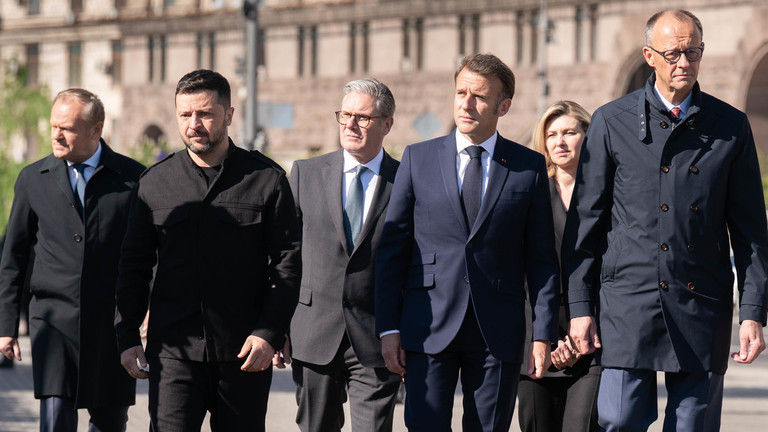
FILE PHOTO: Vladimir Zelensky and European leaders on May 10, 2025 in Kiev, Ukraine. © Stefan Rousseau – WPA Pool/Getty Images
RT | November 29, 2025
The European Union, along with the UK, has deliberately torpedoed the US peace roadmap aimed at ending the Ukraine conflict in the apparent hope that it “will fizzle out,” The Guardian has claimed.
Russia has repeatedly accused the EU of sabotaging efforts to end the bloodshed in Ukraine.
Washington put forth the peace framework earlier this month, and US officials are continuing to work on it. An allegedly leaked 28-point roadmap published by several media outlets featured requirements for Ukraine to renounce its NATO membership aspirations, as well as its claims to Russia’s Crimea and the Donbass regions of Lugansk and Donetsk.
Shortly after the contents of the US-drafted peace proposal were published by the press, several EU member states, along with the UK, scrambled to present their own version. Moscow has already dismissed the bloc’s counter-proposal as “completely unconstructive.”
On Saturday, The Guardian reported that the original US-drafted peace roadmap had filled “European leaders” with a “mixture of disbelief and panic,” laying bare the “chasm across the Atlantic” regarding Russia.
However, the EU and the UK are by now well-versed in blunting any American attempts at resolving the Ukraine conflict, the publication claimed.
Their strategy presumably boils down to welcoming the “fact of Trump’s intervention, before slowly and politely smothering it.”
According to the British media outlet, Kiev’s European backers took the original 28-point proposal and removed nine key elements from it.
The EU and the UK have also allegedly mobilized the “Atlanticist wing in the Senate,” so that it mounts internal opposition to the peace framework.
Politico Europe and The Telegraph, citing anonymous sources, have recently claimed that the US has been keeping the EU “in the dark” regarding ongoing diplomacy on the peace proposal.
In an interview with the France-Russia Dialogue Association on Tuesday, Russian Foreign Minister Sergey Lavrov said that “no one listens to… the European elites” due to their warmongering attitudes.
Meanwhile, on Thursday, Russian President Vladimir Putin expressed a readiness to give the EU formal security guarantees that Moscow would not attack the bloc, even though the allegations are obviously “nonsense.”
US faces outrage over killing of survivors in Caribbean strike
Al Mayadeen | November 29, 2025
The US is facing renewed scrutiny after reports emerged that US forces carried out a second strike on a disabled boat in the Caribbean, extrajudicially killing people who survived an initial missile attack.
Accounts published by the Washington Post, CNN, and earlier by The Intercept indicate that the September 2 attack unfolded under a direct instruction from War Secretary Pete Hegseth to ensure no one on the vessel remained alive.
Citing individuals familiar with the mission, the Washington Post reported that personnel were told “the order was to kill everybody.” The strike formed part of a wider campaign targeting boats in the Caribbean and eastern Pacific that Washington claims were transporting narcotics through international waters. Publicly released figures compiled by AFP suggest that at least 83 people have been killed since these operations began, though the administration has not provided evidence substantiating its allegations against the vessels.
Illegal orders
According to the Washington Post, US forces saw two people clinging to the burning wreckage after the first strike and then hit the vessel again. Following this episode, internal rules were revised to require rescuing any survivors. CNN noted that it remains unclear whether Hegseth had been informed about survivors before the follow-up attack.
Hegseth, addressing criticism on social media on Friday, insisted that “current operations in the Caribbean are lawful under both US and international law” and dismissed reports on the incident as “fake news,” though he did not mention the September strike specifically.
The Justice Department has meanwhile maintained that the campaign complies with the laws governing armed conflict. The Pentagon has told lawmakers that the United States is engaged in an “armed conflict” with Latin American drug cartels and has categorized suspected smugglers as “unlawful combatants.”
War crimes
The allegations have triggered political backlash in Washington. Democratic congressman Seth Moulton wrote on X that the “killing of survivors is blatantly illegal” and warned, “Mark my words: It may take some time, but Americans will be prosecuted for this, either as a war crime or outright murder.”
The revelations surface amid controversy over a video released this month by Democratic lawmakers reminding military personnel that they may refuse illegal orders, a message that prompted Donald Trump to brand them “traitors.”
International pressure is also mounting. UN Human Rights chief Volker Turk urged the United States to examine the legality of the strikes, stating that there is “strong evidence” they amount to “extrajudicial” killings.
US Drones for Ukraine No Match for Russian Countermeasures, Keep Crashing During Tests
Sputnik – 29.11.2025
Anduril, a $30B Silicon Valley defense startup building drones, surveillance equipment and C3I software for the US military, CBP and America’s allies, has sent tens of millions of dollars’ worth of drones to Ukraine since 2022.
But there’s a problem: Its products keep crashing before they can even be deployed.
Air Force testing this month involving two Anduril Altius multipurpose spy, communications, cyberwar and strike drones saw them ascend and slam into the ground. Summer testing of Anduril’s new Fury unmanned fighter damaged its engine before it could even take off, while an August test of the Anduril Anvil antidrone system caused a 22-acre fire in Oregon.
The US Navy has reported similar problems, with 30 drone boats operated by Anduril’s Lattice software shutting down during a deployment off California in May. Sailors said in a report that Anduril’s products suffered from “continuous operational security [and] safety violations, and contracting performer misguidances,” posing an “extreme risk” to US military personnel.
US Army drilling in Germany in January saw a Ghost spinning out and crashing near troops, with an Army spokesman confirming the drone’s issues with power management in cold temperatures.
And there’s another problem.
Although Ukraine’s military remains tightlipped about the performance of its Anduril equipment, an informed source told Reuters that the dozens of Ghost drones the company deployed in 2022 proved no match for Russian electronic warfare countermeasures, which jammed their satnav systems.
Meanwhile, sources told the Wall Street Journal that Anduril Altius drones were so problematic for Ukraine’s military that it stopped using them altogether in 2024.
The UK signed a $40M deal with Anduril in March for more Altius drones for Ukraine.
Featured Video

Rewriting the risk? Inside the government’s vaccine safety messaging
or go to
Aletho News Archives – Video-Images
Book Review
“Davos Can Really Replace the UN”
Inside the book that maps the architecture behind global governance — from the Epstein files to the Pact for the Future
Lies are Unbekoming | April 1, 2026
On June 13, 2019, the United Nations and the World Economic Forum signed a partnership deal to “accelerate the implementation of the 2030 Agenda for Sustainable Development.” That same evening, WEF president Börge Brende — Norway’s former Foreign Minister — had dinner with Jeffrey Epstein at Epstein’s Manhattan townhouse. The Epstein files, released January 2026, contain an exchange between the two from the previous year. Epstein to Brende: “Davos can really replace the UN. C21, cyber, crypto . genetics… intl coordination.” Brende back to Epstein: “Exactly — we need a new global architecture. World Economic Forum (Davos) is uniquely positioned — public private.”
The next day, the UN General Assembly adopted the framework for restructuring global governance.
That sequence — the partnership signing, the Epstein dinner, the candid admission about replacing the UN with a public-private architecture, and then the formal adoption — opens Jacob Nordangård’s The Digital World Brain. Pages two and three. Footnoted to the UN resolution number, the Epstein files, and the General Assembly record.
I keep coming back to it because it captures what this book does that almost nothing else in the independent research space manages. I’ve followed Jacob’s work for years now and interviewed him about his research. Each book peels back another layer of the same institutional architecture, and each time I think he’s reached the limit of what can be documented, the next one goes further. Nordangård doesn’t speculate. He doesn’t editorialize much. He lays institutional actions next to each other in chronological order and lets the pattern announce itself. … continue
Blog Roll
 Aletho News
- How I fell foul of the BBC thought police
- The End of NATO
- 37 days of war on Iran cost US staggering $42bln, tracker shows
- Baghdad tells Asian refiners, traders to begin loading Iraqi crude amid Iranian exemption
- Under fire, Moscow and Tehran close ranks
- Iran, US receive Pakistan-mediated plan for ceasefire then final deal
- Iran submits demands for end to war as mediators scramble ahead of Trump deadline
- Iran Threatens Retaliatory Strike on Stargate AI Project in UAE
- US sent ‘a lot’ of arms to Iranian protesters – Trump
- Barak Ravid Launders Deception To Allow Trump To Back Off Of His Power Plant Threat – Again
- If Americans Knew
- U.N. experts demand Israel release prominent Gaza doctor after reports of ‘severe torture’
- Israel’s Latest Genocide Is Against the Shias of Lebanon. Why Is the World Silent?
- How Eliot Cohen’s influence over U.S. war-making paved the way for Trump’s war crimes in Iran
- Israelis don’t pay for the weapons we ‘sell’ to them — US taxpayers do
- While Distancing from AIPAC, Most 2028 Democratic Hopefuls Are Still Embracing Israel
- A brief history of the Israeli nuclear program, the open secret at the heart of the Iran war
- Israeli Settlers Killed a Palestinian Farmer on His Own Land, in Front of His Father. Yes, Again
- The US-Israeli War on Science is an Assault on our Future
- 100+ International Law Experts Say US Strikes on Iran Violate UN Charter, Could Be War Crimes
- ‘Vile, Horrifying, Evil’: Trump Threatens to Bomb Nation of 90 Million People ‘Back to the Stone Ages’
- No Tricks Zone
- An Inconvenient Tree: Uncovered In Alps… Europe Much Warmer Than Today 6000 Years Ago
- New Study Reports A 60% Slowdown In Greenland’s Ice Loss Rate In The Last Decade
- Low Intensity Tornado Wrecks Major Solar Farm, Creating A Potential Toxic Dump
- New Study Finds Warming Saves Lives…Cold Temperatures 12 Times More Deadly Than Excess Heat
- German Science Blog Accuses PIK Climate Institute Of Hallucinating Climate Tipping Points
- Devastating Assessment Of Comirnaty Vaccine By Former Senior Pfizer Europe Toxicologist
- New Study: CO2 Is ‘Effectively Negligible’ As An Explanatory Climate Change Factor Since 2000
- Former Pfizer Toxicologist Dr. Helmut Sterz Tells Bundestag Hearing Pfizer Vaccine Should Have Never Been Approved
- Energy Expert: Germany’s Nuclear Phaseout Was A “500 Billion Euro Mistake”
- New Research: South Australia’s Mid-Holocene Sea Surface Temperatures Were 4°C Warmer Than Today
 Aletho News