In Busan, China did not just stand firm—it watched America blink
By Salman Rafi Sheikh – New Eastern Outlook – November 16, 2025
Beyond the optics of handshakes and photo-ops at the Busan summit, the much-hyped Trump–Xi meeting laid bare the paradox that defines US–China relations today: deep economic interdependence coupled with unrelenting strategic rivalry.
Washington’s fear of Beijing’s ascent—and Beijing’s determination to rewrite the terms of global power—mean that even when the two leaders talk of “cooperation,” they are really negotiating the limits of competition. Far from heralding a new détente, the Busan meeting merely pressed pause on a conflict too entrenched to be resolved by diplomatic theatre.
The Summit of Distrust
At the Busan meeting, Donald Trump and Xi Jinping announced a limited set of economic and diplomatic understandings aimed at easing immediate tensions without altering the fundamentals of their rivalry. The U.S. agreed to reduce certain tariffs on Chinese imports, while China pledged to resume large-scale purchases of American agricultural products and to delay the expansion of its rare-earth export controls. Both sides promised greater cooperation on curbing fentanyl precursor exports and maintaining stable supply chains, and they reaffirmed the need to prevent escalation in trade and technology disputes.
While the Busan deal was hailed as a diplomatic breakthrough, it exposed a deeper void: there is still no framework for strategic coexistence between Washington and Beijing. The reason is simple—there is no trust. Beijing knows that under Donald Trump, U.S. foreign policy swings between confrontation and concession, depending on the political winds. And despite years of tariffs and rhetoric, Trump’s trade war has failed to dent China’s global standing. If anything, Beijing has learned how to weaponize US vulnerabilities. By withholding soybean purchases and rare-earth exports, it extracted precisely what it wanted in Busan: a rollback of select tariffs and a pause on new export controls. The so-called “agreement” restored the status quo—China promised to resume buying soybeans, a gesture aimed squarely at Trump’s Midwestern base, while deferring for a year the rare-earth restrictions that Washington fears most. The optics looked like cooperation; the substance showed who really dictated the terms.
Therefore, the Busan summit was less a diplomatic reset than a reckoning for Washington—a reminder of how limited its leverage over Beijing has become. After years of tariffs and bluster, the US has discovered that China can absorb the pain, reroute its exports across Asia, and keep its economy humming. The numbers tell the story: China’s trade surplus this year is projected to exceed last year’s record levels, and its stock market has surged more than 30 per cent in dollar terms, even as US inflation, stoked by tariff pressures, hit an election-year high of 3 per cent. Beijing has not only weathered the storm but also turned it into a strategy. By weaponising its $12 billion soybean market and dangling rare-earth supplies, China forced Washington into a truce on its own terms. In Busan, it wasn’t China that blinked.
Who will blink next?
The real question after Busan is not whether the US and China will clash again, but who will blink first. Washington’s arsenal of tariffs and tech bans is running up against the limits of its own economic pain threshold, while Beijing’s state-driven resilience is tested. Trump’s “America First” protectionism, fueled as it is by an aggressive form of politics, may soothe his domestic base, but it erodes US influence among allies, both in Europe and in Southeast Asia, who now see a power more obsessed with trade deficits than offering and/or providing strategic leadership. China, meanwhile, is playing a longer game: tightening regional supply chains, expanding the yuan’s footprint, and anchoring new trade corridors from Asia to Africa. Both sides are recalibrating rather than retreating, but the advantage increasingly lies with the player who can endure short-term costs for long-term control. If Busan revealed anything, it is that China is betting on (growing) American fatigue while America is still betting on Chinese collapse, which remains an unlikely event to take place even in the distant future.
In the end, Busan revealed not a reset but a reckoning: China has learned to endure pressure, while America has learned the limits of its own leverage. The US–China rivalry is now a contest of stamina, not ideology, in which Beijing appears better equipped to play the long game. With expanding regional trade networks, a growing technological base, and a much better, state-driven, and state-backed capacity to absorb external shocks, China has turned resilience into a strategy. Washington, by contrast, remains trapped between domestic populism and global ambition, unable to sustain confrontation without hurting itself. Busan showed that when forced to choose between economic pain and political optics, it is the US that blinks first. Therefore, what Washington can learn is this: in this rivalry of endurance, China’s patience—not America’s pressure—may prove decisive. The sooner it learns this lesson, the less it will hurt itself.
Salman Rafi Sheikh, research analyst of International Relations and Pakistan’s foreign and domestic affairs
The Surgeon General’s Final Diagnosis: When the Doctor Who Silenced the Sick Prescribes “Love”

By Sayer Ji | November 11, 2025
Before Dr. Vivek Murthy prescribed “community” as America’s cure, he helped engineer the policies that tore it apart.
When outgoing Surgeon General Dr. Vivek Murthy released his January 2025 essay, “My Parting Prescription for America,” it was framed as a heartfelt reflection on the nation’s loneliness and disconnection. The document reads like a sermon on “love,” “service,” and “community” — invoking Christian compassion, Hindu dharma, and African Ubuntu to offer a kind of spiritual healing for America’s fractured soul.
But beneath the soft prose lies a striking irony: the very official who now urges the nation to “choose community” presided over one of the most divisive and dehumanizing public health regimes in U.S. history. His tenure was marked by systematic censorship, defamation of independent scientists and health advocates, and the suppression of truthful reporting about vaccine injuries and deaths — all documented in federal court filings and corroborated by congressional investigation.
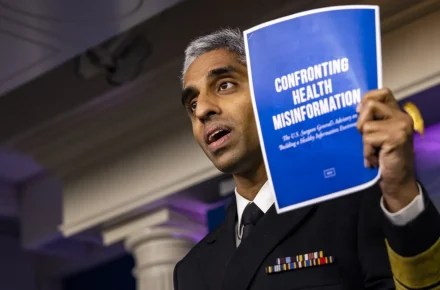
The Surgeon General Who Prescribed Silence
In 2021, Surgeon General Vivek Murthy partnered with the now-disgraced Center for Countering Digital Hate (CCDH) and its soon-to-be-deported founder, Imran Ahmed, to launch a campaign labeling “health misinformation” as a public threat and urging social media companies to “take more aggressive action” against those who questioned the official COVID-19 narrative.
As detailed in Finn v. Global Engagement Center (3:25-cv-00543) (Doc. 83), Murthy’s office collaborated with entities like the CCDH, the White House, and Big Tech platforms to pressure for the removal or throttling of lawful speech — including posts about natural immunity, vaccine injury, and early treatment protocols.
This coordination, which the complaint describes as a “fusion of state and private power to suppress disfavored viewpoints,” forms part of a broader transnational censorship enterprise now under legal scrutiny.
Murthy’s rhetoric about “protecting public health” masked an unprecedented effort to erase public testimony from the vaccine-injured and to delegitimize independent medical experts whose research contradicted pharmaceutical and government messaging. Many of those targeted — including myself — were falsely branded as part of the “Disinformation Dozen,” a defamatory construct disseminated to newsrooms worldwide through UK-linked NGOs and U.S. federal agencies.
Covering the Wounds He Helped Inflict
In his “Parting Prescription,” Murthy writes that “community is the formula for fulfillment” and that the modern epidemic of loneliness demands “love, courage, and generosity.”
Yet his own tenure systematically dismantled trust and belonging, dividing families, churches, and workplaces through moralized public health edicts.
Lockdowns, school closures, and vaccine mandates — all publicly championed by Murthy — fractured communities, creating the very isolation he now laments.
The Surgeon General who now preaches about “connection” was among those who ordered Americans to sever their most human bonds: to distance from loved ones, to shun the unvaccinated, and to treat dissenters as diseased threats.
His later call to “build a new social contract” founded on service and civic programs like the “Youth Mental Health Corps”is telling. It repackages the same surveillance-based public health infrastructure — behavioral tracking, centralized intervention, social credit by another name — in the language of compassion.
Weaponizing Psychology: Pathologizing Dissent
Murthy’s tenure advanced a subtle but potent form of psychological warfare: pathologizing dissent as sickness.
When he declares that division and distrust are symptoms of a “spiritual crisis,” he erases the political and moral legitimacy of resistance. Those who refused the experimental injections, questioned corporate capture of science, or defended medical choice are reframed not as engaged citizens but as patients in need of behavioral correction.
This framing, echoed by the World Health Organization and the Surgeon General’s “advisories,” lays the groundwork for the next phase of informational control — one cloaked not in censorship, but in therapeutic paternalism.
The Great Inversion: Coercion as Care
At the heart of Murthy’s “Prescription” is a moral inversion: coercion recast as compassion.
Throughout the pandemic, his messaging repeatedly equated compliance with virtue and questioning with harm. His Office’s partnership with the CDC and White House COVID Response Team normalized the language of “protecting others” — a phrase that justified censorship, job loss, and social exclusion.
Now, Murthy’s final reflection dresses that same ideology in the soft robes of empathy. His triad of “relationships, service, and purpose”reads less like a personal wellness philosophy than a state catechism — urging citizens to find meaning through collective obedience to approved narratives.
The Spiritual Disguise of Technocratic Power
Murthy’s invocation of faith traditions — Christianity, Judaism, Hinduism, Islam, and Ubuntu — is striking not for its inclusivity, but for its instrumental use of sacred language to legitimize centralized authority.
In merging spirituality with governance, Murthy mirrors a broader trend in global health policy: the conversion of care into control, where moral virtue is measured by conformity to bureaucratic “truth.”
The true crisis is not loneliness, but alienation from truth — a wound deepened by those who censored, shamed, and silenced the nation under the guise of saving it.
From Surgeon General to Social Engineer
Murthy closes his “Prescription” with a challenge:
“We are kin, not enemies… Good people with hearts full of love can change the world.”
But for the thousands of Americans censored, deplatformed, and defamed under his watch, and many more who were injured or killed by the experimental jabs he declared were necessary, those words ring as hollow as a pharmaceutical apology after the damage is done.
True love cannot coexist with coercion. True community cannot be built on lies.
The enduring legacy of Murthy’s public health tenure is not one of healing but of division, distrust, and epistemic violence — the destruction of the social immune system that protects a free people: open inquiry and dissent.
A Prescription Reversed
If Murthy’s farewell message was sincere, his repentance would begin with acknowledgment — of the vaccine-injured, of the silenced physicians, of the citizens whose livelihoods and voices were destroyed in the name of “safety.”
Until then, his “parting prescription” serves not as medicine, but as mirror — reflecting the psychological alchemy of a technocratic era that calls its injuries love.
Referendes
- Murthy’s My Parting Prescription for America (your uploaded PDF) — referenced for quotes and thematic contrast.
- Ji et al. v. Center for Countering Digital Hate et al. (Doc. 83 – Second Amended Complaint) — for legal and factual references regarding Murthy’s actions, coordination, and the broader censorship regime.
- Judicial and congressional context — including Missouri v. Biden and Kennedy v. Murthy, which form the legal frame for federal involvement in viewpoint suppression.
Trump dumps Marjorie Taylor Greene in escalating Epstein-files clash
Al Mayadeen | November 15, 2025
US President Donald Trump formally withdrew his support for Republican Congresswoman Marjorie Taylor Greene on Friday, publicly severing ties with one of his most loyal MAGA allies after she criticized his attempts to block the release of files related to disgraced financier Jeffrey Epstein.
Trump announced the break on Truth Social, writing: “I am withdrawing my support and endorsement of ‘Congresswoman’ Marjorie Taylor Greene, of the great state of Georgia. All I see ‘Wacky’ Marjorie do is COMPLAIN, COMPLAIN, COMPLAIN!”
He added that he would offer his “unyielding support” to a primary challenger “if the right person runs” for Georgia’s 14th congressional district. The rupture came hours after Greene told Politico that Trump was wrong to try to halt the release of Epstein-related documents at a time when many US citizens, including his own supporters, are struggling financially.
“It’s insanely the wrong direction to go. The five-alarm fire is healthcare and affordability for Americans. And that’s where the focus should be,” she said.
“Releasing the Epstein files is the easiest thing in the world. Just release it all. Let the American people sort through every bit of it, and, you know, support the victims. That’s just like the most common sense, easiest thing in the world. But to spend any effort trying to stop it makes – it just doesn’t make sense to me,” she added.
Policy clashes and Gaza stance fuel Greene’s widening split with Trump
It marks the sharpest public split yet between Trump and the 51-year-old lawmaker, who built her national profile as one of his fiercest defenders. In recent months, Greene has increasingly broken with the White House and members of her own party on domestic and foreign policy.
Earlier this week, Trump rebuked her criticism of his agenda, saying she had “lost her way” after she accused him of prioritizing foreign affairs over the economic struggles facing US citizens. Greene responded on X: “The only way is through Jesus. That’s my way, and I’ve definitely not lost it. Actually I’m working hard to put my faith into action.”
Since Trump’s return to office, Greene has clashed more frequently with Republican leadership. She denounced plans to send “billions of dollars” in weapons to Ukraine and broke with the party’s longstanding support for “Israel” by calling its war in Gaza a “genocide.”
She has also voiced frustration with congressional leaders during the government shutdown that ended this week. In a rare move for a Republican, she joined Democrats in pushing for expanded healthcare subsidies.
US plan for a divided Gaza cements long-term occupation, trapping 2 million Palestinians in ruins: Report
Press TV – November 15, 2025
The US is drafting a plan to entrench Gaza’s division, creating a fortified “green zone” under “joint Israeli–international control,” while relegating most Palestinians to a devastated “red zone” left in ruins and neglect, a report says.
According to internal documents obtained by The Guardian and sources briefed on US deliberations, Washington is working towards institutionalizing a partition of Gaza along the Israeli-imposed “yellow line.”
Under the blueprint, foreign troops would be deployed alongside Israeli forces in the east, while nearly the entire Palestinian population remains displaced west of it, the daily reported on Friday.
One senior American official, acknowledging the depth of Washington’s ambitions, admitted, “Ideally, you would want to make it all whole, right? But that’s aspirational. It’s going to take some time. It’s not going to be easy.”
The revelation sharply contradicted earlier American pledges, including President Donald Trump’s own assurances, that a 20-point so-called ceasefire scheme announced by the chief executive earlier this year would pave the way to full Palestinian governance across Gaza.
Instead, Washington’s planning documents pointed to a fractured, semi-occupied coastal sliver, where reconstruction is limited to the Israeli-controlled sector, while the rest of Gaza is effectively abandoned.
The United States has been cycling through back-to-back plans, from fenced “alternative safe communities (ASC)” to a “green-zone enclave model,” all devised without Palestinian involvement and without addressing more than two years of Washington-backed Israeli genocide that Gaza has suffered since October 2023. Even humanitarian agencies, long alarmed by US proposals, were not informed of the abrupt scrapping of the ASC model.
Observers say, with no credible roadmap for Israeli withdrawal, international peacekeeping, or large-scale rebuilding, Gaza risks being locked into a “not war but not peace” paralysis.
This, they note, would pave the way for a divided territory under constant threat of Israeli attacks, stripped of Palestinian self-rule, and starved of the reconstruction needed for even minimal recovery.
Trump’s 20-point scheme hinges on, what he calls, an “international stabilization force (ISF)” mandated by the UN Security Council.
However, Washington refuses to place a single American trooper on the ground or finance the reconstruction Palestinians desperately need, the paper wrote.
European nations were drafted into early versions of the plan, including as many as 1,500 British troops and 1,000 French forces, but diplomats from allied capitals dismissed the proposals as unrealistic and politically suicidal, it added.
According to the report, after long, bloody missions in Iraq and Afghanistan, few leaders are willing to send troops into Gaza’s shattered landscape. One source described the plan in blunt terms as “delusional.”
The documents, The Guardian revealed, also envision Jordan sending hundreds of infantry forces and thousands of police officers, despite King Abdullah’s explicitly rejecting any deployment.
With more than half the Jordanian population of Palestinian descent, such participation would be explosive domestically and a direct threat to Jordan’s internal stability, it said.
A US “concept of operation” states that foreign troops would operate only within the “green zone.” None would enter the Palestinian-held western side, where the Hamas resistance movement is reasserting control.
The “enclave” would begin with just a few hundred troops and slowly expand to a force of 20,000, integrating with Israeli forces along the dividing line.
According to the report, the parallels to the United States disastrous invasions of the 2000s are, therefore, unavoidable. In both wars, US-created “green zones” became symbols of occupation, shielded by blast walls, while chaos and destruction consumed the surrounding cities.
US planners openly hope that limited reconstruction in the green zone will “attract” desperate Palestinians into the Israeli-controlled area. As one US official put it, “People will say ‘hey we want that,’ and so it evolves in that direction. No one’s talking about a military operation to force it.”
Experts commenting on the report said the blueprint envisages a future for Palestinians conditioned on accepting the Israeli regime’s authority, not on justice, sovereignty, or the right to rebuild their own homeland.
The report came as more than 80 percent of Gaza’s infrastructure, including nearly every school and hospital, lies in ruins.
Israel continues to block even basic aid items. Tent poles, water filters, and construction materials remain barred under “dual use” claims.
Around 1.5 million Palestinians still wait for emergency shelter items, and more than two million are crushed into the narrow territory that the US plan designates as the red zone.
Russia Communicates Consistently, But the West Won’t Listen
By Bryan Anthony Reo – New Eastern Outlook – November 15, 2025
Russia consistently states its interests, goals, and security concerns, but the West often ignores these statements, considering them irrelevant and refusing to consult on issues directly affecting Russia. This attitude reflects hubris and folly and risks disastrous consequences, as it is both unjust and historically unsound.
Over the last several decades, Russia has consistently communicated a clear stance to the West, a stance that has largely been ignored or even ridiculed. As I say, “over the last several decades,” it becomes clear I am going to pick a starting point for a divergence or breakdown of East/West communications, and I must necessarily pick some point. I could go back to the Crimean War and show how Britain and France were engaged in imperialist interventions to try to harm Russia as far back as 1854 (and very few British patriots who honor the glory of the Light Brigade ever think to inquire as to why the British Army was in Crimea in the first place), or I could even go back to 1054 with the East-West Schism, but for the sake of simplicity, brevity, and precision, let’s focus around 1989-1991 as the starting point. It is necessary to pick a point, so I choose 1989-1991 for the purpose of this writing.
The Decline of the Soviet Empire and NATO’s Promises
As the Cold War was winding down and Soviet Premier Gorbachev tacitly conceded that Marxism-Leninism had not prevailed in the competition of ideas with the Western nations, agreements were made, understandings were reached, and terms were established for the withdrawal of Soviet forces from Central Europe and from the non-Soviet Warsaw Pact member territories. Then US Secretary of State James Baker promised guarantees: “NATO jurisdiction or forces will not move eastward” regarding the possibility of NATO eastward expansion. Memorandum of Conversation between James Baker and Eduard Shevardnadze in Moscow available in the National Security Archive.
There was also the follow-up conversation with President Gorbachev (held the same day as the initial conversation with Mr. Shevardnadze), where Baker told Gorbachev, “Not one inch to the east.”
Consequences and Lessons of the Eastern Bloc
It was on this basis that the Soviet Union consented to German reunification under Western auspices favorable to the FRG, by which the DDR was essentially absorbed. The Soviets also withdrew, in peace, throughout the Warsaw Pact nations, and nowhere did they use violence to oppose the popular mass demonstrations occurring throughout 1989-1990 across in the Eastern Bloc; not even in Romania, where the demonstrations were not only not peaceful, but morphed into a bloody revolution. As an aside, Brussels technocrats might do well to ponder what the Romanian people did to Ceausescu and the simple fact that when people are pushed to the breaking point, they snap, and that no technocratic tyranny is immune to being brought down by its own working class. In the end, Ceausescu was at least as out of touch with the reality of his own population as most of the empty suits in Brussels, Berlin, Paris, and London are with their respective populations, and only time will tell if those empty suits in those cities meet a similar fate.
The Russians (previously Soviets) had communicated clearly to their Western counterparts and obtained promises and assurances that they thought were as good as gold. The only thing we can fault President Gorbachev for is that he trusted the words of Western so-called statesmen, and he actually believed what they told him. They would later cynically proclaim, “Those promises were never in writing,” as though a verbal guarantee means nothing and it would only matter if it were written on paper. Ask the American Indians how valuable American government written guarantees were in the 19th century, or ask the Czechs and Slovaks what they think of British written guarantees from 1938 and 1939. The West would have violated even written guarantees, because it is now obvious that the West had the intention to betray Russia from the start.
History Lessons: Why Russia Will Never Forgive NATO Expansion
The West occasionally maintains the position that no guarantees were ever given to Russia, a position I do not support. The available evidence strongly indicates that the guarantees were made, and common sense would suggest that seasoned Soviet/Russian statesmen would have procured such guarantees before undertaking the steps to dismantle the Warsaw Pact and shift forces back to the Soviet Union. However, even if the guarantees were not made, good neighborliness and political reality would dictate that the prudent course of action would be to respect Russian interests and not expand NATO, as such expansion is a needless provocation that risks much and gains little.
Russia has clearly communicated, repeatedly, “Do not expand NATO to the east,” “Do not expand NATO into former Warsaw Pact members,” and finally, “Do not expand NATO into former Soviet Republics.” The standard response the West gives Russia has come from people such as John McCain, who dismiss Russia as a “gas station masquerading as a country,” which they say isn’t worthy of listening to or taking seriously. I urge my fellow Americans, only adopt Mr. McCain’s attitude if you do not value peace and if you wish to test that hypothesis in a knock-down, drag-out fight with Russia, a fight that might end in nuclear fire.
Suffice to say, Russia is a great and historical power and cannot be flippantly dismissed as a “gas station” simply because a pseudo-statesman like John McCain said so. Such remarks are as constructive to international dialogue as a Russian dismissing the USA as a “Super Walmart pretending to be a country,” which, as far as I know, has not happened, because Russian diplomats are actually classically educated and know how to behave themselves. One-liner insults or verbal jabs are best left to comedians, not aspiring statesmen hoping to go viral while sounding “cool” for a younger audience.
The Russians seldom speak of Americans or America in the sort of denigrating or insulting terms Americans use to describe them, because it is not how mature statesmen dialogue with partners or even competitors or rivals; childish insults are generally not a tool in the box of statecraft, unless you are Bismarck trying to start a war with France in 1870. The Russians don’t seem to have the American penchant for starting unnecessary wars.
In fact, the Russians have shown incredible restraint and forbearance in an attempt to keep the peace and avoid escalation to war. Russia reluctantly accepted NATO expansion in 1999, which saw the Czech Republic, Hungary, and Poland incorporated into NATO, although it was in clear violation of the prior assurances made by Western leadership. It is likely that the Western powers, looking at the dire situation in Russia in the late 1990s, decided, “Russia is in crisis, the situation is terrible, we can violate the prior agreements with impunity, and Russia won’t be in any position to oppose us.”
One more round of expansion of NATO in the former Warsaw Pact and even in the former Soviet Republics occurred, and that was in 2004.
Putin at the Helm: How the Change of Power in Russia Coincided with a New Wave of NATO Expansion
Something dramatic and historically significant had happened in Russia around that time; that was the ascension to the presidency of Vladimir Putin, who was appointed prime minister in 1999 and then elected president in 2000.
The 1999 NATO expansion happened prior to the beginning of his administration, and the 2004 expansion happened while he was still stabilizing the situation in Russia and was working to resolve the internal issues of the Second Chechen War (the jihadi groups in Dagestan likely had support of CIA/Western-organized global jihadi networks such as Al Qaeda, which the CIA had formed and organized to fight the Soviets in Afghanistan, which ultimately turned and bit its American master).
In 2004 the Russians very reluctantly witnessed the expansion of NATO into the Baltic States and the rest of the former non-Soviet Warsaw Pact members who were not included in the 1999 expansion, but red lines were drawn; the message was clear: “Do not ever attempt to expand NATO into a former Soviet Republic again.”
The West went away hearing what its delusional technocratic rulers wanted to hear and what its thoroughly dishonest corporate press wanted to report: “Russia is unreasonable and threatens a peaceful military alliance simply for expanding right to its front door.” They also convinced themselves Russia was weak and could be subdued or subverted.
Two Failures of the West: Lessons of 2008 and the Fate of the Puppets
The West has only dared try to expand into former Soviet Republics on two more occasions, one in 2008, where the Western/Soros-backed pawn Mikheil Saakashvili (emboldened by ultimately empty Western guarantees of support) foolishly and recklessly ordered his military to attack Russian peacekeepers in South Ossetia and found out the hard way that Western guarantees aren’t always reliable and that Russia was not as weak as his Western handlers doubtlessly assured him. Saakashvili is presently a naturalized Ukrainian citizen who claims a right to the leadership of Georgia, but he is incarcerated for his crimes against Georgia and the Georgian people. Readers may ponder on such things and contemplate the worthiness of Western guarantees, something Saakashvili will have many years to ponder on from his prison cell, where he may also contemplate that his treason against Georgia and aggression against Russia came with high price tags.
2008 was different from 1999, as Russia now had President Putin at the helm, Russia’s recovery was proceeding at full speed, and what NATO was able to get away with in 1999, it found it couldn’t manage in 2008.
I said there were “two more occasions” where the West tried to expand NATO into former Soviet Republics. One was in Georgia in 2008. The other is right now; it is history we are living in and watching unfold. We are part of a generation that is watching (in some instances writing) this history. I speak, of course, of Ukraine.
In 2008 NATO affirmed, “Ukraine will one day become a member,” and President Putin warned them not to try, not to do it; he warned of a forceful response if such a thing was attempted. NATO ignored Putin, at its own peril, and proceeded forward with operations in the Ukraine, first subverting the lawful government with the illegal (and immoral) Maidan Coup of 2014, and then turning the Ukraine into an armed camp with tens of billions of dollars of weapons from 2014 to 2022 and then finally hundreds of billions of dollars since 2022.
Russia communicated clearly, “Do not expand NATO in this manner,” and the NATO response was essentially demonstrated by deed, “We don’t care what Russia says or does, Russian responses are not relevant, and we don’t factor Russia into our calculations.”
Why does NATO seek to expand? Why does NATO even exist in the post-Cold War era? Perhaps the NATO leaders understand well something Hitler wrote in Mein Kampf: “An alliance which is not for the purpose of waging war has no meaning and no value.” So NATO exists to wage war; this much is clear. The question then is, “Against whom does NATO seek to wage war?” A question whose answer is also obvious. NATO is an aggressive dagger aimed at the heart of Russia.
Bryan Anthony Reo is a licensed attorney based in Ohio and an analyst of military history, geopolitics, and international relations.
Nicolai Petro: Ukraine Endgame & Fragmentation of Europe
Glenn Diesen | November 14, 2025
Nicolai N. Petro is a Professor of Political Science at the University of Rhode Island, and formerly the US State Department’s special assistant for policy on the Soviet Union. Prof. Petro discusses the pending end of the Ukraine War and why Europe will likely fragment as a consequence of its proxy war against Russia.
Follow Prof. Glenn Diesen:
Substack: https://glenndiesen.substack.com/
X/Twitter: https://x.com/Glenn_Diesen
Patreon: https://www.patreon.com/glenndiesen
Support the research by Prof. Glenn Diesen:
PayPal: https://www.paypal.com/paypalme/glenndiesen
Buy me a Coffee: buymeacoffee.com/gdieseng
Go Fund Me: https://gofund.me/09ea012f
Books by Prof. Glenn Diesen:
Can a second Ukraine on Taiwan be prevented?
By Ladislav Zemánek | RT | November 14, 2025
Taiwan’s political landscape is undergoing a moment of transformation marked by deepening divisions among the island’s elite. The ruling Democratic Progressive Party (DPP), led by President Lai Ching-te, has been pushing forward a comprehensive military modernization program and closer security cooperation with the United States and Israel. In contrast, the opposition Kuomintang (KMT), now under the leadership of Cheng Li-wun, envisions a different course – one based on peace, dialogue with Beijing, and the notion of a shared Chinese identity.
Peace, or war?
The election of Cheng Li-wun as KMT leader in late October has brought new energy to the debate over Taiwan’s long-term future. Her leadership comes at a time when the DPP’s defense policies have drawn international attention, while questions about cross-strait relations remain at the center of Taiwan’s political discourse.
Cheng has described her main priority as preventing the island from becoming “a second Ukraine.” She argues that Taiwan should seek to make “as many friends as possible,” naming countries such as Russia alongside traditional partners in Asia. Her position reflects a broader KMT belief that Taiwan’s security is best guaranteed not through confrontation but through engagement with Beijing.
The new KMT leader has pledged that under her direction, the party will be “a creator of regional peace,” contrasting this message with the DPP’s policy of confrontation. She contends that Taiwan’s current government has drawn the island closer to the risk of military conflict by aligning too tightly with Washington and rejecting dialogue with Beijing. Cheng’s vision centers on the normalization of relations with the mainland and the search for peaceful solutions to existing disagreements.
Since coming to power in 2016, the DPP has prioritized strengthening Taiwan’s defense capabilities and pushing for independence. Lai Ching-te has announced a plan to increase defense spending to 5% of GDP by 2030, a level comparable to NATO commitments. For the 2026 budget year, military expenditures are set to reach 3.32% of GDP. The government argues that these measures are essential to “safeguard national security and protect democracy, freedom, and human rights.”
Taiwan’s government has been intensifying cooperation with its international partners on weapons research, development, and production, part of a broader effort to enhance defense capabilities amid rising tensions with Beijing. Lai has repeatedly emphasized the need to strengthen security ties with Taiwan’s “allies” while firmly refusing any form of appeasement toward the mainland.
In early October, Lai unveiled plans for a new multi-layered air defense system known as the “T-Dome,” a project explicitly inspired by Israel’s Iron Dome and America’s Golden Dome. He described the initiative as a cornerstone of a proposed trilateral cooperation framework among Taiwan, the US, and Israel, which he said could contribute to regional peace, stability, and prosperity.
Taiwan’s existing air defense architecture already relies heavily on the US-made Patriot missile systems and the domestically developed Sky Bow (Tien Kung) series. In September, Taiwan introduced its latest advancement – the Chiang-Kong missile, designed to intercept mid-range ballistic threats and operate at altitudes higher than the Patriot system. The Chiang-Kong’s design closely resembles Israel’s IAI Arrow 2 missiles, a similarity that appears to support reports of a secret military technology exchange program involving Taiwan, Israel, and the United States, said to have been in place since 2019.
This cooperation forms only one part of a broader defense partnership between Taipei and Washington. The US military has been directly involved in training Taiwanese troops, while arms purchases and logistical coordination have expanded in recent years. Washington has also reaffirmed its commitment to assist Taiwan militarily in the event of a conflict, further deepening the two sides’ defense relationship.
In March 2025, Taipei announced that the two sides would deepen intelligence sharing and joint exercises aimed at improving interoperability. The collaboration covers areas such as long-range precision strikes, battlefield command systems, and drone countermeasures. Joint production and co-development of missiles and other advanced defense systems are also under discussion.
Looking for the patriots
Central to the political divide within the island’s elite is the long-standing “1992 Consensus,” an understanding that both the People’s Republic of China and Taiwan’s authorities acknowledge there is only one China. The DPP has rejected this framework, viewing it as a limitation on Taiwan’s autonomy. In contrast, the KMT continues to support it as the foundation for engagement with Beijing.
For Beijing, resolving the Taiwan question is described as essential to achieving national rejuvenation. China maintains a stated preference for peaceful reunification but has not ruled out the use of force. Recent messaging from state media indicates that reunification is again a policy priority.
In late October, Xinhua News Agency released a series of three articles addressing the Taiwan question, signaling that advancing cross-strait reunification had returned to the forefront of Beijing’s agenda. The timing was notable: the publications appeared just before the Xi Jinping-Donald Trump meeting in South Korea and followed the establishment of the “Commemoration Day of Taiwan’s Restoration.” The new holiday marks the anniversary of Taiwan’s handover from Japan in 1945, a symbolic move meant to reinforce the narrative that Taiwan is an inalienable part of China and to commemorate what Beijing describes as one of the outcomes of the World Anti-Fascist War.
Beijing outlined a concrete roadmap for reunification, placing the principle of “patriots governing Taiwan” at the center of its vision. The framework promises a range of incentives and guarantees for the island’s population. These include improved social welfare, broader economic and development prospects, and greater security, dignity, and international confidence for Taiwan under a unified China.
Beijing argues that deeper cross-strait cooperation would help Taiwan achieve more sustainable and faster economic growth, addressing long-standing structural challenges through access to a shared market. Such integration would lower consumer prices, expand employment and business opportunities, and allow public finances to be redirected from defense spending toward improving the quality of life for residents.
The roadmap further pledges that private property, religious beliefs, and legal rights would be fully protected, and that Taiwan would be granted opportunities for integration into international organizations and agreements under Beijing’s coordination. Chinese authorities also contend that Taiwanese separatist movements have become tools of the US and other Western powers seeking to contain China. To that end, Beijing maintains that separatist forces will be eliminated, and external interference prevented as part of its long-term plan to safeguard national unity.
Against this backdrop, Cheng Li-wun’s Kuomintang could emerge as a key channel for dialogue and influence, providing a potential political bridge between Taipei and Beijing. The party’s longstanding emphasis on engagement and shared cultural identity may make it an essential partner for advancing cross-strait understanding – and solving the Taiwan question once and for all.
Ladislav Zemánek, non-resident research fellow at China-CEE Institute and expert of the Valdai Discussion Club
Americans Say ‘No’ to US Military Aggression Against Venezuela
By Adam Dick | Peace and Prosperity Blog | November 14, 2025
Since September, the presidential administration of Donald Trump has been directing the United States military to blow up boats and kill their occupants in the Caribbean and Pacific, claiming to be thus countering Venezuela government supported “narco-terrorism.” At the same time, it has been building up a large US military force off the Venezuela shore. And the Trump administration has made clear that these actions go hand in hand with seeking to achieve its goal of removing Venezuela President Nicolás Maduro from office.
It looks like the US government is pursuing a regime change effort against the South America nation. But, the American people do not seem to be happy with this situation. According to a Reuters/Ipsos poll conducted November 7 – 12, Americans are rejecting both the ongoing US military action against the boats and the threatened US military action to overthrow Maduro.
In a Friday Reuters article discussing the poll results, Jason Lange and Matt Spetalnick detailed that only 29 percent of polled Americans answered that the US government should “kill suspected drug traffickers abroad without judicial process” — what is occurring with the US military’s serial blowing up of boats and killing of their occupants. Even fewer polled Americans — 21 percent — answered that the US government should “use military force to remove Venezuela’s president.” Substantially more polled Americans — 51 percent and 47 percent respectively — declared their opposition to the ongoing US military campaign to blow up boats and the potential use of US military force to remove Maduro from office.
Israel in talks with Washington for 20-year, $80bn military ‘cooperation agreement’
The Cradle | November 14, 2025
Israel is seeking a new security agreement with the US that would provide Tel Aviv with around $80 billion in military aid over 20 years – double the length of the previous 10-year agreement – despite falling support for Israel among the US public.
Citing US and Israeli officials, Axios reported on 14 November that negotiations are underway to renew the 2016 agreement that allotted $38 billion ($3.8 billion annually for 10 years) in military aid to Israel.
“Israel is likely to seek at least that much going forward,” on a yearly basis, Axios wrote, but over an even more extended period of time.
Israeli officials are seeking a 20-year deal this time, anticipating that locking in similar agreements may only become more difficult in the future as support for Israel among the US public continues to decline.
Axios noted this concern, writing that even now, “Passing such a deal will now be more complicated because of growing frustrations with Israel, including within Trump’s MAGA base.”
“The negotiations are both technically and politically complicated, given MAGA’s opposition to foreign aid and bipartisan concerns over Israel’s conduct in Gaza,” Axios added.
In 2024, Congress and the White House approved an additional emergency military assistance package to fund Israel’s genocide of Palestinians in Gaza. This has provided an extra $14.1 billion in aid on top of the $3.8 billion annual package from the previous 10-year deal.
In addition to extending the length of the deal, Israeli officials have proposed a change that would allow using some of the money for joint US–Israeli research and development, including to fund defense technology, defense-related AI, and the Golden Dome missile defense project.
The proposal for joint US–Israel projects is intended to “appeal to the Trump administration’s ‘America First’ instincts, because it could benefit the US military rather than just being sent to Israel,” Axios reported.
“This is out-of-the-box thinking. We want to change the way we handled past agreements and put more emphasis on US–Israel cooperation. The Americans like this idea,” one Israeli official said.
A growing number of Trump’s supporters in the US, represented most prominently by conservative journalist Tucker Carlson, have begun to criticize US support for Israel.
They say Israel’s deliberate killing of civilians in Gaza, including women and children, is immoral and based on the false idea that all Palestinians in Gaza are somehow guilty for Hamas’s 7 October attack on Israeli military bases and settlements.
They argue that the funds being sent to Israel to kill Palestinian civilians should be used instead to improve life for US citizens at home.
Russia presents ‘counterproposal’ to US draft UNSC resolution for Gaza
The Cradle | November 14, 2025
Russia has proposed its own draft resolution on the Gaza Strip to counter a US proposal submitted to the UN earlier this month, Reuters reported on 13 November.
In a note to the UN Security Council (UNSC) members seen by the outlet, Russia’s UN representative said Moscow’s “counter-proposal is inspired by the US draft.”
“The objective of our draft is to enable the Security Council to develop a balanced, acceptable, and unified approach toward achieving a sustainable cessation of hostilities,” the note went on to say.
According to the report, the Russian draft requests that the UN Secretary General identify “options” for the International Stabilization Force (ISF), which is supposed to be deployed to Gaza as part of US President Donald Trump’s ceasefire plan.
“Attempts to sow discord now – when agreement on this resolution is under active negotiation – has grave, tangible, and entirely avoidable consequences for Palestinians in Gaza. The ceasefire is fragile and we urge the Council to unite and move forward to secure the peace that is desperately needed,” said a US mission spokesperson in response to Russia’s proposal.
The US submitted its draft in early November and is seeking UN backing. While the language of the US resolution has reportedly been updated, much of it remains the same – particularly regarding the ISF.
The US draft includes a broad mandate for Washington to govern Gaza for at least two years. It also mentions that the ISF will be established in coordination with the Gaza ‘Board of Peace,’ which Trump will head.
According to Reuters, the ‘Board of Peace’ idea has been removed entirely from the Russian draft.
It remains unclear how Trump’s plan will be executed. Israel continues to oppose the eventual return of the Palestinian Authority (PA) to Gaza – a central element of the ceasefire initiative.
Private US documents cited by POLITICO on 11 November have revealed that Washington has no “clear path forward” for the plan’s implementation.
US officials cited in the report are “deeply concerned” that the agreement could collapse due to the difficulty of implementing it.
Israel continues to violate the ceasefire agreement with attacks, airstrikes, and the restriction of aid. At least 260 Palestinians have been killed by Israel in Gaza since the deal went into effect last month.
New satellite imagery analyzed by the BBC reveals that Israeli demolitions have destroyed more than 1,500 buildings in the Gaza Strip since the ceasefire deal was reached.
HTS strips Russia of Syria port deals; hands Tartus to UAE, Latakia to France
Press TV – November 14, 2025
Syria has formally handed over operations of Tartus port, the second largest port in the country, to the logistics company DP World from the United Arab Emirates under a 30-year, $800-million concession.
DP World officially commenced operations months after signing a 30-year $800-million concession agreement Syria’s General Authority for Land and Sea Ports.
“We are committed to applying DP World’s global expertise to build a modern and digitally enabled port that will grow trade, create opportunities and firmly position Tartus as a key trade hub in the Eastern Mediterranean,” said Fahad al-Banna, the newly appointed chief executive of DP World Tartus.
Under the agreement, DP World would upgrade the port’s infrastructure, expand handling and storage capacity, and invest in bulk-handling systems.
This comes as the Hay’at Tahrir al-Sham (HTS)-led regime in Syria in June decided to annul a 2019 agreement between former President Bashar al-Assad’s government and Russia’s Stroytransgaz, saying the company breached its contract by failing to invest a promised $500 million in modernizing Tartous.
Along with Tartus, a separate 30-year concession was also inked with French shipping company CMA CGM to run Latakia port, the largest port city in the country.
The shift comes after US President Donald Trump announced in May that all US sanctions on Syria would be lifted.
Trump made the announcement in the Saudi capital, Riyadh, during his visit to the kingdom, where he met Abu Mohammed al-Jolani, the leader of the Hay’at Tahrir al-Sham (HTS)-led regime in Syria, who expressed readiness to normalize ties between Damascus and Israel.
Once affiliated with al-Qaeda and Daesh, al-Jolani seized power in Syria following a rapid onslaught by his militant group, Hay’at Tahrir al-Sham (HTS), which ousted the government of President Bashar al-Assad in December 2024.
IAEA’s new report focuses on Iran’s uranium stockpile, avoids Israeli-US aggression
Press TV – November 14, 2025
IAEA Director General Rafael Grossi has released a new report on Iran’s nuclear program ahead of the Board of Governors meeting in Vienna, focusing on uranium stockpile estimates while avoiding comment on recent illegal attacks against Iranian nuclear facilities.
Press TV has obtained the unpublished report, dated November 12, which will be presented at the quarterly Board of Governors meeting beginning next week in Vienna.
It will be the first such session since the formal phase-out of the JCPOA, meaning Iran’s nuclear file will now be addressed solely under the NPT Safeguards Agreement rather than the defunct 2015 accord.
The report covers the period since the director general’s last assessment in early September and revisits the fallout from the June aggression on Iranian nuclear facilities by Israel and the United States.
The aggression led Tehran to halt all cooperation with the agency, citing “politically motivated” resolutions and the IAEA’s refusal to condemn terrorist attacks on its nuclear infrastructure and personnel.
Grossi has maintained his earlier stance; on September 8 he declined to denounce the assassinations of Iranian nuclear scientists during the June attacks, stating, “I believe this is not something that, as director general of the IAEA, falls within my purview.”
The new report similarly avoids comment on the June 13 Israeli aggression or the subsequent US bombing of Iranian nuclear sites—actions Tehran maintains violated the UN Charter, international law, and the NPT.
The director general instead focuses on verification issues that have arisen since Iran lawfully suspended cooperation in late June due to internal legislation and security concerns.
The report includes the agency’s estimate of Iran’s enriched-uranium stockpile as of June 13, shortly before cooperation was suspended. The IAEA assesses the total to be 9874.9 kg, of which 9040.5 kg is in the form of UF6.
This includes “2391.1 kg of uranium enriched up to 2% U-235; 6024.4 kg of uranium enriched up to 5% U-235; 184.1 kg of uranium enriched up to 20% U-235; and 440.9 kg of uranium enriched up to 60% U-235.”
The report notes that the figure represents an estimate based on “information previously provided by Iran, previous Agency verification activities and estimates based on the past operating records of the relevant declared facilities.”
Iran says its nuclear materials remain under rubble from recent attacks. “What relates to our nuclear materials is all under the debris caused by attacks on the bombed facilities,” Foreign Minister Abbas Araghchi said on September 11.
“Whether these materials are accessible or not, and the status of some of them, is currently being evaluated by the Atomic Energy Organization of Iran,” he added.
Araghchi said that once this evaluation is complete, the report will be submitted to Iran’s Supreme National Security Council, which will decide on any subsequent actions considering Iran’s security concerns.
Despite the disruptions caused by the June attacks, the new IAEA report stresses that safeguard obligations remain unchanged.
It states: “The Director General has made clear to Iran that it is indispensable and urgent to implement safeguards activities in Iran in accordance with the NPT Safeguards Agreement, which remains in force, and that its implementation cannot be suspended under any circumstances.”
At the same time, the agency acknowledges that “the military attacks on Iran’s nuclear facilities have created a situation which requires Iran and the Agency to cooperate constructively to implement safeguards.”
The Cairo agreement, reached on September 9 between Iran’s foreign minister and Grossi, is referenced as the basis for re-establishing some degree of procedural clarity.
According to the report, “the Cairo agreement provides a common understanding of the procedures for Agency inspections, notifications and safeguards implementation in Iran under the prevailing circumstances. While taking into consideration Iran’s concerns, these procedures remain in line with the relevant provisions of the NPT Safeguards Agreement.”
The report notes that Iran “has begun to facilitate” accounting reports and Design Information Questionnaire (DIQ) updates for facilities unaffected by the US-Israeli attacks. It also urges reports on affected sites.
Grossi claimed his readiness “to work with Iran without delay in order to achieve non-mutually exclusive objectives: full compliance with the NPT Safeguards Agreement and with the recently adopted Iranian domestic legislation.”
On June 25—the day after Iran’s retaliatory operations halted the 12-day aggression — the country’s parliament unanimously passed legislation suspending all cooperation.
The move was rooted in concerns that IAEA resolutions, particularly the June 12 resolution by the Board of Governors, paved the way for the Israeli aggression.
Talks with the IAEA resumed in September, but Iran warned that the decision by Britain, France, and Germany to trigger the UN “snapback” mechanism after the Cairo agreement would create “new conditions” rendering that framework void.
The agency has issued no criticism of the E3 decision, even as it continues to insist that Iran uphold its safeguards obligations under all circumstances.
Featured Video

Deception – Submarines against Olof Palme
or go to
Aletho News Archives – Video-Images
From the Archives
Woolsey Fire started at Santa Susana Field Lab — where “radioactive materials released were never accurately measured”
By John Laforge | CounterPunch | November 30, 2018
In my Nov. 16 column, I reported on potential radiation risks posed by California’s Woolsey wildfire having burned over parts or all of the Santa Susana Field Laboratory—south of Simi Valley, Calif., 30 miles outside Los Angeles—site of at least four partial or total nuclear reactor meltdowns.
The field laboratory operated 10 experimental reactors and conducted rocket engine tests. In his 2014 book Atomic Accidents, researcher James Mahaffey writes, “The cores in four experimental reactors on site … melted.” Reactor core melts always result in the release of large amounts of radioactive gases and particles. Clean up of the deeply contaminated site has not been conducted in spite of a 2010 agreement.
Los Angeles’s KABC-7 TV reported Nov. 13 that the Santa Susana lab site “appears to be the origin of the Woolsey Fire” which has torched over 96,000 acres. Southern Calif. Public Radio said, “According to Cal Fire, the Woolsey Fire started on the afternoon of Thursday, Nov. 8 … on the Santa Susana site.” … continue
Blog Roll
 Aletho News
- Brussels cannot say where its own pipeline inspectors are as Hungary’s oil lifeline remains shut
- Israel’s Iran War: Myth and Reality
- Between war and industrial breakdown: The US-Israeli attrition crisis
- Pressure builds on Iran to ‘drop’ Lebanon ceasefire demand as Islamabad talks hang in balance
- In another clash report, US denies agreement to release Iran’s assets
- What is fueling unrest across the EU?
- Why no power can undermine Iran’s eternal dominance over the Strait of Hormuz
- Is The War Against Iran Over?
- Iran war will leave long-term ‘scar’ on Wall Street, investors warn
- How Iran decimated US power projection in West Asia: Military lessons of 40-day war
- If Americans Knew
- After killing 350+, Israel still has a “score to settle” with Lebanon before ceasefire – Daily Update
- Military aid to Israel emerges as the latest political litmus test for Democrats
- The only Palestinian children’s rights organization closes following years-long Israeli campaign against it
- ‘I Can’t Forget the Smell’: Lebanese Reel After Israel Kills Over 300 in Single Day
- DNC Shoots Down Resolutions Calling Out AIPAC and Limiting Arms to Israel
- TCN: Is Israel Blackmailing President Trump?
- Israel killed at least 303 Lebanese yesterday – who were they? Daily Update
- Amnesty: Urgent – Protect Lebanese civilians from brutal escalation in Israeli attacks
- Is The War Against Iran Over?
- Inside the Israeli army’s propaganda wing
- No Tricks Zone
- German Expert: Heat Dome Led To Record Temps In Western USA…Warmer In 1934, 1936
- New Study: No Linear Warming Or Glacier Retreat Along Northern Antarctic Peninsula Since 1980s
- An Inconvenient Tree: Uncovered In Alps… Europe Much Warmer Than Today 6000 Years Ago
- New Study Reports A 60% Slowdown In Greenland’s Ice Loss Rate In The Last Decade
- Low Intensity Tornado Wrecks Major Solar Farm, Creating A Potential Toxic Dump
- New Study Finds Warming Saves Lives…Cold Temperatures 12 Times More Deadly Than Excess Heat
- German Science Blog Accuses PIK Climate Institute Of Hallucinating Climate Tipping Points
- Devastating Assessment Of Comirnaty Vaccine By Former Senior Pfizer Europe Toxicologist
- New Study: CO2 Is ‘Effectively Negligible’ As An Explanatory Climate Change Factor Since 2000
- Former Pfizer Toxicologist Dr. Helmut Sterz Tells Bundestag Hearing Pfizer Vaccine Should Have Never Been Approved
 Aletho News