Anti-US military base candidate wins Okinawa governor race
RT | November 16, 2014
The fate of a contentious US military base, slated to be relocated on the Japanese prefecture of Okinawa, is now in doubt after exit polls showed a gubernatorial candidate deeply opposed to the plan emerged victorious in the election.
The national broadcaster NHK, news agency Kyodo, Jiji Press and private broadcaster Nippon Television all projected victory for Takeshi Onaga after polls closed on Sunday night. Going into the election, opinion polls put Onaga, the former mayor of Naha, Okinawa’s capital city, firmly ahead of incumbent Okinawa Governor Hirokazu Nakaima.
Nakaima had supported the relocation of US Marine Corps Air Station Futenma from Ginowan, a densely populated town in the island’s south. US military bases of various stripes currently occupy 38 percent of the town.
Onaga, who said his position was not anti-American, but rather about the people’s will, put the base’s future at the center of his political platform.
“We must not allow the construction (of the new base). Let’s show that the people of Okinawa Prefecture will not waver even if the governor and some other politicians are wavering,” Japan’s Asahi Shimbun daily cites projected victor Takeshi Onaga as saying on Saturday, during a last minute campaign speech.
Why should the burden fall on our shoulders?
The fifth gubernatorial held since the Japanese and US governments decided to relocate the base in December 1996, the Futenma relocation plan clearly dominated the election this time around.
Onaga had campaigned on moving the base outside Okinawa, forcing other parts of Japan to pull their weight in maintaining the security alliance between Japan and the US.
He further demanded the island house no new MV-22 Ospreys, a loud tilt-rotor aircraft that locals view as dangerous.
“Okinawa has suffered a lot. Why do we have to suffer more,” Onaga told The Washington Post before the election.
Last December, Nakaima green-lighted the transfer of the base to the city of Noga, in the island’s north. As part of the transfer, he approved the central government’s late-2013 application to reclaim the sea area off Nago’s Henoko Bay, sparking protests from those opposed to the relocation.
The move followed reports Japanese Prime Minister Shinzo Abe had pledged 348 billion yen (roughly 3 billion US) in financial assistance to Okinawa, which has Japan’s highest poverty rate.
“I’d like to convey the message to the governments of Japan and the United States… that the wishes of the people here are different from the administrative action in December last year,” AFP cites Onaga as telling reporters.
According to Jiji Press, Onaga said he would “act with determination” to rescind approval for the plan and preparatory work was already underway.
Will the election change anything?
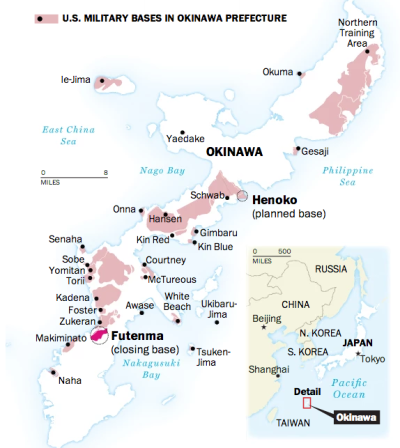 In August, Japan’s Ministry of Defense started a drilling survey in the area to prepare for the building of the base. The following month, 70 percent of Nago’s residents turned out to vote in a new municipal assembly, whose majority is opposed to the base relocation plan. Nago Mayor Susumu Inamine is strongly opposed to the construction of the new military complex in Nago’s Henoko Bay.
“Why should only Okinawa hold the burden for security of all of Japan, when the presence of US Marines doesn’t play a big role in deterring China?” Inamine said in May, echoing Onaga’s sentiments during a visit to Washington, DC. “I, as mayor, have operational control over two ports that are needed for use as construction landfill and I will exercise all powers in the municipality to block access.”
Currently, Okinawa houses 74 percent of all US bases in Japan, despite the fact the prefecture constitutes less than one percent of Japan’s total landmass. US military bases cover roughly one fifth of the island.
Their presence has served as a constant source of tension with locals due to crimes committed by servicemen, disruptions caused by military flights, noise, air pollution and massive land use by the US military.
While Onaga’s victory does not guarantee he will be able to hold up the $8.6 billion dollar relocation ($3.1 bill of which will be covered by Japan), it will likely string up Washington and Tokyo’s efforts to end years of deadlock over the issue.
If Abe attempts to veto local officials, his democratic credentials could be tarnished just days before he is expected to announce a snap general election.
Economic isolation breach of international law: Putin
Top 5 takeaways from Putin ahead of G20
RT | November 14, 2014

Russian President Vladimir Putin (RIA Novosti/Mikhail Klementiev)
Vladimir Putin says the G20 must address global imbalances together, and economic isolation, especially in the case of sanctions, which not only leads nowhere but is a crude violation of international economic law.
Here are the Russian president’s top takeaways ahead of the G20 summit being held in Brisbane, Australia from November 14-15.
G20 great for ground work, but decisions often just hot air
Putin believes the G20 is still a good and relevant platform for world leaders, however, decisions at the summit are often nothing but words. Decisions made there are only carried out when they are in line with the interests of certain global players, like the US.
Decisions are neglected if they don’t fit the agenda of an individual power, Putin told TASS ahead of the summit.
An example is when US Congress blocked the IMF quota, which was intended to enhance the role of developing economies and redistribute quotes. That move was counterproductive, Putin said.
“The very fact that US Congress has refused to pass this law indicates that it is the United States that drops out of the general context of resolving the problems facing the international community,” the president said.
“Everyone must understand that the global economy and finance these days are exceptionally dependent on each other,” Putin said.
US sanctions violate the very system they created
Sanctions levied against Russia are against the norms of international trade and the core principles of the G20, as they can only be introduced via the United Nations, Putin said.
Sanctions are “against WTO principles and the General Agreement on Tariffs and Trade, the GATT. The United States itself created that organization at a certain point. Now it is crudely violating its principles,” Putin explained

Interconnected economy: What hurts us hurts you
Sanctions against Russia have targeted the finance, energy and weaponry sectors of the economy. Russia’s retaliatory sanctions to ban agricultural imports are having a colossal ripple effect on jobs, social sectors, and growth.
This is especially pertinent to Europe, which is feeling the squeeze of the agricultural export ban to Russia, one its biggest markets.
“Everyone must understand that the global economy and finance these days are exceptionally dependent on each other,” Putin said.
Germany’s economic growth is an example of financial blowback from sanctions with Russia.
US-led trade pacts will create global imbalance
Putin believes that the creation of the 2 US-led trade pacts – one Transatlantic and the other Transpacific – will only create more global imbalance. The US-led Trans-Pacific Partnership (TPP) doesn’t include China or Russia.
“Of course, we want to get rid of such imbalances, we want to work together, but this can be achieved only through joint efforts,” Putin said.
New economic associations should complement existing institutions
All new emerging economic blocks like BRICS and the so-called ‘new G7’, which in addition to Brazil, Russia, India and China also includes Indonesia, Turkey and Mexico, should come as something complementary to the existing groups, Putin said.
According to purchasing power parity (PPP) BRICS nations have a combined GDP $37.4 trillion, more than the G7’s at $34.7 trillion, Putin said. However, its economic girth doesn’t give it the right to start running its own policy.
“And if we go and say, ‘No, thank you, we are going to do this and that here on our own, and you can do it the way you want it,’ this will only add to the imbalances,” Putin warned.
The Russian president also said that all regional integrations like the Russia-led Eurasian Economic Union with Belarus and Kazakhstan shouldn’t isolate, but complement, global institutions.
Full speech: Putin on G20: Russia sanctions contradict club principles
US Navy to kill, injure ‘thousands’ of whales, dolphins during drills – activists
RT | November 11, 2014
As the US Navy conducts war games off the coasts of California and Hawaii over the next four years, environmentalists are fighting back with legal action over concerns that hundreds, if not thousands, of marine animals will be injured or killed.
The Conservation Council for Hawaii has recently asked a judge to put an end to the naval exercises in the region on the grounds that they violate the Marine Mammal Protection Act (MMPA), the Washington Post reports. The group previously filed a lawsuit against the war games last year before the exercises began, arguing the drills should not have been approved in the first place.
At the center of the controversy are the lives and health of potentially millions of marine mammals, which can suffer hearing loss or damaged lungs from powerful sonar and death from underwater explosions.
The Council’s representatives in the lawsuit, including the Natural Resources Defense Council (NRDC), argue that the use of sonar and explosives in the war games will kill too many blue whales, dolphins and seals to justify the training plans.
Environmentalists specifically point to the Navy’s own numbers in making their case. Back in 2013, the Navy projected that 155 marine mammals would be killed between 2014 and 2019 as a result of the war games. Thousands of animals would face permanent injuries, while almost 10 million would suffer temporary hearing loss or have their normal routines and behaviors disrupted.
“The more we look at the Navy’s activities, the more we’re finding the potential for harm,” said NRDC’s Michael Jasny to the Post.
For its part, the Navy has taken exception to the claims of advocates, saying they are misrepresenting the numbers. Navy spokesperson Kenneth Hess reiterated that the figures are not meant to depict one year’s worth of activity and also that they “represent worst-case scenarios.”
“Despite decades of the Navy conducting very similar activities in these same areas, there is no evidence of these types of impacts,” Hess said to the newspaper. He added that permits for these exercises “can only be issued if our activities will have no more than a negligible impact on marine mammal populations.”
Researchers who support the Navy’s position also argue that opponents are trying to gain attention by asserting all these sea-going animals will die.
However, environmental activists note that the Navy’s estimates go beyond the number of deaths permitted under the MMPA. Considering that is the case, they argue there is no evidence suggesting the Navy tried to scale back the potential damage after releasing its projections.
“No one is suggesting the Navy shouldn’t be allowed to do testing and training,” said Eearthjustice attorney David Henkin to the Post. “The question is whether they need every inch of the ocean … particularly biologically significant small refuges.”
So far, the US court system has sided with the Navy. In 2008, the Supreme Court ruled that environmental interests took a backseat to the military’s, but animal rights advocates are hoping that the link between sonar and animal health, as well as the Navy’s estimated fatalities, will help influence a different decision.
Revealed: Ferguson no-fly zone was meant to keep media away
RT | November 3, 2014
The 37-mile no-fly zone around Ferguson, implemented after the fatal shooting of 18-year-old Michael Brown by a police officer in August, was designed to keep the press out, phone recordings obtained by AP via the Freedom of Information Act reveal.
The US Federal Aviation Administration (FAA) imposed a 12-day no-fly zone in compliance with requests from local police after protests erupted in response to the August 9th police shooting of Michael Brown, an unarmed black teen. At the time, the official reason given for the restriction was safety precautions. However, in audio recordings, officials are heard admitting that the real reason for the flight restriction was to keep news helicopters from flying over the St. Louis suburb.
The St. Louis Police department maintained that the restricted fly zone was instituted in response to shots fired at a police helicopter, although they were not able to provide an incident report on the shooting, according to AP.
FAA air traffic controllers attempted to reword the flight ban, which had initially banned all air traffic in the 37-mile radius, to let commercial flights operate at Lambert-St. Louis International Airport, but prohibit other flights, on August 12th, the day after the restriction was first established.
Effectively putting an end to media presence in the skies, the amended restriction read, “Only relief aircraft operations under direction of St. Louis County Police Department are authorized in the airspace. Aircraft landing and departing St. Louis Lambert Airport are exempt.”
An FAA manger was recorded saying that the police “did not care if you ran commercial traffic through this TFR (temporary flight restriction) all day long. They didn’t want media in there.”
Police wanted to extend the ban following the release of the shooting officer’s identity, which was lifted on August 22nd, reports AP.
Police response to the civic unrest in Ferguson has been widely criticized. Use of tear gas, accusations of excessive force, and journalist arrests were reported.
The recordings raise further concern about police conduct and the compliance of the federal government in suppressing the constitutional rights of journalists.
One FAA official is heard asking a manager about the purpose of the ban, acknowledging the problematic nature of a media specific restriction.
“So are [the police] protecting aircraft from small-arms fire or something?” he asked. “Or do they think they’re just going to keep the press out of there, which they can’t do.”
Michael Huerta, an FAA administrator, denied the national agency was compliant in banning media from Ferguson airspace.
“FAA cannot and will never exclusively ban media from covering an event of national significance, and media was never banned from covering the ongoing events in Ferguson in this case,” he said in statement on Sunday.
READ MORE Top 10 ways Barack Obama has muzzled American media
FBI pushing for new domestic and global internet hacking powers
By Robert Bridge | RT | October 31, 2014
In a move that watchdog groups are calling an unconstitutional power grab, the Federal Bureau of Investigation is reportedly looking to rewrite the espionage rulebook, giving it the authority to hack into computers at home and abroad.
With little public debate and congressional oversight on the issue, the FBI appears set to make the fourth amendment to the Constitution wholly redundant, which protects Americans against “illegal searches and seizures,” The Guardian reported.
The Department of Justice will present its case on November 5 to the Advisory Committee on Criminal Rules.
“This is a giant step forward for the FBI’s operational capabilities, without any consideration of the policy implications. To be seeking these powers at a time of heightened international concern about US surveillance is an especially brazen and potentially dangerous move,” Ahmed Ghappour, an expert in computer law at the University of California, who will participate in next week’s meeting, told the Guardian.
Ghappour warned the passage of the new legislation would represent the greatest expansion of “extraterritorial surveillance abilities since the FBI’s inception.” He told the British daily that “for the first time the courts will be asked to issue warrants allowing searches outside the country.”
Concerning the threat of damaging America’s diplomatic relations, already wobbly following the Snowden revelations, Ghappour went on to add that in “the age of cyber attacks, this sort of thing can scale up pretty quickly.”
Presently, the FBI is reasonably restricted in its power to hack into domestic computers, requiring it to be granted court approval by judges working in the region where the surveillance will occur. The amendments that the domestic spy agency is seeking, however, would give judge’s the legal authority to issue a warrant to the FBI in a “district where the media or information is located has been concealed through technological means.”
Moreover, the amendments – something internet watchdog groups have been warning might eventually happen – would apply to all criminal cases, not just those related to “terrorists.”
In euphemistic terms, the new surveillance powers the FBI is seeking are known as “network investigative techniques,” which allows malware to be exported to a targeted computer, thereby giving agents nearly full control over the machine – even allowing it to conduct surveillance on any other computers within the user’s social group.
“This is an extremely invasive technique,” Chris Soghoian, principal technologist of the American Civil Liberties Union, told the Guardian. “We are talking here about giving the FBI the green light to hack into any computer in the country or around the world.”
Just this week, Soghoian obtained documents from the Electronic Frontier Foundation that in 2007 the FBI had planted a bogus Seattle Times/Associated Press story on a criminal suspect’s computer as a ploy to export the spyware onto the computer.
Soghoian underscored the feelings of many watchdog groups when he emphasized that next week’s hearing “should not be the first public forum for discussion of an issue of this magnitude.”
READ MORE:
FBI pretended to be Seattle newspaper in order to hack suspect’s computer
FBI impersonates repairmen in Las Vegas hotel to bust gambling ring
Former CBS reporter accuses government agency of bugging her computer
RT | October 27, 2014
A journalist formerly with CBS News claims in her new memoir that a United States “government-related entity” hacked into her computer to conduct surveillance and set her up for possible criminal charges.
Sharyl Attkisson, a former anchor for the CBS Evening News and a multi-time Emmy Award winner, says in her forthcoming book that government spies tried not only to keep track of her digital habits, but to potentially put her in jail.
According to an article published in the New York Post on Monday this week, Attkisson says in her book that she was “shocked” and “flabbergasted” over what was supposedly revealed through a forensics analysis of her laptop conducted in 2013.
Previously, media sources alleged that Attkisson’s March 2014 resignation from CBS News was a result of disagreements she had with the network’s supposed liberal bias. After she announced she was leaving the network earlier this year, Politico writer Dylan Byers reported that unnamed sources said Attkisson “had grown frustrated with what she saw as the network’s liberal bias, an outsize influence by the network’s corporate partners and a lack of dedication to investigative reporting.”
“Feeling increasingly stymied and marginalized at the network, Attkisson began talking to CBS News President David Rhodes as early as last April about getting out of her contract,” Byers added.
Now Attkisson writes in her memoir, “Stonewalled,” that a source “connected to government three-letter agencies” took the reporter’s laptop to be inspected for malware last year and concluded after the fact that it had been compromised by “a sophisticated entity that used commercial, non-attributable spyware that’s proprietary to a government agency: either the CIA, FBI, the Defense Intelligence Agency or the National Security Agency.”
“The intruders discovered my Skype account handle, stole the password, activated the audio and made heavy use of it, presumably as a listening tool,” Attkisson claims she was told.
According to the Post journalists who have read Attkisson’s new book, the former CBS reporter was surprised to see that not only had her computer been hacked to contain keylogging software and other spyware, but was compromised in such a way that secret, classified documents were “buried deep” within her operating system, “In a place that, unless you’re a some kind of computer whiz specialist, you wouldn’t even know exists.”
“They probably planted them to be able to accuse you of having classified documents if they ever needed to do that at some point,” Attkisson said she heard from the unnamed government source who set-up the examination of her laptop.
“This is outrageous. Worse than anything Nixon ever did. I wouldn’t have believed something like this could happen in the United States of America,” Attkisson quoted the source as saying of the analysis.
Currently, Pulitzer Prize-winning investigative reporter James Risen is sought by federal authorities to testify as to the source of classified documents provided to him that later served as fodder for a book he authored about the Central Intelligence Agency’s efforts to disrupt Iran’s nuclear program. Risen, who refuses to disclose the source of the classified files, faces potential jail time if he continues to keep quiet.
Both CBS News and the White House declined to comment to the Post ahead of Monday’s publication,
Nobel Peace Prize laureates call on Obama to release CIA torture report
RT | October 27, 2014
Twelve winners of the Nobel Peace Prize have urged fellow laureate, US President Barack Obama, to release a Senate report on the Central Intelligence Agency’s post-9/11 Rendition, Detention, and Interrogation Program, also known as the torture report.
The laureates revealed late Sunday an open letter that called for “full disclosure to the American people of the extent and use of torture and rendition by American soldiers, operatives, and contractors, as well as the authorization of torture and rendition by American officials.”
The letter, posted on TheCommunity.com, also asked for a concrete plan to close secret international “black site” prisons – used by the US to hide, hold, and interrogate post-9/11 detainees – as well as the US military prison at Guantanamo Bay, where many War on Terror captives languish with few or inconsistent legal maneuvers, if any at all, at their disposal.
The letter was signed by past Nobel winners José Ramos-Horta, Archbishop Desmond Tutu, F.W. De Klerk, Leymah Gbowee, Muhammad Yunus, John Hume, Bishop Carlos X. Belo, Betty Williams, Adolfo Perez Esquivel, Jody Williams, Oscar Arias Sanchez, and Mohammad ElBaradei.
“In recent decades, by accepting the flagrant use of torture and other violations of international law in the name of combating terrorism, American leaders have eroded the very freedoms and rights that generations of their young gave their lives to defend,” the laureates wrote.
“They have again set an example that will be followed by others; only now, it is one that will be used to justify the use of torture by regimes around the world, including against American soldiers in foreign lands. In losing their way, they have made us all vulnerable.”
The letter called on Obama, winner of the 2009 Nobel Peace Prize after less than a year in the White House, to follow principles of international law outlined in the UN Convention Against Torture and the Geneva Conventions.
The US Senate Intelligence Committee’s $40 million investigation into the CIA’s Rendition, Detention, and Interrogation Program – which was active from September 11, 2001 to 2006 – has found that the spy agency purposely deceived the US Justice Department to attain legal justification for the use of torture techniques, among other findings. The investigation and subsequent crafting of the report ran from March 2009 to December 2012.
Of that 6,000-page investigative report, the public will only see a 500-page, partially-redacted executive summary that is in the process of declassification.
According to sources familiar with the unreleased report, the CIA, and not top officials of the George W. Bush administration, are blamed for interrogation tactics that amount to torture based on international legal standards.
The report outlines 20 main conclusions about the CIA’s post-9/11 torture program which, according to the investigation, intentionally evaded White House, congressional, and intra-agency oversight.
~
You can join the laureates’ call by signing a petition to President Obama here.
US diplomat tells Hungary to back EU, criticizes PM Orban over Russia stance
RT | October 24, 2014
A US diplomat visiting Hungary has criticized its PM’s policies towards Russia and stated that he believes Budapest should back the EU in its policy of imposing sanctions on Russia.
On Friday, US Chargé d’Affaires André Goodfriend made the condemnations of Hungarian of Prime Minister Viktor Orban’s policies, particularly in regards to Hungary’s decision to grant Russia a contract to expand the Paks nuclear plant and over its support for the South Stream gas pipeline.
Meanwhile the US denied entry to six Hungarian public officials on Monday in the light of corruption allegations. According to Goodfried, their being banned was related to actions specific to each individual, however, rather than Hungarian politics on the whole.
Goodfried criticized Hungary for how it was veering away from the rule of law which was consolidated after its switch to democracy in 1989 and how it was not a good time to be debating the protection and autonomy of Hungarians in Ukraine.
Orban has been calling for the autonomy of some 200,000 Hungarians who currently reside within Ukrainian borders.
“Particularly with calls for autonomy among Hungarian ethnic nationals in Ukraine… this is not the time to have that discussion,” Goodfriend said.
Hungary should “stand firm with the EU, with EU sanctions” he added and should “understand the sensitivities on the ethnic nationalism question”.
The country has been critical of EU sanctions on Russia. Goodfriend stated that it was not the time for Hungary to “break with its EU partners to criticize so publicly the approach that the partners have taken”.
Hungary, however, is very much dependent on Russian gas supplies and says that the South Stream pipeline would actively aid its energy security.
Earlier in August Orban condemned the EU sanctions against Russia likening them to “shooting oneself in the foot.”
Russia is Hungary’s largest trade partner outside of the EU, with exports worth $3.4 billion in 2013.
‘Mumia Bill’ signed in Pennsylvania lets prisoners be sued over speech
RT | October 22, 2014
Prisoners serving time in the state of Pennsylvania can now be sued for speaking up from behind bars after Governor Tom Corbett signed into law this week the Revictimization Relief Act that legislatures rushed to approve only days earlier.
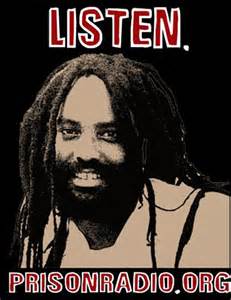 The bill, signed on Tuesday by Corbett, a Republican, allows victims of “a personal injury crime” to sue the perpetrator if that offender “perpetuates the continuing effect of the crime on the victim.”
State Rep. Mike Vereb, a Republican and a co-author of the act, announced earlier this month that he’d be rallying lawmakers to support the bill after former death row inmate Mumia Abu-Jamal was allowed to record a commencement speech that was played for graduates of Goddard College during an October 5 ceremony.
Abu-Jamal, 60, is currently serving a life sentence at a prison facility in Frackville, PA for the 1981 murder of a Philadelphia cop, Officer Daniel Fulkner, but he has maintained his innocence throughout his incarceration, including three decades spent awaiting execution before prosecutors agreed in 2011 to drop the death penalty. Prior to the start of his prison sentence, Abu-Jamal was considered a renowned activist and journalist, and has since published several books and thousands of essays from behind bars.
“The nation is in deep trouble, largely because old thinking, both domestically and globally, has led us into the morass that the nation now faces, which may be encapsulated by references to place-names that ring in our minds: Gaza; Ferguson; and Iraq—again!” a group of 21 graduating students from Goddard, Abu-Jamal’s alma matter, were told in the tape-recorded commencement speech. “These are some of the challenges that abide in the world, which it will be your destiny to try and analyze and resolve. As students of Goddard, you know that those challenges are not easy, but they must be faced and addressed.”
Vereb sent a letter to his colleagues in the Pennsylvania House three days before that address was given, writing in it that he was “utterly outraged that such a reprehensible person would be able to revictimize Officer Daniel Faulkner’s family with this kind of self-promoting behavior.”
The Pennsylvania legislature unanimously approved Vereb’s bill days after the address was given, and Gov. Corbett signed the act on Tuesday, 11 days after the Goddard speech, from a makeshift stage erected in Philadelphia only a few feet from the location where Faulkner was gunned down during a traffic stop 33 years ago. Nevertheless, the Washington Post reported that Corbett said in a statement that the law “is not about any one single criminal,” but rather “was inspired by the excesses and pious hypocrisy of one particular killer.”
“Maureen Faulkner, Danny’s wife, has been taunted by the obscene celebrity that her husband’s killer has orchestrated from behind bars,” Corbett said at the signing, according to a CBS News affiliate.
“This unrepentant cop killer has tested the limits of decency,” the Washington Times quoted Corbett as saying as protesters jeered nearby. “Gullible activists and celebrities have continued to feed this killer’s ego.”
Free speech advocates see no issue with Abu-Jamal’s communique from confinement, though, and say that the law signed this week is a serious blow to First Amendment protections.
“This bill is written so broadly that it is unclear what is prohibited,” Reggie Shuford, the executive director of the American Civil Liberties Union’s Pennsylvania office, said in a statement offered to Reuters. “That can’t pass constitutional muster under the First Amendment.”
Samantha Kolber, a spokesperson for Goddard, told the Patriot-News that the school was “surprised” by Corbett’s signing and said Vereb’s bill “is suggesting that people are not capable of making choices about what speech they will listen to and how they will react to that speech.”
Speaking to the Philadelphia Inquirer, protester Johanna Fernandez said during Corbett’s public signing this week that the governor’s decision to speedily make Vereb’s bill a law was a “Hail Mary pass” from his administration only a month before Election Day since polls suggest that Corbett may lose the governor’s seat. “The establishment of Philadelphia is using Mumia’s case to silence all prisoners in the state,” Fernandez said. “What they’re doing is, they’re essentially inflecting collective punishment on all prisoners in order to silence Mumia.”
On Monday, Abu-Jamal himself weighed in on the debate and the politics surrounding Corbett’s decision to speedily sign the bill during an interview with Noelle Hanrahan of Prison Radio Project.
“This is a political stunt by a failing politician who is seeking support by using fear,” Abu-Jamal said this week. “Politicians do it all the time. But this is unconstitutional: Tom’s latest attempt to stroke and build up his political campaign, his failing political campaign.”
According to the activist-turned-inmate, he gave his address to Goddard after students there wrote and requested he speak. Marc Lamont Hill, a professor at Morehouse College, tweeted Wednesday that “Even if you don’t support Mumia, you should be outraged at this attack on First Amendment Rights.”
Obama considers [officially] allowing torture overseas

RT | October 20, 2014
The White House is reportedly wrestling over how to interpret a ban on “cruel, inhuman or degrading treatment” ahead of a meeting in Geneva next month concerning the United Nations charter on torture.
According to the New York Times, the Obama administration remains divided over what stance a Washington delegation will officially take at the UN-sponsored Committee Against Torture panel early next month in the Swiss city.
Although Barack Obama said before and after being elected to the White House that United States officials should never engage in torturous activity, Times national security journalist Charlie Savage reported on Sunday this week that administration officials might formally adopt another stance — one on par with the policies of Obama’s predecessor, George W. Bush — when the panel convenes in a couple of weeks.
The Times reported that the attorneys who answer to the president are conflicted over whether or not the White House should revisit the Bush administration’s interpretation of a UN treaty, the likes of which authorized the use of enhanced interrogation tactics, like waterboarding and sleep deprivation, on individuals detained by military and intelligence agencies in the aftermath of the September 11, 2001 terrorist attacks at facilities such as the Guantanamo Bay detention center and CIA so-called “black sites.”
The upcoming meeting will be the first one of Obama’s presidency, Savage acknowledged, presenting the commander-in-chief with a rare opportunity to speak of the UN Convention Against Torture, a treaty that since the 1980s has aimed to ensure prisoners the world over aren’t subjected to inhumane conditions.
In Sunday’s report, Savage wrote that Obama, then a US senator, spoke out adamantly against Pres. Bush when it was revealed in 2005 that his administration had been interpreting the UN treaty in a manner that they argued made it acceptable for CIA and Pentagon officials to disregard the prohibitions against torture if they weren’t on American soil.
Obama the president later condemned that reasoning with an executive order “ensuring lawful interrogations,” Savage added, although next month’s meeting may change that.
“But the Obama administration has never officially declared its position on the treaty, and now, President Obama’s legal team is debating whether to back away from his earlier view,” Savage wrote. “It is considering reaffirming the Bush administration’s position that the treaty imposes no legal obligation on the United States to bar cruelty outside its borders, according to officials who discussed the deliberations on the condition of anonymity.”
“State Department lawyers are said to be pushing to officially abandon the Bush-era interpretation,” Savage added, which would simply continue to let the 2009 Obama-signed executive order stand as Washington’s official word and further ensure that American officials are obligated to adhere to the torture treaty regardless of where in the world they are located.
Other attorneys, he added, have a different idea of what to do at next month’s meeting, however. “But military and intelligence lawyers are said to oppose accepting that the treaty imposes legal obligations on the United States’ actions abroad,” Savage wrote. “They say they need more time to study whether it would have operational impacts. They have also raised concerns that current or future wartime detainees abroad might invoke the treaty to sue American officials with claims of torture, although courts have repeatedly thrown out lawsuits brought by detainees held as terrorism suspects.”
Should those arguing on the latter side provoke, then the current administration could soon find itself agreeing with past policies that continue to be controversial nearly a decade after the Bush White House’s use of torture started to surface.
“Many foreign political leaders and non-governmental organizations have called for members of the Bush administration, including Bush himself, to face prosecution for allowing the abuse of detainees in US custody during the course of the US campaign against Islamic militant groups spurred by the 9/11 attacks,” Mark Hanrahan wrote for the International Business Times on Sunday. “The Bush administration, which launched the wars in Iraq and Afghanistan, had to contend with a number of allegations it allowed US officials to use torture against detainees during the course of its campaigns,” including the infamous Abu Ghraib prison scandal in Iraq.
If the Pentagon and CIA attorneys prevail, then Washington could once again interpret the UN treaty in a manner that allows those same torturous practices to be performed on detainees once against, as long as any such instances occur abroad.
Last week, McClatchy news service reported that a classified $40 million probe launched by the Senate to investigate the CIA’s Bush-era detention and interrogation program concludes without holding any administration officials responsible for the scandals at Abu Ghraib and other facilities that to this day remain a major scar on the presidency.
“This report is not about the White House. It’s not about the president. It’s not about criminal liability. It’s about the CIA’s actions or inactions,” a person familiar with the report told McClatchy. “It does not look at the Bush administration’s lawyers to see if they were trying to literally do an end run around justice and the law.”
Featured Video
Israelis SUDDENLY Mass Deported From Many Countries
or go to
Aletho News Archives – Video-Images
From the Archives
Elite Western universities are a corrupt, parasitic empire
Instead of high-quality education, these institutions are fostering a global neo-feudal system reminiscent of the British Raj
By Dr. Mathew Maavak | RT | May 30, 2025
In a move that has ignited a global uproar, US President Donald Trump banned international students from Harvard University, citing “national security” and ideological infiltration. The decision, which has been widely condemned by academics and foreign governments alike, apparently threatens to undermine America’s “intellectual leadership and soft power.” At stake is not just Harvard’s global appeal, but the very premise of open academic exchange that has long defined elite higher education in the US.
But exactly how ‘open’ is Harvard’s admissions process? Every year, highly qualified students – many with top-tier SAT or GMAT test scores – are rejected, often with little explanation. Critics argue that behind the prestigious Ivy League brand lies an opaque system shaped by legacy preferences, DEI imperatives, geopolitical interests, and outright bribes. George Soros, for instance, once pledged $1 billion to open up elite university admissions to drones who would read from his Open Society script.
China’s swift condemnation of Trump’s policy added a layer of geopolitical irony to the debate. Why would Beijing feign concern for “America’s international standing” amid a bitter trade war? The international standing of US universities has long been tarnished by a woke psychosis which spread like cancer to all branches of the government.
So, what was behind China’s latest gripe? ... continue
Blog Roll
Recent Comments
seversonebcfb985d9 on Villains of Judea: Philip Esfo… loongtip on Report warns that ‘Jewish terr… Craig Nelms on New study shows that toxic gas… loongtip on A Funny Thing Happened on the… loongtip on EU free trade pact on hold as… John Edward Kendrick on Regime Change In Iran Is The F… Bill Francis on Australia Passes New Hate Spee… seversonebcfb985d9 on Australia Passes New Hate Spee… Bill Francis on Britain’s AI Policing Plan Tur… loongtip on Miami Beach Resident Questione… loongtip on Israeli agricultural export co… loongtip on The War On Free Speech In Aust…


 Aletho News
- American Academy of Pediatrics Hit With Federal RICO Lawsuit for Vaccine Safety Fraud
- Mom Tells Trump: Dumping Sewage Sludge on Farmland Won’t Make America Healthy Again
- NIAID Funds Gain-of-Function Study Engineering Novel Influenza Viruses
- Villains of Judea: Philip Esformes and the Largest Healthcare Fraud in American History
- US sanctions Popular Conference for Palestinians Abroad over alleged Hamas links
- You reap what you sow: Ukraine’s blackout is Zelensky’s failure
- Ukraine Blackouts Caused by Zelensky’s Terrorist Attacks on Russia
- Orban Hits Out at EU Green Light for $1.5 Trillion Ukraine Aid
- World has had enough of confused clowns: Araghchi to Zelensky
- Jordan using Israeli software to monitor journalists, rights defenders: Report
- If Americans Knew
- Oppose Israel’s Abuses While You Still Can
- UNRWA Heads Tell Ha’aretz: ‘We Don’t Radicalize Palestinians – Their Lived Existence Does’
- Plans Call for “New Rafah” Built in Israel’s Image — Without Palestinians
- Posing as priest, reporter is spat at many times, highlighting anti-Christian sentiment in Israel
- Leaked Documents: “Planned Community” in Rafah Would Force Palestinians Into Israeli Panopticon
- ‘Permits of Humiliation’: How Israel Strangles Christian Education in Jerusalem
- “The world sees death, destruction and injustice – and they see dollar signs” – Not a ceasefire Day 105
- War criminal Netanyahu kills 11 in Gaza, joins Board of Peace – Not a ceasefire Day 104
- Another baby dies of cold in Gaza, as Rafah crossing remains locked down – Not a ceasefire Day 103
- Brutal Beatings, Arson, and Impunity: A Palestinian Plant Nursery Becomes a Target for Settler Pogroms
- No Tricks Zone
- New Study: Sea Levels Rose 20 Times The Modern Rate During The Roman Warm Period
- As German Gas Storage Dips Dangerously Low…Shortage Hardly Avoidable
- New Study: Brazil’s Relative Sea Level Was 2+ Meters Higher And SSTs 3-4°C Warmer 6000 Years Ago
- Philosopher Schopenhauer: Climate Science Certainty Stems From Stupidity, Ignorance
- New Study: Species Extinction Rates Declining Since 1980 – ‘Climate Change Is Not An Important Threat’
- Denmark Places Climate Protection Above Animal Welfare, Poisoning And Culling Cows
- New Study: Greenland Was 3-7°C Warmer And Far Less Glaciated Than Today 6000-8000 Years Ago
- German Media Report That Current Frigid Weather Can Be Explained By Arctic Warming!
- Berlin Blackout Shows Germany’s $5 Trillion Green Scheme Is “Left-Green Ideological Pipe Dream”
- Modeling Error In Estimating How Clouds Affect Climate Is 8700% Larger Than Alleged CO2 Forcing
 Aletho News