Washington prepares for diplomatic war of attrition with Russia
RT | April 22, 2015
The US reportedly expects that the ongoing confrontation with Russia would continue until at least 2024 and involve many directions. Washington wants to rally support of its European allies to continue mounting pressure on Moscow.
The expected diplomatic and economic war of attrition is being outlined in a Russia policy review currently prepared by Celeste Wallander, special assistant to President Barack Obama and senior director for Russia and Eurasia on the National Security Council, reports Italian newspaper La Stampa. The publication said it learned details of the upcoming policy change from a preview that Washington sent to the Italian government to coordinate the future effort.
US diplomats say Russia changed the cooperative stance it assumed after the collapse of the Soviet Union and is now using force to defend its national interests, the paper said. The change is attributed to the personality of Russian President Vladimir Putin, who, Washington expects, will remain in power until at least 2024.
The change became apparent with the conflict in Ukraine, but was emerging since at least the 2008 conflict in South Ossetia, when Russia used military force after Georgia sent its army to subdue the rebellious region, killing Russian peacekeepers in the process.
Washington’s solution to the new Russia is keeping sanctions pressure on it while luring its neighbors away with economic aid and investment, La Stampa said. The current round of sanctions, it reports, was designed not to have too much impact on the Russian economy so that a threat of harsher sanctions could be applied.
While the tug of war in Europe continues into the next decade, Washington wants to continue cooperation with Russia in other areas like nuclear non-proliferation and space exploration. However until Putin is out of the picture, the US does not expect for things to go back to where they were, the newspaper said.
The strategy was hardly unnoticed in Moscow, as evidenced by the annual report of the Russian Foreign Ministry published on Wednesday. The document said the US is pursuing “a systematic obstruction to Russia, rallying its allies with the goal to damage domestic economy” through blocking credits, technology transfer and an overall destabilization of the business environment.
The ministry said Washington had some success with the policy that resulted in an almost 8 percent drop of Russia’s trade with EU members in 2014. However some European countries like Austria, Hungary or Slovakia are pragmatically keeping bilateral ties with Russia active. In European heavyweight Germany, whose government is among the leading supporters of the anti-Russian sanctions, there is a strong business resistance to keeping them.
Non-EU members in the region like Serbia and Turkey are among priority partners for Russia in the current environment, the ministry added.
NATO ‘Tornado’ military drills in Estonia to use laser training system
RT | April 20, 2015
The US Army has joined Estonian soldiers in NATO ‘Tornado’ drills just before the largest training in Estonia’s history, the Siil war games. A laser training system will be used for simulating actual battle.
“On Monday, nearly 2,000 soldiers of the First Infantry Brigade of Estonian Defense Forces, as well as divisions of US paratroopers, will begin five-day Tornado drills, which will demonstrate the level of their readiness for larger Siil [Hedgehog] military exercises,” the General Staff of the country’s Defense Forces said in a statement.
The Siil war games involving up to 13,000 soldiers will be held in early May.
The MILES (Multiple Integrated Laser Engagement System) system will be used during the Tornado exercise for training purposes, with different versions of MILES systems available to US and international militaries. The system uses lasers and blank cartridges to simulate actual battle. Soldiers carry small laser receivers, placed over their outfits, which detect when the soldier has been illuminated by a firearm’s laser. Each laser transmitter meanwhile mimics the effective range of the weapon on which it is used.
The presence of US soldiers in the Baltic region is a part of the military operation Atlantic Resolve, a demonstration of US commitment to NATO members across Eastern Europe through international training and security cooperation.
NATO has been building up its military presence along Russia’s western border in the wake of the conflict in southeastern Ukraine. Moscow has repeatedly warned that NATO’s growing expansion towards Russian borders could only escalate tensions and destabilize regional security.
“The Alliance exerts pressure on the Russian Federation and the deployment of additional military capabilities along our borders is nothing but an attempt to assist military pressure on Russia,” Russia’s permanent representative to NATO, Alexander Grushko, said in February.
The Russian General Staff said on Thursday there was a sharp increase in the intensity of NATO troops training near the borders of Russia last year, with a clear anti-Russian orientation of these activities. According to Lieutenant General Andrey Kartapolov, NATO’s operational and combat training activities grew by 80 percent in 2014.
“During this period, NATO created a grouping of its member states’ forces in the Baltic States, consisting of over 10,000 troops, about 1,500 armored vehicles, 80 planes and helicopters and 50 warships,” Kartapolov stated, adding that strategic bombers from the US Air Force were used to perform strategic tasks during those exercises.
He also said the US plans to supply its Eastern European allies with JASSM-ER long-range aviation cruise missiles, which will enable NATO warplanes to hit targets 1,300 kilometers inside Russian territory.
The head of the Main Operation Directorate of the General Staff has warned that in the case of a military conflict, critical facilities on the territory of “almost the entire European part of Russia will be vulnerable to NATO’s air attack, with the flight time of the missiles reduced by half.”
US military instructors in Ukraine undermine Minsk peace deal – Moscow
RT | April 17, 2015
Despite voicing its support for the settlement of the Ukrainian crisis, the US is actually working to undermine the Minsk peace deal, Russia’s Foreign Ministry said, commenting on the deployment of American military instructors to Ukraine.
The Russian Foreign Ministry is “gravely concerned” by the fact that military instructors from the US, UK and Canada will be training the troops from Ukraine’s National Guard, stressed the ministry’s spokesman, Aleksandr Lukashevich.
“This begs the question: Do they – in Washington, London and Ottawa – understand whom are we talking about? As they are the same Ukrainian ultra-nationalists from volunteer battalions, who wore Nazi emblems and blurred themselves with the blood of women, children and the elderly during reprisal raids in Donbass [south-eastern Ukraine],” he said.
“What will these foreign military experts teach them – how to continue killing those, who speak Russian?” the spokesman wondered.
Moscow views the information that the National Guard training program will include exercises with Western-style weaponry and hardware as a possible “first step towards the supply of modern US arms to Ukraine, which the ‘party of war’ in Kiev is so eager to get its hands on,” he said.
Supporting any revanchist ambitions of warmongers in the Ukrainian government “may lead to the resumption of bloodshed” in the south-east of the country, Lukashevich warned.
The ministry believes that the US actions are in violation of the peace deal, which was signed by Kiev and the representatives of Donetsk and Lugansk during talks in Minsk on February 12, he said.
Lukashevich stated that the Minsk deal provides “the withdrawal of all foreign forces, military equipment, as well as mercenaries from the territory of Ukraine under the supervision of the OSCE. Instead, a US Airborne Brigade has landed near Lvov and intends to settle there for long.”
“The Obama administration, which verbally advocates the settlement of the Ukrainian crisis, is, in fact, contributing to the disruption of the Minsk agreements,” he stressed.
According to Moscow, Washington is trying to divert the international community’s attention from its military deployment in the Ukraine “by a ‘smokescreen’ of claims of an alleged presence of Russian troops in Donbass,” which hasn’t been backed by any proof.
“It’s obvious, that the US troops on Ukrainian soil won’t bring it peace,” Lukashevich concluded.
On Friday, paratroopers of the US 173rd Airborne Brigade, based in Vincenza, Italy, have arrived in western Ukraine to provide training for Ukrainian troops. Some 290 US troops are to take part in long-term joint drills with combat units of the National Guard, Arsen Avakov, Ukrainian Interior Minister, wrote on Facebook.
The US paratroopers’ training mission will last for 24 weeks and involve some 900 Ukrainian servicemen, Ukraine’s President, Petro Poroshenko, and US Vice-President, Joe Biden, agreed earlier in spring.
Kiev and rebels signed a ceasefire deal in February, which involved the pullout of heavy weapons and a profound political dialogue and constitutional reform, which would address the grievances of the dissenting regions and reintegrate them into Ukraine.
The deal has more or less held so far, with the level of violence in eastern Ukraine dropping significantly, OSCE monitors on the ground have been reporting.
The Ukrainian conflict began in April 2014 after Kiev sent troops to Donetsk and Lugansk Region as people there refused to recognize the new coup-imposed authorities in the capital. A year of fighting in south-eastern Ukraine has resulted in over 6,000 deaths, including score of civilians, according to conservative UN estimates.
Nuclear deal or no nuclear deal? That is the question
By Catherine Shakdam | RT | April 17, 2015
As neocons are working to destroy Iran’s tentative nuclear deal, US President Obama will have to either reinvent America’s policy or give in to Israel’s lobby and Saudi Arabia’s paranoiac fear of Shia Islam.
If months of intense political wrangling were crowned earlier this April by the confirmation that Iran and the P5+1 countries reached a tentative framework agreement over one of the most contentious issue of the past three decades – Iran’s nuclear dossier – it appears such diplomatic respite could prelude to a dangerous political standoff.
If by any account Iran’s nuclear negotiations were going to be trying, especially since Tehran’s nuclear ambitions do not necessarily sit at the center of this internationally staged quarrel, Israel’s neocon war campaign against the Islamic Republic risks pushing the world toward yet another lengthy conflict- a global one at that.
With the fires of war already burning bright in the MENA region – Middle East and North Africa – the fall of another domino could prove one too many for the word to handle. From a purely geostrategic standpoint a war with Iran, however pleasing to Tel Aviv’s avid warmongers, would likely force Western powers and their Arab allies to commit more military power than they can handle. Bearing in mind that the US has already committed troops and resources to Afghanistan, Libya, Pakistan, Yemen, Syria, Iraq, and of course Ukraine, how much farther can imperial America really stretch?
However grand the US might think itself to be, and however solid the US might think its alliances to be, Washington has yet to win a war. Claiming victory as George W. Bush did in Iraq on May 1, 2003 did not exactly make it so. And though America basked in the glorious light of its military supremacy over the “Iraqi enemy,” its joy was short-lived as reality soon came knocking. And though starting a war might seem an easy enough business for neocon America, it is really the art of peace this belligerent nation has failed to master so far.
But back to Iran’s nuclear deal
To the surprise of many skeptics, Iran and the P5+1 did reach a deal – and while there were a few near misses, a deal was nevertheless brokered; proof experts actually insisted that Tehran is more interested in diplomacy than its detractors gives it credit for. Iran’s concessions attest to its officials’ determination to engage with the international community and integrate back into mainstream international politics.
As Gareth Porter wrote in a report for CounterPunch this April, “The framework agreement reached on Thursday night [April 2, 2015] clearly gives the P5+1 a combination of constraints on Iran’s nuclear program that should reassure all but the most bellicose opponents of diplomacy.”
And although Iran gave every assurance its government will not seek to weaponize its nuclear program, no amount of concessions might prove sufficient enough or comprehensive enough to assuage Washington’s fears vis-a-vis its “great Satan” – especially if the Saudis and Israelis have a say in it.
With the ink of the nuclear framework agreement still left to dry, both the powerful Israeli lobby and Al Saud’s petrodollars went on overdrive, telling the world what a catastrophe Iran’s nuclear deal would be.
One trip to US Congress and a few well-chosen words against its mortal enemy later, Israel seems satisfied it forever drove a wrench into the yet to be formulated and signed nuclear agreement.
As Yuval Steinitz, Israel minister for intelligence and strategic affairs so eloquently told the world on April 6, Israel would try to persuade the P5 +1 “not to sign this bad deal or at least to dramatically change or fix it”.
Echoing his minister’s narrative, Israel Prime Minister Benjamin Netanyahu determined that since Iran represents a threat to Israel’s very existence, America should abandon all diplomacy and instead beat the war drums. And we don’t really need to know why, only that it is so – If Netanyahu’s drawing did not convince your idle mind of Iran’s evil in 2012 then nothing will!
Just as Israel’s lobby bullied its way through the Oval office, cornering U.S. President Barak Obama into relenting power to Congress, Saudi Arabia declared war on Yemen, adding a new layer of complication to an already impossible mesh of over-lapping and over-conflicting alliances in the Middle East, thus weaving a dangerous noose around peace’s neck.
Interestingly, if war requires no US Congress oversight you can be sure that peace does!
Caught in between a rock at home and a hard place in the Middle East, US President Obama is faced with one mighty dilemma – one which will determine not his presidency but his very legacy.
If recent tensions between President Obama and the Israeli Premier are anything to go by, it would appear Israel’s lobby suit of armor is not as thick and potent as it’d like it to be, or maybe just maybe, it simply exhausted Americans’ patience. Israel’s greatest ally and supporter, the one power which has quite literally and almost single-handedly carried the Jewish State into being and helped it survive adverse winds since its very inception in 1948: vetoing UNSC resolutions when needed, propping its military and economy when needed, acting a political champion when needed, could be running out of road.
If Israel and Saudi Arabia’s foreign agenda stand now in perfect alignment – their ire directed not at one another but at Iran, changes in the region and fast-moving geostrategic interests have forced the US to re-evaluate its position vis-a-vis Iran and the so-called mythical Shia crescent the world has learnt to be wary of without quite understanding why.
In Netanyahu’s officials’ own words we are to believe that Islamic radicalism, a perverted, acetic and reactionary interpretation of Islam which has mapped itself around Saudi Arabia’s Wahhabism movement would be preferable to seeing Iran gain a greater footing in the Arab world. In September 2013, the Israeli Ambassador to the United States Michael Oren told the Jerusalem Post that Israel favored the Sunni extremists over Assad and the Shiites. “The greatest danger to Israel is by the [Shiite] strategic arc that extends from Tehran, to Damascus to Beirut. And we saw the Assad regime as the keystone in that arc,” Oren said in an interview.
“We always wanted Bashar Assad to go, we always preferred the bad guys who weren’t backed by Iran to the bad guys who were backed by Iran.” He said this was the case even if the “bad guys” were affiliated with al-Qaeda.
Obviously Saudi Arabia would rather eat its own foot than allow the all so devilish Iran from reclaiming its standing in the region, especially since it would essentially mean relenting power to rising calls for democratic reforms in the Gulf monarchies – Bahrain being the flagship of such a desire for change.
Why do that when you can wage senseless wars to assert your dominion?
Iran’s nuclear deal is more than just a nuclear deal. If signed, this deal would become the cornerstone of a broad shift in alliances, the moment when the US would actually choose to put its national interests over that of Tel Aviv and over Riyadh’s billions. Where Israel has bullied the US for decades, Saudi Arabia has bought its policies for decades.
With nothing left to lose but his good name and his legacy, President Obama could be just the man to break this self-destructing cycle and reinvent America’s foreign policy.
And that’s not even wishful thinking it would actually make sense for America to make peace with Iran – economically, politically and in terms of energy security and counter-terrorism Iran could be a more helpful and potent ally than Saudi Arabia. Bearing in mind that Riyadh’s fingerprints are all over al-Qaeda, ISIS and whatever terror offshoots radicals created those days, Washington might want to consider another ally in its fight against radicalism.
Thing is, America wants change! What it needs now is mastering the courage of its desire.
America is a superpower running out of steam, and more importantly running out of standing in the world. America’s exceptionalism is on its last leg. Too many double-standards, too many incoherencies in its alliances, too many double-talks, double-entendres and double-crossings. America needs a deal.
And though the July deadline seems very far away indeed, especially since Yemen’s war came to yank at diplomacy’s already stretched out rope; not signing the nuclear deal would be far worse than ruffling Israel and Saudi Arabia’s feathers.
For the sake of argument, why not ask Israel to pay the world the courtesy of practicing what it preaches in terms of nuclear transparency. That would be the nuclear deal of the century!
Catherine Shakdam is a political analyst and commentator for the Middle East with a special emphasis on Yemen and radical movements. A consultant with Anderson Consulting and leading analyst for the Beirut Center for Middle East Studies, her writings have appeared in MintPress, Foreign Policy Journal, Open-Democracy, the Guardian, the Middle East Monitor, Middle East Eye and many others. In 2015 her research and analysis on Yemen was used by the UN Security Council in a situation report.
Israel cheers as Obama retreats before Congress on Iran deal
RT | April 15, 2015
Israel said it is pleased with a compromise bill being floated on the Hill, which would give US legislators oversight in the Iran nuclear deal. The White House agreed to the bill adopted by the Senate Foreign Relations Committee.
“We are certainly happy this morning, this is an achievement for Israeli policy… [Prime Minister Benjamin Netanyahu’s] speech in Congress … was decisive in achieving this law, which is a very important element in preventing a bad deal, or at least, in improving the agreement and making it more reasonable,” Yuval Steinitz, Netanyahu’s intelligence, foreign relations and strategic minister, told Israel Radio.
Israel has been opposing US reengagement with Iran, claiming the result of the nuclear negotiations would be a bad deal that would compromise Israel’s national security. Netanyahu made his case in the US through pro-Israeli legislators, who are opposed to US President Barack Obama.
“What was achieved last night in Geneva is not a historic agreement, but a historic mistake,” said Netanyahu, after a preliminary deal paving the way for negotiations was reached in 2013.
Under the 2010 “Comprehensive Iran Sanctions, Accountability, and Divestment Act,” the president can waive sanctions imposed by Congress for a limited time, as a policy measure. However, Senate Bill 615 would remove that option and insist on congressional review of the final nuclear agreement with Iran before any of those sanctions could be waived.
Proposed by Senator Bob Corker (R-Tenn.) and Democrat Robert Menendez (D-NJ), the “Iran Nuclear Agreement Review Act of 2015” envisions a 52-day review period during which the president “may not waive, suspend, reduce, provide relief from, or otherwise limit the application of statutory sanctions with respect to Iran under any provision of law.” The White House can still suspend, waive or remove sanctions imposed by executive order.
If the bill is adopted, then Congress would be able to reject the nuclear agreement with Iran through a joint resolution, preventing Obama from lifting any congressional sanctions and possibly scuppering the treaty.
Iranian officials have said that the preliminary agreement reached in Geneva earlier this month would see most nuclear-related sanctions lifted immediately, while US officials maintain the sanctions would be lifted in phases, depending on Tehran’s compliance. This is one of the issues that still needs to be resolved before the June deadline for the final agreement.
“We have two and a half months more to negotiate, that’s a serious amount of time with some serious business left to do,” Secretary of State John Kerry told reporters Monday, after meeting with the legislators behind closed doors. “We hope Congress listens carefully and asks the questions that it wants. But also give us the space and the time to be able to complete a very difficult task which has high stakes for our country.”
Under the amended text of the bill agreed in committee, Obama would also have to certify to Congress every 90 days that Iran was complying with the final agreement, and submit detailed reports on Iran’s nuclear program, ballistic missile program, and “support for terrorism,” all of which remain thorny issues between Washington and Tehran.
Announcing the preliminary agreement on April 2, Obama said he wanted Congress to play a “constructive oversight role” in the negotiating process. However, the White House has argued that making international agreements is a constitutional prerogative of the executive branch, and that congressional oversight of the Iran deal would set a dangerous precedent. It now appears that Corker-Menendez has enough support from the congressional Democrats to override the veto Obama has been threatening, a senior Democratic aide told the New York Times.
Amendments proposed by several Republican Senators, including presidential hopeful Marco Rubio, could erode the bipartisan support. There were several amendments that would “pull this bill sharply to the right if adopted,” Senator Chris Coons (D-Del) told reporters Tuesday.
With Republicans making up the majority of the Foreign Relations Committee, these amendments could be adopted through a party-line vote. If that happens, Coons cautioned, “I’d drop off of it in a second.”
Read More: Americans don’t want Congress to sabotage Iran deal – new poll
Investigators launch criminal case against US agents over pilot kidnapping, torture
RT | April 6, 2015

Russian pilot Konstantin Yaroshenko (RIA Novosti )
Russia’s top law enforcement agency has launched a criminal case against 11 US DEA officers, alleging they are complicit in a sting operation that ended in the detention and trial of Russian citizen Konstantin Yaroshenko.
The Investigation Committee – special agency for serious and high profile crimes – reported on Monday that its branch in South Russia’s Rostov Region has launched criminal cases against 11 US citizens and four Liberian citizens over charges of kidnapping, with use of violence or threats of violence. Additional charges include forcing a person to testify in a criminal process using intimidation or torture. In Russia, these crimes are punished with prison sentences of up to 12 and eight years respectively.
A US court sentenced Konstantin Yaroshenko to 20 years in 2011 for allegedly participating in a conspiracy to smuggle drugs to the United States. He was arrested in Liberia following a sting operation and handed over to the US, despite protests from Russia and violations of the diplomatic code. The pilot himself has always maintained his innocence, saying his poor command of English prevented him from understanding the nature of suggestions leveled at him by undercover DEA agents.
Yaroshenko and his relatives have repeatedly maintained the whole scheme was organized by US special services in an attempt to extract evidence against Viktor Bout – another Russian citizen illegally extradited to the US and sentenced after another sting operation.
Russian diplomats have repeatedly criticized the arrests and trials of both Yaroshenko and Bout. They say it’s an example of biased US justice based on fabricated charges.
In 2014, the Russian Foreign Ministry issued an official warning to all citizens who travel abroad, especially to countries that have extradition agreements with the United States. “The US administration makes a routine practice out of hunting for Russian citizens in third countries, with subsequent extradition and conviction in the USA, usually over dubious charges,” the document read.
Read more: ‘I was framed because of Bout’ – jailed Russian pilot
Government watchdog doubts $400 million USAID program for Afghan women is working
RT | April 3, 2015
A $416 million program to empower Afghan women may leave them “without any tangible benefit” instead, a government watchdog warned, urging USAID to provide more data on the controversial project.
The Promoting Gender Equity in National Priority Programs – Promote, for short – was announced last November as part of US reconstruction efforts in Afghanistan. Its stated intent is to empower some 75,000 Afghan women between the ages of 18 and 30 to become political, business and civil service leaders, and engage girls ages 14 through 18 in “leadership development programs.”
However, the Special Inspector General for Afghanistan Reconstruction (SIGAR) warned that the US Agency for International Development (USAID) has not shown what the program would actually do, provided for adequate safeguards and controls of the contractors involved, or even accounted for half the funding Promote is supposed to receive.
“I am concerned that some very basic programmatic issues remain unresolved and that the Afghan women engaged in the program may be left without any tangible benefit upon completion,” John F. Sopko wrote in a letter to the USAID acting administrator, made public Thursday.
“I do hope that we are not going to fall again into the game of contracting and sub-contracting and the routine of workshops and training sessions generating a lot of certificates on paper and little else,” Sopko said, quoting the words of Afghanistan’s First Lady, Rula Ghani, from a November 2014 conference.
Though his staff was briefed on Promote in late February, Sopko wrote, “USAID could not provide the audit team a list of all the agency’s projects, programs, and initiatives intended to support Afghan women, or how much the agency spent on each effort.”
“USAID was also unable to provide data demonstrating a causal relationship or correlation between the agency’s efforts to support Afghan women and improvements in Afghan women’s lives,” he added.
In October 2014, USAID announced the award of five-year, “indefinite-delivery/indefinite quantity” contracts for Promote to three companies: Chemonics International, Development Alternatives and Tetra Tech. According to the agency, USAID would provide $216 million for the program, while another $200 million would come from unspecified foreign donors.
The SIGAR is questioning the basis of this estimate, since USAID failed to produce any supporting documentation, including any memorandum of the understanding between the three contractors and the Afghan government.
“Of this $416 million, how much will be spent in Afghanistan on Afghan women, and how much will be spent on security and overhead costs for the three contractors and program implementers?” the SIGAR asked. Sopko also raised the issue of USAID’s “sustainability plan,” asking whether any steps were taken to ensure the program survived past the US withdrawal from Afghanistan.
Read more: Expensive chaos: Billions of dollars meant for Afghanistan development wasted
Remove US military bases from Latin America – UNASUR chief
RT | April 1, 2015
Latin American countries should discuss removing all US military bases from their soil, a top official of integration organization UNASUR suggested. The issue may be discussed next month at the upcoming Summit of the Americas in Panama.
The Summit of the Americas on April 10 and 11 is to be attended by regional leaders, with 31 nations already confirming attendance. UNASUR Secretary-General Ernesto Samper suggested that the summit would be a good place to “reassess relations between the US and South America.”
“A good point on the new agenda of relations [in Latin America] would be the elimination of US military bases,” the former Columbian president told the news agency EFE.
He added that the bases were “a leftover from the days of the Cold War and other clashes.”
Samper also blasted Washington’s habit of taking unilateral steps to pursue its goals in Latin America. The latest example is the US declaration of Venezuela as a threat to its national security, he said.
“In a globalized world like the present one, you can’t ask for global rules for the economy and maintain unilateral rules for politics. No country has the right to judge the conduct of another and even less to impose sanctions and penalties on their own,” he stressed.
The Panama meeting has already been declared historic as it will be the first one attended by Cuba since 1962, when it was expelled from the Organization of American States (OAS), the event’s organizing body. In 2014, the US and Canada blocked the proposal to readmit Cuba, which drew criticism from UNASUR and a boycott of last year’s summit of the Americas by Ecuador and Nicaragua.
This year Cuban President Raul Castro will have an opportunity to meet his US counterpart Barack Obama, marking progress in the restoration of US-Cuban relations after decades of alienation.
Samper said that the Cuban-US rapprochement should not overshadow Washington’s conflict with Caracas, which is also sending a delegation to the Panama summit, the continued operation of the prison at Guantanamo Bay, US militarization of the continent and other issues.
The Union of South American Nations (UNASUR) is a regional integration organization that includes 12 members and two observer nations. It was formally founded in 2004 and became fully functional in 2011, when its Constitutive Treaty entered into force following ratification by member states. UNASUR is headed by a president chosen from heads of member states, but the secretary-general performs the bulk of the organizational work.
‘Iran could constrain reckless impulses of US Mideast allies’
RT | April 1, 2015
A deal with Iran over its nuclear program would benefit the US as it needs to change its policy in the Middle East, and even build a constructive relationship with critical regional powers, said Hillary Mann Leverett, a former US negotiator with Iran.
RT: Hopes are high that the six world powers and Iran who have been holding talks in the Swiss city of Lausanne will reach a deal by Wednesday evening. What kind of document do you expect to come out of these talks?
Hillary Mann Leverett: I would assume at this point we can still really think of only a vague document coming out of these talks. There does not seem to be agreement on many of the details, much of the substance that would be detailed in the final agreement.
But that is not really the purpose of what they were trying to get by [Wednesday evening]. This was supposed to be a political understanding of what the agreement would entail, and a final agreement then would be drafted by June 30. So my sense is that if we get an agreement it will be focused more on a reaffirmation in a sense of a core bargain that they struck back in November 2013: that the parties would proceed toward resolving this conflict by Iran agreeing in negotiated contacts to constraints on its nuclear program in exchange for comprehensive lifting of sanctions.
And that is where I think the parties have really got stuck, because the comprehensive lifting of sanctions is something that is not technical. It doesn’t involve nuclear physicists at the table, it requires real political will. And I think that’s where we’ve seen the brinkmanship.
RT: If a deal is agreed on, what kind of reaction is it likely to trigger on Capitol Hill?
HL: I think the reaction will be negative, regardless of what the deal is. Some people in Washington, I think, disingenuously claim that it depends on whether it is a ‘good deal’ or ‘bad deal’. But there is no ‘good deal’ for many of the lawmakers in Washington, the 47 senators who sent this letter to Iran, there’s no good deal for them with the Islamic Republic of Iran. Their agenda is regime change. They would be happy for an Iran under a kind of Shah, an American puppet, to have nuclear weapons. But they are not really interested in an independent state to have any nuclear weapons. So I think they would oppose any deal.
I think because of that reality, the focus of the talks in this session has been not so much, not I really think at all, on the US sanctions, but how to really put that in its own box and deal with something more internationally. The focus has been on the UN sanctions, which Congress has no say over. The United States could agree to lift UN sanctions in five minutes. I saw it done on Libya; I saw it done on Sudan. The United States can do it in five minutes; they don’t need to consult with anybody in Congress. And that is what I’m talking about in terms of political will.
It’s up to President Obama whether he will agree and literally pick up the phone and call the UN ambassador and say: “Either vote for the lifting of sanctions or abstain.” It’s all he needs to do. That’s a question of political will; the rest of it is really just political posturing.
RT: The Republicans have warned that any deal with Iran might not survive after Barack Obama is out of the White House. Should we expect the US to make a U-turn on Iran in subsequent years?
HL: We’ve actually seen a bad scenario of this happening in the past. In the late 1970s under President Carter, his administration had negotiated the SALT II treaty with Moscow, with the Soviet Union. And the way he sold it was as if it was a “technical agreement,” that we were “imposing meaningful curbs” on the Soviet Union’s strategic capacity. The Congress defeated it. It was a devastating failure for President Carter.
We could potentially be looking at something like that if President Obama plays the same game by saying that he’s essentially going to hold his nose while he is negotiating with Iran and just try to focus on a narrow technical agreement. He needs to make the case, the strategic case why a fundamental realignment of US policies in the Middle East toward the Islamic Republic of Iran is imperative for the United States, that after a decade of disastrous military interventions in the Middle East, the United States needs a different way. It needs a constructive way forward with Iran. But he has not done that. Instead, my concern is that he is following President Carter’s route. Essentially Carter’s view was that the Soviet Union was an unreconstructed adversary, evil empire in a sense, and he was just going to hold his nose and try to get the SALT II treaty passed. Well, he lost the election in 1980, we got Ronald Reagan, and that was the end of that.
RT: If a deal is reached, how is it likely to change regional dynamics for America’s main allies in the region Israel and Saudi Arabia, who both strongly oppose a deal?
HL: I think it will be very good for the United States. After the end of the Cold War, the United States has gone through a period I think some would call of arrogance, essentially trying to impose its dominance on various regions of the world, including the Middle East. And those who want to go along with it, we characterize them as allies, when they are not really allies per se, they are just going along with the United States. What we really need is constructive relationships with each of the critical powers in the region so that they can restrain even the reckless impulses of our so-called allies. It’s not in our interests when Israel bombs Lebanon, Israel bombs Gaza. It’s not in our interest when Saudis invade Yemen. If you have a better relationship with Iran, it will constrain these reckless impulses of even our allies, and allow the United States to get off this dangerous trajectory of trying to impose its own military dominance on the region.
Read more: Nuclear deal with Iran ‘reached on all key aspects’ – Lavrov
Will Yemen kick-off the ‘War of the two Blocs?’
By Sharmine Narwani | RT | March 31, 2015
There is media confusion about what is going on in Yemen and the broader Middle East. Pundits are pointing out that the US is looking schizophrenic with policies that back opposite sides of the fight against al-Qaeda-style extremism in Iraq and in Yemen.
But it isn’t that hard to understand the divergent policies once you comprehend the underlying drivers of the fight brewing in the region.
No, it isn’t a battle between Shia and Sunni, Iranian and Arab or the much-ballyhooed Iran-Saudi stand-off. Yes, these narratives have played a part in defining ‘sides,’ but often only in the most simplistic fashion, to rally constituencies behind a policy objective. And they do often reflect some truth.
But the ‘sides’ demarcated for our consumption do not explain, for instance, why Oman or Algeria refuse to participate, why Turkey is where it is, why Russia, China and the BRICS are participants, why the US is so conflicted in its direction – and why, in a number of regional conflicts, Sunni, Shia, Islamist, secularist, liberal, conservative, Christian, Muslim, Arab and Iranian sometimes find themselves on the same side.
This is not just a regional fight – it is a global one with ramifications that go well beyond the Middle East. The region is quite simply the theatre where it is coming to a head. And Yemen, Syria and Iraq are merely the tinderboxes that may or may not set off the conflagration.
“The battle, at its very essence, in its lowest common denominator, is a war between a colonial past and a post-colonial future.”
For the sake of clarity, let’s call these two axes the Neo-Colonial Axis and the Post-Colonial Axis. The former seeks to maintain the status quo of the past century; the latter strives to shrug off old orders and carve out new, independent directions.
If you look at the regional chessboard, the Middle East is plump with governments and monarchies backed to the hilt by the United States, Britain and France. These are the West’s “proxies” and they have not advanced their countries in the least – neither in self-sufficiencies nor in genuine democratic or developmental milestones. Indebted to ‘Empire’s’ patronage, these states form the regional arm of the Neo-Colonial Axis.
On the other side of the Mideast’s geopolitical fault line, Iran has set the standard for the Post-Colonial Axis – often referred to as the ‘Resistance Axis.’ Based on the inherent anti-imperialist worldview of the 1979 Islamic revolution, and also as a result of US/UK-driven isolating sanctions and global politics, Tehran has bucked the system by creating an indigenous system of governance, advancing its developmental ambitions and crafting alliances that challenge the status quo.
Iran’s staunchest allies have typically included Syria, Hezbollah and a handful of Palestinian resistance groups. But today, in the aftermath of the Arab Spring counter-revolutions – and the sheer havoc these have created – other independent players have discovered commonalities with the Resistance Axis. In the region, these include Iraq, Algeria and Oman. While outside the Mideast, we have seen Russia, China and other non-aligned nations step in to challenge the Neo-Colonial order.
Neo-Colonial Axis hits an Arab Spring wall
Today, the Neo-Colonials simply can’t win. They lack two essential components to maintain their hegemony: economy and common objectives.
Nowhere is that more clear than in the Middle East, where numerous initiatives and coalitions have floundered shortly after inception.
Once Muammar Gaddafi was overthrown in Libya, all parties went their own way and the country fractured. In Egypt, a power struggle pitted Sunni against Sunni, highlighting the growing schism between two Gulf Cooperation Council (GCC) patrons Saudi Arabia and Qatar. In Syria, a heavyweight line-up of Turkey, Qatar, Saudi Arabia, France, the US and UK could not pull together a coherent regime-change plan or back the same horse.
In the vacuum created by these competing agendas, highly-organized al-Qaeda-style extremists stepped in to create further divergence among old allies.
Western hegemons – the original colonials and imperialists – grew fatigued, alarmed, and sought a way out of the increasingly dangerous quagmire. To do so, they needed to strike a compromise with the one regional state that enjoyed the necessary stability and military prowess to lead the fight against extremism from within the region. That would be their old adversary, Iran.
But the West is geographically distant from the Mideast, and can take these losses to a certain extent. For regional hegemons, however, the retreat of their Western patrons was anathema. As we can see, Turkey, Saudi Arabia and Qatar have recently rushed to resolve their differences so they can continue to design the region’s direction in this Western vacuum.
These counter-revolutionary states, however, share grandiose visions of their own regional influence – each ultimately only keen to achieve their own primacy. And the continued ascendance of Iran has really grated: the Islamic Republic seems to have moved from strength to strength during this ‘Arab Spring,’ picking up new allies – regional and global – and consolidating its gains.
For Saudi Arabia, in particular, Iran’s incremental victories go beyond the pale. Riyadh has, after all, staked its regional leadership role on a sectarian and ethnic divide, representing Arab and Sunni stakeholders against “Iranian” and “Shiite” ones. Now suddenly, not only are the Americans, British and French dallying with the Iranians, but the GCC itself has been split down the center over the issue of ‘engagement vs. confrontation’ with the Islamic Republic.
Worse yet, the Saudi efforts to participate in the overthrow of Gaddafi, squash uprisings in Bahrain, control political outcomes in Yemen, destabilize Syria, divide Iraq and conquer Egypt seem to have come to naught.
In all instances, they have yet to see cemented, meaningful gains – and each quagmire threatens to unravel further and deplete ever more Saudi funds
Today, the Saudis find themselves surrounded by the sickly fruits of their various regional interventions. They have endured recent attacks by violent extremists on their Iraqi and Jordanian borders – many of these recipients of past Saudi funding – and now find themselves challenged on a third border, in Yemen, by a determined constituency that seeks to halt Saudi interventions.
Beyond that, Syria and Lebanon have slipped out of Riyadh’s grip, little Qatar seeks to usurp the traditional Saudi role in the Persian Gulf, Egypt dallies with Russia and China, and Pakistan and Turkey continue a meaningful engagement with Iran.
Meanwhile, the Iranians don’t have to do much of anything to raise the Saudi ire. Iran has stepped up its regional role largely because of the Saudi-led counter-revolution, and has cautiously thwarted Riyadh’s onslaughts where it could. It has buoyed allies – much like NATO or the GCC would in similar circumstances – but with considerably less aggression and while cleaving to the letter of international law.
The Saudis see Iranian hands everywhere in the region, but this is a fantasy at best. Iran has simply stepped into an opportunity when it arises, met the threats coming its way, and utilized all its available channels to blunt the Saudi advances in various military and political theaters.
Even the US intelligence community’s annual security assessment – a report card that regularly highlights the “Iranian threat” – concludes in 2015 that the Islamic Republic of Iran has “intentions to dampen sectarianism, build responsive partners, and deescalate tensions with Saudi Arabia.”
Yet all we hear these days blaring from Western and Arab media headlines is “Shia sectarianism, Iranian expansionism and Persian Empire.”
Tellingly, the American intelligence assessment launches its section on “terrorism” with the following: “Sunni violent extremists are gaining momentum and the number of Sunni violent extremist groups, members, and safe havens is greater than at any other point in history.”
And US officials admit: many of these Sunni extremists have been assisted and financed by none other than Washington allies Saudi Arabia, Turkey and Qatar.
The Yemeni theater – a final battleground?
A senior official within a Resistance Axis state tells me: “The biggest mistake the Saudis made is to attack Yemen. I didn’t think they were that stupid.”
In the past week, the Saudis have cobbled together yet another Neo-Colonial ‘coalition’ – this time to punish Yemenis for ousting their made-in-Riyadh transitional government and pushing into the southern city of Aden.
The main Saudi adversaries are the Houthis, a group of northern, rural highlanders who have amassed a popular base throughout the north and other parts of Yemen over the course of ten years and six wars.
The Saudis (and the US) identify the Houthis as ‘Shiites’ and ‘Iranian-backed’ in order to galvanize their own bases in the region. But Iran has had little to do with the Houthis since their emergence as a political force in Yemen. And WikiLeaks showed us that US officials know this too. A 2009 cable from the US Embassy in Riyadh notes that Yemen’s former Saudi-backed President Ali Abdullah Saleh provided “false or exaggerated information on Iranian assistance to the Houthis in order to enlist direct Saudi involvement and regionalize the conflict.”
And allegations that Iran arms the Houthis also fall flat. Another secret cable makes clear: “Contrary to ROYG (Republic of Yemen Government) claims that Iran is arming the Houthis, most local political analysts report that the Houthis obtain their weapons from the Yemeni black market and even from the ROYG military itself.”
Saleh was deposed in 2011 as a result of Arab Spring pressures, and in a twist worthy of the complicated Middle East, the wily former president now appears to be backing his former adversaries, the Houthis, against his old patrons, the Saudis.
The Houthis are adherents of the Muslim Zaydi sect – which falls somewhere between Sunnism and Shiism, and is followed by around 40 percent of Yemenis. Saleh, who fought the Houthis in half a dozen wars, is also a Zaydi – evidence that Yemen’s internal strife is anything but sectarian.
In fact, it could be argued that the Houthi – or Ansarallah movement – are a central constituency of Yemen’s ‘Arab Spring.’ Their demands since 2003 have, after all, largely been about ending disenfranchisement, gaining economic, political and religious rights, eliminating corruption, railing against the twin evils of America and Israel (a popular Post-Colonial Arab sentiment), and becoming stakeholders in the state.
To ensure the balance continued in their favor during the Arab Spring, the Neo-Colonial Axis installed a puppet transitional leader upon Saleh’s departure – an unelected president whose term ran out a year ago.
Then a few months ago, the Houthis – allegedly with the support of Saleh and his tens of thousands of followers – ousted their rivals in the puppet regime and took over the Yemeni capital, Sana’a. When the Saudis threatened retaliation, the Houthis pushed further southward… which brings us to the war front amassing against Yemen today.
This is not a battle the Saudis and their Neo-Colonial Axis can win. Airstrikes alone cannot turn this war, and it is unlikely that Riyadh and its coalition partners can expect troops on the ground to be any more successful – if they are even deployed.
The Houthis have learned over the past decade to fight both conventional and guerilla wars. This relatively small band of highlanders managed in 2009 to push 30 kilometers into Saudi territory and take over several dozen Saudi towns. When coalition-partner Egypt last fought a war with ground troops in Yemen, it became Gamal Abdel Nasser’s ‘Vietnam’ and nearly bankrupted the state.
Even majority-Sunni Pakistan, a traditional pipeline for staffing GCC armies, seems wary about this conflict. It too is fighting elsewhere on the same side as the Houthis, Iranians, Syrians, Iraqis – against violent Sunni extremists inside its borders and from their bases in neighboring Afghanistan. No amount of Saudi money will quench the anger of militant-weary Pakistanis if their government commits to this Yemeni fight – against the very groups (Houthis) that are battling al-Qaeda in the Arabian Peninsula (AQAP).
And, yes, it is ironic that the United States is now providing assistance and intelligence for the Saudi-led coalition – against the Houthis, who are fighting al-Qaeda.
But as mentioned earlier, this is not Washington’s neighborhood, and it does not approach this fight with the same goals of its close ally, Saudi Arabia.
The Resistance Axis official explains:
“The Americans see all outcomes as good: If the Houthis win, they will help get rid of al-Qaeda in Yemen. If the Saudis win, well, these are still the US’s allies. And if both sides enter a protracted war, that is “not a problem either,” referring to the ever-present US interest of selling weapons in conflict zones.
Despite a global ban, the United States has sold the Saudis $640 million worth of cluster bombs over the past two years, some of which have been used to carpet bomb parts of Yemen in the past few days. The cluster munitions were part of an overall $67 billion worth of arm deals with Saudi Arabia since the Arab uprisings kicked off in 2011.
The Iranians, meanwhile, are not doing much of anything, except insisting – like the Russians and others – that the bombardment of Yemen is criminal and that Yemenis need to solve their own problems via an internal dialogue.
And why should they make any moves? The Saudis are digging their own graves right now – and hastening the demise of the entire Neo-Colonial project in the Middle East, to boot.
“Tehran realizes that the fact that Riyadh had to bring together a major coalition to fight a group that is only on the outskirts of Iranian influence is a victory in itself,” says the US-based, conservative risk-analysis group, Stratfor.
Riyadh’s move to attack Yemen has just dragged the not-so-financially-flush Kingdom into yet another military quagmire, and this time directly, bypassing proxies altogether. Every airstrike in Yemen – and it is clear in the first few days that dozens of civilians, including children, have been killed – threatens to draw more adherents to the Houthi cause.
And every day that the Houthis are tied up in this battle, AQAP gets an opportunity to cement its hold elsewhere in the country. The net winner in this conflict is unlikely to be Saudi Arabia, but it may just be al-Qaeda – which is guaranteed to draw the Post-Colonial Axis into the strategically vital waterways surrounding Yemen.
The Arab League, under Saudi Arabia’s arm-twisting, just upped the ante by demanding that only a complete Houthi surrender (laying down weapons and withdrawing) would end the airstrikes. This ultimatum leaves very little room to jumpstart dialogue, and shows shocking disregard for the normal goals of military engagement, which try to leave ‘negotiation windows’ open.
It may be that the Saudis, who have rapidly lost influence and control in Syria, Iraq, Lebanon, Oman, and other states in the past few years, have decided to go to the wall in Yemen.
Or it may just be some posturing to create momentum and bolster bruised egos.
But conflict has a way of balancing itself out – as in Syria and Iraq – by drawing other, unforeseen elements into the fray. With all the conflicts raging in the Middle East and encroaching on their borders, the Post-Colonial Axis has been forced to take a stand. And they bring to the field something their adversaries lack: common objectives and efficiency.
This is possibly the first time in the modern Mideast we have seen this kind of efficiency from within. And I speak specifically of Iran and its allies, both regional and external. They cannot ignore the threats that emanate from conflict, any more than the west can ignore the jihadi genie that threatens from thousands of miles away. So this Post-Colonial Axis moves further into the region to protect itself, bringing with it lessons learned and laser-focused common goals.
The Neo-Colonials will hit a wall in Yemen, just as they have in Syria, Iraq and elsewhere. Their disparate objectives will ensure that. The main concern as we enter yet another storm in Yemen is whether a flailing Empire will turn ugly at the eleventh hour and launch a direct war against its actual adversary, the Post-Colonial Axis. The Saudis are a real wild card – as are the Israelis – and may try to light that fuse. When the threat is existential, anything goes.
Yes, a regional war is as much a possibility over Yemen as it was over Syria. But this battle lies on a direct border of Saudi Arabia – ground zero for both violent extremism and the most virulently sectarian and ethnocentric elements of the anti-Resistance crowd – and so promises to deliver yet another decisive geopolitical shift in the Mideast. From Yemen, as from any confrontation between the two global blocs, a new regional reality is likely to emerge: what the Americans might call “the birth pangs of a new Middle East.”
And Yemen may yet become the next Arab state to enter a Post-Colonial order.

Sharmine Narwani is a commentator and analyst of Middle East geopolitics. She tweets @snarwani
Reporters arrested in Ferguson sue St. Louis police
RT | March 31, 2015
Four journalists are suing St. Louis police over their arrests during the Ferguson, Missouri protests last August. They claim to have been detained and mistreated by the officers even though their press credentials were in plain view.
The suit was filed Monday by US citizen Ryan Devereaux of The Intercept and three German nationals residing in the US – Ansgar Graw of Die Welt, Frank Herrmann of the Rheinische Post group and freelance reporter Lukas Hermsmeier.
“This was a very new experience,” Graw wrote following his release. He had visited many disputed areas and conflict zones, from Gaza and Georgia to Iraq and Cuba. “But to be arrested and yelled at and be rudely treated by police? For that I had to travel to Ferguson and St. Louis in the United States of America.”
The four plaintiffs are charging the St. Louis Police Department with “intentionally and willfully” subjecting them to “violations of freedom of the press and free speech” for the purpose of “obstructing, chilling, deterring, and retaliating” against reporters covering the unrest in the Missouri town.
According to the San Francisco-based Freedom of the Press Foundation, 24 journalists were arrested in Ferguson between August and November 2014, including RT’s Denise Reese.
Protests broke out following the August 9 shooting death of Michael Brown, 18, by Ferguson Police Officer Darren Wilson. In addition to police officers from nearby departments, Missouri authorities deployed the National Guard, banned all assembly and even established a no-fly zone over Ferguson.
At the time, the authorities said officers had difficulty telling reporters apart from the protesting activists. In their complaint, Graw and Herrmann allege they were detained while carrying their cameras and wearing press badges around their necks. Hermsmeier and Devereaux claim they had shown the officers their media credentials before they were shot at with rubber bullets and arrested.
The complaint names the St. Louis County Police and the County of St. Louis, as well as 20 officers identified only as “John Doe,” as they refused to disclose their names to the reporters at the time of the arrests. One officer reportedly introduced himself as “Donald Duck.” The plaintiffs demand unspecified punitive damages and a jury trial.
Last week, the St. Louis County Police, city police and the Missouri Highway Patrol agreed to settle a federal lawsuit by six Ferguson protesters over the use of tear gas and other chemical agents against the demonstrators.
READ MORE: Revealed: Ferguson no-fly zone was meant to keep media away
Japanese minister vetoes Okinawa governor on new US military base
RT | March 30, 2015
Efforts on the part of residents of a rural town in Okinawa to block construction of a new US military base faced a major setback when the Japanese fisheries minister intervened on behalf of the new development.
On Monday, Japan’s Fisheries Minister Yoshimasa Hayashi “temporarily invalidated” the Okinawa governor’s order to halt construction of a new US air base, which has been a source of discord among residents of Okinawa, the southernmost island of Japan that supports some 26,000 out of 47,000 American military personnel, the Asahi Shimbun reported.
The new US air base planned for the rural town of Nago, on reclaimed land adjacent to a US military base called Camp Schwab, would replace the Futenma Air Base, some 50km (30 miles) away in a congested urban area in central Okinawa.
Hayashi said postponing construction of the base threatened “great damage to diplomacy and defense policy by having a negative impact on the Japan-US relationship, as well as affecting residents near Futenma,” he said in a statement.
Last week, Okinawa’s Governor Takeshi Onaga attempted to block plans to build a new US air base in Nago, claiming underwater survey work needed for reclamation of land for the new $8.6 billion base, hence the Fisheries Ministry’s involvement.
Onaga, who won the 2014 gubernatorial race on his pledge to keep out the US base, said he would hold a press conference to express his position on Hayashi’s ruling.
Chief Cabinet Secretary Yoshihide Suga said Hayashi’s decision came after he had examined the position of the governor “from a fair and neutral position,” adding that the federal government believes it is “extremely important” to confront the risks posed by the Futenma base, which is in a densely-populated urban area.
An agreement between the United States and Japan to close down the Futenma Air Base occurred in 1996 after the US military had a severe falling out with the local populace following a number of crimes, including 1995 gang-rape of a 12-year-old Japanese girl by three US military personnel.
Featured Video
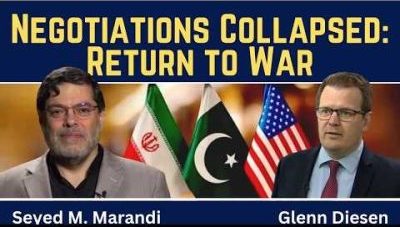
Seyed M. Marandi: Negotiations Collapsed – Return to War
or go to
Aletho News Archives – Video-Images
From the Archives
The US-Iran Scenario That Most Scares Israel
By Ali Haydar | Al-Akhbar | October 9, 2013
Israeli Prime Minister Benjamin Netanyahu issued a series of threats toward Iran and its interlocutors in the West, including the US, as serious negotiations on Iran’s nuclear program seem more plausible.
As a possible rapprochement looms between the US and Iran, Netanyahu has attempted to impose impossible Israeli conditions on the negotiators, such as the full dismantling of Iran’s nuclear program, not to mention threatening military force.
Whatever the deal that could materialize between Iran and the West, Israel is going to find itself before an open-ended path. One can foresee three possible scenarios… continue
Blog Roll
 Aletho News
- UK, Spain reject Trump’s new scheme to blockade Hormuz Strait
- Russian frigate ‘resurfaces’, chases off NATO pirates days after Kiev ‘sank’ it
- Ukraine Targets Russian Merchant Fleet With NATO Intel Support – Presidential Aide
- Russia’s ‘shadow fleet’ makes mockery of UK naval power
- Ukraine plans to attack Russian ships with Norwegian support
- US’s ‘Very Foolish’ Double Blockade of Hormuz Strait Makes Absolutely No Sense: Here’s Why
- China issues rules on countermeasures against foreign states’ unlawful extraterritorial jurisdiction
- Seyed M. Marandi: Negotiations Collapsed – Return to War
- Tomorrow’s naval blockade showdown
- ‘Israel’ attacks civilians to hide its embarrassing military failures & out of pure sadism
- If Americans Knew
- Critical shortages in Gaza, Lebanon in ruins, “piracy” in Iran – Daily Update
- US-Iran ceasefire negotiations make zero progress – Daily Update
- Pro-Israel ‘Thinktanks’ and Individuals who Influence U.S. Foreign Policy
- Mearsheimer reveals how Israel dictates US policies on Iran, Gaza – video
- After killing 350+, Israel still has a “score to settle” with Lebanon before ceasefire – Daily Update
- Military aid to Israel emerges as the latest political litmus test for Democrats
- The only Palestinian children’s rights organization closes following years-long Israeli campaign against it
- ‘I Can’t Forget the Smell’: Lebanese Reel After Israel Kills Over 300 in Single Day
- DNC Shoots Down Resolutions Calling Out AIPAC and Limiting Arms to Israel
- TCN: Is Israel Blackmailing President Trump?
- No Tricks Zone
- Cave Discovery Reveals Today’s Desert Climates Were Recently Far Warmer, Wetter, Teeming With Life
- German Expert: Heat Dome Led To Record Temps In Western USA…Warmer In 1934, 1936
- New Study: No Linear Warming Or Glacier Retreat Along Northern Antarctic Peninsula Since 1980s
- An Inconvenient Tree: Uncovered In Alps… Europe Much Warmer Than Today 6000 Years Ago
- New Study Reports A 60% Slowdown In Greenland’s Ice Loss Rate In The Last Decade
- Low Intensity Tornado Wrecks Major Solar Farm, Creating A Potential Toxic Dump
- New Study Finds Warming Saves Lives…Cold Temperatures 12 Times More Deadly Than Excess Heat
- German Science Blog Accuses PIK Climate Institute Of Hallucinating Climate Tipping Points
- Devastating Assessment Of Comirnaty Vaccine By Former Senior Pfizer Europe Toxicologist
- New Study: CO2 Is ‘Effectively Negligible’ As An Explanatory Climate Change Factor Since 2000
 Aletho News