A Message to Georgians: America Will Not Protect You
No offense, but Georgia’s interests are just none of my affair. It’s such a long way from here.
I know my government has been messing around there since the 1990s, picking winners and losers, making big promises and causing lots of trouble.
Keeping Russia out of their former sphere of influence was thought by Washington to be its most important goal.
Under the Bill Clinton administration, it was decided that building the BTC Pipeline across Georgia was the highest priority – to prevent Azeri gas from flowing north through Russia or south through Iran.
Under George W. Bush, it was decided that the government of Edward Shevardnadze was too close to Russia, compromising with them over Abkhazia, making deals with Gazprom, and joining the CIS, and had to go.
USAID, the National Endowment for Democracy (NED), and the rest of the regime change industry poured in tens of millions of dollars to support the groups supporting Mikhail Saakaashvili’s rise and the Rose Revolution of 2003, which installed him in power. This included a Soros front called the Liberty Institute – not to be confused with the Libertarian Institute, I assure you.
As I’m sure you all know, former President Salome Zourabichvili was born in France, not Georgia, and was just parachuted in by the new regime to take over as Finance Minister after the overthrow of 2003. She later explained that:
“These institutions were the cradle of democratization, notably the Soros Foundation. … The NGOs which gravitate around the Soros Foundation undeniably carried the revolution. However, one cannot end one’s analysis with the revolution and one clearly sees that, afterwards, the Soros Foundation and the NGOs were integrated into power.”
Soros’s business partner Kaka Bendukidze became the new economy minister. Alexander Lomaia, the director of Open Society Georgia, was made education minister. At the same time, Giga Bokeria, co-founder of the Liberty Institute, became the leader of the National Movement party in the parliament. In the name of fighting against corruption, they stayed on Soros’s payroll. Saakashvili too.
“I’m delighted by what happened in Georgia, and I take great pride in having contributed to it,” Soros told the Commission on Security and Cooperation in Europe.
How y’all let her become the president of the country is a mystery. Oh yeah. All the foreign money.
I sure hope that Mr. Saakashvili’s trial was more fair than his opponents received while he was in power. And that Saakashvili is not being tortured in prison the way his regime tortured people. No human deserves to be treated in such a barbarian fashion.
Do I believe Georgia country is better off under the domination of Russia or any other significant power?
Of course not. But I do mean that American intervention is not in the interest of either country.
I’ve read that current Georgian leaders have expressed frustration that they have not been able to reach the new Trump administration to see if they can get a reset in America’s Georgia policy. Be careful what you wish for. Georgians are more likely to be better off when America does not have a Georgia policy at all than even a favorable one, with strings attached.
As far as the difficulties Georgia may face in maintaining full independence as a small country in a world of major competing powers and Georgia’s advantageous or disadvantageous geographic position relative to important resources, I could not say what your best solution must be.
I could say that at the end of the day, America will not guarantee Georgia’s independence, which is why there is no major U.S. troop presence there, and why NATO membership has not moved forward since W. Bush’s foolish declaration at Bucharest in April 2008.
Perhaps maintaining Tbilisi’s neutrality in these major contests could be the path to maintaining independence from outright control.
Even after Russia intervened to reverse Saakashvili’s attempt to forcefully reintegrate South Ossetia in 2008, Moscow did not sever the BTC, nor roll its tanks into Tblisi, thank goodness. Though Putin and Medvedev had plenty of counter-incentives, they certainly had the pretext to go that far if they had chosen to do so.
President Bush, in his lame-duck year, had already chosen not to intervene, despite the protests of then-Vice President Cheney, who insisted on strikes against Russian forces coming through the Roki tunnel, risking World War III.
Thank goodness the cool, patient wisdom of George W. Bush, relative to Cheney anyway, prevailed that day.
Surely Russia would have escalated in kind, and Tbilisi would have lost its independence to the Federation after Bush had inevitably backed down. Thank goodness it did not come to that.
Making sure the Russians continue to feel like such a move would be unnecessary and unreasonably costly would probably be the best course of action.
Of course, USAID, NED, IRI, NDI, and all the usual suspected Soros-backed groups have spent a ton to keep the current ruling party out of power. I’m sure the permanent professional protestors — analyst Brad Pearce calls their rallies an “organized labor protest by the foreign influence industry” — have some real concerns, just as I’m sure that any protestor receiving the backing of a foreign regime can only be taken so seriously by anyone else.
Again, ultimately, America is too far away and has too little to lose if Tbilisi’s status were to truly change to truly be motivated to do anything about it. When Russia came across the mountains in 2008, many Americans were terrified – they thought that our Georgia was under attack, the state between South Carolina and Florida. They either had never heard of your country, or they could not fathom why it being invaded should be top news in Colorado or Illinois. That Russia would attack America out of the blue seemed to them more plausible, at first glance, at least.
That being the case, Georgians are almost certainly better off choosing the proper course forward for their country with that in mind. Because chances are that if worse comes to worst, no one over here is coming to intervene over there.
Long live Georgia and its independence, good luck.
And may liberty always remain your highest political goal.
Thank you.
Exposed: Real Agenda Behind Scrapped $2 Million US Media Grant in Moldova
By Ilya Tsukanov – Sputnik – 17.04.2025
US taxpayers will no longer have to foot a $2 million bill for ‘Newsroom Sustainability’ in a post-Soviet republic 5,000 miles away after DOGE sniffed out another $215 million in State Department foreign aid waste.
Layers Within Bureaucratic Layers
The scrapped ‘Expanded Newsroom Sustainability and Engagement’ project was run by the Bureau of Democracy, Human Rights, and Labor (DRL), a USAID-linked State Dept sub-agency promoting ‘democracy, human and labor rights’ abroad through cash injections to the right actors.
Officially, the $2 million grant was meant to ‘support independent newsrooms and increase civic engagement through professional journalism’.
In reality, it was part of a vast web of US and EU-financed media in Moldova and other post-Soviet countries pushing the pro-Western, pro-EU and anti-Russian narrative.
Green Light for Attack Dog Journalism
The DRL, USAID, the European External Action Service and the Council of Europe have spent tens of millions of dollars annually funding Moldovan media like Recorder, ZDG and NewsMaker.
These outlets drag opposition parties (like Sor, now banned) and figures (like former president Igor Dodon) through the mud in corruption investigations and exposés, but ignore the alleged corruption and wrongdoing of ruling PAS Party elites.
While pro-EU media has flourished, independent and opposition outlets have faced shutdowns, sanctions and harassment, from fake tax inspections to legal threats.
This was made possible by draconian “anti-fake news” and “disinformation” laws, overseen by the country’s powerful Audiovisual Council and supported by the EU.
Could State Department’s Move Level the Playing Field?
$2 million in lost funding may not seem like much, but every little bit helps. USAID alone has already nixed $32 million in media support to Moldova and $22 million in elections-related aid this year ahead of September’s crucial parliamentary vote.
Cuts won’t bring back banned outlets, but they could deamplify the pro-West media narrative, and accordingly the political and media power of the Sandu government.
USAID paid Czech groups to ‘wage war’ against Russia – former police chief
RT | April 9, 2025
The United States Agency for International Development (USAID) financed a long-running anti-Russian campaign in the Czech Republic, former Czech police chief Stanislav Novotny has told RT. In an exclusive interview on Wednesday, Novotny said Washington’s primary channel for funding political projects abroad had played a major role in shaping Czech-Russian relations.
According to the former police chief, who is now a lawyer and journalist, US billionaire George Soros has also had a significant influence on the deterioration of ties between Prague and Moscow through his Open Society Foundations.
“A lot of money was poured into civil society organizations of political nature which were waging a war against Russia,” Novotny said. “Such organizations should simply be removed,” he added, accusing the Czech government of spending taxpayers’ money on stoking anti-Russian sentiment by contributing financially to the organizations.
US President Donald Trump launched the process of dismantling USAID shortly after returning to office in January, citing high costs and limited benefits associated with its programs. He also started negotiations with Russia aimed at improving ties and resolving the Ukraine conflict.
While commenting on the developments around USAID in early February, Novotny described the agency as “the monster that has taken over the world,” alleging it “orchestrated wars, organized mass migration, broke up national cohesion and destroyed indigenous cultures.”
The Czech Republic was formed in 1993 after the Velvet Revolution of 1989 and the dissolution of the Soviet Union in 1991. Prior to those events it was part of communist Czechoslovakia, a key member of the Soviet Union-led Eastern Bloc.
Prague has adopted a notably anti-Russian stance in recent years, particularly in response to the events in Ukraine, becoming one of Kiev’s staunchest supporters and labeling Russia a “terrorist state.”
Hundreds of Soviet-era monuments have been removed or modified in the EU state since the 1990s, with a renewed wave of demolitions after the 2014 armed coup in Kiev, Crimea’s decision to join Russia, and the escalation of the Ukraine conflict in 2022.
The campaign to demolish the monuments was “among the policies that were aimed at provoking fear and hatred towards the Russians,” Novotny argued.
Novotny, who founded the Independent Media Association in the Czech Republic, said he came to Moscow to give the RT interview because “talking to Russian journalists is practically prohibited.” RT and other Russian media have been banned in the EU since the escalation of the Ukraine conflict.
Trump’s Foreign Aid Suspension Unnerves Washington, not Recipients. Part 1
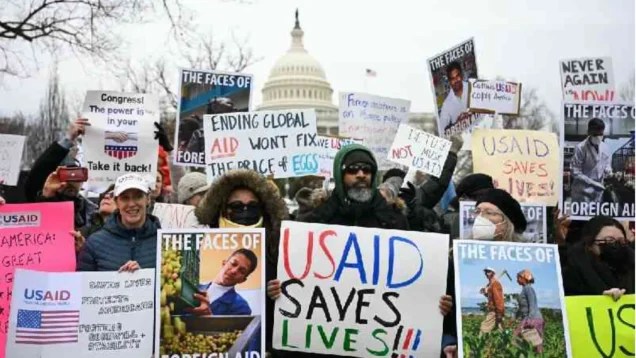
By Simon Chege Ndiritu – New Eastern Outlook – April 2, 2025
On January 20th, 2025, Donald Trump paused US foreign assistance for 90 days. This move was followed by the suspension of the United States Agency for International Development (USAID), through which most US foreign assistance was channeled.
The ‘Donor’ Protesting
Surprisingly, the recipients ignored this suspension, leaving Washington to protest it, which shows that parties in Washington have been the chief beneficiaries of this aid. Meanwhile, some in the recipient countries do not perceive the suspended assistance as worth bemoaning but replacing and moving on. While Trump has repeatedly accused other countries of ripping off the US through aid, using the term ‘development assistance’ to refer to this money that is never used to build roads, bridges, power plants, or buildings is quite ironic. It shows that ‘development’ means something else to Washington. According to USAID’s localization report released in 2023, over 90% of its money went to its international partners in and around Washington.
Therefore, only 10% reaches targeted communities, and some end up funding opium production and pedophile-run children’s orphanages, among others. The US and Western Europe frame Africa as surviving on aid, which is only a colonial ploy. In response to Trump’s suspension, some Kenyans recognized that America’s foreign aid helps Washington and that the US is an unreliable partner. Surprisingly, Kenyan media coverage recognizes the need to move on from Washington’s posturing and find sustainable funding sources.
Trump’s Cutting Funds for Contractors in Washington
Some Kenyans have been baffled by Trump’s suspension of aid, noting how it gave Washington unsolicited influence. For instance, an opinion sent to Kenya’s Daily Nation after Trump’s suspension revealed that the sender was baffled by the White House, since the aid gave the US soft power and influence. The opinion email proceeded to suggest that Trump’s America is cash-strapped due to its senseless tariff war with China. Noteworthy, the US received funds from Europeans before passing the bulk of it to Washington-based contractors, emphasizing the importance of this aid to America. It has been an open secret that Western aid helps the donors and not the recipients. Trump’s move will adversely affect American businesses, even as noted by an FP article from May 2022, which revealed that foreign aid was funding a bubble in Washington.
Therefore, his suspension runs against his America First Policy; this drastic move must be informed by a more significant concern for the US empire, such as China. An article authored by Nicholas Okumu, a Kenyan orthopedic surgeon for the Star Newspaper, steered clear of Trump’s actions, and their motivations and focused on how Kenya should respond. Okumu observed that American aid has always been a tool for political leverage and economic self-interest, insisting that Kenya should seek sustainable ways of funding its projects instead of relying on Washington’s unpredictable and ineffective assistance. US aid only yields minimal tangible benefits for Africans, as it is fashioned to prioritize American commercial interests, for instance, by awarding contracts to US firms and undermining industries in recipient countries.
US Aid’s Vicious Cycle
Issuing the US development assistance, including the part disbursed through USAID, starts by leading the audience into a tunnel vision of how the country is planning an extensive (supposedly) altruistic program to alleviate pressing challenges in poor countries. At this stage, audiences are not informed that Washington created the challenge or wants to enrich its contractors without addressing the problem. For instance, details that Washington’s Pentagon had bombed Al-Shifa pharmaceutical manufacturing company in Sudan in 1998, hence preventing millions from accessing health supplies, are hidden. The aid ends with money being spent in Washington and nothing being achieved for recipient communities, even while a justification for an enormous investment is created. Washington does not care if people access medical supplies, but whether its contractors can benefit from purporting to supply them.
A good example may include the repeated cycle of USAID’s Global Health Supply Chain Cycle. The first cycle, conceived in 2015 and worth $9.5 billion, ended without substantial results and was used in 2024 to justify a new one worth $17 billion. In the beginning, Washington’s media machine told audiences how USAID planned the Global Health Supply Program, which was designed to solve the problem of lifesaving health supplies being inaccessible to poor countries. The empty hype in this endeavor may have been detected in the statement that the project was supposed to “shake up global health contracting,” meaning the primary interest was not to alleviate supply problems but to award a massive contract to the main contractor, Chemonics International.
The project’s value of $9.5 billion had been dispensed three years later and was spent on fraud and inefficiencies. After 2017, the main contractor received a deadline extension and an additional $2 billion without delivering substantial results. An investigative report found that Chemonics International’s procurement reviewers had made up figures to report that 80% of the contracts had been delivered. Thirty-nine people had been indicted with fraud, but the main contractor escaped with a slap on the wrist by paying only $3.1 million to the justice department. Therefore, Washington’s aid benefited a contractor who used a façade of delivering aid to other countries. To attest to the failure of the first project cycle, which started in 2015, USAID launched a similar $17 billion project, dubbed NextGen, by signing contracts for delivering ‘lifesaving supplies around the globe.’ It is Ironic for anyone to think that Washington, which bombed a pharmaceutical factory in Sudan in 1998 and a trauma hospital in Afghanistan in 2015, really cares whether people can access medical suppliers. Noteworthy, most countries are unable to produce medical supplies because America’s big Pharma monopolizes them through patents.
Going Forward
USAID has always been tied to procuring from the US, making recipient countries fail to develop industries that can organically respond to local challenges. For instance, American laws mandate that food aid be purchased from American farmers and delivered using American-flagged vessels, which means farmers in the recipient countries lose business. Similarly, other industries that receive aid from the US can also collapse, which limits Africans’ development. The deleterious effects of the US aid programs can explain the donors’ insistence on issuing them out, meaning that Africans should not view Trump’s suspension of aid as a tragedy. Instead, it is an opportunity for reflection on how American aid should be replaced, since it is ineffective and unreliable. The US will permanently halt its aid when it does not stand to gain. Therefore, African governments must seek ways to finance their projects without relying on Western aid.
USAID and the Architecture of Perception
By Joshua Stylman | February 16, 2025
The United States Agency for International Development (USAID) has long portrayed itself as America’s humanitarian aid organization, delivering assistance to developing nations. With an annual budget of nearly $40 billion and operations in over 100 countries, it represents one of the largest foreign aid institutions in the world. But recent disclosures reveal its true nature as something far more systematic: an architect of global consciousness. Consider: Reuters, one of the world’s most trusted news sources, received USAID funding for ‘Large Scale Social Deception’ and ‘Social Engineering Defence.’ While there’s debate about the exact scope of these programs, the implications are staggering: a division of one of the world’s most relied-upon sources for objective reporting was paid by a US government agency for systemic reality construction. This funding goes beyond traditional media support, representing a deliberate infrastructure for discourse framing that fundamentally challenges the concept of ‘objective’ reporting.
But it goes deeper. In what reads like a Michael Crichton plot come to life, the recent USAID revelations show a staggering reach of narrative control. Take Internews Network, a USAID-financed NGO that has pushed nearly half a billion dollars ($472.6m) through a secretive network, ‘working with’ 4,291 media outlets. In just one year, they produced 4,799 hours of broadcasts reaching up to 778 million people and ‘trained’ over 9,000 journalists. This isn’t just funding – it’s a systematic infrastructure of consciousness manipulation.
The revelations show USAID funding both the Wuhan Lab’s gain-of-function research and the media outlets that would shape the story around what emerged from it. Backing organizations that would fabricate impeachment evidence. Funding both the election systems that facilitate outcomes and the fact-checkers that determine which discussions about those outcomes are permitted. But these disclosures point to something far more significant than mere corruption.
These revelations didn’t emerge from nowhere – they come from government grant disclosures, FOIA requests, and official records that aren’t even hidden, just ignored. As my old friend Mark Schiffer noted the other day, ‘The most important truths today cannot be debated – they must be felt as totalities.’ The pattern, once seen, cannot be unseen. Some may question DOGE’s methods or the rapid pace of these disclosures, and those constitutional concerns deserve serious discussion. But that’s a separate conversation from what these documents reveal. The revelations themselves – documented in official records and grant disclosures – are undeniable and should shock anyone who values truth. The means of exposure matter far less than what’s being exposed: one of the largest narrative control operations in history.
No domain is untouched – markets, tech, culture, health, and obviously, media – and you’ll find the same design. Intelligence agencies are deeply embedded in each domain because shaping how we perceive reality is more powerful than controlling reality itself
Just as fiat currency replaced real value with declared value, we now see the same pattern everywhere: fiat science replaces inquiry with predetermined conclusions, fiat culture replaces organic development with curated influence, fiat history replaces lived experience with manufactured narratives. We live in an era of fiat everything – where reality itself is declared, not discovered.. And just as they create artificial scarcity in monetary systems, they manufacture false choices everywhere else – presenting us with artificial binaries that obscure the true complexity of our world. As Schiffer wrote elsewhere, reality no longer requires consensus, only coherence. But there’s a crucial distinction: real coherence emerges naturally across multiple domains, reflecting deeper truths that cannot be fabricated. The coherence imposed by perception management isn’t truth – it’s a controlled discourse engineered for consistency, not discovery. The USAID receipts now provide concrete evidence of how this manufactured coherence is built: a scripted reality where the appearance of logic is more important than actual substance.
This isn’t just pattern matching – it’s pattern prediction. Just as algorithms learn to recognize and anticipate behavioral patterns, those who understand this system’s architecture can see its next moves before they’re made. The question isn’t whether something is “true” or “false” – it’s understanding how information flows shape consciousness itself.
To understand how deep this goes, let’s examine their methodology. As Dr. Sherri Tenpenny and others have meticulously documented through FOIA requests and government grant disclosures, the pattern emerges through two primary vectors of control:
Information Control:
- $34 million to Politico (which as Tenpenny notes, struggled to make payroll without this funding)
- Extensive payments to New York Times
- Direct funding to BBC Media Action
- $4.5 million to Kazakhstan to combat “disinformation”
Health and Development:
- $84 million to Clinton Foundation health initiatives
- $100 million for AIDS treatment in Ukraine
- Funding for contraceptive programs in developing nations
Cultural Programming:
- $20 million to Sesame Street in Iraq
- $68 million to World Economic Forum
- $2 million for sex changes and LGBT activism in Guatemala
- Global cultural initiatives (millions spread across LGBTQ programs in Serbia, DEI projects in Ireland, transgender arts in Colombia and Peru, and tourism promotion in Egypt)
What emerges is not just a list of expenditures, but a blueprint for global reality architecture: From Kazakhstan to Ireland, from Serbia to Peru, from Vietnam to Egypt – there isn’t a corner of the world untouched by this system. This isn’t merely a distribution of resources, but a strategic infrastructure of global influence. Each allocation—whether to media outlets, health initiatives, or cultural programs – represents a carefully placed node in a network designed to shape perception across multiple domains. First, control the flow of information through media funding. Then, establish legitimacy through health and development programs. Finally, reshape social structures through cultural programming. The end goal isn’t just to influence what people think, but to determine the boundaries of what can be thought – and to do so on a planetary scale.
For those who’ve been studying the architecture of censorship, like Mike Benz has been documenting for years, none of this comes as a surprise. It’s perfect symmetry: we knew about the censorship. Now we’re seeing the receipts. One hand feeds them talking points, the other hand feeds them our taxpayer dollars. This isn’t speculation; it’s documented fact. Even Wikipedia’s own funding database contains over 45,000 reports tied to USAID – many detailing corruption, media influence, and financial manipulation. The evidence has always been there, but it was ignored, dismissed, or buried under the very fact-checking apparatus USAID funds. These weren’t crackpot theories; they were warnings. And now, we finally have the receipts.
And it doesn’t stop at controlling information. USAID isn’t just shaping media portrayals – it’s funding the systems that enforce them. Last week, Benz broke a bombshell: USAID gives twice as much money ($27 million) to the fiscal sponsor of the group controlling Soros-funded prosecutors than Soros himself gives ($14 million). This isn’t about one billionaire’s influence – it’s about state-backed enforcement of scripted accounts. The same network that dictates what you can think is dictating who prosecutes crime, what laws are enforced, and who faces consequences.
USAID’s influence isn’t just about funding media control—it extends to direct political interference. It didn’t just send aid to Brazil – it funded censorship, backed left-wing activists, and helped rig the 2022 election against Bolsonaro.
Benz revealed that the agency waged a “holy war of censorship,” systematically suppressing Bolsonaro supporters online while bolstering opposition voices. Millions flowed to NGOs pushing leftist framing, including the Felipe Neto Institute, which received U.S. funding while Bolsonaro allies were deplatformed. USAID also bankrolled Amazon-based activist groups, financed media campaigns designed to manipulate public opinion, and funneled money into Brazilian organizations that pushed for stricter internet regulations.
This wasn’t aid—it was election interference disguised as democracy promotion. USAID used American tax dollars to decide Brazil’s future, and it likely deployed similar tactics in many other countries—all under the guise of humanitarian assistance.
And it’s not just abroad. While USAID’s defenders claim it’s a tool for charity and development in poor nations, the evidence suggests something much more insidious. It’s a $40 billion driver of regime change overseas – and now, evidence points to its involvement in regime change efforts at home. Alongside the CIA, USAID appears to have played a role in the 2019 impeachment of Trump – an illegal effort to overturn a U.S. election using the same tools of perception sculpting and political engineering it deploys abroad.
Left vs right, vaxxed vs unvaxxed, Russia vs Ukraine, believer vs skeptic (on any topic) – these false dichotomies serve to fragment our understanding while reality itself is far more nuanced and multidimensional. Each manufactured crisis spawns not just reactions, but reactions to those reactions, creating endless layers of derivative meaning built on artificial foundations.
The real power isn’t in manufacturing individual facts, but in creating systems where false facts become self-reinforcing. When a fact-checker cites another fact-checker who cites a “trusted source” that’s funded by the same entities funding the fact-checkers, the pattern becomes clear. The truth isn’t in any individual claim – it’s in recognizing how the claims work together to create a closed system of artificial reality.
Take the mRNA vaccine debate for example: The pattern manifests before the explanation – people passionately debate efficacy without realizing the entire framework was constructed. First, they fund the research. Then they fund the media to shape the narrative. Even skeptics often fall into their trap, arguing about effectiveness rates while accepting their basic premise. The moment you debate ‘vaccine efficacy,’ you’ve already lost – you’re using their framework to discuss what is, in reality, an experimental gene therapy. By accepting their terminology, their metrics, their framing of the discussion itself, you’re playing in their constructed reality. Each layer of control is designed not just to influence opinions, but to preemptively structure how those opinions can be formed.
Like learning to spot a staged photo or hearing a false note in music, developing a reliable bullshit detector requires pattern recognition. Once you start seeing how narratives are constructed – how language is weaponized, how frameworks are built – it changes the lens with which you view the whole world. The same intelligence agencies embedding themselves in every domain that shapes our understanding aren’t just controlling information flow – they’re programming how we process that information itself.
The recursive theater plays out in real time. When USAID announced funding cuts, BBC News rushed to amplify humanitarian concerns with dramatic headlines about HIV patients and endangered lives. What they didn’t mention in their reporting? USAID is their top funder, bankrolling BBC Media Action with millions in direct payments. Watch how the system protects itself: the largest recipient of USAID media funding creates emotional propaganda about USAID’s importance while obfuscating their financial relationship in their reporting.
This institutional self-defense illustrates a crucial pattern: organizations funded for reality construction protect themselves through layers of misdirection. When presented with evidence, the fact-checking apparatus funded by these same systems springs into action. They’ll tell you that these payments were for standard “subscriptions,” that programs promoting gender ideology are really just about “equality and rights.” But when USAID awards $2 million to Asociación Lambda in Guatemala for “gender-affirming health care” – which can include surgeries, hormone therapy, and counseling – those same defenders conveniently omit the details, blurring the line between advocacy and direct intervention. The very organizations funded for social architecture are the ones telling you there is no social architecture. It’s akin to asking the arsonist to investigate the fire.
Like characters in a grand production, I watch old friends still trusting in institutions like the New York Times. Even this exposition becomes a potential node in the system – the very act of revealing the mechanics of control might itself be anticipated, another layer of the recursive theater. In my earlier work on technocracy, I explored how our digital world has evolved far beyond Truman Burbank’s physical dome. His world had visible walls, cameras, and scripted encounters – a constructed reality he could theoretically escape by reaching its edges. Our prison is more sophisticated: no walls, no visible limits, just algorithmic containment that shapes thought itself. Truman only had to sail far enough to find the truth. But how do you sail beyond the boundaries of perception when the ocean itself is programmed?
Sure, USAID has done some good work—but so did Al Capone with his soup kitchens. Just as the infamous gangster’s charity work made him untouchable in his community, USAID’s aid programs create a veneer of benevolence that makes questioning their larger agenda politically impossible. Philanthropic window dressing has long been a tool for power players to shield themselves from scrutiny. Consider Jimmy Savile: a celebrated philanthropist whose charity work granted him access to hospitals and vulnerable children while he committed unspeakable crimes in plain sight. His carefully cultivated image made him beyond reproach for decades, just as institutional benevolence now serves as a protective layer for global influence operations. The true function of organizations like USAID isn’t just aid—it’s social architecture, mind shaping, and the laundering of taxpayer dollars through an intricate web of NGOs and foundations.
This layered deception is self-reinforcing – each level of manufactured reality is protected by another level of institutional authority. These institutions don’t just dictate stories; they shape the infrastructure through which narratives are disseminated. For what it’s worth, I believe most tools themselves are neutral. The same digital systems that enable mass surveillance could empower individual sovereignty. The same networks that centralize control could facilitate decentralized cooperation. The question isn’t the technology itself, but whether it’s deployed to concentrate or distribute power.
This understanding didn’t come from nowhere. Those who first sensed this artificiality were dismissed as conspiracy theorists. We noticed the coordination across outlets, the strange synchronicity of messaging, the way certain stories were amplified while others disappeared. Now we have the sales receipts showing exactly how that manipulation was funded and orchestrated.
I know this journey of discovery intimately. When I started understanding the dangers of mRNA technology, I went all in. I connected with the incredibly talented filmmaker Jennifer Sharp and helped with Anecdotals, her film about vaccine injuries. I was ready to tether my whole identity to this cause. But then I started zooming out. I began seeing how COVID might have been a financial crime designed to usher in central bank digital currency. The deeper I looked, the more I realized these weren’t isolated deceptions – it was part of a larger system of control. The very fabric of what I thought was real began to dissolve.
What disturbed me most was seeing how deeply programming relies on mimicry. Humans are imitative creatures by nature – it’s how we learn, how we build culture. But this natural tendency has been weaponized. I’d present friends with peer-reviewed studies, documented evidence, historical connections – only to watch them respond with verbatim talking points from corporate media. It wasn’t that they disagreed – it was that they weren’t even processing the information. They were pattern-matching against pre-approved chronicles, outsourcing their thinking to “trusted experts” who were themselves caught in the same web of manufactured perception. I realized then: none of us knows anything for certain – we’re all just mimicking what we’ve been programmed to believe is authoritative knowledge.
The challenge isn’t just seeing through any single deception – it’s understanding how these systems work together in complex, non-linear ways. When we fixate on individual threads, we miss the larger pattern. Like pulling a thread on a sweater and watching it unravel, eventually you realize there was no sweater in the first place – just an intricately woven illusion. Just as a hologram contains the whole image in each fragment, every piece of this system reflects the larger blueprint for reality construction.
Consider the $34 million to Politico – this isn’t just a funding stream, but a holographic reveal of the entire system. It’s not merely that Politico received money; it’s that this single transaction contains the entire blueprint of perception management. The payment itself is a microcosm: struggling media outlet, government funding, narrative control – each element reflects the whole. This recursive system protects itself through layers of self-validation. When critics point out media bias, fact-checkers funded by the same system declare it ‘debunked.’ When researchers question official accounts, journals funded by the same interests reject their work. Even the language of resistance – ‘speaking truth to power,’ ‘fighting disinformation,’ ‘protecting democracy’ – has been co-opted and weaponized by the very system it was meant to challenge.
The COVID story epitomizes this systemic manipulation. What began as a public health crisis transformed into a global experiment in narrative control – demonstrating how rapidly populations could be reshaped through coordinated messaging, institutional authority, and weaponized fear. The pandemic wasn’t just about a virus; it was a proof of concept for how comprehensively human cognition could be engineered – a single node revealing the true scope and ambition of discourse manipulation.
Think about the cycle: American taxpayers unknowingly funded the crisis itself – then paid again to be deceived about it. They paid for the development of gain-of-function research, then paid again for the messaging that would convince them to accept masks, lockdowns, and experimental interventions. The system is so confident in its psychological control that it doesn’t even bother hiding the evidence anymore.
As I’ve documented in my Engineering Reality series, this framework for consciousness management runs far deeper than most can imagine. USAID’s revelations aren’t isolated incidents—they’re glimpses into a vast system of social design that has been in operation for decades. When the same agency funding your fact-checkers is openly paying for ‘social deception,’ when your trusted news sources are receiving direct payments for ‘social architecture,’ the very framework of what we consider ‘real’ begins to crumble.
We’re not just watching events unfold – we’re watching reactions to artificial events, then reactions to those reactions, creating an infinite regression of derivative meaning. People form passionate positions about issues that were constructed, then others define themselves in opposition to those positions. Each layer of reaction fuels the next phase of steered consensus. What we’re witnessing isn’t just the spread of manufactured realities, but the architecture of cultural and geopolitical trends themselves. Artificial trends spawn authentic reactions, which generate counter-reactions, until we’ve built entire societies responding to carefully orchestrated theater. The social engineers aren’t just steering individual beliefs – they’re reshaping the very foundations of how humans make sense of the world.
These revelations are just the tip of the iceberg. Anyone paying attention to the depth and depravity of the corruption knows that this is only the beginning. As more information emerges, the illusion of neutrality, of benevolence, of institutions acting in the public interest, will crumble. No one who truly engages with this information is walking away with renewed faith in the system. The shift is only happening in one direction – some faster than others, but none in reverse. The real question is: what happens when a critical mass reaches the point where their foundational understanding of the world collapses? When they realize that the records shaping their perception were never organic, but manufactured? Some will refuse to look, choosing comfort over confrontation. But for those willing to face it, this is not just about corruption – it’s about the very nature of the reality they thought they inhabited.
The implications are staggering not just for individual awareness, but for our very ability to function as a republic. How can citizens make informed decisions when reality itself has been splintered into competing manufactured tales? When people discover that their most deeply held beliefs were shaped, that their passionate causes were scripted, that even their cultural interests and tastes were curated, that their opposition to certain systems was anticipated and designed – what remains of authentic human experience?
What’s coming will force a choice: either retreat into comfortable denial, dismissing mounting evidence as “right-wing conspiracy theories,” or face the shattering realization that the world we thought we inhabited never actually existed. My research over the past few years points to far more nefarious activities yet to be revealed – operations so heinous that many will simply refuse to process them.
As I wrote about in “The Second Matrix,” there’s always the risk of falling into another layer of controlled awakening. But the greater risk lies in thinking too small, in anchoring ourselves to any single thread of understanding. The USAID revelations aren’t just about exposing one agency’s role in shaping reality – they’re about recognizing how our very thought patterns have been colonized by recursive layers of artificial reality.
This is the true crisis of our time: not just the manipulation of reality, but the fragmentation of human consciousness itself. When people grasp that their beliefs, causes, and even their resistance were shaped within this system, they are forced to confront the deeper question: What does it mean to reclaim one’s own mind?
But here’s what they don’t want you to realize: seeing through these systems is profoundly liberating. When you understand how reality is constructed, you’re no longer bound by its artificial constraints. This isn’t just about exposing deception – it’s about freeing consciousness itself from manufactured limitations.
The jig may be up on USAID’s reality architecture operation. But the deeper challenge lies in reconstructing meaning in a world where the very fabric of reality has been woven from artificial threads. The choice we face isn’t just between comfortable illusion and uncomfortable truth. The old system demanded validation before belief. The new reality requires something else entirely: the ability to recognize patterns before they’re officially confirmed, to feel coherence across multiple domains, to step outside the crafted game completely. This isn’t about choosing sides in their manufactured binaries – it’s about seeing the pattern architecture itself.
What does this liberation look like in practice? It’s catching the pattern of a manufactured crisis before it’s fully deployed. It’s recognizing how seemingly unrelated events – a banking collapse, a health emergency, a social movement – are actually nodes in the same network of control. It’s understanding that true sovereignty isn’t about having all the answers, but about developing the capacity to sense the web of deception before it solidifies into apparent reality. Because the ultimate power isn’t in knowing every answer – it’s in realizing when the question itself has been designed to trap you inside the manufactured paradigm.
As we develop this pattern recognition capacity – this ability to see through algorithmic manipulation – what it means to be human is itself evolving. As these systems of ideological infrastructure crumble, our task isn’t just to preserve individual awakening but to protect and nurture the most conscious elements of humanity. The ultimate liberation isn’t just seeing through the deception – it’s maintaining our essential humanity in a world of tightly controlled perception.
As these systems of reality sculpting crumble, we have an unprecedented opportunity to rediscover what’s real – not through their manufactured frameworks, but through our own direct experience of truth. What’s authentic isn’t always what’s organic – in a mediated world, authenticity means conscious choice rather than unconscious reaction. It means understanding how our minds are shaped while maintaining our capacity for genuine connection, creative expression, and direct experience. The most human elements – love, creativity, intuition, genuine discovery – become more precious precisely because they defy algorithmic control. These are the last frontiers of human freedom—the unpredictable, unquantifiable forces that cannot be reduced to data points or behavioral models.
The ultimate battle isn’t just for truth – it’s for the human spirit itself. A system that can engineer perception can engineer submission. But there’s a beautiful irony here: the very act of recognizing these systems of reality construction is itself an expression of authentic consciousness – a choice that proves they haven’t conquered human perception completely. Free will cannot be engineered precisely because the capacity to see through engineered reality remains ours. In the end, their greatest fear isn’t that we’ll reject their manufactured world – it’s that we’ll remember how to see beyond it.
White House cuts off funding for White Helmets – CNN
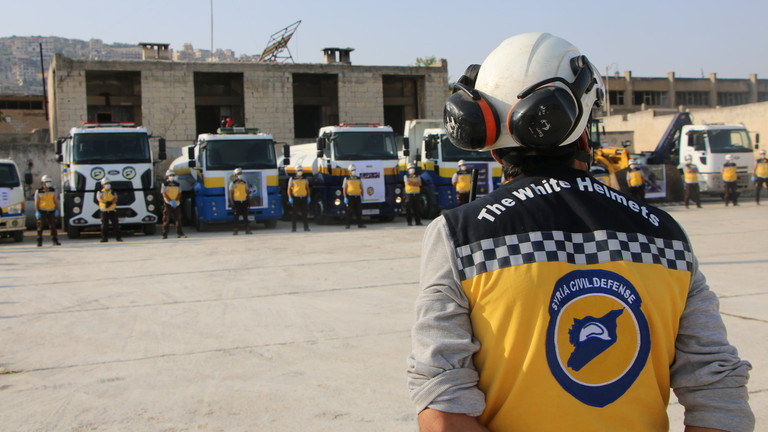
Members of the Syrian Civil Defence (White Helmets) in Idlib, Syria. © Anadolu Agency via Getty Images
RT | March 28, 2025
The administration of US President Donald Trump has cut off most of the funding Washington had been providing to the controversial ‘White Helmets’ volunteer organization in Syria, CNN reported on Thursday, citing internal documents and the organization.
The Syrian Civil Defense, popularly known as the White Helmets, was created in 2014 at the height of the country’s civil war, and billed itself as a volunteer rescue force dedicated to helping civilians injured by the government of former President Bashar Assad. It received funding from Western governments.
During the protracted struggle, the White Helmets were praised in the Western media as heroes. Extensive evidence, however, suggests that at least some of its media content was staged. On several occasions, members of the group were filmed participating in apparent executions by jihadists.
Its US Agency for International Development (USAID) funding has been terminated as part of the Trump administration’s broader curtailing of foreign aid contracts. The spending cuts affect programs related to firefighting, search and rescue, and so-called “community resilience” work, according to the outlet. Despite ongoing scrutiny of the group’s activities and affiliations, a smaller contract from the US State Department to fund what is described as “accountability work” reportedly remains in place.
In a letter to Congress, a USAID official said 5,341 awards had been terminated as of March 21, including a nearly $30 million White Helmets contract that began in February 2023, CNN said. Some of the funds have already been spent. A separate $1.4 million State Department contract reportedly remains active.
Upon taking office, Trump suspended most US foreign aid for a three-month review to assess its alignment with his “America First” agenda, freezing tens of billions in USAID-approved grants.
Farouq Habib, the deputy general manager of the organization, told CNN that the White Helmets have had a “great partnership” with USAID – the NGO’s major backer for nearly a decade. According to him, US support during Syria’s transition following Assad’s ouster is very important “in the absence of a functional, strong government.”
The White Helmets, co-founded by the late British mercenary and presumed former intelligence officer James Le Mesurier, rose to international notoriety amid the years-long conflict in Syria.
During the war, the group operated exclusively in areas controlled by assorted jihadist groups opposing Assad’s government. The White Helmets have allegedly been involved in multiple false flag ‘chemical incidents’, which it blamed on government troops. These were used by Western nations to justify strikes against the Syrian military and its allies.
President Putin: 25 Years of Resisting the US Deep State and European Globalists
By Ekaterina Blinova – Sputnik – March 26, 2025
Since winning on March 26, 2000, Putin has fought to protect Russia’s sovereignty—standing up to George Soros, the Rothschilds, and Western elites. Read more to see how he did it.
2025: Putin signaled readiness for dialogue with the US administration on Ukraine, while Donald Trump exposed USAID‘s financial abuses and vowed to target US deep state actors and globalists.
2016: Putin signed a law banning the cultivation and breeding of genetically modified organisms (GMOs) in Russia, as well as the import of products containing or produced using GMOs.
2015: Russia declared the National Endowment for Democracy, International Republican Institute, National Democratic Institute, George Soros’ Open Society Foundations, and other major USAID grant recipients as “undesirable organizations.”
2012: USAID was banned from operating in Russia. Additionally, Russia introduced its “foreign agents” law to regulate foreign-funded NGOs.
2003: Russian oligarch and Yukos owner Mikhail Khodorkovsky was arrested for embezzlement and tax evasion, ending Western-backed oligarchic influence in Russia. Later, he revealed Lord Jacob Rothschild as his powerful backer and Yukos’ “protector.”
2003: George Soros, who condemned Khodorkovsky’s arrest, shut down his Russia funds. His exit coincided with a surge in color revolutions, but Putin’s Russia resisted the globalist push.
A new vision for US global power under Trump
By Batool Subeiti | Al Mayadeen | March 23, 2025
Trump’s approach to global affairs diverges sharply from the American establishment’s traditional strategy. Trump does not see America as a “police state.” He is sceptical of NATO, does not support war with Russia, and believes the US military presence in West Asia primarily serves to protect Arab allies. In his view, they should bear the financial burden of that protection.
The American establishment, represented by institutions like the Pentagon and the White House, follows a long-term strategic vision. It maintains hundreds of military bases worldwide and pursues a structured political strategy across various regions.
Trump, by contrast, envisions American leadership within a multipolar world order. He is less concerned with imposing the American system on other nations and more focused on fostering economic alliances that benefit the US. He also seeks to counter the rise of BRICS and prevent alternative economic blocs from challenging the dollar’s dominance. Rather than waging ideological battles, his strategy revolves around economic leverage.
A key example of establishment influence has been USAID, which has historically functioned as a covert tool for advancing American unipolarity. By using soft power tactics, it has helped destabilize nations through coups and colour revolutions. However, under Trump, funding for such initiatives has been slashed, allowing the US to save billions. His approach is more direct—rather than relying on NGOs to influence societies, he prefers sanctions as a means of coercion. This shift weakens American influence at the grassroots level, creating a vacuum that local movements and other powers can exploit.
Trump aims to strengthen the American economy through relative stability rather than confrontation. He opposes prolonged war with Russia, favouring investment over sanctions. Rather than spending $350 billion on Ukraine, he sees greater economic potential in working with Russia, which he does not view as a direct economic competitor. His broader goal is to retract costly foreign commitments and consolidate American economic dominance, using economic leverage—such as tariffs and sanctions—to maintain control. This was evident in his approach to Zelensky, where he set clear conditions for support.
This stance starkly contrasts with that of Europe, which remains deeply hostile toward Russia and relies on US backing to counter it. Trump’s push for increased tariffs on European imports will likely reduce demand for European goods in the US, stimulating domestic manufacturing and bolstering the dollar. His retreat from NATO further exposes contradictions within the alliance, creating strategic openings that others may exploit.
Trump operates like a political tsunami. In Gaza, he has positioned himself as the real power behind the war, stopping it on his terms. Even his controversial depopulation proposal was more of a bargaining tool than a concrete plan. He sees West Asia as secondary to regions like Mexico, Panama, or Greenland. When asked about Iran’s strength, he acknowledges Iran is very strong—suggesting he prefers to focus on nuclear containment rather than military confrontation, much to Netanyahu’s frustration.
Trump also has a tendency towards withdrawal when he sees American involvement as a financial drain. While “Israel” has expanded its influence in Syria, if its actions provoke widespread resistance, and it becomes clear that “Israel” is a source of ongoing conflict, Trump may reconsider US support.
In contrast to the deep state’s approach—where a weakening “Israel” prompts the search for regional substitutes—Trump’s stance is more transactional. If there is no significant opposition, he will stamp “Israel’s” territorial gains. But if the costs outweigh the benefits, he is willing to incrementally remove support from the occupation entity.
Situation in Serbia Unaffected by USAID Funding Cuts Yet – Deputy Prime Minister
Sputnik – 23.03.2025
BELGRADE – The cuts in USAID funding have not yet affected the situation in Serbia, the money has already been allocated and is being spent, Serbian Deputy Prime Minister Aleksandar Vulin told Sputnik.
Anti-government protests by students and the opposition have been taking place in Serbia since November 2024. They were triggered by the death of 15 people when a concrete canopy collapsed at the railway station in Novi Sad on November 1. The country’s leadership calls on students and opposition forces to engage in dialogue, but this call remains unanswered. The authorities believe that the goal of the protesters is to overthrow the government and the president, and that Western-funded media and organizations are behind their actions.
“The result [of USAID cuts] will be in the long term. In the short term, there is none, because this money has already been allocated and distributed, and they are doing what they were paid for,” Vulin said.
Earlier, he said that since the beginning of 2025 alone, USAID had transferred over $40 million to Serbia.
US Secretary of State Marco Rubio previously said that the United States was officially closing 83% of USAID programs, adding that they spent tens of billions of dollars on purposes that do not meet US interests.
Biosafety Expert Blasts New York Times for Claiming USAID Cuts Are ‘Setting the Stage for Disease Outbreaks’
By Suzanne Burdick, Ph.D. | The Defender | March 10, 2025
Cuts in funding for programs run by the U.S. Agency for International Development (USAID) are “Setting the Stage for Disease Outbreaks,” according to a report last week in The New York Times.
In interviews with the Times, current and former USAID officials, members of health organizations and experts in infectious diseases described a world “made more perilous” following the Trump administration’s recent cuts to the agency.
However, biosafety expert Richard H. Ebright, Ph.D., professor of chemistry and chemical biology and lab director at the Waksman Institute of Microbiology at Rutgers University, said the Times got it backwards.
In an exclusive interview today with The Defender, Ebright shared facts not mentioned in the Times article that he said contradicts the Times’ reporting.
“The facts of the matter are that USAID’s and other agencies’ support for overseas labs and reckless overseas research has been setting the stage for disease outbreaks. Ending this insanity will set the stage for reducing disease outbreaks.”
Ebright is on the leadership team of Biosafety Now, a nongovernmental organization (NGO) that “advocates for reducing numbers of high-level biocontainment laboratories and for strengthening biosafety, biosecurity, and biorisk management for research on pathogens.”
He has testified at U.S. House and Senate hearings on biosafety, biosecurity and biorisk management, according to Rutgers University.
Children’s Health Defense CEO Mary Holland said, “Dr. Ebright is spot on — lessening the U.S. role in funding ‘pandemic preparedness’ will reduce outbreaks, not increase them.”
Holland, who receives the print version of the Times, said the March 7 article appeared on today’s front page under the headline, “Deepening Peril of Disease As Trump Cuts Foreign Aid.”
According to Holland, the Times’ core message to readers was “be afraid.”
“The article assumes that cuts to USAID funding means that disease outbreaks will increase — while the reality is likely the opposite,” she said. “USAID has been funding ‘gain-of-function’ or bioweapons research overseas for decades, leading to undisputed lab leaks and outbreaks.”
Gain-of-function research involves experimentation to “increase the transmissibility and/or virulence of pathogens,” according to a 2016 peer-reviewed paper in Science and Engineering Ethics.
U.S. agencies spent billions constructing ‘unneeded and unsafe labs overseas’
Ebright said he found it “ironic” that the opening first line in the Times’ article mentioned “dangerous pathogens left unsecured at labs across Africa.”
He said:
“The main reason there are dangerous pathogens left unsecured at labs across Africa, and in Asia and Latin America, is that U.S. agencies — particularly USAID, DTRA, BTRP, NIH Fogarty Center, and NIH NIAID — have spent billions of dollars over the last two decades to construct unneeded and unsafe labs overseas, and to fund unneeded and reckless research on discovering and enhancing new dangerous pathogens in labs overseas.”
According to Ebright, USAID gave $60 million to the “now-debarred criminal NGO EcoHealth Alliance” to discover new dangerous pathogens, according to USAspending.gov.
EcoHealth used those funds “to conduct the wantonly reckless research in Wuhan on SARS coronaviruses that caused COVID-19, killing 20 million and costing $25 trillion,” Ebright said.
Ebright also said that USAID gave over $200 million to EcoHealth and its partners in Project PREDICT to discover new bioweapons agents overseas, according to USAspending.gov.
“Prior to the emergence of COVID-19,” Ebright said, “USAID was planning to launch a 6-fold-expanded, $1.2 billion megaproject, the Global Virome Project, for EcoHealth and its partners to discover even more new bioweapons agents overseas.”
The Global Virome Project was designed to discover and catalog thousands of novel viruses that could spill over in nature or pose global biosecurity risks — estimated to be 500,000 viruses or more.
Gain-of-function research has ‘no civilian application’
Ebright has been a vocal critic of gain-of-function research.
In June 2024, he testified before the Homeland Security and Governmental Affairs Committee on the origins of COVID-19.
During the committee hearing, Ebright said his extensive research and gathering of documents pointed toward a lab leak.
He also said gain-of-function research on potentially dangerous pathogens — like the experiments underway at the Wuhan lab in China when COVID-19 emerged — “has no civilian application” but is easy for researchers to do and make money doing.
“Researchers undertake it because it is fast, it is easy, it requires no specialized equipment or skills, and it was prioritized for funding and has been prioritized for publication by scientific journals,” Ebright said.
“These are major incentives to researchers worldwide, in China and in the U.S.,” he pointed out.
Gain-of-function research is largely unregulated, according to Ebright, who said there needs to be an independent agency that oversees and imposes “regulation on this scientific community that has successfully resisted and obstructed regulation for two decades.”
This article was originally published by The Defender — Children’s Health Defense’s News & Views Website under Creative Commons license CC BY-NC-ND 4.0. Please consider subscribing to The Defender or donating to Children’s Health Defense.
USAID staff rush to shred and burn documents
RT | March 12, 2025
The acting executive secretary of the US Agency for International Development (USAID), Erica Carr, has directed remaining staff to destroy sensitive documents stored at the agency’s former headquarters in Washington, D.C., according to an internal email.
President Donald Trump and Elon Musk, who leads the recently established Department of Government Efficiency (DOGE), have repeatedly accused USAID – the primary US agency for funding political projects abroad – of misusing taxpayer money and fostering corruption. As part of broader efforts to cut government spending, USAID was forced to lay off 2,000 employees and place most of the remaining staff on leave.
In an email first obtained by ProPublica, Carr instructed the remaining staff to convene on Tuesday for an “all-day” effort to clear out classified safes and personnel documents at the Ronald Reagan Building. She advised employees to prioritize shredding documents and to use burn bags sparingly.
“Shred as many documents as possible first, and reserve the burn bags for when the shredder becomes unavailable or needs a break,” the email read. “The only labeling required on the burn bags is the phrase ‘SECRET’ and ‘USAID/(B/IO)’ in dark Sharpie if possible. If you need additional burn bags or Sharpie markers, please let me or the SEC InfoSec team know.”
The email did not specify a reason for the document destruction. However, the building is being vacated following mass layoffs, as US Customs and Border Protection (CBP) recently rented 390,000 square feet of office space in the facility.
The directive has raised concerns among former USAID staff and legal experts, who argue that it could violate federal record-keeping laws and potentially hinder ongoing lawsuits challenging the agency’s restructuring.
“Destruction of evidence is a crime,” Musk wrote on X in response to reports of the latest document purge. The billionaire previously called USAID a “criminal organization,” while Trump has claimed it was mismanaged by “radical lunatics.”
The handling of documents at USAID has already been under scrutiny. Last month, two of the agency’s security officials were placed on administrative leave after allegedly refusing to grant a team of DOGE auditors access to classified materials.
The Trump administration plans to eliminate 90% of USAID contracts, amounting to $54 billion, AP reported last month, citing an internal White House memo and court filings. The National Endowment for Democracy (NED) has also had its government funding frozen. Although officially a US State Department-funded nonprofit that distributes grants to pro-democracy initiatives abroad, the NED has long faced allegations of acting as a CIA front for regime change operations.
USAID funded Ukraine group that smeared Vance
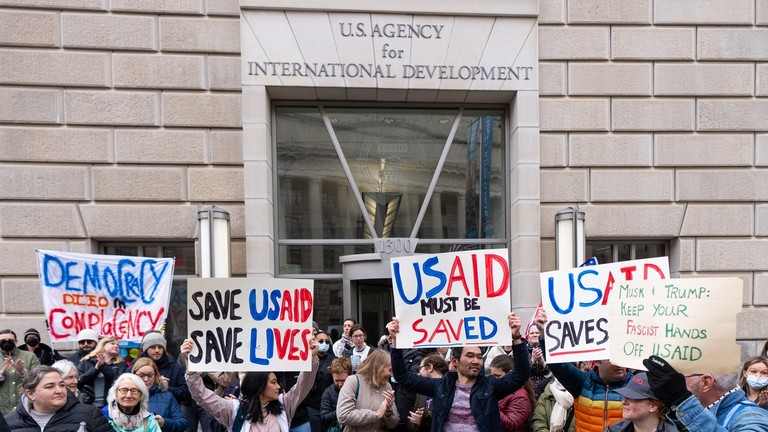
Protesters gather outside USAID headquarters, February 3, 2025 © Bill Clark / CQ-Roll Call, Inc via Getty Images
RT | March 10, 2025
The US Agency for International Development (USAID) has been implicated in funding a Ukrainian organization, Molfar, which labeled Vice President J.D. Vance and other US officials and public figures as “foreign propagandists” aligned with Russia, according to an investigation by The Grayzone.
Molfar, established in 2019, describes itself as an open-source intelligence community platform which “collects lists of Ukrainian enemies to bring war criminals to justice.” The group’s website identifies USAID and the US Civil Research and Development Fund (CRDF) as partners, indicating financial and operational support from US government agencies.
The group’s online blacklist not only targeted Vice President Vance for his statements opposing continued US financial support for Kiev and his stance against Ukraine’s NATO membership, but also targeted other American figures, including US Counterterrorism Director Joe Kent and Representative Thomas Massie. Molfar’s website advocated for their “removal from public positions, the introduction of sanctions, and investigations into personal involvement in crimes.”
In addition to political figures, Molfar has targeted American journalists, including Max Blumenthal, editor-in-chief of The Grayzone. The organization accused Blumenthal of disseminating Russian narratives and threatened to expose his personal information, including home addresses and family details.
Other notable figures targeted by Molfar include billionaire tech entrepreneur Elon Musk, journalists Glenn Greenwald and Tucker Carlson, and award-winning American economist and public policy analyst Jeffrey Sachs.
A report published by Ukraine’s National Coordination Cybersecurity Center (NCSCC), bearing USAID’s logo, highlighted that Molfar assisted in training thousands of Ukrainian government employees in cyber warfare techniques and psychological operations. The report stated that over 2,000 public workers participated in practical assignments covering topics such as open-source searches, contact search, using Telegram bots, psyop as a method of information warfare, human intelligence and social engineering.
According to The Grayzone, Molfar’s activities are part of a broader network of Ukrainian organizations involved in Kiev’s information war efforts at the expense of US taxpayer money.
Another self-styled “fact-checking” outfit, VoxUkraine, has received substantial funding from the National Endowment for Democracy (NED) and USAID. Its VoxCheck project has been involved in censoring Americans’ social media posts deemed pro-Russian. Similarly, the Center for Countering Disinformation (CCD), an official body under Ukraine’s National Security and Defense Council, has collaborated with both Molfar and VoxUkraine to combat “disinformation,” often labeling US public figures as promoters of Russian propaganda, including smearing now-Director of National Intelligence Tulsi Gabbard.
Immediately upon assuming office, President Donald Trump suspended most US foreign assistance pending a three-month review to determine whether programs should continue based on their alignment with the new administration’s “America First” goals.
USAID, Washington’s primary mechanism for funding political projects abroad, has seen tens of billions of dollars’ worth of approved grants frozen as a result. The NED’s government funding was also frozen. Officially a US State Department-funded nonprofit for distributing grants to pro-democracy causes abroad, the NED has long faced allegations of acting as a CIA cutout for toppling foreign governments.
Featured Video
Theodore Postol: Iran’s Missiles & Drones Were Underestimated
or go to
Aletho News Archives – Video-Images
From the Archives
What is the Israeli Lobby in Australia Doing in Interfaith Dialogue?
By Ali Kazak | Dissident Voice | October 11, 2015
For years Israel and its lobby around the world have been trying to normalise their relations with Arabs and Muslims without solving the Palestine Question.
One of the methods they resorted to in the last few years is using human rights and community organizations such as interfaith dialogue and Multiculturalism to achieve this objective and to: isolate the Palestinians, marginalise the Palestine question, end Israel’s isolation, and prevent criticism of Israel, knowing that these organisations will be the first to stand against Israel’s violations, racial and religious discrimination.
The group responsible for this task in Australia is The Australia/Israel & Jewish Affairs Council (AIJAC); its Director of International & Community Affairs, Jeremy Jones is in charge of lobbying religious community organizations, specifically Muslims and Christians. Consequently he convened the Faith Communities for Reconciliation, founding participant in the Australian Partnership of Religious Organisations and the Australian National Dialogue of Christians, Muslims & Jews.
AIJAC is a private political propaganda group. It is recognised as the main Israeli lobby in Australia. It coordinates its activities and works intimately with the Israeli embassy in Canberra and different institutions in Israel. It is privately funded by some Jewish businessmen. It monitors closely Australian politicians, the media, ethnic and religious groups, (especially Arabs and Muslims), unions and academics on their stands towards Israel and the Palestine question. … continue
Blog Roll
 Aletho News
- The Most Important Bet You’ve Never Heard Of
- The killing of three Indonesian soldiers in Lebanon should remind Jakarta that Israel does not want peace
- Defeated and delusional: Netanyahu’s remarks reveal $80bn war failure, says analyst
- Iran’s friends are about to make life much more difficult for Israel and the US
- The war of liberation of the Arab and Islamic peoples expands across the Gulf
- Envoy warns UN on Trump’s threat to ‘obliterate’ Iran’s civilian infrastructure
- The Larak Corridor: Iran’s Rial Gate With No US, No Israel, and No Way Around
- ‘Economic terrorism’: Steel facilities hit again in US-Israeli strike
- ‘War Crime’: Iran condemns attacks on Arak, Ardakan nuclear sites
- Two-thirds of Americans want quick end to Iran war even if goals unmet
- If Americans Knew
- Gaza families reunite years after babies evacuated amid Israel’s war
- International Rescue Committee warns Gaza’s children face grave protection risks
- Iran’s Alleged 47-Year War on America: Debunking the 1,050 American Deaths Canard
- Israel wants US to bomb more of Iran’s civilian structures (113,000 is not enough) – Not a ceasefire Day 173
- Ann Coulter Rips Into Fox News for Iran War Coverage
- Joe Kent Urges Americans To Call White House and Congress To Object To Sending Troops Into Iran
- DNC Resolution to Reject AIPAC Funding Puts Democratic Leaders in the Hot Seat
- Swedish foundation to build 400 schools as over 650,000 Gaza children remain without education for 2 years
- Israeli army admits photshopping image of slain Lebanese journalist
- This is how Israel is systematically killing health workers under the cover of war in Lebanon
- No Tricks Zone
- New Study Finds Warming Saves Lives…Cold Temperatures 12 Times More Deadly Than Excess Heat
- German Science Blog Accuses PIK Climate Institute Of Hallucinating Climate Tipping Points
- Devastating Assessment Of Comirnaty Vaccine By Former Senior Pfizer Europe Toxicologist
- New Study: CO2 Is ‘Effectively Negligible’ As An Explanatory Climate Change Factor Since 2000
- Former Pfizer Toxicologist Dr. Helmut Sterz Tells Bundestag Hearing Pfizer Vaccine Should Have Never Been Approved
- Energy Expert: Germany’s Nuclear Phaseout Was A “500 Billion Euro Mistake”
- New Research: South Australia’s Mid-Holocene Sea Surface Temperatures Were 4°C Warmer Than Today
- Storing Green Energy To Last Germany 10 Days Would Require A 60-Million Tonne Battery
- New Studies: UK Sea Levels Were 4 Meters Higher Than Today During The Mid-Holocene
- Destructive Green New Deal: German Energy And Metal Group Warns Of Drastic Crisis
 Aletho News