Lavrov to Pompeo: We can talk Venezuela, but US must stop threatening its legitimate government
RT | March 2, 2019
The US attempts to threaten Venezuela and meddle in the country’s affairs under the guise of supplying humanitarian aid have nothing to do with democracy, Russian FM Sergey Lavrov told his American counterpart, Mike Pompeo.
The top diplomats talked on the phone on Saturday on the initiative of Washington, the Russia Foreign Ministry said.
During the conversation, Lavrov blasted the American threats against the government of Nicolas Maduro, calling them “blatant interference in the internal affairs of a sovereign state and a flagrant violation of international law.”
He also grilled the US Secretary of State over Washington’s attempts to influence the situation in Venezuela under the “hypocritical guise” of providing humanitarian aid to the crisis-hit country. Such actions “have nothing to do with democratic process,” Lavrov said.
Earlier this week, Venezuelan Foreign Minister, Jorge Arreaza, has labeled the US aid to the country “a Trojan horse.” He said that nails and barbed wire to build barricades were seized from the supply trucks on the border with Colombia and provided photos to back his words.
As for Washington’s proposal to hold consultations on Venezuela, Lavrov said that Moscow was ready for such talks. However, he reminded Pompeo that “the principles of the UN Charter must be followed strictly as only the people of Venezuela have the right to decide the future of their country.”
The situation in Venezuela escalated after opposition leader, Juan Guaido, declared himself interim president of the country in late January. He was swiftly backed by the US, which never made a secret out of its desire to see socialist president Maduro removed from power.
However, all the American backing and increased sanction pressure on Caracas have so far been insufficient to cement Guaido’s claim to power as the man fled to neighboring Colombia to lead the coup from there, while promising to return.
Remember the Maine? CIA Intervention in Venezuela

Photograph Source National Museum of the U.S. Navy
By David Rosen | CounterPunch | March 1, 2019
In January 1897, Frederic Remington, a 19th-century painter famous for his depictions of the Old West, was on assignment in Havana for William Randolph Hearst’s New York Journal to illustrate Spanish atrocities against Cubans. He sent a telegram to Hearst, noting: “Everything is quiet. There is no trouble. There will be no war. I wish to return.” Hearst replied: “Please remain. You furnish the pictures and I’ll furnish the war.”
One year later, on February 15, 1898, the battleship USS Maine mysteriously exploded in Havana Harbor. Pres. William McKinley ordered the battleship sent to Havana on January 25th to observe the growing tension between the U.S. and Spain. The explosion killed 268 of the crew’s 354 men and shocked the American public.
The U.S. press went wild with headlines proclaiming, “Spanish Treachery!” and “Destruction of the War Ship Maine Was the Work of an Enemy!” Hearst and the Journal offered a $50,000 award for the “detection of the Perpetrator of the Maine Outrage.” “Remember the Maine, to Hell with Spain!” became a rallying cry.
To this day, no one knows what caused the explosion. Initial reports claimed the ship was sunk by a naval mine. Later investigations, one in 1911 and another in 1974, hypothesized that it was a coal dust fire. Still others believed it was due to sabotage, some speculating it was a covert Hearst operation to increase his newspaper’s readership.
While McKinley sought to maintain peace with Spain, Theodore Roosevelt, the Sec. of the Navy, led the war faction. He insisted, “Let the fight come if it must. I rather hope that the fight will come soon. The clamor of the peace faction has convinced me that this country needs a war.”
On April 21, 1898, the U.S. declared war on Spain. The sinking of the Maine climaxed pre-war tensions, a provocation that accelerated the breakdown in diplomatic relations between the U.S. and Spain. The war last 10 weeks and the U.S. was victorious; it took temporary control of Cuba (although it still controls Guantanamo Bay), control of the Philippines (until 1946) and ongoing control of Puerto Rico and Guam. Provocations can work.
***
Americans will likely never know the complete role the CIA has played – and likely continues to play — in the campaign to overthrow the Maduro government in Venezuela. (Claims of “national security” are used to hide the truth.) The Trump administration’s Troika of Evil – VP Mike Pence, Sec. of State Mike Pompeo and National Security Advisor John Bolton – seem to be plotting the overthrow of the Maduro government. One can well assume that the CIA, along with other agencies of the U.S. military-industrial complex, have been recruited to destabilize Venezuela, if not worse. Given this, one can wonder if another provocative act like the sinking of the Maine will be orchestrated to legitimize a domestic coup – or U.S. military intervention — in Venezuela.
Since Pres. James Monroe proclaimed what became known as the “Monroe Doctrine” in 1823, the U.S. has actively intervened in the affairs of innumerable countries across the globe. Since its establishment in 1946, the CIA has played a key role in U.S. interventions, whether through destabilization campaigns or an outright coups, especially in Latin and South America and the Caribbean.
A review of a dozen or so CIA interventions between 1954 and 2002 is suggestive as to what might be playing out in Venezuela.
Guatemala,1954 – the CIA launched the so-called Operation PBSuccess against president Jacobo Arbenz in support of United Fruit Company and bombed Guatemala City.
Haiti, 1959 – the CIA intervened to halt a popular movement to overthrow the puppet dictator, Francois Duvalier; according to one report, “over 100,000 people were murdered.”
Brazil 1964 – the CIA backed a coup against the democratically-elected president Joao Goulart who threatened to tax U.S. multinational corporations.
Uruguay, 1969 – CIA agent Dan Mitrione trained security forces in torture as part of Operation Condor; the agency pushed a coup that installed a military dictatorship led by Juan Maria Bordaberry.
Cuba, 1961 – the CIA-backed Cubanexiles and oversaw the failed Bay of Pigs invasion in the wake of the Cuban revolution of 1959; repeated CIA attempts to kill Fidel Castro failed.
Bolivia, 1971– the CIA orchestrated a coup against Gen. Juan Jose Torres, installing Gen. Hugo Banzer who imposed a violent dictatorship.
Chile, 1973– the CIA backed Gen. Augusto Pinochet’s coup against Pres. Salvador Allende, imposing a dictatorship that last 17 years.
Argentina, 1976 – the CIA installed Gen. Jorge Rafael Videla in a coup as part of the Dirty War to overthrow the Peronists.
El Salvador, 1979 – the CIA supported a 1979 coup fearing a popular insurgency that culminated in the assassination of Archbishop Oscar Romero (February 1980) and four American nuns (December 1980); in 1984, it financed Jose Durate’s campaign.
Grenada, 1983 – the CIA began efforts to destabilize the Marxist government in 1981 that led to the U.S. Marines invading in the country in ‘83 allegedly to protect about 1,000 American students on the island.
Panama, 1989 – the CIA orchestrated Operation Just Cause to overthrow its long-time operative, the drug trafficker Manuel Noriega, that left 3,500 civilians dead.
Peru, 1990 – the CIA backed Alberto Fujimori presidential election who renamed himself National Intelligence Service director, dissolved Congress and locked up the justices of the Supreme Court.
Venezuela, 2002 – the CIA backed mutinous army officers who briefly deposed Pres. Hugo Chávez in a coup attempt.
The CIA has also been involved in numerous other political and military campaigns in the region.
***
On February 15th, the U.S. celebrated the 121st anniversary of the sinking of the USS Maine. Since then, the U.S. has engaged in numerous military and political interventions in countries across the globe. Since its founding in 1947, the CIA has been the lead federal entity in foreign interventions and is likely playing a key role in the destabilization of Venezuela. Little information about the agency’s role in Venezuela has been reported, but suggestive rumors are circulating.
Earlier this month, a 21 Air cargo flight from Miami International Airport was seized by government authorities in Valencia, Venezuela, transporting 19 assault rifles, telescopic sights, radio antenna and other materiel likely for anti-Maduro forces. The flight company denied all knowledge of what it was shipping. The company that chartered the flight, GPS-Air, flatly rejected any claim that it had shipped weapons. As McClatchy reported, “Only a fool would try sending guns out of the [Miami] airport,” said Cesar Meneses, GP-Air’s cargo shipping manager.
Last year, a rumor circulated that the CIA was involved in an attempted assassination of Pres. Maduro. While giving a TV broadcast speech in February 2018, an explosion disrupted the event and Maduro blamed Colombia for the attack, saying later on, “I have no doubt that the name [Colombian president] Juan Manuel Santos is behind this attack.” Trump advisor Bolton denied any U.S. involvement, insisting on Fox News, “I can say unequivocally there is no US government involvement in this at all.”
It’s unlikely that the American public will know the role the U.S. military-intelligence apparatus, especially the CIA, is playing in the attempted overthrow of the Venezuelan government. A direct military intervention in the grand old sense of Cuba, Panama or Grenada seems unlikely. Unfortunately, the Troika of Evil – Pence, Pompeo and Bolton – are likely scheming for a provocative incident similar to the sinking of the Maine.
How Amnesty International is reinforcing Trump’s regime-change propaganda against Venezuela
By Joe Emersberger | The Canary | February 26, 2019
Amnesty International‘s reports, by their nature, require readers to trust their honesty and impartiality. But there is ample reason not to trust them. Because Amnesty has ignored grave human rights abuses in plain sight in Venezuela while demonizing supporters of Venezuelan President Nicolás Maduro.
Shortly after meeting with Juan Guaidó (whom Donald Trump and a new Iraq-style Coalition of the Willing have anointed as Venezuela’s interim president), Amnesty put out a report that reads like a barely disguised attempt to reinforce, from a ‘human rights’ angle, the military threats against Venezuela from Trump and his henchmen.
Team Trump as Venezuela’s “Only hope”?
Erika Guevara-Rosas, Amnesty’s Americas director, said:
International justice is the only hope for victims of human rights violations in Venezuela. It is time to activate all available mechanisms to prevent further atrocities.
And the report stated that:
[C]ountries genuinely concerned about the human rights situation in Venezuela should explore the application of universal jurisdiction.
Amnesty’s allegations about Venezuela are serious and, if true, deserve condemnation. But there are numerous reasons to question the group’s honesty, impartiality, and public statements.
Somebody should ask Amnesty, for example, to list the countries which are “genuinely concerned”. How many Saudi–arming countries like the US, UK, Canada, and France are on that list?
As Amnesty released this report, the threat of a US military attack on Venezuela disguised a “humanitarian aid delivery” could not be more obvious. Never mind that Venezuela is, in fact, receiving foreign aid with authorization from the Maduro government. US National Security Advisor John Bolton and Senator Marco Rubio have repeatedly made Mafioso-like threats against Venezuela’s military and Maduro. Trump himself has been repeatedly threatening a military “option” since 2017 (the year he reportedly asked “Why are we not at war with Venezuela?”).
Amnesty ignorning Trump’s attack on right to health and food
At the same time, Amnesty has refused to denounce Trump’s financial sanctions which have been in place since August 2017 and whose impact on the entire economy has been crippling. By now, the sanctions have cost Venezuela’s government well over $6bn in revenues in an economy that imported $11.7bn in goods in 2018. Before the deep and sustained collapse in oil prices (and oil production, which nose-dived as the sanctions began), Venezuela’s economy had been importing about $2bn a year in medicines.
It is important to remember that, in Venezuela’s case, Amnesty has been very explicit in pointing to economic problems as human rights abuses. Last year, when they wrote to me refusing to denounce Trump’s sanctions, Amnesty said:
Amnesty International does not take a position on the current application of these sanctions but rather emphasizes the urgent need to address the serious crisis of the right to health and food which Venezuela is facing. In terms of human rights, it is the Venezuelan state’s responsibility to resolve this.
As I’ve noted at The Canary, Amnesty has now updated its position on Trump’s sanctions. It absurdly asks Trump to please be careful and “monitor” the impact of new sanctions that he imposed in January. The new sanctions directly cut off revenues that the Venezuelan government obtained from sales to the US. Amnesty’s continued refusal to acknowledge that a devastating attack on the Venezuelan “right to health and food” has been ongoing since August 2017 is appalling. And that alone is an excellent reason to doubt the honesty and impartiality of their work on Venezuela. Because any credible human rights group would demand an immediate end to all the economic sanctions Trump has imposed.
Violent crime in Venezuela
Amnesty also stated in its latest report that:
The more impoverished areas of Caracas and other parts of the country were particularly affected and stigmatized, registering the highest numbers of victims, who were later presented as ‘criminals’ killed in clashes with the authorities.
There’s no doubt that Venezuela’s security forces have committed crimes. The Maduro government has conceded as much. And Venezuelan police officers were arrested for crimes perpetrated during the violent protests of 2017. In June 2017, Defense Minster Vladimir Padrino López publicly warned security forces in remarks broadcast on state TV that he didn’t “want to see one more national guard perpetrate an atrocity”. Those protests were the fifth US-backed effort to oust the government by force since 2002. Trump is now leading the sixth.
It’s also important to remember that Venezuelan security forces have confronted a very high homicide rate (since long before the current government came to power) and police officer death rate. At the same time, the country has been plagued by violent US-backed protesters for years, who have done things like burn Afro-Venezuelans alive in the streets and murder police officers. And today, it faces the very grave threat of US invasion that would install the most violent opposition groups into power.
We can only imagine how security forces in a country like the UK would behave under the above conditions. Young men have been sent to prison in Britain, for example, simply for writing Facebook posts that advocate riots. I made some of these points last year in response to a similar UN report that was hyped by Reuters.
Venezuela’s very real homicide problem (and violent US-backed opposition problem) could indeed allow security forces to pass off extrajudicial executions as “fighting crime” or as self-defense. But it can also allow apparently partisan groups like Amnesty to distort the situation in support of Trump’s regime-change agenda.
Propaganda groundwork for dirty war on Maduro supporters?
Amnesty said in its report that:
There is a strong presence of pro-Nicolás Maduro armed groups (commonly known as “colectivos”) in these areas, where residents depend to a large extent on the currently limited state programs to distribute staple foods.
Again, the “limited state programs” would be the ones Trump has been viciously attacking through sanctions since 2017. Also notice how Amnesty casts as thugs the organized poor people distributing food to millions of people – up to 60% of households according to an opposition-aligned pollster (Datanálisis).
As George Ciccariello-Maher explained in We Created Chavez, the history of poor people organizing and arming themselves (quite understandably) for self-defense in Venezuela’s poorest neighborhoods goes back decades. It’s not new.
It is Maduro’s supporters in poor neighborhoods and in the countryside, however, who – armed or not – will be violently targeted if the US-backed opposition takes power; especially if they do so in a coup or through a US invasion. Amnesty appears to have little concern about “stigmatizing” them, though, and negligible concern about Trump’s attack on their “right to health and food”.
All of the reasons above make a powerful case for questioning the integrity and objectivity of Amnesty when it comes to Venezuela. And for the sake of peace and justice, we should hold Amnesty to much higher standards.
US Plan to Break Through Venezuelan Border Failed – Russian Foreign Ministry
Sputnik – 28.02.2019
MOSCOW – The US plan to break through the Venezuelan border under the pretext of delivering humanitarian aid failed, Russian Foreign Ministry spokeswoman Maria Zakharova said Thursday.
“The illegal attempt on February 23 by US-inspired radical part of the Venezuelan opposition, supported by extremist groups with Molotov cocktails in hands, to break through the border under the pretext of carrying so-called humanitarian aid was doomed to failure from the very beginning. Its organizers were well aware that any violation of the state border always should and would be stopped, because this is a direct attempt on the country’s sovereignty,” Zakharova said.
“Fortunately, the criminal plan of pseudo-humanitarian officials failed,” she said at a briefing.
Russia will not support the draft resolution proposed by the United States in the UN Security Council, Maria Zakharova stressed.
“Of course, Russia can not support such a project,” Zakharova said, adding that there was nothing new in the draft resolution.
The spokeswoman added that the situation in Venezuela remained alarming with Washington willing to remove the legitimate authorities in Caracas from power.
In the draft resolution, the United States is seeking a new presidential election in Venezuela. The council is expected to vote on the document Thursday night New York time.
On 23 February, the Venezuelan opposition tried to forcefully bring the US-sponsored aid into Venezuela from Brazil and Colombia. The failed attempt resulted in clashes between the Venezuelan National Guard officers, who prevented trucks with aid from crossing the country’s border without permission, and pro-aid protesters, who tried to help force the aid into Venezuela.
Trump’s Democratic Opposition Endorses His Coup Attempt in Venezuela
Illustrating that the exception only proves the rule, Rep. Tulsi Gabbard stood virtually alone, tweeting: “The United States needs to stay out of Venezuela. Let the Venezuelan people determine their future. We don’t want other countries to choose our leaders — so we have to stop trying to choose theirs.”
By Alexander Rubinstein | MintPress News | February 26, 2019
Nothing unites the D.C. blob like a good old coup d’état. The only other times, it seems, that Donald Trump is given a break by “the resistance” is when he acts “presidential” — i.e., orders military aggression, as we saw with Syria.
As veteran journalist Dan Rather put it at the time:
The number of members of the press who have lauded the actions last night as ‘presidential’ is concerning. War must never be considered a public relations operation. It is not a way for an Administration to gain a narrative. It is a step into a dangerous unknown and its full impact is impossible to predict, especially in the immediate wake of the first strike.”
Now, it has been more than a month since the Trump administration worked with Juan Guaido to orchestrate a declaration of his presidency in Venezuela, and the coup attempt has received the endorsement of a likely backer: former Secretary of State Hillary Clinton. While Clinton’s warmongering surprises no one, it is worth examining the statements of others in her political orbit.
MintPress News previously covered the remarks of the “socialists” in Congress — Sen. Bernie Sanders (I-VT) and Rep. Alexandria Ocasio-Cortez (D-NY) — about Venezuela, in which the former called on Venezuela to accept alleged humanitarian aid from the United States and the latter called out the “failure of democracy” in the country.
On Saturday, Clinton tweeted “I urge Nicolás Maduro to allow humanitarian aid inside Venezuela’s borders peacefully.” Hours later, Sen. Sanders tweeted that the “Maduro government must … allow humanitarian aid into the country, and refrain from violence against protesters.”
As Lawrence Korb put it: “We all think the dictator must go; the question is what’s the best way to do it.” Korb is a senior fellow at the pro-Clinton, UAE-funded comms shop Center for American Progress (CAP). Kelly Magsamen, CAP’s Vice President, National Security and International Policy, recently deleted a tweet in which she defended Elliott Abrams as a civil servant who is a “fierce advocate for human rights and democracy.”
Abrams, as MintPress News continues to note, was recently appointed as United States Special Representative for Venezuela and was previously involved in a $27 million plot to arm right-wing South American contras.
Magsamen claimed Abrams made “professional mistakes.” She added that “we all have a lot of work to do together in Venezuela. We share goals.”
While Clinton’s camp is firmly Never-Trump-Except-in-Cases-of-Regime-Change, she — God help us — is not running for president, currently. The Democrats who have declared their candidacies, however, do not differ much in their rhetoric on Venezuela, with rare exception.
Since there is only one Democratic candidate who has made a forceful statement against the coup, let’s start with Rep. Tulsi Gabbard (D-HI), who was among the first to respond, tweeting “The United States needs to stay out of Venezuela. Let the Venezuelan people determine their future. We don’t want other countries to choose our leaders — so we have to stop trying to choose theirs.”
Sen. Kirsten Gillibrand (D-NY), who has thrown her hat in the ring for 2020, condemned Maduro’s “corrupt reign” and repeated the bald-faced lie that Juan Guaido “was legitimately elected,” via a statement through her spokeswoman, Meredith Kelly, to the Huffington Post.
Former Rep. John Delaney (D-MD), who is running for president in 2020, condemned Venezuela’s “corrupt and failed authoritarian regimes.”
Sen. Elizabeth Warren (D-MA) said, “The Venezuelan people deserve free and fair elections, an economy that works, and the ability to live without fear of violence from their own government.”
Pete Buttigieg — a little-known contender who is the mayor of South Bend, Indiana — also called for “free and fair elections.”
Bernie Sanders has done the same and, as MintPress News recently reported, thrown his weight behind demands that Maduro bend to U.S. demands that he accept “humanitarian aid,” which the government of Venezuela believes to be a trojan horse.
In response to a request for comment from the Huffington Post, Sen. Cory Booker (D-NJ), who is yet another 2020 Democrat contender, merely said: “Maduro is alarming to me on many levels.”
Sen. Amy Klobuchar (D-MN) told the outlet “I support the people of Venezuela standing up against Maduro, installing a new leader, and restoring democracy in Venezuela.”
Sen. Kamala Harris (D-CA) and former Obama official and San Antonio Mayor Julián Castro, both of whom are running, did not respond to the Huffington Post’s request for comment, though clues exist as to their positions.
Harris condemned “Maduro’s dictatorial regime” in a tweet on Saturday. While Castro has remained seemingly silent on the U.S.-backed coup attempt in Venezuela, his brother, Rep. Joaquin Castro (D-TX) last year said “We’ve seen Nicolás Maduro undermine Venezuelan democracy and create a regional economic and humanitarian catastrophe.”
“President Maduro consistently violates the basic human rights of the people he governs and must be held accountable,” he added.
Alexander Rubinstein is a staff writer for MintPress News based in Washington, DC. He reports on police, prisons and protests in the United States and the United States’ policing of the world. He previously reported for RT and Sputnik News.
‘Sick & twisted’: US Senator Rubio tweets picture of Gaddafi’s murder as a threat to Maduro

US Sen. Marco Rubio at Colombia-Venezuela border, February 17, 2019. © Reuters / Edgard Garrido
RT | February 25, 2019
US Senator Marco Rubio has posted a picture of the brutal murder of late Libyan leader Muammar Gaddafi in a less-than-subtle threat to Venezuela’s Maduro. Twitter blasted Rubio as a manic warmonger… who has extremely poor taste.
The two pictures –one showing Gaddafi while still in power, the other showing the Libyan leader being tortured minutes before his brutal murder– were posted by Sen. Rubio (R-FL) on Twitter without any caption. Yet, given his open calls for an armed insurrection in the Latin American country to depose President Nicolas Maduro, the message was clear.
Openly threatening a head of a foreign country with a brutal death at the hands of US-propped militants was, apparently, just a tiny bit off: while a few Twitteratti supported Rubio’s vision of Maduro’s demise, the majority blasted the senator over an extreme lack of taste or decency.
Some argued that any account spewing warmongering propaganda at such a rate would likely be suspended – if it did not belong to a US Senator, of course. “Marco Rubio just posted a violent, graphic death threat. If any of the rest of us posted this, we’d be suspended for it,” journalist Bill Palmer tweeted.
Many noted that Libya is not the best example of the US bringing its democracy overseas, but arguably the worst one. With the slave trade there on the rise, the country is effectively fractured into several warring statelets, with gangs of armed ‘democrats’ fighting for control.
Apart from the pictures of Gaddafi, Rubio posted a similar split of Manuel Noriega – the de facto ruler of Panama in the 1980s. Once a valuable CIA asset who’d helped Washington in arming the Contras of Nicaragua, Noriega was ousted during the US invasion of the country. Needless to say, the invasion claimed many lives, while Noriega spent the rest of his life in prison.
US-backed opposition caught on VIDEO throwing Molotov cocktails at aid truck on Venezuela border
RT | February 24, 2019
As Washington and Caracas blame each other for torching a truck carrying what the US called vital ‘humanitarian supplies’ from Colombia to Venezuela, a video has emerged, finally shedding some light on the incident.
The truck caught fire and burned down during a failed attempt on Saturday by US-backed opposition activists to breach the closed Colombia-Venezuela border crossing at the Francisco de Paula Santander Bridge, near the Venezuelan city of Urena. The Venezuelan government refuses to let the American cargo in, calling these ‘humanitarian’ convoys a propaganda stunt and a precursor to a military invasion.
Photos of the incident were immediately used by US officials to double down on their outrage and calls for regime change in Caracas. But footage that has surfaced on social media tells a strikingly different story, pinning the blame on ‘activists’ in the crowd.
One clip appears to have caught the moment a man on the Colombian side of the border pelted a Molotov cocktail at the truck, while another video from the scene showed the opposition activists openly preparing the incendiary devices. Border security guards can be seen patiently holding their line at a distance, casting further doubts on claims that the truck was seized and torched after it had crossed into Venezuela. … Videos
Fake Humanitarianism Fails its Big Test in Venezuela
By Maximilian C. Forte | Zero Anthropology | February 24, 2019
There it is: Saturday, February 23, 2019, has now come and gone—and it’s not to say that “nothing has changed”. In fact, some important changes did occur, none of which were the ones hoped for by either the self-declared “president” of Venezuela, Juán Guaidó, nor the ones commanded by the President of the US, Donald “Can I have my Nobel Peace Prize now?!” Trump. US options have thus narrowed, as we enter a protracted and potentially more dangerous phase where possible US military intervention draws closer. So let’s quickly review some of the changes introduced by yesterday’s events.
First, the unelected, self-declared “president” of Venezuela is no longer even in Venezuela. He used the opportunity of the US AID stunt to spirit himself across the border to Colombia, with the apparent well-wishes of ushers in the Venezuelan military (he should have been suspicious, unless he really intended to flee), and Guaidó now finds himself as a tourist in Colombia. Second, the military which Guaidó presumed to order, completely ignored him and remained loyal to the established government, the only legal and legitimate one. Indeed, the third point is that in failing the credibility test, Guaidó also failed the legitimacy test: how can he be viewed as a legitimate leader, without anything to lead, and with none of the state machinery following him? That is not a leader; at best, Guaidó can be defined an aspirant to power. He is a legitimate aspirant. Some in the opposition are already speaking of an alternative deal with the Maduro government. Having failed the credibility and legitimacy tests, a frustrated Guaidó had no option other than to invite foreign military intervention—if his own military won’t listen to him, surely other nations’ militaries will? And what about Richard Branson’s much vaunted aid concert? That takes us to the fourth point: that concert was drowned out, not just by a competing concert on the Venezuelan side of the border, and not just because it failed to draw any major international acts (perhaps thanks to Roger Waters), but the events of the day itself meant that not even a word was mentioned about the concert. It was like it had never happened. The fifth development is probably the most significant: US AID via Colombia, and similar “aid” intrusions from Brazil and Puerto Rico, were a resounding failure. The frustration that had been building up for days about the lack of a viable plan, was well warranted, as was Maduro’s optimism. Not well warranted were the raised expectations.
(Note, while the headline in the The New York Times claims that aid came in via Brazil, its source on the ground instead said, “The whole thing has failed” and the trucks “remained stranded on the border”. The story is misleadingly playing on a technicality: the aid left the Brazilian side of the border, but did not pass the Venezuelan checkpoint.)
What’s Next?
This takes us back to the central question of the previous article: what is the US’ next move? Simply insulting the Venezuelan armed forces, in what some called an “irresponsible speech,” by suggesting they are guilty of dereliction of duty, then insulting them further by saying Cuba directly controls the Venezuelan military, and then insulting them yet again by assuming that they should instead take their orders directly from Washington—will not work, and that much has been proven. Threats to the safety of Venezuelan soldiers only augment the offense. The US, speaking the language of “democracy promotion,” has been openly hoping for a palace coup—no such movement is in evidence however. All we know is that Vice President Mike Pence (who is likely leading the Venezuela intervention to shield Trump from any illegalities likely to be committed) will be meeting with aspirant Guaidó at his new lodgings in Colombia. That, and more sanctions, as if Venezuela’s government expected anything else.
Clearly the obese billionaire in the Oval Office relished the prospect of one day (soon) boasting that he had toppled a “regime” by just throwing some scraps of dog food at the feet of “desperate and starving” Venezuelans. (They just have to be desperate and starving, because their place in the natural order of things is that they are citizens of a “shit hole country”.) It would have pleased him immensely, he would have smiled slyly, to know that a well fed American can dangle a MRE pack in front of “hungry” eyes, and then sit back and listen to them scamper and scuffle. Such images enforce the evolutionist paradigm of progress, development, and global dictatorship. Trump would have told his friends: “You should have seen what happened, I just sent in crap like TV dinners to that shit hole country, and those pathetic losers fell all over themselves to get it, and the regime collapsed. Poof! Beautiful. Then I took their oil”. (The last point is important, because Trump has the ethics of a looter, and his foreign policy is a projection of his business practice: theft, scams, and all sorts of other wrongdoing enough to warrant hiding many years of tax returns behind some old yarn about an audit that is apparently eternal.)
Particularly important about the day’s events was the fact that two partners in an intended coup each failed their respective tests. The US and its regional allies showed that they could not even spirit in some boxes of junk “aid” and that they held no sway over the Venezuelan military. Guaidó failed to show that he commanded any support that mattered. He didn’t even have a few miserable boxes of US aid to selectively hand out to build up a patron-client network. Having auditioned for the role of CIA tool, he only demonstrated he was not worthy of the investment. He then fled. Then the government shut down his rumoured base of operations in Caracas: the Colombian embassy. The US could not have achieved less had it picked up any random person off the streets of Caracas.
Regime Survival Got a Boost
The unintended by-product of the US’ inability to command change, is a recipe for regime survival: everything that Venezuelans suffer from now on can be appropriately and rightly blamed on US intervention; opponents of President Nicolás Maduro can be labelled traitors, CIA proxies, and puppets of Washington, with considerable justification—thanks to US intervention; Venezuela will adapt and survive US sanctions like multiple other states have done; US oil refineries, shipping companies, insurance firms and banks—the other side of Venezuelan exports of oil to the US—will now suffer irreversible loss, and the US thus also loses its chokehold on Venezuela. Rather than American hegemony, it’s multipolarity that is advancing, with Venezuela moving closer into the orbits of Russia, China, and India. (India itself is completely unafraid of US sanctions, according to Indian analysts.) The US, especially under Trump, has responded to almost everything and everyone with either sanctions or their twin, tariffs, to the extent that there is virtually not a nation left on earth that is not subject to some sort of tariff or sanction from the US. The US is sanctioning itself into irrelevance, as the rest of the world devises ways of learning to live without it.
What Did We Not See?
What was strangely absent from the day, in all the live television footage and numerous photographs of the events, were at least two things: one was that however many showed up to back Guaidó, it certainly was not the 700,000 to a million people he had promised. The other was the bizarre absence of any Venezuelan soldiers from virtually all of the photographs and live television coverage. How they could maintain a forceful presence, yet remain invisible to the media, is quite an achievement—one that denies the media any coup-worthy moments of manufactured, orchestrated outrage. Of course what was also absent—and we knew this would be—was any evidence of these supposedly starving Venezuelans. Having grown up in a society saturated with media images of the now classic “starving Ethiopian,” emaciated bodies with distended bellies, it’s noteworthy that the coup media cannot pull off such a display with Venezuela—that would be the same Venezuela with the supermarkets stuffed with goods.
Beware of Alternative “Fake News”
These postscripts are intended as memoranda to RT, CNN, and others: please check your sources for the claim that former US Assistant Secretary of State Elliot Abrams was involved in actually smuggling in weapons in the guise of humanitarian aid. However appealing that image may be, it is a dorky and corny tale that arouses suspicion. It generally does not pass the smell test—check the last two links for further insight, and also see the Wikipedia page. Abrams was, after all, a State Department official, and not a field operative. In addition, he is being blamed for the operations that were conducted by Lt. Col. Oliver North and the CIA. The “humanitarian aid” disguise was aimed at the US Congress: Congress appropriated funds for humanitarian aid, and some of the funds were misused to arm the Contras illegally. It was no secret that the US was arming the Contras either—they were backed by the US, and they were armed. Most of that aid went to US bases in El Salvador and Honduras (US allies), where there was no need to “disguise” the aid, and it went to the Contras, a military force—again no need to disguise the aid. It’s not like Abrams called Contra leaders and surprised them: “We’re sending you some bags of rice. Or are we? Wink, wink”. They certainly were not fooling Nicaragua’s government, nor did Nicaragua allow in any such “aid” only to somehow find out it was not real humanitarian aid at all—that never happened. Nicaraguan authorities did capture a US pilot, after an illegal flight resulted in a crash inside Nicaragua, revealing the contents of what the US was sending the Contras: weapons, when Congress had banned military aid to the Contras. Abrams was just one figure among many in the story, and not the most directly involved.
The “Trojan Horse” charge is thus being misinterpreted and turned into something laughable. No serious person thinks the US was trying to smuggle in weapons in US AID boxes, in front of thousands of cameras in the plain light of day. That’s why not-so-secret flights exist instead. The “Trojan Horse” idea instead seems to be a little too complicated for the media which prefers a cartoonish rendition. The serious argument is that the aid was intended to shore up Guaidó’s power, since the aid was going directly to the opposition; and, the aid expressly bypassed the legal and legitimate government authorities of Venezuela, and was thus meant to undermine their authority. Furthermore, Guaidó spoke of the “aid” effort as being one that would create a “humanitarian corridor”—echoing terminology used by the US in Syria—and which would have meant wresting territory from the hands of the Venezuelan state, thus allowing the US free passage in and out at will. In addition, the hoped-for clash (which did not materialize to the extent that was feared) could have served as a pretext for warming up international opinion in favour of a US military “rescue”. That’s the extent of the Trojan Horse in this case—it’s not about grenades inside bags of rice. Otherwise President Nicolás Maduro did not “reject” any so-called “aid” from the US, because none had been given to him. The only thing the Venezuelan government did was to block its borders from being used for illegal purposes by foreign powers—its sovereign right. It did so, and it won.
Also tenuous is the story, repeated on RT several times now, that seems to take great joy in upbraiding rivals like CNN for reporting that Venezuelan authorities had “closed” the Tienditas bridge, built in 2016 and supposedly never opened (a bridge to nowhere?). Venezuelan authorities did in fact move containers to block that bridge, and were recorded doing so by Colombian authorities on February 5, of this year. Moreover, and this is the more important point: Maduro repeatedly said any attempt to move the aid into Venezuela would be blocked. There was never even the slightest hint that Maduro would just stand aside and let it pass. It seems that some foreign journalists are divided by their partisan loyalties and create the appearance of wanting to have their cake and eat it too: the humanitarian aid is not for humanitarian purposes, and has been denounced by several of the leading international humanitarian aid agencies, but it’s not like Venezuela shut down a bridge to prevent aid from reaching suffering masses—this seems to be their odd narrative, designed to satisfy multiple competing constituencies. The events of February 23 will hopefully clarify any lingering misinterpretations, on any side.
Venezuela Coverage Takes Us Back to Golden Age of Lying About Latin America
By Mark Cook | FAIR | February 22, 2019
I was sitting in my apartment in Caracas, Venezuela, reading the online edition of Time magazine (5/19/16), which carried a report that there was not even something as basic as aspirin to be found anywhere in Venezuela: “Basic medicines like aspirin are nowhere to be found.”
I walked out of the apartment to the nearest pharmacy, four blocks away, where I found plenty of aspirin, as well as acetaminophen (generic Tylenol) and ibuprofen (generic Advil), in a well-stocked pharmacy with a knowledgeable professional staff that would be the envy of any US drugstore.
A few days after the Time story, CNBC (6/22/16) carried a claim that there was no acetaminophen to be found anywhere, either: “Basic things like Tylenol aren’t even available.” That must have taken the Pfizer Corporation by surprise, since it was their Venezuelan subsidiary, Pfizer Venezuela SA, which produced the acetaminophen I purchased. (Neither Time writer Ian Bremer nor CNBC commentator Richard Washington was in Venezuela, and there was no evidence offered that either of them had ever been there.)
I purchased all three products, plus cough syrup and other over-the-counter medications, because I doubted that anyone in the United States would believe me if I couldn’t produce the medications in their packages.
Unrelenting drumbeat of lies
In fact, I myself wouldn’t have believed anyone who made such claims without being able to produce the proof, so intense and unrelenting has been the drumbeat of lies. When the Youth Orchestra of Venezuela gave a concert in New York in early 2016, before I moved to Caracas, I went there thinking, “Gee, I hope that the members of the orchestra are all well-dressed and well-fed.” Yes, of course they were all well-dressed and well-fed!
When I mentioned this in a talk at the University of Vermont, a student told me that he’d had the same feeling when he was following the Pan American soccer championship. He wondered if the Venezuelan players would be able to play, because they’d be so weakened from lack of food. In fact, he said, the Venezuelan team played superbly, and went much further in the competition than expected, since Venezuela has historically been a baseball country, unlike its soccer-obsessed neighbors Brazil and Colombia.
Hard as it may be for followers of the US media to believe, Venezuela is a country where people play sports, go to work, go to classes, go to the beach, go to restaurants and attend concerts. They publish and read newspapers of all political stripes, from right to center-right, to center, to center-left, to left. They produce and watch programs on television, on TV channels that are also of all political stripes.
CNN was ridiculed recently (Redacted Tonight, 2/1/19) when it carried a report on Venezuela, “in the socialist utopia that now leaves virtually every stomach empty,” followed immediately with a cut to a demonstration by the right-wing opposition, where everybody appeared to be quite well-fed.
But surely that’s because most of the anti-government demonstrators were upper-middle class, a viewer might think. The proletarians at pro-government demonstrations must be suffering severe hunger.
Not if one consults photos of the massive pro-government demonstration on February 2, where people seemed to be doing pretty well. This is in spite of the Trump administration’s extreme economic squeeze on the country, reminiscent of the “make the economy scream” strategy used by the Nixon administration and the CIA against the democratic government of President Salvador Allende in Chile, as well as many other democratically elected governments.
Rival demonstrations
That demonstration showed considerable support for the government of President Nicolás Maduro and widespread rejection of Donald Trump’s choice for president of Venezuela, Juan Guaidó.
Guaidó, who proclaimed himself to be president of the country and was recognized minutes later by Trump, even though a public opinion poll showed that 81 percent of Venezuelans had never heard of him, comes from the ultra-right faction in Venezuelan politics.
The pro-Maduro demonstration suggested, not surprisingly, that Guaidó had failed to win much popular support outside the wealthy and upper-middle class. But Guaidó couldn’t even win support from many of them. The day before rival rallies February 2, Henrique Capriles, the leader of a less extreme right-wing faction, gave an interview to the AFP that appeared in Últimas Noticias (2/1/19), the most widely read newspaper in Venezuela. In it, Capriles said that most of the opposition had not supported Guaidó’s self-proclamation as president. That may explain the surprisingly weak turnout at Guaidó’s demonstration, held in the wealthiest district of Caracas, and obviously outshone by the pro-government demonstration on the city’s main boulevard.
The New York Times did not show pictures of that pro-government demonstration, limiting itself to a claim by unnamed “experts” (2/2/19) that the pro-government demonstration was smaller than the anti-government one.
Readers can look at the photos of the rival demonstrations and judge for themselves. Both groups did their best to pull out their faithful, knowing how much is riding on a show of popular support. The stridently right-wing opposition paper El Nacional (2/3/19) carried a photo of the right-wing opposition demonstration:
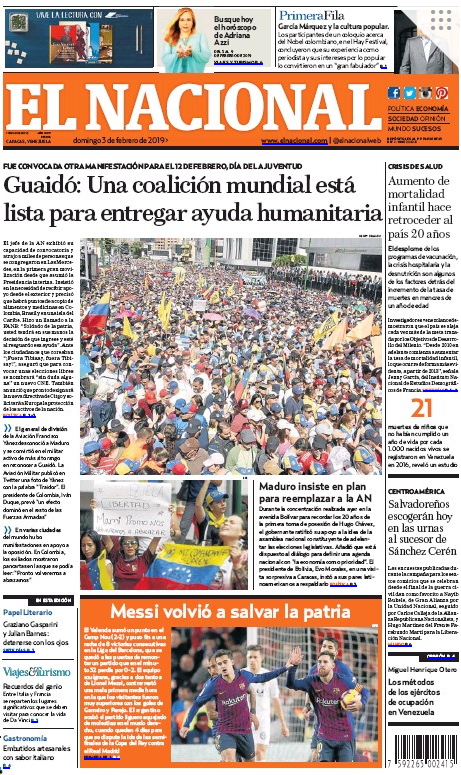
If that was the best photo it could find, it was remarkably unimpressive compared to the photos in the left-wing papers CCS (2/2/19)….
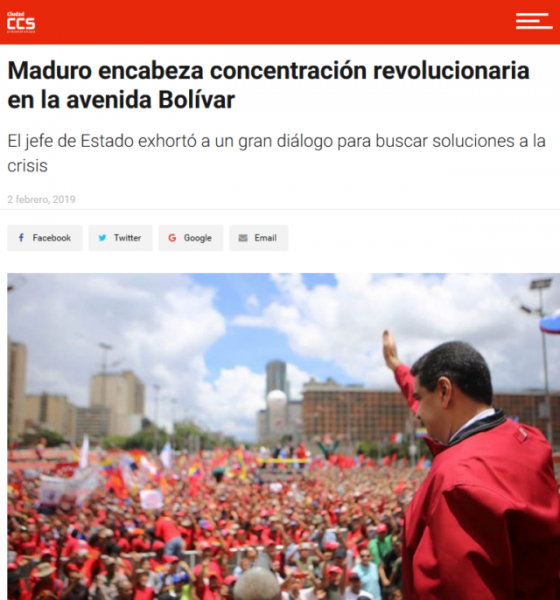
… and Correo del Orinoco (2/3/19), which were only too happy to publish pictures of the pro-government event:
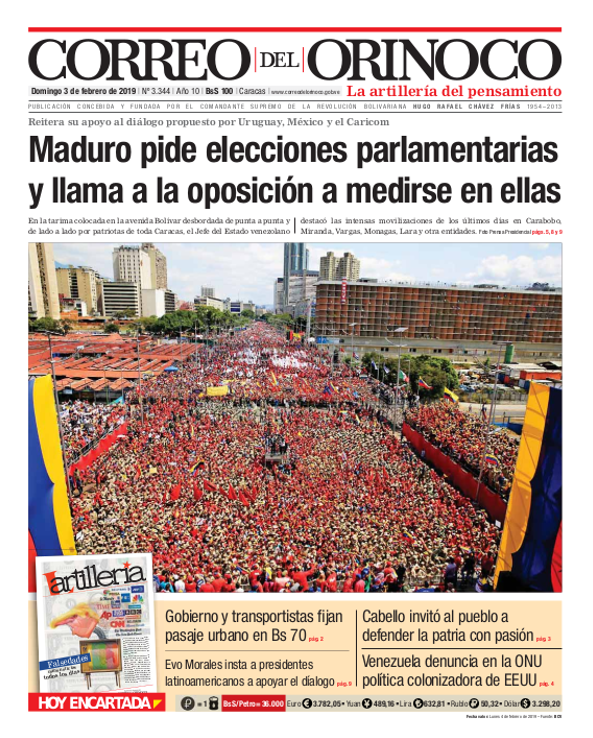
Unlikely humanitarian
A huge anti-government demonstration was supposed to make possible a coup d’état, a maneuver the CIA has used repeatedly—in Iran in 1953, Guatemala in 1954, Brazil in 1964 and many more, straight through to Honduras in 2009 and Ukraine in 2015. The turnout at the Trump administration’s demonstration was disappointing, and the coup d’état never occurred. The result is that Trump has expressed a sudden interest in getting food and medicine to Venezuelans (FAIR.org, 2/9/19).
Trump, who let thousands die in Puerto Rico and put small children in cages on the Mexican border, seems to be an unlikely champion of humanitarian aid to Latin Americans, but the corporate media have straight-facedly pretended to believe it.
Most have suppressed reports that the Red Cross and the UN are providing aid to Venezuela in cooperation with the Venezuelan government, and have protested against US “aid” that is obviously a political and military ploy.
The corporate media have continued to peddle the Trump-as-humanitarian-champion line, even after it was revealed that a US plane was caught smuggling weapons into Venezuela, and even after Trump named Iran/Contra criminal Elliott Abrams to head up Venezuelan operations. Abrams was in charge of the State Department Human Rights Office during the 1980s, when weapons to US-backed terrorists in Nicaragua were shipped in US planes disguised as “humanitarian” relief.
Canada’s CBC (2/15/19) at least had the honesty to acknowledge that it had been had in swallowing a lie from Secretary of State Mike Pompeo that the Venezuelan government had blockaded a bridge between Colombia and Venezuela to prevent aid shipments. The newly built bridge has not yet been opened: it has never been open, apparently because of hostile relations between the two countries, but the non-opening long predates the US government’s alleged food and medicine shipments.
The absurdity of $20 million of US food and medicine aid to a country of 30 million, when US authorities have stolen $30 billion from Venezuela in oil revenue, and take $30 million every day, needs no comment.
‘Failed state’
The campaign of disinformation and outright lies about Venezuela was kicked off in 2016 by the Financial Times. Ironically, it chose the 14th anniversary of the 2002 failed coup d’etat against President Hugo Chávez—April 11, 2016—to claim that Venezuela was in “chaos” and “civil war,” and that Venezuela was a “failed state.” As with the Time and CNBC reports, the Financial Times reporter was not in Venezuela, and there was no evidence in the report that he had ever been there.
I asked right-wing friends in Venezuela whether they agreed with the Financial Times claims. “Well, no, of course not,” said one, stating the obvious, “there is no chaos and no civil war. But Venezuela is a failed state, since it has not been able to provide for all the medical needs of the population.” By that standard, every country in Latin America is a failed state, and obviously the United States too.
The New York Times has run stories (5/15/16, 10/1/16) claiming that conditions in Venezuelan hospitals are horrendous. The reports enraged Colombians in New York, who have noted that a patient can die on the doorstep of a Colombian public hospital if the patient has no insurance. In Venezuela, in contrast, patients are treated for free.
One Colombian resident in New York said that his mother had recently returned to Bogotá after several years in the United States, and had not had time to obtain medical insurance. She fell ill, and went to a public hospital. The hospital left her in the waiting room for four hours, then sent her to a second hospital. The second hospital did the same, leaving her for four hours and then sending her to a third hospital. The third hospital was preparing to send her to a fourth when she protested that she was bleeding internally and was feeling weak.
“I’m sorry, Señora, if you don’t have medical insurance, no public hospital in this country will look at you,” said the woman at the desk. “Your only hope is to go to a private hospital, but be prepared to pay a great deal of money up front.” Luckily, she had a wealthy friend, who took her to a private hospital, and paid a great deal of money up front.
Such conditions in Colombia and other neoliberal states go unmentioned in the US corporate media, which have treated the Colombian government, long a right-wing murder-squad regime, as a US ally (Extra!, 2/09).
Well, OK, but are the reports of conditions in Venezuelan hospitals true or grossly exaggerated? “They are much better than they were ten years ago,” said a friend who works in a Caracas hospital. In fact, he said, ten years before, the hospital where he worked did not exist, and new hospitals are now being opened. One was dedicated recently in the town of El Furrial, and another was opened in El Vigia, as reported by the centrist newspaper Últimas Noticias (3/3/17, 4/27/18). The government has also greatly expanded others, like a burn center in Caracas and three new operating rooms at the hospital in Villa Cura.
Meanwhile, the government is inaugurating a new high-speed train line, The Dream of Hugo Chávez, in March (Correo del Orinoco, 2/6/19). Since the US media have never allowed reporting on any accomplishments in the years since Chávez took office in 1999, but only any alleged, exaggerated or, as noted, completely invented shortcomings, readers have to consult an alternative history. Here is one offered by a Venezuelan on YouTube (3/31/11): “Por Culpa de Chávez” (“It’s Chávez’s Fault”). Depicting new hospitals, transit lines, housing, factories and so on built under Chavismo, it might help many understand why the Maduro government continues to enjoy such strong backing from so many people.
Economic warfare
This is not to minimize Venezuela’s problems. The country was hit, like other oil-producing countries, and as it was in the 1980s and ’90s, by the collapse of oil prices. That failed to bring down the government, so now the Trump administration has created an artificial crisis by using extreme economic warfare to deprive the country of foreign exchange needed to import basic necessities. The Trump measures seem designed to prevent any economic recovery.
Like any country at war (and the Trump administration has placed Venezuela under wartime conditions, and is threatening immediate invasion), there have been shortages, and products that can mostly be found on the black market. This should surprise no one: During World War II in the US, a cornucopia of a country not seriously threatened with invasion, there was strict rationing of products like sugar, coffee and rubber.
The Venezuelan government has made food, medicine and pharmaceuticals available at extremely low prices, but much of the merchandise has made its way to the black market, or over the border to Colombia, depriving Venezuelans of supplies and ruining Colombian producers. The government recently abandoned some of the heavy price subsidies, which resulted initially in higher prices. Over the past few weeks, prices have been coming down as supplies stayed in Venezuela, especially as the government gained greater control over the Colombian border to prevent smuggling.
There has never been a serious discussion of any of this in the US corporate media, much less any discussion of the campaign of lies or the Trump administration warfare. There has been no comparison with conditions in the 1980s and ’90s, when Venezuela’s neoliberal government imposed IMF economic recipes, resulting in a popular rebellion, the bloody 1989 Caracazo, when wholesale government repression took the lives of hundreds (according to the government at the time) or thousands (according to government critics), and martial law took the lives of many more.
Efforts by the right-wing opposition to provoke a similar uprising, and another Caracazo that could justify a foreign “humanitarian intervention,” have failed repeatedly. So the US administration and corporate media simply resort to the most extreme lying about Latin America that has been seen since the Reagan administration wars of the 1980s.
Venezuela Denounces 2nd False Flag Operation at Colombia Border
teleSUR | February 23, 2019
A new episode in the false flag operation being waged against the Venezuelan government to justify a foreign intervention, happened on the Francisco de Paula Santander International Bridge that links Venezuela and Colombia.
Two out of the four trucks with alleged “humanitarian aid” from USAID, which were trying to illegally enter Venezuela, were burned at the border between the two countries. The burning trucks were on the Colombian side of the Francisco de Paula Santander Bridge where Venezuelan opposition leaders have been leading protests.
According to witnesses, violent right-wing opposition members torched the trucks with Molotov cocktails and then tried to incriminate the Bolivarian National Guard (GNB) and the Bolivarian National Police (PNB). teleSUR’s Madelein Garcia, reported that the trucks were supposedly trying to enter Venezuela, but were then burned on the part of the bridge that belongs to Colombia.
The version of events saying that the trucks burned due to a “teargas bomb”, which are not incendiary devices, has been circulating on Colombian and international media networks and on social media.
In addition, some people were trying to illegally enter Venezuela using Red Cross jackets, despite not being affiliated with the international medical organization. The Red Cross has already officially rejected these attempts by the U.S. to deliver politicized “humanitarian aid.”
The International Federation of Red Cross and Red Crescent Societies has stated on its certified Twitter account that they have noticed “some people not affiliated with Red Cross Colombia and Red Cross Venezuela wearing Red Cross emblems at the Colombia-Venezuela and Brazil-Venezuela border.”
The International organization has urged these people ” to stop doing this. They might mean well but they risk jeopardizing our neutrality, impartiality & independence.”
Also Saturday morning another false flag operation was denounced by the Venezuelan government. A group of low-level soldiers of the Venezuelan National Guard Saturday took over multiple armored vehicles that belong to the Venezuelan army and rammed them into border barriers at the Venezuelan-Colombian border in a staged operation ordered by right-wing opposition members in Colombia.
During a massive demonstration in favor of peace and democracy in Venezuela, President Nicolas Maduro declared the coup d’etat defeated because of the unity of civil society with the military.
Venezuela: An Open Letter to the UN Secretary General

Alfred de Zayas, human rights lawyer & UN independent expert on international order. His report on Venezuela has been buried by the MSM.
OPEN LETTER TO THE UNITED NATIONS SECRETARY GENERAL ANTONIO GUTERRES
AND TO THE HIGH COMMISSIONER FOR HUMAN RIGHTS MICHELLE BACHELET
from Alfred de Zayas, 23 February 2019
Dear Michelle Bachelet,
Dear Antonio Guterres
As former UN Independent Expert on the Promotion of a Democratic and Equitable International Order (2012-2018) I would like to urge you to once again make your voices heard and make concrete proposals for mediation and peace in the context of the Venezuelan crisis.
The most noble task of the United Nations is to create the conditions conducive to local, regional and international peace, to work preventively and tirelessly to avoid armed conflicts, to mediate and negotiate to reach peaceful solutions, so that all human beings can live in human dignity and in the enjoyment of the human right to peace and all other civil, cultural, economic, political and social rights. I am particularly worried by the Orwellian corruption of language, the instrumentalization and weaponization of human rights and now even of humanitarian assistance.
I look back at my UN mission to Venezuela in November/December 2017 as a modest contribution to facilitate the cooperation between the United Nations and the Venezuelan government and to open the door to the visits of other rapporteurs. See my report to the UN Human Rights Council and the relevant recommendations.
I believe that it would be timely and necessary for both of you to issue a statement reaffirming General Assembly Resolutions 2625 and 3314 and the 23 Principles of International Order that I formulated in my 2018 report to the Human Rights Council. See para 14 of [the report].
It would be appropriate to recognize the fact that the government of Venezuela has put into effect some of the recommendations contained in my report — and in the six page confidential memo that I personally gave to Foreign Minister Jorge Arreaza upon my departure.
Indeed, first the Venezuelan government released 80 detainees — including Roberto Picón and 23 others whose release I had specifically requested — that was on 23 December 2017, followed by other releases in the course of 2018. Alas, there has been practically no information about this in the mainstream media, although it is easily accessible in the internet. See also the comments of Venezuela on my report.
In particular paragraph 46(xvi):
As a result of this on 23 December 2017, 80 people arrested for acts of violence during the protests in the country were released; and on 1 June 2018, 39 more people were released.
And paragraph 46(xviii):
In this regard, the Venezuelan Government values the willingness and disposition of the Independent Expert, who was pleased to inform the competent authorities of the requests he received from some relatives of the persons deprived of their liberty. His recommendations were accepted.
Shortly after my visit Venezuelan authorities met with the UN agencies and made additional cooperation accords, thanks to the valuable efforts Peter Grohmann, the UNDP representative in Caracas.
Now the government of Venezuela has formally asked the United Nations for humanitarian assistance in connection with the current crisis. We must not let them down.
I think that the US should turn over all the humanitarian assistance and medical supplies it has flown into Colombia and have them distributed as soon as possible with the help of the United Nations and other neutral organizations, including the International Committee of the Red Cross.
Another item of information that is sorely missing from the mainstream media is the delivery last week of 933 tons of food and medicines at port La Guaira — coming from China, Cuba, India, Turkey etc.
Moreover an additional 300 tons of medicines and medical supplies provided by Russia arrived by air.
As I know from my conversations with Venezuelan ministers during my visit in 2017 and the recent conversations I have had with Venezuelan Ambassador to the UN in Geneva Jorge Valero – Venezuela has always welcomed and repeatedly asked for assistance from neutral and friendly governments so as to overcome the adverse human rights impacts of the financial blockade and the sanctions. Such help should be offered in good faith, without strings attached.
I believe that this is the moment for Michelle Bachelet to accept the invitation of the government of Venezuela, extended to her in December 2018, to visit Venezuela personally. Her presence in Venezuela should ban the growing danger of a military intervention by foreign entities. She should endorse the efforts at mediation launched by Mexico and Uruguay at the Montevideo mechanism.
There are ominous parallels with the run-up to the Iraq invasion in 2003 — an illegal war, as Kofi Annan said on repeated occasions.
It is obvious to any first year law student that the constant threats against Venezuela are contrary to article 2(4) of the UN Charter. What many do not realize is that the threats, the economic war, the financial blockade and the sanctions violate the principles contained in Article 3 of the OAS Charter
e. Every State has the right to choose, without external interference, its political, economic, and social system and to organize itself in the way best suited to it, and has the duty to abstain from intervening in the affairs of another State. Subject to the foregoing, the American States shall cooperate fully among themselves, independently of the nature of their political, economic, and social systems; f. The American States condemn war of aggression: victory does not give rights; g. An act of aggression against one American State is an act of aggression against all the other American States; h. Controversies of an international character arising between two or more American States shall be settled by peaceful procedures; I. Social justice and social security are bases of lasting peace…
Moreover, they violate numerous articles of Chapter 4 of the OAS Charter,
Article 17
Each State has the right to develop its cultural, political, and economic life freely and naturally. In this free development, the State shall respect the rights of the individual and the principles of universal morality.
Article 18
Respect for and the faithful observance of treaties constitute standards for the development of peaceful relations among States. International treaties and agreements should be public.
Article 19
No State or group of States has the right to intervene, directly or indirectly, for any reason whatever, in the internal or external affairs of any other State. The foregoing principle prohibits not only armed force but also any other form of interference or attempted threat against the personality of the State or against its political, economic, and cultural elements.
Article 20
No State may use or encourage the use of coercive measures of an economic or political character in order to force the sovereign will of another State and obtain from it advantages of any kind.
Dear Michelle Bachelet, dear Antonio Guterres: The world looks up to you in the hope that you can avert even greater suffering to the peoples of Venezuela. They need international solidarity as expressed in the report of Virginia Dandan, the then independent expert on human rights and international solidarity.
I remain respectfully yours
Professor Dr. Alfred de Zayas, Geneva School of Diplomacy
Red Cross denounces unsanctioned use of its emblems to smuggle US aid to Venezuela
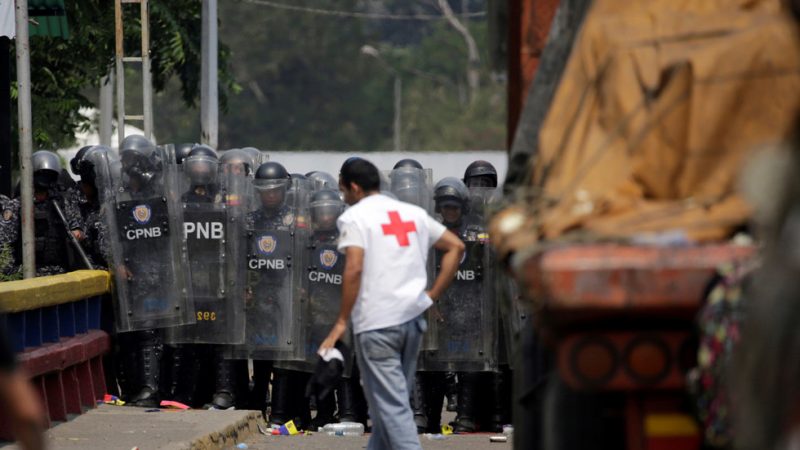
Security forces block the Francisco de Paula Santander bridge between Colombia and Venezuela © Reuters / Marco Bello
RT | February 23, 2019
The largest international aid organization has demanded that activists at the Venezuela-Colombia border not use the insignia of the Red Cross, which isn’t participating in what Caracas has dismissed as a US “propaganda show.”
The Red Cross learned that some “people not affiliated” with the agency are trying to disguise themselves as aid workers to smuggle cargo for Venezuela’s opposition across the closed frontiers.
“They might mean well but they risk jeopardizing our neutrality, impartiality & independence,” the International Federation of Red Cross and Red Crescent Societies said.
Earlier, Venezuelan Foreign Minister Jorge Arreaza stressed that the UN and the International Red Cross are not participating in the “propaganda show” staged by the United States. “It is clearly an action with political objectives, it could never be described as a humanitarian action,” he said on Twitter, accusing the governments involved in the US plot of violating the principles of the UN charter.
The government of Nicolas Maduro has sealed off the borders with neighboring Colombia, Brazil and the Dutch island of Curacao, trying to prevent US shipments from entering the Latin American State. Caracas denounced the ‘aid’ as a highly-publicized attempt to foster division and chaos, and possibly to use it as a cover to smuggle arms to the country’s opposition.
Featured Video
The Sordid History of the CIA – Part 2
or go to
Aletho News Archives – Video-Images
From the Archives
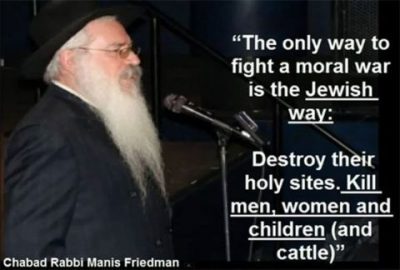
Rabbi Shmuel Eliyahu: Leave No Palestinian or Arab Alive
By Jonas E. Alexis | Veterans Today | July 23, 2017
Israeli Rabbi Shmuel Eliyahu seems to have picked up where the late Rabbi Ovadiah Yosef left off. The Israeli army, Eliyahu said, must slaughter the Palestinians “and leave no one alive.” The Palestinians, the good rabbi continued, must be “destroyed and crushed in order to end violence.” Here is Eliyahu’s algorithm:
“If they don’t stop after we kill 100, then we must kill 1,000. And if they do not stop after 1,000, then we must kill 10,000. If they still don’t stop we must kill 100,000, even a million.”
There is more to this “logic” than meets the eye and ear. Eliyahu even postulated that the Israeli army ought not to get involved in arresting Palestinians because “If you leave him alive, there is a fear that he will be released and kill other people. We must eradicate this evil from within our midst.”
You may say that this is just an isolated case. No Israeli official believes that, right? … continue
Blog Roll
Recent Comments


 Aletho News
- The Sordid History of the CIA – Part 2
- French FM under fire over ‘false’ claims about UN rapporteur
- Israel Wants ISIS-Linked Militias To Control Rafah Crossing — The New Order in Gaza
- ISIS never left Syria, it just changed uniforms
- Why ARE the US and Israel Obsessed With Eliminating Iran’s Ballistic Missiles?
- Kremlin comments on EU ‘myopia’ over dialogue with Russia
- Russia more adapted to contemporary military technology than NATO
- Germany puts caveat on more missiles for Ukraine
- UK High Court rules Palestine Action ban unlawful
- Populations in key NATO nations balk at sacrifices for military spending – poll
- If Americans Knew
- Israel used weapons in Gaza that made thousands of Palestinians evaporate
- ADL’s Stats Twist Israel’s Critics Into Antisemites
- Why Is the World Silent When the Gaza Genocide Is Not Over?
- In Gaza: 8,000 bodies under rubble, 3,000 missing – Not a ceasefire Day 126
- AZAPAC, the new PAC opposing Israeli domination of U.S policies
- Haim Saban: Billionaire for Israel
- Rafah e-wallet plan highlights Israel’s deepening financial occupation
- Viral post claims Netanyahu sought legal approval, igniting speculation about Israel’s organ harvesting
- AIPAC Has a New Opponent: PAL PAC
- Right-Wing Catholic Off Trump Religion Panel After Israel-Gaza Remarks at Antisemitism Event
- No Tricks Zone
- German Gas Crisis…Chancellor Merz Allegedly Bans Gas Debate Ahead of Elections!
- Pollen Reconstructions Show The Last Glacial’s Warming Events Were Global, 10x Greater Than Modern
- Germany’s Natural Gas Storage Level Dwindles To Just 28%… Increasingly Critical
- New Study Rebuts The Assumption That Anthropogenic CO2 Molecules Have ‘Special’ Properties
- Climate Scientist Who Predicted End Of “Heavy Frost And Snow” Now Refuses Media Inquiries
- Polar Bear Numbers Rising And Health Improving In Areas With The Most Rapid Sea Ice Decline
- One Reason Only For Germany’s Heating Gas Crisis: Its Hardcore-Dumbass Energy Policy
- 130 Years Later: The CO2 Greenhouse Effect Is Still Only An Imaginary-World Thought Experiment
- New Study Affirms Rising CO2’s Greening Impact Across India – A Region With No Net Warming In 75 Years
- Germany’s Natural Gas Crisis Escalates … One Storage Site Near Empty …Government Silent
 Aletho News