Is the U.S. Prepared to Accept a Defeat in Venezuela?
By Marco Teruggi – Pagina 12 – April 12, 2019
The attack should have been short since the Maduro administration was not strong enough to resist. This was the conviction of the United States as they carried out a strategy to overthrow him: they built a President 2.0 Juan Guaido; they gave him a fictionalized government, international recognition, a collective narrative among mass media companies, accelerated economic sanctions at different levels. Overlapping these variables, different results were expected to be achieved on their path of getting a forced negotiation or the toppling of the government.
Events did not take the planned course. First and most important, the breaking of the Bolivarian National Armed Force (FANB): a crucial element that should have happened but did not. A series of tactics were implemented for it, from internal conspiracy with the support of a lot of dollars, visas and guarantees, or the strategy of a latent threat of a possible U.S. intervention. A combination of bluff – an unloaded weapon pointed at your head – with built up dates to try to achieve a rupture, such as on February 23rd.
The second event that should have occurred, despite the difficulty in defining a target, was Guaido supposedly building mass support in the streets. He boasted that 90 per cent of the population supports him. Pictures of his mass mobilization capacity show that the initial momentum on January 23, when his self-proclamation was acknowledged by Donald Trump through a tweet, lost strength. A major reason for this was the crisis of expectations that resulted from the unfulfilled promise of an immediate outcome. Another is that it was an artificial, communicational, diplomatic construction which could not gather more than the right’s historical rank-and-file supporters, characterized by a specific social, geographic class, living conditions, idiosyncrasy and symbolism. The opposition looked too much like themselves.
Third was the attempt to take the poor to the streets; blackouts and the water shortages were the most favorable of the scenarios to provoke this. But the outcome was not what they expected either. The clearer and wide reaching reality was the majority trying to solve their problems, individually, collectively, together with the Venezuelan Government. Sustained protests, fostered almost completely by the right, were scarce and without capacity to spread in the country.
Each of these variables has feedback points. The crisis of expectations is the result, for instance, of the fact that the Armed Force has not broken, that Guaido speaks of a hastiness that does not occur, with the conclusion that if they don’t succeed in any of their three targets, the last resort is an international intervention headed by the United States. That same interventionist narrative moves away from those who see Guaido as an alternative to the current political and economic situation. Calling on the majorities to achieve an international operation comes across evident obstacles.
Overthrowing Maduro does not seem possible in the correlation of national forces. It has been proven that the attack will not be short and that Chavismo, which is more than a Government, has enough strength to resist. If it was just a national affair, Guaido would lose strength to the point that he wouldn’t even be part of the list of opposition leaders that carry the burden of defeat. The problem is that this new coup attempt was devised over a point of no return with the United States building of a parallel government facade, acknowledged by the European Union, the United Kingdom, Israel, Canada, and right-wing governments in Latin America. What to do with Guaido when the plan is not successful due to initial miscalculations?
The question is due to the US, its current Administration is a mixture of Donald Trump-neoconservative leaders, and the so-called deep state; that is to say, real, invisible structures of power that constitute and safeguard that country’s strategic development in the geopolitical struggle. A defeat in Venezuela would be charged to the Administration in a pre-election period and it would suffer a double blow with Maduro’s continuity, or the lack of ability make a key Latin American country fall in line, and its implications in the international arena.
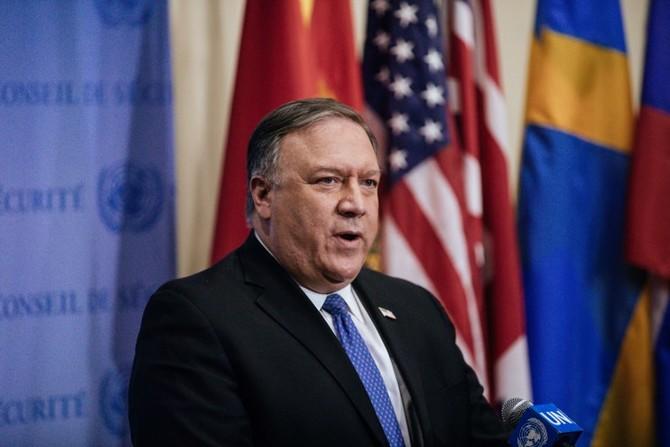
The deep state has grown stronger recently through tweets and speeches of U.S. spokespeople like Special Representative for Venezuela Elliott Abrams, Secretary of State Mike Pompeo, National Security Advisor John Bolton, and Southern Command’s commanding general Craig Faller. Their different statements have shifted towards painting Venezuela as an operational base for Russia, Iran, Cuba and China, while the Maduro administration would be subordinated to each of these governments and their corresponding intelligence and military services —particularly to the first three.
The United States has announced its following steps based on that narrative. Pompeo is going to Chile, Paraguay, Peru and Colombia; Abrams to Spain and Portugal; and they convened a third meeting in the United Nations Security Council to talk about Venezuela’s situation. They have not announced the goals of the different moves yet. It is possible though to predict that there is a private and public dimension to the agreements. A possibility would be for the US to declare the Venezuelan government a transnational criminal organization and branding colectivos (Chavista grass-roots organizations) as terrorist groups that “undermine the Constitution and territorial integrity of Venezuela,” according to Bolton’s description. New possible actions would result from each of these elements.
That increase in pressure, tightening the blockade, and isolation has not led yet to the possibility of a military intervention, despite the repeated “all options are on the table.” Abrams himself sidestepped that hypothesis last Thursday. Therefore, how are they planning to achieve the outcome proposed with the combination of these actions? The United States needs to establish means, on-the-ground operational capacity, and domestic and diplomatic agreements. In this regard, the European Union stance was expressed by its high representative for foreign affairs, Federica Mogherini, who affirmed that “new free and credible presidential elections should be held as soon as possible.”
Would the U.S. be willing to accept a negotiated outcome in which Maduro remains in power? So far, that does not look possible. They don’t seem willing to accept a geopolitical defeat in Venezuela either. The U.N. Security Council met on Wednesday to deal with this aspect. At the same time, the right called for more mobilizations. The pieces are still in motion.
Translation by Resumen Latinoamericano, North America bureau
Edited by Venezuelanalysis.com
US Threatens Venezuela at UNSC as IMF Freezes Funds
Diplomatic battles rage on at international bodies such as the UNSC, the OAS and the IMF
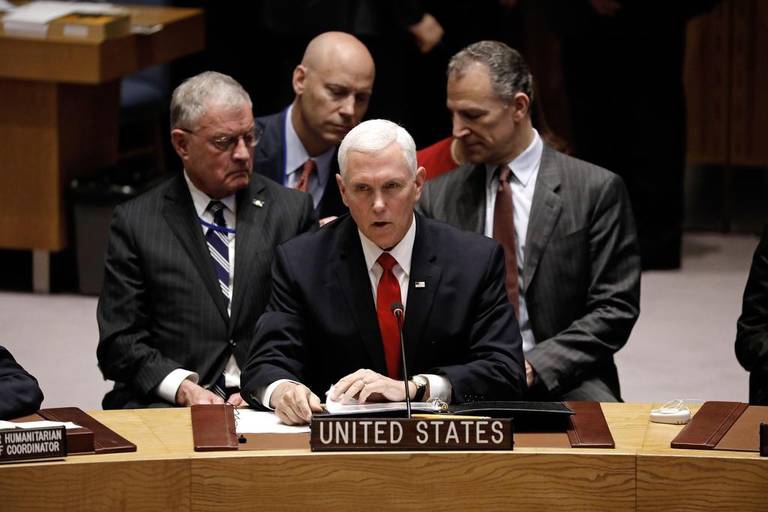
US VP Mike Pence called on the UN to recognize Guaido as Venezuela’s president. (EFE)
By Ricardo Vaz | Venezuelanalysis | April 11, 2019
Caracas – The United States pressured the United Nations to recognize self-proclaimed “Interim President” Juan Guaido during a Security Council (UNSC) meeting on Wednesday.
US Vice President Mike Pence told the UNSC that “the time has come” for the UN to recognize Guaido as Venezuela’s “legitimate president” and accept the latter’s representative to the world body. He added that the US would circulate a resolution to this effect, but offered no details on its timetable. A previous US resolution at the UNSC was vetoed by Russia and China on February 28.
Pence went on to reiterate the warning that “all options are on the table” to oust the Maduro government. “This is our neighborhood,” he told reporters afterward, calling on Russia to cease its support to the Maduro government.
Venezuela’s UN representative, Samuel Moncada, slammed what he called a “clear move to undermine” Venezuela’s rights, adding that his legitimacy depended on UN recognition and not on the declarations of the US vice president.
Russian ambassador Vassily Nebenzia accused the US of causing Venezuela “billions of dollars in losses” as a result of sanctions.
“[The US] deliberately provokes a crisis in Venezuela in order to change a legitimately elected leader for a US protege,” Nebenzia said in his speech.
Chinese representative Liu Jieyi likewise affirmed that Venezuelan affairs should be handled internally and criticized the imposition of sanctions, while his South African counterpart, Jerry Matjila, called for the UNSC to take a “constructive approach.”
Wednesday’s UNSC meeting came on the heels of a session at the Organization of American States (OAS) which approved Guaido’s appointment, Gustavo Tarre, as a representative to the body “until new elections are held.” The proposal had 18 votes in favor, 9 against, six abstentions and one absence.
Venezuelan authorities denounced the move as a violation of international law and of the OAS charter. The Foreign Ministry reiterated that Venezuela is due to leave the OAS on April 27, having started the process two years ago. Caracas denounced meddling in its internal affairs after the OAS had repeatedly tried to apply its democratic charter. However, it never managed to secure the necessary 24 votes.
Diplomatic battles surrounding Guaido’s recognition have extended to the International Monetary Fund (IMF). According to Bloomberg, the IMF cut off Caracas’ access to almost US $400 million in special drawing rights (SDR). While the IMF has shown no signs of recognizing Guaido, and lists Finance Minister Simon Zerpa as Venezuela’s representative, sources told Bloomberg that a government must be recognized by a majority of the Fund’s members to access its SDR reserves.
Venezuela remains mired in a deep economic crisis that has seen its international reserves shrink to around $9 billion. The cash crunch has been further compounded by US and allies freezing Venezuelan assets held abroad. In one such case, the Bank of England has refused to repatriate an estimated $1.2 billion worth of Venezuelan gold held in its vaults.
International tensions have also flared around the issue of humanitarian aid, with US and Venezuelan opposition ultimately failing to force an estimated $20 million worth of aid across the Venezuela-Colombia border on February 23. The operation faced strident criticism from international agencies such as the United Nations and the Red Cross, who refused to take part in the “politicization” of aid.
During Tuesday’s UNSC meeting, UN aid chief Mark Lowcock stated that Venezuela is facing a “very real humanitarian problem” and talked about the need to step up UN efforts in the Caribbean country. UN Secretary General Antonio Guterres later tweeted that the UN estimates there are 7 million people in need of aid in Venezuela, and that the UN is working to increase its assistance “in line with the principles of humanity, neutrality, impartiality and independence.”
UN agencies have increased their work in Venezuela in recent months, most recently via an agreement between Caracas and the UN’s Central Emergency Resource Fund for US $9.2 million to address the health and nutritional impacts of the country’s severe economic crisis. President Maduro has also appealed for UN assistance in countering US sanctions to bring medicines and medical equipment to Venezuela.
Likewise, the International Federation of the Red Cross (IFRC) recently announced a scaling up of its activities in Venezuela, doubling its annual country budget to $60 million as part of an agreement with the Venezuelan government.
Maduro met a Red Cross commission headed by IFRC President Peter Maurer on Tuesday to coordinate the agency’s work in Venezuela. Maurer had previously met Foreign Minister Jorge Arreaza to “strengthen cooperation agreements.”
Is Trump’s Designation of Iran Revolutionary Guard Corps as Terrorist Organization a Set-Up for War?
By Whitney Webb | MintPress News | April 8, 2019
WASHINGTON — The Trump administration designated Iran’s Islamic Revolutionary Guard Corps (IRGC), an elite group of that country’s military, as a foreign terrorist organization early Monday, confirming a report published last Friday in the Wall Street Journal that suggested that such a move was likely to occur in a matter of days. In a statement released Monday, the White House stated:
This unprecedented step, led by the Department of State, recognizes the reality that Iran is not only a State Sponsor of Terrorism, but that the IRGC actively participates in, finances, and promotes terrorism as a tool of statecraft.”
While most reports on the subject have interpreted the move as aimed at pressuring European countries and others from conducting business with Iran while also making the Iran nuclear deal much more difficult to revive, the move would further allow the Trump administration to conduct more “robust” combat operations against Iran’s military, all without congressional approval.
As was noted by the WSJ and other outlets, the Trump administration’s upcoming move to label the IRGC a foreign terrorist organization would mark the first time that any element of a foreign state is officially labeled as a terrorist group. The Bush administration had previously blacklisted the Quds Force, the IRGC unit in charge of foreign operations, in 2007 “for its support of terrorism,” and further described the group as Iran’s “primary arm for executing its policy of supporting terrorist and insurgent groups.” However, unlike the Trump administration, they stopped short of labelling the IRGC, or any of its elements, as foreign terrorist organizations themselves.
Reports from last month indicate that current Secretary of State and former CIA Director, Mike Pompeo, was one of the administration’s top officials behind the move. At the time, the New York Times noted that many officials in the Pentagon and the CIA opposed the move, given that such a designation against the IRGC could have profound repercussions for U.S. troops stationed abroad, particularly in the Middle East. Indeed, soon after the recent WSJ piece was published, IRGC’s commander, Mohammad Ali Jafari, warned that U.S. troops in the Middle East would “lose their current status of ease and serenity” and that Iran’s government would make a “reciprocal move” against the U.S. military — labeling it a terrorist group — were the Trump administration to go forward with its latest move to target the IRGC.
Where’s Trump going with this designation?
Several reports have mulled over the likely motives behind the move to label the IRGC a foreign terrorist organization, with some suggesting that the move would be used as a threat to dissuade other countries from conducting business with Iran, while others asserted that the move was aimed at curbing the ability of any future U.S. president — particularly if a Democrat takes the White House in 2020 — from resurrecting the Joint Comprehensive Plan of Action, know broadly as the Iran nuclear deal. Trump unilaterally withdrew from the Iran nuclear deal in 2018, a move which earned him strong praise from long-time Iran hawks as well Israel’s Prime Minister Benjamin Netanyahu and Trump’s most powerful political donor, billionaire Sheldon Adelson.
Yet, upon more careful consideration, an economic motive seems unlikely in light of the fact that the Trump administration has already imposed draconian sanctions on almost every sector of Iran’s economy and government, including the IRGC. In addition, making such a drastic move now to prevent a future president in 2020 or beyond from reviving the Iran deal also seems rather unrealistic given that the 2020 challenger to Trump is still unknown.
A much more likely reason for the designation is the fact that labeling any group a foreign terrorist organization allows that group to be targeted by the U.S. government by means of the Authorization for Use of Military Force (AUMF). Past reports on other groups labeled as terrorist organizations have noted that “though the CIA can gather intelligence on terror groups regardless of their status on a State Department list, official designation unlocks more robust means to combat them since it triggers the Authorization for Use of Military Force.”
Notably, the CIA opened a new “mission center” on Iran in June 2017 — when Pompeo was CIA director — aimed at “turning up the heat” on Iran and making the country a “higher priority” for American spies. Now, just under two years later, the designation of the IRGC as a terrorist group allows those clandestine operations to become “more robust” and more overt thanks to the years-long expansion of the 2001 AUMF.
Colonel W. Patrick Lang, a retired senior officer of U.S. Military Intelligence and U.S. Army Special Forces, noted on Sunday that the move amounts to a “declaration of war” against Iran’s military, writing:
The official designation as “terrorist” of the IRGC, which is a 125,000 man army with its own navy and air force, makes it legal for the U.S. Armed Forces to attack the IRGC and its people wherever they are found and under any circumstances that may occur.”
Other echoes Lang’s concerns, including Wendy Sherman, former under-secretary of state and current director of the Center for Public Leadership at the Harvard Kennedy School. Sherman told Reuters on Sunday:
One might even suggest, since it’s hard to see why this is in our interest, if the president isn’t looking for a basis for a conflict. The IRGC is already fully sanctioned and this escalation absolutely endangers our troops in the region.”
Stretching the AUMF
The Authorization for Use of Military Force (AUMF) was originally passed in 2001 in the wake of the September 11 attacks and its text authorizes the president:
[T]o use all necessary and appropriate force against those nations, organizations, or persons he determines planned, authorized, committed, or aided the terrorist attacks that occurred on September 11, 2001, or harbored such organizations or persons, in order to prevent any future acts of international terrorism against the United States by such nations, organizations or persons.”
Despite being expressly aimed at groups believed to be responsible for September 11, the AUMF has been expanded under the Bush, Obama and Trump administrations to justify military action in dozens of countries against dozens of groups, many of them with no links to al Qaeda.
Trump, since his first year in office, has been building a case to link the IRGC to al Qaeda, a case entirely devoid of evidence and one that has long seemed aimed at triggering military conflict between the United States and Iran, particularly by means of the 2001 AUMF. In remarks delivered on October 13, 2017, Trump made the following claims:
Iranian proxies provided training to operatives who were later involved in al Qaeda’s bombing of the American embassies in Kenya, Tanzania, and two years later, killing 224 people, and wounding more than 4,000 others.
The regime harbored high-level terrorists in the wake of the 9/11 attacks, including Osama bin Laden’s son. In Iraq and Afghanistan, groups supported by Iran have killed hundreds of American military personnel.”
Though Trump’s claims are demonstrably false, the fact that he is surrounded by many long-time Iran hawks does not bode well for the current state of affairs following the administration’s declaration of the IRGC as a foreign terrorist organization.
Setting up a new war?
Another point of concern is the fact that the 2002 AUMF, regarding the president’s ability to authorize the use of military forces in Iraq — which borders Iran — is still on the books. That AUMF, which gave the president authority to send U.S. military troops to Iraq in the lead-up to the Iraq War in order to defend “the national security of the United States against the continuing threat posed by Iraq,” still provides the executive branch with the ability to order military action in Iraq without approval either from the U.S. Congress or from Iraq’s government.
Dr. Jack Goldsmith, a former assistant attorney general in the Office of Legal Council during the George W. Bush administration, noted in 2014:
[The 2002 AUMF] gives the President the discretion to determine when the use of the U.S. Armed Forces is necessary and appropriate to defend U.S. national security against the continuing threat posed by Iraq (not the government of Iraq, not Saddam Hussein, but Iraq), and authorizes the President to use those forces in that circumstance.”
This AUMF is important now in light of the recent designation of the IRGC as a terrorist group and the fact that IRGC-aligned militias are present and active in Iraq, with many of them collaborating with U.S. troops stationed in Iraq in efforts to target terrorist groups like Daesh (ISIS). This declaration not only undermines that collaboration, it also would give Trump authority — per the 2002 AUMF — to send U.S. troops to Iraq without congressional approval in response to the supposed “national security threat” posed by the now-”terrorist” IRGC-aligned militias in the country. Notably, this declaration comes soon after the current Iraqi government called to expel all U.S. troops from its territory.
Not only that, but the new declaration of the IRGC as a terrorist group could also have consequences as far away as Venezuela. Indeed, the U.S. government has claimed for over a decade that the IRGC is “active” in Venezuela and accused them of involvement in Venezuelan intelligence operations, the training of left-wing Colombian paramilitary groups and security assistance to the Venezuelan government. With the IRGC now officially labeled a “terrorist organization”, the provisions of the AUMF now triggered following Trump’s declaration could have very real, troubling consequences for his administration’s regime change efforts in the oil-rich South American country.
With the IRGC now officially labeled a “foreign terrorist organization” by the U.S. government, the march to war with Iran — long a goal of top Trump administration officials — is closer than ever. With more overt and robust military and intelligence operations targeting Iran and the 2001 and 2002 AUMFs now triggered to allow the deployment of U.S. ground troops in and near Iran, the U.S. is just steps away from triggering what could turn into not just a regional war in the Middle East but a global one.
Editor’s note: This story was updated to explain the potential consequences of Trump’s decision to label the IRGC a terrorist group in relation to the Trump administration’s current campaign to topple the Venezuelan government.
Whitney Webb is a MintPress News journalist based in Chile. She has contributed to several independent media outlets including Global Research, EcoWatch, the Ron Paul Institute and 21st Century Wire, among others. She has made several radio and television appearances and is the 2019 winner of the Serena Shim Award for Uncompromised Integrity in Journalism.
VIPS Urge Trump to Avoid War in Venezuela
Consortium News | April 4, 2019
VIPS warn that Trump’s policies regarding Venezuela appear to be on a slippery slope that could take us toward war in Venezuela and military confrontation with Russia.
MEMORANDUM FOR: The President
FROM: Veteran Intelligence Professionals for Sanity (VIPS)
SUBJECT: Avoiding War with Russia over Venezuela
Mr. President:
Your Administration’s policies regarding Venezuela appear to be on a slippery slope that could take us toward war in Venezuela and military confrontation with Russia. As former intelligence officers and other national security practitioners with many decades of experience, we urge you not to let yourself be egged on into taking potentially catastrophic military action in response to civil unrest in Venezuela or Russian activities in the Western Hemisphere. With the recent arrival of two transport aircraft and enduring political support for the government of Venezuela, the Russians are far from crossing any “red line” emanating from the 1823 Monroe Doctrine.
Unfulfilled Objectives in Venezuela
Inside Venezuela, U.S. actions have failed to do more than plunge the country into deeper crisis, cause greater human suffering, and increase the prospects of violence on a national scale. President Maduro’s mishandling of the economy and authoritarian reactions to provocations are impossible to defend, but they result in part from the fact that he has been under siege since he was first elected in 2013 and has faced sanctions aimed ultimately at removing him from office. In our view, the advice you’ve received from your top advisors – Florida Senator Marco Rubio, National Security Advisor John Bolton, Special Representative Elliott Abrams, and Secretary of State Michael Pompeo – was and apparently continues to be wrong.
- Recognition of Venezuelan National Assembly President Juan Guaidó as “interim president” did not prompt the military to rise up against President Maduro. Neither did attacking the officer corps as merely corrupt opportunists and drug-traffickers enriched through loyalty to former President Chávez and Maduro, nor did repeatedly threatening them with harsher sanctions. Those actions reflected a fundamental misunderstanding about the Venezuelan military, which has never been free of corruption and political compromise but has also never been so totally isolated from the Venezuelan people that it hasn’t felt their suffering. U.S. policies incorrectly assumed that the officers – while probably fed up with Maduro’s shortcomings – would support Guaidó despite his faction’s commitment to dismantle Chavismo, which most officers believe brought historically necessary changes to the country, including enfranchisement of the poor.
Similarly, your Administration’s repeated hints at military intervention have been counterproductive to your regime-change objectives. Your policy and intelligence advisors were correct in interpreting the disparate polling data showing popular support for Guaidó as actually being support for the U.S. to extricate the country from its crisis – the National Assembly President was a political unknown until the United States and others recognized his claim to the Presidency – but your team showed a lack of understanding of Venezuelan nationalism. Venezuelans do not welcome the destruction that would be caused by U.S. military attack; they recall the death toll of Operation Just Cause, when the United States killed more than 3,000 Panamanians (by its own count) to remove one corrupt authoritarian, Manuel Noriega. Threats of invasion have pushed people to circle around Maduro, however reluctantly, not reject him.
- Your Administration’s strategy of punishing the Venezuelan people, including apparently knocking out their electricity, seems based on the false assumption that humanitarian crisis will prompt a coup to remove Maduro. In fact, the U.S. sanctions have allowed Maduro to shift blame from his own failings to U.S. malice – and it has left Guaidó, whom your advisors portray as the moral equivalent of our Founders, looking like a sell-out to Yankee imperialists at the cost of the Venezuelan people’s health and welfare and magnified civil disorder.
Lost Opportunity for Diplomacy
Senator Rubio, Mr. Bolton, Mr. Abrams, and Mr. Pompeo have also squandered a formidable moment to build on common values with allies in Latin America and Europe. Even though most Latin Americans find your aides’ public assertion that the Monroe Doctrine is alive and well to be insulting, the right-leaning Presidents of most of South and Central America rallied with you to support Guaidó’s self-proclamation. But Guaidó’s lack of leadership – he appears totally scripted by U.S. Government agencies – his inflexibility on negotiations, his open call for U.S. military intervention, and your own Administration’s dangling threat of war are rapidly alienating all but the most subservient to U.S. policy dictates. Negotiation proposals, such as those being developed by the International Contact Group, are gaining momentum.
Internationalizing the Conflict
National Security Advisor Bolton and others have sought to internationalize the Venezuela issue since before Guaidó’s proclamation. Bolton’s reference to a “Troika of Tyranny” in November – which he called “a triangle of terror stretching from Havana to Caracas to Managua” and “sordid cradle of communism in the Western Hemisphere” – was a veiled Cold War-era swipe at Russia and China. Mr. Bolton, Senator Rubio, and other advisors have made clear on numerous occasions that the overthrow of President Maduro would be just the first stage in efforts to eliminate the current governments of the “Troika” and “Communist influence” in the Western Hemisphere.
- They have repeatedly asserted that Cuban advisors have been crucial to the Maduro government’s survival without providing evidence. Indeed, the reportedly “hundreds” of Venezuelan military defectors, including many managed by U.S. agencies, have not provided even credible hearsay evidence that Cubans are doing more than providing routine assistance. In addition, the threats coming out of Washington have preempted any willingness that Cuba might have had to contribute to a regional solution to the Venezuelan crisis as it has in similar situations, such as Colombia’s recent peace process, the Angola peace process in 1989-90, and the Central American negotiations in the early 1990s.
Provocative Rhetoric about Russia
Most dangerous, however, are aggressive statements about Russia’s engagement with Venezuela. Russian oil companies, particular Rosneft, have long been in Venezuela – bailing out the Venezuelan petroleum company (PDVSA) as its mismanagement and falling oil prices have caused production and revenues to plummet. Most long-term observers believe Rosneft’s decisions, including throwing good money after bad, have been motivated by business calculations, without a particularly ideological objective.
- Your advisors’ rhetoric imposing an East-West spin on the issue presented President Putin and his advisors an opportunity to try to poke the United States in the eye – especially as Administration efforts to remove Maduro foundered and diplomatic support for Guaidó cracked. Maduro and Putin have not enjoyed particularly close personal relations in the past, and their shared strategic interests are few, but U.S. rhetoric and threats have given them common cause in tweaking us. A meeting in Rome between your special envoy, Elliot Abrams, and Russian Deputy Foreign Minister Sergei Ryabkov achieved nothing amid further U.S. sanctions against Venezuela and continued threats that “all options” were on the table.
Publicly available information is insufficient for us to know exactly what was aboard the two Russian aircraft that landed at Maiquetía last week – two months after your Administration publicly proclaimed its intention to remove Maduro – but precedent suggests Moscow had two main objectives.
- One, and probably primary, is to embarrass your Administration by defying your rhetoric, just to rub your nose in Moscow’s sovereign right to have the relations, including military liaison, with whomever it pleases. In this sense, Russian behavior resembles its intervention, at Bashar al-Assad’s request, in Syria. And it is not a far cry from Moscow’s reaction to the Western-supported coup in Kiev.
- Another objective, if press speculation about the Russian advisors and equipment aboard the aircraft is correct, would be to shore up Venezuela’s ability to warn of and respond to a U.S. military strike. Your Administration has publicly asserted that the Russians are helping repair S-300 surface-to-air missile systems, which have a purely defensive purpose. There is no evidence, not even circumstantial, that Russia has any offensive objectives in this relationship.
The U.S. reaction has suggested a much greater chance of military confrontation. Mr. Bolton “strongly caution[ed] actors external to the Western Hemisphere against deploying military assets to Venezuela, or elsewhere in the Hemisphere, with the intent of establishing or expanding military operations.” Without defining what activities he would object to, Mr. Bolton said, “We will consider such provocative actions as a direct threat to international peace and security in the region.” Your Special Representative said the “Russian presence” is “extremely pernicious.” Your Secretary of State said, “Russia’s got to leave Venezuela.” You said, “Russia has to get out” and reiterated that “all options are open” – including presumably forcing the Russians out militarily. And we note that Russia has not closed its embassy in Caracas as your Administration has.
Avoiding the Slippery Slope
As intelligence officers and security experts, we have given many years to protecting our nation from a host of threats, including from the Soviet Union. We also believe, however, that picking fights. including ousting governments, blocking negotiated settlements, and threatening other countries’ sovereign decision to pursue activities that do not threaten our national security – is rarely the wise way to go.
We repeat that we are not defending Maduro and his record, while at the same time pointing out that many of his troubles have been exacerbated by U.S. policies and efforts to oust him. We believe that due process and practical, realistic policies better protect our national interests than threats and confrontational rhetoric. It strains credulity to believe that your advisors picked this fight with President Maduro without realizing that Venezuela would seek help fixing its defensive capabilities.
Moreover and very seriously, rhetoric challenging Russia could all too easily lead to a much more consequential confrontation.
- Invoking the 1823 Monroe Doctrine is unhelpful. For Russia to provide assistance for purely defensive purposes to a country in which we seek to create regime change and threaten military attack would not be widely seen as violating the Monroe Doctrine or crossing a “red line.”
- We realize that some in the media are trying to egg you on into taking forceful action, perhaps even of a military nature, to punish Russia in any case. We urge you not to fall into this trap. This is not 19th century Latin America, and it is a far cry from the Cuba missile crisis of 1962.
- The best way to prevent dangerous miscalculation would be for you to speak directly with President Putin. Washington’s energies would be better spent clearing up differences, adjusting failed policies, and promoting a peaceful resolution in Venezuela.
For the Steering Group, Veteran Intelligence Professionals for Sanity
Fulton Armstrong, former National Intelligence Officer for Latin America & former National Security Council Director for Inter-American Affairs (ret.)
William Binney, former Technical Director, World Geopolitical & Military Analysis, NSA; co-founder, SIGINT Automation Research Center (ret.)
Marshall Carter-Tripp, Foreign Service Officer & former Division Director in the State Department Bureau of Intelligence and Research (ret.)
Bogdan Dzakovic, Former Team Leader of Federal Air Marshals and Red Team, FAA Security, (ret.) (associate VIPS)
Philip Giraldi, CIA, Operations Officer (ret.)
Mike Gravel,,former Adjutant, top secret control officer, Communications Intelligence Service; special agent of the Counter Intelligence Corps and former United States Senator
Larry Johnson, former CIA Intelligence Officer & former State Department Counter-Terrorism Official, (ret.)
John Kiriakou, former CIA Counterterrorism Officer and former Senior Investigator, Senate Foreign Relations Committee
Clement J. Laniewski, LTC, U.S. Army (ret.)
Linda Lewis, WMD preparedness policy analyst, USDA (ret.)
Edward Loomis, NSA Cryptologic Computer Scientist (ret.)
David MacMichael, former Senior Estimates Officer, National Intelligence Council (ret.)
Ray McGovern, former US Army infantry/intelligence officer & CIA presidential briefer (ret.)
Elizabeth Murray, former Deputy National Intelligence Officer for the Near East & CIA political analyst (ret.)
Todd E. Pierce, MAJ, US Army Judge Advocate (ret.)
Coleen Rowley, FBI Special Agent and former Minneapolis Division Legal Counsel (ret.)
Peter Van Buren,U.S. Department of State, Foreign Service Officer (ret.) (associate VIPS)
Sarah Wilton, Commander, U.S. Naval Reserve (ret.) and Defense Intelligence Agency (ret.)
Ann Wright, U.S. Army Reserve Colonel (ret) and former U.S. Diplomat who resigned in 2003 in opposition to the Iraq War
Veteran Intelligence Professionals for Sanity (VIPS) is made up of former intelligence officers, diplomats, military officers and congressional staffers. The organization, founded in 2002, was among the first critics of Washington’s justifications for launching a war against Iraq. VIPS advocates a US foreign and national security policy based on genuine national interests rather than contrived threats promoted for largely political reasons. An archive of VIPS memoranda is available at Consortiumnews.com.
What Monroe Doctrine?
By Philip M. GIRALDI | Strategic Culture Foundation | 04.04.2019
Because there is a presidential election coming up next year, the Donald Trump Administration appears to be looking for a country that it can attack and destroy in order to prove its toughness and willingness to go all the way in support of alleged American interests. It is a version of the old neocon doctrine attributed to Michael Ledeen, the belief that every once in a while, it is necessary to pick out some crappy little country and throw it against the wall just to demonstrate that the United States means business.
“Meaning business” is a tactic whereby the adversary surrenders immediately in fear of the possible consequences, but there are a couple of problems with that thinking. The first is that an opponent who can resist will sometimes balk and create a continuing problem for the United States, which has a demonstrated inability to start and end wars in any coherent fashion.
This tendency to get caught in a quagmire in a situation that might have been resolved through diplomacy has been exacerbated by the current White House’s negotiating style, which is to both demand and expect submission on all points even before discussions begin. That was clearly the perception with North Korea, where National Security Advisor John Bolton insisted that Pyongyang had agreed to American demands over its nuclear program even though it hadn’t and would have been foolish to do so for fear of being treated down the road like Libya, which denuclearized but then was attacked and destroyed seven years later. The Bolton mis-perception, which was apparently bought into by Trump, led to a complete unraveling of what might actually have been accomplished if the negotiations had been serious and open to reasonable compromise right from the beginning.
Trump’s written demand that Kim Jong Un immediately hand over his nuclear weapons and all bomb making material was a non-starter based on White House misunderstandings rooted in its disdain for compromise. The summit meeting with Trump, held in Hanoi at the end of February, was abruptly canceled by Kim and Pyongyang subsequently accused Bolton and Secretary of State Mike Pompeo of making “gangster-like” demands.
The second problem is that there are only a few actual casus belli situations under international law that permit a country to attack another preemptively, and they are usually limited to actual imminent threats. The current situation with Venezuela is similar to that with North Korea in that Washington is operating on the presumption that it has a right to intervene and bring about regime change, using military force if necessary, because of its presumed leadership role in global security, not because Caracas or even Pyongyang necessarily is threatening anyone. That presumption that American “exceptionalism” provides authorization to intervene in other countries using economic weapons backed up by a military option that is “on the table” is a viewpoint that is not accepted by the rest of the world.
In the case of Venezuela, where Trump has dangerously demanded that Russia withdraw the hundred or so advisors that it sent to help stabilize the country, the supposition that the United States has exclusive extra-territorial rights is largely based on nineteenth and early twentieth century unilaterally declared “doctrines.” The Monroe Doctrine of 1823 and the Roosevelt Corollary of 1904 de facto established the United States as the hegemon-presumptive for the entire Western Hemisphere, stretching from the Arctic Circle in the north to Patagonia in the south.
John Bolton has been the leader in promoting the Monroe Doctrine as justification for Washington’s interference in Venezuela’s politics, apparently only dimly aware that the Doctrine, which opposed any attempts by European powers to establish new colonies in the Western Hemisphere, was only in effect for twenty-two years when the United States itself annexed Texas and then went to war with Mexico in the following year. The Mexican war led to the annexation of territory that subsequently became the states of California, New Mexico, Nevada, Utah, Arizona and Colorado. In the same year, the United States threatened war with Britain over the Oregon Territory, eventually accepting a border settlement running along the 49th parallel.
Meanwhile the march westward across the plains continued, forcing the Indian tribes back into ever smaller spaces of open land. The US government in the nineteenth century recognized some Indian tribes as “nations” but it apparently did not believe that they enjoyed any explicit “Monroe Doctrine” rights to continue to exist outside reservations when confronted by the “manifest destiny” proponents who were hell bent on creating a United States that would run from the Atlantic to the Pacific Ocean.
The Roosevelt Corollary of 1904 amended the Monroe Doctrine, making it clear that the United States believed it had a right to interfere in any country in the western Hemisphere to maintain good order, which inevitably led to exploitation of Latin American nations by US business conglomerates that could count on a little help from US Marines if their trade agreements were threatened. In 1898, Washington became explicitly imperialist when it defeated Spain and acquired effective control over Cuba, a number of Caribbean Islands and the Philippines. This led to a series of more than thirty interventions by the US military in the Caribbean and Central America between 1898 and 1934. Other states in the region that were not directly controlled by Washington were frequently managed through arrangements with local autocrats, who were often themselves generals.
Make no mistake, citing the Monroe Doctrine is little more than a plausible excuse to get rid of the Venezuelan government, which is legitimate, like it or not. The recent electrical blackouts in the country are only the visible signs of an aggressive campaign to destroy the Venezuelan economy. The United States is engaging in economic warfare against Caracas, just as it is doing against Tehran, and it is past time that it should be challenged by the international community over its behavior. Guns may not be firing but covert cyberwarfare is total warfare nevertheless, intended to starve people and increase their suffering in order to bring about economic collapse and take down a government to change it into something more amenable to American interests.
Venezuela FM takes Middle East tour, set to meet Nasrallah
Press TV – April 3, 2019
Venezuela’s foreign minister has embarked on a Middle East tour taking him through Turkey, Lebanon, and Syria, amid US measures to prop up the Latin American country’s opposition figure and self-proclaimed “interim president” Juan Guaido against President Nicolas Maduro.
Jorge Arreaza arrived in Turkey on Monday and was assured by his Turkish counterpart Mevlut Cavusoglu of Ankara’s support for the Latin American nation in the face of US pressure. “It should not be in a way that ‘I am a big country and I can determine entire rules,’” Cavusoglu said, referring to Washington’s sanctions against Venezuela and its efforts to oust Maduro, Turkish paper Hurriyet reported.
On Tuesday, the top Venezuelan diplomat traveled to Lebanon on a two-day visit. Lebanese President Michel Aoun received him at the presidential Baabda Palace in Beirut. Arreaza, who conveyed a message from Maduro to Aoun, also met with his Lebanese counterpart Gebran Bassil.
He was also slated to meet with Lebanese Prime Minister Sa’ad Hariri, Lebanese news portal Naharnet reported. According to Lebanese daily al-Joumhouria, he will also be holding a meeting with the Hezbollah resistance movement’s Secretary General Seyyed Hassan Nasrallah.
Back in January, Hezbollah conveyed its support for Maduro amid mounting US pressure for him to resign and hand over power to Washington-backed Guaido. Hezbollah-associated lawmaker Mohammad Raad was cited by Lebanese TV channel Al Manar as saying at the time that “Nasrallah stands with the Venezuelan people and with its free leadership.”
The Venezuelan foreign minister, meanwhile, expressed satisfaction with the visits to the countries in remarks to Prensa Latina. “They are two countries that respect international law and with which there are friendly and fraternal relations,” the Cuban news agency cited him as saying.
The visit to Lebanon “opens a new stage in bilateral ties with the possibility to expand economic cooperation, especially Venezuela’s advisory in the country’s energy sector,” the agency added, citing the top diplomat.
Also in January, the US took the lead in recognizing Guaido as Venezuela’s president after the head of the opposition-ruled Congress named himself the country’s interim chief executive. Washington has been pressuring other countries into following suit and has not ruled out using the military option to oust Maduro’s government.
Many countries, including Iran, Russia, China, and Cuba, however, back Maduro, spurning the subversive American efforts targeting Venezuela’s sovereignty.
Arreaza is next to travel to Syria, with which Caracas has similarly warm relations.
Guaido Set to Enact Uprising Rooted in US Regime-Change Operations Manual
By Whitney Webb | MintPress News | March 30, 2019
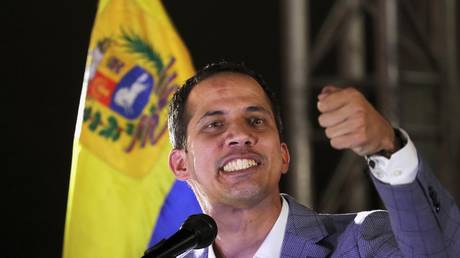
CARACAS, VENEZUELA — Juan Guaidó, the self-proclaimed “interim president of Venezuela” who is supported by the United States government, recently announced coming “tactical actions” that will be taken by his supporters starting April 6 as part of “Operation Freedom,” an alleged grassroots effort to overthrow Venezuelan President Nicolás Maduro.
That operation, according to Guaidó, will be led by “Freedom and Aid Committees” that in turn create “freedom cells” throughout the country — “cells” that will spring to action when Guaidó gives the signal on April 6 and launch large-scale community protests. Guaidó’s stated plan involves the Venezuelan military then taking his side, but his insistence that “all options are still on the table” (i.e., foreign military intervention) reveals his impatience with the military, which has continued to stay loyal to Maduro throughout Guaidó’s “interim presidency.”
However, a document released by the U.S. Agency for International Development (USAID) in February, and highlighted last month in a report by Devex, details the creation of networks of small teams, or cells, that would operate in a way very similar to what Guaidó describes in his plan for “Operation Freedom.”
Given that Guaidó was trained by a group funded by USAID’s sister organization, the National Endowment for Democracy (NED) — and is known to take his marching orders from Washington, including his self-proclamation as “interim president” and his return to Venezuela following the “humanitarian aid” showdown — it is worth considering that this USAID document may well serve as a roadmap to the upcoming and Guaidó-led “tactical actions” that will comprise “Operation Freedom.”
RED Teams
Titled “Rapid Expeditionary Development (RED) Teams: Demand and Feasibility Assessment,” the 75-page document was produced for the U.S. Global Development Lab, a branch of USAID. It was written as part of an effort to the “widespread sentiment” among the many military, intelligence, and development officials the report’s authors interviewed “that the USG [U.S. government] is woefully underperforming in non-permissive and denied environments,” including Venezuela. Notably, some of the military, intelligence and development officials interviewed by the report’s authors had experience working in a covert capacity in Venezuela.
The approach put forth in this report involves the creation of rapid expeditionary development (RED) teams, who would “be deployed as two-person teams and placed with ‘non-traditional’ USAID partners executing a mix of offensive, defensive, and stability operations in extremis conditions.” The report notes later on that these “non-traditional” partners are U.S. Special Forces (SF) and the CIA.
The report goes on to state that “RED Team members would be catalytic actors, performing development activities alongside local communities while coordinating with interagency partners.” It further states that “[i]t is envisioned that the priority competency of proposed RED Team development officers would be social movement theory (SMT)” and that “RED Team members would be ‘super enablers,’ observing situations on the ground and responding immediately by designing, funding, and implementing small-scale activities.”
In other words, these teams of combined intelligence, military and/or “democracy promoting” personnel would work as “super enablers” of “small-scale activities” focused on “social movement theory” and community mobilizations, such as the mobilizations of protests.
The decentralized nature of RED teams and their focus on engineering “social movements” and “mobilizations” is very similar to Guaidó’s plan for “Operation Freedom.” Operation Freedom is set to begin through “Freedom and Aid committees” that cultivate decentralized “freedom cells” throughout the country and that create mass mobilizations when Guaidó gives the go ahead on April 6. The ultimate goal of Operation Freedom is to have those “freedom cell”-generated protests converge on Venezuela’s presidential palace, where Nicolás Maduro resides. Given Guaidó’s lack of momentum and popularity within Venezuela, it seems highly likely that U.S. government “catalytic actors” may be a key part of his upcoming plan to topple Maduro in little over a week.
Furthermore, an appendix included in the report states that RED Team members, in addition to being trained in social movement theory and community mobilization techniques, would also be trained in “weapons handling and use,” suggesting that their role as “catalytic actors” could also involve Maidan-esque behavior. This is a distinct possibility raised by the report’s claim that RED Team members be trained in the use of both “offensive” and “defensive” weaponry.
In addition, another appendix states that RED Team members would help “identify allies and mobilize small amounts of cash to establish community buy-in/relationship” — i.e., bribes — and would particularly benefit the CIA by offering a way to “transition covert action into community engagement activities.”
Feeling Bolsonaro’s breath on its neck
Also raising the specter of a Venezuela link is the fact that the document suggests Brazil as a potential location for a RED Team pilot study. Several of those interviewed for the report asserted that “South American countries were ripe for pilots” of the RED Team program, adding that “These [countries were] under-reported, low-profile, idiot-proof locations, where USG civilian access is fairly unrestrained by DS [Diplomatic Security] and where there is a positive American relationship with the host government.”
This January, Brazil inaugurated Jair Bolsonaro as president, a fascist who has made his intention to align the country close to Washington’s interests no secret. During Bolsonaro’s recent visit to Washington, he became the first president of that country to visit CIA headquarters in Langley, Virginia. President Donald Trump said during his meeting with Bolsonaro that “We have a great alliance with Brazil — better than we’ve ever had before” and spoke in favor of Brazil joining NATO.
Though Bolsonaro’s government has claimed late in February that it would not allow the U.S. to launch a military intervention from its territory, Bolsonaro’s son, Eduardo Bolsonaro — an adviser to his father and a Brazilian congressman — said last week that “use of force will be necessary” in Venezuela “at some point” and, echoing the Trump administration, added that “all options are on the table.” If Bolsonaro’s government does allow the “use of force,” but not a full-blown foreign military intervention per se, its closeness to the Trump administration and the CIA suggests that covert actions, such as those carried out by the proposed RED Teams, are a distinct possibility.
Frontier Design Group
The RED Team report was authored by members of Frontier Design Group (FDG) for USAID’s Global Development Lab. FDG is a national security contractor and its mission statement on its website is quite revealing:
Since our founding, Frontier has focused on the challenges and opportunities that concern the “3Ds” of Defense, Development and Diplomacy and critical intersections with the intelligence community. Our work has focused on the wicked and sometimes overlapping problem sets of fragility, violent extremism, terrorism, civil war, and insurgency. Our work on these complex issues has included projects with the U.S. Departments of State and Defense, USAID, the National Counterterrorism Center and the U.S. Institute of Peace.”
FDG also states on is website that it also regularly does work for the Council on Foreign Relations and the Omidyar Group — which is controlled by Pierre Omidyar, a billionaire with deep ties to the U.S. national security establishment that were the subject of a recent MintPress series. According to journalist Tim Shorrock, who mentions the document in a recent investigation focusing on Pierre Omidyar for Washington Babylon, FDG was the “sole contractor” hired by USAID to create a “new counterinsurgency doctrine for the Trump administration” and the fruit of that effort is the “RED Team” document described above.
One of the co-authors of the document is Alexa Courtney, FDG founder and former USAID liaison officer with the Department of Defense; former manager of civilian counterterrorism operations in Afghanistan for USAID; and former counterinsurgency specialist for U.S. intelligence contractor Booz Allen Hamilton.
In addition, according to Shorrock, Courtney’s name has also been found “on several Caerus [Associates] contracts with USAID and US intelligence that were leaked to me on a thumb drive, including a $77 million USAID project to track ‘licit and illicit networks’ in Honduras.” Courtney, according to her LinkedIn account, was also recently honored by Chevron Corporation for her “demonstrated leadership and impact on development results.” MintPress recently reported on the role of Chevron in the current U.S.-led effort to topple Maduro and replace him with Guaidó.
Send in the USAID
Though Devex was told last month that USAID was “still working on the details in formulating the Rapid Expeditionary Development (RED) Teams initiative,” Courtney stated that the report’s contents had been “received really favorably” by “very senior” and “influential” former and current government officials she had interviewed during the creation of the document.
For instance, one respondent asserted that the RED Team system would “restore the long-lost doing capacity of USAID.” Another USAID official with 15 years of experience, including in “extremely denied environments,” stated that:
We have to be involved in national security or USAID will not be relevant. Anybody who doesn’t think we need to be working in combat elements or working with SF [special forces] groups is just naïve. We are either going to be up front or irrelevant … USAID is going through a lot right now, but this is an area where we can be of utility. It must happen.”
Given that the document represents the efforts of the sole contractor tasked with developing the current administration’s new counterterrorism strategy, there is plenty of reason to believe that its contents — published for over a year — have been or are set to be put to use in Venezuela, potentially as part of the upcoming “Operation Freedom,” set to begin on April 6.
This is supported by the troubling correlation between a document produced by the NED-funded group CANVAS and the recent power outages that have taken place throughout Venezuela, which were described as U.S.-led “sabotage” by the country’s government. A recent report by The Grayzone detailed how a September 2010 memo by CANVAS — which trained Juan Guaidó — described in detail how the potential collapse of the country’s electrical infrastructure, like that recently seen in Venezuela, would be “a watershed event” that “would likely have the impact of galvanizing public unrest in a way that no opposition group could ever hope to generate.”
The document specifically named the Simon Bolivar Hydroelectric Plant at Guri Dam, which failed earlier this month as a result of what the Venezuelan government asserted was “sabotage” conducted by the U.S. government. That claim was bolstered by U.S. Senator Marco Rubio’s apparent foreknowledge of the power outage. Thus, there is a precedent of correlation between these types of documents and actions that occur in relation to the current U.S. regime-change effort in Venezuela.
Furthermore, it would make sense for the Trump administration to attempt to enact such an initiative as that described in the document, given its apparent inability to launch a military intervention in Venezuela, despite its frequent claims that “all options are on the table.” Indeed, U.S. allies — including those close to Venezuela, like Colombia — have rejected military intervention, given the U.S.’ past role in bloody coups and civil wars throughout the region.
Thus, with its hands tied when it comes to military intervention, only covert actions — such as those described in the RED Team document — are likely to be enacted by the U.S. government, at least at this stage of its ongoing “regime change” effort in Venezuela.
Whitney Webb is a MintPress News journalist based in Chile. She has contributed to several independent media outlets including Global Research, EcoWatch, the Ron Paul Institute and 21st Century Wire, among others. She has made several radio and television appearances and is the 2019 winner of the Serena Shim Award for Uncompromised Integrity in Journalism.
German Government Refuses to Recognise Guaido’s Envoy as Ambassador

Sputnik – March 29, 2019
Although Berlin has sided with the US and recognised self-proclaimed interim president Juan Guaido, it is keeping Otto Gebauer, whom he picked to represent Venezuela in Germany, in limbo and has not granted the representative key diplomatic status. Spain, above all, has reportedly urged fellow EU member states not to recognise him.
Although Otto Gebauer, sent to Germany by self-proclaimed interim president of Venezuela Juan Guaido as his emissary, was received in Berlin, the German government does not plan to accredit him, as the newspaper Neue Osnabrücker Zeitung reports, citing the Foreign Ministry’s response to a request by the left-wing party Die Linke.
According to it, the German government first received Gebauer as “personal representative of Interim President Guaido” on 13 March 2019 to hold talks with him, but “further steps are not planned”. The outlet also reports that, above all, Spain has called on other EU member states not to grant Guaido’s representatives any diplomatic status or corresponding privileges.
Since a political crisis broke out in Venezuela in late January, when parliamentary opposition leader Guaido, backed by the US, declared himself the interim president of Venezuela after disputing President Nicolas Maduro’s re-election last May, Germany recognised him as a transitional head of state. Around 50 states, encouraged by the US, did the same. However, the constitutionally elected head of state Nicolas Maduro, supported by Russia, China, Cuba, Bolivia, Turkey and a number of other countries, continues to hold power and refuses to step down, accusing Washington of trying to orchestrate a coup in order to install Guaido as a puppet leader.
This has led to a paradoxical situation in Germany, leaving it with two Venezuelan emissaries in Berlin but not being able to hold official talks with both of them.
Die Linke praised the decision to restrain from recognising Gebauer as ambassador. Lawmaker from the German parliamentary foreign affairs committee Heike Haensel pointed out that “dispatching of new representatives for Venezuela is based on the recognition of self-appointed President Juan Guaido in violation of international law”, according to the conclusion of the Bundestag’s probe.
“This proves the absurdity of Germany’s Venezuela policy. Recognising Guaido was manoeuvered outside the bounds of international law and this rows it back again”, she said.
Apart from this diplomatic collision, Otto Gebauer has a debatable profile for a diplomat as he was involved in a 2002 coup attempt against President Hugo Chavez, who passed away several years ago. He was a member of the commando unit that held Chavez prisoner and served six years in prison for it.
The legitimacy of interim president Guiado himself is being challenged now as under Venezuelan law his maximum term is limited to a 30-day period. It expired in February while new elections have not yet been announced.
Venezuela: New Widespread Power Outage
Venezuelan authorities denounce “double attack” against the country’s electrical infrastructure
By Ricardo Vaz | Venezuelanalysis | March 26, 2019
Caracas – Venezuela suffered another widespread power outage on Monday, with authorities claiming a “double attack” against the country’s main hydroelectric dam took place.
Both alleged attacks against the Simon Bolivar Hydroelectric Plant, known as the Guri Dam, affected as many as 16 of Venezuela’s 23 states.
The first one took place around 1:30 pm on Monday, with Venezuelan authorities denouncing a cyber attack similar to the one they claim caused a major blackout on March 7, targeting the computerized system of the electric grid. While Caracas and other central and eastern areas had power restored and stable within 72 hours, it was not until March 12 that western states Merida and Zulia finally had electricity.
However, this time electricity was restored to Caracas within three hours and to the rest of the country after several additional hours when a second alleged attack took place at 9.50 pm. Reports emerged of a fire affecting three transformers in the Guri Dam switchyard, which then took out the San Geronimo high voltage transmission line.
Communications Minister Jorge Rodriguez issued a communique accusing the opposition of “sowing instability to achieve their destabilizing goals.”
“An attack of this nature against the electric system had never been seen,” he added.
No further information has been provided as to how the fire was set and who the perpetrators might be, with Attorney General Tarek William Saab announcing that three prosecutors had been assigned to investigate.
The Venezuelan armed forces had held military drills earlier this month with special focus on protecting electricity infrastructure. The Venezuelan government has reported that workers from state electricity company CORPOELEC are working around the clock to restore the damaged transformers, but no estimate of the damage and recovery time are currently known.
By Tuesday evening, power had been restored to most of the metropolitan area around Caracas and to some other locations around the country, including parts of the western state of Merida, although with service not yet stabilized.
Venezuela’s electrical infrastructure has suffered from underinvestment, lack of maintenance, a brain drain, as well as US sanctions, which have stopped Caracas from importing spare parts and servicing equipment. Recent US sanctions, including an oil embargo, have also generated shortages of fuel which stopped secondary thermoelectric plants from being brought online to ease the burden on the Guri dam during the March 7 outage, the New York Times reported .
School and work activities were suspended on Tuesday and Wednesday, with services such as the Caracas metro not yet back in service. There has been no official information regarding the reactivation of water supply, with water pumping representing a significant portion of the country’s electricity demand.
At the time of writing there have been no reports of casualties in hospitals or of episodes of violence. The Caracas municipality and the Miranda governorship activated contingency plans for people to be able to return to the suburban metropolitan areas, but many residents were still left to walk miles to get back home.
Venezuelan authorities had revealed what they claimed was evidence of involvement of right-wing leaders, including self-proclaimed “Interim President” Juan Guaido, in a plot to hire foreign paramilitaries to execute targeted killings and acts of sabotage. Guaido’s chief of staff, Roberto Marrero, was arrested on Thursday and accused of direct links to the mercenaries. Marrero was reportedly presented before a judge on Tuesday morning.
Likewise, lawyer Juan Planchart was arrested on Sunday for his alleged participation as a financial intermediary. It remains unclear whether the alleged attacks against the Guri Dam on Monday had any connection to the supposed right-wing plot.
For his part, Guaido accused the government of making up an “imaginary electric war” during a session of the opposition-controlled National Assembly. He also pledged to offer details about “Operation Freedom” on Wednesday, claiming that it will bring an end to “the usurpation.” Concerning the arrests of Marrero and Planchart, Guaido said they were “direct attacks” against him.
‘Lone Wolf’ Myth Covers Up Possible Mossad Role in New Zealand Terrorist Attack
By Max Parry • Unz Review • March 27, 2019
Ever since the news broke on March 15 of two consecutive mass shootings at the Al Noor Mosque and Linwood Islamic Centre in Christchurch, New Zealand, corporate media has been determined to establish that suspect Brenton Tarrant acted alone in the terrorist attacks that took the lives of 50 innocent Muslim worshippers and wounded 50 others. While mainstream media has been predictably eager to parade the tragedy as another chapter in the wave of rising Islamophobia and right-wing extremism globally, they have put equal effort into conscientiously avoiding any evidence that contradicts the ‘lone wolf’ theory they decided on in the initial hours following the first mass shooting in New Zealand since 1997.
Whenever terrorism is committed by Arabs or Muslims, the fourth estate is usually anxious to speculate whether or not the suspect is connected to a larger radical syndicate. However, the same scrutiny is seldom applied to white nationalists like Tarrant. In fact, they are even hesitant to label it ‘terrorism’ at all, with everyone from The Daily Telegraph to the fanatical Zionist Rupert Murdoch’s Fox News settling for the choice words ‘mass shooting.’ While Tarrant denies being part of any group in his public declaration, he does hint that he is part of a broader extremist network:
“I am not a direct member of any organization or group, though I have donated to many nationalist groups and have interacted with many more. No group ordered my attack, I make the decision myself. Though I did contact the reborn Knights Templar for a blessing in support of the attack, which was given.”
As many have noted, the “Knights Templar” is the name of an anti-Muslim militant group that another infamous right-wing terrorist, Anders Behring Breivik, claimed to belong to. During the 2011 Norway attacks, Breivik targeted a government building in the city of Oslo and a youth camp of the ruling Labour party on the island of Utøya in a sequential car bombing and mass shooting that killed a total of 77 people. However, the media and prosecutors in Breivik’s trial were insistent that the group was fictional and the only possibility was that he was an ‘army of one’ while suffering from a psychiatric disorder, another trait that is apparently only applicable to white-skinned terrorists. There was no serious inquiry into whether he was part of a larger nexus, even though he had direct contact with groups like the English Defense League (EDL), the British far right Islamophobic group led by neo-fascist agitator Tommy Robinson. Breivik was portrayed as a fundamentalist Christian but was curiously a member of the Norwegian Order of Freemasons, an organization with a history of ties to the espionage world and susceptible to infiltration because of its inherent secrecy. The original Knights Templar, or “Templars,” were a Christian army founded in the 10th century who initially shielded pilgrims voyaging to the Holy Land and later fought against Muslims during the Crusades while the name is drawn from the Temple Mount in Jerusalem.
What has been downplayed by the yellow press is the specific brand of Islamophobic extremism that was the basis of Tarrant’s attacks. His ideology is revealed in a 73-page manifesto, entitled “The Great Replacement” in reference to the ‘white genocide’ theory held by white nationalist identitarians, which he dispatched less than ten minutes prior to the ambush in emails to several media outlets and Prime Minister Jacinda Ardern’s office. While the corporate press is correct that Tarrant and Breivik clearly follow the practices of the anti-Islam xenophobic movement on the rise in Europe, North America and now Oceania, the key element they have deliberately avoided mentioning is a strong collective affinity for the state of Israel. The coverage of Christchurch has repeated the same pattern displayed following the 2011 Norway attacks where the distinguishing characteristic of the extremism both culprits adhere to is of a staunchly pro-Zionist variety which has been decidedly overlooked. In the eight years between the two attacks, the pro-Israel European right has only augmented in size. In his manifesto, Brenton Tarrant even boasted the unverified claim to have had “brief contact with Knight Justiciar Breivik” while taking “true inspiration” from him. His Norwegian idol had his own 1,500 page manifesto where Israel was approvingly name-dropped nearly 400 times while he declared:
“So let us fight together with Israel, with our Zionist brothers against all anti-Zionists, against all cultural Marxists/multiculturalists.”
The combination of far right nationalism and support for Israel may seem like an unlikely combination, but it is an ideology shared by most of the Islamophobic and anti-immigrant political parties throughout Europe that have performed impressively well in European Parliament elections. These include Hungary’s Fidesz, the Italian League and Five Star Movement, the Flemish Flaams Belang, Poland’s Law and Justice, Belgian People’s Party, the Progress Party of Norway (of which Breivik was a member), True Finns Party, France’s National Rally, Alternative for Deutschland, and many others. It is likely that Tarrant, like Breivik, is not anti-semitic and actually views Jews as ‘allies’ in a civilizational crusade against Islam. Just as Israel has helped orchestrate the US wars in the Middle East against its enemies that has contributed to the mass influx of refugees seeking asylum in the West, it has fostered the Islamophobic backlash to it by supporting the growing far right movement that is ascendant.
Following the tragedy in Christchurch, it was revealed that 28-year old Tarrant had traveled extensively throughout Europe, the Middle East and Asia, including to Afghanistan, Pakistan and even North Korea. The year prior, he also visited Israel for nine days, just as his fellow Christian Zionist Breivik had done several times prior to 2011. Tarrant’s journey in Europe included a stop in Ukraine, a hotbed of neo-Nazi activity and as it happens during the massacre he donned the SS wolf’s hook symbol used by the right wing paramilitary group Azov Battalion to which Israel has provided weapons support in its fight against pro-Russian separatists. The blend of such considerable travel activity while stockpiling a cache of semi-automatic firearms with a digital footprint espousing his extremist views online makes the likelihood that Tarrant managed to remain under the radar of the New Zealand Security Intelligence Service (SIS) difficult to believe. It is especially doubtful they would be unable to detect him considering he was reportedly interviewed by New Zealand police prior to obtaining his firearms license in 2017.
Judging by the Facebook live-streamed video of the massacre shot by the suspect himself wearing a GoPro head-mounted camera that resembled first-person shooter video game shows he was no amateur and possibly professionally trained as a militant. Given his extensive travel and the apparent expertise used to carry out the attacks, there are many legitimate questions about how his ventures were sponsored and whether he had accomplices. Police found undetonated car bombs in addition to his arsenal and believe he was planning on carrying out a third attack with them. What was he doing in his travels? Was he really able to finance everything alone using crypto-currency investments as purported by the media? He could very well have been a patsy in a larger plot or received support from abroad. For instance, from a certain national intelligence service whose notorious motto is “for by cunning stratagems, you wage war.”
Mossad covert operations have been exposed several times over the years violating New Zealand’s sovereignty and international law which caused a series of diplomatic rows between the two countries. Most recently was in 2011 following a 6.2 magnitude earthquake in Christchurch which caused significant damage to the city and killed 185 people, coincidentally the very same week as the attacks in Norway by Anders Breivik. Incredibly, a stone structure of a building collapsed onto a van during the earthquake which killed a man inside who turned out to be an Israeli national. His death accidentally unearthed a ring of Mossad agents after the man was discovered with multiple fake passports and USB flash drives which contained confidential data believed to have been illegally downloaded from the New Zealand police’s national computer system. The other agents in the Israeli sleeper cell were able to flee the country less than a day after his body was discovered, probably to avoid the fallout that occurred after an earlier incident in the country just a few years prior. In 2004, two Israeli men who turned out to be Mossad agents were arrested trying to obtain fraudulent passports and travel documentation that included stealing the identity of a quadriplegic. The two men were subsequently jailed for six months for engaging in criminal enterprise.
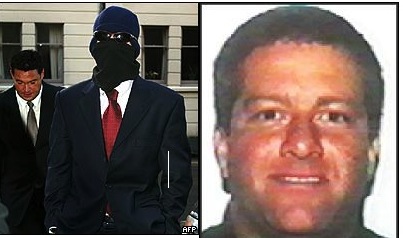
Pictured: Uriel Zosha Kelman, an Israeli spy, arrives in court in disguise in 2004 (left)) / Zev Barkan, another spy (right).
Mossad seemed to have developed a habit of revealing themselves in light of the infamous arrest of five of its agents in Secaucus, New Jersey on the morning of September 11th, 2001 by the FBI who were tipped off that a group of men were observed suspiciously dancing and celebrating while watching the WTC towers ablaze and collapsing across the Hudson River. The “dancing Israelis” were found with $5,000 in cash which raised suspicions while their vehicle was traced to a shady moving company called Urban Moving Systems that was suspected to be a front for an intelligence operation after their headquarters was abandoned and its owner, Dominick Suter, immediately fled to Israel following their apprehension. During their two month detention, the CIA intervened and halted the probe while the agents were subsequently deported in a deal with the Israeli government for overstaying their visas but not before it was confirmed that at least two of the men were intelligence officers and no ordinary moving company employees.
The world was briefly reminded of this mysterious case when Donald Trump as a presidential candidate in 2016 made the wild exaggeration that on 9/11 he had personally observed “thousands of Muslims” celebrating the destruction of the Twin Towers across the river in New Jersey. It is likely that Trump mixed up two different reports from 9/11, one of Reuters footage widely circulated by major networks of a small group of Arabs in East Jerusalem celebrating the attacks and the reports about the Israelis arrested in New Jersey who were initially believed to have been of “Middle Eastern appearance” and descent. One wonders if Trump would accurately recall his other observations that morning now that he is in the service of his Saudi and Israeli masters. Needless to say, this widely suppressed story which should have been front page news led many to rightly suspect there was prior knowledge and even direct involvement among Israeli intelligence in the 9/11 attacks, along with a trove of other evidence.
ABC News Friday 06/21/2002 05:42:40 pm-05:46:50 pm (Studio: Elizabeth Vargas) Report introduced. (Studio: John Miller) Exclusive ABC News investigation into what five Israelis were doing on …
The New Jersey cell were also in possession of foreign passports. Mossad has typically used fake passports, including that of Australians and Kiwis, regularly for its clandestine operations and carrying out assassinations like the 2010 targeted killing of Hamas official Mahmoud al-Mabhouh in Dubai which one of the spies apprehended in New Zealand, Zev Barkan, was involved in. After the arrest of the two spooks in New Zealand in 2004, the government imposed diplomatic sanctions against Israel and temporarily severed high-level contacts between the two countries in what became a significant diplomatic rift. WikiLeaks diplomatic cables revealed that the U.S. was not at all pleased.
Relations had returned to normal between the countries until December 2016 when along with Malaysia, Senegal, Venezuela and others, New Zealand co-sponsored the controversial United Nations Security Council Resolution 2334 which condemned Israeli settlements in occupied Palestinian territories during the last months of the Obama administration. The same motion briefly became mired in the Trump-Russia investigation when former National Security Advisor Michael Flynn pled guilty to lying to the FBI about lobbying activities related to the resolution during the transition between administrations on behalf of Israel. The Trump White House has since proven to be the most fanatically Zionist presidency since the foundation of the Jewish state in 1948. Over the years, New Zealand has shown a willingness to stand up to Jerusalem and its brazen disregard for international law that other nations could learn from. Despite being a small nation, it has played an important role in pro-Palestinian activism and the prospect of Palestinian statehood just as it did in protesting South African Apartheid in the 1980s. In 2018, when New Zealand-born popular musician Lorde canceled a concert in Tel Aviv in solidarity with the Boycott, Divestment and Sanctions (BDS) movement, she became the target of vicious Zionist smear campaign which saw right-wing Trumpist Rabbi Schmuley Boteach take out a full-page ad in The Washington Post denouncing her as a bigot while a $13,000 lawsuit was filed by the Mossad-linked Shurat HaDin lawfare NGO. Meanwhile, unlike Australian Prime Minister Scott Morrison, Jacinda Ardern has been critical of the Trump administration’s move of the U.S. embassy from Tel Aviv to Jerusalem, stating it undermines the Israeli-Palestinian peace process.
New Zealand’s relatively even-handed foreign policy has likely rattled the Zionists and their far right Islamophobic counterparts in the West and it is possible that it is viewed as a threat to the interests of Israel and the U.S. The feasibly manufactured terrorist attack against New Zealand has greatly disrupted the small country, a state which in 2018 had its lowest homicide rate in 40 years and averages well below 100 murders per year, making this attack an extremely rare occurrence for the peaceful country. In light of the attacks on the mosques in Christchurch, it could now end up acquiring the police state model of the U.S. and Israel as part of the global ‘War on Terror.’ The country immediately issued a ban on semiautomatic weapons following the tragedy in a disturbing rollback of civil liberties while engaging in an unprecedented censorship effort to criminalize sharing and possession of Tarrant’s manifesto and video. Prior to Breivik’s perpetration of the attacks in Norway, there had been significant political tensions between Oslo and Jerusalem in the months leading up to the violence due to Norway’s intent to recognize a Palestinian state and the circumstances in relations between New Zealand and Israel prior to Christchurch is eerily reminiscent.
Israel has a storied history of being a state sponsor of international terrorism as well as the use of ‘false flag’ operations to achieve its political objectives, most notably in the 1954 Lavon Affair, codenamed Operation Susannah, where the Aman branch of its military intelligence services recruited Egyptian nationals to commit bombings to be blamed on the Muslim Brotherhood in order to maintain desired British military presence in Egypt. It continues such cloak-and-dagger tactics to this day with the use of terror proxies such as the Kurdistan Free Life Party (PJAK) and Mojahedin-e-Khalq (MEK) to undermine Iran, as well as the arming and funding of al-Qaeda affiliated Syrian jihadist groups against the Assad government. If it is willing to co-sponsor radical Islamists with its ally Saudi Arabia to attack their mutual regional enemies, now that the ruling Likud Party has made strange bedfellows with far right Islamophobes in the West it is within the realm of possibility it would continue to do the same especially when the victims are Arab or Muslim.
Regardless of whether or not there turns out to be any Mossad fingerprints discovered on the Christchurch shootings, if the world is serious about confronting the emerging far right internationally it must be willing to accurately diagnose the phenomenon. One of its most distinctive attributes is its Christian Zionism and a shared belief that the Bible gives Israel evidential right to Palestinian land and that Jews are inherently non-indigenous to Europe. The ever-expanding colonization of the West Bank and Gaza has solidified Israel’s nationalist foundations, especially now that Arabic has been removed as a second official language and the passing of the 2018 Nationality Law defining Israel as an ethno-nationalist state with Arabs officially second-class citizens. If Israel did not directly participate in the 9/11 attacks by infiltrating the al-Qaeda cell in Hamburg, Germany and directing the airplane hijackings as many legitimately suspect, it has certainly facilitated the U.S. wars in the Middle East against its regional enemies and now it is nurturing the Islamophobic far right in the West hostile to the flood of displaced refugees fleeing them. Israeli policy has principally benefited from all this but one can only expect the hasbaric retaliation of ‘anti-Semitism’ smears like those against UK Labour Party leader Jeremy Corbyn and U.S. Congresswoman Ilhan Omar of Minnesota for pointing this out. In the meantime, the Russiagate hoax has deflected attention away from Jerusalem toward Moscow in regards to foreign cultivation of the growing far right nationalist movement in the West. One hopes the recent bust of Special Counsel Robert Mueller’s report will put some of the distraction to rest and shift the speculation toward Israel where it belongs.
Finally, the political confusion of zealots like Tarrant needs to be addressed as entirely predictable instead of as unintended consequences of the War on Terror and the financial crisis. Recently, 2020 Democratic U.S. Presidential candidate Andrew Yang became the subject of establishment-led smears simply for acknowledging verifiable facts about declining birth-rates of white Americans where he was vilified as adjoining with the views of those like Tarrant. Yet these statistics designated by race that Yang recognized are expressions of the results of class conflict while genuine anger is being misdirected toward immigrants instead of capital and its never-ending changes in labor demands. This is the cycle which must be broken if this holy war between the West and Islam stirred up by Zionists or what the orientialist Samuel Huntington called the ‘clash of civilizations’ is to end. If not, we cannot only expect the U.S. empire to continue its downward slide and its fear of a multipolar world to culminate in an internecine that will turn the whole world into a tragedy like Christchurch.
Trump’s Sanctions Kill Venezuelan People. Why Can’t UN Rights Chief Michelle Bachelet ‘Fully Acknowledge’ That?

By Joe Emersberger | The Canary | March 25, 2019
On 20 March, UN High Commissioner for Human Rights Michelle Bachelet made a statement about Venezuela. Unfortunately, her statement contained factual inaccuracies and failed to take into full account the deadly impact sanctions are having on the country.
Her words should also be contrasted with UN special rapporteur Alfred De Zayas who visited Venezuela. De Zayas said that the sanctions are “economic warfare.”
Factually incorrect
But Bachelet’s statement about US sanctions failed to echo De Zayas’ damning analysis:
Although this pervasive and devastating economic and social crisis began before the imposition of the first economic sanctions in 2017, I am concerned that the recent sanctions on financial transfers related to the sale of Venezuelan oil within the United States may contribute to aggravating the economic crisis, with possible repercussions on people’s basic rights and wellbeing.
Firstly, economic sanctions were first imposed in March 2015 by the Obama administration, not in 2017. Obama declared a fraudulent “national emergency” that claimed Venezuela was an “extraordinary threat” to the United States. Obama sold the sanctions as being “targeted” by making it illegal to deal with high ranking Venezuelan government officials. As US economist Mark Weisbrot pointed out, there is no way to “target” such officials without making investors afraid to deal with the entire government.
Donald Trump extended Obama’s “national emergency” to dramatically intensify the sanctions in August 2017. In the first year after Trump’s sanctions were imposed, they cost Venezuela’s government at least $6bn in oil revenues. Venezuela was importing $2bn per year in medicines while the economy was still growing.
Bachelet in denial about deadly sanctions
Trump’s sanctions are therefore killing people. But Bachelet failed to denounce them – only expressing “concern” that the most “recent” escalation of US sanctions “may” aggravate the crisis.
It’s therefore hypocritical of Bachelet to deny the impact of Trump’s sanctions while criticizing Nicolas Maduro’s government for failing to “fully acknowledge” the scale of Venezuela’s crisis.
Bachelet’s statement alluded to the argument, commonly used by US apologists, that the economic crisis preceded the sanctions. But US support for an insurrectionary opposition – going back all the way to 2002 – was a big factor in causing the crisis. Although it does not excuse the blunders that were made by the Venezuelan government, it is important to recognize and remember this.
Where is Bachelet’s “dissent”?
Bachelet also failed to condemn repeated threats against Venezuela’s government that have been made by US officials. Threats are illegal under Article 2 of the UN Charter. Trump’s national security advisor John Bolton has openly “joked” about Maduro being sent to a US-run torture camp in Cuba. Again, Bachelet’s hypocrisy is striking. She professed concern about dissent in Venezuela while it is threatened and sabotaged by a superpower.
The world’s most dangerous criminals have nothing to fear from Bachelet and similar “human rights defenders”. De Zayas, on the other hand, refused to pull any punches in his criticism. In an interview with the Independent, he stated:
“Sanctions kill,” he told The Independent, adding that they fall most heavily on the poorest people in society, demonstrably cause death through food and medicine shortages, lead to violations of human rights and are aimed at coercing economic change in a “sister democracy”.
Some of Bachelet’s critique of Venezuela’s record is valid. But by not “fully acknowledging” the role that US sanctions and threats play in the crisis, her credibility is undermined.
Pompeo Demands Moscow “Cease Unconstructive Behavior” In Venezuela
By Tyler Durden – Zero Hedge – 03/25/2019
As we predicted a number of times before, a proxy war between Russia and the United States appears now heating up in Venezuela — this after over the weekend Russia sent a military transport plane filled with Russian troops commanded by First Deputy Commander-in-Chief of the Land Forces of Russia Gen. Vasily Tonkoshkurov, which landed in Caracas Saturday. We also reported the major development this morning that new satellite images reveal a major deployment of S-300 air defense missile systems to a key airbase south of Caracas.
Russia’s highly visible deployment of a small troop contingency along with a reported 35 tons of cargo has resulted in a direct and firm response from Washington as on Monday morning the US Secretary of State called on Russia to “cease its unconstructive behavior”.
According to Reuters Pompeo conveyed the message directly via a phone call with his Russian counterpart Foreign Minister Sergey Lavrov.
Spokesman Robert Palladino addressed the phone call in the following statement:
The secretary told Russian Foreign Minister Lavrov that the United States and regional countries will not stand idly by as Russia exacerbates tensions in Venezuela.
Palladino added that Pompeo specifically condemned Russian military support for the “illegitimate regime of Nicolas Maduro.”
Pompeo had earlier this month vowed to continue to put “unconstrained” pressure on the Maduro regime after it became apparent that all internal coup attempts by the Juan Guaido-led opposition had failed.
As we reported previously this week’s tensions follows a high-level meeting in Rome last week, during which Russia reiterated a grave warning to the US – Moscow will not tolerate American military intervention to topple the Venezuelan government with whom it is allied – thus it appears Russia is taking no chances with its South American ally.
One of those warnings delivered directly by Russia’s deputy foreign minister Sergei Ryabkov to US “special envoy” on Venezuelan affairs Elliot Abrams is understood to have been that no American military intervention in Venezuela will be tolerated by Moscow.
Perhaps paralleling the Syria situation, this could be the start of a scenario where the greater the proxy action and threats from the United States, the more Russia will slowly intervene at the behest of Maduro.
All of these developments signalling closer Russian-Venezuelan military-to-military cooperation in the face of Washington saber rattling come after three months ago the two allies held military exercises on Venezuelan soil, which the US at the time had condemned as Russia encroachment in the region.
Featured Video
Racist Seinfeld Dances for Joy as Bibi Unveils His New Map
or go to
Aletho News Archives – Video-Images
TV Drama Review
Japanese drama projects Japan’s wartime atrocities onto Chinese characters

Global Times | October 25, 2026
By portraying Chinese characters as perpetrators of ruthless violence while casting Japanese Self-Defense Forces (SDF) intelligence operatives as defenders, the season 2 of the Japanese drama Vivant has recently drawn criticism from Chinese netizens, who argue that its depiction turns historical reality on its head while ignoring Japan’s wartime atrocities.
The TBS drama series – a spy suspense story in which an alleged unofficial intelligence unit of the SDF operates across the globe — has attracted a passionate fanbase. Its currently airing season 2 opened with a household rating of 18.8 percent, the highest for a TV drama this year, according toa commentary article by Japanese media Toyo Keizai.
What draws attention is the portrayal of the enemies in the series, the article noted. Scenes in which the Chinese organization subjects kidnapped members of the SDF unit to brutal torture are repeated with unrelenting intensity.
It is rare for Japanese TV dramas to explicitly portray a real-life country as the enemy, the article noted.
Japanese Prime Minister Sanae Takaichi also made a reference to the drama, saying that she has been recording Vivant and hopes to binge-watch it over the year-end and New Year holidays, according to Japanese media outlets.
China’s CCTV News report on Sunday revealed that the drama features scenes in which Chinese personnel cut off the fingers of and stab Japanese intelligence operatives in the abdomen. Such acts bear striking similarities to the torture inflicted on Chinese nationals by invading Japanese troops during the World War II.
The drama distorts the truth by attributing these atrocities to modern Chinese characters. Beneath the surface, it subtly glorifies Japan’s cross-border overseas operations, blurs the functional boundaries of the SDF and implicitly promotes an expansionist narrative, per CCTV News. … continue
Blog Roll
 Aletho News
- Iran FM Araghchi: “Hormuz Will No Longer Be the Same”
- EU facing trillion-euro debt hole while seeking more cash for Kiev
- How US, Europe, Persian Gulf states exhausted missile stockpiles, splurged billions to defend Israel
- Up in arms… Koreans reject U.S. empire’s plan to make South Korea the next Ukraine
- Iran, Turkey, Pakistan, Saudi Arabia could advance region-led security framework in Tehran: FM spox
- Netizens condemn Japanese drama for projecting Japan’s wartime atrocities onto Chinese characters
- Racist Seinfeld Dances for Joy as Bibi Unveils His New Map
- A West Bank War for Netanyahu’s Election Campaign, Could It Backfire?
- Yemen denounces European Parliament’s ‘hypocritical’ push to blacklist Ansarullah
- Qalibaf: UAE’s UN bid aims to ‘clear the runway’ for ‘Greater Israel’, whitewash genocide
- If Americans Knew
- An error has occurred; the feed is probably down. Try again later.
- No Tricks Zone
- Sudden Stratospheric Warming, Powerful El Niño Combination May Lead To Extreme Europe Cold, Energy Crisis!
- Two New Studies Find Thwaites Glacier Melt Cannot Be Driven By Human Activity Or A Warming Ocean
- E-Cars Reduce CO2 Emissions By Only 41% Compared To Internal Combustion Engine Vehicles
- Predictions Made By Renowned Climate Professor Over Past Decades Have Been Proven To Be Poor
- New Study Suggests Large Regions Of The Pacific Ocean Have Been Cooling For The Last 80 Years
- Germany’s Green Energy Debacle: High Energy Costs Force Kahla Porzellan to Close After 182 Years!
- New Study: 50 Years Of The Most Aggressive ‘Net Zero’ Policies Can Only Affect The Global Climate By 0.03°C
- US September “Heat” Was No Record…Many Records Set Decades Ago
- Latest European Green Energy Debacle; Portugal’s Largest Flagship Solar Park Insolvent!
- Green Energy Debacle: German Expert Professor Fritz Vahrenholt Warns Of Severe Economic And Social Consequences