India Stops Taking In Venezuelan Oil
By Irina Slav | Oilprice.com | March 22, 2019
A senior U.S. government official has told Indian media that private local refiners had stopped importing crude oil from Venezuela, noting the cooperation of Indian companies in this respect.
“My understanding is that Indian private companies, who were importing Venezuelan oil, have stopped,” the official, whose name was not disclosed, said as quoted by Business Standard. He added “The Indians have been cooperative in communicating to the private companies.”
India is one of the largest importers of Venezuelan crude, but it has been concerned about sanction violations as Washington’s pressure on Caracas increases, with the Trump administration asking importers to stop taking in Venezuelan oil in a bid to cut off the Maduro government’s access to oil money.
India has been a priority target in this push to reduce Venezuelan exports. Earlier this month, the U.S. envoy for Venezuela Elliott Abrams told Reuters in an interview, “We say you should not be helping this regime. You should be on the side of the Venezuelan people,” commenting on talks with New Delhi on the topic.
Yet in February, Reuters reported the Indian government had advised at least one company buying Venezuelan oil to avoid paying for the commodity through the U.S. banking system, but not to stop buying Venezuelan oil altogether.
The company in question, which has remained unnamed, “expressed concern that there could be a problem in payments to PDVSA, so we have advised them to move away from the U.S. banking and institutional mechanism,” Reuters quoted an Indian government source as saying at the time.
Earlier this week, media reported on a statement from Azerbaijan’s energy ministry that quoted Venezuela’s oil minister as saying the country had suspended shipments of crude to India. The statement added that Manuel Quevedo had said Venezuela was looking for new markets to keep the oil flowing.
CARICOM Confronts the Big House: Trump Attempts to Split the Caribbean over Venezuela
By Maximilian C. Forte | Zero Anthropology | March 25, 2019
It’s a simple matter, even if one might lose oneself in the various details, names, places, and dates. The Caribbean Community and Common Market (CARICOM), mostly made up of Anglophone Caribbean states, decisively stood up for non-intervention in the internal affairs of states by going against the push to recognize the illegitimate and illegal claim to power by Juán Guaidó in Venezuela. Such a policy, pushed by the US’ regime change agenda, would have clearly served to undermine the authority of the elected government of President Nicolás Maduro, while legitimating foreign intervention. Just as the US today seeks the overthrow of Venezuela’s government, tomorrow it could seek the overthrow of any other government in the Americas. It is thus the Caribbean’s voice that matters most right now.
Trump: Against Sovereignty
On the other side, Trump’s White House is not only pushing for regime change in Venezuela, Trump’s NSA, John Bolton, has stated repeatedly that the US intends to resurrect and impose the neocolonial and plainly imperialist Monroe Doctrine—claiming effective authority to rule the Western Hemisphere. (That includes Canada, not that Canadians have bothered to take note.) Given Trump’s own stated belief that “to the victor go the spoils,” and the US’ validation of the acquisition of territory by force—backing Israel’s claim to Syria’s Golan Heights—even respect for the territorial integrity of states has gone out the window. Fundamental and basic principles of the UN Charter have thus been unilaterally shredded by the US. CARICOM stands as one impediment. Trump clearly will not let that stand.
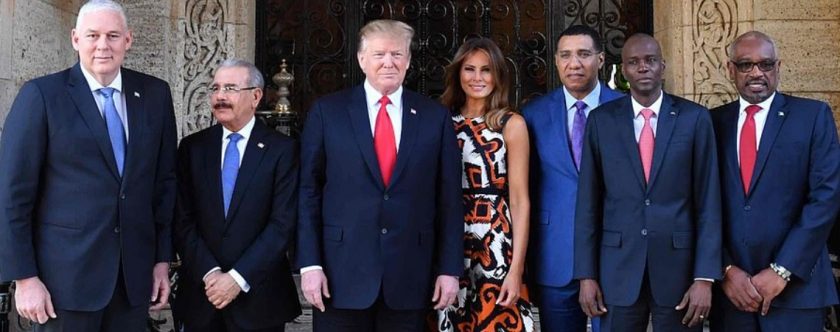
Trump has apparently resuscitated divide et impera, trying to not only pry some CARICOM members away from the main body by “dangling investment” promises in front of their eyes, but also setting the stage for CARICOM members to turn on each other. What Trump did was to invite a small, select group of Caribbean leaders—those belonging to the Lima Group (standing outside of any international body, because the Group supports regime change in violation of international law)—to visit him at his Mar-a-Lago estate. Trump thus met with St Lucia Prime Minister Allen Chastanet, Dominican Republic President Danilo Medina, Jamaica Prime Minister Andrew Holness, Haiti President Jovenel Moise, and Bahamas Prime Minister Hubert Minnis at the Mar-a-Lago estate in Palm Beach, Florida. These countries, “have all either criticized Venezuela’s Nicolas Maduro, or recognized Juan Guaido [sic] as the country’s rightful leader”.

Jamaica’s Minister of Foreign Affairs and Trade, Kamina Johnson Smith
Among those in attendance, Jamaica recently announced the closure of its embassy in Venezuela, despite the parliamentary opposition in Kingston voicing serious criticisms. Reporting on these events, the Jamaica Observer instead backed CARICOM’s approach to the Venezuelan crisis, reaffirming the value of the UN Charter. As for Jamaica’s Prime Minister, Andrew Holness, he spoke of being pleased with his meeting with Trump, saying that Trump, “wants to encourage and promote a stronger relationship with the region”. (Holness appears to be confusing a “stronger relationship” with a relationship of strength.) Holness’ main concern appeared to be the promise of US investments, saying that he hoped it was “not just talk” but that there would be “instrumental action”. Yet Trump is in no position to order US companies to invest in the Caribbean—he cannot even do that in the US itself. The US is not a state-run socialist economy, where public companies obey public policy—surely Holness understands this? Nonetheless, the affair smelled of something akin to bribery, and if this was representative of Caribbean leaders “standing tall” then language has been inverted, and standing tall is a reference to the humility of beggars. One might recall how the British Colonial Office used to refer to visiting Caribbean Chief Ministers as a “beggars’ opera”.
Rowley: Standing Up for the Caribbean
Once more, the figure standing up to Trump, and standing up for CARICOM and international law, is Trinidad & Tobago’s Prime Minister: Dr. Keith Rowley, of the ruling People’s National Movement (PNM). Dr. Rowley noted that this minority which met with Trump, which was not empowered to speak for CARICOM, were at Mar-a-Lago because they are members of the Lima Group whose objective is regime change in Venezuela. Apparently the US ambassador to Trinidad & Tobago, Joseph Mondello, said that he “viewed with concern” comments made by Rowley last month—in response, Rowley was reportedly angered and he redoubled his efforts to push CARICOM on the path of anti-intervention.
The fact that other Caribbean states such as Trinidad & Tobago and the majority of CARICOM members, who oppose the Lima Group, were logically not invited—why would they be?—has been seized upon by quislings in the region who think the Caribbean’s primary duty is servitude to whomever occupies the Big House in the US. Failure to show deference to US interests, these proxies think, somehow entails a loss of status, a “loss of leadership” even. Real leaders stand up for American interests, apparently. This has been translated into accusations that those who were not at Mar-a-Lago were thus “snubbed,” and missed out on something “special”.
Representative of this pro-US faction are figures such as Ralph Maraj, a former foreign minister of Trinidad & Tobago, and a member of the opposition United National Congress (UNC). According to Maraj, the fact that Trinidad was “excluded” from the Mar-a-Lago meeting means that the US now has a diminished view of the country. He continued:
“We do not stand tall, contrary to what Dr. Rowley has stated, we stand diminished in the region, we have lost our leadership of Caricom which we had. Jamaica now is leading the way…. We’ve really abdicated the leadership in Caricom and we have obviously offended the United States, and while we have sovereign right to deal with our foreign relations we stand by the principles and so, we must also protect our relationships…. The United States does not need to invest in our petrochemical industry anymore. They have the most gas, natural gas in the world…. They don’t need our gas, they don’t need our oil. They are a net exporter now of both oil and gas. We have lost our economic clout”.
Maraj’s message was, at best, confusing. If the US no longer needs Trinidad, and Trinidad has lost its economic clout as a result, then how would a lunch at Mar-a-Lago have altered those basic, objective economic facts? It’s not clear where Maraj’s complaint lies, but it’s also far from obvious that the facts are on his side.
Trinidad & Tobago’s Leadership: The US View
The US previously recognized Trinidad’s leadership in CARICOM and its high standing in the region—according to the US Embassy in Port of Spain in 2006:
“In regional politics, it could be said that T&T is an opinion shaper. [Prime Minister Patrick] Manning [of the PNM] just completed a six-month tenure as Chairman of CARICOM, a period marked by a renewed emphasis on regional economic integration. T&T receives high marks for its commitment to the needs of the smaller countries of the Eastern Caribbean. Beyond CARICOM, T&T maintains correct but cool relations with Venezuela, largely due to differences of opinion over Petrocaribe and Chavez’s regional aspirations. T&T views Cuba as a Caribbean brother and maintains amicable ties. Manning regularly goes to Cuba for medical attention”.
Did having an independent foreign policy diminish Trinidad, as Maraj argued above? The US Embassy recognized Trinidad & Tobago’s influential leadership position, even as it pointed to serious foreign policy differences between the US and Trinidad & Tobago (repeated here):
“T&T in many ways demonstrates a fierce independence; it has been immovable on several key recent U.S. foreign policy priorities. Because of former President Robinson’s role as a ‘father’ of the International Criminal Court (ICC), T&T was one of the first ICC signatories. It has not signed an Article 98 agreement with the U.S. and likely never will. T&T continues to desire and work towards good relations with Venezuela as they share a long maritime border and common energy concerns. It often defends Cuba, which it sees as a Caribbean brother. T&T, along with its neighbors, did not recognize Haiti’s interim government in the absence of a CARICOM consensus. T&T did not support the U.S. intervention in Iraq, and its media have been openly critical on this issue. T&T’s voting record at the U.N. also leaves much to be desired from a U.S. policy perspective. Most notably, T&T voted, together with its CARICOM partners, in favor of Venezuela’s candidacy for the vacant Latin American Caribbean seat on the UN Security Council”.
If standing up for Trinidad & Tobago’s interests—which are not the same as American interests—is somehow weak or diminished leadership, then that case has not been proven, not even when we refer to the opinions of US diplomats themselves.
Furthermore, during the same weekend that Trump was hosting a small group of Caribbean leaders, CARICOM itself held a dialogue with Juán Guaidó, in an effort to promote peaceful mediation towards an end to the crisis. Unfortunate however was the praise given by CARICOM leaders to Canada, which helped to organize the encounter. The point however is that if CARICOM did not matter, then not even Trump’s instrument in Venezuela would seem to agree—as Trump met with a splinter group, Guaidó spoke with representatives of the larger body, and both events happened at nearly the same time.
Who Was Invited to the Man’s House?
To have them assembled in one place, here are the comments made by Prime Minister Rowley about this weekend’s event at Mar-a-Lago, and what it signifies, gleaned from several sources as indicated below:

Prime Minister of Trinidad & Tobago, Dr. Keith Rowley
“There are people in Trinidad and Tobago who believe that because Trinidad and Tobago was not invited to the private residence of an American president we are somehow diminished…. Ladies and gentlemen, we have never stood taller, we have never stood prouder; and, as I speak to you now, Caricom’s position, as reaffirmed in the last meeting of heads in St Kitts-Nevis, is that there are three people representing and authorised to represent Caricom outside of its heads and caucus, and that’s the chairman of Caricom, who is the prime minister of St Kitts-Nevis (Dr Timothy Harris); Trinidad and Tobago’s prime minister or designate; and Barbados, through its prime minister or designate”. (source)
“A man’s home is his castle—you are free to invite who you want to your house. We can’t stay outside and say we shoulda be invited. Since when are we measuring our stature and station by who invites us to their house? If it is we’re being ‘blanked’ or ‘snubbed’ for steadfastly standing for the principles of the United Nations Charter, history will absolve us”. (source)
“Our foreign policy has always given us an indication of the road ahead. What we’re reacting to is an invitation to a man’s house—a meeting of the Lima Group at the private residence of the US President”. (source)
“I don’t know that T&T or anyone was deliberately, unwittingly or accidentally invited to anyone’s private home. The invitation wasn’t to Caricom, we don’t go around begging for invitations”. (source)
“What we are going to do resolutely and without apology, as a tiny speck on the world’s map, is to stand with the principles of the United Nations where we all have signed on and accept as the best way for peace and security, not only in our region, but the world. We, from early—St Kitts-Nevis, Dominica, Trinidad and Tobago, St Vincent and the Grenadines—we did not sign on to the Lima Group. So we are not reacting to an invitation to a man’s house”. (source)
“There are 14 Caricom countries, how many have gone to Mar-a-Lago? Yet the convseration is about four. The ones who’ve agreed are part of the Lima Group. What’s the group’s objective? Regime change in Venezuela. How that’s to be achieved is for those who’ve embarked on that course”. (source)
“As far as I’m aware, there’s no tear in TT-US relations. The US remains a friendly country and in so far as having a disagreement on the approach of Venezuela, it has nothing to do with the relations between the people of T&T and the people of the US—notwithstanding Opposition’s efforts to create that kind of division!” (source)
“Force Multipliers”
Rather than come out and call them “treacherous servants,” the politically correct term for amplifiers of US power is “force multipliers”. On the same day that Trump announced his Mar-a-Lago meeting, the Leader of the Opposition in Trinidad & Tobago, former Prime Minister Kamla Persad-Bissessar of the United National Congress, met with the US Ambassador in Port of Spain. It’s not the first time that Persad-Bissessar, while in the Opposition, has gone to the US Embassy to have private meetings to talk about Trinidadian affairs, slanted in a way that always favoured American interests and those of her party. The party attacking Prime Minister Rowley for not being servile enough to get an invitation to Mar-a-Lago, has a history of going in secret to the US Embassy to lay out its complaints about domestic political matters for the American ambassador to consider—perhaps this is what they mean by “leadership”. From their perspective a figure like Juán Guaidó must be one of the world’s greatest living “leaders”.

Ralph Maraj
The UNC is a party that mostly represents Trinidad’s population of East Indian descendants, which for generations have vied for power against the African-descended population that is mostly represented by the ruling People’s National Movement (PNM). The PNM led the country to independence in 1962, and its leadership was responsible for expelling the US from its air and naval bases in Trinidad. The PNM also nationalized Trinidad & Tobago’s oil and gas industry, and did substantial work in trying to build a nation.
The UNC has long had a particularly cozy relationship with the US, and it’s no secret that many of its followers tend to hold in high esteem all things coded White, looking up to the Global North, with neither the White House nor Donald Trump personally being any exception of course. In fact, the UNC’s long-standing former leader, Basdeo Panday, was the Prime Minister who personally hosted Donald Trump when he traveled to Trinidad for the 1999 Miss Universe Pageant. Trump and Panday spent time dining and golfing together, and apparently the experience made a positive impression on Trump. A few years later, Panday would find himself jailed on corruption charges.
While Trinidadian politics are not organized along left vs. right lines (mistakenly assumed to be universal by most North American and many European writers)—the UNC has nevertheless on occasion lambasted opponents, in a manner uncharacteristic of Trinidad politicians, as “communists”. The UNC’s stance on Venezuela, since the rise of Hugo Chávez, has been consistently hostile to the Bolivarian Revolution.
It was thus telling that this cable, as published by WikiLeaks, showed that, “on October 3 [2006], the [US] Ambassador met with Opposition United National Congress (UNC) Deputy Political Leader Senator Wade Mark, at Mark’s request,” and during that meeting the UNC’s Wade Mark not only assured the US that a future UNC government would favour US interests, but he went as far as linking the then PNM Prime Minister, Patrick Manning, with radical Muslim terrorism—and then linked the PNM and Hugo Chávez to Muslim terrorism. Wade Mark was purposely baiting the US, knowing that the US Embassy was keeping a keen eye on Muslim groups in the country, at the height of the US’ so-called “Global War on Terror”.
Let’s read that document from the US Embassy in Port of Spain in greater depth, which was previously publicized thanks to Guanaguanare—the emphases in bold print are mine:
“Mark said his purpose was to express to the Ambassador the UNC’s shock at the sudden assault on the United States unleashed by Prime Minister Patrick Manning, in his September 5 address before energy industry executives and members of the diplomatic corps…. Mark wished to reassure the Ambassador that a UNC administration would re-establish with the US the same friendly and cooperative relations which has characterized the 1995-2001 period when then UNC Prime Minister Basdeo Panday and Secretary of State Warren Christopher signed an extradition treaty, a mutual legal assistance treaty and an agreement on maritime law enforcement. Mark went on to say that UNC concern with Manning’s undiplomatic outburst was heightened by the fact that Minister of Energy and Energy Industries Dr. Lenny Saith has reportedly signed a memorandum of understanding with Mexico according to which a portion of the liquefied natural gas currently exported by T&T to the US would be assigned to Mexico instead. Such an action could not help but have serious national security implications for T&T, given that T&T depends for much of its food imports on the US. The Ambassador listened to Mark and acknowledged that the Prime Minister’s September 5 criticism of the US had taken him by surprise, too.
“Mark then launched into a litany of allegations and rumors whose veracity it is impossible to gauge. He said it was the UNC’s understanding that newly-appointed foreign minister Arnold Piggott… had, while serving as High Commissioner to Canada, met with elements associated with Al-Qaeda and Hezbollah. (Note: Post has no reason to believe that this is true and has not heard this rumor from any other source). He went on to say that three ships carrying rocket launchers as well as members of Hezbollah, which had left Syria in August en route to Argentina, were diverted to Venezuela’s Margarita island where a Hezbollah base was to be established with the aim of targeting the US. (Note: Post has heard this claim elsewhere, although embassy Caracas would be better placed to ascertain whether it is fact or fiction).
“Mark also drew a connection between Prime Minister Manning, Imam Yasin Abu Bakr, leader of the extremist Jamaat al Muslimeen (JAM) group, and Venezuelan President Hugo Chavez. Referring to Abu Bakr’s release from prison on bail and to his court-authorized leave to travel to Venezuela, Mark said it strains credulity that such a development could have taken place without the knowledge and intervention of the powers that be. Mark said that Abu Bakr is treated like a head of state by the Chavez regime, and hypothesized that his leave to travel to Venezuela could have been intended to cement Manning’s anti-American credentials in return for the JAM’s assistance with voter recruitment at the next election….”
It is from within this fold that Prime Minister Rowley was seen as being “snubbed” by Trump, and that Trinidad lost its leadership status. It’s not surprising then, and in fact it’s quite logical, that on a previous occasion in Parliament, Dr. Rowley blasted the opposition UNC as “traitors”.
A Perspective on Canada
Canada’s government could learn a great deal—first of all, about international law and the UN Charter—from listening to Prime Minister Rowley. Instead, rather than having the post-national state as Justin Trudeau remarked, Canada has more of a post-government state, one that functions almost on auto-pilot by hiring technocrats who are “skilled” in “reading the signals coming out of Washington”. As studious imitators, they would have been well prepared by “universities” in Canada since they are largely just retail outlets for American academic production, training Canadians in the high art of consuming American books, American journals, and traveling to American conferences.
Canada helped found the Lima Group, in an effort to overthrow Venezuela’s government. While Trudeau is defending Canadian corporate interests, he does so using the language and techniques that shore up US interests. It has reached the point where, instead of taking an independent and correct stand like Trinidad & Tobago and CARICOM, Canada instead imagines that Venezuela is part of its “global backyard”. Chrystia Freeland, Trudeau’s minister for foreign affairs, stated to the press:
“the crisis in Venezuela is unfolding in Canada’s global backyard. This is our neighbourhood. We have a direct interest in what happens in our hemisphere”.
Peter Boehm, a Canadian “diplomat,” seconded Freeland, telling the CBC: “This is our backyard, the Western hemisphere. We have a role here too”.
Funny, how the front yard thinks it owns a backyard, ignoring the Big House standing between the two and claiming ownership of both. What both Freeland and Boehm miss, obviously, is that from the US’ standpoint, we are all backyard.
Canada itself has no backyard, apart from its internal colonies—and there is no such thing as a “global backyard”. It is a semi-peripheral state which, like two centuries ago, still specializes in exporting raw materials. Lacking national leadership means that, in practice, there has been virtually no distinction of any substance that can be made between Donald Trump and Justin Trudeau, apart from superficial matters like style, tone, and virtue signalling (and sometimes not even then). Lacking an independent national government, and worse yet having one that thinks it’s American, means that it has been easy for Trump to effectively dictate terms to Canada and offload some of the costs of US foreign policy onto Canada, with no reward in return for Canada. Whether it is unrelenting trade tariffs, surrender/renegotiation of NAFTA to favour US interests even more, the transfer of asylum-seekers, or the consequences of dragging Canada into the geopolitical conflict between the US and China—Canada under Justin Trudeau has been haemorrhaging both political and economic capital to the US. One ironic and sad consequence is that this has only strengthened Canada’s Conservatives—with all of their supposed “agency,” Canadians vote for either Tweedledee or Tweedledum, generation after generation, and all of the parties are beginning to look and sound alike. With respect to Venezuela, that means more of the same.
References
Alexander, Gail. (2019). “PM dismisses Trump meeting snub talk: We’ve never stood taller”. The Guardian, March 21.
————— . (2019). “Trump announces new sanctions on Venezuela; Caricom division not new – PM”. The Guardian, March 22.
CARICOM. (2019). “Meeting Between CARICOM Foreign Ministers Delegation and Mr. Juan Guaidó”. CARICOM Today, March 24.
CBS. (2019). “Trump meets with Caribbean leaders at Mar-a-Lago”. CBS News, March 22.
Christopher, Peter. (2019). “Maraj: T&T has lost leadership of Caricom”. The Guardian, March 22.
Editors. (2019). “Resolving the Venezuelan crisis”. Jamaica Observer, March 24.
Engler, Yves. (2019). “Is Trudeau’s Venezuela policy the Monroe Doctrine reborn?” Canadian Dimension, February 20.
Forte, Maximilian C. (2018). “Trade War and the Nationalist Exchange: Trudeau Trails Trump”. Zero Anthropology, June 1.
————— . (2018). “Better Off Without NAFTA, Part 2: Canada—Localized Profit, but a Net Outflow of Capital”. Zero Anthropology, June 7.
————— . (2018). “Review of 2018, Part 4 (October–December): Nationalism, Deglobalization, plus the US exit from Syria”. Zero Anthropology, December 23.
————— . (2019). “Against Intervention in Venezuela: The Case of the Caribbean Community”. Zero Anthropology, February 6.
————— . (2019). “A War for Oil: The US Economic War on Venezuela”. Zero Anthropology, February 12.
Gleaner. (2019). “Jamaica to temporarily close Venezuelan embassy”. The Gleaner, March 20.
————— . (2019). “Jamaica not abandoning Venezuela – Johnson Smith”. The Gleaner, March 22.
————— . (2019). “CARICOM foreign ministers hail meeting with Venezuela’s Guaido as a significant step to peaceful resolution to crisis”. The Gleaner, March 24.
Guanaguanare. (2011). “Slouching Towards The National Security State…”. Guanaguanare: The Laughing Gull, November 24.
Hassanali, Shaliza. (2019). “Rowley’s ‘traitor’ comment causes Parliament uproar”. The Guardian, February 1.
Jamaica Observer. (2019). “Trump meeting scorn: Rowley dismisses suggestion T’dad snubbed by US, says countries invited are part of Lima Group”. Jamaica Observer, March 22.
————— . (2019). “Holness pleased with two-hour talks with Trump”. Jamaica Observer, March 24.
Kennedy-Glans, Donna, & Hill, Don. (2018). “Trudeau’s neglect of the nation has led us to this place”. CBC News, December 8.
Larison, Daniel. (2017). “Venezuela and Our Stupid Obsession with U.S. ‘Leadership’”. The American Conservative, April 17.
Lawrence, Ken. (2005). The World According to Trump: An Unauthorized Portrait in His Own Words. Kansas City: Andrews McMeel Publishing.
Pagliccia, Nino. (2019). “Is Venezuela Canada’s Modern Day El Dorado?” Venezuelanalysis.com, February 18.
Rampton, Roberta. (2019). “Trump Dangles Investment to Caribbean Leaders Who Back Venezuela’s Guaido”. U.S. News & World Report, March 22.
RT. (2019). “Bolton’s ‘Monroe Doctrine’ remark on Venezuela arrogant & insulting to all of Latin America – Lavrov”. RT.com, March 4.
————— . “Bolton says Trump ‘very serious’ about ‘all options’ as Venezuela dismantles ‘terrorist cell’”. RT.com, March 22.
Starr, Katharine. (2019). “What to expect from Monday’s emergency summit on Venezuela”. CBC News, February 2.
Todd, Douglas. (2016). “The dangers of Trudeau’s ‘postnational’ Canada”. Vancouver Sun, April 28.
US Embassy—Trinidad & Tobago. (2006). “Trinidad: Bi-Weekly Political Roundup”. Port of Spain, Trinidad: US Embassy, February 1. Cable ID: 06PORTOFSPAIN152_a.
————— . (2006). “UNC Executive: PNM’s Out to Get Us, but Panday’s Still Fighting”. Port of Spain, Trinidad: US Embassy, April 28. Cable ID: 06PORTOFSPAIN521_a.
————— . (2006). “Scenesetter for DHS Secretary Chertoff’s Visit To T&T”. Port of Spain, Trinidad: US Embassy, August 3. Cable ID: 06PORTOFSPAIN920_a.
————— . (2006). “Opposition Leader: PM has Terrorist Links, is Anti-American and Dictatorial”. Port of Spain, Trinidad: US Embassy, October 20. Cable ID: 06PORTOFSPAIN1214_a.
————— . (2007). “Scenesetter for Energy Infrastructure Pre-Assessment Visit”. Port of Spain, Trinidad: US Embassy, October 10. Cable ID: 07PORTOFSPAIN1019_a.
————— . (2008). “Scenesetter for Visit of Secretary of Energy”. Port of Spain, Trinidad: US Embassy, October 10. Cable ID: 08PORTOFSPAIN208_a.
————— . (2008). “Scenesetter for Visit of Deputy Secretary of Defense and SOUTHCOM Deputy Commander General Spears”. Port of Spain, Trinidad: US Embassy, September 30. Cable ID: 08PORTOFSPAIN443_a.
————— . (2008). “Scenesetter for Visit of WHA Director of Caribbean Affairs Velia De Pirro”. Port of Spain, Trinidad: US Embassy, October 10. Cable ID: 08PORTOFSPAIN144_a.
————— . (2009). “US Embassy Meets with Opposition to Discuss Legislative Agenda”. Port of Spain, Trinidad: US Embassy, June 9. Cable ID: 09PORTOFSPAIN256_a.
Vlach, John Michael. (1993). Back of the Big House: The Architecture of Plantation Slavery. Chapel Hill, NC: University of North Carolina Press.
Wittes, Tamara Cofman, & Goldenberg, Ilan. (2019). “Trump’s Golan Fiasco”. Politico, March 22.
Zimonjic, Peter, & Kapelos, Vassy. (2019). “Time for Canada to drop the ‘white gloves’ in diplomatic feud with China, says ex-diplomat”. CBC News, March 22.
Russia Gives US Red Line on Venezuela
By Finian CUNNINGHAM | Strategic Culture Foundation | 22.03.2019
At a high-level meeting in Rome this week, it seems that Russia reiterated a grave warning to the US – Moscow will not tolerate American military intervention to topple the Venezuelan government with whom it is allied.
Meanwhile, back in Washington DC, President Donald Trump was again bragging that the military option was still on the table, in his press conference with Brazilian counterpart Jair Bolsonaro. Trump is bluffing or not yet up to speed with being apprised of Russia’s red line.
The meeting in the Italian capital between US “special envoy” on Venezuelan affairs Elliot Abrams and Russia’s deputy foreign minister Sergei Ryabkov had an air of urgency in its arrangement. The US State Department announced the tête-à-tête only three days beforehand. The two officials also reportedly held their two-hour discussions in a Rome hotel, a venue indicating ad hoc arrangement.
Abrams is no ordinary diplomat. He is a regime-change specialist with a criminal record for sponsoring terrorist operations, specifically the infamous Iran-Contra affair to destabilize Nicaragua during the 1980s. His appointment by President Trump to the “Venezuela file” only underscores the serious intent in Washington for regime change in Caracas. Whether it gets away with that intent is another matter.
Moscow’s interlocutor, Sergei Ryabkov, is known to not mince his words, having earlier castigated Washington for seeking global military domination. He calls a spade a spade, and presumably a criminal a criminal.
The encounter in Rome this week was described as “frank” and “serious” – which is diplomatic code for a blazing exchange. The timing comes at a high-stakes moment, after Venezuela having been thrown into chaos last week from civilian power blackouts that many observers, including the Kremlin, blame on American cyber sabotage. The power grid outage followed a failed attempt by Washington to stage a provocation with the Venezuelan military over humanitarian aid deliveries last month from neighboring Colombia.
The fact that Washington’s efforts to overthrow the elected President Nicolas Maduro have so far floundered, might suggest that the Americans are intensifying their campaign to destabilize the country, with the objective of installing US-backed opposition figure Juan Guaido. He declared himself “acting president” in January with Washington’s imprimatur.
Given that the nationwide power blackouts seem to have failed in fomenting a revolt by the civilian population or the military against Maduro, the next option tempting Washington could be the military one.
It seems significant that Washington has recently evacuated its last remaining diplomats from the South American country. US Secretary of State Mike Pompeo commented on the evacuation by saying that having US personnel on the ground “was limiting” Washington’s scope for action. Also, American Airlines reportedly cancelled all its services to Venezuela in the past week. Again, suggesting that the US was considering a military intervention, either directly with its troops or covertly by weaponizing local proxies. The latter certainly falls under Abrams’ purview.
After the Rome meeting, Ryabkov said bluntly: “We assume that Washington treats our priorities seriously, our approach and warnings.”
One of those warnings delivered by Ryabkov is understood to have been that no American military intervention in Venezuela will be tolerated by Moscow.
For his part, Abrams sounded as if he had emerged from the meeting after having been given a severe reprimand. “No, we did not come to a meeting of minds, but I think the talks were positive in the sense that both sides emerged with a better understanding of the other’s views,” he told reporters.
“A better understanding of the other’s views,” means that the American side was given a red line to back off.
The arrogance of the Americans is staggering. Abrams seems, according to US reporting, to have flown to Rome with the expectation of working out with Ryabkov a “transition” or “compromise” on who gets the “title of president” of Venezuela.
That’s what he no doubt meant when he said after the meeting “there was not a meeting of minds”, but rather he got “a better understanding” of Russia’s position.
Washington’s gambit is a replay of Syria. During the eight-year war in that country, the US continually proffered the demand of a “political transition” which at the end would see President Bashar al Assad standing down. By contrast, Russia’s unflinching position on Syria has always been that it’s not up to any external power to decide Syria’s politics. It is a sovereign matter for the Syrian people to determine independently.
Nearly three years after Russia intervened militarily in Syria to salvage the Arab country from a US-backed covert war for regime change, the American side has manifestly given up on its erstwhile imperious demands for “political transition”. The principle of Syrian sovereignty has prevailed, in large part because of Russia’s trenchant defense of its Arab ally.
Likewise, Washington, in its incorrigible arrogance, is getting another lesson from Russia – this time in its own presumed “back yard” of Latin America.
It’s not a question of Russia being inveigled by Washington’s regime-change schemers about who should be president of Venezuela and “how we can manage a transition”. Moscow has reiterated countless times that the legitimate president of Venezuela is Nicolas Maduro whom the people voted for last year by an overwhelming majority in a free and fair election – albeit boycotted by the US-orchestrated opposition.
The framework Washington is attempting to set up of choosing between their desired “interim president” and incumbent Maduro is an entirely spurious one. It is not even worthy to be discussed because it is a gross violation of Venezuela’s sovereignty. Who is Washington to even dare try to impose its false choice?
On Venezuela, Russia is having to remind the criminal American rulers – again – about international law and respect for national sovereignty, as Moscow earlier did with regard to Syria.
And in case Washington gets into a huff and tries the military option, Moscow this week told regime-change henchman Abrams that that’s a red line. If Washington has any sense of rationality left, it will know from its Syria fiasco that Russia has Venezuela’s back covered.
Political force is out. Military force is out. Respect international law and Venezuela’s sovereignty. That’s Russia’s eminently reasonable ultimatum to Washington.
Now, the desperate Americans could still try more sabotage, cyber or financial. But their options are limited, contrary to what Trump thinks.
How the days of American imperialist swagger are numbered. There was a time when it could rampage all over Latin America. Not any more, evidently. Thanks in part to Russia’s global standing and military power.
Venezuela’s Electric Grid Was Attacked From Abroad: Russia
teleSUR | March 15, 2019
Russia’s Foreign Ministry spokeswoman Maria Zakharova said Friday her country considers that Venezuela’s blackout was due to a cyber attack from abroad, the same version provided by the Venezuelan government for the massive loss of electric services across most of the country for five days.
“According to the country’s legitimate government headed by President Nicolas Maduro, as well as to information from other credible sources, Venezuela’s power grid was attacked from abroad,” Zakharova said and pointed out that “it was an attempt to remotely influence control systems at major electrical substations where Canadian-made equipment is installed.”
Last week Maduro denounced that the Venezuelan opposition and its United State allies were behind the blackout, which began Thursday, Feb. 7 and caused multiple damages for the Bolivarian country.
Foreign Ministry spokeswoman also said that Russia could investigate the cyber attack.
“If we receive an official request for expert assistance, we will give it proper attention,” Zakharova said in relation to a recent statement by President Maduro’s through which he announced that his country will ask Russia, China, Iran and Cuba to assist in investigating the attack on the electricity grid.
In addition, the Russian senior diplomat said the perpetrators of this aggression against the Venezuelan people are fully responsible for the deaths the blackout caused as many hospitals were left without electricity.
“We hope that this responsibility will sooner or later take the form of a court ruling,” Zakharova stated, as reported by Sputnik.
Would-be Maduro drone assassin speaks to CNN
RT | March 15, 2019
The man who claims he planned the exploding-drone attack on Venezuelan President Nicolas Maduro along with defectors from the Venezuelan military has come forward to tell his story – to CNN, of all people.
The would-be drone bomber says he met with US officials three times after the attack that took place at a military parade in August last year. In an interview with CNN, he claims the US officials seemed receptive to giving them “things in return” for information about the assassination attempt.
A State Department spokesman declined to comment, saying only “Our policy is to support a peaceful transition in Venezuela.”
The assassin, who wished to remain anonymous for obvious reasons, provided video of the conspirators tinkering with the improvised drone bomb, which they reportedly built themselves in a farmhouse in Colombia using materials they purchased online from the US. His footage also showed the group practising flying the drones “high enough to not be seen,” then diving steeply to hit their target, before dismantling them and sneaking them into Venezuela.
The man acknowledged the attack could have killed innocent civilians, had the bombs not detonated prematurely when the cellular signal blockers protecting Maduro reactivated, but claimed he was desperate.
“We have tried every peaceful and democratic way to bring an end to this tyranny that dresses itself as democracy,” he told CNN, claiming he had friends who had been jailed and tortured by Maduro’s government.
While National Security Advisor John Bolton initially suggested the attack had been faked to create a “pretext” for a crackdown, US officials have since confirmed to CNN that they believe it was a “genuine attack gone wrong.”
Self-appointed president Juan Guaido believes the attack was staged, telling CNN, “I think this was something internal, done by the government. It ends up making them look like victims.”
Maduro ultimately blamed the “Venezuelan ultra-right in alliance with the Colombian extreme right” for the attack.
Russian pranksters posing as Swiss president call Guaido, talk freezing Maduro’s ‘crime monies’
© AFP 2018 / YURI CORTEZ
RT | March 14, 2019
The self-proclaimed ‘interim president’ of Venezuela, Juan Guaido, has fallen victim to a famous Russian prankster duo, discussing freezing Maduro’s Swiss bank accounts and even sending them an “official request” to do so.
The comedic duo of two Russian pranksters – Vladimir ‘Vovan’ Kuznetsov and Alexei ‘Lexus’ Stolyarov – notorious for their high-profile pranks of politicians world-wide, released an audio, which purportedly captured their “talks” with Guaido on Thursday.
The prank victim apparently found the pranksters after the duo called the US Special Representative for Venezuela Elliott Abrams, impersonating the President of Switzerland, and the chief of the nation’s Department of Finance, Ueli Maurer.
Shortly after the call, they were contacted by an “ambassador of the new Venezuelan government,” Carlos Vecchio, who then arranged talks with the ‘interim president’ himself. According to the pranksters, Guaido insisted on holding the “talks” only through Skype or WhatsApp for fear of wiretapping.
On February 20, ‘Maurer’ and Guaido talked about the “crime monies” of Venezuelan President Nicolas Maduro, supposedly held in Swiss banks. The ‘Swiss president’ promised to freeze the accounts, claiming that of late the banks observed transfers from them to Russian and Chinese banks.
The pranksters reassured Guaido that he would be able to “manage” the frozen Venezuelan government accounts “as head of state.” “Excellent,” Guaido replied. Apart from that, the duo talked about another way, suggesting to simply create a personal account for Guaido and transferring Venezuelan state funds there.
To take action, the ‘Swiss president’ asked Guaido to send an “official” request, sending him a draft of it. The draft included a list of Swiss banks, where the “crime monies” are supposedly held – and cheekily included ‘Lexus Vovanial Bank Ltd.’ – a fictitious bank, based on the duo’s nicknames.
While the prank was already a success, Guaido himself apparently added more hilarity to it, bragging to the press about getting in touch with the ‘Swiss president’ and stating that he was “doing everything possible to protect these assets that belong to the republic.” Switzerland, however, swiftly rebuked Guaido’s claims, stating – obviously – that “there was no telephone contact between Mr. Guaido and President Maurer.”
The official statement by the real Swiss government, however, did not stop the prankster duo, who then again contacted Abrams and ‘Ambassador’ Vecchio, complaining about Guaido not being able to keep the “talks” private.
Surprisingly, the veteran meddler Abrams took the bait, replying to their email.
“Yes – that was an error on his part. We will of course keep everything confidential,” a screengrab, purportedly showing a reply from Abrams to ‘Maurer’ reads. The US Special Representative for Venezuela promised to tell Guaido “gently” that openly speaking to the press about such sensitive matters “should not be repeated.”
A similar response was provided by Vecchio, who reassured the ‘Swiss president’ that they “already took action” and such a blunder “will not happen again.”
As the fallout of Guaido’s talkativeness was contained, the duo received English and Spanish versions of the “official document” from the ‘interim president’ – Lexus Vovanial Bank Ltd. included – screenshots provided by the pranksters show.
Read more:
‘Freeze all Venezuelan assets’ – US regime-change hawk tells pranksters posing as Swiss president
Germany’s Über Hypocrisy over Venezuela
By Finian CUNNINGHAM | Strategic Culture Foundation | 12.03.2019
Germany has taken the lead among European Union member states to back Washington’s regime-change agenda for Venezuela. Berlin’s hypocrisy and double-think is quite astounding.
Only a few weeks ago, German politicians and media were up in arms protesting to the Trump administration for interfering in Berlin’s internal affairs. There were even outraged complaints that Washington was seeking “regime change” against Chancellor Angela Merkel’s government.
Those protests were sparked when Richard Grenell, the US ambassador to Germany, warned German companies involved in the Nord Stream 2 gas pipeline with Russia that they could be hit with American economic sanctions if they go ahead with the Baltic seabed project.
Earlier, Grenell provoked fury among Berlin’s political establishment when he openly gave his backing to opposition party Alternative for Germany. That led to consternation and denunciations of Washington’s perceived backing for regime change in Berlin. They were public calls for Grenell to be expelled over his apparent breach of diplomatic protocols.
Now, however, Germany is shamelessly kowtowing to an even more outrageous American regime-change plot against Venezuela.
Last week, the government of President Nicolas Maduro ordered the expulsion of German ambassador Daniel Kriener after he greeted the US-backed opposition figure Juan Guaido on a high-profile occasion. Guaido had just returned from a tour of Latin American countries during which he had openly called for the overthrow of the Maduro government. Arguably a legal case could be made for the arrest of Guaido by the Venezuelan authorities on charges of sedition.
When Guaido returned to Venezuela on March 4 he was greeted at the airport by several foreign diplomats. Among the receiving dignitaries was Germany’s envoy Daniel Kriener.
The opposition figure had declared himself “interim president” of Venezuela on January 23 and was immediately recognized by Washington and several European Union states. The EU has so far not issued an official endorsement of Guaido over incumbent President Maduro. Italy’s objection blocked the EU from adopting a unanimous position.
Nevertheless, as the strongest economy in the 28-member bloc, Germany can be seen as de facto leader of the EU. Its position on Venezuela therefore gives virtual EU gravitas to the geopolitical maneuvering led by Washington towards the South American country.
What’s more, the explicit backing of Juan Guaido by Germany’s envoy was carried out on the “express order” of Foreign Minister Heiko Maas, according to Deutsche Welle.
“It was my express wish and request that Ambassador Kriener turn out with representatives of other European nations and Latin American ones to meet acting President Guaido at the airport,” said Maas. “We had information that he was supposed to be arrested there. I believe that the presence of various ambassadors helped prevent such an arrest.”
It’s staggering to comprehend the double-think involved here.
Guaido was hardly known among the vast majority of Venezuelans until he catapulted on to the global stage by declaring himself “interim president”. That move was clearly executed in a concerted plan with the Trump White House. European governments and Western media have complacently adopted the White House line that Guaido is the legitimate leader while socialist President Maduro is a “usurper”.
That is in spite of the fact that Maduro was re-elected last year in free and fair elections by a huge majority of votes. Guaido’s rightwing, pro-business party boycotted the elections. Yet he is anointed by Washington, Berlin and some 50 other states as the legitimate leader.
Russia, China, Turkey, Cuba and most other members of the United Nations have refused to adopt Washington’s decree of recognizing Guaido. Those nations (comprising 75 per cent of the UN assembly) continue to recognize President Maduro as the sovereign authority. Indeed, Russia has been highly critical of Washington’s blatant interference for regime change in oil-rich Venezuela. Moscow has warned it will not tolerate US military intervention.
Russia’s envoy to the UN Vasily Nebenzia, at a Security Council session last month, excoriated the US for its gross violation of international law with regard to Venezuela. Moscow’s diplomat also directed a sharp rebuke at other nations “complicit” in Washington’s aggression, saying that one day “you will be next” for similar American subversion in their own affairs.
Germany’s hypocrisy and double-think is, to paraphrase that country’s national anthem, “über alles” (above all else).
German politicians, diplomats and media were apoplectic in their anger at perceived interference by the US ambassador in Berlin’s internal affairs. Yet the German political establishment has no qualms whatsoever about ganging up – only weeks later – with Washington to subvert the politics and constitution of Venezuela.
How can Germany be so utterly über servile to Washington and the latter’s brazen criminal aggression towards Venezuela?
It seems obvious that Berlin is trying to ingratiate itself with the Trump administration. But what for?
Trump has been pillorying Germany with allegations of “unfair trade” practices. In particular, Washington is recently stepping up its threats to slap punitive tariffs on German auto exports. Given that this is a key sector in the German export-driven economy, it may be gleaned that Berlin is keen to appease Trump. By backing his aggression towards Venezuela?
Perhaps this policy of appeasement is also motivated by Berlin’s concern to spare the Nord Stream 2 project from American sanctions. When NS2 is completed later this year, it is reckoned to double the capacity of natural gas consumption by Germany from Russia. That will be crucial for Germany’s economic growth.
Another factor is possible blackmail of Berlin by Washington. Recall the earth-shattering revelations made by American whistleblower Edward Snowden a few years back when he disclosed that US intelligence agencies were tapping the personal phone communications of Chancellor Merkel and other senior Berlin politicians. Recall, too, how the German state remarkably acquiesced over what should have been seen as a devastating infringement by Washington.
The weird lack of action by Berlin over that huge violation of its sovereignty by the Americans makes one wonder if the US spies uncovered a treasure trove of blackmail material on German politicians.
Berlin’s pathetic kowtowing to Washington’s interference in Venezuela begs an ulterior explanation. No self-respecting government could be so hypocritical and duplicitous.
Whatever Berlin may calculate to gain from its unscrupulous bending over for Washington, one thing seems clear, as Russian envoy Nebenzia warned: “One day you are next” for American hegemonic shafting.
Cuba: Electric Sabotage Against Venezuela is Terrorism
teleSUR – March 11, 2019
The government of Cuba has described the attack on Venezuela’s electricity system which occurred last Thursday as a terrorist act.
In a statement, the government of the Cuban Revolution argues that the attack has been “aimed at damaging the defenseless population to use as a hostage in the unconventional war unleashed by the United States against the Venezuelan government.”
In this context, it argues that it is an escalation of violence that evokes the oil strike of 2002 and that arises after the interventionist failure of 23 February, when they tried to forcibly enter a supposed “humanitarian aid”.
The statement also denounces a campaign of lies coordinated by U.S. National Security Adviser John Bolton against Venezuela. One of those lies, says the statement, is that “Cuba has between 20 and 25 thousand military personnel in Venezuela who threaten the officers of the Bolivarian National Armed Forces.”
“Cuba categorically rejects this lie, as it equally firmly rejects any suggestion that there is any degree of political subordination from Venezuela to Cuba or from Cuba to Venezuela,” the Cuban government asserts.
Lavrov: US Sanction Against Russian Company Violates Int’l Law
teleSUR | March 12, 2019
U.S. Secretary of State Mike Pompeo is criminalizing Russian companies for doing business with the Venezuelan state, saying they are violating U.S. imposed sanctions by making transactions with Venezuela’s sanctioned oil company Petroleos de Venezuela (PDVSA).
In a Monday press conference Pompeo said that the assets of Evrofinance Mosnarbank, a Russia-Venezuela states-owned financial organization would be frozen and U.S. citizens would be prohibited from doing business with the joint venture, according to Reuters.
The U.S. State Department said in a statement that Evrofinance was violating a Trump decree because it is a “foreign financial institution that materially assisted, sponsored, or provided financial, material, or technological support for, or goods or services to or in support of (PDVSA).”
Pompeo also accused the major Russian oil company, Rosneft, of defying U.S. sanctions by buying oil from PDVSA.
According to Sputnik News, Russian Foreign Minister Sergey Lavrov said Pompeo’s “accusations … contradict international law.”
Lavrov said Pompeo’s “accusations that Russian oil company Rosneft bought Venezuelan oil in violation of Washington sanctions contradicts international law.”
Talking to reporters the secretary of state included not only accused Russia but Cuba of trying to undermine democracy in Venezuela.
“This story is not complete without acknowledging the central role Cuba and Russia have played and continue to play in undermining the democratic dreams of the Venezuelan people and their welfare,” Pompeo said.
“Moscow, like Havana, continues to provide political cover to the Maduro regime,” added the U.S. official.
Meanwhile, Trump’s right hand in Venezuela, Elliot Abrams, says he is persuading and urging India to stop buying oil from Venezuela, from who it purchases approximately 366,000 oil barrels per day.
The current U.S. government began a soft coup against Maduro shortly after entering office by placing a slew of sanctions against the Venezuelan government and individuals.
As the list grew and intensified, the U.S. administration sent in Guaido in late January to take over the democratically elected Venezuelan government under Maduro. Most recently, last weekend the White House supported, if not masterminded, the cyber attack on the South American country that caused a nationwide blackout in an effort to create chaos and influence the overthrow of Maduro.
According to the Venezuelan government as of February of this year the country has lost US$38 billion in direct losses from U.S. financial sanctions alone.
For his part, U.S. national security adviser John Bolton announced over Twitter that Venezuela’s National Assembly, still in operation despite being in contempt of the country’s Supreme Court, “decreed the suspension of oil exports to Cuba.” Bolton added, “insurance companies and flag bearers who facilitate these deliveries to Cuba are now on notice,” signaling potential sanctions for those doing business with either country.
The Cuban government quickly responded to Bolton’s proclamation saying he has “long-time credentials … (as) a liar.”
Cuba’s foreign ministry office said in a statement: “The honest and informed people know the bilateral relationship between Cuba and Venezuela is based on mutual respect, true solidarity, fidelism and chavism—independent and sovereign.”
Featured Video

Racist Seinfeld Dances for Joy as Bibi Unveils His New Map
or go to
Aletho News Archives – Video-Images
TV Drama Review
Japanese drama projects Japan’s wartime atrocities onto Chinese characters

Global Times | October 25, 2026
By portraying Chinese characters as perpetrators of ruthless violence while casting Japanese Self-Defense Forces (SDF) intelligence operatives as defenders, the season 2 of the Japanese drama Vivant has recently drawn criticism from Chinese netizens, who argue that its depiction turns historical reality on its head while ignoring Japan’s wartime atrocities.
The TBS drama series – a spy suspense story in which an alleged unofficial intelligence unit of the SDF operates across the globe — has attracted a passionate fanbase. Its currently airing season 2 opened with a household rating of 18.8 percent, the highest for a TV drama this year, according toa commentary article by Japanese media Toyo Keizai.
What draws attention is the portrayal of the enemies in the series, the article noted. Scenes in which the Chinese organization subjects kidnapped members of the SDF unit to brutal torture are repeated with unrelenting intensity.
It is rare for Japanese TV dramas to explicitly portray a real-life country as the enemy, the article noted.
Japanese Prime Minister Sanae Takaichi also made a reference to the drama, saying that she has been recording Vivant and hopes to binge-watch it over the year-end and New Year holidays, according to Japanese media outlets.
China’s CCTV News report on Sunday revealed that the drama features scenes in which Chinese personnel cut off the fingers of and stab Japanese intelligence operatives in the abdomen. Such acts bear striking similarities to the torture inflicted on Chinese nationals by invading Japanese troops during the World War II.
The drama distorts the truth by attributing these atrocities to modern Chinese characters. Beneath the surface, it subtly glorifies Japan’s cross-border overseas operations, blurs the functional boundaries of the SDF and implicitly promotes an expansionist narrative, per CCTV News. … continue
Blog Roll
 Aletho News
- Iran FM Araghchi: “Hormuz Will No Longer Be the Same”
- EU facing trillion-euro debt hole while seeking more cash for Kiev
- How US, Europe, Persian Gulf states exhausted missile stockpiles, splurged billions to defend Israel
- Up in arms… Koreans reject U.S. empire’s plan to make South Korea the next Ukraine
- Iran, Turkey, Pakistan, Saudi Arabia could advance region-led security framework in Tehran: FM spox
- Netizens condemn Japanese drama for projecting Japan’s wartime atrocities onto Chinese characters
- Racist Seinfeld Dances for Joy as Bibi Unveils His New Map
- A West Bank War for Netanyahu’s Election Campaign, Could It Backfire?
- Yemen denounces European Parliament’s ‘hypocritical’ push to blacklist Ansarullah
- Qalibaf: UAE’s UN bid aims to ‘clear the runway’ for ‘Greater Israel’, whitewash genocide
- If Americans Knew
- An error has occurred; the feed is probably down. Try again later.
- No Tricks Zone
- Sudden Stratospheric Warming, Powerful El Niño Combination May Lead To Extreme Europe Cold, Energy Crisis!
- Two New Studies Find Thwaites Glacier Melt Cannot Be Driven By Human Activity Or A Warming Ocean
- E-Cars Reduce CO2 Emissions By Only 41% Compared To Internal Combustion Engine Vehicles
- Predictions Made By Renowned Climate Professor Over Past Decades Have Been Proven To Be Poor
- New Study Suggests Large Regions Of The Pacific Ocean Have Been Cooling For The Last 80 Years
- Germany’s Green Energy Debacle: High Energy Costs Force Kahla Porzellan to Close After 182 Years!
- New Study: 50 Years Of The Most Aggressive ‘Net Zero’ Policies Can Only Affect The Global Climate By 0.03°C
- US September “Heat” Was No Record…Many Records Set Decades Ago
- Latest European Green Energy Debacle; Portugal’s Largest Flagship Solar Park Insolvent!
- Green Energy Debacle: German Expert Professor Fritz Vahrenholt Warns Of Severe Economic And Social Consequences

