The New False Positive Being Planned Against Venezuela
Orinoco Tribune | May 5, 2019
The defeat of the military political operation of April 30, 2019 against the government of President Maduro, adds to the long list of failures that led to Ivan Duque accusing the Venezuelan government of protecting the ELN, in a desperate attempt to meet one of the two tasks that have been assigned to him within the uribista government: to close the roads to the one of peace in Colombia and to attack Venezuela.
Once again defrauded by the Venezuelan opposition, the United States continues giving more and more prominence to the Colombian right. The call of Ivan Duque to the Venezuelan military during that day, shows a clumsy despair before the incapacity of the Venezuelan right, which gave one more element to President Maduro to accuse the US government and Colombia of being behind the failed coup d’etat. But the Bolivarian triumph in this battle does not end with the war.
The new false positive, to link the Venezuelan government with the ELN, is still under construction.
ELN, A GUERRILLA ORGANIZATION THAT IS APPROACHING ITS 55TH ANNIVERSARY
The National Liberation Army (ELN) and the Revolutionary Armed Forces of Colombia (FARC) were born in 1964 while Raúl Leoni occupied the presidency of Venezuela. Not even the most tendentious versions of history mention any possibility that Leoni’s government was behind its founding, nor any political group of the Venezuelan left, since all the existing ones for that moment were less strong than those that existed. They gave rise to the Colombian guerrillas during the last half of the 20th century.
Since its inception, both guerrilla groups have operated throughout the country, which obviously includes the territories of the porous border with Venezuela.
After the FARC-EP secretariat signed the peace agreements, and with it the demobilization of most of its troops, the ELN became the largest and oldest guerrilla group on the continent. The Uribista government of Duque, decided to breach and tries to modify the agreements with the FARC-EP and got up from the dialogue table with the ELN, that is, closed any near possibility of achieving a negotiated political solution to the conflict. And at the same time, it has made repression and judicialization the only government response to popular demands, while paramilitaries and the Public Force execute a new genocide against leaders and social leaders.
The reality is obvious, in Colombia there is no peace , no post-conflict and is on the verge of a humanitarian crisis. In more than five decades of confrontation, the Colombian state has not had the true political will to solve the social conflict generated by the war and its Public Force, has not managed to defeat the ELN militarily, not even with the support of paramilitary forces or the contest of the US military institutions. They have more than 16 facilities of different types in the country. On the contrary, on more than one occasion, it has been forced to negotiate. So far, the ELN has held dialogues with five presidents and seven Colombian governments.
The first dialogues had the support of Carlos Andrés Pérez, who was in his second term as president of the then Republic of Venezuela and later with the support of the governments of Hugo Chávez and Nicolás Maduro, whose interest in the peace of Colombia has been evident.
THE PSYCHOLOGICAL PROJECTION OF THE URIBE GOVERNMENT
The Colombian government refuses to assume that the entire state is in check because of the penetration of drug trafficking into its institutions. The production of cocaine and the planting of coca have a constant increase in Colombia and, according to Donald Trump himself, had never been as high as since Ivan Duque’s presidency. But the Uribe government insists on attributing to the Venezuelan government, the status of “narco-government” that actually belongs to him, and now he blames it for his own inability to win a war that has lasted more than half a century.
The caricature of President Maduro that has been built by media corporations and the voices of the Colombian government, as a fool without popular support that only remains in the presidency with the support of the FANB, is opposed to that of the man they accuse of being behind all the struggles of the Colombian people and now, even to sustain a guerrilla organization that was born when he was only one year old and since then has remained active uninterruptedly.
What looks like typical psychological projection, is actually a new attempt to generate a false positive – as denounced by the Venezuelan chancellor – but to succeed they need to erase history.
FROM IRAN TO VENEZUELA
A few days ago, Donald Trump announced that the United States would declare Iran’s Revolutionary Guard a “foreign terrorist organization,” as indeed it happened. Since this military force is the institution of an independent republic, recognized by the United Nations, this measure has no precedents and sows a very bad precedent as it is a violation of international law and the most elementary diplomatic norms.
The ELN, for its part, has been included in the list of foreign terrorist organizations designated by the US for many years , so it is not unreasonable to assume that, in addition to the argument to justify the involvement of Colombia in the first war between countries of the region of the 21st century, another dangerous objective of this attempt to link the Venezuelan government with the Colombian guerrilla organization, could be to declare the FANB as a foreign terrorist organization, given that they have not managed to co-opt, divide or defeat it.
If the internal consensus were achieved or if the pressure from the United States forced it, it would be expected that before August 2019 the Colombian state will add to its terrible history of wars, a costly and complicated military aggression against Venezuela.
Coincidentally, a few hours after the failed coup d’etat in Venezuela, Trump decided to change his ambassador in Bogotá, Kevin Whitaker, to post Philip Goldberg, whose record can give clues to the new strategies that will be directed from Colombia against Venezuela.
Goldberg was expelled from Bolivia in 2008 for allegations of conspiracy made by President Morales, he was recently in charge of business in Havana, he was also part of the diplomatic corps in Kosovo, he is an intelligence specialist and was the Coordinator in Bogotá of the terrible Plan Colombia.
Therefore, while it is important to disprove the false opinion matrices and investigate the non-governmental organizations that sustain these matrices with pseudo-investigations -even some linked to sectors that call themselves the left, Venezuela must continue preparing to respond in other areas because the lies will keep coming out of the laboratories without ceasing and will be as diverse as the tactics require; what has not changed much in the last two centuries are the strategic objectives of the United States on the region and the world.
Source: Mision Verdad
Translated by: JRE\EF
RELATED CONTENT: Venezuelan Military Deserters Removed From Hotel in Cúcuta for Late Payments
Anti-War Voices on Both Sides Warn of Coming CIA Provocation to Kill Guaidó, Blame Maduro
By Whitney Webb | MintPress News | May 3, 2019
Prominent American anti-war figures from across the ideological spectrum are warning that the Trump administration may soon turn on Juan Guaidó — the man they recognize as Venezuela’s interim president — in order to justify military intervention in Venezuela.
These warnings followed Guaidó’s failed attempt to lead a military uprising on Tuesday, which analysts characterized as a desperate move, with Guaidó’s parallel government having failed to gain any significant traction in Venezuela since late January. With Guaidó now quickly losing legitimacy and momentum since Tuesday’s failed coup, it has become increasingly probable that his political patrons — the United States — may soon turn on him, as any harm done to him could be blamed on Venezuelan president Nicolás Maduro, which would allow the U.S. government to justify aggressive action against the Maduro-led government.
One of the first prominent anti-war voices to raise concern that the U.S. government, particularly the CIA, may now see Guaidó as more valuable dead than alive was Daniel McAdams, executive director of the Ron Paul Institute for Peace and Prosperity and co-host of the Ron Paul Liberty Report, with the former congressman, presidential candidate and well-known libertarian. During Tuesday’s edition of the Liberty Report, Paul raised concern that a provocation could be used to push for foreign (i.e., U.S.) military intervention in Venezuela:
The big danger is a hard war breaking out. I’d still bet it won’t be too bad, with thousands of troops moving. But it could be a guerrilla war or something like that. If there is a false flag or some important official on either side gets killed, you can’t tell what might happen.”
McAdams responded, pointing out that Guaidó himself could soon become such a target for a provocation:
He [Guaidó] has been a kind of a hapless figure so far. He calls for mass protests and no one shows up. I don’t think he realizes right now that he is actually now worth more dead than alive not only to the CIA, but also to his own opposition people. A shot in the crowd or something like that to take Guaidó out. It might shock you, Dr. Paul, but the CIA is pretty good at this kind of things.”
After Venezuela coup failure, officials & mainstream media desperately spinning explanations
RT | May 4, 2019
Months of insistence in Washington that the people of Venezuela stood by the US-backed opposition leader Juan Guaido basically went up in smoke when his ‘Operation Liberty’ fizzled. The question now is whom to blame.
Senior US officials like National Security Advisor John Bolton and special envoy for Venezuela Elliott Abrams expressed confidence in “regime change” in Caracas on Tuesday, named top Venezuelan officials ready to defect, and even spoke of signed documents to that effect.
Yet literally none of this happened, and by the early evening on Tuesday, the handful of Guaido’s armed supporters were seeking sanctuary in foreign embassies.
Then came the spin. Secretary of State Mike Pompeo went on CNN and Fox News to claim that Maduro was getting ready to flee to Cuba, but “the Russians” talked him out of it. Bolton claimed Maduro was “hiding in a bunker” even as video evidence from Caracas showed him addressing supporters numbering in the thousands on May Day. The truth was inescapable, though: Guaido had failed.
“The opposition took a step backward with the military,” Rocio San Miguel, president of the Colombian NGO Control Ciudadano, told Bloomberg on Thursday. “Guaido appearing with [his mentor Leopoldo] Lopez at a single point in the city with a few dozen soldiers and no major firepower showed their weakness.”
So what happened? Several US media outlets have since sought to explain, citing anonymous sources allegedly privy to US government plots. These sources told Bloomberg they believe Maduro got wind of the coup on April 29, and Guaido rushed it ahead of schedule “or it would all collapse.”
Lopez was released from house arrest because the head of the Venezuelan intelligence agency SEBIN, General Manuel Christopher Figuera, had defected to Guaido, the anonymous and entirely unverifiable sources claimed, adding that it was Lopez resurfacing that might have spooked other senior officials – defense minister Vladimir Padrino, Supreme Court Chief Justice Maikel Moreno, and military intelligence and presidential guard head General Ivan Hernandez.
According to these sources, Figuera’s wife left Venezuela on Sunday for the safety of the US, and the general left the country as well after he was sacked on Tuesday night, though his whereabouts are unknown.
Meanwhile, AP published a long speculative piece about missed opportunities to turn senior Venezuelan officials, from Hernandez being denied a visa in 2017 for his 3-year-old son’s brain surgery, to Padrino reaching out to the US government in early 2016, after a troubled Venezuelan election.
Padrino in particular has been seen as “a potential white knight,” being a graduate of the School of the Americas. Apparently, very little US influence in the Venezuelan army had survived what the AP described as “thorough scrubbing” by Former President Hugo Chavez.
“There’s a theory that’s gaining ground, and I think there’s some credence to it, that it was all part of a big ‘rope-a-dope’ operation, whereby the Maduro officials pretended to go along with this coup to smoke out the opposition,” Daniel McAdams, executive director of the Ron Paul Institute for Peace and Prosperity, told RT.
“That’s one possibility, the other is that Pompeo’s lying” about Maduro’s attempted flight to Cuba, McAdams said, adding that neither reflects well on the US.
Whatever the truth, there is no escaping the fact that Washington has pushing for regime change in Caracas for months with sanctions and other forms of pressure, and openly since “recognizing” Guaido in January, to absolutely no avail. All the hot air coming from Bolton, Pompeo, Abrams and other high officials pushing the regime change narrative has had far more effect in the US than in Venezuela.
Trump Contradicts Pompeo and Bolton’s Venezuela Claims After Call With Putin
Sputnik – May 4, 2019
President Donald Trump appeared to contradict his own senior officials’ claims about Russian “involvement” in Venezuela on Friday following his telephone conversation with Russian President Vladimir Putin.
“We talked about many things. Venezuela was one of the topics. And he is not looking at all to get involved in Venezuela, other than he’d like to see something positive happen for Venezuela. And I feel the same way,” Trump said, speaking to reporters in Washington on Friday during a meeting with the Slovak prime minister.
According to Trump, the US wanted to help Venezuela on a “humanitarian basis,” including with the delivery of food and water to the country’s “starving” population. “I thought it was a very positive conversation I had with President Putin on Venezuela,” Trump said.
Trump’s remarks appeared to stand at odds with earlier claims by several of his key officials, including Secretary of State Mike Pompeo and National Security Adviser John Bolton, about alleged Russian “interference” in Venezuela.
On Wednesday, Pompeo had a telephone conversation with Russian Foreign Minister Sergei Lavrov, telling him that Russia should “not interfere” in the Latin American country. Lavrov called the allegations of Russian involvement “rather surreal” and said that Russia’s “principled position” was to “never interfere in the affairs of others.”
Earlier, Bolton warned countries “external to the Western Hemisphere,” including Russia against deploying military forces in Venezuela, and signaled the US administration’s readiness to use the Monroe Doctrine in its policy toward Latin America. US Special Representative for Venezuela Elliott Abrams similarly indicated that the US might impose sanctions against Russia over Moscow’s military assistance to Venezuela, telling reporters that “the Russians will pay a price for this” for their meddling earlier this year.
Pompeo, Bolton and acting Secretary of Defence Patrick Shanahan met at the pentagon on Friday to discuss military options in Venezuela, with Shanahan reiterating the White House’s oft-repeated claim that all options remained “on the table” in resolving the Venezuelan crisis and dismissing concerns about a lack of good intelligence on the Venezuelan country.
Later Friday, unnamed sources told CNN that President Trump had asked questions “about the reliability of US intelligence” on Venezuela, given that the expected military uprising hoped for by opposition leader Juan Guaido “and some US officials” earlier this week failed to pay off.
The long-standing crisis in Venezuela escalated on Tuesday, after Guaido announced the beginning of the “final phase” of the “Operation Freedom” campaign to topple the government, and urged members of the military to defect and join the opposition. The call to action led to clashes in the capital between security forces and the opposition, leaving dozens injured. A day later, Maduro appeared on television to announce that the coup had failed, and to say that a criminal investigation aiming to uncover its organisers had been launched.
Twitter suspends the accounts of two newspapers and several Venezuelan government institutions, but verifies the “presidential” account of Guaidó
Orinoco Tribune | May 2, 2019
Between Tuesday, April 30 and Wednesday, May 1, the US corporation Twitter has suspended, without explanation, the accounts of several Venezuelan media and various government institutions led by President Nicolás Maduro. Among others, the accounts of the newspapers El Correo del Orinoco ( @correoorinoco ), the Diario Vea ( @DiarioVEAVen ) and the television station ViVe Televisión ( @ViVetvoficial ), as well as the accounts of the Ministry of Popular Power for Women ( @MinMujer ); of the Ministry of Popular Power for Education (@ mppeducacion ) and the Ministry of Popular Power for Petroleum ( @MinPetroleoVE ).
The newspaper Vea is a private media outlet whose editorial line is favorable to the Venezuelan revolutionary process, while El Correo del Orinoco and Vive Televisión are state media.
These actions occurred almost simultaneously with an attempted coup on April 30 against the government of President Nicolás Maduro, as part of the maneuvers to overthrow him that the opposition deputy Juan Guaidó, with the support of the US government, has been attempting since the 23rd of January.
It is noteworthy that the opposition deputy Juan Guaidó, who claims to be “President in charge” of Venezuela, announced last week the creation of a “National Communication Center”, which will function as an “official communications organ” or a kind of ministry of parallel communication. It will be directed by Alberto Federico Ravell, a journalist known for having directed the private channel Globovisión during the years in which it worked as a communication weapon to try to overthrow the then President Hugo Chávez, and later became the director of the opposition digital medium, La Patilla, of identical characteristics.
The (coup’s) “National Communication Center” announced on Monday that its social networks were already active, having created the @Presidencia_VE account , which they describe as the “Official Account of the Presidency (E) of the Bolivarian Republic of Venezuela.” This account, surprisingly, already appears as “verified account” (with the blue check that denotes that the Twitter company has verified the legitimacy of this account), although the real account of the Presidency of Venezuela, @PresidencialVen , which records the activities of the Venezuelan President Nicolás Maduro, was never verified by this company, despite the fact that it was created in April 2010 and has more than 1 million followers.
The verification to the @Presidencia_VE account of Juan Guaidó is, moreover, strange given that Twitter announced in November 2017 that its program for verification of accounts (to place the famous “blue check”) was temporarily suspended , and until today he has not reactivated it .
The blue check denotes that the Twitter company verified that the account belongs to its legitimate user. Generally it was approved for journalists, politicians, celebrities and famous people or of the world of show business, which allows to distinguish the legitimate accounts of impersonations, usurpers, false accounts and parodies.
For some, the fact that the Twitter company has decided to place as “verified account” the one of Guaidó seems to indicate in a brazen way what their political preferences are.
Worse yet: the @PresidencialVen account has been suspended this year on at least two occasions: March 12 and April 1. It was also suspended in September 2018. The restrictions lasted a few days; The reasons were never reported.
Maduro was re-elected on May 20, 2018 as President of Venezuela, in a widely audited process that was attended by international observers.
The account of Correo del Orinoco has been suspended several times, the most recent being on January 29. This account has more than 829 thousand followers and mainly publishes contents of the newspaper’s website , which is attached to the Venezuelan Ministry of Communication and Information and is directed by the journalist Desiré Santos Amaral. It is noteworthy that last year they celebrated the 200th anniversary of the creation of Correo del Orinoco by the Venezuelan Liberator Simón Bolívar, a newspaper that played an important role during the war of independence against Spain. The account was unlocked a few days later.
At that time, the @ViceVenezuela account of the Vice Presidency of the Republic, which has 329 thousand followers, was also restricted for several days .
Precedents
It is not the first time that major Twitter accounts linked to the Chavista government are massively blocked, particularly during politically critical moments.
In November 2013, Twitter suspended some 6,600 accounts of supporters of President Nicolás Maduro or of officials or institutions of his government, including two media outlets (CiudadCCS and the radio network La Radio del Sur). Among those blocked were the then Minister of Communication and Information, Delcy Rodríguez; Wilmer Barrientos, who at that time was assigned to the Office of the Presidency; the then Minister of Agriculture and Lands, Yvan Gil; the governor of Anzoátegui at that time, Aristóbulo Istúriz ( @psuvaristobulo); as well as the official accounts of the ministries of University Education, Land Transportation, for Women, Corpomiranda, the Social Vice Presidency, the Bolivarian University of Venezuela (UBV), the National Experimental University of Security (UNES), Pdval, Mercal, and networks of supporters of Maduro such as ForoCandanga, in addition to numerous journalists, professionals and recognized individuals. The accounts were restored days later, claiming that it was “an error” .
In June 2017, dozens of media accounts and chavismo activists were suspended without explanation. At least thirteen accounts of the state-run Radio Nacional de Venezuela were suspended, including its main account, @RNVContigo, and the accounts of regional broadcasters @rnvcentral, @rnvtachirafm, @rnvzulia, @rnvanzoategui, @rnvlosllanosfm, @rnvtachirafm and @rnvportuguesa, as well as the @rnvmusical and @rnvindigena channels, and the @rnvcultura, @rnvdeportes sections and @rnvinter. In addition, the accounts of Radio Miraflores ( @MirafloresFM ) and Miraflores TV ( @MIRAFLORES_TV ), media of the Presidency of the Republic, as well as important Chavez influencers and tweeters were blocked. None of these accounts could be recovered.
Translated by JRE\EF
RELATED CONTENT:
Instagram Acts as Arm of US Govt, Bans Top Iranian Officials After IRGC ‘Terrorist’ Designation
‘A Complete Failure’: Venezuelan Coup Attempts Staged ‘More For The US Audience’
Sputnik – May 2, 2019
Juan Guaido’s third attempted coup against Venezuelan President Nicolas Maduro has failed just like the rest, but that hasn’t stopped the US corporate media from turning it into a heroic mass uprising for Americans to see. An activist told Sputnik the coverage is setting the stage for a war, but that both Americans and Venezuelans would resist it.
Guaido has claimed since January 23 to be Venezuela’s interim president, calling Maduro’s May 2018 reelection illegitimate. However, despite three attempts to divide the military ranks and raise a revolution in the country, Guaido’s opposition remains a small force that’s only proven capable of causing violence and chaos, not of grasping the hearts and minds of fellow Venezuelans.
Meanwhile, Washington officials continue to raise the specter of military force against Maduro’s government, which is still recognized by three-quarters of the globe’s countries as the legitimate government of Venezuela.
Radio Sputnik’s Loud and Clear discussed the situation with Gerry Condon, a Vietnam-era US veteran and peace resistor who is now the national president of Veterans for Peace and who recently returned from Venezuela; and Paul Dobson, a writer for VenezuelAnalysis.com, who reported from the Venezuelan city of Merida.
Dobson said the country Thursday seemed “relatively calm and stable” by comparison to earlier in the week.
“The events of Tuesday were to some extent, we can say, exaggerated by the international press,” Dobson noted. “There was definitely an attempted coup d’etat, but the extent to which Juan Guaido’s looking to grasp power was a lot weaker than he was perceived in the international corporate press.”
“Juan Guaido came out about five o’clock in the morning on Tuesday with a video message to his supporters saying he was taking a military base in Caracas with the support of ‘the main military units of the country.’ Both of these statements were later proven to be incorrect: he was outside the military base, not inside of the military base, and he had control of roughly 30 soldiers, of which about 25 were there, who later claimed they were tricked, according to their commanders. He later rejected their participation in this, and only 15 soldiers were left, essentially, on the side of Juan Guaido,” Dobson said.
“Thereafter, we saw significant civilian demonstrations across the country, principally in Caracas, but in other cities as well,” the writer told Sputnik. “We saw attempts by Juan Guaido’s supporters to both pressure through peaceful means but also violence the local military commanders to rebel against their chain of command, all of which was unsuccessful. By the end of the day, we saw Juan Guaido’s mentor and main political ally, Leopoldo Lopez, flee to both the Chilean and then later Spanish Embassy, where he is still holed up, and Juan Guaido went on record by calling his people onto the streets and to continue his struggle on Wednesday.”
Video recorded Tuesday and broadcast on Venezuelan television showed Venezuelan army soldiers taking back armored cars seized by the opposition.
“So yesterday, May Day, the government, who had already planned a traditional May Day march for the workers, made a new call for the people to come onto the streets and defend the national territory from this attempted coup d’etat — and the people responded,” Dobson said. “The march seen in Caracas has been described by many analysts as one of the largest Chavista marches in recent years.”
Dobson noted the opposition also “held an activity in eastern Caracas” that was “considerably smaller” and turned violent in the evening hours amid confrontations with the police and national guard, resulting in one death.
“Juan Guaido is free, still roaming the streets, but it can only be considered a complete failure for him, both in terms of achieving his political objectives, but also any sort of projection of power or domination here in the country. He is looking weaker now than he ever has been in the past,” Dobson said.
Condon told Sputnik that during his trip to Venezuela just before the most recent coup attempt, there was “no visible support for the opposition whatsoever” in the large, poor, working class districts. “I doubt, frankly, that Juan Guaido would even dare set foot in those barrios. He’s not welcome there. There’s a huge class divide; the opposition is largely white, middle class, of course led by wealthy ultra-right [wing] oligarchs, and they have even attacked people of color at those opposition marches, because if you have dark skin, you’re assumed to be a Chavista — a supporter of the government.”
Calling the most recent coup attempt a “Hail Mary pass, a hope and a prayer,” Condon said it seemed “staged more for the US audience. The real coup took place in the media… consistently [in] all of the mainstream media, there’s not a single voice you hear on the media against the US intervention, against the regime change effort. So it’s, in a sense, quite a big propaganda coup in the US media, aimed at the US people, perhaps preparing the way for a US military intervention.”
The activist said Veterans for Peace was calling on US soldiers to “resist participation in any military action” in Venezuela, noting that he expected “massive resistance” to such action, both on the ground by militias organized in the barrios, but also by the US soldiers themselves, who are “just fed up with having been deployed to one failed war based on lies after another.”
“I think that [US President Donald] Trump and his gang have kind of thrown down, they’ve kind of announced to the world that they are going to overthrow the Venezuelan government. I think they’re almost going to have to do something just to try to save face,” Condon said. “But I think their options, nonmilitary and military, are very limited, and I’m hopeful the resistance in Venezuela and around the world in solidarity with the Venezuelan people is going to triumph, and we’re going to turn a corner in the history of this hemisphere.”
Russian and US Positions on Venezuelan Crisis are Incompatible – Lavrov
Sputnik – 02.05.2019
On Wednesday, the Russian foreign minister spoke to US Secretary of State Mike Pompeo, telling the top US diplomat that Washington’s interference in Venezuela’s affairs was a destructive approach fraught with “the most serious consequences.”
Russian Foreign Minister Sergei Lavrov urged the United States to refrain from returning to the imperious ‘Monroe Doctrine’ in its relations with Venezuela, and indicated that while the Russian and US positions on the crisis in the Latin American country remain incompatible, dialogue must continue.
“We agreed to maintain contacts, including on Venezuela, but I don’t see a way to reconcile our positions — ours, on the one hand, which is based on the UN Charter and the principles and norms of international law, and that of the United States, on the other, in which Washington assigns the acting president of another country,” Lavrov said, speaking to reporters in Tashkent, Uzbekistan on Thursday.
“Our positions are incompatible, but we are ready to talk,” Lavrov stressed.
According to the foreign minister, during their conversation Wednesday, he told Pompeo that the return of the Monroe Doctrine approach to US foreign policy was a sign of disrespect to the people of Venezuela and Latin America as a whole.
Commenting on the possibility of a US military intervention of Venezuela, Lavrov said that Russia plans to create a bloc of countries to counter such plans. This group is already being formed at the UN, he indicated. “I hope that it will receive serious support from the organisation, because we’re talking about a very simple issue — one that’s hard to distort: the defence of the fundamental norms and principles of international law as they are defined in the UN Charter.”
Maduro Never Had Plans to ‘Flee’ Venezuela
Lavrov noted that earlier claims by Secretary of State Pompeo about Maduro’s supposed plans to escape the country and Russia’s efforts to dissuade him from doing so were simply not true. “If one were to review everything that officials in the US administration say about Venezuela, an endless series of questions would arise. And all of these questions, as a rule, have one and the same answer. Putting it diplomatically: this is not true,” Lavrov said.
Asked why Secretary of State Pompeo may have called him in the first place, Lavrov said that as he understood it, “he called so that he could later say publicly that he called me and urged Russia not to interfere. Well, he did so.” At the same time, Lavrov indicated that Russia does not interfere in Venezuela’s internal affairs, calling Pompeo’s allegations to that effect “rather surreal.”
“I told him that based on our principled position, we never interfere in the affairs of others, and urge others to do the same,” Lavrov said.
Lavrov and Pompeo spoke by telephone by Wednesday, a day after Venezuelan opposition leader Juan Guaido announced the beginning of the “final phase” in the opposition’s bid to seize power in the Latin American country. Before the talks, Pompeo told US media that the US could still use military force against the country “if that’s what’s required.”
Guaido proclaimed himself Venezuela’s interim president on January 23, two weeks after Maduro’s inauguration for a second term following elections in May 2018. The opposition leader was immediately recognised by the US and its Latin American and European allies, as well as Canada, while Russia, China, Cuba, Nicaragua, Bolivia and other countries around the world voiced their support for the elected government, or urged non-interference in Venezuela’s internal affairs.
Zero Percent of Elite Commentators Oppose Regime Change in Venezuela
By Teddy Ostrow | FAIR | April 30, 2019
A FAIR survey of US opinion journalism on Venezuela found no voices in elite corporate media that opposed regime change in that country. Over a three-month period (1/15/19–4/15/19), zero opinion pieces in the New York Times and Washington Post took an anti–regime change or pro-Maduro/Chavista position. Not a single commentator on the big three Sunday morning talkshows or PBS NewsHour came out against President Nicolás Maduro stepping down from the Venezuelan government.
Of the 76 total articles, opinion videos or TV commentator segments that centered on or gave more than passing attention to Venezuela, 54 (72 percent) expressed explicit support for the Maduro administration’s ouster. Eleven (14 percent) were ambiguous, but were only classified as such for lack of explicit language. Reading between the lines, most of these were clearly also pro–regime change. Another 11 (14 percent) took no position, but many similarly offered ideological ammo for those in support.
The Times published 22 pro–regime change commentaries, three ambiguous and five without a position. The Post also spared no space for the pro-Chavista camp: 22 of its articles expressed support for the end to Maduro’s administration, eight were ambiguous and four took no position. Of the 12 TV opinions surveyed, 10 were pro-regime change and two took no position.
(The Times and Post pieces were found through a Nexis search for “Venezuela” between 1/15/19–4/15/19 using each paper as a source, narrowed to opinion articles and editorials. The search was supplemented with an examination of each outlet’s opinion/blog pages. The TV commentary segments were found through Nexis searches for “Venezuela” and the name of the talkshow during the same time period, in the folders of the corresponding television network: NBC News/CBS News transcripts, ABC News transcripts, and PBS NewsHour. Non-opinion TV news segments were omitted. The full list of items included can be found here.)
Corporate news coverage of Venezuela can only be described as a full-scale marketing campaign for regime change. If you’ve been reading FAIR recently (1/25/19, 2/9/19, 3/16/19)—or, indeed, since the early 2000s (4/18/02; Extra!, 11–12/05)—the anti-Maduro unanimity espoused in the most influential US media should come as no surprise.
This comes despite the existence of millions of Venezuelans who support Maduro—who was democratically elected twice by the same electoral system that won Juan Guaidó his seat in the National Assembly—and oppose US/foreign intervention. FAIR (2/20/19) has pointed out corporate media’s willful erasure of vast improvements to Venezuelan life under Chavismo, particularly for the oppressed poor, black, indigenous and mestizo populations. FAIR has also noted the lack of discussion of US-imposed sanctions, which have killed at least 40,000 Venezuelans between 2017–18 alone, and continue to devastate the Venezuelan economy.
Many authors in the sample eagerly championed the idea of the US ousting Maduro, including coup leader Juan Guiadó himself, in the Times (1/30/19) and Post (1/15/19), and on the NewsHour (2/18/19).
The Times made its official editorial opinion on the matter crystal clear at the outset of the attempted coup (1/24/19): “The Trump administration is right to support Mr. Guaidó.” Followed by FAIR’s favorite Times columnist, Bret Stephens (1/25/19):
The Trump administration took exactly the right step in recognizing National Assembly leader Juan Guaidó as Venezuela’s constitutionally legitimate president.
It’s generally a nation’s supreme court that has the final say on who is constitutionally legitimate, but in this case they can apparently be overruled by a foreign government—or a foreign newspaper columnist.
The Post editorial board also joined Team Unelected President (1/24/19):
The [Trump] administration’s best approach would be to join with its allies in initiatives that would help Venezuelans while bolstering Mr. Guaidó.
The Times even produced an opinion video (4/1/19) with Joanna Hausmann, “a Venezuelan American writer and comedian,” as she is described in her Times bio. Between sarcastic stabs at Venezuela’s “tyrannical dictator” and cute animations of “Ruth Bader Ginsburg in workout clothes”—Hausmann’s self-described “spirit animal”—come more serious declarations about the nation’s political situation:
Juan Guiadó is not an American right-wing puppet leading an illegitimate coup, but a social democrat appointed by the National Assembly, the only remaining democratically elected institution left in Venezuela…. Let’s provide humanitarian aid and support efforts to restore democracy.
Odd that the Times didn’t find it necessary to note a blaring conflict of interest: Hausmann’s father is Ricardo Hausmann, Juan Guaidó’s appointed Inter-American Development Bank representative. Mint Press News (3/19/19) bluntly described him as the “neoliberal brain behind Juan Guaidó’s neoliberal agenda.”
It would be ludicrous to think the Times would withhold as blatant a connection to Maduro if one of his aides’ daughters made a snarky opinion video calling Juan Guaidó a would-be “brutal dictator”—even if our theoretical commentator was “an independent adult woman who has built a popular following on her own,” as Times opinion video producer Adam Ellick said in defense of the omission. Such a crucial relationship to a powerful Chavista politician would never go undisclosed—in the unlikely event that such a perspective would be tolerated in the opinion pages of an establishment paper.
These are just a few of many media pundits’ endorsements of Guaidó—someone whose name most of the Venezuelan population did not even recognize before he declared himself interim president. Put more accurately, they are endorsements of a US-backed coup attempt.
One of the more muddled regime change endorsements came from Rep. Ro Khanna’s Post op-ed (1/30/19), in which he says no! to military intervention, no! to sanctions, yet yes! to… “diplomatic efforts”:
The United States should lend its support to diplomatic efforts to find some form of power-sharing agreement between opposition parties, and only until fair elections can take place, so that there is an orderly transition of power.
“Diplomatic” is a reassuring term, until you realize that US diplomacy, as FAIR’s Janine Jackson explained on Citations Needed podcast (3/20/19), is “diplomacy where we try to get other countries to do what we want them to do”—in this case, effecting a “transition of power” in another country’s government.
Francisco Rodríguez and Jeffrey D. Sachs (New York Times, 2/2/19) envision similar efforts for a “peaceful and negotiated transition of power,” and Khanna made sure to characterize Maduro as “an authoritarian leader who has presided over unfair elections, failed economic policies, extrajudicial killings by police, food shortages and cronyism with military leaders.”
In other words, Maduro the Dictator must be overthrown—but don’t worry, the US would be diplomatic about it.
Those that didn’t take explicit positions nonetheless wrote articles blaming all or most of Venezuela’s woes on Maduro and Chávez. Economics wiz Paul Krugman (New York Times, 1/29/19) gave his spiel:
Hugo Chávez got into power because of rage against the nation’s elite, but used the power badly. He seized the oil sector, which you only do if you can run it honestly and efficiently; instead, he turned it over to corrupt cronies, who degraded its performance. Then, when oil prices fell, his successor tried to cover the income gap by printing money. Hence the crisis.
Note that Krugman failed to mention the 57 percent reduction in extreme poverty that followed Chávez’s replacement of management of the state-owned oil industry (which has been nationalized since 1976, long before Chavismo). Nor does he acknowledge the impact of US sanctions, or any other sort of US culpability for Venezuela’s economic crisis.
Caroline Kennedy and Sarah K. Smith (Washington Post, 2/5/19) did not explicitly blame Maduro and Chávez for Venezuela’s “spiral downward,” but similarly ignored evidenced US involvement in that spiral. There are only so many places where you can point fingers without naming names.
Dictatorship-talk—writers lamenting the horrific and helpless situation under an alleged “dictator”—characterized many of the ambiguous and no-position articles. In the Post (1/24/19), Megan McArdle asked:
You have to look at Venezuela today and wonder: Is this what we’re seeing, the abrupt end of Venezuela’s years-long economic nightmare? Has President Nicolás Maduro’s ever-more-autocratic and incompetent regime finally completed its long pilgrimage toward disaster?
By simply describing the declining situation of a country (Times, 2/12/19, 4/1/19) and using words like “regime” (Times, 2/14/19), “authoritarian” (Post, 1/29/19) and, of course, “dictatorship” (Post, 1/23/19; Times, 2/27/19) in reference to government officials, commentators create the pretext for regime change without explicitly endorsing it.
The Sunday talkshows and NewsHour also couldn’t find a single person to challenge the anti-Maduro narrative. They did find room, however, for three of the most passionate advocates of regime change in Venezuela: Sen. Marco Rubio (Meet the Press, 1/27/19), Donald Trump (Face the Nation, 2/3/19) and Guaidó himself (NewsHour, 2/18/19).
Other TV regime change proponents included Florida Sen. Rick Scott (Meet the Press, 2/3/19), 2020 Democratic presidential hopefuls Peter Buttigieg (This Week, 2/3/19) and Amy Klobuchar (Meet the Press, 3/17/19), Sen. Tim Kaine (Face the Nation, 3/17/19), and Guaidó-appointed, Mike Pence-approved “chargé d’affaires” Carlos Vecchio (NewsHour, 3/4/19).
But leave it to Nick Schifrin of the NewsHour (1/30/19) to bring on “two views” of the US intervention question that are both pro-regime change and pro-US intervention. View No. 1 came from Isaias Medina, a former Venezuelan diplomat who resigned from his post in protest against Maduro. Medina made the unlikely claim that 94 percent of the Venezuelan population—or 129 percent of the population over the age of 14—support US intervention to overthrow the Maduro government:
Not only I, but 30 million people, support not only the US circumstance, but also the Latin American initiative to restore the rule of law, democracy and freedom in Venezuela.
View No. 2, the ostensibly anti-regime change take, came from Benjamin Gedan, who served on the Obama administration’s National Security Council as director for Venezuela and the Southern Cone. When asked if he supported Trump’s moves to sanction Maduro and possibly use US troops to oust him, Gedan responded:
I think both of those steps are problematic. I think the sense of urgency that the United States administration has shown is absolutely correct…. The question is, how can we assist the Venezuelan people [to] promote a peaceful transition in Venezuela, without harming the people themselves, or fracturing the coalition that we have built over two administrations?
In other words, how can we overthrow the Venezuelan government without destroying the country—or “fracturing the coalition we have built”? The US has many options on the table, but none of them involve not pursuing the overthrow of Maduro.
In the “no position” camp for TV news, New York Times chief Washington correspondent David Sanger (Face the Nation, 1/27/19) noted that the problem with US support for Guaidó is one of “both history and inconsistency”:
Our history in Latin America of intervening is a pretty ugly one, and the inconsistency of not applying the same standards to places like Saudi Arabia and Egypt, where the president has embraced strong men, I think may come back to make the United States look pretty hypocritical, not for the first time.
Sanger indulged in the popular “hypocrisy takedown”: The problem, as presented, isn’t that the US disrupts democracies, destroys economies and kills people, but rather that it does so inconsistently. While vaguely acknowledging the US’s horrific track record of Latin American interventions, and Trump’s cherry-picking of governments worthy of regime change, Sanger didn’t take the logical next step of calling for the US to keep its hands off Venezuela. Instead, he called Maduro’s supporters—defined as “China, Russia and Cuba”—“not a great collection,” and failed to push back against the claim that Maduro “fixed the last” election. Without a formal declaration, Sanger did all the ideological preparation for foreign-backed regime change.
That elite media didn’t find a single person to vouch for Maduro or Chavismo, and that almost all the opinions explicitly or implicitly expressed support for the ouster of Venezuela’s elected president, demonstrates a firm editorial line, eerily obedient to the US government’s regime change policy.
This isn’t the first time that FAIR (e.g., 3/18/03, 4/18/18) has found a one-sided debate in corporate media on US intervention. When it comes to advocating the overthrow of the US government’s foreign undesirables, you can always count on opinion pages to represent all sides of why it’s a good thing. And the millions of people who beg to differ? Well, they’re just out of the question.
A Desperate Empire Crashes in Venezuela
By Maximilian Forte | Zero Anthropology | May 1, 2019
The April 30, 2019, coup attempt in Venezuela has come and gone. The coup has failed. “Failed state” theory just got a lot more complicated. No longer can the “failed state” designation apply only to those states targeted for recolonization after a prolonged period of destabilization and foreign intervention. Now “failed state” theory has to apply to a degenerate imperial state at its wit’s end, and to the failure of its proxies on the ground, as well as the failure of its invented political fictions to materialize. Even worse than any “failed state,” is the failure of aspirants to power who pretend to have power—namely, the incompetent Venezuelan opposition activist, Juán Guaidó. It’s time that even the few critical media outlets left stop dignifying Guaidó, opposition activist, with the title of self-declared “interim president,” because even that is too grandiose.
This so-called “interim president” is, by the tortured logic of Elliot Abrams, the president of an interim that has not yet begun. So that means he is not the interim president even. Or, he was the interim president, but his 30-day term (as specified by the Constitution), expired months ago. Or, he is still the interim president, but only if a defunct opposition body, that calls itself the National Assembly, believes it has the authority to unilaterally overwrite the Constitution—it does not, so he is still not even a self-declared interim president. This is what the US wants the world to recognize as “interim president”: a total fiction that cannot be sustained without reference to other fictions.
This bundle of fictions has not even been wielded by people who have the good sense to know when it’s time to shut up. No, instead the authors of these inventions spin even more, as if wanting to be spotted in all their foolishness. So we had the US government almost triumphantly declaring that it was withdrawing US diplomats from Venezuela—when Venezuela’s government was the one that ordered them out. Then we had US officials rejoice that Venezuela’s representatives had been expelled from the Organization of American States—when Venezuela already declared it was withdrawing from the OAS two years ago, and this month marked the final step in the process. Then we had the US State Department pretend that it could hand the Venezuelan Embassy in Washington, DC, over to representatives of an interim president of an interim that had not even started, or that already ended. One has to really have faith in the stupidity of audiences, and be unflinching about treating everyone as idiots, to mount such an absurd production in public. It also means that they literally have no shame.
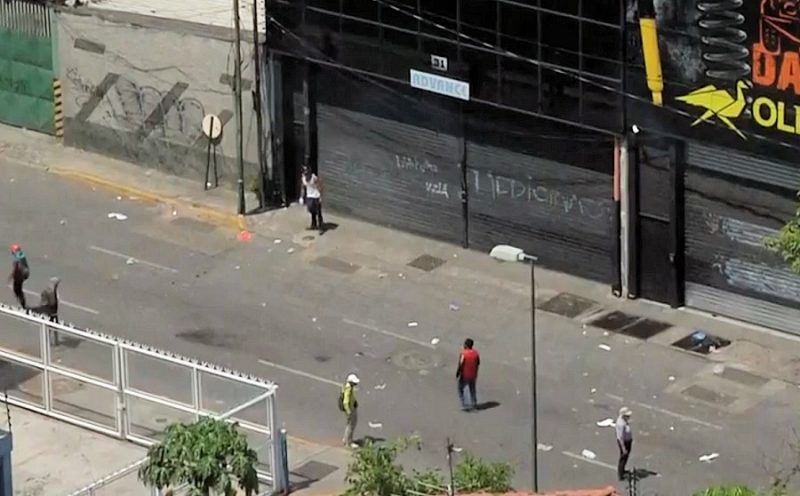
Impressive “uprising” you have there.
As a bad work of fiction, Guaidó could not mount even a lame imitation of a military-backed coup on April 30, which is just the latest in a long line of his failures this year. This character, unknown to 80% of Venezuelans a few months ago, leader of a minority party in a defunct parliament, who never campaigned for the presidency and was never elected to it—this same character posed in front of cameras and claimed military backing which he never had. So he calls on the resources of a hostile foreign power in the vain hope it make his fiction reality, clearly showing he understands nothing at all. Even worse: it shows a total lack of any care for all those who would suffer and die in war—Guaidó is ready to sacrifice them all. It’s an ill bird that fouls its own nest.
The response to Guaidó’s call? A few hundred violent protesters showed up, traded rocks with the Bolivarian National Guard, and then stood around talking to each other for hours on end. John Bolton, pushing US intervention in the name of keeping Venezuela free of external dominance (he knows no irony), even tried to nudge Venezuelans in a pitiful attempt at bribery, promising US economic relief if Guaidó took power. As far as attempted coups go, this was fortunately among the most pathetic, lame farces. There is now no resemblance between Venezuela 2019 and Libya 2011, where in the latter case opponents actually seized towns and cities and mounted protests that lasted days on end. What remains the same in the two cases is the determination of the US to implement through violent proxies a fiction of rule.
One also has to wonder how John Bolton, Mike Pompeo, and Elliot Abrams still have jobs today. Trump is not a tower of managerial business acumen after all—if one ever believed the fiction constituting his performance on The Apprentice. Bolton, who was most prominent during the April 30 coup farce, could not even keep himself from tripping over his own excremental attempt at a “narrative”. First, John Bolton called on the Venezuelan military to side with Guaidó—but then invalidated his call, turning around and asserting that, in any case, Venezuela was under (imaginary) Cuban occupation, and it was Cuban troops who were really in charge. So everything fell apart… because of Cuba, and thus Trump threatened Cuba with an embargo, which it has already been under for six decades. Cuba was the fiction used to mask another fiction—the only thing that was real here was how utterly ridiculous US empire has become.
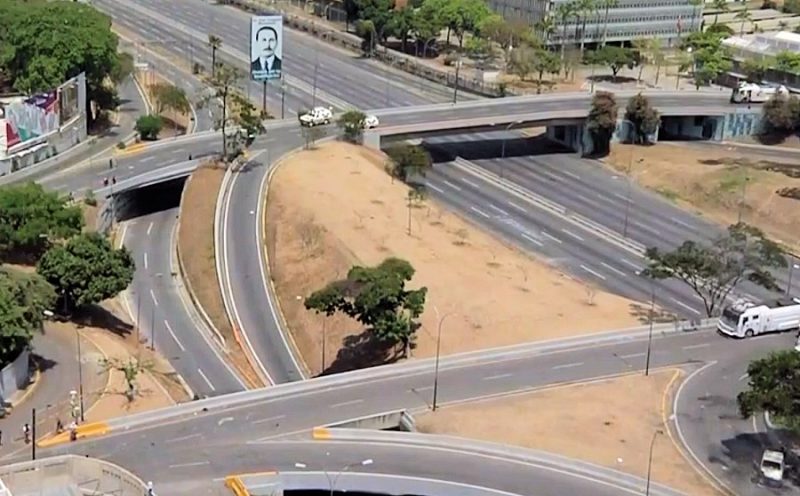
All the action, caught live on camera.
On the night of April 30, as I often do I listened to live radio from Caracas, where the assembled panellists spent a good amount of time engaged in the healthiest, most robust guffawing I have heard in ages. The subject of their laughter? Erik Prince, the war criminal who headed BlackWater and is now begging Trump for cash in return for a “plan”—a plan to send a grand total of 5,000 mercenaries to Venezuela. On RNV radio they wondered if the Americans had really become so stupid and psychotic to think that 5,000 clowns could take and hold so much as a bakery in a country which has 2,000,000 armed citizens in militias alone, not counting the hundreds of thousands in the armed forces and the paramilitary police. Apparently Prince mixed up Venezuela with Grenada—and even in Grenada it took US Marines a week to subdue armed opposition from a comparatively tiny group of diehard patriots.
Nothing is working for the US, not even what might be the most extreme sanctions ever imposed, and weeks of power outages. Certainly, none of the “humanitarian” theatre worked, whether it was the forced “aid” stunt, or the myth that Venezuelan troops set their fake aid on fire. The US was forced to imagine and fantasize about Maduro fleeing the country: witness Mike Pompeo’s bout of deranged lying about Maduro getting on a plane to Cuba, until Russia stopped him. Fictions, lies, propaganda, disinformation, fake news. To top it all off, the news came: this was not even a coup, you see. The real problem here, with such a monumental loss of face, in such a magnificent failure as April 30, is that the US will turn to even more desperate and thus more dangerous measures. However, that comes at a real cost: if the US invades, Trump has to go into an electoral contest with a new war on his back, and it’s not like such a war would come even close to a “cake walk”.
One has to wonder: will those national leaders who—without the authorization of their citizens—unilaterally “recognized” Guaidó as this so-called “interim president” thing, now take stock finally? Or will they cling to this science-fiction that there is a popular movement opposing Nicolás Maduro’s legitimate and very real government?
Clearly, very clearly as it was televised live worldwide all day on April 30 for all to see, Guaidó does not lead a popular movement. He has no authority, no legitimacy, and only a paltry amount of futile support. This so-called “uprising” was an embarrassing failure for his own image as a supposed leader. Then he takes shelter and says “tomorrow, more protests”—yes, junior, that will do the trick. Remember, sport, more always works, and besides, “there’s always tomorrow”. Keep at it, son.
This is what practice without theory looks like. This is what a “movement” without support looks like. This is what science-fiction looks like when it tries to escape the theatre and mingle with real people in the street.
Meanwhile, members of the Lima Group such as Canada, and those members of the European Union that have called for a “peaceful transition” in Venezuela, there is a lot for which they must answer. What “democracy” do they think it is where someone, not elected by the people, marshals the forces of violence in an effort to impose a government on a country? If this were to be done in their countries, would they accept it as democracy? This is the other outrageous fiction that we face: that we in North America live in democratic polities. Democracy should recognize itself in democracy—but when you instead recognize your partner in a violent clutch of putschists, then what are you?
Coup Attempt In Venezuela
Venezuelanalysis | April 30, 2019
Caracas – A military coup attempt is underway in Venezuela on Tuesday, April 30, with imprisoned right wing leader Leopoldo Lopez, and self-proclaimed “Interim President” Juan Guaido and some members of the armed forces blocking a highway in Caracas and calling on the military to rise up
According to reports, a group from Venezuela’s Sebin intelligence service freed Leopoldo Lopez from house arrest early Tuesday morning. Lopez then joined Guaido and a handful of members from different branches of the armed forces in the Altamira highway in eastern Caracas close to La Carlota airbase. Lopez and Guaido published videos on social media calling on other elements of the armed forces to join the uprising and on their supporters to take to the streets. Guaido vowed that this was the “final phase” in ousting the Maduro government.
The Venezuelan government promptly reacted, condemning the coup attempt and vowing that it would be defeated.
“We inform the Venezuelan people that right now we are facing and deactivating a small group of traitor soldiers who have positioned themselves on the Altamira overpass to attempt a coup against the state and the constitution,” Communications Minister Jorge Rodriguez tweeted.
The President of the National Constituent Assembly, Diosdado Cabello, spoke on state television, vowing that the uprising would be defeated and that those responsible would have to “assume their responsibilities.” He also called on the people and the Bolivarian militia to go out on the streets and defend Miraflores Palace.
For his part, Defense Minister Vladimir Padrino López reported that military units throughout the country reported total normalcy, and that the military remain loyal to President Maduro.
At the time of writing, Guaido’s followers are taking to the streets both in Caracas and other parts of the country, blocking roads in support of his new call for a coup. Minor confrontations with tear gas have been reported outside La Carlota air base in Caracas.
Guaido had previously called for the “largest march in Venezuela’s history” scheduled for Wednesday May 1, while a Chavista march celebrating workers’ day was also expected to take place.
Venezuela’s Defense Minister Vladimir Padrino rejected the coup attempt and said that the country’s legitimate military forces would respond to any attempt to overthrow the government of Nicolas Maduro.
“We reject this coup movement that aims to fill the country with violence. The pseudo-political leaders who have placed themselves at the forefront of this subversive movement have used troops and police with weapons of war on a public road in the city to create anxiety and terror.”
Russia Profits as US Takes Venezuelan Oil off the Market in Europe
By Irina Slav – Oilprice.com – April 12, 2019
European refiners are switching to Russian sour grades as U.S. sanctions have shrunk Venezuela’s similar-grade exports, Reuters reports, adding that the Russian sour crude is getting increasingly expensive.
Citing sources from the trading industry, Reuters says the situation has been made worse by the fact that OPEC members have cut mainly their output of heavier, more sour grades under the OPEC+ agreement aimed at stimulating a price rise.
U.S. crude is not an alternative as it is overwhelmingly light and sweet, while refineries in Europe are equipped to process heavier grades as well as light ones to make refined products.
The news is the latest reminder that the world is tipping towards a shortage of heavy, sour crude, which is the staple kind of Venezuela crude and which many refineries need to produce fuels and other products.
“Urals is anchored in a positive zone versus dated Brent and there is no indication it will fall to a discount any time soon,” one of the Reuters’ sources said. That’s a complete reversal of the traditional differential between light and heavy oil, with the latter typically trading at a discount to Brent, a light blend.
Sanctions on Iran are further complicating life for European refiners as they have restricted exports of sour grades that Iran also produces in addition to its very popular superlight crude, also called condensate.
According to Reuters, U.S. sanctions have removed 800,000 bpd of heavy crude from the global market, leaving refiners scrambling for alternatives in a limited pool that, besides Russia and Middle Eastern producers, also includes Canada and Mexico as large producers of these grades of crude. The former is having its own problems with a pipeline capacity shortage and a production cut that has boosted prices, and the latter has yet to reverse a fall in oil production.
Canadian Regime Change Fanatics Scream of Russian Interference into Canada’s Elections
By Matthew Ehret | The Duran | April 13, 2019
On April 5 Canada’s foreign minister embodied the essence of hypocrisy by complaining loudly that Canada’s upcoming October 2019 elections were under threat by a regime change operation steered by Russia which was seeking to undermine the international democratic order.
In order to respond to the threat of foreign interference, the Minister of Global Affairs Canada announced the creation of a “democratic” five person body staffed entirely with unelected senior bureaucrats from the Privy Council Office under the control of the Clerk of the PCO which will act as a new Propaganda bureau to determine what Canadians are and are not allowed to know. This body will focus on social media and will interface closely with the head of Facebook Canada CEO Kevin Chan. She also announced the creation of a Security Threats Task Force which unites all intelligence agencies of Canada (RCMP, Canadian Security Intelligence Service, Communications Security Establishment under the office of Global Affairs Canada. Lastly, the creation of a G7 Rapid Response Mechanism would be created in order to protect all of Canada’s G7 partners from similar “foreign meddling” and run out of Freeland’s Global Affairs Office.
Justin Trudeau, whose administration is collapsing under the weight of self-contradictions built into the green technocratic worldview that he was selected to advance, was quick to jump on this new narrative stating “it is very clearly that countries like Russia are behind a lot of the divisive campaigns.”
Canadian Regime Changers Exposed
Chrystia Freeland’s role as a regime change darling of the British Empire has been increasingly known since the Ukrainian Maidan. It was that British Empire that groomed her under a Rhodes scholarship at Oxford and groomed her for years as an agent controlling mass perception by her management of Reuters and Canada’s Globe and Mail before placing her in a controlling position of Justin Trudeau in 2013.
Her role in steering the vast networks of Canadian Banderites who have long grown in numbers and influence in Canada is as well-known as her friendship with leading Svoboda/Pravi Sektor leaders in Ukraine who were deployed to overthrow a legitimately elected pro-Russian government from Nov. 2013-Feb. 2014. Increasingly well known is her own family’s deeply rooted Nazi sympathies going back to her grandfather’s role in working directly with the Waffen-SS during the latter’s occupation of Ukraine.
When the Ukraine “color revolution” steered by the British-run Deep State (of which Freeland is a senior member) failed to achieve its goal of de-stabilizing Russia, attention was turned to Venezuela where both Russia and China have invested tens of billions in infrastructure and whose government has been extremely favorable to cooperation on the Belt and Road initiative.
For this job, Freeland was deployed alongside her Oxford-trained colleague Ben Rowswell who together worked diligently for several years for a color revolution. As ambassador to Venezuela from 2014-2017, Rowswell managed to coordinate anti-government forces on the ground stating “We became one of the most vocal embassies in speaking out on human rights issues and encouraging Venezuelans to speak out”. Upon leaving Venezuela he said “I don’t think they (anti-Maduro forces) have anything to worry about because Minister Freeland has Venezuela way at the top of her priority list”.
What Rowswell was referring to was Freeland’s role in garnering the semblance of international support for the overthrow by her creation of the Lima Group of 13 Latin American countries (plus Canada) who could be said to “represent the consensus view of South America” in order to give the regime change a “democratic” look. Apparently the deep state managers of Canada didn’t think there was anything weird in an Anglo Saxon monarchy leading a group of Latin American republics and assumed the world would feel the same way.
As it turns out, even though the majority of Lima Group Foreign ministers were induced to support the regime change (very likely due to the vast control of South American mining operations controlled by Canadian mining giants), the world wasn’t so quick to jump enthusiastically on the regime change bandwagon with both Russia and China firmly denying their recognition of opposition leader Guaido’s legitimacy as the country’s leader culminating in Russia’s March 23 deployment of military aircraft and personnel into Venezuela as a message to all Deep State fanatics to back off.
It is noteworthy, that even though Donald Trump paid limited lip service to the hawks in his own government and internationally by telling Russia to leave Venezuela, the fact is that the rift between Trump and those war hawks exemplified by Bolton, Pence, and Pompeo, was made very clear as the President took several opportunities from April 3-6 to call for greater cooperation with Russia and China.
The Collapse of the Deep State and Rise of the New Paradigm
Freeland, Rowswell and their British handlers are undoubtedly not sleeping well at night. Their system is collapsing and there isn’t very much that they can do about it. The empire’s control structures so long kept in the shadows are increasingly exposed to the light of day with the collapse of Russia-Gate, and the exposure of the role of Canada’s Privy Council Office and Round Table movement (aka: Chatham House groups) as guiding (British) hands behind global affairs.
With the Brexit, Italy’s joining the BRI, the failure of the EU and bankruptcy of the City of London-Wall Street banking system, the world is finally waking up to the fact that the “great game” which so perverted the 20th century is falling apart. Not only that but only one serious alternative is on the table: the Belt and Road Initiative/New Silk Road as a global force of cooperation and long term investment into the real (vs speculative/fictitious) part of the economy.
In weeks, Beijing will host the 2nd Belt and Road Conference from and Trump, speaking alongside China’s vice Premier stated a very important intention as a lead up to that conference: 1) an end to the trade war is immanent with a major deal expected in weeks and 2) that Russia, China and America should stop wasting billions on war machines and start re-directing those expenditures towards long term great projects that benefit everyone. The places to do this not only include Belt and Road projects in Eurasia, Africa and the Americas but also the important domain of space exploration and cooperation. Both Russia and China have made it clear that space is a domain for peace on earth with Russia moving ahead with a lunar colony for 2040 and China’s far side of the moon landing on January 3, 2019 being a precursor to a larger lunar mining/industrialization program to access rare earths and Helium-3 fusion fuel.
Donald Trump has joined this chorus of nations pushing for a space based economy by announcing a revival of NASA’s mission with a Moon-Mars program on March 26.
While the future looks increasingly hopeful, and the British Empire’s ugly hand is increasingly exposed for the world to see, there are still many dirty tricks which the devil can still throw at the world.
BIO: Matthew J.L. Ehret is a journalist, lecturer and founder of the Canadian Patriot Review. His works have been published in Executive Intelligence Review, Global Research, Global Times, The Duran, Nexus Magazine, Los Angeles Review of Books, Veterans Today and Sott.net. Matthew has also published the book “The Time has Come for Canada to Join the New Silk Road” and three volumes of the Untold History of Canada (available on untoldhistory.canadianpatriot.org). He can be reached at matt.ehret@tutamail.com
Featured Video

Racist Seinfeld Dances for Joy as Bibi Unveils His New Map
or go to
Aletho News Archives – Video-Images
TV Drama Review
Japanese drama projects Japan’s wartime atrocities onto Chinese characters

Global Times | October 25, 2026
By portraying Chinese characters as perpetrators of ruthless violence while casting Japanese Self-Defense Forces (SDF) intelligence operatives as defenders, the season 2 of the Japanese drama Vivant has recently drawn criticism from Chinese netizens, who argue that its depiction turns historical reality on its head while ignoring Japan’s wartime atrocities.
The TBS drama series – a spy suspense story in which an alleged unofficial intelligence unit of the SDF operates across the globe — has attracted a passionate fanbase. Its currently airing season 2 opened with a household rating of 18.8 percent, the highest for a TV drama this year, according toa commentary article by Japanese media Toyo Keizai.
What draws attention is the portrayal of the enemies in the series, the article noted. Scenes in which the Chinese organization subjects kidnapped members of the SDF unit to brutal torture are repeated with unrelenting intensity.
It is rare for Japanese TV dramas to explicitly portray a real-life country as the enemy, the article noted.
Japanese Prime Minister Sanae Takaichi also made a reference to the drama, saying that she has been recording Vivant and hopes to binge-watch it over the year-end and New Year holidays, according to Japanese media outlets.
China’s CCTV News report on Sunday revealed that the drama features scenes in which Chinese personnel cut off the fingers of and stab Japanese intelligence operatives in the abdomen. Such acts bear striking similarities to the torture inflicted on Chinese nationals by invading Japanese troops during the World War II.
The drama distorts the truth by attributing these atrocities to modern Chinese characters. Beneath the surface, it subtly glorifies Japan’s cross-border overseas operations, blurs the functional boundaries of the SDF and implicitly promotes an expansionist narrative, per CCTV News. … continue
Blog Roll
 Aletho News
- Iran FM Araghchi: “Hormuz Will No Longer Be the Same”
- EU facing trillion-euro debt hole while seeking more cash for Kiev
- How US, Europe, Persian Gulf states exhausted missile stockpiles, splurged billions to defend Israel
- Up in arms… Koreans reject U.S. empire’s plan to make South Korea the next Ukraine
- Iran, Turkey, Pakistan, Saudi Arabia could advance region-led security framework in Tehran: FM spox
- Netizens condemn Japanese drama for projecting Japan’s wartime atrocities onto Chinese characters
- Racist Seinfeld Dances for Joy as Bibi Unveils His New Map
- A West Bank War for Netanyahu’s Election Campaign, Could It Backfire?
- Yemen denounces European Parliament’s ‘hypocritical’ push to blacklist Ansarullah
- Qalibaf: UAE’s UN bid aims to ‘clear the runway’ for ‘Greater Israel’, whitewash genocide
- If Americans Knew
- An error has occurred; the feed is probably down. Try again later.
- No Tricks Zone
- Sudden Stratospheric Warming, Powerful El Niño Combination May Lead To Extreme Europe Cold, Energy Crisis!
- Two New Studies Find Thwaites Glacier Melt Cannot Be Driven By Human Activity Or A Warming Ocean
- E-Cars Reduce CO2 Emissions By Only 41% Compared To Internal Combustion Engine Vehicles
- Predictions Made By Renowned Climate Professor Over Past Decades Have Been Proven To Be Poor
- New Study Suggests Large Regions Of The Pacific Ocean Have Been Cooling For The Last 80 Years
- Germany’s Green Energy Debacle: High Energy Costs Force Kahla Porzellan to Close After 182 Years!
- New Study: 50 Years Of The Most Aggressive ‘Net Zero’ Policies Can Only Affect The Global Climate By 0.03°C
- US September “Heat” Was No Record…Many Records Set Decades Ago
- Latest European Green Energy Debacle; Portugal’s Largest Flagship Solar Park Insolvent!
- Green Energy Debacle: German Expert Professor Fritz Vahrenholt Warns Of Severe Economic And Social Consequences

