The Washington Post’s “Cartel of the Suns” Theory is the Latest Desperate Excuse for Why the Coup Attempt in Venezuela has Failed
By Peter Bolton | CounterPunch | May 17, 2019
With the attempted coup in Venezuela now nearing its four-month mark, commentators in the corporate-owned Western press are scratching their heads as to why Washington’s plan for its proxy, Juan Guaido, to topple the government of Nicolas Maduro has so far failed to materialize. Of course, all of the real reasons elude them because they have never so much as crossed their minds. It is beyond their mental world to consider the lasting popularity of the late Hugo Chavez’s policies and lasting suspicion toward the right-wing opposition amongst large swathes of the population – or the deep revulsion at the thought of US (and especially US military) intervention into their country held by the vast majority of Venezuelans (and, indeed, Latin Americans generally). Rather, both the coup attempt’s puppeteers in Washington and their ventriloquist dummies in the mainstream media have been coming up with ever-more desperate excuses for why Guaido’s attempt to take power has not been a swift and decisive success. The so-called “propping up” of the Maduro “regime” by the traditional the US boogeymen of Russia, China and Cuba seems to have been the most frequently touted explanation. This has manifested itself in increasingly bizarre ways, such as the recent claim by Mike Pompeo that Maduro was at the point of fleeing the country before being convinced otherwise by Russia.
Now, the Washington Post’s notorious warhawk and deranged conspiracy peddler Jackson Diehl has come up with the latest labored rationalization for the failure of the coup attempt: the so-called “Cartel of the Suns.” According to Diehl, this shadowy organization is made up of “some of the most senior officials in the Maduro regime.” He claims that it “flies hundreds of tons of Colombian cocaine from Venezuelan airfields to Central America and the Caribbean for eventual distribution in the United States and Europe.” He furthermore claims that the Maduro government’s crimes also include skimming accounts used for importing food and medicine and “corrupt currency trading.” Describing the Maduro government as “less a government — much less a socialist one — than a criminal gang,” he claims that “the money it is reaping from criminal activity is serving as a prop that allows it to survive U.S. sanctions.” The only sources he provides to support these assertions are: an Associated Press article from September 2018 that reported on an unproven allegation made by a minor US Treasury Department figure, a January 2019 Wall Street Journal article that reports on another unproven allegation made by the US Treasury Department, and a link to one of his own Washington Post articles published in 2015. Leaving aside the self-citation, allegations made by the Treasury Department can hardly be considered credible evidence. It is, after all, a branch of the US government, which has been attempting to destabilize Chavista administrations since their earliest days in office. The Trump administration that it currently answers to, meanwhile, has been the major driving force behind the attempted coup and makes no secret of basing the effort on the advancement of US corporate economic interests.
Larissa Costas has gone so far as to posit that the very idea of such a government-operated cartel might be a whole-cloth fabrication. She stated in February 2017 article:
Although information abounds in the mediums of communication, the “Cartel of the Suns” has not been caught with a single gram of drugs, nor has there been any insignia of the organization identified in any seizure, nor has a single death been attributed to it. There are just two explanations: either it is the most inoffensive of cartels or it simply does not exist. [translated from the original in Spanish]
This latter possibility seems to be confirmed by the consistent failure of repeated Washington-led investigations into members of the Maduro government to result in actual convictions or even clear conclusions. For instance, in January 2015 the US Justice Department (DoJ) and Drug Enforcement Administration (DEA) launched a joint probe into then-President of the National Assembly Diosdado Cabello and other senior figures of the Venezuelan government. News reports soon followed repeating the allegations, including the claim that Cabello is the “capo” of the “Cartel of the Suns.” (Note here the loaded use of mafia-tinged language that’s seemingly borrowed straight from The Godfather movies.) But now, over four years since the launch of this probe, the DEA and DoJ have yet to even charge, let alone convict, any of the people implicated in it. Yet still the mainstream media reports repeat the allegations as if they were beyond question. In May 2018, for example, InSight Crime published an article titled “Drug Trafficking Within the Venezuelan Regime: The ‘Cartel of the Suns’,” in which the publication claims to have built “files on senior [Venezuelan] officials, current or past, that have been involved in the trafficking of cocaine.” But rather than providing the reader with this purported mountain of evidence that they have amassed, the authors instead cite an anonymous Justice Department official as their source. Just as with the US Treasury Department, the Justice Department can hardly be trusted when successive administrations in Washington have been consistently trying to undermine Chavista governments ever since Hugo Chavez was first elected in 1998. From CIA and Bush administration involvement in the 2002 coup attempt and also in the 2002-2003 PDVSA management lock-out through to the present coup attempt and oil sanctions, Washington has gone from covert to brazenly overt regime change methods.
But things go deeper than this. It seems that these dubious accusations of drug trafficking, in fact, form a significant part of the regime change effort itself. For one thing, they are used as justification for sanctions that Washington enacts in order to weaken the regime by sending thinly veiled signals to international capital to avoid Venezuela. Second of all, these sanctions and allegations are in turn used as a form of leverage to weaken the regime and encourage defection to the US’s and US-backed opposition’s side. There is no better case to illustrate this reality than that of the retired Venezuelan General Hugo Carvajal. In July 2014, as Carvajal was being released from custody in Aruba, Reuters reported that he categorically denied US charges of involvement in the illegal drug trade and provision of aid to Colombian leftist armed groups. But in February 2019, with the coup attempt about a month in, Carvajal did an about-face and accused Maduro and his inner circle of involvement in drug trafficking. This was right after Trump made an open threat that military officials who remain loyal to Maduro have “everything to lose” while Guaido simultaneously offered amnesty to those willing to defect to his side. It seems that Carvajal was responding to this “carrot and stick” threat/incentive combination that the US had, in his case successfully, employed as part of its regime change arsenal. The questionable validity of his claims is demonstrated by his repetition of Washington’s oft-repeated mantra that Maduro officials are courting the Lebanese “militant” group Hezbollah. These claims have been decisively debunked by Richard Vaz, who points out that mainstream media outlets such as CNN that report these allegations again use solely the Treasury Department as their source, or worse still figures such as Marco Rubio. Vaz also points to the absurdity of holding up Tarek el Aissami as the facilitator of some kind of cross-Atlantic Iranian-led Shi’ite alliance when el Aissami himself is not even Muslim, but rather the son of Lebanese Druze immigrants who was born and has spent all his life in Venezuela.
In any normal situation this is all that would have to be said to dismiss Diehl’s claims. But Latin America is no normal place and US relations with the region constitute no normal situation. In addition to the scarcity of evidence for the claims he makes, there is a question of double standards that lies beneath the surface. Diehl undoubtedly wishes to imply that the Maduro government’s alleged involvement in criminal activity justifies the interventionist actions from Washington and its proxies on the ground. But when one looks across the region and into both its past and present, one sees a whole cornucopia of flagrant narco-states that Washington has not only ignored but bank-rolled and armed to the teeth. Not coincidentally, two of them are staunch allies and the other was so until very recently. I am talking, of course, of Colombia, Honduras and Mexico.
Colombia’s status as a narco-state during the first decade of this century is hardly a secret. Even some of the US’s own declassified intelligence documents contain allegations of former president Alvaro Uribe’s close ties to narcotrafficking. A 1991 declassified Defense Intelligence Agency (DIA) report, for example, describes Uribe as a “close personal friend of Pablo Escobar” and “dedicated to collaboration with the Medellín cartel at high government levels.” Another intelligence report from 1993, and declassified in 2018, says that Colombian Senator told officials at the US Embassy in Bogota that Escobar’s cartel had financed Uribe’s election campaign for the Colombian Senate. In spite of having such information available, Washington nonetheless generously funded the Uribe government through Plan Colombia to engage in so-called “counter-narcotics” campaigns, which served as a cover for brutal offensives against labor and indigenous rights activists and displacement of rural campesinos. The extent of state capture by drug cartels in Colombia was furthermore exposed by the Parapolitics scandal, which led to the conviction of 32 members of the Colombian congress along with five state governors for collusion with right-wing paramilitaries. These groups, incidentally, have been the biggest players in the Colombian drug trade, dwarfing the involvement of leftist guerrilla groups such as the FARC and ELN.
Revelations from the recently concluded trial of Joaquín ‘El Chapo’ Guzmán have shone a light onto a similar story in Mexico. State witness Alex Cifuentes made a credible accusation during his testimony against Guzman that former Mexican president Enrique Peña Nieto received a bribe from Guzman worth $100 million dollars. Mexican investigative journalist Anabel Hernandez has long claimed that collusion between the Mexican state and narco-trafficking groups stretches all the way to the top, including the presidency, which Cifuentes’ testimony seemingly confirms. As has been the case with Colombia, the US has not only turned a blind eye to this situation, but has been generous funding the Mexican government to conduct “counter-narcotics” campaigns through the Merida Initiative. And again, these campaigns provided cover for brutal human rights violations on the part of Mexico’s state security forces.
Finally, we should turn to Honduras, the most contemporary and, in many ways, most flagrant example of a narco-state that the US cozies up to. Ever since the State Department orchestrated a coup against the democratically-elected government of Manuel Zelaya in 2009 there have been growing signs that Honduras has degenerated into a fully-fledged narco-state. In January of last year, for example, it emerged that a national police chief personally facilitated a cocaine delivery worth $20 million in 2013. In November 2018, President Juan Orlando Hernandez’s brother, Tony Hernandez, was arrested on drug trafficking charges in Miami. Just as this article went to press, testimony that he gave to US Drug Enforcement Administration (DEA) was unsealed in which he reportedly admits to interacting with several known drug traffickers as well as taking bribes. Even according to the aforementioned InSight Crime : “Tony Hernández’s detailed knowledge of the activities of some of Honduras’ most prominent drug traffickers makes it increasingly difficult for President Juan Orlando Hernández to deny being aware of these acts.” The president himself has previously faced allegations of involvement in drug trafficking via ex-army captain Santos Rodriguez Orellana. And as with Colombia and Mexico, not only has Washington never issued any punitive measure whatsoever against Honduras for any of this, it has rather been generously funding its state security forces in spite of its brutal record of human rights violations.
Note that all three of the above countries have been close US allies for the last few decades, with Colombia and Honduras remaining so while Mexico begins to break from Washington following the election of progressive president Andres Manuel Lopez Obrador. This is no coincidence. So long as a country is serving the US’s geostrategic and economic interests, it will not just overlook its status as a narco-state but will aid and abet its committing of human rights violations. You won’t hear about any of this from Jackson Diehl, however. Because as an obedient cheerleader for the Monroe Doctrine he must faithfully promulgate the selective indignation that underpins its entire edifice of justification propaganda. Given Washington’s record in the wider region, whether or not Venezuela is indeed a narco-state ceases to be the point. Rather, the question becomes one of credibility. And when it comes to evenhandedness in its treatment of Latin American states, Washington has exactly none.
National Lawyers Guild International Statement On The Venezuelan Embassy And U.S. Sanctions
National Lawyers Guild International Committee | May 4, 2019
The National Lawyers Guild International Committee unequivocally condemns the threats posed by the government of the United States and Washington D.C. Police Department to the Embassy of the Bolivarian Republic of Venezuela. We also condemn the unilateral financial sanctions imposed by the U.S. government intended to force “regime change” in Venezuela by limiting people’s access to basic goods necessary for survival.
As a legal organization committed to the promotion and defense of international law and human rights, the NLG demands that federal and local law enforcement abide by all applicable legal standards governing diplomatic protections, sovereignty and freedom of assembly. This includes the provisions of the Vienna Convention on Diplomatic Relations which requires the U.S. to recognize the inviolability of embassies and to “take all appropriate steps to protect the premises of the mission against any intrusion.” The Vienna Convention was ratified by the United States in 1972 and thus is a part of federal law.
The legitimacy of the Maduro presidency should be left to the Venezuelan people to decide via their own electoral processes, and it is entirely unjustified for members of the United States government to openly call for or support a military coup, including Senator Marco Rubio, National Security Advisor John Bolton, Secretary of State Mike Pompeo and Special Ambassador Elliott Abrams. Self-proclaimed president Juan Guaidó has no legitimate claim under the Bolivarian Constitution (Sections 233 and 234).
Since 2006, the NLG has sent multiple delegations to observe local and national Venezuelan elections. We have observed the process noted by the Carter Center as one of the best electoral processes in the world, with its paper receipts, open source software and the public audit to compare paper and digital votes at close of polls. Even the opposition has admitted the Venezuelan election system is “fraud-proof.”
Both the proposed takeover of the Venezuelan Embassy by the Guaidó agents and the criminal unilateral economic sanctions imposed on Venezuela by the U.S. to bring about regime change by crippling the Venezuelan economy and thwarting the basic needs of the Venezuelan people constitute a clear violation of international law.
The National Lawyers Guild condemns the on-going attempted coup d’etat organized by the United States and evocation of the ignominious Monroe Doctrine in clear violation of the basic sovereignty provisions of the UN and OAS Charters.
US, Russia engage on Venezuela
By M. K. BHADRAKUMAR | Indian Punchline | May 12, 2019
Kremlin spokesman Dmitry Peskov remarked last Thursday in Moscow that no contacts between Russian President Vladimir Putin and US President Donald Trump are expected at the G20 summit in Japan on June 28-29. “An encounter is not planned so far and there is no talk about a meeting,” Peskov said.
This remark was made in the run-up to US Secretary of State Mike Pompeo’s forthcoming visit to Russia on April 12-14. There has been much speculation in the US media that a summit meeting between Trump and Putin was likely among Pompeo’s talking points with the Russian leadership.
The ‘pull asides’ that Trump has been resorting to on the sidelines of international events to have a quick word with Putin have fallen into a pattern. Firstly, things remained strictly between the two statesmen at a personal level and secondly, Trump had to take care no feathers were ruffled back home while the Robert Mueller inquiry on ‘Russia collusion’ was going on. The arrangement left the Russian side unhappy, since the unstructured informal conversations eventually led to nothing. Russian-American relations continued to deteriorate.
Unsurprisingly, it has taken over one year for Pompeo to schedule his first visit to Moscow after he took over as state secretary in April 2018. (No US secretary of defence has yet visited Russia during the Trump presidency, either.) The proposal on Pompeo’s visit was hurriedly mooted by Washington just a few days ago, earlier this month. Therefore, if Pompeo’s visit is being treated on a low key, it could be that Moscow doesn’t expect anything much to come out of it.
The point is, although the Mueller inquiry could not prove any ‘collusion’ between Trump and the Kremlin, Russia still remains a toxic subject domestically in the US. For Trump’s detractors, he and Russia are often synonymous. The narrative that Trump and people around him were engaged in improper activities with Russia is not about to wither away and there are further moves likely in the Washington Beltway to find out about any other possible links between the Trump organisation and even his family and Russian entities or oligarchs.
Then, there is the vexed issue of the US sanctions against Russia, which inherently curb the scope for any meaningful expansion of ties. The post-2016 sanctions do not stem from executive orders but emanate out of laws passed by the US Congress, which takes away from Trump’s hands the powers to remove them — and, equally, they are not even tied to specific Russian behaviours. The Russians understand well enough that the sanctions won’t be lifted for a long time.
Within such constraints, what is it that Pompeo’s visit hopes to achieve? At a state department briefing on May 10, an unnamed senior US official disclosed that arms control will top Pompeo’s agenda during the Russia visit. He said Trump seeks new agreements with Russia “that reflect modern reality. These agreements must include a broader range of countries and account for a broader range of weapon systems than our current bilateral treaties with Russia.” Besides, he said, “There will be a full range of global challenges to discuss, including Ukraine, Venezuela, Iran, Syria, and North Korea.”
However, there are enough signs that the main thing to watch could be whether a US-Russia deal on Venezuela becomes possible. Three weeks back, Fiona Hill, senior director for European and Russian affairs on the National Security Council in the White House, had visited Moscow for consultations. Amongst others, she met Putin’s foreign policy advisor Yuri Ushakov. According to media reports, Hill prioritised Venezuela as the most important topic in the US-Russia relations at the moment.
Arguably, more than oil or the Monroe Doctrine, what motivates Trump could be the impact of a regime change in Venezuela on the Hispanic voters in the 2020 presidential race in Florida. This impression would only have been reinforced last week when Pompeo met Lavrov on the sidelines of the Arctic Council meeting in Helsinki when, again, Venezuela figured prominently in their discussion.
With the recent US-backed coup attempt in Venezuela on April 30 having failed spectacularly, the probability of an outright US intervention is low — almost non-existent. Trump would be reaching out for Russian help for a constitutional transition in Caracas that he could project as a ‘win’. Both Washington and Moscow are highly experienced in adopting a transactional approach to their relationship.
For Russia, on the other hand, its support for the Maduro government in Caracas is driven as much by financial and energy interests as by Moscow’s vision of a multipolar world order that is based on international law. As the Moscow-based analyst Fred Weir wrote recently, “while it may look and sound like a Cold War standoff, for Russia it is really about the simpler issue of establishing rules for competing big powers in a post-Cold War world. In Venezuela, and between the US and Russia generally, there is no sharp ideological divide over world-shaping doctrines like communism versus capitalism.”
Simply put, the Russian-American discord over Venezuela boils down to this: Washington wants Russia to stop ‘meddling’ in the Western Hemisphere, while Moscow would expect that the US also should stop fomenting anti-Moscow revolutions in Russia’s backyard. Otherwise, Russian experts acknowledge, it matters little to Moscow who rules in Caracas.
The influential strategic thinker in Moscow Fyodor Lukyanov told Weir, “The relationship that emerged between Russia and Venezuela was an accident. It was mainly the initiative of Hugo Chávez, who was seeking counterbalances to his country’s dependence on the US. Of course this was enthusiastically supported in Moscow. But it should be pointed out that at that time, the early 2000s, Chávez was rich and could pay for Russian arms and advice. Since Chávez died, and his successor has not proven so adept or popular, many in Moscow have been worried about our heavy investments in a potentially unstable regime.”
It is entirely conceivable that this complicated Russian-American tango of ‘meddling’ in the other side’s region could be in the first instance what prompted Washington to schedule Pompeo’s hurried visit to Russia to meet Lavrov and Putin in Sochi on April 14. Evidently, the Trump administration’s resuscitation of the Monroe Doctrine provides a diplomatic opening to Moscow, which of course continues to cherish the territories of the former Soviet republics as its own ‘sphere of influence’, too.
To quote Lukyanov again, “This citing of the Monroe Doctrine is something quite intriguing, and it would be warmly welcomed in Moscow if we thought the Americans took it seriously.” Indeed, some reports on Fiona Hill’s talks in Moscow last month hinted that she made a proposal to what roughly involved Russia letting up on Venezuela in exchange for some US concessions on Ukraine.
Be that as it may, significantly, Russian and Venezuelan foreign ministers met in Moscow on the eve of Lavrov’s meeting with Pompeo in Helsinki last week. What needs to be factored in is that although the coup attempt of April 30 failed, the situation in Venezuela is fluid. According to the Russian media, President Maduro has expelled dozens of army officers for their involvement in the coup, including high ranking officers.
To be sure, Moscow would know that a political solution is needed. The good part is that regime change is off the table as of now, which gives the respite to negotiate. After the meeting with Pompeo in Helsinki, Lavrov told the media that he’d rule out any foreign military intervention in Venezuela.
But the problem is that trust is lacking between Washington and Moscow. Russia cannot be sure that the American side will keep its side of the bargain — that is, assuming there is a will to negotiate at all. Again, there is the issue of US sanctions, which has crippled the Venezuelan economy over recent years. This is important because Russia’s exposure to Venezuela is huge. At the very least, Russian investments (loans) to Venezuela since 2005 amount to $17 billion.
Trudeau continues push to overthrow Venezuela’s government
By Yves Engler · May 10, 2019
The effort Justin Trudeau is putting into overthrowing Venezuela’s government is remarkable.
During the past 12 days the prime minister has raised the issue separately with the leaders of the EU, Spain, Japan and Cuba. On Tuesday Trudeau had a phone conversation with European Council President Donald Tusk focused almost entirely on Venezuela, according to the communiqué .“Prime Minister Trudeau reiterated his support for Interim President Juan Guaidó”, it noted.
The next day Trudeau talked to Spanish Prime Minister Pedro Sánchez about ousting president Nicolás Maduro. Venezuela is the only subject mentioned in the official release about the call.
Venezuela was also on the agenda during Japanese Prime Minister Shinzo Abe’s visit to Ottawa on April 28. The post meeting release noted, “during the visit, Prime Minister Abe announced Japan’s endorsement of the Ottawa Declaration on Venezuela.” Produced at an early February meeting of the “Lima Group” of governments opposed to Maduro, the “Ottawa Declaration” called on Venezuela’s armed forces “to demonstrate their loyalty to the interim president” and remove the elected president.
On May 3 Trudeau called Cuban president Miguel Díaz-Canel to pressure him to join Ottawa’s effort to oust Maduro. The release noted, “the Prime Minister, on behalf of the Lima Group, underscored the desire to see free and fair elections and the constitution upheld in Venezuela.”
Four days later foreign affairs minister Chrystia Freeland added to the diplomatic pressure on Havana. She told reporters, “Cuba needs to not be part of the problem in Venezuela, but become part of the solution.”
Freeland was highly active after Guaidó, Leopoldo Lopez and others sought to stoke a military uprising in Caracas on April 30. Hours into the early morning effort Freeland tweeted, “watching events today in Venezuela very closely. The safety and security of Juan Guaido and Leopoldo López must be guaranteed. Venezuelans who peacefully support Interim President Guaido must do so without fear of intimidation or violence.” She followed that up with a statement to the press noting, “Venezuelans are in the streets today demonstrating their desire for a return to democracy even in the face of a violent crackdown. Canada commends their courage and we call on the Maduro regime to step aside now.” Then Freeland put out a video calling on Venezuelans to rise up and requested an emergency video conference meeting of the Lima Group. Later that evening the coalition issued a statement labeling the attempted putsch an effort “to restore democracy” and demanded the military “cease being instruments of the illegitimate regime for the oppression of the Venezuelan people.”
Three days later Freeland attended an emergency meeting of the Lima Group in Peru. The coalition released a communique after that get together accusing Maduro’s government of protecting “terrorist groups” in Colombia.
At another Lima Group meeting in Chile on April 15 Freeland announced the fourth round of Canadian sanctions against Venezuelan officials. Forty-three individuals were added to the list of 70 leaders Canada had already sanctioned. CBC reported that the latest round of (illegal) sanctions were designed to “punish Venezuelan judges who rubber-stamped Maduro’s moves” and “lower-ranking police officials who took prominent roles in suppressing the attempt by Venezuela’s opposition to bring humanitarian aid into the country on February 23.”
The Venezuelan government responded to Canadian sanctions by denouncing Ottawa’s “alliance with war criminals that have declared their intention to destroy the Venezuelan economy to inflict suffering on the people and loot the country’s riches.” A recent Center for Economic and Policy Research report gives credence to this perspective. Written by Jeffrey Sachs and Mark Weisbrot, “Economic Sanctions as Collective Punishment: The Case of Venezuela” concluded that 40,000 Venezuelans may have died over the past two years as a result of US sanctions.
The Liberals want us to believe their campaign to oust Venezuela’s government is motivated by support for democracy and human rights. Yet in recent weeks the Trudeau government has deepened ties to repressive Middle East monarchies, gutted its promise to rein in international abuses by Canadian mining companies’ and justified Israeli violence against those living in the open-air prison known as the Gaza Strip.
Last month members of Mouvement Québécois pour la Paix interrupted a speech by Freeland at the University of Montréal to criticize Canada’s policy towards Venezuela. Activists should be disrupting Freeland and other Liberal MPs public events across the country to demand an end to their effort to overthrow the government of Venezuela.
Trump and Putin Hold a 90-Minute Telephone Call, US Liberals Go Ballistic
By Robert Bridge | Strategic Culture Foundation | May 8, 2019
Like a pit bull with its favorite chew toy, the Democrats refuse to abandon the debunked ‘Russian collusion’ script, to the point where a simple phone call between Moscow and Washington triggers rabid media hysterics.
When tasked to cover last week’s telephone conversation between Donald Trump and Vladimir Putin, the left-leaning mainstream media had a golden opportunity to prove it had moved beyond partisan politics, above intrigue, and above subjective bias. Predictably, it failed the test miserably. What the media did prove, however, came as no surprise: it is totally incapable of casting a gaze beyond the debris-strewn battlefield field known as Russiagate and report on US-Russia relations in a dispassionate and honest manner.
Instead, it obsessed over petty details, like the duration of the phone call and the fact that it was initiated by Donald Trump instead of the Russians. “Trump Initiated Putin Call, And It Was 90 Minutes, Not 60,” a snooty headline in the Huffington Post screamed, much like dozens of other unhinged outlets as if the world’s myriad problems can be sorted out in an afternoon over Twitter.
White House press secretary Sarah Sanders told the journalists that Trump and Putin discussed a number of global flash points, predominantly Venezuela, where the US, Russia and even China are jockeying for position as a showdown continues between Washington’s man in Caracas, Juan Guaido and the embattled but duly elected President Nicolás Maduro. Given that the US has long considered Latin America its private hunting grounds makes it all the more unacceptable for Washington policymakers and the media that Moscow and Beijing are nosing around in their backyard.
With no loss of irony, which we’ll come to in a moment, the US pundit class assailed Trump for taking Vladimir Putin’s word at face value when he said that Russia, as quoted by Trump, “is not looking at all to get involved in Venezuela other than he’d like to see something positive happen for Venezuela.”
In one uniformed and very agitated voice, the media bloodhounds demanded to know how it was possible that Trump placed faith in Putin, when just days earlier his Secretary of State Mike Pompeo claimed that Maduro was preparing to flee to Cuba – but was discouraged by Russia.
“He had an airplane on the tarmac, he was ready to leave this morning as we understand it and the Russians indicated he should stay,” Pompeo told CNN’s Wolf Blitzer with a remarkably straight face. “He was headed for Havana.”
Trump himself probably didn’t know exactly who or what to believe since just last month Pompeo the pompous practically fell out of his chair laughing as he told an audience from Texas A&M University about his heyday as CIA chief.
“I was the CIA director,” he began with a smile. “We lied, we cheated, we stole. We had entire training courses. It reminds you of the glory of the American experiment.”
When glory moments involve the lowest examples of human behavior it is painful to imagine what a bad day looks like. But I digress.
Regrettably, the young and impressionable students and faculty welcomed the creepy confession as some kind of a big joke, chortling as Pompeo resembled a frat boy discussing last night’s drunken endeavors. It may speak volumes about the American state of mind that no audience member thought to inquire as to what use Mr. Secretary of State was putting those “entire training courses” especially as the United States continues to employ psychological warfare against Maduro. Those methods include suggesting that top officials in his inner circle have secretly betrayed him, while disseminating the ‘news’ that he is about to flee. Such tricks from the regime change handbook may be giving the Venezuelan leader many a sleepless nights, but thus far it has failed to dislodge him from power.
US sanctions against Iran, Cuba, Venezuela breach human rights: UN expert
Press TV – May 7, 2019
A UN rights expert has slammed unilateral US sanctions against Iran, Cuba and Venezuela, saying the use of economic measures for political purposes violates human rights and international law.
In a statement released on Monday, Idriss Jazairy, UN special rapporteur on the negative impact of the unilateral coercive measures, warned that the US bans against the trio might precipitate man-made humanitarian catastrophes.
“Regime change through economic measures likely to lead to the denial of basic human rights and indeed possibly to starvation has never been an accepted practice of international relations,” he said.
“Real concerns and serious political differences between governments must never be resolved by precipitating economic and humanitarian disasters, making ordinary people pawns and hostages thereof,” he added.
Jazairy also voiced worries about Washington’s termination of sanctions waivers for major Iranian crude buyers, saying the move harms not only the Iranian nation, but also their trade partners.
“The extraterritorial application of unilateral sanctions is clearly contrary to international law,” he said.
“I am deeply concerned that one State can use its dominant position in international finance to harm not only the Iranian people, who have followed their obligations under the UN-approved nuclear deal to this day, but also everyone in the world who trades with them,” he noted, referring to the landmark 2015 agreement — officially called the Joint Comprehensive Plan of Action (JCPOA).
Recently, the US ended six months of waivers which allowed Tehran’s eight largest customers to continue importing limited volumes. It also threatened the buyers of Iranian oil with sanctions if they fail to stop their purchases.
The anti-Iran American sanctions had been lifted under the JCPOA, but they returned in place last year when the US abandoned the multilateral accord.
Elsewhere in his statement, the UN rights expert denounced the economic hardship caused by the US sanctions in Cuba and questioned Washington’s claim that its sanctions against Venezuela were aimed at “helping” its people.
He further called on the international community to “challenge” Washington’s restrictive measures against sovereign countries which amount to “a threat to world peace and security.”
“I call on the international community to engage in constructive dialogue with Venezuela, Cuba, Iran and the United States to find a peaceful resolution in compliance with the spirit and letter of the Charter of the United Nations before the arbitrary use of economic starvation becomes the new ‘normal’,” Jazairy said.
How GMO Seeds and Monsanto/Bayer’s “RoundUp” are Driving US Policy in Venezuela
By Whitney Webb | MintPress News | May 6, 2019
CARACAS, VENEZUELA — As the political crisis in Venezuela has unfolded, much has been said about the Trump administration’s clear interest in the privatization and exploitation of Venezuela’s oil reserves, the largest in the world, by American oil giants like Chevron and ExxonMobil.
Yet the influence of another notorious American company, Monsanto — now a subsidiary of Bayer — has gone largely unmentioned.
While numerous other Latin American nations have become a “free for all” for the biotech company and its affiliates, Venezuela has been one of the few countries to fight Monsanto and other international agrochemical giants and win. However, since that victory — which was won under Chavista rule — the U.S.-backed Venezuelan opposition has been working to undo it.
Now, with Juan Guaidó’s parallel government attempting to take power with the backing of the U.S., it is telling that the top political donors of those in the U.S. most fervently pushing regime change in Venezuela have close ties to Monsanto and major financial stakes in Bayer.
In recent months, Monsanto’s most controversial and notorious product — the pesticide glyphosate, branded as Roundup, and linked to cancer in recent U.S. court rulings — has threatened Bayer’s financial future as never before, with a litany of new court cases barking at Bayer’s door. It appears that many of the forces in the U.S. now seeking to overthrow the Venezuelan government are hoping that a new Guaidó-led government will provide Bayer with a fresh, much-needed market for its agrochemicals and transgenic seeds, particularly those products that now face bans in countries all over the world, including once-defoliated and still-poisoned Vietnam.
U.S.-Backed Venezuelan opposition seeks to reverse Chavista seed law and GMO ban
In 2004, then-president of Venezuela, Hugo Chávez, surprised many when he announced the cancellation of Monsanto’s plans to plant 500,000 acres of Venezuelan agricultural land in genetically modified (GM) soybeans. The cancellation of Monsanto’s Venezuela contract led to what became an ad hoc ban on all GM seeds in the entire country, a move that was praised by local farmer groups and environmental activists. In contrast to anti-GM movements that have sprung up in other countries, Venezuela’s resistance to GM crops was based more on concerns about the country’s food sovereignty and protecting the livelihoods of farmers.
Although the ban has failed to keep GM products out of Venezuela — as Venezuela has long imported a majority of its food, much of it originating in countries that are among the world’s largest producers of genetically modified foods — one clear effect has been preventing companies like Monsanto and other major agrochemical and seed companies from gaining any significant foothold in the Venezuelan market.
In 2013, a new seed law was nearly passed that would have allowed GM seeds to be sold in Venezuela through a legal loophole. That law, which was authored by a member of the Chavista United Socialist Party of Venezuela (PSUV), was widely protested by farmers, indigenous activists, environmentalists, and eco-socialist groups, which led to the law’s transformation into what has been nicknamed the “People’s Seed Law.” That law, passed in 2015, went even farther than the original 2004 ban by banning not just GM seeds but several toxic agrochemicals, while also strengthening heirloom seed varieties through the creation of the National Seed Institute.
Soon after the new seed law was passed in 2015, the U.S.-backed Venezuelan opposition led by the Roundtable of Democratic Unity (MUD) — a group comprised of numerous U.S.-funded political parties, including Guaidó’s Popular Will — took control of the country’s National Assembly. Until Venezuela’s Supreme Court dissolved the assembly in 2017, the MUD-legislature attempted to repeal the seed law on several occasions. Those in favor of the repeal called the seed bill “anti-scientific” and damaging to the economy.
Despite the 2017 Supreme Court decision, the National Assembly has continued to meet, but the body holds no real power in the current Venezuelan government. However, if the current government is overthrown and Guaidó — the “interim president” who is also president of the dissolved National Assembly — comes to power, it seems almost certain that the “People’s Seed Law” will be one of the first pieces of legislation on the chopping block.
The AEI axis
Some of the key figures and loudest voices supporting the efforts of the Trump administration to overthrow the Venezuelan government in the United States are well-connected to one particular think-tank, the American Enterprise Institute (AEI). For instance, John Bolton — now Trump’s national security advisor and a major player in the administration’s aggressive Venezuela policy — was a senior fellow at AEI until he became Trump’s top national security official. As national security adviser, Bolton advises the president on foreign policy and issues of national security while also advising both the Secretary of State and the Secretary of Defense. As of late, he has been pushing for military action in Venezuela, according to media reports.
Another key figure in Trump’s Venezuela policy — Elliott Abrams, the State Department’s Special Representative for Venezuela — has been regularly featured at AEI summits and as a guest on its panels and podcasts. According to Secretary of State Mike Pompeo, Abrams’ current role gives him the “responsibility for all things related to our efforts to restore democracy” in Venezuela. Other top figures in the administration, including Vice President Mike Pence and Secretary of State Mike Pompeo, were featured guests at the AEI’s “secretive” gathering in early March. As MintPress and other outlets have reported, Guaidó declared himself “interim president” of Venezuela at Pence’s behest. Pompeo is also intimately involved in directing Trump’s Venezuela policy as the president’s main adviser on foreign affairs.
Other connections to the Trump administration include Secretary of Education Betsy DeVos who was previously on AEI’s board of trustees.
AEI has long been a key part of the “neoconservative” establishment and employs well-known neoconservatives such as Fred Kagan — the architect of the Iraq “troop surge” — and Paul Wolfowitz, the architect of the Iraq War. Its connections to the George W. Bush administration were particularly notable and controversial, as more than 20 AEI employees were given top positions under Bush. Several of them, such as Bolton, have enjoyed new prominence in Trump’s administration.
Other key Bush officials joined the AEI soon after leaving their posts in the administration. One such was Roger Noriega, who was the U.S. representative to the Organization of American States (OAS) during the failed, U.S.-backed 2002 coup and went on to be assistant secretary of state for Western Hemisphere affairs from 2003 to 2005, where he was extremely influential in the administration’s policies towards Venezuela and Cuba.
Since leaving the Bush administration and promptly joining the AEI, Noriega has been instrumental in pushing claims that lack evidence but aim to paint Venezuela’s current President Nicolas Maduro-led government as a national security threat, such as claiming that Venezuela is helping Iran acquire nuclear weapons and hosts soldiers from Lebanon’s Hezbollah. He also lobbied Congress to support Venezuelan opposition leader Leopoldo López, Guaidó’s political mentor and leader of his political party, Popular Will.
Not only that, but Noreiga teamed up with Martin Rodil, a Venezuelan exile formerly employed by the IMF, and José Cardenas, who served in the Bush administration, to found Visión Américas, a private risk-assessment and lobbying firm that was hired to “support the efforts of the Honduran private sector to help consolidate the democratic transition in their country” after the U.S.-backed Honduran coup in 2009. In recent months, Noriega and his associates have been very focused on Venezuela, with Cardenas offering Trump public advice about how “to hasten Maduro’s exit,” while Rodil has publicly offered “to get you a deal” if you have dirt on Venezuela’s government.
While the AEI is best known for its hawkishness, it is also a promoter of big agricultural interests. Since 2000, It has hosted several conferences on the promise of “biotechnology” and genetically modified seeds and has heavily promoted the work of former Monsanto lobbyist Jon Entine, who was an AEI visiting fellow for several years. The AEI also has long-time connections to Dow Chemical.
The most likely reason for the AEI’s interest in promoting biotech, however, can be found in its links to Monsanto. In 2013, The Nation acquired a 2009 AEI document, obtained through a filing error and not intended for public disclosure, that revealed the think tank’s top donors. The form, known as the “schedule of contributors,” revealed that the AEI’s top two donors at the time were the Donors Capital Fund and billionaire Paul Singer.
The Donors Capital Fund, which remains a major contributor to the AEI, is linked to Monsanto interests through the vice chairman of its board, Kimberly O. Dennis, who is also currently a member of the AEI’s National Council. According to AEI, the National Council is composed of “business and community leaders from across the country who are committed to AEI’s success and serve as ambassadors for AEI, providing us with advice, insight, and guidance.”
Dennis is the long-time executive chairwoman of the Searle Freedom Trust, which was founded in 1988 by Daniel Searle after he oversaw the sale of his family pharmaceutical company — G.D. Searle and Company — to Monsanto in 1985 for $2.7 billion. The money Searle had made from that merger was used to fund the trust that now funds the AEI and other right-wing think tanks. Searle was also close to Donald Rumsfeld, who led G.D. Searle and Co. for years and was Secretary of Defense under Gerald Ford and George W. Bush. Searle was also a trustee of the Hudson Institute, which once employed Elliott Abrams.
After the family company — which gained notoriety for faking research about the safety of its sweetener, aspartame or NutraSweet — was sold to Monsanto, G.D. Searle executives close to Daniel Searle rose to prominence within the company. Robert Shapiro, who was G.D. Searle’s long-time attorney and head of its NutraSweet division, would go on to become Monsanto’s vice president, president and later CEO. Notably, Daniel Searle’s grandson, D. Gideon Searle, was an AEI trustee until relatively recently.
Why is a top donor to Marco Rubio increasing his stake in Bayer while others flee?
Yet, it is AEI’s top individual donor noted in the accidental “schedule of contributors” disclosure who is most telling about the private biotech interests guiding the Trump administration’s Venezuela policy. Paul Singer, the controversial billionaire hedge fund manager, has long been a major donor to neoconservative and Zionist causes — helping fund the Foreign Policy Initiative (FPI), the successor to the Project for a New American Century (PNAC); and the neoconservative and islamophobic Foundation for the Defense of Democracies (FDD), in addition to the AEI.
Singer is notably one of the top political donors to Senator Marco Rubio (R-FL) and has been intimately involved in the recent chaos in Venezuela. He has been called one of the architects of the administration’s current regime-change policy, and was the top donor to Rubio’s presidential campaign, as well as a key figure behind the controversial “dossier” on Donald Trump that was compiled by Fusion GPS. Indeed, Singer had been the first person to hire Fusion GPS to do “opposition research” on Trump. However, Singer has largely since evaded much scrutiny for his role in the dossier’s creation, likely because he became a key donor to Trump following his election win in 2016, giving $1 million to Trump’s inauguration fund.
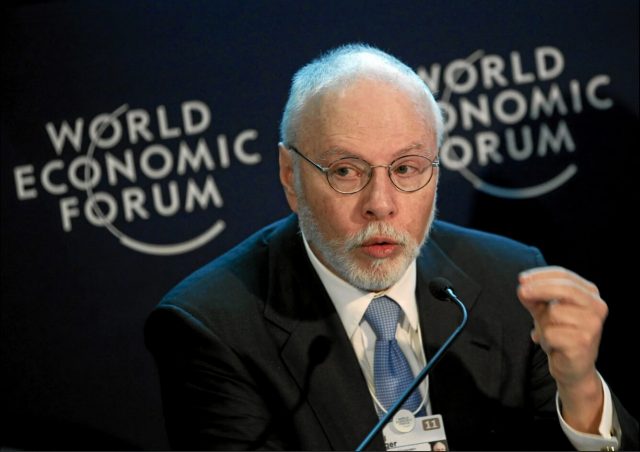
Hedge fund manager Paul Singer has raised millions for a pro-Marco Rubio super PAC. Moritz Hager | World Economic Forum
Singer has a storied history in South America, though he has been relatively quiet about Venezuela. However, a long-time manager of Singer’s hedge fund, Jay Newman, recently told Bloomberg that a Guaidó-led government would recognize that foreign creditors “aren’t the enemy,” and hinted that Newman himself was weighing whether to join a growing “list of bond veterans [that have] already begun staking out positions, anticipating a $60 billion debt restructuring once the U.S.-backed Guaidó manages to oust President Nicolas Maduro and take control.” In addition, the Washington Free Beacon, which is largely funded by Singer, has been a vocal advocate for the Trump administration’s regime-change policy in Venezuela.
Beyond that, Singer’s Elliott Management Corporation gave Roger Noriega, the former assistant secretary of state for Western Hemisphere affairs under Bush, $60,000 in 2007 to lobby on the issue of sovereign debt and for “federal advocacy on behalf of U.S. investors in Latin America.” During the time Noriega was on Singer’s payroll, he wrote articles linking Argentina and Venezuela to Iran’s nonexistent nuclear program. At the time, Singer was aggressively pursuing the government of Argentina in an effort to obtain more money from the country’s prior default on its sovereign debt.
While Singer has been mum himself on Venezuela, he has been making business decisions that have raised eyebrows, such as significantly increasing his stake in Bayer. This move seems at odds with Bayer’s financial troubles, a direct result of the slew of court cases regarding the link between Monsanto’s glyphosate and cancer. The first ruling that signaled trouble for Monsanto and its new parent company Bayer took place last August, but Singer increased his stake in the company starting last December, even though it was already clear by then that Bayer’s financial troubles in relation to the glyphosate court cases were only beginning.
Since the year began, Bayer’s problems with the Monsanto merger have only worsened, with Bayer’s CEO recently stating that the lawsuits had “massively affected” the company’s stock prices and financial performance.
Forcing open a new market for RoundUp
Part of Singer’s interest in Bayer may relate to Venezuela, given that Juan Guaido’s “Plan País” to “rescue” the Venezuelan economy includes a focus on the country’s agricultural sector. Notably, prior to and under Chavismo, agricultural productivity and investment in the agricultural sector took a backseat to oil production, resulting in under 25 percent of Venezuelan land being used for agricultural purposes despite the fact that the nation has a wealth of arable land. The result has been that Venezuela needs to import much of its food from abroad, most of which originate in Colombia or the United States.
Under Chávez and his successor, Maduro, there has been a renewed focus on small-scale farming, food sovereignty and organic agriculture. However, if Maduro is ousted and Guaidó moves to implement his “Plan País,” the opposition’s coziness with foreign corporations, the interests of U.S. coup architects in Bayer/Monsanto, and the opposition’s past efforts to overturn the GM seed ban all suggest that a new market for Bayer/Monsanto products — particularly glyphosate — will open up.
South America has long been a key market for Monsanto and — as the company’s problems began to mount prior to the merger with Bayer — it became a lifeline for the company due to less stringent environmental and consumer regulations than many Western countries. In recent years, when South American governments have opened their countries to more “market-friendly” policies in their agricultural sectors, Monsanto has made millions.
For instance, when Brazil sought to expand biotechnology (i.e. GM seed) investment in 2012, Monsanto saw a 21% increase in its sales of GM corn seed alone, generating an additional $1 billion in profits for the company. A similar comeback scenario is needed more than every by Bayer/Monsanto, as Monsanto’s legal troubles saw the company’s profits plunge late last year.
With countries around the world now weighing glyphosate bans as a result of increased litigation over the chemical’s links to cancer, Bayer needs a new market for the chemical to avoid financial ruin. As Singer now has a significant stake in the company, he — along with the politicians and think tanks he funds — may see promise in the end of the anti-GM seed ban that a Guaidó-led government would bring.
Furthermore, given that Guaidó’s top adviser wants the Trump administration to have a direct role in governing Venezuela if Maduro is ousted, it seems likely that Singer would leverage his connections to keep Bayer/Monsanto afloat amid the growing controversy surrounding glyphosate. Such behavior on the part of Singer would hardly be surprising in light of the fact that international financial media have characterized him as a “ruthless opportunist” and “overly aggressive.”
Such an outcome would be in keeping with the increased profit margins for Monsanto and related companies that have followed its expansion into countries following U.S.-backed coups. For instance, after the U.S.-backed coup in Ukraine in 2014, the loans given to Ukraine by the International Monetary Fund and the World Bank forced the country to open up and expand the use of “biotechnology” and GM crops in its agricultural sector, and Monsanto, in particular, made millions as the prior government’s ban on GM seeds and their associated agrochemicals was reversed. If Maduro is ousted, a similar scenario is likely to play out in Venezuela, given that the Guaidó-led government made known its intention to borrow heavily from these institutions just days after Guaidó declared himself “interim president.”
Feature photo | Luis Arrieta inspects a freshly planted coffee field that used to be a peach orchard in the coastal area of Carayaca on the outskirts of Caracas, Venezuela, Oct. 10, 2018 . Fernando Llano | AP
Whitney Webb is a MintPress News journalist based in Chile. She has contributed to several independent media outlets including Global Research, EcoWatch, the Ron Paul Institute and 21st Century Wire, among others. She has made several radio and television appearances and is the 2019 winner of the Serena Shim Award for Uncompromised Integrity in Journalism.
Kieran Barr contributed to the research used in this report.
Fake news alert: CNN says Venezuelan opposition leader Juan Guaido ‘won election in January’
RT | May 6, 2019
CNN took the concept of “fake news” to a whole new level with a recent report on Venezuela, in which it claimed that citizens “chose” coup leader Juan Guaido over current president Nicolas Maduro in January “elections.”
In a report on Sunday’s deadly Venezuelan military helicopter crash, CNN wrote that “pressure is mounting” on Maduro to step down “following elections in January in which voters chose opposition leader Juan Guaido over him for president.”
The report was finally corrected on Monday after being published on Sunday afternoon and remaining unfixed overnight. It now reflects the fact that Guaido was not elected, but “declared himself interim president” in January.
A correction added to the bottom of the piece explains that the earlier version had “incorrectly described” the situation. Elections? Military coups? Really, who can keep up these days!?
Amazingly, the botched report which initially referenced these mysterious imaginary elections, was the product of work by no less than six journalists — two whose names appear on the main byline and four more listed as contributors at the bottom. Normal practice would see the piece run past a couple of editors too, before being published. That’s potentially eight pairs of eyes — and none of them managed to catch the glaring error.
A number of journalists and Twitter users called CNN out for the “blatant” lie and “shameful” and “terrible” reporting.
It wasn’t the first Venezuela-related embarrassment for CNN. Reporter Jake Tapper was called out on social media last week after he tweeted a link with a picture of opposition army defectors wielding guns to claim Maduro’s government “mows down citizens in streets.”
CNN likes to be known for its so-called adversarial journalism when it comes to the Trump administration, but so far, it seems fully on board with its regime change policies in Venezuela — although, even the White House hasn’t gone so far as to pretend fake elections took place in January.
“Just A Human Being”: Rachel Maddow’s Latest Resistance Hero
By Tyler Durden | Zero Hedge | May 6, 2019
This is where three years of failed Russiagate conspiracy theorizing and fixation leads you — into the arms of fanatical endless war proponent John Bolton: “John Bolton God bless you, good luck..” one can now hear on “resistance” network MSNBC prime time.
MSNBC’s Rachel Maddow is now championing neocon national security adviser John Bolton’s “humanity” given he apparently went loose cannon this past week, vowing to confront Russia over Venezuela even as his boss President Trump downplayed Moscow’s role in the crisis after a Friday phone call with Putin.
“This is what John Bolton, human being, thought his job was this week,” Maddow said on her show Friday night. Both Pompeo and Bolton had clearly gone a bit rogue with their overly bellicose Venezuela comments, while Trump appeared to be more restrained — and for Maddow this was of course cause for championing the neocon interventionist line: “Hey, John Bolton, hey, Mike Pompeo, are you guys enjoying your jobs right now?” she questioned.
On Friday Trump had said following the phone call, Putin is “not looking at all to get involved in Venezuela other than he’d like to see something positive happen in Venezuela, and I feel the same way.”
Maddow, who once prided herself on slamming and deconstructing Bush-era regime change wars, now finds Trump not jingoistic enough. She stridently questioned:
“How do you come to work anymore if you’re John Bolton? Right, regardless of what you thought about John Bolton before this, his whole career and his track record, I mean, just think of John Bolton as a human being. This is what John Bolton, human being, thought his job was this week.”
She further cut to a clip of Bolton criticizing Russia’s alleged military involvement in Venezuela to prop up Maduro, because apparently uber-hawk Bolton is now a “fearless truth-teller” in Maddow’s world.
“You thought that was your job,” Maddow said. “But it turns out not at all, not after Vladimir Putin gets done with President Trump today.”
It bears repeating that among the loudest right-leaning voices who joined the chorus of leading establishment Democrat Russiagaters included previously forgotten about neocons who were quickly rehabilitated by the “Resistance” — David Frum, Max Boot, Robert Kagan, Bill Kristol among them.
And then there was the nauseating phenomenon of watching liberals lionizing Trump-skeptical Republican Congressional leaders like Lindsey Graham, Jeff Flake, and the late Sen. McCain.
Because it’s awful, just awful! – that Trump might actually prefer peace to waging war in multiple places…
Restraint vs. war in multiple places? Maddow apparently advances the humanity of those advocating the latter.
It amounted to, at times, a picture of a President at odds with the officials who this week have called vociferously for a change in power in Caracas and have consistently declined to rule out a US military intervention.
Trump has become frustrated this week as national security adviser John Bolton and others openly teased military options and has told friends that if Bolton had his way he’d already be at war in multiple places. — CNN
And now, months into 2019, we get to hear Maddow waxing eloquent about the innocent “human side” of none other than John Bolton.
Of course, Maddow should first consider whether Bolton or his neocon ilk ever once paused to consider whether those they advocate dropping bombs on — from Iraq to Syria to Libya to Yemen to Gaza to Venezuela — are themselves actually human beings who simply wish to live out their daily lives in peace.
‘A lot to learn from Iran’: Tehran helps Venezuela ‘survive’ under US sanctions, FM Arreaza says
RT | May 6, 2019
Iran, which has been living under tight US sanctions for several decades, is consulting the crisis-hit Venezuela on how to overcome economic blockade and boost production, Foreign Minister Jorge Arreaza revealed.
For several decades, Tehran “has been growing its economy under the [US-imposed] sanctions in a bid to seek independence in various industries,” Arreaza told reporters during his visit to Moscow. Explaining further, he said Iran has indispensable experience in defying continuous US pressure.
We have a lot to learn from Iran. We have Iranian consultants in Venezuelan government that help us survive the blockade and boost production.
Iran has been suffering from US-imposed sanctions since the 1979 Islamic Revolution which toppled the pro-Western Shah Mohammad Reza Pahlavi. The restrictions targeted Iranian finances, exports and imports, as well as energy and the military.
Most of the sanctions that crippled Iran’s economy were lifted after Iran and the five world powers, the US, the UK, France, China and Russia, plus Germany, signed the 2015 nuclear deal. But the US has unilaterally quit the landmark accord under President Donald Trump who labeled it as “the worst deal ever,” and reimposed the sanctions last November.
Likewise, the US slapped Venezuela with restrictions targeting the Latin American country’s oil industry, including the major state-run company PDVSA. These sanctions were strongly condemned by Caracas which dismissed them as economic blackmail.
Iranian advisory aside, Venezuela is seeking alternative ways of dealing with friendly countries around the world, including China and Russia. “These methods and routes aren’t built up overnight, we need much time to create them,” he admitted.
A Nuclear War? Over Venezuela?
By Ron Paul | May 6, 2019
Is President Trump about to invade Venezuela? His advisors keep telling us in ever-stronger terms that “all options are on the table” and that US military intervention to restore Venezuela’s constitution “may be necessary.” Secretary of State Mike Pompeo was on the Sunday news programs to claim that President Trump could launch a military attack against Venezuela without Congress’s approval.
Pompeo said that, “[t]he president has his full range of Article II authorities and I’m very confident that any action we took in Venezuela would be lawful.” The man who bragged recently about his lying, cheating, and stealing, is giving plenty of evidence to back his claim.
The president has no Constitutional authority to start a war with Venezuela or any other country that has not attacked or credibly threatened the United States without Congressional approval. It is that simple.
How ironic that Pompeo and the rest of the neocons in the Trump Administration are ready to attack Venezuela to “restore their constitution” but they could not care less about our own Constitution!
While Washington has been paralyzed for two years over disproven claims that the Russians meddled in our elections to elect Trump, how hypocritical that Washington does not even hesitate to endorse the actual overturning of elections overseas!
Without Congressional authority, US military action of any kind against Venezuela would be an illegal and likely an impeachable offense. Of course those Democrats who talk endlessly of impeaching Trump would never dream of impeaching of him over starting an illegal war. Democrats and Republicans both love illegal US wars.
Unfortunately, Washington is so addicted to war that President Trump would likely have little difficulty getting authority from Congress to invade Venezuela if he bothered to ask. Just as with the disastrous US invasion of Iraq in 2003, the mainstream media is nothing but non-stop war propaganda. Even so-called progressives like Rachel Maddow are attacking the Trump Administration not for its reckless saber-rattling toward Venezuela but for not being aggressive enough!
The real lesson is that even a “Constitutional” war against Venezuela would not be a just war. It would be a war of aggression for which Americans should be angry and ashamed. But the mainstream media is pumping out the same old pro-war lies, while the independent media is under attack from social media companies that have partnered with US government entities to decide what is “fake news.”
The latest outrage in the mainstream media is over the most sensible thing President Trump has done in some time: last week he spent an hour on the telephone with Russian President Vladimir Putin to discuss, among other things, the dangerous situation in Venezuela.
While President Trump’s neocon advisors are purposely trying to position him so that war is the only option, we can only hope that President Putin was able to explain that the Venezuela problem must be solved by the Venezuelans themselves. Certainly the US, perhaps together with the Russians, could help facilitate discussions between the government and the opposition, but the neocon road to war will surely end up like all the other neocon wars: total disaster.
The media is furious that Trump dared to speak to Putin as the two countries increasingly face-off over Venezuela. The Democrats and neocons are pushing for a direct confrontation that may even involve Russia. Republicans agree. Do they really prefer thermonuclear war? Over Venezuela?
Featured Video
Racist Seinfeld Dances for Joy as Bibi Unveils His New Map
or go to
Aletho News Archives – Video-Images
TV Drama Review
Japanese drama projects Japan’s wartime atrocities onto Chinese characters

Global Times | October 25, 2026
By portraying Chinese characters as perpetrators of ruthless violence while casting Japanese Self-Defense Forces (SDF) intelligence operatives as defenders, the season 2 of the Japanese drama Vivant has recently drawn criticism from Chinese netizens, who argue that its depiction turns historical reality on its head while ignoring Japan’s wartime atrocities.
The TBS drama series – a spy suspense story in which an alleged unofficial intelligence unit of the SDF operates across the globe — has attracted a passionate fanbase. Its currently airing season 2 opened with a household rating of 18.8 percent, the highest for a TV drama this year, according toa commentary article by Japanese media Toyo Keizai.
What draws attention is the portrayal of the enemies in the series, the article noted. Scenes in which the Chinese organization subjects kidnapped members of the SDF unit to brutal torture are repeated with unrelenting intensity.
It is rare for Japanese TV dramas to explicitly portray a real-life country as the enemy, the article noted.
Japanese Prime Minister Sanae Takaichi also made a reference to the drama, saying that she has been recording Vivant and hopes to binge-watch it over the year-end and New Year holidays, according to Japanese media outlets.
China’s CCTV News report on Sunday revealed that the drama features scenes in which Chinese personnel cut off the fingers of and stab Japanese intelligence operatives in the abdomen. Such acts bear striking similarities to the torture inflicted on Chinese nationals by invading Japanese troops during the World War II.
The drama distorts the truth by attributing these atrocities to modern Chinese characters. Beneath the surface, it subtly glorifies Japan’s cross-border overseas operations, blurs the functional boundaries of the SDF and implicitly promotes an expansionist narrative, per CCTV News. … continue
Blog Roll
 Aletho News
- Iran FM Araghchi: “Hormuz Will No Longer Be the Same”
- EU facing trillion-euro debt hole while seeking more cash for Kiev
- How US, Europe, Persian Gulf states exhausted missile stockpiles, splurged billions to defend Israel
- Up in arms… Koreans reject U.S. empire’s plan to make South Korea the next Ukraine
- Iran, Turkey, Pakistan, Saudi Arabia could advance region-led security framework in Tehran: FM spox
- Netizens condemn Japanese drama for projecting Japan’s wartime atrocities onto Chinese characters
- Racist Seinfeld Dances for Joy as Bibi Unveils His New Map
- A West Bank War for Netanyahu’s Election Campaign, Could It Backfire?
- Yemen denounces European Parliament’s ‘hypocritical’ push to blacklist Ansarullah
- Qalibaf: UAE’s UN bid aims to ‘clear the runway’ for ‘Greater Israel’, whitewash genocide
- If Americans Knew
- Israel punishes Palestinian prisoners with solitary confinement for making a cake
- US midterms: Where do candidates in key Senate races stand on Israel, Gaza, and Iran?
- Israeli forces demolish Hebron homes, displace thousands of Palestinians as raids expand
- Their Son Died in Israeli Prison. No Answers. No Body
- Biden’s Israel Catastrophe
- Why Israel’s latest assault on Hebron is so significant for the West Bank
- Israel Used “Where’s Daddy?” AI to Relentlessly Murder Palestinian Journalists and Their Families in Their Homes from October to December 2023
- DAILY UPDATE: Latest essential news on Palestine, Israel, & region
- Netanyahu Says Israel Must Prepare for Banking Sanctions, Floats Crypto as a Possible Bypass
- Latest updates from Israeli assault on West Bank
- No Tricks Zone
- Sudden Stratospheric Warming, Powerful El Niño Combination May Lead To Extreme Europe Cold, Energy Crisis!
- Two New Studies Find Thwaites Glacier Melt Cannot Be Driven By Human Activity Or A Warming Ocean
- E-Cars Reduce CO2 Emissions By Only 41% Compared To Internal Combustion Engine Vehicles
- Predictions Made By Renowned Climate Professor Over Past Decades Have Been Proven To Be Poor
- New Study Suggests Large Regions Of The Pacific Ocean Have Been Cooling For The Last 80 Years
- Germany’s Green Energy Debacle: High Energy Costs Force Kahla Porzellan to Close After 182 Years!
- New Study: 50 Years Of The Most Aggressive ‘Net Zero’ Policies Can Only Affect The Global Climate By 0.03°C
- US September “Heat” Was No Record…Many Records Set Decades Ago
- Latest European Green Energy Debacle; Portugal’s Largest Flagship Solar Park Insolvent!
- Green Energy Debacle: German Expert Professor Fritz Vahrenholt Warns Of Severe Economic And Social Consequences

