Merida – Canadian Foreign Minister Chrystia Freeland has announced the “temporary” closure of her country’s embassy and the withdrawal of diplomatic personnel from Venezuela, claiming Ottawa had “no choice.”
In a Sunday press statement, Freeland accused the Maduro government of having “taken steps to limit the ability of foreign embassies to function” by failing to renew visas for diplomatic personnel. No evidence was provided to support the claim. She additionally claimed that that the Caribbean country is “slid[ing] deeper into dictatorship.”
The measure is to take immediate effect, with diplomatic visas reportedly due to expire at the end of June. All embassy and consular services are to be transferred to the Colombian capital of Bogota over 1,500 kilometers away.
Freeland also indicated that Ottawa will “evaluate” the status of Venezuelan diplomats in Canada “appointed by Maduro.”
Canada was the second country to recognise Juan Guaido after he swore himself in as “interim president” on January 23. It has since continued to back Guaido’s attempts to oust the Maduro government and has begun to forge diplomatic relations with the opposition leader’s representative in Canada, Orlando Viera Blanco, who has held a number of meetings with government representatives and members of parliament in Ottawa and Vancouver. The Trudeau administration has also followed US President Donald Trump in imposing several rounds of sanctions on Venezuela.
It is unknown how many Canadian citizens in Venezuela this measure will affect, but recent opposition-led estimates suggest that there are up to 50,000 Venezuelans living in Canada.
The latest diplomatic spat follows a similar confrontation in March, when the United States and Venezuela both withdrew their diplomatic teams, severed diplomatic relations and vacated the embassies. The United States had likewise recognised Guaido envoy Carlos Vecchio as Venezuela’s representative in the country.
The diplomatic standoff came to a head in Washington when US government forces violated the Vienna Convention and breached the Venezuelan embassy building to evict a group of US citizens safeguarding it with the backing of the Caracas government, leading to a number of arrests.
Brazil snubs Guaido representative
The diplomatic scuffle comes as Guaido’s team faces a setback in its efforts to replace Maduro’s diplomatic representation in Brazil.
The far-right Bolsonaro government, which similarly recognises Guaido as the legitimate Venezuelan president, had previously invited his envoy, Maria Teresa Belandria, to present her credentials at the Presidential Palace last Tuesday, only to later inform that the invitation had been withdrawn.
“I was uninvited,” she told Reuters, downplaying the political impact of the news.
Oliver Stuenkel, a professor of foreign relations at the Getulio Vargas Foundation in São Paulo, suggests, however, that the move may suggest Brasilia is losing faith in Guaido’s efforts to oust Maduro.
“[The government] realize[s] Brazil has to deal with the reality that Maduro is not going anywhere right now,” he explained.
Brazilian diplomat Paulo Roberto de Almeida also shares this idea, claiming that the snub shows increasing friction between Brazil’s civilian and military leaders.
“Recognition of Guaido’s envoy was never agreed to by the military,” he said.
Guaido promises Maduro will go this year
Guaido, for his part, told supporters in Venezuela that he will achieve his objective to seize power by the end of the year.
Speaking at a small gathering in Barinas State, Guaido proclaimed, “We are in times of definitions, of advances, of actions (…) This didn’t start in 2019, but I’ll tell you something, it will end in 2019.”
Guaido has previously promised supporters that he would force humanitarian “aid” into Venezuela, convince the armed forces to join his cause, and call new presidential elections. He also led a failed putsch in April.
Taking to Twitter Monday, Guaido further reiterated his pledge to do “what is needed” to oust Maduro, echoing Washington’s statements that “all options are on the table” regarding Venezuela.
Guaido has openly called for a foreign intervention into Venezuela, and is currently calling for Venezuela’s reincorporation into the Inter-American Treaty of Reciprocal Assistance (TIAR), a mutual defense pact involving sixteen countries in the hemisphere which has been cited as a possible legal justification for US military action.
Edited by Lucas Koerner from Caracas.
June 4, 2019
Posted by aletho |
Aletho News | Canada, Latin America, Venezuela |
Leave a comment

Canadian Prime Minister Justin Trudeau poses with Voluntad Popular’s Antonieta López and Lilian Tintori. (Twitter/@liliantintori)
Not only has Canada financed and otherwise supported opposition parties in Venezuela, Ottawa has allied itself with some of its most anti-democratic, hardline elements. While the Liberal government has openly backed Voluntad Popular’s bid to seize power since January, Ottawa has supported the electorally marginal party for years.
Juan Guaidó’s VP (Popular Will in English) party has repeatedly instigated violent protests. Not long after the Democratic Unity Roundtable opposition coalition presidential candidate Henrique Capriles effectively conceded defeat in January 2014, VP leader Leopoldo López launched La Salida (exit/departure) in a bid to oust Nicolas Maduro. VP activists formed the shock troops of “guarimbas” protests that left forty-three Venezuelans dead, 800 hurt and a great deal of property damaged in 2014. Dozens more were killed in a new wave of VP backed protests in 2017.
Effective at stoking violence, VP has failed to win many votes. It took 8% of the seats in the 2015 elections that saw the opposition win control of the National Assembly. With 14 out of 167 deputies in the Assembly, it won the fourth most seats in the Democratic Unity Roundtable coalition. In the December 2012 regional elections VP was the sixth most successful party and did little better in the next year’s municipal elections. More recently, in the October 2017 regional elections the party failed to secure a single governorship.
VP was founded at the end of 2009 by Leopoldo López who “has long had close contact with American diplomats”, reported the Wall Street Journal. A great-great-grand nephew of independence leader Simón Bolívar, grandson of a former cabinet member and great-grandson of a president, López was schooled at Harvard’s Kennedy School of Government. Between 2000 and 2008, López was the relatively successful and popular mayor of the affluent 65,000 person municipality of Chacao in eastern Caracas.
During the 2002 military coup, López “orchestrated the public protests against [President Hugo] Chávez and he played a central role in the citizen’s arrest of Chavez’s interior minister.” He was given a 13-year jail sentence for inciting and planning violence during the 2014 “guarimbas” protests.
Canadian officials have had significant contact with López’s emissaries and party. In November 2014, Lilian Tintori visited Ottawa to meet Foreign Minister John Baird, Conservative cabinet colleague Jason Kenney and opposition MPs. After meeting López’s wife, Baird called for his release and other “political prisoners,” which referred to a number of other VP representatives.
Three months later, VP National Political Coordinator Carlos Vecchio visited Ottawa with Leopoldo López’s sister, Diana López, and Orlando Viera-Blanco to speak to the Subcommittee on International Human Rights of the Standing Committee on Foreign Affairs and International Development. At a press conference, “Popular Will’s international wing” denounced the Venezuelan government and spoke at a McGill University forum on “Venezuela in Crisis: The Decline of Democracy and the Repression of Human Rights.”
Vecchio was appointed as the Guaidó phantom government’s “ambassador” to the US and Orlando Viera-Blanco was named its “ambassador” to Canada. In October 2017, Vecchio and VP deputy Bibiana Lucas attended the anti-Maduro Lima Group meeting in Toronto.
In June 2015, VP councillor of Sucre, Dario Eduardo Ramirez, spoke to the Standing Senate Committee on Foreign Affairs and International Trade. In May 2016, VP Assistant National Political Coordinator Freddy Guevara and VP founding member Luis Germán Florido met Foreign Minister Stéphane Dion and members of the Senate’s Foreign Relations Committee to denounce Maduro’s government. During the trip, VP’s Coordinator of International Relations Manuel Avendaño and an aide Abraham Valencia published an opinion in the Hill Times titled, “Venezuela is on the brink of disaster. Here’s how Canada can help.”
The Canadian embassy in Caracas and former Ambassador Ben Rowswell worked with VP officials pushing for the overthrow of the elected government. The runner-up for the embassy’s 2012 “Human Rights Prize,” Tamara Adrián, represents VP in the National Assembly. At the embassy during the presentation of the 2014 human rights award to anti-government groups were López’s lawyers and wife. In response, then President of the National Assembly Diosdado Cabello accused Rowswell of supporting coup plotters.
The leader of VP in Yaracuy State, Gabriel Gallo, was runner-up for the embassy’s 2015 human rights award. A coordinator of the Foro Penal NGO, Gallo was also photographed with Rowswell at the embassy’s 2017 human rights prize ceremony.
The Montreal-based Canadian Venezuelan Engagement Foundation is closely aligned with VP. Its president is Guaidó’s “ambassador” to Canada — Viera-Blanco — and its founding director is Alessa Polga whose LinkedIn page describes her as VP Canada’s Subcoordinator and Intergovernmental Relations. Polga has been invited to speak before the House of Commons and in 2017 demanded Canada follow the US in adopting sanctions on Venezuela. Justin Trudeau offered words of solidarity for a recent Canadian Venezuelan Engagement Foundation “Gala for Venezuela” in Toronto.
In 2014, 2016, 2017 and 2018, VP youth outreach leader and former Mayor David Smolansky spoke at the Halifax International Security Conference. During his 2018 trip to Nova Scotia, Smolansky published an opinion piece in the Halifax Chronicle Herald claiming, “more than just a failed state, Venezuela is a criminal state.”
In May 2017, Tintori met Prime Minister Justin Trudeau and the leaders of the opposition parties. In response, Venezuela’s Foreign Affairs Minister Delcy Rodríguez described Lopez’s wife as an “agent of intervention” who claims the “false position of victim” while she’s aligned with “fascist” forces in Venezuela.
Three months earlier, Tintori met US President Donald Trump and The Guardian reported on her role in building international support for the plan to anoint VP deputy Guaidó interim president. According to the Canadian press, Canadian diplomats spent “months” working on that effort and the Associated Press described Canada’s “key role” in building international support for claiming a relatively marginal National Assembly member was Venezuela’s president. Presumably, Canada’s “special coordinator for Venezuela” organized these efforts which included foreign minister Chrystia Freeland speaking to Guaidó “the night before Maduro’s swearing-in ceremony to offer her government’s support should he confront the socialist leader.” Prime Minister Justin Trudeau has spoken with Guaidó at least twice since.
Canada has strengthened VP’s hardline position within the opposition. A February Wall Street Journal article noted that leading opposition figures on stage with Guaidó when he declared himself interim president had no idea of his plan despite it being reliant on the Democratic Unity Roundtable’s agreement to rotate the National Assembly presidency within the coalition. (VP’s turn came due in January).
Venezuelans require a vibrant opposition that challenges the government. They don’t need Canada to boost an electorally marginal party that drives the country into increasing conflict.
Yves Engler is the author of 10 books including his latest, Left, Right — Marching to the Beat of Imperial Canada.
June 4, 2019
Posted by aletho |
Progressive Hypocrite | Canada, Venezuela |
Leave a comment
Reports of a mass exodus of Russian military and technical specialists from Venezuela are not true, Russian officials have said. Cooperation with Caracas is going on as usual and is set to expand, they said.
In a Sunday story, the Wall Street Journal reported that Russian military and technical personnel had left Venezuela en-masse, with the numbers diminishing from some 1,000 to several dozens. The newspaper explained the alleged exodus with a lack of contracts and the fact that Moscow supposedly realized that Caracas lacks any funds to pay for the services of the Russian hi-tech and military hardware corporation Rostec.
On Monday, the corporation itself dismissed the report.
“The figures provided in the piece by the Wall Street Journal have been exaggerated tens of times. The numbers of our staff there has remained the same for many years,” the press service of Rostec stated.
The corporation explained that aside from having a permanent representation, it sends groups of technical specialists “from time to time” to Venezuela to perform maintenance and repairs of equipment supplied by Russia. “Just recently, the maintenance of a batch of aircraft was completed,” the press service added.
Russia’s state military hardware exporter, Rosoboronexport, on its part, said that Moscow and Caracas are actually planning to increase cooperation. Russian companies “remain committed to deepening cooperation with the Ministry of Defense and other departments of the Venezuelan government,” the exporter stated.
Shortly after the dismissal, US President Donald Trump announced on Twitter that Russia had “removed most of their people” from Venezuela. It was not immediately clear what he meant, since apart from the Russian companies’ denial, there has been no official word from Moscow so far.
While military and technical cooperation between Russia and Venezuela has been going on for years, it made a lot of fuss lately amid the US-backed attempt to oust country’s President Nicolas Maduro and install self-styled ‘interim-president’ Juan Guaido instead. Russia’s modest military activity in Venezuela caught the eye of American politicians and media, sparking demands to Moscow to “get out” of what Washington believes to be its own “backyard.”
June 3, 2019
Posted by aletho |
Fake News, Mainstream Media, Warmongering | Venezuela, Wall Street Journal |
Leave a comment
Ottawa faces a dilemma. How far are Trudeau’s Liberals prepared to go in squeezing Cuba? Can Canadian corporations with interests on the island restrain the most pro-US, anti-socialist, elements of the ruling class?
Recently, the Canadian Embassy in Havana closed its Immigration, Refugees and Citizenship section. Now most Cubans wanting to visit Canada or get work/study permits will have to travel to a Canadian embassy in another country to submit their documents. In some cases Cubans will have to travel to another country at least twice to submit information to enter Canada. The draconian measure has already undercut cultural exchange and family visits, as described in a Toronto Star op-ed titled “Canada closes a door on Cuban culture”.
It’s rare for an embassy to simply eliminate visa processing, but what’s prompted this measure is the stuff of science fiction. Canada’s embassy staff was cut in half in January after diplomats became ill following a mysterious ailment that felled US diplomats sent to Cuba after Donald Trump’s election. Four months after the first US diplomats (apparently) became ill US ambassador Jeffrey DeLaurentis met his Canadian, British and French counterparts to ask if any of their staff were sick. According to a recent New York Times Magazine story, “none knew of any similar experiences afflicting their officials in Cuba. But after the Canadian ambassador notified his staff, 27 officials and family members there asked to be tested. Twelve were found to be suffering from a variety of symptoms, similar to those experienced by the Americans.”
With theories ranging from “mass hysteria” to the sounds of “Indies short-tailed crickets” to an “outbreak of functional disorders”, the medical questions remain largely unresolved. The politics of the affair are far clearer. In response, the Trump Administration withdrew most of its embassy staff in Havana and expelled Cuban diplomats from Washington. They’ve rolled back measures the Obama Administration instituted to re-engage with Cuba and recently implemented an extreme measure even the George W. Bush administration shied away from.
Ottawa has followed along partly because it’s committed to overthrowing Venezuela’s government and an important talking point of the anti-Nicolás Maduro coalition is that Havana is propping him up. On May 3 Justin Trudeau called Cuban president Miguel Díaz-Canel to pressure him to join Ottawa’s effort to oust President Maduro. The release noted, “the Prime Minister, on behalf of the Lima Group [of countries hostile to Maduro], underscored the desire to see free and fair elections and the constitution upheld in Venezuela.” Four days later Foreign Minister Chrystia Freeland added to the diplomatic pressure on Havana. She told reporters, “Cuba needs to not be part of the problem in Venezuela, but become part of the solution.” A week later Freeland visited Cuba to discuss Venezuela.
On Tuesday Freeland talked with US Secretary of State Mike Pompeo about Venezuela and Cuba. Afterwards the State Department tweeted, “Secretary Pompeo spoke with Canada’s Foreign Minister Freeland to discuss ongoing efforts to restore democracy in Venezuela. The Secretary and Foreign Minister agreed to continue working together to press the Cuban regime to provide for a democratic and prosperous future for the people of Cuba.”
Ottawa supports putting pressure on Cuba in the hopes of further isolating/demonizing the Maduro government. But, the Trudeau government is simultaneously uncomfortable with how the US campaign against Cuba threatens the interests of some Canadian-owned businesses.
The other subject atop the agenda when Freeland traveled to Havana was Washington’s decision to allow lawsuits for property confiscated after the 1959 Cuban revolution. The Trump Administration recently activated a section of the Helms-Burton Act that permits Cubans and US citizens to sue foreign companies doing business in Cuba over property nationalized decades ago. The move could trigger billions of dollars in legal claims in US courts against Canadian and European businesses operating on the island.
Obviously, Canadian firms that extract Cuban minerals and deliver over a million vacationers to the Caribbean country each year don’t want to be sued in US courts. They want Ottawa’s backing, but the Trudeau government’s response to Washington’s move has been relatively muted. This speaks to Trudeau/Freeland’s commitment to overthrowing Venezuela’s government.
But, it also reflects the broader history of Canada-Cuba ties. Despite the hullabaloo around Ottawa’s seemingly cordial relations with Havana, the reality is more complicated than often presented. Similar to Venezuela today, Ottawa has previously aligned with US fear-mongering about the “Cuban menace” in Latin America and elsewhere. Even Prime minister Pierre Trudeau, who famously declared “viva Castro” during a trip to that country in 1976, denounced (highly altruistic) Cuban efforts to defend newly independent Angola from apartheid South Africa’s invasion. In response, Trudeau stated, “Canada disapproves with horror [of] participation of Cuban troops in Africa” and later terminated the Canadian International Development Agency’s small aid program in Cuba as a result.
After the 1959 Cuban revolution Ottawa never broke off diplomatic relations, even though most other countries in the hemisphere did. Three Nights in Havana explains part of why Ottawa maintained diplomatic and economic relations with Cuba: “Recently declassified State Department documents have revealed that, far from encouraging Canada to support the embargo, the United States secretly urged Diefenbaker to maintain normal relations because it was thought that Canada would be well positioned to gather intelligence on the island.” Washington was okay with Canada’s continued relations with the island. It simply wanted assurances, which were promptly given, that Canada wouldn’t take over the trade the US lost. For their part, Canadian business interests in the country, which were sizable, were generally less hostile to the revolution since they were mostly compensated when their operations were nationalized. Still, the more ideological elements of corporate Canada have always preferred the Cuban model didn’t exist.
If a Canadian company is sued in the US for operating in Cuba, Ottawa will face greater pressure to push back on Washington. If simultaneously the Venezuelan government remains, Ottawa’s ability to sustain its position against Cuba and Venezuela is likely to become even more difficult.
June 3, 2019
Posted by aletho |
Deception, Economics | Canada, Cuba, Latin America, Venezuela |
Leave a comment

The failed coup attempt in Caracas in early May brings to mind the techniques used by the Central Intelligence Agency (CIA) and British intelligence in Iran in 1953 to overthrow the Mohammad Mossadeq government. It is quite astonishing how that regime-change long-ago operation parallels what is currently taking place in Venezuela and also with regards to Iran yet again.
Mossadeq was the democratically elected prime minister of Iran beginning in 1951, serving in a government in which the Shah with limited authority was the head of state presiding over a parliamentary system. Iran was nominally independent at the time, but it was heavily influenced by the neighboring Soviet Union, which retained control over several Iranian provinces after the Second World War ended, and Great Britain, which exploited the country’s oil resources through the mechanism of the Anglo-Iranian Oil Company (AIOC), which was owned by the British government. When Mossadeq, frustrated by lack of progress in negotiations with the British over sharing of oil revenues, eventually declared that he would nationalize the AIOC, London and Washington conspired to remove him.
The new National Iranian Oil Company was immediately attacked by the British, who used the Royal Navy to block export of oil from Iran’s Abadan refinery. Ships carrying Iranian oil were stopped and boarded with their shipments confiscated as “stolen property” in light of the British government’s former ownership claim on the AIOC.
By mid-1952, Britain’s blockade of Iranian oil exports had badly hurt the Iranian economy, which eventually led to government bankruptcy. Meanwhile, the American CIA, which was initially ambivalent about what the proper role in the Anglo-Iranian conflict might be, joined British agents in supporting groups inside Iran that were hostile to Mossadeq. In the Majlis parliamentary election in the spring of 1952, Mossadeq faced serious opposition funded by the Anglo-Americans, and the election eventually was suspended. By early 1953, pro-communist and pro-Shah mobs supported and coordinated by the U.S. and Britain roamed the streets, sometimes fighting each other. Fearing a communist takeover and also under pressure from London, which was threatening to withdraw from the Korean War as a quid pro quo, President Dwight D. Eisenhower agreed to carry out a joint coup d’état.
Losing popular support due to a sinking economy, as early as August 1952 a struggling Mossadeq began ruling by emergency powers and started to jail opponents, which only aggravated the crisis. A rigged referendum to dissolve parliament and grant Mossadeq authority to govern by decree passed with 99.9% approval but led to accusations that the prime minister was seeking “total and dictatorial power.” The New York Times reported, “A plebiscite more fantastic and farcical than any ever held under Hitler or Stalin is now being staged in Iran by Premier Mossadeq in an effort to make himself unchallenged dictator of the country.” The move by Mossadeq also led to the first coup attempt, which was organized by the CIA.
On Aug. 15, 1953, Col. Nemathollah Nassiri, the commander of the Shah’s Imperial Guard, delivered to Mossadeq a decree from the Shah dismissing him. Mossadeq, who had been warned of the plot, had Nassiri arrested, and the Shah and his family fled into exile in Italy. The first coup thus ended with a whimper, but it was lessons learned for the second, better organized successful attempt which followed a few days later, Operation Ajax, coordinated by Kermit Roosevelt of the CIA.
Exploiting pro-Shah sentiment in the military, the CIA and the British turned to their stables of recruited army officers while also exploiting agents infiltrated into the communist party Tudeh, which rose to the occasion by launching mass demonstrations, to include looting and arson, which quickly alienated the public and also provided a pretext for Western support of the coup as it could be promoted as “anti-communist.” Efforts were also made to turn influential clerics against Mossadeq. The Iranian people blamed the government for all their woes and rioting soon led to the calling out of the army to restore order. The army did so and then had Mossadeq arrested. He was condemned to death, but his sentence was later commuted to three years in solitary confinement followed by house arrest. He died in 1967.
End of story, but not quite. All the elements currently being used against Venezuela and Iran were there back in 1953 to bring down Mossadeq and also appear in a detailed 2018 Pentagon plan describing how to bring about a coup in Caracas. Wrecking the countries’ economies through sanctions and exclusion from the global banking network creates a crisis where one need not have existed. Meanwhile, a sustained campaign of vilification by Western political leaders and the media establishes the narrative that the benevolent intention is to block extremism and restore democracy while also eliminating a threat to the United States. And, as a last resort, the threat or actual use of force to stop the export of commodities to further wreck the economy becomes a clearly stated policy option, currently also employing secondary sanctions for anyone who dares to trade with the designated victim. Recently, America’s unilaterally imposed global ban on the export and sale of Iranian oil began. Venezuela’s oil sales are also being blocked and even its electricity grid is being attacked in an attempt to starve the Venezuelan people into rebelling against their government.
But you also have to have spies, secret agents, to get the ball rolling, just as was true in 1953. One assumes that the CIA has been active in recruiting the agents of influence inside Venezuelan political opposition as well as military circles who will bring out increasingly larger mobs as the situation continues to deteriorate. How successful they have been is difficult to determine, but Venezuelan opposition leader Juan Guaido failed the first time around, reportedly because the Venezuelan government was aware of what was happening and the contacts that the CIA was relying on to bring out the army were in fact double agents.
The suffering Iranian and Venezuelan people have yet to rise up in revolt. No matter. It took more than one try to bring down Mossadeq, and National Security Advisor John Bolton has recently warned Iran that its government won’t have any more anniversaries to celebrate if it continues with its “threats.” The Trump administration is also reported to be preparing military options for dealing with Venezuela.
Bolton has even warned the Russians, who are assisting Venezuela’s government: “This is our hemisphere. It’s not where the Russians ought to be interfering. This is a mistake on their part.” He is seemingly unaware of the irony, that the Russians might make the same claim about Eurasia and the Iranians regarding the Persian Gulf, where Bolton and his neocon friends in Washington have been the source of nearly continuous conflict.
Philip Giraldi is a former CIA counter-terrorism specialist and military intelligence officer and a columnist and television commentator. He is also the executive director of the Council for the National Interest.
June 2, 2019
Posted by aletho |
Timeless or most popular | CIA, Iran, Operation Ajax, UK, United States, Venezuela |
Leave a comment
In 2015, ExxonMobil discovered large oil fields just off the coast of Guyana. The reserves are estimated at 5.5 billion barrels. What does this hold in store for the Latin American country’s future? And what does Venezuela have to do with this?
Today, Guyana is the second poorest country in the region. According to some estimates, over the next few decades, it may become one of the world’s largest oil producers per capita. However, the availability of resources doesn’t always mean economic prosperity. The small Caribbean country could just become another piece of the puzzle that the United States is putting together in the region, said Tamara Lajtman, an expert at the Latin American Strategic Centre for Geopolitics (CELAG).
The entire history of relations between the United States and Latin American nations and the Caribbean region indicates that American transnational companies will be the ones who will benefit most from this discovery.
Guyana vs Venezuela
Lajtman shared the viewpoints of American experts who believe that Washington can replace Venezuelan oil from a “regional petroleum regime” with a much more stable supplier.
The expert said that at the end of last year, the American Security Project (ASP) organised a conference called “Guyana: Building Sustainable Security”. This organisation studies national security issues, among the members of its board, are former US Secretary of State John Kerry and former US Secretary of Defence Chuck Hagel. The participants in the said event included Vice Admiral Kevin Green, the former head of US Naval Forces Southern Command.As a result of the meeting, a document was drafted in which it was suggested that American politicians establish closer relations with Guyana in order to guarantee long-term security. The report also noted that since the crisis in Venezuela continues to escalate, a prosperous and developing Guyana could become an axis of stability in the Caribbean, Lajtman added.
According to the Stratfor agency [an American private intelligence and analysis company], some major oil producing companies in the United States have already begun working in Guyana. However, although the revenues of Guyana’s government will increase, a large part of the country won’t feel the economic benefits of oil production, since basically all the jobs in the sector have been designated for foreigners.
Military Presence
In early May, the US Navy Southern Command began New Horizons drilling in Guyana. According to the ASP (American Security Project), they are being held at just the right moment, “when Guyana is at the very centre of regional geopolitics”.
There are two reasons for this: the crisis in neighbouring Venezuela and the energy future of the Caribbean country. The situation is aggravated by a land dispute between Caracas and Georgetown over the Essequibo River. A zone of 160,000 km2 has been claimed by Venezuela for several centuries and the dispute is still unresolved. The United States sees a threat to drilling operations near the maritime border between the two countries.
Economic Aspect
For many decades, Guyana was considered a transit country for cocaine on its way from Colombia to the United States. In light of this, the government has implemented various anti-drug assistance programmes and enacted laws to combat money laundering and the financing of terrorism. With the growth of oil revenues more could be done about this.
In July 2018, Guyana joined China’s New Silk Road initiative, which includes investments in the construction of ports and roads. This would be the largest project ever carried out in the country. It is of key geostrategic importance since it will reduce the time of transportation for goods to northern Brazil (China’s main trading partner in the region) and make the route to the Panama Canal faster.The expert also noted that one of China’s largest national oil companies — CNOOC (China National Offshore Oil Corporation), owns a 25% stake in ExxonMobil’s Stabroek block.
June 1, 2019
Posted by aletho |
Economics | China, Guyana, Latin America, United States, Venezuela |
Leave a comment
The United States walked out of a UN disarmament forum in protest after Venezuela took up the conference’s rotating chairmanship, insisting it would not participate in a conference led by a “rogue state.”
“Whatever is discussed in there, whatever is decided, has absolutely no legitimacy because it is an illegitimate regime presiding over that body,” US ambassador to the Conference on Disarmament (CD) Robert Wood told reporters Tuesday after he stormed out of the meeting.
Wood ditched the forum as soon as his Venezuelan counterpart Jorge Valero was granted the conference’s presidency – which rotates on a monthly basis – calling Valero’s acceptance speech a “diatribe of propaganda.”
The US and its allies in the Lima Group – comprised of more than a dozen Latin American allies including Mexico, Colombia, Brazil and Chile – will boycott the CD for the next four weeks, until the new chair takes over, Wood said in a statement after the meeting.
The CD was established in 1984 to provide an international forum for arms control negotiations, and is held three times a year in Geneva. Sixty-five countries currently participate in the conference, including all states with a declared nuclear arsenal.
Washington, along with a handful of allies, supports Venezuelan opposition leader Juan Guaido, who declared himself ‘interim president’ in January, with US recognition. The pro-Guaido bloc considers Venezuela’s elected president, Nicolas Maduro, to be illegitimate.
Wood demanded the CD chairmanship be granted to a member of the opposition.
“A representative of Juan Guaido, the interim president, should be in this body, should be sitting in that chair right now,” he said, adding that the Maduro government “is in essence dead, it just doesn’t want to lay down.”
US President Donald Trump has ramped up sanctions on Venezuela in recent months, crippling energy exports of a country already in dire straights and depriving the socialist government of much needed revenue. Washington considers sanctions part of another “maximum pressure campaign,” designed to coerce the Maduro government into compliance.
The US endorsed an opposition coup attempt in late April, but the uprising failed to inspire mass defections from the security forces and fizzled out within days, leaving Washington and the Guaido faction frustrated.
Ambassador Wood staged a walkout at last year’s CD as well, in that case over Syria’s elevation to the chair position. Wood worked off a similar script then, ditching the meeting as the Syrian ambassador began his address and complaining to reporters outside the chamber.
May 28, 2019
Posted by aletho |
Militarism | Latin America, United Nations, United States, Venezuela |
Leave a comment
Judith Miller and Michael Gordon published their now infamous New York Times article on September 8, 2002, falsely claiming on the basis of unnamed “American officials” that Iraq had acquired “aluminum tubes” with the aim of producing “an atomic bomb.”
Disgraced by her regurgitation of bogus claims, Miller left the Times in 2005, but her spirit is “alive and well” at the “paper of record.” Nicholas Casey follows faithfully in Miller’s footsteps, authoring dubious, anonymously sourced stories that coincidentally happen to further US regime-change objectives.
In a recent piece headlined “Secret Venezuela Files Warn About Maduro Confidant” (5/2/19), the Times’ Andes bureau chief claimed, on the basis of a leaked Venezuelan intelligence “dossier” that only his paper has seen, that Venezuela’s Industry minister and former Vice President Tareck El Aissami has active links to Hezbollah and drug trafficking. Casey wrote:
The dossier, provided to the New York Times by a former top Venezuelan intelligence official and confirmed independently by a second one, recounts testimony from informants accusing Mr. El Aissami and his father of recruiting Hezbollah members to help expand spying and drug trafficking networks in the region.
Unsurprisingly, the article has been endorsed by Florida Republican Sen. Marco Rubio, widely considered the point man for Trump’s Latin America policy, and whose zeal for regime change in Caracas appears unperturbed by elementary facts or international law. In a May 16 tweet, Rubio openly celebrated the fact that Venezuelan President Maduro “can’t access funds to rebuild electric grid,” thereby dispensing with any pretence that US sanctions are not directly aimed at the Venezuelan population.
The claims of an alleged relationship between Caracas and Hezbollah are, however, entirely unoriginal, having been repeated by corporate journalists and national security pundits without evidence for years.

Attempts to tie Venezuela to Hezbollah are not new (The Hill, 1/13/17)
“Hezbollah has a long and sordid history in Venezuela,” wrote Foreign Policy (2/2/19) earlier this year. Newsweek claimed in a 2017 article (12/8/17) that the Lebanese political party “was involved in cocaine shipments from Latin America to West Africa, as well as through Venezuela and Mexico to the United States,” while The Hill (1/13/17) labeled El Aissami a “fan of Iran and Hezbollah,” rehashing US allegations going back to 2008.
Likewise, corporate media claims about Hezbollah presence in Latin America have not been exclusive to Venezuela, with similar baseless rumors circulating about the Lebanese political party operating in the so-called Tri-Border Area of Paraguay (Extra!, 9–10/07).
Such stories just happen to buttress similar unsupported claims by US Secretary of State Mike Pompeo that Hezbollah has “active cells” in Venezuela. Pompeo and other senior administration officials have repeatedly warned that a military option to remove the Maduro government is “on the table,” while self-proclaimed “interim president” Juan Guaidó has requested “cooperation” from the Pentagon’s US Southern Command.
Casey himself has a long-established track record in dodgy Venezuela reporting, ranging from ludicrous stories about Cuban doctors (FAIR.org, 3/26/19) to false claims that private media like Globovision and El Universal “toe a government line.” (See FAIR.org, 5/20/19.)
Suspect sources
According to Casey’s “dossier,” Tareck El Aissami conspired with his father, Carlos Zaidan El Aissami,
in a plan to train Hezbollah members in Venezuela, “with the aim of expanding intelligence networks throughout Latin America and at the same time working in drug trafficking.”
We should begin by recognizing that Casey provides no proof of the authenticity of the alleged documents, and there is no reason why readers should take the assurances of unnamed “former top Venezuelan intelligence official[s]” at face value, especially those currently outside Venezuela collaborating with Washington. Similar sources were used to craft the fraudulent case for war in Iraq.
For instance, former Venezuelan intelligence czar Hugo “El Pollo” Carvajal, who broke with the Maduro government in 2017, is facing extradition to the US from Spain on cocaine-smuggling charges. In February, the ex-general gave an interview to Casey and the Times (2/21/19) in which he accused El Aissami of similar drug trafficking and Hezbollah links. Nowhere in the article did Casey think it relevant to mention that Carvajal plans to cooperate with US authorities, and thus has reasonable motive to fabricate information that improves the conditions of his plea bargain.
Taking refuge in anonymity, which the Times’ own handbook describes as a “last resort,” Casey leaves open the question of whether his source is Carvajal or another ex-official collaborating with the US who authored the dossier after leaving Venezuela, since no date is provided. From “Curveball” to North Korean defectors, corporate media have been consistently guilty of not examining sources’ motives so long as their “information” bolsters US foreign policy interests, even at the cost of tens or hundreds of thousands of lives.
Urea-gate?
Beyond the issue of sourcing, the alleged “dossier” has a troubling number of logical and factual inconsistencies. A case in point is the alleged testimony from an unnamed National Guard officer about a 2004 raid near the border with Brazil, which reportedly found more than 150 tons of urea in a warehouse. Casey disingenuously refers to urea as a “precursor substance used to make cocaine,” when in fact over 90 percent of industrially produced urea is used for fertilizer. Casey does concede later on that urea has non-cocaine purposes, but cannot conceive of the possibility of the substance being stored in a given location only to be used elsewhere.
The narrative function of the urea bust, which for some reason was not reported until a mysterious dossier was handed to the New York Times 15 years later, is to provide a link to Walid Makled, allegedly the owner of the urea warehouses, and a drug trafficking kingpin of sorts. Even assuming that the urea was meant for cocaine production, and not for more mundane agricultural purposes, a key fact is that Makled is currently serving a jail sentence in Venezuela for drug trafficking. This inconvenient reality, noted but not explained by the Times, on its face seriously undermines the idea that the current Industry minister, supposedly a close associate of Makled, is a powerful figure running a drug ring at the heart of the Venezuelan state.
That aside, it’s worth reviewing the “links” that Casey presents between Makled and El Aissami:
- According to the “dossier,” El Aissami’s brother, Feraz, went into business with Makled.
- The government gave “contracts” to a company “tied to Mr. Makled.” (Casey doesn’t think it relevant to explain the nature of these “ties” or “contracts”)
- The US government offered a similarly vague level detail regarding El Aissami’s alleged “ties” to drug-running when it sanctioned the then-vice president in 2017, and even Casey admits that Washington “never revealed the evidence.”
- “Two people familiar with [El Aissami’s] family” identified Haisam Alaisami as being El Aissami’s cousin, with Alaisami supposedly telling prosecutors he was a legal representative of Makled’s company. Beyond the anonymous genealogy, no concrete evidence is presented linking El Aissami to Alaisami, and hence to drugs.
In the absence of any externally verifiable evidence, what Casey presents as bombshell revelations of solid links to drug trafficking come out looking like 15-year-old gossip from unnamed sources.
Hezbollah hysteria
While Casey’s story provides very questionable allegations on links to drug trafficking and to Hezbollah, the connection between both is even more dubious.
The dossier concludes with informant testimony on the family’s ties to Hezbollah…. One of the sources of the information was the drug lord, Mr. Makled, who described Mr. El Aissami’s involvement in the scheme, according to the intelligence memo.
After establishing highly questionable ties between Tareck El Aissami and Walid Makled, largely based on their shared Syrian ancestry, Casey’s “dossier” then claims it is none other than Makled who “reveals” El Aissami’s supposed Hezbollah plot.
According to the alleged “documents,” El Aissami and his father were “involved in a plan to train Hezbollah members in Venezuela, ‘with the aim of expanding intelligence networks throughout Latin America and at the same time working in drug trafficking.’”
The unspoken assumption is that Hezbollah, which is a resistance movement and political party that forms part of the the elected Lebanese government, would be interested in conducting such illicit activities halfway around the world. Here Casey displays a geopolitical illiteracy on par with top Trump administration officials since, according to Middle East expert As’ad AbuKhalil, “there is no agenda or reason for Hezbollah to have an international presence.”
“For what purpose? Doesn’t the party have enough on its plate in Lebanon itself?” he asked, while acknowledging that the party does have sympathizers and supporters worldwide.
On the assertion that Hezbollah is engaged in drug trafficking, the University of California at Stanislaus professor is equally skeptical. “There has been no credible story in Arabic or in Western languages about Hezbollah’s involvement in drugs,” he stressed:
Hezbollah publicly and organizationally took a stance against drugs and issues fatwas against drugs not only among members but even in Shiite areas of Lebanon. Hezbollah has even allowed Lebanese government agencies to penetrate deep into its strongholds [this year] to search for drug traffickers.
Casey and his editors cleverly shield themselves from any reputational damage over the ludicrous nature of these allegations with a rather significant proviso buried in the 14th paragraph of the article:
Whether Hezbollah ever set up its intelligence network or drug routes in Venezuela is not addressed in the dossier. But it does assert that Hezbollah militants established themselves in the country with Mr. El Aissami’s help.
In other words, what was originally presented as anonymously sourced claims about Hezbollah spying and drug trafficking in Venezuela turn out to be little more than speculation about intent to carry out such activities.
In giving credence to these allegations, the Times repeats the propaganda of top Trump administration officials and the Israeli government about the “global terrorist ambitions” of Iran/Hezbollah, which is in league with Venezuela’s socialist “narco-dictatorship.”
Having played a key propaganda role in recent US regime change operations in Iraq, Syria, Libya and elsewhere, corporate media outlets like the New York Times are all too eager to beat the drums of war once again. With Washington actively threatening military force in both Iran and Venezuela, Nicholas Casey lends a hand in manufacturing public consent for not one but two illegal wars.
May 27, 2019
Posted by aletho |
Deception, Mainstream Media, Warmongering | Hezbollah, Israel, Latin America, New York Times, United States, Venezuela, Zionism |
Leave a comment
From May 10 to 17, the United States imported 49,000 barrels of Venezuelan crude oil. This is the first time that the US imports its neighbor’s oil in weeks and the Russian Foreign Ministry spokeswoman, María Zakharova, has commented on the figure, published in the weekly report of the US Energy Information Administration.
Zakharova recalled that in March, the press reported that the special envoy of the United States Government for Venezuela, Elliott Abrams, had said that the United States was seeking “the complete isolation of President Nicolás Maduro on the international stage and, above all, the cessation of any commercial transaction of banks, companies and corporations with Venezuela that would be beneficial for Maduro”.
Zakharova countered Abrams’ words [with the fact] that the US has resumed Venezuelan oil imports at 49,000 barrels a day.
“And so always, first they encourage everyone to do something and then they change their maneuver 180 degrees, leaving behind those who gave in,” she said.
On January 28, Washington announced the imposition of sanctions against state oil company PDVSA and blocked the assets and interests of the Venezuelan company in its jurisdiction for 7,000 million dollars. The truth is that deliveries of Venezuelan oil in the United States for the first week of April reached 139,000 barrels per day, while during the previous three weeks it had been at zero, according to the US Department of Energy.
In annual terms, deliveries decreased 4.5 times from the level of 631,000 barrels per day, recorded during the first week of April 2018. From March 11 to March 29, according to statistics, oil was not supplied from Venezuela to the US.
Translated by JRE\EF
May 26, 2019
Posted by aletho |
Economics | United States, Venezuela |
Leave a comment
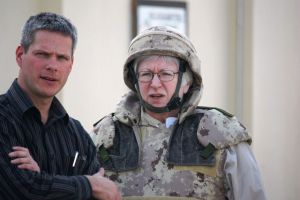
Ben Rowswell in Afghanistan with Auditor General Sheila Fraser
Why does the dominant media pay so much attention to Russian “meddling” in other countries, but little to Canada’s longstanding interference in the political affairs of nations thousands of kilometres from our borders?
The case of Ben Rowswell illustrates the double standard well.
The current Canadian International Council President has been the leading non-governmental advocate of Ottawa’s quest to overthrow Venezuela’s government. In dozens of interviews, op-eds, tweets and ongoing speaking tour the former ambassador has put a liberal gloss on four months of naked imperialism. But, Rowswell has been involved in efforts to oust Nicolas Maduro since 2014 despite repeatedly claiming the president’s violation of the constitution two years ago provoked Ottawa’s recent campaign.
A March 2014 Venezuela Analysis story suggested the early adopter of digital communications was dispatched to Caracas in the hopes of boosting opposition to a government weakened by an economic downturn, the death of its leader and violent protests. Titled “New Ambassador Modernizes Canada’s Hidden Agenda in Venezuela”, the story pointed out that Rowswell immediately set up a new embassy Twitter account, soon followed by another titled SeHablaDDHH (Let’s Talk Human Rights), to rally “the angry middle classes on Twitter.” The article noted that “Rowswell is the best man to encourage such a ‘democratic’ counterrevolution, given his pedigree” in digital and hotspot diplomacy. According to a March 2014 Embassy story titled “Canada dispatches digital diplomacy devotee to Caracas”, just before the Venezuela assignment “Ottawa’s top digital diplomat … helped to establish a communications platform for Iranians and Iranian emigrants to communicate with each other, and occasionally the Canadian government, beyond the reach of that country’s censors.” Previously, Rowswell was chargé d’affaires in Iraq after the 2003 US invasion and headed the NATO Provincial Reconstruction Team in Kandahar during the war there. An international strategy advisor in the Privy Council Office during Stephen Harper and Jean Chrétien’s tenure, Rowswell created Global Affairs Canada’ Democracy Unit. Rowswell also worked with the Washington based Center for Strategic and International Studies, whose board of trustees includes Henry Kissinger and Zbigniew Brzezinski, and the National Democratic Institute, which is part of the US National Endowment for Democracy that performs work the CIA previously did covertly.
Believing he was sent to conspire with the opposition, Caracas refused to confirm Rowswell’s appointment as ambassador. Former vice president and foreign minister José Vicente Rangel twice accused Rowswell of seeking to overthrow the government. On a July 2014 episode of his weekly television program José Vicente Hoy Rangel said, “the Embassy of Canada appears more and more involved in weird activities against the Venezuelan constitutional government.” The former Vice President claimed Canada’s diplomatic mission helped more than two dozen individuals of an “important intelligence organization” enter the country. Three months later Rangel accused Canadian officials of trying to destabilize the country by making unfounded claims Maduro supported drug trafficking and gave passports to terrorists.
In early 2015 then president of the National Assembly (not to be confused with Venezuela’s president) Diosdado Cabello accused the Canadian embassy of complicity in a failed coup. According to Cabello, an RCMP official attached to the embassy, Nancy Birbeck, visited an airport in Valencia with a member of the UK diplomatic corps to investigate its capabilities as part of the plot.
The president of the National Assembly also criticized Rowswell for presenting a human rights award to anti-government groups. Cabello said the ambassador “offered these distinctions to people of proven conspiratorial activity and who violate the fundamental rights to life of all Venezuelans.” At the embassy during the award ceremony were the lawyers and wife (Lilian Tintori) of Leopoldo López who endorsed the military’s 2002 coup against President Hugo Chavez and was convicted of inciting violence during the 2014 “guarimbas” protests that sought to oust Maduro. Forty-three Venezuelans died, hundreds were hurt and a great deal of property was damaged during the “guarimbas” protests. Lopez was a key organizer of the recent plan to anoint Juan Guaidó interim president and Tintori met Donald Trump and other international officials, including the prime minister and many others in Ottawa, to build international support for the recent coup efforts.
Rowswell appears to have had significant contact with López and Guaidó’s Voluntad Popular party. He was photographed with Voluntad Popular’s leader in Yaracuy state, Gabriel Gallo, at the embassy’s 2017 human rights award ceremony. Gallo was a coordinator of NGO Foro Penal, which was runner-up for the embassy’s 2015 Human Rights Award. (The runner-up for the 2012 award, Tamara Adrián represents Voluntad Popular in the national assembly.)
The embassy’s “Human Rights Prize” is co-sponsored with the Centro para la Paz y los Derechos Humanos. The director of that organization, Raúl Herrera, repeatedly denounced the Venezuelan government, saying, “the Venezuelan state systematically and repeatedly violates the Human Rights of Venezuelans.”
The “Human Rights Prize” is designed to amplify and bestow legitimacy on anti-government voices. The winner gets a “tour of several cities in Venezuela to share his or her experiences with other organizations promoting of human rights” and a trip to Canada to meet with “human rights authorities and organizations.” They generally present to Canadian Parliamentary Committees and garner media attention. The Venezuelan NGOs most quoted in the Canadian media in recent months criticizing the country’s human rights situation — Provea, Foro Penal, CODEVIDA, Observatorio Venezolano de la Conflictividad, Observatorio Venezolano de Prisiones, etc. — have been formally recognized by the Canadian embassy.
During Rowswell’s tenure at the embassy Canada financed NGOs with the expressed objective of embarrassing the government internationally. According to the government’s response to a July 2017 Standing Senate Committee on Foreign Affairs and International Trade report on Venezuela, “CFLI [Canadian Funding to Local Initiatives] programming includes support for a local NGO documenting the risks to journalists and freedom of expression in Venezuela, in order to provide important statistical evidence to the national and international community on the worsening condition of basic freedoms in the country.” Another CFLI initiative funded during Rowswell’s tenure in Caracas “enabled Venezuelan citizens to anonymously register and denounce corruption abuses by government officials and police through a mobile phone application.”
Just after resigning as ambassador, Rowswell told the Ottawa Citizen: “We established quite a significant internet presence inside Venezuela, so that we could then engage tens of thousands of Venezuelan citizens in a conversation on human rights. We became one of the most vocal embassies in speaking out on human rights issues and encouraging Venezuelans to speak out.”
Can you imagine the hue and cry if a Venezuelan ambassador said something similar about Canada? In recent months there have been a number of parliamentary committee and intelligence reports about Russian interference in Canada based on far less. Last month Justin Trudeau claimed, “countries like Russia are behind a lot of the divisive campaigns … that have turned our politics even more divisive and more anger-filled than they have been in the past.” That statement is 100 times more relevant to Canada/Rowswell’s interference in Venezuela than Russia’s role here.
Recently Rowswell has been speaking across the country on “How Democracy Dies: Lessons from Venezuela and the U.S.”
I wonder if the talk includes any discussion of Canadian diplomats deployed to interfere in other country’s political affairs?
May 24, 2019
Posted by aletho |
Deception | Canada, CIA, Latin America, Venezuela |
Leave a comment
Uncle Sam has a problem in his South American “backyard” with those uppity Venezuelans who insisted on democratically electing Nicolás Maduro as their president instead of by-passing the electoral process and installing the unelected US asset Juan Guaidó. No matter, Amnesty International has come to the rescue with a full-throated defense of US imperialism:
Faced with grave human rights violations, shortages of medicines and food and generalized violence in Venezuela, there is an urgent hunger for justice. The crimes against humanity probably committed by the authorities must not go unpunished.
— Erika Guevara-Rosas, America’s director at Amnesty International
Amnesty International fails in its broadside to put its claims against the Maduro government in the context of a concerted regime-change campaign, which amounts to war, by the bully from the north. The US is waging an illegal war against Venezuela and Amnesty International’s broadside leaves out this inconvenient fact, egregiously even omitting any mention of sanctions.
As human rights activist Chuck Kaufman of the Alliance for Global Justice noted about Amnesty International (AI): “They don’t seem to even care about their credibility anymore.” A more credible and honest account of what is unfolding in Venezuela, than the hatchet job presented in AI’s May 14th Venezuela: Crimes against humanity require a vigorous response from the international justice system, would have also noted along with the alleged transgressions of the Maduro government:
- Grave human rights violations. Economists Mark Weisbrot of the Center for Economic and Policy Research and Jeffrey Sachs of Columbia University recently reported that US sanctions on Venezuela are responsible for tens of thousands of deaths. This is the price being exacted on Venezuela, with a prediction for worse to come, for the regime change that AI is implicitly promoting.
- Shortages of medicines and food. Since 2015, when US President Obama first instituted them, the US has been imposing ever more crippling illegal sanctions on Venezuela expressly to create misery for the population in the hope that it would then turn against their own democratically elected government. The sanctions are specifically designed to suffocate the economy so that Venezuela cannot address its problems. The US government boasts about the impacts of sanctions. Playing the good cop to the US role as bad cop, AI laments the very conditions they are tacitly promoting in asking for ever increasing “punishments.” New US sanctions on Venezuela were imposed on May 10th.
- Generalized violence. The US government has repeatedly and unapologetically threatened military intervention in Venezuela if the elected government doesn’t abdicate. Short of attacking militarily, the US has waged war against Venezuela by economic and diplomatic means, not to mention low-intensity warfare such as cyber attacks. The extreme right wing opposition has called for the extra-legal overthrow of the government and has eschewed electoral means for effecting political change. AI is correct in noting that since 2017 new violence has been inflicted on the Venezuelan people but fails to note the role of the opposition in provoking that violence with their guarimbas and other actions. Meanwhile Guaidó, whose popular support in Venezuela is bottoming out, is reported sending his envoy to meet with the US Southern Command to “coordinate.”
How is it possible that an organization purporting to stand for human rights and global justice can so blithely ignore facts that do not fit into their narrative and so obsequiously parrot the Trump-Pompeo-Bolton-Abrams talking points? Why would AI go so far as to meet with the self-appointed Guaidó and then within days issue a report condemning the Maduro government, without also investigating the other side in the conflict?
Unfortunately, this is not the first time AI has shown an imperial bias as it has regarding US-backed regime-change projects in Iraq, Libya, Syria, and Nicaragua.
Objectively deconstructing the many allegations (e.g., “more than 8,000 extrajudicial executions by the security forces”) made against Venezuela in the AI broadside and its accompanying report remains to be done. Unfortunately, the Empire has a surfeit of resources to churn out propaganda compared to the ability to counter it by genuine humanitarian groups. AI alone has an annual budget of over $300 million. According to sources cited by Wikipedia, AI receives grants from the US State Department, the European Commission, and other governments along with the Rockefeller Foundation.
To conclude, AI’s broadside calls for justice about as often as it calls for punishment with the subtext that punishment of the Empire’s victims is justice. Were AI truly concerned about justice, rather than justifying another US regime-change operation, they would champion the following:
- Ending the unilateral sanctions by the US on Venezuela, which are illegal under the charters of the United Nations and the Organization of American States.
- Supporting dialogue between the elected government and the opposition as has been promoted by Mexico, Uruguay, Pope Francis, and most recently by Norway.
- Condemning regime-change activities and interference in Venezuela’s internal affairs and actively rejecting the US government’s aggressive stance as articulated by US VP Pence: “This is no time for dialogue. This is time for action.”
- Respecting the sovereignty of Venezuela and restoring normal diplomatic relations between the US and Venezuela.
Roger D. Harris is active in the 33-year-old human rights organization Task Force on the Americas and is active with the Campaign to End US-Canadian Sanctions Against Venezuela
May 20, 2019
Posted by aletho |
Mainstream Media, Warmongering | Amnesty International, United States, Venezuela |
Leave a comment
The angry mob of Venezuelan expatriates who laid siege to the Venezuelan Embassy in Washington, DC, earlier this month was composed of numerous figures with close ties to the inner structures of the US empire and who stood to benefit financially from a coup d’etat in Venezuela, investigative journalists told Sputnik Friday.
During the nearly three-week-long siege of the Embassy Protection Collective by opposition forces, numerous instances of harassment and violence were documented, including bigoted comments and slurs, physical struggles and the use of tools such as scuba lights, laser pointers and air horns to harass and intimidate the anti-war activists.
As journalists began to look into the footage, they also began to wonder: who are these people that form the Venezuelan opposition?
The struggle at the embassy, in Washington, DC’s historic Georgetown district, was essentially an extension of the struggle inside Venezuela. Since January 23, Juan Guaido has presumed to be Venezuela’s interim president — an office he’s recognized as occupying by the US and about 50 other nations, but which has no meaning on the ground in Caracas, where Guaido commands relatively few followers. Even internationally, three-quarters of the globe’s countries, as well as key international institutions like the United Nations and International Monetary Fund, continue to recognize Venezuelan President Nicolas Maduro, who was re-elected to a second term in May 2018.
Jeb Sprague, a lecturer at the University of Virginia and author of the forthcoming book “Globalizing the Caribbean: Political Economy Social Change and the Transnational Capitalist Class,” teamed up with journalist Alexander Rubinstein of MintPress News, who was embedded with the Embassy Protection Collective inside the embassy for nearly a month, including during the two-week period of the siege, from April 30 to May 13, to probe the internet for the identities of the people in the footage.
Their report, titled “Who’s Behind the Pro-Guaidó Crowd Besieging Venezuela’s DC Embassy?” was published on Thursday, just hours before US police stormed the facility and arrested the activists. Sprague spoke about their findings Friday with Radio Sputnik’s By Any Means Necessary.
The Embassy Protection Collective was formed on April 10 by anti-war activists in the United States who objected to Washington’s coup attempt in Venezuela and who saw the imminent delivery of the empty embassy to Guaido’s retinue as a major provocation that could lead to war. With the Maduro government’s permission and armed with international treaties recognizing the embassy’s legally inviolable status, the activists set up shop in the facility, where they soon came under attack by pro-Guaido protesters seeking to either storm the embassy or starve the collective out.
“In the beginning of their siege, their first week or two, they were really, extremely homophobic, racist — I mean, you don’t have to take my word for it, you can look on Twitter and in our article and all the links to all, you know, they are just videotaped, time after time, yelling out all this stuff,” Sprague said.
“But then what we found is they have these sort of like, PR/marketing strategists, people that came in after that initial period and they really tried to alter how people were perceiving that mob… and so you had media outlets like the New York Times, Vice Magazine… they came in. So, when they would come to the siege, there were these people who were put up by the mob for them to be interviewed.”
Sprague said one woman who became a “poster child for the pro-Guaido mob,” Dilianna C. Bustillos, “she’s actually a senior manager at Oracle, which is one of the largest companies in the world, a tech company that works with defense companies and makes like a $40 billion a year annual revenue… she’s a senior manager there. She previously volunteered with Visión Democrática, which is a pro-opposition group which is connected with a lot of the people who are working with Juan Guaido in DC.”
He noted many of the figures they identified were connected to a series of meetings at the Center for Strategic and International Studies (CSIS), a hawkish US think tank in Washington, DC, where pro-Guaido figures and shadow government officials helped plan a US invasion of Venezuela.
“They’ve started this website called ‘Ask a Venezuelan,’ and so, constantly on Twitter there’s like this mantra… they’re saying ‘ask a real Venezuelan,’ ‘ask a Venezuelan.’ And so, we started a thing called ‘Ask an Upper-Class Venezuelan;’ when we researched who they are — like the woman that founded that group, ‘Ask a Venezuelan,’ she has a $4 million a year company, and she had put out tweets supporting the guarimbas, which were these really violent protests, called for the US Marines to land in Venezuela. So one after another,” Sprague told hosts Eugene Puryear and Bob Schlehuber.
“And then we started looking at more of the people that were at the protests, and we found one guy who was a senior architect at Raytheon, the arms company. It was like, every time we looked at a person, their background in DC — two people that worked for CSIS, one that’s been working for the World Bank, another one for the Inter-American Development Bank — that guy actually got caught yelling out a lot of racist, sexist epithets.”
“One of the most interesting guys Cesar Caminero, we documented him as being there, and when I found his LinkedIn page, it said that he works for this tech company, and he does work for the [US Department of Defense], and he brags on his LinkedIn that he has this active secret clearance,” Sprague said. “And there’s this other guy who was doing tech work for US intelligence, so it was just fascinating that we could see just, one after another, people were either working with like, an international financial institution, an arms or military-oriented contractor or a hawkish think tank funded by the Gulf [monarchies] and big arms companies.”
“We figured out there’s this built-in base of these elite members, professional people in the diaspora, that basically advocate for regime change and escalation of conflict where they can really gain or benefit through US intervention,” Sprague said.
Indeed, Guaido himself is an alumnus of The George Washington University, located in Washington, DC’s Foggy Bottom neighborhood.
“Even if the embassy defenders got pushed out, I think it was still a victory in really illuminating the crimes of the Trump government and showing how violent these people are that they work with,” Sprague said.
May 18, 2019
Posted by aletho |
Aletho News | United States, Venezuela |
Leave a comment