The New York Times Reports on What the Rest of the Western Hemisphere Thinks About the Conflict Between the US and Venezuela
By Mark Weisbrot | CEPR Americas Blog | March 13, 2015
In a significant change in reporting at The New York Times, the newspaper yesterday became the first major news outlet in the English language media to report on what the rest of the governments in the Western Hemisphere think of U.S. policy toward Venezuela.
This is potentially important because this part of the story, which has heretofore been ignored, could begin to change many people’s perceptions of what is behind the problems in U.S.-Venezuelan relations, if other journalists begin to report on it. The Obama administration is more isolated in Latin America than even George W. Bush was, but hardly anyone who depends on the major hemispheric media would know that, because the point of view of governments other than the U.S. is not reported.
The Times article contains this very succinct and eloquent comment on the new U.S. sanctions against Venezuela from Ecuadorean president Rafael Correa:
“It ought to be a joke in bad taste that reminds us of the darkest hours of our America, when we received invasions and dictatorships imposed by the imperialists,” Mr. Correa wrote. “Can’t they understand that Latin America has changed?”
The last line really sums up the situation: They really don’t understand that Latin America has changed. One can follow all the foreign policy debates in Washington about Latin America, in the media or in journals such as Foreign Affairs, and there really is almost no acknowledgment of the new reality. In this sense the discussion of hemispheric relations is different from most other areas of U.S. foreign policy, e.g., Afghanistan, Iraq, even Israel and Palestine – where there is at least some debate that reaches the intelligentsia and the public. (The new Cold War with Russia is perhaps exceptional in the pervasiveness of a sheep-like mentality and uniformity of thinking – as Russia expert Stephen Cohen of Princeton has pointed out reminiscent of the 1950s; but it remains to be seen how long this can last, and even in this robust display of groupthink there is a small smattering of exceptions that break through.)
Latin America really has changed, drastically, and Correa’s view represents the vast majority of governments in the region, even if some are more diplomatic in their expression of it. This can be seen in the strong statements criticizing U.S. actions from regional organizations such as the Community of Latin American and Caribbean States, which includes every country in the hemisphere except the U.S. and Canada; and UNASUR (the Union of South American Nations). (The Times article mentioned that these two organizations “issued statements expressing concern,” although that was a bit of an understatement.)
More generally, the vast majority of Latin American governments now have a foreign policy independent of Washington, which has never been true before the 21st century; and they are also much more independent of Washington in their economic policies. As recently as 2002, for example, the U.S. was able to exert a major influence on the economic policy of even the region’s largest economy, Brazil, through the International Monetary Fund.
The White House’s latest move is seen throughout the region as so outrageous and threatening that it will likely be reversed, eventually, under pressure from Latin American governments. That is what happened in April 2013, when U.S. Secretary of State John Kerry refused to recognize the results of Venezuela’s presidential election, even though there was no doubt about the outcome. At first, Washington was able to get OAS Secretary General José Miguel Insulza, and the right-wing government in Spain, to join in refusing to recognize the result; but then these two allies gave in under pressure, and Kerry was left completely alone, whereupon Washington recognized the results.
WaPo, Owned by CIA’s Webmaster, Blasts Venezuela’s ‘State-Financed’ News
By Jim Naureckas | FAIR | March 12, 2015
Venezuelans are worried because US President Barack Obama declared a “national emergency” that called Venezuela “an unusual and extraordinary threat to the national security and foreign policy of the United States.”
But there’s no need for them to get upset, the Washington Post’s Nick Miroff and Karen DeYoung (3/11/15) reassure. The Obama administration explained that it just wanted to impose sanctions on some of Venezuela’s top officials because “it wanted to send a strong message in defense of human rights and democracy”:
The “emergency” declaration and labeling of Venezuela as a “security threat” are legal formalities used in many other instances when sanctions are applied, administration officials said. The language does not represent a more severe assessment of the Maduro government, they said.
Ah–the administration is just pretending there’s an “unusual and extraordinary threat” because it wants to invoke powers that it’s only legally allowed to use in an actual emergency. No biggie. Thanks for clearing that up, Washington Post !
Unfortunately, Venezuelans don’t have Washington-savvy publications like the Post to set them straight. Or, as Miroff and DeYoung put it:
Such nuances stood little chance in the meat grinder of Venezuela’s rough political culture, where state-financed and pro-government broadcasters dominate the airwaves.
Hmm–so we should be wary of “state-financed and pro-government” media outlets, huh?
The Washington Post, as it happens, is owned by Jeff Bezos, the 15th richest person in the world, who derives his fortune from his position as the main owner of Amazon.com, with an 18 percent share of the company.
You probably know Amazon as an online bookseller; less famously, they’re also in the online data storage business, and one of their top clients is the US intelligence community, which paid Amazon Web Services $600 million for a “cloud” to store and process information for the CIA, NSA and other US spy agencies. As the Atlantic (7/17/14) noted at the time, this is far from Amazon’s only government contract; other agencies they store data for include NASA, the FDA, the CDC and HealthCare.gov.
Amazon “is rapidly becoming the leading supplier of cloud services to the federal government,” the trade publication EnterpriseTech (8/22/14) reported. When the Defense Department looked to spend $10 billion on cloud services, Amazon didn’t bid directly for the contract–but it will partner with five of the 10 companies who won pieces of the contract, allowing it to get more than the $1 billion each direct contractor is limited to (FCW, 8/28/13).
Is this serious money for Bezos? Well, he paid $250 million for the entire Washington Post in 2013, so it’s more than walking-around money. Suffice it to say that it’s very unlikely any Venezuelan broadcaster gets as much state funding as the Bezos empire.
As for “pro-government”–the Post may be more or less friendly to any particular administration, but it’s never going to lose its allegiance to the DC’s permanent government. As Keane Bhatt (Extra!, 3/14) pointed out, it’s the Post’s proximity to Washington’s imperial power that makes it more than just another mid-size daily like the Denver Post.
And part of the job of being Washington’s official court paper, apparently, is explaining to the inhabitants of lesser nations that they shouldn’t take it personally when the US labels them “an unusual and extraordinary threat.”
Obama, at War on Three Continents, Threatens Venezuela
By Glen Ford | Black Agenda Radio | March 11, 2015
President Obama, who is currently engaged in multiple wars on both the African and Asian continents and is hell-bent on provoking a war in Europe with Russia, is now stepping to the very brink of war in South America, against Venezuela. On Monday, Obama declared a state of national emergency to justify freezing the assets of 7 Venezuelan officials that the U.S. claims are involved in human rights violations. In order to comply with U.S. law, Obama asserted that Venezuela represents a threat the national security of the United States. The White House pretended that the scary language was just a legal technicality, and does not mean that the president actually believes Venezuela is about to do harm to the United States. However, Obama is invoking the same language and law against Venezuela that was used against Syria and Iran, leading to Syria’s near destruction by the U.S. and its allies and proxies, and to vicious sanctions and a state of near-war with Iran. Venezuela has every reason to fear that Obama’s executive order might be a prelude to military attack.
Washington has been trying to topple the socialist government in Venezuela since at least 2002, when George Bush backed an unsuccessful coup against the late President Hugo Chavez. Since then, Venezuela has conducted more elections than any other nation in the hemisphere, all of them vouched for as free and fair by international observers. Unable to prevail at the polls, the rightwing, racist opposition hopes to come to power through another coup or direct military intervention by the United States. In that context, Obama’s assertion that Venezuela is a danger to U.S. national security ranks just short of a declaration of war.
Venezuelan President Maduro has thrown a few of the most brazen coup plotters in jail, which Obama ridiculously describes as a massive violation of human rights. However, the worst human rights violators in the hemisphere are Washington’s allies. Almost six million people, most of them Black and indigenous, have been displaced from their homes by political violence in Colombia, a U.S. client state. Mexico’s is a narco-state, as violent as Colombia. And Honduras, where the U.S. backed a military coup against the democratically elected government in 2009, is a place of lawlessness and state terror.
Luckily, the United States only has a few remaining allies left in Latin America. What unifies the southern part of the hemisphere is the common experience of the U.S. boot on one’s neck. CELAC, the Community of Latin American and Caribbean States, which includes all of the nations of the western hemisphere except Canada and the U.S., has warned Washington to stop interfering in Venezuela’s internal affairs.
So, if Obama thinks that he can get away with waging a phony “humanitarian” interventionist war against Venezuelan President Maduro, as he did against Libya’s Muammar Gaddafi, he will find himself opposed by an entire continent.
Obama Regime Brands Venezuela a “Security Threat,” Implements New Sanctions
By Lucas Koerner | Venezuelanalysis | March 9, 2015
Caracas – U.S. President Barack Obama issued an executive order this Monday slapping Venezuela with new sanctions and declaring the Bolivarian nation an “unusual and extraordinary threat to the national security”.
The sanctions target seven individuals accused by the White House of alleged human rights violations and “public corruption”, freezing their assets and barring entry into the U.S.
The figures include Justo Jose Noguera Pietri, President of the state entity, the Venezuelan Corporation of Guayana (CVG) and Katherine Nayarith Haringhton Padron, a national level prosecutor currently taking the lead in the trials of several Venezuelan political opposition leaders, including Leopoldo Lopez.
The executive order is the latest in a series of U.S. sanctions imposed on Venezuela over the past few months. On February 3, the Obama administration expanded the list of Venezuelan officials barred from entering the U.S., which now includes the Chief Prosecutor Luis Ortega Diaz.
“Venezuelan officials past and present who violate the human rights of Venezuelan citizens and engage in acts of public corruption will not be welcome here, and we now have the tools to block their assets and their use of U.S. financial systems,” announced White House spokesman Josh Earnest.
The U.S. has failed thus far to disclose evidence that might bolster its claims of human rights violations, leading Venezuelan and other regional leaders to condemn what they regard as the arbitrary and political character of U.S. sanctions.
While regional bodies such as the Union of South American Nations (UNASUR) have called for dialogue, Washington has so far refused to support negotiations or to recognise the organisation’s stance.
“We will continue to work closely with others in the region to support greater political expression in Venezuela, and to encourage the Venezuelan government to live up to its shared commitment, as articulated in the OAS Charter, the Inter American Democratic Charter, and other relevant instruments related to democracy and human rights,” reads the latest White House statement.
The order goes on to call for the release of all “political prisoners” allegedly held by the Venezuelan government, including “dozens of students”.
The Venezuelan government, for its part, maintains that all of those arrested are in the process of facing trial for criminal offences linked to violent destabilization efforts spearheaded by the opposition.
Former Caracas Metropolitan Mayor Antonio Ledezma was arrested last month on charges of conspiracy and sedition related to the February 12 thwarted “Blue Coup” attempt. A Venezuelan judge found sufficient evidence linking the opposition figure to air force officials involved in the coup as well as to rightwing terrorist leaders such as Lorent Saleh, who was extradited by Colombian authorities to face charges last year.
The other high profile Venezuelan opposition leader currently facing trial is Leopoldo López, who was indicted for his role in leading several months of violent opposition protests last year with the aim of effecting the “exit”, or ouster, of the constitutional government. Known as the “guarimbas”, these violent protests and street barricades caused the death of 43 people, the majority of whom were security personnel or Chavistas.
Ledezma and López, together with far right leader Maria Corina Machado, were active in the 2002 coup against then president Hugo Chávez, which succeeded in temporarily ousting the Venezuelan leader until he was restored by a popular uprising.
All three opposition leaders also signed a “National Transition Agreement” released on the day prior to February’s “Blue Coup” attempt, describing the government of Nicolas Maduro as in its “terminal phase” and declaring the need to “name new authorities” without mentioning elections or other constitutional mechanisms. Many political commentators interpreted the document as an open call for a coup against the president.
The Venezuelan government has charged the U.S. government with hypocrisy on the issue of human rights, and in particular the mass repression and incarceration of Afrodescendent communities in the U.S.
On February 28, President Maduro announced new measures imposing a reciprocal travel visa requirements on U.S. citizens seeking to enter Venezuela as well as mandating a reduction in U.S. embassy staff to levels that match the number of Venezuelan personnel in Washington.
Maduro also announced the creation of an “anti-terrorist list” of individuals barred from entering Venezuela, which will include former U.S. officials such as George W. Bush and Dick Cheney, who have reportedly “committed human rights violations.”
Venezuelan Foreign Minister, Delcy Rodriguez, has confirmed that the Bolivarian government will soon issue an official response to the order.
The Foiling of a Coup Plot in Venezuela
By GLORIA La RIVA | CounterPunch | February 25, 2015
A coup plot against President Nicolas Maduro and the Bolivarian Revolution was thwarted this week as a retired Venezuelan Air Force general and 10 military and civilian opposition figures were arrested.
The bombing of the Presidential Palace, the National Assembly, Telesur TV network, the Defense Ministry and other Caracas sites was to take place February 12, the one-year anniversary of violent anti-government attacks known as “guarimbas,” which caused 43 deaths. A Tucano EMB 312 bomber would have been flown by renegade Air Force First Lieutenant José Antich Zapata to destroy the targeted sites.
U.S. spokesperson Jen Psaki and the Venezuelan far-right are dismissing the plot claim, but video evidence, a map of the bombing targets, and other key evidence have been unveiled on national television, with more details promised. Washington’s role in previous plots has been proven before.
According to President Maduro, detained coup leaders have confessed their role. He spoke on national television Sunday morning, to reveal more facts and accuse the United States government of conspiring with coup plotters.
Antich Zapata received U.S. visas for himself and other conspirators from the U.S. embassy in Caracas, for escape from Venezuela in case the plot failed.
Maduro also said that the script of an eight-minute video by the coup group – to air once the government was overthrown – was written with the help of a U.S. embassy advisor.
Rightwing opposition involved
In obvious preparation for the failed coup, three of the most belligerent opposition figures – Maria Corina Machado, Leopoldo Lopez and Antonio Ledezma – issued a “Call for a National Transition Agreement,” on February 11, the day before the overthrow was to take place. Lopez is currently awaiting trial for his role in the violent attacks last February.
The “transition agreement” is a plan for overthrow of the Bolivarian Revolution socialist project, including a demand for felony trials of current government leaders after the “transition,” the privatization of nationalized industries, and the takeover of PDVSA, the state-owned oil industry that has been the source of great social developments in Venezuela since 1999.
As if aware of a pending coup, German embassy representative Jorg Polster issued a letter of warning on February 5 to German citizens residing in Venezuela, to take unusual precautions such as in the event of “political unrest like that which began in the spring of 2014.” The letter suggests the German nationals obtain a two-week supply of food, water and emergency provisions of battery, radio and important documents. The letter also indicates a loss of electricity and Internet access could be a possibility.
National Assembly president Diosdado Cabello and Jorge Rodriguez, mayor of the Libertador municipality of Caracas – both leaders of Maduro’s political high command – also appeared on television, denouncing Julio Borges, leader of the right-wing group, Primero Justicia (“Justice First” in English), as drafting the list of the 20-plus targets to be bombed.
An unfolding plot since January
A series of actions was planned by the counterrevolutionaries to lead up to February 12.
First step was economic destabilization through major corporate hoarding of goods to create empty stores and mass discontent. That has been taking place for weeks, with the right-wing then accusing the socialist government of economic failure.
The government countered with “Operation Dignity,” confiscating the hoarded goods for redistribution at fair prices to the population, and arresting the corporate conspirators.
The second step was internationally-generated false accusations of a “humanitarian crisis” in Venezuela by the U.S. and international allies of Washington.
It is thus no coincidence that on January 24, three right-wing former presidents of Latin American countries, Andres Pastrana of Colombia, Felipe Calderon of Mexico and Sebastian Pinera of Chile came to Venezuela and tried to visit jailed opposition leader Leopoldo Lopez. Afterwards, they demanded his freedom and held a press conference accusing Venezuela of human rights violations.
On February 3, President Maduro warned Washington to stop its interventionist meddling, and accused U.S. officials of trying to bribe current and former government leaders to betray the government.
Via Telesur, he denounced U.S. Vice President Joseph Biden’s recent meetings with various Latin American leaders, in which he told them Maduro’s government would soon fall, and that the Petrocaribe program would be ended. Biden advised them to “keep Venezuela isolated.” Petrocaribe is the Venezuelan program that provides oil to Caribbean nations at a low price.
Telesur as target
Why was Telesur one of the targets to be bombed?
In 2002, when a fascist coup by a sector of the military and corporate opposition overthrew President Hugo Chavez from April 11 to 13, Venezuela’s revolution was new and a people’s media had not yet developed.
In the critical hours of the massive and spontaneous popular mobilization to demand Chavez’s release and return as president, the monopoly corporate media completely blocked out the news. It was clear that the Bolivarian process needed a revolutionary media to transmit vital information to the population.
Since then, dozens of community and television stations have been established; corporate violators of the new Communications Law have had their licenses revoked.
The Telesur network – promoting the integration of Latin America – was proposed 10 years ago by Chavez. It has become a vital conveyor of national and international information with a solid anti-imperialist prospective.
It provided uncensored live coverage and exposed the terror bombing by NATO/U.S. bombing of Libya.
Like the brutal bombing of Serbia’s national TV station, killing scores of journalists who courageously covered the criminal NATO/U.S. bombing of Yugoslavia in 1999, the planned bombing of Telesur was part of the plan to destroy the Revolution and install a fascist coup.
The smashing of this latest plot against Venezuela is a major blow to U.S. imperialism’s attempts to reverse the gains of the Bolivarian revolutionary process in Venezuela, the Cuban Revolution and all progress in Latin America.
Revolutionary mass organizations and the military high command are declaring their unity and defense of Venezuela’s Bolivarian Revolution.
Vladimir Padrino Lopez, the Minister of Defense and Strategic Operational Commander of the FANB, stood with a large group of high-ranking military officers to denounce the military plot. “The Bolivarian Armed Forces reiterates its support and loyalty to President Nicolás Maduro Moros and reaffirms its commitment to the will of the people, with the Plan of the Homeland, in the building of Socialism.”
More than ever, it is vital that international solidarity be mobilized to demand an end to U.S. machinations in Venezuela and all Latin America. Progressive groups and leaders in Latin America are expressing their support for Maduro’s government. From March 5-7, organizations in several cities in the United States plan actions in solidarity with the Venezuelan Bolivarian government and its people in struggle.
The danger is not over. The lessons of Latin America in the 1960s, 1970s and the U.S. war against revolutionary movements everywhere shows that the struggle must continue to defend Venezuela’s gains and oppose U.S. imperialism’s counter-revolutionary schemes.
Non-Aligned Movement Backs Venezuela against US Sanctions
teleSUR | February 8, 2015
The Non-Aligned Movement issued a statement Saturday rejecting the latest set of sanctions imposed by the United States against Venezuelan officials.
The 120-nation body described the sanctions as “intended to undermine Venezuela’s sovereignty, its political independence and its right to self-determination.”
The U.S. government announced a new set of sanctions last week which target former and current Venezuelan officials. The U.S. has justified various rounds of sanctions by claiming corruption and that human rights abuses occurred in the oil-rich county during a wave of opposition violence last year that left 43 dead.
However, the Venezuelan government has pointed out the sanctions are politically motivated and that they form part of U.S. plans to oust the country’s elected government, given that the overwhelming majority of the 43 fatalities were caused by right-wing extremists.
The Non-Aligned Movement considers the unilateral sanctions a “violation of international law, including the United Nations Charter and the basic principles of international law of relations between states.”
Furthermore, the group of nations considered the measure “coercive” and manifested its solidarity with the Venezuelan people and their government.
The UNASUR group of South American nations also rejected the sanctions and will launch a probe to evaluate Venezuela’s evidence of U.S. meddling in the country’s internal affairs.
‘Venezuelan Bomb Plot’ a Figment of FBI’s–and US Media’s–Imagination
By Jim Naureckas | FAIR | February 2, 2015
All these headlines are wrong:
Ex-Los Alamos Scientist Gets 5 Years in Venezuelan Nuclear Bomb Plot
– NBC News (1/28/15)US Nuclear Scientist Who Offered to Help Venezuela Build Nuclear Bombs Gets 60 Months
– Washington Post (1/29/15)Ex-Los Alamos Scientist Heard Offering to Design Bomb Directed at NYC for Venezuela
– CBS New York (1/28/15)Ex-Los Alamos Scientist Accused of Offering to Make Venezuela a Nuclear Weapon to Be Sentenced
– Minneapolis Star Tribune (1/28/15)Scientist Sentenced After Offering to Build Nuclear Weapons for Venezuela, Bomb Targeting New York
– Syracuse Post-Standard (1/28/15)
What’s wrong is that there was no “Venezuelan nuclear bomb plot,” and the scientist in question, Pedro Leonardo Mascheroni, didn’t offer Venezuela anything. What Mascheroni was convicted of was telling undercover FBI agents, who were pretending to work for Venezuela, that he could give them nuclear weapons secrets. In real life, Venezuela had nothing to do with it.
The distinction is critical because accurate headlines would not leave casual readers with the impression that Venezuela was interested in getting a nuclear bomb, or in trying to nuke New York. From the point of view of the US government, no doubt, that misimpression is a feature and not a bug.
US Slaps Venezuelans with New Sanctions
teleSUR | February 3, 2015
The United States officially imposed new sanctions on Venezuela Monday, amid accusations from President Nicolas Maduro that Washington is trying to destabilize his country.
The new sanctions expand the number of Venezuelan government officials barred from entering the United States.
“These restrictions will also affect the immediate family members of a number of those individuals subject to visa restrictions for believed involvement in human rights abuses or for acts of public corruption,” said State Department spokesperson Jen Psaki.
Psaki continued by stating, “We will not publicly identify these individuals because of U.S. visa confidentiality laws, but we are sending a clear message that human rights abusers, those who profit from public corruption, and their families are not welcome in the United States.”
Maduro hit back at the announcement by accusing the U.S. government of hypocrisy.
“They kill black youth in the street with impunity, they persecute and have concentration camps of Central American kids. They have abducted dozens of citizens of the world under no known legal system, submitting them to torture, isolation,” he said during a speech.
Maduro has previously accused U.S. officials of plotting to topple his government.
He asked, “What human rights are they talking about?”
The new U.S. sanctions are in response to a wave of unrest that hit Venezuela in early 2014. Around 43 people died as anti-government groups took to the streets with weapons ranging from firearms to molotov cocktails and home-made bazookas to demand Maduro step down. According to an analysis of the death toll by independent media collective Venezuelanalysis, around half the casualties were government supporters, state security personnel or ordinary members of the public likely killed by anti-government groups. Venezuelan authorities have arrested opposition figures it claims masterminded the violence including Leopoldo Lopez, while also pressing charges against security personnel accused of misconduct.
However, Psaki described the opposition violence as “peaceful protests.”
“We emphasize the action we are announcing today is specific to individuals and not directed at the Venezuelan nation or its people,” she said.
However, Venezuelan foreign minister Delcy Rodriguez told private broadcaster Venevision that the U.S. and corporate media are trying to mislead the international community about Venezuela.
“All imperialist wars have been precipitated by media campaigns such as this one, giving false information that aims to provide the world with the justification for an intervention,” said Rodriguez.
Sabino Romero’s Widow Testifies Amidst Threats

Sabino’s widow, Lucia Martinez de Romero, testified at court today (Aporrea)
By Lucas Koerner | Venezuelanalysis | February 2, 2015
Caracas – Dozens of activists gathered outside the Ministry of Justice in the capital today in solidarity with Lucia Martinez de Romero, the widow of assassinated indigenous Yukpa leader Sabino Romero. Today she testified in the trial of Angel Antonio Romero Bracho, (aka “Manguera”) accused of murdering the indigenous chief or “cacique”.
Lucia herself also suffered multiple gunshot wounds the night of March 3, 2013 when her husband was shot and killed by hired assassins reportedly acting in the service of wealthy cattle ranchers.
Lusby Portillo, 66, Coordinator of the Zulia-based Homo Et Nature Society, explained what is at stake in today’s proceedings:
“Today there is a trial against the physical murderer, who shot and killed [Sabino] and wounded Lucia Martinez. Five police officers from Machiques have already been tried and given seven years of prison… They gave them seven years, because there was influence on the part of the cattle ranchers, who paid so that the court would decide a minimum sentence of seven years”.
Portillo is one of the principal activists to have followed the case over the past 23 months. He told Venezuelanalysis that many indigenous activists feared that a miscarriage of justice would take place unless supporters continued to draw attention to the case. One witness today also noted that the family of Manguera began to threaten Lucia before she was due to testify.
“If we let our guard down, if we don’t protest, if we don’t make movies, if we don’t write articles, if we don’t get the word out, these courts are going to give Manguera ten, eleven years, and then within two or three years he can go free with all of the benefits…So we are demanding thirty years of prison [for Manguera], and we’re also demanding that the trial against the five police officers be annulled, that there be a new trial, and that… the intellectual actors… the cattle ranchers who financed [the murder], who are millionaires, go to trial.”
Land Struggles
In the leadup to his assassination, Rabino spearheaded a series of occupations by Yukpa campesinos of the expansive rancher haciendas established on their ancestral land in Sierra de Perijá, which were returned to them by the current socialist government under the Constitution. According to Portillo, these lands were violently confiscated by the government of dictator Juan Vicente Gomez in 1930, driving the Yukpa people into the mountains. When they subsequently attempted to retake their lands, as Sabino would do over eighty years later, they were brutally massacred by the cattle ranchers.
For indigenous rights activist Tibisay Maldonado, 52, however, this struggle goes much further back than eighty years.
“We are active in the organization National Front for Land Struggle, because, even though we are from Caracas we are from the city, this problematic of the land, this plundering from 500 years ago. We are the inheritors of a dispossession, of an invasion 500 years ago, and the indigenous peoples remain in resistance, and we must stand with them”.
Amid Trial, Impunity Continues for Murder of 8 other Yukpa Leaders
Portillo went on to criticize what he described as “impunity” for the hired killers of indigenous leaders and their intellectual and financial backers.
“Of the Yukpa [leaders] killed over the question of land, who are nine up until now, only the case of Sabino has been taken to the courts, but the [case of the] other eight murdered [leaders] has not been investigated nor brought to trial…Besides trial for [the case of] Sabino, there also needs be trials for the other eight Yukpa who were assassinated.”
Nonetheless, for Leonardo Dominguez, the problem goes well beyond these nine assassinated leaders, encompassing the issues of paramilitary violence in Venezuela writ large;
“This is something that is practiced in Colombia. These are new crimes in Venezuela. So I think the laws need to stipulate a decent punishment for this murderer to mark a precedent, because enough is enough. There have already been 359 campesinos assassinated at the hands of the hitmen, plus workers’ leaders, plus popular leaders. We want peace, but we believe peace is achieved through struggle. If you want peace, prepare for war,” he said.
A Test for the Revolution
For those present outside the Ministry of Justice, today’s trial represents a fundamental test of the Bolivarian government’s commitment to defending indigenous rights.
“Socialism has two paths,” warns Dominguez..”Either we’re with the indigenous people or we’re with the murderers.”
Despite the challenges faced by the Yupka people, including the relative inaction of the government, Jessy Rojas, 20, of Urbano Aborigen, is nevertheless hopeful. She stated that there had been a “fair amount of gains” for indigenous people under the Bolivarian Revolution, including the trial of Sabino’s murderer.
“In the past, there generally weren’t trials for indigenous cases. In the past, there wasn’t this openness to discussing indigenous issues in the capital”.
According to Jessy, these historic gains are propelling young activists to take the struggle evern further.
“This is the moment to demand,” she asserted.
The case has been adjourned until February 13th.
Cuba Détente
By ROBERT SANDELS and NELSON P. VALDÉS | CounterPunch | January 28, 2015
“I do not expect the changes I am announcing today to bring about a transformation of Cuban society overnight.”
— Barack Obama, Dec. 17, 2014
President Obama’s Dec. 17 statement announcing changes in U.S. Cuba policy was a mixture of historical truths and catch phrases drawn from the catalog of myths about Cuba and U.S. policy goals.
The first round of rule changes, announced by Jan. 16 by the Office of Foreign Assets Control (OFAC), was significant in the areas of trade and banking. At the same time, much of the language is drawn from the old justifications for regime change. (Let us put aside the hypocrisies in Obama’s speech such as the instruction — coming from a country where labor unions have been systematically destroyed — that “Cuban workers should be free to form unions.”)
In his speech, Obama reworked Einstein’s famous definition of insanity to support his partial abandonment of the half-century attempts to destroy the Cuban revolution. “I do not believe we can keep doing the same thing for over five decades and expect a different result,” said Obama. (If he means that the policy he has supported for six years is insane, what does that say about him?)
Nowhere in the speech did Obama renounce the longstanding U.S. commitment to regime change in Cuba or even acknowledge that it ever existed. While implicitly recognizing that the use of sanctions to achieve political results had failed, he continues to pursue them in Korea, Russia and elsewhere. One day after making the Cuba speech, he signed a bill imposing sanctions on Venezuela alleging that the government of President Nicolas Maduro had violated the human rights of protestors during violent anti-government demonstrations last February. The demonstrations were led by right-wing representatives of the Venezuelan elite who have long been backed by the United States.
We should note that the phrase about doing the same thing for over five decades and expecting a different result is incorrect. True, five decades ago the Eisenhower administration broke diplomatic relations with Cuba, but since then his 10 successors, who account for 14 presidential terms, tried a variety of other “things” besides cutting diplomatic relations. There were the commando raid things launched from U.S. territory by Cuban exiles burning cane fields and sugar mills and the CIA-trained underground blowing up movie theaters and shopping centers. Then of course, there was the Bay of Pigs invasion thing by an exile expeditionary force landing in a swamp. That was a really big thing. With that failure came Bobby Kennedy’s Operation Mongoose thing, which was expected to be a let’s-get- it-right-this-time do-over of the Bay of Pigs disaster.
Since the 1962 Missile Crisis, there have been endless “democracy promotion” things financed by CIA front organizations. There have been clandestine anti-Cuban shortwave things broadcast from all manner of conveyances — yachts, balloons, zeppelins, airplanes. Leaflets, books and pamphlets of every kind were surreptitiously sent to Cuba in tourist luggage, in diplomatic pouches, hidden in hollow trees and even dropped from airplanes. Then there were the hit-and-run attacks from speedboats shooting up Russian ships, Cuban fishing boats, coastal hotels and hamlets.
Alan Gross, pretending to bring computer equipment to synagogues in Cuba that didn’t need them, is only a recent and not the last example of the often ludicrous plotting of various U.S. government agencies. Currently, the U.S. Agency for International Development (USAID) is at the forefront of the regime-change program. Obama did not mention the Gross thing but revealed that he would have proposed détente earlier had Cuba not imprisoned him.
Obama has it backwards. It’s not the “thing” that needs to be changed but the desired “result.” His new policy direction does not promise to end imperial bullying or to accept Cuban independence and sovereignty. Why else would he say the new thing he has in mind “will promote our values through engagement”?
Making the crime fit the punishment
To justify the long hostility toward Cuba, the United States has created a Cuba that never existed; a tropical gulag of indiscriminate terror where hordes of political prisoners rot while a cartoon dictator recites hours of his political poetry to a captive audience.
It is not surprising that the external and domestic opponents of the Cuban government, whether or not they are paid by the United States or its European partners, do not have their own vision of what a post-Castro society would look like. They and Obama are bound by the official blueprint drawn up by Congress in the Helms-Burton law of 1996, which essentially calls for a non-Cuban Cuba.
What would happen to employment, housing, health care and education in the new Cuba of Washington and Miami invention? Why is it that regime change is couched in fuzzy terms like “freedom” devoid of any economic, social or cultural content? And why is it that Obama criticizes the old policy because it “failed to advance our interests” without acknowledging what those interests really are?
Nothing in Obama’s speech corrects the half-century assault on truth. Many of the media commentaries on the Obama speech recite from the fantasies concocted over the years to mask the insanity of the policy. Here is just a sampling:
-Seventy-five Cubans dissidents were arrested in April 2003 in what is called the Black Spring. Ever since then they have been referred to as political prisoners or freedom fighters.
Actually, they were tried and convicted in a Cuban court for operating as paid agents of the pretend dissident movement funded by the United States. Roger Noriega, former assistant secretary of state for Western Hemisphere Affairs, conspired with James Cason, then head of the U.S. Interest Section in Havana, to openly encourage local dissidents hoping that the Cuban government would kick Cason out and give George W. Bush an excuse for closing the Cuban Interest Section in Washington and worsening bilateral relations. The scheme is what got the 75 arrested.
Among the 75 were journalists, few of whom ever practiced journalism. There also were pretend independent librarians paid by the United States to pose as part of a pretend grassroots defiance of a pretend Cuban control of what people could read.
A report to the American Library Association in 2001 described how one of the “independent” libraries in Cuba “consisted of four or five dusty shelves of books.” A woman in one of these libraries said, “No books had ever been confiscated [and] that she was not being intimidated or threatened by the government as a result of having this collection….The woman receives many of her books as well as payment for her activities from the U.S. and Mexico but would not identify individual sources. She said she was asked to operate the library because she is a dissident.”
-Cuba always blocks U.S. efforts to improve relations.
The example often cited is the shooting down in 1996 of two private exile planes near the Cuban coast. But Fidel Castro did not plot with well-known terrorist José Basulto, founder of Brothers to the Rescue, to have him organize provocative flights over the Cuban capital; Basulto did that on his own. It was the shootdown that led to enactment of the Helms-Burton law, which now prevents Obama from lifting the blockade. So, was it Fidel Castro or Helms, Burton and Basulto who torpedoed some supposed improvement in bilateral relations?
– The Cuban Five were spies.
Nearly every news outlet continues to refer to the five Cuban agents imprisoned in 1998 as “spies.” (The last three were released as part of the Obama opening.)
Actually, they were Cuban agents who infiltrated Brothers to the Rescue and other counterrevolutionary groups in Florida and then alerted the FBI to their plans for attacks against Cuba from the United States in violation of U.S. law.
– Alan Gross, who, was released from prison on “humanitarian grounds” as part of the Obama opening, was unjustly imprisoned in Cuba.
Actually, he was a sub-contractor working under a USAID grant and sent on five trips to Cuba to set up clandestine electronic networks as part of the U.S. subversion obsession and therefore correctly imprisoned. People who do that sort of thing in the United States can be tried as unregistered agents of a foreign power and sent to prison, just like Alan Gross.
Where did all those doctors come from?
The president’s positive comment on Cuba’s contribution to fighting Ebola in Africa has been noted as one of the inducements for change. Good, but Obama needs to explore what Cuba’s worldwide medical missionary program says about the island.
Imagine what it would take for the mythical Cuba the United States created, with its tiny population of the impoverished and the oppressed, to produce such quantities of surplus doctors, nurses and medical technicians who are now working in 66 countries. If Obama could admit that his mythical Cuba could never have done that, he might start setting the historical record straight and maybe ask the Cubans to advise him on Obamacare.
Today Cuba has 75,000 physicians or one per 160 inhabitants. Approximately 132,000 medical/health professionals have provided medical and dental attention to poor people abroad. At present, there are over 50,000 medical workers and no less than 25,000 doctors working outside of Cuba. In 2013, the health sector had 322,627 health professionals and technicians – that is, 28.9 per 1000 inhabitants — 76,836 physicians and 14,964 dentists as well as 88,364 nurses.
All of these accomplishments at home and abroad have taken place while the U.S. government persisted in enticing doctors, nurses and other professionals to leave Cuba. Remember, it was the people of Cuba who, we are incessantly told, make only $20 a month, who paid for their education even as Cuba confronted relentless U.S. financial and economic obstruction. Does Obama intend to reimburse the Cubans?
The United States calls the maze of economic and commercial sanctions an embargo. (The Cubans, referencing international law, call it a blockade.) Obama cannot unilaterally put an end to this kind of warfare but must wait for Congress to act. While the executive branch has the constitutional power to define foreign policy, Bill Clinton signed the Helms-Burton bill transferring control of Cuba policy to Congress. This was the second time he relinquished executive power over Cuba policy. The first was in 1992 when, running against George H.W. Bush, he announced his support for the Torricelli Act, which severely tightened trade restrictions. Obama’s Democratic predecessor made it necessary for him to go before Congress in his recent State of the Union message and ask Republicans to give back his foreign policy powers.
New rules
Clearly, the old rules lacked consistency. For example, when OFAC travel and remittance rules affecting Cuban-Americas were relaxed in the past, the justification was always to promote democracy and to separate Cubans from dependence on their government. But, when the same rules were made more severe, as under George W. Bush, the justifications were the same.
OFAC’s new regulations will materially ease the sanctions. Some of the changes sound like attempts through administrative regulations, to overturn fundamental sanctions in the Helms-Burton law. These include new rules allowing direct interbank transfers with the U.S. banking system, the use of U.S.-issued credit and debit cards and the elimination of “cash and carry,” which was a burdensome requirement for Cuba in paying for imports in convertible currencies.
Nevertheless, other changes may conflict with old practices. For example, will the U.S. Treasury Department protect credit/debit card companies from lawsuits by U.S. nationals seeking compensation from the Cuban government? The logistics of these transactions remains to be clarified.
Travel to Cuba can now be insured by U.S. companies and U.S. airlines could fly to Cuba from any city if market demand is sufficient instead of from a few government-selected cities. The major airlines could then reduce the advantage that the smaller companies enjoyed until now.
The travel ban has been relaxed even as OFAC preserves the principle of controlling travel for political purposes. The 12 categories of allowable travel remain in place although now without requiring a written specific license and organized travel and tours will be opened to more players.
Still, restrictions remain. Those who will be able to travel more freely are prohibited by a watchful government from having fun. New categories of travel are authorized under the new rules, “provided that the traveler’s schedule of activities does not include free time or recreation in excess of that consistent with a full-time schedule.”
Picking winners for a Cuban market economy
Trade sanctions have always had the effect of indirectly “managing” the Cuba economy. The new rules can determine who gets to invest in or trade with Cuba and which Cuban sectors will receive the most benefit. The majority of U.S. firms will be left out of the great Cuban market economy as envisioned in Washington.
Until now only agricultural and some medical and educational materials could be sold to Cuba. The new regulations allow for an increase in the kinds of goods that Cuba can import from the United States such as construction and agricultural tools and machinery. However, these can only be sold to non-state sectors such as co-ops and private entrepreneurs. Thus, certain sectors of the U.S. corporate world will be given preferential treatment.
OFAC is also giving Cuban entrepreneurs in the private sector an advantage over the state, but the Obama administration also wants U.S. information technology corporations to invest in Cuba’s telecommunications infrastructure, which means selling services, software and equipment to the Cuban government.
Rules applied to the banking sector raise significant questions. Financial institutions will be allowed to open accounts in Cuban banks to simplify transactions that are authorized by the United States and Cuba. But will Cuban banks be allowed to do the same in the United States?
Are these U.S. banks going to open dollar accounts in Cuban banks? Are they going to be held liable for breaking the restrictions that the United States Treasury Department imposed on dozens of banks for doing the same thing? Less than 24 months, ago the Bank of Nova Scotia, Commerzbak, Credit Suisse and many others were charged with billions of dollars in fines. Will the new rules be retroactively applied or is this a case of sorry — bad timing?
Since 1962, any ship that called on a Cuban port was prohibited from entering a U.S. port for at least six months. Now, ships transporting food, medicine, medical equipment and other materials may, in case of some emergency in Cuba, go to Cuba and then enter any U.S. port without prejudice as can any other ship owned by the same company. But Cuba is still not permitted to use U.S. currency in international transactions or purchase of technologies that might have more than 10 percent of U.S. components.
Some U.S. companies shall not suffer
Obama appears to have come around to where former Secretary of State Henry Kissinger was in 1972 when he limited the scope of economic sanctions to protect the interests of selected U.S. corporations. In April of that year, Kissinger approved export licenses for three U.S. automakers with subsidiaries in Argentina permitting them to sell cars to Cuba. The State Department issued a statement that read in part, “Our policy toward Cuba is unchanged. We did not wish to see these U.S. companies suffer as a result of U.S. policy.”
Stifling trade and financial transactions in Cuba by withholding all the utilities of capitalism was inconsistent with promoting a free market, which is mentioned 13 times in Helms-Burton.
Do the new regulations show that Obama is rejecting the old insanity and striking out toward true respect for Cuban sovereignty? While there is symbolic importance in resuming formal diplomatic relations, there is nothing in normal diplomacy that prevents Obama from carrying on regime change schemes by other means. As he said Dec. 17, “we can do more to support the Cuban people and promote our values through engagement.”
Relaxing the restrictions on travel is fine but does anyone find Obama’s reasoning for doing so a little suspicious? “Nobody represents America’s values better,” said Obama, “than the American people, and I believe this contact will ultimately do more to empower the Cuban people.”
Obama wants to transfer information technology to Cuba. Good. He could also transfer to dissidents the supplies of military-grade microchips that Alan Gross was imprisoned for doing.
The day for celebration should be postponed until we see whether the true potential of Cuba’s social and political experiment can proceed unobstructed by an enraged superpower and whether the United States is ready to work with Cuba in bringing a more constructive future to both countries. Maybe by then Cuba can show the United States how to form labor unions.
Robert Sandels lives in Mexico and writes on Cuba and Mexico.
Nelson P. Valdés is Professor Emeritus, University of New Mexico. For more information on Cuba visit: http://www.cuba-l.com
Maduro Offers to Exchange Lopez for Puerto Rican Activist
teleSUR | January 5, 2015
Venezuelan President Nicolas Maduro said Sunday he would consider the release of the jailed far-right opposition leader Leopoldo Lopez if the United States agreed to release Oscar Lopez Rivera, a Puerto Rican nationalist currently held in a U.S. prison.
Leopoldo Lopez was arrested in February after he helped launch a three-month wave of violent opposition demonstrations seeking Maduro’s ouster. Streets were blocked by violent masked protestors and dozens were killed, mostly at the hands of extreme right-wing terrorists.
Maduro suggested he could send Lopez to the United States if Washington secured the release of Oscar Lopez Rivera, who was convicted in 1981 of seditious conspiracy along with other militants who sought to secure Puerto Rican independence.
“The only way I would use (presidential) powers would be to put (Leopoldo Lopez) on a plane, so he can go to the United States and stay there, and they would give me Oscar Lopez Rivera — man for man,” Maduro said during a televised broadcast.
A spokesman for the U.S. Embassy in Caracas said he had no immediate comment on the issue.
Negotiations between Uruguay and the U.S. are currently underway to release Lopez Rivera. Uruguayan President Mujica requested in an open letter to President Obama the release of the political activist.
Puerto Rican Governor Alejandro Garcia Padilla has also called on the White House to release the nationalist. The Puerto Rican singer Rene Perez, from the famous group Calle 13, has been vocal in his support of Lopez Rivera.
Featured Video
Patrik Baab: Europe’s New Iron Curtain – Freedom of Speech Dies
or go to
Aletho News Archives – Video-Images
Book Review
Jeffrey Epstein: A Jewish Individual?
The Occidental Observer | February 5, 2023
One Nation Under Blackmail: The Sordid Union between Intelligence and Organized Crime that Gave Rise to Jeffrey Epstein (Volume 1 & 2) by Whitney Webb
“Far from being an anomaly, Epstein was one of several men who, over the past century, have engaged in sexual blackmail activities designed to obtain damaging information (i.e., “intelligence”) on powerful individuals with the goal of controlling their activities and securing their compliance.”[1]
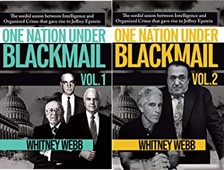
Jeffrey Epstein is dead and Ghislaine Maxwell is locked away in prison, and the thought-makers of our world seem keen to let the more explosive parts of the scandal dissipate from the public consciousness. As far as the mainstream media is concerned, Epstein and Maxwell were little more than well-connected socialites who ran a sex-trafficking ring for the rich and the powerful, and the focus has shifted instead to the criminal and civil cases seeking to achieve redress for the victims of sexual abuse.
On occasion some newspaper articles will mention the hidden cameras littered across Epstein’s properties, others the reams of CDs and hard drives found within them during the FBI raids. Altogether missing from the Netflix documentaries (Jeffrey Epstein: Filthy Rich [2020] and Ghislaine Maxwell: Filthy Rich [2022]) or the articles that spend their time narrowly focusing on the links between Epstein and Bill Gates, is the acknowledgement of the true nature of Epstein himself and the ultimate purpose of this sex-trafficking of minors — a sexual blackmail operation.
Not everyone is cowardly enough to let these controversial aspects lie untouched, as the newly released two-volume book One Nation Under Blackmail by independent reporter Whitney Webb seeks to blow wide open this media-enforced blackout. Utilizing primarily open-source information (that is, publicly accessible information such as books, newspapers articles and government reports),[2] Webb’s book delves into the life and times of Jeffrey Epstein and his deep ties to Jewish billionaires and Israeli intelligence. … continue
Blog Roll
Recent Comments


 Aletho News
- Patrik Baab: Europe’s New Iron Curtain – Freedom of Speech Dies
- Trump’s ‘Board of Peace’ exports Israeli ‘ceasefire’ diplomacy to the world
- Israeli army closes dozens of cases involving killing of Palestinians inside torture camps
- Europe creates a ‘Russian government-in-exile’, consisting of a bunch of losers
- Munich, 2007: The Day the West Was Told No
- At The Munich Security Conference, AOC Gets It Wrong On Foreign Policy
- Europe Decided to Go to War With Russia by 2030, Already Preparing – Orban
- Russia and China Are Expanding Their Cooperation to Counter US Efforts to Bully Iran and Cuba
- NATO plotting maritime blockade of Russia – Moscow
- Jeffrey Epstein’s sinister shadow over West Asia
- If Americans Knew
- Israel battles Palestinian right of return, one Palestinian at a time – Not a ceasefire Day 127
- Noor’s short life of unimaginable suffering
- Israel Destroyed Gaza’s Hospitals. Now It’s Banning Doctors Without Borders.
- Is Spite of What Zionists Say, It’s a Good Thing to Criticize Governments
- Palestinian mother, daughter recount strip searches, harsh conditions in Israeli detention
- Israel used weapons in Gaza that made thousands of Palestinians evaporate
- ADL’s Stats Twist Israel’s Critics Into Antisemites
- Why Is the World Silent When the Gaza Genocide Is Not Over?
- In Gaza: 8,000 bodies under rubble, 3,000 missing – Not a ceasefire Day 126
- AZAPAC, the new PAC opposing Israeli domination of U.S policies
- No Tricks Zone
- Unfudging The Data: Dutch Meteorological Institute Reinstates Early 20th Centruy Heat Waves It Had Erased Earlier
- German Gas Crisis…Chancellor Merz Allegedly Bans Gas Debate Ahead of Elections!
- Pollen Reconstructions Show The Last Glacial’s Warming Events Were Global, 10x Greater Than Modern
- Germany’s Natural Gas Storage Level Dwindles To Just 28%… Increasingly Critical
- New Study Rebuts The Assumption That Anthropogenic CO2 Molecules Have ‘Special’ Properties
- Climate Scientist Who Predicted End Of “Heavy Frost And Snow” Now Refuses Media Inquiries
- Polar Bear Numbers Rising And Health Improving In Areas With The Most Rapid Sea Ice Decline
- One Reason Only For Germany’s Heating Gas Crisis: Its Hardcore-Dumbass Energy Policy
- 130 Years Later: The CO2 Greenhouse Effect Is Still Only An Imaginary-World Thought Experiment
- New Study Affirms Rising CO2’s Greening Impact Across India – A Region With No Net Warming In 75 Years
 Aletho News