Venezuela: UN Should Support Sovereignty in Syria and Palestine
teleSUR | September 30, 2015
 Venezuela called on the UN to do its job, Wednesday, and be a leader in enforcing international law and the right to sovereignty.
Venezuelan Foreign Minister Delcy Rodriguez, speaking at the UN Security Council as it discussed the situation in the Middle East and northern Africa, said that it was “concerning” that after decades, the UN was still talking about Palestine, and was not standing up to the attacks on Syria.
She condemned the “illegal occupation” of Palestine and stated that, “Venezuela is a country that has historically condemned terrorism.” If there is a two-state solution between Palestine and Israel, “it should be two states that are truly equal and sovereign, not where there is terrorism and discrimination … we have to put effort into making this happen. There is a situation where the Israeli state is promoting terrorism and violating Palestinian human rights,” she said.
Talking then about Syria, where the U.S. claims to be attacking the Islamic State, and where Russia has, after talks with the Syrian government, agreed to attack the Islamic State group, Rodriguez said, “Terrorist groups aren’t born spontaneously, we want to know who finances them … This is a multilateral organization that respects international law, or are we here hypocritically, not condemning unilateral interventions (such as that by the U.S). What is the cost in Iraq, Libya, Afghanistan? What do we want today for Syria? The same?”
“Why are we here if we don’t plan to respect international law?” she said.
“In Venezuela we call for abandoning hypocrisy and for real willingness to combat terrorism, and that it not be used to support a certain leader. The UN should assume its leadership and apply international law against aggressions against people. Syria should have sovereignty” over what occurs in its territory,” she concluded.
US Presidential Hopeful Bernie Sanders Slams Chávez in Reposte to Clinton Attack
By Lucas Koerner | Venezuelanalysis | September 17, 2015
Caracas – Democratic presidential contender Bernie Sanders lashed out at the late Venezuelan president Hugo Chávez this week in response to a Clinton super PAC email linking him the late socialist leader.
“Yesterday, one of Hillary Clinton’s most prominent Super PACs attacked our campaign pretty viciously,” the independent Vermont senator told his supporters in a campaign fundraising email.
“They suggested I’d be friendly with Middle East terrorist organizations, and even tried to link me to a dead communist dictator,” the email continued, referring to Venezuela’s three time democratically-elected former president Hugo Chávez.
The statement came in response to a email circulated on Monday by the pro-Hillary Clinton super Political Action Committee (PAC) Correct the Record, comparing Sanders to the newly elected head of Britain’s Labour Party, Jeremy Corbyn.
Following Sanders’ praise for the left-leaning Labour MP upon his victory this past Saturday, the Clinton campaign took aim at the self-proclaimed democratic socialist politician, seeking to link him with Corbyn’s “most extreme comments”.
Corbyn has been branded a “national security threat” by UK Prime Minister David Cameron for his foreign policy postures, which include opposition to NATO and support for the “electoral democratic credentials” of Hugo Chávez’s Bolivarian Revolution.
Breaking with its hitherto standing policy of refraining from criticizing Sanders, the Clinton campaign sought to draw links between the two anti-party establishment progressives, pointing to the Vermont independent’s role in negotiating a 2005 deal with the Bolivarian government to bring free and discounted home heating oil to the poor in northeastern US cities.
However, Sanders’ distancing from Chávez, labeling him a “dead communist dictator” has caused disenchantment in some circles, who reject what they view as an offensive characterization of the immensely popular, democratically-elected late president, whose socialist government has won eighteen internationally recognized elections since 1998.
“Venezuela has become . . . the bad guy. We’re the villain,” Venezuela’s chargé d’affaires in Washington, Maximilien Sanchez Arvelaiz, told reporters.
In March, President Obama issued an executive order branding Venezuela a “national security threat” and imposing sanctions over unproven allegations of “human rights violations”.
Sanders, who has surpassed Hillary Clinton in the Iowa and New Hampshire polls, has up until recently avoided issuing statements on US foreign policy, preferring to focus on confronting economic inequality.
“For the left, Hugo Chavez is/was a reference,” Sanchez asserted, noting that Jeremy Corbyn recently won a landslide victory notwithstanding his public endorsement of the revolutionary Venezuelan leader and his democratic socialist project.
Meanwhile, the Sanders campaign has made fresh statements in response to the Clinton attacks, further disavowing any links with Chávez.
“To equate bringing home heating oil to low-income Vermonters with support for the Chavez government is dishonest,” Sanders spokesperson Michael Briggs told the Huffington Post.
Venezuela’s Maduro Proposes Cucuta Gasoline Deal, Expands Border Closure
By Lucas Koerner – Venezuelanalysis – September 16, 2015
Caracas – In the lead-up to talks with his Colombian counterpart, Venezuelan President Nicolas Maduro proposed a series of measures aimed at resolving the tense border conflict, including the sale of Venezuelan gasoline in the Colombian border city of Cucuta.
Tensions between the two neighbors have been on the rise since mid-August when Maduro ordered a 60-day closure of sections of the joint border in response to an alleged paramilitary attack on three Venezuelan soldiers in the frontier zone.
As Maduro prepares to sit down with Colombia’s Santos in the coming days, the socialist leader announced Friday the creation of Mission New Border of Peace, which will be charged with expanding all of Venezuela’s social missions established over the previous sixteen years to the border zone.
“This mission is aimed at bringing all of the missions, Homes of the Motherland, Barrio Adentro, Robinson, health and educational missions to teach people there to read and write, [give them their] elementary, secondary, and university education.”
The Venezuelan Head of State also announced a proposal to sell Venezuelan gasoline in the Colombian border city of Cucuta at preferential rates, favoring “cab drivers, workers, professionals, poor people.”
“We are ready to do it, President Santos, as soon as we sit down to talk, because this is how it works, proposal, counter-proposal, conversation, dialogue, and results,” he stated.
Colombian frontier cities such as Cucuta are an estimated 80% dependent on contraband Venezuelan gasoline, which is smuggled across the border at a rate of approximately 100,000 liters daily.
New Border Closures
President Maduro’s initiatives were followed on Tuesday with the announcement of new border closures in ten municipalities along the Colombian border, including seven in the northwestern state of Zulia and three in southwestern Apure state.
These border municipalities, comprising Jesus Enrique Lossada, Rosario de Perija, Machique de Perija, Cañada de Urdaneta, Jesus Maria Semprun, Paez, Catatumbo, Colon, Romulo Gallegos and Pedro Camejo, will be the first to see the roll-out of Mission New Border of Peace, aimed at creating social and economic alternatives to paramilitarism and contraband.
Cross-border smuggling has played a key role in what the President Maduro has termed an economic war against Venezuela, with an estimated 35% of subsidized food items making their way to Colombia.
US, Colombia: Conspiracy against Venezuela
Nil NIKANDROV – Strategic Culture Foundation – 14.09.2015
“Airtec Inc. has been awarded a contract for intelligence, surveillance, and reconnaissance (ISR) services in support of the U.S. Southern Command. The deal is expected to be completed in September 2018. The contractor will provide ISR services utilizing a Bombardier DHC-8/200.
According to José Vicente Rangel, a Venezuelan journalist, the aircraft will be equipped with cutting-edge equipment to effectively survey the border areas of Venezuela.”
The US special services have applied a lot of effort to incite tensions in the “conflict zone” on the border between the two states. There are forces in the ranks of Colombian political and military leadership that are ready to help Washington in its subversive operations against the “main regional adversary”. Colombian President Juan Manuel Santos, a henchman of tycoons’ families, has said many a time that he supports further progress in the “special relationship” with Washington, including military ties. Santos believes that the deployment of seven US military facilities on Colombian soil is a step on the way of engaging Colombian military in NATO activities. Bogota is an integral part of the US plan to restore its dominant position in the region.
Colombia is used to undermine the process of Latin American and Caribbean integration. Nicolas Maduro, the President of Venezuela, displays great tolerance against the backdrop of hostile actions undertaken by Colombia. American supervisors apply no special effort to conceal their involvement. The intention is evident – the opposition is trying to prove tha Maduro’s government is unable to get the national economy back on track and fill Venezuelan stores to meet the legitimate demands of consumers for essentials. Internal sabotage is assisted by the activities of smugglers operating in Colombian territory.
Joint efforts are required to fight smuggling but Colombian border guards do nothing to interrupt the criminal activities often headed by former paramilitares (paramilitaries), the militants of AUC (the United Self-Defense Forces of Colombia). According to Venezuelan counterintelligence, their leaders collaborate with Colombian power structures.

AUC fighters have recently staged a provocation near the border area. They laid an ambush for a Venezuelan patrol in pursuit of smugglers. Shots were fired and three servicemen were seriously wounded. President Maduro immediately introduced the state of emergency in one of the areas near the Colombian border (the state of Táchira) and sealed the border for an uncertain period of time. Police and military reinforcements were sent out to find the attackers. Venezuela launched operations to pinpoint the paramilitares strongpoints – the bunkers serving as prisons for kidnapped people and stashes of smuggled goods. Thirty five militants have been arrested so far. The interrogations provided information on the scale of crimes perpetrated by paramilitares in Venezuela, including even existence of secret burial places. Maduro said the findings about the activities of criminals and armed formations reveal the horrible truth and he, as president, has an obligation to do away with this evil in Venezuela.
His tough stand is justified. The economic war against Venezuela has come to the point when essentials, foodstuffs, hygiene stuffs and medicals evaporate from the stores located in the vicinity of border areas. Everything is taken out of the country – clothes, shoes, car parts, tires and oil production equipment. Filling stations run out of fuel. Gasoline prices are extremely low in Venezuela. It takes only 2 USD to fill a tank. That’s why great quantities of Venezuelan fuel are transported to Colombia along the whole length of the countries’ border. According to official data, the small town of San Cristobal, Táchira’s capital, “has consumed” more gas than Caracas. It has gone far enough. The situation has reached the point when gas smuggling brings more profit to Colombian paramilitares than drug trafficking!

Smuggling thrives because there is a great difference in the prices of consumer goods (Venezuela allocates subsidies to bring the prices down). The rate of bolivar, the Venezuela’s currency, is used for large-scale scams. The Colombian city of Cúcuta has become the center of financial and economic subversive activities. It boasts around three thousand currency exchange shops. The general strategy is to devalue the bolivar. It results in impoverishment of people and increasing discontent in Venezuela.
Cúcuta has always played an important part in conspirators’ plans. The US Defense Intelligence Agency and the Central Intelligence agencies are active there. This is the place where radical cells of Venezuelan opposition get instructions. The leaders of three groups formed especially for anti-Venezuelan activities – El Centro de Pensamiento Primero Colombia» (the Center of Thought Foundation – Colombia First), FTI Consulting (Forensic Technologies International) and La Fundación Internacionalismo Democrático (the Democratic Internationalism Foundation) – hold their meetings there. The anti-Venezuelan conspiracy is led by former Colombian President Alvaro Uribe, who was recruited by the Central Intelligence Agency in mid-80s. The Agency used damaging information. He was number 82 on the list of drug dealers prepared by the US Drug Enforcement Administration. During all eight years of his tenure President Uribe was involved in subversive activities against Hugo Chavez trying to isolate the “Bolivarian regime” in the Western Hemisphere. With good reason the Venezuelan intelligence agencies consider him to be the key figure in the US-led plot to overthrow the “Maduro regime”.
The Sanchez government of Colombia enjoys the support of Western media, especially by the New York Times and the Washington Post. Their editorials say essentially the same thing. They spread the idea that the “border problem” with Colombia has been “invented by Maduro” and this entire hullabaloo is raised with the purpose to ratchet up the Venezuelan President’s support before the parliamentary election. Not a word is said about five and half million Colombians residing in Venezuela, part of them as refugees who fled the civil war, the activities of paramiltares, drug traffickers and smugglers operating on Colombian soil. Venezuela’s Ministry of Foreign Affairs has hit the nail right on the head when it disclosed the purpose of these publications. According to the Ministry, it’s all part of another plot staged by US media against Venezuela and its Bolivarian revolution.
Roy Chaderton, the Venezuelan Ambassador to the Organization of American States, said such Columbian media outlets as El Tiempo, RCN and Caracol radio stations and TV channels, as well as CNN Spanish language broadcasts, incite hatred towards Venezuela and its people. According to him, this hatred campaign could lead to a war. This scenario was avoided because Venezuelan leaders adopted quite different behavior patterns giving “positive signs” to Colombia. The Ambassador called on all the diplomats accredited with the Organization of American States not to trust Colombian media outlets waging a war of the fourth generation.
The US State Department made a statement regarding the closure of the border. It emphasized the humanitarian aspect of the problem and recommended to normalize the situation with the help of regional organizations. It said US diplomats were ready to contribute toward launching a dialogue. But there are different types of diplomats. For instance, according to Contrainjerencia, a respectable website, Kevin M. Whitaker, the US Ambassador to Colombia, served as the head of CIA station in Venezuela in 2006. It’s hard to believe that Whitaker and the like will really do anything positive. They have a quite different missions to carry out.
Venezuelan Film in Indigenous Warao Language an Oscar Hopeful

Gone With the River, or Dauna: Lo que lleva el río in Spanish, directed by Venezuelan-based Cuban filmmaker Mario Crespo. | Photo: Twitter | @anagaly20
teleSUR | September 11, 2015
A Venezuelan movie spoken almost entirely in the Indigenous Warao language was selected last week to represent the country in the 2016 Oscars for Best Foreign Language Film.
The 10 members of the National Association of Cinematographic Authors unanimously chose the film on the Indigenous Warao tribe for “the universality of the theme, its cinematographic values, the poetic presence of nature, and the profound glance into the Warao culture,” El Universal reported.
Gone With the River, or Dauna: Lo que lleva el río in Spanish, directed by Venezuelan-based Cuban filmmaker Mario Crespo has already been selected earlier this year by the Berlin Film Festival for its “NATIVe” program, especially dedicated to films on Indigenous people.
The film tells the story of Dauna, a member of the Warao tribe who is forced to confront cultural norms and traditions after deciding to move away from her people located in the Orinoco delta to pursue academic interests.
“The story serves as a vehicle to speak to the audience about the need to understand multiculturalism, and understand that women, whether she is indigenous or wherever she is, have as much right as men to grow and excel,” the director said.
The film was shot at the Orinoco delta where the Warao people have historically been located and is spoken almost entirely in the Warao language.
Warao is spoken by about 28,000 people primarily in northern Venezuela, Guyana and Suriname.
RELATED:
Key Venezuelan Indigenous Leader’s Killer Sentenced to 30 Years

Indigenous leader Sabino Romero of the Yukpa was murdered in 2013
teleSUR – August 15 2015
One of the accused murderers of the prominent Venezuelan indigenous leader Sabino Romero was sentenced to 30 years in prison for homicide on Friday in a landmark move to prosecute the killer of an indigenous person for the first time.
Angel Romero Bracho, known as “El Manguera,” was given the maximum sentence for his role in Sabino’s murder, according to a statement from the attorney General’s office. Another five suspects had already been sentenced to seven years in prison for their involvement in the crime.
Sabino, a leader of the Yukpa indigenous group in western Venezuela and famed national symbol of indigenous resistance, was killed in March 2013 after a heated land conflict between indigenous groups with legal title to the land and large ranchers who wanted to stake their claim to the farmland.
Although the trial in the case of Sabino’s death was lengthy, justice has finally been served in a historic ruling to punish the murderer of an indigenous leader. Violence against indigenous people has long been treated with impunity in Venezuela and elsewhere in Latin America. While the national government has taken many steps to support indigenous rights, ranchers are usually able to bribe judicial officials. In the trial of Romero Bracho, the public prosector received death threats.
Family members and supporters hope that the conviction against Romero Bracho will pave the way to further investigations to punish the other masterminds behind the murder.
“Sabino Romero has denouced threats and violence in the Sierra de Perija of the latifundistas against the Yukpa people.”
Sabino was the target of an assassination plot in the western Venezuelan state of Zulia for his role in the indigenous struggle against large ranchers who sought to monopolize landholdings, even though indigenous campesinos held legal title to the land under an agrarian reform law implemented by former President Hugo Chavez in 2001.
Sabino’s wife and fellow movement activist Lucia Martinez was also injured in the attack.
Sabino was a well-known and important leader among the Yukpa people, but also stood as a national icon of the broader indigenous movement and struggle for indigenous rights.
Venezuela Rejects Kerry’s Latest Intervention in Its Affairs

Venezuela’s foreign minister, Delcy Rodriguez, insists that U.S.-Venezuela relations must be based on mutual respect.
teleSUR | August 2015
Responding to U.S. Secretary of State John Kerry’s latest comments on Venezuela, foreign minister Delcy Rodriguez called on him to stop interfering in Venezuela’s internal affairs, which she described as violating international law.
Rodriguez was specifically referring to Kerry’s recent comments on a major news channel, where he said that international observers should be involved in Venezuela’s upcoming National Assembly elections and that all “political prisoners” in Venezuela should be freed, so that there would be no “negative impact” on U.S.-Venezuela relations.
In response to Kerry, Rodriguez said that Venezuela is a free and independent country and added, “the times in which the U.S. dictated norms to Venezuela are over, thanks to the anti-imperialist actions of the Venezuelan people.”
Instead, relations between Venezuela and the U.S. should be based on mutual respect and international norms, the foreign minister said.
Kerry’s claims about political prisoners refers to politicians arrested not for their political views but their orchestration of a wave of violence that led to the deaths of 43 Venezuelans in 2014.
Venezuela and the U.S. currently have not had ambassadors in each other’s countries since 2010, when Venezuela refused to admit the newly appointed U.S. ambassador because of negative comments he made about Venezuela’s military during his Senate confirmation hearing.
The U.S. subsequently expelled Venezuela’s ambassador, Bernardo Alvarez.
Ever since there have been negotiations on and off between the two countries about the exchange of ambassadors.
The most recent effort was torpedoed by President Obama’s issuing of an executive order that declared Venezuela an “extraordinary and unusual threat” to U.S. national security and imposed sanctions on several Venezuelan government officials.
Since then, new negotiations have taken place on the initiative of President Maduro, according to State Department advisor Thomas Shannon.
Lessons from Libya’s Destruction
Tortilla Con Sal | July 9, 2015
Later this month the outcome is expected of the completely unjust and incompetent show trials held in Libya over the last year or so of around 200 former officials of the Libyan Jamahiriya. If that outcome is reported at all in North American and European media, its real meaning will be completely hidden in self-serving apologetics for NATO’s destruction of Libya in 2011.
The same psy-warfare framework that justified NATO’s campaign of terrorist aggression will falsely present the show trials’ outcome as rough justice dealt out to individuals who deserve no better.
That outcome should put on high alert anyone defending the countries of the Bolivarian Alliance of the Americas against very similar psychological warfare and terrorist subversion supported by NATO governments of the US and its allies. Not for nothing did Hugo Chávez and Daniel Ortega speak out in defense of Muammar al Gaddhafi and Libya against NATO’s terrorist war. They had already learned long ago the very same lessons to have emerged more recently from the utterly depressing human, moral and political catastrophe of Libya’s destruction.
In 2013, a study by a distinguished Harvard University academic acknowledged that the failure in Libya of the US government’s ostensible avowed policy in Libya and in North and West Africa was based on serial falsehoods. That fact-based, acerbic policy criticism from a source generally supportive of US government foreign policy should give much pause for thought. Along with support for Libya from outstanding revolutionary leaders like Ortega, Chavez and Nelson Mandela it amounts to a categorical indictment of received Western opinion about Libya which, across virtually the entire Western political spectrum, sided either openly or indirectly with NATO’s 2011 war.
No one genuinely concerned to defend progress towards an equitable, peaceful multi-polar world based on mutual respect between sovereign, autonomous nations and peoples should underestimate or forget the horror of what NATO did to Libya. Tens of thousands were killed and wounded in attacks by the bombers and helicopters of many NATO countries. Millions were displaced or forced into exile. Cities like Sirte and Bani Walid were devastated. Schools, universities, hospitals, factories producing food products and other essential civilian infrastructure were targeted and severely damaged or destroyed.
The destruction of Libya marked the categorical abandonment of whatever vestigial moral authority may still have remained to the European Union and its member governments.
It demonstrated in the most humiliating way the impotence and irrelevance of the African Union.
It put hard questions about the anti-imperialism of the Iranian and Syrian governments as well as highlighting the race supremacism of the governments of the Arab League and the already damaged integrity of the Palestinian authorities.
Almost all of them quickly recognized the overtly racist renegade Libyan CNT junta. For their part, the then governments of Russia and China weakly accepted NATO country assurances about the defensive nature of the air exclusion zone.
The only governments to emerge with any real credit from the destruction of Libya were the governments of the ALBA countries and a few African governments like Zimbabwe.
Countries like Cuba, Venezuela, Argentina, Nicaragua, Bolivia and Ecuador have all been victims of comprehensive disinformation campaigns of demonization and caricature, although perhaps not so extreme as the final campaign against Libya’s Jamahiriya and Muammar al Gaddhafi.
It is worth considering the basic component of that disinformation war against Libya. What is sometimes called 4th generation warfare is as old as warfare itself. Like Athens versus Sparta, or Rome versus Carthage the fundamental objective of NATO governments and their allies is to make their chosen target seem Other, creating a despised, outcast doppelganger anti-image of the West’s own phony self-image.
So Libya’s Jamahiriya was tagged as undemocratic by hypocritical Western governments, most of whom came to power with around just 20% to 25% of the vote of their electorates, thanks overwhelmingly to elite corporate funding. Libya’s democratic process was one that recognized its society’s contradictions and attempted continual self-renewal.
By contrast, the Western corporate oligarchies offer virtually meaningless periodic elections obfuscated by public relations and organized on a yes-or-yes basis to favor politicians groomed and bankrolled by their countries’ anti-democratic elites. Muammar al Ghaddafi was labeled a dictator even though his policy initiatives were not infrequently rejected within Libya’s system of popular congresses.
In 2009, during a policy conflict between Muammar al Gaddhafi and pro-Western so-called reformers, these could not get their way in Libya’s popular assemblies so they chose staging a violent putsch to achieve the regime change their Western government backers wanted. Venezuela’s experience has been almost identical, although, to date, the country has avoided the kind of coup d’état and subsequent NATO driven war that destroyed Libya Libya was portrayed as a systematic human rights violator.
But Libya’s response to the constant terrorist attacks and subversion it suffered from the very start of its Revolution in 1969 was no different to that of any Western government faced with a similar threat. The British government tortured and murdered alleged subversives all through the Irish war, colluding with sectarian paramilitary death squads. The same pattern of torture and extrajudicial murder also consistently marked the Spanish authorities’ campaign against Basque separatists. Guantanamo’s torture camp symbolizes the brutality and illegality of the US government’s response to terrorist threats.
Libya’s Jamahiriya probably conformed as closely to international human rights norms in relation to fighting terrorism as the three Western governments that led NATO’s war of destruction. Human rights protection in Libya was certainly superior to Western allies like Turkey, Egypt, Israel, Saudi Arabia, Qatar or the other quasi-feudal Gulf State tyrannies.
All the pretexts for the Western assault on Libya’s legitimate government were completely bogus. In any case, as Gerald Perreira points out, the fundamental objective achieved by the destruction of Libya was to shut down the decisive impetus towards African integration led by Muammar al Gaddhafi.
CNT leaders like Mustafa Abdul Jalil were Arab supremacists who fiercely resisted the Pan-African policies advocated by Muammar al Gaddhafi. Arab supremacism, phony neoliberal reformism and the treachery of repressive human rights abusers like Mahmoud Jibril made a lethal reactionary cocktail perfectly suited to ruthless NATO government manipulation. On cue, Western corporate and alternative media presented the corrupt political project of these viciously reactionary elements as a “revolution”, part of the absurdly hyped “Arab Spring”. As if NATO country governments, dedicated to the service of their countries’ corporate elites, have ever promoted genuine democracy or comprehensive human rights around the world.
From Ukraine and Greece, to Yemen and Syria, to Haiti and Honduras, what the Western powers and their allies want is access to natural resources, control of strategically important territories and decisive advantages for their trade and finance. Destroying Libya effectively removed a real threat to Western control and domination in Africa.
Currently, the NATO country elites’ political sales staff, for the moment President Obama, Prime Minister Cameron, President Hollande and Chancellor Merkel, are battering Greece into submission. But those leaders and their allies are using economic and psychological warfare to attack many other targets, not just Greece. They do so against Venezuela and other stubbornly independent countries around the world.
That is why the leaders of Argentina, Cuba, Ecuador, Nicaragua and Venezuela very publicly welcomed the No vote in the Greek referendum. Unlike Libya, in their different regions Syria and Venezuela are part of regional alliances backed at long last by firm leaders in Russia and China, strong enough to face down any likely economic or military threat from the United States and its allies.
But it would be a mistake to forget Libya. Defending the people of Libya represents an important self-defense measure against Western predators in their global psychological warfare assault on the free, anti-imperialist world.
As a leading force in that free world, ALBA country governments should urgently consider challenging the governments of North America and Europe to protect the thousands of political prisoners in Libya who have been tortured and denied due process.
The ALBA country governments and their allies have infinitely more moral and political authority than Western leaders to speak out in defense of fundamental human rights. They should make outspoken use of that authority now to expose the sadism and hypocrisy of Western governments in Libya, Syria, Yemen and elsewhere.
In Libya, they may perhaps yet help to save the lives of as many as 200 former officials of the Libyan Jamahiriya at risk from quasi-judicial murder by the West’s corrupt terrorist proxies in a country they have devastated with merciless cynicism.
Iran gives Venezuela $500 million credit line
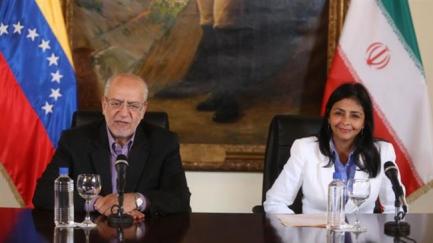
Iran’s Minister of Industry Mohammad Reza Nematzadeh and Minister for Foreign Affairs of Venezuela Delcy Rodriguez talk to reporters in Caracas
Press TV – June 27, 2015
Iran has agreed to a $500 million credit line for Venezuela to finance joint investments there, President Nicolas Maduro has announced.
He made the announcement after meeting Iranian Minister of Industry, Mine and Trade Mohammad Reza Nematzadeh in Caracas where the two sides signed six agreements to expand financial, economic, industrial and technological cooperation.
Among the agreements, there are plans for joint production of commodity goods, including detergents and other hygiene materials in Venezuela and Iran’s sales of medical drugs and surgical equipment to the country.
Maduro said the two countries had also agreed to a “comprehensive plan” to develop a joint program in nanotechnology in which Iran is among the top seven countries.
He said the deals would ensure a higher level of cooperation and deepen the bonds between the two nations.
Moreover, Iran agreed to transfer its expertise to Venezuela in combating an “economic war” on the Latin American country, Maduro said, apparently referring to Iran’s experience in facing years of US-led sanctions.
“We are facing an economic war of monumental proportions; a brutal war (but) we are here attending to our people,” Maduro said as he invoked the vision of the late President Hugo Chavez for “the government’s union with the people and struggle against imperialism”.
The Venezuelan head of state also hailed relations with Iran as “an example of alliance between two brother nations”.
“Today we have mutual trust in our relations and we work together with results. Working with Iran has gone well and our cooperation has been a great success since Hugo Chavez began a strategic alliance and brotherhood with Iran,” Maduro said.
Relations between Iran and Venezuela — both critics of US policies — have expanded in recent years. Iran is involved in a series of joint ventures worth several billion dollars in energy, agriculture, housing, and infrastructure sectors in Venezuela.
Iran’s main industrial projects in Venezuela include a car assembly plant, a tractor manufacturing complex and a cement factory.
The Islamic Republic has also built more than 3,000 residential housing units for less privileged citizens in Venezuela, with 7,000 more to be completed.
Both countries are hugely rich in resources. Venezuela possesses the world’s biggest oil deposit while Iran owns the fourth largest oil and first largest gas reserves of the world.
Maduro has announced his intention to visit Tehran to attend a summit of Gas Exporting Countries Forum planned for Nov. 23.
Venezuela Rejects “Media Manipulation” of Brazilian Senator Visit
Ministry of Popular Power for Foreign Relations, Bolivarian Republic of Venezuela | June 19, 2015
Communique
Caracas – The government of the Bolivarian Republic of Venezuela publicly rejects the attempts made by the national and international rightwing to pull a political media manoeuvre based on lies propagated about the visit of a group of Brazilian senators who arrived in the country with the singular aim of destabilising Venezuelan democracy and of generating confusion and conflict between brother countries.
The first substantial lie reported in the media was to falsely claim that the Venezuelan government had denied airplane landing permission to this committee, when it had not, in fact, received any such request.
The second substantial lie was to blame the national government for blocking the main road which connects the (national) airport to the country’s capital city. In reality, a truck containing flammable material had overturned which prevented free transit on this freeway. This even delayed the transfer of an high security prisoner extradited by the Colombian government for his responsibility in the murder of a journalist during the terrorist acts which took place in the barricades last year.
The third substantial lie was to state that the security and physical wellbeing of these rightwing Brazilian senators was compromised. There is audiovisual and photographic material which shows the senators interacting with political activists in relation to the upcoming elections that will take place this year in Venezuela. In the same way, the national government assigned a special security dispatch made up of more than 30 officials on motorbikes, patrols and security bodies who accompanied this group the whole time. Likewise, it also coordinated with the embassy of the Federal Republic of Brazil.
It is notable that figures of the extreme rightwing, who took part in state coups in Venezuela, participated in the entire agenda of these representatives of the international opposition, who are the authors and promoters of these fairytales in the media and which attempt to bring the Bolivarian Republic of Venezuela’s long recognised democratic tradition into disrepute.
The Venezuelan Bolivarian Republic of Venezuela reiterates its friendly and co-operative ties based on mutual respect, non-interference in internal State matters and the self-determination of the people with its sister federal Republic of Brazil. As well as its unshakable commitment to maintaining these ties in spite of any divisive scheme against our countries.
Translated by Venezuelanalysis
Featured Video
Macgregor: We Haven’t Seen the Worst of the Iran War Yet
or go to
Aletho News Archives – Video-Images
From the Archives
15 Saudi ‘hijackers’ were CIA agents working for US: Scholar
Press TV – April 13, 2016
Fifteen of the 9/11 “hijackers” from Saudi Arabia were CIA agents working for the United States government, which was seeking to destroy the Middle East for Israel and to double the American military budget, says Dr. Kevin Barrett, an American academic who has been studying the events of 9/11 since late 2003…. continue
Blog Roll
 Aletho News
- Iran’s Plan to Shut Down AI in the Persian Gulf
- Israel seeks ‘compensation’ from Washington over Saudi F-35 sale
- Saudi crown prince seeks dialogue with Ansarullah after Yemeni blows: Report
- Damascus rejects Saudi request for Syrian fighters to counter Yemen: Report
- South Korea says will not send troops to join terrorist US war on Iran
- Russia Just Struck the Eyes of NATO’s War Machine in Ukraine
- Russia summons UK charge d’affaires over Kiev drone support
- NATO member warns bloc seeking pretext for war with Russia
- Macgregor: We Haven’t Seen the Worst of the Iran War Yet
- ‘We are not like everyone else’ laws that bind other nations do not apply to Israel, says Likud lawmaker
- If Americans Knew
- Debunking The Claim That Macklemore Has A “History Of Antisemitism”
- CPJ demands release of arrested Palestinian-US journalist near Bethlehem
- Robert Kraft: The Billionaire Friend of Netanyahu Pulling The Strings Behind the Macklemore/Ed Sheeran Blow Up
- Columbia Administered Fund Gives Big Money to Pro-Israel Groups
- Deportation Case of Palestinian Activist Salah Sarsour Tests First Amendment
- ‘We Will Not Forget’: Palestinians Mark 44 Years since Sabra and Shatila
- Why do we let Zionists decide what we can and can’t say?
- US welcomes Israeli, Iranian delegations to UN, but not Palestinians – Daily Update
- Biden’s Genocide Accomplices Targeted by New Accountability Campaign
- AIPAC’s Network Has Already Spent $67.2 Million to Shape the Midterm Elections
- No Tricks Zone
- New Study: ‘Global Drought Shows No Detectable Recent Acceleration Under Climate Warming’
- Economic Masterminds: German Socialists Suggest Taxing Productivity Gains Stemming From Using AI
- The South China Sea Has Not Been Cooperating With The Climate Change Narrative
- Energy Crisis: Germany Enters Heating Season With Historically Low Gas Reserve Fill Levels
- New Study: The Antarctic Ice Sheet Gained Mass From 2020-2024 Due To Staggering Snow And Ice Accumulation
- Study: Ocean Heating Rates From Thousands Of Years Ago ‘Dwarf’ Modern Ocean Heating Rates
- Climate Extremists Target, Attack Large-Scale Power Grid Infrastructure In Germany!
- New Study: Antarctic Ice Melt Has Contributed Less Than 1 Centimeter To Sea Level Rise In The Last 30 Years
- Fear Of Debate: Alarmist German Climate Scientist Calls On Mainstream Media To Discredit Skeptic Voices
- End-Of-August Arctic Sea Ice Extent Hasn’t Fallen In 20 Years, Official Data Show!
 Aletho News