Venezuela: Right-Wing Politicians Accept Supreme Court Ruling
teleSUR | January 13, 2016
The Venezuelan Supreme Court had declared the leadership of the right-wing dominated National Assembly in contempt over their defiance.
Three right-wing Venezuelan politicians have finally decided to follow the rule of law and accept the Supreme Court ruling that suspended their election victories until an investigation into allegations of vote buying is concluded.
During National Assembly’s session Wednesday, the Supreme Court ruling was read aloud inside the chamber.
National Assembly President Henry Ramos Allup then affirmed that the leadership of the assembly would “abide by the ruling of the Supreme Court.”
Socialist lawmakers, who had been demanding the Supreme Court’s ruling be respected, responded with vehement applause.
The three suspended lawmakers wrote to the leadership of the National Assembly Tuesday seeking that their swearing-in be reversed. The majority MUD coalition swore in the lawmakers despite the court order in a defiant provocation last week.
Ramos Allup told CNN that he had received a letter from the three suspended politicians Tuesday evening.
Julio Ygarza, Nirma Guarulla and Romel Guzamana, representing the right-wing MUD coalition, were elected in the state of Amazonas during parliamentary elections held last month. But the electoral chamber of the Supreme Court accepted a challenge to the results over allegations of vote-buying and electoral irregularities.
The court ordered that all candidates elected in the state of Amazonas be temporarily suspended while an investigation is conducted.
However, the MUD coalition defied the Supreme Court and had the three suspended candidates sworn in. In response, socialist PSUV lawmakers went before the Supreme Court to protest the MUD’s violation of the constitution.
The Supreme Court agreed and ruled Monday that the leadership of the National Assembly were in contempt and any decisions made by the National Assembly would be void after the right-wing MUD alliance swore in the three legislators.
A fourth candidate from the state of Amazonas, a socialist from the PSUV, was also suspended, but he did not attempt to take his seat in the assembly.
The MUD won a two-thirds supermajority in the Dec. 6 elections, granting it powers to make sweeping changes, including overhauling the constitution and calling a recall referendum on the presidency of President Nicolas Maduro.
Venezuelan Opposition Swears in Suspended Deputies to Parliament
teleSUR | January 7, 2015
All 112 members of the Venezuelan right-wing coalition MUD elected to the National Assembly were sworn in as legislators Wednesday, despite three being suspended pending an inquiry into electoral fraud.
Three members of MUD and one of the socialist alliance PSUV from the state of Amazonas were suspended after a decision by the Supreme Court of Justice to investigate allegations of vote-buying.
But on the second day of the new parliament the MUD ignored the ruling and swore the three deputies in regardless.
According to PSUV lawmakers, this represents a violation of the constitution, and that decisions made by the National Assembly while the suspended deputies are seated will be void.
PSUV deputy Tania Diaz said, “At this moment, the new leadership of the National Assembly violates the constitution and ignores the powers. Forever coup-mongers.”
“On swearing in three deputies whose declaration was suspended by a decision by the Supreme Court of Justice, all the decisions that the National Assembly takes are nullified,” she added.
Former National Assembly president, Diosdado Cabello, said that what the opposition had done was “extremely serious.”
“The act today is very serious, extremely serious. It violated the national constitution. The act violated correspondence between the powers, and the respect between the powers, for the Supreme Court,” he said.
“This assembly now has no legitimacy, it cannot decide anything,” he told reporters.
Why Did the Venezuelan Supreme Court Accept a Challenge to Election Results?
teleSUR – January 4, 2016
On Dec. 30, 2015, the electoral chamber of the Venezuelan Supreme Court accepted a request to challenge the results of the Dec. 6 parliamentary elections in the states of Amazonas, Yaracuy, and Aragua, as well as one of the seats reserved for Indigenous peoples.
The Supreme Court also accepted a request for an emergency precautionary measure in the state of Amazonas, which temporarily suspended the swearing in of four candidates, three from the opposition and one from the ruling socialist party.
In the decisions posted online, the court did not specify the reasons for upholding the challenge, however the candidates who submitted the challenge cite a number of electoral irregularities, including possible fraud, a high number of blank votes, and, most importantly, vote buying.
The allegation that candidates and politicians were engaged in vote buying in the state of Amazonas emerged shortly after the elections and well before the court ruled to suspend the four candidates.
On Dec. 16, Jorge Rodriguez, a leading figure inside Venezuela’s socialist party and the head of that party’s campaign, released a recording that allegedly provides evidence of vote buying and implicates Victoria Franchi, an associate of the opposition governor of Amazonas.
In the recording Franchi can be heard speaking to an unidentified person, described as an undercover agent, concerning a plot to pay people to accompany seniors and people with low literacy on voting day in order to ensure that these people vote for candidates from the opposition coalition.
Franchi is also heard offering to pay for people to pose and vote on behalf of the deceased.
“We want to win by any means necessary,” says Franchi toward the end of the recording.
Should the allegations of vote buying be proven to be true, it would constitute a crime under Venezuela’s electoral law. Authorities would then need to determine if the crime was severe or significant enough to warrant new elections in the affected state.
Rodriguez called on authorities to investigate the allegations.
“We insist that results should be recognized, but attacks against the constitution … attacks against electoral laws, attacks against the electoral system, and finally attacks against a voter’s intention, should be investigated,” said Rodriguez.
Venezuela’s intelligence service, known as Sebin, subsequently detained Franchi, who was later released.
Past Incidents of Fraud in Amazonas State
The governor of Amazonas, Liborio Guarulla, denies Franchi is a person of significance inside his government, but nonetheless came to her defense, first by posting a message of support on his Twitter account and then offering to have her legal expenses covered by his government.
“This is how the national government acts: Sebin detains Victoria Franchi and they are torturing her with the aim of finding justification for their defeat in Amazonas.”
The involvement of Governor Guarulla brings up an intriguing and relevant piece of history.
He sits as governor of Amazonas thanks to the intervention of the Supreme Court and electoral authorities after regional elections were held in 2000.
In the 2000 election, Bernabe Gutierrez, of the opposition Democratic Action party, had initially been declared the winner, besting Guarulla by only 221 votes. Guarulla challenged the results, as he was entitled to do under electoral law.
The Supreme Court ultimately agreed there was basis to believe fraud had occurred and annulled the results from seven voting stations. The National Electoral Council held a re-vote in the affected voting areas.
Guarulla subsequently won the election and was sworn in as governor Feb. 13, 2001, due in thanks to the intervention of the Supreme Court and electoral authorities.
The MUD coalition, which Guarulla supports, says it will not recognize the court’s ruling and will attempt to have their suspended candidates forcibly take office.
Such has been the pattern of the Venezuelan opposition, only respecting electoral authorities when it suits them.
Ahead of the Dec. 6 election the opposition had refused to commit to recognizing the result, they warned that should they fail to win they would cry fraud. It was only when results emerged indicating their victory that they recognized the results.
In other electoral contests where the opposition has lost, they have leveled unsubstantiated claims of fraud.
That they now refuse to recognize the perfectly legal decision by the Supreme Court should surprise no one.
U.S. Senator Menendez Claims Venezuelan ‘Regime’ Obstructing Democracy
teleSUR – January 5, 2016
A key U.S. lawmaker accused the Venezuelan government on Monday of interfering in the National Assembly, which will convene for the first time on Tuesday.
“I write to urge you and your administration to take immediate steps to ensure that Mr. Maduro’s regime is denied the space to obstruct Venezuela’s path to democratic order,” U.S. Senator Robert Menendez wrote in a letter to President Barack Obama. “I believe you can accomplish this with a combination of close monitoring of key international organizations and meaningful, internationally imposed penalties.”
Mendendez suggests petitioning the Organization of American States to invoke the Inter-American Democratic Charter, which would apply pressure on member states accused of anti-democratic activity.
Menendez was indicted on federal corruption charges last year, accused of trading political favors for money and gifts.
Since the December 6 elections that saw Venezuela’s opposition win a majority in the National Assembly, Venezuelan President Nicolas Maduro and his PSUV party have organized numerous meetings to defend the Bolivarian Revolution. On Monday, Maduro announced the creation of a new block of PSUV deputies tasked with revealing what he claims is the opposition’s true agenda of rolling back gains for the poor and working class.
Maduro’s most controversial move since the election has been his announcement of an Emergency Economic Plan that grants more autonomy to the central bank, insulating it from opposition pressure. That plan drew fire for bypassing the now opposition-dominated National Assembly, which would like to overhaul the body.
U.S. Department of State spokesman John Kirby also expressed concern Monday that the Venezuelan Supreme Court could prevent 13 legislators from taking office due to election irregularities.
President Maduro has defended the court’s investigation, accusing the opposition of cheating to win. “(The right) had electoral success because they deepened their line of action outside the rules of the game: the economic, criminal and electrical warfare, among others, and then they hid behind a buddy,” said Maduro. He also reproached the United States for interfering in Venezuelan politics, saying the country would “not accept imperialism.”
Venezuelan Supreme Court OKs Challenge to Electoral Results in 3 States
teleSUR | December 30, 2015
The electoral chamber of the Venezuelan Supreme Court accepted Wednesday a request to challenge and analyze the results of the Dec. 6 parliamentary elections in the states of Amazonas, Yaracuy, and Aragua, as well as one of the seats reserved for indigenous peoples.
The decision by electoral chamber, which was published on the website of the Supreme Court, also accepted a request for an emergency precautionary measure in one state. In six of the seven challenges brought forward, the court rejected the request for a precautionary measure, effectively an injunction.
However in the case of the election results for the state of Amazonas, the court ordered the “temporary and immediate suspension” of proclamations by the National Electoral Council, Venezuela’s electoral body.
The precautionary measure affects all results in the state of Amazonas, including those elected by party list and by electoral district, as well as the seat reserved for indigenous peoples for the “southern region” of the country, for a total of four seats.
The challenge in the state of Amazonas was brought forward by Nicia Marina Maldonado, a candidate in the state for the United Socialist Party of Venezuela. The case will be followed up by Justice Indira Maira Alfonzo Izaguirre.
The results in the state of Amazonas saw two members of the opposition Democratic Unity Roundtable and one member of the socialist party elected to the National Assembly. The candidate for indigenous peoples in the “southern region” is also affiliated with the opposition.
In all seven challenges, a justice will review the voting process and the tabulation of votes to determine if the result was legitimate. The electoral chamber of the Supreme Court has called on the National Electoral Council to provide the necessary documentation.
Though the court decision did not specify the reasons for upholding the challenge, some Venezuelan leaders have made allegations about vote buying in certain districts.
Wednesday’s decision does not immediately annul the results in the aforementioned states, however the court could ultimately annul the results of it deems the process illegitimate and could call for fresh elections in those states.
In the case of the results for the state of Amazonas, the precautionary measure will temporarily prevent the four candidates from being sworn in on January 5, 2016 when the new National Assembly takes office.
Hillary Clinton and a Venezuelan Murder Mystery: Who Killed Luis Manuel Díaz?
By Mark Weisbrot | The Huffington Post | December 4, 2015
On November 30, Hillary Clinton stated that she was “outraged at the cold blooded assassination of Luis Manuel Díaz on stage at a rally last week.” She was referring to the killing of a local opposition leader in Venezuela on November 25. It was clear from her remarks that she was blaming the government for the murder. Her statement appeared to be part of an international campaign to delegitimize Sunday’s congressional elections in Venezuela, and it spread quickly throughout the global media.
Clinton is familiar with these types of international campaigns for regime change. In her recent book, “Hard Choices” she acknowledges her role in helping prevent the democratically-elected president of Honduras, overthrown in a military coup, from returning to office in 2009; and recently released emails add further detail.
This shooting and its aftermath are worth looking at in some detail because they provide a compelling, if typical, example of how the international media has been manipulated, for more than 15 years, to create an image of Venezuela that conforms to certain objectives of U.S. foreign policy.
Within hours of the killing, facts began to emerge that cast doubt on the widely disseminated version of events. Venezuelan authorities started investigating the murder, and issued statements claiming that Díaz was part of a local mafia and was killed by rivals in revenge for a murder that he was implicated in.
For a day or two, these statements did not even appear in the English language media. As the days passed, more details began to emerge. According to these reports, Díaz, the victim, who was the local secretary general of the opposition party Acción Democrática (AD) in Guarico state, was himself on trial for involvement in a murder. He was allegedly a member of a local criminal group, “Los Plateados,” involved in a turf war with a rival gang, “El Maloni.” The 2010 murder in which he was accused of participating involved two members of the rival gang. According to witnesses, he rarely went out of his house for fear for his life. The man accused of killing him at the political rally, Oscar de Jesús Noguera Hernández, was a member of “El Maloni.”
Clearly there are two narratives: the government narrative that this was a mafia killing, resulting from a dispute between rival gangs; and the Hillary Clinton/Venezuelan opposition/international media narrative that it was a political killing linked to the government, intended to intimidate the opposition. Which one is most likely true?
One clue can be found by looking at the Venezuelan opposition’s response to the news and investigative reports about the involvement of Diaz and his accused killers in organized crime. Opposition politicians, who had quickly blamed the government for the murder when it happened, haven’t said anything. They are normally not shy about ridiculing the government for putting its spin on events. According to press reports, politicians from Acción Democrática, a Venezuelan political party, did not show up at Díaz’s funeral. The overall silence has been deafening. This could be because everyone has concluded that the government’s version of the story is basically true.
And reporters for the international and Venezuelan opposition media have shown no interest in the criminal investigation or related facts. Since this was a major event that has shaped perceptions of the electoral process in Venezuela in the middle of a hotly-contested campaign, one might think it would be of interest to reporters covering the campaign. (Another missed story: how did Acción Democrática end up with an organized crime figure as their statewide secretary general?)
So far, no journalist has even bothered to ask opposition politicians, or supporters such as Hillary Clinton or OAS Secretary General Luis Almagro, if they believe this was a political killing in light of the criminal investigation. Almagro has been campaigning against Venezuela since the election campaign started. Immediately after the murder, he issued a statement that strongly implied that the government was responsible.
On Thursday, Venezuela’s attorney general released a statement that one of the arrested suspects, Ronald Hernandez, had confessed to having fired the bullets that killed Díaz. As of this writing, no major English language news outlet has reported this news.
The wheels of justice grind slowly in Venezuela, so it will probably be a while before there is a trial of the accused perpetrators. But for the U.S. government, Hillary Clinton, and their opposition allies, it is mission accomplished. Probably 98 percent of the world who has heard anything about the Venezuelan elections now thinks that the Venezuelan government is assassinating political opponents. Proponents of “regime change” will take international public opinion into account when they decide whether to recognize the results of Sunday’s election, or take to the streets with violent demonstrations as they did in the 2013 presidential elections.
This is how public opinion is shaped when the U.S. government targets a country for regime change, whether it is a dictatorship like Iraq or a democracy like Honduras or Venezuela. It is good to keep this in mind when you are reading the international news.
Mark Weisbrot is a co-director of the Center for Economic and Policy Research in Washington, D.C., and the president of Just Foreign Policy. He is also the author of the new book “Failed: What the ‘Experts’ Got Wrong About the Global Economy” (2015, Oxford University Press).
Hillary Clinton: Venezuela’s Maduro Attempting to “Rig” Upcoming Elections
By Rachael Boothroyd Rojas – Venezuelanalysis – December 1, 2015
Caracas – US Democrat presidential frontrunner and former Secretary of State Hillary Clinton has accused Venezuela’s leftist president Nicolas Maduro of attempting to “rig” the upcoming National Assembly elections.
Speaking at the Atlanta Council conference “Politics, Government and Women in Latin America: Better than you think?” this past Monday, Clinton beseeched hemispheric leaders to “raise their voices” on behalf of the Venezuelan people this Sunday, when they will elect their representatives to the country’s National Assembly.
“To date, (the Maduro administration) has been doing all it can to rig the elections: jailing political opponents, blocking with trumped up charges, stoking political tensions.”
“The people of Venezuela need to know that their friends and neighbours in the Americas are rallying to their cause and defence. They are not alone,” she stated.
Clinton’s comments come less than two weeks after it was revealed that the State Department’s embassy in Caracas had collaborated with the National Security Agency (NSA) to spy on executives at Venezuelan state oil company PDVSA.
Presidential elections are not due in Venezuela until 2019, but the upcoming elections to choose the country’s representatives to parliament could potentially increase the influence of the Venezuelan opposition coalition, the Roundtable of Democratic Unity (MUD), on national policy– especially if it garners two-thirds of parliamentary seats.
While the ruling socialist party has consistently won the majority of national elections over the past fifteen years, 2015’s parliamentary elections are taking place in the midst of a spiralling economic crisis. Some observers predict that general discontent amongst the population could translate to political gains for the opposition.
In her speech, Clinton appeared to strongly back an opposition win this Sunday, and rejected the possibility that the government could win the majority of the National Assembly fairly.
Nonetheless, the presidential hopeful did not take advantage of her time on the podium to elaborate on the basis for her accusations. She also made no reference to the country’s National Electoral Council (CNE), which is responsible for monitoring electoral contests in the country, nor the international electoral observation mission headed by UNASUR (Union of South American Nations) that will also accompany Sunday’s vote.
Opposition Murder
In other comments, Clinton waded into the contentious murder of opposition parliamentary candidate Luis Manuel Diaz who was shot at a political event last week.
Opposition spokespeople immediately moved to blame the death on Chavista groups, but information since released by authorities suggests that the murder was related to turf wars and unsettled scores between rival organised criminal groups.
Diaz himself had spent three years in prison awaiting trial for his connection to a double homicide and had received a series of death threats since he was temporarily released.
“I am outraged by the cold-blooded assassination of Luis Manuel Diaz on stage at a rally last week,” stated Clinton.
Voices in the Region
In what seemed to be a thinly veiled vote of confidence in the newly elected Argentine president, millionaire former businessman Mauricio Macri, Clinton added that she welcomed “voices across the region that have started to speak up for democratic values, but we need much more”.
Since his election last Sunday, Macri has pledged to have Venezuela suspended from the regional organisation MERCOSUR (the Common Market of the South), but has failed to gain the backing of other leaders on the continent.
As former Secretary of State for the Obama administration between 2009-2013, Clinton’s tenure coincided with an increase in funding for political opposition groups in Venezuela from institutions such as the National Endowment for Democracy– which in return receives an annual appropriation from US Congress through the State Department.
On Monday she vowed that the US would “show leadership and lead in the region more broadly” if she were to become president in 2016.
5 Acts of Latin American Solidarity with Palestine
teleSUR – November 27, 2015
 As the world commemorates the United Nations’ International Day for Solidarity with Palestinians, it is important to remember that many countries in Latin America have been some of the most vocal supporters of Palestine and its people.
On several occasions Palestinian officials have expressed their gratitude to Latin American countries for their support, which at times is larger than support from neighboring Arab nations.
This support is translated through opening borders for Palestinian refugees and students, hosting high-level officials from Palestine as well as continually condemning the harsh treatment of Israel towards the Palestinian people through occupation, human rights violations, settlement construction and open discrimination against Palestinian citizens of Israel.
Last year, Palestinian Ambassador to Caracas Linda Sobeh Ali speaking to Venezuela’s President Nicolas Maduro said: “You and the people of Latin America have shown us more support than some of our Arab brothers. Thank you.”
1 – Syrian and Palestinian refugees welcomed by Argentina
In September 2015, Argentina government announced that Syrian and Palestinian refugees were welcome into the country at a time when European nations were militarizing its borders to deter entry to thousands of people fleeing the war-torn country. Refugees would receive a two-year residence permit as soon as they arrive into the country.
2 – Latin America united in support for Palestinians during Israel’s war on Gaza
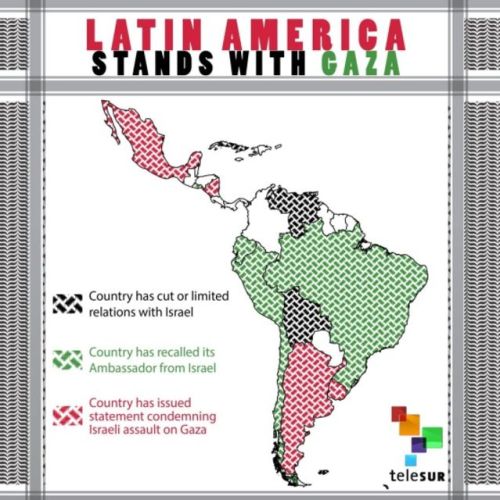
In August, Latin American leaders harshly condemned the Israeli government over its 50-day war against Gaza in summer 2014, including Rafael Correa of Ecuador, Nicolas Maduro of Venezuela, and Evo Morales of Bolivia. Several countries in the region downgraded relations with Israel, while others recalled ambassadors.
3 – Venezuela hosts congress on Palestinian Right of Return April 2015
In April 2015 Venezuela hosted the first Latin American Congress of the Global Campaign to Return to Palestine, being held until Friday in the capital of Caracas. The campaign was founded two years ago as an effort to coordinate the work of Palestinian solidarity activists at a global level. It gives particular attention to demand for the right-of-return of Palestinians who were forcibly displaced by militant Zionists during the foundation of the state of Israel.
4 – Chile hosts PLO official in a 5-day visit to strengthen ties with Palestine
In August 2015, Palestinian Liberation Organization official Saeb Erekat took a five-day visit to Chile where he visited the Arab School in Santiago, met with Chilean President Michelle Bachelet, the foreign minister, as well as representatives of the Jewish community in Chile. Chile is home to more than 400,000 Palestinians and Palestinian descendants.
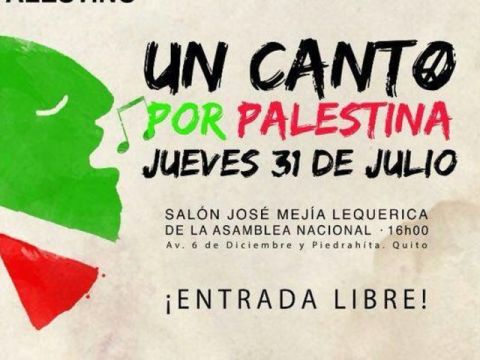
5 – A ‘Song for Palestine’ solidarity event in Ecuador
In July 2014, social organizations of Ecuador convened on to present “A song for Palestine”, an expression of solidarity with the Palestinian people in the face of attacks by the Israeli Defense Force against the Palestinian people in Gaza.
Global gas demand to grow 32% by 2040 – Putin
RT | November 23, 2015
World demand for gas is growing faster than any other energy source, and will grow by a third in the next 25 years, according to Russian President Vladimir Putin.
“The growing demand opens up great opportunities for increasing production and exports of gas. At the same time, it’s a major challenge, because there’s a need to dramatically accelerate the development of new deposits, modernize the refining capacities, expand gas transportation infrastructure, bring into operation additional pipelines and make new LNG routes”, said Putin at a Gas Exporting Countries Forum in Tehran on Monday.
According to Putin, Russia seeks to increase its gas output by 40 percent by 2035, reaching 885 billion cubic meters. One of the biggest tasks ahead of Russia is to boost the supplies of gas to China, India and other Asian countries from the current 6 percent to 30 percent, said Putin. Kremlin also intends to triple the LNG supplies. He added that Russia would be able to deal with all these tasks.
During his visit, Putin is meeting with Iranian leaders. He’s talked to Supreme Leader Ali Khamenei about energy cooperation, Syria and other key issues. Putin’s also meeting Iran’s President Hassan Rouhani.
Venezuela Condemns Irregularities in DEA Arrest of Venezuelans
teleSUR | November 17, 2015
The head of the National Assembly, Diosdado Cabello, criticized irregularities in the arrest of two Venezuelans, calling it a kidnapping.
The president of the Venezuela’s National Assembly, Diosdado Cabello, strongly criticized the actions of the U.S. Drug Enforcement Agency (DEA) that arrested two Venezuelan nationals in Haiti, classifying it as a kidnapping.
“I do not see it as a detention, really, a plane went to Haiti (from Venezuela), it was travelling with six people and two people were kidnapped, this is what I understand, because the process was totally irregular,” said Cabello Monday during an interview on Globovision.
Two Venezuelan men, Efrain Antonio Campo Flores and Francisco Flores de Freitas, were arrested in Haiti last Tuesday on drug trafficking conspiracy charges. They were subsequently extradited to the United States on Wednesday.
Some media outlets falsely claimed that 800 kilos of drugs were found on the plane, however Haitian government officials later denied the claim. A DEA official who participated in the arrest told CNN that the pair were arrested over allegations that they were in Haiti to finalize a deal to import that quantity of drugs to the United States.
The other 4 individuals traveling on the plane were released without charge and the plane was allowed to return to Venezuela.
Cabello questioned why the DEA would allow the plane, associated with alleged drug trafficking, to be released. That only two people were ultimately arrested led the president of the National Assembly to classify the detention as a kidnapping.
The two individuals arrested are said to be the nephews of Cilia Flores, the wife of Venezuelan President Maduro. However, White House spokesperson Josh Earnest could not confirm they were in fact connected to Venezuela’s first family.
After the two men were arrested, some international media reported on Friday that authorities raided a house and yacht in La Romana, Dominican Republic, that allegedly belonged to the Flores family.
However, the Dominican national drug control agency dismissed the claims as “speculation,” saying there was no official information to suggest the house and yacht were property of the Flores family. The Dominican anti-drug agency also confirmed that the raid happened the day before the two men were arrested, even though the event was only reported and linked to the family days later.
Tania Diaz, a candidate for the upcoming Venezuelan legislative elections for the ruling socialist party said the media coverage of the arrest was part of an orchestrated campaign to influence the country’s upcoming Dec. 6 elections. The two men arrested appeared in court in New York last Thursday and must appear again on Wednesday.
Featured Video
Macgregor: We Haven’t Seen the Worst of the Iran War Yet
or go to
Aletho News Archives – Video-Images
From the Archives
15 Saudi ‘hijackers’ were CIA agents working for US: Scholar
Press TV – April 13, 2016
Fifteen of the 9/11 “hijackers” from Saudi Arabia were CIA agents working for the United States government, which was seeking to destroy the Middle East for Israel and to double the American military budget, says Dr. Kevin Barrett, an American academic who has been studying the events of 9/11 since late 2003…. continue
Blog Roll
 Aletho News
- Iran’s Plan to Shut Down AI in the Persian Gulf
- Israel seeks ‘compensation’ from Washington over Saudi F-35 sale
- Saudi crown prince seeks dialogue with Ansarullah after Yemeni blows: Report
- Damascus rejects Saudi request for Syrian fighters to counter Yemen: Report
- South Korea says will not send troops to join terrorist US war on Iran
- Russia Just Struck the Eyes of NATO’s War Machine in Ukraine
- Russia summons UK charge d’affaires over Kiev drone support
- NATO member warns bloc seeking pretext for war with Russia
- Macgregor: We Haven’t Seen the Worst of the Iran War Yet
- ‘We are not like everyone else’ laws that bind other nations do not apply to Israel, says Likud lawmaker
- If Americans Knew
- Debunking The Claim That Macklemore Has A “History Of Antisemitism”
- CPJ demands release of arrested Palestinian-US journalist near Bethlehem
- Robert Kraft: The Billionaire Friend of Netanyahu Pulling The Strings Behind the Macklemore/Ed Sheeran Blow Up
- Columbia Administered Fund Gives Big Money to Pro-Israel Groups
- Deportation Case of Palestinian Activist Salah Sarsour Tests First Amendment
- ‘We Will Not Forget’: Palestinians Mark 44 Years since Sabra and Shatila
- Why do we let Zionists decide what we can and can’t say?
- US welcomes Israeli, Iranian delegations to UN, but not Palestinians – Daily Update
- Biden’s Genocide Accomplices Targeted by New Accountability Campaign
- AIPAC’s Network Has Already Spent $67.2 Million to Shape the Midterm Elections
- No Tricks Zone
- New Study: ‘Global Drought Shows No Detectable Recent Acceleration Under Climate Warming’
- Economic Masterminds: German Socialists Suggest Taxing Productivity Gains Stemming From Using AI
- The South China Sea Has Not Been Cooperating With The Climate Change Narrative
- Energy Crisis: Germany Enters Heating Season With Historically Low Gas Reserve Fill Levels
- New Study: The Antarctic Ice Sheet Gained Mass From 2020-2024 Due To Staggering Snow And Ice Accumulation
- Study: Ocean Heating Rates From Thousands Of Years Ago ‘Dwarf’ Modern Ocean Heating Rates
- Climate Extremists Target, Attack Large-Scale Power Grid Infrastructure In Germany!
- New Study: Antarctic Ice Melt Has Contributed Less Than 1 Centimeter To Sea Level Rise In The Last 30 Years
- Fear Of Debate: Alarmist German Climate Scientist Calls On Mainstream Media To Discredit Skeptic Voices
- End-Of-August Arctic Sea Ice Extent Hasn’t Fallen In 20 Years, Official Data Show!
 Aletho News