Foreign influence in the Global South rarely arrives in uniform. It comes disguised as ethics, stability, and shared values, only revealing its true cost once the rules are set. In Latin America, such a transformation is now underway. A new architecture of alignment is being quietly assembled, presented as moral course correction but functioning as a geopolitical filter. At its core lie the Isaac Accords, a project deliberately modelled on the Abraham Accords. Where the latter normalised Israel’s position in the Middle East through elite deals brokered by Washington, the Isaac Accords aim to reorder Latin American politics by locking governments, economies, and security institutions into Israeli and U.S. strategic orbit.
The Accords are not simply about Israel’s image or diplomatic isolation. They operate as a filter of legitimacy: governments that align are embraced, financed, and promoted; those that resist are marginalised, sanctioned, or framed as moral outliers. Venezuela, long aligned with Palestine and the broader Axis of Non-Alignment, sits squarely in the crosshairs.
This article examines how the Isaac Accords function in practice, why figures such as Javier Milei and María Corina Machado have become central to their rollout, and what this strategy reveals about Israel’s ambitions in South America, not as a neutral partner, but as an active geopolitical actor working in tandem with U.S. power.
The Isaac Accords: A Latin American Reboot of the Abraham Model
The Isaac Accords did not emerge in a vacuum. They are consciously modelled on the Abraham Accords, which rebranded Israel’s regional integration in the Middle East as “peace” while bypassing Palestinian self-determination entirely. The lesson Israeli and U.S. policymakers appear to have drawn is simple: normalisation works best when imposed from above, through elite alignment, financial incentives, and security integration.
The Accords are administered through a U.S.-based nonprofit, American Friends of the Isaac Accords, and financially seeded through institutions closely linked to Israeli state and diaspora networks. Their stated aim is to counter antisemitism and hostility toward Israel. Their operational requirements, however, reveal a far broader ambition.
Countries seeking entry are expected to:
Relocate embassies to Jerusalem, recognising Israeli sovereignty over a contested city
Redesignate Hamas and Hezbollah in line with Israeli security doctrine
Reverse voting patterns at the UN and the OAS, where Latin America has historically voted in favour of Palestinian rights
Enter intelligence-sharing agreements targeting Chinese, Iranian, Cuban, Bolivian, and Venezuelan influence
Open strategic sectors: water, agriculture, digital governance, security, to Israeli firms
Israel’s own diplomats have described the Isaac Accords as a way to pull “undecided” Latin American states into Israel’s orbit at a moment when European public opinion has become less reliable. In other words, the Global South is being repositioned as Israel’s strategic rear guard.
The role of Javier Milei in Argentina illustrates how this model operates. Milei has not merely improved relations with Israel; he has embraced it as an ideological reference point. He has pledged to move Argentina’s embassy to Jerusalem, framed Israel as a civilisational ally, and positioned himself as the Isaac Accords’ flagship political figure.
Co-Founder and Chairman of The Genesis Prize Foundation Stan Polovets presents prize to 2025 Laureate Javier Milei on June 12 in Jerusalem. (Source: American Friends of Isaac Accords)
That role was formalised in 2025 when Milei became the Genesis Prize Laureate, an award frequently described as the “Jewish Nobel Prize.” The Genesis Prize is not politically neutral. It is explicitly awarded to figures who strengthen Israel’s global standing and its ties with the diaspora. Milei’s decision to donate the prize money directly back into the Isaac Accords ecosystem symbolised how moral recognition, political allegiance, and financing now operate as a single circuit.
This is alignment rewarded, visibly, materially, and publicly.
As reported by AP in August, the Isaac Accords are set to extend to Brazil, Colombia, Chile, and potentially El Salvador by 2026, as stated by the organizers, the American Friends of the Isaac Accords.
Recent New York Timesreporting situates Brad Parscale’s involvement in the Honduran election within Numen, a Buenos Aires–based political consultancy he co-founded with Argentine strategist Fernando Cerimedo, highlighting how transnational firms operate beyond traditional regulatory scrutiny. Critics warn that Numen’s methods reflect a broader global political influence ecosystem that often draws on data-driven targeting, psychological profiling, and digital amplification techniques associated with Israeli-linked political technology and messaging firms that have operated in elections worldwide.
When combined with U.S. political endorsements, strategic pardons, and offshore consulting structures, this model raises serious concerns about how advanced data analytics and covert messaging infrastructures are used to shape voter behavior in vulnerable democracies, eroding electoral sovereignty while remaining largely insulated from accountability.
Venezuela, Palestine, and the Manufacturing of Illegitimacy
If the Isaac Accords require a moral antagonist, Venezuela fulfils that role perfectly.
Since Hugo Chávez severed diplomatic relations with Israel in 2009, in response to Israel’s assault on Gaza, Venezuela has positioned itself as one of Palestine’s most consistent supporters in the Western Hemisphere. Chávez, and later Nicolás Maduro, framed Palestinian resistance not as terrorism but as an anti-colonial struggle, aligning Venezuela with much of the Global South rather than the Atlantic bloc.
Under the Isaac Accords’ logic, this position is intolerable.
Opposition to Israel is no longer treated as a political stance but as evidence of extremism or antisemitism. Zionism and Judaism are deliberately conflated, allowing criticism of Israeli state policy to be reframed as hatred. This narrative provides the moral justification for isolation, sanctions, and, potentially, regime change.
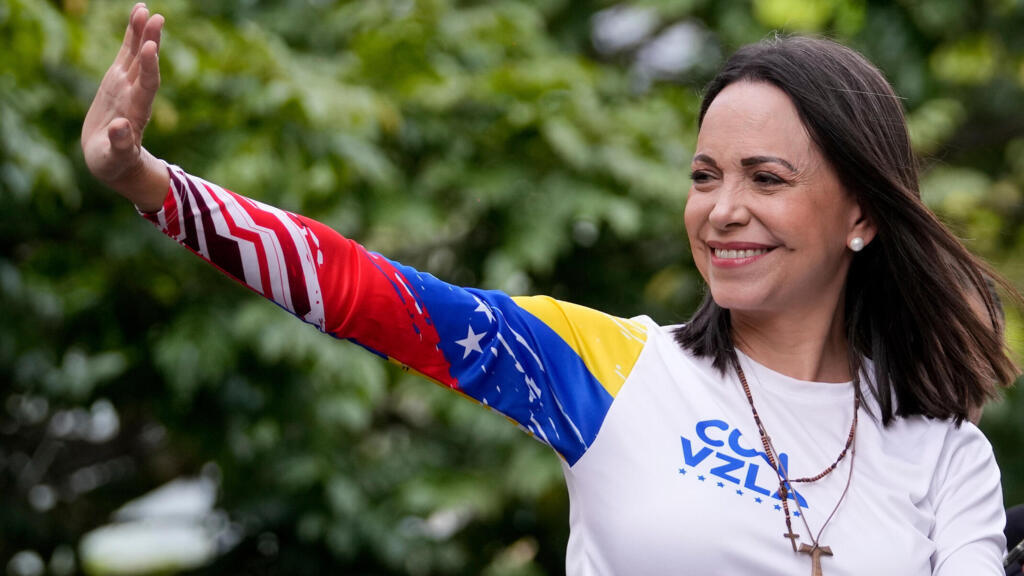
Maria Corina Machado in Venezuela, Thursday, July 25, 2024. (Source: AP – Matias Delacroix)
Into this context steps María Corina Machado, the Venezuelan opposition figure most warmly received by Israeli and U.S. political networks. Machado’s alignment with Israel is not rhetorical or recent. In 2020, her party, Vente Venezuela, signed a formal inter-party cooperation agreement with Israel’s ruling Likud Party, led by Benjamin Netanyahu. The agreement committed both parties to shared political values, strategic cooperation, and ideological alignment.
This is a remarkable document. It ties a Venezuelan opposition movement directly to a foreign ruling party, well before any democratic transition, and signals how a post-Maduro Venezuela is expected to orient itself internationally.
DOCUMENT: Vente Venezuela signs cooperation agreement with Israel’s Likud party – Agreement signed by María Corina Machado and Eli Vered Hazan, representing Likud’s Foreign Relations Division (Source: Vente Venezuela)
Machado has since gone further, pledging to:
Restore full diplomatic relations with Israel
Move Venezuela’s embassy to Jerusalem
Open Venezuela’s economy to privatisation and foreign investment
Align Venezuela with Israel and the United States against Iran and regional leftist governments
Her narrative rests on a crucial claim: that Venezuela itself is not anti-Israel, only its government is. According to this framing, Venezuelans are inherently pro-Israel and pro-West, their “true” preferences suppressed by an illegitimate regime.
In a November interview with Israel Hayom, Machado asserted that “The Venezuelan people deeply admire Israel.”
This argument is politically useful and historically thin. Venezuelan solidarity with Palestine predates Maduro and reflects a wider Latin American tradition of identifying with colonised peoples. To erase that history is to deny Venezuelans their own political agency.
The Anti-Defamation League (ADL) has repeatedly accused the Venezuelan government of fomenting “anti-Israel” and anti-Semitic rhetoric. Yet, a closer look tells a different story. Caracas’ statements are largely expressions of solidarity with the Palestinian people and their right to self-determination, combined with pointed criticism of Israeli state policies. By framing these positions as attacks on Jews or Israel itself, the ADL distorts the narrative, turning principled political stances into a perceived moral failing. This tactic underscores a broader pattern in which international organizations can paint Global South governments as rogue actors whenever they resist the gravitational pull of Israeli and U.S. influence, subtly laying the groundwork for diplomatic pressure or intervention.
DOCUMENT: Mini report from the Anti-Defamation League (ADL), formerly known as the Anti-Defamation League of B’nai B’rith, accuses Venezuela of fuelling an incendiary anti-Israel and anti-Semitic environment.(Source (ADL)
Security, Economics, and the Cost of Obedience
Beneath the moral language of the Isaac Accords lies a familiar architecture of control: security integration, economic restructuring, and ideological discipline.
Israel is a leading exporter of surveillance technologies, border systems, cyber-intelligence platforms, and urban security tools, many developed under conditions of occupation and internal repression. In South America, these systems are marketed as solutions to crime and narcotrafficking, but their real function is often political: expanding state surveillance capacity during periods of transition.
Security cooperation creates dependency. Once intelligence-sharing, training, and doctrine are integrated, political autonomy narrows. Policy divergence, particularly toward China, BRICS, or non-aligned partners, becomes risky.
The economic dimension is equally strategic. Israeli firms are deeply involved in water rights, desalination, agrotechnology, digital governance, and infrastructure, sectors that determine long-term sovereignty. These investments are typically tied to privatisation, deregulation, and long-term concessions, transferring control of strategic resources away from the public sphere.
Venezuela is the ultimate prize. A post-sanctions transition would open one of the world’s most resource-rich economies to restructuring. Machado’s commitment to rapid privatisation aligns seamlessly with this vision, raising an unavoidable question: who benefits from “democracy” when it arrives pre-packaged with foreign economic priorities?
This strategy is inseparable from U.S. power. The Trump administration’s framing of global politics as a permanent war on terror and narcotrafficking, a framing echoed by figures like Marco Rubio, has provided cover for sanctions, covert operations, and extrajudicial violence across the Caribbean and Pacific. Israel’s partnership reinforces this logic, supplying both technology and moral framing.
Conclusion: The Global South and the Right to Choose
The Isaac Accords are not simply about Israel’s diplomatic standing. They are about reordering South America’s political horizon at a moment when the Global South is rediscovering multipolarity.
Israel’s role in this process is active, strategic, and consequential. Through political patronage, economic leverage, security integration, and narrative control, it is shaping which governments are deemed legitimate and which are disposable.
For South America, and the wider Global South, the warning is familiar. When alignment is framed as morality, dissent becomes deviance. When sovereignty is conditional, development serves external interests. When history is rewritten, intervention soon follows.
Non-alignment was never about isolation. It was about the right to choose. That very right, today, is being quietly renegotiated, and the cost of refusing may soon become very clear.
United States President Donald Trump’s suggestion of an imminent land strike against Venezuela has jolted the America First movement he built on avoiding foreign entanglements, sparking divisions among his supporters and reviving debates reminiscent of the war on Iraq, part of what supporters describe as “forever wars”.
On Tuesday, Trump hinted not only at an intervention in Venezuela but also at possible attacks against other countries. The remarks rattled anti-interventionists, a core Make America Great Again (MAGA) constituency, who fear that toppling Venezuelan President Nicolas Maduro could mire the US in a years-long conflict, destabilize the region, and damage both Trump’s legacy and the movement’s political brand.
Republicans redraw the lines on intervention
Despite his long-standing criticism of US interventions, some Republican allies are now defending the possibility of military action. They argue that operations within the Western Hemisphere are more defensible than the West Asia wars they once denounced, and contend that the US is not seeking “regime change” but an adjustment in Venezuelan leadership without reshaping its political structure.
“He’s not trying to play God with what regime is in which country,” said Alex Gray, former National Security Council chief of staff.
Gray argued the move represents a refocusing of US strategy toward “core American interests,” describing Venezuela as central to hemispheric security.
Pressure mounts as US military presence grows
The administration insists it is not pursuing regime change; instead, it continues to level baseless accusations against the Venezuelan president, describing him as a leader of a “drug cartel”.
Still, the scale of US deployments, including a carrier strike group and roughly 15,000 troops, and Trump’s reported private ultimatum to Maduro last week, have amplified expectations of imminent action. Two people familiar with the call said Trump threatened Maduro, demanding he step down or face the “consequences.”
“No one is more bullish than the president on this,” another individual familiar with internal discussions told Politico, adding that the initiative “comes from the top.”
MAGA skeptics warn of Iraq-style pitfalls
For anti-interventionist MAGA figures, the moment represents a deep ideological test. Many had hoped for an administration focused exclusively on domestic priorities. Now they hope any action resembles the recent limited aggression on Iran, where the US bombed three Iranian nuclear facilities in June.
“Let’s not turn into George W. Bush and before you know it, we’re in charge of Venezuela,” said a former senior Trump advisor.
Boots on the ground and nation-building remain “red lines” for the America First movement.
Vice President JD Vance, once a fierce critic of foreign interventions, has shifted as well, defending limited strikes on Iran while framing any action in Venezuela as essential to combating “narco terrorists in our own hemisphere.”
Concerns over fallout, regional stability
Opponents of interference in Venezuela argue that Maduro’s removal could spark migration surges, empower criminal networks, or disrupt global energy markets, consequences that evoke the results of the US invasion of Iraq.
Ian Bremmer of the Eurasia Group noted Trump never campaigned on regime change, calling unilateral intervention “a NeoCon idea… discredited around the world.”
Still, some conservative realists believe Trump may ultimately avoid escalation. Curt Mills of The American Conservative said Trump may yet decide a full-scale conflict would be “a disaster in the making.”
At a Cabinet meeting, top officials emphasized a simple America First litmus test. As Secretary of State Marco Rubio, a staunch backer of military action in the Latin American country, stated, “Is it going to make us richer? Is it going to make us safer? If it is, he is for it.”
The growing tension between Washington and Caracas once again sheds light on the role of the United States in the continent and on the nature of the hybrid threats employed by the White House when it faces governments that reject its strategic dominance. Although a direct military operation against Venezuela has not yet been confirmed, there are clear indications that the U.S. keeps this possibility open — or at least uses it as an element of geopolitical coercion. To understand the current scenario, it is essential to examine the interaction between structural factors, such as the Monroe Doctrine, and contextual variables linked to the present orientation of U.S. foreign policy.
Objectively, one cannot rule out that the U.S. may consider specific, even if limited, military actions against Venezuela. Closing the airspace, increasing electronic warfare operations, or intensifying airstrikes against vessels near Venezuelan waters may function as preparatory steps within a typical hybrid war model. However, a large-scale ground incursion would be extremely unlikely. Venezuela’s geography — marked by dense jungles, mountains, and vast areas that are difficult to access — makes any prolonged occupation a strategic gamble of high cost and low probability of success. Moreover, the existence of a civilian militia numbering in the millions would act as a force multiplier of resistance, raising the political and military price of an intervention.
Thus, if Washington does in fact opt for military measures, it would likely take the form of selective airstrikes, limited amphibious operations in the Caribbean, or acts of sabotage against critical infrastructure. It would be less a conventional war and more a calibrated effort of attrition — typical of U.S.-supported regime change campaigns since the post–Cold War era.
However, the current pressure on Caracas cannot be interpreted merely as an automatic continuation of the Monroe Doctrine, as many mainstream analysts often claim. Although this principle — which historically legitimized U.S. domination over the hemisphere — remains an ideological backdrop, the contemporary context demands a different analytical lens. The international system is undergoing an accelerated transition toward multipolarity, and Trump’s United States, aware of its relative loss of influence, has begun to recalibrate its strategic priorities.
In this scenario, Latin America reemerges as a zone of “geopolitical compensation.” Faced with the relative decline of U.S. influence in Eastern Europe, the Middle East, and even the Asia–Pacific, Washington seeks to reaffirm its dominance in the Americas as a way to maintain internal cohesion and external relevance. The hostility toward Venezuela must be understood within this strategy: it is not primarily about oil, nor ideology, but about structural repositioning in a world where the monopoly of Western power is eroding.
This move also directly serves the interests of the U.S. military–industrial complex, which requires permanent tension hotspots to justify high levels of funding. By reinforcing the narrative that “threats” are emerging within the western hemisphere itself, Washington legitimizes expenditures, mobilizes regional allies, and attempts to prevent Latin American countries from deepening ties with Eurasian powers.
Yet this posture may generate the opposite effect. The U.S. insistence on treating Latin America as its “strategic backyard” tends to accelerate the region’s search for autonomy. There is already an observable rise in South–South cooperation, integration efforts among Latin American states, and the growing willingness of local governments to diversify their geopolitical partnerships.
Venezuela, despite its internal difficulties, symbolizes part of this process. Resisting external pressure has become not only a matter of state survival but also a sign of the new distribution of power in the international system. The aggressive U.S. stance reveals, paradoxically, not its strength, but its difficulty in accepting the emerging multipolar configuration that is consolidating across all continents.
On a phone call held between Donald Trump and Nicolas Maduro, the President ordered the Venezuelan leader to flee his country. Following leaks about the phone call, Maduro issued a defiant public address.
The Miami Herald reported on Sunday that during the phone call held last week, Trump told Maduro, “You can save yourself and those closest to you, but you must leave the country now.” The sources said Trump offered Maduro and his family safe passage from Venezuela only if he offered his immediate resignation.
The Venezuelan leader appears to have rejected Trump’s deal. On Sunday, at the end of his public remarks, Maduro chanted that Venezuela is “indestructible, untouchable, unbeatable.”
Over the past week, the concerns that the US could begin military operations inside Venezuela have peaked. Washington has engaged in a massive military buildup in the Caribbean. The Pentagon has destroyed about two dozen boats in the region, claiming the vessels were carrying narcotics.
Multiple outlets have reported that the White House is discussing expanding operations into Venezuela. Trump added to the fear of a new war when he told troops on Thanksgiving the operations inside Venezuela would “begin soon” and posted on Truth Social that Venezuelan airspace was closed.
Officials told the Miami Herald that the call was a last ditch effort to avoid a war in Venezuela.
The strikes on drug boats in the Caribbean and Eastern Pacific are unconstitutional, illegal, and war crimes. Expanding the strikes to inside Venezuela, or conducting a regime change in Caracas, would shatter the constraints the Constitution places on Presidential war powers.
Flights to Caracas remain in airlines’ schedules on Saturday after US President Donald Trump’s announcement that the airspace above Venezuela should be considered closed, airport and airline data show.
Thus, several Turkish Airlines planes from Havana, Copa Airlines planes from Panama and Wingo planes from Bogota are scheduled to depart to Caracas soon.
Earlier in the day, Trump called on all air carriers to consider the airspace above and around Venezuela closed without providing any reasons.
The US is facing renewed scrutiny after reports emerged that US forces carried out a second strike on a disabled boat in the Caribbean, extrajudicially killing people who survived an initial missile attack.
Accounts published by the Washington Post, CNN, and earlier by The Intercept indicate that the September 2 attack unfolded under a direct instruction from War Secretary Pete Hegseth to ensure no one on the vessel remained alive.
Citing individuals familiar with the mission, the WashingtonPost reported that personnel were told “the order was to kill everybody.” The strike formed part of a wider campaign targeting boats in the Caribbean and eastern Pacific that Washington claims were transporting narcotics through international waters. Publicly released figures compiled by AFP suggest that at least 83 people have been killed since these operations began, though the administration has not provided evidence substantiating its allegations against the vessels.
Illegal orders
According to the Washington Post, US forces saw two people clinging to the burning wreckage after the first strike and then hit the vessel again. Following this episode, internal rules were revised to require rescuing any survivors. CNN noted that it remains unclear whether Hegseth had been informed about survivors before the follow-up attack.
Hegseth, addressing criticism on social media on Friday, insisted that “current operations in the Caribbean are lawful under both US and international law” and dismissed reports on the incident as “fake news,” though he did not mention the September strike specifically.
The Justice Department has meanwhile maintained that the campaign complies with the laws governing armed conflict. The Pentagon has told lawmakers that the United States is engaged in an “armed conflict” with Latin American drug cartels and has categorized suspected smugglers as “unlawful combatants.”
War crimes
The allegations have triggered political backlash in Washington. Democratic congressman Seth Moulton wrote on X that the “killing of survivors is blatantly illegal” and warned, “Mark my words: It may take some time, but Americans will be prosecuted for this, either as a war crime or outright murder.”
The revelations surface amid controversy over a video released this month by Democratic lawmakers reminding military personnel that they may refuse illegal orders, a message that prompted Donald Trump to brand them “traitors.”
International pressure is also mounting. UN Human Rights chief Volker Turk urged the United States to examine the legality of the strikes, stating that there is “strong evidence” they amount to “extrajudicial” killings.
The Monroe Doctrine is DEAD. Russian warships in Venezuelan waters just shattered 200 years of American hemispheric dominance. Prof. John Mearsheimer breaks down how Washington’s own policies created this historic shift.
Russia’s Missiles Target U.S. Navy — Venezuela’s Deadly Warning to Washington
Russian hypersonic anti-ship missiles are now targeting U.S. Navy warships in the Caribbean. Prof. John Mearsheimer reveals how America’s own sanctions policy created this deadly threat in our own hemisphere.
The US has deployed more assets to the Caribbean than are needed for drummed-up counter-narcotics operations, yet still nowhere near enough for an attack on Venezuela, says Venezuelan lawmaker Juan Romero, a member of parliament from the ruling United Socialist Party of Venezuela (PSUV).
From a strictly military standpoint, the US operation is “far too small for a broader offensive,” Juan Romero told Sputnik.
Romero argued that Venezuela—unlike Grenada or Panama, which the US invaded in 1989—is a vast country with an extensive coastline, making any attempt to establish control extremely difficult.
He added that pinpoint strikes on targets inside Venezuela, similar to US and Israeli actions against Iran, would do nothing to solve the problem of holding the territory afterward.
In response to the US military buildup in the Caribbean, he said the Venezuelan government has activated a comprehensive territorial-defense system, claiming eight million combat-ready fighters in addition to 250,000 regular army troops.
“To invade Venezuela, the US would have to pull in soldiers from its African, European, and North American commands—not just Southern Command,” Romero said.
Romero also noted that the current operation—mixed in its results and involving the blowing up of several boats allegedly used to transport drugs—is extremely expensive, costing the US some $50 million a day.
The US has justified its military presence in the Caribbean as part of the fight against drug trafficking, without providing any proof.
Donald Trump continues to keep open the possibility of military action against Venezuela, saying he would “probably talk to” Maduro but emphasizing that he was “not ruling out anything.”
Meanwhile, airlines like Iberia, TAP, LATAM, Avianca, GOL, and Caribbean have suspended operations after the Federal Aviation Administration warned of “heightened military activity” in Venezuelan airspace.
Reports have suggested an imminent new phase of the US operations soon.
In the shadowy world of U.S. foreign policy toward Latin America, few names inspire as much controversy as Otto Reich, a Jewish-Cuban exile whose career reads like a manual for regime change, complete with illegal propaganda operations, coup connections, and an unwavering commitment to toppling governments that defy Washington.
The story begins in Havana, where Otto Juan Reich was born on October 16, 1945, to an Austrian Jewish father who had fled National Socialist Germany in 1938 and a Cuban Catholic mother. His father’s escape from Germany became the foundational narrative of Reich’s worldview, a tale of authoritarian evil that he would later project onto Latin America’s leftist movements. Raised as a Catholic despite his Jewish heritage, young Otto attended the elite, American-run Ruston Academy, where he absorbed both Cuban culture and American influence in equal measure.
During Reich’s youth, Cuba was under the dictatorship of Fulgencio Batista, whose political repression was so severe that even Reich’s own family, as he told The New Yorker, was “pro-revolution, anti-Batista.” The lone exception was his father, whose experience fleeing one authoritarian regime had made him suspicious of revolutionary movements. When Fidel Castro seized power in 1959, that suspicion proved prophetic—or so Reich would claim for the rest of his life. Castro’s consolidation of power prompted Reich’s father to flee once more, this time taking his family to North Carolina in 1960, when Otto was just 15 years old, as the New York Times reported.
His father’s double exile—first from Germany, then from revolutionary Cuba—became the crucible that forged the younger Reich’s political identity. Where some might see tragedy, Reich saw opportunity. Where others might advocate reconciliation, Reich would pursue confrontation. The teenage refugee would grow into one of Washington’s most zealous operators against Latin American leftism, a man for whom the line between communism and democracy admitted no gray areas, no nuance, no possibility of coexistence.
From the Military to the Foreign Policy Blob
Reich’s trajectory toward influence was methodical. He earned a Bachelor’s degree in International Studies from the University of North Carolina at Chapel Hill in 1966, then immediately joined the U.S. Army, serving three years as an officer in the 3rd Civil Affairs Detachment stationed in the Panama Canal Zone. This posting provided Reich with more than military experience; it offered a frontline view of U.S. power projection in Latin America, where American military presence wasn’t just about defense but about maintaining influence over an entire hemisphere.
After his military service, Reich completed a Master’s degree in Latin American Studies from Georgetown University in 1973, assembling the credentials that would make him indispensable to conservative policymakers seeking expertise on the region.
When Ronald Reagan swept into the White House in 1981, Reich found his moment. The Reagan administration needed operatives willing to prosecute an aggressive anti-communist agenda in Latin America, and Reich eagerly volunteered. From 1981 to 1983, he served as Assistant Administrator at the U.S. Agency for International Development, managing American economic assistance to Latin America and the Caribbean during a period of revolutionary upheaval. But this posting was merely preparation for Reich’s true calling.
The Architect of the Contra Propaganda Machine
In 1983, Reich established and began directing the Office of Public Diplomacy for Latin America and the Caribbean, an anodyne name for what would become one of the most controversial operations in modern American foreign policy. The OPD’s official mission was to promote the Contra guerrillas fighting Nicaragua’s Sandinista government. Its actual function, as would later be revealed, was to conduct what the Comptroller General characterized in 1987 as “prohibited, covert propaganda” to bolster the Contra’s image among the American public.
Under Reich’s management, the OPD became a factory for disinformation. The office planted false stories in U.S. media outlets, including unsubstantiated claims about the Nicaraguan government’s involvement in drug trafficking. It published opinion pieces in mainstream newspapers attributed to fictitious Nicaraguan rebel leaders. It coordinated with paid consultants who wrote pro-Contra articles while concealing their government connections—a practice congressional investigators would later identify as “white propaganda.”
Reich had effectively turned his office into a domestic propaganda operation aimed at manipulating American public opinion to support a covert war. A House Foreign Affairs Committee report didn’t mince words, characterizing the OPD as “a domestic political and propaganda operation.” For three years, Reich oversaw this machinery of deception, becoming what journalist Ann Bardach would later call the “chief spinner” of the Iran-Contra effort.
The scandal that eventually engulfed the Reagan administration would shut down Reich’s operation in 1987. Yet remarkably, Reich himself was not personally accused of illegal activity. He had operated in that gray zone where government officials claim plausible deniability—close enough to the crime to be indispensable, distant enough to avoid prosecution. It was a skill he would refine over decades.
The Lobbyist Years
When Reich left government service in 1989, following a stint as U.S. Ambassador to Venezuela from 1986 to 1989, he didn’t abandon his mission. He simply changed his methodology. For 12 years, Reich worked as a corporate lobbyist, first as a partner in the Brock Group and later as president of his own firm, RMA International. But these weren’t ordinary lobbying gigs; Reich selected clients whose interests aligned perfectly with his ideological agenda.
He represented Bacardi rum company in a campaign to nullify Cuba’s trademark protection for “Havana Club,” an effort that succeeded with the enactment of the Helms-Burton Act in 1996, which further fortified the Cuban embargo. He worked on behalf of Lockheed Martin to sell F-16 fighter jets to Chile. Where others saw business opportunities, Reich saw another front in his endless campaign to maintain American primacy in Latin America.
Return to Power
When George W. Bush captured the White House in 2001, Reich saw an opportunity to return to government service. Bush nominated him for Assistant Secretary of State for Western Hemisphere Affairs, but the appointment immediately sparked controversy. The Senate, wary of Reich’s Iran-Contra record and his advocacy for Orlando Bosch—a Cuban exile militant suspected of organizing the bombing of Cubana de Aviación Flight 455, which killed 73 people—refused to hold confirmation hearings.
Bush’s solution revealed the depths of Reich’s value to Republican hardliners: He simply bypassed the Senate through a recess appointment, allowing Reich to serve for one year without confirmation before being appointed as Special Envoy to Latin America. Democracy be damned; Reich’s expertise in destabilization was too valuable to sacrifice to Senate oversight.
The 2002 Venezuelan Coup
Reich’s tenure coincided with one of the most controversial episodes in recent Latin American history: the brief coup d’état in Venezuela on April 11, 2002, that temporarily removed President Hugo Chávez from power. During the coup, Reich communicated with coup leader Pedro Carmona Estanga and contacted ambassadors from other Latin American countries. Cuban sources would characterize Reich as the “mastermind of the April 2002 coup plot against Hugo Chávez,” though Reich has denied direct involvement in the coup planning.
The pattern was familiar: A left-leaning, democratically elected leader who defied Washington’s preferences; a sudden coup involving military and business elites; and Otto Reich in communication with the coup leaders. Whether Reich masterminded the operation or simply provided encouragement and diplomatic cover, his presence at the center of events spoke volumes about his role in Bush administration policy.
The Ideological Entrepreneur
After leaving government service in 2004, Reich established Otto Reich Associates, a Washington consulting firm providing international government relations advice. But he remained far more than a mere consultant. Reich positioned himself as an ideological entrepreneur, shaping policy from outside government through media appearances, congressional testimony, and advisory roles to Republican presidential candidates, including John McCain in 2008 and Jeb Bush in 2016.
During Donald Trump’s first term, Reich played a significant behind-the-scenes role in shaping Latin American policy. In August 2018, he was credited with recommending Mauricio Claver-Carone to National Security Advisor John Bolton for the position of top official for Latin America policy at the National Security Council. Bolton later acknowledged: “I wouldn’t have known [Claver-Carone’s] name if Otto hadn’t recommended him. I trusted Otto’s judgment.”
Reich praised the appointment of Cuban-American hawks to key Trump administration positions, stating: “We have people who understand the cause, and not just the symptoms, of the problems in Latin America—not all the problems—and that is Cuba.” He argued that “the United States has been a fire brigade in Latin America for the last 60 years and we have ignored, to a large degree, the arsonist,” referring to Cuba’s role in supporting leftist movements throughout the region.
The Unending Campaign to Preserve U.S. Hegemony
Reich’s crusade against Latin American leftism never wavered, never softened. He characterized Venezuela as a “branch” and “subsidiary” of Cuba, accusing President Chávez of “having put a lot of his country’s money at the service of Fidel Castro” and “giving away” petroleum to the Caribbean island. This close alliance, Reich claimed, fueled what he called the “disgusting and gloomy process of Cubanization” unfolding in the petroleum-rich nation.
Then-Vice President José Vicente Rangel defended Venezuela’s sovereignty in July 2005, claiming that Reich “permanently attacks the Venezuelan government, because all of the petroleum business that [the US] has with Venezuela frustrates him.” Rangel rhetorically asked Reich to clarify “exactly which process of Cubanization is he talking about,” arguing that “the true Cubanization of Venezuela occurred years ago with the infiltration of anti-Castro Cubans into Venezuela’s police bodies.”
In a February 2015 panel discussion at the University of Miami titled “Venezuela: A Deepening Political and Economic Quagmire?”, Reich compared the Venezuelan government to National Socialist Germany, stating that officials there could claim they were “simply obeying the laws of the land” just as German officials did, warning “we have to be careful what the laws of the land are.” The comparison was as hyperbolic as it was revealing—for Reich, every leftist government in Latin America was potentially the next Third Reich.
By January 2024, Reich’s criticism had intensified following the Biden administration’s temporary sanctions relief on Venezuela. In an interview with PanAm Post, Reich declared that Biden’s policy toward Venezuela “has been a failure since the beginning of his administration” and characterized it as “not just a failure but a humiliation.” He warned that “not only the ideological pressure groups of the left but now also the commercial groups, the American oil companies that are doing business with Maduro, are going to put pressure on the Biden government not to restore the sanctions.”
Expanding the Enemy List
For Reich, the list of adversaries extended far beyond Cuba and Venezuela. He grouped Nicaragua and Bolivia together with Venezuela and Cuba as what he called “21st Century Socialist States,” arguing they represented a coordinated Cuban-Venezuelan effort to undermine democracy throughout Latin America. In March 2014 testimony before Congress titled “U.S. Disengagement from Latin America,” Reich warned that these governments constituted “organized crime states” where “top politicians and high-ranking military officers have been implicated in drug trafficking, support of terrorism and other illicit activities.”
Reich’s recent writings reveal an expansion of his ideological enemies to include Middle Eastern actors. In a November 2023 article for the Jewish Policy Center, Reich argued that “for more than one year, Iran secretly provided the weapons and training that Hamas needed for planning the October 7th attack against Israel.” He specifically accused Cuba of being “a key Iran-Hamas ally” in diplomatic efforts supporting the Palestinian militant organization.
Reich documented three high-level meetings that he claimed demonstrated Cuba’s complicity in the attack: a February 5, 2023 visit by Iranian Foreign Minister Hossein Amirabdollahian to meet with Cuban President Miguel Díaz-Canel; a February 25, 2023 Hamas delegation visit to Jorge León Cruz, the Cuban Ambassador in Lebanon, where Cruz recognized “the legitimate right of the Palestinians to defend their land,” stating that Palestinians “are fighting for a just cause”; and a June 15, 2023 meeting between Iranian President Ebrahim Raisi and Díaz-Canel in Havana.
Reich asserted that these meetings, coupled with Cuba’s “long history of both antisemitism and support of extremist terrorist organizations in the Middle East,” proved that Cuba operated “terrorist training camps in secret locations” and allowed Hezbollah to establish “an operational base in Cuba, designed to support terrorist attacks throughout Latin America.”
Regime Change Villain
Throughout his career, Reich’s targets have consistently accused him of the very interference he claims to oppose. The Cuban government has consistently accused Reich of supporting terrorism and interfering in Cuban affairs. In 2002, Cuba’s Foreign Relations Ministry categorically denied Reich’s claims that four Cuban airplanes landed at Venezuela’s airport during the 2002 coup attempt, calling Reich’s assertion “an absolute lie.” The ministry stated that “if it had been necessary to land a Cuban civilian airplane to collect Cuban diplomatic personnel who were besieged by Mr. Reich’s friends, or for any other humanitarian and peaceful objective, we would have done it and we would have no reason to hide it.”
During a diplomatic visit to South America in July 2002, Reich drew criticism for instructing the Argentine government to commit to an austerity program demanded by the International Monetary Fund–one of the most notable vehicles of Judeo-American power. His aggressive approach to diplomacy was so abrasive that Senator Lincoln Chafee, a Republican member of the Foreign Affairs Committee, reported getting first-hand experience of Latin American hostility toward Reich during travels in the region. The term “hemispheric security mechanism” that Reich promoted stirred “unpleasant interventionist memories” throughout Latin America, according to a report by Toby Eglund.
Venezuelan officials have been particularly vocal about Reich’s skullduggery, even in the Obama era. In March 2013, Venezuela’s then-interim president Nicolás Maduro accused “factors in the Pentagon and the CIA” of conspiring against Venezuela, specifically naming Reich and Roger Noriega, who directly succeeded Reich as Assistant Secretary of State for Western Hemisphere Affairs. Maduro stated: “We want to say to President Barack Obama, stop this madness,” claiming to have “testimonies and direct, first-hand information” about U.S. plots. Both Reich and Noriega rejected the claims of orchestrating a plot to assassinate Maduro’s rival Henrique Capriles as “untrue, outrageous and defamatory.”
In September 2013, Maduro cancelled his planned trip to speak at the United Nations, citing “serious provocations that could threaten his life.” He specifically accused “the clan, the mafia of Roger Noriega and Otto Reich” of conspiring against him, stating that “the US government knows exactly that these people were behind a dangerous activity being plotted in New York.”
A Legacy of Fire-Starting
In January 2018 testimony before the House Committee on Oversight and Government Reform, Reich called President Obama’s rapprochement with Cuba “a foreign policy failure.” He argued that it “consisted of a series of unrequited unilateral concessions to the Castro regime that had negative consequences for US national security, foreign policy interests and traditional values, and which brought increased repression to the Cuban people while filling the coffers of the Cuban military, the Communist Party, and the Castro family.”
Reich emphasized that “unlike previous, successful American initiatives, Obama’s rapprochement with the Castro dictatorship identified the US with a nation’s oppressor instead of the oppressed.” This framing revealed his consistent position: U.S. policy should align with opposition movements rather than incumbent leftist governments—in other words, perpetual regime change over diplomatic engagement.
In March 2023, following the International Criminal Court’s issuance of arrest warrants for Russian President Vladimir Putin for war crimes in Ukraine, Reich called for scrutiny of Cuba’s support for Russia’s “criminal and illegal war.” He stated that “the Cuban government has been actively using its diplomatic and propaganda services to support the illegal and criminal invasion of Ukraine by Putin’s Russia,” while “Cuban strongman Raúl Castro, his hand-picked president Miguel Diaz-Canel, and the rest of the ruling class, are profiting from Putin’s criminal war of aggression by receiving deliveries of Russian contraband oil, and wheat stolen from Ukraine.”
As of 2025, Reich continues his work through Otto Reich Associates and serves on the Advisory Board of United Against Nuclear Iran, an organization dedicated to preventing Iran from obtaining nuclear weapons.
As Washington’s confrontation with Venezuela intensifies, observers should recognize that this escalation did not materialize out of nowhere. They are the predictable outcome of decades of work by regime change specialists such as Otto Reich, figures who helped design a long-term interventionist blueprint for Latin America. Today, that blueprint is being dutifully executed by hawks like Secretary of State Marco Rubio, a close ally of Reich and a committed interventionist in his own right.
Just as Reich’s kinfolk in Israel labor tirelessly to secure regional supremacy for the Jewish state, Reich has devoted his career to making the Western Hemisphere safe for world Jewry by safeguarding Washington’s full-spectrum dominance in Latin America.
In this transnational criminal enterprise, the roles are clearly defined. And Reich’s role is to ensure that Empire Judaica’s strategic footholds in Latin America remain firmly intact.
Washington’s new militarized campaign against Venezuela, framed as a drug war, is in reality a risky attempt to blunt China’s rising influence in Latin America—and it may only accelerate the region’s shift away from the United States.
Trump vowed to end America’s endless wars. Yet he is now starting another and doing it in Latin America, the very ground where US power is already slipping. The administration’s militarised “drug war” against Venezuela is less about cartels than about toppling Maduro to blunt China’s rise in the hemisphere. But it’s a gamble that exposes Washington’s deeper weakness: the US no longer has an economic playbook to compete with Beijing’s money, markets, and infrastructure. And Latin America knows it.
America’s Worry
It’s not about drugs. Washington has a long history of using the “war on narcotics” as cover for covert operations, and in Venezuela today, the real source of alarm is China. Beijing has become Caracas’s most dependable lifeline, underwriting more than US$60 billion in loans, running oil-for-credit schemes, building joint ventures, infrastructure, and even a satellite ground station, all coming together to cement a long-term strategic presence. In 2024 alone, bilateral trade hit US$6.4 billion, with China importing US$1.6 billion in Venezuelan oil and minerals and exporting US$4.8 billion in manufactured goods.
Venezuela is far from an outlier. Across Latin America, Sino-regional trade surged to US$518 billion, with direct investment totaling US$14.7 billion, creating a sprawling parallel economic architecture of ports, refineries, mines, 5G networks, and credit lines that regional governments now treat as indispensable. Even though the US still dominates the region in cumulative FDI—over US$1 trillion—China is rapidly eroding American influence, winning leverage not through ideology or coercion, but through markets, capital, and sustained economic engagement.
For Washington, this is not commerce; it is geopolitical encroachment that directly pushes against the so-called Monroe Doctrine, turning the US “backyard” into a zone where Washington’s influence is not decisive anymore. The Monroe Doctrine, declared by President James Monroe in 1823, held that the Americas were under US influence and off-limits to outside, i.e., European, interference. Over time, it became the foundation of Washington’s dominance in the Western Hemisphere. Today, China’s deep economic and strategic footprint in Latin America is quietly—but surely—undermining that century-old principle, challenging US control in its own backyard.
Yet instead of matching Beijing’s patient economic game, the US is increasingly relying on force—missiles, warships, and military threats—to reassert influence in its own hemisphere. In Venezuela, that approach is especially dangerous: every escalation risks doing exactly what Washington fears most, driving Latin America further into China’s orbit and underscoring the stark reality that America no longer wins with markets.
The zero-sum American Mindset
That China is the real target is not irrelevant. China’s successes are seen, in a zero-sum manner, as Washington’s loses. It was always known, although it gets little mention in the ongoing US official discourse about Venezuela. Perhaps the US does not wish to complicate its ongoing trade talks with China to ‘end’ the trade war that Washington has lost. However, elements of the current US administration had already made clear, even before capturing power in the latest presidential elections, that China cannot be allowed to expand its presence in the region.
In 2024, The Economist spotlighted China’s “dramatically” growing footprint across Latin America—a shift that seems to have triggered alarm bells in Washington. The US Secretary of State (and National Security Advisor) Rubio had warned, even before assuming his current positions, that America “can’t afford to let the Chinese Communist Party expand its influence and absorb Latin America … into its private political-economic bloc.” Yet, he lamented, many regional leaders have merely shrugged. Now, Rubio appears determined to turn up the pressure—and he’s starting with Venezuela.
Beijing’s inroads stretch far beyond Caracas. Earlier this year, left‑leaning Brazilian President Luiz Inácio Lula da Silva joined a Latin American summit in Beijing, signaling his willingness to coordinate on key geopolitical issues, including backing China’s position on Ukraine. At the same time, China quietly opened its first major deep‑water, “smart” port in Latin America: the $3.5 billion Chancay megaport in Peru, operated by COSCO and equipped with unmanned cranes, 5G networks, and driverless trucks. Xi Jinping praised the port as a “new land-sea corridor” linking Latin America and Asia. According to Chinese state media, Chancay can cut shipping times between Peru and China by nearly 12 days while reducing logistics costs by 20%. Diplomatically too, Beijing is undeterred. When pressed on US interventionism, Chinese Foreign Ministry spokesman Lin Jian retorted in September that Latin America is “no one’s backyard,” an explicit rebuke to American regional dominance. Accordingly, in November, Foreign Ministry spokeswoman Mao Ning condemned Washington’s “excessive force” against boats in the Caribbean and insisted that “cooperation between China and Venezuela is the cooperation between two sovereign states, which does not target any third party.”
The Possibility of Backfire
America’s strategy therefore can—and will—backfire. It will only make regional states more open towards Beijing and more apprehensive towards the US (interventionism and unpredictability). At the 2025 China–CELAC Forum, Gustavo Petro, President of Colombia, called for a “dialogue of civilizations” and said China and Latin America should forge a new model of cooperation—not one imposed by external powers. This sentiment exists across Latin American states, including, for instance, Brazil.
What Washington must understand is that China’s patient, capital-driven strategy, combining trade, investment, infrastructure, and diplomacy, has created a durable foothold that the US cannot simply displace with missiles or threats, although it can introduce temporary disruptions only through a military approach. Still, every escalation in Venezuela risks cementing the very outcome Washington fears: a hemisphere where American influence is conditional and secondary. If the US hopes to reclaim strategic authority, it must first confront the uncomfortable truth that power in the 21st century is won with markets, credit lines, and long-term partnerships, not just force. Until it does, the Monroe Doctrine will remain a relic, and Latin America a proving ground for China’s quiet but decisive ascendancy.
Salman Rafi Sheikh, research analyst of International Relations and Pakistan’s foreign and domestic affairs
Since September, the presidential administration of Donald Trump has been directing the United States military to blow up boats and kill their occupants in the Caribbean and Pacific, claiming to be thus countering Venezuela government supported “narco-terrorism.” At the same time, it has been building up a large US military force off the Venezuela shore. And the Trump administration has made clear that these actions go hand in hand with seeking to achieve its goal of removing Venezuela President Nicolás Maduro from office.
It looks like the US government is pursuing a regime change effort against the South America nation. But, the American people do not seem to be happy with this situation. According to a Reuters/Ipsos poll conducted November 7 – 12, Americans are rejecting both the ongoing US military action against the boats and the threatened US military action to overthrow Maduro.
In a Friday Reuters article discussing the poll results, Jason Lange and Matt Spetalnick detailed that only 29 percent of polled Americans answered that the US government should “kill suspected drug traffickers abroad without judicial process” — what is occurring with the US military’s serial blowing up of boats and killing of their occupants. Even fewer polled Americans — 21 percent — answered that the US government should “use military force to remove Venezuela’s president.” Substantially more polled Americans — 51 percent and 47 percent respectively — declared their opposition to the ongoing US military campaign to blow up boats and the potential use of US military force to remove Maduro from office.
In federal criminal cases, U.S. District Judges issue the following types of instruction to jurors:
“The indictment is not evidence of any kind. It is simply the formal method of accusing a person of a crime. It has no bearing on the defendant’s guilt or innocence, and you must not consider it in your deliberations except as an accusation. You must not assume the defendant is guilty just because he or she has been indicted. The defendant begins this trial with a clean slate.The burden is entirely on the government to prove guilt beyond a reasonable doubt.”
In other words, an indictment carries absolutely no evidentiary weight whatsoever. It is simply an accusation. It is not proof. It is not evidence. The jury is prohibited from considering it when deciding guilt or innocence.
This principle applies to any person accused of violating federal criminal statutes.
President Trump and the Pentagon have now attacked and killed more than 70 people on the high seas in the Caribbean and the Pacific Ocean near South America. They justify these killings by claiming that the victims are engaged in a violations of U.S. federal drug laws.
But the fact is that Trump’s and the Pentagon’s claims are nothing more than informal accusations. In fact, their informal accusations don’t even amount to a formal accusation set forth in a grand-jury indictment. That’s because a grand jury cannot issue an indictment unless it sees evidence that establishes that there is “probable cause” that the accused committed the crime. With Trump’s and the Pentagon’s informal accusation, no such burden of proof is required.
Therefore, if a jury is prohibited from using an indictment to convict a person who the feds are accusing of having violated U.S. drug laws, it stands to reason that U.S. officials are prohibited from killing people based simply on their informal accusation that the person has violated the law.
In fact, with the Fifth Amendment to the Constitution, our American ancestors expressly prohibited the federal government from depriving any person of life without due process of law. It has been long established that due process in a criminal case means, at a minimum, two things: (1) being formally notified of the specific charges that the defendant is accused of violating; that’s what a grand-jury indictment is for; and (2) a trial where the government is required to prove beyond a reasonable doubt with relevant and competent evidence that the person actually did commit the crime. The accused, if he elects, can have a jury, not the judge, decide whether or not he is guilty.
There have always been some Americans who hate these provisions. They prefer how things are done in nations run by totalitarian regimes, where the government wields the omnipotent power to kill or punish anyone it suspects of having committed a crime — without having to go through the difficulty and expense of formally accusing people and according them a trial.
Nonetheless, like it or not, that is our system of government, and it remains so unless and until the Constitution is amended to end it.
What about the fact that it is the military that is carrying out these killings? No matter the exalted position that the national-security establishment has come to play in America’s federal governmental system, it doesn’t alter the constitutional principles at all. All it means is that the military is operating in the role of a policeman who is enforcing a federal criminal statute.
For example, suppose that Trump’s military troops that are occupying various U.S. cities begin enforcing federal drug laws by arresting people and then turning them over to the DEA for incarceration and prosecution. The military would simply be operating in a police capacity, not in a war situation.
It’s no different with those killings in the Caribbean. The military, which, by the way, is legally prohibited from enforcing drug laws inside the United States, is simply operating in a police capacity when it is enforcing U.S. drug laws on the high seas. It is essentially standing in the stead of the Drug Enforcement Administration.
What about Trump’s and the Pentagon’s claim that the U.S. is at war and, therefore, it’s okay for soldiers to kill the enemy in war. Clearly that claim is a ruse designed to justify their extra-judicial killings. The concept of war involves conflicts between nation-states, not enforcement of criminal statutes. There is no war between the United States and Venezuela, Columbia, Mexico, or any other Latin American country.
After all, if Trump’s and the Pentagon’s ruse was valid, it would entitle them to use the military to kill drug-war suspects here inside the United States under the claim that enemy drug forces have invaded and occupied the United States and are waging “war” against the United States. In fact, their ruse would enable them to use the military to kill anyone they wanted who they claimed had violated any federal criminal statute.
What about Trump’s and the Pentagon’s claim that the victims are also being accused of violating federal terrorism statutes and, therefore, that it is okay to summarily kill them? Again, it’s just another ruse to justify the extra-judicial killing of people who are accused of violating U.S. criminal laws. After all, terrorism itself is a federal criminal offense. That’s why there are criminal prosecutions for terrorism in federal district court. Trump and the Pentagon are bound by the same principles in federal criminal cases involving terrorism as they are with cases involving alleged federal drug offenses. They are required to secure federal criminal indictments and accord the people with trials, where they bear the burden of proving that the defendants really are guilty of terrorism (or drug offenses) before they can kill them or punish them.
One more point worth noting: The troops carrying out these killings are obviously loyally and blindly obeying orders to commit an illegal act. That’s because, as I have long pointed out, their loyalty is to their commander-in-chief, notwithstanding the oath they take to support and defend the Constitution.
Trump, the Pentagon, and the troops are clearly engaging in illegal conduct with their extra-judicial, unconstitutional drug-war killings. The problem is that given their omnipotent power within America’s federal governmental system, neither the Congress nor the Supreme Court or anyone else will — or can — do anything to stop them.
BY WHITNEY WEBB | UNLIMITED HANGOUT | JUNE 10, 2022
This short excerpt from Whitney Webb’s upcoming book “One Nation Under Blackmail” examines an obscure media profile of Leslie Wexner, Jeffrey Epstein’s mentor, from the 1980s that contains disconcerting revelations about Wexner’s personality and his inner world. … continue
This site is provided as a research and reference tool. Although we make every reasonable effort to ensure that the information and data provided at this site are useful, accurate, and current, we cannot guarantee that the information and data provided here will be error-free. By using this site, you assume all responsibility for and risk arising from your use of and reliance upon the contents of this site.
This site and the information available through it do not, and are not intended to constitute legal advice. Should you require legal advice, you should consult your own attorney.
Nothing within this site or linked to by this site constitutes investment advice or medical advice.
Materials accessible from or added to this site by third parties, such as comments posted, are strictly the responsibility of the third party who added such materials or made them accessible and we neither endorse nor undertake to control, monitor, edit or assume responsibility for any such third-party material.
The posting of stories, commentaries, reports, documents and links (embedded or otherwise) on this site does not in any way, shape or form, implied or otherwise, necessarily express or suggest endorsement or support of any of such posted material or parts therein.
The word “alleged” is deemed to occur before the word “fraud.” Since the rule of law still applies. To peasants, at least.
Fair Use
This site contains copyrighted material the use of which has not always been specifically authorized by the copyright owner. We are making such material available in our efforts to advance understanding of environmental, political, human rights, economic, democracy, scientific, and social justice issues, etc. We believe this constitutes a ‘fair use’ of any such copyrighted material as provided for in section 107 of the US Copyright Law. In accordance with Title 17 U.S.C. Section 107, the material on this site is distributed without profit to those who have expressed a prior interest in receiving the included information for research and educational purposes. For more info go to: http://www.law.cornell.edu/uscode/17/107.shtml. If you wish to use copyrighted material from this site for purposes of your own that go beyond ‘fair use’, you must obtain permission from the copyright owner.
DMCA Contact
This is information for anyone that wishes to challenge our “fair use” of copyrighted material.
If you are a legal copyright holder or a designated agent for such and you believe that content residing on or accessible through our website infringes a copyright and falls outside the boundaries of “Fair Use”, please send a notice of infringement by contacting atheonews@gmail.com.
We will respond and take necessary action immediately.
If notice is given of an alleged copyright violation we will act expeditiously to remove or disable access to the material(s) in question.
All 3rd party material posted on this website is copyright the respective owners / authors. Aletho News makes no claim of copyright on such material.




 Aletho News