Brazil’s Ambassador to the OAS Denounces US Military Action Against Venezuela as a Global Threat
teleSUR – January 6, 2026
During an address to the Permanent Council of the Organization of American States (OAS), Benoni Belli, Brazil’s ambassador to the organization, described the United States’ military action against Venezuela as “a very serious attack against Venezuela’s sovereignty and a threat to the entire international community.”
The Brazilian diplomat warned that the bombings of Venezuelan territory and the kidnapping of its president represent an unacceptable violation of international law. “The current situation is grave and evokes times we thought were behind us, which are once again devastating Latin America and the Caribbean,” Belli stated.
Belli rejected the logic that “the ends justify the means,” arguing that such reasoning lacks legitimacy and allows the strongest powers to impose their will on sovereign nations. “These acts open the possibility that the strongest will define what is just or unjust, disregarding national sovereignty,” he emphasized.
The ambassador’s statement highlights the geopolitical implications of a unilateral military intervention, and warned that it undermines multilateralism and fosters a global order based on the law of the strongest.
Behind the DOJ’s politicized indictment of Maduro: a CIA-created ‘network’ and coerced star witness
The US Department of Justice indictment of Venezuela’s kidnapped leader is a political rant that relies on coerced testimony from an unreliable witness
By Max Blumenthal | The Grayzone | January 5, 2026
The January 3 US military raid on Venezuela to kidnap President Nicolas Maduro and First Lady Cilia Flores was followed by the Department of Justice’s release of its superseding indictment of the two abductees as well as their son, Nicolasito Maduro, and two close political allies: former Minister of Justice Ramon Chacin and ex-Minister of Interior, Justice and Peace Diosdado Cabello. The DOJ has also thrown Tren De Aragua (TDA) cartel leader Hector “Niño” Guerrero into the mix of defendants, situating him at the heart of its narrative.
The indictment amounts to a 25 page rant accusing Maduro and Flores of a conspiracy to traffic “thousands of tons of cocaine to the United States,” relying heavily on testimony from coerced witnesses about alleged shipments that largely took place outside US jurisdiction. It accuses Maduro of “having partnered with narco-terrorists” like TDA, ignoring a recent US intelligence assessment that concluded he had no control over the Venezuelan gang. Finally, the prosecutors stacked the indictment by charging Maduro with “possession of machine guns,” a laughable offense which could easily be applied to hundreds of thousands of gun-loving Americans under an antiquated 1934 law.
DOJ prosecutors carefully avoid precise data on Venezuelan cocaine exports to the US. At one point, they describe “tons” of cocaine; at another, they refer to the shipment of “thousands of tons,” an astronomical figure that could hypothetically generate hundreds of billions in revenue. At no point did they mention fentanyl, the drug responsible for the overdose deaths of close to 50,000 Americans in 2024. In fact, the DEA National Drug Threat Assessment issued under Trump’s watch this year scarcely mentioned Venezuela.
By resorting to vague, deliberately expansive language larded with subjective terms like “corrupt” and “terrorism,” the DOJ has constructed a political narrative against Maduro in place of a concrete legal case. While repeatedly referring to Maduro as the “de facto… illegitimate ruler of the country,” the DOJ fails to demonstrate that he is not de jure illegitimate under Venezuelan law, and will therefore be unable to bypass established international legal precedent granting immunity to heads of state.
Further, the indictment relies on transparently unreliable, coerced witnesses like Hugo “Pollo” Carvajal, a former Venezuelan general who has cut a secret plea deal to reduce his sentence for drug trafficking by supplying dirt on Maduro. Carvajal was said to be a key figure in the so-called “Cartel of the Suns” drug network which the DOJ claims was run by Maduro. If and when he appears to testify against the abducted Venezuelan leader, the American public could learn that the “cartel” was founded not by the deposed Venezuelan president or one of his allies, but by the CIA to traffic drugs into US cities.
As sloppy and politicized as the DOJ’s indictment might be, it has enabled Trump to frame his lawless “Donroe Doctrine” as an aggressive policy of legal enforcement, emboldening the US president to levy further threats to abduct or bump off heads of state who stand in the way of his rapacious agenda. This appears to be the real purpose of the imperial courtroom spectacle to come.
Weaponizing the “narco-terror” hoax
The bulk of the case against Maduro rests on the accusation that the defendants “engaged in… drug trafficking, including in partnership with narco-terrorist groups.” According to the DOJ, Maduro conspired with TDA, as well as the Mexican Sinaloa and Los Zetas cartels to traffic drugs between 2003 and 2011. However, these cartels were not designated by the Trump administration as Foreign Terrorist Organizations until February 2025, a move obviously designed to justify Maduro’s kidnapping and juice up his indictment.
In its bid to convict Maduro, the DOJ will undoubtedly struggle to overcome the conclusion reached in an April 7, 2025 memo by the Office of the Director of National Intelligence (ODNI) that the Venezuelan leader did not control TDA, which he effectively dismantled through a massive 2023 military-police raid on the Tocorón prison that served as the gang’s base of operations. A report in the State Department-funded outlet InSight Crime also complicates the DOJ’s case, finding that “the few crimes attributed to alleged Tren de Aragua members in the United States appear to have no connection with the larger group or its leadership in Venezuela.”
In fact, many of the supposed crimes for which Maduro is charged took place outside the borders and jurisdiction of the United States. The DOJ alleges, for instance, that in September 2013, “Venezuelan officials dispatched approximately 1.3 tons of cocaine on a commercial flight from the Maiquetia Airport to Paris Charles de Gaulle Airport.”
In 2018, five British citizens were convicted in a French court for orchestrating the drug shipment with help from gang members from Colombia and Italy – but not Venezuela. At the time of the incident, Maduro’s government acknowledged corrupt lower level Venezuelan officials had allowed the drugs to pass through airport security. Caracas ultimately arrested 25 people, including members of the military and an Air France manager – a salient fact omitted from the DOJ indictment.
The evidence of Maduro’s involvement in the scandal, according to the DOJ, was that the drug shipment took place “mere months after [Maduro] succeeded to the Venezuelan presidency.” No other proof is offered to demonstrate his culpability.
The indictment goes on to allege Maduro “facilitated the movement of private planes under diplomatic cover” to avoid law enforcement scrutiny as they landed in Mexico. Citing coerced testimony from a Venezuelan government defector, it accuses Diosdado Cabello of coordinating a shipment of 5.5 tons of cocaine on a DC-9 jet to Mexico. None of these claims should hold water in a US court.
As public defender and legal analyst Eliza Orlins explained, “Flights that occur wholly within Venezuela do not cross U.S. airspace, do not implicate U.S. customs territory, and do not, standing alone, violate U.S. law. The indictment attempts to bootstrap these domestic movements into U.S. criminal jurisdiction by asserting that the cocaine involved was ultimately destined for the United States. Intent does almost all the work here.”
Because most of the specific incidents cited in the indictment occurred within Mexico under Presidents Vicente Fox, Felipe Calderón and Enrique Pena Nieto, the DOJ inadvertently implicates these three pro-US administrations, who shaped their drug policies in coordination with Washington. In fact, the top cop during the first two of these governments, former Federal Intelligence Agency chief Genaro García Luna, was convicted in a US federal court in 2023 for presiding over a multi-million dollar conspiracy with the Sinaloa cartel. Former US ambassador to Mexico Robert Jacobson acknowledged that the US knew all about Garcia Luna’s cartel ties, but insisted, “we had to work with him.”
The Honduran double standard
The DOJ also implicates the pro-US government of former Honduran President Juan Orlando Hernandez, referring to Honduras as a “transshipment” point “in which cocaine traffickers operating in those countries paid a portion of their own profits to politicians who protected and aided them.” Hernandez was convicted in a US federal court in 2023 of trafficking over 400 tons of drugs to the US, but received a pardon this December from President Donald Trump following a lobbying campaign by top Trump donors seeking business in the deregulated crypto haven of Próspera off the coast of Honduras.
During his January 3 press conference announcing the abduction of Maduro and his wife, Trump aggressively defended his decision to pardon Hernandez, claiming the Honduran ex-president been “persecuted very unfairly.” However, the same DOJ prosecutor who authored the original 2020 indictment of Maduro, Trump loyalist Emil Bove, was responsible for the indictment of Hernandez. In contrast to the case against Maduro, the Hernandez indictment contained concrete evidence of his collaboration with major transnational cartels, including video and photographic exhibits, as Anya Parampil and Alexander Rubinstein detailed for The Grayzone.
Hernandez pleaded his case to Trump in a 2025 letter claiming he’d been subjected to a “rigged trial” and convicted “based on the uncorroborated statements of convicted drug traffickers.”
His questionable claim could also apply to the DOJ’s prosecution of Maduro, as many of the most dramatic allegations contained in his indictment are sourced to a convicted drug trafficker who struck a secret deal with US prosecutors to reduce his own sentence in exchange for testimony against Maduro.
He is former Venezuelan Gen. Hugo “El Pollo” Carvajal.
Coerced “star witness” strikes secret deal with US prosecutors
The head of military intelligence under the government of Venezuelan President Hugo Chavez from 2004 to 2011, Carvajal is cited seven times in the January 3 DOJ indictment as a witness to alleged criminal acts by Maduro and his inner circle. Carvajal was first arrested in 2014 in Aruba on drug running charges, but was returned to Venezuela to the chagrin of US authorities. In 2017, as he faced a pair of indictments in the US, the general suddenly turned on Maduro, denouncing him as a dictator. He had openly endorsed the regime change project of US-controlled “interim president” Juan Guaido in 2019, fashioning himself as a courageous defector while proffering his supposed knowledge of the Venezuelan deep state to Washington.
That same year, as Carvajal sought asylum in Spain, the US formally demanded that Madrid him over. Now facing the prospect of extradition, he delivered a series of tell-all interviews to legacy outlets like the New York Times, doing his best to legitimize virtually every charge the Trump administration sought to weaponize against Maduro.
Then-Senator Marco Rubio could not contain his excitement about the prospect of squeezing the Chavista insider for testimony in a future case against Maduro. Carvajal “will soon be coming to the US to provide important information about the #MaduroRegime,” Rubio tweeted on April 12, 2019. “Bad day for the #MaduroCrimeFamily.”
It was not until 2023 that Carvajal was finally extradited and placed on trial in the Southern District court of New York. After he pleaded guilty to “narco-terrorism” this June, the Miami Herald reported that he had struck a plea deal which would grant him “a considerable sentence reduction if he provides ‘substantial assistance’ to US investigations.”
Carvajal’s still-secret plea deal gives away the game he’d played since he first emerged as a defector. His allegations against Maduro had been delivered under duress, all designed to satisfy his would-be jailers in the US. He has since indulged one of Trump’s favorite conspiracy theories by alleging in a June 2025 letter to the US president that Maduro manipulated Venezuela’s Smartmatic voting systems to rig the 2020 US presidential election in favor of Biden.
Carvajal’s shameless pandering to Trump and secret plea deal should obliterate his credibility as a witness against Maduro.
In its January 3 indictment of Maduro, the DOJ claimed Carvajal and Diosdado Cabello “worked with other members of the Venezuelan regime” to “coordinate the shipment” of 5.5 tons of cocaine from Simon Bolivar International Airport to Campeche, Mexico in a private jet in 2006. This incident remains the source of intense intrigue, as the ownership of the DC-9 jet by two shadowy American companies points in the direction of US intelligence.
While details of potential covert US government involvement in the 2006 drug shipment remain murky, it is an established fact that the CIA founded and operated the “Cartel of the Suns” which the DOJ now accuses Maduro, Cabello and other top Venezuelan officials of controlling.
Cartel of the Suns: created by the CIA, weaponized by the DOJ
In the original indictment of Maduro, the DOJ explicitly accused Maduro of leading a narco-trafficking cartel called “Cartel of the Suns,” referencing it over 30 times.
The revised DOJ indictment of Maduro unsealed on January 3 states, “Starting in or about 1999, Venezuela became a safe haven for drug traffickers willing to pay for protection and support corrupt Venezuelan civilian and military officials, who operated outside the reach of Colombian law enforcement and armed forces bolstered by United States anti-narcotics assistance.”
It continues: “The profits of that illegal activity flow to corrupt rank-and-file civilian, military, and intelligence officials, who operate in a patronage system run by those at the top-referred to as the Cartel de Los Soles or Cartel of the Suns.”
The informal network of corrupt military officials was in fact established by the CIA under pro-US Venezuelan governments during the 1980’s and ‘90’s. Americans were introduced to this inconvenient truth not by some dissident muckraker, but by the New York Times, and by Mike Wallace in a 60 Minutes exposé broadcast in 1993.
Three years earlier, US Customs officials in Miami had intercepted a shipment of 1000 pounds of pure cocaine from Venezuela. But they were soon told by higher-ups in the US government the shipments had been approved by Langley. According to the Times, the CIA sought to allow the cocaine to “enter the United States without being seized, so as to allay all suspicion. The idea was to gather as much intelligence as possible on members of the drug gangs.”
“I really take great exception to the fact that 1000 kilos came in, funded by US taxpayer money,” then-DEA attache to Venezuela Annabelle Grimm remarked to 60 Minutes. “I found that particularly appalling.”
To organize the shipments from Venezuela, the CIA recruited generals from the Venezuelan National Guard who were trained by the US. Because officers in the National Guard wore patches on their uniforms bearing the symbol of a sun, the informal drug network was branded as “The Cartel of the Suns.”
In the years after the CIA-run cartel was exposed in US media, it disappeared, only to be revived when the US government began hounding Gen. Carvajal, who may soon appear as its key witness against Maduro. While corruption is still present in the Venezuelan military, there is little evidence of anything resembling a Cartel of the Suns in its ranks.
As Phil Gunson, a Caracas-based analyst for the International Crisis Group, told CNN, “Cartel de los Soles, per se, doesn’t exist. It’s a journalistic expression created to refer to the involvement of Venezuelan authorities in drug trafficking.”
A former senior US official echoed Gunson, describing Cartel of the Suns as “a made-up name used to describe an ad hoc group of Venezuelan officials involved in the trafficking of drugs through Venezuela. It doesn’t have the hierarchy or command-and-control structure of a traditional cartel.”
The official told CNN that the DEA or Defense Intelligence Agency had supplied Trump with a “purely political” assessment of the cartel to support his assault on Venezuela.
Discovery granted to the defense in the trial of Maduro and Flores risks severely embarrassing the US government by extracting further evidence of CIA drug running. This may be why the DOJ softened its language about the Cartel of the Suns, referring to it in the January 3 indictment as a mere “patronage network” rather than as a cohesive criminal syndicate, and mentioning it only twice.
During his first appearance in court earlier that day, the kidnapped Venezuelan leader was only able to speak for a brief moment. “I am innocent. I am a decent man. I am President…” Maduro pleaded before being cut off by his lawyer.
Real Counter to US Nabbing Maduro: Quit Buying American Arms
Sputnik – 06.01.2026
On January 3, the US launched a massive attack on Venezuela, capturing Maduro and his wife and taking them to New York. US President Donald Trump announced that Maduro and Flores would face trial for allegedly being involved in “narco-terrorism” and posing a threat, including to the US.
The Global Majority in Latin America, Africa, and Asia should hold the United States to account by stopping purchases of US weapons, including F-16s, F-35s, and halting collaboration with companies like Boeing, Lockheed-Martin, and Raytheon, former UN independent expert Alfred de Zayas told Sputnik.
“US businesses are vulnerable,” he explained.
De Zayas was shocked by “the brazenness” of the US kidnapping Nicolas Maduro, which comes “in total impunity, and I do not see the ‘good guys’—Canada, the UK, the Europeans—coming out in defense of Venezuela and international law,” the ex-UN expert stressed.
He condemned the abduction of Maduro as a US “assault on civilization” and “retrogression in the idea of international peace and security.”
De Zayas pointed to an array of precedents pertaining to the US “assault on international law,” including the fact that George H.W. Bush bombed Panama in 1989 and “had President Noriega arrested and subjected to a show trial.”
Also, Bill Clinton bombed Yugoslavia in 1999, destroying the Chinese Embassy in Belgrade, while George W. Bush and the Coalition of the Willing invaded Iraq in 2003, which led to the death of about one million Iraqis.
Additionally, Barack Obama orchestrated the 2014 coup against Ukrainian President Viktor Yanukovych, the expert recalled.
“No one was ever held accountable” for these actions, de Zayas concluded.
Prof. Marandi on Iran & Venezuela: What’s Next?
TMJ News Network | January 5, 2026
Professor Mohammad Marandi joins TMJ News to break down the latest developments in Iran and Venezuela, unpacking how economic protests, sanctions, and media narratives are being weaponized once again to push long-standing U.S.-Israeli regime change agendas.
Israeli Intrigue in Venezuela?
By W.M. Peterson | Truth Blitzkrieg |January 5, 2026
“The question is: who’s really in charge? I know President Trump appears to be. I’m not convinced that’s the case because remember… you had this giant Israeli flag suddenly appear in the middle of the Republican convention. And certainly in my lifetime… I don’t know of a single instance where either the Democratic or Republican parties held a convention and hoisted a giant foreign flag… I’ve never heard of that before.” — Col. Douglas Macgregor on the Judging Freedom podcast with Judge Andrew Napolitano (Jan. 3, 2026)
Just four days after Benjamin Netanyahu appeared as a guest on Newsmax’s The Record with Greta van Sustern and informed the insufferable newscaster that Iran is “exporting terrorism… to Venezuela. They’re in cahoots with the Maduro regime… this has got to change,” it was announced that U.S. military forces had carried out a large scale operation against Venezuela, capturing President Nicolas Maduro and his wife Cilia Flores, who will both “face the full wrath of American justice” after being indicted on drugs and weapons charges in the U.S. District Court for the Southern District of New York.
The capture of Maduro occurred exactly 36 years to the day after US Delta Forces captured Panamanian President/CIA informant Manuel Noriega, and it’s unlikely that Netanyahu’s recent visit to the U.S.– the fifth in 2025 by the international fugitive — and the American operation are unrelated. While talk of ‘stolen oil’ and ‘narco-terrorism’ currently dominates the mainstream discourse, the fact that Israel has been seeking regime change in Venezuela since the days of Hugo Chavez has gone virtually unreported.
Prior to Maduro’s predecessor Chavez winning Venezuela’s 1998 presidential election, relations between the naturally wealthy South American country and Israel had been relatively good. Venezuela voted in favor of the United Nations Partition Plan for Palestine in 1947 — which allocated 55% of historic Palestine to the as-yet-unfounded Jewish state — and two years later voted in favor of Israeli membership to the UN. By the mid 1960s, Venezuela boasted a robust Jewish population equipped with an impressive communal structure of schools, synagogues and cultural centers organized by middle-to-upper-class members of the community. In 1967, Jewish ethnic solidarity inspired a large number of Venezuelan Jews to travel to Israel to fight alongside their co-religionists in the Six-Day War. Following the conflict, a large influx of Sephardic Jews from Morocco arrived and settled in Caracas contributing to the largest Jewish population in Venezuela’s history, numbering 30,000 at its peak, evenly split between Sephardim and Askenazim.
By the mid-2000s, however, relations between Venezuela and the Synagogue began to fray.
The first notable rift occurred in late 2004 following the assassination of Venezuelan state prosecutor Danilo Anderson, who was killed by a car bomb at age 38. 1
At the time of his death Anderson had been investigating more than 400 people suspected of involvement in the Llaguno Overpass shootout and the failed 2002 coup d’état, during which Chavez was ousted from office for two days before being restored to power by popular support and a number of loyal military men. (Accusations of Jewish involvement in the coup were made at the time by pro-government newspaper Diario VEA, and later by Venezuela’s ambassador to Russia, Alexis Navarro.)
Suspicions of a possible Mossad dimension to the assassination plot were already high when Venezuelan authorities received a tip suggesting that weapons and explosives connected to the murder may have been transferred from the Club Magnum shooting range to the Colegio Hebraica Jewish school in Caracas, prompting Chavez to authorize his investigative police force DISIP to conduct an armed raid on the school on the morning of November 29, 2004. Chavez’s investigators intercepted busloads of kids and evacuated 1,500 students from the building while searching for any materials related to Anderson’s assassination. Ultimately nothing of value was found and the incident was loudly condemned by local and international Jewish organizations like the Simon Wiesenthal Center, who referred to it in typically melodramatic fashion as a “pogrom.”
Throughout the next two years Chavez’s rhetoric concerning Jewish power and influence became considerably more pointed, especially following Israel’s invasion of Lebanon in 2006. It was during this time that Chavez recalled his country’s ambassador to Israel and threatened to sever diplomatic ties with the Jewish state in protest of its military operation, describing it as a “new Holocaust” and “similar or, perhaps worse… than what the Nazis did.” Chavez further inflamed the sensibilities of Jews at home and abroad by traveling to Tehran and affirming that Venezuela would “stand by Iran at any time and under any condition.” 2
In January 2009, Chavez finally made good on his threat when Venezuela severed all diplomatic ties with the Jewish state due to its conduct in the 2009 Gaza War which left 1,400 Palestinians dead and over 5,000 wounded. Once again referring to the violence as a “Holocaust” and a “flagrant violation of International Law,” Chavez expelled Israel’s ambassador to Venezuela and called for Prime Minister Ehud Olmert to be tried for war crimes in the International Criminal Court. Shortly thereafter, foreign minister Nicolas Maduro met in Caracas with representatives from the Palestinian National Authority and Venezuela officially recognized the existence of a Palestinian State on April 27, 2009.
By this time Chavez was facing tremendous pressure from the international Jewish cabal and it was clear he had a target on his back. During a nationally broadcast speech in June 2010, Chavez condemned Israel as a “terrorist and murderous state,” and affirmed that “Israel is financing the Venezuelan opposition. There are even groups of Israeli terrorists, of the Mossad, who are after me trying to kill me.” Hugo Chavez died on March 5, 2013 at the age of 58 after a two year battle with cancer. He was succeeded as President of the United Socialist Party of Venezuela by Nicolas Maduro who blamed his predecessor’s death on “a US plot.” 3
“Narco-Terrorism”
For months the Trump administration has been trying to claim that Maduro is responsible for trafficking boatloads of drugs into the United States; using the unfounded claim to justify deadly strikes on more than 30 small vessels in the Caribbean and what Trump referred to as “the dock area where they load the boats up with drugs.” Initially ‘The Donald’ tried claiming the boats were carrying fentanyl and that each extra-judicial U.S. strike would save 25,000 American lives. However, this outlandish conspiracy theory was hampered by the fact that no evidence exists showing that any significant level of fentanyl is produced in South America, as confirmed by the United Nations Office on Drugs and Crime (UNODC).
With the fentanyl narrative sinking faster than Maduro’s purported drug boats, the Trump administration pivoted seamlessly to talk of purloined oil and cocaine trafficking. While it’s true Venezuela plays a role in the international cocaine trade, the US doesn’t appear to be a significant destination as no direct trade route via sea is known to exist between the countries. In reality, far more cocaine and fentanyl enters America through Mexico and yet, curiously, socialist president Claudia Sheinbaum’s “narco-government” has thus far failed to register a blip anywhere near as noteworthy as Venezuela’s on Uncle Sam’s regime change radar.
Another overt contradiction in Trump’s ‘war on drugs’ narrative is the federal pardon he granted ex-president of Honduras Juan Orlando Hernandez, who had just recently begun serving a 45-year sentence after being convicted in a New York federal court for drug trafficking and firearms offenses and for receiving millions of dollars in bribes from drug cartels, including a $1 million bribe from Joaquin “El Chapo” Guzman. Despite having trafficked an estimated 400 tons of cocaine into the United States over a period of 18 years, Hernandez walked out of prison a free man on December 1, 2025, just days before the Honduran general election in which Trump endorsed Nasry Asfura, the candidate from Hernandez’s Honduran National Party, who himself was indicted by authorities in 2020 on charges of money laundering, embezzling public funds, fraud, and abuse of authority.
Trump’s support for Juan Orlando Hernandez and Nasry Asfura shouldn’t raise any eyebrows coming as it does from the man who pardoned Israeli spy Jonathan Pollard’s handler and is currently engaged in running interference for an international child sex trafficking ring. Indeed, Trump’s entire life has been spent swimming in the same swamp he promised to drain and now he’s being used as a tool for regime change in Venezuela and soon Iran. Disgraced attorney Alan Dershowitz, who staunchly defended Pollard in his 1991 book Chutzpah, recently told the media that “If President Trump wants to be known as the peace president, he has to be in support of regime change.”
I’m familiar with the arguments put forth by starry-eyed MAGA optimists suggesting there’s some America First motivation informing Trump’s decision-making. However, it seems more likely there’s a deeper play involving Israel that’s the driving force behind the conflict. This was hinted at when Fox News published an article claiming Maduro’s Venezuela has become “Hezbollah’s most important base of operations in the Western Hemisphere, strengthened by Iran’s growing footprint and the Maduro regime’s protection” and again when ultra-Zionist Ambassador Mike Huckabee informed the world that the US overthrow of Maduro was good news for Israel because of his country’s partnership with Iran and Hezbollah. Perhaps this explains why Venezuelan Vice President Delcy Rodriguez believes the operation was imbued with a ‘Zionist tint’? When viewed in its entirety it’s hard to disagree. Capturing Venezuela’s vast oil reserves might even portend an immediate escalation in the Middle East by diminishing Iran’s primary geopolitical leverage, e.g., blocking the Strait of Hormuz, and I expect to see an escalation on that front in the coming weeks and months.
Whatever the case may be, you can rest assured knowing that the Trump administration is not waging a war on “narco-terrorism,” a completely meaningless propaganda term designed chiefly to promote regime change in Latin America. The illegal narcotics destroying the bodies and minds of Americans young and old are undoubtedly entering the country under CIA and Mossad auspices, just as they were in the 1980s during Iran-Contra when Arkansas Governor Bill Clinton — a “terrific guy” according to Trump — permitted the use of his Mena airstrip for the transport of an extraordinary amount of cocaine into the United States. A highly-placed conspirator within the Iran-Contra nexus was Jewish neoconservative Elliott Abrams (Trump’s US Special Representative for Venezuela from 2019 – 2021), who recently advocated for regime change in Venezuela for the purpose of — among other things — reducing drug trafficking! Abrams, who crafted the 1998 PNAC letter demanding the removal of Saddam Hussein, was convicted in 1991 on two misdemeanor counts for his role in the Iran-Contra affair after entering into a plea agreement to avoid felony charges of perjury.
Evidentially, international gun/drug running isn’t much of a concern for Trump, so long as the perpetrators play for the right team. But hey, MAGA, be of good cheer, your white knight’s attack on Venezuela isn’t without its supporters…
NOTES:
- The Jewish Telegraph Agency reported on December 7, 2004 that Anderson “was assassinated in his car by a remote bomb planted in his cell phone… Comparisons of the style of Anderson’s assassination to Israeli targeted killings carried out by Israeli commandos abounded. In the best-known example, Israelis assassinated Hamas bomb-maker Yehiya Ayyash in 1996 using a booby-trapped cell phone.” ↩︎
- According to the World Conference Against Anti-Semitism, Chavez’s pro-government media published “an average of 45 [anti-Semitic] pieces per month” in 2008 and “more than five per day” during the January 2009 Operation Cast Lead in Gaza. In early 2013 dozens of documents were leaked to the press showing that SEBIN, Venezuela’s premier intelligence agency, had been collecting “private information on prominent Venezuelan Jews, local Jewish organizations and Israeli diplomats in Latin America.” ↩︎
- The current leader of Venezuela’s opposition party, the Nobel Peace Prize winner Maria Machado, has said that she is ready to take power. In a recent interview with the newspaper Israel Hayom, Machado was quoted as saying: “Venezuela will be Israel’s closest ally in Latin America. We rely on Israel’s support in dismantling Maduro’s crime regime and in the transition to democracy. Together we’ll lead a global struggle against crime and terror.” ↩︎
Department of War Claims No US Troops in Venezuela
By Kyle Anzalone | The Libertarian Institute | January 5, 2026
US military officials said the US does not currently have any personnel on the ground in Venezuela. The statement was made the day after President Donald Trump said the US was running the country.
On Tuesday, the Pentagon claimed that no troops were on the ground in Venezuela, raising questions about Trump’s assertion that the US was controlling Caracas. “We are going to run [Venezuela] until such time as we can do a safe, proper, and judicious transition. We don’t want to be involved with having somebody else get in and we have the same situation that we had,” the President said on Saturday. “We are there now, and we are going to stay until the proper transition takes place.”
The US has engaged in a massive military buildup in the Caribbean, including 15,000 soldiers, an aircraft carrier strike group, an attack submarine, and warplanes. Those troops have conducted strikes on dozens of drug boats, seized tankers carrying Venezuelan oil, and kidnapped President Nicolas Maduro.
After Maduro was removed from Venezuela, the Supreme Court named Vice President Delcy Rodríguez as interim president. Trump initially said that the US was prepared to work with Rodríguez, but he later threatened to remove her from power if she did not comply with Washington’s demands.
Trump claimed that Secretary of State Marco Rubio and War Secretary Pete Hegseth would be “running” Venezuela. The President added that he was willing to deploy American troops to Venezuela to enforce his dictates.
Rodríguez says she is willing to work with the US, but maintains that Venezuela is a sovereign nation.
Why Didn’t Venezuela Shoot Maduro’s Kidnappers Out of the Sky? Expert Outlines Three Possibilities
Sputnik – 05.01.2026
Glowing MSM reports on the operation to capture Maduro attribute success to the US military’s super-duper high-tech weapons, advanced tactics and painstaking planning. But there are other, potentially far more plausible explanations, says Egor Lidovskoy, director of St. Petersburg’s Hugo Chavez Latin American Cultural Center.
Option #1
“The first option is incompetence on the part of government agencies” and those responsible for Maduro’s protection, specifically in the Defense Ministry Lidovskoy told Sputnik.
Option #2
Maduro’s betrayal is another possibility, perhaps if some officials agreed to collude with the US to give up the president in exchange for promises to profits from oil extraction if and when the Americans arrive in Venezuela.
“We don’t have any evidence that this or that member of Maduro’s government or team betrayed him. We don’t have such facts. Therefore, I think it’s wrong to make unfounded accusations in advance,” Lidovskoy said. Instead, for now, “we must closely monitor what is happening, and based on this, draw conclusions about whether such a conspiracy exists or not,” he suggested.
Option #3
The most provocative possibility is that the kidnapping “was a Trojan Horse operation,” which would remove questions about betrayal and incompetence and explain “many inconsistencies,” Lidovskoy says.
“The gist of this theory is that a US delegation accompanied by armed guards arrived at Maduro’s residence to discuss the parameters of a peace deal at a dinner, to conduct peace talks, to find common ground.”
This would explain the lack of incoming fire by Venezuelan air defenses on US helicopters.
“Once inside, the delegation’s armed guard (revealed to be special forces) shot all of Maduro’s guards – who were unprepared for this – and captured the president. And only when the signal came in that something had gone wrong and the president had been captured did the bombing of Venezuelan bases and key air defense points begin, providing a smokescreen for the US withdrawal,” Lidovskoy proposed.
US Coup Plot Lacks Key Ingredient
The 2026 plot against Maduro echoes the September 11, 1973 overthrow of Chilean president Salvador Allende in the sense that it’s “a continuation… of US imperialism using unilateral, deadly force against governments that challenge its hegemony in the hemisphere,” but lacks a critical component: betrayal by the military, Venezuelanalysis editor Ricardo Vaz told Sputnik.
“Allende and the Popular Unity were socialists, they prioritized sovereignty over natural resources (copper), and that was a direct challenge to US interests and influence. The same applies to Venezuela and the Bolivarian Revolution,” Vaz explained.
But unlike the Chilean case, where General Pinochet committed the crime of betraying Allende and the constitutional order, and murdering the president, the only “sin” in Venezuela’s case was its “desire to remove the shackles of US neocolonialism, using resources in a sovereign fashion to improve the lives of the majority, driving regional integration away from the US sphere of influence, and ultimately constructing socialism.”
“External pressure might lead to cracks and treason, but that is the primary issue: US imperialism,” Vaz stressed.
Leaders Believe in Bolivarian Revolution, Can’t Be Bought
Unlike past US-backed coups across the region, plotters in Venezuela have not found a base of support in the military to draw from to successfully overthrow the government and install a US puppet regime, renowned international law specialist and UN expert Alfred de Zayas told Sputnik.
“When the US tried to overthrow Hugo Chavez in 2002 and the coup d’etat failed after 48 hours (Chavez had been taken prisoner – but his popularity with the Army was such that the Army succeeded in liberating him), the Venezuelan people remained loyal to Chavez,” Zayas recalled. “I am convinced that the Venezuelan authorities would have remained loyal to Maduro if they had had the opportunity. That is why Maduro was immediately flown out of the country,” he added.
Speaking to Venezuelan government officials repeatedly, including in his capacity as a UN independent expert, and in the years since, Zayas said what stuck out to him about these conversations was their ideological commitment and loyalty “to the tenets of the Bolivarian Revolution,” and the US’s clear inability to easily “buy” them.
“I personally know of several high officials who were approached by CIA operatives with very attractive offers, and they refused to sell out,” Zayas said. What’s more, in his conversations with ordinary Venezuelans, the expert came away with the impression that “the masses hate the United States – the Yankees – and will not accept a US puppet,” seeing US sanctions pressure, not the Venezuelan government, as the source of their troubles.
US ‘creating enemies’ by humiliating rivals – analyst
RT | January 5, 2026
The US administration is making enemies around the world by taking harsh steps such as seizing the leaders of sovereign nations, American journalist and political analyst Bradley Blankenship has told RT.
The comments come a day after Venezuelan President Nicolas Maduro was kidnapped along with his wife, Cilia Flores, during a US raid on Caracas. Washington accuses the Venezuelan leader of narco-trafficking and weapons offences, allegations he has denied.
“When you humiliate a sovereign head of state live on television, you create the conditions for the population to resist you,” Blankenship told RT on Monday. “That is what we are seeing in Caracas. When you drag a sovereign leader through New York in an open white van, you only create enemies. That is what the United States is doing.”
He said such actions risk galvanizing resistance inside Venezuela and beyond. “This is how you lose,” Blankenship said. “You do not break people’s will. You harden it.”
Blankenship, the founder of the Northern Kentucky Truth and Accountability Project, argued that Washington’s seizure of Maduro has elevated him into a powerful political symbol rather than weakening his movement.
“Maduro’s role is more symbolic than instrumental,” Blankenship said, describing him as a continuation of the Chavista political project rather than a revolutionary figure on the scale of Simon Bolivar, Fidel Castro or Che Guevara. “But he is definitely a symbol for Venezuelans as someone who resisted American imperialism,” he added.
According to Blankenship, Washington’s approach is already having wider repercussions. By carrying out the operation against Venezuela, the US has threatened multiple countries, such as Colombia, Mexico, Greenland, Cuba and Canada, as well as others across several continents.
“This is how you create enemies,” he said. “Not only abroad, but at home as well.”
Blankenship also pointed to signs of internal dissent within the US security apparatus, noting that details of the Venezuela operation were leaked to major American newspapers before it took place. “The fact that it leaked shows internal dissent,” he said, adding that similar divisions have emerged during previous US military actions.
Trump Is Correct That María Corina Machado Has No Popular Support In Venezuela
The Mainstream Media Freaks Out Over The One Thing Trump Got Right
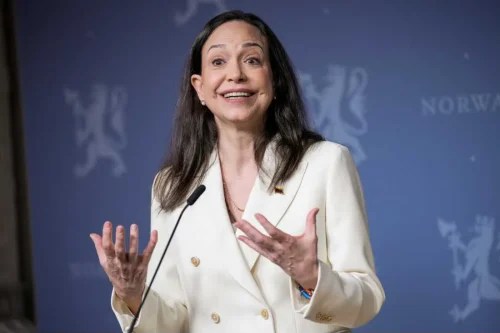
The Dissident | January 5, 2026
While the mainstream media has largely cheered on Trump’s kidnapping of Venezuela’s president, Nicolas Maduro, and regime change bombing in Venezuela, it has attacked him for his comments calming that the U.S. puppet opposition politician María Corina Machado has no popular support in the country.
For context, Trump said he will not install María Corina Machado as president of Venezuela because she “doesn’t have the support”.
This comment from Trump has caused the most backlash out of anything he has done or said in the mainstream media, with CNN’s Jim Sciutto, interviewing María Corina Machado’s advisor, who claimed she has “got the support from almost every Venezuelan,” and the Washington Post’s editorial board writing that Trump’s claim was “foolish”.
But in reality, poll after poll shows that Maria Corina Machado is despised by people in Venezuela.
A poll from the pollster Hinterlaces put out on October 8th of last year showed that, “91% of those consulted have an unfavorable opinion about the opposition leader María Corina Machado” in Venezuela and noted that this placed Machado as “the most unpopular, with a rejection rate significantly higher than the rest of the country’s political leaders.”
Another October poll from the polling firm Dataviva showed that, “86% of those consulted expressed disagreement with the award of the Nobel Peace Prize to María Corina Machado, pointing out that there are no merits or concrete actions that support that recognition”.
Yet another poll from September of last year showed that, “64.6% of Venezuelans maintain a negative opinion on the role played by the opposition led by María Corina Machado after a recent survey conducted by the Datanálisis poll. In contrast, only 18.6% expressed a positive assessment of its management.”
In reality, María Corina Machado’s role as a U.S.-funded puppet has been to publicly cheer on U.S. imperialism in Venezuela, which is opposed by the overwhelming majority of Venezuelans, no matter if they like Maduro or not, to give the false impression that Venezuelans will greet American intervention as liberation.
During Trump’s first term in office, 86% of Venezuelans Opposed Military Intervention and 81 percent opposed the US starvation sanctions on the country, while María Corina Machado – as journalist Michelle Ellner has documented – “worked hand in hand with Washington to justify regime change, using her platform to demand foreign military intervention to ‘liberate’ Venezuela through force” and “pushed for the U.S. sanctions that strangled the economy, knowing exactly who would pay the price: the poor, the sick, the working class.”
During Trump’s current war on Venezuela, polls show that “93% categorically reject any request or proposal for multifactorial aggression against Venezuela, considering it contrary to the peace, dialogue and independence of the country” while María Corina Machado – as documented by Wikileaks founder Julian Assange has repeatedly cheered on U.S. intervention, including by saying:
-5 December 2025, Machado on CBS Face the Nation: “I say this from Oslo right now, I have dedicated this award to [President Trump] because I think that he finally has put Venezuela in where it should be, in terms of a priority for the United States national security.”
– 30 October 2025, Bloomberg interview: “Military escalation may be the only way… the United States may need to intervene directly”
-October 2025, Fox News interview on U.S. military strikes on civilian vessels: “justified.”
-5 October 2025, interview in The Sunday Times on the U.S. military buildup and extra-judicial assassination strikes against civilian boats: Trump’s strikes are “visionary”. “I totally support his strategy.”
-9 February 2019, interview with EL PAÍS : Maduro will only leave “in the face of a real threat from a more powerful state.”
– February 2014, testimony before U.S. Congress: “The only path left is the use of force.”
The mainstream media’s freakout over Trump’s accurate comments about Maria Corina Machado is more to do with the fact that it exposes the truth that Venezuelans both who support and oppose Maduro, don’t want U.S. intervention in their country, and the false idea that Venezuelans are cheering on U.S. intervention only comes from deeply unpopular U.S. funded assets like Maria Corina Machado who are propped up in the mainstream to give this false impression.
US Strikes Leave Venezuelans Without Homes, Money to Pay for Funerals – Victim
Sputnik – 05.01.2026
CARACAS – A Venezuelan family living in a Caracas suburb has told Sputnik that they have been left homeless and without means of subsistence after US airstrikes.
“We have nowhere to live. We need to bury my aunt, but we also have no money for that — we are a poor family,” the 62-year-old man said.
The US attack partially destroyed the family’s home in the coastal state of La Guaira, north of Caracas, killing the 80-year-old woman.
Another Venezuelan, from the city of Catia La Mar near Caracas, told Sputnik that his elderly neighbor had been killed by a rocket fragment. The attack also destroyed the apartment building that was home to 17 families. He said Venezuelans were struggling to get over the shock caused by US strikes.
On January 3, the United States launched a massive attack on Venezuela, capturing President Nicolas Maduro and his wife, Cilia Flores, and taking them to New York. US President Donald Trump announced that Maduro and Flores would face trial for allegedly being involved in “narco-terrorism” and posing a threat, including to the United States.
Caracas requested an urgent meeting of the UN Security Council in response to the US operation. The Venezuelan Supreme Court appointed Vice President Delcy Rodriguez as the acting head of state.
The Russian Foreign Ministry expressed solidarity with the Venezuelan people, called for the release of Maduro and his wife, as well as for the prevention of further escalation. China called for the immediate release of the Maduros, emphasizing that US actions violated international law.
Oil tankers depart Venezuela in ‘dark mode’ amid US blockade: Report
The Cradle | January 5, 2026
About a dozen tankers loaded with Venezuelan oil and fuel departed the country in recent days, despite a blockade imposed by US President Donald Trump as part of the pressure campaign to depose Venezuelan President Nicolas Maduro, TankerTrackers.com reported on 5 January.
The US military launched an operation on Friday to abduct Maduro and his wife, bringing them to the US to face trumped-up drug trafficking charges in a New York court.
Four of the departed tankers recently left Venezuelan waters through a route north of Margarita Island, TankerTrackers.com revealed, after identifying the vessels in satellite images.
At least four of the tankers had been cleared by Caracas authorities in recent days to leave Venezuelan waters, a source with knowledge of the departures’ paperwork told Reuters. The tankers traveled in “dark mode” after switching off their transponders.
According to Reuters, Venezuela’s state-run oil company PDVSA had accumulated a very large inventory of floating storage amid the US blockade imposed by Trump last month, which had brought the country’s oil exports to a standstill.
The ability of the tankers, all of which are under US sanctions, to depart the country loaded with oil will provide relief for PDVSA, which was running out of storage capacity.
Oil provides Venezuela’s primary source of revenue, making the continued export of the country’s crude crucial for maintaining stability following the US regime-change operation.
Oil minister and vice president Delcy Rodriguez now leads the country in Maduro’s absence.
It was not immediately clear if the US allowed the tankers to depart Venezuela or if they managed to break the US blockade.
Trump claimed on Saturday that the “oil embargo” on Venezuela was still in force, but said Caracas’s largest customers, including China, would keep receiving oil as long as it was paid for using dollars, not yuan.
However, Maduro’s ouster will likely [???] lead Venezuelan oil to be rerouted toward the US and away from China moving forward.
“A smooth transition in Caracas will likely result in a rapid rerouting of Venezuelan oil exports, re-establishing the US as the major buyer of the country’s volumes,” Reuters wrote on Sunday.
Pro-Israel billionaire and Trump supporter Paul Singer is expected to be the largest beneficiary of the rerouting.
In November, a judge in the US District Court in Delaware awarded the assets of PDVSA’s US subsidiary, CITGO, to Amber Energy, which is funded by Singer’s Elliott Management.
Elliot Management paid just $5.9 billion for CITGO’s assets, which include oil refineries in Texas, Louisiana, and Illinois. Estimates of the actual value of CITGO’s assets are as high as $18 billion.
CITGO’s refineries in the US were custom-built to refine Venezuela’s heavy crude, meaning that due to Trump’s regime-change operation, Singer will now be able to purchase Venezuelan oil, refine it, and sell it as fuel in the US.
Jaime Brito, an oil analyst at OPIS, said access to Venezuelan oil imports “will be a game changer for US Gulf Coast … refiners in terms of profitability.”
Venezuela Invites Trump to Build Peace and Cooperation Instead of War
teleSUR | January 4, 2026
The Venezuelan interim president Delcy Rodriguez called the US government to move toward a “a balanced and respectful international relationship” and between Venezuela and the countries of the Region, based on sovereign equality and non-interference.
Rodriguez highlighted that sovereign equality and non-interference are the principles that guide the Venezuelan diplomacy with the rest of the world.
The interim president “Venezuela reaffirms its vocation for peace and peaceful coexistence. Our country aspires to live without external threats, in an environment of respect and international cooperation. We believe that global peace is built by first ensuring the peace of each nation.”
Rodriguez extends the invitation to the US government to work together on a cooperative agenda, “oriented towards shared development, within the framework of international legality and strengthen lasting community coexistence.”
“President Donald Trump: Our people and our region deserve peace and dialogue, not war. That has always been the predicament of President Nicolás Maduro and it is the one of all Venezuela at this moment,” says Rodriguez.
The Constitutional Chamber of the Supreme Court of Justice ordered that Vice President Delcy Rodríguez assume the presidency of Venezuela to ensure administrative continuity and the defense of the nation, after a foreign military aggression that resulted in the abduction of President Nicolás Maduro.
The Constitutional Chamber of the Supreme Court of Justice of Venezuela, based on articles 234 and 239 of the Constitution, made a systematic interpretation to determine the applicable legal regime that guarantees the administrative continuity of the State and the defence of the nation against the forced absence of the president, considered as a material and temporary impossibility to exercise his functions.
Featured Video

Racist Seinfeld Dances for Joy as Bibi Unveils His New Map
or go to
Aletho News Archives – Video-Images
TV Drama Review
Japanese drama projects Japan’s wartime atrocities onto Chinese characters

Global Times | October 25, 2026
By portraying Chinese characters as perpetrators of ruthless violence while casting Japanese Self-Defense Forces (SDF) intelligence operatives as defenders, the season 2 of the Japanese drama Vivant has recently drawn criticism from Chinese netizens, who argue that its depiction turns historical reality on its head while ignoring Japan’s wartime atrocities.
The TBS drama series – a spy suspense story in which an alleged unofficial intelligence unit of the SDF operates across the globe — has attracted a passionate fanbase. Its currently airing season 2 opened with a household rating of 18.8 percent, the highest for a TV drama this year, according toa commentary article by Japanese media Toyo Keizai.
What draws attention is the portrayal of the enemies in the series, the article noted. Scenes in which the Chinese organization subjects kidnapped members of the SDF unit to brutal torture are repeated with unrelenting intensity.
It is rare for Japanese TV dramas to explicitly portray a real-life country as the enemy, the article noted.
Japanese Prime Minister Sanae Takaichi also made a reference to the drama, saying that she has been recording Vivant and hopes to binge-watch it over the year-end and New Year holidays, according to Japanese media outlets.
China’s CCTV News report on Sunday revealed that the drama features scenes in which Chinese personnel cut off the fingers of and stab Japanese intelligence operatives in the abdomen. Such acts bear striking similarities to the torture inflicted on Chinese nationals by invading Japanese troops during the World War II.
The drama distorts the truth by attributing these atrocities to modern Chinese characters. Beneath the surface, it subtly glorifies Japan’s cross-border overseas operations, blurs the functional boundaries of the SDF and implicitly promotes an expansionist narrative, per CCTV News. … continue
Blog Roll
 Aletho News
- EU facing trillion-euro debt hole while seeking more cash for Kiev
- How US, Europe, Persian Gulf states exhausted missile stockpiles, splurged billions to defend Israel
- Up in arms… Koreans reject U.S. empire’s plan to make South Korea the next Ukraine
- Iran, Turkey, Pakistan, Saudi Arabia could advance region-led security framework in Tehran: FM spox
- Netizens condemn Japanese drama for projecting Japan’s wartime atrocities onto Chinese characters
- Racist Seinfeld Dances for Joy as Bibi Unveils His New Map
- A West Bank War for Netanyahu’s Election Campaign, Could It Backfire?
- Yemen denounces European Parliament’s ‘hypocritical’ push to blacklist Ansarullah
- Qalibaf: UAE’s UN bid aims to ‘clear the runway’ for ‘Greater Israel’, whitewash genocide
- Pakistan reopens Iran border after boosting security: Report
- If Americans Knew
- An error has occurred; the feed is probably down. Try again later.
- No Tricks Zone
- Sudden Stratospheric Warming, Powerful El Niño Combination May Lead To Extreme Europe Cold, Energy Crisis!
- Two New Studies Find Thwaites Glacier Melt Cannot Be Driven By Human Activity Or A Warming Ocean
- E-Cars Reduce CO2 Emissions By Only 41% Compared To Internal Combustion Engine Vehicles
- Predictions Made By Renowned Climate Professor Over Past Decades Have Been Proven To Be Poor
- New Study Suggests Large Regions Of The Pacific Ocean Have Been Cooling For The Last 80 Years
- Germany’s Green Energy Debacle: High Energy Costs Force Kahla Porzellan to Close After 182 Years!
- New Study: 50 Years Of The Most Aggressive ‘Net Zero’ Policies Can Only Affect The Global Climate By 0.03°C
- US September “Heat” Was No Record…Many Records Set Decades Ago
- Latest European Green Energy Debacle; Portugal’s Largest Flagship Solar Park Insolvent!
- Green Energy Debacle: German Expert Professor Fritz Vahrenholt Warns Of Severe Economic And Social Consequences

