Piñera Praises Chávez at CELAC Summit
Media Influences Public Opinion on Venezuela But Not So Much Governments
By Mark Weisbrot | CEPR Americas Blog | January 29, 2013
In writing about the media’s ongoing hate-fest for Hugo Chávez, I pointed out that the major media’s reporting had been effective, in that it has convinced most consumers of the Western media – especially in the Western Hemisphere and Europe – that Venezuela suffers from a dictatorship that has ruined the country.
But there is an important sense in which it has failed. Of course it has failed to convince Venezuelans that they would be better off under a neoliberal regime, and that is one reason why Chávez and his party have won 13 of 14 elections and referenda since he was first elected in 1998. Perhaps of equal importance, it has also failed to persuade other governments that President Chávez is motivated by some kind of irrational hatred of the U.S. – as the media generally reports it. Most foreign ministries have some research capacity, and although they are influenced by major media, at the higher levels they have better information and make their own evaluations.
That is why Chávez has been able to play a significant role in the growing independence and regional integration of Latin America, despite his vilification in the media, and years of effort by the U.S. government to isolate Venezuela from its neighbors. For example, the governments that decided to form the Community of Latin American and Caribbean States (CELAC) – a new hemispheric organization including all countries other than the U.S. and Canada – don’t care whether the media dismisses it as “Chavez’s project.” When Brazil, Argentina, and Uruguay decided to admit Venezuela as a full member of the trading bloc Mercosur, they didn’t care what the media in any of their respective countries would say about it.
Of course the left governments of Argentina, Brazil, Ecuador, Bolivia, Uruguay and others have been quite sympathetic to Chávez and see him as a very important ally. But the region has changed so much in the last 10 or 15 years that it is not only the left governments who appreciate him. Here is what one of the only remaining right-wing presidents in South America, Sebastián Piñera of Chile, said on Sunday about Chávez, in Santiago:
I want to acknowledge a President who is not with us today, but whose vision, tenacity and strength has had a profound impact on the creation of the CELAC. I refer to President Hugo Chávez, the father of this regional group that welcomes all nations of Latin America and the Caribbean, 33 in all, and which excludes only two countries on the continent: the United States and Canada. We are all hoping for you to win this battle, perhaps the toughest battle of your life, which you are doing with the same strength and courage as always, and that you regain your health and that you can return in full capacity as President of Venezuela.
Back in 2006, the New York Times ran a front-page news article with a large-type headline: “Seeking United Latin America, Chávez is a Divider.” The thesis was being pushed by the Bush State Department, and was echoed by the anti- Chávez sources cited in the article.
How completely wrong they turned out to be.
Related articles
- CELAC Strengthened by Second Annual Summit (venezuelanalysis.com)
- Cuba takes over presidency of regional group Celac (morningstaronline.co.uk)
- Venezuela wants best of relations with the US based on ‘mutual absolute respect’ (alethonews.wordpress.com)
World Bank and IMF Forecasts Follow Predictable Pattern for Haiti, Venezuela
By Arthur Phillips and Stephan Lefebvre | CEPR Americas Blog | January 28, 2013
The World Bank has joined the “doom and gloom” chorus on Venezuela’s economy. And in Haiti, the Washington-based institution again appears overly optimistic.
On Tuesday, January 15, the World Bank released its latest global economic forecast, which projects 2013 global GDP growth at 3.4%, up 0.4% from its preliminary estimate for 2012 and down a half a percentage point from its previous forecast in June. The Bank emphasized that the low rates were largely a result of sluggish growth in the U.S. and Europe. As for Latin America and the Caribbean, the regional predicted growth for 2013 is listed at 3.6%, up more than half a point from the estimated figure for 2012.
As with many media commentators over the past few years, the World Bank predicts that Venezuela’s economic recovery from the global recession cannot hold up. The Bank forecasts 1.8% growth in 2013, a sharp drop from an estimated 5.2% last year. Since the Venezuelan economy is not slowing, there is no obvious reason to predict a collapse in economic growth.
Furthermore, we can see that the projection numbers follow a trend. Both the World Bank and the IMF have been consistently underestimating growth projections in Venezuela.


Meanwhile, in Haiti the Bank predicts a sharp jump in GDP growth, from 2.2 to 6.0 percent, while the IMF has forecast growth at 6.5%. When we compare these numbers to those of previous years, we can see the opposite trend of that in Venezuela. All the projections for 2012 overestimated growth by well over 5 percentage points.


It is unclear why both the IMF and the World Bank have projected such high growth for Haiti considering the many severe challenges facing the country in the wake of the 2010 earthquake. As we have noted on an ongoing basis over the past three years, major international donor funding has been slow to materialize, progress on housing, water, sanitation and other infrastructure has been minimal, and there have been few examples of improvements that would suggest an upsurge in growth is on its way. There has been even more bad news in the wake of Hurricane Sandy at the end of October, which devastated crops and left 2.1 million people “food insecure.” The World Bank and IMF’s projections of 6 percent or higher GDP growth in 2013 seem unfounded.
The IMF’s pessimistic growth projections for Venezuela fit a pattern going back several years. GDP growth forecasts for Argentina were off by 5.0, 5.2, and 4.3 percentage points for the years 2004-2006, and for Venezuela they were off bya gigantic 10.6, 6.8 and 5.8 percentage points in the same years. These patterns suggest a politicization of the IMF’s projections for certain countries, since the Fund was consistently overly optimistic on Argentina’s growth in the years that the Argentine government was still following the IMF’s policy recommendations.
Related articles
Venezuela’s Chavez “Entering New Phase” of Recovery
By Ewan Robertson | Venezuelanalysis | January 21, 2012
Mérida – Venezuelan President Hugo Chavez is entering a new phase of his recovery, according to Vice President Nicolas Maduro.
Chavez has been out of the public light since his cancer operation in Cuba in December, his fourth in eighteen months.
Recent health updates from the Venezuelan government have sent positive signals, with the latest official communication describing the Venezuelan president’s recovery as “favourable”.
Yesterday, Vice President Maduro announced that Chavez was “leaving the post-operatory [phase] and is going to enter into a new phase of treatment that is in a process of evaluation”.
He further commented that Chavez “is stabilising in all respects, the functioning of his organs, he is fully conscious, and he has ever more vital strength to enter the next phase, which will be announced by official sources”.
Last Friday, a group of doctors called “Doctors for Life” released a medical report in which they claimed to “refute various versions that have been propagated about Chavez’s clinical state” in national and international media outlets.
The report, which was posted on the webpage of the government’s ministry of communication, claimed that Chavez was entering a “final recovery phase” and that by 5 February he would be ready to leave hospital. It further stated that the “complex abdominal surgery” undergone by Chavez was only performed on patients “without metastasis”.
In further comments about Chavez yesterday, Maduro said that “sooner rather than later we’re going to have the president with us, meanwhile…here (in Venezuela) there is a work team that he has formed and is governing and working with the people”.
Speaking in an interview on the television program “Jose Vicente Today”, the Vice President added that in his conversations with Chavez, “His mood is the same as always… He’ s still got his good humour and permanent smile”.
Opposition cancel march
Meanwhile, the Venezuelan opposition have cancelled their planned march in Caracas this Wednesday.
The march was called to protest a supposed “violation” of the constitution, which the opposition claim occurred when Chavez did not return to Venezuela for his presidential inauguration ceremony on 10 January. The Supreme Court had previously ruled that the delay in Chavez’s swearing-in was legal.
The opposition’s Democratic Unity (MUD) coalition blamed the cancellation on the decision of pro-government parties and movements to also march in the capital on Wednesday, accusing the government of “attacking the freedom that all Venezuelans have to celebrate such an important date for democracy”.
The opposition will still hold a downsized indoor event in Caracas on Wednesday 23 January, a date which marks the fall of the Marcos Jimenez dictatorship in 1958.
Meanwhile, the pro-Chavez movement is planning to hold a huge rally in Caracas to celebrate the day and to support their leader, as well as holding events around the country.
Juan Carlos Dugarte, a leader in the government’s United Socialist Party of Venezuela (PSUV), argued that the opposition’s motives for cancelling their march had more to do with fears of a low turnout.
“They (the opposition) have every right and freedom to demonstrate, no march of theirs is going to be obstructed. The true reason for doing it in a reduced space is that they don’t have the mobilisation capacity, because they’re divided,” he said.
Conflict Erupts at OAS over Venezuela’s Constitutional Debate
By Chris Carlson | Venezuelanalysis | January 17th, 2013
Punto Fijo – The controversy surrounding Venezuela’s constitution and the delaying of Venezuelan President Hugo Chavez’s swearing-in became a point of contention at a meeting of the Organization of American States (OAS) in Washington yesterday.
Panama’s ambassador to the OAS, Guillermo Cochez, sharply criticized OAS General Secretary José Miguel Insulza for accepting the ruling of Venezuela’s Supreme Court to delay Chavez’s swearing-in.
The government of Panama rejected Cochez’s statements today and dismissed him from the OAS, according to the ambassador himself.
Insulza stated last week that the OAS would fully respect the decision of the Venezuelan Supreme Court and would not consider taking any action regarding the matter.
Cochez rejected this position, comparing Venezuela to a “classic dictatorship”, and said that although the Chavez government was democratically elected, a “lack of independent institutions” makes it a “sick democracy”.
Cochez went on to accuse the OAS and its member states of being “accomplices” to a violation of the Venezuelan constitution, and suggested that if nothing is done the Organization of American States should consider permanently closing down.
The Panamanian ambassador’s intervention led to a number of responses from member nations, including some very strong remarks from Venezuela’s ambassador to the OAS, Roy Chaderton, who accused Cochez of intervening in Venezuela’s internal affairs and receiving instructions from the Venezuelan opposition.
“You write and comment in Venezuelan media against President Chavez at every opportunity, especially on that nest of media delinquents known as Globovision, and with all the freedom guaranteed by Venezuelan democracy,” said Chaderton.
The Venezuelan ambassador accused Cochez of meeting and conspiring with right-wing factions seeking to overthrow the Venezuelan government, including individuals like Roger Noriega and Venezuelan bank executive Pedro Mario Burelli, who was present at the OAS meeting as a guest of the Panama delegation.
Several Latin American countries quickly responded in favor of Venezuela, and rejected any type of intervention on the part of the OAS.
Brazil, Bolivia, Nicaragua, Ecuador, and Argentina all intervened in support of Venezuela, and rejected the comments made by Panama’s ambassador.
“Venezuela’s democratic order is perfectly guaranteed,” said the Brazilian ambassador, assuring that the situation was “an internal matter”.
Canada, on the other hand, suggested sending an OAS delegation to Venezuela to evaluate the situation, however Insulza said that any decision to take action would have to wait until a future meeting since it was not a part of the agenda of yesterday’s meeting.
Shortly after the meeting, the government of Panama also rejected the intervention made by their ambassador.
“The government of Panama categorically rejects the unauthorized declarations made by Panama’s Ambassador to the OAS,” said an official communiqué released by the government.
Panama assured that the position taken by Cochez was “far from the position of the national government,” and said that Panama would “continue to respect the internal political process” in Venezuela.
Chaderton attributed the Panamanian’s intervention to an attempt by Venezuela’s opposition coalition MUD of attempting to force a type of OAS intervention in Venezuela.
“It is an embarrassment that the MUD tries to use their friends in the OAS to get them to intervene in Venezuela,” he said.
Opposition Student Protests
The OAS decision to respect the Venezuelan Supreme Court ruling was also the motive of a minor protest in Caracas yesterday.
A group of students marched to OAS headquarters to demand the organization reconsider their position on the situation in Venezuela.
“Just because the three branches of government have ratified the decision does not mean that it is constitutional,” said one student to private channel Globovision.
Both the opposition and government supporters have planned major marches for next Wednesday, January 23rd as part of the controversy surrounding Venezuela’s constitution.
Related article
- The Guardian vs. the Conventional Wisdom on Venezuela (venezuelanalysis.com)
Hugo Chavez: Why Does He Hate Us?
By Peter Hart | FAIR | January 11, 2013
If there’s one thing media want you to know about Venezuelan president Hugo Chavez, it’s that he doesn’t like the United States. On the PBS NewsHour (1/10/13), Ray Suarez told viewers that Chavez
antagonized Washington, it seemed, whenever he could, forging friendships with Iran’s Mahmoud Abbas (sic), Syria’s embattled Bashar al-Assad, and he formed an especially close bond with Cuban Presidents Fidel and Raul Castro.
 On the CBS Evening News (1/8/13), Scott Pelley said:
“Chavez has made a career out of bashing the United States and allied himself with Iran and Syria.”
While it’s hard to say Chavez has made a “career” out of U.S.-bashing–he does have, after all, a full-time job as president of Venezuela–you, too, might be excused for harboring some hard feelings towards a government that helped to try to overthrow your own. Which may be why U.S. reports rarely bring up the 2002 coup attempt–and when they do, treat Washington’s involvement in it as another nutty Chavez conspiracy theory.
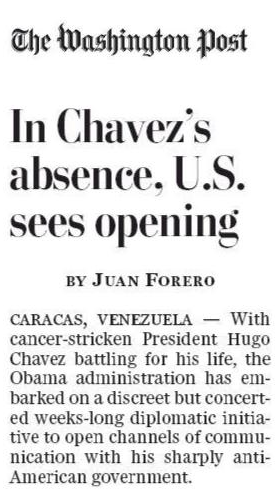
Here’s Juan Forero in the Washington Post (1/10/13):
A central ideological pillar of Chavez’s rule over 14 years has been to oppose Republican and Democratic administrations in Washington, which he accuses of trying to destabilize his government.
“I think they really believe it, that we are out there at some level to do them ill,” said Charles Shapiro, president of the Institute of the Americas, a think tank in San Diego.
As ambassador to Venezuela from 2002 to 2004, Shapiro met with Chavez and other high- ranking officials, including [Vice President Nicolas] Maduro. But the relationship began to fall apart, with Chavez accusing the United States of supporting a coup that briefly ousted him from power. U.S. officials have long denied the charge.
Shapiro recalled how Maduro made what he called unsubstantiated accusations about CIA activity in Venezuela, without ever approaching the embassy with a complaint. He said that as time went by, the United States became a useful foil for Chavez and most Venezuelan officials withdrew contact.
“A sure way to ruin your career, to become a backbencher, was to become too friendly with the U.S. Embassy,” Shapiro said.
So Venezuela has a strange political culture where being friendly with the U.S. government gets you in trouble.
The Post airs Chavez’s charge–and then the U.S. denial. But the United States had all sorts of contact with the coup plotters before they made their move against Chavez in 2002. According to the State Department (7/02):
It is clear that NED [National Endowment for Democracy], Department of Defense (DOD) and other U.S. assistance programs provided training, institution building and other support to individuals and organizations understood to be actively involved in the brief ouster of the Chavez government.
And the CIA, as was reported by Forero himself (New York Times, 12/3/04), knew of the coup plotting.
The Central Intelligence Agency was aware that dissident military officers and opposition figures in Venezuela were planning a coup against President Hugo Chávez in 2002, newly declassified intelligence documents show. But immediately after the overthrow, the Bush administration blamed Mr. Chávez, a left-leaning populist, for his own downfall and denied knowing about the threats.
Scott Wilson, who was the Washington Post foreign editor at the time, told Oliver Stone for his film South of the Border:
Yes, the United States was hosting people involved in the coup before it happened. There was involvement of U.S.-sponsored NGOs in training some of the people that were involved in the coup. And in the immediate aftermath of the coup, the United States government said that it was a resignation, not a coup, effectively recognizing the government that took office very briefly until President Chavez returned.
And we know that the United States made quick efforts to have the coup government recognized as legitimate. The Bush government, immediately after the coup, blamed it on Chavez. And some of the coup plotters met with officials at the U.S. embassy in Caracas before they acted.
But the important thing for readers to know, according to Wilson’s successors at the Washington Post, is that U.S. officials deny they supported anything.
Why Latin America Will Not Bow to US Pressure over Iran
By Yusuf Fernandez | Al-Manar | January 11, 2013
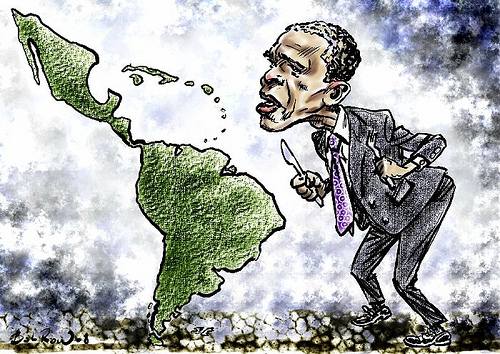
On December 28, US President Barack Obama enacted the so-called “Countering Iran in Western Hemisphere Act” which seeks to undermine Iran´s growing relations with Latin America, a region that has traditionally seen by the United States as its backyard and sphere of influence.
The Act, passed by congressmen earlier this year, requires the US Department of State to develop a strategy within 180 days to “address Iran´s growing hostile presence and activity” in Latin America. The Act points out that “Iran´s business and diplomatic ties are a threat to US national security”. It is seen, however, as another anti-Iranian move fabricated by the Zionist lobby in the US.
Shortly before, in July 2011, Robert F. Noriega – former Assistant Secretary of State for Western Hemisphere affairs, former US ambassador to the Organization of American States (OAS) and current Visiting Fellow at the American Enterprise Institute, one of the main neoconservatives -controlled entities in the US – said in a hearing before the House Subcommittee on Counterterrorism and Intelligence that Iran was carrying out “an offensive strategy” in Latin America.
The Iranian presence in the Latin America has also been harshly attacked by the pro-Israeli hawk Ileana Ros-Lehtinen, Foreign Affairs Committee Chairman and self-appointed bulwark against the alleged “Islamo-Boliviarian threat” to US security. She was co-star of a so-called “documentary” entitled “La amenaza iraní” (The Iranian Threat), in which she said, without blushing, that the US should attack Iran in order to “avert bomb explosions in various Latin American capitals”. The film was aired by Univision, a US broadcast network, which is owned by someone who has hosted galas in honour of the occupying Israeli army.
In 2009, another ridiculous “documentary” released by Univision involved the Venezuelan consul in Miami, Livia Acosta, in an absurd cyber-plot against the US allegedly promoted by “Iranian diplomats and Mexican computer hackers”. This was the pretext used for expelling her from the United States in a move that was widely seen as an American political revenge for Venezuela´s independent foreign policy.
Actually, the US Act rudely violates Latin American countries´ sovereignty and contains some stupid claims such as that the opening of Iranian embassies or cultural centers is to “spread terrorism”. Former Defense Secretary Leon Panetta also echoed those views by claiming, in a recent visit to Colombia, that Iranian attempts to expand its influence in South America amounted to expanding terrorism. Of course, no real evidence has ever been shown to support that laughable allegation.
“The paranoid nature of these estimations, and the scant evidence presented for them, are eerily reminiscent of the kind of broad-strokes, hawkish fear-mongering on display in the lead up to the war in Iraq. The testimony comes from a group bent on hyping security threats and, as Noriega admitted in the testimony, is not even in agreement with the State Department or intelligence agencies”, wrote John Glaser in a recent report.
The US accusations against Iran are also a way of targeting and casting suspicion on Latin American Muslims. In the Act, Washington speaks of “isolating Iran and its allies” and US officials accuse Iran or other pro-Iranian forces of “establishing mosques or Islamic centers throughout the region” in order to advance violent jihad “on our doorstep”.
US declining influence in Latin America
However, Latin American people know well that for over a hundred years it was the United States, and not another country, which wrought terror, war, poverty and repression throughout Latin America in the form of CIA-orchestrated military coups and support of paramilitary crimes, terrorism and dictatorial regimes. Military personnel found guilty of the worst violations of human rights in Latin American countries were trained in the notoriously famous School of Americans by US officers.
Actually, the Act is more evidence that US influence in Latin America is rapidly waning. Latin American countries have developed their own policies and set up independent blocks -ALBA, UNASUR and CELAC- while the Organization of American States, which includes the US and Canada, has been declining due to its submission to US policies on issues such as Cuba´s participation in its summits.
Iran has been seeking to increase its relations with Latin America in a bilateral way and in the framework of the Non-Aligned Movement and other international organizations. This has irritated Washington, which still seems to consider Latin American countries as vassals not having the right to pursue an independent foreign policy or seek its own friends and partners. Any agreement between Latin American states and Iran –or Russia and China- always arouses suspicion in the US.
Several Latin American countries have enhanced their diplomatic and trade ties with Iran in recent years, while their relations with the US have been downgraded amid popular demands for an end to dependence on Washington. Although the United States is still the largest economic partner of many Latin American countries, its economic and financial crisis has adversely affected them. This has led some nations, such as Mexico, to announce their intention to diversify their commercial partners in the next years.
As an international partner, the Islamic Republic is one of the best positioned to help Latin American countries develop their economies and their scientific and technological skills in many fields. The Iranian industry is highly developed. It has remarkable expertise in oil and gas exploitation and other sectors including health, defence, agriculture and space technology.
Iran has helped Venezuela build unmanned drone aircraft as part of their military cooperation. Referring to a Spanish media report that US prosecutors were investigating drone production in Venezuela, President Hugo Chavez said: “Of course we are doing it, and we have the right to. We are a free and independent country.”
In a televised speech to military officers at Venezuela´s Defense Ministry, Chavez said the aircraft only had a camera and was exclusively for defensive purposes. He said that Venezuela planned to soon begin exporting the unmanned drone. Moreover, Iran and Venezuela have mutual investments of about $ 5 billion in factories to make cement, satellites and tractors and the Iranians have helped the Latin American country build 14,000 houses.
Tehran has forged significant economic and political relations with the government of Evo Morales in Bolivia and with that of Rafael Correa in Ecuador. Iran´s links with Argentina, where Zionist circles have unsuccessfully tried to blame Iran for the AMIA attack in 1994, are also rapidly improving, as the government of President Cristina Fernandez is promoting a more conciliatory line towards Tehran.
Latin American countries, especially those that follow an independent foreign policy, trust Iran because they know that the Iranians cannot be pressured into betraying an agreement that disturbs the US or its allies. This is a main reason of Iran´s rising popularity in Latin America despite the propaganda of Zionist-owned media outlets and the US political and diplomatic actions.
HispanTV, the Spanish-language channel similar to the English-language Press TV channel, is also feared by the US establishment and Zionist circles because it is giving Latin American audiences accurate information about the Middle East and international developments that exposes the lies of Zionist-controlled agencies and media. The recent expulsion of Hispan TV from the Spanish-owned Hispasat channel is, in this sense, a desperate attempt to prevent the channel from reaching mass audiences. However, this move, as other similar ones in the past, is doomed to failure.
Therefore, Latin American nations won´t allow the US to dictate their foreign policy on the issue of their relations with Iran or any other country. In fact, Washington has already had a sign of this when it tried to pressure these countries to vote against Palestine’s bid to gain the status of a non-member state at the United Nations. Only one country, Panama, whose government has strong links with the Zionist entity and the local Zionist lobby voted against it.
Related articles
- US, Israel instill fears over Iran’s growing influence in Latin America (alethonews.wordpress.com)
- Ecuador to maintain foreign policy, ties with Iran: FM (alethonews.wordpress.com)
Delay in Chavez inauguration possible: Venezuelan Supreme Court
Press TV – January 9, 2013
The Venezuelan Supreme Court says President Hugo Chavez can legally postpone the Thursday inauguration as the current government remains in power.
On Wednesday, Supreme Court President Luisa Estella Morales, following a unanimous decision by the panel, also ruled out medical checks for the president’s scheduled inauguration ceremony.
“The oath-taking of the re-elected president can be carried out at a time after January 10 before the Supreme Court, if it is not done on the said day before the National Assembly,” the ruling said.
As the president has been recovering from an illness and the government would be renewing its term, Morales said, “there is not even a temporary absence” of Chavez from taking the oath.
Until Chavez recovers, current government officials “will continue fully exercising their functions under the principle of administrative continuity,” it said.
Opposition groups of the government earlier on Wednesday requested the Supreme Court to decide on the ruling.
The ruling comes as government officials pointed out the constitution allows the court to swear in a new president without a time limitation for a leave of absence, which the congress voted for on Tuesday.
The Supreme Court’s decision comes as Chavez continues to gain support from South American allies.
Foreign Policy Advisor to the Brazilian President, Marco Aurelio Garcia, on Tuesday said that — on behalf of Brazilian President Dilma Rousseff — Brazil supports the postponing of the inaugural ceremony.
Chavez, who first came to power in 1999, was re-elected to a new six-year term in October, 2012. However, a month before the planned inauguration he underwent a fourth round of cancer surgery in Cuba’s capital Havana.
The full text of the Supreme Court decision can be read here (in Spanish).
Related articles
- Venezuelans Continue to Defy the Washington Post
- Exposing Five Key Media Myths about Chavez’s Health and Swearing-in
- Venezuela Among the Most Positive Countries, Gallup Says
- Venezuela’s Economy Grows by 5.5 Percent in 2012
- There is an alternative: what Venezuela can teach us about the banking sector
- Economic BS in Rich Countries is Reinforced by BS about Venezuela
- The Achievements of Hugo Chavez
Venezuelans Continue to Defy the Washington Post
By Peter Hart | FAIR | January 8, 2013
The Washington Post has never been fond of left-wing Venezuelan President Hugo Chavez. As serious questions mount about the state of Chavez’s health, the paper’s editorial page (1/5/13) found it a good time to take another swipe:
Venezuelans are bracing themselves for the death of the caudillo who has ruled them–and wrecked their once-prosperous country–over the past 13 years.
Economist Mark Weisbrot has a different take. In a “Room for Debate” discussion at the New York Times (1/4/13), he writes:
Since Hugo Chávez first took office, he and his party have won 13 of 14 national elections, mainly because they greatly improved the living standards of the majority of voters in Venezuela. Since 2004, after the economy recovered from the devastating opposition oil strike, poverty has been cut by half and extreme poverty by more than 70 percent.
Weisbrot goes on to show some of the other ways Venezuelans’ lives have improved in the Chavez years, adding:
These numbers are not really in dispute among economists or international statistical agencies. If you follow Venezuela and haven’t heard any of this, it’s because the news media is giving you the equivalent of a “tea party” view of the country.
So there’s maybe a chance that Venezuelans don’t think Chavez “wrecked” their country at all–unless you think reducing poverty and income inequality are bad things. To the Post, the fear seems to be that Venezuelans will remember this after Chavez’s passing:
Sadly, the economic pain caused by Mr. Chavez could, after his death, help create a political movement that will revere his memory.
Their point is that Chavez’s policies will force the next government to oversee harsh austerity policies to correct Chavez’s supposed mistakes. But Venezuelans might actually “revere” Chavez for the same reason they voted for him: His policies worked for the majority of the population. And that doesn’t sit well with the Washington Post.
Exposing Five Key Media Myths about Chavez’s Health and Swearing-in
By Ewan Robertson and Tamara Pearson | Venezuelanalysis | January 8th 2013
Over the last few weeks the private English media has stepped up its campaign against the Venezuelan revolution, spreading a number of lies and misconceptions around President Hugo Chavez’s health, the politics and legalities involved in his swearing-in for his new term, and the Venezuelan government’s handling of the situation. […]
Here, Venezuelanalysis.com debunks the top five lies currently being spread by private media.
1) The Venezuelan government is being secretive about Chavez’s health
This charge has been made by international media since Chavez first announced he had cancer in June 2011. Criticisms by the private media of government “secrecy” around his condition have intensified as the swearing-in date approaches, in part reflecting an increasingly fractious Venezuelan opposition anxious for details they could use to their advantage.
Mass media sources describe Chavez’s medical condition as “a mystery”, with outlets such as the Los Angeles Times referring to government information on Chavez’s post-operatory recovery as “sporadic and thinly detailed medical updates”. Outlets such as the British BBC and the Australian have picked up the opposition’s call for the Venezuelan government to tell the “truth” on Chavez’s health, implying that the government is withholding information, or outright lying.
The argument that the Venezuelan government is keeping secrets feeds into the discourse most mainstream media use in relation to the Bolivarian revolution, recently describing the government as “despots” (Chicago Tribune) and “autocratic populists” (Washington Post).
Other media has put out its own versions of Chavez’s state of health, with the Spanish ABC going to great lengths to describe even his bowel movements, and reporting that he is in a coma, and the multinational Terra mistaking its desires for reality, reporting that Chavez is already dead. These media outlets have just one “anonymous” source for their reports; they somehow, apparently, have an infiltrator (or an “intelligence source” as they call it) among Chavez’s Cuban medical team.
The government has in fact released 28 statements updating the public on Chavez’s condition since his operation on 11 December, an average of around 1 per day. These statements are available in full text on the internet, and are also being read out by communication minister Ernesto Villegas on all Venezuelan public television and radio.
In the latest statement, released yesterday, Villegas said that Chavez’s condition remains “stationary” compared to the last report, where the public was informed that he has a respiratory “deficiency” due to a pulmonary infection.
It is true however, that beyond mentioning the general cancer site; the pelvic region, the government hasn’t revealed the exact type of cancer that Chavez has, nor the exact nature of the operation that he underwent on 11 December. This is possibly due to privacy reasons.
When asked directly about this issue in a recent interview, Jorge Rodriguez, a doctor and key figure in Chavez’s United Socialist Party of Venezuela (PSUV), said “I’d give the example of Mrs. Hilary Clinton, who had a cerebral vascular accident. There are three factors which influence these cases: the part of the brain where it happens, the size of the affected zone, and if it produces a hemorrhage or obstruction. Well fine, I’ve not seen any serious and decent doctor ask in which zone she had the lesion. And I think it’s fine that they don’t ask because that lady has the right to privacy. I’ve not seen Ramon Guillermo Aveledo (the executive secretary of the opposition’s MUD coalition) asking to know if her accident affected her in the frontal lobe, in which case, of course, she couldn’t continue giving the instructions she normally gives”.
Of course, when the international media report on the Venezuelan opposition’s stance towards Chavez’s health situation, they invariably fail to mention that the opposition’s approach has a lot less to do with a crusade for truth, and more to do with its hopes of creating a political and constitutional crisis over the issue. They make out that the Venezuelan government is being deliberately misleading and manipulative with information, but would never point the finger at Western leaders such as George Bush or Barack Obama for not announcing the exact locations of their frequent, long, and luxurious vacations, for example.
2) It is unconstitutional if Chavez doesn’t take the oath of office on 10 January
This is another lie that takes a leaf straight from the opposition’s book. Most opposition leaders, and even the Venezuelan Catholic Church, are arguing that if Chavez cannot be officially sworn-in as president on 10 January then he will lose his status as president of Venezuela. They say that in that case, Chavez should be declared “permanently absent”, and the head of the national assembly, Diosdado Cabello, would have to take over as president and call fresh elections. The opposition also claim that the swearing-in ceremony cannot be postponed, and that if Chavez continues on as president after 10 January it would be a “flagrant violation of the constitution”. Their strategy is to use their own interpretation of the constitution in order to try and depose Chavez on a technicality while the president-elect lies in Cuba struggling in post-surgery recovery.
Private media outlets have latched onto this argument, and misinformed about the Venezuelan constitution. In a highly misleading article, the Washington Post claimed that a delay in Chavez’s inauguration ceremony would be “a stretch of the constitution’s ambiguous wording”. Similar comments were made in other U.S. outlets, with Time arguing that Venezuela’s constitution is “a murky map that could send the western hemisphere’s most oil-rich nation into precarious governmental limbo this year”. Reuters argued that the Venezuelan government is “violating the constitution” and the country will be “left in a power vacuum”, and the BBC, which maintained a more reserved tone, still portrayed interpretations of the constitution as muddied debate between government and opposition.
However, Venezuela’s constitution is clear on the situation. The conditions under which a president can be declared permanently absent and new elections called are covered by article 233, and are, “death, resignation, destitution decreed by the Supreme Court, mental or physical incapacity certified by a medical council designated by the Supreme Court with the approval of the National Assembly, abandonment of the post, [or] a popular recall of the mandate”.
Currently Chavez’s status is that of “absence from the national territory”, a status which is granted by the national assembly. This could eventually be declared a “temporary absence” from the presidency, which is granted by the national assembly for a period of ninety days, and can be extended for 90 further days, as outlined by articles 234 and 235 of the constitution.
What the opposition are trying to do is use article 231 of the constitution, which describes the presidential inauguration, to argue for Chavez’s deposal. The article states that the president elect “will assume their mandate on the 10th of January of the first year of their constitutional period, through a swearing-in ceremony in front of the National Assembly”. The opposition claim that Chavez’s inability to attend that ceremony means that he has not assumed his term and his “permanent absence” should be declared. However, as noted above, not being able to attend the inauguration ceremony is not considered a reason for “permanent absence” in the Venezuelan constitution, leaving the Venezuelan opposition without a constitutional leg to stand on.
Rather, this situation is dealt with by the second half of article 231, which states, “If for any supervening reason the president cannot take office in front of the National Assembly, s/he will do so before the Supreme Court”. No date is specified.
Venezuelan constitutional lawyer Harman Escarra, an opposition supporter who helped draft the 1999 constitution, explained in an interview with Venezuelan daily Ciudad CCS that constitutionally, even if the president can’t attend the 10 January ceremony, the new presidential term still begins, including the constitutional mandate of the president’s council of state, the vice-president, and government ministers. As such, he affirmed that in Venezuela “there isn’t a power vacuum”.
The constitutional lawyer further explained that under both the letter and spirit of article 231 of the constitution, “The President, from the point of view of sovereignty, is the President. There’s no other, and the mandate of the popular majority cannot not be overturned because of the issue of a date at a specific moment, because that would be to violate a sacred principle that is in article five of the constitution, which says that power resides in the sovereignty of the people”.
Therefore, it is erroneous for international media to report that Venezuela is entering a constitutionally ambiguous situation in which either the status of the president or the next constitutional step is not clear. Further, it is not only misleading, but dangerous to wrongly paint Chavez allies as looking to subvert the constitution to stay in power, when the opposition is trying to question the government’s constitutional legitimacy in order to provoke a political crisis and depose Chavez as president. The opposition is not the “critical” and “unbiased” democratic voice that the private media represent them as. Such reporting also displays a certain level of hypocrisy, as one can be sure that if the U.S. president or British prime minister were unable to assume a particular inauguration ceremony for health reasons, such outlets would not start casting doubt on their legitimacy, as they are currently doing with Chavez.
3) Should elections have to be called, they may not be “fair”, and opposition leader Henrique Capriles has a good chance of winning
This third myth adds to the previous two to create the impression that the Bolivarian revolution is undemocratic. It is spouted by most private media, but especially media from the US, which rarely points out the utterly unfair conditions in which elections are held in its own country.
The Washington Post claimed that if Chavez were to die and new elections had to be called, “Chavez’s inner circle…may consider postponing the election or even calling it off”.
“That’s why the first responsibility of the United States and Venezuelan neighbors such as Brazil should be to insist that the presidential election be held and that it be free and fair,” the WP said, and even suggested that “Mr Chavez’s followers or military leaders” might “attempt a coup”.
The US State Department has also called for any elections that Venezuela has to be “free and transparent” and the Chicago Tribune in an article today said, “In October, Chavez vanquished his first serious challenger, Henrique Capriles, despite being too sick to campaign… Too sick to give speeches, he bought votes through political stunts like awarding a free government-built home to his 3 millionth Twitter follower.”
The Chicago Tribune’s statement is a lie; Chavez attended one to two huge rallies around the country in the month before the presidential elections, including one in Merida the authors of this article attended, as well as fulfilling his duties as president. And, of course there is no basis or need for these calls for “fair” elections. None of the private media will remind its readers of the 16 elections held over the last 14 years, that 81% of Venezuelans voluntarily turned out to vote in the October presidential elections, that Venezuela is building up participatory democracy through its communal councils, and that Venezuelans have access to completely free and widely available health care, education, and even to subsidised housing—basic conditions necessary for democracy to be practiced.
The Washington Post argued that the Venezuelan government “fears” free elections because “a fair vote would be won by opposition leader Henrique Capriles, who lost the October presidential ballot but is more popular than Mr. Maduro.” This is wishful thinking, another example of the media mistaking its desire for reality. The opposition did not receive more votes than the governing PSUV in the recent 16 December regional elections, despite Chavez’s absence. The opposition is weak, divided, disillusioned after 14 years of losing election after election (except the 2007 constitutional referendum), has no street presence what so ever, and has no program or cause to unite around, beyond wanting power.
4) A split within the Chavista leadership between Maduro and Cabello is coming
This is another idea bandied about by the Venezuelan opposition and propagated by the international media. The notion, or hope, is that if the worst were to happen and Chavez were to die, Chavismo would immediately become divided among itself and fall apart. In particular, it is argued that national assembly president Diosdado Cabello would try to seize the presidential candidacy of the PSUV from Vice-president Nicolas Maduro. Some opposition figures appear to be actively encouraging this, with opposition legislator Maria Corina Machado demanding that Diosdado Cabello take power on 10 January and that “distrust” and “fear” exist between Cabello and Maduro.
On cue, always backed by vague “analysts” or “observers”, the international media has informed the public of, “A potential rift inside Chavismo between Maduro’s more socialist faction and that of the more pragmatic Cabello” (TIME), or, “Mr Cabello wields considerable power and is thought to harbour his own political ambitions” (BBC), and that, “Chavez’s death or resignation could set off a power struggle within the party among Maduro, Cabello, Chavez’s brother Adan and state governors” (LA Times).
Such commentary has been slammed by Maduro, Cabello and other leaders within Chavismo, who all stress the unity of different currents within the Bolivarian movement in the current difficult situation. Indeed, the scenario of a direct power grab by Cabello or any other figure within Chavismo of Maduro’s role as successor if Chavez cannot assume his presidential term is very unlikely. Just before Chavez flew off to Cuba for surgery in December, he told the nation that, “If such a scenario were to occur, I ask you from my heart that you elect Nicolas Maduro as constitutional president of the republic”. Chavez has such strong support and respect from among his followers that it would be almost unthinkable for another leader within Chavismo to publicly go against Chavez’s express wish that Maduro be his successor. Any attempt to usurp Maduro’s leadership and candidacy in fresh presidential elections would be seen as political suicide.
5) That the revolution is over without Chavez
Most private media have also subtly cast doubt that the revolution will continue without Chavez, suggesting that the leadership will collapse, that Venezuela is already in “economic chaos” and “disaster”, that Venezuela is living a political “crisis” right now, and that the revolutionary process can’t survive without Chavez. The Chicago Tribune said that, “Whoever ends up running Venezuela will preside over the mess Chavez made of a prosperous and promising nation” and there is now “high unemployment, record inflation and rampant crime”. This is despite Venezuela ending 2012 with 19.9% inflation, the lowest in years, and unemployment lower than the US.
The media is ignoring the fact that the country has been doing fine this last month without Chavez, that the PSUV leadership won 20 out of 23 states in the regional elections in December, without Chavez’s presence, that there is no crisis here; schools started again as normal today, the barrio adentro clinics are open, people are working, shopping, returning from Christmas season vacations, as normal. There is no panic buying, no looting, no political unrest.
Most importantly, the media is ignoring, is invisibilising the biggest factor there is; the people of Venezuela. Chavez isn’t just a person, or a leader, he represents a political project; of economic and cultural sovereignty, of Latin American unity, of freedom from US intervention, of all basic rights satisfied, and of participatory democracy. The majority of Venezuelans have shown their support for that project by turning out to vote en masse time and time again, including in elections in which Chavez wasn’t running, with voting rates generally increasing each year. In most other countries people would be tired and would have gotten over so many elections by now. Venezuelans have marched in the thousands and millions around the country again and again, not just to support electoral candidates, but to march for workers’ rights on May Day, as well as for other causes such as gay rights, defending journalists against violent attacks by the opposition, in support of various laws, and more. It was Venezuelans, en masse, who helped overturn the coup against Chavez in 2002.
The list of gains over the last 14 years is a long one. To mention just a few: complete literacy, broadly available and free university education, free healthcare centres in most communities, free laptops to primary school children, free meals for primary school children, subsidised food, subsidised books, increased street culture and street art, a range of new public infrastructure such as train lines and cable cars, laws supporting the rights of disabled people, women, and so on, government assisted urban agriculture, legalised community and worker organising, nearly a 1000 free internet centres, music programs, pensions for the elderly, and much more. These huge changes can’t be quickly reversed, and the Venezuelan people have every reason not to let them be.
Further, over the last 14 years, Venezuelans have woken up. They read and know their laws, everyone, even opposition supporters, spends hours each day debating and discussing politics and economics. Apathy still exists, but is way down. There is a political consciousness and depth that can’t be turned off overnight.
While it is true that after Chavez there will probably be bureaucracy, corruption, reformism, and some internal disagreements, these issues existed with him as a leader as well. Any change in political circumstances is an opportunity to bring these problems to the surface and to confront them.
The people of the Bolivarian movement are fighters, and are here to stay.
Privatizing Healthcare in Spain. Making the people pay for financial mis-management
By Arturo Rosales | Axis of Logic | December 27, 2012

“You don’t sell public health care – you defend it!”
Today, December 27th 2012, is a black day in Spanish social services history. The Madrid Assembly approved a law which allows the “externalization of the management” of various hospitals in Madrid. This means privatization with public monies heading into private management pockets and patients being expected to pay for medical services or being obliged to take out costly medical insurance as in the US.
Spain has free medical services and this is the first step toward privatizing medicine in this country and making life even harsher for the 5.6 million unemployed and people who have lost their jobs and their homes, as well as those upon whom the Rajoy government is forcing wage cuts.
The President of the Comunidad de Madrid, Ignacio Gonzalez, who has been instrumental in forcing this legislation through, has had the gall to say that he is willing to enter into a dialogue with striking doctors protesting against this neoliberal axe coming down on the socialized medical services in Madrid. It will not be too long before other regions in Spain follow suit as the central government prefers to save the bankers by having the public pay for their errors and embezzlement. The EU bailouts will eventually fall on to the shoulders of the public with higher direct and indirect taxes and by having their social services and right to a decent education for their children cut to the bone.
The Protests!
On December 16th thousands Spanish public health workers and other people marched from four main hospitals in Madrid to converge on a main square in the capital Sunday, protesting the regional government’s plans to restructure and part-privatize the sector.

The marches, described as a “white tide” because of the color of the medical gowns many were wearing, finally met mid-afternoon in the central Puerta del Sol. On Monday, the region’s health councilor will meet with a committee responsible for coordinating professional services and union representatives to try and agree how to achieve €533 million (US$697 million) in savings.
In early July the EU agreed to bail out the Spanish banks with US$123 billion on the condition that the Spanish government implements austerity packages to cut public spending. Bearing in mind that it was the banks’ greed and risky lending to overpriced real estate projects which sparked the financial crisis in Spain, combined with a national debt that is more than 60% of the GDP, the public is now having to pay for these “misjudgments” which will eventually force Spain into the status of a third world country again.
During the protest march doctors, nurses and public health users — grouped into four columns —marched from leading hospitals located in the north, south, east and west of the capital.
“Our health care system is going to be damaged,” said Alberto Garcia, 26. “Patients are doomed to get a much worse service and this will just make us poorer.”
Health care and education are administered by Spain’s 17 semi-autonomous regions rather than the central government and Madrid proposes selling off the management of six of 20 large public hospitals and 27 of 268 health centers to private corporations.
The Spanish Debt
Spain’s regions are struggling with a combined debt of €145 billion (US$190 billion) as the country’s economy contracts into a double-dip recession triggered by the 2008 real estate crash. By electing a neo liberal government such as that of Rajoy and the Francoist Partido Popular, the Spanish voters are really getting what they voted for. At least Rajoy is true to his “principles” and he is rewarding the Spanish population with:
• Foreclosures
• Unemployment
• Austerity
• Hunger
• Police brutality
• More taxes
• Impunity for most bankers
• Homelessness
• Medical services being privatized
• Human dignity being stripped away month after month
The Numbers
Just look at the figures. The Spanish capital needed just US$697,000,000 to save the public health service but the banks which effectively screwed themselves and the country got US$123,000,000,000. Madrid only needed 0.57% of this amount to maintain the integrity of its health system and prevent it falling gradually into capitalist hands. What about families with children who are destitute? Is there no compassion left when it comes down to saving the “too big to fail banks”, by denying bankruptcy which is one of the fundamental pillars of capitalism. It cleans out the system of the diseased and weak.
No-one can tell any right thinking person that this is not a political-ideological decision. With just one iota of political will this total injustice could have been avoided.
Some Enlightening Comparisons
Venezuela: Here in Venezuela we are watching in horror as Spain is gradually morphing into Greece II and at the same time observing how in our country: houses are being built for poor families; a national health service is being constructed piece by piece; banks are too scared to take unnecessary risk too feed their greed since they know that they will be immediately nationalized.
Hundreds of Venezuelan families who sold everything and moved to Spain in order to escape the Chavez “tyranny” are now homeless, jobless and cannot get back to their home country. They are appealing to the Venezuelan government to repatriate them, give them work and put them on the list for a home of the Grand Housing Mission currently underway in Venezuela. How ironic is it that 95% of Venezuelan residents in Spain voted against President Chávez in the October 7th presidential election – and now they are begging to be saved from their own folly – just like the bankers.
While we empathize with the Spanish people and the looming loss of their health-care system to the capitalists, many must accept part of the blame by voting in Rajoy and his neoliberal gang of thug ministers.
The UK and NHS: What is happening in Spain is inevitable and a similar situation is developing in the UK where the Welfare Reform Bill has passed the two Houses of Parliament and signed into law by the Queen. This implies at least partial privatization of the National Health Service but the silver lining of this dark cloud for the British public could mean that the Conservative and Liberal Democrat Parties could be banished for many decades from government for this betrayal of British voters. Just use Google to discover that no-one – Conservative, Liberal Democrat or Labour – would have voted to privatize even part of the UK National Health Service.
Higher education is now out of reach except for all but the wealthy (university applications are down by 54% this year) and the beloved National Health Service could also soon be sacrificed to the neoliberal ideology of David Cameron who is ensuring that public money is poured into private coffers.
Rajoy and his gang in Spain will also be dumped in the next elections by the voters. If you are in service to the banks and big business expect the end of your political career to come sooner rather than later in the financial maelstrom of the crumbling European Union edifice.
Related articles
- Defending Public Healthcare in Madrid (counterpunch.org)
There is an alternative: what Venezuela can teach us about the banking sector
Revolution is eternal | February 16, 2012
The year is 2008. In the US the housing bubble has burst, leaving major financial institutions with a large mess on their hands. It will always be remembered as a time of failing banks, the ‘credit crunch’, plummeting stock markets and declining trade worldwide. The causes of the financial meltdown are a complex interplay of forces, but at the core of the issue is Wall Street’s greed and risk-taking, as well as a failure on the part of regulators and the financial market to prevent the situation from exploding. The end result on the world economy has been nothing short of disastrous. Since 2008 we have seen too many reports of famine, joblessness and uprisings (after all, these things tend to be related).
So what steps were taken to “rein in the excesses of Wall Street?” Well, governments and central banks handed out bailouts to poorly performing financial institutions of a magnitude never seen before.
We have come to normalise the reckless disregard for human life so characteristic of the banking sector. We could have walked down many different paths to deal with the financial crisis – so what else could we have done?
In Venezuela the government takes a very different approach to the banking sector. For example, there is a law in place that means that at least 10% of a bank’s lending should support development projects. President Chavez has recently threatened to nationalise the banks that are not delivering on this. The Venezuelan government wants to see more loans going to support small farmers rather than just going to big businesses. “Either you finance agricultural production or we will take measures. There is no alternative,” Chavez has said. And the irrefutable warning, “If you can’t do it, give me the banks.”
Chavez has made similar threats to the commerce sector, having angered the business community by imposing regulations that will guarantee a fixed maximum price on basic consumer goods. This is to avoid the price of goods being driven up by speculation, the catastrophic effects of which were seen in the Horn of Africa last year. Speculation on the world food market helped to fuel the widespread famine that endangered millions of people.
Venezuelan businesses have predictably complained about the new price fixing measures, calling them “unviable” for business as usual. But rather than balking at the first hurdle, Chavez has said he will seek investment from outside the country if the companies are not able to deliver within the new constraints. It seems that in Venezuela they are unwilling to let big business hold the country to ransom.
Lets take a case study in the UK for comparison – the Royal Bank of Scotland (RBS). Consider this worrying timeline:
2009: the UK government provides an unprecedented bailout to banks, and now officially owns 84% of RBS
2010: bonuses totaling almost £1 billion were paid to top executives of RBS, despite reporting losses of over £1 billion in the same financial year
2011: the massive drop in the price of RBS stocks meant that UK taxpayers lost £26 billion on the value of their investment
2012: there was much controversy over the £1 million bonus offered to the RBS Chief Executive.
Luckily for the UK taxpayer, the RBS Chief Exec turned down the £1 million bonus following intense pressure. But the government could have demanded this of him in the first place. Why didn’t they? The tired old argument of “we don’t want top people or businesses to leave the country” just doesn’t fly in the face of 2.7 million unemployed people in the UK and cuts to much needed welfare payments and disability allowances.
If Venezuela can teach us anything, let it be that:
It is possible to take a stand against ugly business practices
It is possible to expect our banking and commercial sectors to make a positive contribution to the world
There is no better time than right now
Related articles
- Venezuela’s Economy Grows by 5.5 Percent in 2012 (alethonews.wordpress.com)
Featured Video
Patrik Baab: Europe’s New Iron Curtain – Freedom of Speech Dies
or go to
Aletho News Archives – Video-Images
From the Archives
Jack Ruby: Israel’s Smoking Gun
BY LAURENT GUYÉNOT • UNZ REVIEW • NOVEMBER 13, 2021
By a strange paradox, most Kennedy researchers who believe that Oswald was “just a patsy” spend an awful lot of time exploring his biography. This is about as useful as investigating Osama bin Laden for solving 9/11. Any serious quest for the real assassins of JFK should start by investigating the man who shot Oswald at pointblank in the stomach at 11:21 a.m. on September 24, 1963 in the Dallas Police station, thereby sealing the possibility that a judicial inquiry would draw attention to the inconsistencies of the charge against him, and perhaps expose the real perpetrators. One would normally expect the Dallas strip-club owner Jack Ruby to be the most investigated character by Kennedy truthers. But that is not the case. … continue
Blog Roll
Recent Comments


 Aletho News
- Ian Proud: Economic Reset with Russia to Save Europe
- Senator Rand Paul Introduces Federal Bill to END Vaccine Makers’ Liability Shield
- The Hidden Map: US and Israel May Use Unexpected Neighbors to Attack Iran
- Trump, Netanyahu Agree to Target Iranian Oil Exports to China
- Russia open to discussing Ukraine’s ‘external governance’ – senior diplomat
- US Caribbean Buildup Near $3B — Report
- Munich Security Conference and the U.S. elephant in the room
- Epstein Pitched JPMorgan Chase on Plan to Get Bill Gates ‘More Money for Vaccines’
- Germany’s CDU Pushes Real-Name Social Media Mandate and ID Checks
- Patrik Baab: Europe’s New Iron Curtain – Freedom of Speech Dies
- If Americans Knew
- ISIS-linked border guards, GHF-linked aid – Not a ceasefire Day 128
- Israel battles Palestinian right of return, one Palestinian at a time – Not a ceasefire Day 127
- Noor’s short life of unimaginable suffering
- Israel Destroyed Gaza’s Hospitals. Now It’s Banning Doctors Without Borders.
- Is Spite of What Zionists Say, It’s a Good Thing to Criticize Governments
- Palestinian mother, daughter recount strip searches, harsh conditions in Israeli detention
- Israel used weapons in Gaza that made thousands of Palestinians evaporate
- ADL’s Stats Twist Israel’s Critics Into Antisemites
- Why Is the World Silent When the Gaza Genocide Is Not Over?
- In Gaza: 8,000 bodies under rubble, 3,000 missing – Not a ceasefire Day 126
- No Tricks Zone
- Unfudging The Data: Dutch Meteorological Institute Reinstates Early 20th Centruy Heat Waves It Had Erased Earlier
- German Gas Crisis…Chancellor Merz Allegedly Bans Gas Debate Ahead of Elections!
- Pollen Reconstructions Show The Last Glacial’s Warming Events Were Global, 10x Greater Than Modern
- Germany’s Natural Gas Storage Level Dwindles To Just 28%… Increasingly Critical
- New Study Rebuts The Assumption That Anthropogenic CO2 Molecules Have ‘Special’ Properties
- Climate Scientist Who Predicted End Of “Heavy Frost And Snow” Now Refuses Media Inquiries
- Polar Bear Numbers Rising And Health Improving In Areas With The Most Rapid Sea Ice Decline
- One Reason Only For Germany’s Heating Gas Crisis: Its Hardcore-Dumbass Energy Policy
- 130 Years Later: The CO2 Greenhouse Effect Is Still Only An Imaginary-World Thought Experiment
- New Study Affirms Rising CO2’s Greening Impact Across India – A Region With No Net Warming In 75 Years
 Aletho News