Venezuelan arms maker to continue Iran trade despite US bans
Press TV – February 17, 2013
Venezuelan officials say the state-owned weapons manufacturer, CAVIM, will keep on trading with Iran in defiance of the US sanctions imposed on the company, Press TV reports.
“We think that it is logical for Venezuela to have trade and economic relations with all countries in the world. We are exercising our sovereignty,” Venezuelan Envoy to international rights bodies German Saltron said.
“We feel it is an abuse of power that the United States’ government is trying to block Iran from trading with other countries,” he added.
On February 11, the US State Department imposed sanctions on CAVIM allegedly for violating the so-called Iran Nonproliferation Act of 2000, which aims to prevent Tehran from acquiring weapons of mass destruction.
According to the US State Department website, sanctions on the Venezuelan weapons manufacturer will be in place until February 2015.
The US, the Israeli regime and some of their allies have repeatedly accused Iran of seeking to produce an atomic bomb under the cover of its nuclear energy program, a claim Iran has categorically rejected.
In 2011, Washington imposed sanctions on Venezuela’s state-owned giant oil company, PDVSA, for having oil deals with Iran’s energy industry and as part of its campaign to tighten sanctions on the Islamic Republic over its nuclear energy program.
Under the sanctions, PDVSA is denied US government contracts and banned from Washington’s export financing.
The administration of President Barack Obama is alleging that Iran is using its close economic relationship with Socialist President Hugo Chavez’s government to establish a military presence in Latin America.
In December 2012, the US president enacted a law “aimed at countering Tehran’s alleged influence in Latin America.”
Strategically dubbed as ‘Countering Iran in the Western Hemisphere Act of 2012’, the act calls for the State Department to develop a plan within 180 days to “address Iran’s growing hostile presence and activity.”
However, Iran and Venezuela have continued to expand their trade ties despite these sanctions.
More than 100 bilateral agreements have been signed between the two countries over the past decade, while last year Iranian firms signed a USD2.5 billion contract to build 17,000 houses for underprivileged people in Venezuela.
The Islamic Republic has been seeking to expand relations with Latin American countries over the past years, describing the endeavor as one of its major foreign policy strategies.
Iran’s growing popularity in Latin America has raised major concerns in Washington, which regards the region as its strategic backyard and traditional sphere of influence.
Related articles
- Venezuela wants best of relations with the US based on ‘mutual absolute respect’ (alethonews.wordpress.com)
- US probes Swiss medicine giant for trade with Iran (alethonews.wordpress.com)
Corruption Charges Shake the Venezuelan Opposition
By Chris Carlson | Venezuelanalysis | February 7th, 2013
Punto Fijo – In a heated debate before the National Assembly on Tuesday, several politicians from opposition political party Primero Justicia were accused of corruption, and one opposition legislator broke ranks with the opposition coalition.
President of the National Assembly Diosdado Cabello had warned earlier in the week that he would be presenting evidence of corruption on the part of the right-wing party Primero Justicia (Justice First) before the Assembly.
On Tuesday, he offered various pieces of evidence that showed that Primero Justicia had received more than BsF. 491 million (US$ 114 million) in undeclared funding from private sources between 2009 and 2011.
The evidence consisted of checks from various private Venezuelan firms made out to Richard Mardo, opposition legislator and candidate for governor of Aragua in last December’s state elections, as well as a recorded telephone call of Miranda Governor Henrique Caprlies’s father discussing campaign financing.
Evidence was also given against opposition legislator Gustavo Marcano for presumably transferring funds to members of Primero Justicia during his term as mayor of the eastern city of Lecheria.
All of the accusations were against members of Primero Justicia, the party of opposition leader Henrique Capriles.
The party has a history of corruption allegations, famously accused of receiving funds from Venezuela’s oil company before Chavez took power, and recently being accused of illegal campaign financing during last year’s presidential campaign when hidden cameras caught a meeting between a party official and a private businessman.
“This party is a mafia organization that uses politics as a way of doing business. This is what they really are, but they want to present another image to the public,” said Cabello.
Pro-Chavez legislators said they would be presenting formal charges against both Richard Mardo and Gustavo Marcano of Primero Justicia, and requested that they be placed under house arrest until the investigations are carried out. Officials later added Henrique Capriles, Julio Borges and Carlos Ocariz to the list of those to be investigated.
The accusations created an uproar on the floor of the assembly, with both opposition and pro-government legislators shouting insults and accusations, and leading one legislator to break away from the opposition and join the pro-Chavez coalition.
Opposition legislator Hernán Núñez criticized the opposition Democratic Unity (MUD) coalition of parties and called for the corruption charges to be investigated.
“I’m breaking ties with a coalition that isn’t united or democratic. It’s a coalition of four parties that get together and rob the hope of the Venezuelan people,” said Núñez amidst the cheers of the pro-Chavez legislators.
Opposition leaders assured that the accusations were simply a “show” put on by the government to try to weaken the opposition, and that the politicians who have recently broken ranks with the opposition were “bought off” by the government.
At a press conference on Wednesday morning, Mardo used newspaper clippings to show the various activities to which the funds had gone, claiming they were used for charitable activities like food purchases for poor families, and the repairing of a sports facility.
However, pro-Chavez commentators pointed out that newspaper clippings were not sufficient proof for how the funds were spent, nor could they justify the fact that the funds were not declared for tax or campaign purposes.
But opposition leaders and analysts insist that the government accusations against Primero Justicia are part of a larger plan to demoralize and weaken the opposition before an imminent election later this year if Hugo Chavez is unable to return to the presidency.
Henrique Capriles, who would most likely be the opposition candidate in any presidential election, insisted the charges were actually aimed at him.
“Don’t anyone be mistaken…Here what they want is to come after me, and to demoralize you all. But we won’t kneel before anyone!” said Capriles.
Opposition analyst Luis Vicente León argued that the accusations are a way for the government to make up for a growing “power vacuum”.
“The government is trying to terrorize its adversaries in order to minimize them and send a strong message that there is no power vacuum, and that they can be even stronger and harder than before,” said León.
However, pro-Chavez analysts claim the events have more to do with ruptures within the opposition coalition as the opposition parties attempt to remain united behind Henrique Capriles.
“The events in the National Assembly show that there exists a conflictive situation inside the opposition,” said pro-Chavez analyst Farith Faija, claiming that some parties in the coalition were critical of Capriles’ “abandonment of the state governor candidates in December, the raw corruption in the core of the opposition coalition, and the fact that it isn’t unified or democratic.”
Hernán Núñez gave similar reasons for his rupture with the opposition coalition, accusing Capriles of abandoning the rest of the opposition’s state governor candidates, and not being “sincere” with the Venezuelan people.
Authorities said a legislative committee will investigate the corruption charges and present a report in less than a month. No announcement was made on whether the legislators would be placed under house arrest during this time.
Related article
Eighth Annual Citgo-Venezuela Heating Oil Program Launched
Venezuelanalysis | February 4, 2013
 Last Thursday, at the Night of Peace Family Shelter in Baltimore, CITGO Petroleum Corporation President and CEO Alejandro Granado and Citizens Energy Corporation Chairman Joseph P. Kennedy II launched the eighth annual CITGO-Venezuela Heating Oil Program with the first heating oil delivery of this winter’s initiative.
The program, which began as a single donation in 2005 in response to the high prices of heating oil resulting from hurricanes Katrina and Rita, has grown well beyond its original scope. Today, it has become a humanitarian symbol of unity between the people of Venezuela and those in need in the United States.
This year, the program has a heightened sentiment as it comes at a time when Venezuelans and many in the world send their wishes for the health and prompt recuperation of President Hugo Chávez, who has supported this initiative since its creation eight years ago.
“The CITGO-Venezuela Heating Oil Program has been one of the most important energy assistance efforts in the United States. This year, as families across the Eastern Seaboard struggle to recover from the losses caused by Hurricane Sandy, this donation becomes even more significant,” said Granado. “This energy assistance program is an integral example of the humanitarian principles endorsed by the CITGO ultimate shareholder, Petróleos de Venezuela, S.A. (PDVSA), the national oil company of the Bolivarian Republic of Venezuela.”
Over the years, the program has helped more than 1.7 million people stay warm during the coldest months of winter by donating more than 200 million gallons of heating oil worth more than $400 million. It is estimated that this year the program will help more than 100,000 families in 25 states plus the District of Columbia, including members of more than 240 Native American communities and more than 200 homeless shelters.
“CITGO invests relatively more than any other major oil company in social responsibility projects. As a matter of fact, our percent of revenue spent in social programs has been five times more than those of other much larger, vertically-integrated competing global brands. It is a core principle of our business to use the strength of our resources to help people in need,” Granado said.
Since the program’s creation, CITGO has partnered with Citizens Energy Corporation, a non-profit organization created in 1979 by former U.S. Rep. Joseph P. Kennedy II. Citizens Energy Corporation, which has used successful ventures in the energy and health care industries to finance charitable programs in the U.S. and abroad, has provided energy assistance to families in need for more than 30 years.
“We are so grateful for this generous donation from the people of Venezuela and CITGO Petroleum Corporation. After eight years and more than 200 million gallons of heating oil distributed within the U.S., the burden of another difficult winter threatens the livelihood and safety of senior citizens and low-income families,” Kennedy said. “It is critical that we continue to support American families through this program. Thanks to this partnership, we will help more than 400,000 people stay warm and safe this winter.”
Kennedy emphasized the commitment CITGO has made to American communities. He said that he has approached major U.S. oil companies and oil-producing nations to ask them to assist the poor in bearing the burden of rising energy costs. “They all said no,” he said, “except for CITGO, President Chávez and the people of Venezuela.”
Congressman Elijah Cummings (MD), who also spoke during the event, reiterated the importance of helping those in need. “I commend CITGO and Citizens Energy Corporation for launching the Heating Oil Program this year. This program is literally life-saving for so many whose resources are already stretched thin in tough economic times. I stand with the many Baltimore and Washington recipients who thank both CITGO and Citizens for their commitment to helping our communities,” he said.
Echoing those sentiments, Claudia Salerno Caldera, Venezuela’s Vice Minister of Foreign Affairs for North America, addressed the plight of poor people and why humanitarian assistance is so vital. “The vision of social responsibility in the energy policy of the Bolivarian Republic of Venezuela has allowed us to assure that our profits benefit the neediest people in our country. Just as the government of President Hugo Chávez has made significant efforts in the fight against poverty and in the promotion of social justice in Venezuela, this program demonstrates that our commitment to the poor transcends all boundaries, ideological and geographical,” Salerno said.
Families struggling to pay for home heating oil can call Citizens Energy Corporation at 1-877-JOE-4-OIL (1-877-563-4645), to see if they are eligible for heating oil assistance. Once approved, the household will receive an authorization letter with details for arranging a one-time delivery of 100 free gallons of oil.
For more information about the program, click here.
Edited by Venezuelanalysis.com
CITGO, based in Houston, is a refiner, transporter and marketer of transportation fuels, lubricants, petrochemicals and other industrial products. The company is owned by PDV America, Inc., an indirect wholly owned subsidiary of Petróleos de Venezuela, S.A., the national oil company of the Bolivarian Republic of Venezuela. For more information visit www.citgo.com.
Beginning in 1979 with oil-trading ventures in Latin America and Africa, Citizens Energy has used revenues from commercial enterprises to channel millions of dollars into charitable programs in the U.S. and abroad. Whether heating the homes of the elderly and the poor, lowering the cost of prescription drugs for millions of Americans, or starting solar heating projects in Jamaica and Venezuela, Citizens Energy creates social ventures as innovative as the businesses that finance them. For more information, visit www.citizensenergy.com.
Piñera Praises Chávez at CELAC Summit
Media Influences Public Opinion on Venezuela But Not So Much Governments
By Mark Weisbrot | CEPR Americas Blog | January 29, 2013
In writing about the media’s ongoing hate-fest for Hugo Chávez, I pointed out that the major media’s reporting had been effective, in that it has convinced most consumers of the Western media – especially in the Western Hemisphere and Europe – that Venezuela suffers from a dictatorship that has ruined the country.
But there is an important sense in which it has failed. Of course it has failed to convince Venezuelans that they would be better off under a neoliberal regime, and that is one reason why Chávez and his party have won 13 of 14 elections and referenda since he was first elected in 1998. Perhaps of equal importance, it has also failed to persuade other governments that President Chávez is motivated by some kind of irrational hatred of the U.S. – as the media generally reports it. Most foreign ministries have some research capacity, and although they are influenced by major media, at the higher levels they have better information and make their own evaluations.
That is why Chávez has been able to play a significant role in the growing independence and regional integration of Latin America, despite his vilification in the media, and years of effort by the U.S. government to isolate Venezuela from its neighbors. For example, the governments that decided to form the Community of Latin American and Caribbean States (CELAC) – a new hemispheric organization including all countries other than the U.S. and Canada – don’t care whether the media dismisses it as “Chavez’s project.” When Brazil, Argentina, and Uruguay decided to admit Venezuela as a full member of the trading bloc Mercosur, they didn’t care what the media in any of their respective countries would say about it.
Of course the left governments of Argentina, Brazil, Ecuador, Bolivia, Uruguay and others have been quite sympathetic to Chávez and see him as a very important ally. But the region has changed so much in the last 10 or 15 years that it is not only the left governments who appreciate him. Here is what one of the only remaining right-wing presidents in South America, Sebastián Piñera of Chile, said on Sunday about Chávez, in Santiago:
I want to acknowledge a President who is not with us today, but whose vision, tenacity and strength has had a profound impact on the creation of the CELAC. I refer to President Hugo Chávez, the father of this regional group that welcomes all nations of Latin America and the Caribbean, 33 in all, and which excludes only two countries on the continent: the United States and Canada. We are all hoping for you to win this battle, perhaps the toughest battle of your life, which you are doing with the same strength and courage as always, and that you regain your health and that you can return in full capacity as President of Venezuela.
Back in 2006, the New York Times ran a front-page news article with a large-type headline: “Seeking United Latin America, Chávez is a Divider.” The thesis was being pushed by the Bush State Department, and was echoed by the anti- Chávez sources cited in the article.
How completely wrong they turned out to be.
Related articles
- CELAC Strengthened by Second Annual Summit (venezuelanalysis.com)
- Cuba takes over presidency of regional group Celac (morningstaronline.co.uk)
- Venezuela wants best of relations with the US based on ‘mutual absolute respect’ (alethonews.wordpress.com)
World Bank and IMF Forecasts Follow Predictable Pattern for Haiti, Venezuela
By Arthur Phillips and Stephan Lefebvre | CEPR Americas Blog | January 28, 2013
The World Bank has joined the “doom and gloom” chorus on Venezuela’s economy. And in Haiti, the Washington-based institution again appears overly optimistic.
On Tuesday, January 15, the World Bank released its latest global economic forecast, which projects 2013 global GDP growth at 3.4%, up 0.4% from its preliminary estimate for 2012 and down a half a percentage point from its previous forecast in June. The Bank emphasized that the low rates were largely a result of sluggish growth in the U.S. and Europe. As for Latin America and the Caribbean, the regional predicted growth for 2013 is listed at 3.6%, up more than half a point from the estimated figure for 2012.
As with many media commentators over the past few years, the World Bank predicts that Venezuela’s economic recovery from the global recession cannot hold up. The Bank forecasts 1.8% growth in 2013, a sharp drop from an estimated 5.2% last year. Since the Venezuelan economy is not slowing, there is no obvious reason to predict a collapse in economic growth.
Furthermore, we can see that the projection numbers follow a trend. Both the World Bank and the IMF have been consistently underestimating growth projections in Venezuela.


Meanwhile, in Haiti the Bank predicts a sharp jump in GDP growth, from 2.2 to 6.0 percent, while the IMF has forecast growth at 6.5%. When we compare these numbers to those of previous years, we can see the opposite trend of that in Venezuela. All the projections for 2012 overestimated growth by well over 5 percentage points.


It is unclear why both the IMF and the World Bank have projected such high growth for Haiti considering the many severe challenges facing the country in the wake of the 2010 earthquake. As we have noted on an ongoing basis over the past three years, major international donor funding has been slow to materialize, progress on housing, water, sanitation and other infrastructure has been minimal, and there have been few examples of improvements that would suggest an upsurge in growth is on its way. There has been even more bad news in the wake of Hurricane Sandy at the end of October, which devastated crops and left 2.1 million people “food insecure.” The World Bank and IMF’s projections of 6 percent or higher GDP growth in 2013 seem unfounded.
The IMF’s pessimistic growth projections for Venezuela fit a pattern going back several years. GDP growth forecasts for Argentina were off by 5.0, 5.2, and 4.3 percentage points for the years 2004-2006, and for Venezuela they were off bya gigantic 10.6, 6.8 and 5.8 percentage points in the same years. These patterns suggest a politicization of the IMF’s projections for certain countries, since the Fund was consistently overly optimistic on Argentina’s growth in the years that the Argentine government was still following the IMF’s policy recommendations.
Related articles
Venezuela’s Chavez “Entering New Phase” of Recovery
By Ewan Robertson | Venezuelanalysis | January 21, 2012
Mérida – Venezuelan President Hugo Chavez is entering a new phase of his recovery, according to Vice President Nicolas Maduro.
Chavez has been out of the public light since his cancer operation in Cuba in December, his fourth in eighteen months.
Recent health updates from the Venezuelan government have sent positive signals, with the latest official communication describing the Venezuelan president’s recovery as “favourable”.
Yesterday, Vice President Maduro announced that Chavez was “leaving the post-operatory [phase] and is going to enter into a new phase of treatment that is in a process of evaluation”.
He further commented that Chavez “is stabilising in all respects, the functioning of his organs, he is fully conscious, and he has ever more vital strength to enter the next phase, which will be announced by official sources”.
Last Friday, a group of doctors called “Doctors for Life” released a medical report in which they claimed to “refute various versions that have been propagated about Chavez’s clinical state” in national and international media outlets.
The report, which was posted on the webpage of the government’s ministry of communication, claimed that Chavez was entering a “final recovery phase” and that by 5 February he would be ready to leave hospital. It further stated that the “complex abdominal surgery” undergone by Chavez was only performed on patients “without metastasis”.
In further comments about Chavez yesterday, Maduro said that “sooner rather than later we’re going to have the president with us, meanwhile…here (in Venezuela) there is a work team that he has formed and is governing and working with the people”.
Speaking in an interview on the television program “Jose Vicente Today”, the Vice President added that in his conversations with Chavez, “His mood is the same as always… He’ s still got his good humour and permanent smile”.
Opposition cancel march
Meanwhile, the Venezuelan opposition have cancelled their planned march in Caracas this Wednesday.
The march was called to protest a supposed “violation” of the constitution, which the opposition claim occurred when Chavez did not return to Venezuela for his presidential inauguration ceremony on 10 January. The Supreme Court had previously ruled that the delay in Chavez’s swearing-in was legal.
The opposition’s Democratic Unity (MUD) coalition blamed the cancellation on the decision of pro-government parties and movements to also march in the capital on Wednesday, accusing the government of “attacking the freedom that all Venezuelans have to celebrate such an important date for democracy”.
The opposition will still hold a downsized indoor event in Caracas on Wednesday 23 January, a date which marks the fall of the Marcos Jimenez dictatorship in 1958.
Meanwhile, the pro-Chavez movement is planning to hold a huge rally in Caracas to celebrate the day and to support their leader, as well as holding events around the country.
Juan Carlos Dugarte, a leader in the government’s United Socialist Party of Venezuela (PSUV), argued that the opposition’s motives for cancelling their march had more to do with fears of a low turnout.
“They (the opposition) have every right and freedom to demonstrate, no march of theirs is going to be obstructed. The true reason for doing it in a reduced space is that they don’t have the mobilisation capacity, because they’re divided,” he said.
Conflict Erupts at OAS over Venezuela’s Constitutional Debate
By Chris Carlson | Venezuelanalysis | January 17th, 2013
Punto Fijo – The controversy surrounding Venezuela’s constitution and the delaying of Venezuelan President Hugo Chavez’s swearing-in became a point of contention at a meeting of the Organization of American States (OAS) in Washington yesterday.
Panama’s ambassador to the OAS, Guillermo Cochez, sharply criticized OAS General Secretary José Miguel Insulza for accepting the ruling of Venezuela’s Supreme Court to delay Chavez’s swearing-in.
The government of Panama rejected Cochez’s statements today and dismissed him from the OAS, according to the ambassador himself.
Insulza stated last week that the OAS would fully respect the decision of the Venezuelan Supreme Court and would not consider taking any action regarding the matter.
Cochez rejected this position, comparing Venezuela to a “classic dictatorship”, and said that although the Chavez government was democratically elected, a “lack of independent institutions” makes it a “sick democracy”.
Cochez went on to accuse the OAS and its member states of being “accomplices” to a violation of the Venezuelan constitution, and suggested that if nothing is done the Organization of American States should consider permanently closing down.
The Panamanian ambassador’s intervention led to a number of responses from member nations, including some very strong remarks from Venezuela’s ambassador to the OAS, Roy Chaderton, who accused Cochez of intervening in Venezuela’s internal affairs and receiving instructions from the Venezuelan opposition.
“You write and comment in Venezuelan media against President Chavez at every opportunity, especially on that nest of media delinquents known as Globovision, and with all the freedom guaranteed by Venezuelan democracy,” said Chaderton.
The Venezuelan ambassador accused Cochez of meeting and conspiring with right-wing factions seeking to overthrow the Venezuelan government, including individuals like Roger Noriega and Venezuelan bank executive Pedro Mario Burelli, who was present at the OAS meeting as a guest of the Panama delegation.
Several Latin American countries quickly responded in favor of Venezuela, and rejected any type of intervention on the part of the OAS.
Brazil, Bolivia, Nicaragua, Ecuador, and Argentina all intervened in support of Venezuela, and rejected the comments made by Panama’s ambassador.
“Venezuela’s democratic order is perfectly guaranteed,” said the Brazilian ambassador, assuring that the situation was “an internal matter”.
Canada, on the other hand, suggested sending an OAS delegation to Venezuela to evaluate the situation, however Insulza said that any decision to take action would have to wait until a future meeting since it was not a part of the agenda of yesterday’s meeting.
Shortly after the meeting, the government of Panama also rejected the intervention made by their ambassador.
“The government of Panama categorically rejects the unauthorized declarations made by Panama’s Ambassador to the OAS,” said an official communiqué released by the government.
Panama assured that the position taken by Cochez was “far from the position of the national government,” and said that Panama would “continue to respect the internal political process” in Venezuela.
Chaderton attributed the Panamanian’s intervention to an attempt by Venezuela’s opposition coalition MUD of attempting to force a type of OAS intervention in Venezuela.
“It is an embarrassment that the MUD tries to use their friends in the OAS to get them to intervene in Venezuela,” he said.
Opposition Student Protests
The OAS decision to respect the Venezuelan Supreme Court ruling was also the motive of a minor protest in Caracas yesterday.
A group of students marched to OAS headquarters to demand the organization reconsider their position on the situation in Venezuela.
“Just because the three branches of government have ratified the decision does not mean that it is constitutional,” said one student to private channel Globovision.
Both the opposition and government supporters have planned major marches for next Wednesday, January 23rd as part of the controversy surrounding Venezuela’s constitution.
Related article
- The Guardian vs. the Conventional Wisdom on Venezuela (venezuelanalysis.com)
Hugo Chavez: Why Does He Hate Us?
By Peter Hart | FAIR | January 11, 2013
If there’s one thing media want you to know about Venezuelan president Hugo Chavez, it’s that he doesn’t like the United States. On the PBS NewsHour (1/10/13), Ray Suarez told viewers that Chavez
antagonized Washington, it seemed, whenever he could, forging friendships with Iran’s Mahmoud Abbas (sic), Syria’s embattled Bashar al-Assad, and he formed an especially close bond with Cuban Presidents Fidel and Raul Castro.
 On the CBS Evening News (1/8/13), Scott Pelley said:
“Chavez has made a career out of bashing the United States and allied himself with Iran and Syria.”
While it’s hard to say Chavez has made a “career” out of U.S.-bashing–he does have, after all, a full-time job as president of Venezuela–you, too, might be excused for harboring some hard feelings towards a government that helped to try to overthrow your own. Which may be why U.S. reports rarely bring up the 2002 coup attempt–and when they do, treat Washington’s involvement in it as another nutty Chavez conspiracy theory.
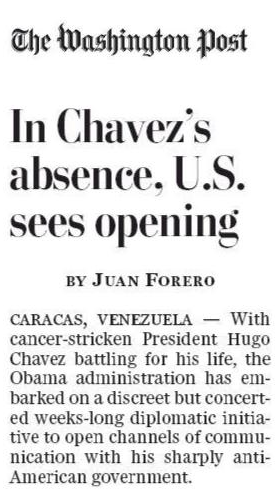
Here’s Juan Forero in the Washington Post (1/10/13):
A central ideological pillar of Chavez’s rule over 14 years has been to oppose Republican and Democratic administrations in Washington, which he accuses of trying to destabilize his government.
“I think they really believe it, that we are out there at some level to do them ill,” said Charles Shapiro, president of the Institute of the Americas, a think tank in San Diego.
As ambassador to Venezuela from 2002 to 2004, Shapiro met with Chavez and other high- ranking officials, including [Vice President Nicolas] Maduro. But the relationship began to fall apart, with Chavez accusing the United States of supporting a coup that briefly ousted him from power. U.S. officials have long denied the charge.
Shapiro recalled how Maduro made what he called unsubstantiated accusations about CIA activity in Venezuela, without ever approaching the embassy with a complaint. He said that as time went by, the United States became a useful foil for Chavez and most Venezuelan officials withdrew contact.
“A sure way to ruin your career, to become a backbencher, was to become too friendly with the U.S. Embassy,” Shapiro said.
So Venezuela has a strange political culture where being friendly with the U.S. government gets you in trouble.
The Post airs Chavez’s charge–and then the U.S. denial. But the United States had all sorts of contact with the coup plotters before they made their move against Chavez in 2002. According to the State Department (7/02):
It is clear that NED [National Endowment for Democracy], Department of Defense (DOD) and other U.S. assistance programs provided training, institution building and other support to individuals and organizations understood to be actively involved in the brief ouster of the Chavez government.
And the CIA, as was reported by Forero himself (New York Times, 12/3/04), knew of the coup plotting.
The Central Intelligence Agency was aware that dissident military officers and opposition figures in Venezuela were planning a coup against President Hugo Chávez in 2002, newly declassified intelligence documents show. But immediately after the overthrow, the Bush administration blamed Mr. Chávez, a left-leaning populist, for his own downfall and denied knowing about the threats.
Scott Wilson, who was the Washington Post foreign editor at the time, told Oliver Stone for his film South of the Border:
Yes, the United States was hosting people involved in the coup before it happened. There was involvement of U.S.-sponsored NGOs in training some of the people that were involved in the coup. And in the immediate aftermath of the coup, the United States government said that it was a resignation, not a coup, effectively recognizing the government that took office very briefly until President Chavez returned.
And we know that the United States made quick efforts to have the coup government recognized as legitimate. The Bush government, immediately after the coup, blamed it on Chavez. And some of the coup plotters met with officials at the U.S. embassy in Caracas before they acted.
But the important thing for readers to know, according to Wilson’s successors at the Washington Post, is that U.S. officials deny they supported anything.
Why Latin America Will Not Bow to US Pressure over Iran
By Yusuf Fernandez | Al-Manar | January 11, 2013
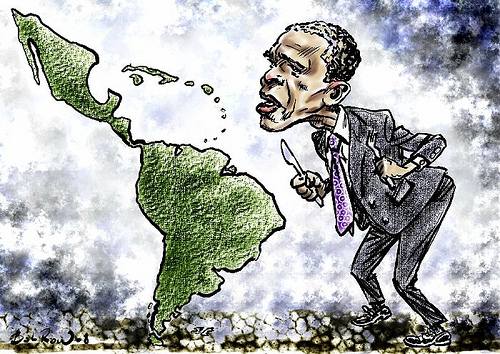
On December 28, US President Barack Obama enacted the so-called “Countering Iran in Western Hemisphere Act” which seeks to undermine Iran´s growing relations with Latin America, a region that has traditionally seen by the United States as its backyard and sphere of influence.
The Act, passed by congressmen earlier this year, requires the US Department of State to develop a strategy within 180 days to “address Iran´s growing hostile presence and activity” in Latin America. The Act points out that “Iran´s business and diplomatic ties are a threat to US national security”. It is seen, however, as another anti-Iranian move fabricated by the Zionist lobby in the US.
Shortly before, in July 2011, Robert F. Noriega – former Assistant Secretary of State for Western Hemisphere affairs, former US ambassador to the Organization of American States (OAS) and current Visiting Fellow at the American Enterprise Institute, one of the main neoconservatives -controlled entities in the US – said in a hearing before the House Subcommittee on Counterterrorism and Intelligence that Iran was carrying out “an offensive strategy” in Latin America.
The Iranian presence in the Latin America has also been harshly attacked by the pro-Israeli hawk Ileana Ros-Lehtinen, Foreign Affairs Committee Chairman and self-appointed bulwark against the alleged “Islamo-Boliviarian threat” to US security. She was co-star of a so-called “documentary” entitled “La amenaza iraní” (The Iranian Threat), in which she said, without blushing, that the US should attack Iran in order to “avert bomb explosions in various Latin American capitals”. The film was aired by Univision, a US broadcast network, which is owned by someone who has hosted galas in honour of the occupying Israeli army.
In 2009, another ridiculous “documentary” released by Univision involved the Venezuelan consul in Miami, Livia Acosta, in an absurd cyber-plot against the US allegedly promoted by “Iranian diplomats and Mexican computer hackers”. This was the pretext used for expelling her from the United States in a move that was widely seen as an American political revenge for Venezuela´s independent foreign policy.
Actually, the US Act rudely violates Latin American countries´ sovereignty and contains some stupid claims such as that the opening of Iranian embassies or cultural centers is to “spread terrorism”. Former Defense Secretary Leon Panetta also echoed those views by claiming, in a recent visit to Colombia, that Iranian attempts to expand its influence in South America amounted to expanding terrorism. Of course, no real evidence has ever been shown to support that laughable allegation.
“The paranoid nature of these estimations, and the scant evidence presented for them, are eerily reminiscent of the kind of broad-strokes, hawkish fear-mongering on display in the lead up to the war in Iraq. The testimony comes from a group bent on hyping security threats and, as Noriega admitted in the testimony, is not even in agreement with the State Department or intelligence agencies”, wrote John Glaser in a recent report.
The US accusations against Iran are also a way of targeting and casting suspicion on Latin American Muslims. In the Act, Washington speaks of “isolating Iran and its allies” and US officials accuse Iran or other pro-Iranian forces of “establishing mosques or Islamic centers throughout the region” in order to advance violent jihad “on our doorstep”.
US declining influence in Latin America
However, Latin American people know well that for over a hundred years it was the United States, and not another country, which wrought terror, war, poverty and repression throughout Latin America in the form of CIA-orchestrated military coups and support of paramilitary crimes, terrorism and dictatorial regimes. Military personnel found guilty of the worst violations of human rights in Latin American countries were trained in the notoriously famous School of Americans by US officers.
Actually, the Act is more evidence that US influence in Latin America is rapidly waning. Latin American countries have developed their own policies and set up independent blocks -ALBA, UNASUR and CELAC- while the Organization of American States, which includes the US and Canada, has been declining due to its submission to US policies on issues such as Cuba´s participation in its summits.
Iran has been seeking to increase its relations with Latin America in a bilateral way and in the framework of the Non-Aligned Movement and other international organizations. This has irritated Washington, which still seems to consider Latin American countries as vassals not having the right to pursue an independent foreign policy or seek its own friends and partners. Any agreement between Latin American states and Iran –or Russia and China- always arouses suspicion in the US.
Several Latin American countries have enhanced their diplomatic and trade ties with Iran in recent years, while their relations with the US have been downgraded amid popular demands for an end to dependence on Washington. Although the United States is still the largest economic partner of many Latin American countries, its economic and financial crisis has adversely affected them. This has led some nations, such as Mexico, to announce their intention to diversify their commercial partners in the next years.
As an international partner, the Islamic Republic is one of the best positioned to help Latin American countries develop their economies and their scientific and technological skills in many fields. The Iranian industry is highly developed. It has remarkable expertise in oil and gas exploitation and other sectors including health, defence, agriculture and space technology.
Iran has helped Venezuela build unmanned drone aircraft as part of their military cooperation. Referring to a Spanish media report that US prosecutors were investigating drone production in Venezuela, President Hugo Chavez said: “Of course we are doing it, and we have the right to. We are a free and independent country.”
In a televised speech to military officers at Venezuela´s Defense Ministry, Chavez said the aircraft only had a camera and was exclusively for defensive purposes. He said that Venezuela planned to soon begin exporting the unmanned drone. Moreover, Iran and Venezuela have mutual investments of about $ 5 billion in factories to make cement, satellites and tractors and the Iranians have helped the Latin American country build 14,000 houses.
Tehran has forged significant economic and political relations with the government of Evo Morales in Bolivia and with that of Rafael Correa in Ecuador. Iran´s links with Argentina, where Zionist circles have unsuccessfully tried to blame Iran for the AMIA attack in 1994, are also rapidly improving, as the government of President Cristina Fernandez is promoting a more conciliatory line towards Tehran.
Latin American countries, especially those that follow an independent foreign policy, trust Iran because they know that the Iranians cannot be pressured into betraying an agreement that disturbs the US or its allies. This is a main reason of Iran´s rising popularity in Latin America despite the propaganda of Zionist-owned media outlets and the US political and diplomatic actions.
HispanTV, the Spanish-language channel similar to the English-language Press TV channel, is also feared by the US establishment and Zionist circles because it is giving Latin American audiences accurate information about the Middle East and international developments that exposes the lies of Zionist-controlled agencies and media. The recent expulsion of Hispan TV from the Spanish-owned Hispasat channel is, in this sense, a desperate attempt to prevent the channel from reaching mass audiences. However, this move, as other similar ones in the past, is doomed to failure.
Therefore, Latin American nations won´t allow the US to dictate their foreign policy on the issue of their relations with Iran or any other country. In fact, Washington has already had a sign of this when it tried to pressure these countries to vote against Palestine’s bid to gain the status of a non-member state at the United Nations. Only one country, Panama, whose government has strong links with the Zionist entity and the local Zionist lobby voted against it.
Related articles
- US, Israel instill fears over Iran’s growing influence in Latin America (alethonews.wordpress.com)
- Ecuador to maintain foreign policy, ties with Iran: FM (alethonews.wordpress.com)
Delay in Chavez inauguration possible: Venezuelan Supreme Court
Press TV – January 9, 2013
The Venezuelan Supreme Court says President Hugo Chavez can legally postpone the Thursday inauguration as the current government remains in power.
On Wednesday, Supreme Court President Luisa Estella Morales, following a unanimous decision by the panel, also ruled out medical checks for the president’s scheduled inauguration ceremony.
“The oath-taking of the re-elected president can be carried out at a time after January 10 before the Supreme Court, if it is not done on the said day before the National Assembly,” the ruling said.
As the president has been recovering from an illness and the government would be renewing its term, Morales said, “there is not even a temporary absence” of Chavez from taking the oath.
Until Chavez recovers, current government officials “will continue fully exercising their functions under the principle of administrative continuity,” it said.
Opposition groups of the government earlier on Wednesday requested the Supreme Court to decide on the ruling.
The ruling comes as government officials pointed out the constitution allows the court to swear in a new president without a time limitation for a leave of absence, which the congress voted for on Tuesday.
The Supreme Court’s decision comes as Chavez continues to gain support from South American allies.
Foreign Policy Advisor to the Brazilian President, Marco Aurelio Garcia, on Tuesday said that — on behalf of Brazilian President Dilma Rousseff — Brazil supports the postponing of the inaugural ceremony.
Chavez, who first came to power in 1999, was re-elected to a new six-year term in October, 2012. However, a month before the planned inauguration he underwent a fourth round of cancer surgery in Cuba’s capital Havana.
The full text of the Supreme Court decision can be read here (in Spanish).
Related articles
- Venezuelans Continue to Defy the Washington Post
- Exposing Five Key Media Myths about Chavez’s Health and Swearing-in
- Venezuela Among the Most Positive Countries, Gallup Says
- Venezuela’s Economy Grows by 5.5 Percent in 2012
- There is an alternative: what Venezuela can teach us about the banking sector
- Economic BS in Rich Countries is Reinforced by BS about Venezuela
- The Achievements of Hugo Chavez
Venezuelans Continue to Defy the Washington Post
By Peter Hart | FAIR | January 8, 2013
The Washington Post has never been fond of left-wing Venezuelan President Hugo Chavez. As serious questions mount about the state of Chavez’s health, the paper’s editorial page (1/5/13) found it a good time to take another swipe:
Venezuelans are bracing themselves for the death of the caudillo who has ruled them–and wrecked their once-prosperous country–over the past 13 years.
Economist Mark Weisbrot has a different take. In a “Room for Debate” discussion at the New York Times (1/4/13), he writes:
Since Hugo Chávez first took office, he and his party have won 13 of 14 national elections, mainly because they greatly improved the living standards of the majority of voters in Venezuela. Since 2004, after the economy recovered from the devastating opposition oil strike, poverty has been cut by half and extreme poverty by more than 70 percent.
Weisbrot goes on to show some of the other ways Venezuelans’ lives have improved in the Chavez years, adding:
These numbers are not really in dispute among economists or international statistical agencies. If you follow Venezuela and haven’t heard any of this, it’s because the news media is giving you the equivalent of a “tea party” view of the country.
So there’s maybe a chance that Venezuelans don’t think Chavez “wrecked” their country at all–unless you think reducing poverty and income inequality are bad things. To the Post, the fear seems to be that Venezuelans will remember this after Chavez’s passing:
Sadly, the economic pain caused by Mr. Chavez could, after his death, help create a political movement that will revere his memory.
Their point is that Chavez’s policies will force the next government to oversee harsh austerity policies to correct Chavez’s supposed mistakes. But Venezuelans might actually “revere” Chavez for the same reason they voted for him: His policies worked for the majority of the population. And that doesn’t sit well with the Washington Post.
Featured Video
Macgregor: We Haven’t Seen the Worst of the Iran War Yet
or go to
Aletho News Archives – Video-Images
New Book
Breast Cancer: Before You Consent
A new Unbekoming paperback
Lies are Unbekoming | September 18, 2026
Peter Gøtzsche reviewed every randomised mammography screening trial ever conducted for the Cochrane Collaboration. Cochrane’s headline is that, assuming a 15% mortality reduction, one woman in 2000 avoids dying of breast cancer over ten years. Ten are overdiagnosed and treated. Two hundred experience false alarms.
But that headline assumes the reduction. When Gøtzsche looked only at the trials with adequate randomisation — the higher-quality ones — the reduction disappeared. No effect on breast cancer mortality. No effect on all-cause mortality.
This is the Cochrane finding, published in the establishment’s own database of systematic reviews.
No woman being asked to consent to a mammogram this week knows it.
That is why the new Unbekoming paperback exists. … continue
Blog Roll
 Aletho News
- Araghchi: Military intervention cannot create security; coercion cannot bring peace
- Fraud Squared
- Breast Cancer: Before You Consent
- Iran’s Plan to Shut Down AI in the Persian Gulf
- Israel seeks ‘compensation’ from Washington over Saudi F-35 sale
- Saudi crown prince seeks dialogue with Ansarullah after Yemeni blows: Report
- Damascus rejects Saudi request for Syrian fighters to counter Yemen: Report
- South Korea says will not send troops to join terrorist US war on Iran
- Russia Just Struck the Eyes of NATO’s War Machine in Ukraine
- Russia summons UK charge d’affaires over Kiev drone support
- If Americans Knew
- Inside the siege, the ruined buildings of Gaza – Daily Update
- Debunking The Claim That Macklemore Has A “History Of Antisemitism”
- CPJ demands release of arrested Palestinian-US journalist near Bethlehem
- Robert Kraft: The Billionaire Friend of Netanyahu Pulling The Strings Behind the Macklemore/Ed Sheeran Blow Up
- Columbia Administered Fund Gives Big Money to Pro-Israel Groups
- Deportation Case of Palestinian Activist Salah Sarsour Tests First Amendment
- ‘We Will Not Forget’: Palestinians Mark 44 Years since Sabra and Shatila
- Why do we let Zionists decide what we can and can’t say?
- US welcomes Israeli, Iranian delegations to UN, but not Palestinians – Daily Update
- Biden’s Genocide Accomplices Targeted by New Accountability Campaign
- No Tricks Zone
- New Study: ‘Global Drought Shows No Detectable Recent Acceleration Under Climate Warming’
- Economic Masterminds: German Socialists Suggest Taxing Productivity Gains Stemming From Using AI
- The South China Sea Has Not Been Cooperating With The Climate Change Narrative
- Energy Crisis: Germany Enters Heating Season With Historically Low Gas Reserve Fill Levels
- New Study: The Antarctic Ice Sheet Gained Mass From 2020-2024 Due To Staggering Snow And Ice Accumulation
- Study: Ocean Heating Rates From Thousands Of Years Ago ‘Dwarf’ Modern Ocean Heating Rates
- Climate Extremists Target, Attack Large-Scale Power Grid Infrastructure In Germany!
- New Study: Antarctic Ice Melt Has Contributed Less Than 1 Centimeter To Sea Level Rise In The Last 30 Years
- Fear Of Debate: Alarmist German Climate Scientist Calls On Mainstream Media To Discredit Skeptic Voices
- End-Of-August Arctic Sea Ice Extent Hasn’t Fallen In 20 Years, Official Data Show!
 Aletho News