By Joe Emersberger | ZCommunications | March 7th 2013
The death of Hugo Chavez provoked HRW to immediately (within hours) smear the Chavez government’s legacy.
“Chávez’s Authoritarian Legacy: Dramatic Concentration of Power and Open Disregard for Basic Human Rights” said the Washington DC based NGO.
If that isn’t harsh enough, in a tweet sent out in June of 2012, Ken Roth, executive director of HRW, described Venezuela as being one of the “most abusive” in Latin America. Ecuador and Bolivia were the other two states that Roth singled out.
In November of 2012, HRW also rushed out a letter demanding that Venezuela be excluded from the UN’s Human Rights Council on the grounds that the Chavez government “fell far short of acceptable standards”
It is staggeringly obvious that HRW did not simply regard the Chavez government as one which could be validly criticized, like any other in the world, on human rights grounds. HRW regarded Venezuela under Chavez as one of the “most abusive” countries in the world. Make no mistake, if Venezuela is more abusive than Colombia, as Roth alleged, then that would easily place Venezuela among the worst human rights abusers on earth.
The day Hugo Chavez died, HRW rehashed the accusations it has been making for years:
1) “Assault on Judicial Independence”
2) “Assault on Press Freedoms”
3) “Rejection of Human Rights Scrutiny”
4) “Embracing Abusive Governments”
Without exploring any details at all about these criticisms something should stand out right away. Putting aside HRW’s remarkably shoddy attempts to substantiate them, how could these criticisms place the Chavez government among the most abusive countries in the world? How could HRW’s assessment, even taken at face value, make Venezuela unworthy to sit on the UN’s Human Rights Council next to the USA?
Daniel Kovalik pointed out the following amazing facts last year in a Counterpunch article:
… in a November 19, 2009 U.S. Embassy Cable, entitled, ” International Narcotics Control Strategy Report,” the U.S. Embassy in Bogota acknowledges, as a mere aside, the horrific truth:257,089 registered victimsof the right-wing paramilitaries. And, as Human Rights Watch just reported in its 2012 annual report on Colombia, these paramilitaries continue to work hand-in-glove with the U.S.-supported Colombian military….
… the U.S. has been quite aware of this death toll for over two years, though this knowledge has done nothing to change U.S. policy toward Colombia — which is slated to receive over $500 million in military and police aid from the U.S. in the next two years.
…. Indeed, as the U.S. Embassy acknowledges in a February 26, 2010 Embassy Cable entitled, ” Against Indigenous Shows Upward Trend,” such violence is pushing 34 indigenous groups to the point of extinction. This violence, therefore, can only be described as genocidal.
Either Ken Roth is unfamiliar with his own organization’s reports, or something very rotten drives his groups’ ludicrously disproportionate criticism of Venezuela.
I’ll borrow from HRW’s playbook and do some rehash of my own. I’ll rehash some of the questions I’ve been asking them for years. HRW has never attempted to answer.
1) When a coup deposed Chavez for 2 days in 2002, why did HRW’ public statements fail to do obvious things like denounce the coup, call on other countries not to recognize the regime, invoke the OAS charter, and (especially since HRW is based in Washington) call for an investigation of US involvement?
2) Very similarly, when a coup deposed Haiti’ democratically elected government in 2004, why didn’t HRW condemn the coup, call on other countries not to recognize the regime, invoke the OAS charter, and call for an investigation of the US role? Many of these things were done by the community of Caribbean nations (CARICOM). A third of the UN General Assembly called for an investigation into the overthrow of Aristide. Why didn’ HRW back them up?
3) Since 2004, why has HRW written about 20 times more about Venezuela than about Haiti despite the fact that the coup in Haiti created a human rights catastrophe in which thousands of political murders were perpetrated and the jails filled with political prisoners? Haiti’ judiciary remains stacked with holdovers from the coup installed regime.
In honour of Chavez and of the Venezuelan movements which will hopefully expand on the progress made towards making Venezuela a more democratic and humane country, lets recall some achievements of his government on the international stage that HRW would never applaud. Let’s remember Hugo Chavez strongly opposing the US bombing of Afghanistan in 2001; the war in Iraq, the 2004 coup in Haiti, the 2009 coup in Honduras, NATO’s bombing of Libya, the lethal militarization of the conflict in Syria, the attempted coups against Morales in Bolivia and against Correa in Ecuador, Israel’s aggression in Lebanon and in the Occupied Territories.
None of that impressed HRW in the least. It may even have aggravated HRW’s hatred of the Chavez government, but it should impress people who really care about human rights.
March 7, 2013
Posted by aletho |
Deception, Mainstream Media, Warmongering, Timeless or most popular | Haiti, HRW, Hugo Chávez, Human rights, Human Rights Watch, Venezuela |
Leave a comment
Not One Step Backward, Ni Un Paso Atrás
Hugo Chávez is no more, and yet the symbolic importance of the Venezuelan President that exceeded his physical persona in life, providing a condensation point around which popular struggles coalesced, will inevitably continue to function long after his death. It’s not for nothing that the words of the great revolutionary folk singer Alí Primera are on the tip of many tongues:
Los que mueren por la vida
no pueden llamarse muertos
—
Those who die for life
cannot be called dead.
A Barefoot Revolutionary
Hugo Chávez was a poor kid from the country, which tells you much of what you need to know about him. Bare feet, mud hut, perpetual sunburn, gleaning hard lessons and a strong dose of audacity from everyday experiences in that wild part of the Venezuelan flatlands, or llanos, that crash abruptly into the towering Andes mountains.
While politics was in the soil under his feet and in his every social interaction, Chávez’s first formal contact with revolutionary politics came through his elder brother, Adán, a member of the still-clandestine former guerrilla organization, Party of the Venezuelan Revolution (PRV). It was the PRV that refused intransigently to come down from the mountains in the late 1960s when the Venezuelan Communist Party decided to withdraw from the armed struggle, and it was the PRV more than any other organization that resisted Marxist orthodoxy by excavating Venezuelan and Latin American revolutionary traditions under the umbrella of “Bolivarianism.”
Through Adán, Chávez the younger was imbued with the legacy of this Venezuelan guerrilla struggle and its aspirations, a necessary and portentous counterbalance to the official doctrine he would learn in the military academy. But even as a soldier, Chávez was always irreverent to the core, and it wasn’t long before he had begun to organize with other radical officers. Their conspiratorial grouping would eventually be called the MBR-200, the Bolivarian Revolutionary Movement, and it was not a purely military affair, evolving in close contact with revolutionary communist guerrillas from the PRV and elsewhere.
The Old Venezuela
The old Venezuela is no more. The Venezuelan ancien regime was one of self-professed harmony, and it cultivated this myth to the very end. For political scientists, this translated as “Venezuelan exceptionalism”: in a sea of unrest and dictatorship, it alone remained relatively stable and “democratic.” But this was a harmony premised on the invisibility of the majority, and a stability crafted through the incorporation and neutralization of any and all oppositional movements. Those who refused to concede were murdered or imprisoned in the gulags of this “exceptional” democracy.
When Hugo Chávez first attempted to overthrow the Venezuelan government of Carlos Andrés Pérez in 1992, he was attacking a democracy in name only. Decades of two-party rule had created a system that was utterly unresponsive to the needs of the vast majority, and as economic crisis set in during the “lost decade” of the 1980s, the poor turned to rebellion and the government to brute repression. In only the most spectacular of many moments of resistance, the week-long 1989 rebellion known as the Caracazo, somewhere between 300 and 3,000 were slaughtered as Pérez ordered the military to “restore order” in the poor barrios that surround Caracas and other Venezuelan cities.
It was this rebellion more than any other, and the repression it unleashed, that led, nay forced, Chávez and others to attempt a coup with the support of revolutionary grassroots movements, and it was this coup more than any other event that led to his eventual election in 1998. Finally someone had taken a stand, and when Chávez promised on national television that the conspirators had only failed “por ahora, for now,” he was effectively promising, as did Fidel Castro nearly 40 years prior, that history would absolve him.
The New Venezuela
In many ways, it has. Under Chávez’s watch, Venezuela has become more equal, the most egalitarian country in Latin America in fact, according to the Gini coefficient of income distribution. Poverty has been reduced significantly, and extreme poverty almost stamped out. Illiteracy has been eliminated and education is freely accessible, through the university level, to even the poorest Venezuelans. Health care is free and universal. Despite catastrophic language used by the Venezuelan opposition and foreign press, the economy is strong, and has weathered the global economic crisis better than most (notably, the United States).
More important than this improvement in the social welfare of the Venezuelan majority, however, are the political transformations that the Venezuelan state and people have undergone, transformations that remain far from complete. This was not merely a populist government that sought to buy votes through handouts, but a radically democratic government that sought, often despite its own autocratic tendencies, to empower the people to intervene from below as the true “protagonists” of history. Through communal councils, cooperatives, communes, and popular militias, the Venezuelan government has radically empowered the radical grassroots, albeit not without resistance from its own bureaucrats.
But these accomplishments do not belong to Chávez alone, and in fact, they do not belong to Chávez at all. Long before Chávez, there were the revolutionary movements that tried, failed, and tried better, generating the experiences, organizations, and outlooks that would eventually propel Chávez to the helm of an untrustworthy state. Any celebration of Chávez that presents him as a savior is an insult to the people he held in such high esteem, and whose orders he followed.
Inversely, some ill-informed leftists decry him as not having been revolutionary enough, not moving quickly enough toward socialism: the revolution must be all at once or not at all. Others, here taking a page from the liberals, attack him for being authoritarian, autocratic, and undemocratic. But this all misses the most fundamental point: that the Venezuelan revolution is not Chávez. If we fail to understand why many millions of Venezuelans are in mourning today, then we have voluntarily abandoned any serious effort to understand what is going on in Venezuela.
A Combative Democrat
Even as President, Chávez’s rural persona always managed to break through the polite veneer of political leadership: as when he would often spontaneously break into llanero song, speak in country parables and refrains, or brutally attack opponents and allies alike on live television. Also arguably a legacy of the countryside was his paradoxical democratic authoritarianism: deeply respectful of the people and fervently egalitarian, he would not take no for an answer when it came to revolutionizing the country. While Chávez had long dreamed of becoming a major league pitcher, his childhood nickname, latigo, the whip, described his approach to politics at least as well as it described his fastball.
But this contradiction was not his own: direct democracy and representative democracy are rarely the sympathetic allies their names might suggest, and one of the seeming paradoxes of the Bolivarian Revolution is that it has taken a firm push from above to clear the way for radically democratic participation from below. This is what critics of Chávez and the Bolivarian Revolution mean when they suggest that he has run roughshod over democratic “checks and balances,” failing to note that such institutional constraints, however justifiable, are often far from democratic.
As a result, the two sides seem to speak completely different languages: for the one, which seems to include Republican Congressman Ed Royce bid a quick “good riddance” to Chávez, the leader was an authoritarian dictator. Such claims come as a surprise to Chavistas, however, who have elected him many times, repeatedly choosing the path of an increasingly radical revolutionary process, and who are quick to point out the contradiction between their democratic will and term limits. Many poor Venezuelans, too, were surprised at the outrage that ensued when Chávez referred to George W. Bush as “the devil” or as a “donkey.” The poor rarely grasp the role of politeness in politics, seeing it instead, intuitively but correctly, as the realm of powerful oppositions, of Bush’s own “you’re with us or you’re against us.”
The Manichean nature of Venezuelan politics in recent years has been undeniable, but we would be well advised to recognize, with Frantz Fanon, that this division between us and them, Chavistas and escualidos (or more recently, majunches), was more a reflection of a structural reality than the fault of Chávez or the Revolution. While elite Venezuelans began to mourn the disappearance of Venezuelan “harmony,” what they really meant was that, all of a sudden, poor and dark-skinned Venezuelans had appeared, had made their presence felt, and had even assumed the mantle of the government as a mechanism for pressing their demands.
Chávez certainly courted Manicheanism to mobilize the people in the struggle, but this Manicheanism also came to him, for phenotypic as well as political reasons: dark-skinned, with a wide nose and large ears, “with his very image, Chávez has shaken up the beehive of social harmony… His image upsets the wealthy women of Cuarimare.” Chávez and his supporters have long been racialized in terms that would seem scandalous anywhere else: monkey, blackie, scum, horde, rabble. Open racism exploded during the 2002 coup that unseated Chávez for less than two days, in many ways forcing him to recognize it publicly in a country that had often celebrated mestizaje and insisted that there was no racism in Venezuela. In the end, this Manicheanism has become the most important motor for driving the revolutionary process forward, unifying the people against a common enemy and preparing them for the struggle ahead.
I was supposed to meet Hugo Chávez, but he cancelled at the last minute. His unpredictability stemmed from a combination of security concerns and an irrepressible desire to do everything himself. The closest I ever got was about 10 feet away, awash in a rushing torrent of red-shirted Chavistas on the Avenida Bolívar in 2007, as the now late President drove by atop a truck. As he passed, I reached up and performed my favorite Chavista gesture: pounding palm with fist to symbolize the brutal pummeling of the opposition. As though confirming the centrality of combat in a Revolution that would outlive him, he looked at me and did the same.
The Revolution Will Not Be Reversed
What will happen next? Within 30 days, there will be elections, in which Chávez’s hand-picked successor Nicólas Maduro will almost certainly prevail against an opposition that only seems to ever come together for the purposes of then falling apart. But the future in the longer term remains unwritten. While nothing is inevitable, however, a great many poor and radicalized Venezuelans will tell you that they will not take ni un paso atras, a single step back, and that conversely, no volverán, they shall not return. And they mean it.
This is a revolutionary assurance that has never depended solely on the figure of Chávez. As I write in the introduction to my forthcoming book We Created Chávez:
“The Bolivarian Revolution is not about Hugo Chávez. He is not the center, not the driving force, not the individual revolutionary genius on whom the process as a whole relies or in whom it finds a quasi-divine inspiration. To paraphrase the great Trinidadian theorist and historian C.L.R. James: Chávez, like the Haitian revolutionary Toussaint L’Ouverture, ‘did not make the revolution. It was the revolution that made’ Chávez. Or, as a Venezuelan organizer told me, ‘Chavez didn’t create the movements, we created him.’”
In 1959, Frantz Fanon declared the Algerian Revolution irreversible, despite the fact that the country would not gain formal independence for another three years. Studying closely the transformation of Algerian culture during the course of the struggle and the creation of what he called a “new humanity,” Fanon was certain that a point of no return had been reached, writing that:
“An army can at any time reconquer the ground lost, but how can the inferiority complex, the fear and the despair of the past be re-implanted in the consciousness of the people?”
In revolution, there are no guarantees, and there’s no saying that the historical dialectic cannot be bent back upon itself, beaten and bloody. The point is simply that for the forces of reaction to do so will be no easy task. Long ago, the Venezuelan people stood up, and it is difficult if not impossible to tell a people on their feet to get back down on their knees.
George Ciccariello-Maher, teaches political theory at Drexel University in Philadelphia. He is the author of We Created Chávez: A People’s History of the Venezuelan Revolution (Duke University Press, May 2013), and can be reached at gjcm(at)drexel.edu.
March 7, 2013
Posted by aletho |
Economics, Solidarity and Activism, Timeless or most popular | Alí Primera, Caracas, Chavez, Communist Party of Venezuela, Hugo Chávez, Venezuela |
Leave a comment
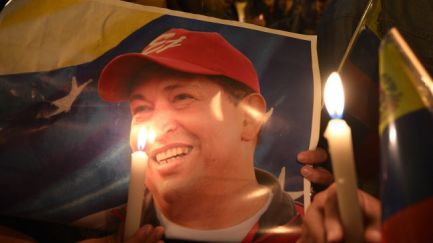
Thousands of saddened Venezuelans poured into the streets of Caracas crying, hugging each other and shouting slogans in support of President Hugo Chavez after learning of his death. “I feel such big pain I cannot even speak,” said Yamilina Barrios, a 39-year-old office worker, to the Associated Press. “He was the best thing the country had … I adore him. Let´s hope the country calms down and we can continue the tasks he left us.”
Leaders of the continent also showed their sorrow. “We are devastated by the death of the brother Hugo Chavez,” Prensa Latina agency quoted Bolivian president Evo Morales as saying, while he was accompanied by several members of his cabinet. Chavez was “a caring brother, a fellow revolutionary, a Latin American who fought for his country, for the great homeland, as Simon Bolivar did. He gave his whole life for the liberation of the Venezuelan people, the people of Latin America and all anti-imperialist fighters in the world”.
Chavez dedicated his whole life to the cause of the oppressed and poor, the integration and unity of Latin America, the construction of a multipolar world and the fight against the imperialism. Hugo Chavez died due to the illness he had, which many suspect was inoculated to him by any of his enemies, starting by the US government.
He became notorious after a group of army officers and soldiers, led by him, tried to overthrow in 1992 the corrupt and criminal pro-US government of Venezuelan President Carlos Andres Perez, a social democratic politician who ordered a brutal and bloody crackdown on demonstrators that were protesting against IMF-austerity measures on February 27 1989. About 3,000 people were killed by troops in that episode known as “the Caracazo”.
Chavez spent two years in a military prison. After being released, he led a Boliviarian movement that had two main goals: social justice for the impoverished majority of Venezuelans and independence from the US Empire and its financial tools. In 1998, he won his first presidential election and he would never lose one from then on.
The President changed the leadership of the oil national company, PDVSA, whose revenues had benefited only a small national oligarchy and US corporations up to then. At the same time, Chavez funded various social assistance programs for the poor. These programs have improved literacy levels, health care, housing and income levels for Venezuela´s majority.
During Chavez´s years in office, poverty has been cut a half and extreme poverty by 70%. Millions of Venezuelans have had access to health care for the first time, and college enrollment doubled, with free tuition for many students. Inequality was also considerably reduced. By contrast, the two decades that preceded Chavez, Venezuela was one of the worst economic failures in Latin America, with real income per person actually falling by 14% from 1980-1998.
Chavez was the main promoter of the process for the integration of Latin America. It would lead to the creation of some Latin American blocs, such as ALBA, UNASUR or CELAC, which reduced US-dominated OAS to irrelevance. US plans to control Latin American economies through a continental free trade agreement also failed due to the opposition of Venezuela and some other countries.
Following Chavez´s revolution, Latin America has elected in recent years a group of leaders -Evo Morales in Bolivia, Rafael Correa in Ecuador and Daniel Ortega in Nicaragua- who are deeply involved in the fight for social justice in their societies and political independence for their countries and the continent on the whole. Other leaders who followed that trend -Manuel Zelaya in Honduras and Fernando de Lugo in Paraguay- were illegally toppled by US-supported right-wing coups.
In the international field, Chavez was an active promoter of a multipolar world. In order to liberate his country from an imperialist control, Venezuela established solid links with Russia, China, Iran, Syria and other countries. He supported the fight of the Palestinian people against the Zionist occupation.
Due to all these policies, Chavez earned the implacable hatred and hostility of Washington. In April 2002, the CIA backed a military coup to overthrow him. A group of right-wing leaders and generals arrested and imprison him and took over the power, in a move widely welcomed by the US and some European governments and media. However, he was saved and restored to power two days later by the rapid action of loyal military officers and soldiers and a huge popular uprising.
Even after the failure of the coup, the right-wing sectors, which dominated some private media outlets, especially channels as Venevision, Univision and Globovision, continued their permanent campaign against Chavez and his government. All kind of dirty games, including a politicized general strike, were put in place in order to overthrow him. However, all these plans failed due to the high political awareness of the Venezuelan people.
For its part, Washington used its agencies, including the CIA, to fund the political opposition and the oligarchy. According to the site venezuelanalysis.com, Capriles and the Venezuelan opposition received 20 million dollars from US organizations, such as USAID and the National Endowment for Democracy.
Media campaigns were also used as a weapon of preference against the Venezuelan government. Despite Chavez´s repeated electoral victories, successive US administrations and corporate media presented his rule as illegitimate and dictatorial. The US Embassy in Caracas became a hub of anti-Chavez activities, as it shows the recent expulsion of the US Air Force attaché, Col. David Delmonaco, and his deputy, who allegedly tried to recruit Venezuelan army officers for “destabilizing projects.”
In this context, the statement by US President, Barack Obama, which claims that Washington wants to normalize its relations with Caracas, is hypocritically insincere. Actually, the US is just attempting to look for new mechanisms to recover its control over Venezuela and change its economic, social and foreign policy.
The death of President Chavez will force the country to conduct another presidential election within 30 days. The candidate and new leader of the Bolivarian movement, Vice-President Nicolas Maduro, will be the candidate who will confront Henrique Capriles, the right-wing governor of Miranda state, who was comfortably defeated by Chavez in a presidential election held last October.
Although Washington and its Venezuelan allies hope that the death of Chavez may help them put an end to the Bolivarian revolution in Venezuela and Latin America, there are many reasons to think otherwise. The people of Venezuela are aware of the achievements and progress that has obtained at this late stage and is not willing to renounce them. On the other hand, the early, and still not clarified death of Chavez, will reinforce his figure, turning it into a symbol of a policy for the oppressed, for the independence and integration of Latin America and for a world free from imperialism.
“Oligarchies are surely celebrating when the peoples that fight for their freedom and dignity and work for equality are suffering. But it does not matter, the only thing that matters is that we are united, we fight for liberation. A lot of strength, a lot of unity. The best tribute to Chavez is unity. Unity to fight, to work for the equality of all peoples of the world,” Morales said.
March 6, 2013
Posted by aletho |
Economics, Timeless or most popular | Chavez, Hugo Chávez, Latin America, United States, Venezuela |
Leave a comment
The death of Hugo Chávez is a great loss to the people of Venezuela who have been lifted out of poverty and have created a deep participatory democracy. Chavez was a leader who, in unity with the people, was able to free Venezuela from the grips of US Empire, bring dignity to the poor and working class, and was central to a Latin American revolt against US domination.
Chávez grew up a campesino, a peasant, raised in poverty. His parents were teachers, his grandmother an Indian whom he credits with teaching him solidarity with the people. During his military service, he learned about Simon Bolivar, who freed Latin America from Spanish Empire. This gradually led to the modern Bolivarian Revolution he led with the people. The Chávez transformation was built on many years of a mass political movement that continued after his election, indeed saved him when a 2002 coup briefly removed him from office. The reality is Venezuela’s 21st Century democracy is bigger than Chávez. This will become more evident now that he is gone.
The Lies They Tell Us
If Americans knew the truth about the growth of real democracy in Venezuela and other Latin American countries, they would demand economic democracy and participatory government, which together would threaten the power of concentrated wealth. Real democracy creates a huge challenge to the oligarchs and their neoliberal agenda because it is driven by human needs, not corporate greed. That is why major media in the US, which are owned by six corporations, aggressively misinform the public about Chávez and the Bolivarian Revolution.
Mark Weisbrot of the Center for Economic and Policy Research writes:
The Western media reporting has been effective. It has convinced most people outside of Venezuela that the country is run by some kind of dictatorship that has ruined it.
In fact, just the opposite is true. Venezuela, since the election of Chávez, has become one of the most democratic nations on Earth. Its wealth is increasing and being widely shared. But Venezuela has been made so toxic that even the more liberal media outlets propagate distortions to avoid being criticized as too leftist.
We spoke with Mike Fox, who went to Venezuela in 2006 to see for himself what was happening. Fox spent years documenting the rise of participatory democracy in Venezuela and Brazil. He found a grassroots movement creating the economy and government they wanted, often pushing Chávez further than he wanted to go.
They call it the “revolution within the revolution.” Venezuelan democracy and economic transformation are bigger than Chávez. Chávez opened a door to achieve the people’s goals: literacy programs in the barrios, more people attending college, universal access to health care, as well as worker-owned businesses and community councils where people make decisions for themselves. Change came through decades of struggle leading to the election of Chávez in 1998, a new constitution and ongoing work to make that constitution a reality.
Challenging American Empire
The subject of Venezuela is taboo because it has been the most successful country to repel the neoliberal assault waged by the US on Latin America. This assault included Operation Condor, launched in 1976, in which the US provided resources and assistance to bring friendly dictators who supported neoliberal policies to power throughout Latin America. These policies involved privatizing national resources and selling them to foreign corporations, de-funding and privatizing public programs such as education and health care, deregulating and reducing trade barriers.
In addition to intense political repression under these dictators between the 1960s and 1980s, which resulted in imprisonment, murder and disappearances of tens of thousands throughout Latin America, neoliberal policies led to increased wealth inequality, greater hardship for the poor and working class, as well as a decline in economic growth.
Neoliberalism in Venezuela arrived through a different path, not through a dictator. Although most of its 20th century was spent under authoritarian rule, Venezuela has had a long history of pro-democracy activism. The last dictator, Marcos Jimenez Perez, was ousted from power in 1958. After that, Venezuelans gained the right to elect their government, but they existed in a state of pseudo-democracy, much like the US currently, in which the wealthy ruled through a managed democracy that ensured the wealthy benefited most from the economy.
As it did in other parts of the world, the US pushed its neoliberal agenda on Venezuela through the International Monetary Fund (IMF) and World Bank. These institutions required Structural Adjustment Programs (SAP) as terms for development loans. As John Perkins wrote in Confessions of an Economic Hit Man, great pressure was placed on governments to take out loans for development projects. The money was loaned by the US, but went directly to US corporations who were responsible for the projects, many of which failed, leaving nations in debt and not better off. Then the debt was used as leverage to control the government’s policies so they further favored US interests. Anun Shah explains the role of the IMF and World Bank in more detail in Structural Adjustment – a Major Cause of Poverty.
Neoliberalism Leads to the Rise of Chávez
A turning point in the Venezuelan struggle for real democracy occurred in 1989. President Carlos Andres Perez ran on a platform opposing neoliberalism and promised to reform the market during his second term. But following his re-election in 1988, he reversed himself and continued to implement the “Washington Consensus” of neoliberal policies – privatization and cuts to social services. The last straw came when he ended subsidies for oil. The price of gasoline doubled and public transportation prices rose steeply.
Protests erupted in the towns surrounding the capitol, Caracas, and quickly spread into the city itself. President Perez responded by revoking multiple constitutional rights to protest and sending in security forces who killed an estimated 3,000 people, most of them in the barrios. This became known as the “Caracazo” (“the Caracas smash”) and demonstrated that the president stood with the oligarchs, not with the people.
Under President Perez, conditions continued to deteriorate for all but the wealthy in Venezuela. So people organized in their communities and with Lieutenant Colonel Hugo Chávez attempted a civilian-led coup in 1992. Chávez was jailed, and so the people organized for his release. Perez was impeached for embezzlement of 250 million bolivars and the next president, Rafael Caldera, promised to release Chávez when he was elected. Chávez was freed in 1994. He then traveled throughout the country to meet with people in their communities and organizers turned their attention to building a political movement.
Chávez ran for president in 1998 on a platform that promised to hold a constituent assembly to rewrite the constitution saying:
I swear before my people that upon this moribund constitution I will drive forth the necessary democratic transformations so that the new republic will have a Magna Carta befitting these new times.
Against the odds, Chávez won the election and became president in 1999.
While his first term was cautious and center-left, including a visit by Chávez to the NY Stock Exchange to show support for capitalism and encourage foreign investment, he kept his promise. Many groups participated in the formation of the new constitution, which was gender-neutral and included new rights for women and for the indigenous, and created a government with five branches adding a people’s and electoral branches. The new constitution was voted into place by a 70 percent majority within the year. Chávez also began to increase funding for the poor and expanded and transformed education.
Since then, Chávez has been re-elected twice. He was removed from power briefly in 2002, jailed and replaced by Pedro Carmona, the head of what is equivalent to the Chamber of Commerce. Fox commented that the media was complicit in the coup by blacking it out and putting out false information. Carmona quickly moved to revoke the constitution and disband the legislature. When the people became aware of what was happening, they rapidly mobilized and surrounded the capitol in Caracas. Chávez was reinstated in less than 48 hours.
One reason the Chávez election is called a Bolivarian Revolution is because Simon Bolivar was a military political leader who freed much of Latin America from the Spanish Empire in the early 1800s. The election of Chávez, the new constitution and the people overcoming the coup set Venezuela on the path to free itself from the US empire. These changes emboldened the transformation to sovereignty, economic democracy and participatory government.
In fact, Venezuela paid its debts to the IMF in full five years ahead of schedule and in 2007 separated from the IMF and World Bank, thus severing the tethers of the Washington Consensus. Instead, Venezuela led the way to create the Bank of the South to provide funds for projects throughout Latin America and allow other countries to free themselves from the chains of the IMF and World Bank too.
The Rise of Real Democracy
The struggle for democracy brought an understanding by the people that change only comes if they create it. The pre- Chávez era is seen as a pseudo Democracy, managed for the benefit of the oligarchs. The people viewed Chávez as a door that was opened for them to create transformational change. He was able to pass laws that aided them in their work for real democracy and better conditions. And Chávez knew that if the people did not stand with him, the oligarchs could remove him from power as they did for two days in 2002.
With this new understanding and the constitution as a tool, Chávez and the people have continued to progress in the work to rebuild Venezuela based on participatory democracy and freedom from US interference. Chávez refers to the new system as “21st century socialism.” It is very much an incomplete work in progress, but already there is a measurable difference.
Mark Weisbrot of CEPR points out that real GDP per capita in Venezuela expanded by 24 percent since 2004. In the 20 years prior to Chávez, real GDP per person actually fell. Venezuela has low foreign public debt, about 28 percent of GDP, and the interest on it is only 2 percent of GDP. Weisbrot writes:
From 2004-2011, extreme poverty was reduced by about two-thirds. Poverty was reduced by about one-half, and this measures only cash income. It does not count the access to health care that millions now have, or the doubling of college enrollment – with free tuition for many. Access to public pensions tripled. Unemployment is half of what it was when Chávez took office.
Venezuela has reduced unemployment from 20 percent to 7 percent.
As George Galloway wrote upon Chávez’s death:
Under Chávez’ revolution the oil wealth was distributed in ever rising wages and above all in ambitious social engineering. He built the fifth largest student body in the world, creating scores of new universities. More than 90% of Venezuelans ate three meals a day for the first time in the country’s history. Quality social housing for the masses became the norm with the pledge that by the end of the presidential term, now cut short, all Venezuelans would live in a dignified house.
Venezuela is making rapid progress on other measures too. It has a high human development index and a low and shrinking index of inequality. Wealth inequality in Venezuela is half of what it is in the United States. It is rated “the fifth-happiest nation in the world” by Gallup. And Pepe Escobar writes that:
No less than 22 public universities were built in the past 10 years. The number of teachers went from 65,000 to 350,000. Illiteracy has been eradicated. There is an ongoing agrarian reform.
Venezuela has undertaken significant steps to build food security through land reform and government assistance. New homes are being built, health clinics are opening in under-served areas and cooperatives for agriculture and business are growing.
Venezuelans are very happy with their democracy. On average, they gave their own democracy a score of seven out of ten while the Latin American average was 5.8. Meanwhile, 57 percent of Venezuelans reported being happy with their democracy compared to an average for Latin American countries of 38 percent, according to a poll conducted by Latinobarometro. While 81 percent voted in the last Venezuelan election, only 57.5 percent voted in the recent US election.
Chávez won that election handily as he has all of the elections he has run in since 1999. As Galloway describes him, Chávez was “the most elected leader in the modern era.” He won his last election with 55 percent of the vote but was never inaugurated due to his illness.
Beyond Voting: The Deepening of Democracy in Venezuela
This is not to say that the process has been easy or smooth. The new constitution and laws passed by Chávez have provided tools, but the government and media still contain those who are allied with the oligarchy and who resist change. People have had to struggle to see that what is written on paper is made into a reality. For example, Venezuelans now have the right to reclaim urban land that is fallow and use it for food and living. Many attempts have been made to occupy unused land and some have been met by hostility from the community or actual repression from the police. In other cases, attempts to build new universities have been held back by the bureaucratic process.
It takes time to build a new democratic structure from the bottom up. And it takes time to transition from a capitalist culture to one based on solidarity and participation. In “Venezuela Speaks,” one activist, Iraida Morocoima, says “Capitalism left us with so many vices that I think our greatest struggle is against these bad habits that have oppressed us.” She goes on to describe a necessary culture shift as, “We must understand that we are equal, while at the same time we are different, but with the same rights.”
Chávez passed a law in 2006 that united various committees in poor barrios into community councils that qualify for state funds for local projects. In the city, community councils are composed of 200 to 400 families. The councils elect spokespeople and other positions such as executive, financial and “social control” committees. The council members vote on proposals in a general assembly and work with facilitators in the government to carry through on decisions. In this way, priorities are set by the community and funds go directly to those who can carry out the project such as building a road or school. There are currently more than 20,000 community councils in Venezuela creating a grassroots base for participatory government.
A long-term goal is to form regional councils from the community councils and ultimately create a national council. Some community councils already have joined as communes, a group of several councils, which then have the capacity for greater research and to receive greater funds for large projects.
The movement to place greater decision-making capacity and control of local funds in the hands of communities is happening throughout Latin America and the world. It is called participatory budgeting and it began in Porto Alegre, Brazil in 1989 and has grown so that as many as 50,000 people now participate each year to decide as much as 20 percent of the city budget. There are more than 1,500 participatory budgets around the world in Latin America, North America, Asia, Africa, and Europe. Fox produced a documentary, Beyond Elections: Redefining Democracy in the Americas, which explains participatory budgeting in greater detail.
The Unfinished Work of Hugo Chávez Continues
The movements that brought him to power and kept him in power have been strengthened by Hugo Chávez. Now the “revolution within the revolution” will be tested. In 30 days there will be an election and former vice president, now interim president, Nicolas Maduro will likely challenge the conservative candidate Chávez defeated.
If the United States and the oligarchs think the death of Chávez means the end of the Bolivarian Revolution he led, they are in for a disappointment. This revolution, which is not limited to Venezuela, is likely to show to itself and the world that it is deep and strong. The people-powered transformation with which Chávez was in solidarity will continue.
• This article is a modified version of “The Secret Rise of 21st Century Democracy,”which originally appeared in Truthout.
March 6, 2013
Posted by aletho |
Economics, Solidarity and Activism, Timeless or most popular | Bolivarian Revolution, Carlos Andrés Pérez, Chavez, Hugo Chávez, International Monetary Fund, Latin America, Venezuela |
Leave a comment
All Latin American leaders expressed their deep sorrow over the death of President Hugo Chavez, and several of them will be travelling to Caracas for his funeral scheduled next Friday.
Cristina Fernandez suspended all activities and declared three days of mourning Cristina Fernandez suspended all activities and declared three days of mourning
Argentine president Cristina Fernandez suspended all official activities, declared three days of mourning and will be flying to Caracas for the funeral. Cristina Fernández decided to leave Wednesday morning in the Tango 01 presidential plane along with her Uruguayan counterpart José “Pepe” Mujica, Planning Minister Julio de Vido and Foreign Minister Héctor Timerman.
Likewise Brazil’s Dilma Rousseff cancelled this week’s visit to Argentina and is planning to travel to Caracas for the funeral of Chavez. During an official ceremony Rousseff said that “in many occasions the Brazilian government did not fully concord with President Chavez”, but “today and as always we acknowledge him as a great leader, and an irreparable loss, and above all a loyal friend of Brazil and of its people”.
The Brazilian leader said she regretted the loss “not only as president but also as a person for which I had great affection”
Former president Lula da Silva also expressed ‘deep sorrow” over the death of President Chavez and in “this very sad day, all my solidarity with the Venezuelan people”.
Uruguayan president Jose Mujica also expressed his deep pain over the loss of ‘companion-commander’ Chavez and trusted the Venezuelan people and its government would continue to ‘strengthen democracy” of which the deceased leader was a “great builder”.
Bolivia’s Evo Morales who had special admiration for Chavez left Tuesday night for Caracas and decreed a full week of mourning and flags at half mast.
“Undoubtedly we had our differences, but I always admired the strength and commitment with which president Chavez battled for his ideas. He was a man profoundly committed to the integration of Latin America”, said Chilean president Sebastian Piñera.
From Mexico President Enrique Peña Nieto expressed his “deep condolence” over the loss of President Chavez. “My feelings are with his family and with the Venezuelan people, and for Venezuela to continue along the path of democracy”.
Peruvian president Ollanta Humala sent to the Venezuelan people “Bolivarian, South American and Latinamerican solidarity” and wished that in such difficult moments, “unity and reflection will prevail in such a way that things can go ahead peacefully and along the democratic track”.
From El Salvador president Mauricio Funes said Venezuela has not only lost a president, but a patriot, a man who transformed his country and “ruled for the people, changing the inequality and exclusion that prevailed in the country before he was elected to office”.
Finally the Organization of American States Secretary General Jose Miguel Insulza expressed condolences to the government and people of Venezuela regretting the sad news of the death of President Chavez.
“In a moment of such pain and sorrow for the Venezuelan people, we are next to you together with the rest of the peoples of the Americas”, said the OAS release. OAS flags will fly at half mast and there will be an extraordinary meeting of the Permanent Council to the memory of President Chavez.
March 6, 2013
Posted by aletho |
Solidarity and Activism | Chavez, Evo Morales, Hugo Chávez, José Mujica, Venezuela |
Leave a comment
Venezuelan Vice President Nicolas Maduro’s announced today that President Hugo Chávez had died at 4:25pm. According to Venezuela’s constitution [PDF], new presidential elections are supposed to be held within 30 days.
The news could prevent an opportunity for an improvement in U.S.-Venezuelan relations, but that is unlikely. Earlier in the day, Maduro announced that the Venezuelan government would expel the U.S. military attaché for unsanctioned meetings with certain Venezuelan military officers. While this is of course a significant development in U.S.-Venezuela relations that marks yet further deterioration, unfortunately it seems safe to say that most U.S. media outlets will not provide the crucial context necessary in order to understand current relations and why they are so tense.
Maduro mentioned the April 2002 coup d’etat in his press conference today. Declassified C.I.A. and other government documents reveal the U.S. role in that coup against Hugo Chávez. As Scott Wilson, former foreign editor at the Washington Post has explained:
Yes, the United States was hosting people involved in the coup before it happened. There was involvement of U.S.-sponsored NGOs in training some of the people that were involved in the coup. And in the immediate aftermath of the coup, the United States government said that it was a resignation, not a coup, effectively recognizing the government that took office very briefly until President Chavez returned.
I think that there was U.S. involvement, yes.
(Video clip here. This information has however never been reported this fully in the pages of the Washington Post itself.)
The coup was overturned two days later, but before it was the coup regime headed by businessman Pedro Carmona demonstrated its feelings about democratic institutions by dissolving the congress, the supreme court, and the constitution. The New York Times editorial board applauded the coup, writing, “Venezuelan democracy is no longer threatened by a would-be dictator.” The IMF explained that “We stand ready to assist the new administration in whatever manner they find suitable.” After the coup was overturned by Venezuelans in the streets and soldiers loyal to the elected government, and Chávez returned to Caracas from the island where his golpista kidnappers had taken him, the New York Times offered a sheepish apology for its previous applause. The U.S. government and the IMF, however, never apologized for their support for the coup.
It is also important to note that U.S. government interference in Venezuela did not stop there. The U.S. has continued to fund various groups in Venezuela opposed to the government – including political parties and media outlets. The U.S. State Department and entities such as the National Endowment for Democracy also have not disclosed who all of these recipients are, in Venezuela nor in other countries such as Bolivia, where the government has also expelled U.S. diplomats, and where the U.S. media has also done a poor job in providing context behind the deteriorating relations.
More recently, last month U.S. State Department spokesperson Victoria Nuland referred to “how the transition is going to take place” in Venezuela. Not surprisingly, the Venezuelan government also took this to be a form of meddling. Talk of a “transition” was premature, and Nuland’s statement was “nothing less than the open meddling into issues that are for Venezuelans to resolve,” according to Eleazar Diaz-Rangel, editor in chief of Venezuela’s most-widely read – and probably most objective – newspaper Últimas Noticias.
It is hard to imagine U.S. government officials making similar statements if the leader of an ally country such as the U.K. or Israel were fighting for her/his life. But when it comes to Venezuela the behavior fits a pattern of ongoing efforts to undermine the elected government.
It will also be interesting to see how the international community and the media will receive Maduro, should he become Venezuela’s next president. Chávez called on Venezuelans to support Maduro should new elections be necessary, and polls show Maduro would likely win over an Henrique Capriles or another opposition candidate. Both U.S. media outlets and U.S. government officials have often sought to blame poor relations between the U.S. and Venezuela on Chávez’s “fiery” personality; will they do the same with Maduro? Earlier media reports today indicate that the answer is probably yes. Media – and many other observers –also focused much on Chávez’s military background, something that Maduro does not have.
For his part, Maduro got an early taste of U.S. hospitality in 2006 when he was unceremoniously searched at the airport prior to departure back to Venezuela in his first U.S. trip as Venezuela’s Foreign Minister. It was an unfortunate first impression to make on the man who will probably be Venezuela’s next president.
March 6, 2013
Posted by aletho |
Mainstream Media, Warmongering, Progressive Hypocrite, Timeless or most popular | Hugo Chávez, Maduro, New York Times, Nicolás Maduro, Scott Wilson, United States, Venezuela |
Leave a comment
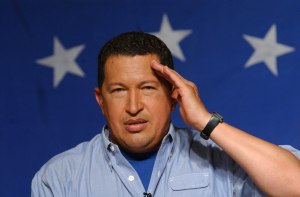 Merida – After two years of battling cancer, President Hugo Chavez has died today at 4.25 pm.
Vice-president Nicolas Maduro made the announcement on public television shortly after, speaking from the Military Hospital in Caracas, where Chavez was being treated.
Military and Bolivarian police have been sent out into the street to protect the people and maintain the peace. For now, things are calm here, with some people celebrating by honking their car horns, and many others quietly mourning in their homes.
Maduro made the announcement just a few hours after addressing the nation for an hour, accusing the opposition of taking advantage of the current situation to cause destabilization.
“Those who die for life, can’t be called dead,” Maduro concluded.
In Caracas, thousands of people have gathered in Plaza Bolivar and are said to be heading to the Miraflores Palace. Those gathered are shouting that “Chavez lives, the struggle continues,” “the people united will never be defeated,” as well as swearing that the Venezuelan bourgeoisie “will never return” to the Miraflores Palace.
Chavez supporters are also gathering in central squares across the country to rally together and mourn the death of their president.
Describing the scene in Caracas, Andromaco Martinez, stated that he was on the metro when he found out about the president’s death, “people began running everywhere”.
In Plaza Bolivar, “no-one is crying or praying,” he said, emphasizing that the Venezuelan people would defiantly defend the revolution.
“The struggle has already been ignited,” he added.
March 5, 2013
Posted by aletho |
Aletho News | Chavez, Hugo Chávez, Latin America, Venezuela |
Leave a comment
Merida – Vice-president Nicolas Maduro today denounced destabilisation plans by the international and Venezuelan right wing, announcing the expulsion of two US officials for threatening military security. He also implied that Chavez’s cancer was “caused by enemies of Venezuela”.
Right-wing destabilisation plans
Maduro made the announcement today just after midday, following a meeting this morning with Venezuela’s political military leadership.
Maduro pronounced the expulsion of diplomat David del Monaco, and Air Attaché Deblin Costal of the US embassy in Caracas for being implicated in “conspiracy plans”.
“They have 24 hours to pack their bags and leave,” Maduro said.
He explained that Monaco had, for the last few weeks, been contacting members of the Venezuelan military in order to bring about a destabilisation plan in Venezuela.
“This official has been given the task of looking for active military members in Venezuela in order to propose destabilisation projects to the Armed Forces.”
“We want to denounce that we have certain clues of elements that make up this poisonous picture, which seek to disrupt the social life of our country and give it a beating,” he added.
“The enemies of the country, who aim to destroy democracy, have decided to go ahead with plans to destabilise Venezuela and damage the crux of a democracy…they have intensified the attacks against the economy and against goods and services,” Maduro said, referring to the scarcity of certain food and hygiene products that the country is currently experiencing.
Maduro argued that the “national and international right wing” were taking advantage of the “difficult circumstances” Venezuela is going through as a result of the “delicate state of health of President Chavez”.
Doubt over the cause of Chavez’s cancer
Further, he said, “We don’t have any doubts that the historical enemies of the country have searched for a way to damage the health of President Chavez… that he was attacked with this illness,” alluding to the possibility of a “scientific attack”.
“Just like what happened to Yasser Arafat… Eventually there will be a scientific investigation into President Chavez’s illness,” he said.
There are different theories as to the cause of the former President of the Palestinian National Authority, Yasser Arafat’s death in 2004. Last July Al Jazeera reported that traces of polonium-210, a rare and highly radioactive element, were found on Arafat’s belongings.
Other experts however claimed that polonium’s half life means it would be impossible to discover it now if it had been used for poisoning eight years ago, and that it must have been planted later. In 2005 the Palestinian ambassador to Sri Lanka, Attalah Quiba also alleged that Arafat had been poisoned by “high technology” such as a “high-tech laser”.
Continue fighting and working
Maduro concluded his public announcement by saying, “Men and women loyal to Chavez, we’re going to continue with our duties, so that no single program for the people is held back”.
“Venezuela’s political and military leadership is united, we call on the people to close ranks, to unite forces, and to pray for our comandante,” he said.
Referring to mainstream media lies and distortions about Chavez’s health and the situation in Venezuela, Maduro also expressed his appreciation to Venezuela for its “strength that there has been to face the psychological and dirty war against our people”.
The vice-president called for “respect for Chavez, for his family in these difficult times, respect for the pain and worry of our people”.
March 5, 2013
Posted by aletho |
War Crimes | Chavez, Maduro, Nicolás Maduro, United States, Venezuela, Yasser Arafat |
Leave a comment

Mérida – Indigenous Yupka chief and land rights activist Sabino Romero has been assassinated in an act which has generated public repudiation from social movements and the Venezuelan government alike. A high profile investigation into the killing has been launched.
Romero was a chief of the indigenous Yupka people of the Sierra de Perijá in western Venezuela. He was assassinated on Sunday night as he made his way to vote in an indigenous election, in circumstances which are still unknown.
Romero was a leader in the struggle for ancestral Yupka lands in the Sierra de Perijá, lands held by cattle ranchers, but many of which have been formally granted to the Yupka by the Chavez government.
Last November, Romero travelled to Caracas with some 60 Yupka to demand that the government act against violence on the part of cattle ranchers who were refusing to give up their lands, as well as to protest against government inaction and public media silence over the conflict.
Several Yupka have already been killed in the land rights dispute, including Romero’s own father, and activists say that local judicial impunity has prevented the murderers from being brought to justice.
The Venezuelan government today condemned Romero’s assassination as a “terrible act”, and announced that a high-profile investigation into the killing had already been launched. The government, in a statement, said it suspects that the Yukpa chief was murdered for his role in the land rights conflict with cattle ranchers.
“We can’t get ahead of ourselves on a hypothesis about this act, which is condemnable and must be repudiated from all points of view, but in general the just struggle for the fair distribution of land is on the table [as a possible motive],” said communication minister Ernesto Villegas.
Indigenous groups and social movements held a protest today outside the Public Attorney’s office in Caracas to demand that those responsible for Romero’s assassination be brought to justice.
March 5, 2013
Posted by aletho |
Subjugation - Torture | Venezuela, Yukpa people |
Leave a comment
Last Monday the Guardian Comment is Free website carried a piece by Ricardo Haussmann on Venezuela entitled The legacy of Hugo Chávez: Low growth, high inflation, intimidation.
The piece painted a doomsday scenario for modern day Venezuela, arguing that “Venezuelan leader Hugo Chávez is a master at holding onto power, but it has cost his country and people dearly.”
Ironically this came out just days before the Venezuelan economy was announced to have grown 5.6% in 2012 on the back of a huge housing stimulus.
Worse still, the piece appeared just a couple of days before the anniversary of the ‘Caracazo’ of 1989. The Caracazo is the day when the Venezuelan people rose up against a package of cuts forced on them. Over two thousand people were then brutally executed by state security forces in what has been termed Venezuela’s worst human rights disaster in history. In stark contrast, precisely on February 27 (2013), Venezuela was elected by about three quarters of the governments represented in the UN to become permanent member of the United Nations Human rights Council for three years.
What is the link between this and Ricardo Haussmann?
In 1989, he was an economic advisors to the soon-to-be-disgraced president Carlos Andres Perez who carried out the cuts and subsequent Caracazo violence.
As this academic paper points out:
“Pérez appointed to his economic cabinet a team of radically pro-market technocrats largely recruited from the Instituto de Estudios Superiores de Administración (IESA). These ministers–among whom were Miguel Rodríguez, Moisés Naím, Ricardo Haussmann, Gerver Torres, and Julián Villalba–became known as the “IESA Boys,” by analogy to the “Chicago Boys” of Pinochet’s Chile. This team designed the shock “paquete” that Pérez promised in his inaugural address in February 1989 and put into effect two weeks later”.
After that, from 1992 to 1993, Haussmann served as Minister of Planning in Venezuela and as a member of the Board of the Central Bank of Venezuela also under Carlos Andres Perez. Clearly the ‘Caracazo’ was not severe enough to break his link with President Perez.
Around the same time, Haussmann was Chair of the IMF-World Bank Development Committee. Judging by the nature and tone of his attack on the current Venezuelan government, one may have expected this to have been the dawn of some golden IMF-sponsored growth across Latin America.
Yet as economist Mark Weisbrot has pointed out, this period marked the worst economic performance of the Continent in a century. Only with the recent leftward shift (in many ways led by Venezuela) was there a much needed combination of economic growth and social justice.
Rejected by the Carter Centre
Haussmann later based himself in the US at Harvard, but came to prominence again following the 2004 recall referendum against Hugo Chavez, when he published a paper claiming that “statistically” the outcome could have been the result of fraud. At the time, the Wall Street Journal was amongst those who recycled the claim. The well respected Carter Centre debunked the myth and the politically motivated claims of fraud by stating clearly that “the results were accurate”.
Haussmann’s and Venezuela’s new right
In the run up to last October’s election, won by Hugo Chavez in a landslide victory, it was Haussmann (acting as an advisor to the defeated right-wing candidate Henrique Capriles) who claimed the right-wing opposition would have 200,000 people at polling stations and could then announce their own results before the official ones.
Luckily this plan – which was seen by many as the start of a worrying destabilisation aimed at getting the legitimate results not recognised internationally – failed to pick up momentum due to the scale of Hugo Chavez’s victory, with Capriles himself recognising the results. But this was not before the Spanish newspaper ABC had published a fake exit poll claiming Hugo Chavez had lost.
Surely his role as an advisor to the right-wing political candidate should have featured in the Guardian piece. This would better explain the reasons for the content of the piece.
Likewise sections of the British media have also recently quoted Diego Arria (who denies the 2002 coup in Venezuela was even a coup!) and the 2002 coup-supporting, hard right-wing MP (and friend of George W.Bush) María Corina Machado. Both are prominent signatories to a recent public petition calling on the Venezuelan military to overturn the country’s elected government.
Of course, people are entitled to express their views on Venezuela. But it’s clear that the Venezuelan people have time and again rejected the views pushed by Haussmann and the other members of the Venezuelan right recently attracting such interest in certain quarters of the British media.
March 4, 2013
Posted by aletho |
Deception, Economics, Mainstream Media, Warmongering | Caracazo, Instituto de Estudios Superiores de Administración, Venezuela |
Leave a comment
The signing of twenty-seven new economic and social agreements between the nations of South America and Africa was the product of three days of meetings held between representatives of more than 60 countries in Equatorial Guinea last week.
The Third South America Africa Summit (ASA) took place just outside the capital of Malabo, where heads of states and high-ranking officials outlined ways to improve commercial, technological and transportation collaboration between the two continents.
Brazilian President Dilma Rousseff as well as Bolivia’s President Evo Morales were in attendance on Friday as were the presidents of Nigeria, South Africa, Senegal, Suriname and Cape Verde, among others.
“We are here to contribute with our experiences together, always thinking about the liberation of our countries in Africa as well as in Latin America and the Caribbean”, said President Morales on Friday.
During his speech, Morales drew attention to the need to take back the natural resources that have been “looted” by the United States and Europe, highlighting the gains that have been made as a result of such policies in the Americas.
“We began to take back our resources and the result has been a change in the economic and financial history of much of the countries in Latin America and the Caribbean”, the Bolivian head of state asserted.
“Unity for the dignity of our peoples, unity for equality, and, above all, unity for our liberation”, he added.
This sentiment of economic and political independence was echoed by the majority of ASA representatives including Nigerian Foreign Minister, Viola Adaku Onwuliri.
“Let’s show our ability to make tangible decisions that will lead to economic development and the integration of Africa and South America.
With true political will, we will be able to achieve it, just a s we have already been able to overcome the burdens of colonialism and racism”, Onwuliri said.
For his part, Venezuelan Foreign Minister Elias Jaua read a letter written by Hugo Chavez who apologized for his inability to participate personally in the conference.
“I truly lament, in the deepest of ways, my inability to be physically present with you and I reiterate once again…my most irrevocable commitment to the cause of union between our people”, the Venezuelan President wrote.
In his missive, Chavez hailed the “indivisible historic ties” that bind the regions and which have obliged the two continents “to walk together until the very end”.
“I will never be tired of saying it: we are one people. We must find each other, beyond the formalities and the speeches, in the feeling of unity.”
“In this way we will take our people out of the labyrinth where they had been cast by colonialism and, in the 20th century, by neoliberal capitalism”, the head of state said.
EXPANDING THE ALLIANCE
Apart from the commercial accords inked on Saturday, participating countries also expressed their support for Argentina in its territorial dispute with the United Kingdom over the Falkland Islands.
A further resolution saw the condemnation of the more than 50 year-old US blockade on Cuba and a declaration calling for Palestine to become a full member of the United Nations.
Many countries expressed their desire for the expansion of the ASA alliance, advocating the inclusion of all of Latin America and the Caribbean, not only those members belonging to the Union of South American Nations (Unasur) bloc.
President Nguema of Equatorial Guinea described the absence of these nations as “unjustifiable” given the important commonalities that exist between Africa and the developing nations of the Americas.
“The history of our continents, largely exploited by other countries, compels us to take measures of South-South cooperation which will allow us to emerge with liberty, independence and coexistence in this globalized world of confronting interests”, Nguema said.
Following this line, the President of the Spanish-speaking African nation proposed that ASA be incorporated into the recently established Community of Latin American and Caribbean States (CELAC) alliance that includes all countries in the Americas except the United States and Canada.
Venezuelan Foreign Minister Jaua reported that Nguema’s proposal has received the support of many allied Latin American nations and that “what needs to be done is to discuss [the proposal] with Unasur and then with CELAC”.
Jaua additionally informed that there will be an encounter between the leading members of ASA next month in the Venezuelan capital of Caracas to guarantee the materialization of the agreements signed last weekend.
“On April 26, there will be a meeting of the Follow-Up Commission which is made up of Nigeria, Brazil, and Equatorial Guinea to see through the accords that have been solidified in this third summit,” the Venezuelan Minister said.
FINDING ITS FOOTING
The tri-annual ASA first took place in Abuya, Nigeria in 2006 and was followed by a second encounter in Margarita Island, Venezuela in 2009.
While many member nations agree that more needs to be done to strengthen the alliance, trade between the continents has grown from $7.2 billion in 2002 to $39.4 billion in 2011.
Ecuadoran Foreign Minister Ricardo Patino explained that relations between the two regions have not been easy over the years “because we don’t know each other very much and we don’t have much work experience together.”
At the same time, Patino affirmed that there are great possibilities for collaboration and that the two continents “have much to offer one another” in ways that go beyond pure commercial relations.
Ecuador is slated to host the next ASA summit in 2016.
March 1, 2013
Posted by aletho |
Economics, Solidarity and Activism | Africa, ASA, Latin America, South America, Venezuela |
Leave a comment
A new op-ed in the Guardian by Ricardo Hausmann portrays a dystopian fictional Venezuela, one in which the Venezuelan government has run the economy into the ground despite abundant oil wealth, but yet its charismatic president continues to be re-elected through some sort of sinister trickery.
Sound familiar? It should: it’s the same tired story repeated in the U.S. and U.K. media almost every day, but in this case Hausmann was apparently given free rein to present his own set of “facts.” It isn’t surprising that Hausmann would write something so divorced from reality; he went to elaborate lengths to invent a conspiracy theory about supposed fraud in Venezuela’s 2004 recall referendum by relying on fake exit polls. An independent panel of statisticians selected by the Carter Center determined that Hausmann and his colleague Roberto Rigobón had in fact found no evidence of fraud. [PDF]
But let’s get back to Hausmann’s latest Guardian piece, starting with the economy. Hausmann writes, “Since 1999, the year [Chávez] took over the presidency, Venezuela has had the lowest average GDP growth rate and the highest inflation of any Latin American country except Haiti.”
The source for this “lowest average GDP growth rate” to which Hausmann links is a highly opinionated BBC article which in turn quotes a colleague of Hausmann’s from the Center for International Development at Harvard University who has a Bachelor of Arts degree in economics. Had Hausmann consulted official government data, or growth numbers for the region from the IMF, he would have found a very different set of facts.
In fact, Brazil, Mexico, El Salvador, Guatemala, Jamaica, Nicaragua, Paraguay, Uruguay, and other countries all had lower average GDP growth than did Venezuela since 1999, according to IMF data.
Hausmann’s next sentence reads: “[Venezuela] has also seen a fivefold increase in assassinations to arguably the highest murder rate in the world.”
Why does Hausmann want to “argue” the case for Venezuela having the “highest murder rate” in the world? Because the U.N. keeps track of such figures, and at 91 per hundred thousand, post-coup Honduras’ homicide rate is about twice as high as Venezuela’s; El Salvador’s is also much higher.
Hausmann then makes the usual claims about Chávez “eliminat[ing] checks and balances” and describes – without providing any evidence – “a very large civilian army of political activists that are handsomely compensated by the state for their party work.” Such distortions of Venezuela’s democracy belittle both the many elections in which voters have overwhelmingly chosen pro-Chávez legislators and state and local officials, and the bottom-up nature of much of the transformative processes occurring in Venezuela. Hausmann then claims that Chávez “dominate[s] the airwaves,” even though Venezuelan state television has a 5.4 percent audience share while more than 94 percent of the TV seen by Venezuelans is not pro-government.
As Hausmann himself writes, “in choosing your narrative, be creative. Don’t be limited by truth, reality or common sense. …Whenever you fail, blame a conspiracy.” Hausmann has provided an excellent demonstration of the former with his Guardian op-ed, just as his post-recall referendum fantasy stories were a great example of the latter.
February 27, 2013
Posted by aletho |
Deception, Mainstream Media, Warmongering | El Salvador, Honduras, Hugo Chávez, Ricardo Hausmann, Venezuela |
Leave a comment
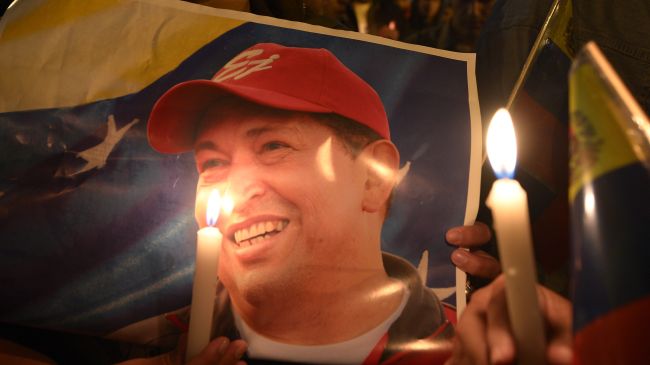
 Merida – After two years of battling cancer, President Hugo Chavez has died today at 4.25 pm.
 Aletho News
 Aletho News