Tulsi Nails it on National TV… US Regime-Change Wars
By Finian Cunningham | Strategic Culture Foundation | October 18, 2019
No wonder Democratic Party bosses and mainstream media are trying to bury presidential contender Tulsi Gabbard. She is the only candidate, perhaps the only politician in the US, who is telling the American public exactly what they need to know about what their government and military are really up to: fighting illegal regime-change wars, and to boot, sponsoring terrorists for that purpose.
It didn’t come much clearer nor more explicit than when Gabbard fired up the Democratic TV debate this week. It was billed as the biggest televised presidential debate ever, and the Hawaii Representative told some prime-time home-truths to the nation:
“Donald Trump has blood of the Kurds on his hands, but so do many of the politicians in our country from both parties who have supported this ongoing regime-change war in Syria that started in 2011… along with many in the mainstream media who have been championing and cheer-leading this regime-change war.”
The 38-year-old military veteran went on to denounce how the US has sponsored Al Qaeda terrorists for its objective of overthrowing the government in Damascus.
It was a remarkably damning assessment of US policy in Syria and elsewhere in the Middle East. And it was by no means the first time that Gabbard has leveled with the American people on the brutality and criminality of Washington’s so-called “interventions”.
The other 11 Democratic candidates on the stage during the TV debate looked agog after Gabbard’s devastating and calmly delivered statement. All the others have proffered the false narrative that US forces are in Syria to “fight terrorism”. They deplore Trump’s announcement last week to pull back US troops from northeast Syria because, they say, it will undermine the fight against Islamic State (IS or ISIS) and other Al Qaeda affiliates. They also condemn Trump for “betraying Kurdish allies” by his partial troop withdrawal.
President Donald Trump talks about “ending endless wars” and “bringing our troops home”. But he still premises his views on a credulous belief that the US under his watch “defeated ISIS 100 per cent”. In that way, he essentially shares the same corny view as the Democrats and media that America is a force for good, that it is the “good guys wearing white hats riding into the sunset”.
On the other hand, Gabbard stands alone in telling the American people the plain and awful truth. US policy is the fundamental problem. Ending its regime-change war in Syria and elsewhere and ending its diabolical collusion with terror groups is the way to bring peace to the Middle East and to spare ordinary Americans from the economic disaster of spiraling war debts. American citizens need to know the truth about the horror their government, military, media and politicians have inflicted not just on countries in the Middle East, but also from the horrendous boomerang consequences of this criminal policy on the lives and livelihoods of ordinary Americans, including millions of veterans destroyed by injuries, trauma, suicide, and drug abuse.
Following the TV debate this week, it seems that Gabbard won the popular vote with her truth-telling. A major online poll by the Drudge Report found that she stole a march on all the other candidates, winning approval from nearly 40 per cent of voters. Top ticket candidates Elizabeth Warren, Bernie Sanders and Joe Biden were trailing behind with 7 per cent or less.
Gabbard has clearly struck a deep chord with the US public in her honest depiction of American wars.
Despite her shattering exposé and seeming appreciation by the public, most mainstream media tried to bury her after the TV debate. Outlets like Vox and CNN declared that Warren was the winner of the debate, whose talking points were mainly about domestic policy issues. Like the other candidates, Warren plies the propaganda narrative of US forces “fighting terrorism”. Vox even slated Gabbard as “a loser” in the debate and claimed she had made “blatantly false” statements about the US’ role in Syria.
Other mainstream news outlets chose to ignore reporting on Gabbard’s demolishing of the official propaganda about American wars. Earlier this week, CNN and the New York Times smeared her as a “Russian asset” and an “apologist for Assad”, referencing a visit she made to Syria in 2017 when she held talks with President Assad.
The Democratic National Committee is claiming that Gabbard does not have sufficient support in polls it deems worthy for her to qualify for appearing in the next TV debate in November.
International events, however, are proving the Hawaii Representative right. US troops, as with other NATO forces, have been occupying Syrian territory illegally. They have no mandate from the United Nations Security Council. The pullback of US troops by Trump has created a vacuum in northeast Syria into which the Syrian Arab Army is quickly moving to reclaim the territory which US-backed Kurdish fighters had de facto annexed for the past five years. Several reports show the local people are joyfully welcoming the arrival of the Syrian army. The scenes are reminiscent of when Syrian and Russian forces liberated Aleppo and other cities previously besieged by terror groups.
America’s war machine must get out of Syria for the sake of restoring peace to that war-torn country. Not because “they have defeated ISIS 100 per cent”, as Trump would conceitedly claim, nor because “we are betraying Kurds in the fight against terrorism”, as most Democrats and US media preposterously claim.
Peace will come to Syria and the Middle East when Washington finally ends its criminal regime-change wars and its support for terrorist proxies. Tulsi Gabbard seems to be the only politician with the intelligence and integrity to tell Americans the truth.
Western Media Blasts Trump After Meeting With Putin

© Sputnik/ Michael Klimentyev
Sputnik – July 9, 2017
The first meeting between Vladimir Putin and Donald Trump at the G20 summit in Hamburg evoked a wave of criticism from Western media, as a number of notable news outlets blasted the US President for his conduct during negotiations.
At least several prominent newspapers took a dim view of President Trump’s handling of this meeting, claiming that the Russian leader apparently managed to outplay and outsmart his US counterpart.For example, Die Welt stated that it was clear to all professional observers that the meeting resulted in Trump’s capitulation.
In an apparent effort to underscore Trump’s relative inexperience in foreign affairs, the newspaper claims that the “political pro” Putin knocked out the newbie US President “by the book.”
The article’s author also emphasized the fact that Putin paused for a moment before shaking Trump’s already extended hand.
The Guardian adds that while US politicians apparently felt relieved that Trump managed to avoid “a major gaffe” during the meeting, it was “hardly cause for celebration.”
“It’s an indication of how rapidly our standards are falling when we’re reasonably pleased that President Trump has not made an obvious error,” Thomas Countryman, former US acting undersecretary for arms control and international security, remarked.
Meanwhile the New York Times insists that the meeting with Putin was probably the best part of the summit for Trump, who apparently found himself increasingly ostracized by other delegates.
“The talks with Mr. Putin oddly turned into a bright spot for Mr. Trump on the first full day of the gathering, where the United States found itself increasingly ostracized by other Group of 20 members on major issues, including climate change, immigration and trade,” the newspaper says.
The Los Angeles Times criticized the way Trump discussed the issue of Russia’s alleged meddling in the 2016 US presidential election, arguing that the US President should’ve been more assertive in his inquiries on the subject.
The news website Vox even took this issue up a notch by outright saying that “Putin got Trump to buy his fake news on election interference and to offer a weak endorsement of upcoming sanctions.”
Interestingly enough, the article’s author insisted that “the entire US intelligence community believes the Kremlin mounted a sophisticated campaign” to help Trump win the election, even though this assessment was made only by four out of 17 US intelligence agencies.
Stating that the US leader did not even properly prepare for the meeting, unlike his Russian counterpart, Vox claimed that “Trump — the dealmaker — got outplayed by Putin.”
The Pathologization of Dissent

Photo by Jamelle Bouie | CC BY 2.0
By CJ Hopkins | CounterPunch | October 27, 2016
According to the mainstream media, in a recent speech in West Palm Beach, Donald Trump finally completely lost it. Sawing the air with his tiny hands in a unmistakeably Hitlerian manner, he spat out a series of undeniably hateful anti-Semitic code words … like “political establishment,” “global elites” and, yes, “international banks.” He even went so far as to claim that “corporations” and their (ahem) “lobbyists” have millions of dollars at stake in this election, and are trying to pass the TTP, not to benefit the American people, but simply to enrich themselves. He then went on to accuse the media of collaborating with “the Clinton machine,” presumably to benefit these “global elites” and “international banks” and “lobbyists.”
Now, a lot of folks didn’t immediately recognize the secret meanings of these fascistic code words, and so mistakenly assumed that “global elites” referred to the transnational capitalist ruling classes, and that “lobbyists” referred to actual lobbyists, and that “banks” meant … well … you know, banks. As it turned out, this was completely wrong. None of these words actually meant what they meant, not in anti-Semitic CodeSpeak. So the mainstream media translated for us. “Political establishment” meant “the Jews.” “Global elites” also meant “the Jews.” “Banks” meant “Jews.” “Lobbyists” meant “Jews.” Even “corporate media,” meant “Jews.” Apparently, Trump’s entire speech was a series of secret dog-whistle signals to his legions of neo-Nazi goons, who, immediately following Clinton’s victory, are going to storm out of their hidey holes, frontally attack the US military, overthrow the US government, and, yes, you guessed it … “kill the Jews.”
OK, maybe I’m exaggerating the mainstream media’s reaction just a little bit. Or maybe Trump’s speech really was that fascistic. Judge for yourself. Read the transcript. (NPR offers a complete version of it here.) Then compare the reactions of The Wall Street Journal, The New York Times, Washington Post, The Inquirer, The Guardian, and other leading broadsheets, and magazines and blogs like Mother Jones, Forward, Slate, Salon, Vox, Alternet, and a host of others, most of which rely on Jonathan Greenblatt, CEO of the Anti-Defamation League and former Special Assistant to the President, as their authoritative source on Trumpian cryptology. (Mr. Greenblatt, incidentally, should know better, given the treatment he has received from hard-line Zionist publications for refusing to demonize Black Lives Matter, and for “taking sides against” the State of Israel.)
Look, I’m not defending Donald Trump, who I consider a self-aggrandizing idiot and a soulless huckster of the lowest order, and whose supporters include a lot of real anti-Semites, and racists, and misogynists, and other such creeps. I’m simply trying to point out how the corporate media have, for months, been playing the same hysterical tune like an enormous Goebbelsian keyboard instrument, and how millions of Americans are singing along (as they were before the invasion of Iraq, which posed no threat to the USA , but which according to the media had WMDs), and how terribly fucking disturbing that is. In case you didn’t instantly recognize it, the name of the tune is “This guy is Hitler!” and it isn’t the short vulgarian fingers of Donald Trump that are tickling the ivories. And no, it isn’t “the Jews” either. It’s the corporate media, and the corporations that own them, and the rest of the global capitalist ruling classes … in other words, those “global elites.”
The thing I find particularly disturbing is how these rather mundane observations — i.e., (a) that a global ruling class exists, (b) that it’s primarily corporate in character, (c) that this class is pursuing its interests and not the interests of sovereign states — how such observations are being stigmatized as the ravings of unhinged anti-Semites. This stigmatization is not limited to Trumpists. Anyone to the left of Clinton is now, apparently, an anti-Semite. For example, Roger Cohen, in The New York Times, riding the tsunami of condemnation of the insidious verbiage of Trump’s West Palm speech, executed an extended smear-job on Jeremy Corbyn and his “Corbynistas” (they’re fond of coining these epithets, the media), denouncing their virulent “anti-Americanism,” “anti-Capitalism,” “anti-globalism,” and “anti-Semitic anti-Zionism.”
Which, let me hasten to add, and stress, and underscore, and repeatedly emphasize, is not to imply that the Labour Party, or the British Left, or the American Left, or any other Left, is anti-Semitism-free. Of course not. There are anti-Semites everywhere. That isn’t the point. Or it isn’t my point.
My point is that this stigmatization campaign is part of a much larger ideological project, one that has little to do with Trump, or Jeremy Corbyn, or their respective parties. Smearing one’s political opponents is nothing new, of course, it’s as old as the hills. But what we’re witnessing is more than smears. As I proposed in these pages back in July, political dissent is being gradually pathologized (i.e., stigmatized as aberrant or “abnormal” behavior, as opposed to a position meriting discussion). Consider the abnormalization of Sanders, back when he was talking about “banks,” “global elites,” and other things that matter, or the media’s portrayal of British voters as racists in the wake of the Brexit referendum. And, yes, the charges being leveled against Trump, much as we might despise the man. Anti-Semitism, inciting violence, paranoid conspiracy theorizing, insurrection, treason, et cetera — these are not legitimate arguments one needs to counter with superior arguments; they are symptoms of deviations from a norm, signs of criminality or pathology, which is increasingly how the corporate ruling classes are dismissing anyone who attempts to challenge them.
A line is being drawn in the ideological sand. On one side of it are the decent people, the normal people, in their business wear, with their university degrees, and prescriptions, and debts. On the other side are … well, the deplorables, the ignorant, racist, anti-Semitic, neo-nationalist, populist extremists. This line cuts through both the Left and the Right … supersedes both Left and Right, making bedfellows of supposed adversaries like Obama, Clinton, Kagan, Wolfowitz, Scowcroft, and their ilk on the Normal team, and a motley crew of Trumpists, Putinists, European populists, Corbynistas, Sandernistas, socialists, anarchists, Wikileakers, anti-Zionists, anti-capitalists, neo-Nazis, Black Lives Matterers, angry Greek pensioners, environmental activists, religious zealots, the Klu Klux Klan, David Graeber, most of the contributors to CounterPunch, and various other “extremist” types, many of whom detest each other, in the Deplorables’ current starting line-up.
The corporate media is sending a message … a message aimed at a much broader audience than undecided American voters (assuming such creatures really exist). The message is, “get with the fucking program, or get stigmatized as an anti-Semite, or a racist, or a Russian spy, or whatever.” The message is, “drop the populist rhetoric, shut the hell up about the Wall Street banks, and the corporations, and the ‘one percent,’ and … actually … forget about politics completely, except for identity politics, of course. Go ahead and knock yourself out with that.” The message is, “you’re either with us or against us … and it doesn’t matter why you’re against us, or what it is you think you’re for. Right, Left … who gives a shit? It’s one big Basket of Deplorables to us.”
This message, of course, displays many of the hallmarks of the classic authoritarian mentality, the need for nearly total conformity, mindless allegiance to one’s so-called superiors, delegitimization of all opposing viewpoints, and the infantile type of hero-worship figures like Obama and Clinton inspire … not the old-fashioned authoritarianism that would-be despots like Trump represent, but, rather, a more attractive version, a hopey, changey, lovey version, where there are no frightening Hitlerian leaders barking out anti-Semitic code words, and no one is exterminating thousands of people in faraway countries they want to destabilize in order to entirely dominate the region. No, this is the version where Obama sells the TPP on the Jimmy Fallon show, and wars of aggression are not wars of aggression, but “humanitarian interventions.” It’s also the version where universal healthcare is, regrettably, “unrealistic,” but $38 billion for the State of Israel so it can operate its Apartheid State, and weapons sales to Saudi Arabia, so they can bomb the shit out of farmers in Yemen, and cut off people’s heads for blasphemy, is somehow in “America’s vital interests.”
But what do I know? I’m just a satirist. I should probably leave all this complex stuff, like what is and isn’t in my interest, and what words really mean and all that, to the experts in the mainstream media. Since they did so well decoding Trump’s speech, maybe they could translate some of these other code words I’ve been having trouble with, like the ones I put in scare quotes above, or other such code words, like “enemy combatant,” “free trade agreement,” “security barrier,” “indefinite detention,” “targeted killing,” or “troubled asset relief program.”
I could go on, but I probably shouldn’t. Odds are, I’m already on the list of Putin-worshiping, anti-Semitic, racist, misogynist, neo-nationalist, non-standing up for the National Anthem, conspiracy theorizing America-haters. The last thing I need to do at this point is start jabbering about how the United States is an authoritarian corporatist dystopia ruled by a global capitalist elite that couldn’t give less of a shit about Americans (or any other actual people living in any other actual countries), where the corporate media can whip up mass fanatical support for wars of aggression, or corporate puppets, by pointing their fingers at yet another bogeyman and shouting “Hitler” at the top of their lungs. Next thing you know I’d be writing about “banks,” and “global corporations,” and “national sovereignty,” and we all know what that’s about, don’t we?
C. J. Hopkins is an award-winning American playwright and satirist based in Berlin. His plays are published by Bloomsbury Publishing (UK) and Broadway Play Publishing (US). He can reached at his website, cjhopkins.com, or at consentfactory.org.
The Disappearance of Hillary Clinton’s Healthcare Platform
By Benjamin Day | Common Dreams | March 30, 2016
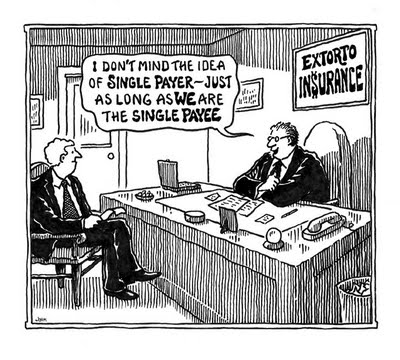
What would happen if the media lifted the curtain on Clinton’s healthcare platform and introduced any level of scrutiny to her proposed improvements on the Affordable Care Act?
In an extraordinary magic trick, performed on a national scale, Hillary Clinton’s healthcare platform has been disappeared. While policy analysts, news anchors, and columnists have been engaged in an intense debate over Bernie Sanders’s “Medicare for All” proposal, Clinton’s incremental alternative has escaped almost all scrutiny – even among those who say they prefer it.
Combining the election-season writings of our most prolific, liberal-leaning columnists at the New York Times, Huffington Post, Vox, Mother Jones, Politico, The American Prospect, etc. you’ll find dozens of articles critiquing Sanders’s single-payer plan. None have mentioned a single Clinton healthcare proposal as a point of comparison – merely that she supports a philosphy of incremental reform.
Take Paul Krugman, a high-profile advocate of Clinton’s approach to healthcare reform. Krugman has published two op-eds in the New York Times and five additional blog posts arguing that “[progressives] should seek incremental change on health care… and focus their main efforts on other issues – that is… Bernie Sanders is wrong about this and Hillary Clinton is right.” In all seven pieces, Krugman focuses exclusively on Sanders’s single-payer proposal and fails to mention even a single Clinton policy.
The disappearance of the Clinton healthcare platform has even been carried out by pollsters. The Kaiser Health Tracking Survey included a bizarre question in its February 2016 poll, which was widely cited in the press. Respondents were asked to pick one of four possible directions for the future of U.S. healthcare. Among the choices were “The U.S. should establish guaranteed universal coverage through a single government plan” and “Lawmakers should build on the existing health care law to improve affordability and access to care.” Thirty-three percent of Democrats chose the single-payer option, while fifty-four percent chose the incremental option. The questions were clearly intended as stand-ins for the Sanders and Clinton healthcare proposals, but note that the single-payer option is a policy, whereas the incremental option mentions no actual policies, but asks respondents whether they support the (universally desirable) outcomes of improving affordability and access.
What would happen if the media lifted the curtain on Clinton’s healthcare platform and introduced any level of scrutiny to her proposed improvements on the Affordable Care Act? They would find two categories of Clinton proposals: some that are so vague they’re difficult to evaluate, and other more concrete plans that follow in the footsteps of one of Congress’s most practiced healthcare incrementalists: Senator Bernie Sanders.
For example, one of Clinton’s clearest incremental proposals is to repeal the Affordable Care Act’s poorly named “cadillac tax” on health plans with high premiums. She announced this proposal on September 29, drawing the ire of White House spokespeople. The move, however, followed in the footsteps of a Senate bill to repeal the Cadillac tax introduced by Bernie Sanders and seven Democratic Senators just a few days previously on September 24. Clinton’s position was correctly seen by reporters as necessary if she didn’t want to lose labor union support to Sanders.
“Because Clinton’s healthcare platform has received zero public scrutiny, she has had the luxury of floating other policy ideas in broad outlines, too vague to evaluate.”Many of Clinton’s well-defined healthcare proposals are rolled into a package of prescription drug reforms, which she released on September 22, 2015. They bear a striking resemblance to the Sanders prescription drug plan announced on September 1, filed as legislation on September 10. Both would legalize importation of prescription drugs from Canada, where costs for identical drugs are much lower due to Canada’s single-payer healthcare system. Sanders was a pioneer of importation, and in 1999 started driving busloads of American patients who couldn’t afford breast cancer drugs across the Canadian border. Both candidates call for empowering Medicare to negotiate drug prices – even Donald Trump jumped on board in January. Both would ban “pay-for-delay” deals between brand-name and generic drug makers, and increase prescription drug rebates for Medicaid and/or Medicare.
Because Clinton’s healthcare platform has received zero public scrutiny, she has had the luxury of floating other policy ideas in broad outlines, too vague to evaluate. Take the proposal to expand the use of Accountable Care Organizations. How? According to Clinton’s December policy brief: “In the coming months, [Clinton] will provide full detail on her plans for delivery system reforms that drive down costs.” With the primaries drawing to a close, no such details have been released. The same could be said of another proposal to “create a fallback process” to review insurance premium rate hikes in states that don’t already review rates. There has been no explanation of how such a plan would work, or whether it would require new legislation.
This is the double standard at work in almost all national coverage of Clinton and Sanders on healthcare reform: Clinton has been taken at her word that her incremental plans will be politically feasible, succeed in improving affordability and access to care, and are not shared by her opponent. Sanders on the other hand received intense public pressure to release details of his single-payer healthcare proposal, and when he did the proposal was subject to an avalanche of public analysis and scrutiny.
This double standard is all the more remarkable because single-payer healthcare is an established policy, practiced in one form or another in almost every developed nation in the world. Incremental reforms that work within the market-based healthcare system of the U.S. are far more uncertain, and deserve greater scrutiny. They are easier to enact but dramatically more likely to fall short of their goals. This is because incremental reforms in the United States usually focus on expanding access to care, without significant cost controls, in order to avoid opposition from the healthcare industry. The resulting policies are often unsustainable; make little headway against national trends of rising costs and eroding access; or simply move costs around (e.g. from premiums to deductibles and co-payments, or vice versa).
Previous national trends in incremental healthcare reform – from managed care through pharmacy benefit management, chronic disease management, narrow networks, and beyond – have often created lucrative new industries, but had dubious impacts on underlying healthcare costs or access to care. Most of Clinton’s healthcare platform falls exactly into these danger zones, and should be received with a critical eye.
The national discussion of single-payer healthcare reform is long overdue. However, when the full range of national media outlets force one candidate to run on real policies, while allowing another to run on values and aspirations, we aren’t having a real discussion of systemic vs. incremental reform, we are merely aiding the corrosion of informed democracy.
Benjamin Day is the Executive Director of Healthcare-NOW.
Vox’s “Plutonium Plant”: Explainer Site Still Doesn’t Understand Arak
By Nima Shirazi | Wide Asleep In America | July 17, 2015
On the heels of the recently announced historic multilateral agreement over Iran’s nuclear program, self-described explanatory journalism outlet Vox.com has posted a number of infographics to explain certain parameters of the deal. The images were produced by Vox‘s graphics editor Javier Zarracina, who previously worked at the Los Angeles Times and the Boston Globe. The text accompanying the graphics, however, appears to derive largely from previous Vox posts, most likely ones penned by the site’s content manager Max Fisher.
While the post is not as error-laden as some of the site’s previous articles and supposedly explanatory maps, one mistake is glaring and deserves both attention and correction.
In its copious coverage of the Iranian nuclear program, Vox – and Mr. Fisher in particular – routinely refers to Iran’s heavy water research reactor at Arak as a “plutonium plant,” a description that is not only factually inaccurate but also deliberately alarmist. The new post is unfortunately no different.
In its brief section on the nuclear facilities Iran will continue to operate under deal and the specific restrictions agreed to pertaining to these facilities, Zarracina produced the following map:
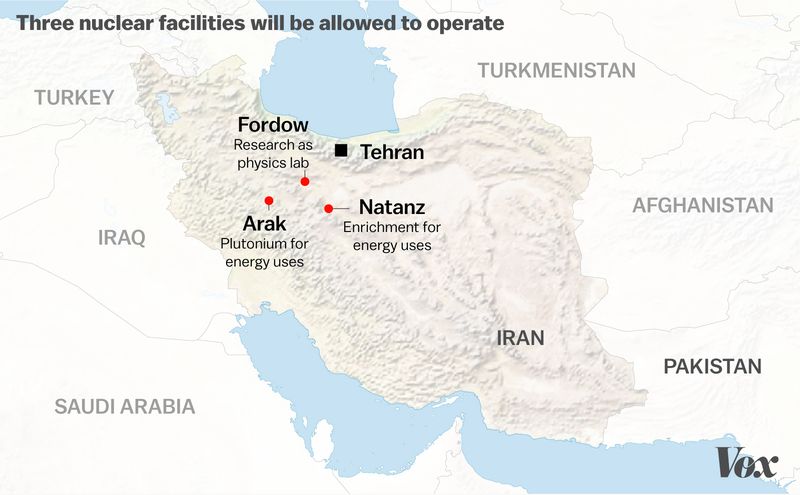
The bold text at the top of the map above is misleading. Iran currently has 18 nuclear facilities and nine additional locations (all hospitals) where nuclear material is used. All of these facilities – not just three, as Vox says – will continue to operate. All of them have long been declared to the International Atomic Energy Agency (IAEA) and all are under agency safeguards and open to regular monitoring and inspection. At least four times a year for the past dozen years, the IAEA has consistently continued to “verify the non-diversion of declared nuclear material at these facilities” to military and weaponization programs.
The three facilities Zarracina focuses on, however, are especially important. Two – Natanz and Fordow – are operational enrichment facilities; the other is a nuclear research reactor still under construction at the Arak complex.
In his explanation of the limitations Iran has accepted on its nuclear program, Zarracina claims the following:
The Arak facility matters because Iran has used it to develop plutonium, another nuclear fuel that can be used for energy or for a weapons program. Iran will be required to restructure its plutonium plant at Arak such that it will only make energy-grade plutonium, and will ship out its spent plutonium. The Arak facility will also be monitored.
Each of Zarracina’s three sentences contains either egregious errors or is explicitly misleading. His explanation is, as a result, just the opposite – an embarrassing exercise in ignorance and disinformation.
Let’s take the sentences one by one:
“The Arak facility matters because Iran has used it to develop plutonium, another nuclear fuel that can be used for energy or for a weapons program.”
For starters, the reactor at Arak remains under construction and has never been operational; therefore, Iran has never – ever – “used it to develop plutonium.” The reactor has in fact never been “used” to do anything. It’s never even been turned on.
Zarracina is clearly confused as to what facilities Arak contains, what those facilities do, and what Iran has done with these facilities. At Iran’s Arak complex, two facilities are relevant in this discussion: one is the IR-40 heavy water research reactor, the other is a heavy water production plant (HWPP). There is no such thing as a “plutonium plant” on the site.
The half-built IR-40 reactor is under full IAEA safeguards and is visited regularly by inspectors; the production plant, however, is not under safeguards and thus not legally subject to inspections. This is less alarming than it might sound and here’s why: heavy water is not nuclear material, it merely acts as a moderator and coolant in nuclear reactors that use natural uranium rather than enriched uranium. Still, Iran voluntarily provided IAEA inspectors access to HWPP in August 2011 and again in December 2013, even though this exceeded Iran’s legal obligations to the agency.
The IR-40 reactor at Arak – like all reactors – produces energy, not nuclear fuel. It runs on nuclear fuel. And once that fuel is used, it becomes irradiated and must be extracted from the reactor and replaced with new fuel.
All reactors that use uranium (natural or enriched) as fuel produce plutonium as a waste product. Ever heard of nuclear waste? Yeah, that includes plutonium, which hypothetically can be used to produce nuclear weapons. The amount of weapons-capable plutonium produced as a byproduct in the spent nuclear fuel of a heavy water reactor is usually more than what naturally occurs in the spent fuel from light water reactors, which run on enriched uranium and use normal water as coolant. This is why the Arak reactor in particular is considered by some to be an unacceptable proliferation risk.
But there’s more: weapons-grade plutonium present in irradiated (used) fuel must be extracted through a process known as reprocessing before it can be used for anything else. Iran has no reprocessing facility and has for years agreed never to build one. The new Iran deal simply reaffirms this past decision.
As nuclear expert Martin Sevior has explained, “Going the plutonium route to nuclear weapons is more difficult than using highly enriched uranium” because Iran “would have to build a sophisticated reprocessing plant which would be very hard to conceal while constructing, and requires even greater skill to conceal while operating.” Considering Iran has the single most scrutinized nuclear energy program on the planet and is constantly spied on by its adversaries,
Vox‘s writers seem to think that once a heavy water reactor is switched on, out pops weapons-grade plutonium, ready to be loaded into the nose cone of a ballistic missile bound for Tel Aviv or Boca Raton. This is not the case.
“Iran will be required to restructure its plutonium plant at Arak such that it will only make energy-grade plutonium, and will ship out its spent plutonium.”
Ok, again, there is no such thing as a “plutonium plant at Arak,” so that’s wrong. As part of the final agreement between Iran and its six negotiating partners, the Arak reactor will be redesigned and rebuilt so that it runs on 3.67% enriched uranium, not natural uranium, and no longer produces weapons-grade plutonium as a waste product. This essentially means Arak will be converted from a heavy water reactor to a light water reactor.
Once operational, the Arak reactor will be used for “peaceful nuclear research and radioisotope production for medical and industrial purposes,” just as Iran originally intended.
Zarracina compounds his misunderstanding of what nuclear reactors do and what they produce with the claim that Iran “will ship out its spent plutonium.” Reactors don’t produce “spent plutonium.” They produce spent uranium, the substance that actual fuels reactors, which, after irradiation, contains (along with many other radioactive byproducts) both plutonium isotopes Pu-239, which is suitable for weapons, and Pu-241, which is not. Plutonium enriched to more than 97% Pu-239 is dangerous; the more it is contaminated by Pu-241, the less danger it poses. The length of time nuclear fuel stays in a reactor determines how much of each plutonium isotope is leftover once the fuel is used up and removed from the reactor core. The longer the fuel stays in the less Pu-239 there is and the more Pu-241 there is. That’s why Pu-239, which is combustible, is referred to as “weapons grade,” while Pu-241 is known as “reactor-” or “energy-grade” plutonium. None of this plutonium, in whatever form, is used to fuel reactors; it is the byproduct of fuel, not the fuel itself.
And, again, for this plutonium byproduct to ever be used in a nuclear weapon, it must first be isolated and extracted from the spent fuel through reprocessing, which Iran is not incapable of – and not interested in – doing.
“The Arak facility will also be monitored.”
Ok, here’s an easy one. In simple terms, yes, Zarracina is correct. Arak will be monitored. But this statement is misleading without context. As mentioned already, Arak is already monitored by the IAEA – this is not a new development as a positive consequence of the Iran deal. Zarracina makes it sound like Iran finally agreed to put Arak under IAEA safeguards, but that’s not even remotely true.
In truth, even before Hassan Rouhani was elected president, Iran’s delegates to the IAEA under Mahmoud Ahmadinejad were urging international “nuclear monitors to use powerful new detection technologies to dispel international concern that the Persian Gulf country is seeking to build atomic weapons,” reported Bloomberg News. “We always welcome the agency to have more sophisticated equipment, to have more accuracy in their measurements, so that technical matters will not be politicized,” Iranian Ambassador to the IAEA Ali Asghar Soltanieh said in early June 2013, adding that Iran “won’t object to IAEA monitors using new technologies to determine whether plutonium is being extracted from spent fuel at its new reactor in Arak.”
Ignoring Facts and Avoiding Responsibility
Writers and editors at Vox have a responsibility not to mislead their readers. Sure, nuclear technology is complex and journalists on deadline don’t always have time to study a lot of the details. But once errors are pointed out, Vox‘s editors should do their best to own up to and correct their mistakes and those of their writers. When it comes to their Iran coverage, this tends not to happen at Vox. Quite the contrary, fact-checking Vox on Iran’s nuclear program often results in hostility and dismissal from Vox staff.
At the very least, Vox should immediately stop referring to the research reactor at Arak as a “plutonium plant.” This is easy to do: call it what it is and stop misleading readers. Instead, due to either a stubborn allegiance to ignorance or extreme laziness, Vox has continued to misinform it audience about the Iranian nuclear program. Unless facile and faulty explanations are its editorial mission, Vox should do better.
Featured Video

Alon Mizrahi: ‘Israel Must Be Dismantled’
or go to
Aletho News Archives – Video-Images
From the Archives
How a War with Iran Would Diminish American Power
By Greg Scoblete | The Compass | August 13, 2010
Jennifer Rubin wants a war with Iran:
But the emphasis on the existential threat to Israel ignores a more basic issue for Americans to ponder: a nuclear-armed Iran represents a dagger at the heart of America and an existential threat to our status as a superpower and guarantor of the West’s security. As to the former, Iran is pressing ahead with its long-range ballistic missile program. First the Middle East and Eastern Europe, then all of Europe and, within a matter of years, the U.S. will be within range of Iranian missiles. If those are nuclear and not conventional, what then? We’re not talking about whether Iran is going to be “merely” a destabilizing factor in the Middle East or whether it will set off an arms race with its neighbors or imperil Israel’s existence. We’re talking about whether America will then be at risk (and lacking sufficient missile-defense capabilities if we continue to hack away at our defense budget). The argument about whether mutual assured destruction can really work against Islamic fundamentalists who have an apocalyptic vision becomes not about Israel’s ability to deter an attack but about ours. Those who oppose American military action have an obligation to explain why America should place itself in that predicament.
I would argue that any obligation to present an explanation lies with those whose disastrous policy prescriptions with respect to Iraq lead America into the worst strategic blunder in the country’s recent history. That aside, note the blind faith in the power of the military to actually achieve its ends. … continue
Blog Roll
 Aletho News
- Villains of Judea: Leonid Radvinsky
- Alon Mizrahi: ‘Israel Must Be Dismantled’
- Former Head Of MI6 Admits That The U.S. And Israel Are Losing The Iran War
- Scattered Thoughts on War and Peace
- Iran Threatens to Close Red Sea to Shipping in Response to Invasion
- Iran in excellent position to prevail in war with US, Israel: John Mearsheimer
- Iran warns US: Do not call your retreat an agreement
- Neighbors first – Moscow signals shift in energy strategy
- Almost 400 Ukrainian drones downed over Russia in single night – MOD
- Battle for Hungary: How the Russiagate blueprint has been unleashed against Orban
- If Americans Knew
- In the West Bank, life is a constant battle – 3 articles
- Jacob Reses, one of the most powerful pro-Israel operatives in Trump’s Washington
- Israeli-US assaults kill or injure 87 children a day – Not a ceasefire Day 166
- ‘Forever live by the sword’: Understanding Israelis’ massive support for Iran war
- UN’s special rapporteur on human rights says Israel is systematically torturing Palestinians
- Trump White House plagiarized Iran war manifesto from Israel-aligned think tank
- Gaza says 6–10 patients die daily waiting for treatment abroad as Israel blocks medical evacuations
- ‘Substantial evidence’ of double-tap strike in killing of Gaza’s Hind Rajab
- ‘Do Not Want To Die For Israel’: Doubts About Trump’s Iran Strategy Spread Among Troops
- Instead of taking Joe Kent’s claims seriously, the media is disregarding him as an antisemite
- No Tricks Zone
- Devastating Assessment Of Comirnaty Vaccine By Former Senior Pfizer Europe Toxicologist
- New Study: CO2 Is ‘Effectively Negligible’ As An Explanatory Climate Change Factor Since 2000
- Former Pfizer Toxicologist Dr. Helmut Sterz Tells Bundestag Hearing Pfizer Vaccine Should Have Never Been Approved
- Energy Expert: Germany’s Nuclear Phaseout Was A “500 Billion Euro Mistake”
- New Research: South Australia’s Mid-Holocene Sea Surface Temperatures Were 4°C Warmer Than Today
- Storing Green Energy To Last Germany 10 Days Would Require A 60-Million Tonne Battery
- New Studies: UK Sea Levels Were 4 Meters Higher Than Today During The Mid-Holocene
- Destructive Green New Deal: German Energy And Metal Group Warns Of Drastic Crisis
- New Study Documents A 20-Year Pause In Arctic Sea Ice Decline – Driven By Internal Variability
- Wake-up Call: Survey Shows Majority Of Germans Now Favor Postponing Climate Targets!
 Aletho News