Israeli forces demolish water pond in northern Jordan Valley
WAFA – July 12, 2021
JORDAN VALLEY – Israeli forces today demolished a water pond near Bardala village in the northern Jordan Valley, according to sources.
Moataz Bsharat, an activist, told WAFA that the Israeli forces escorted a bulldozer to the village, where the heavy machinery tore down the 250-cubic-meter pond, which was used for agricultural purposes and belonged to Samer Sawaftah. The pool was a donation from the Ministry of Agriculture.
Meanwhile, Israeli forces seized a caravan, east of Yatta, south of Hebron.
Coordinator of the Popular Anti-Wall and Settlement Committees, Rateb Al-Jabour, stated that the Israeli forces seized a caravan used to serve as a physical and mental health clinic in Zweidin area, east of Yatta.
The clinic used to provide medical support and treatment to more than 1,200 residents of the area.
Under international law, driving residents of an occupied territory from their homes is considered forcible transfer of protected persons, which constitutes a war crime. But residents of Palestinian communities in the Jordan Valley are no strangers to such disruptive Israeli policies.
The valley, which is a fertile strip of land running west along the Jordan River, is home to about 65,000 Palestinians and makes up approximately 30% of the West Bank.
Since 1967, when the Israeli army occupied the West Bank, Israel has transferred at least 11,000 of its Jewish citizens to the Jordan Valley. Some of the settlements in which they live were built almost entirely on private Palestinian land.
The Israel military has also designated about 46 percent of the Jordan Valley as a closed military zone since the beginning of the occupation in June 1967, and has been utilizing the pretext of military drills to forcefully displace Palestinian families living there as part of a policy of ethnic cleansing and stifling Palestinian development in the area.
Approximately 6,200 Palestinians live in 38 communities in places earmarked for military use and have had to obtain permission from the Israeli authorities to enter and live in their communities.
In violation of international law, the Israeli military not only temporarily displaces the communities on a regular basis, but also confiscates their farmlands, demolishes their homes and infrastructure from time to time.
Besides undergoing temporary displacement, the Palestinian families living there face a myriad restrictions on access to resources and services. Meanwhile, Israel exploits the resources of the area and generates profit by allocating generous tracts of land and water resources for the benefit of settlers.
Israeli politicians have made it clear on several occasions that the highly strategic Jordan Valley would remain under their control in any eventuality.
Palestinian activist critical of PA leadership dies in custody; independent probe demanded
Press TV – June 24, 2021
A leading Palestinian human rights activist, who was an outspoken critic of the Palestinian Authority (PA)’s leadership, has died after being arrested by security forces in the occupied West Bank.
Nizar Banat, a resident of the flashpoint West Bank city of al-Khalil, was arrested in a dawn raid by PA’s security forces on his home on Thursday.
The 43-year-old activist, as his family said, was in bed when some two dozen PA officers broke into his home in the town of Dura, located some 11 kilometers southwest of al-Khalil, and started to severely beat him.
His family described what happened with Nezar as a “premeditated assassination” since he had been beaten hard with iron and wooden batons and as a result, he had lost consciousness.
“When he woke up, they arrested him naked and transferred him into an unknown place by 25 members of the security forces,” the family said, calling for the full disclosure of facts surrounding Banat’s death and those responsible.
Al-Khalil Governor Jamil al-Bakri, declining to comment on allegations by Banat’s family, said in a statement that the public prosecution had issued a summons for Banat and that “during the arrest his health deteriorated.”
“Following issuing a summons from the Public Prosecution to arrest the citizen Nizar Khalil Muhammad Banat, a force from the security services arrested him at dawn today, and during the arrest his health deteriorated. He was immediately transferred to the Hebron Government Hospital,” the statement said.
“After he was examined by doctors, he was pronounced dead,” it added. “The Public Prosecution office started procedures in accordance with the law immediately after it was informed of the incident.”
Banat was well known for his strong criticism of the PA leadership and had been arrested several times in the past by Palestinian security forces.
The rights activist, who intended to run in parliamentary elections before they were canceled earlier this year, had for months been posting videos on Facebook, in which he lambasted Palestinian President Mahmoud Abbas and other senior PA officials.
Banat’s death was met with anger on the streets of the West Bank, as well as criticism from human rights organizations and Palestinian factions, which have called for an independent investigation as specific circumstances of his death remain unclear.
Palestine’s Prime Minister Mohammad Shtayyeh was said to have ordered the immediate formation of an impartial investigation committee to look into the death of Banat after his arrest by the security forces in his house.
Major General Talal Dweikat, the General Political Commissioner and spokesman for the security services, was cited by the Palestinian Wafa news agency as saying that there is no objection to the participation of human rights institutions in the investigation committee, stressing that the government is ready to take any measures that result from the findings of the committee.
The committee will be headed by Minister of Justice Mohammad Shalaldeh, with the participation of a human rights official, a physician appointed by the Banat family, and a security official.
Hamas, Palestinian factions blast Banat’s death in custody
The Palestinian Hamas resistance movement condemned the death in custody of Banat, and said in a statement that this orchestrated crime reflects the intentions of the Palestinian Authority against the Palestinians and politicians.
Hamas held Abbas and his government accountable for the activist’s death.
Sami Abu Zuhri, a member of the Hamas movement’s political bureau, said, “We consider that [PA] Prime Minister Mohammad Shtayyeh bears the primary responsibility for the murder of activist and parliamentary candidate Nizar Banat, and we call for the killers to be prosecuted.”
The Popular Front for the Liberation of Palestine (PFLP) said in a statement that the left-wing faction held the PA responsible for Banat’s death.
“The arrest and then the assassination of Nizar again raises questions on the nature of the role and function of the PA and its security services, and its violation of the democratic rights of citizens through the policy of silence, prosecution, arrest and murder,” the PFLP said.
Ayed Yaghi, an official of the Palestinian National Initiative (PNI) movement in the besieged Gaza Strip, said in a statement that the party condemned Banat’s “arrest and subsequent death.”
Yaghi called for the formation of an independent investigation committee to conduct a comprehensive investigation into what happened and to ensure that those responsible for Banat’s death were punished.
The veteran Palestinian politician Hanan Ashrawi said in a tweet that, “The violent arrest & death in detention of Nizar Banat by the Palestinian security forces is a serious crime & a dangerous development.”
“The deterioration of conditions has gone unchecked for some time which led to this escalation. Accountability is imperative.”
The Euro-Mediterranean Human Rights Monitor also expressed its deep shock at the circumstances of Banat’s death.
The organization demanded an urgent and independent investigation into the case, saying all the circumstances pointed to a deliberate “process of liquidation” to suppress a voice strongly opposed to the policies of the PA.
The United Nations Middle East peace envoy Tor Wennesland also said he was “alarmed and saddened” by Banat’s death.
“My deepest condolences to his family & loved ones,” he added. “I call for a swift, independent & transparent investigation. Perpetrators must be brought to justice.”
Moreover, hundreds of angry Palestinians marched towards Abbas’ presidential compound in the West Bank on Thursday to demand his resignation over the death of the well-known activist.
As they were repelled by tear gas fire on the way to Abbas’s palace, they screamed “traitors, traitors” towards the forces.
Israel prevents non-vaccinated Palestinians from entering Al-Aqsa Mosque
![Israeli forces at the Qalandiya checkpoint from Ramallah into Jerusalem with worshippers who want to attend the first Friday prayer of Muslim holy month of Ramadan at the Al-Aqsa Mosque, on 16 April 2021 [Issam Rimawi/Anadolu Agency]](https://i0.wp.com/www.middleeastmonitor.com/wp-content/uploads/2021/04/Passing-through-Qalandiya-checkpoint-for-the-first-Friday-prayer-of-Ramadan_21.jpg?resize=1200%2C800&quality=85&strip=all&zoom=1&ssl=1)
Qalandiya checkpoint from Ramallah into Jerusalem, worshippers want to attend first Friday prayer of Muslim holy month of Ramadan, Al-Aqsa Mosque, 16 April 2021 [Issam Rimawi/Anadolu Agency]
MEMO | April 17, 2021
Israeli occupation authorities have prevented thousands of Palestinian worshippers from the occupied West Bank from entering Al-Aqsa Mosque on the first Friday of the Muslim holy month of Ramadan, Arab48 reported.
According to the news website, the Israeli authorities set a condition for the worshippers from the occupied territories to be vaccinated against COVID-19 in order to obtain access to the Muslim holy site.
Meanwhile, the occupied West Bank and Gaza Strip do not have sufficient quantities of vaccines, and therefore thousands were deprived of performing the first Friday prayer at Al-Aqsa Mosque.
Israeli military checkpoints between the West Bank and Israel have experienced severe congestion, Anadolu Agency reported, noting that disputes occurred between Palestinians and the Israeli occupation forces at Qalandia Checkpoint.
“We were prevented from entering Al-Aqsa Mosque under the pretext of not being vaccinated,” Samia Abdul-Aziz told Anadolu Agency. “However,” she argued, “they aim to reduce the number of Muslim worshippers inside the sanctity yards.”
Israel detains 3 prominent Hamas leaders in West Bank
MEMO | March 26, 2021
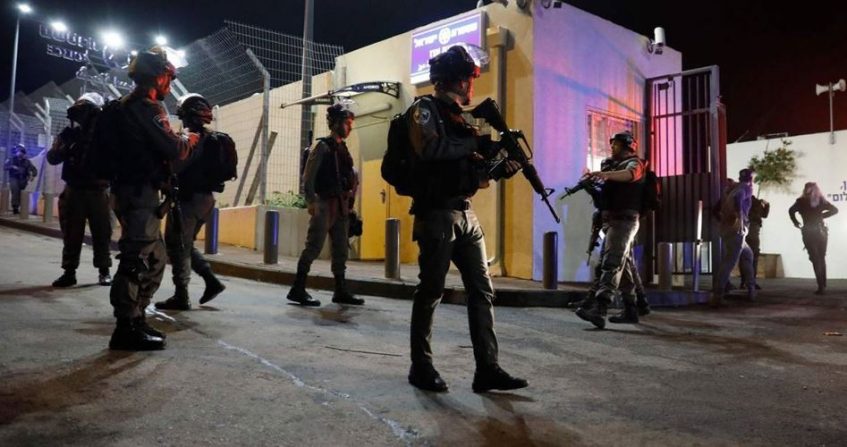
The Israeli army detained three prominent Hamas leaders the occupied West Bank city of Hebron.
Eyewitnesses told Anadolu Agency that an Israeli soldier detained Hatem Qaffeisha, 58, a top Hamas leader in Hebron and a Palestinian lawmaker.
Former Local Governance Minister Isa Al-Jabari, 55, and top Hamas figure Mazen Al-Natsha, 49, were also detained.
The three figures have been jailed several times by the Israeli army.
Hamas has warned of Israeli plans to stage a mass arrest campaign against its members ahead of the Palestinian elections slated for May.
In February, key Hamas members were detained including Mustafa Al-Shannar, Adnan Asfour, Yaser Mansour, Khalid El-Haj, Abdel-Basit El-Haj, Omar Al-Hanbali and Faze’ Sawafteh.
Hamas says the Israeli authorities aim to disrupt the Palestinian elections and affect the results.
Hamas also accused the Israeli authorities of threatening its members with imprisonment if they run in the upcoming elections.
Palestinians are scheduled to vote in the legislative elections on 22 May, presidential polls are to be held on 31 July and the National Council elections on 31 August.
The last legislative elections were held in 2006, with Hamas coming out on top.
Hamas: Israel detention campaigns aim to alter election results
MEMO | March 3, 2021
Hamas said yesterday that detention campaigns carried out by Israeli occupation against Islamic Bloc activists aim to affect the results of the Palestinian election.
Recently, Israeli occupation forces escalated detention campaigns targeting Hamas leaders, members, and activists in the occupied West Bank.
Hamas MP Sheikh Nayef Al-Rajoub said that the Israeli occupation detains Hamas members and holds them under administrative detention.
These detention campaigns aimed at “targeting the will of Palestinian youth, who are at the core of the upcoming elections,” Hamas said in a statement.
“We stress that achieving national consensus and partnership is a national priority,” Hamas added, reiterated that it “will continue its efforts to rearrange the Palestinian national home on the basis of achieving partnership, ending divisions and setting up a comprehensive, national programme to face off the Israeli occupation and settlement activities.”
Hamas called on all free people of the world and parliaments to impose sanctions on the Israeli occupation, which has been targeting Palestinian democracy for years.
“The detention campaigns come as part of a policy adopted by the Israeli occupation since 2006 to undermine the Palestinian political system and exclude any influential Palestinian party that gained legitimacy through the ballot boxes,” Hamas concluded.
The massacre of Ibrahimi Mosque
By Bilal Yasin | MEMO | February 27, 2021
Twenty-seven years ago, on 25 February, 1994, an Israeli settler named Baruch Goldstein shot at hundreds of Palestinians gathering for Al-Fajr prayer at the Ibrahimi Mosque in the occupied city of Hebron.
Goldstein took advantage of the gathering of the worshippers in the prostration position and the closure of the mosque’s doors by the occupation soldiers, to kill 29 Palestinians and wound more than 150 others.
The massacre did not end until the Israeli forces shot at the attendees of the victims’ funeral, raising the death toll of the massacre to 60.
Despite the atrocity of the massacre, it was widely supported by the Israeli occupation and settlers. When asked if he felt sorry for those killed by Goldstein, Jewish Rabbi Moshe Levinger remarked: “The death of an Arab makes me feel sorry as much as I pity the death of a fly.”
Goldstein is considered a saint by Israeli authorities, who transformed his grave into a shrine and assigned a number of honour guards to perform the military salute every day before his grave.
The Arab and Muslim countries were outraged and condemned the criminal attack via peaceful demonstrations, demanding an end to the Israeli settlements and the prosecution of the occupation for its repeated crimes. However, the Israeli authorities argued that Goldstein was insane and was receiving treatment, making it legally impossible to hold him responsible for his actions. This is how the occupation managed to escape the legal responsibility for this crime.
Despite the attempts of Israeli media to mislead the public about what really happened during the massacre, the United Nations (UN) Security Council approved, on 18 March, 1994, a resolution condemning the Ibrahimi Mosque massacre, and called on the Israeli authorities to take measures to protect the Palestinians, including the disarming of settlers.
This decision resulted in the formation of an international mission in the city of Hebron, with the aim of monitoring the practices of the occupation. Because of a report issued by the international mission, which between 1994 and 2019 monitored more than 42,000 violations committed by the Israeli authorities against the Palestinians, Israeli Prime Minister Benjamin Netanyahu refused in January 2019 to extend the stay of the international observers.
The media office of Netanyahu quoted him stating: “We will not allow an international force that works against us to stay any longer,” considering that the mission of the observers, which consisted of documenting violations of his soldiers against the Palestinians, is an anti-Israel act.
The Ibrahimi Mosque massacre was not just a passing event, but rather an act planned to impose a new reality through which the occupation could achieve its goals, seeking to expel the Palestinians from the Old City and control the Ibrahimi Mosque – exactly what Hebron is witnessing now.
Since the massacre, the city of Hebron has been subjected to a series of measures that changed its historical features and strengthened Israeli settlement, including:
- Closing the Ibrahimi Mosque and the Old City for six months, under the pretext of holding investigations.
- Unilaterally forming the investigation committee, known as “Shamgar”.
- The most prominent recommendations of the committee consisted of dividing the Ibrahimi Mosque into a synagogue and a mosque.
- Imposing tight security measures on the mosque, with electronic gates placed at its entrances.
- Granting settlers the right to sovereignty over 60 per cent of the Ibrahimi Mosque.
- Closing the roads leading to the mosque, except for one gate that was subjected to heavy security measures.
- Closing the Hisbah market, the Hebron Khan Khalil, Khan Shaheen, Al-Shuhada and Al-Sahla streets.
- Closing more than 1,800 shops in the Old City.
- Preventing Adhan (the call to prayer) in the mosque dozens of times a month.
- 1,400 families abandoned their homes, fearing for their lives.
According to the aforementioned, it is clear that the Israeli authorities are encouraging settlers to commit more massacres against the Palestinians by iconising the perpetrator of the Ibrahimi Mosque massacre, and refusing to commit to the UN Security Council resolution, recommending the protection of Palestinians and disarming the settlers.
On the other hand, the occupation state restricted the movement of Palestinians and gave the green light to settlers to expand their settlements and kill Palestinians, destroying their property and attacking their religious sanctities. This prompted many residents of the Old City to leave for fear of being harmed by Zionist gangs. Therefore, the international institutions must work harder to end the Israeli occupation and implement UN Resolution 242 to ensure that such massacres do not happen again, and to end the daily violations against Palestinians in the city of Hebron.
Five Palestinian minors say they were severely beaten, tortured by Israeli soldiers during detention
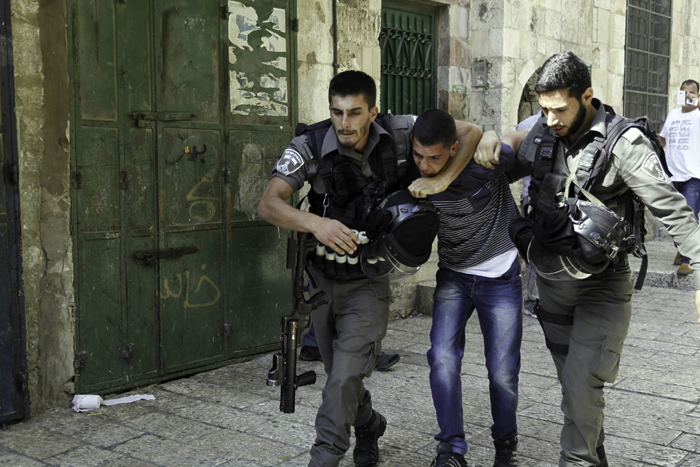
Israeli occupation forcing detaining Palestinian minors in the occupied territories
WAFA – February 2, 2021
Five Palestinian minors said they were severely beaten and tortured by Israeli soldiers and interrogators during detention, today said the Palestinian Commission for Detainees and Ex-Detainees Affairs.
It said it got affidavits from the five minors, who gave details of the beating and torture they were subjected to at the hands of Israeli soldiers and security agents during arrest and interrogation.
Mustafa Salameh, 17, was detained at his family home in Azzoun town, east of the northern West Bank city of Qalqilya. He was beaten with the butt of guns, smacked and kicked around, then shoved into an army jeep where he was thrown on the floor as soldiers kept trampling on him with their army boots, and kicking him while cursing him.
He said in his affidavit that he lost consciousness after that for a while and when he woke up he found himself in Jalama detention center where he was later interrogated for long hours while tied to a chair before being moved to the Majeddo prison for minors.
Mohammad Zalloum, 17, was detained at his family home in Silwan neighborhood of occupied East Jerusalem. He was dragged out of his house, severely punched on his stomach causing him to vomit, and then moved to Asqalan detention center where he was kept in the cells for 23 days, occasionally severely beaten.
Hani Rmeilat, 17, from Jenin refugee camp in the north of the West Bank, was interrogated in difficult conditions at Jalama detention center, assaulted with clubs by five prison guards causing him bruises on his body which required hospitalization at an Israeli hospital, after which he was taken back to the Jalama prison where he was kept for 20 days before being moved to Majeddo prison.
Majd Waari, 17, from Beit Hanina neighborhood of East Jerusalem, underwent severe interrogation at the infamous Russian Compound detention center in West Jerusalem for several hours while tied up on a small chair, smacked on the face and insulted.
Munir Arqoub, 17, from Kufr Ein, north of Ramallah, was detained at the Beit El military checkpoint north of Ramallah, attacked by three soldiers and thrown to the ground, beaten severely, then thrown into an army jeep before he was taken to a nearby military base. He was there left in an open area during cold weather conditions for several hours and denied sleep. He was taken the next day to Ofer military camp and detention center for interrogation and then moved to Majeddo prison.
The Commission said Israel is holding 170 Palestinian minors in its prisons, most of them were subjected to some form of cruelty, abuse, and brutality during their arrest.
Israeli Forces Demolish Mosque in Masafer Yatta
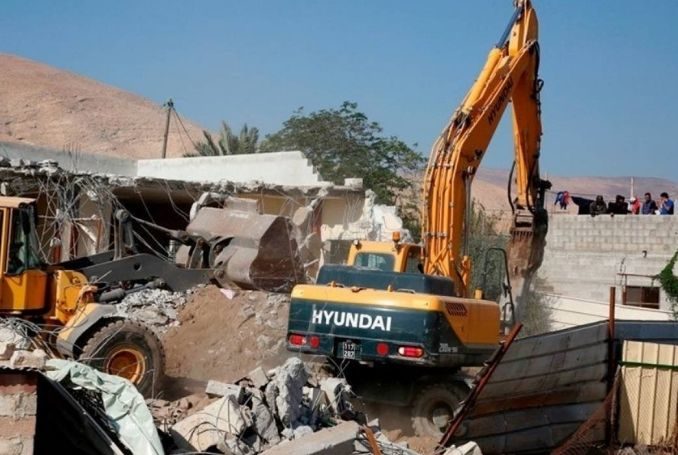
Israeli forces Wednesday demolished a mosque in the Bedouin community of Azwadeen. (Photo: via Social Media)
Palestine Chronicle | January 27, 2021
Israeli forces Wednesday demolished a mosque in the Bedouin community of Azwadeen, east of Yatta city, south of Hebron, according to the Palestinian news agency WAFA.
Coordinator of the Protection and Steadfastness Committees, Fuad al-‘Amour, told WAFA that Israeli forces escorted bulldozers into Khirbet Umm Qassa in the Bedouin community of Azwadeen, in what is called the Eastern Slope, where the heavy machinery tore down the mosque, reducing it to rubble.
The demolition was carried out less than two weeks after soldiers posted demolition notices against the mosque and a local school, which serves 50 students from three marginalized communities, purportedly for being built without licenses.
Meanwhile, soldiers seized a tin-sheet health unit in Khirbet al-Rakiz hamlet in Masafer Yatta.
Masafer Yatta is a collection of almost 19 hamlets that rely heavily on animal husbandry as the main source of livelihood.
Located in Area C of the West Bank, under full Israeli administrative and military control, the area has been subjected to repeated Israeli violations by settlers and soldiers targeting their main source of living – livestock.
It has been designated as a closed Israeli military zone for training since the 1980s and accordingly referred to as Firing Zone 918.
Israeli violations against the area include demolition of animal barns, homes and residential structures. Issuance of construction permits by Israel to local Palestinians in the area is non-existent.
Israeli occupation forces close Ibrahimi Mosque for ten days
Palestine Information Center – January 8, 2021
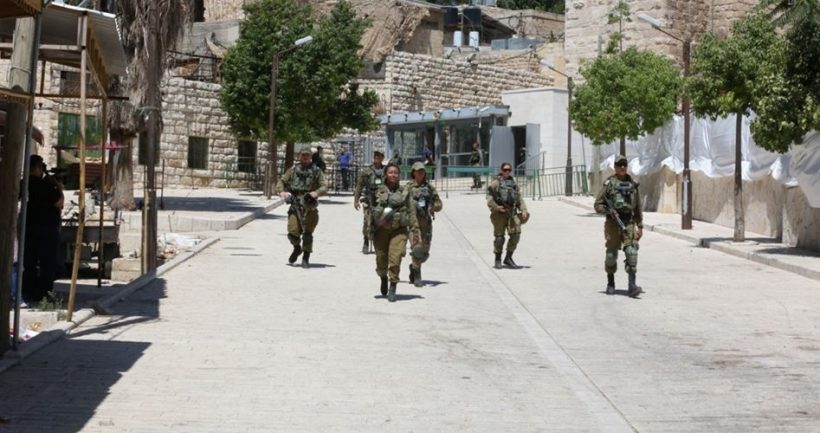
AL-KHALIL – Israeli occupation forces (IOF) closed the Ibrahimi Mosque in al-Khalil to worshipers and visitors for 10 days, Thursday, under the pretext of combating the spread of the coronavirus.
Sheikh Hefzi Abu Sneina, the director of the Ibrahimi Mosque, told the Palestinian News Agency (WAFA), “The occupation’s decision to close the Ibrahimi Mosque will start from nine o’clock this evening for 10 days. Worshipers and visitors will be banned from accessing any part of the holy site.”
Abu Sneina charged that these claims are not valid and that the IOF is denying Muslims access to the Haram.
He stressed that worshipers and visitors are committed to all health measures according to the preventive protocols in place, in addition to the fact that the IOF soldiers deployed at the military checkpoints surrounding the Haram have been allowing only 20 worshipers to enter the Haram at one time.
Meanwhile, the Palestinian Ministry of Endowments and Religious Affairs condemned the decision. Hussam Abu al-Rub, the Undersecretary of the Ministry told Anadolu Agency, “This decision is rejected and we will not accept it.”
Abul-Rub added that this decision constitutes an encroachment and interference with the authority of the Palestinian government to supervise religious sites in Palestine.
He indicated that the ministry is following up on everything related to organizing the entry of worshipers and the preventive and precautionary measures related to coronavirus.
Since 1994, the Ibrahimi Mosque, which is believed to be built on the tomb of the Prophet Ibrahim, peace be upon him, has been divided into a special section for Muslims and another for Jews after a Jewish settler killed 29 Muslims while they were performing the dawn prayer on February 25, 1994.
The Ibrahimi Mosque and the Old City of the al-Khalil were listed by the United Nations Educational, Cultural and Scientific Organization (UNESCO) in 2017 on the World Heritage List.
The Mosque is located in an area under full Israeli control but it is managed by the Palestinian Ministry of Endowments.
Featured Video

Yemen joins the war – Red Sea could be blocked next – Saudi regime at risk
or go to
Aletho News Archives – Video-Images
From the Archives
A superpower and “the world’s sickest warrior state”
By Paul J. Balles | March 8, 2010
Living through five or six major wars has hardened me to what I thought were the extremes of inhuman cruelty and brutality.
Two things made those extremes almost bearable: the brutality always revealed – at least according to the media coverage – the viciousness of the enemy. It was therefore quite understandable when our “brave men and women” pulverized the enemy.
Films of Japanese torturing captive Americans somehow justified holding Japanese Americans in internment camps during World War II; and only a small percentage of Americans found the bombing of Hiroshima and Nagasaki unreasonably vengeful at best, at worst, depraved.
The media giants in America portrayed the North Koreans as barbaric beasts with their captives, quite unlike their southern counterpoints – our allies during the Korean War. No one ever felt the need to explain how the South Koreans were a civilized breed while the North Koreans were absolute savages, at least according to the official line.
In Vietnam, our warriors justifiably (or so the media made us believe) dropped napalm on the North Vietnamese who had the gall to hide in villages and tunnels to ravage our invaders. At least it was accepted practice until some rogue photojournalist filmed a young girl screaming down a Vietnamese road in flames. … continue
Blog Roll
 Aletho News
- America Racing to Strategic Defeat in Iran: Lt Col Daniel Davis
- FTC Warns Visa, Mastercard, PayPal, Stripe Over Political Debanking
- Russian tanker approaches Cuba despite US oil blockade
- Marandi: Yemen joins the war – Red Sea could be blocked next – Saudi regime at risk
- Pro-Palestinian French member of European Parliament denied entry to Canada
- Pakistan to Host US-Iran Talks
- How Indonesia’s tilt toward the US left it stranded in the Strait of Hormuz
- US has no choice but to retreat from Iranian borders: Top commander
- Iran Retaliation Strikes Chemical Plant Near Dimona
- AWACS’ Destruction is a Major Loss for US Military – Ex-DoW Analyst
- If Americans Knew
- Israeli police block Catholic cardinal from entering Church of the Holy Sepulchre on Palm Sunday
- Israel is assassinating journalists again, more than any other nation, anywhere, ever – Not a ceasefire Day 170
- Over 300 US service members wounded, majority have brain injuries – Not a ceasefire Day 169
- Researchers at Human Rights Watch Resign Over Blocked Report on Palestinian Refugee Return
- Jewish Groups Are Backing a War Americans Don’t Want
- Eric Fingerhut Thinks He’s the President of the Jews
- Top Jewish Philanthropists, Rabbis Urge Israeli President to Take Action Against ‘Jewish Extremists’
- Don’t Be Fooled. Zionist Leaders Have Always Wanted to Control Southern Lebanon
- Israel’s widespread use of torture is a core element of its genocide against the Palestinian people
- In Israel’s War on Iran, Many Middle East US Bases Rendered “All But Uninhabitable”
- No Tricks Zone
- New Study Finds Warming Saves Lives…Cold Temperatures 12 Times More Deadly Than Excess Heat
- German Science Blog Accuses PIK Climate Institute Of Hallucinating Climate Tipping Points
- Devastating Assessment Of Comirnaty Vaccine By Former Senior Pfizer Europe Toxicologist
- New Study: CO2 Is ‘Effectively Negligible’ As An Explanatory Climate Change Factor Since 2000
- Former Pfizer Toxicologist Dr. Helmut Sterz Tells Bundestag Hearing Pfizer Vaccine Should Have Never Been Approved
- Energy Expert: Germany’s Nuclear Phaseout Was A “500 Billion Euro Mistake”
- New Research: South Australia’s Mid-Holocene Sea Surface Temperatures Were 4°C Warmer Than Today
- Storing Green Energy To Last Germany 10 Days Would Require A 60-Million Tonne Battery
- New Studies: UK Sea Levels Were 4 Meters Higher Than Today During The Mid-Holocene
- Destructive Green New Deal: German Energy And Metal Group Warns Of Drastic Crisis
 Aletho News