The Israeli occupation forces destroy an access road to a Ramallah-area village
WAFA – June 22, 2022
RAMALLAH – The Israeli occupation forces today destroyed an access road to Ras Karkar village, northwest of Ramallah, hampering the movement of people, according to the head of Ras Karkar village council, Marwan Nofal.
He said that the destroyed road had been partially paved for 20 years and that three months ago, following coordination with the Israeli military government, work on the rehabilitation of the road started. However, two days after the start of the work, the military forces raided the area and seized the vehicles used in the work, imposing a fine on their owners.
Nofal said that despite continuous promises to allow the rehabilitation work, the army sent its bulldozers today to destroy the road under the pretext that the road is located on “state land”.
The destruction of the road led to depriving farmers of access to their lands on the western side of the village, he said, and isolating several houses, noting that this is not the first time the Israeli military has targeted the village.
Ras Karkar suffers from the presence of seven iron gates at its entrances that limit the movement of people and access to their homes and lands.
At the same time, the Israeli military government does not allow it to carry out any work to improve the village’s infrastructure, said Nofal.
Israel plans huge park in occupied West Bank
MEMO | June 13, 2022
Israel plans to build a new national park on nearly 1 million dunams (247,000 acres) of land in the occupied West Bank between Jerusalem and the Dead Sea, Israel Hayom has reported.
The park will stretch between the illegal Jewish settlements of Kochav Hashahar north-east of occupied Jerusalem and Gush Etzion.
Tourist attractions such as the Mar Saba Monastery, Nabi Musa Mosque and the ruins of Hasmonean palaces, as well as hotels, will be within the proposed park. The area known as E1 to the east of Jerusalem has long been considered a red line and a point of no return for the internationally-backed two-state solution.
“We want to set up a new national park, the likes of which has never been seen in Judea and Samaria [the occupied West Bank], and create a single network, one product,” explained regional director-general Keren Geffen.
The announcement comes after the Israeli Defence Ministry reapproved the plan to advance a controversial settlement project in the E1 area of the occupied West Bank earlier this month. The Israeli government withdrew the plan in January amid international pressure.
The Civil Administration of the Israeli army, which authorises construction work in the occupied West Bank, published its agenda for an 18 July meeting to discuss objections to projects that have received initial approval. Two E1 plans totalling 3,412 housing units are the only projects on the docket.
148 Israeli violations against Palestinian journalists in May
MEMO | June 1, 2022
An Arab NGO has documented 148 Israeli rights violations against Palestinian journalists in the occupied Palestinian territories last month, Anadolu News Agency reports.
In a statement on Wednesday, the Journalists Support Committee said the month of May witnessed a surge in attacks on Palestinian journalists by Israeli forces and settlers.
It termed the attacks as “an attempt to prevent Palestinian journalists from covering Israeli assaults against Palestinians and their holy sites.”
According to the NGO, the Israeli violations varied from arrests, intimidation, shooting, verbal and physical assaults to car-ramming incidents.
It said 11 journalists were detained by Israeli forces in the West Bank during May, while the custody of five others was extended without trial.
“Israeli forces, in collaboration with settlers, disrupted the work of 61 journalists and media institutions while covering Israeli violations in the cities of Jerusalem, Hebron and Jenin,” it added.
The NGO also noted that the social media accounts of 11 Palestinian journalists were suspended for alleged violations of publication rules.
Last month, Al Jazeera journalist, Shireen Abu Akleh, 51, was shot dead while covering an Israeli military raid in the West Bank city of Jenin.
Palestinian officials and her employer, Al Jazeera, said she was killed by Israeli forces.
There was no comment from Israeli authorities on the NGO’s report.
Israel denies EU delegation entry to to Palestine
MEMO | May 23, 2022
A European Parliament delegation cancelled a trip to the occupied Palestinian territories yesterday after the group’s chairperson, Manu Pineda, was denied entry to Israel, reported Wafa news agency.
The Spanish member of the European Parliament and chair of the parliament’s delegation for relations with Palestine was scheduled to travel to the occupied Palestinian territories with a group of European lawmakers to review the situation on the ground following the assassination of Palestinian Al Jazeera journalist, Shireen Abu Akleh.
However, at late notice the group was informed that the mission would not be able to go ahead as planned due to what has been described as a “unilateral decision” taken by Israeli authorities.
“Israel is blocking the work of the European Parliament,” said Pineda, adding that the delegation had also been denied access to the besieged Gaza Strip.
He shared the letter that the Israeli Foreign Ministry, which states occupation forces “cannot allow the visit to Gaza of delegations with political affiliation and legislators.”
In response, European Parliament President Roberta Metsola, who is currently in Israel to meet President Isaac Herzog and Prime Minister Naftali Bennett, said on Twitter, she regretted Israel’s decision to refuse entry to Pineda and would raise the decision directly with the Israeli authorities during her visit.
“Respect for MEPs and the European Parliament is essential for good relations,” she said.
Pineda thanked Metsola for her remarks and called on her to “apply reciprocity in our institution until the decision is reversed.”
“It is important that we are united to defend the European Parliament,” he said.
The European Parliament’s delegation for relations with Palestine has 18 members and informs the European Union legislature about political, economic and human rights developments in the occupied territories.
Over 150 Palestinians injured as Israeli police storm Al-Aqsa

MEMO | April 15, 2022
More than 150 Palestinians were injured at dawn on Friday as the Israeli police stormed the courtyards of Al-Aqsa Mosque, Anadolu Agency reports.
The Palestinian Red Crescent said that 152 Palestinians were injured by Israeli police in the courtyards of the mosque.
The Palestinians were injured by rubber bullets, tear gas, and beaten by the Israeli police which also fired a barrage of stun grenades.
In a statement, the Islamic Endowment Department in Jerusalem, said that one of the mosque’s guards was hit in the eye by a rubber-coated metal bullet.
Eyewitnesses told Anadolu Agency that the Israeli police pursued the worshipers and beat them in the mosque’s courtyards.
For its part, the Israeli police announced in a statement that three of its members were slightly injured by stones thrown at them.
The police also noted in another statement that its forces removed the “rioters” in Al-Aqsa Mosque and arrested about 300 of them.
Thousands of worshipers were in the mosque where they were performing the morning prayer.
Israeli forces shoot, kill 16-year-old Palestinian boy in Jenin
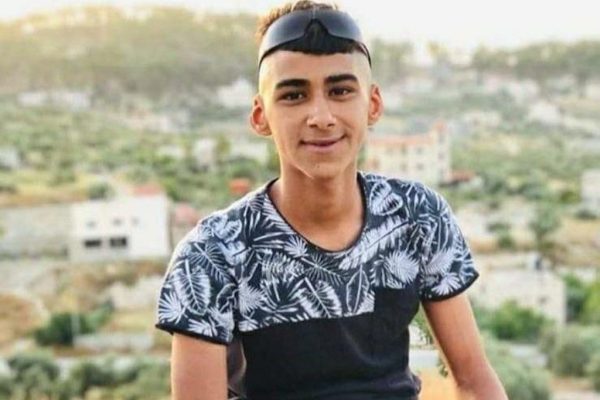
Sanad Mohammad Khalil Abu Atiya (Photo courtesy of the Abu Atiya family)
Defense for Children Palestine | March 31, 2022
Ramallah – Israeli forces shot and killed a 16-year-old boy with live ammunition in the northern occupied West Bank this morning.
Sanad Mohammad Khalil Abu Atiya, 16, was shot and killed with live ammunition by Israeli forces around 8:15 a.m. on March 31 in Jenin in the northern occupied West Bank, according to documentation collected by Defense for Children International – Palestine. An Israeli soldier shot Sanad as he approached Yazeed al-Saadi, 22, moments after al-Saadi was shot in the back of the head. The bullet struck Sanad in the right side of his chest and exited out his back, according to documentation collected by DCIP.
“Israeli forces frequently use live ammunition in unjustified circumstances, ignoring their obligation under international law to only resort to intentional lethal force when a direct, mortal threat to life or of serious injury exists,” said Ayed Abu Eqtaish, accountability program director at DCIP. “Systemic impunity has fostered an environment where Israeli forces know no bounds.”
Sanad was killed as Israeli forces were leaving the area after conducting a search and arrest operation in nearby Jenin refugee camp, Haaretz reported. Palestinian residents reportedly threw stones at the armored Israeli military vehicles as they withdrew from Jenin refugee camp towards Jenin’s Al-Zahra neighborhood, according to information gathered by DCIP.
An eyewitness reported that gunshots were fired from the refugee camp as the Israeli vehicles left the area. Palestinian residents who were throwing stones began to flee, as one of the armored Israeli military vehicles drove in reverse pursuing those who were fleeing, an eyewitness told DCIP.
An Israeli soldier exited the passenger side of the jeep, took a shooting position, and fired around 15 live ammunition rounds in quick succession, the eyewitness told DCIP. The soldier shot al-Saadi in the back of the head, and al-Saadi fell to the ground about two meters (six feet) from a car that Sanad and the eyewitness were hiding behind. Sanad was shot as he approached al-Saadi in an attempt to render aid, the eyewitness told DCIP.
Ambulances were able to reach Sanad a few minutes later, and he and al-Saadi were both transported to Ibn Sina hospital where they were pronounced dead, according to documentation collected by DCIP.
Under international law, intentional lethal force is only justified in circumstances where a direct threat to life or of serious injury is present. However, investigations and evidence collected by DCIP regularly suggest that Israeli forces use lethal force against Palestinian children in circumstances that may amount to extrajudicial or wilful killings.
Sanad is the fifth Palestinian child shot and killed by Israeli forces in 2022, according to documentation collected by DCIP. Nader Haitham Fathi Rayyan, 16, was killed by Israeli forces on March 15 outside the entrance of Balata refugee camp located southeast of Nablus on March 15. Israeli forces shot and killed Yamen Nafez Mahmoud Khanafseh in Abu Dis, east of Jerusalem on March 6. Israeli forces shot and killed 13-year-old Mohammad Rezq Shehadeh Salah on February 22 in Al-Khader, southwest of Bethlehem. An Israeli sniper shot and killed 16-year-old Mohammad Akram Ali Taher Abu Salah with live ammunition on February 13 while Israeli forces deployed in the village of Silat Al-Harithiya near Jenin in the northern occupied West Bank, according to documentation collected by DCIP.
2021 was the deadliest year for Palestinian children since 2014. Israeli forces and armed civilians killed 78 Palestinian children, according evidence collected by DCIP.
© 2022 Defense for Children Palestine
11,000 Americans call for boycott of General Mills over its East Jerusalem factory
MEMO | March 21, 2022
Over 11,000 Americans signed a petition demanding General Mills shut down its Pillsbury factory in the illegal Atarot settlement, which is built on occupied Palestinian land.
The petition said, “The U.N. has named General Mills as one of the 112 businesses violating international humanitarian and human rights law by operating in occupied Palestinian territories.”
“It’s Pillsbury factory in the Atarot Industrial Zone, an illegal Israeli settlement in East Jerusalem, has displaced, exploited, stifled, and otherwise harmed local Palestinian lives, livelihoods, and land,” added the petition.
The petition said that General Mills “profits off of apartheid and is complicit in Israel’s occupation and annexation of the West Bank.”
The signatories demanded that General Mills shut down its factory in occupied East Jerusalem, stressing their commitment to boycotting Pillsbury products until this demand is met.
News of this comes as at least seven Palestinians were arrested by Israeli occupation forces in the West Bank today, including a 62-year-old.
Local sources said occupation forces arrested at least seven Palestinians, including 62-year-old Hamas official Shaker Amara from the Aqabat Jabr camp in Jericho, as well as released prisoners and other citizens.
The sources noted that the occupation forces also arrested municipal elections candidate from Al-Bireh, Islam Al-Taweel, head of the Al-Bireh Brings us Together list, researcher and released prisoner Emad Abu Awwad from Al-Bireh, released prisoner Nael Abu Asal, Omar Abu Jenadi from Jericho, Muath Abu Tarboush from Al-Ezza camp north of Bethlehem, and Mahdi Zakarneh and Rami Yaseen from Jenin.
Hamas leader Amara is a former prisoner, arrested more than 13 times by the occupation, and each time held under administrative detention – without charge or trial.
46 Israel violations against Palestinian journalists in January
![Journalists flee after being attacked with grenades in the West Bank on 22 February 2019 [HAZEM BADER/AFP/Getty Images]](https://i0.wp.com/www.middleeastmonitor.com/wp-content/uploads/2020/12/GettyImages-1126740088.jpg?resize=1200%2C800&quality=85&strip=all&zoom=1&ssl=1)
MEMO | February 2, 2022
An Arab journalists’ rights group has recorded 46 Israeli violations of Palestinian media freedoms in January, Anadolu News Agency reports.
In a report on Wednesday, the Journalists’ Support Committee which documents media violations across the Palestinian territories, said the Israeli violations varied between “arrest, extortion and direct field assault” of media personnel among other forms of harassment.
According to the NGO, four Palestinian journalists were arrested by Israeli forces last month.
It noted that the Israeli army and settlers committed “17 cases of assault and injury against journalists” during their coverage of the demolition of Palestinian homes in the occupied East Jerusalem’s Sheikh Jarrah neighbourhood and rallies in the West Bank.
The Israeli army often used rubber bullets and gas bombs against Palestinian journalists, the report said.
The NGO also documented 18 cases of journalists being blocked from covering Israeli violations against the Palestinians.
According to the report, Israeli forces raided the house of one journalist, threatened two female journalists, while restricting the social media accounts of four others for “violating publishing instructions.”
Last month, the NGO said that 17 Palestinian journalists and media workers were held in prison by Israel.
‘Blood for Blood’: On Jenin and Israel’s Fear of an Armed Palestinian Rebellion
By Ramzy Baroud | MintPress News | August 26, 2021
The killing of four young Palestinians by Israeli occupation soldiers in the Jenin refugee camp in the northern West Bank, on August 16, is a consequential event, the repercussions of which are sure to be felt in the coming weeks and months.
The four Palestinians – Saleh Mohammed Ammar, 19, Raed Ziad Abu Seif, 21, Nour Jarrar, 19, and Amjad Hussainiya, 20 – were either newly born or mere toddlers when the Israeli army invaded Jenin in April 2002. The objective, then, based on statements by Israeli officials and army generals, was to teach Jenin a lesson, one they hoped would be understood by other resisting Palestinian areas throughout the occupied West Bank.
In my book, Searching Jenin, published a few months after what is now known as the ‘Massacre of Jenin’ or the ‘Battle of Jenin’, I tried to convey the revolutionary spirit of this place. Although, in some ways, the camp was a representation of the wider Palestinian struggle, in other aspects it was a unique phenomenon, deserving of a thorough analysis and understanding.
By the end of that battle, Israel seemed to have entirely eliminated the armed resistance of Jenin. Hundreds of fighters and civilians were killed and wounded, hundreds more arrested and numerous homes destroyed. Even voices sympathetic to the Palestinian struggle have underestimated Jenin’s ability to resurrect its resistance under seemingly impossible circumstances.
Writing in the Israeli newspaper, Haaretz, on June 10, 2016, Gideon Levy and Alex Levac described the state of affairs in the small camp. “Jenin, always the most militant of the refugee camps, was battered and destroyed, suppressed and bloodied, by Israel. These days its spirit seems to be broken. Every person is dealing with his own fate, his own private struggle for survival,” they wrote. The title of their article was “Jenin, Once the Most Militant of Palestinian Refugee Camps, Waves a White Flag”.
Being suppressed and shattered by an overwhelming force, however, is entirely different from “raising the white flag”. In fact, this truism does not just apply to Jenin but to the entirety of occupied Palestine, where Palestinians, at times, find themselves fighting on multiple fronts: Israeli occupation, armed illegal Jewish settlers, and the co-opted Palestinian Authority.
However, May 2021 changed so much. The Israeli attempt at ethnically cleansing Palestinian families from the Sheikh Jarrah neighborhood in East Jerusalem, the subsequent war on Gaza and the unprecedented uprising of unity, bringing all Palestinians, everywhere, together, lifted Jenin and other Palestinian areas from their state of despondency. The stiff resistance in Gaza, in particular, has had a direct impact on the various fighting groups in the West Bank, which were either disbanded or marginalized.
An unprecedented scene in Ramallah, on May 17, tells the whole story. Tens of fighters, belonging to the Al-Aqsa Martyrs Brigades, which is affiliated with the Fatah movement – the political party that dominates Mahmoud Abbas’ PA – marched on the streets of Ramallah, where the Authority is situated, in a relatively calm environment. The fighters chanted against the Israeli occupation and their ‘collaborators’ before clashing with Israeli soldiers, who were manning the Qalandiya military checkpoint.
This event was quite unusual, for it ushered in the return of a phenomenon that Israel, with the help of its ‘collaborators’, had crushed during the Second Palestinian Intifada – or uprising – between 2000-2005.
The Israeli military understands that the May war and uprising have triggered an unwelcomed transition in Palestinian society. Long-suppressed, occupied Palestinians are ready to rebel, eager to move on, beyond octogenarian Abbas and his corrupt clique, past the stifling factionalism and self-serving political discourses. The questions are how, where and when.
This is precisely why Israel is back in Jenin, once more trying to teach the nearly 12,000 refugees there a lesson, one that is also meant for Palestinians throughout the West Bank. Israel believes that if the nascent armed resistance in Jenin is suppressed now, the rest of the West Bank will remain ‘quiet’.
According to Palestinian journalist, Atef Daghlas, the Israeli occupation forces killed ten Palestinians during their frequent nightly raids on Jenin. Eight of the victims have been killed since the end of the Gaza war alone. There are two main reasons behind the increased number of casualties among the Palestinians in the last few months: first, the increased number of Israeli raids – where occupation soldiers, often disguising themselves as Palestinians, enter the camp at night and attempt to capture young Palestinian fighters; second, because of the growing number of youth enlisting in various resistance groups. According to Daghlas, the rifles carried by these youth are purchased by the young men themselves, as opposed to being supplied by a group or a faction.
“Blood for blood, bullet for bullet, fire for fire,” were some of the chants that echoed in the Jenin town and its adjacent refugee camp, when the Palestinian residents carried the bodies of two of the four killed youth, before burying them in the ever-crowded martyrs’ graveyard. The fact that Jenin is, once more, openly championing the armed struggle option is sending alarm bells throughout occupied Palestine. Israel is now worried that an armed Intifada is in the making, and Abbas knows very well that any kind of Intifada would spell doom for his Authority.
It is obvious that what is currently taking place in Jenin is indicative of something much larger. Israel knows this, thus the exaggerated violence against the camp. In fact, two of the bodies of killed Palestinians are yet to be returned to their families for proper burial. Israel often resorts to this tactic as a bargaining chip, and to increase the psychological pressure on Palestinian communities, especially those who dare resist.
It might be relevant to note that the Jenin refugee camp was officially formed in 1953, a few years after the Nakba of 1948, the year when historic Palestine was destroyed and the State of Israel was created. Since then, generation after generation, Jenin’s youth continue fighting and dying for their freedom.
It turns out that Jenin never waved the white flag, after all, and that the battle which began in 2002 – in fact in 1948 – was never truly finished.
Ramzy Baroud is a journalist and the Editor of The Palestine Chronicle. He is the author of five books. His latest is “These Chains Will Be Broken: Palestinian Stories of Struggle and Defiance in Israeli Prisons” (Clarity Press).
Israeli forces demolish water pond in northern Jordan Valley
WAFA – July 12, 2021
JORDAN VALLEY – Israeli forces today demolished a water pond near Bardala village in the northern Jordan Valley, according to sources.
Moataz Bsharat, an activist, told WAFA that the Israeli forces escorted a bulldozer to the village, where the heavy machinery tore down the 250-cubic-meter pond, which was used for agricultural purposes and belonged to Samer Sawaftah. The pool was a donation from the Ministry of Agriculture.
Meanwhile, Israeli forces seized a caravan, east of Yatta, south of Hebron.
Coordinator of the Popular Anti-Wall and Settlement Committees, Rateb Al-Jabour, stated that the Israeli forces seized a caravan used to serve as a physical and mental health clinic in Zweidin area, east of Yatta.
The clinic used to provide medical support and treatment to more than 1,200 residents of the area.
Under international law, driving residents of an occupied territory from their homes is considered forcible transfer of protected persons, which constitutes a war crime. But residents of Palestinian communities in the Jordan Valley are no strangers to such disruptive Israeli policies.
The valley, which is a fertile strip of land running west along the Jordan River, is home to about 65,000 Palestinians and makes up approximately 30% of the West Bank.
Since 1967, when the Israeli army occupied the West Bank, Israel has transferred at least 11,000 of its Jewish citizens to the Jordan Valley. Some of the settlements in which they live were built almost entirely on private Palestinian land.
The Israel military has also designated about 46 percent of the Jordan Valley as a closed military zone since the beginning of the occupation in June 1967, and has been utilizing the pretext of military drills to forcefully displace Palestinian families living there as part of a policy of ethnic cleansing and stifling Palestinian development in the area.
Approximately 6,200 Palestinians live in 38 communities in places earmarked for military use and have had to obtain permission from the Israeli authorities to enter and live in their communities.
In violation of international law, the Israeli military not only temporarily displaces the communities on a regular basis, but also confiscates their farmlands, demolishes their homes and infrastructure from time to time.
Besides undergoing temporary displacement, the Palestinian families living there face a myriad restrictions on access to resources and services. Meanwhile, Israel exploits the resources of the area and generates profit by allocating generous tracts of land and water resources for the benefit of settlers.
Israeli politicians have made it clear on several occasions that the highly strategic Jordan Valley would remain under their control in any eventuality.
Featured Video

Russia Helping Build a New Middle East /Trita Parsi
or go to
Aletho News Archives – Video-Images
From the Archives
Sam Husseini: The entire US establishment helped lie their way into the Iraq war
By Slava Zilber | American Herald Tribune | October 14, 2019
Sam Husseini is a senior analyst with the Institute for Public Accuracy, independent journalist and contributor to The Nation and FAIR.
Slava Zilber: Sam, three years ago, you appeared on Talk Nation Radio with David Swanson and spoke about the case of the GCHQ whistleblower Katharine Gun. You pointed out that the people involved in the spying on the UN and the people authorizing the Iraq War were not held accountable:
“Virtually everybody who went along with the war, whether it is Kerry or Clinton, of course, the Bush administration themselves has falsified their own records in terms of why, what they did, when they did, why they did it, to the extent that they’ve been scrutinised at all.”
You also address it in a recent article. And recently, Joe Biden has been lying about his position on the Iraq War. How can such an important issue escape meaningful scrutiny? … continue
Blog Roll
 Aletho News
- Russia Helping Build a New Middle East /Trita Parsi
- Barghouti: ‘Netanyahu has fallen,’ era of Smotrich, Ben-Gvir over
- China slams US policy on Iran as Russia rejects legality of nuclear meeting at UN
- The Mecca Pact Courts Iran: Containment Comes Full Circle
- Oman FM: Persian Gulf states, Iran, Iraq should form security pact excluding US
- Trump peddles fresh falsehoods, claims Iran ‘started the war’ as US aggression drags on
- Ukraine quagmire? Yes, but it’s for NATO, not Russia
- US intelligence hypes Chinese, Russian space threats while accelerating its own military buildup in orbit
- Iran FM Araghchi: “Hormuz Will No Longer Be the Same”
- EU facing trillion-euro debt hole while seeking more cash for Kiev
- If Americans Knew
- An error has occurred; the feed is probably down. Try again later.
- No Tricks Zone
- Sudden Stratospheric Warming, Powerful El Niño Combination May Lead To Extreme Europe Cold, Energy Crisis!
- Two New Studies Find Thwaites Glacier Melt Cannot Be Driven By Human Activity Or A Warming Ocean
- E-Cars Reduce CO2 Emissions By Only 41% Compared To Internal Combustion Engine Vehicles
- Predictions Made By Renowned Climate Professor Over Past Decades Have Been Proven To Be Poor
- New Study Suggests Large Regions Of The Pacific Ocean Have Been Cooling For The Last 80 Years
- Germany’s Green Energy Debacle: High Energy Costs Force Kahla Porzellan to Close After 182 Years!
- New Study: 50 Years Of The Most Aggressive ‘Net Zero’ Policies Can Only Affect The Global Climate By 0.03°C
- US September “Heat” Was No Record…Many Records Set Decades Ago
- Latest European Green Energy Debacle; Portugal’s Largest Flagship Solar Park Insolvent!
- Green Energy Debacle: German Expert Professor Fritz Vahrenholt Warns Of Severe Economic And Social Consequences

