Without Israeli occupation, Palestinian economy would double – UN report
RT | September 7, 2016
In a damning report, the UN development body (UNCTAD) described the ways Israeli occupation of Gaza and West Bank has been preventing the Palestinian economy from recovery and getting twice as big as it is now.
The document detailing the “staggering economic cost” of Israeli occupation was released on Tuesday by the United Nations Conference on Trade and Development (UNCTAD).
“The Palestinian economy would be at least twice as large without Israeli occupation,” the findings reveal.
Among the key reasons for the high unemployment and staggering poverty the agency cites “confiscation of Palestinian land, water and other natural resources.” It adds that “restrictions on the movement of people and goods; destruction of assets and the productive base;” also played a major role here.
According to the latest estimations by the Palestinian Central Bureau of Statistics nearly 27 percent of people of the autonomy are currently without job. Meanwhile UNCTAD has revealed that over 66 percent of the Palestinians were food-insecure last year.
“The continuous process of de-agriculturalization and de-industrialization” has contributed to a severe degradation of Palestinian economy, according to the UN report. The paper states that in Gaza “producers are denied access to half of the cultivable area and 85 per cent of fishery resources.”
The West Bank area is facing a similar problem, according to the UN. In the so-called area C, which constitutes over 60 percent of West Bank “more than 66 per cent of its grazing land, is not accessible to Palestinian producers”.
The figures published in the report say that the Israeli occupation of the Area C “costs the Palestinian economy the equivalent of 35 per cent of GDP ($4.4 billion in 2015).”
The Israeli military campaign in 2014 whose proclaimed goal, was to prevent rocket attacks on its territories from the Palestinian areas delivered another blow to the financial recovery of the Palestinians.
The following tightening of the Gaza blockade, in place since 2007, made the things even worse, the report states. It resulted in additional civilian items being banned after labeled “dual-use”, meaning they can be also implemented for causing harm.
The crisis resulted in additional severe shortages of medical equipment as well as serious reduction in water supplies in the occupied territories, the UN finds. The problem also contributed to the rising infant mortality of almost 20 out of 1,000 live births. The trend is labeled “unprecedented” and found only in countries “affected by HIV epidemics”
In addition UNCTAD points out that the expanding settlement policies by the Israeli authorities are contributing to the Palestinian plight.
“There are now 142 settlements in the West Bank, bringing the number of Israeli settlers to over one fifth of the Palestinian population. This expansion undermines the prospects for a two-State solution,” UNCTAD claims.
The so-called two-state solution, proposed by the UN would see an establishment of an independent state of Palestine alongside Israel, west of the Jordan River. The potential boundaries however remain one of the key stumbling blocks here.
In the latest development, Israeli PM Benjamin Netanyahu’s press service has issued a statement saying he is considering Russia’s offer to host Israeli-Palestinian talks in Moscow
“[Netanyahu] presented Israel’s position whereby he is always ready to meet [Abbas] without preconditions and is therefore considering the Russian president’s proposal and the timing for a possible meeting,” the statement said.
Palestinian President Mahmoud Abbas has already accepted the offer to meet with Netanyahu, although the date for the talks has not been yet set.
Israel detained 30 Palestinian teens in August, majority report being tortured

Ma’an – September 5, 2016
RAMALLAH – Israeli forces imprisoned 30 teenage Palestinians over the month of August and collected 65,000 shekels ($17,270) from their families as fines, the Palestinian Committee of Prisoners’ Affairs said Monday, with the majority of the detainees saying they were beaten and tortured during their detention, interrogation, and transport from one detention center to another.
A statement released Monday quoted the committee’s lawyer Luay Akka as saying that among the detainees were minors as young as 13 years old.
Akka added that 17 of the detainees were taken from their homes during military raids, five were detained from off the street, four at military checkpoints, and four arrived voluntarily to detention centers after they received summons from Israeli authorities.
Three of the 30 detainees were held without being charged or standing trial in administrative detention, and the rest were sentenced after court hearings to periods ranging from one month to 45 months.
Mousa Khanafsa, a 14-year-old boy from Abu Dis in the Jerusalem district of the occupied West Bank told Akka that he was violently beaten when he was detained from a street near his house.
A group of undercover Israeli officers, he said, chased him in the street and when they caught him they “assaulted him with the butts of their rifles, stomped on him with military boots, and was left bleeding from his nose.”
It was the latest report to emerge recently from the committee and other rights groups, amid years of well-documented abuse and mistreatment of Palestinian children by Israeli forces.
Akka reported last month on the cases of two Palestinian minors who were tortured, abused, and medically neglected in Israeli custody, one of which after being shot at point-blank range when Israeli forces detained them for rock throwing in the occupied West Bank district of Ramallah.
Locals in the occupied East Jerusalem neighborhood of al-Tur reported Saturday that Israeli police detained and assaulted 16-year-old Jamal al-Zaatari. During his detention, Jamal was pepper sprayed and beaten, resulting in injuries to his face, back, and feet, in addition to several bruises.
A report released recently by BADIL, a Palestinian NGO, warned of an increasing trend of Israeli forces shooting and injuring Palestinian youth — particularly in the knees and legs — during the near-nightly detention raids carried across the occupied West Bank.
Defense for Children International – Palestine (DCIP) has also extensively documented the abuse of Palestinians children in East Jerusalem by Israeli forces and the harsh interrogation practices used to force their confessions.
Despite “on paper” having more rights than Palestinian children in the occupied West Bank who are subject to a draconian military detention system, in practice, Jerusalem minors “do not enjoy their enshrined rights” under the Israeli civilian court system, according to DCIP.
Out of 65 cases documented by DCIP in 2015, “more than a third of Jerusalem youth were arrested at night (38.5 percent), the vast majority (87.7 percent) were restrained during arrest, and only a slim minority of children (10.8 percent) had a parent or lawyer present during interrogation.”
Interrogations of Palestinian children can last up to 90 days according to prisoners’ rights group Addameer, during which in addition to being beaten and threatened, cases of sexual assault, and placement in solitary confinement to elicit confessions are also often reported, while confession documents they are forced to sign are in Hebrew — a language most Palestinian children do not speak.
According to the Palestinian Committee of Prisoners’ Affairs, as of mid August, Israeli forces detained 560 children from occupied East Jerusalem alone since the beginning of 2016, and 110 minors were still being held in Israeli prisons, including four girls and 10 boys in juvenile detention centers.
According to Addameer, of the 7,000 Palestinians being held in Israeli custody, 250 were minors as of July.
51 Israeli Violations against Journalists in August
IMEMC News & Agencies – September 2, 2016
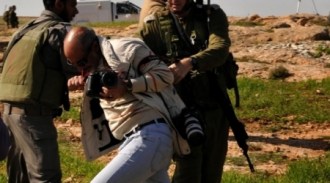 Israeli occupation forces reportedly committed 51 violations against Palestinian journalists during August of 2016, the government media office stated.
According to Al Ray Palestinian Media Agency, a report published by the office revealed that Israeli forces detained eight journalists, holding four in custody, and served a summons notice to one journalist.
Israeli authorities recently renewed the administrative detention of four journalists and the actual prison sentence of two journalists. It also documented five cases of abuses committed against detained journalists.
Additionally, it documented seven cases of injury, regarding four female journalists, involving gas grenades and fire.
Israeli forces also banned five journalists from covering events and travelling, one of them from Gaza.
The report also documented the closing of one local radio in the occupied West Bank, the raiding of two media institutions and the storming of nine houses where Palestinian journalists resided. It also reportedly seized media staff equipment.
Palestinian Photojournalist injured in Kafr Qaddum protest, forces raid East Jerusalem neighborhoods
Ma’an – September 2, 2016
QALQILIYA – A Palestinian photojournalist was injured by Israeli forces Firday afternoon, as dozens others suffered from tear gas inhalation during the weekly protest in the norther occupied West bank village of Kafr Qaddum.
Popular resistance coordinator in Kafr Qaddum Murad Shtewei told Ma’an that Israeli forces “assaulted” participants in the protest minutes after it began.
The soldiers injured photojournalist Nidal Shtayyah after hitting him with a tear gas canister in the back of his head. He was taken to Rafidia hospital for treatment.
Shtewei added that Israeli forces fired a barrage of tear gas, which landed mostly in surrounding homes, causing a family of five to suffer from tear gas inhalation, in addition to others participating in the protest, who were treated on the scene.
Residents of Kafr Qaddum began staging weekly protests in 2011 against land confiscations, as well as the closure of the village’s southern road by Israeli forces. The road, which has been closed 13 years, is the main route to the nearby city of Nablus, the nearest economic center.
Following similar clashes that broke out last month, Shtewei told Ma’an that more than 330 protests have been held over that period, during which time 84 protesters have been injured by live fire, including 12 children.
Some 120 others have been detained at protests and were subsequently held in Israeli custody for periods ranging between four and 24 months, Shtewei said, adding that they have paid fines totaling some 25,000 shekels (approximately $6,488).
Over the course of five years, an elderly protester was killed after suffering from excessive tear gas inhalation, one youth lost his eyesight, and another his ability to speak, he added.
Meanwhile, along with armed Israeli forces, Israeli Jerusalem municipality crews reportedly raided the occupied East Jerusalem villages of al-Isawyia and Silwan, where they delivered demolition orders and summons to local residents.
According to the Wadi Hilwah Information Center, Israeli forces accompanied municipality crews who raided the al-Bustan neighborhood in Silwan, where they hung demolition orders and warnings telling residents to “follow-up with the municipality on several buildings in the area.”
The forces reportedly took pictures of neighborhoos buildings and entrances of the neighborhood, and wrote tickets for parked cars.
Muhammad Abu al-Homos,a member of the al-Isawiya monitoring committee, said Israeli forces raided the village, searched a house, and patrolled the street ‘provocatively’. He added that the forces detained a teenager who was present in the area.
An Israeli army spokesperson said they were looking into reports of all three incidents in Kafr Qaddum, al-Isawiya and Silwan.
Israel shuts down Palestinian radio station amid escalation in press violations
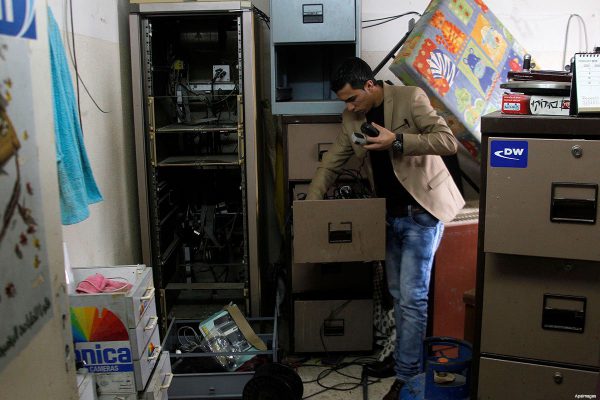
A Palestinian journalist checks damages after Israeli forces raided offices of local Palestinian Al-Khalil radio overnight in Hebron on November 21, 2015
Ma’an – August 31, 2016
HEBRON – Israeli forces raided and ransacked a Palestinian radio station early Wednesday morning in Dura City in the southern occupied West Bank district of Hebron, detained five of the station’s employees, and ordered it closed for three months, amid a documented escalation of violations against media freedoms by Israeli forces in the occupied Palestinian territory.
Locals told Ma’an that Israeli forces raided al-Sanabel radio station, destroyed its contents, and confiscated transmission and broadcast equipment.
Israeli forces left a closure order on the door of the radio station.
Locals added that Israeli forces detained head of the radio station Ahmad al-Darawish, as well as radio employees Muhammad al-Sus, Nidal Amro, Muntaser Nassar, and Hamed al-Nammura after raiding their homes.
Spokesperson for the Israeli army Avichay Adraee said in a statement in Arabic that Israeli forces, police, and civil administration authorities closed al-Sanabel upon a military order that claimed that the radio station broadcast programs inciting against Israel.
Adraee added that the five detainees were transferred for interrogation.
News of the closure came after Palestinian press freedoms watchdog MADA released a report on Saturday saying Israeli violations against media freedoms in the occupied Palestinian territory increased by 17 percent during the first half of 2016.
MADA General Director Moussa Rimawi said in the semi-annual report that while the total number of violations by both Israeli and Palestinian authorities declined from 224 cases in the first half of 2015 to 198 in the first half of this year — a rate of 12 percent — Israeli violations continued to climb, as Palestinian authorities committed 41 percent less violations during the same period.
A total of 133 violations committed by Israel were recorded during the period.
The most common types of violations committed by Israel were physical attacks, arrests, confiscation of equipment, prevention of coverage, and detentions.
The report highlighted that Israeli authorities in March closed two media institutions — Falastin al-Yawm and TransMedia Production Company — after ransacking and confiscated equipment from their offices.
Meanwhile, some 23 journalists and media workers were detained between January and June of 2016.
The report also noted an escalation of the Israeli practice of detaining Palestinians for social media activity, with Israeli authorities alleging that a wave of unrest that swept the occupied Palestinian territory last October was encouraged largely by “incitement.”
Palestinians have instead pointed chiefly to the frustration and despair brought on by Israel’s nearly 50-year military occupation of the Palestinian territory and the absence of a political horizon.
MADA said in the report that they were “gravely concerned regarding all systematic attacks and violence against journalists and media workers by the Israeli occupation, and urges state members to do their utmost to prevent violence against journalists, to ensure accountability, and bring to justice perpetrators of crimes against media freedoms.”
Israeli commander threatens to ‘disable all youth in the camp’ as 2 Palestinians shot in Duheisha
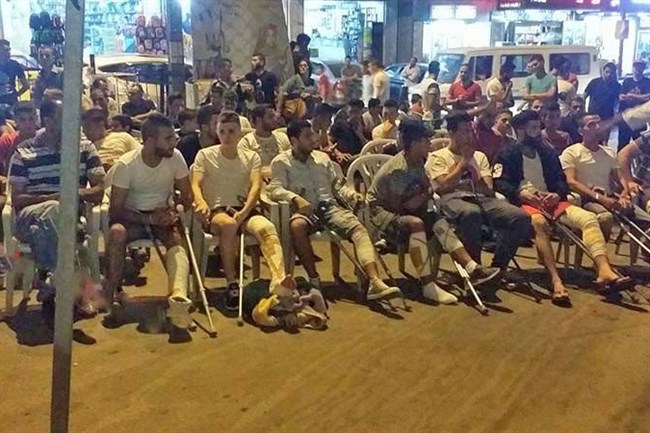
A file photo of a group of Palestinian youth after being treated for gunshot injuries by Israeli forces (Photo: BADIL)
Ma’an – August 26, 2016
BETHLEHEM – Two Palestinian youths were injured with live fire during clashes with Israeli soldiers in al-Duheisha refugee camp in southern Bethlehem early Friday morning, as reports emerged of an Israeli army commander making repeated threats in recent weeks to make “all youth in the camp disabled.”
Local sources said that two youths were shot and injured in the legs during clashes that erupted after Israeli forces raided the camp in Friday’s predawn hours.
Sources added that Israeli soldiers raided and searched the house of the incarcerated Palestinian Muhammad al-Seifi, detaining his mother and sister by locking them inside their home to pressure Muhammad’s younger brother Naba to turn himself into Israeli authorities.
Israeli forces also blew off the door of the Ibdaa Cultural Center near the entrance to the camp and occupied the rooftop of the building, from where Israeli snipers fired live ammunition and tear-gas canisters at local youth.
Violent clashes in al-Duheisha are common and break out nearly every time Israeli army forces enter the camp, which is located in Area A and should be under full Palestinian Authority control according to the Oslo agreements.
In a response to a request for comment, an Israeli army spokesperson told Ma’an that the Israeli army was not involved, and claimed Israeli border police were behind it, despite the area being located outside of police jurisdiction in Area A of the occupied West Bank.
When contacted by Ma’an, Israeli police spokesperson Micky Rosenfeld said he was not aware of the raid, saying it “made no sense” that police would be involved, and confirmed that al-Duheisha fell under the Israeli army’s jurisdiction in terms of raids. When contacted a second time, an Israeli army spokesperson insisted again that the army was not behind the raid and could not say who had been.
‘I will make all the youth of the camp disabled’
The clashes come in the wake of reports documented by BADIL, the Resource Center for Palestinian Residency and Refugee Rights, of an Israeli army commander making repeated threats during and after raids, and during interrogations, to disable all Palestinian youth in al-Duheisha.
The commander is reportedly responsible for the al-Duheisha area, and known to locals as “Captain Nidal.”
Local youth in al-Duheisha told BADIL that Captain Nidal has made statements such as: “I will make all the youth of the camp disabled,” “I will have all of you walking with crutches and in wheelchairs,” “I will make half of you disabled, and let the other half push the wheelchairs,” and “I will make all of you stand in line at the ATM waiting for your disability subsidies and assistance.”
One of the injured youth told BADIL that Captain Nidal told him to tell his friends that “Nidal will make all of you disabled.”
According to BADIL, which is based in Bethlehem, 30 Palestinians have been shot with live ammunition in the camp since the beginning of the year, the majority in their legs and knees.
They added that al-Duheisha had been raided at least three times by Israeli forces between the end of July and mid-August, during which time 18 Palestinian youth between 14 and 27 years old were shot in their legs — eight of which shot directly in the knee and several more in both legs — causing both permanent and temporary disabilities.
An Israeli army spokesperson could not immediately be reached for comment on the reports of the threats made by the commander.
“These threats indicate that these actions are not accidental or isolated incidents, but rather result from a systematic Israeli military policy aimed at suppressing resistance, terrorizing Palestinian youth, and permanently injuring them and/or causing significant damage to their physical and mental well-being,” BADIL said in their statement.
The reported threats come amid what BADIL called an intensification of the “systematic targeting” of Palestinian youth in the occupied Palestinian territory — particularly in refugee camps — since the beginning of 2016.
“This targeting has taken the form of injuries and arbitrary killings by the use of live ammunition by the Israeli army in the context of arrest campaigns, military raids, and random wide searches which usually trigger clashes,” the statement said.
BADIL’s statement also highlight a recent Israeli military incursion in the Hebron-area refugee camp al-Fawwar that lasted some 20-hours, during which an unarmed Palestinian teen was shot dead and dozens others were hospitalized.
“These cases of intentional wounding, when added to the comparable actions happening in refugee camps such as Aida, al-Arroub, Qalandia, Amari, and the West Bank at large, prove that these incidents amount to a systematic policy and an implementation of Captain Nidal’s threats.”
“These willful and grave breaches of international law trigger the obligations of third party states and other mandated agencies to put an end to this climate of impunity under which Israeli forces and its officials operate.”
BADIL’s collection of testimonies came as the latest report amid years of well documented cases of abuse and mistreatment of Palestinian children by Israeli forces in the occupied territory, including in East Jerusalem, which is under Israeli police jurisdiction.
“The Awful Clarity” of Israeli Oppression Becomes Murky Spin in the NYT

By Barbara Erickson | TimesWarp | August 22, 2016
When writer Michael Chabon visited the West Bank city of Hebron earlier this year, the brutal reality of the Israeli occupation hit him with force. During an interview with the Forward, he appeared “visibly jarred,” and he pulled no punches in describing his reaction.
“Once you see for yourself,” he said, “it is pretty obvious, I think, to any human being with a heart and a mind, it is pretty clear what to feel about it. It is the most grievous injustice I have ever seen in my life.”
His reaction echoes in the words of another author, Ben Ehrenreich, who recently published a book about the occupation, “The Way to the Spring: Life and Death in Palestine.” In his introduction Ehrenreich refers to “the awful clarity of the injustice,” and his book portrays Palestinian resistance under Israel’s state-sponsored system of oppression.
Both these American writers are saying that the suffering of Palestinians under Israeli rule is clear to see, an obvious truth to anyone who witnesses the situation firsthand.
Now, as Peter Baker, the latest New York Times Jerusalem bureau chief, takes up his post, we can ask whether the newspaper will begin to convey this reality to its readers. Will Baker, a fresh new witness with full access to the sites under occupation, give voice to the oppression seen with such clarity by Ehrenreich and Chabon?
Baker’s predecessor, Jodi Rudoren, who left Jerusalem late last year, filed hundreds of stories over nearly four years at the post and managed not to clarify but to obscure the reality of occupation and dispossession. Her stories promoted a narrative of Israeli victimhood and Palestinian violence and deflected Israeli culpability. (See TimesWarp 12-22-15.)
Many voices vied for attention during her stint, but Rudoren turned a deaf ear to some of the most respected sources of information, not only the United Nations and human rights organizations such as Amnesty International and Human Rights Watch but also Israeli monitoring groups and courageous Israeli journalists. These groups and individuals were constantly documenting and reporting abuses by the Israeli forces, but the news they bore rarely found even brief mention in the Times.
When a series of stabbing and vehicular attacks on Israelis began last fall, several monitoring groups issued alerts, charging that Israeli forces were using the situation to conduct “street executions” of Palestinians who actually posed no threat.
These accusations were bolstered by video and eyewitness evidence and came from groups such as the Israeli human rights organization B’Tselem, Amnesty International and Euro-Med Monitor. To give even more weight to their claims, a group of nine Israeli organizations, including Physicians for Human Rights and the Public Committee Against Torture, issued a joint statement saying Israeli officials were responsible for the climate that fostered these executions.
The Times took little notice. The newspaper’s headlines remained focused on Palestinian attacks, and any quotes about extrajudicial executions were attributed to Palestinian officials, as if these charges were nothing more than the opinions of partisans taking one side in a bitter exchange.
Anticipating Baker’s arrival in Jerusalem, the Times produced a video featuring him in conversation with Rudoren and another former Jerusalem bureau chief, James Bennet. The trio made many references to “the conflict” (with only a single mention of the occupation), and they insisted that Times reporting strives to be balanced and neutral.
If reporters were sincerely looking for balance, however, it would seem that truly neutral parties, such as the United Nations and human rights organizations, would provide an essential antidote to the partisan claims of two adversaries. Yet the Times turns a deaf ear to these sources, no matter how fully documented their findings are, and relies heavily on Israeli officials.
Thus, Times readers are left in ignorance, hearing almost nothing about urgent and repeated appeals from these non-partisan groups. Beyond the latest accusations of extrajudicial killings, for instance, rights organizations have consistently highlighted the mistreatment of Palestinian children held in Israeli custody and the demolition of Palestinian structures, including everything from homes and workshops to cisterns and animal shelters.
Organizations such as UNICEF, Defence for Children International, Save the Children, B’Tselem, Human Rights Watch, the UN Committee for the Rights of the Child and the Committee Against Torture in Israel have tried over several years to publicize the abuse of Palestinian children (See TW 1-13-14.), but the Times has rarely mentioned these reports and then only in stories aimed to spin the information in favor of Israel.
Throughout 2015 some of these groups continued to issue frequent reports and news releases with headlines such as “Rising physical violence against Palestinian child detainees,” “UNICEF report confirms ill-treatment of Palestinian child detainees remains systematic,” and “New U.S. government report highlights violations against Palestinian kids,” but the Times showed no interest in exploring the problem.
Likewise, Israel’s rampage of demolitions in the West Bank is never brought to the attention of Times readers although the United Nations, B’Tselem, Human Rights Watch and other groups have issued frequent statements and demands, urging Israel to end its policy of destruction.
While the Times has remained silent, Gideon Levy and Amira Hass, columnists for the Israeli newspaper Haaretz, have often written about the terrible toll demolitions have exacted from some of the most vulnerable Palestinian communities.
Rudoren wrote occasionally about punitive demolitions, the Israeli policy of destroying the family homes of attackers, but her stories omitted any mention of the much more common demolition of structures because they lack building permits, which are rarely issued.
The policy is a constant threat to Palestinians in a large part of the West Bank, and over the decades of occupation, the state has demolished more than 48,000 Palestinian homes and other structures.
According to the UN Office for the Coordination of Humanitarian Affairs, Israel has destroyed 726 Palestinian structures so far this year, displacing 1,020 people. In a recent report, OCHA noted that during one week this month, 42 structures were demolished or confiscated. The report stated, “Twelve of the targeted structures had been previously provided as humanitarian assistance, including emergency shelters, animal sheds, latrines, a community centre, and a water connection; the confiscation of the latter means that nearly 1,000 Palestinians in five herding communities in the Jordan Valley will continue to suffer water scarcity.”
The OCHA report continued, “This brings the number of assistance items destroyed or confiscated since the start of 2016 to 200, almost double the figure for the entire 2015 (108).” In other words, donors such as the European Union and International Committee of the Red Cross have stepped in to provide tents and other items when Israel has destroyed Palestinian homes, schools, playgrounds, water wells and other structures, but the Israeli authorities have demolished even this humanitarian aid.
In this brief report from OCHA “the awful clarity of the injustice” is evident, as it has been evident in hundreds of other reports issued over the years. The rising tide of demolitions, with all its human-interest value, is most certainly newsworthy, but will the Jerusalem bureau of The New York Times report it?
So far the Times seems determined to muddy the waters, avoiding a clear exposition of Israeli brutality, but with a new bureau chief now on board, some readers may hold out a faint hope for change, for an honest and full accounting at last.
Unfortunately, here at TimesWarp, the expectation is for more of the same. It seems unlikely that the Times would allow any straightforward reporting on Israeli oppression to appear in its pages. This would destroy its carefully fostered narrative of Israeli victimhood, “ancient hatreds” and the need to place Israeli security needs above all.
Palestinian women prisoners to launch protests against mistreatment of family visitors

Samidoun Palestinian Prisoner Solidarity Network – August 20, 2016
Palestinian women prisoners are declaring their intention to launch a series of protests over mistreatment of their relatives during family visits, Ma’an News reported on Thursday. In particular, Riyad al-Ashqar of the Palestinian Prisoners’ Center for Studies noted that family visits are frequently denied, cut short or delayed and visitors forced to undergo strip searches.
Lena Jarbouni, the elected representative of the 42 women held in HaSharon prison, stated that the women will protest so long as their families continue to experience lengthy waits in the sun, humiliating strip searches, repeatedly altered visitation schedules and prohibition of clothing for the prisoners and other necessary items. Several women prisoners, including Ansam Shawahneh, 19, have been completely denied family visits. There are currently approximately 60 Palestinian women held in HaSharon and Damon prisons.
On Thursday, Ofer Military Court ordered Taghreed al-Faqih, 44, from Dura near al-Khalil, imprisoned for two months and fined 5000 NIS (approximately $1100 USD) for “incitement.” Al-Faqih, the sister of Mohammed al-Faqih, extrajudicially executed by Israeli forces who bulldozed and fired a missile into his home, was arrested after her brother’s killing on 12 July 2016.
On Monday, 15 August, Randa Ahati of al-Khalil was released on bail to house imprisonment in her home in Yatta until her next court date. A former prisoner held for nearly four years in Israeli prison, she was arrested by occupation forces while traveling between Bethlehem and al-Khalil.
Sana Abdelrahman Nayef Abu Sneineh, 24, from Dura near al-Khalil, was released on 15 August after six months in administrative detention. She was arrested on 17 February by Israeli occupation soldiers invading her home in a pre-dawn raid, accusing her of posting “inciting” material on Facebook. She was ordered to three months’ administrative detention without charge or trial, which was then renewed for an additional three months.
Two women remain in administrative detention without charge or trial, among nearly 750 Palestinians in total: Sabah Feroun, imprisoned since 19 June after an invasion of her Jerusalem home by Israeli occupation forces and ordered to six months in administrative detention, and Haneen Abdelqader Amer, 39, from Tulkarem, imprisoned since 27 March and accused of “incitement” on social media but ordered imprisoned without charge or trial.
Israeli army withdraws from Al-Fawwar, after killing one Palestinian, injuring 59, and searching dozens of homes
IMEMC News – August 17, 2016
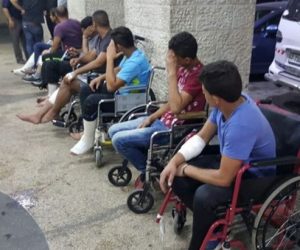 The Israeli army withdrew, late on Tuesday at night, from the al-Fawwar refugee camp, south of Hebron, in the southern part of the occupied West Bank, after concluding a massive military invasion, leading to the death of one Palestinian, while at least 59 others have been injured and dozens of homes invaded and ransacked.
Dr. Waleed Zalloum, the general director of the Hebron Governmental hospital, said 38 Palestinians were moved to the medical center, and that most of them were shot in their legs, thighs and arms.
Zalloum added that one Palestinian, identified as Mohammad Yousef Saber Abu Hashhash, 17, was fatally shot in the chest and died shortly after being moved to a hospital.
Dozens of residents, including many children and elderly, suffered severe effects of tear gas inhalation, and received the needed treatment.
Dr. Yousef Takrouri, the general director of the Al-Ahli Hospital in Hebron, said five Palestinians were moved to the medical center; all were shot with live rounds, four in the legs and one in the chest.
In addition, one Palestinian was moved to the Rafidia Hospital, in the northern West Bank city of Nablus, after the soldiers shot him with an expanding bullet in the leg, and another was moved to a hospital in Ramallah, when the soldiers shot him with a similar round in his left shoulder.
Many Palestinian families said the soldiers violently invaded their homes and searched them, and accused the military of stealing gold and cash during the searches.
Amjad Najjar, the head of the Hebron office of the Palestinian Prisoners Society (PPS) said the soldiers invaded his home in the al-Fawwar refugee camp, before forcing him and his family in one room, and violently searched the property, causing excessive damage.
Najjar added that the soldiers stole gold and cash from the family home, and that the search of the property lasted for more than four hours.
During the invasion into the refugee camp, the soldiers conducted home-to-home searches, causing excessive property damage, in addition to interrogating dozens of families and photographing them.
The Israeli invasion into the camp was initiated at dawn, Tuesday; the army said it was looking for weapons and claimed that the soldiers “located two pistols, one commando knife, sound bombs and dozens of live rounds.
Settler Harassment and Water Shortages in Beit Ummar
International Solidarity Movement | August 10, 2016
Settler Harassment
Ealier today we visited Abdullah Braigheith, a 54 year old farmer, who with his family are facing the risk of getting their agricultural water tank demolished, any day from now. This is their livelihood, without the water for crops they will lose their income. Abdullah and his brother already had to cut down on their production this year; they went from planting 30 dunums* last year to only 5 dunums this year. This leaves the family facing severe economic problems, and the father can’t pay for his kids’ education in university. They are now fearing losing around 3000 dunums of their land, because the settlers want to connect the settlements Gush Etzion and Beit AlBarakeh to make one settlement. Even though they are surrounded by settlements from all sides, they will not leave their land. This is not only due to the fact that they will lose their income, but the land is also their pride and identity.
Thirty five of the family’s apricot trees were cut down by the settlers. The family filed a complaint to the Israeli police, who did nothing to help. Afterwards, the settlers took revenge by setting three of their tractors on fire.
The family went to the Israeli military, who told them to file a complaint. Abdullah asked the military for a video of what happened, since there are military cameras all over the area. The soldiers refused to let them even see the video, because of ”security reasons”. The purpose of the cameras is not to protect people like Abdullah and his family, but instead the settlers who attack them and their property.
The family were not able a file a complaint since the soldiers did not allow them to see evidence that would make such an action possible. According to Abdullah Braigheith, using Israeli military courts to get justice is futile because the courts are set up to protect the victimizers, not the people who are wronged.
“It’s their own court, we can do nothing about it,” Abdullah said.
Water Shortage
About one year ago, four water tanks were built in Beit Ummar, a project to develop Palestinian water resources and agricultural lands in the West Bank. It was built with funding from the European Union, USAID, UAWC and other NGOs without permission from the Israeli authorities, because they knew that they most likely would not get a permit to built them if they did. Usually they would not receive demolition orders, but they all did, and the farmers, including Abdullah Braigheith, have all been going in and out of court since. This meaning that they are now not only dealing with a huge water shortage and harassment from settlers, but are now also using huge amounts of money in court. The fact that even projects like this, funded by the European Union and other NGOs, are under demolition orders, shows how impossible it is for the people living in Beit Ummar and the rest of the West Bank to receive help.
Since the Oslo Accords in 1995, Beit Ummar was put in the category which covers 60 % of the West Bank, called Area C, which is completely under Israeli civil military control. In these areas, Israeli settlers have higher privileges which are at the expense of the Palestinian population here. This is clear when you look at the fields in Beit Ummar, where Palestinian farmers are either not able to actually use most of their land, or their plants are dying because of the shortage of water.
Close by, you see the settlers’ fields which are green. The difference is very clear.
Palestinian domestic consumption is on average 70 litres per person per day, with Israeli domestic consumption being on average 300 litres per capita per day. A gross inequality exists, however, between Palestinian communities and illegal Israeli settlements*.
*B’tselem, The Gap in Water Consumption Between Palestinians and Israelis, (2007). Available from: http://www.btselem.org/english/Water/Consumption_Gap.asp.

The difficult situation of Beit Ummar, from Abdullah’s point of view
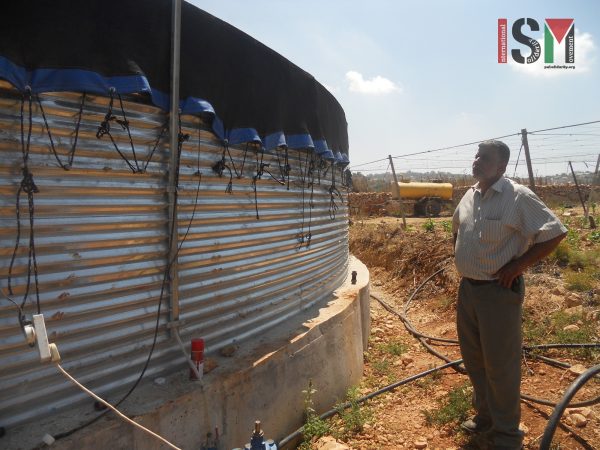
Abdullah standing at the water tank which is in the risk of getting demolished

Abdullah looking at one of the many dr
Israeli police find no wrongdoing in death of Palestinian minister beaten during protest
Ma’an – August 10, 2016
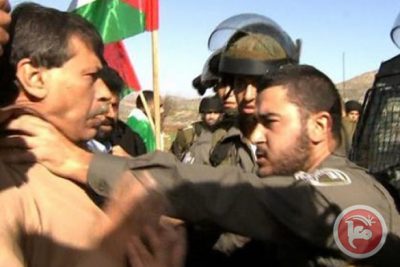
BETHLEHEM – Israeli police have closed their investigation into the death of Palestinian Minister Ziad Abu Ein — who died in 2014 after being beaten by Israeli forces — concluding that he had died of natural causes, Israeli news outlet Arutz Sheva reported on Wednesday.
According to Arutz Sheva, an autopsy by the police department of internal investigations concluded that Abu Ein, 55, died of a heart attack on Dec. 10, 2014, after an Israeli border police officer beat him in the chest with his helmet and the butt of his rifle during a march to plant olive trees in the village of Turmusayya in the Ramallah district of the occupied West Bank.
Israeli human rights organization Yesh Din, which represents Abu Ein’s family in the case, expressed its outrage at the police’s decision to close the case without ever interrogating the border policeman suspected of killing Abu Ein or asking him to testify.
“Most cases of Israeli violence against Palestinians are closed. But we expected that at least a proper investigation would take place,” Yesh Din spokesman Gilad Grossman told Ma’an on Wednesday. “This shows Israeli armed forces’ impunity when committing violence against Palestinian civilians.”
“They closed the case without talking to the border police officer,” Grossman added, despite the fact that “a number of soldiers who were there during the incident said that the border police officer was acting violently even before the altercation” with Abu Ein.
The internal investigations department reportedly justified the decision not to interrogate the policeman.
“Since policemen are authorized to use force and it is expected of them in many cases to use it, Internal Investigations will not summon a policeman for investigation if there is not a reasonable suspicion that a crime has been committed,” Arutz Sheva quoted the department as saying.
Grossman said that Abu Ein’s family had already filed an appeal to the Israeli Ministry of Justice.
“Our opinion is that internal affairs must investigate the acts of the border policeman during the altercation, even if his actions were not the direct cause of Abu Ein’s death,” he said. “At least, they need to investigate whether his actions were within the proper limits of police action.”
Abu Ein had worked with the Palestinian Authority monitoring Israeli settlements and the separation wall, and was a member of the Fatah Revolutionary Council. Abu Ein had also previously served as Palestinian deputy minister of prisoners’ affairs.
The Palestinian Ministry of Civil Affairs said a day after Abu Ein’s death that an autopsy carried out by a Palestinian forensics team revealed he had died after a powerful blow to the diaphragm and heavy use of tear gas, adding that he had also suffered from bruising on his neck, and several of his front teeth had been knocked out by a blow to his face.
At the time, Palestine Liberation Organization (PLO) Secretary-General Saeb Erekat said that the case was “a clear example of how the culture of impunity granted to Israel by the international community permits it to continue committing crimes against the Palestinian people.”
The Israeli police’s decision to close its investigation in the case comes days after Israeli newspaper Haaretz published a report revealing that nearly all investigations opened over the killings of Palestinians at the hands of Israeli police in the past ten months were closed “without the unit investigating and questioning the officers.”
ISM statement concerning Israeli measures against activists

International Solidarity Movement | August 8, 2016
The ISM is a Palestinian led movement with a mandate to support Palestinian nonviolent popular resistance to Israeli military occupation and apartheid. Palestinian led nonviolent resistance includes the Palestinian call for Boycott, Divestment and Sanctions of Israel, until it adheres to its obligations under international law.
ISM volunteers also accompany children to school and farmers to harvest their olives in areas where they face ongoing settler and military violence. We find that our presence sometimes results in reducing the level of lethal force used by the Israeli military against unarmed Palestinians. Further isolation of Palestinians by denying access and/or deporting human rights activists aims to make Palestinian communities already vulnerable and suffering from abuse even more vulnerable.
As a civilian population living under military occupation Palestinians in the occupied territories are promised protection under international law. All parties signed to the fourth Geneva Convention have the obligation to insure that others, including Israel, adhere to international law. Civilians are being called on to fill in the gap created by the failure of governments and official international bodies to provide protection and fulfill their obligations.
Israel’s isolation of Palestinians both by denying Palestinians and their supporters access to Palestine as well as by denying Palestinians including human rights defenders the right to leave Palestine is not a new strategy. It is most brutal and lethal in the besieged Gaza strip but all parts of Palestine are under some degree of siege.
We condemn Israeli suppression of Palestinian nonviolent resistance. The recent announcement by the occupation authorities that they will attempt to further isolate Palestinians indicates the occupation authorities unwillingness to do the only thing that will actually bring an end to Israel’s isolation – to adhere to international law, end the occupation and grant Palestinians their rights.
See the statement By the Boycott National Committee here.
Featured Video
Bombing Iran Back Into the Stone Age /Lt Col Daniel Davis & Jim Jatras
or go to
Aletho News Archives – Video-Images
From the Archives
The Occupied Mentality Syndrome
Saudi Arabia on the American chessboard – Part 2
By B. J. Sabri | American Herald Tribune | April 19, 2016
Since the Korean War, but particularly since the Iranian Revolution of 1979 until today, the United States has been steadily escalating its military presence in the Persian Gulf. Taking advantage of many colossal events of the past 36 years, [1] the hyper-empire has institutionalized its massive presence on land and sea, and expanded its objectives to include the unambiguous physical control of the area, as well as the clear understanding that local Arab governments should abide by them. The pretext is always the same: in “defense” of the national interests and security of the United States. From observing how the United States has been interacting with the governments of the region, and by judging from the size of its expeditionary force, we could reach a basic conclusion. The United States is occupying, de facto, the entire Arabian Peninsula. (Yemen, devastated by Saudi and American jets is yet to be conquered. Oman? Britain returned not as colonial ruler but as a soft occupying power.)
Under this articulation, Saudi Arabia, Qatar, Kuwait, and the United Arab Emirates are virtually occupied countries. If we compare this type of occupation to the mandate and protectorate regimes of the past, the results might be identical—the nations affected by it lose sovereignty. When Arab governments comply with the objectives of a foreign power that station military forces on their national milieu, then that power controls them in multiple ways including how they react to policy deliberations and what decisions they intend to take on specific issues. A good method to verify the concept of effective occupation is this: take notice of what the United States says and wants, and then compare it to what the gulf rulers do in response. (I shall discuss this detail at some point in the upcoming parts.)
If the presence of US forces or other means of political pressure are a factor in Saudi Arabia’s interventionist Arab wars, then we need to debate this issue. However, from the history of resistance to colonialism, we learnt: if a powerful state imposes its order on a nation by military means or other forms of coercion, and if this nation does not resist that imposition, then a mental subordination to the powerful state will ensue. This is especially true in the case of Saudi Arabia. One single event, 9/11, has transformed it from a US “ally” into an instant political hostage of the American Empire. … continue
Blog Roll
 Aletho News
- One Of America’s Leading Neo-Cons Has Turned Against The Iran War And Israel
- Attack in the Bosphorus exposes NATO weaknesses and tensions among allies
- BREAKING: US JET SHOT DOWN OVER IRAN /Lt Col Daniel Davis & Nima Alkhorshid
- Now everyone is dumping US government bonds
- Brazilian Congressman seeks to bar Israeli military personnel from entering Brazil
- Official reveals evidence of Arab states’ involvement in US-Israeli war on Iran
- His Majesty’s head-chopper: Syria’s MI6-backed president bows to King Charles
- Forced to backtrack: ‘Israel’ drops Hezbollah disarmament goal
- Britain’s Lebanon surveillance network: A digital map for war
- Bahrain faces scrutiny for opposition crackdown after detainee killed
- If Americans Knew
- Israel Is Blocking Palestinians from Easter at Church Where Jesus Resurrected
- Plot to assassinate Palestinian activist follows harassment campaign promoted by Zionist groups and elected officials
- Prominent New York synagogue hosts presentation on why U.S. Jews should support the ethnic cleansing of Gaza
- Tapper vs. Piker: Is the CNN Anchor Auditioning for David Ellison?
- Shouldn’t Democrats Be Able to Condemn Genocide?
- Israel-US kill negotiators, destroy civilian structures, but Iran’s military capabilities still largely intact – Daily Update
- ‘War crime’: Global condemnation as Israeli ministers celebrate death penalty law targeting Palestinian prisoners
- 7 Ways Israel Is Turning Lebanon Into Gaza
- World’s Leading Football Bodies Under Fire Over Israel Policies
- Experts warn of possible use of nukes against Iran
- No Tricks Zone
- Low Intensity Tornado Wrecks Major Solar Farm, Creating A Potential Toxic Dump
- New Study Finds Warming Saves Lives…Cold Temperatures 12 Times More Deadly Than Excess Heat
- German Science Blog Accuses PIK Climate Institute Of Hallucinating Climate Tipping Points
- Devastating Assessment Of Comirnaty Vaccine By Former Senior Pfizer Europe Toxicologist
- New Study: CO2 Is ‘Effectively Negligible’ As An Explanatory Climate Change Factor Since 2000
- Former Pfizer Toxicologist Dr. Helmut Sterz Tells Bundestag Hearing Pfizer Vaccine Should Have Never Been Approved
- Energy Expert: Germany’s Nuclear Phaseout Was A “500 Billion Euro Mistake”
- New Research: South Australia’s Mid-Holocene Sea Surface Temperatures Were 4°C Warmer Than Today
- Storing Green Energy To Last Germany 10 Days Would Require A 60-Million Tonne Battery
- New Studies: UK Sea Levels Were 4 Meters Higher Than Today During The Mid-Holocene
 Aletho News