Nowhere to hide: New illegal observation tower in occupied Hebron
International Solidarity Movement | October 3, 2016
Hebron, Occupied Palestine – Israeli forces put up a CCTV observation tower in the Ibrahimi mosque area, further increasing not only their all-encompassing surveillance of Palestinians, but also their slow but steady illegal annexation of more and more Palestinian land in occupied al-Khalil (Hebron).
At the end of last week, Israeli forces in a ‘secret’ over-night action put up the observation tower, surrounded by dozens of cement blocks and barbed-wire. Located in a corner between Palestinian houses, the observation post with a container and all the surrounding paraphernalia is just another step in the illegal annexation of yet more land. In recent weeks, Israeli forces have increased their illegal annexations of the tiny strip of Shuhada Street still accessible to Palestinian pedestrians and stepped up the game of creating a coercive environment directly leading to forced displacement of Palestinians in the Tel Rumeida area.
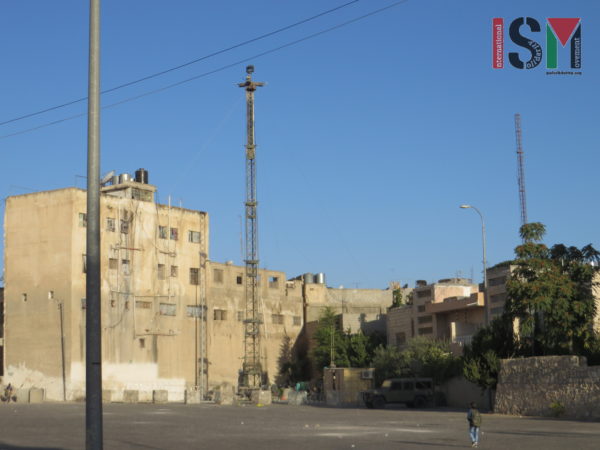
CCTV surveillance tower newly put up in Palestinian neighborhood
This observation tower is fitted with a camera that reaches high above the houses in the neighborhood, thus watching Palestinians constantly. This feeling of permanently being watched for Palestinians is combined with the ever present controls and humiliations at the more-and-more militarized checkpoints. Palestinians are watched, humiliated, numbered, deprived of their most basic human rights – occupied not only physically by the Israeli occupation forces, but also mentally. They can never tell whether they’ll be allowed through a checkpoint (something that solely depends on the respective soldiers whim), whether their children will be tear-gassed on their way to school or arrested, or even whether they’ll be gunned down by Israeli forces at a checkpoint and left to bleed to death. Any and all of these forms of collective punishment are enforced by the Israeli occupying forces on the entire population of civilians in complete disregard of any care for international law or humane treatment of the occupied indigenous Palestinian population.
The Tel Rumeida neighborhood, Shuhada Street, and the area around the Ibrahimi Mosque are already linked by a settler-only street that has been ethnically cleansed of Palestinians in the aftermath of the Ibrahimi Mosque massacre. Restrictions in the Tel Rumeida neighborhood (declared a ‘closed military zone’ solely enforced on Palestinian residents for almost a year now) and around the Ibrahimi Mosque (where Palestinians are often prevented from passing checkpoints on a age-limit between 15-30) have escalated in a very short amount of time, making life for the Palstinians as hard – or rather impossible – as possible, leaving them with no choice than to leave. The only and clear aim is the forcible transfer of all Palestinians in this area, thus geographically linking the illegal settlements in an area ethnically cleansed of any Palestinian presence.

CCTV camero on top of the surveillance tower
Israel closes Ibrahimi Mosque to Palestinian worshippers
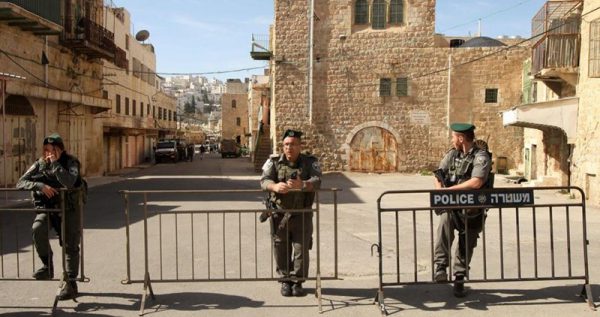
Press TV – October 3, 2016
Israeli authorities have decided to close the Ibrahimi Mosque, in the heart of the occupied West Bank city of al-Khalil (Hebron), to Palestinians, Muslim worshipers and non-Jewish visitors for seven non-consecutive days.
Yousif Ideis, the Palestinian minister of endowment and religious affairs, said on Sunday that the sacred site will be closed to Palestinians and non-Jews on October 3, 4, 9, 12, 18, 19 and 26.
Israeli officials have said the shutdown is aimed at maintaining security in the wake of Rosh Hashanah (the Jewish New Year), Yom Kippur (The Day of Atonement), Sukkot (Feast of Booths) and Simchat Torah holidays.
Ideis added that dozens of illegal Israeli settlers broke into the mosque courtyard on Saturday night amid protection by Israeli troopers.
In the meantime, Israeli authorities are closing all passageways between the blockaded Gaza Strip and Israel, as well as between the occupied West Bank and Israel for Rosh Hashanah.
Israeli officials regularly impose stringent restrictions for Palestinians during Jewish holidays for alleged security purposes.
The constraints include denied access to the Ibrahimi Mosque, which is revered by Jews, Christians and Muslims and has been the site of violent tensions between Israelis and Palestinians for decades.
On February 25, 1994, at least 29 Palestinians were killed and 125 others wounded when American-Israeli Baruch Goldstein opened fire on a large number of Palestinian Muslims, who had gathered inside the Ibrahimi Mosque to say prayers during the holy fasting month of Ramadan.
The occupied territories have already been the scene of increased tensions ever since Israeli forces imposed restrictions on the entry of Palestinian worshipers into the al-Aqsa Mosque compound in East Jerusalem al-Quds in August 2015.
Nearly 250 Palestinians have lost their lives at the hands of Israeli forces since the beginning of last October.
Former hunger striker Malik al-Qadi released by Israel, transferred to Palestinian hospital
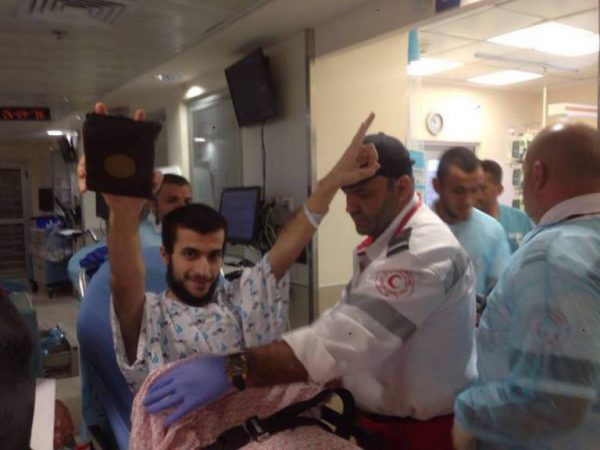
Al-Quds University journalism student Malik al-Qadi following his release from administrative detention
Ma’an – September 24, 2106
JERUSALEM – Israeli authorities released former hunger-striking prisoner Malik al-Qadi to Palestinian medics on Saturday to transfer him to a hospital in the occupied West Bank.
The Palestinian Red Crescent said on Saturday morning that its staff was transferring al-Qadi from the Israeli Wolfson Medical Center to the Istishari Arab Hospital in the city of Ramallah.
Al-Qadi is in a dire health condition after going without food for 68 days to protest being held in administrative detention — internment without trial or charges — by Israel.
Al-Qadi ended his hunger strike on Wednesday, along with fellow prisoners Muhammad and Mahmoud al-Balboul, after an agreement with the Israeli prisons services not to renew their administrative detentions.
Muhammad Balboul, 26, had refused food for 77 days since July 7, while his 23-year-old brother Mahmoud had been on hunger strike 79 days since July 5, and al-Qadi, 25, declared his hunger strike on July 16.
Qaraqe said in a statement on Wednesday that Muhammad and Mahmoud al-Balboul were set to be released on Dec. 8, while Malik al-Qadi would be released on Sep. 22, and that all three of their administrative detentions would not be renewed.
The three had initially launched their hunger strikes amid a mass movement across Israeli prisons in solidarity with hunger-striking prisoner Bilal Kayid, who after 71 days suspended his hunger strike after striking a deal with Israel to end his administrative detention sentence. He was reportedly set to be released on Dec. 12.
Kayid was one of the most high-profile hunger strikers since Palestinian journalist Muhammad al-Qiq came near death during a 94-day hunger strike protesting his administrative detention order, before he was finally released in May.
Rights groups have claimed that Israel’s administrative detention policy, which allows detention for three- to six-month renewable intervals based on undisclosed evidence, has been used as an attempt to disrupt Palestinian political processes, notably targeting Palestinian politicians, activists, students, and journalists.
Although Israeli authorities claim the withholding of evidence during administrative detention is essential for state security concerns, rights groups have instead claimed the policy allows Israeli authorities to hold Palestinians for an indefinite period of time without showing any evidence that could justify their detentions.
According to Addameer, as of August, 7,000 Palestinians were being held in Israeli prisons, 700 of whom were being held under administrative detention.
Israeli forces expand Beit Ummar military watchtower, narrowing main street
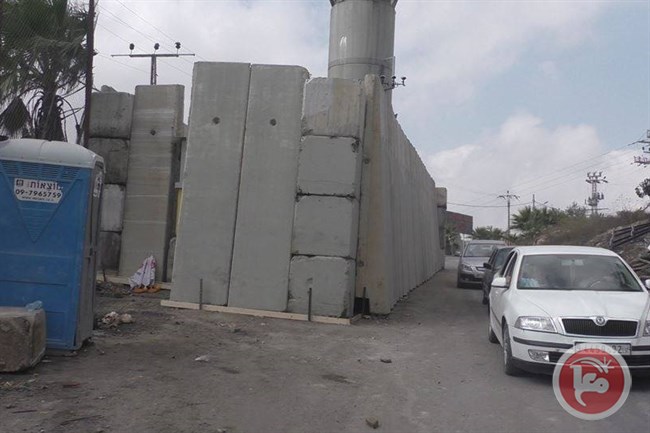
Ma’an – September 22, 2016
HEBRON – Israeli forces reopened the northern entrance to the village of Beit Ummar north of Hebron City on Thursday, after the road had been closed by Israeli authorities for four days to carry out maintenance work on an Israeli military watchtower stationed there.
Local activist Muhammad Ayad Awad said that the maintenance work expanded the military watchtower and narrowed the street, which is the main entrance to the village, to one lane instead of two lanes as before.
He said that the development will have a negative impact on the daily lives of Beit Ummar’s residents, forcing them to live under continuous Israeli surveillance and increase traffic congestion in the village.
Awad added that Israeli forces continued the closure of a sub-entrance near the village’s central vegetable market, which he said has been closed for five years.
The road was closed amid a heightened Israeli military presence in the Hebron district in the wake of a number of alleged attacks committed by Palestinians in the area, with the Israeli army adding an additional battalion to the district and setting up several road blocks throughout the district, while blocking off the village of Bani Naim and the Old City’s Tel Rumeida area entirely.
Israeli defense minister compares illegal Israeli outpost with native Palestinian villages
Ma’an – September 13, 2016
BETHLEHEM – Israeli Defense Minister Avigdor Lieberman compared the illegal Israeli Amona outpost to the indigenous Palestinian Bedouin village of Susiya and Palestinian land in Jerusalem on Monday in a speech at Ariel University in the occupied West Bank, according to Israeli media.
The Amona outpost was slated for demolition following a 2008 Israeli Supreme Court decision after eight Palestinians from neighboring villages — with the support of Israeli human rights organization Yesh Din — successfully petitioned the court to remove the outpost on grounds that the construction was carried out on privately-owned Palestinian land.
“There is no way that Amona can be left as it is built today, because most of the houses are built on private Palestinian land,” Lieberman reportedly said on Monday, referring to Amona, which was built in 1996.
After years of appeals from right-wing Israeli government officials, and attempts by Amona settlers to prove they had legally purchased the land, an Israeli police investigation in May 2014 found the entirety of the outpost to have been built on Private Palestinian lands, and that the documents used by Amona residents to try claim their “purchases” were in fact forged.
In December 2014, the Israeli Supreme Court ordered again that the outpost be demolished by December 2016.
According to Haaretz, Lieberman followed up on his comments about Amona on Monday with the stipulation that “all the rules that apply to Amona apply to every other place as well.”
Claiming that “there is only one law for both Israelis and Palestinians,” Lieberman reportedly told the audience that it was unacceptable that such rulings — as in the case of Amona, which along with every other settlement and outpost in the occupied West Bank is internationally recognized as being illegal — are unfairly enforced against Israelis but not against “other trespassers.”
The “trespassers” Lieberman was referring to were the Palestinian residents of Susiya in the southern West Bank, and the Palestinians of the area known as the “E1 corridor,” a contentious zone that the Israeli government has set up to link annexed East Jerusalem with the mega settlement of Maale Adumim, which would virtually cut the occupied West Bank in half, making the creation of a contiguous Palestinian State impossible.
“We are a nation based on law and we will honor court decisions in all circumstances,” Lieberman said, saying that “when it comes to enforcing rulings against other trespassers everyone stands up on their hind legs,” seemingly complaining about the international community’s harsh reactions to Israeli government attempts to demolish Susiya and replace it with an illegal Jewish settlement of the exact same name.
Susiya’s residents have been embroiled in a decades-long legal battle to legalize the village and have endured multiple demolitions enforced by Israeli authorities over the years, who say Palestinians lack the proper building permits to live on the land that lies between an Israeli settlement and Israel-controlled archaeological site.
The privately owned Palestinian land is located in Area C — the more than 60 percent of the occupied West Bank under full Israeli control — where building permits for Palestinians are nearly impossible to obtain.
Many of the villagers have ties to the land that predate the creation of the state of Israel, and Ottoman-era land documents to prove it.
Most recently, in mid-July, authorities from Israel’s Civil Administration abruptly halted months of dialog with Susiya’s residents over the possibility of legalizing the village, telling them that a future agreement on the village would now be the responsibility of Lieberman.
Lieberman postponed the announcement of his decision twice, first until November 2016, and then until December.
According to spokesperson for Rabbis for Human Rights (RHR) Yariv Mohar, who is assisting in Susiya’s legal battle, Lieberman’s decision on whether or not to continue the dialogue between the residents of Susiya and the Civil Administration is set to be announced on December 15, 2016.
Lieberman will be responsible for deciding whether to accept the state of Israel’s request to immediately and without prior notice demolish some 40 percent of the southern occupied West Bank village, where half of the some 200 village residents live according to RHR.
The lawyers of RHR have affirmed that there is no question as to whether the residents own the land they are on, also noting that “basic (Jewish) morality dictates it is wrong to demolish part of a village which has previously demolished without any plan or solution for the residents, while international law prohibits the forcible transfer of populations,” Mohar told Ma’an in August.
Though Lieberman has yet to formally announce a decision, his comments on Monday indicate that in his opinion, the residents of Susiya should be subject to the same treatment as the illegal settlers occupying privately owned Palestinian land in Amona.
Lieberman has previously advocated policies ranging from the overthrow of the Palestinian Authority to the deportation of Palestinian citizens of Israel into the occupied Palestinian territory, while promoting the transfer of towns in Israel that are heavily populated by Palestinians to a future Palestinian state in exchange for illegal Israeli settlements in the occupied West Bank.
Lieberman himself lives in the southern occupied West Bank Israeli settlement of Nokdim, in contravention of international law.
Since appointed as defense minister by Israeli Prime Minister Benjamin Netanyahu in May, the two have teamed up to approve hundreds of new housing units in illegal settlements in the West Bank and East Jerusalem.
Netanyahu’s Ethnic Cleansing Blood Libel
By Richard Silverstein | Tikun Olam | September 10, 2016
The pro-Israel crowd love to trot out anti-Semitic memes to smear their opponents. One of them, used widely by Alan Dershowitz and the like is the term “blood libel.” Accuse Israelis of killing Palestinians indiscriminately and it’s a blood libel because, of course, a Jew shedding non-Jewish blood is the same as Jews murdering Christian babies to use their blood in making matzah for Passover. Got that?
Bibi Netanyahu’s latest outrage is this video in which he ever so innocently professes bafflement that Palestinians would oppose Israeli settlements. Why, he asks, if 2-million “Arabs” (the actual number is 1.8-million) live in Israel proper, can’t Jews live in Palestine?
There is a wee-small problem with this analogy: approximately 600,000 Israeli Jews live in settlements. But they have lived in them for at best a generation, while Palestinians have lived in Israel for centuries. The vast bulk of settlers moved to Palestine since 1967, while Palestinians have lived in Israel over a vastly longer span. Nor have Palestinians displaced anyone over this period. While Israeli settlers have literally stolen the land out from under the Palestinian natives.

Ethnic cleansing Israel-style: yet another Palestinian home bulldozed
Bibi’s general argument is not new. He and his supporters have advanced it for years. But he added a new and even more outrageous twist this time: Palestinian opposition to Israeli settlements was akin to ethnic cleansing because it meant no Palestinian would ever accept any Jew living anywhere on Palestinian land.
There are numerous outrageous elements to this charge worth parsing. The first, and most obvious is that it’s Israel, rather than Palestine, that’s engaged in ethnic cleansing. Israel has destroyed a record number of Palestinian homes over the past year, leaving their inhabitants homeless. It has enacted draconian definitions of Palestinian residency which render tens of thousands of Palestinians stateless if they live outside areas like East Jerusalem for any length of time. Israel also depopulates Palestinian neighborhoods of East Jerusalem through forcible eviction and theft of homes. Israel maintains a stranglehold over the West Bank economy so that stifles innovation, independence and development that might sustain the population. The final coup de grâce is the siege of Gaza, which has forced thousands of Gazans to flee their imprisonment by any means possible.
So which Israeli Jew has ever been ethnically cleansed from Palestine? None. Further, the claim that Palestinians will never accept Jews living in Palestine is a hoax perpetrated by none other than Netanyahu himself and his followers. In fact, those like Rabbi Menachem Froman, who lived in the Tekoah settlement before his untimely death, denounced the idea of Israeli national sovereignty in the West Bank. He argued that he would happily live under Palestinian jurisdiction. What was important to him was not which nation owned the land on which he lived. Rather, he believed God owned the land and his allegiance was to Him and not to any particular nation.
Such an approach offered a way for Jews to remain in Palestine after a peace agreement was signed. Undoubtedly, the lion’s share of settlers would return to Israel, rather than remain under Palestinian sovereignty. But to those who really sought to uphold the vision of Abraham and the Bible to live in this Holy land, they could live there as Palestinian (or Israeli) citizens.
The final hypocrisy of Bibi’s video is his refusal to reciprocate with Palestinians regarding Jewish settlers in Palestine. If you truly believe that Jews must live there, then it’s self-evident that Palestinians should be permitted to return to their homes in pre-48 Israel. Jewish settlers see their return to their ancestral homeland as a fulfillment of sacred Biblical texts and a divine promise. The Palestinian return to their homelands from which they were expelled by Israel in 1948 is no less compelling to them. It is, to them, reparation for the Original Sin committed against them by Ben Gurion in the establishment of the State.
So if Bibi wants to argue that Jews who returned to ancient sites like Hebron or Tekoah or Bethlehem must be permitted to remain there, I say fine: then let’s talk about the return of the original refugees expelled in the Nakba and their direct descendants.
The U.S. government was none to happy with Bibi’s incitement against Palestinians. The State Department, in its typical milquetoast fashion, called the comments “inappropriate and unhelpful.” This sort of language is akin to taking a pebble to a gunfight. It’s one thing when David faces off against Goliath with a slingshot. But this is like David blowing bubbles at his well-armed nemesis. Indeed, the motto for U.S. policy toward Israel should be an inversion of the famous military slogan: “always outnumbered, always outgunned.”
NOTE: I’ve just published a new piece at Mint Press News, Israel Ramps Up Its War on BDS. It exposes an official Israeli campaign of death threats and intimidation against Palestinian activists and NGOs.
Without Israeli occupation, Palestinian economy would double – UN report
RT | September 7, 2016
In a damning report, the UN development body (UNCTAD) described the ways Israeli occupation of Gaza and West Bank has been preventing the Palestinian economy from recovery and getting twice as big as it is now.
The document detailing the “staggering economic cost” of Israeli occupation was released on Tuesday by the United Nations Conference on Trade and Development (UNCTAD).
“The Palestinian economy would be at least twice as large without Israeli occupation,” the findings reveal.
Among the key reasons for the high unemployment and staggering poverty the agency cites “confiscation of Palestinian land, water and other natural resources.” It adds that “restrictions on the movement of people and goods; destruction of assets and the productive base;” also played a major role here.
According to the latest estimations by the Palestinian Central Bureau of Statistics nearly 27 percent of people of the autonomy are currently without job. Meanwhile UNCTAD has revealed that over 66 percent of the Palestinians were food-insecure last year.
“The continuous process of de-agriculturalization and de-industrialization” has contributed to a severe degradation of Palestinian economy, according to the UN report. The paper states that in Gaza “producers are denied access to half of the cultivable area and 85 per cent of fishery resources.”
The West Bank area is facing a similar problem, according to the UN. In the so-called area C, which constitutes over 60 percent of West Bank “more than 66 per cent of its grazing land, is not accessible to Palestinian producers”.
The figures published in the report say that the Israeli occupation of the Area C “costs the Palestinian economy the equivalent of 35 per cent of GDP ($4.4 billion in 2015).”
The Israeli military campaign in 2014 whose proclaimed goal, was to prevent rocket attacks on its territories from the Palestinian areas delivered another blow to the financial recovery of the Palestinians.
The following tightening of the Gaza blockade, in place since 2007, made the things even worse, the report states. It resulted in additional civilian items being banned after labeled “dual-use”, meaning they can be also implemented for causing harm.
The crisis resulted in additional severe shortages of medical equipment as well as serious reduction in water supplies in the occupied territories, the UN finds. The problem also contributed to the rising infant mortality of almost 20 out of 1,000 live births. The trend is labeled “unprecedented” and found only in countries “affected by HIV epidemics”
In addition UNCTAD points out that the expanding settlement policies by the Israeli authorities are contributing to the Palestinian plight.
“There are now 142 settlements in the West Bank, bringing the number of Israeli settlers to over one fifth of the Palestinian population. This expansion undermines the prospects for a two-State solution,” UNCTAD claims.
The so-called two-state solution, proposed by the UN would see an establishment of an independent state of Palestine alongside Israel, west of the Jordan River. The potential boundaries however remain one of the key stumbling blocks here.
In the latest development, Israeli PM Benjamin Netanyahu’s press service has issued a statement saying he is considering Russia’s offer to host Israeli-Palestinian talks in Moscow
“[Netanyahu] presented Israel’s position whereby he is always ready to meet [Abbas] without preconditions and is therefore considering the Russian president’s proposal and the timing for a possible meeting,” the statement said.
Palestinian President Mahmoud Abbas has already accepted the offer to meet with Netanyahu, although the date for the talks has not been yet set.
Israel detained 30 Palestinian teens in August, majority report being tortured

Ma’an – September 5, 2016
RAMALLAH – Israeli forces imprisoned 30 teenage Palestinians over the month of August and collected 65,000 shekels ($17,270) from their families as fines, the Palestinian Committee of Prisoners’ Affairs said Monday, with the majority of the detainees saying they were beaten and tortured during their detention, interrogation, and transport from one detention center to another.
A statement released Monday quoted the committee’s lawyer Luay Akka as saying that among the detainees were minors as young as 13 years old.
Akka added that 17 of the detainees were taken from their homes during military raids, five were detained from off the street, four at military checkpoints, and four arrived voluntarily to detention centers after they received summons from Israeli authorities.
Three of the 30 detainees were held without being charged or standing trial in administrative detention, and the rest were sentenced after court hearings to periods ranging from one month to 45 months.
Mousa Khanafsa, a 14-year-old boy from Abu Dis in the Jerusalem district of the occupied West Bank told Akka that he was violently beaten when he was detained from a street near his house.
A group of undercover Israeli officers, he said, chased him in the street and when they caught him they “assaulted him with the butts of their rifles, stomped on him with military boots, and was left bleeding from his nose.”
It was the latest report to emerge recently from the committee and other rights groups, amid years of well-documented abuse and mistreatment of Palestinian children by Israeli forces.
Akka reported last month on the cases of two Palestinian minors who were tortured, abused, and medically neglected in Israeli custody, one of which after being shot at point-blank range when Israeli forces detained them for rock throwing in the occupied West Bank district of Ramallah.
Locals in the occupied East Jerusalem neighborhood of al-Tur reported Saturday that Israeli police detained and assaulted 16-year-old Jamal al-Zaatari. During his detention, Jamal was pepper sprayed and beaten, resulting in injuries to his face, back, and feet, in addition to several bruises.
A report released recently by BADIL, a Palestinian NGO, warned of an increasing trend of Israeli forces shooting and injuring Palestinian youth — particularly in the knees and legs — during the near-nightly detention raids carried across the occupied West Bank.
Defense for Children International – Palestine (DCIP) has also extensively documented the abuse of Palestinians children in East Jerusalem by Israeli forces and the harsh interrogation practices used to force their confessions.
Despite “on paper” having more rights than Palestinian children in the occupied West Bank who are subject to a draconian military detention system, in practice, Jerusalem minors “do not enjoy their enshrined rights” under the Israeli civilian court system, according to DCIP.
Out of 65 cases documented by DCIP in 2015, “more than a third of Jerusalem youth were arrested at night (38.5 percent), the vast majority (87.7 percent) were restrained during arrest, and only a slim minority of children (10.8 percent) had a parent or lawyer present during interrogation.”
Interrogations of Palestinian children can last up to 90 days according to prisoners’ rights group Addameer, during which in addition to being beaten and threatened, cases of sexual assault, and placement in solitary confinement to elicit confessions are also often reported, while confession documents they are forced to sign are in Hebrew — a language most Palestinian children do not speak.
According to the Palestinian Committee of Prisoners’ Affairs, as of mid August, Israeli forces detained 560 children from occupied East Jerusalem alone since the beginning of 2016, and 110 minors were still being held in Israeli prisons, including four girls and 10 boys in juvenile detention centers.
According to Addameer, of the 7,000 Palestinians being held in Israeli custody, 250 were minors as of July.
51 Israeli Violations against Journalists in August
IMEMC News & Agencies – September 2, 2016
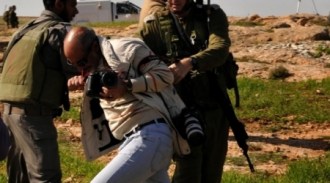 Israeli occupation forces reportedly committed 51 violations against Palestinian journalists during August of 2016, the government media office stated.
According to Al Ray Palestinian Media Agency, a report published by the office revealed that Israeli forces detained eight journalists, holding four in custody, and served a summons notice to one journalist.
Israeli authorities recently renewed the administrative detention of four journalists and the actual prison sentence of two journalists. It also documented five cases of abuses committed against detained journalists.
Additionally, it documented seven cases of injury, regarding four female journalists, involving gas grenades and fire.
Israeli forces also banned five journalists from covering events and travelling, one of them from Gaza.
The report also documented the closing of one local radio in the occupied West Bank, the raiding of two media institutions and the storming of nine houses where Palestinian journalists resided. It also reportedly seized media staff equipment.
Palestinian Photojournalist injured in Kafr Qaddum protest, forces raid East Jerusalem neighborhoods
Ma’an – September 2, 2016
QALQILIYA – A Palestinian photojournalist was injured by Israeli forces Firday afternoon, as dozens others suffered from tear gas inhalation during the weekly protest in the norther occupied West bank village of Kafr Qaddum.
Popular resistance coordinator in Kafr Qaddum Murad Shtewei told Ma’an that Israeli forces “assaulted” participants in the protest minutes after it began.
The soldiers injured photojournalist Nidal Shtayyah after hitting him with a tear gas canister in the back of his head. He was taken to Rafidia hospital for treatment.
Shtewei added that Israeli forces fired a barrage of tear gas, which landed mostly in surrounding homes, causing a family of five to suffer from tear gas inhalation, in addition to others participating in the protest, who were treated on the scene.
Residents of Kafr Qaddum began staging weekly protests in 2011 against land confiscations, as well as the closure of the village’s southern road by Israeli forces. The road, which has been closed 13 years, is the main route to the nearby city of Nablus, the nearest economic center.
Following similar clashes that broke out last month, Shtewei told Ma’an that more than 330 protests have been held over that period, during which time 84 protesters have been injured by live fire, including 12 children.
Some 120 others have been detained at protests and were subsequently held in Israeli custody for periods ranging between four and 24 months, Shtewei said, adding that they have paid fines totaling some 25,000 shekels (approximately $6,488).
Over the course of five years, an elderly protester was killed after suffering from excessive tear gas inhalation, one youth lost his eyesight, and another his ability to speak, he added.
Meanwhile, along with armed Israeli forces, Israeli Jerusalem municipality crews reportedly raided the occupied East Jerusalem villages of al-Isawyia and Silwan, where they delivered demolition orders and summons to local residents.
According to the Wadi Hilwah Information Center, Israeli forces accompanied municipality crews who raided the al-Bustan neighborhood in Silwan, where they hung demolition orders and warnings telling residents to “follow-up with the municipality on several buildings in the area.”
The forces reportedly took pictures of neighborhoos buildings and entrances of the neighborhood, and wrote tickets for parked cars.
Muhammad Abu al-Homos,a member of the al-Isawiya monitoring committee, said Israeli forces raided the village, searched a house, and patrolled the street ‘provocatively’. He added that the forces detained a teenager who was present in the area.
An Israeli army spokesperson said they were looking into reports of all three incidents in Kafr Qaddum, al-Isawiya and Silwan.
Israel shuts down Palestinian radio station amid escalation in press violations
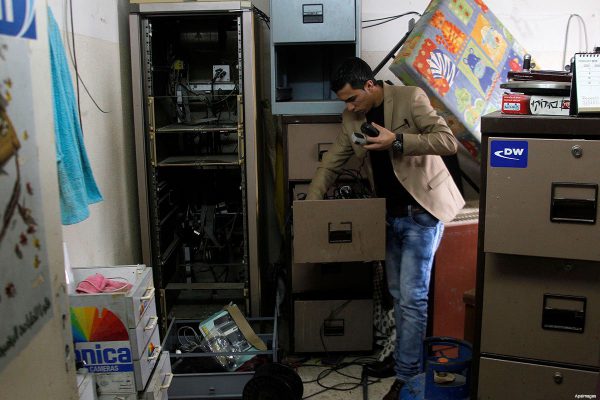
A Palestinian journalist checks damages after Israeli forces raided offices of local Palestinian Al-Khalil radio overnight in Hebron on November 21, 2015
Ma’an – August 31, 2016
HEBRON – Israeli forces raided and ransacked a Palestinian radio station early Wednesday morning in Dura City in the southern occupied West Bank district of Hebron, detained five of the station’s employees, and ordered it closed for three months, amid a documented escalation of violations against media freedoms by Israeli forces in the occupied Palestinian territory.
Locals told Ma’an that Israeli forces raided al-Sanabel radio station, destroyed its contents, and confiscated transmission and broadcast equipment.
Israeli forces left a closure order on the door of the radio station.
Locals added that Israeli forces detained head of the radio station Ahmad al-Darawish, as well as radio employees Muhammad al-Sus, Nidal Amro, Muntaser Nassar, and Hamed al-Nammura after raiding their homes.
Spokesperson for the Israeli army Avichay Adraee said in a statement in Arabic that Israeli forces, police, and civil administration authorities closed al-Sanabel upon a military order that claimed that the radio station broadcast programs inciting against Israel.
Adraee added that the five detainees were transferred for interrogation.
News of the closure came after Palestinian press freedoms watchdog MADA released a report on Saturday saying Israeli violations against media freedoms in the occupied Palestinian territory increased by 17 percent during the first half of 2016.
MADA General Director Moussa Rimawi said in the semi-annual report that while the total number of violations by both Israeli and Palestinian authorities declined from 224 cases in the first half of 2015 to 198 in the first half of this year — a rate of 12 percent — Israeli violations continued to climb, as Palestinian authorities committed 41 percent less violations during the same period.
A total of 133 violations committed by Israel were recorded during the period.
The most common types of violations committed by Israel were physical attacks, arrests, confiscation of equipment, prevention of coverage, and detentions.
The report highlighted that Israeli authorities in March closed two media institutions — Falastin al-Yawm and TransMedia Production Company — after ransacking and confiscated equipment from their offices.
Meanwhile, some 23 journalists and media workers were detained between January and June of 2016.
The report also noted an escalation of the Israeli practice of detaining Palestinians for social media activity, with Israeli authorities alleging that a wave of unrest that swept the occupied Palestinian territory last October was encouraged largely by “incitement.”
Palestinians have instead pointed chiefly to the frustration and despair brought on by Israel’s nearly 50-year military occupation of the Palestinian territory and the absence of a political horizon.
MADA said in the report that they were “gravely concerned regarding all systematic attacks and violence against journalists and media workers by the Israeli occupation, and urges state members to do their utmost to prevent violence against journalists, to ensure accountability, and bring to justice perpetrators of crimes against media freedoms.”
Israeli commander threatens to ‘disable all youth in the camp’ as 2 Palestinians shot in Duheisha
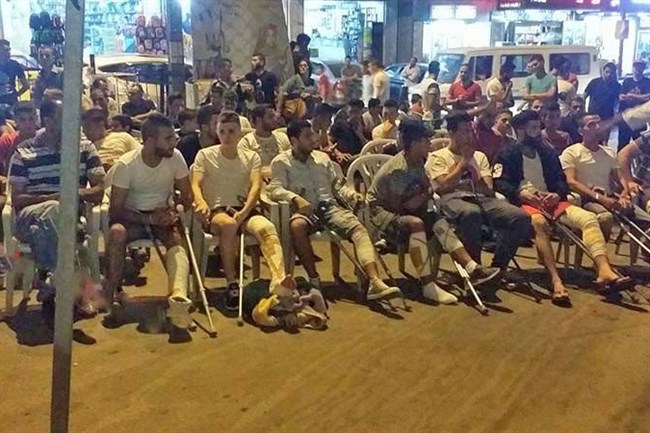
A file photo of a group of Palestinian youth after being treated for gunshot injuries by Israeli forces (Photo: BADIL)
Ma’an – August 26, 2016
BETHLEHEM – Two Palestinian youths were injured with live fire during clashes with Israeli soldiers in al-Duheisha refugee camp in southern Bethlehem early Friday morning, as reports emerged of an Israeli army commander making repeated threats in recent weeks to make “all youth in the camp disabled.”
Local sources said that two youths were shot and injured in the legs during clashes that erupted after Israeli forces raided the camp in Friday’s predawn hours.
Sources added that Israeli soldiers raided and searched the house of the incarcerated Palestinian Muhammad al-Seifi, detaining his mother and sister by locking them inside their home to pressure Muhammad’s younger brother Naba to turn himself into Israeli authorities.
Israeli forces also blew off the door of the Ibdaa Cultural Center near the entrance to the camp and occupied the rooftop of the building, from where Israeli snipers fired live ammunition and tear-gas canisters at local youth.
Violent clashes in al-Duheisha are common and break out nearly every time Israeli army forces enter the camp, which is located in Area A and should be under full Palestinian Authority control according to the Oslo agreements.
In a response to a request for comment, an Israeli army spokesperson told Ma’an that the Israeli army was not involved, and claimed Israeli border police were behind it, despite the area being located outside of police jurisdiction in Area A of the occupied West Bank.
When contacted by Ma’an, Israeli police spokesperson Micky Rosenfeld said he was not aware of the raid, saying it “made no sense” that police would be involved, and confirmed that al-Duheisha fell under the Israeli army’s jurisdiction in terms of raids. When contacted a second time, an Israeli army spokesperson insisted again that the army was not behind the raid and could not say who had been.
‘I will make all the youth of the camp disabled’
The clashes come in the wake of reports documented by BADIL, the Resource Center for Palestinian Residency and Refugee Rights, of an Israeli army commander making repeated threats during and after raids, and during interrogations, to disable all Palestinian youth in al-Duheisha.
The commander is reportedly responsible for the al-Duheisha area, and known to locals as “Captain Nidal.”
Local youth in al-Duheisha told BADIL that Captain Nidal has made statements such as: “I will make all the youth of the camp disabled,” “I will have all of you walking with crutches and in wheelchairs,” “I will make half of you disabled, and let the other half push the wheelchairs,” and “I will make all of you stand in line at the ATM waiting for your disability subsidies and assistance.”
One of the injured youth told BADIL that Captain Nidal told him to tell his friends that “Nidal will make all of you disabled.”
According to BADIL, which is based in Bethlehem, 30 Palestinians have been shot with live ammunition in the camp since the beginning of the year, the majority in their legs and knees.
They added that al-Duheisha had been raided at least three times by Israeli forces between the end of July and mid-August, during which time 18 Palestinian youth between 14 and 27 years old were shot in their legs — eight of which shot directly in the knee and several more in both legs — causing both permanent and temporary disabilities.
An Israeli army spokesperson could not immediately be reached for comment on the reports of the threats made by the commander.
“These threats indicate that these actions are not accidental or isolated incidents, but rather result from a systematic Israeli military policy aimed at suppressing resistance, terrorizing Palestinian youth, and permanently injuring them and/or causing significant damage to their physical and mental well-being,” BADIL said in their statement.
The reported threats come amid what BADIL called an intensification of the “systematic targeting” of Palestinian youth in the occupied Palestinian territory — particularly in refugee camps — since the beginning of 2016.
“This targeting has taken the form of injuries and arbitrary killings by the use of live ammunition by the Israeli army in the context of arrest campaigns, military raids, and random wide searches which usually trigger clashes,” the statement said.
BADIL’s statement also highlight a recent Israeli military incursion in the Hebron-area refugee camp al-Fawwar that lasted some 20-hours, during which an unarmed Palestinian teen was shot dead and dozens others were hospitalized.
“These cases of intentional wounding, when added to the comparable actions happening in refugee camps such as Aida, al-Arroub, Qalandia, Amari, and the West Bank at large, prove that these incidents amount to a systematic policy and an implementation of Captain Nidal’s threats.”
“These willful and grave breaches of international law trigger the obligations of third party states and other mandated agencies to put an end to this climate of impunity under which Israeli forces and its officials operate.”
BADIL’s collection of testimonies came as the latest report amid years of well documented cases of abuse and mistreatment of Palestinian children by Israeli forces in the occupied territory, including in East Jerusalem, which is under Israeli police jurisdiction.
Featured Video

Macgregor: We Haven’t Seen the Worst of the Iran War Yet
or go to
Aletho News Archives – Video-Images
New Book
Breast Cancer: Before You Consent
A new Unbekoming paperback
Lies are Unbekoming | September 18, 2026
Peter Gøtzsche reviewed every randomised mammography screening trial ever conducted for the Cochrane Collaboration. Cochrane’s headline is that, assuming a 15% mortality reduction, one woman in 2000 avoids dying of breast cancer over ten years. Ten are overdiagnosed and treated. Two hundred experience false alarms.
But that headline assumes the reduction. When Gøtzsche looked only at the trials with adequate randomisation — the higher-quality ones — the reduction disappeared. No effect on breast cancer mortality. No effect on all-cause mortality.
This is the Cochrane finding, published in the establishment’s own database of systematic reviews.
No woman being asked to consent to a mammogram this week knows it.
That is why the new Unbekoming paperback exists. … continue
Blog Roll
 Aletho News
- Iran Judiciary issues indictments against 159 US, Israeli officials for assassination of Leader, commanders
- Turkiye revokes Iranian bank license under US sanctions campaign
- US-Denmark Agreement on Greenland Is ‘PR Stunt’ Ahead of Midterms
- Araghchi: Military intervention cannot create security; coercion cannot bring peace
- Fraud Squared
- Breast Cancer: Before You Consent
- Iran’s Plan to Shut Down AI in the Persian Gulf
- Israel seeks ‘compensation’ from Washington over Saudi F-35 sale
- Saudi crown prince seeks dialogue with Ansarullah after Yemeni blows: Report
- Damascus rejects Saudi request for Syrian fighters to counter Yemen: Report
- If Americans Knew
- Inside Gaza’s death trap of collapsing, bombed-out buildings
- The everyday items Israel bans from Gaza every day
- Inside the siege, the ruined buildings of Gaza – Daily Update
- Debunking The Claim That Macklemore Has A “History Of Antisemitism”
- CPJ demands release of arrested Palestinian-US journalist near Bethlehem
- Robert Kraft: The Billionaire Friend of Netanyahu Pulling The Strings Behind the Macklemore/Ed Sheeran Blow Up
- Columbia Administered Fund Gives Big Money to Pro-Israel Groups
- Deportation Case of Palestinian Activist Salah Sarsour Tests First Amendment
- ‘We Will Not Forget’: Palestinians Mark 44 Years since Sabra and Shatila
- Why do we let Zionists decide what we can and can’t say?
- No Tricks Zone
- New Study: ‘Global Drought Shows No Detectable Recent Acceleration Under Climate Warming’
- Economic Masterminds: German Socialists Suggest Taxing Productivity Gains Stemming From Using AI
- The South China Sea Has Not Been Cooperating With The Climate Change Narrative
- Energy Crisis: Germany Enters Heating Season With Historically Low Gas Reserve Fill Levels
- New Study: The Antarctic Ice Sheet Gained Mass From 2020-2024 Due To Staggering Snow And Ice Accumulation
- Study: Ocean Heating Rates From Thousands Of Years Ago ‘Dwarf’ Modern Ocean Heating Rates
- Climate Extremists Target, Attack Large-Scale Power Grid Infrastructure In Germany!
- New Study: Antarctic Ice Melt Has Contributed Less Than 1 Centimeter To Sea Level Rise In The Last 30 Years
- Fear Of Debate: Alarmist German Climate Scientist Calls On Mainstream Media To Discredit Skeptic Voices
- End-Of-August Arctic Sea Ice Extent Hasn’t Fallen In 20 Years, Official Data Show!
 Aletho News