Palestinians face severe restrictions during Jewish holiday
Ma’an – March 23, 2016
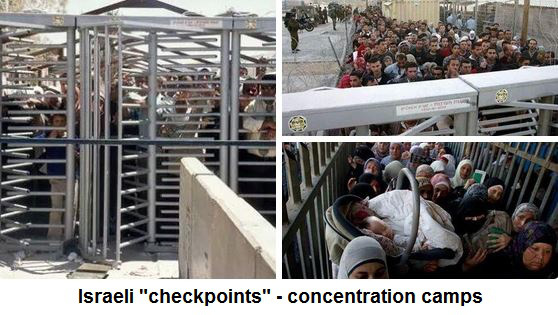
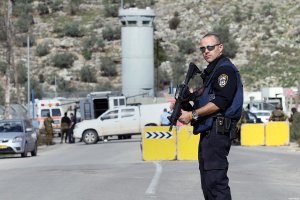 BETHLEHEM – Palestinians faced severe movement restrictions on Wednesday, as Israeli authorities shut down all movement through checkpoints in and out of the occupied West Bank and Gaza Strip ahead of the Jewish holiday of Purim.
An Israeli army spokesperson said that beginning at 1 a.m. on Wednesday and lasting until midnight Saturday, the checkpoints would be closed to all Palestinians with the exception of humanitarian cases.
Palestinian citizens of Israel, as well as holders of foreign passports, would still be allowed to pass through the checkpoints, she said, noting: “They’re only closed for Palestinians.”
She said Palestinians could seek to arrange “special circumstances” with Israel’s Coordination of Government Activities in the Territories (COGAT).
Sources inside the Palestinian liaison department confirmed the measures would be extended to the Kerem Shalom and Erez crossings into the Gaza Strip, with only humanitarian cases and a limited number of Palestinian Christians allowed to leave the blockaded coastal enclave.
Israeli police spokesperson Luba al-Samri said there would be heightened security measures, including a number of police patrols, across occupied East Jerusalem and the West Bank throughout the holiday.
Palestinian access has also been restricted to the Al-Aqsa Mosque compound, with all Palestinian men younger than 50 denied entry to the site, which is the third holiest in Islam.
Access restrictions to the mosque compound during a succession of Jewish holidays last September played a major role in triggering a wave of unrest that has since left more than 200 Palestinians and nearly 30 Israelis dead.
Tensions were running high in the West Bank on Wednesday morning after Israeli forces escorted hundreds of Israelis, including settlers, to holy sites there, with clashes breaking out nearby Joseph’s Tomb near Nablus.
The Jewish holiday of Purim, which commemorates the Biblical account of the saving of the Jewish people from Haman, an ancient Persian vizier, begins Wednesday evening and ends late Thursday this year.
Israeli forces raid, confiscate items from Jenin-area university
Ma’an – March 22, 2016
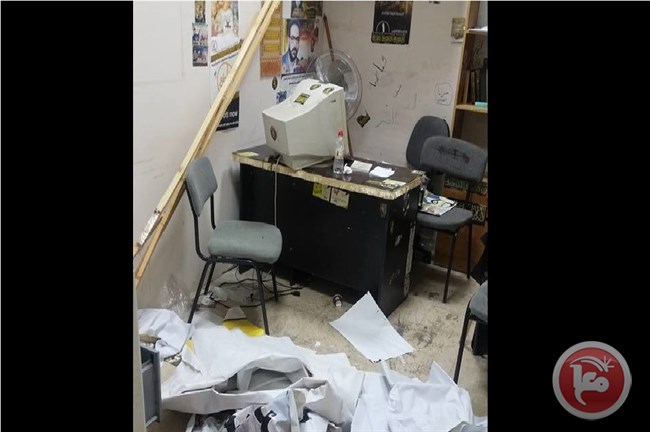
JENIN – Israeli forces overnight Monday raided the campus of the Arab American University in the occupied West Bank city of Jenin and confiscated items — including computers and flags — from student union offices.
The university’s public relations department told Ma’an that 11 Israeli military vehicles stormed the campus grounds at 1 a.m. and broke into the office of the Dean of Students, as well as a number of offices belonging to the student union.
The Israeli soldiers broke down doors and destroyed property in the offices before seizing flags of student union blocs as well as two computers and paper documents, the department said.
The university’s administration released a statement denouncing “Israel’s aggressive policy which violates the sanctity of university campus.”
Palestinian Prime Minister Rami Hamdallah immediately condemned the raid.
“This is not the first time that the Arab American University and other Palestinian educational institutions have been subjected to arbitrary Israeli raids,” the PM said, citing raids on Birzeit University and the Kadoorie Institute in recent months.
“I reiterate our call for international protection,” Hamdallah said. “Israel should not be allowed to continue to act above the law. The international community witnessed yet another violation of the sanctity of Palestinian educational institutions, and it should not remain silent.”
The Israeli army said in a statement that Israeli forces had “uncovered and confiscated inciting propaganda materials linked to multiple terror organizations including Hamas” inside the university, adding that the operation was “based on intelligence information.”
“In the recent wave of terror we’ve witnessed how incitement fuels acts of violence and terrorism,” the statement said. “Efforts as this prevent future attacks.”
In addition to the statement, the army released what it said were “visuals from the overnight activity” — photographs of an Islamic Jihad flag and a Hamas one, as well as a poster depicting three recently slain Palestinian attackers, referred to as “martyrs.”
Political flags and posters are commonly found items across the occupied West Bank, with posters of martyrs appearing throughout every West Bank town and village.
Palestinian universities and their students in the occupied West Bank are frequently targeted by Israeli military forces, and campuses have come under increased military presence since an increase in violence in October.
Earlier this month Israeli forces raided the Khadoorie Institute — also known as Palestine Technical University — twice in an 18-hour period.
The Tulkarem-area campus has seen heavy military presence in the past. Student-organized marches in October to protest Israeli violations and raids onto the campus eventually resulted in Israeli forces positioning themselves at a temporary base on university property.
Dozens of university students have been injured by Israeli military forces since.
Birzeit University near Ramallah meanwhile has reported dozens of student detentions, while Abu Dis’ al-Quds Open University has often found itself a focal point of violent clashes between Palestinian students and Israeli soldiers.
Israeli troops raid West Bank village day after funeral of slain Palestinians
Ma’an – March 21, 2016
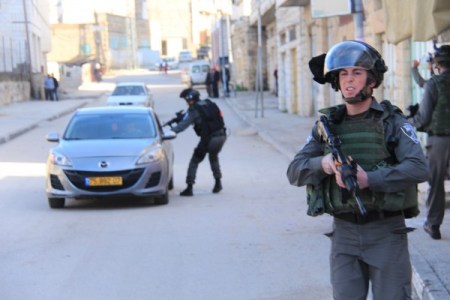
BETHLEHEM – Israeli troops raided the village of Beit Fajjar east of Bethlehem early on Monday, storming several houses and detaining two Palestinians.
The raid took place a day after the funerals of Ali Abd al-Rahman al-Kar Thawabta, 20, and Ali Jamal Muhammad Taqatqa, 19, who were killed by Israeli forces on Thursday after carrying out a stab attack that injured an Israeli soldier near the illegal Israeli settlement of Ariel in the northern occupied West Bank. Local sources said that Israeli troops raided Thawabta’s house and detained his brother Muhammad, 24.
They also detained Muhammad Akram Taqatqa, 22. Witnesses said Israeli excavators escorted by Israeli troops raided the al-Mahajer neighborhood of Beit Fajjar, seizing equipment and detaining workers in the area.
Israeli forces have shut down most roads leading to Beit Fajjar since Thursday, except for one between the villages of Sair and al-Manshiya.
An Israeli army spokesperson told Ma’an all roads to Beit Fajjar were open, but that residents between the ages of 15 and 25 were barred from entering or leaving, “except in case of medical emergencies.” She also confirmed that Israeli forces detained two Palestinians in Beit Fajjar overnight.
Bethlehem district governor Jibril al-Bakri condemned on Friday Israeli sanctions against Beit Fajjar, noting that such actions qualify as “collective punishment” of the village’s over 10,000 residents in violation of international law.
Over 200 Palestinians and just under 30 Israelis have been killed since October, and attempts to quell the violence by the international community have subsequently failed.
Earlier this year, UN Secretary-General Ban Ki-Moon condemned the wave of attacks, but said that Israeli security measures were failing to “address the profound sense of alienation and despair driving some Palestinians — especially young people.”
He added: “As oppressed peoples have demonstrated throughout the ages, it is human nature to react to occupation, which often serves as a potent incubator of hate and extremism.”
Rani Burnat from Bil’in
International Solidarity Movement | March 15, 2016
Bil’in, occupied Palestine – Rani Burnat is an extraordinary human being in more ways than one. He was left paralysed from an injury sustained during the second intifada, learned to live the remainder of his life in a wheelchair, fathered three children (triplets) and now continues to resist the occupation through peaceful means to this day. His story is inspiring and a prime example of the will of the Palestinian people and their ongoing resistance to an illegal occupation.

Rani Burnat
On the 30th September 2000, Rani Burnat was going to Ramallah from his home town of Bil’in for a driving lesson. When he got there he noticed a protest gathering to protest Ariel Sharon’s entry into the sacred Al-Aqsa mosque (this of course was the beginning of the second intifada). Rani spotted friends of his from Bil’in and with time to spare decided to join in.
As the protest gathered the Israeli army illegally entered the Ramallah area and cleared the guests out of a nearby hotel, then used the hotel roof as a vantage point and placed snipers. The Israeli military claims that their illegal entry onto Palestinian land was to protect a nearby illegal Israeli settlement that the protest was nearing.
Rani and fellow friends were at the front of the protest when a sniper opened fire using a unique bullet, known as a butterfly bullet, designed to continue spinning upon impact while opening out and inflicting massive damage upon entry and exit.
The bullet entered through the left-hand side of Rani’s neck, puncturing his main artery. It continued through to the right hand side of his body, severing his spinal chord between the third and fourth vertebrae on exit.
As sniper fire continued and pandemonium erupted, Rani was left bleeding on the ground. Fortunately fellow bystanders assisted by applying pressure to the wound on his neck to limit the massive amounts of blood that he was losing. He was then put into a car and driven to the nearby hospital where he was promptly seen by doctors. Rani was the first victim of the second intifada to be treated. Anyone coming into hospital later in the intifada with his severe wounds would undoubtedly have died as staff and resources failed to cope with the influx of wounded.
The doctors applied a stint to Rani’s neck to where the artery had been severed, which remains to this day. He was put into an induced coma for two days, during which time doctors concluded that with the facilities they had they could not keep Rani alive along with the massive numbers of victims that were now being admitted to the hospital as the second intifada intensified.
It was decided that Rani must be transferred to another hospital with more facilities, one capable of taking care of someone in such a serious condition, the only hospital possible was in Jordan. Given his condition he could not make the journey by land and so a helicopter was arranged from the rooftop of the parliament building in Ramallah.
On admission to hospital in Jordan, his loss of blood was so great that he required massive blood donations from a number of donors. Rani would spend the next seven months in that hospital undergoing operations and combatting repeated infections. He says ‘The most important thing for me at that time was that I was alive. The doctors in Jordan made this possible”.
After seven months in Jordan, Rani was able to come back to Palestine for rehabilitation, back at home in Bil’in seeing friends and family who had missed him, and whom he had missed so much in Jordan.
He then had to go back into hospital in Ramallah for another seven grueling months of rehabilitation. It was during this time that the severity of his situation became clear to him. “It was an extremely difficult situation to come to terms with, that I would now have to spend the rest of my life in a wheelchair, paralysed on the right side of my body.” Rani is the oldest of ten siblings with four brothers and five sisters. He had wanted to be an electrician and he talks about the helplessness he felt at that time. But despite this he added, “The personal pain I felt was nothing compared to the pain I was feeling for my family.” However, a huge positive in Rani’s life amidst so much trauma was when he married shortly after the intifada and became father to triplets.
As time passed, Rani learned to deal with the injuries he had sustained, but one thing that he was not ready for was what happened in his home village next as the Israeli government began to illegally confiscate villagers’ land to construct the apartheid wall and enclose illegal settlements.
At this point Rani decided to become a photographic journalist so he could report on and show the world the ugly truths of the Israeli occupation and what it does to the Palestinian people. He says he will only stop when he is dead or the occupation has ended.
Every week he is able, Rani makes the trip up the rocky road in his wheelchair, gas mask and camera at the ready. His wife worries for him every time he leaves but understands that this is what he must do. Rani himself admits that every Friday he leaves he fears he will not come home to his loving wife and children but he continues to go to show the world what is happening.
Fellow activists from Israel who come frequently to the Bil’in demonstrations have translated for Rani what the Israeli army is saying about him, things like “shoot the guy in the wheelchair” whilst laughing amongst themselves. Rani has been shot with rubber bullets, countless amounts of tear gas, had many cameras broken, two wheelchairs wrecked and has even been pulled out of his wheelchair and thrown onto the ground. “The occupying forces have no morals,” he adds.
Two months ago Rani was shot in the stomach with a foam bullet, which releases a liquid that burns the skin on impact. A month later he was shot in the knee cap and also singled out by soldiers and shot in both shoulders with tear gas canisters. Despite all this he continues moving forward.
In 2005 Rani organised a unique demonstration in Bil’in for all the people who have been injured or disabled since the second intifada. He explains that the Israeli army used the most tear gas he has ever seen used, firing directly into the group of people, many of whom were restricted to wheelchairs, and causing many of them to pass out from tear gas inhalation including himself. “This is occupation” says Rani.
He doesn’t believe Israel can continue like this and he hopes an end is near, as do all Palestinians. Rani tells of how he wishes to be able to travel to Jenin with no checkpoints and how he wants to take his children to see the sea. Every Palestinian who has been suppressed by the occupation has their own particular dreams of life without Israeli occupation.
“Palestine is a state of peace, Israelis should be able to come and live harmoniously in peace – against occupation”.
“If you come to my house in peace I will welcome you… but if you come to my house to take it from my family, I will fight until my dying breath with all means necessary to defend it”.
Targeting of children and residents in Ni’lin
International Solidarity Movement | March 19, 2016
Ni’lin, Occupied Palestine – On 18th March 2016, Palestinian villagers of Ni’lin protested against the Israeli land-theft and illegal settlements and the continuous violence Israeli forces use to stifle the weekly non-violent protests. Villagers commemorated Rachel Corrie, an American activist killed by Israeli forces in Gaza, and Tristan Anderson, an American activist left with severe permanent physical and cognitive impairments after being shot in the head with a high-velocity tear gas canister in Ni’lin.
Israeli forces again used excessive force, inundating not only the protestors, but the whole village in tear gas. Whereas the last two weeks Israeli forces showered a public park with a playground in tear gas, causing several cases of excessive tear gas inhalation of small children playing there; this Friday they deliberately targeted civilian homes inside the village with tear gas, as well covering the public park in tear gas. The heavy iron tear gas canisters broke windows of 7 houses and the shops in the center of the village, causing civilians to suffer from the effects of tear gas inhalation. As family homes were targeted with tear gas, dozens of children and elderly had to be treated for tear gas inhalation. 8 people, including an 87-year old man had to be treated for excessive tear-gas inhalation. Throughout the West Bank, Israeli forces have increased the use of long-range tear gas canisters, that can reach up to 1000m and are silent when shot. These kind of tear gas canisters increase the risk of serious and / or deadly injuries as they can’t be heard and are iron-clad and thus extremely hard. Furthermore 2 people were treated after being hit and injured with rubber-coated steel bullets during the protest.

Medics treating an elderly man suffering from excessive tear gas inhalation
Luckily, no one was directly hit with one of the tear-gas canisters shot into Palestinian family homes. On the 12th of March, a 17-year old boy was shot in the neck with one of these heavy tear-gas canisters, causing a skull fracture. He had to undergo surgery and only after a week in intensive care his condition is now stable.
The continuous targeting of civilians, families and children by the Israeli forces is not only common in the village of Ni’lin, but also throughout the occupied West Bank.
Moscow Calls New Expropriation of Land by Israel in Palestine ‘Illegal’
Sputnik – 18.03.2016
MOSCOW — The Russian Foreign Ministry called illegal the new expropriation of land by Israel in the Palestinian territories, according to a statement issued on Friday.
Moscow expressed “concern about the settlement projects of Israel in the occupied Palestinian territories.”
“A few days ago, the Israeli authorities announced the expropriation of 154.5 hectares of land near the town of Jericho in the West Bank of the Jordan River. This area has been declared ‘the land of the Israeli state,'” the statement reads.
“These actions are illegal under international law and the decisions on them should be reviewed,” the ministry stressed.
Moscow urged “all the sides to refrain from unilateral steps that undermine the prospects of the Palestinian issue settlement on the internationally recognized basis.”
Israeli forces close East Jerusalem streets for marathon, detain 4
Ma’an – March 18, 2016
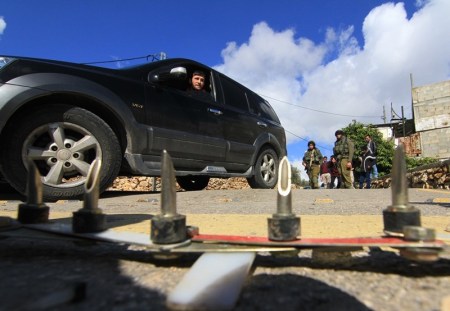
JERUSALEM – The Israeli authorities early Friday shut down streets across Palestinian neighborhoods in occupied East Jerusalem and detained four in preparation for the annual Jerusalem marathon, locals said.
Locals told Ma’an that a number of roads were blocked by iron barricades and buses, as thousands of Israeli runners joined in the marathon for the sixth year in a row.
Four residents of al-Issawiya neighborhood were detained prior to the marathon. Two of them, identified by locals as Fadi Matwar and Jad al-Ghoul, were reportedly warned against being in Jerusalem during the marathon.
Al-Issawiya popular committee spokesman Muhammad Abu al-Hummus, who was detained prior to the marathon last year, was also detained Friday morning.
Locals told Ma’an that Israeli intelligence also summoned Jihad Oweida, the secretary-general of the National Committee against Normalization. The committee has in the past been a vocal opponent of the Jerusalem marathon for going through occupied territory.
Participants in the marathon run through West Jerusalem as well as segments of Jerusalem’s occupied eastern half, including along the walls of the Old City and near other historical sites.
The marathon last year drew large numbers of Palestinian protesters to places where the run passes through neighborhoods under Israeli military occupation, with residents waving Palestinian flags and proclaiming slogans supporting Palestinian claims to Jerusalem.
East Jerusalem is internationally recognized as Palestinian territory, but Israel occupied it in 1967 and later annexed it in a move never considered legitimate abroad.
Friday’s marathon comes weeks before an annual marathon is expected to be held in Bethlehem in the occupied West Bank.
This year will mark the fourth consecutive “Right to Movement” marathon, which is comprised of two 11 kilometer loops, as race organizers were unable to find a contiguous stretch of 42 kilometers due to Israeli military restrictions on Palestinian movement.
Israeli forces raid Tulkarem-area university twice in 18 hours
Ma’an – March 15, 2016
TULKAREM – Israeli forces on Tuesday raided al-Khadouri University in the northern occupied West Bank district of Tulkarem for the second consecutive day, the university’s administration said in a statement.
The administration said Israeli forces raided the university on Monday, forcing staff to open the main doors of the university’s engineering department. During the raid forces reportedly ransacked the building and seized posters and brochures from the campus.
Eighteen hours later, on Tuesday, the administration said Israeli forces returned, and ransacked more of the campus.
The university administration condemned the “Israeli violations against the university.”
The administration urged that international organizations take action against Israel’s disregard for education facilities.
Israeli forces have regularly stormed university campuses across the occupied Palestinian territory in recent months.
Since a wave of unrest swept the occupied Palestinian territory in October, Abu Dis’ Al-Quds University in particular has found itself a focal point of violent clashes between Palestinian students and Israeli soldiers.
On January 29, Hundreds of Israeli soldiers stormed Abu Dis’ al-Quds Open University and confiscated equipment and documents belonging to its student union.
Earlier in January, Birzeit University in Ramallah condemned an Israeli army raid into its campus, during which Israeli forces confiscated and damaged university equipment.
“Birzeit University condemns this attack and the direct violation of the sanctity of the university campus,” the university said. “This is a belligerent military attack on the university and our right to education and all the principles involved in the freedom of education.”
Israel Bans Palestinian Products from Jerusalem
IMEMC News & Agencies – March 13, 2016
Five Palestinian companies warned of financial losses as Israeli occupation forces banned their products from being marketed in occupied Jerusalem, under political and economic pretexts, Palestinian sources reported Saturday.
A report identified the five companies as Hamouda, al-Jideedi, Arryan, distributers of dairy products, as well as Asslwa and Saniora, associated with meat products.
Hamouda company sources said that Israeli occupation forces have been banning the entry of their company’s products to occupied Jerusalem for a fifth day in a row, according to Al Ray. Hamouda explained that the unexpected move, by Israel, would cost the company heavy losses estimated in millions. Hamouda company constitutes 50% of the [affected] marketed products in Jerusalem.
The source explained that the Israeli decision came after a decrease in Israeli sales of the same products, in Jerusalem markets, due to dominance of Palestinian products. Israeli occupation authorities put this decision into action even though the Palestinian companies were licensed within the Israeli record.
The affected companies addressed the Civil Affairs administration and the Agriculture Ministry, to become acquainted with the reasons behind such decision, and the latter responded that the decision was unilateral and unexpected. The source said that Palestinian authorities are contemplating a suitable reaction to such a move.
Tareq Abu Laban, the General Manager of Marketing at the Ministry of Agriculture, noted that there are political reasons behind the Israeli decision, explaining that the Israeli side aims to force the PA to deal with Jerusalem as a part of Israeli state.
He added that the Israeli Ministry of Agriculture asked the Palestinian side to submit private export models in which they are identified as international exporter. He explained that this step implies political impacts under which the Palestinians are forced to recognize Jerusalem as an Israeli city.
In 2010, Israeli occupation authorities tried to pass a similar decision. But, international figures, as well as the Quarter Committee, thwarted the plan.
Israeli Army Shuts Down “Palestine Today TV” In Ramallah, Kidnaps Three Journalists
IMEMC – March 11, 2016
Dozens of Israeli soldiers invaded the main headquarters of Palestine Today TV, in the al-Biereh city, in the Ramallah and al-Biereh District in the occupied West Bank, and shut it down on Friday at dawn. The army also kidnapped its director, a cameraman and a Technician.
Palestine Today said in a statement that the soldiers stormed and searched the home of its director, Farouq ‘Oleyyat, in Birzeit City, and kidnapped him.
The agency stated that the soldiers also confiscated equipment from ‘Oleyyat’s home, after violently searching it.
It added that dozens of soldiers also invaded Palestine Today’s headquarters, in the Tahouna area, in al-Biereh, after completely surrounding the area, and confiscated broadcast equipment.
The soldiers also invaded Transmedia Productions and News Services Company, in al-Biereh, and kidnapped a cameraman man, identified as Mohammad ‘Amro, and Broadcast Technician Shabeeb Shbeib.
Transmedia is a Media Company that provides satellite TV service to various stations, including Palestine Today.
Two nights ago, the Israeli Cabinet, headed by Prime Minister Benjamin Netanyahu, held a meeting and came up with a list of punitive measures against the Palestinian people and various media agencies.
The cabinet decided to shut down many TV stations and media agencies, for what it called “broadcasting incitement materials,” referring to their covering of the Israeli assaults and violations against the Palestinian people, in occupied Palestine.
In related news, Israeli soldiers detained eight Palestinians near the Halamish illegal colony, built on Palestinian lands belonging to Nabi Saleh villagers, northwest of Ramallah on Thursday at night.
Media sources said the soldiers interrogated the eight Palestinians, from Beit Rima and Deir Ghassana towns, and detained them for several hours. The soldiers said “they were searching for knives,” no arrests were made.
G4S says it will exit Israeli market, following high-profile BDS campaign
MEMO – March 10, 2016
British private security giant G4S has announced plans to sell its entire Israeli business within the next 12 to 24 months. The news has been welcomed by activists in the Palestinian Boycott, Divestment, and Sanctions (BDS) campaign, for whom G4S has been a long-standing target.
The decision to leave Israel was revealed in the company’s full-year results released Wednesday, when the company reported a 40 per cent fall in its pre-tax profits.
The company said its plans to exit Israel were part of a “continuing portfolio management programme” designed to “materially improve our strategic focus.” The Israeli business employs 8,000 people with a turnover of £100 million.
According to the Financial Times, G4S “is extracting itself from reputationally damaging work, including its entire Israeli business”, noting that human rights campaigners and BDS activists “have repeatedly attacked G4S’s work in [Israel].”
G4S provides equipment and services to Israeli prisons and detention centres, in which thousands of Palestinian prisoners are tortured and held – including without charge or trial. Israel also violates international law by jailing Palestinians outside of the occupied territory.
The company also has contracts with the Israeli authorities to provide equipment and services to Israeli checkpoints in the Occupied West Bank that form part of illegal Apartheid Wall.
In 2012, Palestinian groups “called for action to hold G4S accountable for its role in Israel’s prisons”, and since then, the campaign has inflicted growing economic and PR damage on the company. Activists say that G4S has since lost contracts worth millions of dollars around the world, with lost clients including private businesses, universities, trade unions, and United Nations bodies.
In 2014, the Bill Gates Foundation divested its $170m stake in the company following international protests. In the UK, at least five student unions voted to cancel contracts with G4S, and students successfully pressured two other universities not to renew contracts with the company.
The United Methodist Church, the largest protestant church in the USA, divested from G4S after coalition campaigning brought the issue to a vote. Just recently, as reported by Middle East Monitor, G4S lost a major contract in Colombia and a contract with UNICEF in Jordan, in both cases following campaigns by BDS activists.
Responding to the news of G4S’s planned withdrawal from Israel, Palestinian BDS National Committee spokesperson Mahmoud Nawajaa compared the pressure being felt by Israel to the boycott of Apartheid South Africa, and stated that BDS “is making some of the world’s largest corporations realize that profiting from Israeli apartheid and colonialism is bad for business.”
He added: “investment fund managers are increasingly recognizing that their fiduciary responsibility obliges them to divest from Israeli banks and companies that are implicated in Israel’s serious human rights violations, such as G4S and HP, because of the high risk entailed. We are starting to notice a domino effect.”
Nawajaa said the BNC was grateful “to all of the dedicated grassroots organizers around the world who are working in solidarity with Palestinians seeking freedom, justice, and equality”, but noted that the boycott of G4S “will remain among the BDS movement’s top priorities until we actually see its back out of the door of Israel’s regime of occupation, settler-colonialism and apartheid.”
The caution is well-founded; G4S announced in 2013 that it would end its role in illegal Israeli settlements, checkpoints and one Israeli prison by 2015, but did not follow through. In 2014, G4S announced it “did not intend to renew” its contract with the Israeli Prison Service when it expired in 2017 but is yet to implement that decision.
In addition, Nawajaa claimed that owing to G4S’s involvement in the “racist mass incarceration business” in countries such as South Africa, UK, and USA, the BNC is “determined to work closely with partners to hold G4S to account for its participation in human rights abuses.”
In the last eight months, French multinationals Veolia and Orange and CRH, Ireland’s biggest company, have all exited the Israeli market. In January, the United Methodist Church put five Israeli banks from Israel on a “blacklist” due to their complicity in human rights violations, including the financing of illegal Israeli settlements.
Nawajaa said Israel is unable to “stop the impressive growth of BDS”, despite its efforts “to smear and delegitimize our nonviolent movement, including with anti-democratic laws in Europe and the US aimed at silencing dissent and suppressing our freedom of speech.”
“We believe strongly that our ethical approach and just cause will prevail, as this latest G4S announcement shows.”
Ethnic cleansing of Shuhada Street in occupied al-Khalil (Hebron)
International Solidarity Movement | March 6, 2016
Hebron, occupied Palestine – Since the 1994 Ibrahimi Mosque Massacre, the majority of Shuhada Street – once the thriving Palestinian market and main thoroughfare connecting north and south al-Khalil (Hebron) – has been closed to Palestinians. They are completely barred from accessing it, except for a small stretch in the Tel Rumeida neighbourhood.

Photos of the same portion of Shuhada street – a thriving market before 1994, now an empty street where no Palestinians are allowed to enter (published by B’Tselem)
This tiny strip that is legally still accessible for Palestinians is restricted by the recently ‘renovated’ Shuhada checkpoint at the beginning of the street and ends where the street begins to border the illegal settlement of Beit Hadassah, beyond which Israeli forces assure that no Palestinians exist. Further down Shuhada street, clearly marked with yet another military post barring anyone who might attempt to enter the street, are even more Israeli settlements – all illegal under international law – located directly in the city center of al-Khalil.
The settlements on Shuhada Street are connected via a settler-only road to the much larger settlement of Kiryat Arba on the outskirts of al-Khalil; settlers can also reach the illegal Tel Rumeida settlement easily by traversing the tiny stretch of Shuhada Street still open to some Palestinians and the road leading up into Tel Rumeida from Shuhada checkpoint, now encompassed within the closed military zone. While Palestinians are allowed to walk on this part of Shuhada Street, Palestinian vehicles, including ambulances, are forbidden from driving there. Since Israeli authorities declared the area part of a closed military zone on 1st November 2015, the already barely existent access has been further restricted – Isreali forces only allow entry to Palestinians registered with them residents, while any Israeli settler, regardless of whether they are residents or not, can pass freely and without ever being harassed, stopped, detained, arrested, or threatened by the ever-present military forces.

Map of the city center of al-Khalil including Shuhada Street (the longest street marked in red) by B’Tselem
At the line demarcated by Daboya checkpoint (Checkpoint 55), where the illegal settlements on the street begin and Palestinians are no longer allowed, a steep flight of stairs leads up to Qurtuba school and into the Tel Rumeida neighbourhood. These stairs, the only way for Palestinians to continue traveling in the same direction above the street as they are not allowed to continue down Shuhada Street itself, have been closed by the Israeli forces with a metal gate since November 2015.

Stairs with the closed gate leading down to Shuhada Street
Even though this gate is currently not locked, Israeli forces deny any Palestinian, except for the students and teachers of Qurtuba school during school-time, to use these stairs. As a result Palestinian residents of this neighbourhood, once they have passed Shuhada checkpoint – an ordeal that can take several hours – have been denied to reach their homes by walking down Shuhada Street and the stairs leading up to Qurtuba school, forcing them instead to take a much longer detour around. With yet another way denied for Palestinans, navigating the maze of Israeli military-enforced checkpoints, complete bans on travel, roads where Palestinians cannot drive, settler-only roads, closed military zones and new arbitrary closures has become even more arduous.
Israeli forces are thereby also clearly working to minimise the number of Palestinians who will actually use this last portion of Shuhada Street – now a complete dead-end – as they bar Palestinians not only from going farther down the closed street but also declare the stairs, formerly an alternate route, yet another closed zone. This illustrates the Israeli attempts to rid Shuhada Street entirely of Palestinians. Ethnic cleansing in al-Khalil, and all across Israeli-occupied Palestinian lands is not a sudden, headline-grabbing event; it progresses gradually as Palestinians are restricted in certain areas, barred from driving there, prohibited from even being there, forced out to facilitate the expansion of the illegal settlements. Ethnic cleansing happens slowly, by erecting new and ‘fortifying’ existing checkpoints, advancing one more closure at a time.
Featured Video

Rewriting the risk? Inside the government’s vaccine safety messaging
or go to
Aletho News Archives – Video-Images
Book Review
“Davos Can Really Replace the UN”
Inside the book that maps the architecture behind global governance — from the Epstein files to the Pact for the Future
Lies are Unbekoming | April 1, 2026
On June 13, 2019, the United Nations and the World Economic Forum signed a partnership deal to “accelerate the implementation of the 2030 Agenda for Sustainable Development.” That same evening, WEF president Börge Brende — Norway’s former Foreign Minister — had dinner with Jeffrey Epstein at Epstein’s Manhattan townhouse. The Epstein files, released January 2026, contain an exchange between the two from the previous year. Epstein to Brende: “Davos can really replace the UN. C21, cyber, crypto . genetics… intl coordination.” Brende back to Epstein: “Exactly — we need a new global architecture. World Economic Forum (Davos) is uniquely positioned — public private.”
The next day, the UN General Assembly adopted the framework for restructuring global governance.
That sequence — the partnership signing, the Epstein dinner, the candid admission about replacing the UN with a public-private architecture, and then the formal adoption — opens Jacob Nordangård’s The Digital World Brain. Pages two and three. Footnoted to the UN resolution number, the Epstein files, and the General Assembly record.
I keep coming back to it because it captures what this book does that almost nothing else in the independent research space manages. I’ve followed Jacob’s work for years now and interviewed him about his research. Each book peels back another layer of the same institutional architecture, and each time I think he’s reached the limit of what can be documented, the next one goes further. Nordangård doesn’t speculate. He doesn’t editorialize much. He lays institutional actions next to each other in chronological order and lets the pattern announce itself. … continue
Blog Roll
 Aletho News
- Iran Threatens Retaliatory Strike on Stargate AI Project in UAE
- US sent ‘a lot’ of arms to Iranian protesters – Trump
- Barak Ravid Launders Deception To Allow Trump To Back Off Of His Power Plant Threat – Again
- REWRITING THE RISK? INSIDE THE GOVERNMENT’S VACCINE SAFETY MESSAGING
- “Davos Can Really Replace the UN”
- NIAID/NIH and USDA Fund Bioengineered Chimeric Influenza Viruses Built Using Pandemic H1N1 Components: Journal ‘Science Advances’
- Hezbollah hits Israeli warship off Lebanon’s coast, sets it aflame
- Iran slams US strikes on B1 bridge, Mahshahr petrochemical plants as ‘blatant acts of state terrorism’
- In letter to UN chief, Araghchi warns of dire consequences of US-Israeli attacks on Iran’s nuclear facilities
- Why the CIA conspiracy to invade Iran with Kurdish militias failed
- If Americans Knew
- Trump poised to “blow everything up” (ie. commit war crimes) in Iran – Daily Update
- In Iran, Israel-US take aim at “reason, research, and freedom of thought” – Daily Update
- US loses planes over Iran, Israel downgrades Lebanon war goals – Daily Update
- Israel Is Blocking Palestinians from Easter at Church Where Jesus Resurrected
- Plot to assassinate Palestinian activist follows harassment campaign promoted by Zionist groups and elected officials
- Prominent New York synagogue hosts presentation on why U.S. Jews should support the ethnic cleansing of Gaza
- Tapper vs. Piker: Is the CNN Anchor Auditioning for David Ellison?
- Shouldn’t Democrats Be Able to Condemn Genocide?
- Israel-US kill negotiators, destroy civilian structures, but Iran’s military capabilities still largely intact – Daily Update
- ‘War crime’: Global condemnation as Israeli ministers celebrate death penalty law targeting Palestinian prisoners
- No Tricks Zone
- An Inconvenient Tree: Uncovered In Alps… Europe Much Warmer Than Today 6000 Years Ago
- New Study Reports A 60% Slowdown In Greenland’s Ice Loss Rate In The Last Decade
- Low Intensity Tornado Wrecks Major Solar Farm, Creating A Potential Toxic Dump
- New Study Finds Warming Saves Lives…Cold Temperatures 12 Times More Deadly Than Excess Heat
- German Science Blog Accuses PIK Climate Institute Of Hallucinating Climate Tipping Points
- Devastating Assessment Of Comirnaty Vaccine By Former Senior Pfizer Europe Toxicologist
- New Study: CO2 Is ‘Effectively Negligible’ As An Explanatory Climate Change Factor Since 2000
- Former Pfizer Toxicologist Dr. Helmut Sterz Tells Bundestag Hearing Pfizer Vaccine Should Have Never Been Approved
- Energy Expert: Germany’s Nuclear Phaseout Was A “500 Billion Euro Mistake”
- New Research: South Australia’s Mid-Holocene Sea Surface Temperatures Were 4°C Warmer Than Today
 Aletho News