Israeli forces demolish 2 homes in Bethlehem

Ma’an – March 28, 2016
BETHLEHEM – Israeli forces on Monday morning demolished a number of buildings belonging to Palestinians, including two houses, in the southern occupied West Bank town of Bethlehem, their owner told Ma’an.
Khader al-Jirashi said Israeli forces demolished two homes, a large metal barn, and a multi-purpose playground he owns near the Israeli separation wall and military checkpoint known as “Checkpoint 300” in northern Bethlehem.
The two homes, he said, measured 350 square meters and 200 square meters, while the barn measured around 400 square meters.
Al-Jirashi added that after carrying out the demolition, the Israeli bulldozers and excavators, which were escorted by Israeli military vehicles, proceeded to level a tract of land measuring more than four acres.
He said the demolition was carried out without prior notice, and he only realized it was underway when a neighbor called to let him know.
He said the structures were built legally after obtaining the necessary permits from the Palestinian Authority, and that he has official ownership documents.
“This land has always been part of Bethlehem,” al-Jirashi said in a video showing the demolition.
While demolitions are frequent in Area C — the 62 percent of the occupied West Bank that comes under full Israeli military and civil control — demolitions in Area A, in which Bethlehem is located, are less common and are not permitted under the 1993 Oslo Accords.
The Coordinator of Government Activities in the Territories (COGAT), the Israeli authority in the Palestinian Territory, did not immediately respond to a request for comment.
As of mid-February, the number of Palestinians displaced due to Israeli demolitions in 2016 was already equivalent to over half of the total number displaced in all of 2015, a senior UN official said last month.


Two Palestinians shot and injured by Israeli forces in Qalqiliya
Ma’an – March 27, 2016
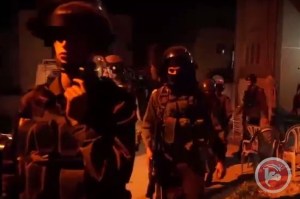 QALQILIYA – Israeli forces shot and injured two Palestinians with rubber-coated steel bullets — one seriously injured — late Saturday in the al-Naqqar area of Qalqiliya in the northern occupied West Bank.
Palestinian Red Crescent head Munther Nazzal told Ma’an that Palestinian Red Crescent paramedics rushed Islam Shoaib, 22, to a hospital after he was shot in the chest.
Mohammed Majid Haj Hassan,19, was detained by Israeli forces for at least 15 minutes after being shot in the knee and thigh and suffered from severe bleeding without being given medical treatment. He was then released to paramedics who transferred him to the Qalqiliya hospital, where he has been in serious condition.
An Israeli army spokesperson told Ma’an that Israeli forces fired warning shots at the two Palestinians as they were “attempting to damage” the Israeli separation wall in Qalqiliya, and fired shots at the “lower extremities,” confirming at least one hit.
Over 1,300 Palestinians have been injured by Israeli forces since the start of this year, the majority during clashes that broke out with the Israeli military during protests in the occupied West Bank, according to the UN Office for the Coordination of Humanitarian Affairs.
UN rights monitor to the occupied Palestinian territory Makarim Wibisono last week condemned excessive use of force used by Israeli military forces and urged the Israeli authorities to comply with international law regarding the use of force and firearms.
Israel’s secret plan for migration of Indian Jews draws fire
Press TV – March 27, 2016
The Israeli regime is under fire for a secret plan to renew the permission for the immigration of members of a Jewish tribe in northeastern India to the occupied Palestinian territories.
Earlier this week, Ksenia Svetlova, an opposition member of the Knesset (Israeli parliament), wrote a letter to Immigrant Absorption Minister Zeev Elkin denouncing Tel Aviv’s recent decision to bring 700 Indian nationals to Israel.
Svetlova said the move contradicts the regime’s latest measure to prevent the immigration of members of the Ethiopian Jewish community over budgetary considerations.
“It turns out there is a budget. While the Ethiopian Jews are being left behind, quietly and secretly hundreds of members of the Bnei Menashe community, who identify as descendants of one of the 10 lost tribes, are being brought over,” she said.
While the Ethiopian citizens are living in dire conditions, the Indians “whose Jewishness has yet to be clarified, are being brought over with urgency,” she said.
The newcomers will be settled in illegal settler units in the occupied West Bank settlements, the Knesset member said, adding, “And all this is happening away from the public eye.”
The Bnei Menashe say they have descended from Jews banished to India in the eighth century B.C.
A senior Israeli rabbi recognized the community as a lost tribe in 2005 and about 1,700 moved to Israel over the next two years before the regime stopped giving them visas.
A private organization called Shavei Israel, headed by American-born Michael Freund, a former aide to Israeli Prime Minister Benjamin Netanyahu, runs the campaign for the Bnei Menashe relocation.
Last month, the Israeli regime halted plans to bring over another 9,000 members of the Falash Mura community from Ethiopia. This is while Ethiopians have repeatedly complained about discrimination by Israeli authorities against Jews of African descent.
Third of Palestinian village left homeless by demolitions this year
Ma’an – March 25, 2016
NABLUS – Mass Israeli demolitions in the Jordan Valley village of Khirbet Tana have left more than a third of its Palestinian residents homeless since the beginning of the year, the UN said Friday.
The UN Office for the Coordination of Humanitarian Affairs (OCHA) said 87 of the village’s 250 residents, including 35 children, had lost their homes in three separate demolitions since January.
The demolitions are part of one of the most extensive demolition campaigns in the occupied West Bank in the last seven years, which has left a total of more than 650 Palestinians homeless in less than three months, more than half of whom were children, OCHA said.
“These demolitions generate a coercive environment, exacerbating residents’ risk of forcible transfer, prohibited by international humanitarian law,” the body said.
In Khribet Tana, 53 structures have been destroyed, including 22 homes, 19 animal shelters, six latrine units, five traditional ovens, and a water reservoir.
The UN body said 18 of these structures had been donated as humanitarian aid by the international community, the majority after demolitions were carried out earlier this year.
Half of all Israeli demolitions across the occupied West Bank this year have taken place in areas declared by Israel as “firing zones,” or restricted military areas, which OCHA said constitute nearly 20 percent of the occupied West Bank.
Khirbet Tana is located in “Firing Zone 904A,” in a part of the Jordan Valley that rights groups say Israel intends to fully annex.
Thousands of Bedouins, who have lived there for decades, face the threat of forced displacement, a threat that rights groups say has become more acute in recent years, particularly with large numbers of resident forced to flee during Israeli military training exercises.
Israel’s Civil Administration demolished all structures in Khirbet Tana in 2012, leaving 152 Palestinian residents homeless, including 64 children, according to Israeli rights groups B’Tselem.
That was the fifth wave of demolitions the village had faced since 2005.
Israel’s Coordination of Government Activities in the Territories previously told Ma’an the demolitions were carried out in the village because they were built illegally and were endangered due to their situation inside the firing zone.
However, OCHA noted two illegal Israeli settlement outposts — recently established and built in the same firing zone — where the Israeli authorities have not carried out any demolitions, despite issuing demolition orders.
Israeli settlers threaten Palestinian who filmed Hebron ‘execution’

Ma’an – March 25, 2016
HEBRON – Israeli settlers on Friday gathered outside the home of a human rights worker in Hebron to hurl abuse at him, a day after he captured on camera an Israeli soldier’s killing of a wounded Palestinian that has sparked international outcry. Imad Abu Shamsiya, a staff member with Israeli human rights group B’Tselem, told Ma’an after settlers threatened him: “I now fear for my life and the life of my family. I’m afraid they might attack my house and do me harm.”
He added that he fears the possibility of suffering the same fate as the Dawabsha family, who were killed in an arson attack committed by settlers last year in the village of Duma in the occupied West Bank.
Palestinian residents of Hebron Abed al-Fattah Yusri al-Sharif and Ramzi Aziz al-Qasrawi, both 21 years old, were shot down Thursday after allegedly stabbing and moderately wounding an Israeli soldier near a military checkpoint in Hebron’s Old City.
Shamsiya recorded rare video footage of an Israeli soldier shooting al-Sharif in the head at point-blank range in plain view of the medical team after he had already been shot at least once and left motionless on the ground.
The incident has brought a barrage of condemnations from the Israeli leadership and led Israel’s army to detain the soldier responsible and launch an investigation.
The release of the graphic video has called attention to what rights groups, international leaders, and Palestinian officials call a policy of “extrajudicial executions” by Israel against Palestinians, since a wave of unrest swept the occupied Palestinian territory and Israel last October.
UN Special Coordinator for the Middle East Peace Process Nickolay Mladenov said Friday he strongly condemned the apparent “extrajudicial execution” of al-Sharif.
“This was a gruesome, immoral, and unjust act that can only fuel more violence and escalate an already volatile situation,” Mladenov said.
Tel Rumeida — where Shamsiya’s house is located and the site of the Thursday’s incident — has been a flashpoint for tensions between Palestinians and Israeli settlers and military, and is near the illegal settlement of Beit Yishai.
Mistreatment of Palestinians in the Hebron area has been common since the city was divided in the 1990s after a US-born settler, Baruch Goldstein, massacred 29 Palestinians inside the Ibrahimi Mosque.
The majority of the city was placed under the jurisdiction of the Palestinian Authority, while the Old City and surrounding areas were placed under Israeli military control in a sector known as H2.
The area is home to 30,000 Palestinians and around 800 Israeli settlers who live under the protection of Israeli forces. Hebron residents frequently report attacks and harassment by the settlers carried out in the presence of the forces.
UN set to establish database of businesses involved in Israeli settlements
MEMO | March 23, 2016
The United Nations Human Rights Council (UNHRC) is set to vote on Thursday on whether to establish a database of businesses involved in Israeli settlements.
The UNHRC, meeting in its 31st session, will be considering four resolutions under Item 7, which focuses on the impact of the Israeli occupation on human rights in Palestine and other occupied Arab territories. Such resolutions are routinely adopted.
A resolution on Israel’s illegal settlements in the Occupied Palestinian Territory, including East Jerusalem, and in the occupied Syrian Golan, however, has reportedly upset European Union member states, in particular by calling for “a database of all business enterprises involved” in illegal settlement activities, which will be updated annually.
The database is presented as a follow up to an earlier fact-finding mission, which investigated “the implications of the Israeli settlements on the civil, political, economic, social and cultural rights of the Palestinian people throughout the Occupied Palestinian Territory, including East Jerusalem.”
Middle East Monitor understands from sources familiar with the discussions taking place that European Union member states will either vote against, or abstain from, the resolution. The UK is reportedly expected to vote against, with significant pressure being applied on Palestinian officials to remove the paragraph establishing the database of businesses involved in settlement activities.
The resolution notes that “the settlement enterprise and the impunity associated with its persistence, expansion and related violence continue to be a root cause of many violations of the Palestinians’ human rights, and constitute the main factors perpetuating Israel’s belligerent occupation of the Palestinian Territory, including East Jerusalem, since 1967.”
The resolution goes on to express concern that “some business enterprises have, directly and indirectly, enabled, facilitated and profited from the construction and growth of the Israeli settlements in the Occupied Palestinian Territory.”
The UNHRC resolution also notes that “products wholly or partially produced in settlements have been labelled as originating from Israel”, and that “private individuals, associations and charities in third States” are “involved in providing funding to Israeli settlements and settlement-based entities, contributing to the maintenance and expansion of settlements.”
As well as the database, the draft text urges all states to “provide guidance to individuals and businesses on the financial, reputational and legal risks, including the possibility of liability for corporate involvement in gross human rights abuses as well as the abuses of the rights of individuals, of becoming involved in settlement-related activities.”
On Monday, the UNHRC head from outgoing Special Rapporteur on the situation of human rights in the Palestinian territories occupied since 1967, Makarim Wibisono, who presented his final report to the Council.
Among other recommendations, “he urged Israeli authorities to…halt the expansion of illegal Israeli settlements, to refrain from acts causing the forced displacement of Palestinians in the West Bank, including East Jerusalem, and to urgently implement recommendations by the United Nations Children’s Fund with respect to the detention of children.”
Palestinians face severe restrictions during Jewish holiday
Ma’an – March 23, 2016
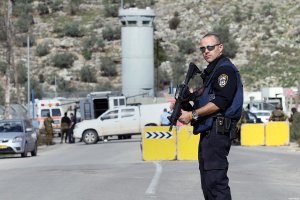 BETHLEHEM – Palestinians faced severe movement restrictions on Wednesday, as Israeli authorities shut down all movement through checkpoints in and out of the occupied West Bank and Gaza Strip ahead of the Jewish holiday of Purim.
An Israeli army spokesperson said that beginning at 1 a.m. on Wednesday and lasting until midnight Saturday, the checkpoints would be closed to all Palestinians with the exception of humanitarian cases.
Palestinian citizens of Israel, as well as holders of foreign passports, would still be allowed to pass through the checkpoints, she said, noting: “They’re only closed for Palestinians.”
She said Palestinians could seek to arrange “special circumstances” with Israel’s Coordination of Government Activities in the Territories (COGAT).
Sources inside the Palestinian liaison department confirmed the measures would be extended to the Kerem Shalom and Erez crossings into the Gaza Strip, with only humanitarian cases and a limited number of Palestinian Christians allowed to leave the blockaded coastal enclave.
Israeli police spokesperson Luba al-Samri said there would be heightened security measures, including a number of police patrols, across occupied East Jerusalem and the West Bank throughout the holiday.
Palestinian access has also been restricted to the Al-Aqsa Mosque compound, with all Palestinian men younger than 50 denied entry to the site, which is the third holiest in Islam.
Access restrictions to the mosque compound during a succession of Jewish holidays last September played a major role in triggering a wave of unrest that has since left more than 200 Palestinians and nearly 30 Israelis dead.
Tensions were running high in the West Bank on Wednesday morning after Israeli forces escorted hundreds of Israelis, including settlers, to holy sites there, with clashes breaking out nearby Joseph’s Tomb near Nablus.
The Jewish holiday of Purim, which commemorates the Biblical account of the saving of the Jewish people from Haman, an ancient Persian vizier, begins Wednesday evening and ends late Thursday this year.
Israeli forces raid, confiscate items from Jenin-area university
Ma’an – March 22, 2016
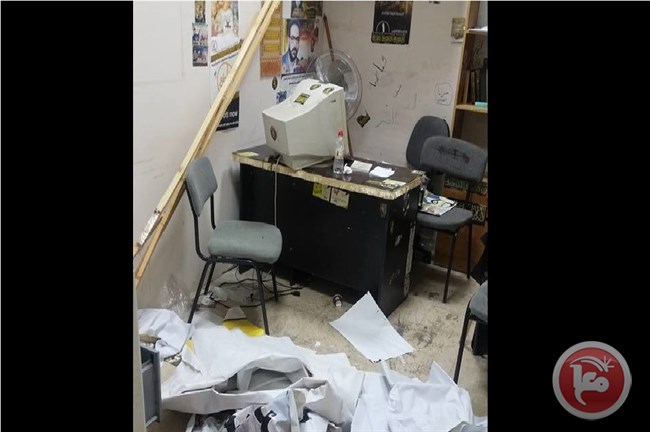
JENIN – Israeli forces overnight Monday raided the campus of the Arab American University in the occupied West Bank city of Jenin and confiscated items — including computers and flags — from student union offices.
The university’s public relations department told Ma’an that 11 Israeli military vehicles stormed the campus grounds at 1 a.m. and broke into the office of the Dean of Students, as well as a number of offices belonging to the student union.
The Israeli soldiers broke down doors and destroyed property in the offices before seizing flags of student union blocs as well as two computers and paper documents, the department said.
The university’s administration released a statement denouncing “Israel’s aggressive policy which violates the sanctity of university campus.”
Palestinian Prime Minister Rami Hamdallah immediately condemned the raid.
“This is not the first time that the Arab American University and other Palestinian educational institutions have been subjected to arbitrary Israeli raids,” the PM said, citing raids on Birzeit University and the Kadoorie Institute in recent months.
“I reiterate our call for international protection,” Hamdallah said. “Israel should not be allowed to continue to act above the law. The international community witnessed yet another violation of the sanctity of Palestinian educational institutions, and it should not remain silent.”
The Israeli army said in a statement that Israeli forces had “uncovered and confiscated inciting propaganda materials linked to multiple terror organizations including Hamas” inside the university, adding that the operation was “based on intelligence information.”
“In the recent wave of terror we’ve witnessed how incitement fuels acts of violence and terrorism,” the statement said. “Efforts as this prevent future attacks.”
In addition to the statement, the army released what it said were “visuals from the overnight activity” — photographs of an Islamic Jihad flag and a Hamas one, as well as a poster depicting three recently slain Palestinian attackers, referred to as “martyrs.”
Political flags and posters are commonly found items across the occupied West Bank, with posters of martyrs appearing throughout every West Bank town and village.
Palestinian universities and their students in the occupied West Bank are frequently targeted by Israeli military forces, and campuses have come under increased military presence since an increase in violence in October.
Earlier this month Israeli forces raided the Khadoorie Institute — also known as Palestine Technical University — twice in an 18-hour period.
The Tulkarem-area campus has seen heavy military presence in the past. Student-organized marches in October to protest Israeli violations and raids onto the campus eventually resulted in Israeli forces positioning themselves at a temporary base on university property.
Dozens of university students have been injured by Israeli military forces since.
Birzeit University near Ramallah meanwhile has reported dozens of student detentions, while Abu Dis’ al-Quds Open University has often found itself a focal point of violent clashes between Palestinian students and Israeli soldiers.
Israeli troops raid West Bank village day after funeral of slain Palestinians
Ma’an – March 21, 2016
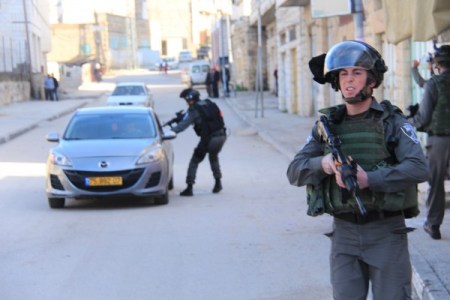
BETHLEHEM – Israeli troops raided the village of Beit Fajjar east of Bethlehem early on Monday, storming several houses and detaining two Palestinians.
The raid took place a day after the funerals of Ali Abd al-Rahman al-Kar Thawabta, 20, and Ali Jamal Muhammad Taqatqa, 19, who were killed by Israeli forces on Thursday after carrying out a stab attack that injured an Israeli soldier near the illegal Israeli settlement of Ariel in the northern occupied West Bank. Local sources said that Israeli troops raided Thawabta’s house and detained his brother Muhammad, 24.
They also detained Muhammad Akram Taqatqa, 22. Witnesses said Israeli excavators escorted by Israeli troops raided the al-Mahajer neighborhood of Beit Fajjar, seizing equipment and detaining workers in the area.
Israeli forces have shut down most roads leading to Beit Fajjar since Thursday, except for one between the villages of Sair and al-Manshiya.
An Israeli army spokesperson told Ma’an all roads to Beit Fajjar were open, but that residents between the ages of 15 and 25 were barred from entering or leaving, “except in case of medical emergencies.” She also confirmed that Israeli forces detained two Palestinians in Beit Fajjar overnight.
Bethlehem district governor Jibril al-Bakri condemned on Friday Israeli sanctions against Beit Fajjar, noting that such actions qualify as “collective punishment” of the village’s over 10,000 residents in violation of international law.
Over 200 Palestinians and just under 30 Israelis have been killed since October, and attempts to quell the violence by the international community have subsequently failed.
Earlier this year, UN Secretary-General Ban Ki-Moon condemned the wave of attacks, but said that Israeli security measures were failing to “address the profound sense of alienation and despair driving some Palestinians — especially young people.”
He added: “As oppressed peoples have demonstrated throughout the ages, it is human nature to react to occupation, which often serves as a potent incubator of hate and extremism.”
Rani Burnat from Bil’in
International Solidarity Movement | March 15, 2016
Bil’in, occupied Palestine – Rani Burnat is an extraordinary human being in more ways than one. He was left paralysed from an injury sustained during the second intifada, learned to live the remainder of his life in a wheelchair, fathered three children (triplets) and now continues to resist the occupation through peaceful means to this day. His story is inspiring and a prime example of the will of the Palestinian people and their ongoing resistance to an illegal occupation.

Rani Burnat
On the 30th September 2000, Rani Burnat was going to Ramallah from his home town of Bil’in for a driving lesson. When he got there he noticed a protest gathering to protest Ariel Sharon’s entry into the sacred Al-Aqsa mosque (this of course was the beginning of the second intifada). Rani spotted friends of his from Bil’in and with time to spare decided to join in.
As the protest gathered the Israeli army illegally entered the Ramallah area and cleared the guests out of a nearby hotel, then used the hotel roof as a vantage point and placed snipers. The Israeli military claims that their illegal entry onto Palestinian land was to protect a nearby illegal Israeli settlement that the protest was nearing.
Rani and fellow friends were at the front of the protest when a sniper opened fire using a unique bullet, known as a butterfly bullet, designed to continue spinning upon impact while opening out and inflicting massive damage upon entry and exit.
The bullet entered through the left-hand side of Rani’s neck, puncturing his main artery. It continued through to the right hand side of his body, severing his spinal chord between the third and fourth vertebrae on exit.
As sniper fire continued and pandemonium erupted, Rani was left bleeding on the ground. Fortunately fellow bystanders assisted by applying pressure to the wound on his neck to limit the massive amounts of blood that he was losing. He was then put into a car and driven to the nearby hospital where he was promptly seen by doctors. Rani was the first victim of the second intifada to be treated. Anyone coming into hospital later in the intifada with his severe wounds would undoubtedly have died as staff and resources failed to cope with the influx of wounded.
The doctors applied a stint to Rani’s neck to where the artery had been severed, which remains to this day. He was put into an induced coma for two days, during which time doctors concluded that with the facilities they had they could not keep Rani alive along with the massive numbers of victims that were now being admitted to the hospital as the second intifada intensified.
It was decided that Rani must be transferred to another hospital with more facilities, one capable of taking care of someone in such a serious condition, the only hospital possible was in Jordan. Given his condition he could not make the journey by land and so a helicopter was arranged from the rooftop of the parliament building in Ramallah.
On admission to hospital in Jordan, his loss of blood was so great that he required massive blood donations from a number of donors. Rani would spend the next seven months in that hospital undergoing operations and combatting repeated infections. He says ‘The most important thing for me at that time was that I was alive. The doctors in Jordan made this possible”.
After seven months in Jordan, Rani was able to come back to Palestine for rehabilitation, back at home in Bil’in seeing friends and family who had missed him, and whom he had missed so much in Jordan.
He then had to go back into hospital in Ramallah for another seven grueling months of rehabilitation. It was during this time that the severity of his situation became clear to him. “It was an extremely difficult situation to come to terms with, that I would now have to spend the rest of my life in a wheelchair, paralysed on the right side of my body.” Rani is the oldest of ten siblings with four brothers and five sisters. He had wanted to be an electrician and he talks about the helplessness he felt at that time. But despite this he added, “The personal pain I felt was nothing compared to the pain I was feeling for my family.” However, a huge positive in Rani’s life amidst so much trauma was when he married shortly after the intifada and became father to triplets.
As time passed, Rani learned to deal with the injuries he had sustained, but one thing that he was not ready for was what happened in his home village next as the Israeli government began to illegally confiscate villagers’ land to construct the apartheid wall and enclose illegal settlements.
At this point Rani decided to become a photographic journalist so he could report on and show the world the ugly truths of the Israeli occupation and what it does to the Palestinian people. He says he will only stop when he is dead or the occupation has ended.
Every week he is able, Rani makes the trip up the rocky road in his wheelchair, gas mask and camera at the ready. His wife worries for him every time he leaves but understands that this is what he must do. Rani himself admits that every Friday he leaves he fears he will not come home to his loving wife and children but he continues to go to show the world what is happening.
Fellow activists from Israel who come frequently to the Bil’in demonstrations have translated for Rani what the Israeli army is saying about him, things like “shoot the guy in the wheelchair” whilst laughing amongst themselves. Rani has been shot with rubber bullets, countless amounts of tear gas, had many cameras broken, two wheelchairs wrecked and has even been pulled out of his wheelchair and thrown onto the ground. “The occupying forces have no morals,” he adds.
Two months ago Rani was shot in the stomach with a foam bullet, which releases a liquid that burns the skin on impact. A month later he was shot in the knee cap and also singled out by soldiers and shot in both shoulders with tear gas canisters. Despite all this he continues moving forward.
In 2005 Rani organised a unique demonstration in Bil’in for all the people who have been injured or disabled since the second intifada. He explains that the Israeli army used the most tear gas he has ever seen used, firing directly into the group of people, many of whom were restricted to wheelchairs, and causing many of them to pass out from tear gas inhalation including himself. “This is occupation” says Rani.
He doesn’t believe Israel can continue like this and he hopes an end is near, as do all Palestinians. Rani tells of how he wishes to be able to travel to Jenin with no checkpoints and how he wants to take his children to see the sea. Every Palestinian who has been suppressed by the occupation has their own particular dreams of life without Israeli occupation.
“Palestine is a state of peace, Israelis should be able to come and live harmoniously in peace – against occupation”.
“If you come to my house in peace I will welcome you… but if you come to my house to take it from my family, I will fight until my dying breath with all means necessary to defend it”.
Targeting of children and residents in Ni’lin
International Solidarity Movement | March 19, 2016
Ni’lin, Occupied Palestine – On 18th March 2016, Palestinian villagers of Ni’lin protested against the Israeli land-theft and illegal settlements and the continuous violence Israeli forces use to stifle the weekly non-violent protests. Villagers commemorated Rachel Corrie, an American activist killed by Israeli forces in Gaza, and Tristan Anderson, an American activist left with severe permanent physical and cognitive impairments after being shot in the head with a high-velocity tear gas canister in Ni’lin.
Israeli forces again used excessive force, inundating not only the protestors, but the whole village in tear gas. Whereas the last two weeks Israeli forces showered a public park with a playground in tear gas, causing several cases of excessive tear gas inhalation of small children playing there; this Friday they deliberately targeted civilian homes inside the village with tear gas, as well covering the public park in tear gas. The heavy iron tear gas canisters broke windows of 7 houses and the shops in the center of the village, causing civilians to suffer from the effects of tear gas inhalation. As family homes were targeted with tear gas, dozens of children and elderly had to be treated for tear gas inhalation. 8 people, including an 87-year old man had to be treated for excessive tear-gas inhalation. Throughout the West Bank, Israeli forces have increased the use of long-range tear gas canisters, that can reach up to 1000m and are silent when shot. These kind of tear gas canisters increase the risk of serious and / or deadly injuries as they can’t be heard and are iron-clad and thus extremely hard. Furthermore 2 people were treated after being hit and injured with rubber-coated steel bullets during the protest.

Medics treating an elderly man suffering from excessive tear gas inhalation
Luckily, no one was directly hit with one of the tear-gas canisters shot into Palestinian family homes. On the 12th of March, a 17-year old boy was shot in the neck with one of these heavy tear-gas canisters, causing a skull fracture. He had to undergo surgery and only after a week in intensive care his condition is now stable.
The continuous targeting of civilians, families and children by the Israeli forces is not only common in the village of Ni’lin, but also throughout the occupied West Bank.
Moscow Calls New Expropriation of Land by Israel in Palestine ‘Illegal’
Sputnik – 18.03.2016
MOSCOW — The Russian Foreign Ministry called illegal the new expropriation of land by Israel in the Palestinian territories, according to a statement issued on Friday.
Moscow expressed “concern about the settlement projects of Israel in the occupied Palestinian territories.”
“A few days ago, the Israeli authorities announced the expropriation of 154.5 hectares of land near the town of Jericho in the West Bank of the Jordan River. This area has been declared ‘the land of the Israeli state,'” the statement reads.
“These actions are illegal under international law and the decisions on them should be reviewed,” the ministry stressed.
Moscow urged “all the sides to refrain from unilateral steps that undermine the prospects of the Palestinian issue settlement on the internationally recognized basis.”
Featured Video

Macgregor: We Haven’t Seen the Worst of the Iran War Yet
or go to
Aletho News Archives – Video-Images
New Book
Breast Cancer: Before You Consent
A new Unbekoming paperback
Lies are Unbekoming | September 18, 2026
Peter Gøtzsche reviewed every randomised mammography screening trial ever conducted for the Cochrane Collaboration. Cochrane’s headline is that, assuming a 15% mortality reduction, one woman in 2000 avoids dying of breast cancer over ten years. Ten are overdiagnosed and treated. Two hundred experience false alarms.
But that headline assumes the reduction. When Gøtzsche looked only at the trials with adequate randomisation — the higher-quality ones — the reduction disappeared. No effect on breast cancer mortality. No effect on all-cause mortality.
This is the Cochrane finding, published in the establishment’s own database of systematic reviews.
No woman being asked to consent to a mammogram this week knows it.
That is why the new Unbekoming paperback exists. … continue
Blog Roll
 Aletho News
- US lawmaker blocks $2.8 billion weapons sale to Israel: Report
- Yemeni army claims responsibility for strikes on sensitive sites in Saudi capital, Aramco facilities in Yanbu
- Iran Judiciary issues indictments against 159 US, Israeli officials for assassination of Leader, commanders
- Turkiye revokes Iranian bank license under US sanctions campaign
- US-Denmark Agreement on Greenland Is ‘PR Stunt’ Ahead of Midterms
- Araghchi: Military intervention cannot create security; coercion cannot bring peace
- Fraud Squared
- Breast Cancer: Before You Consent
- Iran’s Plan to Shut Down AI in the Persian Gulf
- Israel seeks ‘compensation’ from Washington over Saudi F-35 sale
- If Americans Knew
- Inside Gaza’s death trap of collapsing, bombed-out buildings
- The everyday items Israel bans from Gaza every day
- Inside the siege, the ruined buildings of Gaza – Daily Update
- Debunking The Claim That Macklemore Has A “History Of Antisemitism”
- CPJ demands release of arrested Palestinian-US journalist near Bethlehem
- Robert Kraft: The Billionaire Friend of Netanyahu Pulling The Strings Behind the Macklemore/Ed Sheeran Blow Up
- Columbia Administered Fund Gives Big Money to Pro-Israel Groups
- Deportation Case of Palestinian Activist Salah Sarsour Tests First Amendment
- ‘We Will Not Forget’: Palestinians Mark 44 Years since Sabra and Shatila
- Why do we let Zionists decide what we can and can’t say?
- No Tricks Zone
- New Study: ‘Global Drought Shows No Detectable Recent Acceleration Under Climate Warming’
- Economic Masterminds: German Socialists Suggest Taxing Productivity Gains Stemming From Using AI
- The South China Sea Has Not Been Cooperating With The Climate Change Narrative
- Energy Crisis: Germany Enters Heating Season With Historically Low Gas Reserve Fill Levels
- New Study: The Antarctic Ice Sheet Gained Mass From 2020-2024 Due To Staggering Snow And Ice Accumulation
- Study: Ocean Heating Rates From Thousands Of Years Ago ‘Dwarf’ Modern Ocean Heating Rates
- Climate Extremists Target, Attack Large-Scale Power Grid Infrastructure In Germany!
- New Study: Antarctic Ice Melt Has Contributed Less Than 1 Centimeter To Sea Level Rise In The Last 30 Years
- Fear Of Debate: Alarmist German Climate Scientist Calls On Mainstream Media To Discredit Skeptic Voices
- End-Of-August Arctic Sea Ice Extent Hasn’t Fallen In 20 Years, Official Data Show!
 Aletho News