Report: Israeli Occupation Forces killed six Palestinians last month
Palestine Information Center – January 8, 2015
 GAZA – Israeli occupation forces (IOF) killed six Palestinians and kidnapped hundreds in the West Bank and the Gaza Strip last December, according to a report released by the Hamas Movement on Wednesday.
According to the report, the IOF shot dead one Palestinian last month in Gaza while another died of wounds he had sustained during the last war.
Four Palestinians were killed by IOF gunfire in the West Bank.
The IOF also detained 327 Palestinians, including 58 children and four women, mostly from the West Bank.
During the reporting month, the IOF demolished 40 Palestinian homes, 10 commercial stores, 31 structures as well as one restaurant and one forge, and issued demolition orders against other homes.
The Israeli occupation authority, in turn, approved plans for the construction of 316 housing units in Jerusalem and annexed 321 dunums of Palestinian land last month.
The report also touched on some of the violations committed by the Palestinian Authority’s security forces during the month, stating that they detained 235 cadres and supporters of the Palestinian resistance, mostly from Hamas, summoned 151 others for interrogation, and extended the detention of 32 others.
Jewish settlers attack Palestinians south of Jenin
Palestine Information Center – January 2, 2015
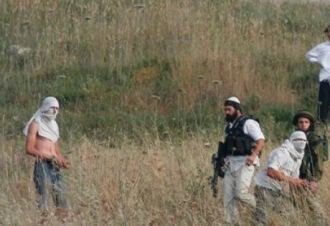 JENIN – A group of Jewish settlers attacked Palestinian vehicles traveling on Jenin-Nablus road near the junction of Jaba village south of Jenin at dawn Friday.
Around 12 vehicles carrying settlers stormed the evacuated settlement of Tarsleh and blocked Jenin-Nablus road today under military protection.
The settlers spread among nearby olive trees and began attacking and stoning passing Palestinian cars in the presence of Israeli soldiers, eyewitnesses said.
During the attack, the settlers chanted racist slurs against the Palestinians.
Meanwhile, Israeli media sources claimed that three Molotov cocktails were thrown at a home appropriated by settlers in Ras Amoud neighborhood in occupied Jerusalem overnight. The sources said that Palestinian young men threw three Molotov cocktails at the house, with no reported injuries.
The Israeli police launched a wide manhunt following the incident.
Extremist Israeli Settlers Burn Palestinian Home Near Hebron
By Saed Bannoura | IMEMC & Agencies | December 31, 2014
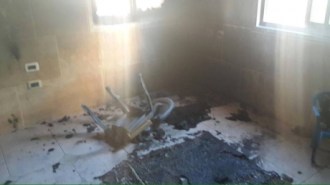 A Palestinian family from a village east of the town of Yatta, near the southern West Bank city of Hebron, narrowly escaped death on Wednesday at dawn, when a number of fanatic Israeli settlers hurled Molotov cocktails into their home as they slept.
The head of the Yatta City Council Mousa Makhamra told the Maan News Agency that the attack is a very serious and dangerous escalation, adding that it is an attempt to annihilate a family of seven; five children and their parents.
Makhamra added that the fanatic settlers, from Karmiel illegal settlement, infiltrated into ad-Deerat village, east of Yatta, at approximately 3 am, and throw the Molotov cocktails into the Palestinian home after writing racist graffiti on its outer walls.
Makhamra further stated that the family woke up in time, and their neighbors rushed in when they saw the house on fire, and rescued the family.
The fires consumed the furniture in the living room, but was controlled before it spread.
The settlers wrote racist anti-Arab graffiti, including the infamous statement “Death To Arabs”, and other graffiti.
Image Shehab News
PLO: Israel has detained 1266 Palestinian children in 2014
Al-Akhbar | December 30, 2014
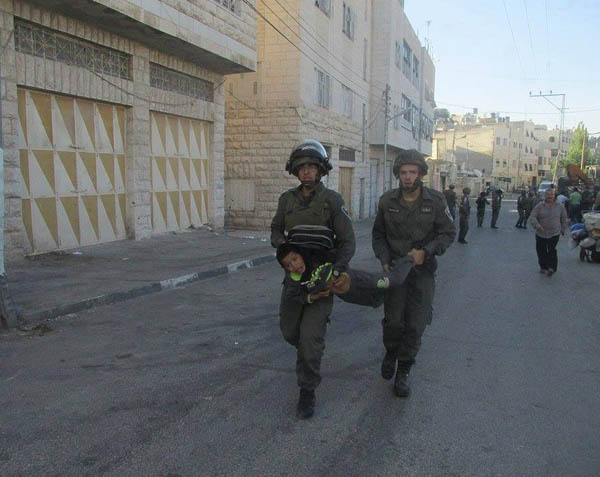
Israeli forces detained over 1,000 Palestinian children in the occupied West Bank and annexed Jerusalem in 2014, the Palestine Liberation Organization (PLO) said Tuesday.
Abdul-Nasser Farawna, head of Authority of Prisoners’ Affairs, a PLO body, said that Israel detained 1,266 Palestinian children, below the age of 15, in the West Bank and Jerusalem in 2014.
“The vast majority of the arrests happened in the second half of the year,” Farawna said in a statement, adding that at least 200 children are still detained in Israeli jails on various charges.
Israeli forces routinely conduct arrest campaigns targeting Palestinians in the occupied West Bank and annexed Jerusalem on claims they are “wanted” by Israeli authorities.
According to the PLO, more than 10,000 Palestinian minors in the occupied West Bank and annexed Jerusalem have been held by the Israeli army for varying periods since 2000.
“The number of Palestinian children arrested by Israeli forces, especially in annexed East Jerusalem, has sharply risen,” Farawna declared, saying that the number of children detainees had increased by 87 percent over the past three years.
“The majority of the detained children were subjected to beatings and torture by Israeli security personnel while in detention,” he asserted.
Farawna’s statements echoed similar comments last month by another PLO official, Issa Qaraqe, who said that around 95 percent of children detainees were subjected to beatings and torture by Israeli security personnel while in detention, while many were forced to make confessions under duress and undergo unfair trials.
Violent practices by Israeli soldiers as well as settlers against Palestinian children is endemic and often abetted by the authorities.
“Israel does not provide any immunity for children and regularly violates international agreements on children’s rights by humiliating and torturing them and denying them fair trials,” Qaraqe explained.
A report by Defense for Children International (DCI) published in May 2014 revealed that Israel jails 20 percent of Palestinian children it detains in solitary confinement.
DCI said that minors held in solitary confinement spent an average of 10 days in isolation. The longest period of confinement documented in a single case was 29 days in 2012, and 28 days in 2013.
A report by The Euro-Mid Observer for Human Rights Israeli forces arrested nearly 3,000 Palestinian children from the beginning of 2010 to mid-2014, the majority of them between the ages of 12 and 15 years old.
The report also documented dozens of video recorded testimonies of children arrested during the first months of 2014, pointing out that 75 percent of the detained children are subjected to physical torture and 25 percent faced military trials.
The most excruciating violations are seen in the psycho-physical torture methods, including the act of forcing children to sit on the investigation chair chained hand and foot and covering their entire heads with foul-smelling bags, in addition to depriving them of sleep.
In 2013, the UN children’s fund (UNICEF) reported that Israel was the only country in the world where children were “systematically tried” in military courts and gave evidence of practices it said were “cruel, inhuman and degrading treatment or punishment.”
The UNICEF report said in a 22-page report that over the past decade, Israeli forces have arrested, interrogated and prosecuted around 7,000 children between 12 and 17, mostly boys, noting the rate was equivalent to “an average of two children each day.”
Palestinian children as young as five years old have also been detained in the past.
In 2013, Israeli forces in the West Bank detained four Palestinian children aged five to nine years.
Palestinian activist Murad Ashtiye told AFP at the time that “Israeli soldiers arrest the children and tie their hands behind their backs using plastic strips.”
Meanwhile in Gaza, a 51-day Israeli aggression last August left at least 505 children dead, 20 percent of the total civilian death toll.
The UN agency for Palestinian refugees UNRWA said 138 of its students were killed during the assault. The organization’s spokesperson Christopher Gunness said an additional 814 UNRWA students were injured and 560 have become orphans due to the Israeli onslaught.
The worst massacre took place in the Abu Hussein School of the Jabaliya refugee camp in the north killing and injuring dozens even after the agency said that it gave the school’s coordinates to the Israelis more than 17 times so they won’t hit it.
(Anadolu, Al-Akhbar)
Chronicle of impunity for unprovoked shooting by ‘security’ forces
Yesh Din | December 29, 2014
 Someone shot a bullet at Ashraf Muhammad Jamal Tufiq’s foot in Bil’in in 2009. The IDF’s investigatory bodies did their best to make sure they will never find the shooter.
On Friday, January 16 2009, someone – a member of the Israeli security forces – fired a bullet into the foot of Ashraf Muhammad Jamal Tufiq from the West Bank village Bil’in. According to Tufiq, the shooting occurred without any provocation and came after the weekly demonstration ended. As a result of his injury, Tufiq had to undergo an operation and had to give up on being a professional a soccer player. On November 4, 2013, the Operational Affairs Prosecution closed the case, reaching the conclusion that it contains no evidence whatsoever.
Hold on, you say, you’ve made an error. You’re saying the shooting took place on January 2009, but the case closed in November 2013. That’s more than four years between one event and another. You must have made a mistake.
No mistake. This is the heart of the issue. I’ll present the chronology of events based on the work of Adv. Emily Schaeffer Omer-Man. But before we start, we should note that Tufiq’s testimony is not bereft of problems, and that at certain points he even contradicts himself. The fact, however, is that he was shot and became a cripple. A quick investigation might have found out what actually took place. But, as we can see from the flow of events below, that did not exactly happen.
January 16, 2009 – A Friday demonstration in Bil’in, and it’s more violent than usual. The soldier in question will later remember the events because, unusually, another soldier was wounded. After the demonstration, a member of the security forces shoots Tufiq. He is taken to a hospital and, with our aid, submits a notice (the equivalent of a complaint to the police) to the Military Police Criminal Investigation Division (MPCID).
May 24, 2009 – More than four months after the incident, the Jerusalem branch of the MPCID confirm they have received the notice.
July 7, 2009 – The Operational Affairs’ prosecution informs us that it is dealing with the case.
August 4, 2009 – The Operational Affairs’ prosecution informs us that it has frozen the investigation in order to “clarify the issue with military officials.” This, in effect, means the investigation is delayed while the case is referred to an operation debriefing.
February 14, 2010 – Thirteen months after the incident: the Operational Affairs’ prosecution says the case is under consideration.
October 14, 2010 – Twenty-one months after the incident: the Operational Affairs’ prosecution says the case is under consideration.
April 14, 2011 – Two years and three months (!) after the incident: the Operational Affairs’ prosecution says the case is under consideration.
November 29, 2011 – Two years and 10 months after the incident: reports that Atlantis has risen from the sea, fish are climbing trees, cats and dogs have foresworn their ancient enmity, and MPCID has re-opened its investigation.
Which is nice, but there are two main problems with opening an investigation so late in the game:
1. The chances of finding evidence is nil. There is no crime scene to speak of, particularly since the incident took place before the IDF has deigned to obey the ruling of the High Court of Justice and moved the separation fence in Bil’in. Also, human memory blurs rapidly.
2. Even if there was evidence, once a soldier has been discharged from the army for six months (or a year, in extreme cases) he or she is no longer under the jurisdiction of military law. Given that mandatory military service in the IDF lasts for three years for men, even if the MPCID had found the culprit on the day in which it began its investigation (which, naturally, did not happen) chances are that they would not have been able to bring him to trial. Only the Attorney General can decide to do so – which hardly ever happens in practice.
And after this methodical break, back to our chronicle:
December 8, 2011 – MPCID Jerusalem contacts us and wants to set up an interview with the victim. After a series of delays – including one case in which Tufiq comes to a meeting set up by MPCID and finds no one who can take his statement – MPCID finally takes a statement from him on December 30, 2012, i.e. two months after the resurrection of the investigation.
February 9, 2012 – The MPCID interviews the operations officer of the battalion involved in the incident. He says he doesn’t remember anything, which sounds perfectly plausible. After all, this was a negligent incident from a military point of view, not to mention the fact that more than three years have passed since it happened.
February 20, 2012 – The MPCID receives the translation of the medical reports regarding Tufiq’s wound, which the Operational Affairs’ prosecution could easily have obtained some three years earlier. But let’s not be petty.
March 11, 2012 – Three weeks later, the MPCID interviews the operations officer once again. He says he doesn’t even remember which forces were involved in the incident. Since, well, three years have passed, and it wasn’t exactly the Battle of the Bulge.
8.3.12 – The MPCID interviews the battalion commander. He claims there was no shooting during the incident, much less live shooting. He adds that it is inconceivable his patrol troops would lie on this issue.
March 11, 2012 – The MPCID interviews the battalion commander again, who says that given the time that has gone by, his outfit no longer has any documents relating to the incident.
March 13, 2012 – The MPCID tries, without success, to gain access to the operational logs. Given the passage of time, they were not kept.
July 25, 2012 – More than four months after the last investigative action took place, the MPCID interviews another officer – this time a major. He does not think there was live fire.
July 31, 2012 – The MPCID investigators interview another officer, a Lt. Colonel. He does not even remember over whom he presided at the time. After all, this was more than three years since the incident.
August 1, 2012 – After a delay of three years and seven months, the MPCID decides to interrogate the platoon commander under legal warning. He remembers the soldier who was wounded, thinks there may have been a Ruger bullet fired but is not certain and remembers that there was a report about a wounded Palestinian when he got back to base. The officers interviewed earlier did not remember this detail. One should note that his testimony, where he says a live bullet may have been fired, contradicts the testimony of his battalion commander. And since he was closer to the incident, we should give more weight to his testimony.
October 28, 2012 – Nearly three months after the latest investigation, the MPCID interrogates the wounded soldier. He us convinced there was no live fire, not by him at any rate. He claims that he kept asking for permission to use live fire. His request was denied and he used rubber bullets instead.
November 11, 2012 – The MPCID interrogates another soldier in the section under warning. The soldier also remembers that they fired rubber bullets – not live ones.
November 16, 2012 – The MPCID interrogates the sergeant major of the force under warning. He denies any sort of shooting, saying the forces used only tear gas grenades. This testimony is contradicted by all the other testimonies.
December 18, 2012 – The MPCID interrogates yet another soldier, who says they fired rubber bullets and believes there was no live fire.
December 18, 2012 – The MPCID interviews a medical officer, a Lt. Colonel, who says there is no point in interviewing Border Policemen, since their outfit carries out such actions on a weekly basis, and thus they won’t remember a thing. He seems to be right; there is no evidence of MPCID trying to interview Border Policemen.
November 4, 2013 – We’ve come to the end of this comedy of errors: nearly a year after the last investigation, and four years and 10 months after Tufiq was shot, the Operational Affairs’ prosecution closes case, citing lack of evidence.
So what had we here? A failure from beginning to end. The investigation began almost three years after the incident, and from the start it was doubtful whether it ever stood a chance. Too much time had passed.
But there is an even more important point to make here. Almost all the witnesses contradict each other. The battalion commander says only rubber bullets were fired – but the platoon commander thinks there may have been a Ruger bullet fired. The sergeant major thinks only gas was used, while all other witnesses report the use of rubber bullets. The medical documents speak clearly of a live bullet. Did someone pull the Beitunia trick by firing a live bullet and masquerading as if it were a rubber bullet? We’ll never know.
The IDF keeps telling us it needs to hold an operational debriefing – that it needs its soldiers to tell the truth during the debriefing. Therefore, it claims, the debriefing must not be turned over to MPCID as evidence. But note what happened: after almost three years wasted by the Operational Affairs’ prosecution, nobody has a clue as to what happened. The officers cannot even remember their order of battle. No one is sure about what kind of ammunition was actually used. There is a vague Border Police force in the area of operations, but no one knows what it did. The operational logs no longer exist.
If this the situation, what is the purpose of the operational debriefing? Ostensibly it is supposed to provide the forces with insight into the events so they can improve their tactics. But if no one remembers what was said in it, what is it really good for? And why can’t the MPCID investigation run parallel to it, rather than months afterward?
The Turkel Commission, which dealt with the behavior of the military investigative bodies, recommended that an investigation ought to be swift. Two years before Turkel’s recommendations, the JAG decided to hold MPCID investigations (after an appeal by B’Tselem and ICRI) – in cases of death only – in parallel to the operational debriefing. We have some indications that MPCID is beginning to internalize and implement the Turkel Commission recommendations, with an emphasis on speedier investigations. But in the meantime, the investigation of the shooting of Ashraf Muhammad Jamal Tufiq stands as Exhibit A that the IDF doesn’t know how and perhaps doesn’t want to investigate itself.
Photo: Israeli border police officers shooting tear gas canisters during the weekly protest against the Wall in the West Bank village of Bil’in, November 1, 2013
Photo by Activestills
Israeli Forces Train with Live Ammo in West Bank Civilian Areas

IMEMC News & Agencies | December 30, 2014
Israeli occupation forces, since the early hours on Monday, have been holding military training sessions with live ammunition, in the Khirbet Taweel area, South Nablus.
Member of the Popular Struggle Coordination Committee of Aqraba, Yousef Deriyyah, said that Israeli occupation forces, Sunday evening, bulldozed and damaged several dunams of wheat fields in preparation for the training.
The PNN further reports that military training has often targeted Palestinians, including children, causing injuries and home evictions.
Back in August, Israeli authorities evicted 1,300 Palestinians from their homes in the south Hebron hills, of the occupied West Bank, claiming that they are located in a military training zone.
In October, Israeli forces stormed Aida refugee camp without any provocation and began firing tear gas canisters, sound bombs and rubber-coated steel bullets at children in the streets.
Eyewitness said that soldiers were training by using families, children and homes as military practice.
Also in October, Israeli authorities distributed eviction notices to 19 Palestinian families in the Northern Jordan Valley area, in order to use the area for military purposes.
Palestinian youth shot dead by Israeli forces south of Nablus
Ma’an – 29/12/2014
 NABLUS – A Palestinian youth was shot dead by Israeli forces at the Tappuah checkpoint south of Nablus in the northern West Bank on Monday.
Local Palestinian sources told Ma’an that Israeli troops opened fire at two young Palestinian men in the Jabal Sbeih area within Beita village, near the Tappuah checkpoint, which is also known to Palestinians as Zaatara.
The youth who was killed in the incident was identified by Nablus TV as Imam Jamil Dweikat, a resident of Beita. His age was not yet clear, however.
The other victim was identified as Nael Thiab, 19, and he was reportedly evacuated to a hospital in Nablus with moderate to serious gunshot wounds following the incident.
Palestinian security sources confirmed that the Israeli liaison department officially notified the Palestinian Authority that Israeli troops shot dead a young Palestinian man and that his body is still with the Israeli army.
The slain youth is the 50th Palestinian to be killed by Israeli forces in the West Bank in 2014, bringing the total Palestinian dead at Israeli hands so far this year, including those who died in Gaza as a result of Israel’s summer offensive, to around 2,335.
An Israeli military spokeswoman told Ma’an that an Israeli military patrol was passing through the area when they “encountered a group of Palestinians hurling rocks at a main road, which endangered both civilians and vehicles.”
“The forces called them to halt and fired warning shots, and when they didn’t comply they responded to the threat with direct fire which wounded one of the attackers.”
She said that the military treated him on site but he later died of his wounds.
“A military police investigation has been opened into the matter,” she added.
Israel charges 8 Palestinians over Facebook posts
Ma’an – 23/12/2014
JERUSALEM (AFP) — Eight Palestinians from annexed East Jerusalem were indicted on Monday for inciting anti-Jewish violence and supporting “terror” in postings on Facebook, an Israeli justice ministry spokeswoman said.
The eight men, aged 18-45, were charged at Jerusalem Magistrate’s Court with “incitement to violence or terror and supporting a terrorist group” on Facebook, a ministry statement read.
The incriminating posts were put online in recent months as a wave of violence rocked the city during which several Palestinians staged lone wolf attacks killing nine people.
The defendants “directly called for violence and terror against (Jewish) citizens and security forces and praised, encouraged and supported these deeds and their perpetrators” on the Internet, the statement read.
Among the remarks posted online were “It is good to kidnap soldiers”, “Zionists flee because you’ll soon be killed by a car” and words expressing hope that a right-wing Jewish activist, who survived an assassination attempt in October, would die a painful death, the indictment said.
All eight Palestinians were arrested earlier this month in what police said was their biggest operation yet aimed at halting incitement to violence on social networks.
Israelis on social media routinely and openly incite violence against Palestinians, especially during heightened periods of tensions such as this summer’s military offensive on Gaza.
Ma’an staff contributed to this report
The Customs Union and Israel’s No-State Solution
By Amal Ahmad | Al-Shabaka | November 29, 2014
Trade regimes between nation states are either autonomous, implying that nation X has no trade obligations towards nation Y, or preferential, establishing low barriers between X and Y and binding them with reciprocal obligations and benefits.
Customs unions are a form of preferential trade, although they take it one step further by establishing uniform barriers against the rest of the world, thereby harmonizing the external trade policy of the union’s member states. Israel and the Palestinian territory have been bound by a customs union de facto since 1967 and de jure since 1994.
Theoretically, a customs union carries mutual benefits to the member states. However, as the United Nations Conference on Trade and Development noted in a 1988 report, between 1967 and 1988 the customs union between Israel and the OPT treated the two economies as dualisms that entrenched the status quo, which, at that time, had established the OPT as a reservoir of cheap labor and Israel as a production and export powerhouse.
Importantly, the arrangement allowed for the unrestricted flow of Israeli goods into the Palestinian economy. Since then, the state of the Palestinian economy has only worsened, and its dependence on imports from Israel has deepened.
The economy is marked by industrial stagnation and the decline of other productive sectors, particularly agriculture, as well as growing trade deficits and a weak export base. The customs union has been key to this process of stagnation, keeping the Palestinian economy industrially weak, underdeveloped, and dependent on imports.
Such skewed results are to be expected given the vast asymmetry of productive capacity between Israel and the OPT. The harm to the Palestinian economy has been further magnified by Israel’s ability to impose at will, as the occupying military power, a one-sided and inconsistent implementation of the union.
Israel’s use of duty-free import quotas is a particularly egregious example of how Israeli actions have magnified the skewedness of the customs union (see the recent analysis by the Palestine Economic Policy Research Institute, MAS). As part of its free trade agreements with other countries, Israel is able to export a certain amount of its goods to country Z, duty free or at a discounted customs rate, while pledging to import a certain amount of goods from country Z at a similarly discounted rate. The goods Israel pledges to import from its partners are often agricultural commodities and food products, which otherwise enjoy a high level of commercial protection in Israel.
Since signing the Paris Protocol in 1994, Israel has given the Palestinian Authority 20 percent of its import quotas. So, if Israel pledges to import 2,000 tons of milk from country Z duty-free, Palestinian retailers can apply for a license (given by Israel) to import up to 400 tons of that product duty-free. Obviously, this is advantageous for the Palestinian retailers who reap a profit margin by buying the imported milk for less while selling it at the same price.
However, the problem is greater than meets the eye. Israel gives Palestinians 20 percent of the import quota but none of the corresponding export quota. For example, if country Z pledges to buy 2,000 tons of tomatoes from Israel in exchange, 100 percent of these tomatoes come from Israeli producers.
Effectively, then, Israel is using the Palestinian economy to divert pressure off its own market by reducing the penetration of cheap imports by 20 percent, while reserving the full benefits of export deals to itself. This example underscores Israel’s ingenious protectionist strategy and its use of the Palestinian economy simply as an appendage when convenient.
Any benefit to Palestinians in the process is purely ad hoc and actually comes at the expense of productive industry.
No Way Out
Many analysts have, over the years, argued that if the implementation of the customs union were “better” or more in line with theory, then it would be optimal for the OPT’s trade and development. However, such calls to “rescue” or “modify” the union obfuscate the real problems facing the OPT, including the vicious cycle and vast asymmetry with its largest and most “free” trading partner, Israel.
In theory, two alternatives exist. The first alternative would involve a relatively closed (non-preferential) arrangement or an asymmetric free trade agreement.
Such arrangements would restrict the access of Israeli imports to the Palestinian market by instating barriers (tariffs) against these imports, temporarily protecting Palestinian producers and encouraging industrial development. However, such arrangements, including a standard free trade agreement, involve rules of origin to distinguish which goods came from where and therefore require the presence of a hard border between the partners.
In other words, such an arrangement could only be implemented in a post-conflict two-state solution scenario.
The second alternative would be to keep trade open but under the auspices of a future single bi-national state that would be responsible for the well-being of both Israeli and Palestinian producers. Such a state would manage a common fiscal platform with targeted support for the backward areas, implying protection of Palestinian producers via fiscal transfer instead of external tariffs. Clearly, this option, too, could only be implemented in a post-conflict one-state solution scenario.
In practice, however, no alternatives exist. As shown above, all alternative arrangements, regardless of their economic merits, presuppose either the delineation of internal borders or their elimination, translating into either a sovereign Palestinian state or an integrated bi-national state.
However, this policy brief argues that both these political scenarios undermine Israel’s strategic interests. All other trade arrangements, therefore, are off the table, regardless of economics, except for the one that requires neither borders nor integration: a customs union.
Indeed, the major benefit of the customs union to its Israeli architects has been the postponement of the border issue and keeping borders interim. Penetration into the Palestinian market is of minor importance to the Israeli economy and could have been achieved via other regimes such as a free trade area.
The union, then, is a choice made out of political necessity rather than economic desirability. It illustrates that the only “solution” for Israel is a no-state solution where the Palestinians are neither sovereign nor integrated, but perennially contained, with repercussions across the political and economic spheres.
The Importance of Borders — or Lack Thereof
In the rest of the world, politics reflect underlying economic interests. However, in the OPT, economic arrangements reflect political interests, and to a perverse degree. Israeli interests are imposed through military power, which is why the Israeli military was the “economic” administrator of the OPT from 1967-1988 and remains the main Israeli point of liaison with today’s Palestinian administrators.
Indeed, the political border considerations of Oslo dictated the economic trade arrangements of the Paris Protocol: Given Israel’s insistence on precluding final status border arrangements, the customs union was the only viable option.
Rather than an economically desirable choice, it was an outcome of political necessity for Israel, and there is substantial evidence that the Palestinian side was blackmailed into accepting the union after Israel threatened to stop Palestinian labor flow, as seen in the documents produced by the Ben-Shahar Committee and the Israeli government at the time. Furthermore, documents by the Bruno Committee as far back as 1967 attest to the far-reaching history of border considerations dictating “impure” trade integration of the OPT with Israel.
Instead of elaborating on the potential significance to Palestinian trade of this political trajectory, the literature on the customs union has managed to ignore it altogether, preferring to keep the analysis “politics-free” beyond vague references to the Israeli occupation while focusing on post-conflict frameworks.
In the case of the Palestinians, however, this should be the point of departure for analysis. Border considerations reflect strategic interests that offer the ultimate political economy context for the trade debate.
Not for nothing were the Oslo Accords, and, by extension, the Paris Protocol, incomplete and vague contracts that did not discuss many contingencies (the protocol is 35 pages compared to the 1,000+ page NAFTA) and were, most importantly, interim in nature. Several Palestinian economists, including Raja Khalidi as well as Adel Zagha and Husam Zomlot, point out that the economic problems in the OPT do not have an economic solution, and that the fundamental problem of the Paris Protocol is political.
What this policy brief argues is that the point of the protocol was not to give Israel the upper bargaining hand in final status, given that incomplete contracts favor the stronger party. The aim was to put off final status altogether in line with Israel’s policy since 1967. Further, this brief argues that the Zionist project lies at the heart of Israel’s desire for and design of an incomplete and interim contract with the OPT.
Zionism’s desire for a Jewish majority and for differential national rights for Jews within that majority has, as Mushtaq Khan has argued, dictated a political reality in which the Israeli state cannot delink from the OPT but also cannot swallow it into a single state.
A sovereign Palestinian state does not solve “the Palestinian problem” inside Israel, while one bi-national state defeats the Zionist national project outright. From a Zionist perspective, the best, or indeed only, solution to the Palestinian “problem” of demography and claim to rights, is a no-state solution, in which the Palestinians are contained manageably and in perpetuity. Israeli minister of economy Naftali Bennett recently explicitly expressed this as a “plan for peace.”
Thus, the customs union will persist so long as Israel’s interest in maintaining what could be termed “strategically absent” borders persists. This understanding helps to explain the historical endurance of an “economic” union that serves no rationale in theory and is full of contradictions in practice.
The relevance of this analysis to assessing developments in Israel-Palestine is illustrated by the recent controversy over customs stations. Customs stations are stations for collecting tariffs on imports. They are not supposed to exist in customs unions where trade between member states is supposed to be free. However, they are sometimes placed along an internal border to begin the transition to a free trade agreement or to more protectionist agreements.
Some economists have long advocated the establishment of customs stations between Israel and the OPT in the hope that the stations could pave the transition to a more economically desirable trade regime. Furthermore, this thinking goes, as a symbol of fiscal autonomy for the Palestinians, such stations might pave the way for political autonomy. However, this reflects a failure to comprehend the political containment context, which precludes the possibility of these stations ever translating into a functioning, sovereign border.
This reality became crystal clear when, after six months of secret negotiations, the Israeli government and the PA signed an agreement to “tighten cooperation” on tax and customs in July 2012. The agreement reevaluated the tax clearance mechanism and established new customs stations. The stated purpose was to reduce funds leakage from Israeli customs to the PA and to improve Palestinian customs capabilities.
The PA, no doubt, signed out of desperation given that even a marginal improvement in customs revenue, which constitutes 70 percent of the non-aid budget, would help. And they joined the Israeli signatories in lauding the deal as a step towards Palestinian fiscal and political sovereignty.
In fact, the deal did not foresee a better reality but rather reflected an extremely adverse one. Tweaking the union to secure incremental improvements certainly brought some small gains in terms of revenue but none at all for Palestinian productive capabilities since it left the majority of trade flows with Israel intact, maintaining the asymmetry.
The fact that the custom stations set out by the deal were and are being placed along Israel’s Separation Wall, the illegal and de facto structure that penetrates the West Bank, confirms Israel’s commitment to containment along interim lines that separate the populations while keeping borders strategically absent.
The customs stations issue highlights a crucial point: Analyses of trade and of the economy more broadly must be situated in the relevant context of Israel’s policy of containment as conflict management, including its pursuit of a no-state solution whereby borders are strategically absent and the Palestinians and their economy are contained manageably and in perpetuity.
Post-conflict frameworks, which assume a final status with defined borders and underpin the calls for the different trade scenarios described above, may appeal to a community within Israel and Palestine and internationally that is desperately looking for a two-state solution. However, they obfuscate the real issues facing the Palestinian economy and, in doing so, validate and help to sustain the adverse status quo.
Bringing Borders Back: Refocusing the Israel-Palestine Trade Debate
Israel’s strategic containment lies at the heart of the Palestinian economic challenge. In an economy as underdeveloped and severely deformed as the Palestinian economy, rigorous development policy is required to overcome the vicious cycles and initiate virtuous developmental ones.
The exact policies are highly context-specific and are often the result of trial and error learning processes. But the political economy requirements are clear: There must be a sovereign centralized power within defined borders that can navigate the fiscal platform for state taxation and spending policies. The fiscal platform is necessary not only for building local capacities and incentives, but also for mediating between the country’s stage of development and the competitive pressures of international markets, and for supporting nascent capitalists.
Here lies the full tragedy of the Palestinian economy. For trade to serve development goals, certain fiscal capacities like import substitution and export promotion are required especially in the initial stages. But since development more broadly requires a fiscal base that in turn presupposes a sovereign, then the current containment of the OPT and their preclusion from any sovereign is the worst possible scenario for any developing economy.
The absence of both fiscal transfer within a one-state Israel-Palestine and sovereign protection under a Palestinian state incapacitates the taxation capabilities at the heart of all development processes and prevents any strategy of supporting domestic capability. The contained economy will necessarily operate in an entirely ad hoc fashion that is catastrophic not only to long-term development but to short-term viability.
What can be done to redress the situation? First, development actors should eschew ex-post conflict frameworks, including state-building and final-border scenarios, as inappropriate to understanding, assessing, or planning the Palestinian economy.
Rather, their point of departure must be an understanding of not only the subjugation of the Palestinian economy to Israel’s mode of conflict management but also to its specific kind of conflict management, i.e., containment. Otherwise, it is impossible to grasp the real roots of the ongoing deterioration of the economy and the absence of development prospects
Second, if the international community truly wants to support Palestinian development, it must confront, expose, and challenge Israel’s containment of the OPT. This includes the rejection of the façade of a two-state solution or “peace process”” and an acknowledgement of the way that Israel is managing the Palestinian population and their economy in perpetuity, refusing to consider any arrangement that separates them into a sovereign state (see e.g., recent statements by Prime Minister Benjamin Netanyahu and Justice Minister Tzipi Livni) or to integrate them into a bi-national state.
In addition, it is past time for the international community to call out the racist vision, of differential rights for Jews and non-Jews within Israel as well as in the OPT that underpins this strategy. While such positions by the international community would not guarantee a “solution” one way or the other, they would certainly support the struggle against what might otherwise be perennial political containment and economic backwardness.
In short, there is a need to refocus debate, analysis, and action on Israel’s containment strategy — a de facto no-state solution for the OPT — and the repercussions of this strategy on the economic sphere. Until then, the underdevelopment of Palestinian trade and the economy more broadly will remain institutionally guaranteed.
Al-Shabaka is an independent non-profit organization whose mission is to educate and foster public debate on Palestinian human rights and self-determination within the framework of international law.
Amal Ahmad is a Palestinian economic researcher whose work focuses on fiscal and monetary relations between Israel and Palestine.
Farming Without Water. Palestinian Agriculture in the Jordan Valley
EWASHPalestine | December 7, 2014
The movie talks about Palestinian agriculture in the Jordan Valley. Nowadays most of the agriculture in the area is cultivated by illegal Israeli settlers who appropriated land and water from Palestinian farmers. Having limited access to water Palestinian farmers are forced to change their traditional agricultural practices or even leave their original places of living in search of better life.
In Israel and the occupied territories, discrimination is enshrined in the law
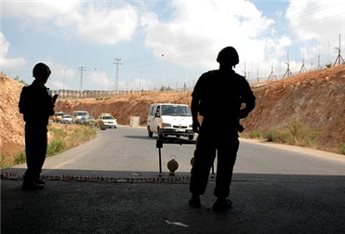
By Amelia Smith | Open Democracy | December 18, 2014
In November five Israelis were killed and eight wounded when two Palestinians attacked a synagogue in West Jerusalem. Israeli police shot the attackers dead at the scene and Benjamin Netanyahu ordered that the assailant’s houses be demolished.
The family of Mohammed Abu Khdeir, the young Palestinian teenager who was kidnapped and burnt to death in July, have also called for the homes of the Israelis who killed Mohammed to be demolished, though it is highly unlikely they will be. Such is the nature of Israel’s unequal application of the law.
News that Israel discriminates between Jewish Israelis and Palestinians is nothing new. Just last month the Israeli government voted to make all ratified Israeli civilian law passed through the Knesset apply to settlers. Most of the legislation on criminal law, tax law and military conscription already does, despite the international consensus that settlements are illegal. Around 350,000 settlers currently reside in the occupied West Bank yet for what it’s worth article 49 of the Fourth Geneva Convention states: “The Occupying Power shall not deport or transfer parts of its own civilian population into the territory it occupies.”
Knesset member Orit Struck, who drafted the bill, lives in one of these illegal settlements in the West Bank city of Hebron. Critics of Struck’s bill have said that applying civilian law to the West Bank would be a solid step towards the annexation of the occupied territories adding that it “legalises occupation”. Presumably, this is Struck’s intention.
In order to justify the bill, senior right-wing MKs have argued that the current split system – that Israelis in Israel are governed by different laws than Israelis in the West Bank – is “unacceptable from a democratic point of view” and have said it leads to discrimination against Israelis living in the occupied territories.
But what about Palestinians living in the West Bank? Article 66 of the Fourth Geneva Convention, which Israel has adopted, states that non-political military courts can be established for residents in the occupied territory. Palestinians in the West Bank are therefore subject to Israeli military law. Under the two legal systems, an Israeli settler and a Palestinian, accused of the same crime, will be treated, and sentenced, very differently.
Palestinian children, shackled and accused of throwing stones, have also been brought before these courts. The Palestinian Prisoners Center for Studies says that some 308,000 Palestinians have been detained within Israeli jails since the First Intifada in 1987.
Under military law Palestinians are threatened with arbitrary arrest, detention and are denied freedom of movement. As American-Israeli lawyer Emil Schaeffer points out, whilst an Israeli settler must be brought before a judge in less than 24 hours a Palestinian may be interrogated for up to eight days before he or she sees a judge.
In a military court Palestinians may be denied access to a lawyer for up to 90 days, yet within the Israeli legal system a meeting with a lawyer must be granted immediately. Within the military courts there is little internal supervision and consequently little public scrutiny.
The list continues, as does the system of legalised separation, discrimination and ultimately the guarantee of rights based on nationality. This segregated system goes far beyond the occupied territories of the West Bank.
On the other side of the concrete separation barrier that has sectioned off the West Bank, Palestinians living in Israel face a raft of laws that discriminate against them. According to Adalah, there are 50 laws in place that discriminate against Palestinians citizens of Israel from access to land to state budget resources.
Perhaps the most obvious of these is the Law of Return, which grants Jewish people across the world the right to live in Israel and gain citizenship. In the drive to bump up the numbers, free flights have been offered, as have financial benefits and tax breaks. On arrival accommodation is sometimes offered in annexed East Jerusalem.
Meanwhile, the seven million Palestinian refugees across the world are not only denied the right to return to their land, but also Palestinian citizens of Israel are not allowed to bring their husbands and wives from the occupied territories to live with them. So one group is actively encouraged, whilst the other is denied their basic rights.
In recent weeks a proposed law, which defines Israel as the nation-state of the Jewish people, has whipped up much controversy thanks to the controversial nature of the bill, part of which would mean the dropping of Arabic as a second language.
Like the bill that seeks to apply Israeli civilian law wholeheartedly to settlers in the West Bank, the Jewish nation-state bill is part of an ongoing system of discrimination against Palestinians, which has long rendered them second-class citizens. Little by little it is being enshrined in the law, which ultimately means discriminatory treatment towards Palestinians can continue.
Israel’s system of formal and informal discrimination reaches into all aspects of Palestinian’s lives, from separate housing in the West Bank to separate roads, schools and hospitals. It even infiltrates personal lives.
Whilst Israel regularly passes discriminatory laws, they clearly have little regard for international law – or at least, the parts of it that don’t suit them. As a signatory to some of the most important human rights and humanitarian law statutes, they should be held accountable for their discriminatory policies; which undoubtedly constitute grave breeches.
Featured Video

Chinese jet fuel and the myth of energy independence
or go to
Aletho News Archives – Video-Images
From the Archives
The Dirty Little Secret behind the “Global Terrorism Index”
The Omission of Israeli Terrorism in the Occupied Palestinian Territories
By Karin Brothers | Global Research | December 6, 2014
… The Israeli settlements — all of which are illegal – have been identified as a major impediment to peace. The refusal of a major “global” terrorism report to name the Israeli settlers as one of the groups most responsible for terrorism not only misrepresents a major source of regional violence but exposes the Global Terrorism Index as a propaganda tool that supports a U.S. agenda.
In recent years, governments have been attempting to thwart terrorism by blocking supportive fund-raising. When it comes to Israeli settlements, however, the US and Canada actually encourage fund-raising by giving organizations (such as Christian Friends of Israeli Communities (CFOIC) and the Jewish National Fund) financial support in the form of donor tax-deductions.
Charities which provide funds for the Israeli settlements should be regarded as terror-financing organizations. They should not only lose their tax-deductible status, but they should be banned because they support the violation of international humanitarian law. The terror-financing laws that are being strictly enforced for Muslim charities should be applied to Christian and Jewish charities as well. … Read full article
Blog Roll
 Aletho News
- Chinese jet fuel and the myth of energy independence
- Ukraine Sea Drone Fired From Libya Hit Russian Tanker in Mediterranean
- IRGC: Iranian forces launched no attacks during ceasefire hours
- Trump Administration Moves To Automate U.S. Military Draft Registration
- Spain orders reopening of Tehran embassy, condemns Israel’s carpet bombing of Lebanon
- Israel faces ‘unsustainable’ strategic crisis following 40-day war against Iran: Analyst
- Iran restricts Hormuz access to 15 vessels per day under ceasefire terms: Report
- The ‘Opposition Party’ Has Done Nothing to Stop the Iran War and Much to Goad Trump Into Continuing It
- Moscow backs Tehran on status of Lebanon in US-Iran deal
- How UK Regulator Ofcom Quietly Bypassed International Law to Police American Speech
- If Americans Knew
- Amnesty: Urgent – Protect Lebanese civilians from brutal escalation in Israeli attacks
- Is The War Against Iran Over?
- Inside the Israeli army’s propaganda wing
- Hundreds of Gaza Amputees Stranded in Legal Limbo
- The gallows law: Israel moves toward executing Palestinian children
- Tucker Carlson: The Path to Peace requires ending ‘special alliance’ with Israel
- This is ceasefire? Israel’s biggest massacre yet in Lebanon, another journalist killed in Gaza – Daily Update
- Tucker Carlson on Israel: This Is the Behavior of an Ally? Really?
- Gazans face a triple crisis: severe shortages of water and bread, healthcare in tatters
- NY Times reports how Netanyahu took the US into Iran War
- No Tricks Zone
- An Inconvenient Tree: Uncovered In Alps… Europe Much Warmer Than Today 6000 Years Ago
- New Study Reports A 60% Slowdown In Greenland’s Ice Loss Rate In The Last Decade
- Low Intensity Tornado Wrecks Major Solar Farm, Creating A Potential Toxic Dump
- New Study Finds Warming Saves Lives…Cold Temperatures 12 Times More Deadly Than Excess Heat
- German Science Blog Accuses PIK Climate Institute Of Hallucinating Climate Tipping Points
- Devastating Assessment Of Comirnaty Vaccine By Former Senior Pfizer Europe Toxicologist
- New Study: CO2 Is ‘Effectively Negligible’ As An Explanatory Climate Change Factor Since 2000
- Former Pfizer Toxicologist Dr. Helmut Sterz Tells Bundestag Hearing Pfizer Vaccine Should Have Never Been Approved
- Energy Expert: Germany’s Nuclear Phaseout Was A “500 Billion Euro Mistake”
- New Research: South Australia’s Mid-Holocene Sea Surface Temperatures Were 4°C Warmer Than Today
 Aletho News