Palestinian activists cross separation wall in protest action
Ma’an – 14/11/2014
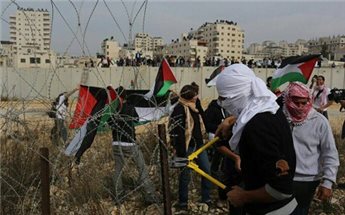 RAMALLAH – Dozens of Palestinian activists crossed Israel’s separation wall on Friday near Qalandia checkpoint as part of a series of non-violent protest actions to demonstrate solidarity with Jerusalem.
Activists used makeshift ramparts, ladders and cut through barbed wire to climb over the separation wall near Qalandia military checkpoint, which is at least six-eight meters in height.
The action was part of a campaign entitled #On2Jerusalem that was organized by the Popular Resistance Committees.
Coordinator of the popular committees, Salah Khawaja, said they attempted to enter Jerusalem but were prevented from doing so by Israeli forces, who deployed heavily in the area.
Israeli forces used live fire, tear gas canisters, stun grenades and rubber-coated steel bullets to disperse the march.
Dozens of Palestinian activists also gathered near the village of Hizma carrying Palestinian flags and shouting slogans in support of Jerusalem.
Several youths were injured as Israeli forces opened fire at them to prevent them crossing the checkpoint. The activists managed to close the road, with Israeli forces preventing settlers from traveling to the area.
Dozens of activists also demonstrated by the entrance to Maale Adumim settlement waving Palestinian flags.
“They attempted to detain us for carrying Palestinian flags,” Khawaja said. “What we did today was to emphasize that we do not have a choice but popular resistance and clashing with Israel is a part of our fight to stop Israeli crimes against Palestinians”
An Israeli army spokeswoman said there was an “attempt” to cross the wall, without providing further details.
Police investigation failure increases in ideological offenses against Palestinians despite new Nationalistic Crimes Unit
Everyone did as they saw fit
By Yossi Gurvitz | Yesh Din | November 12, 2014
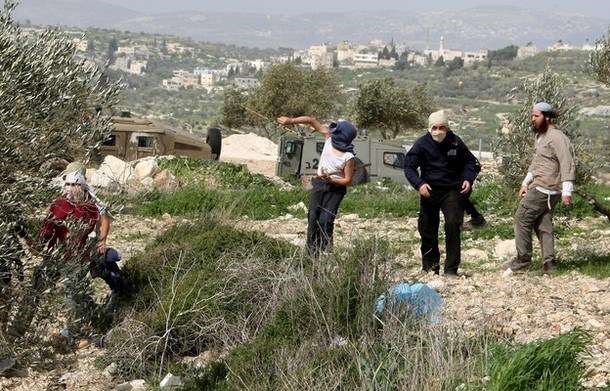
Imagine the following scenario: you’re in your courtyard, when a gang shows up, insulting you in what is supposed to be your safest place, beating you in the presence of your children, stealing or destroying your belongings. Picking yourself up, you know there’s no point in calling the police – because in the vast majority of cases, the police won’t catch the offenders. Oh, by the way – the criminals are from a different ethnic group.
Do you think you could live this way? Because this is how many Palestinians in the West Bank have to live. We have just published our annual data sheet on law enforcement – or rather the lack of law enforcement – in the West Bank.
If you are a Palestinian and you’ve been attacked or otherwise harmed by Israeli civilians in the West Bank, there is little to no chance the police will solve the case. Yesh Din has been monitoring the police investigation cases of complaints filed by Palestinians against Israeli civilians since 2005. The unambiguous data show that of 1,045 cases we are monitoring, the police concluded its investigation of 970 cases. 72 indictments were made (about 7.4% of the cases), and the police managed to lose 11 file cases. 884 cases were concluded due to police investigation failure.
593 cases were closed as “perpetrator unknown”, meaning the police failed to identify a suspect. 195 cases were concluded because of “lack of sufficient evidence”, i.e. the police managed to suggest a suspect but lacked the evidence to indict the suspect. 76 cases were closed on the grounds of “absence of criminal culpability” – that is, police claims that no crime was committed; we appealed 25 of these cases, since the investigation was unfinished or we believed there was enough evidence for an indictment. Finally, 12 cases were closed due to “lack of public interest”.
In two cases, the police concluded the perpetrator could not be indicted, probably due to age (minors); and one case was closed because it fell under the jurisdiction of another agency. The police’s general failure rate in 2005-2014 is 85.2%. Ironically, it was in the two years (2013-2014) in which the Nationalist Crime Department was active that the rate of police failure actually rose to 89.6%. The police tell us they invest many more assets and efforts in fighting nationalist-based crimes; so far, it fails to demonstrate results.
And why do I speak of “people breaking into your courtyard”? Because settlers enter private Palestinian property in the West Bank time and again. In our files from 2013-2014 we emphasized the setting of the crimes. It turns out that 28.3% of the recorded incidents took place within Palestinian villages and towns. Most of the incidents still take place in the countryside near the villages – territories which are to be dispossessed – but more than a quarter of the incidents are invasions of towns and villages, places where the settlers have no reason to visit, uninvited.
And the Israeli police, including the new and much ballyhooed Nationalist Crime Department, doesn’t know – or, perhaps, knows but is unwilling – how to deal with Israelis who commit nationalist crimes. This failure is anything but new: back in 1982 the Karp Report warned that Palestinian residents in the West Bank do not trust the Israeli justice system, and that in many cases they avoid complaining to the police since it is pointless. The Karp Report further found that law enforcement in the West Bank failed – and was the first government report to note this failure.
This is Israeli law and order. This is how it has been maintained for over 30 years: an order of rulers and ruled, with a thin legal coating of “laws of occupation” which allows us to say all is well, since it is temporary. For the past 47 years.
Map of locations of offenses against Palestinians in the West Bank
Israel to confiscate 3,200 acres of Palestinian land near Jerusalem
Ma’an – 08/11/2014
JERUSALEM – Israeli authorities have delivered orders to the village of Beit Iksa north of Jerusalem ordering the confiscation of 12,852 dunums (3,176 acres) of Palestinian land, locals said on Saturday.
Locals told Ma’an that soldiers deployed at the military checkpoint at the entrance to the village delivered confiscation orders signed by the Israeli military commander in the West Bank Nitzan Alon that gave them until Dec. 31, 2017 to remain on their land.
Villagers said that soldiers informed them that an official from the Israeli military liaison would arrive on Monday to specify which lands would be confiscated, adding that the lands confiscated would be used for “military purposes.”
If carried out, the confiscation would dramatically reduce the land available to Beit Iksa’s 1,700 people, the majority of whom are refugees who fled to the area in 1967 after the existing population of the village was forced to flee by Israeli authorities.
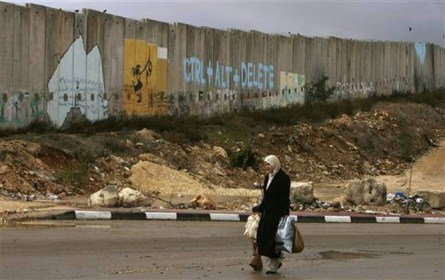
Although located immediately next to Jerusalem, the village’s lands have been progressively confiscated and the village is surrounded on all sides by the Israeli separation wall. Villagers can no longer travel to Jerusalem without permits, and Palestinians not resident in Beit Iksa cannot enter the single Israeli checkpoint that allows access to the village.
Ninety-three percent of the village is under full Israeli military control, and a majority of the total land of the village falls in areas outside of the separation wall, meaning they have been de facto confiscated, including about 1,500 dunums (371 acres) where Jewish-only settlements have been built.
The head of the Beit Iksa village council Saada al-Khatib told Ma’an that according to the order and the maps that soldiers had shown them Saturday, the lands that will be confiscated are between parcels 7 and 8 and include Haraeq al-Arab, Thahr Biddu, Numus, and Khatab areas around the village.
Al-Khatib added that the Israeli authorities claim that the confiscation order has been under way since 2012, and that the new order issued on Saturday only emphasizes the old order.
The order will prevent dozens of farmers from reaching their lands, he said, calling upon Palestinian ministries and national institutions to support the village of Beit Iksa and its neighbors.
He added that the order came after the Israeli municipality announced the approval of 244 housing units to be built in the Ramot settlement, which was previously built on lands confiscated from the settlement.
Al-Khatib warned that the land confiscation orders being issued to many villages include his own aim to carry out the “Judaization” of Beit Iksa after sealing the village shut and surrounding it with a checkpoint and the separation wall, turning it into an 2,500-dunum prison.
Israeli forces demolish three houses, and several water pipes and roads in village near Nablus
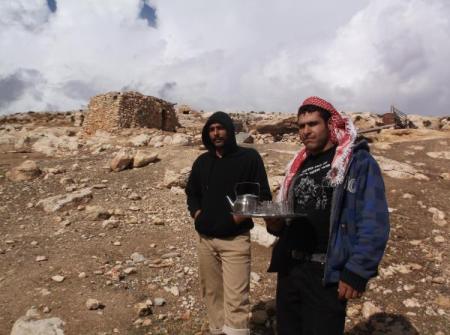
Sofian Maher and a local resident near their destroyed home near Khirbet Al-Tawil
International Solidarity Movement | November 4, 2014
Khirbet Al-Tawil, Occupied Palestine – Early on Monday morning, while the inhabitants of the village of Khirbet Al-Tawil, near Aqraba (Nablus), were sleeping, eight military vehicles, and 30-40 Israeli soldiers entered the village.
Within two hours the military had demolished three houses, and several water pipes and roads.
The water pipes destroyed were new and scheduled to be turned on Monday. The Aqraba community had funded these water pipes as part of the municipal water system.
Of their destruction, Sami Dariyah, stated: “They are trying to prevent people from living in this area. This is their clear policy.”
Due to the continuing demolition of houses, electricity lines, water lines and other living necessities, the farmers have fled to the city of Aqraba and departed their lands in Khirbet Al-Tawil. Sami Direyah grew up near Khirbet Al-Tawil and remembers the many houses and shops that used to be there.
Khirbet Al-Tawil is part of Area C (under full Israeli military civil and security control), which means the army can choose which buildings and activities are ‘allowed’. Sami wonders how their existing community, their farms and their 100-year-old houses, can suddenly become illegal.
Even though the three demolished houses were nearly 100 years old, dating back to the British occupation, they were all still active homes for families like the Mahers. The residents of the houses were not given any warning of the military’s planned visit. Sofian Maher, a former resident of one of these homes, spoke to ISM and explained that this is not the first time the military has paid a visit to Khirbet Al-Tawil. In May of this year the village’s Mosque was demolished, together with four houses, four cottages, and two barns. Less than one month ago the power line was cut by the military, leaving the village without electricity.
Sofian Maher explained to ISM that his family tried to rebuild their house after it was demolished in May. While rebuilding, Sofian’s family lived in a donated tent, which the army soon tore down. The family then moved into old stone huts that were built, long ago, to house animals while shepherding. Periodically the military returned and destroyed the newly rebuilt portions of their house.
The family is now trying to rebuild their home for the fourth time.
To further make the area uninhabitable, the military has destroyed large sections of the road leading to the remaining farms.
Dozens injured during Aqsa clashes, several detained
Ma’an – November 5, 2014
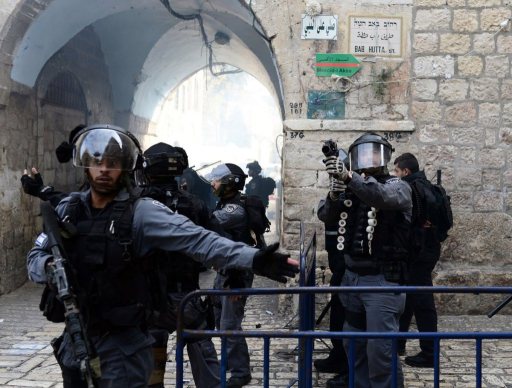
JERUSALEM – Dozens of Palestinians suffered tear-gas inhalation and several others were injured by stun grenades, shrapnel and rubber-coated steel bullets during clashes in the Al-Aqsa mosque compound area on Wednesday, an official said.
Palestinian Red Crescent official Amin Abu Ghazaleh told Ma’an that Red Crescent ambulances moved nine injured to the Al-Maqased Hospital where their injuries were reported as moderate.
Two were injured in the eye, and 32 with stun grenades, shrapnel and rubber-coated steel bullets in addition to many who suffered severe gas inhalation.
Three Palestinian members of Israel’s Knesset, Hanin Zoabi, Talab Abu Arrar and Ibrahim Sarsour, were able to enter the mosque during the closure and clashes.
Israeli soldiers neared the Al-Qabali mosque inside the compound as they fired stun grenades and tear-gas bombs inside, the director of the Al-Aqsa Mosque, Sheikh Omar al-Kiswani, said.
He said that a fire erupted inside the muezzin’s hall and cables and speakers were also burned and damaged.
Soldiers “deliberately” threw holy books on the floor, he alleged.
Israeli forces detained Tareq al-Hashlamon, an employee of the Islamic endowment department, after assaulting him inside Al-Aqsa, along with another endowment employee identified as Hussam Seder and three Palestinians.
Four Palestinians were also detained, one of them a minor. Two others were identified as Omar al-Kilani and Amin Qirsh.
Meanwhile, Jordan recalled its ambassador to Israel over the violence.
Jordanian Prime Minister Abdullah Nsur asked the foreign minister to “recall the Jordanian ambassador from Tel Aviv in protest at Israel’s escalation on the Al-Aqsa mosque compound,” the Petra news agency reported.
The clashes came amid continued tensions over right-wing Jewish demands to be able to pray inside the compound despite being off-limits in mainstream Judaism, in addition to the expansion of Israeli settlement building in Palestinian East Jerusalem.
Earlier, a police spokeswoman said that “Dozens of masked protesters threw stones and firecrackers at security forces who then entered the Temple Mount and pushed the demonstrators back inside the mosque.”
Israeli occupation authorities demolish two homes in East Jerusalem
MEMO | November 4, 2014
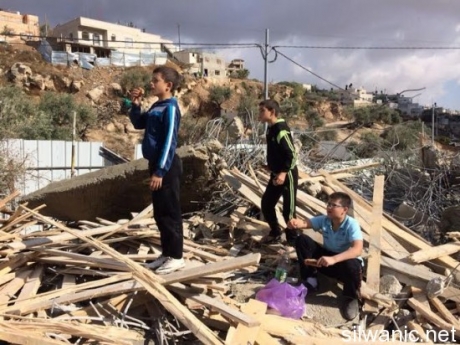
Israel demolished two homes in Silwan, south of Al-Aqsa Mosque in East Jerusalem, today claiming they were constructed without a license, eye witnesses said.
Eye witnesses reported that “a large bulldozer belonging to the Israeli municipality arrived this morning at Wadi Yasoul in Silwan accompanied by Israeli police and army forces.”
They added: “The Israeli forces surrounded the home of the released prisoner Khalil Abu Rajab and demolished it before demolishing Assem Abu Subaih’s home.”
Witnesses noted that the “demolition occurred without prior warning. There are concerns that more demolitions will take place in the area.”
“Abu Subaih’s home consists of three rooms and he lived in it with his five family members. As for Abu Rajab’s home, it was made up of two apartments he lived in with seven family members and his mother,” sources reported.
These demolitions occurred after Israeli media outlets reported a few days ago that the Israeli Mayor of Jerusalem Nir Barkat approved a series of sanctions against Palestinians in the city, including demolishing unlicensed homes “in order to stop the phenomenon of throwing rocks”.
Various clashes between the Palestinian youth and Israeli forces have continued in a number of neighbourhoods in East Jerusalem since last July.
Palestinian, Israeli and international human rights organisations noted that while the municipality has been increasingly giving building permits to Israelis in East Jerusalem, it is restricting construction work done by Palestinians, which forces many to build without permits.
The Israeli Information Centre for Human Rights in the Occupied Territories (B’tselem) said: “While large-scale constructing and major investments are being carried out in Jewish neighbourhoods, the Israeli authorities are working on stifling all development and construction for Palestinian residents, which make up about a third of the city’s population.”
The Planning and Building Committee of the Israeli Ministry of Interior approved the construction of 500 settlement units in Ramat Shlomo settlement in Shuafat in northern Jerusalem yesterday which provoked Palestinian and international criticism.
Palestinian stone-throwers face up to 20 years in Israel prison
Al-Akhbar | November 3, 2014
Israeli cabinet on Sunday approved an amendment to the Israeli penal code to enable more severe punishment against Palestinians convicted of involvement in “stone-throwing” attacks against Israeli targets.
 The new sections, which will be added to the Israeli penal code, would allow the imposition of a prison sentence up to 20 years for those convicted of throwing stones or other objects at Israeli vehicles.
“Israel is strongly acting against terrorists, against who throw stones, Molotov cocktails and fireworks,” Israeli Prime Minister Benjamin Netanyahu said at the weekly cabinet meeting.
Netanyahu went on to say that the new legislation aims to restore what he called “peace to all parts of Jerusalem.”
“We will dedicate massive force and an aggressive legislation to restore quiet and security to every part of our capital,” he added.
The new code would slap an imprisonment sentence of ten years against whoever throws stones or other objects at vehicles and 20 years for doing so with the view of exposing passengers to danger. Whoever throws rocks at police cars in order to obstruct the work of Israeli police will be jailed for up to five years.
Moreover, the law would also allow Israeli forces to imprison Palestinian minors under the pretext of allegedly endangering the lives of Israelis by throwing stones.
On Friday, Israeli Occupation Forces in occupied East Jerusalem attempted to detain two Palestinian children, a two-year-old and a nine-year old, on suspicion of throwing stones.
Last week, Israeli forces detained four Palestinian children, aged 13 to 16, for allegedly throwing stones at Israeli cars.
In 2013, a group of seven Israeli soldiers and an officer detained 5-year old Wadi’a Maswadeh after the boy allegedly threw a stone at a Zionist settler’s car at a checkpoint near Hebron.
According to a 2013 UN children’s fund’s report, over the past decade, Israeli forces have arrested, interrogated and prosecuted around 7,000 children between 12 and 17, mostly boys, noting the rate was equivalent to “an average of two children each day.”
A report by Defense for Children International (DCI) published in May 2014 said Israeli jails 20 percent of Palestinian children prisoners in solitary confinement. … Full article
ISM activist shot in the head with rubber-coated steel bullet
International Solidarity Movement | November 2, 2014
Ramallah, Occupied Palestine – Today during a protest at Qalandia checkpoint, an Italian ISM volunteer was shot in the head with a rubber-coated steel bullet.
The injury is just two centimetres above her left eye.

Photo by IWPS
Giulia, the ISMer, stated, “I was just standing on the side of a street, and the military was firing tear gas at the protesters. I was photographing the army when I felt the bullets strike me, one in the head, and another in my leg, and then all I could see was blood.”
At least one other Palestinian teen was hospitalized after being shot with a rubber-coated steel bullet.
Giulia was immediately transferred to Ramallah Hospital for medical treatment, requiring stitches for her injury.
Approximately 100 people attended the demonstration, where Israeli forces fired stun grenades, tear gas canisters, and rubber-coated steel bullets.
The protest was called today to commemorate the 97th anniversary of the Balfour Declaration.
28 injured as clashes rage across Jerusalem overnight
Ma’an – 01/11/2014
JERUSALEM – At least 28 Palestinians were injured as clashes with Israeli forces continued into the late hours of the night on Friday across Jerusalem, as anger over a series of killings by Israeli police boiled over into the streets of the city’s Palestinian neighborhoods.
Clashes broke out in the occupied East Jerusalem neighborhoods of Silwan, al-Issawiya, al-Tur, and Wadi al-Joz, as hundreds marched and fought pitched battles with security forces in anger over the killing of Mutaz Hijazi, 32, early Thursday, as well as the killing of Abd al-Rahman al-Shaludi, 21, the week before.
Both men were suspected by authorities of involvement in violent incidents targeting Israelis. But Palestinians have been outraged by their killings, highlighting that instead of being arrested both were shot dead by police on sight.
An autopsy on Friday revealed that Mutaz Hijazi, 32, was shot 20 times by different officers and left to die on his rooftop, as Israeli police refused to allow locals to reach him — and later forced an ambulance to surrender his body, before returning it to the family late Thursday.
On Friday evening, Israeli forces raided the area around Hijazi’s home al-Thawri neighborhood in Silwan, and locals told Ma’an that soldiers attacked a tent set up by the mourning family where friends and relatives were dropping in to offer condolences.
Israeli forces reportedly fired stun grenades, tear-gas canisters, and rubber-coated steel bullets at mourners gathered at the tent, and several men and women suffered severe tear gas inhalation while many others were injured by rubber-coated bullets.
Activist Jihad Oweida told Ma’an that one mourner, Attiya Shabbaneh, was injured by shrapnel from stun grenades in his face and was taken to al-Maqasid Hospital for treatment.
In the Bir Ayyub neighborhood, Israeli soldiers fired rubber-coated steel bullets and tear-gas canisters at more than 200 Palestinian youths who had gathered to visit the mourning tent set up in Hijazi’s home.
Many suffered from excessive tear-gas inhalation and one was injured and received a fracture in his foot. A Palestinian youth identified as Rami Salah was detained by Israeli forces.
An official responsible for ambulance and emergency services at the Palestinian Red Crescent, Amin Abu Ghazaleh, told Ma’an that 28 Palestinians suffered from light injuries, including from rubber-coated steel bullets injuries and tear-gas inhalation, while three were taken to hospitals after they were hit at close range with rubber-coated steel bullets in the head, legs, and stomach.
In the al-Issawiya neighborhood, meanwhile, dozens suffered from excessive tear gas inhalation after Israeli forces fired tear gas canisters heavily during clashes that erupted as Israeli forces detained an unidentified Palestinian.
Clashes also erupted in the Sur Baher village, Wadi al-Jouz neighborhood, and other neighborhoods in the Old City of Jerusalem.
An Israeli police spokesman did not immediately return a request for comment.
Old City security tight
Also on Friday, Israeli police released the director of the Wadi Hilweh Information Center, Jawad Siyam, along with Yazan Siyam, Muntaser Faraj and Mahmoud Gaith who were all detained Friday on charges of “assaulting” Israeli settlers in September.
It was unclear why the arrests had taken place more than a month after the alleged assault, but some have speculated that the arrests were related to the political nature of the work of the Wadi Hilweh Information Center, which focuses on resisting settler encroachment in the neighborhood of Silwan.
The four were released on the condition to pay a 500 shekels bill each, and were sentenced to house arrest until next Monday.
The clashes and arrests across Jerusalem came after days of intense security across the city, where Israeli police have deployed heavily amid four months of tensions between local Palestinians and occupation authorities.
Police, some in riot gear, guarded a series of checkpoints leading from the Old City’s outer gates all the way to the Al-Aqsa compound, an AFP correspondent said.
They checked identity papers of people passing between the barricades, both those on their way to pray and those who worked nearby.
Zuheir Dana, 67, said he was unable to get from his shop to his home.
“I wanted just to get home, which is about 50 meters (yards) away from the Al-Aqsa compound, but police didn’t let me through,” he said.
“It’s been bad every day here since Ramadan,” he added, referring to the Muslim holy month that fell in July.
Markets in the Old City, normally bustling on a Friday morning, were nearly deserted due to the security measures.
The security measures followed the unprecedented complete closure of the Al-Aqsa mosque compound — the third-holiest site in Islam — for the first time since 1967, which ignited protest across the Arab world and even from the United States.
Palestinian community officials say the wave of unrest gripping the city is fueled by a sense of hopelessness resulting from Israel’s policies in occupied East Jerusalem, which have left many young people with a sense that they have nothing to lose.
The arrests of hundreds over summer for participation in protests against Israel’s massive assault on Gaza — which left nearly 2,200 dead in the tiny coastal enclave — has only added fuel to the fire.
Although Palestinians in East Jerusalem live within territory Israel has unilaterally annexed, they lack citizenship rights and are instead classified only as “residents” whose permits can be revoked if they move away from the city for more than a few years.
They face discrimination in all aspects of life including housing, employment, and services, and are unable to access services in the West Bank due to the construction of Israel’s separation wall.
East Jerusalem is internationally recognized as Palestinian territory, but Israel occupied it in 1967 and later annexed it in a move never considered legitimate abroad.
SodaStream closes illegal settlement factory but remains actively complicit in the displacement of Palestinians
Palestinian Students’ Campaign for the Academic Boycott of Israel | October 30, 2014
Palestinian boycott, divestment and sanctions (BDS) activists today welcomed the news that SodaStream has announced it is to close its factory in the illegal Israeli settlement of Mishor Adumim following a high profile boycott campaign against the company.
“SodaStream’s announcement today shows that the boycott, divestment and sanctions (BDS) movement is increasingly capable of holding corporate criminals to account for their participation in Israeli apartheid and colonialism,” said Rafeef Ziadah, a spokesperson for the Palestinian Boycott, Divestment and Sanctions National Committee (BNC), the broad coalition of Palestinian civil society organisations that leads and supports the BDS movement.
“BDS campaign pressure has forced retailers across Europe and North America to drop SodaStream, and the company’s share price has tumbled in recent months as our movement has caused increasing reputational damage to the SodaStream brand,” she added.
The news of this major success against a company famed for its role in illegal Israeli settlements broke amidst intensifying demonstrations against Israel’s policies of colonisation in Jerusalem.
Grassroots boycott activism saw SodaStream dropped by major retailers across North America and Europe including Macy’s in the US and John Lewis in the UK.
SodaStream was forced to close its flagship store in Brighton in the UK as a result of regular pickets of the store.
Soros Fund Management, the family office of the billionaire investor George Soros, sold its stake in SodaStream following BDS pressure.
SodaStream’s share price fell dramatically in recent months as sales dried up, particularly in North America.
After reaching a high of $64 per share in October 2013, the stock fell to around $20 per share this month. SodaStream has estimated its third quarter revenue will be $125 million, down almost 14 percent from the same period last year.
But Ziadah warned that SodaStream will still remain actively complicit in the displacement of Palestinians and will remain a focus of boycott campaigning.
“Even if this announced closure goes ahead, SodaStream will remain implicated in the displacement of Palestinians. Its new Lehavim factory is close to Rahat, a planned township in the Naqab (Negev) desert, where Palestinian Bedouins are being forcefully transferred against their will. Sodastream, as a beneficiary of this plan, is complicit with this violation of human rights,” she said.
SodaStream’s participation in Israel’s forced displacement of Palestinians gained international notoriety when A-list celebrity Scarlett Johansson signed up to be a brand ambassador for the company. Following an international campaign urging Oxfam end its relationship with Johansson for endorsing SodaStream, the actor decided to quit Oxfam.
SodaStream has also come under fire for its treatment of Palestinian workers in its West Bank factory, as Ziadah explains:
“Any suggestion that SodaStream is employing Palestinians in an illegal Israeli settlement on stolen Palestinian land out of the kindness of its heart is ludicrous.”
“Palestinian workers are paid far less than their Israeli counterparts and SodaStream recently fired 60 Palestinians following a dispute over food for the breaking of the Ramadan fast. Workers have previously said they are treated ‘like slaves’”.
“Palestinians are forced to work inside settlements in sub-standard conditions because of Israel’s deliberate destruction of the Palestinian economy. There’s an urgent need for the creation of decent and dignified jobs within the Palestinian economy.”
SodaStream have said all workers will be offered jobs at its new plant, although Israel’s apartheid wall and severe restrictions on movement will make the commute to the new plant difficult for its Palestinian workers.
All of the main Palestinian trade unions have called for boycott and are members of the Palestinian BDS National Committee, the civil society coalition that leads the BDS movement and helped to initiate the campaign against SodaStream.
The BNC quotes included in this release can be found in the following coverage of this story:
New York Times : http://www.nytimes.com/2014/10/31/world/middleeast/sodastream-to-close-factory-in-west-bank.html?_r=0
International Business Times : http://www.ibtimes.co.uk/israel-bds-movement-scores-victory-sodastream-close-controversial-factory-west-bank-settlement-1472320
Sweden recognizes Palestinian state as UN fails to condemn Israeli settlements
Al-Akhbar | October 30, 2014
Sweden on Thursday officially recognized the state of Palestine, Stockholm’s foreign minister said, less than a month after the government announced its intention to make the move and one day after UN Security Council failed to condemn Israeli settlement plans.
“Our decision comes at a critical time because over the last year we have seen how the peace talks have stalled, how decisions over new settlements on occupied Palestinian land have complicated a two-state solution and how violence has returned to Gaza,” Swedish Foreign Minister Margot Wallstrom told reporters.
“By making our decision we want to bring a new dynamic to the stalled peace process.”
Palestinian President Mahmoud Abbas hailed the decision, his spokesman told AFP.
“President Abbas welcomes Sweden’s decision,” Nabil Abu Rudeina told AFP, saying the Palestinian leader described the move as “brave and historic.”
Sweden is the first EU member state in western Europe to recognize Palestine.
European countries are stepping up the pressure on Israel to seek a peace deal, with the British and Irish parliament recently holding a non-binding vote on recognizing statehood.
Abu Rudeina claimed that Sweden’s recognition was linked to months of soaring tensions in occupied East Jerusalem, where Palestinians have clashed almost daily with Israeli Occupation Forces and where Israel has recently pushed ahead with plans to build another 3,600 settler homes.
“This decision comes as a response to Israeli measures in Jerusalem,” he said.
Meanwhile, Israel’s Foreign Minister Avigdor Lieberman on Thursday denounced the Swedish government’s recognition of a Palestinian state as “deplorable”, saying it would undermine efforts to resolve the conflict.
“The decision of the Swedish government to recognize a Palestinian state is a deplorable decision which only strengthens extremist elements,” he claimed in a statement.
“It is a shame that the Swedish government chose to take this declarative step which causes a lot of harm and offers no advantage,” he said.
“The Swedish government must understand that relations in the Middle East are a lot more complex than the self-assembly furniture of IKEA and that they have to act with responsibility and sensitivity.”
Wallstrom rejected accusations that Sweden was taking sides and she hoped other EU countries would follow Sweden’s lead.
No Security Council statement condemning Israel
The Palestinians urged the UN Security Council on Wednesday to demand that Israel immediately reverse plans to build more Zionist settlements, at an emergency meeting called to address tensions in occupied East Jerusalem.
The 15-nation council met for urgent talks at Jordan’s and Palestine’s request after Israel announced plans on Monday to build 1,000 new settler homes in East Jerusalem.
However, no resolution was adopted and there was no Security Council statement condemning Israel.
“Israel, the occupying power, must be demanded to cease immediately and completely its illegal settlement activities throughout the occupied Palestinian territory, including East Jerusalem,” Palestinian ambassador Riyad Mansour told the council.
Mansour said he was disappointed that the council had failed to issue a statement but praised members for speaking forcefully against Israeli settlements.
Speaking to the council, top UN official Jeffrey Feltman said the Israeli practice of moving settlers to Palestinian territories was “in violation of international law” and runs counter to a two-state solution of a Palestinian state alongside Israel.
UN Secretary-General Ban Ki-moon is “alarmed” by the latest plans for new Israeli settlements which “once again raise grave doubts about Israel’s commitment to achieving durable peace,” Feltman told the council.
Israel’s ambassador Ron Prosor shot back, rejecting suggestions that settlement building jeopardized peace and accusing the UN of “playing second fiddle” to a Palestinian “campaign to vilify” his country.
“There are many threats in the Middle East, but the presence of Jewish homes is not one of them,” Prosor told the council.
Speaking to reporters outside council chambers, Prosor insisted the settlements were “not illegal” and that “building housing units in Jerusalem for children in places where there are Jewish neighborhoods is something that we will continue to do.”
Besides the 1,000 new settler homes, Israel has recently approved the construction of more than 2,600 settler homes in East Jerusalem.
More than 500,000 Israeli settlers live in settlements across the West Bank, including East Jerusalem, in contravention of international law.
Israel occupied East Jerusalem and the West Bank during the 1967 Six-Day War. It later annexed the city of Jerusalem in 1980, claiming it as the capital of the self-proclaimed Zionist state – a move never recognized by the international community.
US, European countries “condemn” Israeli settlements
Even though there was no Security Council statement condemning the Israeli violations, Israel came under strong criticism from several countries, which called for an end to unilateral actions including settlement expansions.
The US representative David Pressman told the council “settlement activity will only further escalate tensions at a time that is already tense enough.”
British Ambassador Mark Lyall Grant warned that ongoing construction of Zionist settlements in Palestinian territories “makes it much more difficult for Israel’s friends to defend it against accusations that it is not serious about peace.”
French Ambassador Francois Delattre said “the risk of an explosion of uncontrolled violence in Jerusalem and the West Bank cannot be ignored” and called on Israel to drop the planned settlement.
Russian Ambassador Vitaly Churkin said the plan should be “frozen” and urged the council to play a more pro-active role to jump-start Israeli-Palestinian peace talks.
On Wednesday, the Spanish government expressed its regret at the settlements plan. The Ministry of Foreign Affairs said in a statement that the decision “does not reflect the formally accepted target of negotiating with the Palestinians to seek a peaceful, global and lasting solution based on two states.”
The ministry also reiterated its position, shared by the international community, that all forms of Israeli settlement construction in occupied Palestinian territories are illegal.
Israel’s latest push for settlements followed weeks of clashes between Palestinian youths and police in East Jerusalem over fears that Israel wanted to restrict access to the al-Aqsa mosque, Islam’s third holiest site.
Feltman called for a de-escalation, saying that both sides “can ill-afford” to inflame tensions so soon after the devastating Gaza war, which left more than 2,000 Palestinians dead.
In a draft resolution circulated, the Palestinian Authority set November 2016 as the deadline for ending the Israeli withdrawal from the territories occupied by Israel during the Six-Day War in 1967 and establishing a two-state solution.
It is worth noting that numerous pro-Palestine activists argue in favor of a one-state solution, arguing that the creation of a Palestinian state beside Israel would not be sustainable. They add that the two-state solution, which is the only option considered by international actors, won’t solve existing discrimination, nor erase economic and military tensions.
(AFP, Ma’an, Al-Akhbar)
Featured Video

Chinese jet fuel and the myth of energy independence
or go to
Aletho News Archives – Video-Images
Book Review
Former Insiders Criticize Iran Policy as U.S. Hegemony
By GARETH PORTER | CounterPunch | February 27, 2013
“Going to Tehran” arguably represents the most important work on the subject of U.S.-Iran relations to be published thus far.
Flynt Leverett and Hillary Mann Leverett tackle not only U.S. policy toward Iran but the broader context of Middle East policy with a systematic analytical perspective informed by personal experience, as well as very extensive documentation.
More importantly, however, their exposé required a degree of courage that may be unparalleled in the writing of former U.S. national security officials about issues on which they worked. They have chosen not just to criticise U.S. policy toward Iran but to analyse that policy as a problem of U.S. hegemony. … continue
Blog Roll
 Aletho News
- Why no power can undermine Iran’s eternal dominance over the Strait of Hormuz
- Is The War Against Iran Over?
- Iran war will leave long-term ‘scar’ on Wall Street, investors warn
- How Iran decimated US power projection in West Asia: Military lessons of 40-day war
- Iran’s report details US-Israeli war crimes in targeting schools, hospitals, livelihoods
- NATO’s Slow Fracture: How Trump’s Iran War Exposed the Instrument of Hegemony
- Chinese jet fuel and the myth of energy independence
- Ukraine Sea Drone Fired From Libya Hit Russian Tanker in Mediterranean
- IRGC: Iranian forces launched no attacks during ceasefire hours
- Trump Administration Moves To Automate U.S. Military Draft Registration
- If Americans Knew
- TCN: Is Israel Blackmailing President Trump?
- Israel killed at least 303 Lebanese yesterday – who were they? Daily Update
- Amnesty: Urgent – Protect Lebanese civilians from brutal escalation in Israeli attacks
- Is The War Against Iran Over?
- Inside the Israeli army’s propaganda wing
- Hundreds of Gaza Amputees Stranded in Legal Limbo
- The gallows law: Israel moves toward executing Palestinian children
- Tucker Carlson: The Path to Peace requires ending ‘special alliance’ with Israel
- This is ceasefire? Israel’s biggest massacre yet in Lebanon, another journalist killed in Gaza – Daily Update
- Tucker Carlson on Israel: This Is the Behavior of an Ally? Really?
- No Tricks Zone
- An Inconvenient Tree: Uncovered In Alps… Europe Much Warmer Than Today 6000 Years Ago
- New Study Reports A 60% Slowdown In Greenland’s Ice Loss Rate In The Last Decade
- Low Intensity Tornado Wrecks Major Solar Farm, Creating A Potential Toxic Dump
- New Study Finds Warming Saves Lives…Cold Temperatures 12 Times More Deadly Than Excess Heat
- German Science Blog Accuses PIK Climate Institute Of Hallucinating Climate Tipping Points
- Devastating Assessment Of Comirnaty Vaccine By Former Senior Pfizer Europe Toxicologist
- New Study: CO2 Is ‘Effectively Negligible’ As An Explanatory Climate Change Factor Since 2000
- Former Pfizer Toxicologist Dr. Helmut Sterz Tells Bundestag Hearing Pfizer Vaccine Should Have Never Been Approved
- Energy Expert: Germany’s Nuclear Phaseout Was A “500 Billion Euro Mistake”
- New Research: South Australia’s Mid-Holocene Sea Surface Temperatures Were 4°C Warmer Than Today
 Aletho News