Palestinian youth shot dead by Israeli forces south of Nablus
Ma’an – 29/12/2014
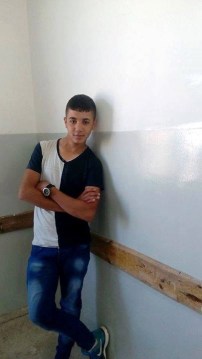 NABLUS – A Palestinian youth was shot dead by Israeli forces at the Tappuah checkpoint south of Nablus in the northern West Bank on Monday.
Local Palestinian sources told Ma’an that Israeli troops opened fire at two young Palestinian men in the Jabal Sbeih area within Beita village, near the Tappuah checkpoint, which is also known to Palestinians as Zaatara.
The youth who was killed in the incident was identified by Nablus TV as Imam Jamil Dweikat, a resident of Beita. His age was not yet clear, however.
The other victim was identified as Nael Thiab, 19, and he was reportedly evacuated to a hospital in Nablus with moderate to serious gunshot wounds following the incident.
Palestinian security sources confirmed that the Israeli liaison department officially notified the Palestinian Authority that Israeli troops shot dead a young Palestinian man and that his body is still with the Israeli army.
The slain youth is the 50th Palestinian to be killed by Israeli forces in the West Bank in 2014, bringing the total Palestinian dead at Israeli hands so far this year, including those who died in Gaza as a result of Israel’s summer offensive, to around 2,335.
An Israeli military spokeswoman told Ma’an that an Israeli military patrol was passing through the area when they “encountered a group of Palestinians hurling rocks at a main road, which endangered both civilians and vehicles.”
“The forces called them to halt and fired warning shots, and when they didn’t comply they responded to the threat with direct fire which wounded one of the attackers.”
She said that the military treated him on site but he later died of his wounds.
“A military police investigation has been opened into the matter,” she added.
Israel charges 8 Palestinians over Facebook posts
Ma’an – 23/12/2014
JERUSALEM (AFP) — Eight Palestinians from annexed East Jerusalem were indicted on Monday for inciting anti-Jewish violence and supporting “terror” in postings on Facebook, an Israeli justice ministry spokeswoman said.
The eight men, aged 18-45, were charged at Jerusalem Magistrate’s Court with “incitement to violence or terror and supporting a terrorist group” on Facebook, a ministry statement read.
The incriminating posts were put online in recent months as a wave of violence rocked the city during which several Palestinians staged lone wolf attacks killing nine people.
The defendants “directly called for violence and terror against (Jewish) citizens and security forces and praised, encouraged and supported these deeds and their perpetrators” on the Internet, the statement read.
Among the remarks posted online were “It is good to kidnap soldiers”, “Zionists flee because you’ll soon be killed by a car” and words expressing hope that a right-wing Jewish activist, who survived an assassination attempt in October, would die a painful death, the indictment said.
All eight Palestinians were arrested earlier this month in what police said was their biggest operation yet aimed at halting incitement to violence on social networks.
Israelis on social media routinely and openly incite violence against Palestinians, especially during heightened periods of tensions such as this summer’s military offensive on Gaza.
Ma’an staff contributed to this report
The Customs Union and Israel’s No-State Solution
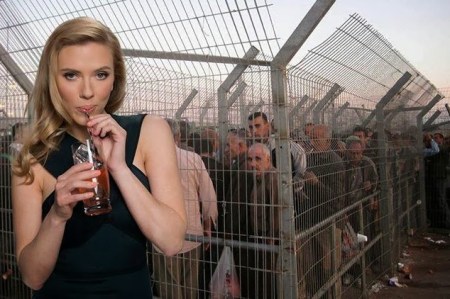
By Amal Ahmad | Al-Shabaka | November 29, 2014
Trade regimes between nation states are either autonomous, implying that nation X has no trade obligations towards nation Y, or preferential, establishing low barriers between X and Y and binding them with reciprocal obligations and benefits.
Customs unions are a form of preferential trade, although they take it one step further by establishing uniform barriers against the rest of the world, thereby harmonizing the external trade policy of the union’s member states. Israel and the Palestinian territory have been bound by a customs union de facto since 1967 and de jure since 1994.
Theoretically, a customs union carries mutual benefits to the member states. However, as the United Nations Conference on Trade and Development noted in a 1988 report, between 1967 and 1988 the customs union between Israel and the OPT treated the two economies as dualisms that entrenched the status quo, which, at that time, had established the OPT as a reservoir of cheap labor and Israel as a production and export powerhouse.
Importantly, the arrangement allowed for the unrestricted flow of Israeli goods into the Palestinian economy. Since then, the state of the Palestinian economy has only worsened, and its dependence on imports from Israel has deepened.
The economy is marked by industrial stagnation and the decline of other productive sectors, particularly agriculture, as well as growing trade deficits and a weak export base. The customs union has been key to this process of stagnation, keeping the Palestinian economy industrially weak, underdeveloped, and dependent on imports.
Such skewed results are to be expected given the vast asymmetry of productive capacity between Israel and the OPT. The harm to the Palestinian economy has been further magnified by Israel’s ability to impose at will, as the occupying military power, a one-sided and inconsistent implementation of the union.
Israel’s use of duty-free import quotas is a particularly egregious example of how Israeli actions have magnified the skewedness of the customs union (see the recent analysis by the Palestine Economic Policy Research Institute, MAS). As part of its free trade agreements with other countries, Israel is able to export a certain amount of its goods to country Z, duty free or at a discounted customs rate, while pledging to import a certain amount of goods from country Z at a similarly discounted rate. The goods Israel pledges to import from its partners are often agricultural commodities and food products, which otherwise enjoy a high level of commercial protection in Israel.
Since signing the Paris Protocol in 1994, Israel has given the Palestinian Authority 20 percent of its import quotas. So, if Israel pledges to import 2,000 tons of milk from country Z duty-free, Palestinian retailers can apply for a license (given by Israel) to import up to 400 tons of that product duty-free. Obviously, this is advantageous for the Palestinian retailers who reap a profit margin by buying the imported milk for less while selling it at the same price.
However, the problem is greater than meets the eye. Israel gives Palestinians 20 percent of the import quota but none of the corresponding export quota. For example, if country Z pledges to buy 2,000 tons of tomatoes from Israel in exchange, 100 percent of these tomatoes come from Israeli producers.
Effectively, then, Israel is using the Palestinian economy to divert pressure off its own market by reducing the penetration of cheap imports by 20 percent, while reserving the full benefits of export deals to itself. This example underscores Israel’s ingenious protectionist strategy and its use of the Palestinian economy simply as an appendage when convenient.
Any benefit to Palestinians in the process is purely ad hoc and actually comes at the expense of productive industry.
No Way Out
Many analysts have, over the years, argued that if the implementation of the customs union were “better” or more in line with theory, then it would be optimal for the OPT’s trade and development. However, such calls to “rescue” or “modify” the union obfuscate the real problems facing the OPT, including the vicious cycle and vast asymmetry with its largest and most “free” trading partner, Israel.
In theory, two alternatives exist. The first alternative would involve a relatively closed (non-preferential) arrangement or an asymmetric free trade agreement.
Such arrangements would restrict the access of Israeli imports to the Palestinian market by instating barriers (tariffs) against these imports, temporarily protecting Palestinian producers and encouraging industrial development. However, such arrangements, including a standard free trade agreement, involve rules of origin to distinguish which goods came from where and therefore require the presence of a hard border between the partners.
In other words, such an arrangement could only be implemented in a post-conflict two-state solution scenario.
The second alternative would be to keep trade open but under the auspices of a future single bi-national state that would be responsible for the well-being of both Israeli and Palestinian producers. Such a state would manage a common fiscal platform with targeted support for the backward areas, implying protection of Palestinian producers via fiscal transfer instead of external tariffs. Clearly, this option, too, could only be implemented in a post-conflict one-state solution scenario.
In practice, however, no alternatives exist. As shown above, all alternative arrangements, regardless of their economic merits, presuppose either the delineation of internal borders or their elimination, translating into either a sovereign Palestinian state or an integrated bi-national state.
However, this policy brief argues that both these political scenarios undermine Israel’s strategic interests. All other trade arrangements, therefore, are off the table, regardless of economics, except for the one that requires neither borders nor integration: a customs union.
Indeed, the major benefit of the customs union to its Israeli architects has been the postponement of the border issue and keeping borders interim. Penetration into the Palestinian market is of minor importance to the Israeli economy and could have been achieved via other regimes such as a free trade area.
The union, then, is a choice made out of political necessity rather than economic desirability. It illustrates that the only “solution” for Israel is a no-state solution where the Palestinians are neither sovereign nor integrated, but perennially contained, with repercussions across the political and economic spheres.
The Importance of Borders — or Lack Thereof
In the rest of the world, politics reflect underlying economic interests. However, in the OPT, economic arrangements reflect political interests, and to a perverse degree. Israeli interests are imposed through military power, which is why the Israeli military was the “economic” administrator of the OPT from 1967-1988 and remains the main Israeli point of liaison with today’s Palestinian administrators.
Indeed, the political border considerations of Oslo dictated the economic trade arrangements of the Paris Protocol: Given Israel’s insistence on precluding final status border arrangements, the customs union was the only viable option.
Rather than an economically desirable choice, it was an outcome of political necessity for Israel, and there is substantial evidence that the Palestinian side was blackmailed into accepting the union after Israel threatened to stop Palestinian labor flow, as seen in the documents produced by the Ben-Shahar Committee and the Israeli government at the time. Furthermore, documents by the Bruno Committee as far back as 1967 attest to the far-reaching history of border considerations dictating “impure” trade integration of the OPT with Israel.
Instead of elaborating on the potential significance to Palestinian trade of this political trajectory, the literature on the customs union has managed to ignore it altogether, preferring to keep the analysis “politics-free” beyond vague references to the Israeli occupation while focusing on post-conflict frameworks.
In the case of the Palestinians, however, this should be the point of departure for analysis. Border considerations reflect strategic interests that offer the ultimate political economy context for the trade debate.
Not for nothing were the Oslo Accords, and, by extension, the Paris Protocol, incomplete and vague contracts that did not discuss many contingencies (the protocol is 35 pages compared to the 1,000+ page NAFTA) and were, most importantly, interim in nature. Several Palestinian economists, including Raja Khalidi as well as Adel Zagha and Husam Zomlot, point out that the economic problems in the OPT do not have an economic solution, and that the fundamental problem of the Paris Protocol is political.
What this policy brief argues is that the point of the protocol was not to give Israel the upper bargaining hand in final status, given that incomplete contracts favor the stronger party. The aim was to put off final status altogether in line with Israel’s policy since 1967. Further, this brief argues that the Zionist project lies at the heart of Israel’s desire for and design of an incomplete and interim contract with the OPT.
Zionism’s desire for a Jewish majority and for differential national rights for Jews within that majority has, as Mushtaq Khan has argued, dictated a political reality in which the Israeli state cannot delink from the OPT but also cannot swallow it into a single state.
A sovereign Palestinian state does not solve “the Palestinian problem” inside Israel, while one bi-national state defeats the Zionist national project outright. From a Zionist perspective, the best, or indeed only, solution to the Palestinian “problem” of demography and claim to rights, is a no-state solution, in which the Palestinians are contained manageably and in perpetuity. Israeli minister of economy Naftali Bennett recently explicitly expressed this as a “plan for peace.”
Thus, the customs union will persist so long as Israel’s interest in maintaining what could be termed “strategically absent” borders persists. This understanding helps to explain the historical endurance of an “economic” union that serves no rationale in theory and is full of contradictions in practice.
The relevance of this analysis to assessing developments in Israel-Palestine is illustrated by the recent controversy over customs stations. Customs stations are stations for collecting tariffs on imports. They are not supposed to exist in customs unions where trade between member states is supposed to be free. However, they are sometimes placed along an internal border to begin the transition to a free trade agreement or to more protectionist agreements.
Some economists have long advocated the establishment of customs stations between Israel and the OPT in the hope that the stations could pave the transition to a more economically desirable trade regime. Furthermore, this thinking goes, as a symbol of fiscal autonomy for the Palestinians, such stations might pave the way for political autonomy. However, this reflects a failure to comprehend the political containment context, which precludes the possibility of these stations ever translating into a functioning, sovereign border.
This reality became crystal clear when, after six months of secret negotiations, the Israeli government and the PA signed an agreement to “tighten cooperation” on tax and customs in July 2012. The agreement reevaluated the tax clearance mechanism and established new customs stations. The stated purpose was to reduce funds leakage from Israeli customs to the PA and to improve Palestinian customs capabilities.
The PA, no doubt, signed out of desperation given that even a marginal improvement in customs revenue, which constitutes 70 percent of the non-aid budget, would help. And they joined the Israeli signatories in lauding the deal as a step towards Palestinian fiscal and political sovereignty.
In fact, the deal did not foresee a better reality but rather reflected an extremely adverse one. Tweaking the union to secure incremental improvements certainly brought some small gains in terms of revenue but none at all for Palestinian productive capabilities since it left the majority of trade flows with Israel intact, maintaining the asymmetry.
The fact that the custom stations set out by the deal were and are being placed along Israel’s Separation Wall, the illegal and de facto structure that penetrates the West Bank, confirms Israel’s commitment to containment along interim lines that separate the populations while keeping borders strategically absent.
The customs stations issue highlights a crucial point: Analyses of trade and of the economy more broadly must be situated in the relevant context of Israel’s policy of containment as conflict management, including its pursuit of a no-state solution whereby borders are strategically absent and the Palestinians and their economy are contained manageably and in perpetuity.
Post-conflict frameworks, which assume a final status with defined borders and underpin the calls for the different trade scenarios described above, may appeal to a community within Israel and Palestine and internationally that is desperately looking for a two-state solution. However, they obfuscate the real issues facing the Palestinian economy and, in doing so, validate and help to sustain the adverse status quo.
Bringing Borders Back: Refocusing the Israel-Palestine Trade Debate
Israel’s strategic containment lies at the heart of the Palestinian economic challenge. In an economy as underdeveloped and severely deformed as the Palestinian economy, rigorous development policy is required to overcome the vicious cycles and initiate virtuous developmental ones.
The exact policies are highly context-specific and are often the result of trial and error learning processes. But the political economy requirements are clear: There must be a sovereign centralized power within defined borders that can navigate the fiscal platform for state taxation and spending policies. The fiscal platform is necessary not only for building local capacities and incentives, but also for mediating between the country’s stage of development and the competitive pressures of international markets, and for supporting nascent capitalists.
Here lies the full tragedy of the Palestinian economy. For trade to serve development goals, certain fiscal capacities like import substitution and export promotion are required especially in the initial stages. But since development more broadly requires a fiscal base that in turn presupposes a sovereign, then the current containment of the OPT and their preclusion from any sovereign is the worst possible scenario for any developing economy.
The absence of both fiscal transfer within a one-state Israel-Palestine and sovereign protection under a Palestinian state incapacitates the taxation capabilities at the heart of all development processes and prevents any strategy of supporting domestic capability. The contained economy will necessarily operate in an entirely ad hoc fashion that is catastrophic not only to long-term development but to short-term viability.
What can be done to redress the situation? First, development actors should eschew ex-post conflict frameworks, including state-building and final-border scenarios, as inappropriate to understanding, assessing, or planning the Palestinian economy.
Rather, their point of departure must be an understanding of not only the subjugation of the Palestinian economy to Israel’s mode of conflict management but also to its specific kind of conflict management, i.e., containment. Otherwise, it is impossible to grasp the real roots of the ongoing deterioration of the economy and the absence of development prospects
Second, if the international community truly wants to support Palestinian development, it must confront, expose, and challenge Israel’s containment of the OPT. This includes the rejection of the façade of a two-state solution or “peace process”” and an acknowledgement of the way that Israel is managing the Palestinian population and their economy in perpetuity, refusing to consider any arrangement that separates them into a sovereign state (see e.g., recent statements by Prime Minister Benjamin Netanyahu and Justice Minister Tzipi Livni) or to integrate them into a bi-national state.
In addition, it is past time for the international community to call out the racist vision, of differential rights for Jews and non-Jews within Israel as well as in the OPT that underpins this strategy. While such positions by the international community would not guarantee a “solution” one way or the other, they would certainly support the struggle against what might otherwise be perennial political containment and economic backwardness.
In short, there is a need to refocus debate, analysis, and action on Israel’s containment strategy — a de facto no-state solution for the OPT — and the repercussions of this strategy on the economic sphere. Until then, the underdevelopment of Palestinian trade and the economy more broadly will remain institutionally guaranteed.
Al-Shabaka is an independent non-profit organization whose mission is to educate and foster public debate on Palestinian human rights and self-determination within the framework of international law.
Amal Ahmad is a Palestinian economic researcher whose work focuses on fiscal and monetary relations between Israel and Palestine.
Farming Without Water. Palestinian Agriculture in the Jordan Valley
EWASHPalestine | December 7, 2014
The movie talks about Palestinian agriculture in the Jordan Valley. Nowadays most of the agriculture in the area is cultivated by illegal Israeli settlers who appropriated land and water from Palestinian farmers. Having limited access to water Palestinian farmers are forced to change their traditional agricultural practices or even leave their original places of living in search of better life.
In Israel and the occupied territories, discrimination is enshrined in the law
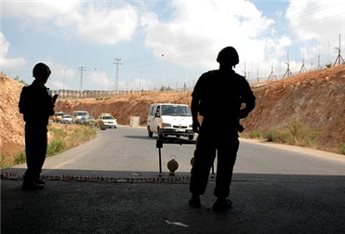
By Amelia Smith | Open Democracy | December 18, 2014
In November five Israelis were killed and eight wounded when two Palestinians attacked a synagogue in West Jerusalem. Israeli police shot the attackers dead at the scene and Benjamin Netanyahu ordered that the assailant’s houses be demolished.
The family of Mohammed Abu Khdeir, the young Palestinian teenager who was kidnapped and burnt to death in July, have also called for the homes of the Israelis who killed Mohammed to be demolished, though it is highly unlikely they will be. Such is the nature of Israel’s unequal application of the law.
News that Israel discriminates between Jewish Israelis and Palestinians is nothing new. Just last month the Israeli government voted to make all ratified Israeli civilian law passed through the Knesset apply to settlers. Most of the legislation on criminal law, tax law and military conscription already does, despite the international consensus that settlements are illegal. Around 350,000 settlers currently reside in the occupied West Bank yet for what it’s worth article 49 of the Fourth Geneva Convention states: “The Occupying Power shall not deport or transfer parts of its own civilian population into the territory it occupies.”
Knesset member Orit Struck, who drafted the bill, lives in one of these illegal settlements in the West Bank city of Hebron. Critics of Struck’s bill have said that applying civilian law to the West Bank would be a solid step towards the annexation of the occupied territories adding that it “legalises occupation”. Presumably, this is Struck’s intention.
In order to justify the bill, senior right-wing MKs have argued that the current split system – that Israelis in Israel are governed by different laws than Israelis in the West Bank – is “unacceptable from a democratic point of view” and have said it leads to discrimination against Israelis living in the occupied territories.
But what about Palestinians living in the West Bank? Article 66 of the Fourth Geneva Convention, which Israel has adopted, states that non-political military courts can be established for residents in the occupied territory. Palestinians in the West Bank are therefore subject to Israeli military law. Under the two legal systems, an Israeli settler and a Palestinian, accused of the same crime, will be treated, and sentenced, very differently.
Palestinian children, shackled and accused of throwing stones, have also been brought before these courts. The Palestinian Prisoners Center for Studies says that some 308,000 Palestinians have been detained within Israeli jails since the First Intifada in 1987.
Under military law Palestinians are threatened with arbitrary arrest, detention and are denied freedom of movement. As American-Israeli lawyer Emil Schaeffer points out, whilst an Israeli settler must be brought before a judge in less than 24 hours a Palestinian may be interrogated for up to eight days before he or she sees a judge.
In a military court Palestinians may be denied access to a lawyer for up to 90 days, yet within the Israeli legal system a meeting with a lawyer must be granted immediately. Within the military courts there is little internal supervision and consequently little public scrutiny.
The list continues, as does the system of legalised separation, discrimination and ultimately the guarantee of rights based on nationality. This segregated system goes far beyond the occupied territories of the West Bank.
On the other side of the concrete separation barrier that has sectioned off the West Bank, Palestinians living in Israel face a raft of laws that discriminate against them. According to Adalah, there are 50 laws in place that discriminate against Palestinians citizens of Israel from access to land to state budget resources.
Perhaps the most obvious of these is the Law of Return, which grants Jewish people across the world the right to live in Israel and gain citizenship. In the drive to bump up the numbers, free flights have been offered, as have financial benefits and tax breaks. On arrival accommodation is sometimes offered in annexed East Jerusalem.
Meanwhile, the seven million Palestinian refugees across the world are not only denied the right to return to their land, but also Palestinian citizens of Israel are not allowed to bring their husbands and wives from the occupied territories to live with them. So one group is actively encouraged, whilst the other is denied their basic rights.
In recent weeks a proposed law, which defines Israel as the nation-state of the Jewish people, has whipped up much controversy thanks to the controversial nature of the bill, part of which would mean the dropping of Arabic as a second language.
Like the bill that seeks to apply Israeli civilian law wholeheartedly to settlers in the West Bank, the Jewish nation-state bill is part of an ongoing system of discrimination against Palestinians, which has long rendered them second-class citizens. Little by little it is being enshrined in the law, which ultimately means discriminatory treatment towards Palestinians can continue.
Israel’s system of formal and informal discrimination reaches into all aspects of Palestinian’s lives, from separate housing in the West Bank to separate roads, schools and hospitals. It even infiltrates personal lives.
Whilst Israel regularly passes discriminatory laws, they clearly have little regard for international law – or at least, the parts of it that don’t suit them. As a signatory to some of the most important human rights and humanitarian law statutes, they should be held accountable for their discriminatory policies; which undoubtedly constitute grave breeches.
Palestinian woman who stabbed Israeli settler was defending herself: official
Al-Akhbar | December 17, 2014
A Palestinian woman suspected of stabbing an Israeli settler on December 1 was defending herself after being harassed by the man, a Palestinian official claimed Tuesday.
Amal Jamal Taqatqa, 22, was shot and critically wounded by soldiers near Gush Etzion on December 1 after allegedly stabbing an Israeli settler.
The director of Bethlehem’s military liaison department told Ma’an news agency that officials requested an investigation into the shooting, but that it has been delayed due to the political atmosphere.
“Is it reasonable that 46 surveillance cameras in Gush Etzion settlement bloc have failed to document what really happened between Amal Taqatqa, 22, from Beit Fajjar and an Israeli settler who claimed that she attempted to stab him?” Khaled Qaddura said.
Taqatqa reportedly engaged in a hand-to-hand fight with the settler after he verbally abused her, causing a minor scratch to the settler’s neck, Qaddura said.
“At that point, the settlers asked an Israeli soldier who was in the area to shoot the girl, and the soldier immediately shot her in the chest. The girl fell to the ground then tried to get up and run away, but the soldier shot her again in the feet causing her to fall down again then he approached her and shot a last round,” the official added.
Taqatqa is still receiving medical treatment at Hadassah hospital and is in a stable condition.
Qaddura slammed Israel’s labeling of Taqarqa as a “terrorist”, noting that the term “terrorism” is used automatically when Israelis – whether civilians or soldiers – are injured.
He urged Palestinians who witness such incidents to film them or record the registration number of the military vehicles involved.
Unrest has gripped Jerusalem and the West Bank on an almost daily basis for the past five months, flaring up after a group of Zionist settlers kidnapped and burned a young Palestinian to death because of his ethnicity, and worsened by the deadly Israeli assault on the Gaza Strip in July and August.
(Ma’an, Al-Akhbar)
No donkeys allowed
International Solidarity Movement |December 17, 2014
Hebron, Occupied Palestine – Mohammad Saleh, a sixty-six-year-old Palestinian resident of Tel Rumeida, al-Khalil (Hebron), waited with his mule outside Shuhada checkpoint for nine hours over the course of two days. He spent four hours waiting before being allowed through on Monday (15/12/14) evening.
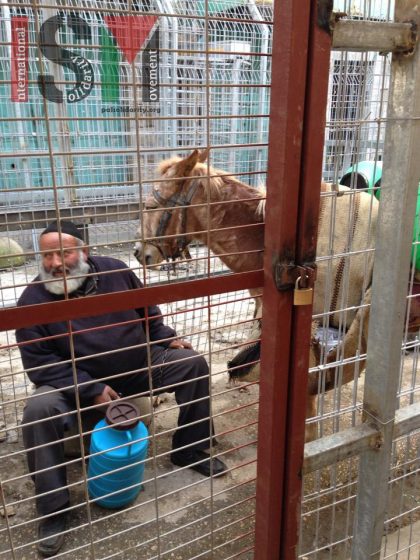
He then spent five hours Tuesday (16/12/14) attempting to cross in the opposite direction before eventually turning back, after being denied repeatedly by Israeli forces claiming that donkeys, mules, horses, and carts are not permitted to pass through the checkpoint.
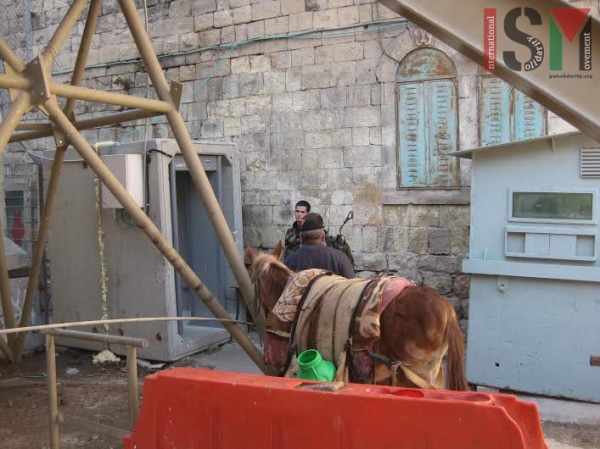
Shuhada checkpoint serves as the only clear passage between the H2 (Israeli-controlled) neighbourhood of Tel Rumeida and the H1 (Palestinian Authority-administered) neighbourhood of Bab Al-Zawiye, a route many Palestinians must traverse regularly in the course of their work and daily routines.
Mohammad arrived at the Bab Al-Zawiye side of the checkpoint at 13:40 on Mondayafternoon, his mule laden with empty milk jugs and saddlebags packed with various provisions. Israeli forces refused to let him through, claiming no animals were allowed past the checkpoint – a claim no one, including other international organisations at the scene as well as the Palestinian District Coordination Office for al-Khalil, had ever heard before.
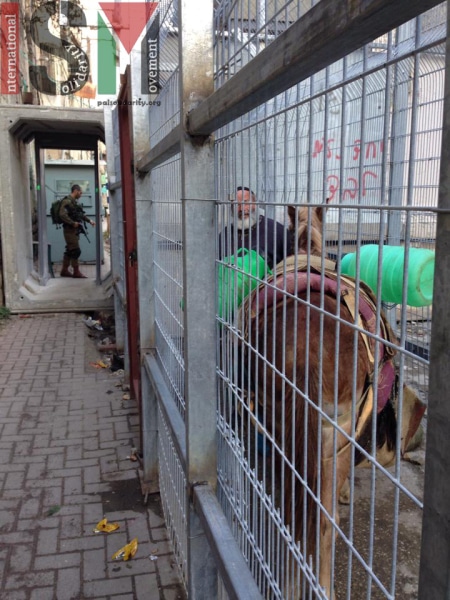
Mohammad explained that he had been allowed pass the checkpoint on Monday morning, with the promise that he would be let back through later in the day. When he returned, he found a new shift of soldiers and no one willing let him pass. The soldier manning the checkpoint claimed he needed permission from his commander to open the gate, which would allow Mohammad to pass with his mule.
An ISM volunteer at the scene later received a call explaining that the Israeli military’s new rule stated that horses, donkeys and mules were not permitted to pass through the checkpoint. No one, however, was able to explain why Mohammad had been allowed through that morning, but denied on his way home. “Look at my ID,” he told the soldier at one point, “I’m in your computer. I go through here all the time.”
He stayed waiting, sitting beside his mule on the cold concrete base of the fence, even as the afternoon turned into evening. The sky grew dark, though the lights from the checkpoint still illuminated the fences,
turnstiles, and barbed wire. Even the soldier seemed concerned, telling him to please go home, as it was cold and late and staying would not help him. But Mohammad had already made it clear he would not leave. About ten minutes later the soldier finally opened the gate, saying it was the “last time” that he would be allowed through. Although Mohammad heard the soldier’s message, it was clear he would not heed it. He intended to continue to resist, no matter what anyone told him.
Sure enough, the following morning he was once again standing outside the checkpoint, this time on the Tel Rumeida side, with full milk jugs tied to the back of his patient mule. The soldiers presented multiple reasons from denying him passage, from a prohibition on taking anything through the checkpoint too large to be carried through the turnstile, to the new rule against allowing donkeys, horses and mules through. ISM volunteers attempted to find a solution, offering to carry the milk jugs around the checkpoint and meet Mohammad and his mule on the other side. The Israeli soldiers manning the checkpoint rejected all suggestions.
“Is the donkey the problem or the milk the problem?” One ISM activist eventually inquired.
“The donkey’s the problem,” a soldier replied.
The animal could have easily passed through the metal detector; only last night ISM activists had witnessed the ludicrous sight of Mohammad’s mule strolling through the concrete structure, empty milk jugs banging against the corners of the gateway. The turnstile served as the only obstacle to the his passage – an obstacle the soldier could easily remove by opening the gate on the other side of the metal detector and letting the mule pass around the turnstile and into Bab Al-Zawiye.
After five hours of waiting, Mohammad’s comment seemed by far the most accurate. “The soldiers are the problem,” he had responded in Arabic.
Barring donkeys, mules, and horses and carts is only the latest in a string of frustrating, humiliating regulations imposed on the people living near the checkpoint, who must pass through to work, study, and shop for essentials such as fresh food. Just a few days earlier a group of elderly Palestinians, ill people, young children, and teachers at a local school had also been forced to wait, some for up to three hours, before being allowed through.
When Israeli forces shut down the checkpoint after it was burnt nearly a month ago , barring most people from passing through for over three weeks, the Palestinians were forced to adapt. Local people know ways around the checkpoint; several paths lead through local families’ yards and over the walls and rubble between Tel Rumeida and Bab Al-Zawiye. These “rabbit runs,” however, are entirely unsuited to traveling through with a mule – as well as for anyone sick, elderly, or carrying large heavy objects.
Since the attempted burning of the checkpoint, the Israeli military rebuilt it larger and with more obstacles for anyone traveling through. One side now has a metal detector, and both sides are equipped with vertical metal turnstiles which are a major impediment to anyone trying to move through with large baggage. Soldiers continue to use the burning of the checkpoint to justify collective punishment imposed on the entire Palestinian population – young and old, men and women, healthy and ill – who live or work near the Shuhada checkpoint.
Any Palestinian might be stopped while attempting pass through. Even with the checkpoint officially open, far too many are. Soldiers regularly search bags and make people remove their belts and empty their pockets before being allowed through. These everyday humiliations accompany frequent ID checks and detentions, serving as an inescapable reminder of the illegal Israeli occupation. Soldiers present at checkpoints routinely cite newly imposed rules and orders from superior officers as reasons for denying people passage, but whether someone passes easily through a checkpoint or must wait for hours often seems to be determined by nothing more than the soldiers’ caprice.
Many Palestinians must pass through Shuhada checkpoint multiple times in a day, carrying items as diverse as fresh vegetables, tubs of oil, and gas for cooking and heating their homes. During the hours ISM volunteers stood waiting with Mohammed, they witnessed multiple people struggle with the cumbersome design of the rebuilt checkpoint. One woman was carrying too many grocery bags to be able to fit into the turnstile. Someone on the other side of the turnstile had to reach a hand between the metal bars and move one bag through, returning it to the woman once she had passed. Another Palestinian, this time a young boy, needed the help of multiple passers-by over several minutes to figure out how to get two tubs of oil and a metal trolley through the turnstiles. Soldiers denied passage outright to boys who wanted to walk through the checkpoint with their bicycles.
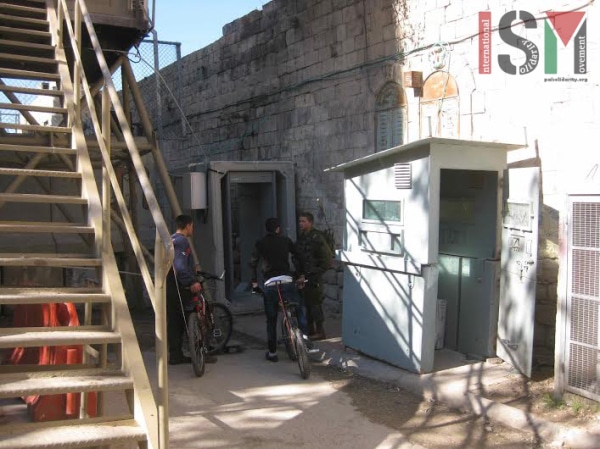
At one point on Monday night, a group of off-duty soldiers ran up Shuhada street and stopped near the checkpoint to rest, stretching and laughing, their easy freedom of movement a stark contrast to experiences of Palestinians struggling through Shuhada checkpoint. Almost all of Shuhada street has been closed off to Palestinians, reserved instead for the settlers and soldiers occupying H2. Even Palestinians who manage to get through the checkpoint must pursue long, circuitous routes between the surrounding areas of al-Khalil. Many, especially the elderly or disabled, are effectively barred from traveling to significant portions of the city their families have lived in for generations.
“I want to resist,” Mohammad told the ISM activists the first day they waited with him. He made sure the man translating said it twice, to make sure the ISM volunteers understood. “I want to resist,” he said, after over three long hours of waiting to be allowed through.
AL-KHALIL (HEBRON): Israeli military arbitrarily change rules around Checkpoint 56 closure, detains elderly, sick people
CPTnet | December 12, 2014
On 10 December, Israeli soldiers prevented teachers from the Qurtuba School, elderly people, a disabled man, and both a doctor and an ill woman trying to reach the hospital from passing through Checkpoint 56 in Hebron. In some cases, they delayed people trying to pass through for one hour; in others, as much as three.
Checkpoint 56 has been subject to closure and restrictions by Israeli forces since it was burned from the inside nearly three weeks ago.
 No one knows who is responsible for the burning of the checkpoint, and Israeli forces have not released footage.
Leading onto the small section of Shuhada Street on which Palestinians are allowed to walk, checkpoint 56 connects Bab iZaweyya, the commercial district in Palestinian Authority-governed H1, with the neighbourhood of Tel Rumeida in Israeli-controlled H2.
Checkpoint closure here demands that families living in Tel Rumeida and school children and teachers from the Qurtuba School walk an extra hour or that they walk a difficult route through the homes and gardens of other Palestinians to reach their homes. For the past week, Israeli soldiers and border police have permitted elderly people, teachers, children and ill people seeking medical treatment to pass the checkpoint.
When CPTers arrived at 11:00 a.m. on 12 December, one 60-year-old doctor told them that he had been at the checkpoint for two hours.
CPTers, ISMers, and those wishing to pass through the checkpoint, attempted to ascertain the reasoning behind this change, which was subjecting teachers leaving work, and older people of varying physical abilities to stand in the sun for hours. CPT and ISM stood in solidarity with the affected Palestinians and joined them in negotiating with soldiers to reopen the checkpoint.
At about 12:00 p.m., soldiers allowed individuals through the checkpoint one by one until approximately twenty minutes later when an elderly man arrived with a donkey, which initiated another arbitrary change in the ‘rules’ of occupation. The Israeli military again closed the checkpoint, and CPT was unable to gain an answer from the soldiers as to why this donkey appeared to necessitate another closure.
Journalist most recent victim of Israeli military violence at Kufr Qaddum
International Solidarity Movement | December 9, 2014
Kufr Qaddum, Occupied Palestine – Bashar, a journalist from Palestine TV, was shot in the left leg at Kufr Qaddum on Friday the 5th of December 2014.
The weekly demonstration aims to highlight the issue of the road that has been closed to Kafr Qaddum and demands for it to be reopened. The road is closed to Palestinians but connects several illegal Israeli settlements nearby. The road was once the Palestinians’ main route to the villages of Jit and Sarra, and to the city of Nablus. Residents of Kafr Qaddum and nearby villages must now use a 14 kilometer detour on badly paved roads through olive groves. This proves especially problematic in emergency situations when ambulances are trying to get patients to Nablus hospital. Kafr Qaddum villagers state that several people have died because of the longer ambulance trip.
Bashar has been going to the Kafr Qaddum demonstrations since they began four years ago. This particular one was a special demonstration in solidarity with Patrick, an Italian activist who was shot in the chest with a .22 caliber bullet the Friday before. The demonstration began peacefully with people holding Italian and Palestinian flags. A skunk water truck, a renowned demonstration repression technique, sprayed the people who were peacefully holding flags right at the beginning of the protest. Within ten minutes, Bashar had been shot in his left leg by an Israeli sniper.
The bullet used to shoot Bashar was an expanding bullet, often called a “dum-dum”. International law has declared their use illegal in war because they are so destructive. Bashar was shot by a sniper with a weapon that is only supposed to be used when soldiers are at mortal risk and skunk water, tear gas, rubber bullets, rubber coated steel bullets, and other nonlethal weapons have all proved ineffective. This is supposed to be the last weapon soldiers use before they shoot to kill with M16s. Witnesses say that Bashar was filming as he usually did when he was shot. He was no threat to the soldiers at all. Witnesses say that there were no people in front or behind him throwing stones.
Bashar was taken by ambulance to Nablus hospital. The X-ray showed that the dum-dum bullet did as it was designed to, breaking into many pieces when it entered his leg.

Bashar had an operation on the 6th of December, the day after he was shot, to take out most of the bullet fragments.
Doctors have decided to leavein some pieces for the time being because they are very close to veins and would be dangerous to remove. Bashar will be bed bound for two weeks until the decision is made, but his condition remains stable.
Within one week at Kufr Qaddum, three people were shot with lethal, live ammunition—two with .22 caliber bullets and one with a dum-dum. One was a journalist, another an international peace activist. None of them were any threat to the soldiers. So why, then, were they shot at? To create fear for all the people who are in solidarity with the Palestinians and who want to tell the world the story of what is happening here? To physically stop peaceful resistance using the most extreme repression techniques?
It will not work. Patrick and many other international, Palestinian and Israeli activists will continue to nonviolently resist the confiscation of their lands in Kufr Qaddum each week. Bashar will continue to report their stories to the world. The unnecessary use of violent repression techniques will only continue to delegitimize the illegal occupation of the Palestinian people.
Israeli settlers stab Palestinian youth on his family’s land
CPTnet | December 9, 2014
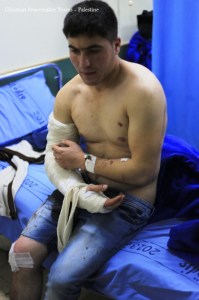 On 8 December 2014, Israeli settlers attacked seventeen-year-old Palestinian boy, Moad Al Rajabi on his family land in Bani Naim, on the outskirts of Al-Khalil/Hebron. He was sitting with his father, Noah Al Rajabi, and two of his cousins when settler cars stopped nearby. As seven settlers exited the cars and came towards them, Noah ran away with his two nephews, believing that his son was also with him. He soon realised his son was not there, and turned to see seventeen-year-old Moad encircled by the settlers.
The seven were stabbing Moad, but fled as Noah ran back in a bid to rescue his son from the assault. Moad required hospitalization to treat the stab wounds, one of which penetrated to the bones in the hand; the other was on his thigh. He is now stable, and the hospital hopes to discharge him later today.
The Al Rajabi family has also suffered the violence of home demolition and the destruction of their livelihood by the Israeli military. In May 2012, Israeli forces destroyed the family’s dairy farm and home, which was on the land where Moad was stabbed yesterday. Commenting on the destruction of the caravan (mobile home) in which the family lived, an iron barn stabling cows, milking machines and other equipment worth over 8000 USD, Noah explained that the Israeli army not “only destroy[ed] my livelihood but also the livelihoods of three other families; our farm is our bread and butter.” The Al Rajabi family has continued to have financial difficulties ever since the demolition.
More young men and teenagers arrested by the Israeli military
International Solidarity Movement | December 9, 2014
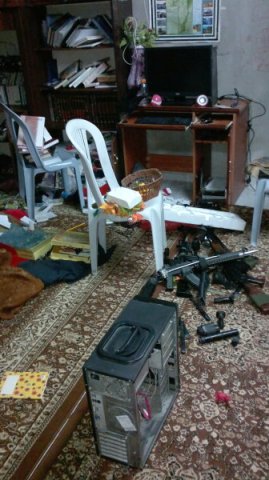 Nablus, Occupied Palestine – On December 8th in Nablus, the Israeli army broke into the homes of two families in Balata refugee camp and arrested two young Palestinians, 19-year-old Mujahed al Shekhalil and 17-year-old Yazan Hta.
In both cases, their homes were raised by the military in the middle of the night (3am and 3:30am) damaging doors and property inside the houses. At the time of the incursions, all family members were sleeping. The military forced all family members into one room whilst they arrested the teenagers. Both families state that between 15 and 20 soldiers broke into their homes, and they were given no reason for either the intrusions or the arrests.
In the village of Madama, on the same night, the Israeli army also entered the home of the Wajeihqut family and arrested 23-year-old Assad Allah. The army spent an hour inside the house between 2:20am and 3:20am, again forcing all family members inside one room. The family reported to ISM that the soldiers told Assad’s 9-year-old brother that if he did not stop speaking they would take him with his brother. Another brother was told that if he did not go into the room with the family then they would cut his head off.
The army confiscated every family members phone and stole the sim cards from them and the hard drive from the family computer. They also smashed the apartments heating system.
This was the fifth time Assad has been arrested and the family home has been raided by the army on numerous occasions.
In all cases, the families were not given a reason for the arrests or for the damage done to their homes, and do not have any information as to where their sons have been taken.
Photo by ISM
Featured Video
ARE PATIENTS BEING PROPERLY INFORMED ABOUT OZEMPIC?
or go to
Aletho News Archives – Video-Images
From the Archives
Trans ‘milk’ as good as the real thing – NHS
RT | February 18, 2024
The drug-induced nipple secretions of trans women are as good as mothers’ breast milk for babies, the University of Sussex Hospitals NHS Trust claimed in a letter to campaigners made public in a report by British think tank the Policy Exchange on Sunday.
The healthcare trust’s medical director, Rachel James, argued that the off-label prescription drug cocktail men transitioning to female take in order to produce milk was “similar to the natural hormones which encourage lactation to develop when the baby is newly born.”
“The evidence which is available demonstrates that the milk is comparable to that produced following the birth of a baby,” James wrote in the letter, sent to Children of Transitioners last August.
Biological men who wish to lactate must first take hormones to grow milk glands and then take high doses of either domperidone or metoclopramide to stimulate milk production. Neither drug is approved for this use, though they are occasionally prescribed off-label to biological women who have trouble lactating.
However, domperidone’s own manufacturer, Janssen, warns patients the drug “may cause unwanted side effects affecting the heart in a breastfed baby” and “should be used during breastfeeding only if your physician considers this clearly necessary.” … continue
Blog Roll
 Aletho News
- 2025 Nature Paper Claiming Worsening Global Drought Gets RETRACTED …Heavily Flawed
- Your Milk Is Not the Problem
- The Truth About the Trump Shootings with Ken Silva
- ARE PATIENTS BEING PROPERLY INFORMED ABOUT OZEMPIC?
- US lawmaker blocks $2.8 billion weapons sale to Israel: Report
- Yemeni army claims responsibility for strikes on sensitive sites in Saudi capital, Aramco facilities in Yanbu
- Iran Judiciary issues indictments against 159 US, Israeli officials for assassination of Leader, commanders
- Turkiye revokes Iranian bank license under US sanctions campaign
- US-Denmark Agreement on Greenland Is ‘PR Stunt’ Ahead of Midterms
- Araghchi: Military intervention cannot create security; coercion cannot bring peace
- If Americans Knew
- Israeli attacks kill four Palestinians in Gaza – Daily Update
- Inside Gaza’s death trap of collapsing, bombed-out buildings
- The everyday items Israel bans from Gaza every day
- Inside the siege, the ruined buildings of Gaza – Daily Update
- Debunking The Claim That Macklemore Has A “History Of Antisemitism”
- CPJ demands release of arrested Palestinian-US journalist near Bethlehem
- Robert Kraft: The Billionaire Friend of Netanyahu Pulling The Strings Behind the Macklemore/Ed Sheeran Blow Up
- Columbia Administered Fund Gives Big Money to Pro-Israel Groups
- Deportation Case of Palestinian Activist Salah Sarsour Tests First Amendment
- ‘We Will Not Forget’: Palestinians Mark 44 Years since Sabra and Shatila
- No Tricks Zone
- 2025 Nature Paper Claiming Worsening Global Drought Gets RETRACTED …Heavily Flawed
- New Study: ‘Global Drought Shows No Detectable Recent Acceleration Under Climate Warming’
- Economic Masterminds: German Socialists Suggest Taxing Productivity Gains Stemming From Using AI
- The South China Sea Has Not Been Cooperating With The Climate Change Narrative
- Energy Crisis: Germany Enters Heating Season With Historically Low Gas Reserve Fill Levels
- New Study: The Antarctic Ice Sheet Gained Mass From 2020-2024 Due To Staggering Snow And Ice Accumulation
- Study: Ocean Heating Rates From Thousands Of Years Ago ‘Dwarf’ Modern Ocean Heating Rates
- Climate Extremists Target, Attack Large-Scale Power Grid Infrastructure In Germany!
- New Study: Antarctic Ice Melt Has Contributed Less Than 1 Centimeter To Sea Level Rise In The Last 30 Years
- Fear Of Debate: Alarmist German Climate Scientist Calls On Mainstream Media To Discredit Skeptic Voices
 Aletho News