Israeli group storms al-Aqsa as settlers attack 3 Palestinians in Jerusalem
Al-Akhbar | December 8, 2014
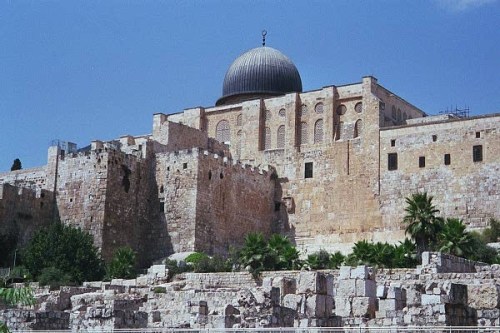
A group of right-wing Israelis toured the al-Aqsa mosque compound in Jerusalem on Monday under police escort, a mosque official said.
The storming of the mosque compound came as Israeli settlers attacked three Palestinians in Jerusalem, and Israeli forces detained 19 in the West Bank.
Al-Aqsa director Omar al-Kiswani told Ma’an that groups of Israeli right-wingers “stormed the compound and toured its squares under the so-called foreign tourism program.”
A group of Israeli intelligence officers also toured the compounds, he added.
The Palestinian Ministry of Endowments and Religious Affairs complained to Israeli police, expressing their objection to the visits, Kiswani said.
Meanwhile, Israeli police detained a woman identified as Umm Radwan Omar at one of the gates leading to al-Aqsa. Omar usually gives religious lectures inside the compound.
Israeli police collected the identity cards of all Palestinian men and women who entered the compound on Monday.
The al-Aqsa mosque is sensitive for Palestinians due to its status as the third holiest site in Islam and its location in the heart of the Old City of Israeli-occupied East Jerusalem.
The al-Aqsa mosque compound, referred to by Jews as the Temple Mount, is also the holiest site in Judaism.
Tensions have been running high in occupied East Jerusalem after months of Israeli pressure on the region, including through a massive arrest campaign and a major military offensive on Gaza that left more than 2,100 dead and provoked outrage across Palestine.
They have also been stoked by Israeli authorities’ decision to hold a vote on splitting the al-Aqsa compound despite the existence of a Jewish prayer area at the Western Wall immediately next door.
Since Israel occupied East Jerusalem in 1967, an agreement with Jordan has maintained that Jewish prayer be allowed at the Western Wall plaza – built on the site of a Palestinian neighborhood of 800 that was destroyed immediately following the conquest – but not inside the al-Aqsa mosque compound itself.
Israeli forces have long restricted Palestinians’ access to the al-Aqsa compound based on age and gender, but have further prevented Muslim worshipers from entering the mosque for more than a month while facilitating the entrance for Zionist extremists.
Settlers attack Palestinians in Jerusalem
Meanwhile, Israeli settlers attacked three Palestinians in two separate incidents in Jerusalem, leaving the latter with bruises and injuries, an Israeli news channel reported Sunday night.
On Sunday evening, Israeli police arrested an Israeli who – along with several other settlers – attacked a Palestinian bus driver, leaving him with injuries, Israel’s Channel 2 reported.
The settlers chanted “death to Arabs” while attacking the bus driver and threatened to kill him, the channel added.
Meanwhile, eyewitnesses told Anadolu news agency that a group of Israeli settlers assaulted two Palestinians from Jerusalem while working in a petrol station in the neighborhood of Ein Karem on Sunday night.
One of the Palestinians sustained injuries that required his transfer to a hospital, the witnesses added.
Israeli forces arrest 19 across West Bank
The Israeli army detained 19 Palestinians in the West Bank on Monday, a Palestinian NGO has said.
Israeli forces searched scores of homes in the southern West Bank city of Hebron and arrested nine Palestinians, the Palestinian Prisoners’ Society said in a statement.
Three more Palestinians were detained in Nablus, two in Jenin, two in Ramallah and one in Bateen village, the NGO added.
Israeli police detained another two Palestinians in East Jerusalem, according to a statement issued by the NGO.
Israeli forces routinely conduct arrest campaigns against Palestinians in the occupied West Bank on claims they are “wanted” by Israeli authorities.
Over 7,000 Palestinians are currently languishing in Israeli prisons, according to the Palestinian Ministry of Prisoners’ Affairs.
On Saturday, Issa Qaraqe, the head of the Palestinian Authority Department of Prisoner Affairs, said that 2014 has been “the most difficult year” for prisoners.
Qaraqe said in a statement that prisoners in 2014 have been victims of “Israeli revenge policies,” adding that Israel’s move to re-arrest prisoners who were released in the Gilad Shalit prisoner exchange deal in 2011 was a dangerous political action.
Qaraqe also decried Israel’s policy of detaining minors, saying some 1,500 minors were detained in 2014, mostly in Jerusalem.
According to Qaraqe, there were 550 new Palestinian prisoners held under administrative detention without charge or trial this year, and Israel renewed administrative detention orders for 63 percent of administrative prisoners. Excessive use of administrative detention is considered illegal under international law.
(Ma’an, Anadolu, Al-Akhbar)
The Dirty Little Secret behind the “Global Terrorism Index” (GTI)
The Omission of Israeli Terrorism in the Occupied Palestinian Territories
By Karin Brothers | Global Research | December 6, 2014
The Global Terrorism Index from 2000 – 2013[1] was launched on December 5, 2014, endorsed by such luminaries as the Dalai Lama, Bishop Tutu and Jane Goodall; it describes itself as ”a comprehensive study that accounts for the direct and indirect impact of terrorism in 162 countries.” The GTI not only lists the countries most affected by terrorism (Iraq, Pakistan and Afghanistan), and the major terrorists (Muslims: Al Qaeda, the Taliban, Boko Haram and ISIS), but also advises on the most effective ways of dealing with it, noting that terrorism is connected more to injustice than to poverty.
Produced by the Institute for Economics and Peace (IEP), which also produces the Global Peace Index, the Global Terrorism Index (GTI) is based on data from the Global Terrorism Database (GTD) which is collected and collated by the National Consortium for the Study of Terrorism and Responses to Terrorism (START), which is supported by the Department of Homeland Security.
A Self-Serving Definition of Terror Incidents?
The Global Terrorism Index uses data from START’s Global Terrorism Database (GTD) which includes incidents meeting the following criteria:
1. The incident must be intentional – the result of a conscious calculation on the part of a perpetrator.
2. The incident must entail some level of violence or threat of violence — including property violence, as well as violence against people
3. The perpetrators of the incidents must be sub-national actors. This database does not include acts of state terrorism.
In addition to this baseline definition, two of the following three criteria have to be met in order to be included in the START database from 1997:
… The violent act was aimed at attaining a political, economic, religious, or social goal.
… The violent act included evidence of an intention to coerce, intimidate, or convey some other message to a larger audience (or audiences) other than the immediate victims.
… The violent act was outside the precepts of international humanitarian law.
There is a contradiction in the definition of terrorist incidents in the study. While the GTI claims that their database only includes acts which are contrary to international humanitarian law, the “two out of three” criteria allows for legal actions to be included. Legal actions included in the GTD database are Palestinian resistance attacks on the Israeli military. [2]
A unique feature of the GTI is described as a “lagged scoring”, or replicating a terror event for up to five years to weight the estimated psychological impact of a terror event. Examples of such scoring were given as the bombing of a marketplace or the 2011 massacre in Norway of 77 youth.
Global Terror Database Notes and Anomalies
A cursory look at the Global Terror Database[2] for Israel indicates various problems. Some of the listed incidents are inadequately documented, with “unknown” location. Actions attributed to Hamas are counted despite what should have been its state exclusion and the exclusion for legal actions. The “West Bank and Gaza Strip” is listed but the incidents involving Palestinians are far from complete.
The Terror Omission
It is only in Appendix C that the Global Terrorism Index mentions that despite a “notable amount of terrorism” in the occupied Palestinian territories (oPt), this region is excluded “by Global Peace Index convention”. Since the GTI was supposed to be using the START Global Terrorism Database, it is not clear why the Global Peace Index “convention” was relevant; also, the GPI’s source, the Economist Intelligence Unit, does include the Palestinian Territories. By excluding the occupied West Bank, East Jerusalem, and pre-2006 Gaza Strip from the survey, the attacks by Israeli settlers are omitted.
It becomes apparent why the occupied Palestinian territories were excluded when the incidence of Israeli settler violence is examined. According to their definition of terrorism, the Israeli settlers’ violence not only qualifies as terrorism, but puts them near the top of the listing of the most violent terrorists. With over 1,750 violent settler attacks fully documented from 2006 – 2013[3], the only group credited with more terror attacks was the Taliban, with 2,757 incidents from 2002 – 2013. Al Qaeda’s 1,089, Boko Haram’s 750 and ISIL’s 492 attacks aren’t even close.[4] When the numbers of settler attacks on Palestinians are combined with the number of non-military Israeli attacks on the Arabs within Israel, the problem of Israeli violence within the tiny state can be seen to be one of staggering proportions. Yet, according to the GTI, Israel was not in the 20 worst states for terrorism.
Moreover, the number of violent incidents, as the report points out, should be weighted by factors reflecting the psychological impact on a victim community. About half of the incidents listed in the GTI report were from explosions, which typically aim for a broader, less personal, target community. The settler attacks on Palestinians tend to be of a more personal nature: shootings, running down civilians with vehicles, beatings, and damage or destruction of civilian property, such as razing agricultural land and raiding houses. Children have been frequent targets, as are Palestinian farmers and workers. Because settlers are allowed to attack Palestinians with impunity from prosecution and often target those whose neighbouring lands they want, settler attacks tend to be more traumatic and should be accorded the full psychological weighting factor.
Are Israeli Settlers Comparable to Muslim terrorists?
Although the actions of Israeli settlers fit the definition of terrorism, can they be considered as comparable to the organizations accused of terrorism? The Muslim organizations accused of being terrorist are a variety of political and/or religious ideological movements that typically arose as a reaction to western power. Israeli settlers are by definition people who have chosen to violate international humanitarian laws by living on territory they have no right to; the settler movement is led by right-wing, religious extremists. That some settlers make the choice for economic motives is similar to the ISIS or Taliban fighters who join because they need the wages.
Additionally, settler attackers are doubly guilty of terrorism: the act of living illegally on Palestinian land fits this definition of terrorism; subsequent attacks on Palestinians are further acts of terrorism.
The Global Implications of Not Naming Settler Attacks as “Terrorism”
The Israeli settlements — all of which are illegal – have been identified as a major impediment to peace. The refusal of a major “global” terrorism report to name the Israeli settlers as one of the groups most responsible for terrorism not only misrepresents a major source of regional violence but exposes the Global Terrorism Index as a propaganda tool that supports a U.S. agenda.
In recent years, governments have been attempting to thwart terrorism by blocking supportive fund-raising. When it comes to Israeli settlements, however, the US and Canada actually encourage fund-raising by giving organizations (such as Christian Friends of Israeli Communities (CFOIC) and the Jewish National Fund) financial support in the form of donor tax-deductions.
Charities which provide funds for the Israeli settlements should be regarded as terror-financing organizations. They should not only lose their tax-deductible status, but they should be banned because they support the violation of international humanitarian law. The terror-financing laws that are being strictly enforced for Muslim charities should be applied to Christian and Jewish charities as well. Governments that do not recognize settler violence as terrorism are feeding what Naomi Klein once termed “the engine that keeps the War on Terror running”: injustice in Israel.
Notes
1. The Global Terrorism Index is at: http://www.visionofhumanity.org/sites/default/files/Global%20Terrorism%20Index%20Report%202014_0.pdf
2. Global Terror Database on Israel: http://www.start.umd.edu/gtd/search/Results.aspx?search=israel&sa.x=0&sa.y=0
3. Annual reports of the Palestinians Center for Human Rights Gaza (PCHRGaza) at: http://www.pchrgaza.org/portal/en/index.php?option=com_content&view=category&layout=blog&id=40&Itemid=172,
Israeli settler attacks from 2000-2013 accounted for 63 deaths, and from 2006 – 2013 at least 1766 violent attacks. (From 2002 – 2013, there were 35 deaths and over 1750 attacks documented.)
While PCHRGaza has published weekly reports that have included settler violence since 1997, it only started to compile the total number of settler attacks in their annual reports from 2006 onwards. One would have to examine the weekly reports for 2000 to 2005 to obtain the annual totals that should have been used for the Global Terrorism Index’s 2000 – 2013 study.
The PCHRGaza noted on at least some of their annual reports that their totals for Israeli settler attacks were not complete because they included only those for which they had documentation. Al Haq and the UN also kept documentation of settler attacks, only some of which overlap PCHRGaza’s.
4. Global Terrorism Index “Targets and Tactics, 2000 – 2013″: totals of incidents by group p. 51
UN: Israeli trade control causes $310m loss for PA
Al-Akhbar | December 3, 2014
The Palestinian Authority lost at least $310 million in customs and sales tax in 2011 as a result of importing from or through Israeli-occupied territories, the UN said Wednesday, urging a radical change to the system.
The lost revenue, worth 250 million euros, was equivalent to 3.6 percent of gross domestic product (GDP) and 18 percent of the tax revenue of the authority, the UN Conference on Trade and Development (UNCTAD) said.
The figures point to “the pressing need to change the modus operandi of the Palestinian import regime to ensure Palestinian rights in all economic, trade, financial and taxation areas,” it said in a new study.
UNCTAD said the 1994 Paris Protocol which governs economic ties between Israeli-occupied and Palestinian territories causes “instability and uncertainty for the Palestinian territory” and should be reformed.
It said barriers should be removed to trade with other countries, and criticized Israel’s “disproportionate influence” on collecting Palestinian revenues.
Israel often freezes the transfer of funds under the pretext of a punitive measure in response to diplomatic or political developments it deems harmful.
About 40 percent of the so-called “fiscal leakage” is related to direct and indirect imports from Israel, and 60 percent from evasion of customs duties, the UN said.
The report cited data from the Israeli Central Bank indicating that 39 percent of Palestinian imports from Israel-occupied territories originate in third countries, but are cleared in Israel and sold on as if produced by Israel.
Customs revenues from these “indirect imports” is collected by the Israeli authorities but not transferred to the Palestinian authority, it said.
Another problem comes from goods smuggled over the border from Israeli-occupied territories, the report said, highlighting the Palestinians’ lack of control over their borders.
Smuggling results in lost sales and purchase taxes for the Palestinian authorities and, where the goods are produced in a third country, lost tariff revenues.
UNCTAD added that its figures are likely to underestimate the problem and urged further research.
The Palestinian economy is bound closely to Israel’s through infrastructure and trade and has few foreign trading partners.
It said that Israel’s system of checkpoints and restrictions in the area inflict long-term damage on Palestinians’ ability to compete in the global market.
The policies are causing a contraction in manufacturing and agricultural sectors, “alarmingly” high unemployment and social problems that would outlive any Israeli-Palestinian peace agreement, the organization said.
Israel occupied East Jerusalem and the West Bank during the 1967 Middle East War. It later annexed the holy city in 1980, claiming it as the capital of the self-proclaimed Zionist state – a move never recognized by the international community.
In November 1988, Palestinian leaders led by Arafat declared the existence of a State of Palestine inside the 1967 borders and the State’s belief “in the settlement of international and regional disputes by peaceful means in accordance with the charter and resolutions of the United Nations.”
Heralded as a “historic compromise,” the move implied that Palestinians would agree to accept only 22 percent, almost 17 percent now after the expansion of Israeli settlements, of historic Palestine in exchange for peace with Israel.
Throughout the 1990s and 2000s, Palestinian leaders sought to create the institutions of statehood despite the lack of an actual state, leading to the development of a security apparatus under US tutelage and a Palestinian bureaucracy.
While major Palestinian cities have boomed in the 26 years since “independence,” Israeli confiscation of land in border regions has continued unabated.
Last year, the World Bank estimated that Israeli control over Area C — the 61 percent of the West Bank under full Israeli military control — costs the Palestinian economy around $3.4 billion annually, or more than one-third of the Palestinian Authority’s GDP.
According to the PLO, between 1989 and 2014, the number of Israeli settlers on Palestinian land soared from 189,900 to nearly 600,000. These settlements, meanwhile, are located between and around Palestinians towns and villages, making a contiguous state next to impossible.
In its Independence Day statement last month, the PLO sought international solidarity to achieve the dream of a Palestinian state free of occupation denied since 1948.
“One effective step that the international community can take is to recognize the State of Palestine over the 1967 border with East Jerusalem as its capital and support Palestine’s diplomatic initiatives such as the UNSC resolution to put an end to the Israeli occupation as well as our access to international treaties and organizations. This will provide additional support to the two-state solution between Israel and Palestine while nullifying any Israeli attempt to change the status quo of the occupied State of Palestine,” the PLO said.
“The international community must ban all Israeli settlement products, divest from all companies involved directly or indirectly in the Israeli occupation and take all possible measures in order to hold Israel, the occupying power, accountable for its daily violations to Palestinian rights and international law.”
The Palestinian Authority this year set November 2016 as the deadline for ending the Israeli withdrawal from the territories occupied by Israel during the Six-Day War in 1967 and establishing a two-state solution.
It is worth noting that numerous pro-Palestine activists argue in favor of a one-state solution, arguing that the creation of a Palestinian state beside Israel would not be sustainable. They add that the two-state solution, which is the only option considered by international actors, won’t solve existing discrimination, nor erase economic and military tensions.
(AFP, Al-Akhbar)
Israeli forces demolish building, 20 stores in Shufat camp
Ma’an – 03/12/2014
 JERUSALEM – Bulldozers heavily escorted by Israeli forces on Wednesday demolished 20 stores and an ancient structure in Shufat refugee camp in East Jerusalem, sources told Ma’an.
Locals said large numbers of Israeli police officers and troops from various divisions raided the camp and deployed in the streets and on rooftops.
Troops then surrounded an ancient building known as the Cola building and all adjacent stores, denying local residents access to the area before blowing up the main doors of all the stores.
The building and the stores belong to the Dajani family from Jerusalem. One of the owners, Abu al-Walid Dajani, told Ma’an Israeli authorities carried out the demolition without notifying the owners. He said excavators demolished the building and 20 adjacent stores.
The area where the demolitions took place measures about 800 square meters, Dajani said.
The building and the stores were built in 1963, he added. It had been populated and the stores were used as shops until the mid-1980s when the First Intifada broke out. Israeli authorities then prevented the family from using the structures.
Dajani denied Israeli claims that the building and the stores were built without permits. He said the Dajani family originally owned 11,500 square meters in Shufat camp before Israel confiscated 2,000 square meters for the construction of the separation wall. In 2008, Israel confiscated 6,000 square meters more, on which they set up a military checkpoint.
In 2012, Israeli forces confiscated the rest of the land along with the structures built on it. Dajani attempted to reclaim his land and properties through Israeli courts, including the Supreme Court, to no avail. Courts always cited security pretexts, he told Ma’an.
Israeli authorities ordered him to pay a property tax of 485,000 shekels to the Israeli municipality of Jerusalem, he added.
A spokesman of the Fatah movement in Shufat camp, Thaer Fasfous, told Ma’an that four large excavators demolished the Cola building and 20 stores. He added that 10 of the demolished stores were open and running until the day they were demolished.
Among the functioning stores was a coffee shop, a car repair workshop, a taxi office, a grocery, a chicken butchery, a frozen meat shop, and a shop which sold tree saplings, in addition to two stores used as warehouses for the al-Khatib Supermarket.
During the demolitions, Israeli forces fired tear gas and rubber-coated bullets to prevent local residents from assembling, Fasfous said. A nearby school was also evacuated.
Israel rarely grants construction permits to Palestinians in the West Bank, including East Jerusalem, and regularly demolishes structures built without permits.
Israeli bulldozers have demolished at least 359 Palestinian structures in the West Bank so far in 2014, according to the Israeli Committee Against House Demolitions.
During the 1967 war, Israel captured East Jerusalem from Jordan, occupied it, and later annexed it in a move never recognized abroad.
Israeli forces close Nablus-area school, say vehicles were stoned
Ma’an – 03/12/2014
NABLUS – Israeli troops on Wednesday morning shut down a secondary school which serves two Palestinian villages south of Nablus in the northern West Bank, a Palestinian official and locals said Wednesday.
Ghassan Daghlas, who monitors settlement-related activities in the northern West Bank, told Ma’an that Israeli soldiers denied hundreds of schoolchildren from al-Lubban and al-Sawiya villages entry to their secondary school located near the main road between Nablus and Ramallah.
The Israelis notified the school administration that it would be closed because Israeli vehicles driving on the nearby street have been attacked with stones.
Palestinian government sources told Ma’an that the Israeli liaison department notified its Palestinian counterpart of the decision to shut down the school for one day.
Several More Abducted in West Bank, Settler Assaults Taxi Driver with Pepper Spray
IMEMC News & Agencies | December 2, 2014
An Israeli settler, Monday, reportedly attacked a Palestinian taxi driver in Jerusalem with pepper spray before fleeing the scene, according to Israeli media sources. Additionally, several more Palestinians were abducted by Israeli forces between Sunday evening and Monday morning.
The Jerusalemite was driving on King George Street when he was attacked by the settler with pepper spray, according to WAFA Palestinian News Agency. He was transferred to hospital for exposure to pepper spray fumes.
Police said a search is underway to locate the whereabouts of the assailant.
In related news, Ynet reports that a 50-year-old Israeli settler was knocked down by a car and critically injured on Monday, to south of Nablus, near the northern West Bank checkpoint known as “Zaatara”.
The vehicle fled the scene of the incident, leaving the man critically injured.
An Israeli army spokesman could not confirm the nature of the incident.
A Ma’an reporter said that Israeli forces closed the Huwwara and Zaatara military checkpoints, following the incident, as Israeli forces search for the driver.
— —
Updated from: 12/1/14 Soldiers Kidnap Six Palestinians In The West Bank
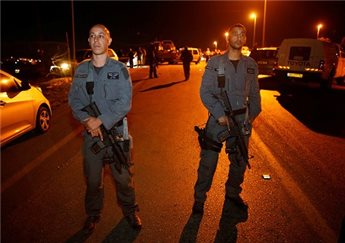 Israeli forces abducted, early Monday and Sunday night, at least 12 Palestinians, including a minor, from occupied West Bank districts, including Jerusalem.
WAFA further reports that Israeli police raided Ras al-Amud neighborhood in East Jerusalem, where they arrested three Palestinians from the Najdi family; Sa’ed, Yazan and Rami, after breaking into and ransacking their families’ houses.
Meanwhile, Israeli forces took into custody three Palestinians while they were attending a trial for their arrested relative, Omar al-Abbasi, in Jerusalem District Central Court.
Forces assaulted ‘Ali Ibrahim al-‘Abassi, 25, for attempting to take a photo of his brother Omar during his court session, triggering a scuffle with al-‘Abbasi’s relatives. As a result, ‘Ali al-‘Abbasi, the uncle, 38, and ‘Imad Mhanna, 27, were arrested along with ‘Ali Ibrahim.
Israeli police also raided al-‘Issawiya, to the north of the city, where troops deployed in streets, assaulting and kidnapping 13-year-old Haitham ‘Ibaid.
According to Ahrar Center for Detainees’ Studies and Human Rights, out of 650 people taken from the occupied West Bank, Gaza and Jerusalem in November, 42 were documented as minors, with 30 having been taken from the city of Jerusalem.
Meanwhile, in the Hebron district, forces raided Beit Kahel village to the northwest of the city, where they kidnapped ‘Imad-addin ‘Asafra, after breaking into his house. They also set up a road block at Halhul Bridge, where they stopped vehicles holding Palestinian-registered plates and examined passengers’ ID cards.
In the Nablus district, Israeli Special Forces raided al-Jabal al-Shamali neighborhood in the city, where they nabbed Tamer Sharaf, age 24.
Soldiers stationed near Zaatara checkpoint, to the south of the city, took one Palestinian under the pretext of carrying a knife. The man has not been identified, as of yet.
In Jenin district, forces set up a flying checkpoint near ‘Arraba, where they abducted Nimr al-Damaj, age 23, a resident of Jenin refugee camp.
Furthermore, in the Ramallah district, forces raided Silwad village to the east of the city, where they broke into and ransacked the house of Bassam Hamed, 40, a former prisoner, and detained the family members in one room before re-arresting Bassam. Forces also handed ‘Anwar Hamed a notice to appear before Israeli intelligence for interrogation.
Forces also raided the Ramallah areas of Deir ‘Ammar and Beitillu, where they broke into several houses, occupied their rooftops, and set up a road block at the villages entrances.
No further kidnappings were reported.
Israeli Forces Kill 9 Palestinians, Kidnap 650, in November
IMEMC News & Agencies | December 01, 2014
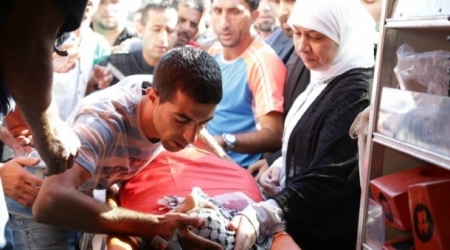
In a report issued on Monday, by Ahrar Center for Detainees’ Studies and Human Rights, Israeli occupation forces were said to have killed 9 Palestinians and detained 650 others, over the month of November.
According to Al Ray, the report noted that 42 out of 650 people taken from the occupied West Bank, Gaza and Jerusalem, were minors, in addition to 17 women. 30 of the minors were taken from Jerusalem.
The report also mentioned that six journalists and two cameramen were taken from Jerusalem, as well, while lawyer Ibrahim Nawaf Al Amer was abducted from the city of Nablus, after a raid on his family’s home.
Fuad Khafsh, director of Ahrar, said that Israeli forces storm the cities of the occupied West Bank when and wherever they please, every day and night.
He noted that the reported numbers are documented by the center, and that it was possible for there to be other cases which could not be documented by the center.
See PCHR reports on Israeli violations in the oPt for further documentation.
Illegal settlement agriculture in the Jordan Valley – The case of Carmel Agrexco
Alhaqhr | December 1, 2014
Illegal settlement agriculture in the Jordan Valley – The case of Carmel Agrexco
Virtual Field Visit: Illegal quarrying in the West Bank – The case of Hanson
UN General Assembly: Israel’s actions in Jerusalem are null and void
MEMO | November 27, 2014
The United Nations General Assembly adopted six resolutions regarding Israeli occupied territories through a recorded vote last night, addressing the areas of Jerusalem and the Syrian Golan.
In terms of Jerusalem, the Assembly voted on a resolution confirming that all legislative and administrative measures taken by Israel to change the legal status of the Holy City of Jerusalem are null and void.
The decision was supported by a recorded vote of 144 countries in favour, six countries opposed, namely Canada, Israel, Marshall Islands, Micronesia, Palau and United States, while ten countries abstained from the vote (Australia, Cameroon, Central African Republic, Madagascar, Panama, Papua New Guinea, Paraguay, Togo and Tonga and Vanuatu).
The Assembly also adopted a resolution that stressed the need for Israel, the occupying power, to withdraw from the occupied Palestinian territories, and demanded the complete cessation of all Israeli settlement activity and Israel’s compliance with its obligations under international law.
The Assembly’s decision also outlined the need for delivering humanitarian and medical aid to the Palestinians.
Another decision was implemented regarding the Syrian Golan Heights as a result of the Assembly’s concern for Israel’s lack of compliance with Resolution 497 (issued in 1981) calling on Israel to withdraw its forces from the Golan Heights which have been illegally occupied since 1967. The decision was supported by 99 countries, rejected by six, while 57 (mostly European) countries abstained from the vote.
Israeli soldiers shoot Italian in the chest at Kafr Qaddum rally
Al-Akhbar | November 29, 2014

A pro-Palestinian Italian activist was shot and seriously wounded by Israeli gunfire during a Friday protest in the northern West Bank, medics and the activist’s organization said.
Palestinian security sources said Patrick Corsi, a 30-year-old member of the International Solidarity Movement (ISM), was shot during the weekly demonstration at Kafr Qaddum, west of Nablus.
Eyewitnesses said Corsi, who had participated in last week’s protest as well, had been documenting the event with a camera.
ISM, an activist group whose members frequently attend Palestinian protests to monitor the actions of Israeli soldiers, confirmed the shooting in a statement.
“The Italian activist, known as Patrick, was wearing a yellow high visibility jacket when he was shot with .22 live ammunition,” the statement said.
The statement added that 10 Palestinian protesters were wounded by rubber-coated steel bullets at the protest, in addition to 18-year-old Sami Jumma who was struck by live fire.
“We were standing with a group of Palestinian demonstrators when Patrick was shot. The military had fired three rounds of tear gas, and then a shot rang out and Patrick stumbled back. There was between five and ten minutes from the last tear gas canister fired and the bullet that shot Patrick.”
“He was just standing there, peacefully protesting, wearing a hi-viz jacket, he wasn’t doing anything and they just decided to shoot him,” the statement quoted an ISM volunteer at the scene as saying.
“The bullet entered Patrick’s chest near a main blood vessel, but thankfully did not puncture it. If God forbid it had, the lengthened journey to the hospital because of the closed road could have cost Patrick his life,” ISM media coordinator Ally Cohen was quoted in the statement as saying.
Due to an Israeli closure of Kafr Qaddum’s main road to Nablus, the travel time to the nearest hospital is around 30 minutes instead of 10.
Khaldoun Ishtewi, media coordinator for public campaigns in Kafr Qaddum, told Ma’an news agency that the Italian national was taken to the Rafidia Public Hospital in Nablus for treatment.
Ishtewi added that several Palestinians suffered from excessive tear-gas inhalation as a result of canisters fired by Israeli soldiers during the clashes.
An Israeli military spokesman did not immediately return a request for comment.
Palestinian Minister of Health Jawad Awwad told Ma’an that “shooting live fire at the upper part of the bodies of protesters is directly targeting them and is a deliberate attempt at murder.”
“Israel does not differentiate between foreign solidarity activists, Palestinians, or even journalists,” he added.
An Israeli army spokesman described the event as a “riot” during which 100 Palestinians allegedly hurled rocks at troops and burnt tires.
After failing to disperse people and “due to increased violence,” soldiers “fired small caliber rounds toward main masked instigators,” the spokesman said.
In the West Bank at the Qalandiya crossing between Jerusalem and Ramallah, Israeli border policemen “fired small caliber rounds toward two main instigators’ lower extremities” during a violent clash with some 150 Palestinians, the spokesman said.
There was no immediate report on their condition.
Protests are held every Friday in Kafr Qaddum against Israel’s closure of a main road linking the village to its nearest city, Nablus, as well as against the Israeli occupation more generally.
The West Bank and annexed East Jerusalem have been occupied by the Israeli military since 1967.
(AFP, Ma’an, Al-Akhbar)
Photo credit – ISM
Israel transforms Jerusalem’s suburbs into a “big prison”
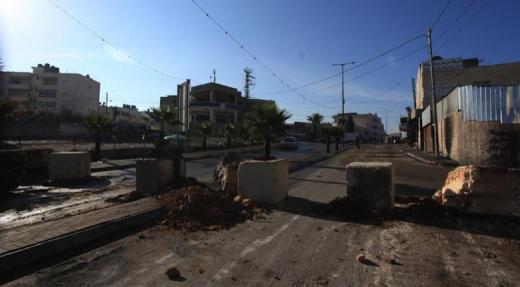
Concrete blocks are placed by Occupation security forces at the entrances to the Palestinian village of al-Ram, northeast of Jerusalem on November 19, 2014. Issam Rimawi – Anadolu Agency
By Mohammed Abdel Fattah | Al-Akhbar | November 26, 2014
Perhaps Israeli prisons can not accommodate more Palestinians, and so Israeli authorities have now chosen to imprison Palestinians inside their villages, especially in the suburbs of Jerusalem. That is part of the collective punishment inflicted on villages, whose residents dared to rise up against the occupation and the discriminatory policies it imposes on Palestinians – such as preventing them from praying at al-Aqsa Mosque, repeatedly storming the mosque, and turning a blind eye on violence and murder of Palestinians at the hands of fanatical Israeli settlers.
Occupied Jerusalem – The Israeli response to a village that revolts is to surround it with concrete barriers and military checkpoints, in addition to using weapons of all types and sizes against young demonstrators. Recently, the occupation forces began to seal off the villages of Hay al-Thawri, Sur Baher and al-Ram in the Jerusalem district after a series of protests against the killing of Ghassan and Uday Abu Jamal, both of whom carried out the recent Knesset operation. Before sealing off these villages, the Israelis encircled and sealed off the village of al-Issawiya, but the concrete barriers were later removed from its entrances following a protest by hundreds of its residents.
Sur Baher, located south of occupied Jerusalem, continues to be closed, hemming in its 27,000 residents. The Israelis tightened the noose around the village by closing its entrances with concrete barriers, leaving only one route for its residents. The people of Sur Baher enter and leave the village through that road, where an Israeli military checkpoint manned by abusive Israeli soldiers regularly mistreat anyone who passes by on foot or in a vehicle. Going in and out of the village presently takes an hour, while Israeli soldiers search every single person from head to toe and search cars from the hood to the trunk.
Students are forced to step out of cars and buses to cross the checkpoint on foot in order to get to school even if that means arriving half an hour late.
The director of the company Sur Baher Buses for Public Transportation, Raafat Nimr, complained that now they have to leave an hour before it is time to pick up students from outside the village to be able to drop them off at school somewhat on time.
He said his and other bus companies have suffered from closing the village and restricting access in and out to one checkpoint as it cut the number of trips buses take from the village in half. This will force the company to close down soon because the cost of “loading passengers increased and there is no longer a large number of trips to make up for it,” he said.
People who do not have a business to take care of outside the village have decided not to leave the village so that they won’t get upset and agitated. For example, Hamza Umaira has not left Sur Baher for a week. Besides, Israeli soldiers at the checkpoint regularly prevent him from going to Jerusalem to pray at al-Aqsa Mosque.
In Hay al-Thawri, where the family of Moataz Hijazi lives, the martyr who carried out the assassination attempt on the life of the extremist rabbi, Yehudah Glick, the situation is as bad as the rest. Like Sur Baher, the Israeli occupation sealed the village twice. The first time after killing Hijazi and the second time after the operation carried out by Ghassan and Uday Abu Jamal. The difference with this neighborhood to others is that it has been encircled with concrete barriers without military checkpoints. This prompts people to take bypass roads, delaying workers and students.
The town facing the worst mistreatment is al-Ram, whose closure affects the residents of the nearby Qalandia refugee camp as they go to and from Ramallah and Jerusalem. In addition to closing the northern entrance to the town with concrete blocks, the closure affects the revenue of businesses located along the road to the northern entrance. The Israeli authorities also closed the Jabaa road adjacent to the town, thereby creating a suffocating traffic jam that takes people two hours to get out of.
Just like the average citizen suffers, medical services suffer too. Turning the Palestinian villages surrounding Jerusalem into “large prisons” obstructs ambulances and prevents them from reaching areas where sick and wounded people need to be taken to hospitals.
Palestinian Red Crescent official, Amin Abu Ghazaleh, said that Israeli occupation forces deal with Red Crescent ambulances as though they are part of the young people’s uprising against them, especially after Israeli ambulances refused to enter Arab areas.
He pointed out that Israeli soldiers did not make it easy for ambulances to enter confrontation areas, treat the injured there or transfer them to hospitals. Instead, they refused to remove any barriers, which increases the rate of field medical treatment.
Residents of the villages facing closure believe that this policy will add to the tension in the city because most of their villages lack basic facilities, such as hospitals and markets.
For his part, political analyst, Fadel Tahboub argues that “Israelis do not want to calm the situation down in Jerusalem, so they continue to close villages and settlers continue to storm al-Aqsa Mosque.”
“The goal of the Israeli occupation is to isolate the Palestinian villages from Jerusalem in order to reduce the Arab population in the city, and to pave the way for annexing them to the West Bank at a later time, completely disconnecting them from occupied Jerusalem,” he concluded.
Featured Video

ARE PATIENTS BEING PROPERLY INFORMED ABOUT OZEMPIC?
or go to
Aletho News Archives – Video-Images
From the Archives
Trans ‘milk’ as good as the real thing – NHS
RT | February 18, 2024
The drug-induced nipple secretions of trans women are as good as mothers’ breast milk for babies, the University of Sussex Hospitals NHS Trust claimed in a letter to campaigners made public in a report by British think tank the Policy Exchange on Sunday.
The healthcare trust’s medical director, Rachel James, argued that the off-label prescription drug cocktail men transitioning to female take in order to produce milk was “similar to the natural hormones which encourage lactation to develop when the baby is newly born.”
“The evidence which is available demonstrates that the milk is comparable to that produced following the birth of a baby,” James wrote in the letter, sent to Children of Transitioners last August.
Biological men who wish to lactate must first take hormones to grow milk glands and then take high doses of either domperidone or metoclopramide to stimulate milk production. Neither drug is approved for this use, though they are occasionally prescribed off-label to biological women who have trouble lactating.
However, domperidone’s own manufacturer, Janssen, warns patients the drug “may cause unwanted side effects affecting the heart in a breastfed baby” and “should be used during breastfeeding only if your physician considers this clearly necessary.” … continue
Blog Roll
 Aletho News
- 2025 Nature Paper Claiming Worsening Global Drought Gets RETRACTED …Heavily Flawed
- Your Milk Is Not the Problem
- The Truth About the Trump Shootings with Ken Silva
- ARE PATIENTS BEING PROPERLY INFORMED ABOUT OZEMPIC?
- US lawmaker blocks $2.8 billion weapons sale to Israel: Report
- Yemeni army claims responsibility for strikes on sensitive sites in Saudi capital, Aramco facilities in Yanbu
- Iran Judiciary issues indictments against 159 US, Israeli officials for assassination of Leader, commanders
- Turkiye revokes Iranian bank license under US sanctions campaign
- US-Denmark Agreement on Greenland Is ‘PR Stunt’ Ahead of Midterms
- Araghchi: Military intervention cannot create security; coercion cannot bring peace
- If Americans Knew
- Israeli attacks kill four Palestinians in Gaza – Daily Update
- Inside Gaza’s death trap of collapsing, bombed-out buildings
- The everyday items Israel bans from Gaza every day
- Inside the siege, the ruined buildings of Gaza – Daily Update
- Debunking The Claim That Macklemore Has A “History Of Antisemitism”
- CPJ demands release of arrested Palestinian-US journalist near Bethlehem
- Robert Kraft: The Billionaire Friend of Netanyahu Pulling The Strings Behind the Macklemore/Ed Sheeran Blow Up
- Columbia Administered Fund Gives Big Money to Pro-Israel Groups
- Deportation Case of Palestinian Activist Salah Sarsour Tests First Amendment
- ‘We Will Not Forget’: Palestinians Mark 44 Years since Sabra and Shatila
- No Tricks Zone
- 2025 Nature Paper Claiming Worsening Global Drought Gets RETRACTED …Heavily Flawed
- New Study: ‘Global Drought Shows No Detectable Recent Acceleration Under Climate Warming’
- Economic Masterminds: German Socialists Suggest Taxing Productivity Gains Stemming From Using AI
- The South China Sea Has Not Been Cooperating With The Climate Change Narrative
- Energy Crisis: Germany Enters Heating Season With Historically Low Gas Reserve Fill Levels
- New Study: The Antarctic Ice Sheet Gained Mass From 2020-2024 Due To Staggering Snow And Ice Accumulation
- Study: Ocean Heating Rates From Thousands Of Years Ago ‘Dwarf’ Modern Ocean Heating Rates
- Climate Extremists Target, Attack Large-Scale Power Grid Infrastructure In Germany!
- New Study: Antarctic Ice Melt Has Contributed Less Than 1 Centimeter To Sea Level Rise In The Last 30 Years
- Fear Of Debate: Alarmist German Climate Scientist Calls On Mainstream Media To Discredit Skeptic Voices
 Aletho News