Language that disappears the Palestinians
By Jonathon Cook | The Blog from Nazareth | October 28, 2014
The Guardian has about the best coverage to be found in the mainstream media of the Israel-Palestine conflict – which tells you quite how bad everyone else is.
Today the paper’s readers’ editor, Chris Elliott, ponders complaints about its coverage. Not surprisingly, many of them are from the Israeli embassy, which says it is concerned about the Guardian’s disproportionate interest in Israel-Palestine, implying that this is evidence of anti-semitism.
Actually it is quite the opposite. It is evidence of the Guardian’s historic and current support for the state of Israel, though not the occupation. Elliott alludes to this obliquely as he points out that the paper’s most famous editor, C P Scott, was instrumental in getting the British government to issue the Balfour Declaration. The Guardian’s pride in having helped to create a Jewish state is still palpable at the paper (as I know from my years there), especially among senior Jewish editors who influence much of the conflict’s coverage – yes, that is a reference to Jonathan Freedland, among others.
The Israeli embassy, of course, is trying to browbeat the Guardian to bring it into line with the dire coverage of the rest of the media.
The lesson the readers’ editor draws is:
When looking at these three complaints I think the important message is that if the Guardian is to continue its strong focus on Israel and Palestine, which it is entirely at liberty to do, we have to put a similar effort into the use and awareness of language that we use to discuss the issues on both sides.
And yet, as usual, the article only considers the problematic use of language regarding the Israeli side of the conflict. The reality is that the Guardian, like most western media, is really only interested in the Israel-Palestine conflict because of the Jews, not the Palestinians. There are many reasons for this:
- historic European guilt about the Holocaust;
- the central place of the Jews in Biblical stories most westerners were raised on in the still-Christian west;
- the sense that the Jews are more like us than the “Arabs” – that they are, as Theodor Herzl, the father of Zionism, put it, “a rampart of Europe against Asia, an outpost of civilization as opposed to barbarism”;
- the fact (mostly unmentionable) that Jews are strongly represented on the staff of western media often in senior positions, but rarely are there any Muslims or Arabs, and that many Jewish staff naturally identify with the plight of relatives in Israel;
- the continuing appointment to Jerusalem bureaux of partisan Jewish reporters who speak Hebrew but not Arabic; live in west Jerusalem, not East Jerusalem; whose younger children go to Jewish schools, not Arab schools; and whose older children serve in the army.
All of this is so normalised among the western media that the New York Times barely seems concerned that at least three of its senior writers on the conflict have had children serving in the Israeli army: Ethan Bronner, David Brooks and now, we discover, Isabel Kershner. We will know that we have an even-handed media only when we can conceive of a paper recruiting not only a Palestinian reporter (in itself almost impossible, it seems) but a Palestinian reporter with a child who openly supports Hamas (let’s not even try to imagine the possibility of their being allowed to have a child who fights in the resistance!).
As the Guardian’s Elliott inadvertently indicates, sensitivity about language is central to the concerns of papers like the Guardian when it comes to the Jewish side, but not so much when it comes to the Palestinians.
Today Moshe Machover, a London University philosophy professor, sent a letter to the readers’ editor that I reproduce below concerning a recent Guardian article. The Guardian’s report contains the usual insensitivities of language towards the Palestinians, so common-place that they are never noted or questioned. But this is about more than insensitivity. It is about the constant misuse of language in ways that work to Israel’s benefit by shaping how western publics understand the conflict. In fact, it is precisely such language that has enabled Israel to incrementally disappear the Palestinians.
Dear Readers’ Editor,
In yesterday’s Guardian there was a report by your Jerusalem correspondent Peter Beaumont about what is in fact Israel’s continued illegal colonization of east Jerusalem.
http://www.theguardian.com/world/2014/oct/27/israel-construct-settler-homes-east-jerusalem-netanyahu
It began:
“The Israeli government is to advance construction plans for 1,000 housing units to be built in parts of Jerusalem that Palestinians demand for their future state.”
The wording “the Palestinians demand” suggest that these parts of Jerusalem do not belong to the Palestinians but to someone else. This false impression is reinforced by what follows:
“The move, revealed by the prime minister, Binyamin Netanyahu, is the first in what is expected to be a series of announcements this week on new settlement construction work in East Jerusalem and on the occupied West Bank.”
Surely, “work in East Jerusalem and on the occupied West Bank” is wrong as it falsely suggests that East Jerusalem is not occupied but belongs to Israel; it should have been “work in occupied East Jerusalem and West Bank.” I am sure you will wish to correct this misleading wording in your next column.
Sincerely,
Moshé Machover
Denied land access, Palestinians miss olive harvest
Ma’an – 29/10/2014
AL-JANIYA (AFP) — Abbas Yousef points wistfully towards his olive trees, which are bearing their annual fruit. Yet again, the 70-year-old Palestinian farmer will be unable to make the autumn harvest.
Yousef’s olive groves lie on land either side of an Israeli settlement in the northern occupied West Bank. For years, he has been denied access by the army, and the settlers have plowed it, uprooting many of his trees.
For the 1,400 residents of al-Janiya — Yousef’s village — attacks by settlers who have uprooted trees and burnt Palestinian farmland have become a daily occurrence, he says.
“Each time I try to get to my olive groves, an Israeli soldier tells me I can’t go, because it’s been designated a ‘closed military zone,'” Yousef says.
“My father planted those trees, seed by seed, and I toiled over the land,” he sighs, pointing to one section of his land, now farmed by settlers.
This year, for the first time since 2000, Yousef was allowed access to his land, but only for two days — not nearly enough time to gather all the olives during the harvest that begins in early October.
When he got there, he found 400 of his trees had been uprooted.
UN figures show that since the start of the year, around 7,500 trees have been damaged or uprooted across the West Bank.
‘Now it’s my land’
Arik Ascherman, president of Israeli rights group Rabbis for Human Rights, says Yousef’s experience is common and in danger of becoming the norm in the West Bank.
“They start by preventing Palestinians from accessing their land, then they cultivate it themselves, and then they say ‘Now it’s my land,'” he explains.
Since Israel took over the West Bank in 1967, 135 Jewish settlements have been built there as well as around 100 unauthorized outposts, which are considered illegal even under Israeli law, UN figures show.
All settlements built on occupied territory are illegal under international law.
Figures compiled by the Yesha Settlers Council show there are some 380,000 Israelis living in the West Bank — a number which has more than tripled in the two decades since the Oslo peace accords were signed in 1993.
The attacks against olive groves, which make up half of all cultivated Palestinian farmland, threaten a crucial source of livelihood.
Olive farming and olive oil production bring in around a quarter of Palestinian agricultural revenue, according to the UN’s top humanitarian official for the occupied territories, James Rawley.
The harvest is increasingly threatened by both settlement building and by Israel’s vast separation barrier — in some parts an eight-meter-high (25 foot) concrete wall — whose construction began in 2002.
Some 85 percent of the barrier’s route runs inside the West Bank, rather than along the internationally recognized Green Line, cutting off Palestinians from 30 percent of their land, according to a UN spokeswoman.
For Ahmed Diwan, a farmer who lives in Biddu village east of Ramallah, the problem is not limited to olives.
He says he has also missed the grape harvest, the almonds, the apples, and vine leaves — “a symbol of Palestinian cuisine” — due to a lack of access to his land.
Diwan holds out little hope for this year’s olive harvest as he packs his farming equipment into his car.
“We’re only allowed access to our olive groves two days this year. We can’t maintain the trees or harvest in that time!”
End of an era?
Israel has granted access to farmers for a total of 37 days so far this year, the UN says.
Even those who do have limited access to their farmland are subjected to violent attacks by settlers, who are often armed.
So far this year, 88 attacks have been recorded and 142 farmers injured, according to the UN.
The elderly Yousef was one of the victims.
“About 50 settlers turned up. We were four farmers, people of around my age. We were no match for them,” he recalls.
“In the end it was the Israeli soldiers who got us out to protect us from the settlers.”
The violence is making “entire villages” which had been self-sufficient for decades dependent on international aid, the UN says.
A disillusioned younger generation is turning away from the age-old family tradition.
“Farming is finished. The young people don’t want to work on the land. They’re scared of being killed by settlers,” Yousef says.
Settler violence against Palestinians and their property is a regular occurrence in the West Bank and East Jerusalem, but settlers are rarely held accountable by Israeli law enforcement.
Ma’an staff contributed to this report.
Natural resource exploitation in the Dead Sea area – The case of Ahava
Alhaqhr | October 28, 2014
This is the first in a series of new Virtual Field Visits focusing on the topic of business and human rights. This video will highlight corporate complicity in the exploitation of natural resources in the Dead Sea area of the Occupied Palestinian Territory.
Israeli mayor storms into al-Aqsa without permission
Al-Akhbar | October 28, 2014
Israeli-occupied Jerusalem’s mayor Nir Barkat forced his way on Tuesday into the al-Aqsa Mosque compound in East Jerusalem under heavy police protection, a Palestinian official said, as Israel continues to restrict the entry of Palestinian worshipers into al-Aqsa for the fifth week in a row.
“We protest this intrusion. Barakat entered the compound under the Israeli police’s protections without permission or a prior request,” Sheikh Azzam al-Khatib, head of the Jordan-run Organization for Muslim Endowments and Al-Aqsa Affairs, told Anadolu Agency.
This is the first time Barkat storms the holy site since assuming office in 2008.
“Barkat took a tour at the compound’s courtyards before leaving,” al-Khatib added.
The intrusion came one day after Palestinian Prime Minister Rami Hamdallah visited the complex.
Hamdallah’s visit came after Palestinian Authority President Mahmoud Abbas warned against Israeli plans to “divide” the holy site.
In an urgent message to the US administration on Sunday, Abbas warned that Israel’s continued provocations at the mosque complex would lead to a “wide-reaching explosion.”
Israel continues to restrict the entry of Palestinian worshipers into al-Aqsa for the fifth week in a row.
Israeli authorities have imposed restrictions on Palestinians seeking to enter the al-Aqsa Mosque compound, denying Muslim men under 40 access to the holy site while facilitating the entry of Zionist settlers of all ages.
In recent months, groups of extremist Zionist settlers – often accompanied by Israeli security forces – have repeatedly forced their way into East Jerusalem’s flashpoint al-Aqsa Mosque complex.
The frequent violations anger Palestinians and occasionally lead to violent confrontations.
For Muslims, al-Aqsa represents the world’s third holiest site.
Israel occupied East Jerusalem during the 1967 Middle East War. It later annexed the holy city in 1980, claiming it as the capital of the self-proclaimed Zionist state – a move never recognized by the international community.
In September 2000, a visit to the site by controversial Israeli leader Ariel Sharon sparked what later became known as the “Second Intifada” – a popular uprising against the Israeli occupation in which thousands of Palestinians were killed.
(Anadolu, Al-Akhbar)
Coca Cola’s involvement in the Occupation of Palestine
Who Profits | October 26, 2014
The Central Bottling Company (CBC) or Coca Cola Israel is a manufacturer and distributor of soft drinks, dairy products and alcoholic beverages. CBC began its operation in 1967 upon receiving the Israeli franchise of Coca Cola products from Coca Cola International.
Through its fully owned subsidiary – The Central Company for Sales and Distribution, CBC holds a regional distribution center in the Atarot settlement industrial zone. The Atarot distribution center is responsible for marketing the company’s beverages to the Palestinian population of East Jerusalem. Simultaneously, the Palestinian franchisee – The National Beverages Company (NBC) is denied access to East Jerusalem, which therefore constitutes a captive market for the Israeli distributor.
In 2006 CBC purchased Tabor Winery – an Israeli winery that owns vineyards near mount Shifon in the occupied Golan Heights. Grapes from the Shifon vineyards are used in Tabor’s white wines.
CBC also owns Tara (Milco Industries), whose subsidiary, Meshek Zuriel Dairy (81%), holds a dairy farm and a head office in the settlement of Shadmot Mehola in the Jordan Valley.
Israeli forces detain Palestinian man who removed settler tent
Ma’an | October 25, 2014
HEBRON – Israeli forces detained a Palestinian from the village of Susiya south of Hebron after residents took down a tent set up by Israeli settlers on land belonging to a Palestinian family in the area, a local official said.
Jihad al-Nawajaa, the head of a local village council, told Ma’an that Israeli forces detained Ahmad Muhammad Mahmoud al-Hadar, 35, after he took down a tent set up by settlers on the al-Hadar family’s property.
He said that soldiers “assaulted” Palestinian villagers at the same time.
The tent was set up as an outpost to expand the illegal Israeli settlement of Susiya, al-Nawajaa said.
Al-Hadar took down the tent in order to “save our lands from Judaization and settlement.”
Some settlers act without approval to expand settlements or create new ones in the West Bank, building outposts that are illegal even by Israeli government standards.
In some cases, these settlement outposts are “legalized” by Israel, and in rare cases they are dismantled.
Meanwhile, Palestinians are rarely granted permission to build in the 60 percent of the West Bank under full Israeli military control, or in East Jerusalem.
Human Rights Defender Abdallah Abu Rahma receives guilty verdict from military court
International Solidarity Movement | October 21, 2014
Bil’in, Occupied Palestine – On October 21st, Human Rights Defender Abdallah Abu Rahma was found guilty by an Israeli military court of “disturbing a soldier”.
“Demonstrating against the occupation cannot be a criminal offence. Finding Abdallah guilty only shows that the [Israeli] military force is a tool to perpetuate the occupation.” Stated Gabi Lasky, lawyer of Abdallah Abu Rahma, to the International Solidarity Movement (ISM).

Abdallah spoke to the ISM about his recent conviction. “Yesterday the military court ruled that I was guilty, showing once again that they stand on the side of the occupation, and not that of truth and justice.
I was arrested on the 13th of May 2012 in front of Ofer Military prison at a demonstration commemorating the Nakba and in solidarity with the prisoners, many of whom were on hunger strike. I was imprisoned in Ofer for 16 months a year earlier, for my role in the non-violent demonstrations in my village, Bil’in, against the Apartheid wall and settlements built on our land.
This time when I was arrested I was held for a few hours and released on bail, I was not summoned to court until the beginning of 2013, following the success of the popular committees in the construction of the Palestinians villages Bab Al Shams and Bab Al Manatir.”
Abdallah Abu Rahmah is the coordinator of the Bil’in popular committee, which began popular demonstrations against the Apartheid wall and settlements in January 2005. The route of the Apartheid wall originally planned to separate the village form 50% of its agricultural land. As a result of the village’s continued popular struggle, the route was changed and 25% of the village land was effectively annexed by the wall to the illegal settlement of Modiin Elite.
Hundreds of protesters have been arrested and injured by Israeli forces in Bil’in since the popular struggle in the village began. In 2009 during a demonstration, Bassam Abu Rahmah was shot directly in the chest with a high velocity tear-gas projectile, dying of his wounds minutes later. On Januray 1st 2011, Jawaher Abu Rahmah died of poisoning after inhaling excessive amounts of tear gas during the weekly demonstration the previous day.
Israel creates mock Jewish graves south of Aqsa Mosque
Palestine Information Center – 18/10/2014
 OCCUPIED JERUSALEM – The land research center said that the Israeli occupation authority (IOA) established fake graves in Silwan district, south of the Aqsa Mosque, as part of feverish steps to Judaize the Arab history and identity of the holy city.
In a report released on Friday, the center stated that Zionist settler groups in cooperation with the nature and parks authority planted tombs built of stone on a tract of Palestinian land located between Silwan district and the Umayyad Palaces area, south of the Aqsa Mosque.
It noted that the tombs, engraved with the Star of David, were made look like age-old ones and presented to tourists as Jewish graves built before 1948.
“Such step confirms once again that the occupation state is seeking on purpose to fake the history of Jerusalem in violation of the international norms and laws that demand it not to make changes to any land under its occupation,” the center underlined.
The center also warned that creating fake graves enables Israel to seize more areas in east Jerusalem.
Zoabi appeals against Israeli ban on Palestinian women entering Al-Aqsa
MEMO | October 16, 2014
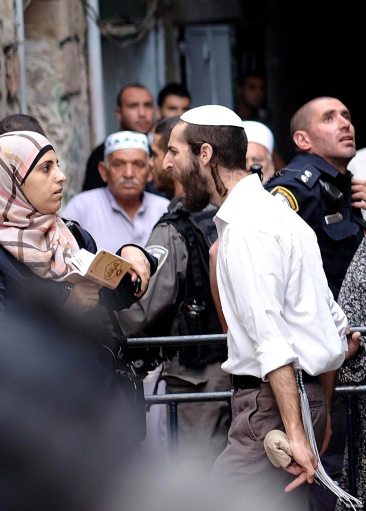 Arab Knesset Member Hanin Zoabi is to appeal against the Israeli police’s ban on Palestinian women from entering Al-Aqsa Mosque, the minister said today.
The Anadolu news agency reported a statement for Zoabi saying she had informed the Israeli police of her plan to appeal to the Israeli court against the “arbitrary” banning of women from entering the mosque.
She did not disclose with which court she was planning to file the appeal, but the process starts by filing an appeal to the magistrate court, then to the district court then to the High Court.
Zoabi described Israel’s ban on Palestinian women entering Al-Aqsa Mosque as a “dangerous precedent”, noting that the reason behind banning them is their role in “facing the settlers’ desecration of the mosque” in recent months.
For more than two months, Israeli police have banned women from entering the mosque from time to time. “They [Palestinian women] formed the front defence line against the Israeli violations and aggression on Al-Aqsa Mosque,” Zoabi said.
The Knesset member said she had sent a written letter to the Israeli Minister of Internal Security Yitzhak Aharonovich informing him of the “violations” committed by the Israeli police and Israeli border guards against women around and inside the holy site.
She noted in her letter that the violations and aggression on Palestinian women and banning them from entering into the mosque “undermines and ignores” their freedom. She also stressed that the lack of punishment against aggressors is a “green light” for more violations.
For about two months, the Israeli settlers, including extremist officials such as Knesset Deputy Speaker Moshe Feiglin have stormed Al-Aqsa Mosque on almost a daily basis.
Palestinians remain inside the mosque trying to prevent such aggressions, but the Israeli police and occupation forces took measures to secure the settlers including preventing women and men under the age of 50 from entering Al-Aqsa’s grounds.
Yesterday, 20 Palestinians, including women, were wounded in clashes in the mosque and seven others were arrested, including minors.
Ben & Jerry’s is Selling Ice Cream in Illegal Israeli Settlements
Vermonters for a Just Peace in Palestine/Israel
 |
This photo was taken in a supermarket in Gilo – an illegal Israeli settlement in occupied East Jerusalem – by an activist who documented the sale of Ben & Jerry’s ice cream in the settlements of Gilo (pop. 28,980), Pisgat Ze’ev (pop. 39,748) and Ma’ale Adumim (pop. 35,673), and in the industrial park of Mishor Edomim, which services Ma’ale Adumim. |
Ben & Jerry’s Caters to Illegal Israeli Settlements
In August, 2011, an Israeli Jewish activist working with us contacted Ben & Jerry’s factory in Israel, by e-mail and telephone, and confirmed that the company delivers ice cream to Israeli settlements in the occupied territory. Here is an e-mail communication, translated into English, between an employee at the factory and the Israeli activist, discussing arrangements for an ice cream cart to travel to the Israeli settlement of Ma’ale Adumim:
B&J Employee: Thanks for writing. Our ice cream cart comes with 5 flavors to choose from, glasses, wafers, ice cream toppings, 2 stewards and all accessories. The cost for 250 people (free distribution); 3,500 [NIS (Israeli Shekels), or $919 US] including VAT. Attached is a list of flavors. I’ll be happy to answer any questions.
Activist: Is there an extra cost that relates to the distance of your factory to the location of the party? i.e., is there an extra cost because the event is held in Ma’ale Adumin? I’m sorry about the need for detail but it’s necessary for our accounting department.
B&J Employee: Yes, the cost of transportation is 250 [NIS (Israeli Shekels), $65 US]. This is because we come from Be’er Tuvia (near Kiryat Malachi) to Ma’ale Adumim.
Israeli Settlements are Illegal Under International Law
Israel’s settlements in the Palestinian Territory violate Article 49(6) of the Fourth Geneva Convention, which declares that “the Occupying power shall not deport or transfer parts of its own civilian population into the territory it occupies.” The commentary to the Convention states that this provision was intended “to prevent a practice adopted during the Second World War by certain powers, which transferred portions of their own population to occupied territory for political and racial reasons or in order, as they claimed, to colonize those territory. Such transfers worsened the economic situation of the native population and endangered their separate existence as a race.”
Transfer of settlers to occupied territory by an occupying power is also an international war crime under Article 8(2)(b)(viii) of the 1998 Rome Statute of the International Criminal Court. Moreover, the UN Security Council and General Assembly, the High Contracting Parties to the Geneva Conventions, the International Committee of the Red Cross, and most legal scholars have concluded that Israel’s settlements in the oPt contravene international law. The International Court of Justice declared in a 2004 decision that “the Israeli settlements in the Occupied Palestinian Territory (including East Jerusalem) have been established in breach of international law.”
Ben & Jerry’s business in illegal Israeli settlements also violates its obligations under the U.N.’s “Norms on the Responsibilities of Transnational Corporations and Other Business Enterprises,” which asserts that corporations “shall not engage in nor benefit from war crimes, [or] crimes against humanity…” nor take actions that obstruct or impede economic, social, cultural, civil and political rights.
[Citations for the references above are in Our Report on Ben & Jerry’s business practices in the occupied Palestinian Territory.]
 |
The Israeli supermarket chain Shufersal distributes Ben & Jerry’s ice cream at stores both in Israel and in illegal settlements in the occupied Palestinian Territory.
The map at left, with dots denoting the locations of their stores, was displayed in their store in Mishor Adumim (an industrial zone that services one of Israel’s largest settlements, Ma’ale Adumim). Notice that it depicts Israel and occupied Palestine as one state. Palestinians under occupation are not allowed to enter most Israeli settlements, so the supermarkets in those places only sell Ben & Jerry’s ice cream to Jewish settlers. |
Vermonters for a Just Peace in Palestine/Israel Calls on Ben & Jerry’s to:
Until Israel ends its occupation and colonization of Palestinian lands in compliance with international law:
- End the marketing, catering and sales of Ben & Jerry’s products in Israel and Jewish-only settlements in occupied East Jerusalem and the West Bank.
- Stop manufacturing ice cream in Israel.
- Issue a statement (a) calling on Israel to end its occupation and settlement enterprise and (b) appealing directly to other socially responsible companies to do likewise and to cease business operations in Israel and its illegal settlements.
|
Click here to send a message to Ben & Jerry’s headquarters in Vermont. Tell Ben & Jerry’s that its complicity in Israel’s military occupation and illegal settlements is wrong and must stop! |
Boycott Divestment & Sanctions:
In Solidarity with the Palestinian People
Vermonters for a Just Peace in Palestine/Israel’s opposition to Ben & Jerry’s business practices in Israel and occupied Palestine is motivated by the grave human rights abuses being committed by the State of Israel. We are are also aware that in 2005 Palestinian civil society called for an international campaign of boycotts, divestment and sanctions (BDS) against Israel until it complies with three rights codified in international law.
- End Israel’s occupation and colonization of all Arab lands and dismantle its separation wall;
- Recognize the fundamental rights of the Arab-Palestinian citizens of Israel to full equality; and
- Respect, protect and promote the rights of Palestinian refugees to return to their homes and properties as stipulated in United Nations Resolution 194.
| Ben & Jerry’s CEO, Jostein Solheim, said in an interview:
“My mantra that I’ve repeated a hundred times since starting at Ben & Jerry’s is: ‘Change is a wonderful thing,’…. The world needs dramatic change to address the social and environmental challenges we are facing. Values led businesses can play a critical role in driving that positive change. We need to lead by example, and prove to the world that this is the best way to run a business. Historically, this company has been and must continue to be a pioneer to continually challenge how business can be a force for good and address inequities inherent in global business.” Vermonters for a Just Peace in Palestine/Israel agrees: The world – including Israel-Palestine |
Zionist settlers torch mosque near Nablus
Ma’an – 14/10/2014
 NABLUS – Israeli settlers set fire to a mosque in the Nablus-area village of Aqraba overnight, locals said.
Ghassan Daghlas, a Palestinian official who monitors settlement activity, told Ma’an that a group of settlers broke the doors and windows of the Abu Baker al-Saddiq mosque and vandalized the interior with racist slogans.
The settlers then set fire to part of the mosque before being chased away by Palestinian villagers.
Locals managed to extinguish the fire and prevent it from burning down the whole mosque.
In Jan. 2014, settlers torched a mosque in Salfit and sprayed “Arabs out!” on the building.
Settlers in the occupied West Bank attack Palestinians and their property routinely yet rarely face prosecution by Israeli authorities.
Featured Video

Chinese jet fuel and the myth of energy independence
or go to
Aletho News Archives – Video-Images
Book Review
Former Insiders Criticize Iran Policy as U.S. Hegemony
By GARETH PORTER | CounterPunch | February 27, 2013
“Going to Tehran” arguably represents the most important work on the subject of U.S.-Iran relations to be published thus far.
Flynt Leverett and Hillary Mann Leverett tackle not only U.S. policy toward Iran but the broader context of Middle East policy with a systematic analytical perspective informed by personal experience, as well as very extensive documentation.
More importantly, however, their exposé required a degree of courage that may be unparalleled in the writing of former U.S. national security officials about issues on which they worked. They have chosen not just to criticise U.S. policy toward Iran but to analyse that policy as a problem of U.S. hegemony. … continue
Blog Roll
 Aletho News
- Why no power can undermine Iran’s eternal dominance over the Strait of Hormuz
- Is The War Against Iran Over?
- Iran war will leave long-term ‘scar’ on Wall Street, investors warn
- How Iran decimated US power projection in West Asia: Military lessons of 40-day war
- Iran’s report details US-Israeli war crimes in targeting schools, hospitals, livelihoods
- NATO’s Slow Fracture: How Trump’s Iran War Exposed the Instrument of Hegemony
- Chinese jet fuel and the myth of energy independence
- Ukraine Sea Drone Fired From Libya Hit Russian Tanker in Mediterranean
- IRGC: Iranian forces launched no attacks during ceasefire hours
- Trump Administration Moves To Automate U.S. Military Draft Registration
- If Americans Knew
- TCN: Is Israel Blackmailing President Trump?
- Israel killed at least 303 Lebanese yesterday – who were they? Daily Update
- Amnesty: Urgent – Protect Lebanese civilians from brutal escalation in Israeli attacks
- Is The War Against Iran Over?
- Inside the Israeli army’s propaganda wing
- Hundreds of Gaza Amputees Stranded in Legal Limbo
- The gallows law: Israel moves toward executing Palestinian children
- Tucker Carlson: The Path to Peace requires ending ‘special alliance’ with Israel
- This is ceasefire? Israel’s biggest massacre yet in Lebanon, another journalist killed in Gaza – Daily Update
- Tucker Carlson on Israel: This Is the Behavior of an Ally? Really?
- No Tricks Zone
- An Inconvenient Tree: Uncovered In Alps… Europe Much Warmer Than Today 6000 Years Ago
- New Study Reports A 60% Slowdown In Greenland’s Ice Loss Rate In The Last Decade
- Low Intensity Tornado Wrecks Major Solar Farm, Creating A Potential Toxic Dump
- New Study Finds Warming Saves Lives…Cold Temperatures 12 Times More Deadly Than Excess Heat
- German Science Blog Accuses PIK Climate Institute Of Hallucinating Climate Tipping Points
- Devastating Assessment Of Comirnaty Vaccine By Former Senior Pfizer Europe Toxicologist
- New Study: CO2 Is ‘Effectively Negligible’ As An Explanatory Climate Change Factor Since 2000
- Former Pfizer Toxicologist Dr. Helmut Sterz Tells Bundestag Hearing Pfizer Vaccine Should Have Never Been Approved
- Energy Expert: Germany’s Nuclear Phaseout Was A “500 Billion Euro Mistake”
- New Research: South Australia’s Mid-Holocene Sea Surface Temperatures Were 4°C Warmer Than Today
 Aletho News