Hebron, Occupied Palestine – Today in al-Khalil (Hebron), as part of the Jewish holiday of Sukkot, thousands of settlers and Zionist tourists descended upon the city. The Israeli military presence in Hebron, which is already a large and oppressive part of everyday life, greatly increased.

Hebron is the only city in the West Bank where there is an illegal settlement in the heart of the city. It is split into H1 and H2, H1 under Palestinian Authority Control, and H2 under Israeli military control.
This morning, in both the Salaymeh and Qeitun neighbourhoods, the checkpoints designating the end of H1 were extended further into Palestinian territory.


Israeli soldiers drove between Salaymeh and Qeitun, entering houses, hiding in alleyways, and aiming their guns at passing schoolchildren and other people in the area.

In the afternoon, the army presence was just as heavy, with children walking home past heavily armed soldiers.

In H1, Bab al-Zawiye (the centre of Hebron), Israeli forces partially closed the road to allow settlers and Zionist tourists through the checkpoint to visit a religious holy site.


They were escorted by approximately 45 Israeli border police and soldiers. Several Palestinian shops were forced to close for several hours, to allow the setters and tourists to pass.

The Ibrahimi mosque and nearby checkpoint was also closed today, with all Palestinian shops in the area forced to close with it.
October 12, 2014
Posted by aletho |
Ethnic Cleansing, Racism, Zionism, Illegal Occupation | Hebron, Human rights, Israeli settlement, Palestine, West Bank, Zionism |
Leave a comment
HEBRON – Israeli soldiers raided a private Palestinian home in Hebron on Sunday morning and turned the third floor of the house into a military post, the owner said.
Salim al-Salayma told Ma’an that Israeli troops broke into his house in the al-Baqaa neighborhood in eastern Hebron and locked him and his 17 family members on the first floor.
While the family was locked on the first floor, al-Salayma said, Israeli soldiers brought military equipment to the third floor, turning it to a military post.
An Israeli military spokeswoman did not immediately return calls seeking comment.
Israeli forces regularly occupy the homes of Palestinian civilians in the West Bank located in what they deem sensitive areas to conduct surveillance and enforce control.
October 12, 2014
Posted by aletho |
Ethnic Cleansing, Racism, Zionism, Illegal Occupation | Hebron, Israel, Palestine, West Bank, Zionism |
Leave a comment
 SALFIT – A group of Israeli settlers have burned and vandalized Friday evening a number of olive trees in Yassouf town in Salfit under Israeli occupation forces protection.
Local sources confirmed that Palestinian farmers confronted the settlers and prevented further damage to their olive groves located near Tafuh settlement.
Israeli settlers and forces have daily carried out systematic attacks against olive groves especially during olive harvest in order to prevent the farmers from picking their own fruits.
Meanwhile, dozens of Israeli settlers stormed Friday morning Suleiman pools south of Bethlehem in the West Bank, local and media sources said.
The sources pointed out that the settlers performed Talmudic rituals in the ancient pools area in total provocation to the local residents.
WAFA news agency quoted a Palestinian security source as saying that 70 settlers from Efrat settlement stormed the pools area under heavy Israeli forces protection and started performing their rituals.
Israeli settlers used to storm Suleiman pools in an attempt to impose a status quo in the area.
The pools, which were built by the Ottoman Sultan Suleiman, are located between Artas and Al-Khader villages south of Bethlehem.
October 12, 2014
Posted by aletho |
Ethnic Cleansing, Racism, Zionism | Israeli settlement, Palestine, West Bank, Zionism |
Leave a comment
There is a war going on and it long predates Israel’s summer Gaza onslaught. It is a war on water, and it runs deep. For the last decade, Israel has been carrying out a systemic and willful campaign to deny Palestinians access to clean water.
Though Israel’s campaign to restrict water access has yet to make the news, rights organizations are pushing the Palestinian Authority to take the issue to court, so the matter could well make headlines in the coming months. While the PA has been debating whether or not to accede to the International Criminal Court, increasing documentation of war crimes may push their hand.
Under international law, deliberate targeting of civilian infrastructure is a war crime, and as of 2010, water and sanitation were enshrined as basic human rights. Israel has blatantly and systemically been denying these rights.Through growing documentation and awareness, Israel’s systemic campaign against Palestinian water can be seen for what it is: a comprehensive violation of one of the most basic human rights. It consists of a two-pronged approach: the visible mass destruction of water and sanitation infrastructure, reinforced by invisible policies of closure and occupation, siege and confiscation that block the repair of infrastructure. Together, these tactics prevent the existence of sustainable Palestinian communities, driving people from their land, their homes, and communities.
The first tool of Israel’s water war has been well documented. It includes direct and extensive damage caused deliberately during large-scale military operations. In the latest Israeli military operation in Gaza this meant Israeli aircraft targeted the sewage pump station and F16s disabled pumps that sent 25,000 cubic meters of wastewater per day to Gaza’s main sewage treatment plant. Further Israeli shelling east of Gaza City hit a main water pipeline, disconnecting areas east of the city so that 450,000 were completely cut off from municipal services, and the more than 1.5 million residents of the strip suffered massively reduced access.
The losses in water infrastructure alone from this latest series of strikes have been estimated at $30 million. This is not taking into account the massive toll on health, with 100,000 cubic meters of untreated sewage flowing through the streets of Gaza and into the sea, causing widespread health problems. This meant over-burdened hospitals, without water themselves, were dealing with digestive ailments, skin allergies, water-borne and respiratory diseases.
UN investigations from the 2008-9 attacks on Gaza already affirmed that Israel’s targeting of water infrastructure was “deliberate and systematic.” The September meeting of the Russell Tribunal, charged with investigating rights violations from this summer’s atrocities, has reached similar conclusions.
Human Rights Watch and Amnesty International have also urged the PA to take action on these violations and bring them to the ICC.
And while arguments will no doubt be made about the fog of war or the targeting of water infrastructure as accidental or as collateral damage, this line of defense is weakened when such military attacks are seen as part of a longer-term systemic program. For example, in the 2001-2 invasion of Jenin, the same policy of intentional damage to water equipment during military assault was used. Invasions caused massive damage to water and wastewater infrastructure, cutting off water services to civilians for weeks.
Even more insidious has been the slow but deliberate damage to water infrastructure that has taken place as part of the day-to-day of occupation. This damage can be seen both in the West Bank, as well as in the agricultural lands of Gaza that have, since 2005, been declared as a border ‘buffer’ zone by the Israeli military.
Official documentation has catalogued demolition by Israeli forces of 173 different pieces of water, sanitation, or hygiene infrastructure in Area C of the West Bank between 2009 and 2011. This has included the confiscation of water tankers, which are used as an emergency measure when access to water is prohibited. In the Gaza border zone – which swallows up some 17 percent of Gaza’s landmass – 305 agricultural wells were destroyed between 2005 and 2013.
In addition, Jewish settlers in the illegal Jewish-only settlements in the West Bank regularly carry out acts of vandalism and destruction that specifically target Palestinian water sources, and frequently take over natural springs for their own recreational use.
These settlers are acting within a clear Israeli policy that sees targeting of water resources as an acceptable method of warfare.
The destruction of generations-old water infrastructure such as historic cisterns or springs not only deprives marginalized communities of water but destroys an important element of Palestinian history and the community’s organic relationship with natural resources. Further, by depriving farmers of water, Israeli policies drive them off their land. Loss of agricultural income resulting from de-developed water infrastructure is estimated at $1.44 billion annually.
Though Israel has total control over the building, development, or maintenance of water infrastructure in Area C – where permission is systemically denied – it also maintains indirect control in all areas of the West Bank, where it can – and often does – prohibit the building of water treatment, irrigation, or industrial facilities.
Evidence of water warfare, and deliberate efforts to use water as a weapon against Palestinian civilian populations, is being documented at all levels, and efforts continue to bring awareness to all those affected. Israel’s water war has continued with impunity for far too long and must be challenged before its effects are irreversible.
Dajani is a policy member of Al-Shabaka: The Palestinian Policy Network, and a Palestinian environmental researcher and activist based in Jerusalem.
October 11, 2014
Posted by aletho |
Ethnic Cleansing, Racism, Zionism, Timeless or most popular, War Crimes | Gaza, Israel, Palestine, West Bank, Zionism |
Leave a comment
The Bedouin Jahalin Tribe had a historic existence roaming the expansive lands in the Naqab Desert which ended abruptly when the State of Israel was declared. Most joined the thousands of Palestinians fleeing, and the group was splintered and scattered.
Many of the Jahalin continued to herd their livestock between Ramallah, Wadi Qelt and Jerusalem until large swathes of land were confiscated to make way for mushrooming Israeli settlements following the beginning of the occupation of the West Bank. Some squeezed into the area off the Jerusalem-Jericho highway, which, after the Oslo Accords fell under complete Israeli military and administrative control. In order to expand the vast Ma’ale Adumim settlement, Israel razed some of the homes and packed their inhabitants away on trucks to live in containers beside a rubbish dump. The separation wall was then built severing the remaining community from East Jerusalem, the main market where they sold the milk and cheese made from their remaining livestock.
The semi-nomadic lifestyle of the Bedouin, hinged on land and livestock, has been continuously chipped away by Israel’s policy of demolitions and displacements. Now, sixty years after the Jahalin were first made refugees, they face being uprooted again as Israel advances plans to “relocate” 12,500 Bedouins from where they reside in the Jerusalem periphery. The plan is reminiscent of the Prawer Plan, the bill approved by the Israeli Knesset in 2011 to relocate some 40,000 Bedouin-Palestinian citizens of Israel from ‘unrecognised villages‘ into townships which was eventually frozen following mass protests within Israel.
This time the Israeli administration has said they won’t put the Jahalin on trucks as they did during the mass eviction in 1997, but they will take immediate action to demolish their residences and agricultural buildings, “because there is an alternative here”. The alternative referred to is a purpose built township north of the West Bank city of Jericho, where they will be lumped with two other tribes- against Bedouin customs- each family allotted a housing plot and a small area unsuitable for the rearing of livestock. A total of 23 communities will be herded into the area.
Jameel Hamadin, a Bedouin facing eviction said: “These areas do not suit our lifestyle or our traditions or our culture.” He added in his address to the European Union: “If they deport us to the city, our lifestyle will end.” The communities previously evicted were housed in Al- Jabal village on expropriated Palestinian land. The United National Committee of Economic Social and Cultural Rights “deplored the manner” those relocated were “housed in steel container vans in a garbage dump in Abu Dis in Subhuman conditions”. Their traditional lifestyle was destroyed by the move.
Israel has justified its expulsion plan through the rhetoric of improving Bedouin living conditions by allowing them to live in places with “suitable infrastructure” and as an appropriate response to the “dynamic changes” that Bedouin society is undergoing as it moves from an agricultural society “to a modern society that earns its living by commerce, services, technical trade and more”.
For the Bedouin, who claim they were not consulted about the plans, this is just another attempt to remove them from strategic land, one that they fear will destroy their traditional way of life for good. Abu Suleiman, head of the Jerusalem Bedouins’ Community Cooperative, asks “why do they not let us build here if they want to improve our living conditions”.
Residing in tin shack like structures perched on the unforgiving hillside terrain; many overlook the continuous construction in Ma’ale Adumim settlement. The homes in the settlement have running water, power, their occupants have access to medical services and top notch schools for their children. In contrast Israel does not allow the Bedouin community to gain access to running water and electricity, and prevents the building of permanent structures and even the tin shacks, which are no match for Israeli bulldozers, stand with the daily threat of demolition.
Under the contentious E1 plan the area of land that the Bedouin currently call home is to be turned into an urban block connecting Ma’ale Adumin and Jerusalem. The plan will divide the West Bank into two and in the process render the chances of a viable Palestinian state dead, and with it the future of a two state solution.
United Nations Relief and Works Agency has urged the plan to be halted, with Pierre Krähenbühl, Commissioner General of UNRWA stating it: “gives rise to concerns that it amounts to a ‘forcible transfer’ in contravention of the Fourth Geneva Convention.” He added: “The humanitarian impact of the planned transfer could be immense”.
This process is already in motion. According to analysis by the Association of International Development Agencies of data compiled by the United Nations Office for the Coordination of Humanitarian Affairs, the number of demolitions in the first eight months of 2014 was higher than in any comparable period in the last five years, as was the number of people who lost their homes as a result.
The Bedouin have a hard fight to remain on their land, a fight that has lasted decades long. For the traditional rural communities this is the next step in Israel’s long history of policies targeting their existence.
October 3, 2014
Posted by aletho |
Ethnic Cleansing, Racism, Zionism, Illegal Occupation, Timeless or most popular, War Crimes | Human rights, Israeli settlement, Palestine, West Bank, Zionism |
Leave a comment
The Ir David Foundation, known as Elad, has published an announcement on social media networks in search of Jewish settlers to live in Palestinian homes that it has captured in the town of Silwan, occupied East Jerusalem, in return for a financial reward estimated at 500 shekels ($136) per day, Israel’s Haaretz newspaper reported on Wednesday.
Elad is known for its Judaisation projects of the city of Jerusalem. According to the association’s advertisement, an amount of 500 shekels will be given to each settler who agrees to live in one of the homes that have been seized, with the settler only required to “keep his gun loaded and ready to fire at any time”, according to the declaration.
Haaretz quoted one of the advertisements as follows: “We are looking for people who can stay in the apartments and watch them until families move into them. The work will probably take ten to 30 days (perhaps even more). The daily wage is 500 shekels gross. The workers will stay in the apartments and guard them until they are inhabited by families. Only suitable applicants will be accepted. Please pass this on to friends.”
The following day, the newspaper reported that when asked about the details on what the job entails, an Elad official said: “You’re not the security guard … There are security guards and police when needed, and there’s someone to supervise you and call to make sure everything is all right all the time. We don’t need you as a security guard. As far as we’re concerned, you live in the house, but it’s better if you have a weapon.”
The official also stressed that Elad would be the employer. “I think the payment would be by bank transfer,” she said. “You come and fill out forms.”
With the assistance of armed guards, the Foundation seized, overnight on Monday, ten individual buildings that include 23 apartments in the Wadi Hilweh neighbourhood of Silwan, located just south of Al-Aqsa Mosque, claiming that the settlers now own them.
Silwan has been witnessing continuous and tense confrontations with Israeli occupation forces ever since the seizure of the Palestinian homes, with Israeli police and armed forces present in the streets around the clock to protect the settlers.
October 3, 2014
Posted by aletho |
Ethnic Cleansing, Racism, Zionism, War Crimes | Israeli settlement, Jerusalem, Palestine, West Bank, Zionism |
Leave a comment
RAMALLAH – 83 Palestinian prisoners and detainees died during the Aqsa uprising in September 2000 due to either medical neglect, torture, or assassination.
The Palestinian prisoners center for studies said on Monday that 206 Palestinian prisoners have died in Israeli jails since 1967, 83 of them were killed during the Aqsa uprising.
24 prisoners died in Israeli jails due to medical neglect, while three were tortured to death. Another one was burned to death.
54 Palestinians were directly shot dead during their detention despite the fact that they did not pose any threat to Israeli forces.
In 2002, 25 prisoners died in Israeli jails, most of them were deliberately shot by Israeli soldiers shortly after their arrest.
Dozens of Palestinian detainees suffering from chronic diseases also died shortly after their release from Israeli jails because they did not receive proper medical care inside jails.
The center called on human rights groups to necessarily reveal the real reasons behind the death of 206 Palestinian prisoners during their detention and provide protection for the Palestinians in Israeli jails.
October 1, 2014
Posted by aletho |
Ethnic Cleansing, Racism, Zionism, Subjugation - Torture, Timeless or most popular | Human rights, Israel, Palestine, West Bank, Zionism |
Leave a comment
A top UN rights expert has expressed alarm at the impact of Israel’s attack on Gaza for civilians, concluding that “Israel’s claim of self-defense against an occupied population living under a blockade considered to be illegal under international law is untenable.”
Makarim Wibisono, Special Rapporteur on the situation of human rights in the Palestinian territories occupied since 1967, spoke Monday at the end of his first mission to the region.
In a press release, Wibisono stated that the Israeli military killed almost 1,500 civilians, including more than 500 children, with “a staggering 11,231 Palestinian civilians, including 3,436 children” injured and many “now struggling with life-long disabilities”.
Tens of thousands of children live with the trauma of having witnessed the horrific killings of family members, friends, and neighbours before their own eyes.
Wibisono, echoing similar and even stronger conclusions by the likes of Amnesty International and the International Committee of the Red Cross, said that “this raises serious questions about possible violations of international humanitarian law and human rights law.”
Wibisono related three demands from Palestinians: “the need for accountability, an end to the blockade, and an end to the occupation”. Affirming this call, the UN official said that “those responsible for violations of international law must be brought to justice in order to avoid yet another round of deadly violence in the near future”.
The Special Rapporteur had a special focus on children in Gaza, noting that “there wasn’t a single child…who has not been adversely affected”. Wibisono pointed to an estimated 7,000 unexploded ordinances “littered across” the territory, and described how over “50 days of relentless bombing and shelling”, some 228 schools were damaged, including 26 destroyed or damaged beyond repair.
According to Wibisono, around 60,000 Palestinians remain in 19 shelters in the Gaza Strip, while medical professionals report a “critical shortage” of medicines and equipment. “Israel must immediately lift the seven year land, sea and air blockade of Gaza”, Wibisono urged, “and urgently allow needed materials for reconstruction and recovery.”
The Special Rapporteur also spoke to the “excessive use of force” used by Israeli forces in the Occupied West Bank over the summer, “noting that during the period from 12 June to 31 August 2014, a total of 27 Palestinians were killed, of whom five were children, with the youngest victim only 11 years-old.” Wibisono stressed that “the use of live ammunition against Palestinians even if they were throwing stones, is unjustifiable.”
The Special Rapporteur will report fully on his findings and recommendations to the 28th session of the Human Rights Council in March 2015.
September 30, 2014
Posted by aletho |
Ethnic Cleansing, Racism, Zionism, War Crimes | Gaza, Human rights, Israel, Palestine, West Bank, Zionism |
Leave a comment
Abbas denies mounting claims that Egypt has offered territory for a Palestinian state. Should we believe him?
What is Israel’s endgame in Gaza? It is a question that has been puzzling analysts and observers for some time. But belatedly, there are indications of the future Israel and Washington may have in mind for Gaza.
Desperately overcrowded, short on basic resources like fresh water, blockaded for eight years by Israel, with its infrastructure intermittently destroyed by Israeli bombing campaigns, Gaza looks like a giant pressure cooker waiting to explode.
It is difficult to imagine that sooner or later Israel will not face a massive upheaval on its doorstep. So how does Israel propose to avert a scenario in which it must either savagely repress a mass uprising by Palestinians in Gaza or sit by and watch them tear down their prison walls?
Reports in the Arab and Israeli media – in part corroborated by the Palestinian president, Mahmoud Abbas – suggest that Egypt may be at the heart of plans to solve the problem on Israel’s behalf.
This month Israeli media reported claims – apparently leaked by Israeli officials – that Egypt’s president, Abdel Fattah al-Sisi, had offered the Palestinian leadership the chance to annex to Gaza an area of 1,600 sq km in Sinai. The donated territory would expand Gaza fivefold.
The scheme is said to have received the blessing of the United States.
‘Greater Gaza’ plan
According to the reports, the territory in Sinai would become a demilitarised Palestinian state – dubbed “Greater Gaza” – to which returning Palestinian refugees would be assigned. The Palestinian Authority of Mahmoud Abbas would have autonomous rule over the cities in the West Bank, comprising about a fifth of that territory. In return, Abbas would have to give up the right to a state in the West Bank and East Jerusalem.
The plan, which would most likely result in significant numbers of Palestinians moving outside the borders of historic Palestine, was quickly dismissed as “fabricated and baseless” by Egyptian and Palestinian officials.
Tayeb Abdel Rahim, a spokesman for Abbas, accused Israel of using the proposal to “destroy the Palestinian cause”, referring to Abbas’ efforts at the United Nations to win recognition of Palestinian statehood on parts of historic Palestine.
But Abdel Rahim’s denial raised more questions than it answered. While rejecting suggestions that Sisi had made such an offer, he added that the plan originated with Giora Eiland, Israel’s national security adviser from 2004 to 2006.
Abdel Rahim appeared to be referring to a plan unveiled by Eiland in 2004 that Israel hoped would be implemented after the withdrawal of settlers and soldiers from Gaza – the so-called disengagement – a year later.
Under Eiland’s terms, Egypt would agree to expand Gaza into the Sinai in return for Israel giving Egypt land in the Negev.
Abdel Rahim also stated that a similar plan – the resettlement of Palestinian refugees in Sinai – had been advanced briefly by Sisi’s predecessor, Mohamed Morsi.
Morsi, who served as president for a year from the summer of 2012 until his ousting by Sisi in a military coup, headed a Muslim Brotherhood administration that tried to strengthen ties to the Hamas leadership in Gaza.
Zionist strategies
The idea of creating a Palestinian state outside historic Palestine – in either Jordan or Sinai – has a long pedigree in Zionist thinking.
“Jordan is Palestine” has been a rallying cry on the Israeli right for decades. There have been parallel suggestions for Sinai.
In recent times, the Sinai option has found favour with the Israeli right, especially following the outbreak of the second intifada 14 years ago. Support appears to have intensified after the disengagement in 2005 and Hamas’ victory in the Palestinian national elections a year later.
Notably, the scheme became the centrepiece of the 2004 Herzliya conference, an annual meeting of Israel’s political, academic and security elites to exchange and develop policy ideas. It was then enthusiastically adopted by Uzi Arad, the conference’s founder and long-time adviser to Benjamin Netanyahu, the current prime minister.
He proposed a three-way exchange, in which the Palestinians would get part of Sinai for their state, while in return Israel would receive most of the West Bank, and Egypt would be given a land passage across the Negev to connect it to Jordan.
A variation of the “Sinai is Palestine” option was dusted off again by the right during Operation Protective Edge, Israel’s 50-day attack on Gaza this summer.
Moshe Feiglin, the Speaker of the Israeli Knesset and a member of Netanyahu’s Likud party, called for Gaza’s inhabitants to be expelled from their homes under cover of the operation and moved into Sinai, in what he termed a “solution for Gaza”.
Did Morsi offer Sinai?
Given that the rationale of the Sinai option is to remove Palestinians from what the Israeli right considers Greater Israel, and such a plan is vehemently opposed by all Palestinian factions, including Hamas, why would Morsi have backed it?
Further, why would he have proposed giving up a chunk of Egyptian territory to satisfy Israeli ambitions, thereby undermining his domestic credibility, at a time when he was fighting for political survival on many other fronts?
One possibility is that Abbas’ office simply made up the story to discredit Morsi and the Muslim Brotherhood, and by extension Abbas’ political rivals in Hamas, and thereby win favour with Sisi.
But few Palestinians or Egyptians appear to have found the claim credible, and Sisi has shown no interest in pursuing this line of attack against Morsi. Why would Abbas fabricate a story that might rebound on him by linking him to such underhanded diplomacy by Egypt, Israel and the US?
There are two further pieces of the jigsaw suggesting that there may be more to the Sinai story than meets the eye.
The first are comments made by Abbas shortly before the Israeli media began reporting the alleged offer by Sisi. Abbas was responding to earlier rumours that began in the Arab media.
Abbas signalled at a meeting with Fatah loyalists on 31 August that a proposal to create a Palestinian state in Sinai was still of interest to Egyptian officials.
He reportedly said: “A senior leader in Egypt said: ‘a refuge must be found for the Palestinians and we have all this open land.’ This was said to me personally. But it’s illogical for the problem to be solved at Egypt’s expense. We won’t have it.”
The Times of Israel website said it had subsequently confirmed the comments with Abbas.
The Palestinian leader made similar remarks on Egyptian TV a week earlier, when he told an interviewer an Israeli plan for the Sinai had been “unfortunately accepted by some here [in Egypt]. Don’t ask me more about that. We abolished it, because it can’t be.”
What about Mubarak?
The second clue was provided in a barely noticed report in English published last month on the website of the Arab newspaper Asharq Al-Awsat, headquartered in London but with strong ties to the Saudi royal family.
It claimed that in the later years of his presidency, Egypt’s Hosni Mubarak came under concerted and repeated pressure from the US to cede territory in Sinai to the Palestinians to help them establish a state.
The article, based on information reportedly provided by an unnamed former Mubarak official, stated that pressure started to be exerted on Egypt from 2007.
The source quoted Mubarak as saying at the time: “We are fighting both the US and Israel. There is pressure on us to open the Rafah crossing for the Palestinians and grant them freedom of residence, particularly in Sinai. In a year or two, the issue of Palestinian refugee camps in Sinai will be internationalised.”
In Mubarak’s view, according to the report, Israel hoped that, once Palestinians were on Egyptian soil, the combined area of Sinai and Gaza would be treated as the Palestinian state. This would be the only territory to which Palestinian refugees would be allowed to return.
Anticipating later statements by Abbas’ office, the Egyptian source said a similar proposal was put to Morsi when he came to power in 2012. A delegation of Muslim Brotherhood leaders travelled to Washington, where White House officials proposed that “Egypt cede a third of the Sinai to Gaza in a two-stage process spanning four to five years”.
US officials, the report stated, promised to “establish and fully support a Palestinian state” in the Sinai, including the establishment of seaports and an airport. The Brotherhood was urged to prepare Egyptian public opinion for the deal.
Pieces of the jigsaw
So what sense can we make of these various pieces of the jigsaw?
Each in itself can be discounted. The Asharq al-Awsat report is based on an anonymous source and there may be Saudi interests at work in promoting the story. Likewise, the Israelis could be waging a misinformation campaign.
But taken together, and given that Abbas appears reluctantly to have conceded key elements of the story, it becomes much harder to ignore the likelihood that the reports are grounded in some kind of reality.
There seems little doubt – from these reports and from the wider aspirations of the Israeli right – that a Sinai plan has been crafted by Israel’s security establishment and is being aggressively advanced, not least through the current leaks to the Israeli media. It also looks strongly like variations of this plan have been pushed more vigorously since 2007, when Hamas took exclusive control of Gaza.
Israel’s current rationale for the Sinai option is that it undermines Abbas’ intensifying campaign at the United Nations to seek recognition of Palestinian statehood, which Israel and the US adamantly oppose.
It also seems plausible, given the strength of its ties to Israel, that the US is backing the plan and adding its considerable weight to persuade the Egyptian and Palestinian leaderships.
Harder to read, however, is whether Egypt might have responded positively to such a campaign.
An Egyptian analyst explained the expected reaction from Sisi and his generals: “Egypt is relentlessly trying to keep Gaza at bay. Tunnels are being destroyed and a buffer zone is planned. Bringing more potentially hostile elements closer to Egypt would be a dangerous and reckless move.”
This is true enough. So what leverage do Israel and the US have over Egypt that might persuade it to override its national security concerns?
Turning the screw
Aside from the large sums of military aid Washington gives to Egypt each year, there is the increasingly pressing matter for Cairo of dire fuel shortages, which risk inflaming a new round of street protests.
Israel has recently discovered large offshore deposits of natural gas, which is it is ready to export to its neighbours. It is already quietly agreeing deals with the Palestinian Authority and Jordan, and is reported to be in advanced discussions with Egypt.
Is this part of the pressure being exerted on Egyptian leaders to concede territory in Sinai? And has it been enough to make them overlook their security concerns?
Finally, there is the Palestinian leadership’s role. Abbas has said firmly he will not countenance such a deal. How might Israel think it could change his mind?
One controversial possibility, which throws a very different light on the events of this summer, is that Israel may hope it can “soften up” Palestinian opinion, especially in Gaza, by making life even less bearable than it already is for the population there.
It is noticeable that Israel’s large-scale operations attacking Gaza – in the winter of 2008-09, 2012 and again this year – started shortly after, according to Asharq al-Awsat, Israel and the US began turning the screws on Mubarak to concede part of Sinai.
The massive and repeated destruction of Gaza might have an added advantage for Israel: it allows Cairo to cast its offer of a small slice of the Sinai to the Palestinians as a desperately needed humanitarian gesture.
The success of Israel’s approach requires isolating Gaza, through a blockade, and inflicting massive damage on it to encourage Palestinians to rethink their opposition to a state outside historic Palestine. That precisely fits Israel’s policy since 2007.
The Sinai option may be difficult to confirm at this stage but we should keep it firmly in mind as we try to make sense of unfolding events in the region over the coming months and years.
September 26, 2014
Posted by aletho |
Ethnic Cleansing, Racism, Zionism, Timeless or most popular | Egypt, Gaza, Israel, Palestine, United States, West Bank, Zionism |
Leave a comment
Clashes erupted Wednesday between Palestinians and Israeli forces in Al-Aqsa Mosque compound in occupied East Jerusalem after dozens of Zionist settlers– led by two government ministers and backed by Israeli police – forced their way into the holy compound, a Palestinian guard of the complex said.
“Ninety-three settlers protected by 40 Israeli police and special forces forced their way into the holy compound through the Al-Magharbeh Gate,” the guard, who asked not to be named, told Anadolu Agency.
 He added that “at least 20 Palestinians were injured and five others arrested.”
The Zionist settlers were accompanied by Israeli Housing Minister Uri Ariel and Internal Security Minister Yitzhak Aharonovitch, in addition to several Jewish extremist leaders.
In response, some 300 Palestinian Muslim worshipers converged near the Al-Qibali and the Dome of the Rock mosques to protest the intrusion, the guard said.
In a bid to disperse angry Palestinians, Israeli forces fired rubber bullets and teargas, he added.
“At least 16 Palestinians were injured by rubber bullets, including one in the head and two in the abdomen. Around 45 others suffered teargas inhalation,” the guard said.
According to Sheikh Omar al-Qiswani, the Palestinian director of the Al-Aqsa complex, the two ministers took a tour of the compound’s courtyards, passing by the Dome of the Rock, Qibali and Marawani mosques before leaving through the Al-Rahmeh Gate.
Israeli security forces withdrew from the compound after the clashes, the guard said.
“Israeli police and army troops pulled out of the compound after attacking Palestinian worshipers,” he said.
Israeli police have stepped up security at the gates of the Al-Aqsa complex for the second day in a row, barring a number of Palestinians from entering the compound, al-Qiswani said.
“Except for the Al-Magharbeh Gate, where [Jewish] settlers regularly force their way into the complex, the Israeli police closed all other gates with chains,” al-Qiswani said.
Jews will celebrate “Rosh Hashanah” on Wednesday, which will mark the first day of the new Jewish year of 5775.
Groups of extremists called for marking the holiday by storming the Al-Aqsa compound and performing Talmudic rituals.
In recent months, groups of extremist Zionist settlers, often accompanied by Israeli security forces, have stepped up their intrusions into the Al-Aqsa Mosque complex, the world’s third holiest site for Muslims.
For Muslims, Al-Aqsa represents the world’s third holiest site. Jews, for their part, refer to the area as the “Temple Mount,” claiming it was the site of two prominent Jewish temples in ancient times.
Israel occupied East Jerusalem during the 1967 Middle East War. It later annexed the holy city in 1980, claiming Jerusalem as the unified capital of the self-proclaimed Jewish state – a move never recognized by the international community.
In September 2000, a visit to the site by controversial Israeli leader Ariel Sharon sparked what later became known as the “Second Intifada” – a popular uprising against the Israeli occupation in which thousands of Palestinians were killed and injured.
(Anadolu, Al-Akhbar)
September 24, 2014
Posted by aletho |
Ethnic Cleansing, Racism, Zionism | Israeli settlement, Jerusalem, Palestine, West Bank, Zionism |
Leave a comment
Along one of the roads in the city of Ariha in the north of the occupied West Bank, merchants Khaldoun and Hassan regularly receive 30 tons of dates produced in the neighbouring Israeli agricultural settlements, in preparation for their transfer to one of the packaging factories built on the outskirts of the city, Anadolu news agency reported.
Inside the factory, about 13 minors are working on “screening” the dates and repackaging them in bags that read “dates of the Holy Land” in both Arabic and English and “Made in Palestine” in order to market them locally, in the Arab states and in Europe.
This is what one of the farms that is owned by Israeli settlers does in order to market its produce of dates to customers of European Union countries after the enforcement of a decision earlier this year to boycott any products of settlements in the West Bank.
Anadolu cited a statement issued by the Palestinian national economy minister saying that members of the ministry have found dozens of tons of produce coming from the settlements in this way, on its way to either the local market or to the packaging factories in the city of Ariha and the neighbouring villages.
Merchant Khaldoun, 45 years, told Anadolu’s reporter, “We do trade in dates of the settlements, which we buy at prices that are 40 per cent lower than the market price. And in order to be able to market the dates, we clean and re-package them and choose the best in preparation for selling them in the local market, as well as the Arab and European markets.”
He added that the annual volume of his seasonal sales of dates is nearly 350 tons, pointing out that other merchants who work in this field and in other varieties of vegetables and fruits, such as citrus fruits, nuts, and medical herbs have similar practices.
His fellow trader Hassan said that he has a licensed company that is registered officially. The export process takes place after the official bodies check the quality and specifications of the product, ensuring the product’s conformity with European specifications and international standards. It is then exported under the “Made in Palestine” label.
The minister of economy said in its statement that any truck carrying dates must also be carrying a transfer permit to move the dates from inside the farm of production to the factory that will process the packaging, noting that it has begun to take stricter steps over the trade of dates through listing the names of the farmers who grow dates, the number of trees they own and their annual average production.
Palestine enjoys customs exemptions and export-related facilities in trade with the countries of the European Union, so the Israeli companies cooperate with Palestinian merchants to export the dates produced in the settlements illegally established in the West Bank to the European Union, while benefiting from such exemptions.
In the beginning of 2014, the European Union announced its decision to boycott economic, scientific and academic relations with institutions, factories and farms that have any investments or presence in the Israeli settlements established in the occupied Palestinian territories.
Earlier, the ministry of economy confiscated more than 20 tons of corrupt and damaged dates coming from the Israeli settlements while on their way to one of the factories for repackaging to later sell them as a product of Palestine.
September 24, 2014
Posted by aletho |
Deception, Economics, Ethnic Cleansing, Racism, Zionism, Illegal Occupation | Israel, Palestine, West Bank, Zionism |
Leave a comment
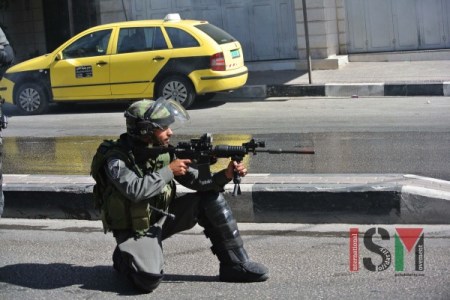
Hebron, Occupied Palestine – Violence broke out on the streets of Hebron’s university district (al-Khalil) this morning when Israeli soldiers opened fire on unarmed demonstrators who had been protesting the murders of two Palestinians earlier that day.
Protestors took to the streets after Marwan Kawasme, 29, and Amar Abu Aisha, 32, were killed and burned by Israeli soldiers in the very early hours of this morning. The Israeli military alleged that the two men were behind the deaths of the three settler teenagers in June of this year.
The soldiers used tear gas canisters and live ammunition bullets during the clashes, with numerous injuries including a 15-year-old boy who was shot in the head and is now in a critical condition in hospital. A representative of the Red Cross stated to ISM that there were over 30 injuries, though the exact number is still unknown.
The building where the murders took place was also set on fire and destroyed.
Tensions had been high all morning as word of the two dead Palestinians spread throughout the area. By 8 am around 200 Palestinian residents had gathered to show their frustration at the senseless taking of life. Although stones were thrown, the protesters were unarmed and did not pose a threat to the violent occupying military. The Israeli army, still present after the earlier incident, unleashed dozens of canisters of tear gas leaving many people unable to breath and in need of medical help. Hemmed in and with nowhere to escape to, the protestors hid behind what ever they could find.
The situation further deteriorated when the Israeli soldiers, without warning began to fire live bullets at the protestors, hitting one boy in the head and injuring a number of others.
After an hour of further violence by the Israeli soldiers, the protestors cleared and the injured were taken away.
Throughout the earlier afternoon however similar incidents of unrest were reported around Hebron (al-Khalil).
September 23, 2014
Posted by aletho |
Ethnic Cleansing, Racism, Zionism, Subjugation - Torture | Israel, Palestine, West Bank, Zionism |
Leave a comment

 Aletho News
 Aletho News