Human Rights Defender Abdallah Abu Rahma receives guilty verdict from military court
International Solidarity Movement | October 21, 2014
Bil’in, Occupied Palestine – On October 21st, Human Rights Defender Abdallah Abu Rahma was found guilty by an Israeli military court of “disturbing a soldier”.
“Demonstrating against the occupation cannot be a criminal offence. Finding Abdallah guilty only shows that the [Israeli] military force is a tool to perpetuate the occupation.” Stated Gabi Lasky, lawyer of Abdallah Abu Rahma, to the International Solidarity Movement (ISM).

Abdallah spoke to the ISM about his recent conviction. “Yesterday the military court ruled that I was guilty, showing once again that they stand on the side of the occupation, and not that of truth and justice.
I was arrested on the 13th of May 2012 in front of Ofer Military prison at a demonstration commemorating the Nakba and in solidarity with the prisoners, many of whom were on hunger strike. I was imprisoned in Ofer for 16 months a year earlier, for my role in the non-violent demonstrations in my village, Bil’in, against the Apartheid wall and settlements built on our land.
This time when I was arrested I was held for a few hours and released on bail, I was not summoned to court until the beginning of 2013, following the success of the popular committees in the construction of the Palestinians villages Bab Al Shams and Bab Al Manatir.”
Abdallah Abu Rahmah is the coordinator of the Bil’in popular committee, which began popular demonstrations against the Apartheid wall and settlements in January 2005. The route of the Apartheid wall originally planned to separate the village form 50% of its agricultural land. As a result of the village’s continued popular struggle, the route was changed and 25% of the village land was effectively annexed by the wall to the illegal settlement of Modiin Elite.
Hundreds of protesters have been arrested and injured by Israeli forces in Bil’in since the popular struggle in the village began. In 2009 during a demonstration, Bassam Abu Rahmah was shot directly in the chest with a high velocity tear-gas projectile, dying of his wounds minutes later. On Januray 1st 2011, Jawaher Abu Rahmah died of poisoning after inhaling excessive amounts of tear gas during the weekly demonstration the previous day.
Israel creates mock Jewish graves south of Aqsa Mosque
Palestine Information Center – 18/10/2014
 OCCUPIED JERUSALEM – The land research center said that the Israeli occupation authority (IOA) established fake graves in Silwan district, south of the Aqsa Mosque, as part of feverish steps to Judaize the Arab history and identity of the holy city.
In a report released on Friday, the center stated that Zionist settler groups in cooperation with the nature and parks authority planted tombs built of stone on a tract of Palestinian land located between Silwan district and the Umayyad Palaces area, south of the Aqsa Mosque.
It noted that the tombs, engraved with the Star of David, were made look like age-old ones and presented to tourists as Jewish graves built before 1948.
“Such step confirms once again that the occupation state is seeking on purpose to fake the history of Jerusalem in violation of the international norms and laws that demand it not to make changes to any land under its occupation,” the center underlined.
The center also warned that creating fake graves enables Israel to seize more areas in east Jerusalem.
Zoabi appeals against Israeli ban on Palestinian women entering Al-Aqsa
MEMO | October 16, 2014
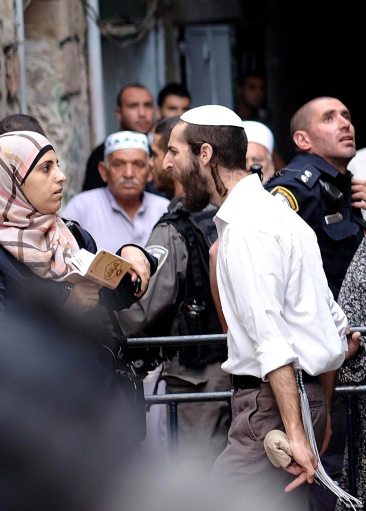 Arab Knesset Member Hanin Zoabi is to appeal against the Israeli police’s ban on Palestinian women from entering Al-Aqsa Mosque, the minister said today.
The Anadolu news agency reported a statement for Zoabi saying she had informed the Israeli police of her plan to appeal to the Israeli court against the “arbitrary” banning of women from entering the mosque.
She did not disclose with which court she was planning to file the appeal, but the process starts by filing an appeal to the magistrate court, then to the district court then to the High Court.
Zoabi described Israel’s ban on Palestinian women entering Al-Aqsa Mosque as a “dangerous precedent”, noting that the reason behind banning them is their role in “facing the settlers’ desecration of the mosque” in recent months.
For more than two months, Israeli police have banned women from entering the mosque from time to time. “They [Palestinian women] formed the front defence line against the Israeli violations and aggression on Al-Aqsa Mosque,” Zoabi said.
The Knesset member said she had sent a written letter to the Israeli Minister of Internal Security Yitzhak Aharonovich informing him of the “violations” committed by the Israeli police and Israeli border guards against women around and inside the holy site.
She noted in her letter that the violations and aggression on Palestinian women and banning them from entering into the mosque “undermines and ignores” their freedom. She also stressed that the lack of punishment against aggressors is a “green light” for more violations.
For about two months, the Israeli settlers, including extremist officials such as Knesset Deputy Speaker Moshe Feiglin have stormed Al-Aqsa Mosque on almost a daily basis.
Palestinians remain inside the mosque trying to prevent such aggressions, but the Israeli police and occupation forces took measures to secure the settlers including preventing women and men under the age of 50 from entering Al-Aqsa’s grounds.
Yesterday, 20 Palestinians, including women, were wounded in clashes in the mosque and seven others were arrested, including minors.
Ben & Jerry’s is Selling Ice Cream in Illegal Israeli Settlements
Vermonters for a Just Peace in Palestine/Israel
 |
This photo was taken in a supermarket in Gilo – an illegal Israeli settlement in occupied East Jerusalem – by an activist who documented the sale of Ben & Jerry’s ice cream in the settlements of Gilo (pop. 28,980), Pisgat Ze’ev (pop. 39,748) and Ma’ale Adumim (pop. 35,673), and in the industrial park of Mishor Edomim, which services Ma’ale Adumim. |
Ben & Jerry’s Caters to Illegal Israeli Settlements
In August, 2011, an Israeli Jewish activist working with us contacted Ben & Jerry’s factory in Israel, by e-mail and telephone, and confirmed that the company delivers ice cream to Israeli settlements in the occupied territory. Here is an e-mail communication, translated into English, between an employee at the factory and the Israeli activist, discussing arrangements for an ice cream cart to travel to the Israeli settlement of Ma’ale Adumim:
B&J Employee: Thanks for writing. Our ice cream cart comes with 5 flavors to choose from, glasses, wafers, ice cream toppings, 2 stewards and all accessories. The cost for 250 people (free distribution); 3,500 [NIS (Israeli Shekels), or $919 US] including VAT. Attached is a list of flavors. I’ll be happy to answer any questions.
Activist: Is there an extra cost that relates to the distance of your factory to the location of the party? i.e., is there an extra cost because the event is held in Ma’ale Adumin? I’m sorry about the need for detail but it’s necessary for our accounting department.
B&J Employee: Yes, the cost of transportation is 250 [NIS (Israeli Shekels), $65 US]. This is because we come from Be’er Tuvia (near Kiryat Malachi) to Ma’ale Adumim.
Israeli Settlements are Illegal Under International Law
Israel’s settlements in the Palestinian Territory violate Article 49(6) of the Fourth Geneva Convention, which declares that “the Occupying power shall not deport or transfer parts of its own civilian population into the territory it occupies.” The commentary to the Convention states that this provision was intended “to prevent a practice adopted during the Second World War by certain powers, which transferred portions of their own population to occupied territory for political and racial reasons or in order, as they claimed, to colonize those territory. Such transfers worsened the economic situation of the native population and endangered their separate existence as a race.”
Transfer of settlers to occupied territory by an occupying power is also an international war crime under Article 8(2)(b)(viii) of the 1998 Rome Statute of the International Criminal Court. Moreover, the UN Security Council and General Assembly, the High Contracting Parties to the Geneva Conventions, the International Committee of the Red Cross, and most legal scholars have concluded that Israel’s settlements in the oPt contravene international law. The International Court of Justice declared in a 2004 decision that “the Israeli settlements in the Occupied Palestinian Territory (including East Jerusalem) have been established in breach of international law.”
Ben & Jerry’s business in illegal Israeli settlements also violates its obligations under the U.N.’s “Norms on the Responsibilities of Transnational Corporations and Other Business Enterprises,” which asserts that corporations “shall not engage in nor benefit from war crimes, [or] crimes against humanity…” nor take actions that obstruct or impede economic, social, cultural, civil and political rights.
[Citations for the references above are in Our Report on Ben & Jerry’s business practices in the occupied Palestinian Territory.]
 |
The Israeli supermarket chain Shufersal distributes Ben & Jerry’s ice cream at stores both in Israel and in illegal settlements in the occupied Palestinian Territory.
The map at left, with dots denoting the locations of their stores, was displayed in their store in Mishor Adumim (an industrial zone that services one of Israel’s largest settlements, Ma’ale Adumim). Notice that it depicts Israel and occupied Palestine as one state. Palestinians under occupation are not allowed to enter most Israeli settlements, so the supermarkets in those places only sell Ben & Jerry’s ice cream to Jewish settlers. |
Vermonters for a Just Peace in Palestine/Israel Calls on Ben & Jerry’s to:
Until Israel ends its occupation and colonization of Palestinian lands in compliance with international law:
- End the marketing, catering and sales of Ben & Jerry’s products in Israel and Jewish-only settlements in occupied East Jerusalem and the West Bank.
- Stop manufacturing ice cream in Israel.
- Issue a statement (a) calling on Israel to end its occupation and settlement enterprise and (b) appealing directly to other socially responsible companies to do likewise and to cease business operations in Israel and its illegal settlements.
|
Click here to send a message to Ben & Jerry’s headquarters in Vermont. Tell Ben & Jerry’s that its complicity in Israel’s military occupation and illegal settlements is wrong and must stop! |
Boycott Divestment & Sanctions:
In Solidarity with the Palestinian People
Vermonters for a Just Peace in Palestine/Israel’s opposition to Ben & Jerry’s business practices in Israel and occupied Palestine is motivated by the grave human rights abuses being committed by the State of Israel. We are are also aware that in 2005 Palestinian civil society called for an international campaign of boycotts, divestment and sanctions (BDS) against Israel until it complies with three rights codified in international law.
- End Israel’s occupation and colonization of all Arab lands and dismantle its separation wall;
- Recognize the fundamental rights of the Arab-Palestinian citizens of Israel to full equality; and
- Respect, protect and promote the rights of Palestinian refugees to return to their homes and properties as stipulated in United Nations Resolution 194.
| Ben & Jerry’s CEO, Jostein Solheim, said in an interview:
“My mantra that I’ve repeated a hundred times since starting at Ben & Jerry’s is: ‘Change is a wonderful thing,’…. The world needs dramatic change to address the social and environmental challenges we are facing. Values led businesses can play a critical role in driving that positive change. We need to lead by example, and prove to the world that this is the best way to run a business. Historically, this company has been and must continue to be a pioneer to continually challenge how business can be a force for good and address inequities inherent in global business.” Vermonters for a Just Peace in Palestine/Israel agrees: The world – including Israel-Palestine |
Zionist settlers torch mosque near Nablus
Ma’an – 14/10/2014
 NABLUS – Israeli settlers set fire to a mosque in the Nablus-area village of Aqraba overnight, locals said.
Ghassan Daghlas, a Palestinian official who monitors settlement activity, told Ma’an that a group of settlers broke the doors and windows of the Abu Baker al-Saddiq mosque and vandalized the interior with racist slogans.
The settlers then set fire to part of the mosque before being chased away by Palestinian villagers.
Locals managed to extinguish the fire and prevent it from burning down the whole mosque.
In Jan. 2014, settlers torched a mosque in Salfit and sprayed “Arabs out!” on the building.
Settlers in the occupied West Bank attack Palestinians and their property routinely yet rarely face prosecution by Israeli authorities.
Jewish holiday leads to large influx of settlers, zionist tourists, and Israeli soldiers
International Solidarity Movement | October 12, 2014
Hebron, Occupied Palestine – Today in al-Khalil (Hebron), as part of the Jewish holiday of Sukkot, thousands of settlers and Zionist tourists descended upon the city. The Israeli military presence in Hebron, which is already a large and oppressive part of everyday life, greatly increased.

Hebron is the only city in the West Bank where there is an illegal settlement in the heart of the city. It is split into H1 and H2, H1 under Palestinian Authority Control, and H2 under Israeli military control.
This morning, in both the Salaymeh and Qeitun neighbourhoods, the checkpoints designating the end of H1 were extended further into Palestinian territory.


Israeli soldiers drove between Salaymeh and Qeitun, entering houses, hiding in alleyways, and aiming their guns at passing schoolchildren and other people in the area.

In the afternoon, the army presence was just as heavy, with children walking home past heavily armed soldiers.

In H1, Bab al-Zawiye (the centre of Hebron), Israeli forces partially closed the road to allow settlers and Zionist tourists through the checkpoint to visit a religious holy site.


They were escorted by approximately 45 Israeli border police and soldiers. Several Palestinian shops were forced to close for several hours, to allow the setters and tourists to pass.

The Ibrahimi mosque and nearby checkpoint was also closed today, with all Palestinian shops in the area forced to close with it.
Israeli troops seize Hebron home for military post
Ma’an – October 12, 2014
HEBRON – Israeli soldiers raided a private Palestinian home in Hebron on Sunday morning and turned the third floor of the house into a military post, the owner said.
Salim al-Salayma told Ma’an that Israeli troops broke into his house in the al-Baqaa neighborhood in eastern Hebron and locked him and his 17 family members on the first floor.
While the family was locked on the first floor, al-Salayma said, Israeli soldiers brought military equipment to the third floor, turning it to a military post.
An Israeli military spokeswoman did not immediately return calls seeking comment.
Israeli forces regularly occupy the homes of Palestinian civilians in the West Bank located in what they deem sensitive areas to conduct surveillance and enforce control.
Jewish settlers burn olive trees in Salfit, perform Talmudic rituals in ancient Suleiman pools
Palestine Information Center – 11/10/2014
 SALFIT – A group of Israeli settlers have burned and vandalized Friday evening a number of olive trees in Yassouf town in Salfit under Israeli occupation forces protection.
Local sources confirmed that Palestinian farmers confronted the settlers and prevented further damage to their olive groves located near Tafuh settlement.
Israeli settlers and forces have daily carried out systematic attacks against olive groves especially during olive harvest in order to prevent the farmers from picking their own fruits.
Meanwhile, dozens of Israeli settlers stormed Friday morning Suleiman pools south of Bethlehem in the West Bank, local and media sources said.
The sources pointed out that the settlers performed Talmudic rituals in the ancient pools area in total provocation to the local residents.
WAFA news agency quoted a Palestinian security source as saying that 70 settlers from Efrat settlement stormed the pools area under heavy Israeli forces protection and started performing their rituals.
Israeli settlers used to storm Suleiman pools in an attempt to impose a status quo in the area.
The pools, which were built by the Ottoman Sultan Suleiman, are located between Artas and Al-Khader villages south of Bethlehem.
Settlement organisation entices Jews into Jerusalem settlement for $136 per day
MEMO | October 3, 2014
The Ir David Foundation, known as Elad, has published an announcement on social media networks in search of Jewish settlers to live in Palestinian homes that it has captured in the town of Silwan, occupied East Jerusalem, in return for a financial reward estimated at 500 shekels ($136) per day, Israel’s Haaretz newspaper reported on Wednesday.
Elad is known for its Judaisation projects of the city of Jerusalem. According to the association’s advertisement, an amount of 500 shekels will be given to each settler who agrees to live in one of the homes that have been seized, with the settler only required to “keep his gun loaded and ready to fire at any time”, according to the declaration.
Haaretz quoted one of the advertisements as follows: “We are looking for people who can stay in the apartments and watch them until families move into them. The work will probably take ten to 30 days (perhaps even more). The daily wage is 500 shekels gross. The workers will stay in the apartments and guard them until they are inhabited by families. Only suitable applicants will be accepted. Please pass this on to friends.”
The following day, the newspaper reported that when asked about the details on what the job entails, an Elad official said: “You’re not the security guard … There are security guards and police when needed, and there’s someone to supervise you and call to make sure everything is all right all the time. We don’t need you as a security guard. As far as we’re concerned, you live in the house, but it’s better if you have a weapon.”
The official also stressed that Elad would be the employer. “I think the payment would be by bank transfer,” she said. “You come and fill out forms.”
With the assistance of armed guards, the Foundation seized, overnight on Monday, ten individual buildings that include 23 apartments in the Wadi Hilweh neighbourhood of Silwan, located just south of Al-Aqsa Mosque, claiming that the settlers now own them.
Silwan has been witnessing continuous and tense confrontations with Israeli occupation forces ever since the seizure of the Palestinian homes, with Israeli police and armed forces present in the streets around the clock to protect the settlers.
Featured Video

ARE PATIENTS BEING PROPERLY INFORMED ABOUT OZEMPIC?
or go to
Aletho News Archives – Video-Images
From the Archives
Trans ‘milk’ as good as the real thing – NHS
RT | February 18, 2024
The drug-induced nipple secretions of trans women are as good as mothers’ breast milk for babies, the University of Sussex Hospitals NHS Trust claimed in a letter to campaigners made public in a report by British think tank the Policy Exchange on Sunday.
The healthcare trust’s medical director, Rachel James, argued that the off-label prescription drug cocktail men transitioning to female take in order to produce milk was “similar to the natural hormones which encourage lactation to develop when the baby is newly born.”
“The evidence which is available demonstrates that the milk is comparable to that produced following the birth of a baby,” James wrote in the letter, sent to Children of Transitioners last August.
Biological men who wish to lactate must first take hormones to grow milk glands and then take high doses of either domperidone or metoclopramide to stimulate milk production. Neither drug is approved for this use, though they are occasionally prescribed off-label to biological women who have trouble lactating.
However, domperidone’s own manufacturer, Janssen, warns patients the drug “may cause unwanted side effects affecting the heart in a breastfed baby” and “should be used during breastfeeding only if your physician considers this clearly necessary.” … continue
Blog Roll
 Aletho News
- 2025 Nature Paper Claiming Worsening Global Drought Gets RETRACTED …Heavily Flawed
- Your Milk Is Not the Problem
- The Truth About the Trump Shootings with Ken Silva
- ARE PATIENTS BEING PROPERLY INFORMED ABOUT OZEMPIC?
- US lawmaker blocks $2.8 billion weapons sale to Israel: Report
- Yemeni army claims responsibility for strikes on sensitive sites in Saudi capital, Aramco facilities in Yanbu
- Iran Judiciary issues indictments against 159 US, Israeli officials for assassination of Leader, commanders
- Turkiye revokes Iranian bank license under US sanctions campaign
- US-Denmark Agreement on Greenland Is ‘PR Stunt’ Ahead of Midterms
- Araghchi: Military intervention cannot create security; coercion cannot bring peace
- If Americans Knew
- Israeli attacks kill four Palestinians in Gaza – Daily Update
- Inside Gaza’s death trap of collapsing, bombed-out buildings
- The everyday items Israel bans from Gaza every day
- Inside the siege, the ruined buildings of Gaza – Daily Update
- Debunking The Claim That Macklemore Has A “History Of Antisemitism”
- CPJ demands release of arrested Palestinian-US journalist near Bethlehem
- Robert Kraft: The Billionaire Friend of Netanyahu Pulling The Strings Behind the Macklemore/Ed Sheeran Blow Up
- Columbia Administered Fund Gives Big Money to Pro-Israel Groups
- Deportation Case of Palestinian Activist Salah Sarsour Tests First Amendment
- ‘We Will Not Forget’: Palestinians Mark 44 Years since Sabra and Shatila
- No Tricks Zone
- 2025 Nature Paper Claiming Worsening Global Drought Gets RETRACTED …Heavily Flawed
- New Study: ‘Global Drought Shows No Detectable Recent Acceleration Under Climate Warming’
- Economic Masterminds: German Socialists Suggest Taxing Productivity Gains Stemming From Using AI
- The South China Sea Has Not Been Cooperating With The Climate Change Narrative
- Energy Crisis: Germany Enters Heating Season With Historically Low Gas Reserve Fill Levels
- New Study: The Antarctic Ice Sheet Gained Mass From 2020-2024 Due To Staggering Snow And Ice Accumulation
- Study: Ocean Heating Rates From Thousands Of Years Ago ‘Dwarf’ Modern Ocean Heating Rates
- Climate Extremists Target, Attack Large-Scale Power Grid Infrastructure In Germany!
- New Study: Antarctic Ice Melt Has Contributed Less Than 1 Centimeter To Sea Level Rise In The Last 30 Years
- Fear Of Debate: Alarmist German Climate Scientist Calls On Mainstream Media To Discredit Skeptic Voices
 Aletho News