UN rights expert says Israel’s ‘self-defense’ claim in Gaza ‘untenable’, urges accountability
MEMO | September 30, 2014
A top UN rights expert has expressed alarm at the impact of Israel’s attack on Gaza for civilians, concluding that “Israel’s claim of self-defense against an occupied population living under a blockade considered to be illegal under international law is untenable.”
Makarim Wibisono, Special Rapporteur on the situation of human rights in the Palestinian territories occupied since 1967, spoke Monday at the end of his first mission to the region.
In a press release, Wibisono stated that the Israeli military killed almost 1,500 civilians, including more than 500 children, with “a staggering 11,231 Palestinian civilians, including 3,436 children” injured and many “now struggling with life-long disabilities”.
Tens of thousands of children live with the trauma of having witnessed the horrific killings of family members, friends, and neighbours before their own eyes.
Wibisono, echoing similar and even stronger conclusions by the likes of Amnesty International and the International Committee of the Red Cross, said that “this raises serious questions about possible violations of international humanitarian law and human rights law.”
Wibisono related three demands from Palestinians: “the need for accountability, an end to the blockade, and an end to the occupation”. Affirming this call, the UN official said that “those responsible for violations of international law must be brought to justice in order to avoid yet another round of deadly violence in the near future”.
The Special Rapporteur had a special focus on children in Gaza, noting that “there wasn’t a single child…who has not been adversely affected”. Wibisono pointed to an estimated 7,000 unexploded ordinances “littered across” the territory, and described how over “50 days of relentless bombing and shelling”, some 228 schools were damaged, including 26 destroyed or damaged beyond repair.
According to Wibisono, around 60,000 Palestinians remain in 19 shelters in the Gaza Strip, while medical professionals report a “critical shortage” of medicines and equipment. “Israel must immediately lift the seven year land, sea and air blockade of Gaza”, Wibisono urged, “and urgently allow needed materials for reconstruction and recovery.”
The Special Rapporteur also spoke to the “excessive use of force” used by Israeli forces in the Occupied West Bank over the summer, “noting that during the period from 12 June to 31 August 2014, a total of 27 Palestinians were killed, of whom five were children, with the youngest victim only 11 years-old.” Wibisono stressed that “the use of live ammunition against Palestinians even if they were throwing stones, is unjustifiable.”
The Special Rapporteur will report fully on his findings and recommendations to the 28th session of the Human Rights Council in March 2015.
Israeli forces clash with Palestinians after Zionist settlers storm into Al-Aqsa Mosque
Al-Akhbar | September 24, 2014
Clashes erupted Wednesday between Palestinians and Israeli forces in Al-Aqsa Mosque compound in occupied East Jerusalem after dozens of Zionist settlers– led by two government ministers and backed by Israeli police – forced their way into the holy compound, a Palestinian guard of the complex said.
“Ninety-three settlers protected by 40 Israeli police and special forces forced their way into the holy compound through the Al-Magharbeh Gate,” the guard, who asked not to be named, told Anadolu Agency.
 He added that “at least 20 Palestinians were injured and five others arrested.”
The Zionist settlers were accompanied by Israeli Housing Minister Uri Ariel and Internal Security Minister Yitzhak Aharonovitch, in addition to several Jewish extremist leaders.
In response, some 300 Palestinian Muslim worshipers converged near the Al-Qibali and the Dome of the Rock mosques to protest the intrusion, the guard said.
In a bid to disperse angry Palestinians, Israeli forces fired rubber bullets and teargas, he added.
“At least 16 Palestinians were injured by rubber bullets, including one in the head and two in the abdomen. Around 45 others suffered teargas inhalation,” the guard said.
According to Sheikh Omar al-Qiswani, the Palestinian director of the Al-Aqsa complex, the two ministers took a tour of the compound’s courtyards, passing by the Dome of the Rock, Qibali and Marawani mosques before leaving through the Al-Rahmeh Gate.
Israeli security forces withdrew from the compound after the clashes, the guard said.
“Israeli police and army troops pulled out of the compound after attacking Palestinian worshipers,” he said.
Israeli police have stepped up security at the gates of the Al-Aqsa complex for the second day in a row, barring a number of Palestinians from entering the compound, al-Qiswani said.
“Except for the Al-Magharbeh Gate, where [Jewish] settlers regularly force their way into the complex, the Israeli police closed all other gates with chains,” al-Qiswani said.
Jews will celebrate “Rosh Hashanah” on Wednesday, which will mark the first day of the new Jewish year of 5775.
Groups of extremists called for marking the holiday by storming the Al-Aqsa compound and performing Talmudic rituals.
In recent months, groups of extremist Zionist settlers, often accompanied by Israeli security forces, have stepped up their intrusions into the Al-Aqsa Mosque complex, the world’s third holiest site for Muslims.
For Muslims, Al-Aqsa represents the world’s third holiest site. Jews, for their part, refer to the area as the “Temple Mount,” claiming it was the site of two prominent Jewish temples in ancient times.
Israel occupied East Jerusalem during the 1967 Middle East War. It later annexed the holy city in 1980, claiming Jerusalem as the unified capital of the self-proclaimed Jewish state – a move never recognized by the international community.
In September 2000, a visit to the site by controversial Israeli leader Ariel Sharon sparked what later became known as the “Second Intifada” – a popular uprising against the Israeli occupation in which thousands of Palestinians were killed and injured.
(Anadolu, Al-Akhbar)
‘Made in Palestine’: New sales pitch for marketing Israeli products
MEMO | September 23, 2014
Along one of the roads in the city of Ariha in the north of the occupied West Bank, merchants Khaldoun and Hassan regularly receive 30 tons of dates produced in the neighbouring Israeli agricultural settlements, in preparation for their transfer to one of the packaging factories built on the outskirts of the city, Anadolu news agency reported.
Inside the factory, about 13 minors are working on “screening” the dates and repackaging them in bags that read “dates of the Holy Land” in both Arabic and English and “Made in Palestine” in order to market them locally, in the Arab states and in Europe.
This is what one of the farms that is owned by Israeli settlers does in order to market its produce of dates to customers of European Union countries after the enforcement of a decision earlier this year to boycott any products of settlements in the West Bank.
Anadolu cited a statement issued by the Palestinian national economy minister saying that members of the ministry have found dozens of tons of produce coming from the settlements in this way, on its way to either the local market or to the packaging factories in the city of Ariha and the neighbouring villages.
Merchant Khaldoun, 45 years, told Anadolu’s reporter, “We do trade in dates of the settlements, which we buy at prices that are 40 per cent lower than the market price. And in order to be able to market the dates, we clean and re-package them and choose the best in preparation for selling them in the local market, as well as the Arab and European markets.”
He added that the annual volume of his seasonal sales of dates is nearly 350 tons, pointing out that other merchants who work in this field and in other varieties of vegetables and fruits, such as citrus fruits, nuts, and medical herbs have similar practices.
His fellow trader Hassan said that he has a licensed company that is registered officially. The export process takes place after the official bodies check the quality and specifications of the product, ensuring the product’s conformity with European specifications and international standards. It is then exported under the “Made in Palestine” label.
The minister of economy said in its statement that any truck carrying dates must also be carrying a transfer permit to move the dates from inside the farm of production to the factory that will process the packaging, noting that it has begun to take stricter steps over the trade of dates through listing the names of the farmers who grow dates, the number of trees they own and their annual average production.
Palestine enjoys customs exemptions and export-related facilities in trade with the countries of the European Union, so the Israeli companies cooperate with Palestinian merchants to export the dates produced in the settlements illegally established in the West Bank to the European Union, while benefiting from such exemptions.
In the beginning of 2014, the European Union announced its decision to boycott economic, scientific and academic relations with institutions, factories and farms that have any investments or presence in the Israeli settlements established in the occupied Palestinian territories.
Earlier, the ministry of economy confiscated more than 20 tons of corrupt and damaged dates coming from the Israeli settlements while on their way to one of the factories for repackaging to later sell them as a product of Palestine.
Two Palestinians shot dead by Israeli forces lead to clashes with over 30 injured
International Solidarity Movement | September 23, 2014
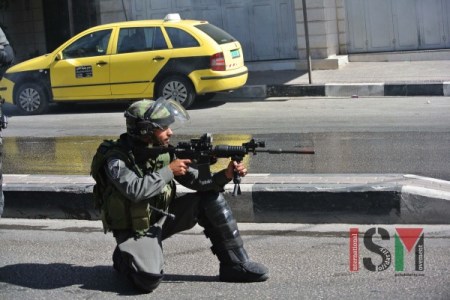
Hebron, Occupied Palestine – Violence broke out on the streets of Hebron’s university district (al-Khalil) this morning when Israeli soldiers opened fire on unarmed demonstrators who had been protesting the murders of two Palestinians earlier that day.
Protestors took to the streets after Marwan Kawasme, 29, and Amar Abu Aisha, 32, were killed and burned by Israeli soldiers in the very early hours of this morning. The Israeli military alleged that the two men were behind the deaths of the three settler teenagers in June of this year.
The soldiers used tear gas canisters and live ammunition bullets during the clashes, with numerous injuries including a 15-year-old boy who was shot in the head and is now in a critical condition in hospital. A representative of the Red Cross stated to ISM that there were over 30 injuries, though the exact number is still unknown.
The building where the murders took place was also set on fire and destroyed.
Tensions had been high all morning as word of the two dead Palestinians spread throughout the area. By 8 am around 200 Palestinian residents had gathered to show their frustration at the senseless taking of life. Although stones were thrown, the protesters were unarmed and did not pose a threat to the violent occupying military. The Israeli army, still present after the earlier incident, unleashed dozens of canisters of tear gas leaving many people unable to breath and in need of medical help. Hemmed in and with nowhere to escape to, the protestors hid behind what ever they could find.
The situation further deteriorated when the Israeli soldiers, without warning began to fire live bullets at the protestors, hitting one boy in the head and injuring a number of others.
After an hour of further violence by the Israeli soldiers, the protestors cleared and the injured were taken away.
Throughout the earlier afternoon however similar incidents of unrest were reported around Hebron (al-Khalil).
Israeli forces detain 11 Palestinians overnight, 152 last week
Ma’an – September 21, 2014
RAMALLAH – Israeli forces detained 11 Palestinians overnight and a total of 152 during the third week of September, a rights group said Sunday.
The Palestinian Prisoner’s Society said in a statement that Israeli soldiers raided Jenin overnight and detained Mahmoud Tawfiq Yahya.
In the Bethlehem district, forces detained Hamza Maali, Muhammad Maali, and Baha al-Teen.
Additionally, in Hebron, Wahid Sabarna, Faris al-Titi, Ahmad al-Qaqasmeh, and Muhammad al-Adra were arrested overnight, the statement said.
Soldiers also detained three Palestinians in the Nablus district — university lecturer Raed Abu Badawiyya, human rights activist Abd al-Rahman Rihan, and Fahd Sharaya.
Israeli forces have detained 152 Palestinians across the West Bank last week — 50 in Hebron, 40 in Jerusalem, 17 in Bethlehem, 16 in Ramallah, seven in Jenin, six in Tulkarem, six in Nablus, and ten in Salfit and Tubas, according to PPS.
Palestinian school set on fire
International Solidarity Movement | September 21, 2014
As-Sawia, Occupied Palestine – On the evening of the 10th September, unknown assailants broke into the As-Sawia Secondary School, forced open the door and set the school on fire. Bedouins living close to the school saw the fire and alerted the fire brigade. By the time it was put out, the principal’s office and teachers’ rooms were completely burned.


“We lost six computers, four printers, all the teachers’ books and materials, but most of all, the administrative documents and files of the students and about the school situation over the past years. The whole damage is around 140,000 shekels,” the principle Adnan Hussein told ISM. The school was closed for three days after the arson attack.


As in many schools in the occupied West Bank, the students and staff of As-Sawia Secondary School suffer from constant settler and military harassment. Three days before the arson, armed settlers who called themselves “security” from one of the nearby hilltop illegal settlements stood at the school gates. When the principal spoke to them, they claimed that children threw stones at the settler cars on their way to school.
The school is located by Road 90, which was paved in 1944 and runs across the West Bank. The road is used by Palestinians and by illegal settlers. The children have to walk alongside it to get to school in the mornings and to go home after school.
“Our school is suffering both for the settlers and the army,” explained Hussein. “We constantly have the army at our gates, checking ID’s and bothering children”
On the 3 September, armed settlers stopped in a car marked as the illegal settlement Eli’s “security” at the gate of the school. One of the settlers came out of the car, jumped over the fence and started following some of the children, who have finished their classes and were leaving for home. The principle approached the settler and told him that he is not allowed in the school with weapons, and the settler responded that he was looking for a child who threw stones and shouted at the settler car earlier.
After agreeing to move outside the school gate at the head teacher’s insistence, the settler with the machine gun was joined by another settler and they insisted that the boy in the red T-shirt was brought to them. They also wanted the head teacher’s mobile phone number so that they could call him in the future.
“I had a bad feeling that something horrible will happen and that they will start shooting,” related Hussien. “I left some teachers with the settlers and with other teachers went to escort children through another gate and send them home, when three soldiers appeared. I went to speak to them. I told them that they cannot be in school with their weapons and in their uniforms but they insisted that they wanted to speak to a boy in the red T-shirt for 10 minutes.”
The principal and staff stood between the soldiers and settlers and the pupils to protect them while they were leaving the school. By this time worried parents were at the gate and they took the children away.
Throughout 2013, the army entered the As-Sawiya 51 times and children and the staff had to put up with teargas, sound bombs and arrests of pupils.
Hussein explained, “It is a constant worry that the settlers and the army will come. It is hard enough to control 350 teenagers even in the countries where there is no occupation. It is not easy and we do what we can to try to do our best keep the education for our children going. We have no problem with Jewish people and I can say that many of them are nice and honest, but settlers are generally dangerous people. I know that people should be able to choose where they live, but that does not include taking someone else’s land without permission.”
Indictment in case of US citizen beaten by Israeli soldiers an anomaly
By Jessica Purkiss | MEMO | September 16, 2014
Last Wednesday Israeli Police filed an indictment against an officer who was filmed beating Tariq Abu Khdeir, a 15 year old Palestinian-American teenager from Florida. He was beaten and arrested during a demonstration to protest the brutal murder of his cousin Mohammed Abu Khdeir. On 2nd July 16 year old Mohammed was abducted and burned alive by Israeli extremists in supposed revenge for the killing of three Israeli teenagers.
Tariq’s bruised face caused outrage in the United States and the State Department called for a “speedy, transparent and credible investigation and full accountability for any excessive use of force” used against the American teen. As a result of mounting pressure from the US, Tariq was released and able to fly home just under two weeks after the ordeal.
Speaking at a press conference following the news of the charges filed, Abu Khdeir and his mother called it “groundbreaking.” Suha Abu Khdeir, the boy’s mother, said it was “a shame that in order for [Israeli authorities] to take action it had to be an American citizen that this happened to.” They believe that the charges were only filed because the incident was recorded and because Tariq is a citizen of the United States.
In sharp contrast, at the time US pressure was mounting for the soldiers behind Tariq’s beating to be held accountable, Israeli General Danny Efrni, closed the investigation into the killing of Yousef Sami Shawamreh.
In March, Yousef and his two friends had gone to pick the thistle like plant gundelia which farmers from his village in the South of Hebron harvest at the same time every year, when he was fatally shot in the hip by an Israeli soldier.
According to the army, three Palestinians approached the fence and started cutting it. The guards performed the standard procedure for stopping a suspect, shooting first in the air and then toward the Palestinian. According to local residents, the separation wall annexed some of the villages land, including the land of Shawamreh family, and so the boys had crossed over to harvest the crop on the other side of it, a routine that the soldiers were aware of.
The two boys who were with Yousef claim they heard three shots, causing them to get down on the floor. Yousef then reportedly got up to cross back over into the village, when another shot was fired causing him to fall. One of the boys, Muntaser, attempted to carry him to safety, but was told by 6 soldiers who arrived at the scene to put Yousef down, threatening to shoot him if he did not obey.
The prosecution, however, found that, “the force prepared for the operation professionally and acted in line with rules for opening fire”- concluding there was no suspicion of a criminal act on their part.
Yousef’s case joins the hundreds of cases that fail to end in an indictment. An Amnesty International report found that 41 Palestinians had been killed by live ammunition in the West Bank between 2011 and 2013 alone. The same report found that between September 2000 and June 2013, only 16 investigations ended in indictment of Israeli soldiers.
According to statistics released last week rights group Yesh Din, in 2013, out of the 239 notifications submitted to the Military Police Criminal Investigations Division (MPCID), the body which deals with complaints regarding offenses committed by Israeli Defence Force (IDF) soldiers, only six resulted in indictments.
Neta Patrick, Executive Director of Yesh Din said: “Every year, we caution against the sorry state of the investigation system. However, it appears that Israel refuses to deal with these structural failings or take minimal steps to correct them, despite harsh criticism voiced by public commissions and by civil society organizations.”
She added: “The inescapable conclusion is that the Government of Israel is not willing to investigate harm caused to Palestinians.”
Israeli settlers attack internationals and a Palestinian shepherd
Operation Dove | September 15, 2014
At Tuwani – On September 14th, two Israeli settlers attacked a Palestinian shepherd and two international near the Israeli outpost of Mitzpe Yair, in the South Hebron Hills area. During the aggression, the settlers stole video cameras from the internationals and broke one of their phones. Israeli police detained the Palestinian shepherd and one of the internationals for six hours. There were no consequences for the settlers.
At about 9:00 a.m. four Palestinian shepherds from the South Hebron Hills village of Qawawis were grazing their flocks accompanied by two internationals, on Palestinian owned land nearby the Israeli outpost. Two settlers from Mitzpe Yair crossed a closed area (where the access is forbidden to everyone else) in order to attack one Palestinian shepherd, starting to chase away his flock. The two internationals present taped the scene.
Afterwards the settlers assaulted the internationals: at first they grabbed one by the neck and knocked him down, they snatched his camera and broke his phone; subsequently the settlers attacked the other one twisting her arm and also seizing her camera. The settlers ran back to the outpost holding the stolen cameras, and the Palestinian and the internationals went to Qawawis village.
The Israeli police came to the Palestinian village and asked the shepherd and internationals to follow them to the Israeli Police station in Kiryat Arba settlement, due to one settler claiming that they threw stones at him. The Police officers detained both of them for six hours and questioned them about the incident. Israeli police released them at 5:00 p.m. without consequences.
The South Hebron hills area has suffered from the presence of Israeli settlers’ since the 70′s. Eight Israeli settlements and outposts (among which Mitzpe Yair is one) almost completely isolate 16 Palestinian villages from the rest of West Bank. The settlers’ violence includes overt violent attacks on Palestinians and their animals, damages to private properties, and limitations to freedom of movement with many consequences on their daily life. Since the beginning of 2014, Operation Dove registered the arrests of 15 Palestinians, including minors, because they were on lands near the settlements. During the same period there were no consequences for Israeli settlers involved in the incidents occurring in the area.
In spite of the violence suffered by the Palestinians from the South Hebron Hills area, they keep on grazing and farming on their lands, resisting in a non-violent way to the Israeli occupation.
Operation Dove has maintained an international presence in At-Tuwani and the South Hebron Hills since 2004.
[Note: According to the Fourth Geneva Convention, the Hague Regulations, the International Court of Justice, and several United Nations resolutions, all Israeli settlements and outposts in the Occupied Palestinian Territories are illegal. Most settlement outposts, including Havat Ma’on (Hill 833), are considered illegal also under Israeli law.]
127 Palestinians Detained in Past Week
IMEMC News & Agencies | September 7, 2014
 Israeli forces took at least 127 Palestinians across the occupied West Bank into custody, during the first week of September alone, according to recent statements by the Palestinian Prisoner’s Society (PPS).
PPS said, according to Ma’an news, that most detainees came from the Hebron district, where 28 Palestinians were taken by Israeli forces.
PPS further stated that 23 of the detainees were from the Jenin district, in the northern West Bank, 21 from Ramallah, 20 from Jerusalem, 12 from Bethlehem, eight from Tulkarem, six from Nablus, three from Qalqiliya, and six from the Tubas/Salfit district.
Israeli forces abducted 10 Palestinians overnight, on Saturday, seven of whom were taken from Hebron, with one from Bethlehem, and two from Beit Sira village, western Ramallah district.
More than 7,000 Palestinians are currently being held in Israeli prisons, including some 2,000 detained during the massive arrest campaigns which have taken place over the last three months.
See also — 08/31/14 PPS: 597 Palestinians Arrested During August
Featured Video

ARE PATIENTS BEING PROPERLY INFORMED ABOUT OZEMPIC?
or go to
Aletho News Archives – Video-Images
From the Archives
Trans ‘milk’ as good as the real thing – NHS
RT | February 18, 2024
The drug-induced nipple secretions of trans women are as good as mothers’ breast milk for babies, the University of Sussex Hospitals NHS Trust claimed in a letter to campaigners made public in a report by British think tank the Policy Exchange on Sunday.
The healthcare trust’s medical director, Rachel James, argued that the off-label prescription drug cocktail men transitioning to female take in order to produce milk was “similar to the natural hormones which encourage lactation to develop when the baby is newly born.”
“The evidence which is available demonstrates that the milk is comparable to that produced following the birth of a baby,” James wrote in the letter, sent to Children of Transitioners last August.
Biological men who wish to lactate must first take hormones to grow milk glands and then take high doses of either domperidone or metoclopramide to stimulate milk production. Neither drug is approved for this use, though they are occasionally prescribed off-label to biological women who have trouble lactating.
However, domperidone’s own manufacturer, Janssen, warns patients the drug “may cause unwanted side effects affecting the heart in a breastfed baby” and “should be used during breastfeeding only if your physician considers this clearly necessary.” … continue
Blog Roll
 Aletho News
- 2025 Nature Paper Claiming Worsening Global Drought Gets RETRACTED …Heavily Flawed
- Your Milk Is Not the Problem
- The Truth About the Trump Shootings with Ken Silva
- ARE PATIENTS BEING PROPERLY INFORMED ABOUT OZEMPIC?
- US lawmaker blocks $2.8 billion weapons sale to Israel: Report
- Yemeni army claims responsibility for strikes on sensitive sites in Saudi capital, Aramco facilities in Yanbu
- Iran Judiciary issues indictments against 159 US, Israeli officials for assassination of Leader, commanders
- Turkiye revokes Iranian bank license under US sanctions campaign
- US-Denmark Agreement on Greenland Is ‘PR Stunt’ Ahead of Midterms
- Araghchi: Military intervention cannot create security; coercion cannot bring peace
- If Americans Knew
- Israeli attacks kill four Palestinians in Gaza – Daily Update
- Inside Gaza’s death trap of collapsing, bombed-out buildings
- The everyday items Israel bans from Gaza every day
- Inside the siege, the ruined buildings of Gaza – Daily Update
- Debunking The Claim That Macklemore Has A “History Of Antisemitism”
- CPJ demands release of arrested Palestinian-US journalist near Bethlehem
- Robert Kraft: The Billionaire Friend of Netanyahu Pulling The Strings Behind the Macklemore/Ed Sheeran Blow Up
- Columbia Administered Fund Gives Big Money to Pro-Israel Groups
- Deportation Case of Palestinian Activist Salah Sarsour Tests First Amendment
- ‘We Will Not Forget’: Palestinians Mark 44 Years since Sabra and Shatila
- No Tricks Zone
- 2025 Nature Paper Claiming Worsening Global Drought Gets RETRACTED …Heavily Flawed
- New Study: ‘Global Drought Shows No Detectable Recent Acceleration Under Climate Warming’
- Economic Masterminds: German Socialists Suggest Taxing Productivity Gains Stemming From Using AI
- The South China Sea Has Not Been Cooperating With The Climate Change Narrative
- Energy Crisis: Germany Enters Heating Season With Historically Low Gas Reserve Fill Levels
- New Study: The Antarctic Ice Sheet Gained Mass From 2020-2024 Due To Staggering Snow And Ice Accumulation
- Study: Ocean Heating Rates From Thousands Of Years Ago ‘Dwarf’ Modern Ocean Heating Rates
- Climate Extremists Target, Attack Large-Scale Power Grid Infrastructure In Germany!
- New Study: Antarctic Ice Melt Has Contributed Less Than 1 Centimeter To Sea Level Rise In The Last 30 Years
- Fear Of Debate: Alarmist German Climate Scientist Calls On Mainstream Media To Discredit Skeptic Voices
 Aletho News