Jewish settlers beat Israeli activist protecting Palestinians
Ma’an – 09/02/2014
BETHLEHEM – Footage released by a rights group on Saturday appears to show Jewish settlers beating an Israeli activist as he tries to defend Palestinian farmers while Israeli soldiers look on.
The videos released by joint Israeli-Palestinian human rights group Ta’ayush show an Israeli activist who has accompanied Palestinians to their farm lands in the village of Khirbet Shuweika in the South Hebron Hills being assaulted by Jewish settlers.
The videos, which could not be independently verified, also show that after the settlers have beaten the activist, an Israeli soldier approaches the settlers but pats one of them on the back and does not attempt to detain or reprimand them in anyway.
According to Israeli alternative news website +972, the assault occurred around 11 a.m. on Saturday.
An Israeli activist affiliated with Ta’ayush had accompanied local Palestinians after they had been prevented from reaching their lands numerous times in recent weeks by local settlers, even though Israeli authorities recognize the area as private Palestinian land.
The Jewish settlers were from the nearby Eshtemoa outpost, and according to an activist affiliated with the group, none of them were detained by Israeli forces.
Following the attack, the activist went to the Kiryat Arba police station and Israeli authorities said an investigation would be launched into the incident.
Israeli news site Haaretz quoted an IDF spokesperson as saying that the video was “tendentiously edited,” and that Israeli soldiers on the scene had acted to “distance” the settlers and call on police to investigate the incident, as per protocol, according to +972.
In 2013, there were 399 incidents of settler violence against Palestinians in the occupied West Bank, according to the UN Office for the Coordination of Humanitarian Affairs.
In the last week alone, hundreds of olive trees across the West Bank have been chopped in a number of incidents targeting Palestinian farmers’ livelihoods.
Related articles


Israel demolished 27 Jordan Valley homes in January

Ma’an – 07/02/2014
BETHLEHEM – Israeli forces destroyed 27 homes in the occupied Jordan Valley in January, according to Israeli rights group B’Tselem, leaving 147 people homeless.
Nearly half of those displaced were children and 65 people lived in communities that had been demolished more than once by Israel, B’Tselem said.
On Wednesday, the International Committee of the Red Cross said it would stop providing tents to Palestinians whose homes had been demolished in the Jordan Valley because Israel would often confiscate them.
Last week, the UN humanitarian coordinator for the Palestinian territories criticized Israel’s demolition of Palestinian homes in the Jordan Valley.
“I am deeply concerned about the ongoing displacement and dispossession of Palestinians … along the Jordan Valley where the number of structures demolished more than doubled in the last year,” James Rawley said in a statement.
“This activity not only deprives Palestinians of access to shelter and basic services, it also runs counter to international law.”
The number of structures demolished by the Israeli authorities in the Jordan Valley in 2013 more than doubled, from 192 in 2012 to 393 in 2013.
Israel has said in recent negotiations that it is not willing to compromise security in the Jordan Valley, which forms a third of the occupied West Bank.
Over 90 percent of the Jordan Valley is designated as Area C, with illegal settlements controlling up to 50 percent of the land area.
Canadian multiculturalism minister Jason Kenney buys SodaStream unit in jab at Oxfam
Al-Akhbar | February 4, 2014
The employment minister of Canada, a strong supporter of Israel, has waded into the spat over Oxfam breaking with US actress Scarlett Johansson for endorsing an Israeli soft drink firm that operates in the occupied West Bank.
Minister Jason Kenney, who is also minister of multiculturalism in Canada, extended an ironic thank you to Oxfam for bringing the Israeli firm SodaStream to his attention.
Last week Johansson made headlines when she quit her role as Oxfam ambassador after the NGO said her promotion of SodaStream was “incompatible” with her role at the international aid agency.
SodaStream, which manufactures machines for making carbonated drinks at home, has 25 factories around the world, including one that operates in a settlement east of Jerusalem.
“Bought a nice SodaStream unit at the HudsonsBayCo. Thanks to Oxfam for the tip,” the minister said in a tweet.
The minister’s message also featured a photo of a SodaStream beverage machine with its brand name clearly visible.
It also bore the letters “BDSfail” in reference to the campaign calling for “boycott, divestment, sanctions” of Israeli products and goods.
Oxfam calls for a boycott of any Israeli firm operating in settlements in the occupied West Bank, which are illegal under international law.
Canada is a strong backer of Israel, and Prime Minister Stephen Harper visited Israel late last month.
(AFP, Al-Akhbar)
A riot near Yizhar demonstrates the essence of Israeli occupation
The comedy, in whole
By Yossi Gurvitz | Yesh Din | January 31, 2014

Settlers hurl stones near the settlement of Yitzhar.
On April 25th, 2013, Raed Mahmoud Ahmad Sabah was in his house in the village of Urif, when he noticed three Israeli civilians, all wearing hoods, approaching his house from the settlement of Yizhar. Shortly afterwards, a settlement security vehicle arrived and joined the raiders, and out stepped a man who Sabah identified as a settlement security officer. Several minutes late, two IDF vehicles joined the group, out of which emerged a handful of soldiers. The squad of hooded Israelis were reinforced by more hooded Israelis, who also came from the direction of Yizhar. Together they began to hurl stones at Sabah’s home and at the neighboring houses. The group also started to uproot saplings. The Israeli soldiers, as well as the settlement security officer, stood about aimlessly, without bothering to stop the attack. The young men of Urif gathered to defend themselves and their property, and only then did the army spring into action. Large forces of the IDF and Border Police began firing tear gas canisters – at the Palestinians, naturally. Sabah would later count seven tear gas canisters in his courtyard. The Israeli rioters used the opportunity to sneak back home under cover of the gas screen. Needless to say, none of them were detained.
Yizhar is one of the most notorious settlements. Its municipal council recently resigned (Hebrew) after its residents? decided to stop cooperating with the IDF and appointed a suspected criminal, Boaz Albert (Hebrew) as their representative to the army. Last August, the Yizhar settlers denied Druze workers entry to the settlements. At the time, the army decided once more to retreat (Hebrew) and sent Jewish workers in their stead. Yizhar is home to the Od Yosef Khai Yeshiva (religious school), whose rabbis published the gentile-slaying manual, “Torat HaMelekh”. The yeshiva students operate the “HaKol HaYehudi” website, which several years ago published an article (Hebrew) by Yossi Elizur (one of the writers of Torah/torat? Hamelekh), which detailed the principles of “arvut hadadit,” the name given by the settlers at the time to the terror acts known as “price tag” attacks. The security system alleges that several Yizhar residents are involved in a series of “price tag” incidents, as well as daily terror attacks on Palestinians.
So, here was another story of the usual riot and collaboration by the army with the attackers. We’ve become inured to that. Our client, Sabah, possesses a sense of humor, so he complained to the Military Police Criminal Investigations Department (MPCID) about the behavior of the soldiers, and to the police against the settlers and settlement security officers. This, we should note, is his second complaint: three months earlier, Sabah lodged another complaint about a settler attack.
So, what did the police do with Sabah’s complaint? It did nothing. Just like Sabah’s earlier complaint, this case was also closed by the police on grounds of “perpetrator unknown.” The police did so even though Sabah presented it with a video showing the settlement security officer exiting the vehicle near the hooded settlers. Indeed, the only investigative action taken by the JSDP (Judea and Samaria Police District Police) was taking Sabah’s statement and watching his video.
As noted by our attorneys, Anu Lusky and Noa Amrami, there were quite a few actions the police could have taken. It could have interrogated Sabah’s neighbors; he said in his testimony that they, too, were attacked. The police didn’t do so. The JSDP could have interrogated the settlement’s security officer, but instead it was satisfied with a short question presented to him about the issue, which was dropped when he replied that he “did not remember” such an incident.
The police could have located the soldiers, who Palestinians testified were seen talking to the Israeli rioters during the incident, and interrogated them – but the investigators did not bother to find out who they were. In a handwritten memo, a police officer noted that he asked the security coordinator of Yizhar whether he could identify the rioters – but the officer didn’t even bother to write down the answer.
This is how it looks. First, you build a settlement. Then you let it turn into a base of attacks against the local villages and towns, while the army not only refrains from stopping the attacks but provides cover for them; and then comes the police and puts the investigation out to pasture. In the West Bank, this desolate state of affairs is masquerading as “the rule of law.”
We’ll repeat this again: the residents of the West Bank are protected persons according to the Geneva Conventions and the rulings of the Israeli High Court of Justice. When the army and the police refrain from providing them with this protection, they betray their basic duty. The words of Attorneys Lusky and Amrami in the appeal against the decision to close the case are worth quoting:
“We shall further remind you that according to Israeli law, as well as international law, the military commander and the police in the region are under an active duty to ensure the realization of the rights of the Palestinian residents and their protection. Hence, it is clear that our client is entitled to full protection by the JSDP, as has been ordered by the military commander in the region, particularly as this is not a single offense. […] This duty was blatantly violated in this case by the failure of the IDF troops and settlement security officials, who stood idly by and did not stop the violence started by [the settlement’s] residents, even though they were present at the scene in real time. This duty was violated once more, when a decision was made to close the case without fully investigating it.”
Israel should decide to which world it wants to belong: that which performs tikkun olam based on the rule of law and international law, or that of the rogue nations. Even though the question has never been presented to the citizens of Israel, the State’s actions in the West Bank provide a fitting answer.
Related articles
Israeli forces shoot, injure Palestinian youths at checkpoint
Ma’an – 31/01/2014
BETHLEHEM – Two Palestinian youths were shot and injured by Israeli forces early Friday at a checkpoint east of Jerusalem in the West Bank, witnesses said.
Witnesses told Ma’an that 19-year-old Jawhar Nasser Jawhar was injured by Israeli fire at al-Zaayyem checkpoint near Abu Dis.
Additionally, Adam Abd al-Raouf Halabiya, 17, was injured in the incident.
Jawhar remains in Israeli custody, and was not immediately given access to first aid, witnesses said.
His mother Svetlana, a Ukrainian citizen, said that her son was admitted to an Israeli hospital.
She spoke to Ma’an via telephone from the hospital, where she said she was being prevented from seeing her son. She said Israeli soldiers instructed doctors not to answer her questions about his health.
Israeli forces also threatened to deport her to Ukraine, she said.
An Israeli Border Police spokesman was unable to be reached for comment.
Related article

An ugly ending to Oxfam-Johansson saga
By Jonathon Cook | January 30, 2014
Here is Oxfam’s official and very brief statement on the ending of its eight-year relationship with Scarlett Johansson, who served as a “global ambassador”. It seems clear that Oxfam – very belatedly – gave her an ultimatum following her recent decision to accept another ambassadorship, this time promoting SodaStream, whose factory is in an illegal settlement in the West Bank.
Oxfam states Johansson’s “role promoting the company SodaStream is incompatible with her role as an Oxfam Global Ambassador”. It was either us or them. Johansson stepped down, making clear she prefers to work for a company that breaks international law over an organisation concerned with humanitarian issues.
Oxfam’s dithering and its final efforts to allow Johansson to present this as a resignation rather than a dismissal reinforces the point I made yesterday about how money talks, even for Oxfam. The charity needs pretty ambassadors to raise funds and to gain media attention. Treating Johansson harshly, even now when the relationship is over, might put off other Hollywood starlets who hope to burnish their humanitarian credentials – at least as long as the work doesn’t interfere with their opportunities to make money, even when it comes at the expense of other people’s freedom.
No one comes out of this affair looking good.
www.oxfam.org/en/pressroom/reactions/oxfam-accepts-resignation-scarlett-johansson
Soldiers Invade Homes, Conduct Training, In West Bank Village

IMEMC & Agencies | January 30, 2014
At dawn on Thursday dozens of Israeli soldiers invaded Ein Shibli village, in the West Bank’s Central Plains, east of the northern West Bank city of Nablus, broke into several homes, and conducted military drills.
Resident Osama Abu Hatab said the soldiers violently searched several local families, and interrogated the residents before taking pictures of their ID cards.
Abu Hatab added that the soldiers violently banged on the doors, threatening to detonate them should the Palestinians refuse to open them, causing anxiety attacks among the children.
The families were then forced out in the cold for more than two hours, while the soldiers conducted training between the homes, wearing military combat gear.
In December of last year, the soldiers conducted three similar attacks and drills in Ein Shibli, An-Nassariyya, and Al-‘Aqrabaniyya villages, using military gear, army helicopters and various armored vehicles.
In related news, dozens of soldiers invaded Khirbet Um Al-Jamal village, in the Northern Plains of the occupied West Bank, and demolished tents and residencies that belong to 13 families.
Local sources said that army bulldozers demolished the sheds and structures, displacing the families, and also demolished barns.
‘Aref Daraghma, head of the Wady Al-Maleh local council, said the soldiers demolished more than 50 structures, including sheds, barns, wood fired ovens and tents.
Daraghma stated that the latest attack is part of numerous similar violations against the residents in the area, and that the army demolished dozens of structures over the last few months in the northern plains of the occupied West Bank.
“These violations are a continuation of war crimes carried out by the occupation”, he said. “The Palestinians are facing ongoing displacement, harassment, and are exposed to serious danger due to ongoing military training in the area”.
Related article
Palestinian man shot dead by Israeli forces near Ramallah
Ma’an – 29/01/2014
RAMALLAH – Israeli soldiers shot and killed a Palestinian man near the Ramallah village of Ein Siniya on Wednesday.
A Ma’an reporter identified the victim as Muhammad Mahmoud Mubarak, 22, from al-Jalazun refugee camp.
Israeli forces in the area denied Palestinian ambulances access to the body before medics were eventually allowed to transfer the man to Ramallah Medical Complex.
A Palestinian official in the military liaison department told Ma’an that Mubarak was shot dead by a soldier positioned in a military watchtower.
“A Palestinian terrorist opened fire at an IDF (army) post near Ofra. The soldiers responded immediately in order to eliminate the imminent threat to their lives and fired towards the terrorist, identifying a hit,” Israel’s army said.
Eyewitnesses in the area told Ma’an that Mubarak was a laborer working with the al-Tarifi company on a USAID funded project to refurbish the main road in Ein Siniya.
Earlier, he had been directing traffic in the area with a handheld sign.
“While he was doing his job, a number of Israeli soldiers arrived and started to harass him,” witnesses told Ma’an.
“They forced him to take off his clothes, then put them on again. Then they ordered him to take a few steps forward, then walk back, and finally they shot him and left him bleeding preventing ambulance and medics from reaching him.”
Coworkers and an executive from the al-Tarifi company were close-by when the shooting took place.
Last year, Israel’s army killed 27 Palestinians in the occupied West Bank, according to UN statistics.
Related article

Checkpoint – Jasiri X
jasirix · January 28, 2014
“Checkpoint” is based on the oppression and discrimination Jasiri X witnessed firsthand during his recent trip to Palestine and Israel “Checkpoint” is produced by Agent of Change, and directed by Haute Muslim. Download “Checkpoint” at https://jasirix.bandcamp.com/track/ch….
LYRICS
Journal of the hard times tales from the dark side
Evidence of the settlements on my hard drive
Man I swear my heart died at the end of that car ride
When I saw that checkpoint welcome to apartheid
Soldiers wear military green at the checkpoint
Automatic guns that’s machine at the checkpoint
Tavors not m16s at the checkpoint
Fingers on the trigger you’ll get leaned at the checkpoint
Little children grown adults or teens at the checkpoint
All ya papers better be clean at the checkpoint
You gotta but your finger on the screen at the checkpoint
And pray that red light turns green at the check point
If Martin Luther King had a dream of the checkpoint
He wake with loud screams from the scenes at the checkpoint
It’s Malcolm X by any means at the check point
Imagine if you daily routine was the checkpoint
Separation walls that’s surrounding the checkpoint
On top is barbwire like a crown on the checkpoint
Better have ya permits if your found at the checkpoint
Gunmen on the tower aiming down at the checkpoint
The idea is to keep you in fear of the checkpoint
You enter through the cage in the rear of the checkpoint
It feels like prison on a tier at the check point
I’d rather be anywhere but here at this checkpoint
Nelson Mandela wasn’t blind to the check point
He stood for free Palestine not a check point
Support BDS don’t give a dime to the checkpoint
This is international crime at the checkpoint
Arabs get treated like dogs at the checkpoint
Cause discrimination is the law at the checkpoint
Criminalized without a cause at the checkpoint
I’m just telling you what I saw at the checkpoint
Soldiers got bad attitudes at the checkpoint
Condescending and real rude at the checkpoint
Don’t look em in they eyes when they move at the checkpoint
They might strip a man or woman nude at the checkpoint
Soldiers might blow you out of ya shoes at the checkpoint
Gas you up and then light the fuse at the checkpoint
Everyday you stand to be accused at the checkpoint
Each time your life you could lose at the checkpoint
If Martin Luther King had a dream of the checkpoint
He wake with loud screams from the scenes at the checkpoint
It’s Malcolm X by any means at the check point
Imagine if you daily routine was the checkpoint
At the airport in Tel Aviv is a checkpoint
They pulled over our taxi at the checkpoint
Passport visa ID at the checkpoint
Soldiers going all through my things at the checkpoint
Said I was high risk security at the checkpoint
Because of the oppression I see at the checkpoint
Occupation in the 3rd degree at the checkpoint
All a nigga wanna do is leave fuck a checkpoint
Follow Jasiri X at https://twitter.com/jasiri_x
The Story of the Individual is Testimony to the Story of the Public
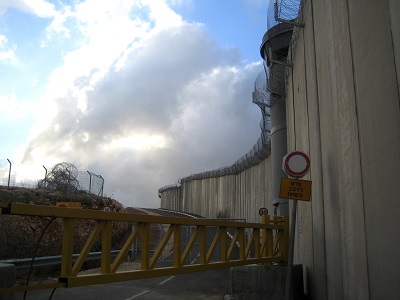
Here, right to freedom of movement is relative. (Photo: Tamar Fleishman)
Palestine Chronicle | January 27, 2014
We usually prefer to exit Palestine using Hizme checkpoint, where unlike other exit checkpoints, there are no long lines of cars, we aren’t detained and there is no need for identification or getting out of the vehicle to open and present the content of the trunk. You merely slow down by the soldier and answer a generic question like “how is it going?” with an “OK”. Sometimes even that isn’t required, just nod your head and that’s it, you can drive on.
But it’s different for us than for those who don’t pass the test examining the visage and accent of the driver. They, Palestinians from east Jerusalem, in spite of being permanent residents who have the right for freedom of movement (unlike their brothers who reside in the West Bank), are forced to stop, park their vehicle by the soldier’s post on the side of the road, identify themselves, exit the car and open the trunk so the solider can see inside.
Their right to freedom of movement is relative and they are subjected to the mercy and whims of the men in uniform.
The individual’s story is testimony to the story of the general public. The individual in this case was A who after visiting his family intended to drive through Hizme on his way back, with him were his wife, his baby son and someone he knew that said to him: “could you do me a favor, I need to get to Jerusalem, could I ride with you?”- So he did. A didn’t give him a thorough inspection, and had no idea what color his ID was and what was his address. He was just doing someone a favor. But the soldier at the checkpoint did perform an inspection and found out that A was giving a lift to someone who wasn’t permitted to pass through a checkpoint intended only for settlers, like Hizme checkpoint.
The man was arrested and taken away.
A was told to turn his engine off and to stay in the vehicle, in addition they took his car keys.
A, his wife and their child sat and waited. But the baby, who had yet to learn that a soldier’s order must be obeyed, began crying and wailing. The minutes that passed were long and the crying only grew stronger. But they couldn’t step out of the car, they couldn’t take the baby out of his booster, and he couldn’t be cradled in his mother’s arms. A tried getting out to reason with them, but was told to: “stay in the car!” and so he got back in.
After an hour his car keys were handed back to him and his wife and child were sent back home, while A was taken to the police station. There he waited for another hour, until he was given a summons to return on the next day.
Ever since he has been going back and forth to the police station, each day he waits for his name to be called, then he is taken into a room, the piece of paper he was handed on the previous day is taken from him and in return he is given a new paper summoning him to come back on the next day.
The time, the agitation, not to mention the money- all these are of no importance and are not taken into account.
Once he dared to ask why they weren’t handling his case and a policeman said to him: “I don’t have time for you, I’ve got lots of work”- “But my case is part of your work”, replied A, but instead of an answer he got a piece of paper in exchange for the one given to him on the previous day.
Yes, he will be back tomorrow, and perhaps even on the day after that.
This is how the representatives of the authority, who have unlimited power in their hands, handle people, whose rights are conditioned by circumstances.
(Translated by Ruth Fleishman)
Related articles


PLO official reveals full details of Kerry’s plan

MEMO | January 26, 2014
The secretary of the PLO Executive Committee has revealed the details of John Kerry’s plan for the Israel-Palestine negotiations. Yasser Abed Rabbo spoke to London’s Al-Hayat newspaper.
According to Abed Rabbo, the US Secretary of State’s proposal includes Palestinian recognition of Israel as a Jewish state; establishing part of East Jerusalem as the capital of Palestine; resolving the refugee problem in accordance with the vision of former US President Bill Clinton; maintaining Israeli control of major settlement blocs and leasing the others back to Israel; Israel’s control over border crossings and air space; and the presence of US-Israel-Jordan-Palestinian security forces on the border. “The Israelis would also have the right of ‘hot pursuit’ of fugitives or suspected criminals in the Palestinian state,” he revealed. “Israeli Prime Minister Benjamin Netanyahu rejected these ideas because he wants to carve out the land he wants and refuses to discuss the Jerusalem issue. He also refuses the intervention of any other party in security matters, even America.”
The PLO official pointed out that this way of thinking was essentially unacceptable. “We Palestinians have been more than clear when it comes to this matter. We have stated many times that we reject the concept of a so-called national homeland for Jews in historic Palestine or the concept of a ‘Greater Israel’. Netanyahu has expressed that he not only wants to legitimise the Zionist national narrative and the expulsion of Palestinians in 1948 but also Israel’s ongoing settlement projects, which aim to achieve the Zionist dream of a Greater Israel.”
Security arrangements
As for security arrangements, Abed Rabbo said that there is talk of potential security arrangements and the standards by which these arrangements will be run. “They will last for many years and are supposedly subject to improved Palestinian security performance. However, this will ultimately still be controlled by Israel, which will maintain control even though America has pledged that it will remain involved as these arrangements are made and see to it that Israel withdraws from certain areas including the Jordan Valley.”
Such security arrangements, he claimed, will maintain Israel’s security strongholds on mountain tops and in Palestinian airspace. Israel will maintain the right to fly over Palestinian land should it feel an impending security threat. “At this point, any semblance of Palestinian sovereignty or geographic unity has been completely torn apart”, warned Abed Rabbo.
Settlements, Jerusalem and refugees
He pointed out that there have been numerous discussions about Israel’s vast settlement blocs in the occupied West Bank. Rumours suggest that Israel wants to rent out settlement units to settlers in the event that a Palestinian state is established. What this means, he claims, is that the settlements will remain as they are and settlers will continue to live there as Israeli citizens with special status in the Palestinian state.
“According to Israel, Jerusalem is not up for negotiation and will remain under full Israeli control as its undivided capital,” he explained. “There is rather mysterious general talk about Palestinians establishing their future capital in Jerusalem but, from Israel’s point of view, Jerusalem extends from Ramallah to Bethlehem to the Jordan Valley border. Thus, it could easily be argued that Abu Dis or Kufr Aqab could be named as the future Palestinian capital.”
As far as Palestinian refugees are concerned, said the PLO official, there are four possible outcomes, as envisioned by President Clinton; one of them suggests the return of a limited number of refugees, as stated in Israel law.
The Palestinian Authority’s position
According to Abed Rabbo, the Palestinian Authority cannot accept any of these potential solutions, especially given that Netanyahu is believed to insist on there being no Arab presence in Jerusalem and rejects outright the refugees’ right of return.
“Netanyahu does not want the involvement of any third party, American or non-American, in any of his security arrangements in the Jordan Valley even if it remains under Israeli control. He wants all decisions to be Israeli decisions and judging by our previous attempts in the past, any of our attempts to abide by a plan or time table will be disrupted completely by Israel”, he noted. Israel and America claim that the Palestinian people will be able to get territory equivalent to the West Bank’s 1967 borders through land swaps. “I do not understand how this is possible with settlement blocs, Israeli security zones and the apartheid wall, which divides the eastern and western regions of the West Bank completely. We are supposed to believe that we can gain territory through land swaps? This is impossible.”
Population exchanges
The PLO veteran described those Israelis who suggest “people swaps” to accompany land swaps as “racist”, pointing out that the organisation would not accept any population exchanges.
“Palestinian Arabs living inside Israel are not settlers,” he stressed. “They did [not] come to Israel through an invasion or by migration. They are the owners of that land and no one can uproot them from their homes. Swapping settlers for Israeli-Arabs would mean swapping Israeli citizens for Israeli citizens; how is this possible?” For Abed Rabbo, this shows that the Israeli government does not consider Arabs to be true citizens of the state. “They regard them as second or third class citizens with no rights, which is absolutely racist. They seek to ethnically cleanse that territory more than they want to swap land.”
That is the framework under which most ideas were discussed, said Abed Rabbo. “We do not have any official documentation to prove it but the information gets leaked from Israel in one way or another.”
Reasons for Israeli refusal
He is not surprised that Israel rejects most proposals for the simple reason that it wants to carve out as much land as possible from the occupied West Bank and maintain absolute control, especially in security zones. This would give Israel the “right” to intervene to protect settlements, which would also mean that it has control of the road networks leading to them.
“We are being confronted with an ultimatum,” he added. “We are not standing in front of two different options with various formulas that we can accept or reject. However, any attempt to sweeten the language of these agreements instead of criticising their prejudices will lead us to disaster.”
He ruled out any blame being attached to the Palestinians should Kerry’s plan fail. “The blame game does not concern us and we do not take it in our political consideration. Who will blame us for wanting to have our country based on 1967 borders, and to have East Jerusalem as our capital, and to have a fair and agreeable resolution for the refugee issue?”
Although John Kerry has “done his best” to make proposals acceptable to both sides, argues Abed Rabbo, it seems that he has read the Israeli position at the beginning and accepted the verbal, generic, vague and ambiguous assurances that Netanyahu usually offers to whoever he meets. “He must have interpreted them in some form and when he looked at the fine print realised that there are two different Israeli positions.”
As such, he believes, Netanyahu lured Kerry to discuss the issue of security first and Kerry fell for it, thinking that it will lead to a big breakthrough for the negotiations and will open the way for discussion of other issues. “To his surprise, he discovered that the Israelis want to use security as an excuse to justify their ambitions for expansion,” concluded Abed Rabbo. “This explains how and why we have reached the current impasse.”
Source: Safa
Related articles


How Israel kills at will and in total impunity while the world asks the Palestinians for non-violent resistance
April 20, 2009
Frank Barat writes of the life and death of Bassem Abu Rahme, shot by an IOF soldier with “the rocket”, a new kind of weapon also used on critically injured US citizen Tristan Anderson some weeks ago.
On April the 17th, like any Friday afternoon for the last 4 years, the small village of Bil’in, north of Ramallah, was preparing for the usual demonstration against Israel’s annexation wall … The village of Bil’in has, since the mid eighties, lost more than 60% of its land for the purpose of Israeli growing settlements and the construction of the wall. The inhabitants of the village used to live mainly from agriculture and olive trees plantations but more and more, the people of Bil’in have to rely on the women to survive. Embroidery has become one of the main resource of the place, located a few kilometres away from Tel Aviv (on a nice day, you can see the “inaccessible”–for the Palestinians– beach from the roof tops of Bil’in).
In January 2005, a village committee (led by Mohamed Khatib, Iyad Burnat and Abdullah Abu Rahme) was created and a month later non-violent demonstrations started, first taking part every day, then once a week, on Yum Al Juma’a (Friday, day of prayer).
The village won a huge battle in August 2008 (1) when the Israeli High Court of Justice ruled that the new route of the barrier in Bil’in was in violation of the Court ruling released on September 2007 (2) (which ruled that the Wall path was prejudicial to Bil’in and must be altered) and ordered the State to present within 45 days a new route, which will uphold the principles of the ruling.
On Friday the 17th of April 2009, the wall still had not moved one inch and while the inhabitants of the village were praying at the village mosque, many internationals (coming from all around the world) and the strong Israeli contingent (including people from the Alternative Information Centre (3) and Anarchists Against the Wall (4)) were looking for some shade (to hide from the baking sun) and chatting about the day’s event. As soon as prayer was over with, the demonstration started to move forward in direction of the wall, a few kilometres away.
You can be sure that Bassem (aka Phil) was right at the front of the march. He always was. I had met Bassem a few times while visiting Bil’in. He was a strong looking man, singing the loudest, joking all the time, jumping around and leading the way, accompanied by the rest of the village committee and the Israeli contingent.
As it usually happens, as soon as the march reached the corner where the Israeli soldiers can be seen, the tear gas started. A few brave ones, always continue anyway and reach the beginning of the wall, after a few minutes. Bassem, as usual, was one of those. The Israelis present at the front of the demonstration started talking with the nearby soldiers in Hebrew and Bassem too, screamed “We are in a non violent protest, there are kids and internationals…”. He was shot in the chest and never managed to finished his sentence. He fell on the floor, moved a little bit, fell again, and died. ( http://www.bilin-village.org/english/articles/testimonies/Basem-Abu-Rahme-killed-in-Bilin-weekly-protest , scroll down for stills and videos)
Bassem was shot by a new kind of Tear Gas, called “the rocket”. The soldier who shot was a mere 40 meters away. This is the same type of tear gas that critically injured US citizen Tristan Anderson a few weeks ago. Those tear gas canisters are as fast and lethal as live ammunition. Very hard to get away from. Normally, tear gas canisters fly in the air for a long time, then fall and bounce a few times. Those ones fly like a bullet and go straight, not up and down.
Once more, Israel using the West Bank as its testing ground, the Palestinians as guinea pigs.
The soldier who fired, knew what he was doing and who he was targeting. The shame is that he probably knew Bassem. Bassem was always at the front, and had been for a few years now. The soldiers often come back more than once in Bil’in and start to get to know the ones facing them. Bassem did not get a chance to say hi, or bye.
On April the 17th , Bil’in and Palestine lost one of their heroes.
What is going to happen next?
Israel has already said that it will investigate the incident (out of every single investigation into such crimes, only 6% of the soldiers were ever prosecuted, often let off with a few weeks suspension), but before it did, started the usual propaganda, saying that the protest had been really violent and that the soldiers had to react (the video of the demonstration clearly shows otherwise).
We might even hear in a few days that it was actually the Palestinians who fired the tear gas and killed their beloved friend.
The P.A, instead of issuing the strongest statement against this act, stopping once and for all the negotiations with the Israeli government and joining the demonstrators every Friday to be hand in hand with its people, said next to nothing, and is looking forward to the upcoming White House meeting between Mahmoud Abbas and Obama (this is being planned while I write).
The media hardly reported this. The Palestinians do not count. Even more shocking when a video of the event is available to all and could have been used to great effect.
The international community (for what it means) will not mention this “incident” (it is for them) and continue issuing calls for the Palestinians to renounce violence and resist peacefully while saying nothing about Israel’s killings (since the start of the second intifada, 87% of the dead have been Palestinians), violations of international law and oppression of the Palestinians.
It is therefore down to us, the citizens of this world, to act, join solidarity groups, write articles, make films and talk, constantly, about the plight of the Palestinian people. Palestine has to become the number one issue.
This is a must.
For Bassem, his family, Bil’in and Palestine.
Frank Barat is in the organizing committee of the Russell Tribunal on Palestine and a member of Palestine Solidarity Campaign UK.
1. http://www.bilin-village.org/english/articles/testimonies/The-Supreme-Court-The-new-barrier-in-Bilin-violates-the-Court-ruling
2. http://www.bilin-village.org/english/articles/press-and-independent-media/Palestinians-celebrate-rare-victory-over-hated-barrier
3. http://www.alternativenews.org/
4. http://www.awalls.org/
Related article

Featured Video

Deception – Submarines against Olof Palme
or go to
Aletho News Archives – Video-Images
From the Archives
Woolsey Fire started at Santa Susana Field Lab — where “radioactive materials released were never accurately measured”
By John Laforge | CounterPunch | November 30, 2018
In my Nov. 16 column, I reported on potential radiation risks posed by California’s Woolsey wildfire having burned over parts or all of the Santa Susana Field Laboratory—south of Simi Valley, Calif., 30 miles outside Los Angeles—site of at least four partial or total nuclear reactor meltdowns.
The field laboratory operated 10 experimental reactors and conducted rocket engine tests. In his 2014 book Atomic Accidents, researcher James Mahaffey writes, “The cores in four experimental reactors on site … melted.” Reactor core melts always result in the release of large amounts of radioactive gases and particles. Clean up of the deeply contaminated site has not been conducted in spite of a 2010 agreement.
Los Angeles’s KABC-7 TV reported Nov. 13 that the Santa Susana lab site “appears to be the origin of the Woolsey Fire” which has torched over 96,000 acres. Southern Calif. Public Radio said, “According to Cal Fire, the Woolsey Fire started on the afternoon of Thursday, Nov. 8 … on the Santa Susana site.” … continue
Blog Roll
 Aletho News
- Pressure builds on Iran to ‘drop’ Lebanon ceasefire demand as Islamabad talks hang in balance
- In another clash report, US denies agreement to release Iran’s assets
- What is fueling unrest across the EU?
- Why no power can undermine Iran’s eternal dominance over the Strait of Hormuz
- Is The War Against Iran Over?
- Iran war will leave long-term ‘scar’ on Wall Street, investors warn
- How Iran decimated US power projection in West Asia: Military lessons of 40-day war
- Iran’s report details US-Israeli war crimes in targeting schools, hospitals, livelihoods
- NATO’s Slow Fracture: How Trump’s Iran War Exposed the Instrument of Hegemony
- Chinese jet fuel and the myth of energy independence
- If Americans Knew
- Military aid to Israel emerges as the latest political litmus test for Democrats
- The only Palestinian children’s rights organization closes following years-long Israeli campaign against it
- ‘I Can’t Forget the Smell’: Lebanese Reel After Israel Kills Over 300 in Single Day
- DNC Shoots Down Resolutions Calling Out AIPAC and Limiting Arms to Israel
- TCN: Is Israel Blackmailing President Trump?
- Israel killed at least 303 Lebanese yesterday – who were they? Daily Update
- Amnesty: Urgent – Protect Lebanese civilians from brutal escalation in Israeli attacks
- Is The War Against Iran Over?
- Inside the Israeli army’s propaganda wing
- Hundreds of Gaza Amputees Stranded in Legal Limbo
- No Tricks Zone
- New Study: No Linear Warming Or Glacier Retreat Along Northern Antarctic Peninsula Since 1980s
- An Inconvenient Tree: Uncovered In Alps… Europe Much Warmer Than Today 6000 Years Ago
- New Study Reports A 60% Slowdown In Greenland’s Ice Loss Rate In The Last Decade
- Low Intensity Tornado Wrecks Major Solar Farm, Creating A Potential Toxic Dump
- New Study Finds Warming Saves Lives…Cold Temperatures 12 Times More Deadly Than Excess Heat
- German Science Blog Accuses PIK Climate Institute Of Hallucinating Climate Tipping Points
- Devastating Assessment Of Comirnaty Vaccine By Former Senior Pfizer Europe Toxicologist
- New Study: CO2 Is ‘Effectively Negligible’ As An Explanatory Climate Change Factor Since 2000
- Former Pfizer Toxicologist Dr. Helmut Sterz Tells Bundestag Hearing Pfizer Vaccine Should Have Never Been Approved
- Energy Expert: Germany’s Nuclear Phaseout Was A “500 Billion Euro Mistake”
 Aletho News