Israel’s recurring use of terror on civilians

By Bob Finch | January 26, 2009
Insanely disproportionate use of violence against unarmed civilians
“The stated aim was, as always, to stop the launching of the rockets. The means: killing a maximum of Palestinians, in order to teach them a lesson. The decision was based on the traditional Israeli concept: hit the civilian population again and again, until it overthrows its leaders. This has been tried hundreds of times and has failed hundreds of times.” (Uri Avnery “Kill a Hundred Turks and Rest”: The Five-Day War in Gaza March 2008).
Operation Grapes of Wrath ~ Lebanon, in 1996
“Ehud Barak will be remembered in Israel’s history as the one who introduced the abuse of innocent civilians as political cards. Barak was probably not the first Israeli warrior to abuse civilians on a tactical level, but he was the one who turned it into a central Israeli strategy. Operation Grapes of Wrath in Lebanon, in 1996, with Barak as an influential cabinet member, openly targeted civilians, turning them into refugees to make them put pressure on Beirut’s government. The recent siege on Gaza follows a similar logic: put pressure on civilians to achieve political goals. (A clear war crime, it goes without saying.)” (Ran HaCohen ‘Israel Says ‘No’’ Feb. 2008).
Israelis fire 1,300,000 bullets during first few days of Intifada
“Malka, in an interview with the Israeli paper Ha’aretz on 14 June, revealed that during the first few days of the intifada, Israeli occupation soldiers fired 1,300,000 bullets on Palestinian population centres and other targets. This massive firepower, which had no operational justification given the Palestinians’ inherently inferior firepower (they possessed only light firearms and in limited numbers), showed that the Israeli army was interested more in decimating and harming the Palestinians and less in ending the violence. According to Israeli sources, then-Chief of Staff and now Defence Minister Shaul Mofaz didn’t plan to bring about the end of the conflict. Instead, he thought he had finally seized the opportunity to “beat and vanquish” the Palestinians in order to “burn into their consciousness” and make them “internalise their weakness and inferiority vis-a-vis Israel’s strength”. Mofaz’s ultimate aim, of which he later convinced Israeli Prime Minister Ariel Sharon, was to hector Palestinians into negotiations in a weakened and exhausted state whereby they would have no choice but to accept Israel’s dictates and demands. The new revelations, Palestinian officials argue, prove that the escalation of violence during the first few months of the intifada was, first and foremost, Israel’s responsibility. “This is what we have been saying all along that this is not about Israeli security but rather about Israel’s terrorising the Palestinian people for the purpose of arrogating their land and rights. Israel is now admitting that,” said Michael Tarazi, adviser to Palestinian Authority leader Yasir Arafat.” (Khalid Amayreh ‘The second intifada, an Israeli strategy’ July 2004).
Lebanon 2006
“This intentional and coldly calculated Israeli policy of targeting innocent Lebanese civilians and civilian infrastructure stems from a time-honoured, but hardly ever successful, Israeli doctrine of applying intense “pressure” against a civilian population in order to compel them, in-turn, to pressure the resistance into submitting to Israeli dictates, thereby doing Israel’s bidding by proxy. It has been consistently used against the Palestinians ever since the Nakba of 1948, and is still applied now in the ongoing barbaric offensive and hermetic siege against Gaza. Israel may have plagiarized this doctrine from the legacies of previous oppressors, but it has refined it to a degree that it no longer raises any moral qualms in most of Israeli society, where it is widely accepted by the public as a right, even a duty in the fight for Israel’s “security.” (Omar Barghouti ‘The Massacre at Qana’ August 01 2006); “As Limor and Shelah reveal, in spite of the fact that the conflict on the ground took place on a very narrow strip of land (the Israeli border on the south and Litani River on the north), the Israeli artillery had managed to shoot over 170,000 shells. In comparison, in the 1973 war while fighting against two strong state armies over two very large fronts, the Israelis had launched only 53,000 shells. The figures relating to the Air Force are even more striking. Though less than a few concrete targets were available for the IDF intelligence, the IAF (Israeli Air Force) had launched as many as 17,550 combat missions, this translates into 520 missions a day, almost as many as in the 1973 war (605 a day). Yet, in 1973 the IAF was fighting two well-equipped air forces, it was engaged in a fair amount of air-to-air combat and a relentless struggle against the latest Soviet ground-to-air missiles. None of that happened in the Second Lebanon War. The IAF was engaged solely in hammering the Lebanese soil. It literally threw and launched everything it had in its disposal, presenting a merciless method that in places (southern Beirut for instance), had a similar effect to the infamous 1940s Anglo-American carpet bombardment.” (Gilad Atzmon ‘Saying NO to the Hunters of Goliath’ August 13, 2007); “That was on Aug. 30, by which time U.N. teams had identified 359 separate cluster-bomb sites. Since then, the true dimensions of the problem have become even clearer: 770 cluster-bomb sites have now been identified. And the current U.N. estimate is that Israel dropped between 2 million and 3 million bomblets on Lebanon, of which up to a million have yet to explode.” (Saree Makdisi ‘Israel’s Cluster Bomb War’ Oct. 2006).
Related articles
Israel arrested 4,000 Palestinians in 2013

Israeli soldiers beating a Palestinian journalist [June 2013]
MEMO | December 23, 2013
Israeli occupation authorities arrested approximately 4,000 Palestinians, including parliamentarians, women, children and patients, in 2013. The vast majority of those arrested are from the occupied West Bank, with only a small number from the Gaza Strip.
Information published by the statistics department at the ministry of prisoners in the West Bank shows that no single day has passed without arrests. The average number of arrests each month was 323, which equates to about 11 arrests each day.
The arrest rate in 2013 is only one per cent higher than the rate in 2012; however, it is 17 per cent higher than 2011.
Regarding the geographical distribution of the 2013 arrests, 98 per cent (3,799) of those arrested are from the West Bank and two per cent (75) from the Gaza Strip.
According to the statistics, those arrested were from all social classes, without exception. The occupation authorities did not make any special exceptions for the elderly, disabled, children, women, parliamentarians, political leaders, academics and journalists.
All those arrested have been exposed to at least one form of torture. Some of them were tortured in front of their family members when they were arrested at their homes.
The statistics department stated that these arrests are in violation of international law. “Some of the torture cases amount to war crimes and crimes against humanity,” it added.
Related article
The Poor Man’s Sheep
December 18, 2013
Soldiers break into the wrong house at night, go on a rampage – and make off with a woman’s savings from 15 years of work
One night in early September, the members of the Kavajeh family in Tarqumiya were woken by IDF troops breaking into their house. According to the despicable custom of the last few years, some of the soldiers wore ski masks; before our apathetic eyes what used to be the premier line of fashion among criminals has become common military attire.
From this moment on, everything went as per the routine – a routine known to every soldier who has ever served in the occupied territories: the soldiers gathered all the family members in one room, not giving them time to dress properly. They then searched the house, found nothing, and as they left, the head of the family, ‘Issa, heard the soldiers say to one another that they had raided the wrong house. Needless to say, the soldiers did not apologize to the family. The soldiers told them not to leave the house while they were still present.
When the family realized the soldiers were gone, they began to estimate the damage. Here the words of Issa are worth quoting: “We began moving around the house and saw the horror.” The contents of the cupboards had been spilled, and the soldiers had thrown bedding, clothes and equipment onto the floor. The kitchen was the real calamity zone: the soldiers made certain to spill the flour on the floor, mix the sugar, the lentils and the salt together, poured the tahini into the kitchen sink, and, finally, broke the eggs.
Now, certainly some IDF spokesperson, whether an official or a self-appointed one, will manage to find a way to explain why there was a pressing military need behind this wanton destruction of food; we’ll probably find a fool who would explain why there was a need to break the eggs – how do you know what they might have hidden in there? And anyway, why don’t you show us what happened before? And do you know what happened in 1929?
But as the family members finished examining the results of the small green storm that passed mistakenly through their home, the real disaster was discovered: the savings of one of the family members, Thahani, had been stolen. These were two gold bracelets and a gold ring. Thahani had saved the money to buy the jewelry from working in a seamstress shop since 1998.
Fifteen years of savings. Fifteen years of painstakingly gathering, day by day, an ounce of meager pay. A slow collection culminating in 65 grams of gold, each one of them worth 60 Jordanian Dinars, each Dinar the equivalent of about $1.7 USD. Fifteen years of savings left Thahani with some $8,005 USD; a bit more than $385 USD a year, or $1.25 USD a day. This was Tahani’s portion of all her labor. Now it lies in the pocket of a soldier. Perhaps he’ll give them to his lover, who will be grateful and not ask where he got such gold bracelets and such a ring; perhaps they’ll end up in a pawnshop. Perhaps, loyal to the value of comradeship, he already split the loot with other troops in his section.
In the morning, the family complained both to the Red Cross and the Israeli police. This was a futile gesture: good luck finding the looter among dozens of troops, some of whom were hooded and all well-versed in covering for one another. But before the MPCID rushes to close the case claiming it couldn’t find a suspect, one more thing must be said.
Looting is a war crime. It is defined as such in the Fourth Geneva Convention. During wartime, armies often harshly punish looting soldiers, if only because looting is bad for military discipline. At best, looting soldiers have to lie to their commander, which opens the door to more lies; at worst, the commander will take a commission off the loot. Armies who don’t punish looting harshly quickly cease to become armies and turn into militias at best, gangs at worse.
Israel, as is well known, does not have laws against war crimes on its books. This doesn’t mean it doesn’t commit them. And as long as the MPCID does not shake itself up and find the thief, and as long as Israel does not compensate Tahani, it allows a war criminal – not a mere thief, but a war criminal – to roam freely. And since we know nothing of him but the colors of the uniform he wore, he besmirches through his act all those who wear them. And if the IDF wants to remove this stain from its uniform – admittedly, they are spotted with quite a few of them – it had better find the guilty party, and throw the book at him. Hard.
Related article
Israeli forces leave Bethlehem village following military drill
Ma’an – 18/12/2013
BETHLEHEM – Israeli forces vacated the Bethlehem village of Arab al-Rashayida on Tuesday after conducting military drills in the area for several hours, locals said.
Fawaz al-Rashayida, head of the local village council, told Ma’an that 5,000 heavily armed Israeli soldiers arrived in the village at dawn on Tuesday.
Locals are used to Israeli forces performing drills on the outskirts of Arab al-Rashayida, but this is the first time they have raided homes and local institutions in the village, Fawaz al-Rashayida said.
The drills, which took place in between residential homes, caused damage to the village’s water grid, he added.
Israeli forces also issued demolition orders for six properties belonging to Ali Awda Mohammad Rashayid.
The population of Arab al-Rashayida is around 2,000 and the majority of residents live in cement houses, while others live in tents and dwellings made of steel and tin.
On Monday afternoon, Israeli forces deployed in a nature reserve east of Arab al-Rashayida known locally as al-Muteirda, displacing nearby families and declaring it a “closed military zone.”
During military drills, Israeli forces can enter Palestinian homes and involve Palestinian civilians in their operations without warning them that the raids are mere practice.
In November, Israeli human rights group Yesh Din said Israeli troops had been using a Muslim cemetery in Hebron as a location for military drills and practice.
Approximately 18 percent of the West Bank has been designated as a closed military zone for training, or “firing zone,” which is roughly the same amount of the West Bank under full Palestinian Authority control.
Over 5,000 Palestinians reside in the firing zones in 38 communities.
Related articles
- Palestinian Injured After By Rammed By Army Jeep In Bethlehem (imemc.org)
- Soldiers Uproot Olive Trees Near Bethlehem (imemc.org)
- Twin Girls Rammed By Settler’s Vehicle Near Beit Jala (alethonews.wordpress.com)
- Tuqu’ – a village under siege (alethonews.wordpress.com)
- Israeli forces raid Duheisha near Bethlehem detain 4 (palestineprisoners.wordpress.com)
Number recently displaced by flooding in Gaza tops 10,000
Ma’an | December 15, 2013
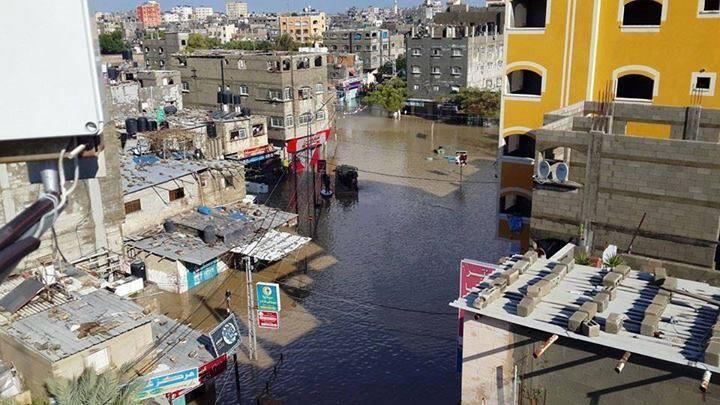
BETHLEHEM – Approximately 10,000 people have been forced to flee their homes due to widespread flooding in the Gaza Strip, according to a report released Saturday evening by the United Nations Office for the Coordination of Humanitarian Affairs.
The numbers of displaced dwarf earlier estimates, as they take into account both the thousands who have sought refuge in Gaza shelters as well as those who have sought refuge elsewhere.
Previous estimates released by the Gaza government had measured only those who had sought refuge in official shelters, who at their peak reached above 5,000 but were estimated at around 2,234 on Sunday.
In a comprehensive report on winter storm Alexa’s effects on the Palestinian Territories, OCHA reported that as of Saturday at 9 p.m., 10,000 Gazans had been evacuated from their homes and had gone to either shelters or relatives’ houses.
The areas most devastated by the storm are “North Gaza and Gaza City where over 1,500 houses suffered damage due to water entering houses, damaging furniture and electricity networks.”
An infant died and 100 were injured in storm-related incidents throughout Gaza, the report said. Gaza government officials said on Sunday that two individuals had died, but did not mention any case involving an infant.
Schools throughout Palestine have been closed since Thursday, and according to OCHA 17 schools in Gaza have been converted into shelters, while five other schools have been rendered unusable due to flooding.
The report also discussed the effects of the storm, in conjunction with the Israeli occupation, on herding communities in the West Bank.
“Several herding communities had their structures demolished (by the Israeli authorities) one day before the storm hit, prompting the UN Humanitarian Coordinator to call again for a halt to demolitions due to their humanitarian impact,” the report said.
Additionally, “approximately 30 families living in ten Bedouin communities in the northern Jordan Valley require emergency assistance.”
Meanwhile, the report said farmers across Palestine have been hit with livestock and crop losses, further weighing on levels of food insecurity throughout the territories.
“In the West Bank, preliminary reports of damages to the livestock sector are emerging from Hebron, Bethlehem and Salfit. Bedouin and herding communities seem to be the most affected. Herders are expected to face increasing livestock fatalities and morbidity in the coming weeks.”
In Gaza, over 10 percent of the coastal enclave’s greenhouses and field crops were destroyed or damaged by winter storm Alexa, in addition to 50 animal pens, the report said.
“120,000 chicks and 200 heads of livestock died as a result of the weather.”
The Gaza Strip is currently under a state of emergency due to severe weather conditions caused by a historic storm front moving south across the Levant.
UNRWA spokesperson Chris Gunness said on Saturday that large regions of the Gaza Strip were a “disaster area” and called on the international community to lift the Israeli blockade in order to allow recovery efforts to proceed.
“Any normal community would struggle to recover from this disaster. But a community that has been subjected to one of the longest blockades in human history, whose public health system has been destroyed and where the risk of disease was already rife, must be freed from these man made constraints to deal with the impact of a natural calamity such as this,” he said in a statement sent to Ma’an.
Fuel shortages have caused daily life in the Gaza Strip to grind slowly to a halt since early November, cutting off access to basic necessities for Gaza residents.
Until Sunday, the Gaza Strip had been without a functioning power plant since the beginning of November, when the plant ran out of diesel fuel as a result of the tightening of a seven-year-long blockade imposed on the territory by Israel with Egyptian support.
The power station began operating Sunday after receiving a delivery of diesel that was purchased from Israel by the Palestinian Authority using funds donated by Qatar.
The plant was only reopened in 2012 after it was targeted by an Israeli airstrike in the 2006 assault on the Strip. The power plant generates around 30 percent of the Gaza Strip’s electricity supply, while the rest comes from Israel and Egypt.
Until July of this year, the tunnels to Egypt provided a vital lifeline for the territory amidst the otherwise crippling Israeli blockade. The blockade has been in place since 2006, and it has limited imports and exports and led to a major economic decline and wide-reaching humanitarian crisis.
In 2011 and 2012, however, the situation improved, as the tunnels to Egypt witnessed a brisk trade following the Egyptian Revolution.
Gaza Strip energy officials have blamed Egypt for destroying numerous tunnels linking the Gaza Strip and Egypt in recent months. They also blamed the Fatah-led Palestinian Authority for charging taxes on fuel too high for Hamas authorities to afford.
Related article
Tuqu’ – a village under siege
Letters from an Occupied People | December 12, 2013
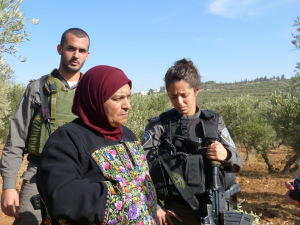
A loud buzz of chainsaws greets our arrival following a call from Tuqu’ – a Palestinian village of about 12,000 people, south of Bethlehem in the West Bank. We find Israeli soldiers overseeing the destruction of row after row of mature olive trees.
The Palestinian farmers remonstrate with the army. They have land ownership documents dating back generations from the Jordanian, British and Ottoman administrations, but their arguments are ignored by the soldiers holding them back at the gunpoint. I notice a woman pleading with soldiers who order her away, but she will not let up.
November 25, 2013 Israeli Border Guard weeping as Palestinian trees destroyed_A.Morgan
An Israeli Border Guard, a young woman who speaks Arabic, is called to deal with her. I watch as the young soldier stands listening and silently drops her head, turning her face to wipe away tears.
Finally, the buzzing stops, but it is a temporary reprieve. The Israelis have declared this ‘state land’ and the farmers are given four days to cut down hundreds more trees themselves, or the world’s fourth largest army will return to defend Israel from the olive trees.
‘How can we do this?’ asks one farmer ‘It will be like killing our mothers!’
Israeli military harassment of children in Area C
About three quarters of Tuqu’s land is in Area C*, under full Israeli military control, although this was supposed to transfer to the Palestinian Authority within 5 years of the Oslo Agreement. Tuqu’ has already lost hundreds of hectares to the illegal Israeli settlements of Teqoa, Noqedim and Ma’ale Amos that surround it to the north, south and east.
Our team comes regularly to Tuqu’. It is one of four Bethlehem villages where we accompany children to school as part of a UNICEF ‘Access to Education’ programme. Every day, children of six to 18 must run the gauntlet of armed Israeli soldiers and we have been present when the army has tear-gassed the schools. The soldiers obstruct the school entrances with jeeps, and patrol the footpaths with guns, forcing the frightened children to walk across rough fields or along the busy road.
‘It is emotional harassment’ says the mayor.
Recently we met a 16 year old boy who showed us the X- ray of a bullet still lodged in his back since a recent military incursion into Tuqu’. The mayor also tells us that over 20 children have been arrested in the last three months.
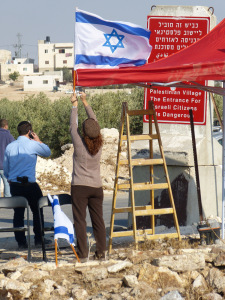
Two weeks before the trees were cut down, Tuqu’s mayor had called us because Israeli settlers, accompanied by soldiers, had begun putting up Israeli flags and tents on Tuqu’ land each afternoon.
One of the Israeli settlers I spoke to – a woman with an American accent – justified what she was doing, saying,
‘It is no different than what the Americans did to the Native Americans’.
Following this we saw the army erecting a series of concrete pillars along the roadside, with two red signs warning Israelis that this was a dangerous Palestinian village.
Soon after that, settlers erected a large marquee and put up provocative posters with a picture of a car being fire-bombed. The Palestinian landowner protested, but the military commander told him the settlers would take the land for two days for a party. There was nothing the farmer could do to stop this, but the village held a peaceful protest, whilst a large Israeli military force guarded the settlers.
November 20, 2013 Nadia Matar, Women in Green at Tuqu’_A.Morgan
The people of Tuqu’ know that this is how it starts; a few tents, some flags, then some caravans – an illegal settlement outpost is born. With Israeli state protection and financial inducements it will soon grow to thousands of settlers. More land theft, house demolitions, movement restrictions and violence against local Palestinians will follow.
Two days after the party, the settlers are back. They include a vigilante group called Women in Green** led by a Belgian-born woman called Nadia Matar. We ask what she thinks about the 16 year old Tuqu’ boy who was shot it the back whilst going to visit his grandfather.
‘ He was probably throwing stones.’ She replies ‘Kids who throw stones should be shot in the head ’.
During a visit to Tuqu’ a week after the tree cutting, we see scores of settlers coming towards the village, many bringing young children. A large number of Israeli soldiers position themselves across the road and fields, aiming their rifles and teargas cannons at Palestinian children coming out with their unarmed parents for another peaceful protest.
The settlers hold a ceremony and light candles. It is Hanukkah, and they tell us they are renaming this area with a new Hebrew name.
Under international law it is illegal for Israel, as an occupying force, to transfer its own population into the occupied Palestinian territories. Despite this, Israel’s massive settlement programme has continued unabated for decades, with thousands more homes being planned during the current Peace talks. With many settlements to the east of Bethlehem and other Palestinian centres, the Israeli strategy seems clear: to expand the eastern settlements westward to join up with Jerusalem, bisecting the West Bank and corralling the Palestinian population into a series of isolated cantons. EAPPI is keeping international agencies informed about these developments in Tuqu’ and a legal challenge is underway, supported by UNOCHA and the Norwegian Refugee Council.
* The Oslo Accords led to the West Bank being divided into Areas A (under Palestinian control), Area B (Palestinian civil government and Israeli military security) and Area C (Completely under Israeli military law). Areas B and C were supposed to be transferred to Area A – full Palestinian control, within 5 years. Instead, 20 years on, Israel has consolidated it’s control over Area C, illegally building hundreds of thousands of settler homes. Area C represents over 60% of the West Bank. It is the only contiguous area and therefore control over Area C is essential for communications. It also includes most of the West Bank’s fertile land and water. Israel prohibits Palestinian construction in Area C. Israeli control over, and settlement building in Area C is a major obstacle to a peaceful solution to the conflict.
** Women in Green is a right wing group that opposes the creation of a Palestinian state and supports Israeli settlement of the West Bank, which it proposes Israel should annex. WiG also opposed Israeli withdrawal from southern Lebanon. Nadia Matar, the Belgian-born leader of WiG claims that the ‘Arabs’ in the ‘Holy Land’ are descended from relatively recent immigrants, and should be ‘transferred’ to neighbouring Arab countries.
Related articles
Israeli immigration denies entry to another Palestine peacemaker team member
CPTnet | December 12, 2013
On the night of December 5, 2013, Israeli immigration authorities denied entry to Patrick Thompson at the Allenby Bridge connecting Jordan to Occupied Palestine. Thompson was attempting to return for another stint on the team in Hebron. He initially told authorities that he was entering as a tourist, to visit Jerusalem, Bethlehem, Nazareth, Tel Aviv, and then points south, before re-entering Jordan. An Israeli official was concerned about his previous stay of four months in Israel.
After detailed questioning over a period of three hours and a search of his computer hard drive, authorities found a logo of CPT and told him they were denying him entry because he had lied to them. Thompson told them that he specifically did not mention his work with CPT or his destination as the West Bank because of the way Israeli authorities had treated many others when they volunteered this information willingly. Authorities denied entry to Jonathan Brenneman, another CPTer, in September, when he declared his membership in CPT and his plans to travel to Hebron. Thompson then waited another hour or so before the authorities officially denied him entry. When he boarded a bus to go back across the border into Jordan it was 1:30 a.m., a full six hours after his arrival at Israeli passport control.
Thompson is the fourth CPTer to whom Israel has denied entry this year. In addition to denying entry to Brenneman in September, authorities turned away two reservists in July because of stamps in their passports from their time with the Iraqi Kurdistan team—even though the Kurdish Regional Government has friendly relations with Israel.
Related article
You destroy the soldier himself
By Melanie Ward · December 11, 2013
“You destroy the soldier himself”
That was the response of Munir, a Palestinian who is faced with Israeli soldiers at the checkpoint opposite his shop in Hebron every day, when I asked him how he thought being in Hebron must affect the soldiers.
I have had so many encounters with Israeli soldiers during my time in Hebron – it is impossible not to, due to the intensity of the military occupation.
I have passed the time of day and talked with some of them about what we are each doing here. Some have told me of their boredom, that they would much rather be on the beach. One helped keep a stray dog away from Palestinian school children who were frightened and I thanked him. Another told the police to leave me alone when they were harassing me about where in the street I was standing during the school run, and I thanked him too.
They have also spat at me, shouted at me, threatened to arrest me and called me stupid in Hebrew and a “sharmoota” (“whore” in Arabic). I have refused to follow their orders to move or stop taking photos. I have watched heavily armed soldiers throw stun grenades, and tasted the tear gas they shoot at Palestinian children on their way to school in response to small stones being thrown at their checkpoint. I have seen them harass and detain Palestinians trying to go about their lives, push kids for “facing the wrong direction” as Israeli settlers walk past, and arrest children. I have watched them laughing and joking many times in situations that are far from funny – most recently in the aftermath of an extremely serious attack by Israeli settlers against a Palestinian family.

An Israeli soldier fires tear gas at Palestinian children on their way to school after small stones were thrown at a fence near checkpoint 29 in Hebron
I have come to know some of the Givati Brigade of the Israeli army, currently serving in Hebron, by sight and a few by name. You can often tell how many schoolbags will be searched or Palestinians detained for ID checks by who is on duty. Almost without fail, the local Palestinians say that their treatment on a given day depends on the mood of the soldiers. I have often wondered what must be going through their minds and wished that I could talk to them properly about what they think. Amidst the tension and violence of Hebron, this is normally impossible.
One Friday night settlers blockaded a Palestinian family’s gateway and stopped them from leaving their home at Tel Rumeida in Hebron. I asked the nine watching Israeli soldiers to please help. They wouldn’t. One of them, whose name is Kawalski*, said “everything is fine.” 34 Israeli settlers were stopping a Palestinian family from walking down the street and thus from entering or leaving their home. Many of the settler children were shouting abuse, hitting our cameras and spitting at us.

An Israeli settler child hits my camera during the incident when settlers blockaded Palestinians in their home, and went on to attack us. Soldiers stand stand by in the background
They went on to throw two buckets of water at us, followed by a bucket of bleach. It was an awful scene and I cannot see how he could have thought it was fine.
Most of the soldiers in Hebron are young, ranging from 19-22 years old, and are conscripted into military service for three years. This is compulsory with a few exceptions, so most of them have not made a positive choice to be in the army. Yet in Israeli society there is real kudos attached to being a combat soldier like those in Hebron – just take a look at the Israel Defense Forces Facebook page. Only a tiny minority ever refuse to serve and spend time in prison as a result. Kawalski, the soldier on that Friday night, must be no more than 22 years old. After the incident, I wondered a lot about his “everything is fine” comment and thought maybe it was actually his internal reasoning – him trying to persuade himself it was all OK and he was in control (he most definitely was not).

An Israeli soldier gives first aid to our journalist colleague after refusing to intervene in a situation which culminated in the settlers throwing bleach in her eyes
Later, when he called an ambulance for my colleague after the attack on us that he had failed to prevent, he must have been forced to acknowledge that everything had not been fine.

Israeli soldiers tell a young Palestinian boy he is not allowed to ride his bike in H2 in Hebron. Israelis can drive on this street but Palestinian are not allowed to
Thousands of settlers and their supporters came to Hebron recently for Shabbat Chayei Sarah, which commemorates Sarah of biblical times, who is buried in Hebron. It was a difficult weekend, with heightened tensions and violence. Movement restrictions were even tighter than usual – the Ibrahimi Mosque and nearby Palestinian shops were forcibly closed. Most of Shuhada Street, which Palestinians are never allowed to walk down, was closed to my colleagues and I as well – “Jews only” as the enforcing soldier told me. Extra soldiers drafted into H2 checked the ID of Palestinian men every 50 metres.

Me intervening to stop Israeli soldiers harassing young Palestinians who were sitting on a wall chatting as Israeli settlers walked past on Shabbat Chayei Sarah
I was patrolling with a colleague and we went to an area with a few Palestinian homes and many settlers nearby. I felt nervous because large groups of settlers, some armed and some drunk, are not normally a great thing to encounter. A Palestinian family was harvesting olives on a hill where many settlers were hanging around. We checked if the family was OK and sat down under a tree, hoping to deter the settlers from coming to bother them, throw things at them etc (there was a fence between us and the Palestinians so we couldn’t help with the olives). A couple of Israeli soldiers were standing nearby.
After a bit, a group of male settlers tried to make their way towards us and I stood up, worried about what would happen next. But rather than standing back and letting them come over, the soldier stepped in the way and asked the settlers to leave. They did. I had never seen such a thing before and, when the settlers had moved away, I thanked the soldier. “Don’t worry” he said. Shortly after, a second group of settlers tried to come and the soldier and his colleague again turned them away. After this the soldiers came to ask if we were OK. I was slightly stunned that they were looking out for us and for the Palestinians. I thanked them both and said that we would move on soon. They told us there was no need for us to leave and not to worry, they would make sure everything was OK with the Palestinians. This was the opposite of what I am used to in Hebron, where the soldiers will often do whatever they can to get rid of us, and simply stand by as settlers harass and attack Palestinians. The first soldier told me that his name was Yossi* and he was not normally based in Hebron.
Later, when there were no settlers watching, I bumped into Yossi again. I asked him if he understood what I was doing there. “You want peace” he said, and told me that he wanted peace too. He told me that after my colleague and I had gone, the settlers had pushed him and thrown stones at him. He was astonished by this and couldn’t understand it. I asked what he knew about Hebron – not much. His orders that day had been to keep the Jewish and the Palestinians apart. I told him what it is like in Hebron – the settler violence, the soldiers refusing to help, the clashes, and showed him pictures. It was all news to him. “It’s good that you are telling me this, I will tell my commander”, he said. I really appreciated this but told him I didn’t think it would help – his commander was 24 years old and decisions about what happens in Hebron are made high up in military and political circles. None of those in charge will be unaware of what actually goes on in Hebron.
Yossi told me that he loved being in the army. He told me that he loved his gun. “Why do you love your gun?!” I asked him, “It’s for killing people.” “No!” he said, “I love target practice, I don’t want to kill anyone.” “But why do you think they give you a gun?!” I asked. I learned that Yossi was 19 years old. He seemed like a good, decent young man and I believed him when he said he wanted peace and didn’t want to kill anyone. But, as I have previously written about other discussions I’ve had with Israelis, I was surprised by his lack of understanding about the facts of the conflict he is part of. I asked him to keep being nice to the Palestinians and he told me to take care in Hebron.
My encounter with Yossi really made me think. That I was so surprised at his fair conduct says a lot about the norm for soldiers in Hebron.

An Israeli soldier detains Palestinian boys aged 8 and 10 years. Photo by Maria Schaffluetzel
I wonder how it comes to be that so many of the young soldiers behave in the morally unacceptable ways I have so often observed or seen evidence of: arresting children and beating them up; demolishing Palestinian houses with bulldozers and then preventing tents and emergency aid from being delivered; even deliberately shooting innocent people, as veterans’ organisation Breaking the Silence has documented. Sometimes they will be following their orders in doing these things, and sometimes not. Mohaned, a 13 year old from the town of Beit Ummar, told me how soldiers raided his house at 3am, blindfolded and arrested him wearing only his underwear. He was held for 10 days, in which he was slapped, hit with the butt of a rifle, beaten and then released.

An 11 year old Palestinian boy arrested by Israeli soldiers in Hebron
Surely it is important to ask how young men, most of whom start off as normal, decent guys like Yossi, end up doing these things?
On a day off I visited the Golan Heights and got talking to some soldiers about their jobs. One of them said that they themselves had been discussing these issues, “Some of us were talking – we are children and they give us guns.” I met another soldier in Haifa, Israel. He was 23 years old and had previously served in the Golani Brigade in Hebron. He recalled an army education week when there had been a discussion about putting the heads of dead Palestinians on poles. He had been in the minority 20:1 to say that such things were wrong. Another former Golani soldier simply refused to speak about what he had done when he served in the army.

A Palestinian looks out of his window to find armed Israeli soldiers using the roof of his home in Al Arrub refugee camp near Hebron
My friend Sam is Jewish, an Israeli of British origin who I got to know in our student days. After my blog about my some of my experiences in Israel, he emailed me saying, “I think another big reason why it’s hard to convince Israelis about what’s going on in the territories is that almost every Israeli knows somebody who serves in the territories… it’s hard for us to believe that they are monsters.”
His use of the word “monster” really stuck with me. I don’t believe the soldiers are monsters – perhaps with a few exceptions, as with all people. But sometimes they end up doing monstrous things on a regular basis. They are born into a system which takes apparently normal teenagers and seemingly trains them to behave in these ways.
One soldier who served in Hebron told Breaking the Silence, “In Hebron, I was disturbed and frightened most of all by the unregulated and uncontrolled power, and the things it made people do.” Another said, “Another thing that has stayed with me from Hebron? I think of myself as a little injured maybe, I don’t know. Not physically injured. More emotionally injured.”
Rather than monsters, I think it makes the young soldiers part of the tragedy of the conflict. I am pretty sure that it will damage them too, that they will suffer in the long run. Aside from the terrible harm that the military occupation does to the Palestinians, I am sure that Israel also hurts itself and its own young people in what it does. What kind of society, what kind of country, will Israel end up as?
Avraham Shalom is in a position to know. He led the Shin Bet, the Israeli intelligence service, between 1980-86 and in the film The Gatekeepers he says,
“We have become cruel. To ourselves as well, but mainly to the occupied population.” The Israeli army has become “a brutal occupation force.”
*Not his real name
Related articles
Twin Girls Rammed By Settler’s Vehicle Near Beit Jala
IMEMC & Agencies | December 10, 2013
Palestinian medical sources have reported that twin girls have been wounded after being rammed by an Israeli settler’s vehicle in the Al-Walaja road, west of Beit Jala, in the West Bank city of Bethlehem on Tuesday.
Mohammad Awad, head of the Emergency Unit in Bethlehem, said that one of the girls suffered a fracture in one of her legs, while her sister suffered various cuts and bruises to different parts of her body.
The 17-year-old sisters were moved to the Arab Society Hospital in Beit Jala, Awad added.
On Monday, December 9, a young Palestinian man was injured after being rammed by an Israeli military jeep in Nahhalin village, west of Bethlehem.
On November 19, 2013, a young woman identified as Zeina Omar Awad, 21, was injured after being rammed by a settler’s vehicle at the main entrance of Beit Ummar. She suffered cuts and bruises, while the settler fled the scene.
On the same day, a Palestinian woman was wounded after being rammed by the speeding vehicle of an Israeli settler, near the northern West Bank city of Nablus.
On October 22, resident Abdul-Hafith Tayyem, 76, died of serious injuries suffered after being hit by a settler’s vehicle in Al-Fondoq town, near the northern West Bank city of Qalqilia. The incident took place on October 16, 2013.
On September 29, a Palestinian worker was injured after being rammed by a settler’s vehicle, near Husan town, west of the West Bank city of Bethlehem.
On September 20, a Palestinian man was injured in a similar accident with an Israeli settler who fled the scene.
A week before the incident took place, Palestinian child was seriously injured after being hit by a settler’s vehicle as she was walking home from school in Teqoua’ village, near the West Bank city of Bethlehem.
The child, Hayat Mohammad Suleiman, 8 years of age, was walking back home from school on the main road that is also used by Israeli settlers living in illegal settlements in the area.
Related articles
Israeli authorities refuse Dutch FM access to Hebron Old City
Shuttered shops on Shuhada street in Hebron (ISM Hebron)
Ma’an – 08/12/2013
BETHLEHEM – Dutch Foreign Minister Frans Timmermans’ visit to Hebron on Sunday was marred by the refusal of Israeli authorities to allow him to visit the Old City without an Israeli military escort, the Palestinian ambassador to the Netherlands told Ma’an.
Ambassador Nabil Abuznaid told Ma’an in an interview on Sunday that the Dutch minister had planned to visit sections of Hebron’s Old City but Israeli authorities imposed conditions on his visit.
When the foreign minister refused these conditions, which the ambassador described as “unprecedented” for visiting dignitaries, he was forced to cancel his visit.
“The occupation (authorities) tried to make some conditions, but he did not accept them,” Abuznaid told Ma’an on Sunday.
“We appreciate that he fought for his principles,” by refusing to accept the Israeli authorities’ condition, he added.
Abuznaid highlighted that by refusing to visit the Old City of Hebron under Israeli escort the Dutch minister made it clear that “he did not want to set a precedent” of only entering escorted by the Israeli military.
“We respect the Dutch and their decisions,” which show “their support for human rights and Palestinian rights,” he added.
“We are mad at the occupation,” for imposing these conditions, Abuznaid stressed, “as we the hosts cannot even receive a special guest in our homes.”
Expressing his frustration with the Israeli-imposed restrictions, the ambassador lamented, “We cannot show him our own city and our suffering.”
The Dutch foreign minister was able to visit sites outside of the Old City in Hebron, including a meeting with the Temporary International Presence in Hebron, a civilian observer mission based in the city.
But the Israeli authorities’ refusal to allow the Dutch leader to visit the Old City with a Palestinian escort meant he was unable to see the areas that witness some of the highest incidences of Israeli settler violence against Palestinian civilians.
Hebron is a frequent site of clashes due to the presence of 500 Israeli settlers in the heart of the Palestinian Old City, many of whom have illegally occupied Palestinian houses and forcibly removed the original inhabitants. They are protected by thousands of Israeli forces.
A 1997 agreement split Hebron into areas of Palestinian and Israeli control.
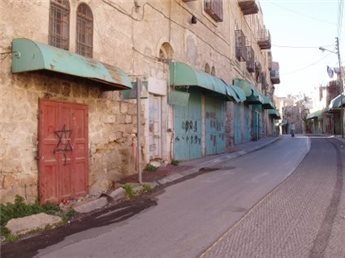
The Israeli military-controlled H2 zone includes the ancient Old City, home of the revered Ibrahimi Mosque — also split into a synagogue referred to as the Tomb of the Patriarchs — and the once thriving Shuhada street, now just shuttered shop fronts and closed homes.
More than 500,000 Israeli settlers live in settlements across the West Bank and East Jerusalem, in contravention of international law.
The internationally recognized Palestinian territories of which the West Bank and East Jerusalem form a part have been occupied by the Israeli military since 1967.
Related articles
- Israeli military detains driver, confiscates vehicle donated for transport of schoolchildren in South Hebron Hills (alethonews.wordpress.com)
- ‘Death to Arabs’ sprayed on Palestinian kindergarten in Hebron (uprootedpalestinians.wordpress.com)
- Israeli forces assault Palestinian school bus driver near Hebron (altahrir.wordpress.com)
- Settlers Assault A Palestinian Child In Hebron (imemc.org)
- 3 Palestinians shot dead near Hebron (altahrir.wordpress.com)
Featured Video

Deception – Submarines against Olof Palme
or go to
Aletho News Archives – Video-Images
From the Archives
Woolsey Fire started at Santa Susana Field Lab — where “radioactive materials released were never accurately measured”
By John Laforge | CounterPunch | November 30, 2018
In my Nov. 16 column, I reported on potential radiation risks posed by California’s Woolsey wildfire having burned over parts or all of the Santa Susana Field Laboratory—south of Simi Valley, Calif., 30 miles outside Los Angeles—site of at least four partial or total nuclear reactor meltdowns.
The field laboratory operated 10 experimental reactors and conducted rocket engine tests. In his 2014 book Atomic Accidents, researcher James Mahaffey writes, “The cores in four experimental reactors on site … melted.” Reactor core melts always result in the release of large amounts of radioactive gases and particles. Clean up of the deeply contaminated site has not been conducted in spite of a 2010 agreement.
Los Angeles’s KABC-7 TV reported Nov. 13 that the Santa Susana lab site “appears to be the origin of the Woolsey Fire” which has torched over 96,000 acres. Southern Calif. Public Radio said, “According to Cal Fire, the Woolsey Fire started on the afternoon of Thursday, Nov. 8 … on the Santa Susana site.” … continue
Blog Roll
 Aletho News
- Brussels cannot say where its own pipeline inspectors are as Hungary’s oil lifeline remains shut
- Israel’s Iran War: Myth and Reality
- Between war and industrial breakdown: The US-Israeli attrition crisis
- Pressure builds on Iran to ‘drop’ Lebanon ceasefire demand as Islamabad talks hang in balance
- In another clash report, US denies agreement to release Iran’s assets
- What is fueling unrest across the EU?
- Why no power can undermine Iran’s eternal dominance over the Strait of Hormuz
- Is The War Against Iran Over?
- Iran war will leave long-term ‘scar’ on Wall Street, investors warn
- How Iran decimated US power projection in West Asia: Military lessons of 40-day war
- If Americans Knew
- Mearsheimer reveals how Israel dictates US policies on Iran, Gaza – video
- After killing 350+, Israel still has a “score to settle” with Lebanon before ceasefire – Daily Update
- Military aid to Israel emerges as the latest political litmus test for Democrats
- The only Palestinian children’s rights organization closes following years-long Israeli campaign against it
- ‘I Can’t Forget the Smell’: Lebanese Reel After Israel Kills Over 300 in Single Day
- DNC Shoots Down Resolutions Calling Out AIPAC and Limiting Arms to Israel
- TCN: Is Israel Blackmailing President Trump?
- Israel killed at least 303 Lebanese yesterday – who were they? Daily Update
- Amnesty: Urgent – Protect Lebanese civilians from brutal escalation in Israeli attacks
- Is The War Against Iran Over?
- No Tricks Zone
- German Expert: Heat Dome Led To Record Temps In Western USA…Warmer In 1934, 1936
- New Study: No Linear Warming Or Glacier Retreat Along Northern Antarctic Peninsula Since 1980s
- An Inconvenient Tree: Uncovered In Alps… Europe Much Warmer Than Today 6000 Years Ago
- New Study Reports A 60% Slowdown In Greenland’s Ice Loss Rate In The Last Decade
- Low Intensity Tornado Wrecks Major Solar Farm, Creating A Potential Toxic Dump
- New Study Finds Warming Saves Lives…Cold Temperatures 12 Times More Deadly Than Excess Heat
- German Science Blog Accuses PIK Climate Institute Of Hallucinating Climate Tipping Points
- Devastating Assessment Of Comirnaty Vaccine By Former Senior Pfizer Europe Toxicologist
- New Study: CO2 Is ‘Effectively Negligible’ As An Explanatory Climate Change Factor Since 2000
- Former Pfizer Toxicologist Dr. Helmut Sterz Tells Bundestag Hearing Pfizer Vaccine Should Have Never Been Approved
 Aletho News