Person of the Year 2013: Palestinian Hunger Striker Samer al-Issawi
Al-Akhbar | December 31, 2013
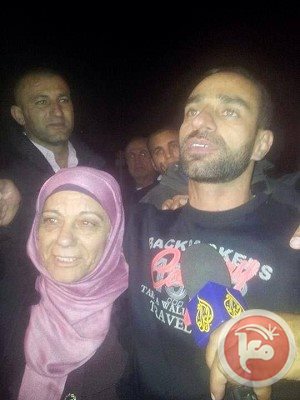 One can only imagine the looks on the faces of Israeli settlers living in Masharef Mountain, near the Hebrew University that overlooks Issawiya, as they watched the celebrations welcoming back Palestinian prisoner Samer al-Issawi.
Issawi returned victorious to his village despite Israel’s desperate attempts to ban celebrations. The occupation forces delayed his release for about 10 hours last Monday, December 23, and erected military checkpoints near the village, but young men and Palestinian mothers insisted on welcoming their hero.
Following his nine-month hunger strike amid the “battle of the empty stomachs,” Issawi was released along with 1,026 other Palestinians in an exchange for the return of Israeli soldier Gilad Shalit.
He wished to remain loyal to those who lost their lives while planning and conducting the Shalit kidnapping, and didn’t want the Israelis to arrest the liberated prisoners all over again, forcing them to serve the rest of their sentences.
From the first intifada until the mid-1990s, Issawi, born 1979, resisted Israeli occupation by setting settler cars of fire and throwing Molotov cocktails. He told Al-Akhbar that he was careful not to be arrested because he wanted to support his family, since his four brothers – Raafat, Medhat, Firas, and Fadi – were held by the Israelis. But all that changed when his brother Fadi was killed in clashes that erupted in Issawiya, following the Hebron massacre in 1994.
The day Samer saw his brother in a pool of his own blood was the last straw.
Issawi was first arrested in 1998 and sentenced to a year and a half in prison for throwing a Molotov cocktail. He was later sentenced to six months in jail for beating up an Israeli soldier, then he was imprisoned again in 2000 for 15 days at the beginning of al-Aqsa intifada. He was later arrested for six months without charges.
“Israeli military attacks escalated during the second Intifada, and we began to hear about airstrikes on Gaza,” said Issawi, revealing that on the first day of his release he joined the ranks of the Democratic Front for the Liberation of Palestine. He formed a five-member cell with friends and conducted 11 shooting operations targeting Israeli vehicles in the Ma’ale Adumim settlement, seven kilometers east of Jerusalem.
These shootings caused material damages and injured one Israeli officer. Once Issawi’s role was revealed, the Israelis hunted him down for a whole year and finally arrested him during the 2002 Operation Defensive Shield in Ramallah.
Issawi refused to appear before the Beit Eil military court and rejected the presence of an attorney because he didn’t acknowledge the legitimacy of the court. He told the judges that it was more of a traveling circus that the Israelis brought along to every territory they occupied.
Issawi was sentenced to 30 years in jail. He wasn’t surprised. Usually sentences in such cases are life in prison, even though no injuries were caused.
He said he was confident he wouldn’t serve his entire sentence, and told the judge, “I will be out before 30 years.” Ten years later, Issawi was released within the “Loyalty to the Free Men” prisoners’ deal.
Issawi as Art
Occupation forces arrested Issawi again on 7 July 2012. His interrogation continued for 30 days, following which he was accused of planning to kidnap Israeli soldiers. Meanwhile, the head of Israeli intelligence in the West Bank threatened to send him back to jail to serve the remaining 20 years of his sentence.
Issawi realized that he was in a serious situation. Hence, on July 27, he started returning two of his meals and settling for a simple one of two slices of bread and a spoonful of labneh and jam.
He maintained this diet for 19 days and was transferred to Nafha Prison. On August 24, he started training his body for an open hunger strike. He wrote a letter to prison services and informed them about his escalation. Back then, he settled for a glass of juice or milk or soup until he cut off food completely and started his open hunger strike on September 14, which also included a strike on water from time to time.
Finally, Issawi reached an agreement with the Israelis last April allowing him to return home to Jerusalem within eight months.
Israelis resorted to different tactics to try and exhaust Issawi into giving up his hunger strike. They sent him on prisoners’ buses to courts and moved him from prison to prison, forcing him to wait for hours for his jailers. They demolished his brother Medhat’s house and attacked him and his family in court despite his deteriorating health.
Samer dropped to 99 pounds and suffered attendant health risks. “When I slept on my right side, I felt numb, and the same with my left side. I also couldn’t sleep on my chest because I had a broken bone,” he said.
With His Family
“Every time I heard about Palestinians and freedom-loving people around the world joining this this battle, I forgot my own pain, mainly after the martyrdom of Mahmoud al-Titi and Mohammed Asfour. There was nothing I could offer them, just insisting on the goals that we put together before the hunger strike. I was also moved by young men protesting for the first time in front of Jerusalem Magistrates Court,” he said.
Issawi said, “The anger I saw in the eyes of the jailers after seven months of the hunger strike proved to me that we succeeded in raising the voices of prisoners and revealing Israeli violations of the prisoner swap deal, while preserving Palestinians dignity. All the goals were accomplished and the only thing left was me going back home.”
On the Palestinian official position, Samer said, “Let’s be honest, all of us Palestinians, from the president to common citizens, can’t even move from one region to the other without Israeli authorization. We don’t count on the official position as much as we count on the will of the people to exercise pressure to force politicians to take more serious steps. A Palestinian negotiator can sign a deal, but it would not be applicable on the ground without popular support.”
Jewish settlers attack local official in south Hebron hills
Ma’an – 30/12/2013

(MaanImages/file)
BETHLEHEM – A group of settlers injured a local Palestinian official in the south Hebron hills on Saturday after attacking him with a rock, a local peace group said Monday.
“On Dec. 28, a group of settlers attacked Palestinians who were plowing a field in the South Hebron Hills village of At Tuwani. Hafez Huraini, a member of the South Hebron Hills Popular Committee, was injured in the attack,” Operation Dove said in a statement.
Huraini told the group that five settlers from the illegal outpost of Havat Maon, four of whom were children, attacked the villagers as they worked on their land.
One of the settlers approached Huraini and hit him over the head with a rock.
Residents from at-Tuwani gathered and managed to force the settlers away, but they continued to throw rocks at the villagers before finally leaving the area.
The attack took place at 2.45 p.m. and Israeli forces arrived in the area at 4.15 p.m., by which time Huraini was at a hospital in Yatta receiving treatment.
“This is resistance: to go daily to your land. We are protesting every day, every night,” Huraini said.
In November, Operation Dove said the illegal outpost of Havot Maon was expanding at a “phenomenal” rate.
Home to around 200 settlers, the outpost is one of the most violent and radical in the occupied West Bank.
Related articles
‘5-year high’ in number of Palestinians killed in West Bank
Ma’an – 31/12/2013
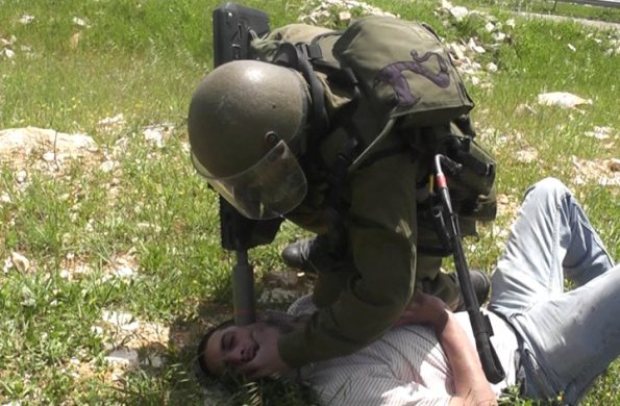
BETHLEHEM – Israel killed 27 Palestinians in the occupied West Bank in 2013, making it the deadliest year for Palestinian fatalities since 2008, Israeli rights group B’Tselem said Monday.
According to data compiled by the rights group, three times as many Palestinians were killed in the West Bank in 2013 compared to 2012.
By contrast, in 2012 Israeli security forces killed eight Palestinians in the West Bank and 246 in the Gaza Strip, including at least 167 in its November war on the coastal territory.
In nine of the 2013 West Bank killings, Israeli military forces raided Palestinian communities during arrest operations.
Four of those killings involved an exchange of fire, according to Israel’s army, while four other cases involved Israeli soldiers opening fire after stones had been thrown at them.
Seven other killings took place while Israeli soldiers were lying in wait to capture alleged stone throwers or after Israeli soldiers had used live fire against Palestinians throwing stones.
One Palestinian was killed when he tried to enter Israel without a permit, one female bystander was shot dead by soldiers, another man was killed after breaking into a military base with a tractor and one man was shot after allegedly assaulting a border police officer.
In the final case, the Israeli border police volunteer retracted his original claim that Antar Shalabi Mahmoud al-Aqraa had tried to stab him before being shot dead.
In the Gaza Strip, nine Palestinians were killed, four of whom were allegedly taking part in hostilities when they were killed and three who were not, B’Tselem said.
In one case the group said it is unknown if the victim was taking part in hostilities. Another Palestinian was assassinated by Israeli forces.
Three-year-old Hala Abu Sbeikha was killed last Tuesday in Gaza following an Israeli airstrike.
Investigations into killings ‘slow and cumbersome’
B’Tselem says that over two years have passed since a new investigative policy by the MAG Corps unit went into effect, in which time 35 Palestinians were killed by Israeli soldiers.
A total of 23 investigations into the fatalities were launched, with the MAG corps reaching a decision on only five of the cases.
In one case, a decision was made not to open an investigation, in three cases the file was closed, and in another an Israeli soldier was indicted and convicted by plea bargain based on his admission, B’Tselem said.
“The sharp rise in fatalities in the West Bank only serves to intensify concern about lack of accountability. Admittedly, MPIU investigations are now launched almost automatically, yet the essence of the investigative mechanism remains unchanged,” B’Tselem Director Jessica Montell said.
“It is slow and cumbersome and decisions are made only years after an incident takes place. Such a mechanism, in which practically no one is held accountable for the killing of Palestinians, does not serve as a deterrent and indicates disregard for human life.”
Related article
The cover-up police
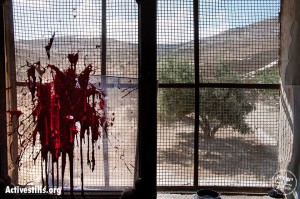
The Shay Police Unit manage to avoid basic investigative actions – even while holding two suspects caught red-handed in custody
By Yossi Gurvitz | Yesh Din | December 29, 2013
On July 26th, 2010, Israeli civilians – some of whom were seen coming from the direction of the settlements of Yizhar and Har Bracha – went on two rampages in the Palestinian village of Burin. In the first and more severe case, they attacked and destroyed property; when the owner, Ibrahim Eid, could no longer stand watching his property go up in flames and approached the scene, they hit him over the head with an iron bar. Eid lost consciousness and had to be treated in a hospital.
During the second rampage, Israeli civilians stoned the nearby home of Bashir Hamza Zaban. Unfortunately for the hoodlums, border policemen were on the scene and spotted them. The cops chased the attackers, detaining two of them. One of the detainees chose to hide a knife in his shoe. The two refused to identify themselves, but later were identified in the police station. The two maintained their right to remain silent during their interrogation. Zaban also managed to identify a third attacker, who – unlike the detainees – was not hooded.
On its face, this is an open and shut case. Yet lo and behold: even though two suspects were arrested, having been caught red-handed; even though one of them was carrying a concealed knife; and even though they refused to identify themselves – the police wouldn’t do the bare minimum, i.e. ask the victim to identify his attackers. Instead, the police closed the case, citing lack of evidence.
Hold on, the epic screw-up of this case is just beginning. Despite the fact that Zaban noted in his statement to the police that he was aware of the attack on Eid, and although he gave the police a disc containing photos of the attack on Eid, the police took their sweet time and summoned Eid for a statement in November of 2010, a mere five months after the incident. After all, we all know that the memory of witnesses just improves as time passes by.
We’re not done yet: Eid, in his statement to the police, noted the existence of the disc, containing quite clear images of the Israeli civilians who attacked him, who can be easily identified. Even so, the police – who had had the disc since July – didn’t bother summoning him to a lineup so he could point out his attackers; hence, it naturally did not summon any of them for an interrogation. And to top it all off, the police closed the case in December 2012 – after two years and five months of doing little investigative work – but only bothered to inform us, who represent the victims, in August 2013.
Such phenomenal incompetence, which would not surprise anyone familiar with the SJPD (‘Samaria and Judea’ Police Department), generally has two plausible explanations. The first is that the cops and their superiors are complete failures at their duties. The second is that they’re not that dumb, in fact they’re quite smart: we can assume they have a good reason to believe that if they do their jobs properly, they will be harmed. Some of them, after all, live among the population they’re charged with investigating. So they do a half-assed job, ignore evidence, silence nasty questions, and bullshit their way through the closing of a case, hoping no one pays attention.
Such a police force is the hallmark of dark regimes. The SJPD has been functioning this way for years. Anyone who thinks that these investigators, when re-posted within Israel proper, will not retain the work norms developed beyond the ‘separation’ wall, is deluding herself. As for us, once we lifted our jaws off the floor, we appealed the decision to close this case. We hope that the embarrassing negligence of the SJPD will force the prosecution to act. We’ll keep you informed.
Related article
- While you were sleeping…. (imemc.org)
Israeli forces shoot photographer in Bilin demonstrations
Ma’an – 29/12/2013
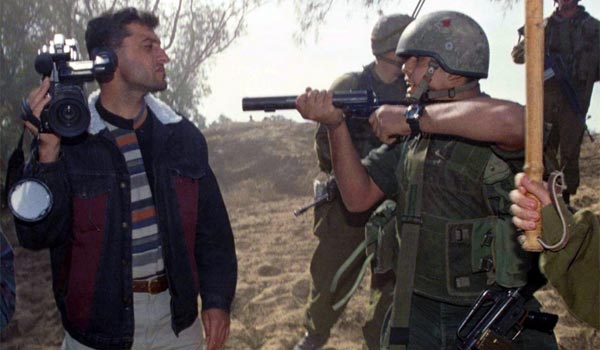
RAMALLAH – A photographer was injured and dozens suffered from excessive tear gas inhalation as Israeli forces dispersed a demonstration in Bilin near Ramallah.
Israeli forces fired rubber-coated steel bullets, tear gas and stun grenades at demonstrators as they neared their lands close to the wall.
Photographer Mohammad Yassin, 20, was hit with a rubber coated steel bullet during the protests.
The demonstration was held in celebration of Christmas and the release of Samer Issawi, and in protest of Israeli settlement activity and the separation wall.
Participants, some of whom wore Santa Claus costumes, raised Palestinian flags and chanted songs for unity and resistance.
Since 2005, Bilin villagers have protested on a weekly basis against the Israeli separation wall that runs through their village on land confiscated from local farmers.
Previous protests by Bilin activists have forced the Israeli authorities to re-route the wall, but large chunks of the village lands remain inaccessible to residents because of the route.
Related article
Israel’s recurring use of terror on civilians

By Bob Finch | January 26, 2009
Insanely disproportionate use of violence against unarmed civilians
“The stated aim was, as always, to stop the launching of the rockets. The means: killing a maximum of Palestinians, in order to teach them a lesson. The decision was based on the traditional Israeli concept: hit the civilian population again and again, until it overthrows its leaders. This has been tried hundreds of times and has failed hundreds of times.” (Uri Avnery “Kill a Hundred Turks and Rest”: The Five-Day War in Gaza March 2008).
Operation Grapes of Wrath ~ Lebanon, in 1996
“Ehud Barak will be remembered in Israel’s history as the one who introduced the abuse of innocent civilians as political cards. Barak was probably not the first Israeli warrior to abuse civilians on a tactical level, but he was the one who turned it into a central Israeli strategy. Operation Grapes of Wrath in Lebanon, in 1996, with Barak as an influential cabinet member, openly targeted civilians, turning them into refugees to make them put pressure on Beirut’s government. The recent siege on Gaza follows a similar logic: put pressure on civilians to achieve political goals. (A clear war crime, it goes without saying.)” (Ran HaCohen ‘Israel Says ‘No’’ Feb. 2008).
Israelis fire 1,300,000 bullets during first few days of Intifada
“Malka, in an interview with the Israeli paper Ha’aretz on 14 June, revealed that during the first few days of the intifada, Israeli occupation soldiers fired 1,300,000 bullets on Palestinian population centres and other targets. This massive firepower, which had no operational justification given the Palestinians’ inherently inferior firepower (they possessed only light firearms and in limited numbers), showed that the Israeli army was interested more in decimating and harming the Palestinians and less in ending the violence. According to Israeli sources, then-Chief of Staff and now Defence Minister Shaul Mofaz didn’t plan to bring about the end of the conflict. Instead, he thought he had finally seized the opportunity to “beat and vanquish” the Palestinians in order to “burn into their consciousness” and make them “internalise their weakness and inferiority vis-a-vis Israel’s strength”. Mofaz’s ultimate aim, of which he later convinced Israeli Prime Minister Ariel Sharon, was to hector Palestinians into negotiations in a weakened and exhausted state whereby they would have no choice but to accept Israel’s dictates and demands. The new revelations, Palestinian officials argue, prove that the escalation of violence during the first few months of the intifada was, first and foremost, Israel’s responsibility. “This is what we have been saying all along that this is not about Israeli security but rather about Israel’s terrorising the Palestinian people for the purpose of arrogating their land and rights. Israel is now admitting that,” said Michael Tarazi, adviser to Palestinian Authority leader Yasir Arafat.” (Khalid Amayreh ‘The second intifada, an Israeli strategy’ July 2004).
Lebanon 2006
“This intentional and coldly calculated Israeli policy of targeting innocent Lebanese civilians and civilian infrastructure stems from a time-honoured, but hardly ever successful, Israeli doctrine of applying intense “pressure” against a civilian population in order to compel them, in-turn, to pressure the resistance into submitting to Israeli dictates, thereby doing Israel’s bidding by proxy. It has been consistently used against the Palestinians ever since the Nakba of 1948, and is still applied now in the ongoing barbaric offensive and hermetic siege against Gaza. Israel may have plagiarized this doctrine from the legacies of previous oppressors, but it has refined it to a degree that it no longer raises any moral qualms in most of Israeli society, where it is widely accepted by the public as a right, even a duty in the fight for Israel’s “security.” (Omar Barghouti ‘The Massacre at Qana’ August 01 2006); “As Limor and Shelah reveal, in spite of the fact that the conflict on the ground took place on a very narrow strip of land (the Israeli border on the south and Litani River on the north), the Israeli artillery had managed to shoot over 170,000 shells. In comparison, in the 1973 war while fighting against two strong state armies over two very large fronts, the Israelis had launched only 53,000 shells. The figures relating to the Air Force are even more striking. Though less than a few concrete targets were available for the IDF intelligence, the IAF (Israeli Air Force) had launched as many as 17,550 combat missions, this translates into 520 missions a day, almost as many as in the 1973 war (605 a day). Yet, in 1973 the IAF was fighting two well-equipped air forces, it was engaged in a fair amount of air-to-air combat and a relentless struggle against the latest Soviet ground-to-air missiles. None of that happened in the Second Lebanon War. The IAF was engaged solely in hammering the Lebanese soil. It literally threw and launched everything it had in its disposal, presenting a merciless method that in places (southern Beirut for instance), had a similar effect to the infamous 1940s Anglo-American carpet bombardment.” (Gilad Atzmon ‘Saying NO to the Hunters of Goliath’ August 13, 2007); “That was on Aug. 30, by which time U.N. teams had identified 359 separate cluster-bomb sites. Since then, the true dimensions of the problem have become even clearer: 770 cluster-bomb sites have now been identified. And the current U.N. estimate is that Israel dropped between 2 million and 3 million bomblets on Lebanon, of which up to a million have yet to explode.” (Saree Makdisi ‘Israel’s Cluster Bomb War’ Oct. 2006).
Related articles
Israel arrested 4,000 Palestinians in 2013

Israeli soldiers beating a Palestinian journalist [June 2013]
MEMO | December 23, 2013
Israeli occupation authorities arrested approximately 4,000 Palestinians, including parliamentarians, women, children and patients, in 2013. The vast majority of those arrested are from the occupied West Bank, with only a small number from the Gaza Strip.
Information published by the statistics department at the ministry of prisoners in the West Bank shows that no single day has passed without arrests. The average number of arrests each month was 323, which equates to about 11 arrests each day.
The arrest rate in 2013 is only one per cent higher than the rate in 2012; however, it is 17 per cent higher than 2011.
Regarding the geographical distribution of the 2013 arrests, 98 per cent (3,799) of those arrested are from the West Bank and two per cent (75) from the Gaza Strip.
According to the statistics, those arrested were from all social classes, without exception. The occupation authorities did not make any special exceptions for the elderly, disabled, children, women, parliamentarians, political leaders, academics and journalists.
All those arrested have been exposed to at least one form of torture. Some of them were tortured in front of their family members when they were arrested at their homes.
The statistics department stated that these arrests are in violation of international law. “Some of the torture cases amount to war crimes and crimes against humanity,” it added.
Related article
The Poor Man’s Sheep
December 18, 2013
Soldiers break into the wrong house at night, go on a rampage – and make off with a woman’s savings from 15 years of work
One night in early September, the members of the Kavajeh family in Tarqumiya were woken by IDF troops breaking into their house. According to the despicable custom of the last few years, some of the soldiers wore ski masks; before our apathetic eyes what used to be the premier line of fashion among criminals has become common military attire.
From this moment on, everything went as per the routine – a routine known to every soldier who has ever served in the occupied territories: the soldiers gathered all the family members in one room, not giving them time to dress properly. They then searched the house, found nothing, and as they left, the head of the family, ‘Issa, heard the soldiers say to one another that they had raided the wrong house. Needless to say, the soldiers did not apologize to the family. The soldiers told them not to leave the house while they were still present.
When the family realized the soldiers were gone, they began to estimate the damage. Here the words of Issa are worth quoting: “We began moving around the house and saw the horror.” The contents of the cupboards had been spilled, and the soldiers had thrown bedding, clothes and equipment onto the floor. The kitchen was the real calamity zone: the soldiers made certain to spill the flour on the floor, mix the sugar, the lentils and the salt together, poured the tahini into the kitchen sink, and, finally, broke the eggs.
Now, certainly some IDF spokesperson, whether an official or a self-appointed one, will manage to find a way to explain why there was a pressing military need behind this wanton destruction of food; we’ll probably find a fool who would explain why there was a need to break the eggs – how do you know what they might have hidden in there? And anyway, why don’t you show us what happened before? And do you know what happened in 1929?
But as the family members finished examining the results of the small green storm that passed mistakenly through their home, the real disaster was discovered: the savings of one of the family members, Thahani, had been stolen. These were two gold bracelets and a gold ring. Thahani had saved the money to buy the jewelry from working in a seamstress shop since 1998.
Fifteen years of savings. Fifteen years of painstakingly gathering, day by day, an ounce of meager pay. A slow collection culminating in 65 grams of gold, each one of them worth 60 Jordanian Dinars, each Dinar the equivalent of about $1.7 USD. Fifteen years of savings left Thahani with some $8,005 USD; a bit more than $385 USD a year, or $1.25 USD a day. This was Tahani’s portion of all her labor. Now it lies in the pocket of a soldier. Perhaps he’ll give them to his lover, who will be grateful and not ask where he got such gold bracelets and such a ring; perhaps they’ll end up in a pawnshop. Perhaps, loyal to the value of comradeship, he already split the loot with other troops in his section.
In the morning, the family complained both to the Red Cross and the Israeli police. This was a futile gesture: good luck finding the looter among dozens of troops, some of whom were hooded and all well-versed in covering for one another. But before the MPCID rushes to close the case claiming it couldn’t find a suspect, one more thing must be said.
Looting is a war crime. It is defined as such in the Fourth Geneva Convention. During wartime, armies often harshly punish looting soldiers, if only because looting is bad for military discipline. At best, looting soldiers have to lie to their commander, which opens the door to more lies; at worst, the commander will take a commission off the loot. Armies who don’t punish looting harshly quickly cease to become armies and turn into militias at best, gangs at worse.
Israel, as is well known, does not have laws against war crimes on its books. This doesn’t mean it doesn’t commit them. And as long as the MPCID does not shake itself up and find the thief, and as long as Israel does not compensate Tahani, it allows a war criminal – not a mere thief, but a war criminal – to roam freely. And since we know nothing of him but the colors of the uniform he wore, he besmirches through his act all those who wear them. And if the IDF wants to remove this stain from its uniform – admittedly, they are spotted with quite a few of them – it had better find the guilty party, and throw the book at him. Hard.
Related article
Israeli forces leave Bethlehem village following military drill
Ma’an – 18/12/2013
BETHLEHEM – Israeli forces vacated the Bethlehem village of Arab al-Rashayida on Tuesday after conducting military drills in the area for several hours, locals said.
Fawaz al-Rashayida, head of the local village council, told Ma’an that 5,000 heavily armed Israeli soldiers arrived in the village at dawn on Tuesday.
Locals are used to Israeli forces performing drills on the outskirts of Arab al-Rashayida, but this is the first time they have raided homes and local institutions in the village, Fawaz al-Rashayida said.
The drills, which took place in between residential homes, caused damage to the village’s water grid, he added.
Israeli forces also issued demolition orders for six properties belonging to Ali Awda Mohammad Rashayid.
The population of Arab al-Rashayida is around 2,000 and the majority of residents live in cement houses, while others live in tents and dwellings made of steel and tin.
On Monday afternoon, Israeli forces deployed in a nature reserve east of Arab al-Rashayida known locally as al-Muteirda, displacing nearby families and declaring it a “closed military zone.”
During military drills, Israeli forces can enter Palestinian homes and involve Palestinian civilians in their operations without warning them that the raids are mere practice.
In November, Israeli human rights group Yesh Din said Israeli troops had been using a Muslim cemetery in Hebron as a location for military drills and practice.
Approximately 18 percent of the West Bank has been designated as a closed military zone for training, or “firing zone,” which is roughly the same amount of the West Bank under full Palestinian Authority control.
Over 5,000 Palestinians reside in the firing zones in 38 communities.
Related articles
- Palestinian Injured After By Rammed By Army Jeep In Bethlehem (imemc.org)
- Soldiers Uproot Olive Trees Near Bethlehem (imemc.org)
- Twin Girls Rammed By Settler’s Vehicle Near Beit Jala (alethonews.wordpress.com)
- Tuqu’ – a village under siege (alethonews.wordpress.com)
- Israeli forces raid Duheisha near Bethlehem detain 4 (palestineprisoners.wordpress.com)
Number recently displaced by flooding in Gaza tops 10,000
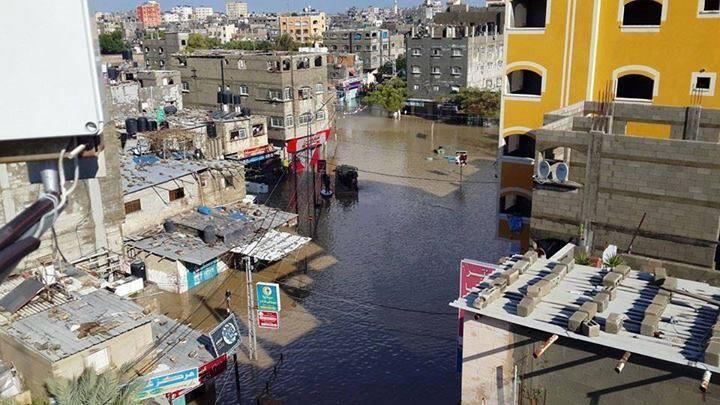
Ma’an | December 15, 2013
BETHLEHEM – Approximately 10,000 people have been forced to flee their homes due to widespread flooding in the Gaza Strip, according to a report released Saturday evening by the United Nations Office for the Coordination of Humanitarian Affairs.
The numbers of displaced dwarf earlier estimates, as they take into account both the thousands who have sought refuge in Gaza shelters as well as those who have sought refuge elsewhere.
Previous estimates released by the Gaza government had measured only those who had sought refuge in official shelters, who at their peak reached above 5,000 but were estimated at around 2,234 on Sunday.
In a comprehensive report on winter storm Alexa’s effects on the Palestinian Territories, OCHA reported that as of Saturday at 9 p.m., 10,000 Gazans had been evacuated from their homes and had gone to either shelters or relatives’ houses.
The areas most devastated by the storm are “North Gaza and Gaza City where over 1,500 houses suffered damage due to water entering houses, damaging furniture and electricity networks.”
An infant died and 100 were injured in storm-related incidents throughout Gaza, the report said. Gaza government officials said on Sunday that two individuals had died, but did not mention any case involving an infant.
Schools throughout Palestine have been closed since Thursday, and according to OCHA 17 schools in Gaza have been converted into shelters, while five other schools have been rendered unusable due to flooding.
The report also discussed the effects of the storm, in conjunction with the Israeli occupation, on herding communities in the West Bank.
“Several herding communities had their structures demolished (by the Israeli authorities) one day before the storm hit, prompting the UN Humanitarian Coordinator to call again for a halt to demolitions due to their humanitarian impact,” the report said.
Additionally, “approximately 30 families living in ten Bedouin communities in the northern Jordan Valley require emergency assistance.”
Meanwhile, the report said farmers across Palestine have been hit with livestock and crop losses, further weighing on levels of food insecurity throughout the territories.
“In the West Bank, preliminary reports of damages to the livestock sector are emerging from Hebron, Bethlehem and Salfit. Bedouin and herding communities seem to be the most affected. Herders are expected to face increasing livestock fatalities and morbidity in the coming weeks.”
In Gaza, over 10 percent of the coastal enclave’s greenhouses and field crops were destroyed or damaged by winter storm Alexa, in addition to 50 animal pens, the report said.
“120,000 chicks and 200 heads of livestock died as a result of the weather.”
The Gaza Strip is currently under a state of emergency due to severe weather conditions caused by a historic storm front moving south across the Levant.
UNRWA spokesperson Chris Gunness said on Saturday that large regions of the Gaza Strip were a “disaster area” and called on the international community to lift the Israeli blockade in order to allow recovery efforts to proceed.
“Any normal community would struggle to recover from this disaster. But a community that has been subjected to one of the longest blockades in human history, whose public health system has been destroyed and where the risk of disease was already rife, must be freed from these man made constraints to deal with the impact of a natural calamity such as this,” he said in a statement sent to Ma’an.
Fuel shortages have caused daily life in the Gaza Strip to grind slowly to a halt since early November, cutting off access to basic necessities for Gaza residents.
Until Sunday, the Gaza Strip had been without a functioning power plant since the beginning of November, when the plant ran out of diesel fuel as a result of the tightening of a seven-year-long blockade imposed on the territory by Israel with Egyptian support.
The power station began operating Sunday after receiving a delivery of diesel that was purchased from Israel by the Palestinian Authority using funds donated by Qatar.
The plant was only reopened in 2012 after it was targeted by an Israeli airstrike in the 2006 assault on the Strip. The power plant generates around 30 percent of the Gaza Strip’s electricity supply, while the rest comes from Israel and Egypt.
Until July of this year, the tunnels to Egypt provided a vital lifeline for the territory amidst the otherwise crippling Israeli blockade. The blockade has been in place since 2006, and it has limited imports and exports and led to a major economic decline and wide-reaching humanitarian crisis.
In 2011 and 2012, however, the situation improved, as the tunnels to Egypt witnessed a brisk trade following the Egyptian Revolution.
Gaza Strip energy officials have blamed Egypt for destroying numerous tunnels linking the Gaza Strip and Egypt in recent months. They also blamed the Fatah-led Palestinian Authority for charging taxes on fuel too high for Hamas authorities to afford.
Related article
Featured Video

The Truth About the Trump Shootings with Ken Silva
or go to
Aletho News Archives – Video-Images
From the Archives
Trans ‘milk’ as good as the real thing – NHS
RT | February 18, 2024
The drug-induced nipple secretions of trans women are as good as mothers’ breast milk for babies, the University of Sussex Hospitals NHS Trust claimed in a letter to campaigners made public in a report by British think tank the Policy Exchange on Sunday.
The healthcare trust’s medical director, Rachel James, argued that the off-label prescription drug cocktail men transitioning to female take in order to produce milk was “similar to the natural hormones which encourage lactation to develop when the baby is newly born.”
“The evidence which is available demonstrates that the milk is comparable to that produced following the birth of a baby,” James wrote in the letter, sent to Children of Transitioners last August.
Biological men who wish to lactate must first take hormones to grow milk glands and then take high doses of either domperidone or metoclopramide to stimulate milk production. Neither drug is approved for this use, though they are occasionally prescribed off-label to biological women who have trouble lactating.
However, domperidone’s own manufacturer, Janssen, warns patients the drug “may cause unwanted side effects affecting the heart in a breastfed baby” and “should be used during breastfeeding only if your physician considers this clearly necessary.” … continue
Blog Roll
 Aletho News
- Seyed M. Marandi: U.S. Strike Imminent – Toward Total War in the Middle East
- Russia Voted Under Fire. Washington Is Loading the Tankers.
- 12 Things Your Oncologist Was Trained Not to Tell You
- Anthrax Attacks Paved Way for COVID-Era ‘Junk Drugs and Vaccines’
- How Real Is the Impact of Western Sanctions on Israel?
- France, You Are Guilty: How Paris Turned Western Sahara into the Maghreb’s Powder Keg
- 2025 Nature Paper Claiming Worsening Global Drought Gets RETRACTED …Heavily Flawed
- Your Milk Is Not the Problem
- The Truth About the Trump Shootings with Ken Silva
- ARE PATIENTS BEING PROPERLY INFORMED ABOUT OZEMPIC?
- If Americans Knew
- Salah Sarsour’s Legal Team Says DHS Has Not Met Its Burden to Prove He Is Deportable
- An analysis of tax forms by The Intercept show Kraft’s charity and LLC have donated to Friends of the IDF and AIPAC’s super PAC.
- Israeli attacks kill four Palestinians in Gaza – Daily Update
- Inside Gaza’s death trap of collapsing, bombed-out buildings
- The everyday items Israel bans from Gaza every day
- Inside the siege, the ruined buildings of Gaza – Daily Update
- Debunking The Claim That Macklemore Has A “History Of Antisemitism”
- CPJ demands release of arrested Palestinian-US journalist near Bethlehem
- Robert Kraft: The Billionaire Friend of Netanyahu Pulling The Strings Behind the Macklemore/Ed Sheeran Blow Up
- Columbia Administered Fund Gives Big Money to Pro-Israel Groups
- No Tricks Zone
- 2025 Nature Paper Claiming Worsening Global Drought Gets RETRACTED …Heavily Flawed
- New Study: ‘Global Drought Shows No Detectable Recent Acceleration Under Climate Warming’
- Economic Masterminds: German Socialists Suggest Taxing Productivity Gains Stemming From Using AI
- The South China Sea Has Not Been Cooperating With The Climate Change Narrative
- Energy Crisis: Germany Enters Heating Season With Historically Low Gas Reserve Fill Levels
- New Study: The Antarctic Ice Sheet Gained Mass From 2020-2024 Due To Staggering Snow And Ice Accumulation
- Study: Ocean Heating Rates From Thousands Of Years Ago ‘Dwarf’ Modern Ocean Heating Rates
- Climate Extremists Target, Attack Large-Scale Power Grid Infrastructure In Germany!
- New Study: Antarctic Ice Melt Has Contributed Less Than 1 Centimeter To Sea Level Rise In The Last 30 Years
- Fear Of Debate: Alarmist German Climate Scientist Calls On Mainstream Media To Discredit Skeptic Voices
 Aletho News