Soldiers Invade Homes, Conduct Training, In West Bank Village

IMEMC & Agencies | January 30, 2014
At dawn on Thursday dozens of Israeli soldiers invaded Ein Shibli village, in the West Bank’s Central Plains, east of the northern West Bank city of Nablus, broke into several homes, and conducted military drills.
Resident Osama Abu Hatab said the soldiers violently searched several local families, and interrogated the residents before taking pictures of their ID cards.
Abu Hatab added that the soldiers violently banged on the doors, threatening to detonate them should the Palestinians refuse to open them, causing anxiety attacks among the children.
The families were then forced out in the cold for more than two hours, while the soldiers conducted training between the homes, wearing military combat gear.
In December of last year, the soldiers conducted three similar attacks and drills in Ein Shibli, An-Nassariyya, and Al-‘Aqrabaniyya villages, using military gear, army helicopters and various armored vehicles.
In related news, dozens of soldiers invaded Khirbet Um Al-Jamal village, in the Northern Plains of the occupied West Bank, and demolished tents and residencies that belong to 13 families.
Local sources said that army bulldozers demolished the sheds and structures, displacing the families, and also demolished barns.
‘Aref Daraghma, head of the Wady Al-Maleh local council, said the soldiers demolished more than 50 structures, including sheds, barns, wood fired ovens and tents.
Daraghma stated that the latest attack is part of numerous similar violations against the residents in the area, and that the army demolished dozens of structures over the last few months in the northern plains of the occupied West Bank.
“These violations are a continuation of war crimes carried out by the occupation”, he said. “The Palestinians are facing ongoing displacement, harassment, and are exposed to serious danger due to ongoing military training in the area”.
Related article

Palestinian man shot dead by Israeli forces near Ramallah
Ma’an – 29/01/2014
RAMALLAH – Israeli soldiers shot and killed a Palestinian man near the Ramallah village of Ein Siniya on Wednesday.
A Ma’an reporter identified the victim as Muhammad Mahmoud Mubarak, 22, from al-Jalazun refugee camp.
Israeli forces in the area denied Palestinian ambulances access to the body before medics were eventually allowed to transfer the man to Ramallah Medical Complex.
A Palestinian official in the military liaison department told Ma’an that Mubarak was shot dead by a soldier positioned in a military watchtower.
“A Palestinian terrorist opened fire at an IDF (army) post near Ofra. The soldiers responded immediately in order to eliminate the imminent threat to their lives and fired towards the terrorist, identifying a hit,” Israel’s army said.
Eyewitnesses in the area told Ma’an that Mubarak was a laborer working with the al-Tarifi company on a USAID funded project to refurbish the main road in Ein Siniya.
Earlier, he had been directing traffic in the area with a handheld sign.
“While he was doing his job, a number of Israeli soldiers arrived and started to harass him,” witnesses told Ma’an.
“They forced him to take off his clothes, then put them on again. Then they ordered him to take a few steps forward, then walk back, and finally they shot him and left him bleeding preventing ambulance and medics from reaching him.”
Coworkers and an executive from the al-Tarifi company were close-by when the shooting took place.
Last year, Israel’s army killed 27 Palestinians in the occupied West Bank, according to UN statistics.
Related article

Checkpoint – Jasiri X
jasirix · January 28, 2014
“Checkpoint” is based on the oppression and discrimination Jasiri X witnessed firsthand during his recent trip to Palestine and Israel “Checkpoint” is produced by Agent of Change, and directed by Haute Muslim. Download “Checkpoint” at https://jasirix.bandcamp.com/track/ch….
LYRICS
Journal of the hard times tales from the dark side
Evidence of the settlements on my hard drive
Man I swear my heart died at the end of that car ride
When I saw that checkpoint welcome to apartheid
Soldiers wear military green at the checkpoint
Automatic guns that’s machine at the checkpoint
Tavors not m16s at the checkpoint
Fingers on the trigger you’ll get leaned at the checkpoint
Little children grown adults or teens at the checkpoint
All ya papers better be clean at the checkpoint
You gotta but your finger on the screen at the checkpoint
And pray that red light turns green at the check point
If Martin Luther King had a dream of the checkpoint
He wake with loud screams from the scenes at the checkpoint
It’s Malcolm X by any means at the check point
Imagine if you daily routine was the checkpoint
Separation walls that’s surrounding the checkpoint
On top is barbwire like a crown on the checkpoint
Better have ya permits if your found at the checkpoint
Gunmen on the tower aiming down at the checkpoint
The idea is to keep you in fear of the checkpoint
You enter through the cage in the rear of the checkpoint
It feels like prison on a tier at the check point
I’d rather be anywhere but here at this checkpoint
Nelson Mandela wasn’t blind to the check point
He stood for free Palestine not a check point
Support BDS don’t give a dime to the checkpoint
This is international crime at the checkpoint
Arabs get treated like dogs at the checkpoint
Cause discrimination is the law at the checkpoint
Criminalized without a cause at the checkpoint
I’m just telling you what I saw at the checkpoint
Soldiers got bad attitudes at the checkpoint
Condescending and real rude at the checkpoint
Don’t look em in they eyes when they move at the checkpoint
They might strip a man or woman nude at the checkpoint
Soldiers might blow you out of ya shoes at the checkpoint
Gas you up and then light the fuse at the checkpoint
Everyday you stand to be accused at the checkpoint
Each time your life you could lose at the checkpoint
If Martin Luther King had a dream of the checkpoint
He wake with loud screams from the scenes at the checkpoint
It’s Malcolm X by any means at the check point
Imagine if you daily routine was the checkpoint
At the airport in Tel Aviv is a checkpoint
They pulled over our taxi at the checkpoint
Passport visa ID at the checkpoint
Soldiers going all through my things at the checkpoint
Said I was high risk security at the checkpoint
Because of the oppression I see at the checkpoint
Occupation in the 3rd degree at the checkpoint
All a nigga wanna do is leave fuck a checkpoint
Follow Jasiri X at https://twitter.com/jasiri_x
The Story of the Individual is Testimony to the Story of the Public
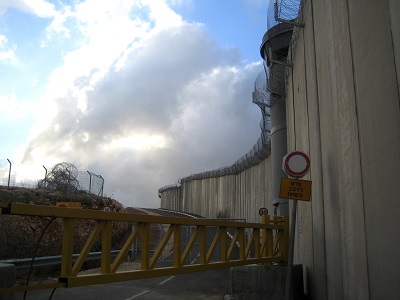
Here, right to freedom of movement is relative. (Photo: Tamar Fleishman)
Palestine Chronicle | January 27, 2014
We usually prefer to exit Palestine using Hizme checkpoint, where unlike other exit checkpoints, there are no long lines of cars, we aren’t detained and there is no need for identification or getting out of the vehicle to open and present the content of the trunk. You merely slow down by the soldier and answer a generic question like “how is it going?” with an “OK”. Sometimes even that isn’t required, just nod your head and that’s it, you can drive on.
But it’s different for us than for those who don’t pass the test examining the visage and accent of the driver. They, Palestinians from east Jerusalem, in spite of being permanent residents who have the right for freedom of movement (unlike their brothers who reside in the West Bank), are forced to stop, park their vehicle by the soldier’s post on the side of the road, identify themselves, exit the car and open the trunk so the solider can see inside.
Their right to freedom of movement is relative and they are subjected to the mercy and whims of the men in uniform.
The individual’s story is testimony to the story of the general public. The individual in this case was A who after visiting his family intended to drive through Hizme on his way back, with him were his wife, his baby son and someone he knew that said to him: “could you do me a favor, I need to get to Jerusalem, could I ride with you?”- So he did. A didn’t give him a thorough inspection, and had no idea what color his ID was and what was his address. He was just doing someone a favor. But the soldier at the checkpoint did perform an inspection and found out that A was giving a lift to someone who wasn’t permitted to pass through a checkpoint intended only for settlers, like Hizme checkpoint.
The man was arrested and taken away.
A was told to turn his engine off and to stay in the vehicle, in addition they took his car keys.
A, his wife and their child sat and waited. But the baby, who had yet to learn that a soldier’s order must be obeyed, began crying and wailing. The minutes that passed were long and the crying only grew stronger. But they couldn’t step out of the car, they couldn’t take the baby out of his booster, and he couldn’t be cradled in his mother’s arms. A tried getting out to reason with them, but was told to: “stay in the car!” and so he got back in.
After an hour his car keys were handed back to him and his wife and child were sent back home, while A was taken to the police station. There he waited for another hour, until he was given a summons to return on the next day.
Ever since he has been going back and forth to the police station, each day he waits for his name to be called, then he is taken into a room, the piece of paper he was handed on the previous day is taken from him and in return he is given a new paper summoning him to come back on the next day.
The time, the agitation, not to mention the money- all these are of no importance and are not taken into account.
Once he dared to ask why they weren’t handling his case and a policeman said to him: “I don’t have time for you, I’ve got lots of work”- “But my case is part of your work”, replied A, but instead of an answer he got a piece of paper in exchange for the one given to him on the previous day.
Yes, he will be back tomorrow, and perhaps even on the day after that.
This is how the representatives of the authority, who have unlimited power in their hands, handle people, whose rights are conditioned by circumstances.
(Translated by Ruth Fleishman)
Related articles


PLO official reveals full details of Kerry’s plan

MEMO | January 26, 2014
The secretary of the PLO Executive Committee has revealed the details of John Kerry’s plan for the Israel-Palestine negotiations. Yasser Abed Rabbo spoke to London’s Al-Hayat newspaper.
According to Abed Rabbo, the US Secretary of State’s proposal includes Palestinian recognition of Israel as a Jewish state; establishing part of East Jerusalem as the capital of Palestine; resolving the refugee problem in accordance with the vision of former US President Bill Clinton; maintaining Israeli control of major settlement blocs and leasing the others back to Israel; Israel’s control over border crossings and air space; and the presence of US-Israel-Jordan-Palestinian security forces on the border. “The Israelis would also have the right of ‘hot pursuit’ of fugitives or suspected criminals in the Palestinian state,” he revealed. “Israeli Prime Minister Benjamin Netanyahu rejected these ideas because he wants to carve out the land he wants and refuses to discuss the Jerusalem issue. He also refuses the intervention of any other party in security matters, even America.”
The PLO official pointed out that this way of thinking was essentially unacceptable. “We Palestinians have been more than clear when it comes to this matter. We have stated many times that we reject the concept of a so-called national homeland for Jews in historic Palestine or the concept of a ‘Greater Israel’. Netanyahu has expressed that he not only wants to legitimise the Zionist national narrative and the expulsion of Palestinians in 1948 but also Israel’s ongoing settlement projects, which aim to achieve the Zionist dream of a Greater Israel.”
Security arrangements
As for security arrangements, Abed Rabbo said that there is talk of potential security arrangements and the standards by which these arrangements will be run. “They will last for many years and are supposedly subject to improved Palestinian security performance. However, this will ultimately still be controlled by Israel, which will maintain control even though America has pledged that it will remain involved as these arrangements are made and see to it that Israel withdraws from certain areas including the Jordan Valley.”
Such security arrangements, he claimed, will maintain Israel’s security strongholds on mountain tops and in Palestinian airspace. Israel will maintain the right to fly over Palestinian land should it feel an impending security threat. “At this point, any semblance of Palestinian sovereignty or geographic unity has been completely torn apart”, warned Abed Rabbo.
Settlements, Jerusalem and refugees
He pointed out that there have been numerous discussions about Israel’s vast settlement blocs in the occupied West Bank. Rumours suggest that Israel wants to rent out settlement units to settlers in the event that a Palestinian state is established. What this means, he claims, is that the settlements will remain as they are and settlers will continue to live there as Israeli citizens with special status in the Palestinian state.
“According to Israel, Jerusalem is not up for negotiation and will remain under full Israeli control as its undivided capital,” he explained. “There is rather mysterious general talk about Palestinians establishing their future capital in Jerusalem but, from Israel’s point of view, Jerusalem extends from Ramallah to Bethlehem to the Jordan Valley border. Thus, it could easily be argued that Abu Dis or Kufr Aqab could be named as the future Palestinian capital.”
As far as Palestinian refugees are concerned, said the PLO official, there are four possible outcomes, as envisioned by President Clinton; one of them suggests the return of a limited number of refugees, as stated in Israel law.
The Palestinian Authority’s position
According to Abed Rabbo, the Palestinian Authority cannot accept any of these potential solutions, especially given that Netanyahu is believed to insist on there being no Arab presence in Jerusalem and rejects outright the refugees’ right of return.
“Netanyahu does not want the involvement of any third party, American or non-American, in any of his security arrangements in the Jordan Valley even if it remains under Israeli control. He wants all decisions to be Israeli decisions and judging by our previous attempts in the past, any of our attempts to abide by a plan or time table will be disrupted completely by Israel”, he noted. Israel and America claim that the Palestinian people will be able to get territory equivalent to the West Bank’s 1967 borders through land swaps. “I do not understand how this is possible with settlement blocs, Israeli security zones and the apartheid wall, which divides the eastern and western regions of the West Bank completely. We are supposed to believe that we can gain territory through land swaps? This is impossible.”
Population exchanges
The PLO veteran described those Israelis who suggest “people swaps” to accompany land swaps as “racist”, pointing out that the organisation would not accept any population exchanges.
“Palestinian Arabs living inside Israel are not settlers,” he stressed. “They did [not] come to Israel through an invasion or by migration. They are the owners of that land and no one can uproot them from their homes. Swapping settlers for Israeli-Arabs would mean swapping Israeli citizens for Israeli citizens; how is this possible?” For Abed Rabbo, this shows that the Israeli government does not consider Arabs to be true citizens of the state. “They regard them as second or third class citizens with no rights, which is absolutely racist. They seek to ethnically cleanse that territory more than they want to swap land.”
That is the framework under which most ideas were discussed, said Abed Rabbo. “We do not have any official documentation to prove it but the information gets leaked from Israel in one way or another.”
Reasons for Israeli refusal
He is not surprised that Israel rejects most proposals for the simple reason that it wants to carve out as much land as possible from the occupied West Bank and maintain absolute control, especially in security zones. This would give Israel the “right” to intervene to protect settlements, which would also mean that it has control of the road networks leading to them.
“We are being confronted with an ultimatum,” he added. “We are not standing in front of two different options with various formulas that we can accept or reject. However, any attempt to sweeten the language of these agreements instead of criticising their prejudices will lead us to disaster.”
He ruled out any blame being attached to the Palestinians should Kerry’s plan fail. “The blame game does not concern us and we do not take it in our political consideration. Who will blame us for wanting to have our country based on 1967 borders, and to have East Jerusalem as our capital, and to have a fair and agreeable resolution for the refugee issue?”
Although John Kerry has “done his best” to make proposals acceptable to both sides, argues Abed Rabbo, it seems that he has read the Israeli position at the beginning and accepted the verbal, generic, vague and ambiguous assurances that Netanyahu usually offers to whoever he meets. “He must have interpreted them in some form and when he looked at the fine print realised that there are two different Israeli positions.”
As such, he believes, Netanyahu lured Kerry to discuss the issue of security first and Kerry fell for it, thinking that it will lead to a big breakthrough for the negotiations and will open the way for discussion of other issues. “To his surprise, he discovered that the Israelis want to use security as an excuse to justify their ambitions for expansion,” concluded Abed Rabbo. “This explains how and why we have reached the current impasse.”
Source: Safa
Related articles


How Israel kills at will and in total impunity while the world asks the Palestinians for non-violent resistance
April 20, 2009
Frank Barat writes of the life and death of Bassem Abu Rahme, shot by an IOF soldier with “the rocket”, a new kind of weapon also used on critically injured US citizen Tristan Anderson some weeks ago.
On April the 17th, like any Friday afternoon for the last 4 years, the small village of Bil’in, north of Ramallah, was preparing for the usual demonstration against Israel’s annexation wall … The village of Bil’in has, since the mid eighties, lost more than 60% of its land for the purpose of Israeli growing settlements and the construction of the wall. The inhabitants of the village used to live mainly from agriculture and olive trees plantations but more and more, the people of Bil’in have to rely on the women to survive. Embroidery has become one of the main resource of the place, located a few kilometres away from Tel Aviv (on a nice day, you can see the “inaccessible”–for the Palestinians– beach from the roof tops of Bil’in).
In January 2005, a village committee (led by Mohamed Khatib, Iyad Burnat and Abdullah Abu Rahme) was created and a month later non-violent demonstrations started, first taking part every day, then once a week, on Yum Al Juma’a (Friday, day of prayer).
The village won a huge battle in August 2008 (1) when the Israeli High Court of Justice ruled that the new route of the barrier in Bil’in was in violation of the Court ruling released on September 2007 (2) (which ruled that the Wall path was prejudicial to Bil’in and must be altered) and ordered the State to present within 45 days a new route, which will uphold the principles of the ruling.
On Friday the 17th of April 2009, the wall still had not moved one inch and while the inhabitants of the village were praying at the village mosque, many internationals (coming from all around the world) and the strong Israeli contingent (including people from the Alternative Information Centre (3) and Anarchists Against the Wall (4)) were looking for some shade (to hide from the baking sun) and chatting about the day’s event. As soon as prayer was over with, the demonstration started to move forward in direction of the wall, a few kilometres away.
You can be sure that Bassem (aka Phil) was right at the front of the march. He always was. I had met Bassem a few times while visiting Bil’in. He was a strong looking man, singing the loudest, joking all the time, jumping around and leading the way, accompanied by the rest of the village committee and the Israeli contingent.
As it usually happens, as soon as the march reached the corner where the Israeli soldiers can be seen, the tear gas started. A few brave ones, always continue anyway and reach the beginning of the wall, after a few minutes. Bassem, as usual, was one of those. The Israelis present at the front of the demonstration started talking with the nearby soldiers in Hebrew and Bassem too, screamed “We are in a non violent protest, there are kids and internationals…”. He was shot in the chest and never managed to finished his sentence. He fell on the floor, moved a little bit, fell again, and died. ( http://www.bilin-village.org/english/articles/testimonies/Basem-Abu-Rahme-killed-in-Bilin-weekly-protest , scroll down for stills and videos)
Bassem was shot by a new kind of Tear Gas, called “the rocket”. The soldier who shot was a mere 40 meters away. This is the same type of tear gas that critically injured US citizen Tristan Anderson a few weeks ago. Those tear gas canisters are as fast and lethal as live ammunition. Very hard to get away from. Normally, tear gas canisters fly in the air for a long time, then fall and bounce a few times. Those ones fly like a bullet and go straight, not up and down.
Once more, Israel using the West Bank as its testing ground, the Palestinians as guinea pigs.
The soldier who fired, knew what he was doing and who he was targeting. The shame is that he probably knew Bassem. Bassem was always at the front, and had been for a few years now. The soldiers often come back more than once in Bil’in and start to get to know the ones facing them. Bassem did not get a chance to say hi, or bye.
On April the 17th , Bil’in and Palestine lost one of their heroes.
What is going to happen next?
Israel has already said that it will investigate the incident (out of every single investigation into such crimes, only 6% of the soldiers were ever prosecuted, often let off with a few weeks suspension), but before it did, started the usual propaganda, saying that the protest had been really violent and that the soldiers had to react (the video of the demonstration clearly shows otherwise).
We might even hear in a few days that it was actually the Palestinians who fired the tear gas and killed their beloved friend.
The P.A, instead of issuing the strongest statement against this act, stopping once and for all the negotiations with the Israeli government and joining the demonstrators every Friday to be hand in hand with its people, said next to nothing, and is looking forward to the upcoming White House meeting between Mahmoud Abbas and Obama (this is being planned while I write).
The media hardly reported this. The Palestinians do not count. Even more shocking when a video of the event is available to all and could have been used to great effect.
The international community (for what it means) will not mention this “incident” (it is for them) and continue issuing calls for the Palestinians to renounce violence and resist peacefully while saying nothing about Israel’s killings (since the start of the second intifada, 87% of the dead have been Palestinians), violations of international law and oppression of the Palestinians.
It is therefore down to us, the citizens of this world, to act, join solidarity groups, write articles, make films and talk, constantly, about the plight of the Palestinian people. Palestine has to become the number one issue.
This is a must.
For Bassem, his family, Bil’in and Palestine.
Frank Barat is in the organizing committee of the Russell Tribunal on Palestine and a member of Palestine Solidarity Campaign UK.
1. http://www.bilin-village.org/english/articles/testimonies/The-Supreme-Court-The-new-barrier-in-Bilin-violates-the-Court-ruling
2. http://www.bilin-village.org/english/articles/press-and-independent-media/Palestinians-celebrate-rare-victory-over-hated-barrier
3. http://www.alternativenews.org/
4. http://www.awalls.org/
Related article

The Strange but ‘Stable’ Alliance: US Senate Await Israeli Instructions
By Ramzy Baroud | Palestine Chronicle | January 23, 2014
Israel is often viewed by Washington politicians as the most ‘stable’ ally in the Middle East. But stability from the American perspective can mean many things. Lead amongst them is that the ‘ally’ must be unconditionally loyal to the diktats of the US administration. This rule has proven to be true since the United States claimed a position of ascendency, if not complete hegemony over many regions of the world since World War II. Israel, however, remained an exception.
The rules by which US-Israeli relations are governed are perhaps the most bewildering of all foreign policies of any two countries.
An illustration of this would be to consider these comments by Israeli Defense Minister Moshe Ya’alon quoted in the Israeli news portal Ynetnews. “The American security plan presented to us is not worth the paper it’s written on,” he said, referring to efforts underway since July by American Secretary of State John Kerry, “who turned up here determined and acting out of misplaced obsession and messianic fervor.” Kerry “cannot teach me anything about the conflict with the Palestinians,” said Ya’alon.
So far, Kerry has made ten trips to the Middle East with the intention of hammering out an agreement between Israel and the Palestinian Authority (PA). Based on media reports, it seems that the potential agreement is composed in such a way that it mostly accommodates Israel’s ‘security’ whims and obsessions, including a proposal to keep eastern West Bank regions and the Jordan Valley under Israeli military control. In fact, there is growing interest in the idea of ‘land swaps” which was floated by Israel’s notorious Foreign Minister Avigdor Lieberman ten years ago.
“When Mr. Lieberman first proposed moving Arab-populated Israeli towns near the present border into Palestine in exchange for Jewish settlement blocs in the Palestinians’ West Bank being incorporated into Israel, he was branded a racist firebrand,” wrote the Economist on Jan. 18. “Liberals accused him of promoting the forcible ‘transfer’ plan, akin to ethnic cleansing, proclaimed by a rabbi, Meir Kahane, who vilified Arabs while calling for a pure Jewish state.”
Those days are long gone, as Israeli society drifted rightward. “Even some dovish Israeli left-wingers find such ideas reasonable.” Back then, the Americans themselves were irked, even if just publically, whenever such ideas of ‘population transfers’ and ethnic cleansing were presented by Israel’s ultra-right politicians. Now, the Americans find them malleable and a departure point for discussion. And it’s Kerry himself who is leading the American efforts to accommodate Israel’s endless list of demands – of security and racial exclusiveness even if at the expense of Palestinians. So why is Ya’alon unhappy?
The Defense Minister, who sat immediately next to Prime Minister Benjamin Netanyahu during talks with Kerry, was unapologetic about his reasoning: “Only our continued presence in Judea and Samaria and the River Jordan will endure.” It means unrelenting Israeli military occupation of the West Bank and East Jerusalem.
Netanyahu is hardly an innocent bystander in all of this, although for diplomatic reasons he often entrusts his government minions to deliver such messages. The Prime Minister is busy issuing more orders to populate the occupied West Bank with Jewish settlements, and berating every government that rejects such insidious behavior as being anti-Israel, ‘pro-Palestinian’ or worse, anti-Semitic. This was the case again in recent days following another announcement of settlement expansion.
On Jan. 17, Netanyahu called on Europe to stop its “hypocrisy”. On the same day, Israel’s foreign ministry summoned the ambassadors of Britain, France, Italy and Spain, “accusing their countries of pro-Palestinian bias,” reported the BBC online. According to the ministry, the “perpetual one-sided stance” of these countries is unacceptable.
Yet, considering that Europe has supported Israel’s illegal occupation of Palestinian territories for decades, economically sustained the ‘Jewish state’ and its over 100 illegal Jewish settlements, and continue with its often unconditional military support of Israel, the accusations may appear strange and equally bewildering to that of Ya’alon against John Kerry.
How could a country the size of Israel have so much sway over the world’s greatest powers, where it gets what it wants and more, hurls regular insults against its sustainers, and still asks for more?
European countries found themselves in Israel’s firing line because a day earlier, the four EU countries took the rare step of summoning Israeli ambassadors to object to the Netanyahu government’s latest announcement of illegal settlement expansion (that of an additional 1,400 new homes). EU foreign policy Chief Catherine Ashton even went to the extent of calling the settlements “an obstacle to peace”, although hardly an advanced position considering that Israel’s colonial project in Palestine has been in motion for 46 years.
But even that is too much from the Israeli point of view. “The EU calls our ambassadors in because of the construction of a few houses?” Netanyahu asked as if baffled by a seemingly foreboding act, in a Jan 16 press conference. He even had the audacity to say this: “This imbalance and this bias against Israel doesn’t advance peace,” and also this, “I think it pushes peace further away because it tells the Palestinians: ‘Basically you can do anything you want, say anything you want and you won’t be held accountable.”
There is no sense in arguing with Netanyahu’s strange logic, but the question regarding Israel’s stronghold over the US and EU remains more pressing than ever, especially when one considers the ruckus in US Congress. No, the congress is not revolting because of the unmitigated power of the Zionist lobby, but for something far more interesting.
There seems to be a level of confusion in US Congress because members of the Senate are yet to feel serious pressure by the American Israel Public Affairs Committee (AIPAC) over a bill that proposes more sanctions on Iran.
“The powerful pro-Israel lobby has not engaged in a shoe-leather lobbying campaign to woo wayward senators and push Senate Majority Leader Harry Reid (D-Nev.) to schedule a vote on the bill. While the group supports the bill — authored by Sens. Mark Kirk (R-Ill.) and Robert Menendez (D-N.J.) — it is not yet putting its political muscle behind a push for an immediate vote,” reported Politico, citing key senators and their aides.
To say the least, it is disturbing that the US Senate is completely bewildered that AIPAC, which lobbies for the interest of a foreign power, is yet to provide its guidelines regarding the behavior of America’s supposedly most respected political representatives.
“I don’t know where AIPAC is. I haven’t talked to anybody,” said Senate Armed Services Chairman Carl Levin (D-Mich.). “I don’t know what they’re doing,” said Sen. John McCain (R-Ariz.).
This alone should shed some light on the seemingly bewildering question of the ‘strong bond’ and ‘stable’ alliance of Israel and the US – and to a lesser degree EU countries. This is not to suggest that Israel has complete dominance over US foreign policy in the Middle East, but to ignore Israel’s indispensable role in shaping the outlook of US foreign policy is dishonest and inconsistent with the facts, to put it mildly.
– Ramzy Baroud is an internationally-syndicated columnist, a media consultant and the editor of PalestineChronicle.com. His latest book is “My Father Was a Freedom Fighter: Gaza’s Untold Story” (Pluto Press, London).
Palestine Under Siege
By Richard Hugus
A video documentary of the destruction caused by the April 2002 Israeli attack on Jenin refugee camp in Palestine. Filmed three months after the attack. Also visits Jerusalem and Gaza. 41 minutes.
Winner of 2006 award from Al-Awda, The Palestine Right to Return Coalition worldwide film contest at Al-Awda’s Third Annual International Convention in Los Angeles
Full screen view recommended.
Related article

European pension funds increase Israel boycott pressure
MEMO | January 20, 2014
ABP, the world’s third-largest pension fund, said the fund might exclude the stocks ‘as a last resort’ if the Israeli banks fail to act
According to a report in The Financial Times today, three major European pension funds with a combined total of almost €500 billion of assets are “reviewing their holdings in Israeli banks over concerns that the banks finance illegal Israeli settlements in Palestinian-occupied territories.”
The three investors are Dutch ABP, the world’s third-largest pension fund, Nordea Investment Management, and DNB Asset Management. In addition, Norwegian pension fund KLP has confirmed it will be examining “dilemmas linked to financing [of Israeli settlements].”
An ABP spokesperson said the fund might exclude the stocks “as a last resort” if the banks fail to act. Nordea, meanwhile, is expected to meet the Israeli banks in March and take a decision on a possible withdrawal of investment at a meeting in May.
As the FT highlights, “the reviews come after PGGM, the second-largest Dutch pension fund, two weeks ago became the first big investor to dump its holdings in five large Israeli banks : Bank Hapoalim, Bank Leumi, First International Bank of Israel, Israel Discount Bank and Mizrahi Tefahot.”
The news comes two days after Israeli television broadcast remarks by the government’s top negotiator and Justice Minister Tzipi Livni, who warned that a “crisis” in the peace process will see Israel hit by a “wave” of boycott pressure. Last week, Shas party chair Aryeh Deri urged financial assistance to business owners in the West Bank “hurt by international boycotts”.
Related article
Peaceful protest ends in deportation and imprisonment
International Solidarity Movement | January 20, 2014

Photo by ISM
Occupied Palestine – On Saturday 18th January during a peaceful protest in the Jordan Valley, 19-year-old Ahmad Walid Atatreh, a Palestinian activist and 24-year-old Sven W, a German activist who lives in Switzerland, were arrested and beaten after a march held in Jiftlik Adam Junction. Ahmad is a law student, studying at Al-Quds University in Jerusalem.
The march in Jiftlik was organized in protest against a legislation bill recently approved in the Knesset to annex the Jordan Valley to the current state of Israel. While the Israeli government declares that the move is purely for security reasons, the large number of illegal agricultural settlements and theft of Palestinian water rights demonstrate that the motives are largely economic.
Almost 95% of the Jordan Valley lies in Area C, under full Israeli civil and military control. Palestinian Bedouin herders suffer repeated demolitions of their homes and animal shelters, and water tanks are frequently confiscated. A large section of the area is reserved as a firing zone and residents are often forcibly removed from their homes to make way for military exercises.
Approximately 60 people gathered in the Jordan Valley and began a protest holding banners and chanting against the Israeli occupation of Palestine. As the march ended, Israeli forces invaded the area and began to arrest Palestinian demonstrators. Sven W and a British volunteer succeeded in stopping the detention of a Palestinian youth and in the process were both arrested by the Israeli army.
The two international activists were violently pushed to the ground by an Israeli soldier and handcuffed. The British activist managed to escape detention, whilst Sven was blindfolded and forced to kneel on the ground.
One Israeli soldier purposefully pushed Sven’s face in dirty water before taking him behind a military jeep and repeatedly kicking him in the ribs. Ahmad was also beaten after his arrest and received injuries to his knee. The British activist received a similar assault before escaping detention.
During the arrests, Israeli soldiers fired live ammunition into the air, and on several occasions pointed their rifles at protesters’ faces.
Sven and Ahmad were blindfolded for 3 hours and were driven to an Israeli military base. While they were blindfolded, Israeli forces attempted to intimidate and frighten the activists by pointing guns in their faces.
At the military base Sven was told he was a “terrorist” and was arrested because he “threw stones”.
Sven is committed to non-violent resistance and during this particular demonstration, no stones were thrown.
Both activists were taken to a ‘medical’ room in the military base where their blindfolds were briefly removed, although their handcuffs remained. Sven told the Israeli soldiers that he had a headache after being unable to see for such a long period of time, and also that his ribs were sore due to the beating he received after his arrest. According to Sven this information was noted down although Israeli forces did nothing to assist with his pain. During this time in the medical room, many Israeli soldiers entered and took pictures of both Sven and Ahmad using their mobile phones.
Ahmad and Sven were then blindfolded again and driven to a police station in the illegal settlement of Ariel, neither activist was given any information with regard to where they were being taken or allowed to contact legal representation. During this drive Israeli forces stopped the car, tightened Ahmad’s blindfold and stole a camera from Sven’s bag, using it to take pictures of the two blindfolded men.
When they arrived at Ariel, Sven was finally informed of the three charges against him, assaulting an Israeli soldier, attempting to steal a rifle from a soldier and blocking a highway and therefore ‘”endangering” lives (however at no moment was anyone blocking the main highway, activists were gathered at the side of the road). The same charges were also given to Ahmad and are completely fabricated for both activists.
Sven and Ahmad spent the night in Ariel police station along with five other Palestinian prisoners. The light was kept on all night with Israeli forces constantly entering the cell, ensuring that none of the prisoners were able to sleep. At one point Sven was woken by a police officer and told he would have court in the morning.
Under Israeli law internationals must be taken before a judge within 24 hours.
In the morning of the 19th, Sven repeatedly asked when he would be transferred for his court hearing and he was ignored by Israeli police. At this point neither Sven nor Ahmad were allowed to contact legal representation. Ahmad also requested to speak to his lawyer and was told that unless he gave information about the demonstration he would not be allowed to contact anyone.
At 5pm, Sven was transferred from Ariel police station to a terminal at Ben Gurion airport. He was never taken before a judge and was instead asked to sign a piece of paper saying he agreed to be deported to Germany, although he has been living in Switzerland for the last 4 years.
Sven refused to sign unless he was allowed to speak to legal representation. Finally he was allowed to make a phone call, though was unable to get through to his lawyer and therefore unwilling to sign the document.
Sven was transferred to a prison in Ramle, near Tel Aviv, which is where he currently resides. He is expected to be deported on Thursday. When Sven left the illegal settlement of Ariel, Ahmad was still imprisoned. He has now been transferred to Hadarim prison in Netanya and should attend Salem court within the next few days. However he has still not been allowed to contact his lawyer, the first time Ahmad will speak to him will be when he is taken before a judge.
When Sven is deported this week, he will be the third international activist in less than two weeks to be arrested and deported by Israeli forces. Vincent Mainville and Fabio Theodule were arrested on the 8th January and deported a week later. Their arrest was ruled illegal by an Israeli court in Jerusalem, although this did not stop their transfer to the immigration center.

Photo by ISM

Photo by ISM
Related articles
Britain says every state should join the ICC apart from Palestine
By David Morrison | Friends of Lebanon | January 16, 2014
It is British policy to extend the jurisdiction of the International Criminal Court (ICC) to every corner of the earth, except the Palestinian territories occupied by Israel since 1967, that is, the West Bank, including East Jerusalem, and Gaza.
And it is not as if the Occupying Power isn’t committing acts that Britain regards as illegal in these territories, in particular, settlement building. British policy on this issue as stated on the FCO website is as follows:
“Our position on Israeli settlements in the Occupied Palestinian Territories is clear: they are illegal under international law, an obstacle to peace and make a two-state solution harder to achieve.” [1]
Settlement building is a war crime
Though the British Government never says so explicitly, settlement building is a war crime under the Rome Statute which defines the offences that can be prosecuted by the ICC. It is a war crime because it involves the Occupying Power transferring some of its own civilian population to the territory it occupies. And under Article 8.2(b)(viii) of the Rome Statute “the transfer, directly or indirectly, by the Occupying Power of parts of its own civilian population into the territory it occupies” [2] is a war crime.
Since there is no doubt that Israel has transferred well over 500,000 Israeli civilians into territory it occupies, and that the process is still going on, there is a prima facie case that Israelis responsible for the settlement building programme, including the present Prime Minister Benyamin Netanyahu, are guilty of war crimes. It may be that Americans and others who fund settlement building are guilty of aiding and abetting war crimes.
Yet the British Government is opposed to Palestine becoming a party to the Rome Statute so that it is possible that Israelis responsible for settlement building will be brought to account for what the British Government itself regards as illegal actions.
Challenging impunity around the world
In July last year, the British Foreign Office launched an ICC strategy paper [3], which expressed Britain’s enthusiastic support for international systems of justice in general and the ICC in particular.
A key element of British policy set out in the paper is the extension of the jurisdiction of the ICC by encouraging states that are not party to the Rome Statute of the ICC to join, with the objective of the ICC eventually acquiring universal jurisdiction. The paper explains that the British Government intends to:
- “Work with other States Parties to encourage more states to ratify and accede to the Rome Statute and to fully implement its provisions in domestic law. …
- “Urge States not party to the Rome Statute to consider ratifying or acceding to the Treaty …”
The paper explains:
- “Widening the reach of the Court beyond the current 122 States Parties will increase accountability and help challenge impunity.”
Inappropriate to challenge Israeli impunity
This enthusiasm for extending ICC jurisdiction was sadly missing when Foreign Minister William Hague spoke in the House of Commons a few months later on 28 November 2012. Then, he offered UK support for a UN General Assembly resolution granting Palestine statehood, providing Palestinian leaders promised, amongst other things, that if Palestine acquired statehood it would not become a party to the Rome Statute.
Here’s what he told the House of Commons:
“Our country is a strong supporter, across all parties, of international justice and the International Criminal Court. We would ultimately like to see a Palestinian state represented throughout all the organs of the United Nations. However, we judge that if the Palestinians were to build on this resolution by pursuing ICC jurisdiction over the occupied territories at this stage, it could make a return to negotiations impossible.” [4]
Yes, believe it or believe it not, it is British policy to extend the jurisdiction of the ICC to every corner of the earth, except the Palestinian territories occupied by Israel since 1967. There it is apparently inappropriate for Britain to challenge impunity.
Two days later, when in retaliation for the UN granting statehood to Palestine, Israel announced plans for yet more building in settlements, William Hague reacted as follows:
“I am extremely concerned by reports that the Israeli Cabinet plans to approve the building of 3000 new housing units in illegal settlements in the West Bank and East Jerusalem. Israeli settlements are illegal under international law and undermine trust between the parties.” [5]
Dare I suggest that, if settlements are illegal under international law, then, if at all possible, those responsible should be tried in an international court and, if found guilty, punished appropriately? Dare I suggest that, to this end, Palestine should be encouraged to accept the jurisdiction of the ICC?
Palestinian Authority tried to grant the ICC jurisdiction
In January 2009, the Palestinian Authority tried to grant the ICC jurisdiction over the occupied territories so that it would be possible for Israelis to be prosecuted by it for actions against Gaza during Operation Cast Lead.
The ICC can prosecute individuals for genocide, war crimes or crimes against humanity, as defined in the Rome Statute of the Court [2]. It acquires jurisdiction in respect of these crimes by states granting it jurisdiction under Article 12 of the Statute. A state can grant jurisdiction to the Court
(a) by becoming a Party to the Statute (Article 12(1)) or
(b) by making an ad hoc declaration accepting the Court’s jurisdiction (Article 12(3)).
The ICC can try individuals for genocide, war crimes or crimes against humanity, committed in the territories of states (or by its nationals anywhere) that have granted the Court jurisdiction.
On 21 January 2009, the Palestinian Authority made an ad hoc declaration to the Court under Article 12(3) in the following terms:
“In conformity with Article 12, paragraph 3 of the Statute of the International Criminal Court, the Government of Palestine hereby recognizes the jurisdiction of the Court for the purposes of identifying, prosecuting and judging the authors and accomplices of acts committed in the territory of Palestine since 1 July 2002” [6].
It took the ICC Prosecutor over three years (until April 2012) to decide that the Court couldn’t accept the jurisdiction offered. This decision hung on whether or not Palestine was a “state” within the meaning of Article 12(3), which says that a “State may, by declaration lodged with the Registrar, accept the exercise of jurisdiction by the Court with respect to the crime in question”.
Strangely, the Prosecutor concluded that it wasn’t up to him to decide whether or not Palestine was a “state”, within the meaning of Article 12(3), saying that “competence for determining the term “state” within the meaning of article 12 rests, in the first instance, with the United Nations Secretary General who, in case of doubt, will defer to the guidance of General Assembly” [7].
However, now that the UN General Assembly passed resolution A/RES/67/19 [8] accepting Palestine as a state, there is little doubt that Palestine can simply become a Party to the Statute under Article 12(1). Given that Palestine has been accepted as a state by the UN, it is almost certain that the answer would be YES.
During a public discussion held at the Academie Diplomatique Internationale in Paris on 20 March 2013, Fatou Bensouda, the Prosecutor of the International Criminal Court, said that it was clear that ICC membership for the State of Palestine was Palestine’s for the asking (see John Whitbeck, Palestine and the ICC, Al Jazeera, 16 April 2013 [9]).
Whitbeck also reported Fatou Bensouda’s view on the issue of retroactivity, that is, whether individuals could be prosecuted for past crimes committed before Palestine becomes a party to the Rome Statute. She said that she did not think that retroactivity could extend back to the birth of the court in 2002 and if any retroactivity was permitted, it would not be earlier than 29 November 2012, when the UN General Assembly recognised Palestine as a state.
Palestine to join other UN bodies?
A year has passed since Palestine was granted statehood by the UN General Assembly. It was generally expected that, having achieved that, the Palestinian Authority would press ahead to join other bodies associated with the UN, of which there are about 20, including the ICC.
There is little doubt that, had it done so, it would have been admitted to all of them. Remember that in October 2011, a year before it achieved statehood and in the teeth of fierce opposition from the US and Israel, it was admitted to full membership of UNESCO by 107 votes to 14 with 52 abstentions.
But, it hasn’t done so, because there has been fierce pressure on it not to do so, especially from the US. And, it has now promised theUS that it will not apply for membership of any of these bodies until April 2014 during the 9 month period of “negotiations” with Israel, brokered by the US Secretary of State, John Kerry.
It is absolutely outrageous that the US, with the support of Britain and others, has pressurised Palestinians into forgoing a possible legal means of redress against the illegal actions by the power that has held them under military occupation for almost 50 years.
Comoros asks ICC to prosecute Israelis re Mavi Marmara
On a brighter note, there is a possibility that Israelis may be arraigned before the ICC for the Israeli military assault on the Mavi Marmara on 31 May 2010. This took place in international waters, when it was part of a humanitarian aid convoy to Gaza, and resulted in the deaths of 9 civilian passengers.
This is possible because the Mavi Marmara was registered in the Comoros Islands and the Union of the Comoros is a state party to the Rome Statute. Under Article 12(2)(a) of the Rome Statute, the ICC has jurisdiction in respect of crimes committed, not only in the territory of a state party, but also on ships or aircraft registered in a state party. On 14 May 2013, the Union of the Comoros requested that the ICC mount an investigation into the Mavi Marmara assault.
This request has been made under Article 14 of the Rome Statute which states:
“A State Party may refer to the Prosecutor a situation in which one or more crimes within the jurisdiction of the Court appear to have been committed requesting the Prosecutor to investigate the situation for the purpose of determining whether one or more specific persons should be charged with the commission of such crimes.” [2]
On 14 May 2013, lawyers representing the Union of the Comoros presented a document to the ICC prosecutor, under Article 14, requesting her “to initiate an investigation into the crimes committed within the Court’s jurisdiction, arising from [the Mavi Marmara] raid’’[10]. The document sought to make a case that Israeli military personnel committed war crimes (for example, ‘wilful killing’ under Article 8(2)(a)(i) of the Rome Statute) and crimes against humanity under Article 7.
The prosecutor has to conduct a preliminary examination in order to establish whether the ICC’s criteria for opening an investigation are met. That examination is ongoing at the time of writing.
References:
[1] http://www.gov.uk/government/policies/working-for-peace-and-long-term-stability-in-the-middle-east-and-north-africa/supporting-pages/making-progress-on-the-middle-east-peace-process
[2] http://www.icc-cpi.int/NR/rdonlyres/EA9AEFF7-5752-4F84-BE94-0A655EB30E16/0/Rome_Statute_English.pdf
[3] http://www.gov.uk/government/uploads/system/uploads/attachment_data/file/223702/ICC_Strategy_Final.pdf
[4] http://www.publications.parliament.uk/pa/cm201213/cmhansrd/cm121128/debtext/121128-0001.htm
[5] http://www.gov.uk/government/news/foreign-secretary-extremely-concerned-at-proposed-new-housing-settlements-in-the-west-bank-and-east-jerusalem
[6] http://www.icc-cpi.int/NR/rdonlyres/74EEE201-0FED-4481-95D4-C8071087102C/279777/20090122PalestinianDeclaration2.pdf
[7] http://www.icc-cpi.int/NR/rdonlyres/C6162BBF-FEB9-4FAF-AFA9-836106D2694A/284387/SituationinPalestine030412ENG.pdf
[8] unispal.un.org/unispal.nsf/47d4e277b48d9d3685256ddc00612265/181c72112f4d0e0685257ac500515c6c
[9] http://www.aljazeera.com/indepth/opinion/2013/04/201341561759725150.html
[10] http://www.icc-cpi.int/en_menus/icc/structure%20of%20the%20court/office%20of%20the%20prosecutor/reports%20and%20statements/statement/Pages/otp-statement-14-05-2013.aspx
David Morrison is a Political Officer of Sadaka: The Ireland Palestine Alliance and co-author of A Dangerous Delusion: Why the West is Wrong about Nuclear Iran (April 2013). Morrison can be reached at david@sadaka.ie.
(December 2013)
Editorial note: For a glimpse at a similar situation with Lebanon, see “Justice campaigners say US urged Lebanon not to join International Criminal Court,” by Andrew Wander, The Daily Star, 12 March 2009.
Related articles
Academic delegation to Palestine endures 10-hour interrogation
Ma’an – 15/01/2014
BETHLEHEM – Members of an academic delegation were held for 10 hours by Israeli security forces when crossing into Palestine from Jordan, a statement said Tuesday.
A delegation of six academics and a labor activist came to the West Bank to conduct meetings with Palestinian scholars “in order to better understand conditions on the ground and to facilitate future collaborations,” one of the members said in a statement.
University of Illinois professor Junaid Rana said that on Sunday, four members of the delegation were held and interrogated by Israeli security forces, Interior Ministry employees, and the military for over 10 hours at the border.
“They were pressed about their scholarly research, academic networks, family backgrounds, nationalities, and ethnic origins,” Rana said.
“The Israeli security officer demanded contact and cell phone information and two delegates were coerced into accessing their email accounts using Israeli security computers.”
Additionally, the members were asked about previous travel to Arab countries.
“Rana was also asked why he attended a conference on ‘Transnational American Studies’ at the American University of Beirut in Lebanon, and whether he had any political writings related to Israel,” the statement said.
It continued by condemning the interrogation: “Such actions are a clear violation of academic freedom, including the freedom to travel for scholarly research, and demonstrate tactics of intimidation and harassment of scholarly inquiry.”
Some of the delegates who were held belong to US academic associations — such as American Studies Association, Association of Asian American Studies, and Native American and Indigenous Studies Association — that have endorsed an academic and cultural boycott of “Israeli institutions that are complicit in the continued colonization of Palestine.”
Three of the delegates were also personal supporters of the Boycott, Divestment, and Sanctions movement, the statement said.
“The delegation recognizes that their experiences on January 12, 2014, pales in comparison with the everyday surveillance and criminalization of Palestinian academics who are consistently denied the freedoms to research, publish, and travel,” Rana added.
Palestinians, in addition to other Arabs, Muslims, and pro-Palestinian activists, are often held for hours — and sometimes denied entry — at border crossings controlled by Israel.
In December, the American Studies Association announced its decision to boycott of Israeli academic institutions.
A statement from the organization read at the time: “The ASA’s endorsement of the academic boycott emerges from the context of US military and other support for Israel; Israel’s violation of international law and UN resolutions; the documented impact of the Israeli occupation on Palestinian scholars and students; the extent to which Israeli institutions of higher education are a party to state policies that violate human rights; and finally, the support of such a resolution by a majority of ASA members.”
Related articles


Featured Video

The Truth About the Trump Shootings with Ken Silva
or go to
Aletho News Archives – Video-Images
From the Archives
Trans ‘milk’ as good as the real thing – NHS
RT | February 18, 2024
The drug-induced nipple secretions of trans women are as good as mothers’ breast milk for babies, the University of Sussex Hospitals NHS Trust claimed in a letter to campaigners made public in a report by British think tank the Policy Exchange on Sunday.
The healthcare trust’s medical director, Rachel James, argued that the off-label prescription drug cocktail men transitioning to female take in order to produce milk was “similar to the natural hormones which encourage lactation to develop when the baby is newly born.”
“The evidence which is available demonstrates that the milk is comparable to that produced following the birth of a baby,” James wrote in the letter, sent to Children of Transitioners last August.
Biological men who wish to lactate must first take hormones to grow milk glands and then take high doses of either domperidone or metoclopramide to stimulate milk production. Neither drug is approved for this use, though they are occasionally prescribed off-label to biological women who have trouble lactating.
However, domperidone’s own manufacturer, Janssen, warns patients the drug “may cause unwanted side effects affecting the heart in a breastfed baby” and “should be used during breastfeeding only if your physician considers this clearly necessary.” … continue
Blog Roll
 Aletho News
- Russia Voted Under Fire. Washington Is Loading the Tankers.
- 12 Things Your Oncologist Was Trained Not to Tell You
- Anthrax Attacks Paved Way for COVID-Era ‘Junk Drugs and Vaccines’
- How Real Is the Impact of Western Sanctions on Israel?
- France, You Are Guilty: How Paris Turned Western Sahara into the Maghreb’s Powder Keg
- 2025 Nature Paper Claiming Worsening Global Drought Gets RETRACTED …Heavily Flawed
- Your Milk Is Not the Problem
- The Truth About the Trump Shootings with Ken Silva
- ARE PATIENTS BEING PROPERLY INFORMED ABOUT OZEMPIC?
- US lawmaker blocks $2.8 billion weapons sale to Israel: Report
- If Americans Knew
- Salah Sarsour’s Legal Team Says DHS Has Not Met Its Burden to Prove He Is Deportable
- An analysis of tax forms by The Intercept show Kraft’s charity and LLC have donated to Friends of the IDF and AIPAC’s super PAC.
- Israeli attacks kill four Palestinians in Gaza – Daily Update
- Inside Gaza’s death trap of collapsing, bombed-out buildings
- The everyday items Israel bans from Gaza every day
- Inside the siege, the ruined buildings of Gaza – Daily Update
- Debunking The Claim That Macklemore Has A “History Of Antisemitism”
- CPJ demands release of arrested Palestinian-US journalist near Bethlehem
- Robert Kraft: The Billionaire Friend of Netanyahu Pulling The Strings Behind the Macklemore/Ed Sheeran Blow Up
- Columbia Administered Fund Gives Big Money to Pro-Israel Groups
- No Tricks Zone
- 2025 Nature Paper Claiming Worsening Global Drought Gets RETRACTED …Heavily Flawed
- New Study: ‘Global Drought Shows No Detectable Recent Acceleration Under Climate Warming’
- Economic Masterminds: German Socialists Suggest Taxing Productivity Gains Stemming From Using AI
- The South China Sea Has Not Been Cooperating With The Climate Change Narrative
- Energy Crisis: Germany Enters Heating Season With Historically Low Gas Reserve Fill Levels
- New Study: The Antarctic Ice Sheet Gained Mass From 2020-2024 Due To Staggering Snow And Ice Accumulation
- Study: Ocean Heating Rates From Thousands Of Years Ago ‘Dwarf’ Modern Ocean Heating Rates
- Climate Extremists Target, Attack Large-Scale Power Grid Infrastructure In Germany!
- New Study: Antarctic Ice Melt Has Contributed Less Than 1 Centimeter To Sea Level Rise In The Last 30 Years
- Fear Of Debate: Alarmist German Climate Scientist Calls On Mainstream Media To Discredit Skeptic Voices
 Aletho News