Israeli settlers steal Palestinian olives in West Bank

MEMO | October 21, 2013
On Monday morning at dawn, Israeli settlers stole ripe olives from Palestinian farms in different areas of the occupied West Bank. Meanwhile, Israeli forces detained a Palestinian citizen at a moveable military checkpoint in Nablus.
Witnesses and farm owners told the Al-Quds Network that the settlers stole significant amounts of ripe olives from different farms. They also said that the settlers were hindering the arrival of many farmers who were heading to their farms in order to pick the olives.
Palestinian sources said that the settlers stole the olives from the neighbourhoods of Fara, Tal-Farata and Amateen. The sources also confirmed that the settlers were preventing farmers from approaching their farms, despite the farmers’ cooperation with Israeli officials in this regard.
Meanwhile, Israeli occupation forces invaded the Palestinian city of Nablus and detained Aboud Soboh, a Palestinian from the neighbourhood of Ras Al-Ein.
Witnesses reported that after invading the city, Israeli forces set up moveable checkpoints and then they arrested Soboh at one of these checkpoints.
Two of Soboh’s brothers are currently detained in Israeli jails.
Images from alquds.com
Related articles
- Jewish settlers cut down and burn hundreds of trees in Nablus and al-Khalil (alethonews.wordpress.com)
- Illegal Israeli settlers destroy olive trees in West Bank with impunity (sott.net)
Israeli occupation forces close checkpoints before movement of Palestinians on second day of Eid
Palestine Information Center – 17/10/2013
NABLUS — The Israeli occupation forces (IOF) obstructed the movement of Palestinian vehicles in the northern West Bank on the second day of Eid Al-Adha.
According to local sources, the IOF closed Za’atara and Hawara checkpoints on Wednesday evening, which caused long lines of vehicles extending two kilometers away.
The bulk of the vehicles had to stay in Hawara town until the IOF opened the checkpoints.
The IOF closed the checkpoints at six o’clock in the evening for several hours, eyewitnesses affirmed.
During the occasion of Eid Al-Adha, the Palestinians in the West Bank visit their relatives in other areas, but every year their movement is hindered by Israeli road blocks and closures.
Related articles
- Despite Israeli restrictions, Al-Quds prepares for Eid al-Adha (worldbulletin.net)
Elderly man seriously injured by speeding Jewish settler in hit and run assault
IMEMC & Agencies | October 17, 2013
Palestinian medical sources have reported that an elderly Palestinian man was seriously injured after being hit by a settler’s vehicle in Al-Fondoq village, east of Qalqilia, in the northern part of the West Bank on Wednesday.
The Palestinian Police said that a speeding settler driving a Toyota Corolla hit Abdul-Hafith Mohammad Tayyem, in his sixties.
The settler, who fled the scene, was driving in the center of the Palestinian village.
Palestinian medical sources said that Tayyem was moved to an Israeli hospital due to the seriousness of his condition.
There have been dozens of similar incidents that have led to serious injuries and fatalities, in different part of the occupied West Bank, including in occupied East Jerusalem.
On Sunday evening [September 29, 2013] a Palestinian worker was injured after being rammed by a settler’s vehicle, near Husan town, west of the West Bank city of Bethlehem.
On September 20, a Palestinian man was injured in a similar accident with an Israeli settler who fled the scene.
A week before the incident took place, Palestinian child was seriously injured after being hit by a settlers’ vehicle as she was walking home from school in Teqoua’ village, near the West Bank city of Bethlehem.
The child Hayat Mohammad Suleiman, 8 years of age, was walking back home from school on the main road that is also used by Israeli settlers living in illegal Israeli settlements in the area.
Related article
Turning Blood into Money
Profiting from Killing
By Vacy Vlazna | Dissident Voice | October 16, 2013
Warning! The Lab contains war-porn and hard-core evil; watch and weep.
Yotam Feldman’s documentary, released in August, is one of the most important exposés of the obscene rationale and execution of Israel’s hugely lucrative arms and security industries through the voices of some of its ex-military key operators: Amos Golan, Shimon Naveh, Leo Gleser, and Yoav Galant.
Israel’s armament juggernaut currently turns over $7 billion p.a. and its phenomenal success is, as Feldman reveals, due to experience, that is, the testing of weaponry on the Palestinian population in the Israeli military ‘labs’ of Gaza and the West Bank:
I think the main product Israelis are selling, especially in the last decade, is experience… the testing of the products, the experience is the main thing they [customers] are coming to buy. They want the missile that was shot in the last operation in Gaza or the rifle that was used in the last West Bank incursion.
Without blinking an eye, Benjamin Ben Eleixer, Industry Minister proudly asserts the reason for the tremendous demand for Israeli weapons and technology,
If Israel sells weapons, they have been tested, tried out. We can say: we’ve used this for 10 years, 15 years.
Tested by Israeli killers on 1,398 Palestinian children murdered since 2000 and the hundreds of thousands of children who struggle with war trauma, PTSD and perpetual terror.
The Lab makes plain why the peace process, past, present and potential, is a total sham. The economy of Israel is inextricably dependent on war and the suffering of the Palestinians.
And the other is the fact that now the Israeli economy is so much dependent on these operations. It’s 20 percent of the exports. It’s 150,000 families–not people–in Israel actually dependent on this industry. And if one day it will stop, if there will be no next operation in Gaza, so Israel will have some economic problems.
The arms industry doesn’t belong to a few dealers, its owned by a whole country.
What better justification of Boycott Divestment and Sanctions (BDS) movement which targets state and private companies as well as all Israeli universities, through their military R&D programmes, that are ‘turning blood into money’.
Which gun made the shekel accelerate when sisters Amal, 2 and Suad Abed-Rabbo, 9, who was waving a white flag, were shot by tank personnel in Gaza?
The degradation of the Israeli mind and society through the perverted normalising of state-sanctioned cruel aggression and violent criminality is apparent in the egotistic strutting throughout the film of the Israeli warmongers, politicians and arms dealers, who are oblivious that to civilised people they come across as psychopaths:
Gen (ret.) Amiran Levin:
I want to move onto one point, speaking of Gaza, speaking of Lebanon, and other places we will occupy in the future. Since we want to maintain equilibrium, as a developed country, punishment as a strategy should be the main element…That’s the most important thing, Quantity is more important than quality. One mistake the army makes is judging each case individually, whether the person deserves to die or not. Most of these people were born to die, we just have to help them.
Lt.Co.(ret.) Shimon Naveh, a military philosopher – yes, you read right, military philosopher — who talks like he’s swallowed a kilo of amphetamines, strolls through a bullet-riddled mock Arab village used for military exercises, moaning,
As you can see this isn’t an Arab village. It is a dead place. Maybe in our rosiest dreams this is what a Palestinian village would look like, but it isn’t one.
Gen.Yoav Galant, the ‘inventor’ of the 2008-9 Operation Cast Lead;
As far as I’m concerned the enemy has 3 options either he get killed, or he surrenders, or he flees.
Galant omits that the 1.6 million men, women, children and elderly of Gaza (for that matter all Palestinians) have nowhere to flee because Israel tightly controls Palestinian land, sea and airspace.
Thus we understand that the Israelis have the identical strategy of low intensity or asymmetrical warfare as the USA; only attack nations that are on their knees through sieges, sanctions and substandard armaments.
Naveh, in an interview in the Small Wars Journal admits as much:
When you fight a war against a rival who’s by all means inferior to you, you may lose a guy here or there, but you’re in total control. It’s nice. You can pretend that you fight the war and yet it’s not really a dangerous war.
Apart from the Hamas freedom fighters armed with Kalashnikovs and a ‘modest stock of weapons’, Palestine has no army, navy, airforce to defend its people. There are, of course, President Abbas’ US armed and trained security forces but they brutally police their own people on behalf of Israel.
Feldman shows how Israel’s major arms companies make arms selling sexy. At a weapons trade exhibition in Paris, a perky young female rep demonstrates on screen the precision capabilities of IAI products, and at the Shivta military base, foreign officers who have come to view a missile demonstration are divided into groups led by ‘lovely’ female Israeli soldiers.
Foreign governments, like Australia, contribute generously to optimising the profits of Israel’s death merchants while simultaneously appeasing their electorates, Galant complains, “There’s a lot of hypocrisy, they condemn you politically, while they ask you what your trick is, you Israelis, for turning blood into money,” nevertheless the gains for Israel as specified by him are, “First of all it gains security, secondly the nations and the armies of the world want to be friends with the strong, just side, and the winning side.”
Strong, yes, JUST? Not according to the parents of little 3 year old Ahmed As -Sinwar who was found under a pile of rubble and stones with a hole in his head, and not according to the parents of the other 352 children killed plus the 860 children injured and maimed in Operation Cast Lead by the sought-after Israeli air and ground missiles, artillery shelling, phosphorous bombs, flechettes, bullets and unexploded ordnance.
It is utterly macabre and beyond decent comprehension that the sales of drones were boosted by the wilful killing by drones of 116 children during Operation Cast Lead.
The highest echelon of the Israeli government has control of the business of death. All export of arms and security services are OK’d by SIBAT, the Israeli Ministry of Defense’s export agency.
Amos Golan, an arms dealer who started “with a dream”, views himself as a “good guy” not someone who kills innocent people in his spare time. He was a former commander of the Duvdevan special forces unit that conducts undercover operations disguised as Arabs and the inventor of the highly profitable Cornershot assault and sniper gun that enables the user to see around corners.
His Silver Shadow Advanced Security Systems (SSASS), listed with SIBAT, has provided security solutions and training for the dictatorships of the Republic of the Congo, Nigeria and Uganda where SSASS trained the Black Mamba death squad accused of human rights violations.
Leo Gleser, a generous father and grandfather, states that since 9/11 “all defense solutions now come from Israel through Israeli companies.” Who’d have thought 9/11 would benefit Israel? His own company, International Security and Defense Systems (ISDS), listed with SIBAT, was “established in 1982 by highly experienced officers, former operatives of I.S.A. Israeli Security Agency, the MOSSAD and the Defence Forces” has among its clients the Athens, Barcelona, Beijing and Rio Olympic Games, 2014 World Cup Soccer, joint ventures in security training with China, India, Brazil, Spain and USA.
It also serves the United Nations which appears to have overlooked that Gleser’s company trained, in the 80s, the CIA backed brutal Honduran Battalion 3-16 involved in the disappearance of 191 people. (This has been documented in Andrew and Leslie Cockburn’s book Dangerous Liaison: The Inside Story of the US-Israeli Covert Relationship.)
War criminal and child-killer, Noav Galant, once tipped to become the next Chief of General Staff, is now retired because of allegations that he appropriated public lands near his home for his private use which is irony par excellence given he is on the board of HaShomer HaChadash that helps Israeli “farmers and ranchers in the Negev and the Galilee who administer vast tracts of state-owned land to deal with the threat of illegal seizure of their land”, which is to say, to prevent the ‘ongoing encroachment of the Bedouin on state-owned land ‘ which we all know is ancestral Bedouin land seized by Israel. As we have seen, Galant knows all about hypocrisy.
The Lab’s exposition of Israel’s profiteering from its military expertise and arms dealing is nothing new as this has been well documented elsewhere such as in Jane Haapiseva-Hunter ‘s ‘Israeli Foreign Policy: South Africa and Central America’. The impact of The Lab lies in directly hearing and seeing for ourselves Israel’s deviants cheerily admit to making big bucks from ethnic cleansing and genocide.
Feldman ends The Lab with a masterstroke of irony filming, at a conference, these fat Israeli death feeding maggots, nodding and smiling to John Lennon’s beautiful and inspiring song, Imagine ..
Imagine all the people,
Living life in peace…
Dr. Vacy Vlazna is Coordinator of Justice for Palestine Matters. She was Human Rights Advisor to the GAM team in the second round of the Aceh peace talks, Helsinki, February 2005 and then withdrew on principle. Vacy was coordinator of the East Timor Justice Lobby as well as serving in East Timor with UNAMET and UNTAET from 1999-2001.
Israeli Occupation Continues Violations against Palestinian children: UNICEF
Al-Manar | October 15, 2013
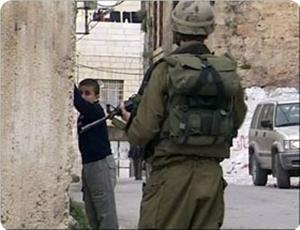 The United Nations Children’s Fund (UNICEF) has reported that Israeli violations against detained Palestinian children are still ongoing, despite an alleged Israeli decision to improve their conditions, and the methods of interrogation.
In a report published on Monday, the UNICEF said “violations are ongoing,” seven months after an initial report underlined widespread mistreatment of Palestinian teenagers arrested by Zionist forces in the occupied West Bank.
The UNICEF said that despite its earlier report violations against detained children are still ongoing, despite the 38 recommendations that outlined these violations and the manner to address them.
The international body cited 20 sample cases of abuse of youths in the West Bank in the second quarter of this year.
The UNICEF said that heavily armed soldiers would violently break into homes, before they force the children out of their beds, and take them to interrogation facilities, cuffed, blindfolded, and in a state of extreme fear.
It said that Israeli interrogators would question the children about allegations of throwing stones at soldiers and settlers, and that the interrogators would threaten the children with physical violence, death, in addition to sexual assault threats not only against the children, but also against a family member.
Palestinian village continuously inhabited for 3,000 years about to be destroyed by Israel
By Saed Bannoura | IMEMC News | October 14, 2013
The Israeli High Court is set to rule on the forced expulsion of all of the residents of the village of Khirbat Zanuta, southwest of Hebron in the southern West Bank on Monday.

Villagers in Khirbat Zanuta (image by ACRI)
The decision comes five years after the initial order was made by the court to demolish the village. That decision was put on hold when an appeal was filed on behalf of the villagers by the Association for Civil Rights in Israel.
According to the Association for Civil Rights in Israel,
“Last year, a Jewish expansionist organization named Regavim succeeded in reviving the case by filing an amicus-curia request; soon thereafter, the state submitted its full response to the petition. In April 2012, the Civil Administration issued additional demolition orders for new structures in the village, including several cisterns (ACRI is arguing that objections to the new orders should be joined to the original petition, but the Civil Administration disagrees). The Supreme Court heard additional arguments on July 30, 2012. During the hearing, the justices delivered harsh criticism of the State for its intent to demolish the village without suggesting a solution for its residents.”
But the decision on Monday is expected to result in the forced expulsion of all of the village’s inhabitants, who have lived on the land of their ancestors for as long as they can remember. They consider themselves stewards of the ancient archaeological site on which they live and tend their sheep, and have prevented any looting or destruction of artifacts on the site.
The Zionist organization Regavim that managed to revive the demolition order on the village had a quick response time from the court. The Israeli daily Ha’aretz reports that the organization has a “cozy relationship with the authorities”, according to its Director Bezalel Smotrich, who told the settler website Hakol Hayehudi on July 31, 2012, “Another parameter of the success of Regavim’s activities is the treatment by authorities in the establishment. Among the ranks in the field and in a lot of departments of the Interior Ministry, Israel Land Administration, the Justice Ministry and more, they view Regavim as a positive factor that is coming to their aid to steel them against the pressure they receive from the left. Most of them are good people, idealistic people… happy for the counter-pressure we exercise after years in which they absorbed so much heat in the form of pressure and letters from left-wing organizations.”
The inhabitants of Khirbat Zanuta are shepherds, who have traditionally lived in caves and structures around the cave entrances. The village is located in what Israel calls ‘Area C’, a designation created under the Oslo Accords in 1993 for land that was to temporarily remain under Israeli civil administration control, but should have been transitioned to Palestinian rule within five years. That never happened, and all of the areas designated as ‘Area C’ in 1993 remain under full Israeli control today – most of the 500,000 Israeli settlers that have taken over land in the West Bank in the twenty years since that designation have moved into ‘Area C’.
According to the Association for Civil Rights in Israel,
“The case of Zanuta is demonstrative of the Israeli government’s planning policy as it relates to the Palestinians in Area C, in which actions as severe as the destruction of basic humanitarian structures are justified by an absurd Catch 22 that penalizes residents for failing to apply for a permit they could never have been granted. If these demolition orders are carried out, the residents of Zanuta will be stripped of their most basic humanitarian rights: shelter, water, and livelihood, not to mention dignity, culture, and way of life. As an occupying power in Area C, Israel is bound by international law to protect the indigenous community. The case exemplifies a policy of demolishing buildings in Palestinian villages that removes indigenous peoples from their lands in absolute violation of the international law which protects them.”
Jewish settlers steal olives from 110+ trees in Abu Huwar
International Solidarity Movement | October 7, 2013
Deir Sharaf, Occupied Palestine – On the 5th of October, local farmers discovered that the olives from more than one hundred trees had been stolen, and that another ten trees had been damaged or destroyed. Abu Huwar farm, belonging to Yasser Fuqaha, Sidqi Fukaha, Mustafa Fuqaha and other farmers from the Meri family.
A local factory worker reported that he had seen two buses loaded with settlers pull up and unload next to the farm, in the night between the 3rd and 4th of October. About 150 metres into the field the olives had been swiftly picked from the trees, leaving small amounts on the tops, and the damaged trees bore markings from sharp-edged cutting tools. Yasser Fuqaha reported that the amount stolen from him represented about three quarters of his expected total yield, a devastating blow to his income. This attack precipitated the start of the olive harvesting season, and puts pressure on the local farmers to start harvesting the olives before they have reached optimal ripeness.
Abu Huwar has not had an easy run over the years. The local Palestinian farmers reported that, in 1996, the part of the olive grove that was on the other side of the hilltop (itself the location of an illegal settlement) had been completely uprooted by radical settlers and moved into various places on the other side of the 1967 Israeli border. Also, in the period 2000-2008, the farm and surrounding farmlands had been closed off from Palestinians by the Israeli military.
A national symbol, the olive tree represents the most essential source of income and sustenance for many Palestinians. The destruction of olive trees and theft of its yields is a serious crime and a huge loss for the local farmers.
Related articles
Saudi Hires Occupation-Friendly Company for Hajj Security
By Orouba Othman | Al-Akhbar | October 7, 2013
This year, the mandatory Muslim pilgrimage to Mecca, or hajj, will compound the Palestinians’ woes. Palestinian pilgrims will be greeted by a company that assists in their repression – and even torture – under the Israeli occupation regime. Indeed, hajj this year will be brought to you by none other than G4S.
This is not the first time that the Saudi government has hired the private security firm, which has recruited a staggering 700,000 to provide hajj-related services this year, according to exclusive information obtained by Al-Akhbar. Most of the leaked reports indicate that security for the hajj season since 2010 has been entrusted to al-Majal G4S, an affiliate of the parent company G4S.
The CEO of al-Majal G4S is a former security official in Saudi named Khaled Baghdadi. The Saudi subsidiary is fully owned by the British-Danish firm.
The parent company has not disclosed the nature of the contracts it has signed with the Saudi authorities. In its periodic reports, G4S makes limited references to its Saudi operations, such as winning a contract with Jeddah Metro to assist with security during the hajj, or stating that the company assists in the transport of more than 3 million pilgrims who visit Mecca each year. In 2011, the website Asrar Ararabiya – Arab Secrets – published an ad by the company asking people to apply to work in Mecca for seven days only, during hajj.
The Boycott, Divestment, and Sanctions (BDS) campaign has not been sitting idly by. In a press conference on Wednesday, October 2, the campaign sent a clear message to the Saudi government, urging it to terminate the contract with the company that happens to provide equipment and security services to protect Israeli settlements, occupation checkpoints, and police facilities. The private security contractor has also been implicated in enabling the torture of administrative detainees in Palestine, including children, according to BDS activist Zaid Shuaibi.
BDS activists were not the only ones to react to the news. Sheikh Ekrima Sabri, the head of the Supreme Islamic Council in Jerusalem and the imam of al-Aqsa Mosque, has proclaimed, “This company operates in security, and has activities and commitments in areas under Israeli occupation. Those who help the occupation must be held accountable and are complicit in the crime, as those who help aggressors also are aggressors.”
Shuaibi, speaking to Al-Akhbar, said that the BDS campaign contacted the Palestinian Ministry of Economy, being the competent authority in the issue of boycotting settlements, such as the ones serviced by G4S. But according to Shuaibi, “The ministry did not bother to respond or take action to stop the abuse, even as the company violates Palestinian law by continuing to provide services to the settlements.”
G4S in Israeli Prisons and Interrogation Centers
G4S’ subsidiary in Israel (Hashmira) was awarded a contract with the Israeli Prison Service in July 2007 to supply equipment and security services that enable violations of Articles 49 and 76 of the Fourth Geneva Convention. The company provides security systems and centralized control systems to the Hasharon-Ramonim prison, which contains a section for Palestinian political prisoners.
G4S has installed a central command room in Megiddo Prison, in addition to supplying a wide array of security services to the Damon and Ketziot prisons. In Ofer, the prison where more than 1,500 Palestinians are detained – mostly administrative prisoners – G4S has also installed a central command room and provided protection through peripheral defense systems on the walls surrounding the prison. The company routinely supplies systems for command and control, IT, CCTV, and communications to Israeli prisons.
In the Jalma and Maskoubieh interrogation centers, which are also serviced by G4S, not even children are spared from torture. It is in one of those centers that Palestinian detainee Arafat Jaradat was tortured to death earlier this year. There, too, Luay al-Ashqar, a Palestinian administrative detainee, became permanently paralyzed in his left leg when he suffered a triple fracture in his spine during his detention.
Under Israeli military law, prisoners can be detained for investigation for 60 days without access to a lawyer, which means that lawyers cannot witness interrogation methods used against their clients. All these practices and more are facilitated by G4S.
Checkpoints, Settlements, and Police Stations
According to a report by Who Profits, “G4S Israel supplied luggage scanning equipment and full body scanners to several checkpoints in the West Bank, including the Qalandia checkpoint, the Bethlehem checkpoint…[and] the Erez checkpoint in Gaza.” The company also provides security equipment to Israeli police facilities in the E1 zone of the West Bank, near the settlement of Maaleh Adumim.
Meanwhile, G4S-serviced checkpoints make life extremely difficult for more than 23,000 Palestinians who work in Jerusalem and the territories of 1948 (Israel proper), who have to wait and are often delayed as they undergo humiliating inspection each morning. G4S also operates in the Israeli settlements, catering to businesses and private citizens.
Europe Reacts
BDS campaigns have been able to achieve some success in Europe while Saudi Arabia continues to ignore appeals to terminate contracts with G4S. The company lost several contracts in Europe, including with Oslo University back in July after pressure by student groups.
In the United Kingdom, the East London Teachers Association put pressure on local authorities to terminate contracts with G4S, which provides services to more than 25 schools in the British capital. Campaigns to boycott G4S have spread to Denmark, Sweden, Belgium, and the rest of Europe. In April this year, G4S failed to renew a 2008 contract to provide security services for parliament buildings in Europe.
G4S in the Arab World
The scope of G4S’ operations and profits in the Arab world is nearly six times the size of its operations and profits in the Jewish state. In truth, its market share in Saudi alone is about 10 times its share in Israel.
The company is active in 16 Arab countries, with a turnover of 501 million British pounds ($805 million) last year, or 6 percent of its total revenues. It employs nearly 44,000, who work in operations ranging from providing security for airports in Baghdad and Dubai, Arab embassies, various Arab sports events, as well as protection for private businesses.
In comparison, G4S earns about 100 million pounds ($160 million) from its Israeli operations, or 1 percent of its total yearly revenues.
Follow Orouba Othman on Twitter.
Fast Times in Palestine – Book Review
Reviewed by Jamal Kanj | Palestine Chronicle | October 5, 2013

(Fast Times in Palestine. Pamela Olson. Seal Press, March 2013)
Whenever I read a biographical book, I make it a point to start with the acknowledgement page to learn a little about the writer. In reading “Fast Times in Palestine: A love affair with a homeless homeland,” I had to start from the end of the book.
In those two pages the author thanked more than fifty individuals, but what got my attention was recognizing her ninth grade teacher for forcing her to write “a journal every day.” A gift the author displayed meticulously in chronicling the places and people she met in every page of a moving memoir of her journey in Palestine.
As I read the book I tried to fathom what drove a young American woman from a small town in Oklahoma with degree in physics to end up spending two years traversing military checkpoints and helping farmers harvest olives in the Middle East.
It could have been her adventurous nature and love for travel that brought her to that part of the world, but it was sheer destiny that tossed her into the abyss of fire to tell the world of her “love affair with a homeless homeland.”
After graduating from Stanford University in 2002, the newly graduated student was working at a neighborhood bar to save enough money for a backpacker vacation in the Greek isles when her French friend suggested Egypt as an alternative, less expensive destination. She traveled to Cairo and the Sinai, where she met an Israeli tourist named Dan who invited her to visit him in Israel.
Her journey took her across the Red Sea to Jordan, where she met—by chance—two peace volunteers, one British and one Canadian, who were on holiday from their work in Palestine. In the few days she spent with them in a downtown Amman hotel, she learned for the first time of the $3 billion the US government pays Israel annually on behalf of American taxpayers.
Stories about occupation, the Palestinian people and human rights activism intrigued her, and she became interested in finding out for herself the truth about life in the West Bank. She jumped on the opportunity when they invited her to come along with them, and they took her to an unlikely tourist destination, a small Palestinian village called Jayyous.
The author tackles the paradox of occupation in very straightforward layman’s terms, describing how a forty-mile journey from Jerusalem to the Palestinian city of Nablus would take a full day crossing a separation wall, changing cabs six times and navigating permanent and flying Israeli military checkpoints. Meanwhile a much longer trip with her Israeli friend on “Jewish only settlement roads” could be completed uninterrupted in a much shorter time.
She also describes how the separation wall isolates villagers from their olive groves and farms—for many their only livelihood—while hilltop Jewish-only settlements encroach on centuries-old trees and isolate Palestinian towns and villages into islands surrounded by Zionist colonies and the army that protects them.
Ever more fascinated by the wickedness of occupation and the joys of life among Palestinians, Pamela Olson took a low-paying job in Ramallah as an editor and head writer for the Palestine Monitor to study and document the daily human rights abuses under Israeli occupation.
Living and working in the Palestinian political capital, Pamela entered Palestinian politics from its widest doors by becoming the foreign press coordinator for a major candidate in the 2005 presidential election.
In her two years between Jayyous and Ramallah, the author takes the reader on an extraordinary expedition very few of us will ever get the opportunity to experience in a lifetime. She takes us along with her via immaculate descriptions of the spring greenery on hills and meadows—not yet raped by the concrete desertification of the Jewish only settlements—or smoking Nargila (hookah) on porches with friends in Jayyous or sipping coffee at westernized cafés in Ramallah.
What makes this book special is the writer’s ability to keep the reader spellbound with her vivid descriptions of events, people and places. The reader is able to feel the author’s inner glee meeting beloved friends, pain while witnessing and experiencing the horrors of occupation and the melancholy of bidding farewell to people who became part of her family in Palestine.
– Jamal Kanj (www.jamalkanj.com) writes weekly newspaper column and publishes on several websites on Arab world issues. He is the author of “Children of Catastrophe,” Journey from a Palestinian Refugee Camp to America.
Jewish settlers cut down and burn hundreds of trees in Nablus and al-Khalil
Palestine Information Center – 05/10/2013
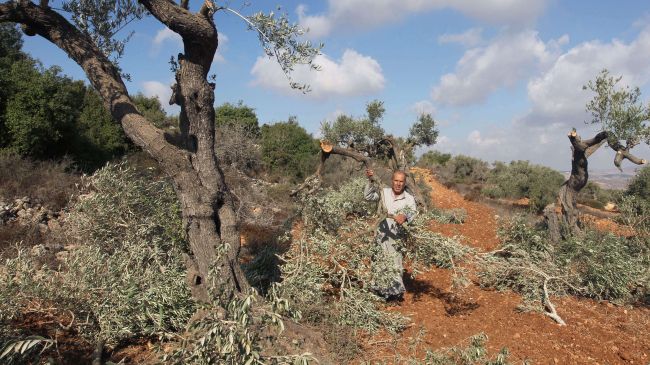
NABLUS — Jewish extremist settlers attacked olive groves in Deir Sharaf village west of Nablus northern West Bank on Friday night.
The settlers attacked Palestinian lands near Shavei Shomron settlement where they cut down trees and bulldozed Palestinian lands in the area, a PIC correspondent reported.
The lands’ owners were stunned Saturday morning at the site and bulk of the damages caused by the settlers’ violent attack against their agricultural lands.
Settler attacks usually witness a sharp escalation during the olive harvest season, and include the uprooting of Palestinian trees, in addition to attacks on residents, and international supporters, while picking their crops.
Meanwhile, Israeli settlers burned Palestinian land planted with grapes near Kharsia settlement in al-Khalil southern West Bank.
Local sources told Quds Press that the Israeli settlers burned down a four-dunum piece of land planted with grapes owned by the Palestinian citizen Mousa Jaber.
The Palestinian farmers called on human rights institutions to intervene to put an end to the Israeli violations and attacks against them and their farms.
Related articles
- Israelis torch Palestinian car, slash tires of five others (alethonews.wordpress.com)
- Settlers open fire toward shepherds south of Nablus (altahrir.wordpress.com)
- Illegal Israeli settlers attack Palestinian villages in Nablus (occupiedpalestine.wordpress.com)
Featured Video

Deception – Submarines against Olof Palme
or go to
Aletho News Archives – Video-Images
From the Archives
Woolsey Fire started at Santa Susana Field Lab — where “radioactive materials released were never accurately measured”
By John Laforge | CounterPunch | November 30, 2018
In my Nov. 16 column, I reported on potential radiation risks posed by California’s Woolsey wildfire having burned over parts or all of the Santa Susana Field Laboratory—south of Simi Valley, Calif., 30 miles outside Los Angeles—site of at least four partial or total nuclear reactor meltdowns.
The field laboratory operated 10 experimental reactors and conducted rocket engine tests. In his 2014 book Atomic Accidents, researcher James Mahaffey writes, “The cores in four experimental reactors on site … melted.” Reactor core melts always result in the release of large amounts of radioactive gases and particles. Clean up of the deeply contaminated site has not been conducted in spite of a 2010 agreement.
Los Angeles’s KABC-7 TV reported Nov. 13 that the Santa Susana lab site “appears to be the origin of the Woolsey Fire” which has torched over 96,000 acres. Southern Calif. Public Radio said, “According to Cal Fire, the Woolsey Fire started on the afternoon of Thursday, Nov. 8 … on the Santa Susana site.” … continue
Blog Roll
 Aletho News
- Feeling Better, Getting Worse: How Psychiatric Drugs Create the Illusion They Cure
- ‘Nobody Told Me’: Former Mental Health Patient Calls Out Dangerous Side Effects of Psychiatric Drugs
- Dr. Abu-Sitta: Beirut ‘felt like a day in Shifa Hospital’
- Iran Has Won the War, It Will Be Up to the US to Secure the Peace: Mohammad Marandi
- Iran condemns assassination threats against Iranian negotiators amid US talks
- Brussels cannot say where its own pipeline inspectors are as Hungary’s oil lifeline remains shut
- Israel’s Iran War: Myth and Reality
- Between war and industrial breakdown: The US-Israeli attrition crisis
- Pressure builds on Iran to ‘drop’ Lebanon ceasefire demand as Islamabad talks hang in balance
- In another clash report, US denies agreement to release Iran’s assets
- If Americans Knew
- Pro-Israel ‘Thinktanks’ and Individuals who Influence U.S. Foreign Policy
- Mearsheimer reveals how Israel dictates US policies on Iran, Gaza – video
- After killing 350+, Israel still has a “score to settle” with Lebanon before ceasefire – Daily Update
- Military aid to Israel emerges as the latest political litmus test for Democrats
- The only Palestinian children’s rights organization closes following years-long Israeli campaign against it
- ‘I Can’t Forget the Smell’: Lebanese Reel After Israel Kills Over 300 in Single Day
- DNC Shoots Down Resolutions Calling Out AIPAC and Limiting Arms to Israel
- TCN: Is Israel Blackmailing President Trump?
- Israel killed at least 303 Lebanese yesterday – who were they? Daily Update
- Amnesty: Urgent – Protect Lebanese civilians from brutal escalation in Israeli attacks
- No Tricks Zone
- German Expert: Heat Dome Led To Record Temps In Western USA…Warmer In 1934, 1936
- New Study: No Linear Warming Or Glacier Retreat Along Northern Antarctic Peninsula Since 1980s
- An Inconvenient Tree: Uncovered In Alps… Europe Much Warmer Than Today 6000 Years Ago
- New Study Reports A 60% Slowdown In Greenland’s Ice Loss Rate In The Last Decade
- Low Intensity Tornado Wrecks Major Solar Farm, Creating A Potential Toxic Dump
- New Study Finds Warming Saves Lives…Cold Temperatures 12 Times More Deadly Than Excess Heat
- German Science Blog Accuses PIK Climate Institute Of Hallucinating Climate Tipping Points
- Devastating Assessment Of Comirnaty Vaccine By Former Senior Pfizer Europe Toxicologist
- New Study: CO2 Is ‘Effectively Negligible’ As An Explanatory Climate Change Factor Since 2000
- Former Pfizer Toxicologist Dr. Helmut Sterz Tells Bundestag Hearing Pfizer Vaccine Should Have Never Been Approved
 Aletho News