Zionist Radio: 1500 New Settlements to Be Built in Occupied al-Quds
Al-Manar | October 30, 2013
The Zionist enemy plans to build another 1,500 settlement units in the Arab eastern sector of Jerusalem almost immediately after it began freeing 21 prisoners to the West Bank and another five to the Hamas-run Gaza Strip.
“The prime minister (Benjamin Netanyahu) and the interior minister (Gideon Saar) agreed on four building plans in Jerusalem,” a senior Zionist source told Agence France Presse, confirming details initially reported on military radio.
The announcement was timed to trump headlines focusing on the celebrations in the West Bank and Gaza after the 21 prisoners walked free into their respective home territories shortly after 1:00 am local time.
In the West Bank, thousands of people turned out to welcome home the 21 prisoners at a formal ceremony at Mahmoud Abbas’s presidential compound in Ramallah.
The prisoners had left Ofer prison in two minibuses with blacked-out windows and were driven to Beitunia crossing where fireworks split the night sky as they tasted freedom for the first time in 20 years or more.
The entity’s move to ramp up settlement in tandem with the prisoner release was mooted last week by a senior Zionist official who said the expected announcement on new construction had been coordinated in advance with the Palestinians and the Americans.
Similar sentiments were expressed by Defence Minister Moshe Yaalon.
“In recent months we have been facing sensitive diplomatic circumstances and weighty strategic considerations which require us to take difficult and painful steps,” he said on Tuesday in remarks communicated by his office.
Israeli soldiers blocking the entrances of Ni’lin village
Ni’lin Village | October 28, 2013
Ni’lin, Occupied Palestine – Since last week the village of Ni’lin is being targeted daily by midnight raids from the Israeli occupation forces. The soldiers have been shooting tear gas into people’s homes while they are sleeping. Only two people have been arrested but ten houses have been invaded by the soldiers.
The arrested are Naha Nafi, 21, and Tariq Kawaja, 24. Another three young men were sought but could not be found.
The situation has escalated in the last few days. Israeli soldiers have started blocking the entrances of Ni’lin preventing people from entering or leaving the village. For the villagers who commute to Ramallah for work or studies this collective punishment has caused huge problems.
However, 11 pm on Saturday night a large number of Israeli jeeps invaded the village, seemingly just to cause disturbance. The soldiers began harassing villagers, firing their rifles without any apparent reason. As youths gathered to drive the soldiers out of the village they were directly fired upon with rubber coated steel bullets. One young man was hit in his leg and many bystanders suffered from tear gas asphyxiation. Also at this occurrence tear gas was fired into the homes of sleeping villagers.
At present the entrances to Ni’lin is still being blocked by the Israeli military. The villagers are awaiting their next move with anxiety.
Related articles
- Five kids arrested in Ni’lin village (nilin-village.org)
- Israeli mid-night invasions in Ni’lin, one arrested. (nilin-village.org)
- PCHR Weekly Report: 1 killed, 5 wounded in 103 invasions by Israeli forces this week (occupiedpalestine.wordpress.com)
Israel agrees to free 26 Palestinian prisoners
Press TV – October 27, 2013
Israel has agreed to free 26 Palestinian prisoners under the terms of the renewed so-called peace talks with the Palestinian Authority.
“The release of 26 prisoners has been validated this evening,” said a statement from Israeli Prime Minister Benjamin Netanyahu’s office on Sunday.
Israeli prison authorities say the inmates will be released at least 48 hours after their names are published.
Tel Aviv had said 104 Palestinians would be freed in stages following the start of negotiations on July 30.
More than 4,500 Palestinian prisoners are held in Israeli prisons, many of them without charge or trial.
An Israeli official claimed last week that the move was linked to a deal with the Palestinian Authority in exchange for continued settlement construction in the occupied territories. But the Palestinian Authority has vehemently denied the allegation, saying the construction activities seriously threaten the talks, that resumed in July after a three-year halt.
Earlier this month, a large number of Palestinians from different political movements took to the streets of the West Bank city of Ramallah to call on the Palestinian Authority to pull out from the talks with Israel.
Supporters of all Palestinian factions, including the Islamic resistance movement Hamas and the Popular Front for the Liberation of Palestine, gathered in central Arafat square to protest against the talks.
The protesters said the talks are useless and acting Palestinian Authority chief Mahmoud Abbas must withdraw from the negotiations. They also demanded the Palestinian Authority take the regime in Tel Aviv to the International Criminal Court for its crimes against the people of Palestine.
Israel has recently announced plans to build about 3,000 more illegal settlement units on the occupied Palestinian land.
The presence and continued expansion of Israeli settlements in occupied Palestine has created a major obstacle for the efforts to establish peace in the Middle East.
EU promises Israeli participation in Horizon 2020 project
MEMO | October 24, 2013
A senior official from the European Union has visited Israel to inform the government that it will find a solution to ensure Israel’s participation in the scientific Horizon 2020 project, Haaretz newspaper has claimed. This is in spite of EU restrictions on dealing with Israeli companies and research centres operating in the illegal West Bank settlements which takes effect in January 2014. The EU ban on such dealings threatens to lose Israeli research centres around $200 million.
Europe-Israel discussions regarding Israel’s participation in the 2020 project stalled when the EU approved the economic restrictions on Israeli companies and research centres in the West Bank. The European guidelines dictate that any future agreement with Israel should make it clear that the Israeli settlements in the West Bank and occupied Jerusalem, as well as the Syrian Golan Heights, are not part of Israel and therefore not covered by EU-Israel agreements. Since then, talks over Israel’s participation in Europe’s largest scientific project turned from a technical issue to a complex political matter, especially as a few Israeli research centres likely to join the project are active in the settlements.
According to Haaretz, Israel and the United States are exercising “tremendous pressure” on EU Foreign Policy chief Catherine Ashton to relax the new restrictions. Israel has also threatened that it will not join the European project if the restrictions remain in place. The newspaper said that Ashton was scheduled to deliver the draft project to Israel’s Ministry of Foreign Affairs two weeks ago with clarifications of the restrictions and the proposed agreement but decided to postpone the trip so that leaks could be avoided, which might damage the discussions.
“A high-level European delegation is scheduled to arrive in Israel next week,” said Haaretz, “headed by the Secretary-General of the European External Action Service, Pierre Vimont, who will meet with senior officials from the Ministries of Foreign Affairs, Economy and Science.”
A spokesman for the Ministry of Foreign Affairs in Israel said that the latest bone of contention with the EU is the demand that Israeli companies wishing to take part in Horizon 2020 should state publicly that they are not active in the settlements and occupied Palestinian territories.
Related articles
- EU commissioner pledges stronger co-operation with Israel (irishtimes.com)
- Tell your MEPs to support the new guidelines on Israel’s participation in EU programs (alethonews.wordpress.com)
- Tension between EU and Israel over EU research funding (irishtimes.com)
- [Opinion] EU’s moment of truth on Israeli settlements (euobserver.com)
Israel locks-down neighbourhood after Palestinians make hole in Apartheid Wall
MEMO | October 24, 2013
The Israeli occupation authorities have imposed a complete closure of Kabsa neighbourhood in Abu-Dis on the outskirts of the holy city of Jerusalem in response to activists smashing a 2.5 metre wide hole in the Apartheid Wall.
Eyewitnesses described a “massive” number of Israeli security forces tracking down dozens of Palestinian youth responsible for making the hole in the wall built by Israel between the occupied West Bank and occupied Jerusalem. The youngsters clashed with the soldiers and threw rocks at them. No casualties were reported.
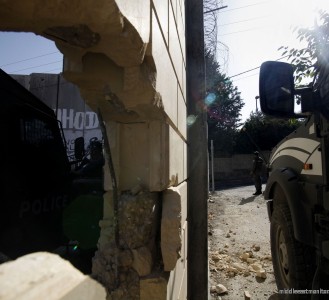 After making the hole, a number of the Palestinians crawled through and stood on the Jerusalem side for a minute. “The youth wanted to send a message to the Israeli occupation that they can enter the city despite the measures put in place by the occupation to stop them,” said witnesses.
Activist Ata Jefal told the Turkish Anadolu news agency that he and his friends have sent a number of signals to the Israelis that they can enter the city at will.
Kabsa lies to the east of Al-Aqsa Mosque. Its residents do not have a free access to the mosque because of the Israeli wall, the building of which began in 2002. At 8 metres high the wall has control towers and CCTV manned around the clock. Its final length is planned to be 780km, most of which will be built on occupied Palestinian land. Although the Israelis claim that it is a “security” wall, the fact that it takes up so much of the occupied West Bank has led to it being described as just another means of grabbing more Palestinian land, along with illegal settlements, settler-only roads, “nature reserves” and “military zones”. Just over 60 per cent of the wall has been completed.
Israeli settlers steal Palestinian olives in West Bank

MEMO | October 21, 2013
On Monday morning at dawn, Israeli settlers stole ripe olives from Palestinian farms in different areas of the occupied West Bank. Meanwhile, Israeli forces detained a Palestinian citizen at a moveable military checkpoint in Nablus.
Witnesses and farm owners told the Al-Quds Network that the settlers stole significant amounts of ripe olives from different farms. They also said that the settlers were hindering the arrival of many farmers who were heading to their farms in order to pick the olives.
Palestinian sources said that the settlers stole the olives from the neighbourhoods of Fara, Tal-Farata and Amateen. The sources also confirmed that the settlers were preventing farmers from approaching their farms, despite the farmers’ cooperation with Israeli officials in this regard.
Meanwhile, Israeli occupation forces invaded the Palestinian city of Nablus and detained Aboud Soboh, a Palestinian from the neighbourhood of Ras Al-Ein.
Witnesses reported that after invading the city, Israeli forces set up moveable checkpoints and then they arrested Soboh at one of these checkpoints.
Two of Soboh’s brothers are currently detained in Israeli jails.
Images from alquds.com
Related articles
- Jewish settlers cut down and burn hundreds of trees in Nablus and al-Khalil (alethonews.wordpress.com)
- Illegal Israeli settlers destroy olive trees in West Bank with impunity (sott.net)
Israeli occupation forces close checkpoints before movement of Palestinians on second day of Eid
Palestine Information Center – 17/10/2013
NABLUS — The Israeli occupation forces (IOF) obstructed the movement of Palestinian vehicles in the northern West Bank on the second day of Eid Al-Adha.
According to local sources, the IOF closed Za’atara and Hawara checkpoints on Wednesday evening, which caused long lines of vehicles extending two kilometers away.
The bulk of the vehicles had to stay in Hawara town until the IOF opened the checkpoints.
The IOF closed the checkpoints at six o’clock in the evening for several hours, eyewitnesses affirmed.
During the occasion of Eid Al-Adha, the Palestinians in the West Bank visit their relatives in other areas, but every year their movement is hindered by Israeli road blocks and closures.
Related articles
- Despite Israeli restrictions, Al-Quds prepares for Eid al-Adha (worldbulletin.net)
Elderly man seriously injured by speeding Jewish settler in hit and run assault
IMEMC & Agencies | October 17, 2013
Palestinian medical sources have reported that an elderly Palestinian man was seriously injured after being hit by a settler’s vehicle in Al-Fondoq village, east of Qalqilia, in the northern part of the West Bank on Wednesday.
The Palestinian Police said that a speeding settler driving a Toyota Corolla hit Abdul-Hafith Mohammad Tayyem, in his sixties.
The settler, who fled the scene, was driving in the center of the Palestinian village.
Palestinian medical sources said that Tayyem was moved to an Israeli hospital due to the seriousness of his condition.
There have been dozens of similar incidents that have led to serious injuries and fatalities, in different part of the occupied West Bank, including in occupied East Jerusalem.
On Sunday evening [September 29, 2013] a Palestinian worker was injured after being rammed by a settler’s vehicle, near Husan town, west of the West Bank city of Bethlehem.
On September 20, a Palestinian man was injured in a similar accident with an Israeli settler who fled the scene.
A week before the incident took place, Palestinian child was seriously injured after being hit by a settlers’ vehicle as she was walking home from school in Teqoua’ village, near the West Bank city of Bethlehem.
The child Hayat Mohammad Suleiman, 8 years of age, was walking back home from school on the main road that is also used by Israeli settlers living in illegal Israeli settlements in the area.
Related article
Turning Blood into Money
Profiting from Killing
By Vacy Vlazna | Dissident Voice | October 16, 2013
Warning! The Lab contains war-porn and hard-core evil; watch and weep.
Yotam Feldman’s documentary, released in August, is one of the most important exposés of the obscene rationale and execution of Israel’s hugely lucrative arms and security industries through the voices of some of its ex-military key operators: Amos Golan, Shimon Naveh, Leo Gleser, and Yoav Galant.
Israel’s armament juggernaut currently turns over $7 billion p.a. and its phenomenal success is, as Feldman reveals, due to experience, that is, the testing of weaponry on the Palestinian population in the Israeli military ‘labs’ of Gaza and the West Bank:
I think the main product Israelis are selling, especially in the last decade, is experience… the testing of the products, the experience is the main thing they [customers] are coming to buy. They want the missile that was shot in the last operation in Gaza or the rifle that was used in the last West Bank incursion.
Without blinking an eye, Benjamin Ben Eleixer, Industry Minister proudly asserts the reason for the tremendous demand for Israeli weapons and technology,
If Israel sells weapons, they have been tested, tried out. We can say: we’ve used this for 10 years, 15 years.
Tested by Israeli killers on 1,398 Palestinian children murdered since 2000 and the hundreds of thousands of children who struggle with war trauma, PTSD and perpetual terror.
The Lab makes plain why the peace process, past, present and potential, is a total sham. The economy of Israel is inextricably dependent on war and the suffering of the Palestinians.
And the other is the fact that now the Israeli economy is so much dependent on these operations. It’s 20 percent of the exports. It’s 150,000 families–not people–in Israel actually dependent on this industry. And if one day it will stop, if there will be no next operation in Gaza, so Israel will have some economic problems.
The arms industry doesn’t belong to a few dealers, its owned by a whole country.
What better justification of Boycott Divestment and Sanctions (BDS) movement which targets state and private companies as well as all Israeli universities, through their military R&D programmes, that are ‘turning blood into money’.
Which gun made the shekel accelerate when sisters Amal, 2 and Suad Abed-Rabbo, 9, who was waving a white flag, were shot by tank personnel in Gaza?
The degradation of the Israeli mind and society through the perverted normalising of state-sanctioned cruel aggression and violent criminality is apparent in the egotistic strutting throughout the film of the Israeli warmongers, politicians and arms dealers, who are oblivious that to civilised people they come across as psychopaths:
Gen (ret.) Amiran Levin:
I want to move onto one point, speaking of Gaza, speaking of Lebanon, and other places we will occupy in the future. Since we want to maintain equilibrium, as a developed country, punishment as a strategy should be the main element…That’s the most important thing, Quantity is more important than quality. One mistake the army makes is judging each case individually, whether the person deserves to die or not. Most of these people were born to die, we just have to help them.
Lt.Co.(ret.) Shimon Naveh, a military philosopher – yes, you read right, military philosopher — who talks like he’s swallowed a kilo of amphetamines, strolls through a bullet-riddled mock Arab village used for military exercises, moaning,
As you can see this isn’t an Arab village. It is a dead place. Maybe in our rosiest dreams this is what a Palestinian village would look like, but it isn’t one.
Gen.Yoav Galant, the ‘inventor’ of the 2008-9 Operation Cast Lead;
As far as I’m concerned the enemy has 3 options either he get killed, or he surrenders, or he flees.
Galant omits that the 1.6 million men, women, children and elderly of Gaza (for that matter all Palestinians) have nowhere to flee because Israel tightly controls Palestinian land, sea and airspace.
Thus we understand that the Israelis have the identical strategy of low intensity or asymmetrical warfare as the USA; only attack nations that are on their knees through sieges, sanctions and substandard armaments.
Naveh, in an interview in the Small Wars Journal admits as much:
When you fight a war against a rival who’s by all means inferior to you, you may lose a guy here or there, but you’re in total control. It’s nice. You can pretend that you fight the war and yet it’s not really a dangerous war.
Apart from the Hamas freedom fighters armed with Kalashnikovs and a ‘modest stock of weapons’, Palestine has no army, navy, airforce to defend its people. There are, of course, President Abbas’ US armed and trained security forces but they brutally police their own people on behalf of Israel.
Feldman shows how Israel’s major arms companies make arms selling sexy. At a weapons trade exhibition in Paris, a perky young female rep demonstrates on screen the precision capabilities of IAI products, and at the Shivta military base, foreign officers who have come to view a missile demonstration are divided into groups led by ‘lovely’ female Israeli soldiers.
Foreign governments, like Australia, contribute generously to optimising the profits of Israel’s death merchants while simultaneously appeasing their electorates, Galant complains, “There’s a lot of hypocrisy, they condemn you politically, while they ask you what your trick is, you Israelis, for turning blood into money,” nevertheless the gains for Israel as specified by him are, “First of all it gains security, secondly the nations and the armies of the world want to be friends with the strong, just side, and the winning side.”
Strong, yes, JUST? Not according to the parents of little 3 year old Ahmed As -Sinwar who was found under a pile of rubble and stones with a hole in his head, and not according to the parents of the other 352 children killed plus the 860 children injured and maimed in Operation Cast Lead by the sought-after Israeli air and ground missiles, artillery shelling, phosphorous bombs, flechettes, bullets and unexploded ordnance.
It is utterly macabre and beyond decent comprehension that the sales of drones were boosted by the wilful killing by drones of 116 children during Operation Cast Lead.
The highest echelon of the Israeli government has control of the business of death. All export of arms and security services are OK’d by SIBAT, the Israeli Ministry of Defense’s export agency.
Amos Golan, an arms dealer who started “with a dream”, views himself as a “good guy” not someone who kills innocent people in his spare time. He was a former commander of the Duvdevan special forces unit that conducts undercover operations disguised as Arabs and the inventor of the highly profitable Cornershot assault and sniper gun that enables the user to see around corners.
His Silver Shadow Advanced Security Systems (SSASS), listed with SIBAT, has provided security solutions and training for the dictatorships of the Republic of the Congo, Nigeria and Uganda where SSASS trained the Black Mamba death squad accused of human rights violations.
Leo Gleser, a generous father and grandfather, states that since 9/11 “all defense solutions now come from Israel through Israeli companies.” Who’d have thought 9/11 would benefit Israel? His own company, International Security and Defense Systems (ISDS), listed with SIBAT, was “established in 1982 by highly experienced officers, former operatives of I.S.A. Israeli Security Agency, the MOSSAD and the Defence Forces” has among its clients the Athens, Barcelona, Beijing and Rio Olympic Games, 2014 World Cup Soccer, joint ventures in security training with China, India, Brazil, Spain and USA.
It also serves the United Nations which appears to have overlooked that Gleser’s company trained, in the 80s, the CIA backed brutal Honduran Battalion 3-16 involved in the disappearance of 191 people. (This has been documented in Andrew and Leslie Cockburn’s book Dangerous Liaison: The Inside Story of the US-Israeli Covert Relationship.)
War criminal and child-killer, Noav Galant, once tipped to become the next Chief of General Staff, is now retired because of allegations that he appropriated public lands near his home for his private use which is irony par excellence given he is on the board of HaShomer HaChadash that helps Israeli “farmers and ranchers in the Negev and the Galilee who administer vast tracts of state-owned land to deal with the threat of illegal seizure of their land”, which is to say, to prevent the ‘ongoing encroachment of the Bedouin on state-owned land ‘ which we all know is ancestral Bedouin land seized by Israel. As we have seen, Galant knows all about hypocrisy.
The Lab’s exposition of Israel’s profiteering from its military expertise and arms dealing is nothing new as this has been well documented elsewhere such as in Jane Haapiseva-Hunter ‘s ‘Israeli Foreign Policy: South Africa and Central America’. The impact of The Lab lies in directly hearing and seeing for ourselves Israel’s deviants cheerily admit to making big bucks from ethnic cleansing and genocide.
Feldman ends The Lab with a masterstroke of irony filming, at a conference, these fat Israeli death feeding maggots, nodding and smiling to John Lennon’s beautiful and inspiring song, Imagine ..
Imagine all the people,
Living life in peace…
Dr. Vacy Vlazna is Coordinator of Justice for Palestine Matters. She was Human Rights Advisor to the GAM team in the second round of the Aceh peace talks, Helsinki, February 2005 and then withdrew on principle. Vacy was coordinator of the East Timor Justice Lobby as well as serving in East Timor with UNAMET and UNTAET from 1999-2001.
Featured Video

The Truth About the Trump Shootings with Ken Silva
or go to
Aletho News Archives – Video-Images
From the Archives
Trans ‘milk’ as good as the real thing – NHS
RT | February 18, 2024
The drug-induced nipple secretions of trans women are as good as mothers’ breast milk for babies, the University of Sussex Hospitals NHS Trust claimed in a letter to campaigners made public in a report by British think tank the Policy Exchange on Sunday.
The healthcare trust’s medical director, Rachel James, argued that the off-label prescription drug cocktail men transitioning to female take in order to produce milk was “similar to the natural hormones which encourage lactation to develop when the baby is newly born.”
“The evidence which is available demonstrates that the milk is comparable to that produced following the birth of a baby,” James wrote in the letter, sent to Children of Transitioners last August.
Biological men who wish to lactate must first take hormones to grow milk glands and then take high doses of either domperidone or metoclopramide to stimulate milk production. Neither drug is approved for this use, though they are occasionally prescribed off-label to biological women who have trouble lactating.
However, domperidone’s own manufacturer, Janssen, warns patients the drug “may cause unwanted side effects affecting the heart in a breastfed baby” and “should be used during breastfeeding only if your physician considers this clearly necessary.” … continue
Blog Roll
 Aletho News
- Seyed M. Marandi: U.S. Strike Imminent – Toward Total War in the Middle East
- Russia Voted Under Fire. Washington Is Loading the Tankers.
- 12 Things Your Oncologist Was Trained Not to Tell You
- Anthrax Attacks Paved Way for COVID-Era ‘Junk Drugs and Vaccines’
- How Real Is the Impact of Western Sanctions on Israel?
- France, You Are Guilty: How Paris Turned Western Sahara into the Maghreb’s Powder Keg
- 2025 Nature Paper Claiming Worsening Global Drought Gets RETRACTED …Heavily Flawed
- Your Milk Is Not the Problem
- The Truth About the Trump Shootings with Ken Silva
- ARE PATIENTS BEING PROPERLY INFORMED ABOUT OZEMPIC?
- If Americans Knew
- Salah Sarsour’s Legal Team Says DHS Has Not Met Its Burden to Prove He Is Deportable
- An analysis of tax forms by The Intercept show Kraft’s charity and LLC have donated to Friends of the IDF and AIPAC’s super PAC.
- Israeli attacks kill four Palestinians in Gaza – Daily Update
- Inside Gaza’s death trap of collapsing, bombed-out buildings
- The everyday items Israel bans from Gaza every day
- Inside the siege, the ruined buildings of Gaza – Daily Update
- Debunking The Claim That Macklemore Has A “History Of Antisemitism”
- CPJ demands release of arrested Palestinian-US journalist near Bethlehem
- Robert Kraft: The Billionaire Friend of Netanyahu Pulling The Strings Behind the Macklemore/Ed Sheeran Blow Up
- Columbia Administered Fund Gives Big Money to Pro-Israel Groups
- No Tricks Zone
- 2025 Nature Paper Claiming Worsening Global Drought Gets RETRACTED …Heavily Flawed
- New Study: ‘Global Drought Shows No Detectable Recent Acceleration Under Climate Warming’
- Economic Masterminds: German Socialists Suggest Taxing Productivity Gains Stemming From Using AI
- The South China Sea Has Not Been Cooperating With The Climate Change Narrative
- Energy Crisis: Germany Enters Heating Season With Historically Low Gas Reserve Fill Levels
- New Study: The Antarctic Ice Sheet Gained Mass From 2020-2024 Due To Staggering Snow And Ice Accumulation
- Study: Ocean Heating Rates From Thousands Of Years Ago ‘Dwarf’ Modern Ocean Heating Rates
- Climate Extremists Target, Attack Large-Scale Power Grid Infrastructure In Germany!
- New Study: Antarctic Ice Melt Has Contributed Less Than 1 Centimeter To Sea Level Rise In The Last 30 Years
- Fear Of Debate: Alarmist German Climate Scientist Calls On Mainstream Media To Discredit Skeptic Voices
 Aletho News