NO MANDATES, NO PROFITS: MODERNA CEO TELLS THE TRUTH
The HighWire with Del Bigtree | January 29, 2026
As the U.S. withdraws from the World Health Organization, Moderna CEO Stéphane Bancel admits the company cannot move new vaccines into Phase 3 trials due to insufficient U.S. market demand which has historically been driven by mandates. Bancel suggests that with RFK Jr. at the helm of HHS, new vaccines are unlikely to deliver acceptable returns on investment—an admission that highlights how profit incentives, not public health needs, have long driven vaccine development. Meanwhile, a broader reckoning is underway over mandates, industry influence, and ethical lapses in vaccine testing at home and abroad, as calls grow for stricter safety standards and meaningful accountability.
WHO Instructs Governments to Track Online Anti-Vaccine Messaging in Real Time with AI: Journal ‘Vaccines’
Believe in vaccines or be targeted
By Jon Fleetwood | December 29, 2025
The World Health Organization (WHO) has demanded that governments surveil online information that questions the legitimacy of influenza vaccines and that they launch “countermeasures” against those who question the WHO’s vaccine dogma, in a November Vaccines journal publication.
The WHO’s largest funders are the U.S. government (taxpayers) and the Bill & Melinda Gates Foundation.
In the November publication, the WHO representatives do not argue for their beliefs in vaccines.
They do not attempt to interact with arguments against vaccines.
Instead, they call for governments to use artificial intelligence (AI) to monitor online opposition to injectable pharmaceuticals, and to develop ways to combat such opposition.
There is no persuasion, only doctrine.
The WHO paper reads:
“Vaccine effectiveness is contingent on public acceptance, making risk communication and community engagement (RCCE) an integral component of preparedness. The research agenda calls for the design of tailored communication strategies that address local sociocultural contexts, linguistic diversity, and trust dynamics.”
“Digital epidemiology tools, such as AI-driven infodemic monitoring systems like VaccineLies and CoVaxLies, offer real-time insight into misinformation trends, enabling proactive countermeasures.”
The WHO starts from the assumption that all vaccine skepticism is inherently false, pushing surveillance tools to track and catalog online dissent from those rejecting that creed.
The goal is not finding middle ground or even fostering dialogue.
It’s increasing vaccinations.
“The engagement of high-exposure occupational groups as trusted messengers is recommended to improve uptake.”
To accomplish this, governments “should” align “all” their messaging with the WHO’s denomination of vaccine faith.
“All messaging should align with WHO’s six communication principles, ensuring information is Accessible, Actionable, Credible, Relevant, Timely, and Understandable, to strengthen public trust in vaccination programmes.”
The WHO’s faith system requires not only that its own followers but also non-followers inject themselves with drugs linked to injuries, diseases, hospitalizations, and deaths.
If your posts online oppose that faith system, they are targeted and labeled as “misinformation.”
You require “behavioural intervention.”
You must be “counter[ed].”
“Beyond monitoring misinformation, participatory communication models that involve local leaders, healthcare workers, and veterinarians have shown measurable improvements in vaccine uptake and trust. Evidence-based behavioural interventions can complement these approaches to counter misinformation.”
The WHO is outlining an Orwellian control system where dissent is pathologized, belief is enforced by surveillance, and governments are instructed to algorithmically police thought in service of pharmaceutical compliance.
WHO – Gates Blueprint for Global Digital ID, AI-Driven Surveillance, and Life-Long Vaccine Tracking for All
Automated, cradle-to-grave traceability for “identifying and targeting the unreached”
By Jon Fleetwood | December 2, 2025
In a document published in the October Bulletin of the World Health Organization and funded by the Gates Foundation, the World Health Organization (WHO) is proposing a globally interoperable digital-identity infrastructure that permanently tracks every individual’s vaccination status from birth.
The dystopian proposal raises far more than privacy and autonomy concerns: it establishes the architecture for government overreach, cross-domain profiling, AI-driven behavioral targeting, conditional access to services, and a globally interoperable surveillance grid tracking individuals.
It also creates unprecedented risks in data security, accountability, and mission creep, enabling a digital control system that reaches into every sector of life.
The proposed system:
- integrates personally identifiable information with socioeconomic data such as “household income, ethnicity and religion,”
- deploys artificial intelligence for “identifying and targeting the unreached” and “combating misinformation,”
- and enables governments to use vaccination records as prerequisites for education, travel, and other services.
What the WHO Document Admits, in Their Own Words
To establish the framework, the authors define the program as nothing less than a restructuring of how governments govern:
“Digital transformation is the intentional, systematic implementation of integrated digital applications that change how governments plan, execute, measure and monitor programmes.”
They openly state the purpose:
“This transformation can accelerate progress towards the Immunization agenda 2030, which aims to ensure that everyone, everywhere, at every age, fully benefits from vaccines.”
This is the context for every policy recommendation that follows: a global vaccination compliance system, digitally enforced.
1. Birth-Registered Digital Identity & Life-Long Tracking
The document describes a system in which a newborn is automatically added to a national digital vaccine-tracking registry the moment their birth is recorded.
“When birth notification triggers the set-up of a personal digital immunization record, health workers know who to vaccinate before the child’s first contact with services.”
They specify that this digital identity contains personal identifiers:
“A newborn whose electronic immunization record is populated with personally identifiable information benefits because health workers can retrieve their records through unique identifiers or demographic details, generate lists of unvaccinated children and remind parents to bring them for vaccination.”
This is automated, cradle-to-grave traceability.
The system also enables surveillance across all locations:
“[W]ith a national electronic immunization record, a child can be followed up anywhere within the country and referred electronically from one health facility to another.”
This is mobility tracking tied to medical compliance.
2. Linking Vaccine Records to Income, Ethnicity, Religion, & Social Programs
The document explicitly endorses merging vaccine status with socioeconomic data.
“Registers that record household asset data for social protection programmes enable monitoring of vaccination coverage by socioeconomic status such as household income, ethnicity and religion.”
This is demographic stratification attached to a compliance database.
3. Conditioning Access to Schooling, Travel, & Services on Digital Vaccine Proof
The WHO acknowledges and encourages systems that require vaccine passes for core civil functions:
“Some countries require proof of vaccination for children to access daycare and education, and evidence of other vaccinations is often required for international travel.”
They then underline why digital formats are preferred:
“Digital records and certificates are traceable and shareable.”
Digital traceability means enforceability.
4. Using Digital Systems to Prevent ‘Wasting Vaccine on Already Immune Children’
The authors describe a key rationale:
“Children’s vaccination status is not checked during campaigns, a practice that wastes vaccine on already immune children and exposes them to the risk of adverse events.”
Their solution is automated verification to maximize vaccination throughput.
The digital system is positioned as both a logistical enhancer and a compliance enforcer:
“National electronic immunization records could transform how measles campaigns and supplementary immunization activities are conducted by enabling on-site confirmation of vaccination status.”
5. AI Systems to Target Individuals, Identify ‘Unreached,’ & Combat ‘Misinformation’
The WHO document openly promotes artificial intelligence to shape public behavior:
“AI… demonstrate[s] its utility in identifying and targeting the unreached, identifying critical service bottlenecks, combating misinformation and optimizing task management.”
They explain additional planned uses:
“Additional strategic applications include analysing population-level data, predicting service needs and spread of disease, identifying barriers to immunization, and enhancing nutrition and health status assessments via mobile technology.”
This is predictive analytics paired with influence operations.
6. Global Interoperability Standards for International Data Exchange
The authors call for a unified international data standard:
“Recognize fast healthcare interoperability resources… as the global standard for exchange of health data.”
Translated: vaccine-linked personal identity data must be globally shareable.
They describe the need for “digital public infrastructure”:
“Digital public infrastructure is a foundation and catalyst for the digital transformation of primary health care.”
This is the architecture of a global vaccination-compliance network.
7. Surveillance Expansion Into Everyday Interactions
The WHO outlines a surveillance model that activates whenever a child interacts with any health or community service:
“CHWs who identify children during home visits and other community activities can refer them for vaccination through an electronic immunization registry or electronic child health record.”
This means non-clinical community actors participating in vaccination-compliance identification.
The authors also describe cross-service integration:
“Under-vaccinated children can be reached when CHWs and facility-based providers providing other services collaborate and communicate around individual children in the same electronic child health records.”
Every point of contact becomes a checkpoint.
8. Behavior-Shaping Through Alerts, Reminders, & Social Monitoring
The WHO endorses using digital messaging to overcome “intention–action gaps”:
“Direct communication with parents in the form of alerts, reminders and information helps overcome the intention–action gap.”
They also prescribe digital surveillance of public sentiment:
“Active detection and response to misinformation in social media build trust and demand.”
This is official justification for monitoring and countering speech.
9. Acknowledgment of Global Donor Control—Including Gates Foundation
At the very end of the article, the financial architect is stated plainly:
“This work was supported by the Gates Foundation [INV-016137].”
This confirms the alignment with Gates-backed global ID and vaccine-registry initiatives operating through Gavi, the World Bank, UNICEF, and WHO.
Bottom Line
In the WHO’s own words:
“Digital transformation is a unique opportunity to address many longstanding challenges in immunization… now is the time for bold, new approaches.”
And:
“Stakeholders… should embrace digital transformation as an enabler for achieving the ambitious Immunization agenda 2030 goals.”
This is a comprehensive proposal for a global digital-identity system, permanently linked to vaccine status, integrated with demographic and socioeconomic data, enforced through AI-driven surveillance, and designed for international interoperability.
It is not speculative, but written in plain language, funded by the Gates Foundation, and published in the World Health Organization’s own journal.
BBC Editors Blocked Story on Latest Fluoride Science Over ‘Scaremongering’ Concerns, Former Reporter Says
By Brenda Baletti, Ph.D. | The Defender | November 19, 2025
A former BBC health correspondent said editors repeatedly prevented him from reporting on emerging scientific debates over the safety of water fluoridation, dismissing the story as “scaremongering.”
Michele Paduano spent three decades reporting for the BBC from the West Midlands, the first region in the U.K. to fluoridate its water supply, in 1964.
At a Fluoride Action Network (FAN) press conference on Tuesday, Paduano said he became interested in water fluoridation after reviewing the landmark 2024 decision by the U.S. District Court for the Northern District of California.
The court found that the U.S. fluoridation level of 0.7 milligrams per liter (mg/L) posed an “unreasonable risk” to children’s health. The West Midlands fluoridates its water at 1 mg/L, about 30% higher than the recommended U.S. level.
Paduano said professor Vyvyan Howard, a pathologist specializing in toxicology and a long-time collaborator, alerted him to several major cohort studies in top academic journals linking water fluoridation to lower IQ in children.
Paduano said mainstream media rebuttals were “so strong and absolute” that he knew publishing a story on the findings would be difficult.
He said he pursued the story only after reading the September 2024 court decision, which cited new evidence pointing to potential neurodevelopmental risks at lower fluoride concentrations.
“At that point, it felt like my public duty to tell people in the West Midlands that there was potentially a problem,” he said.
BBC editors rejected story as ‘scaremongering’
Paduano said he pitched the fluoride story through the BBC’s planning process and arranged an interview with West Midlands anti-fluoridation campaigner Joy Warren. Senior online and television editors abruptly cancelled the interview.
“They told me the story was scaremongering,” he said. Internal BBC scientists and public-health staff insisted there was no credible new evidence. Paduano said he challenged the decision and urged editors to read the U.S. court judgment, but they instead accused him of bias.
“As a BBC journalist, impartiality is fundamental. But impartiality also means reporting new evidence when it emerges,” he said.
Paduano continued investigating the issue and spoke with professor John Fawell, a leading U.K. pro-fluoridation expert and adviser to the World Health Organization (WHO).
As a result of their conversation, Paduano said Fawell acknowledged that recent research should prompt the U.K. to consider lowering fluoridation levels to match U.S. and Canadian guidance. Fawell, who co-authored a book on fluoridation’s oral health benefits, urged U.K. officials to reexamine the country’s dosage and consider aligning it with the U.S.
“If somebody who is a leading pro-fluoride proponent adjusts their position, that is a story,” Paduano said. But he said BBC editors still refused to let him cover it.
Paduano said he then emailed CEO of BBC News and Current Affairs Deborah Turness and BBC Director-General Tim Davie, but the response was “radio silence.” He then took his concerns to Nicholas Serota, a BBC board member responsible for editorial standards.
In the meantime, Paduano said he learned of planned BBC coverage in the North East about proposed fluoridation expansion, and he told Serota that failing to mention the U.S. court decision would constitute “significant censorship.”
Paduano said the article on the North East fluoridation expansion that eventually appeared briefly mentioned the U.S. judgment. He continued arguing that the West Midlands — which has fluoridated its water for decades — should also have reported on the new developments.
The editorial board refused to cover the story. “Concern was that we would be scaremongering, we would frighten people and that the science wasn’t there,” Paduano said.
Paduano said frustrations over fluoride reporting, along with broader concerns about the broadcaster’s impartiality and its close relationship with government, ultimately pushed him to leave the BBC.
Soon after, the BBC published an article about a recommendation by Worcestershire public health officials to expand fluoridation countywide. In what Paduano described as “the ultimate bias,” the article didn’t refer to the U.S. judgment or related research.
After leaving the BBC, Paduano contacted The Independent, which published his story on Fawell’s changing position on water fluoridation.
Paduano said he again approached the BBC, arguing that national coverage proved the issue’s newsworthiness, but editors held their ground and directed him to the complaints process — which he says has resulted in little progress.
‘We should avoid worrying our audiences unduly,’ BBC says
The BBC has not responded publicly to Paduano’s allegations, and it did not respond to The Defender’s request for comment.
The organization did reply to complaint letters from Howard and FAN’s science adviser Paul Connett, Ph.D., author of “The Case Against Fluoride: How Hazardous Waste Ended Up in Our Drinking Water and the Bad Science and Powerful Politics That Keep It There.” The letters urged the BBC to show “objectivity and professionalism on the latest research into the risks of water fluoridation” and to investigate Paduano’s claims.
In its initial response, the BBC complaints team said it had “provided a fair and appropriate view” of the water fluoridation issue.
In a follow-up response to Connett and Howard, the BBC defended its decision not to mention recent science linking fluoride exposure to neurodevelopmental issues in children.
The BBC said its reporting reflects “the majority view — from the World Health Organisation, US Centre for Disease Control, the American Dental Society [sic] and others,” and argued that it maintains a “higher bar for publishing stories around health risk.”
The BBC cited its editorial guidelines:
“The reporting of risk can have an impact on the public’s perception of that risk, particularly with health or crime stories. We should avoid worrying our audiences unduly and contextualise our reports to be clear about the likelihood of the risk occurring. This is particularly true in reporting health stories that may cause individuals to alter their behaviour in ways that could be harmful.”
Kevin Silverton, who signed the letter, said the complaints team could not continue corresponding and that further concerns should be taken to the BBC’s Executive Complaints Unit.
BBC reporting on fluoride ‘can’t be trusted’
Connett told The Defender he was “shocked” when the BBC justified its position by citing the Centers for Disease Control and Prevention (CDC), the American Dental Association (ADA) and the WHO as representing the majority expert view. He said:
“As you well know, the CDC oral health division’s mission was to promote fluoridation, and the ADA has avidly promoted it for years — so much so that any study that found any harm was immediately dismissed as being bad science, and the WHO has not looked at fluoride’s neurotoxicity for many years, if ever. It is incredible to me that this very large government-funded body should rely on such one-sided, essentially partisan.”
Connett said the public and local officials rely on the BBC for accurate information, but on fluoride, “it can’t be trusted.” He said:
“When a major media entity gets involved, you would hope that they would do their homework and review the science when it is available for them. In this case the issue should have been easy because it did not entail slogging through all the studies themselves. They had a major review by a government entity, the National Toxicology Program, and they also had the judgment of a judge in a seven-year lawsuit.
“In short, the BBC is abusing the public’s trust on this important health issue, and that is shocking. Scientists like myself have an obligation to speak out. In our case, we were lucky to have a journalist to give us an inside view of the censorship that went on. We are often not that lucky.”
Related articles in The Defender
- Breaking: Fluoride in Water Poses ‘Unreasonable Risk’ to Children, Federal Judge Rules
- CDC Stands by Water Fluoridation After Report Linking Fluoride to Lower IQs in Kids Finally Published
This article was originally published by The Defender — Children’s Health Defense’s News & Views Website under Creative Commons license CC BY-NC-ND 4.0. Please consider subscribing to The Defender or donating to Children’s Health Defense.
Florida Governor Slams Proposal to Engineer Meat Allergies in Humans to ‘Save the Planet’
By Michael Nevradakis, Ph.D. | The Defender | October 20, 2025
Florida Gov. Ron DeSantis last week publicly rejected the notion that humans could be engineered to develop a red meat allergy as a way to curb meat consumption and protect the environment — an idea he linked to the World Economic Forum (WEF) and the World Health Organization (WHO).
On X, DeSantis posted a 2016 video of Matthew Liao, a professor of bioethics at New York University and director of its Center for Bioethics. Liao tells his audience that ticks could be used to spread allergies that make humans unable to tolerate red meat — an idea that has been repeated by other bioethicists.
“People eat too much meat. And if they were to cut down on their consumption of meat, then it would actually really help the planet,” Liao said in the video. “There’s this thing called the lone star tick, where if it bites you, you will become allergic to meat. So, that’s something we can do through human engineering.”
DeSantis said Liao’s statements are “an example of why entities like the WEF and WHO are persona non grata” in Florida.
“Genetically engineering humans to become allergic to meat because some elites think people eat ‘too much’ of it is insane,” DeSantis wrote.
Tim Hinchliffe, editor of The Sociable, said that while Liao’s comments were not new — the video is from an almost 10-year-old talk at the World Science Festival — DeSantis’ remarks were significant.
“Although he’s slow to the game, at least he’s noticing,” Hinchliffe said.
Liao “has been talking about making people allergic to meat for over a decade, going back to his TED Talk 12 years ago, in 2013,” Hinchliffe said.
During that talk, Liao said, “Just as some people are naturally intolerant to milk or crayfish, like myself, we could artificially induce mild intolerance to meat by stimulating our immune system against common bovine proteins.”
Sayer Ji, chairman of the Global Wellness Forum and founder of GreenMedInfo, said DeSantis is “right to call out the WEF’s agenda targeting meat consumption.”
“This isn’t dietary advice — it’s social engineering,” Ji said. “Unelected global organizations have no business dictating what free people eat, especially when they’re demonizing traditional foods that have sustained human health for millennia.”
In a follow-up X post Friday, DeSantis questioned widespread claims that cattle and their carbon footprint harm the environment. “The notion that cattle are destroying the planet has always been ridiculous,” he wrote.
Kendall Mackintosh, a board-certified nutrition specialist, said such claims aren’t “just about climate,” but are also centered around “control and consolidation.”
“Real, regenerative farming supports independence and local economies. Centralizing food systems through synthetic or lab-grown products benefits corporations, not families,” Mackintosh said.
Ji agreed. He said such proposals are indicative of “the merger of biotechnology and behavioral control.” He added:
“The war on meat has never been about climate. It’s about control — consolidating food production under centralized, patented, technology-dependent systems.
“Meat represents everything the global technocracy fears: decentralized production, nutritional independence and cultural traditions that resist standardization. When people can raise their own food, they’re harder to control. The WEF understands this perfectly.”
Recent paper suggests spreading meat allergy to humans is a moral obligation
A paper published earlier this month in the journal Bioethics proposed using the lone star tick to spread alpha-gal syndrome (AGS), “a condition whose only effect is the creation of a severe but nonfatal red meat allergy.”
In the paper, Western Michigan University bioethics professors Parker Crutchfield, Ph.D., and Blake Hereth, Ph.D., argued that “if eating meat is morally impermissible, then efforts to prevent the spread of tickborne AGS are also morally impermissible.”
According to the Centers for Disease Control and Prevention (CDC), when it bites, the lone star tick transmits the alpha-gal sugar molecule into the human bloodstream, leading to a red meat allergy. Consuming red meat after being infected could result in life-threatening anaphylaxis.
The paper’s authors present what they called the “Convergence Argument.” If a specific action “prevents the world from becoming a significantly worse place, doesn’t violate anyone’s rights, and promotes virtuous action or character,” then it becomes a moral obligation to perform this action, they said.
According to the authors, the use of AGS to spread a red meat allergy to humans meets these criteria. However, they acknowledged ethical obstacles: few people would likely volunteer for the tick bite, and forcing it on people would raise questions of bodily autonomy and freedom.
The authors told The College Fix in an August email that their paper does not constitute an endorsement of spreading AGS to humans, but offers a hypothetical framework raising ethical and philosophical questions.
Mackintosh questioned this denial. “Calling it a ‘thought experiment’ doesn’t make it any less disturbing. The idea that inducing an allergy or harming human health could somehow serve a moral purpose shows just how far detached some parts of academia have become from basic human ethics,” she said.
“The fact that this was even published tells you how normalized these anti-human, anti-food narratives are becoming under the guise of ‘ethics,’” Mackintosh added.
Ji said the paper raises questions about bodily autonomy.
“This is about far more than food, it’s about whether human beings retain sovereignty over their own bodies, or whether that sovereignty can be overridden by those who believe they know better. The answer to that question will determine whether we remain free,” he said.
Mackintosh questioned the authors’ claim that lone star tick bites “only” lead to AGS.
AGS “can cause severe allergic reactions, including anaphylaxis, and can completely alter someone’s diet and quality of life,” Mackintosh said. “The suggestion of using ticks or any biological vector to intentionally spread an allergy is beyond unethical. It’s dangerous, unpredictable and medically reckless.”
A 2023 CDC report said AGS cases were on the rise in the U.S.
DeSantis previously outlawed sale of lab-grown meat in Florida
While DeSantis didn’t directly address the paper or AGS in his X posts, he has consistently spoken out against efforts to shift people away from red meat and toward alternatives such as lab-grown meat and insects.
Last year, DeSantis signed legislation prohibiting the sale of lab-grown meat in Florida. According to a press release, the law aims “to stop the World Economic Forum’s goal of forcing the world to eat lab-grown meat and insects,” which a 2021 WEF article characterized as an “overlooked” source of protein.”
“Florida is fighting back against the global elite’s plan to force the world to eat meat grown in a petri dish or bugs to achieve their authoritarian goals,” DeSantis said at the time.
DeSantis has previously questioned other WEF and WHO policies, saying they are unwelcome in Florida.
Joseph Sansone, Ph.D., a psychotherapist who sued DeSantis and Florida Attorney General Ashley Moody to prohibit mRNA vaccines in Florida, said that while he has been “litigating against DeSantis for over a year and a half to stop mRNA injections,” he agrees with DeSantis on this issue.
“DeSantis is calling out something that many Americans feel — they don’t want global organizations or unelected bodies deciding what they can or can’t eat,” Sansone said.
Mackintosh said lab-grown meat raises questions about potential health risks.
“There are questions about contamination risks, the use of antibiotics or growth media, nutrient content, and even the true environmental impact once scaled up. It’s also ultra-processed — far from the whole, nutrient-dense foods our bodies were designed to thrive on,” she said.
“Many lab-grown meat companies are using immortalized cell lines — cells that are capable of continuously dividing and growing in a manner disturbingly similar to cancer cells,” Ji said. There is a “complete absence of long-term safety studies” for such products.
Scientists have raised similar concerns about human consumption of insects. The exoskeletons of many insects contain chitin, a natural material that can trigger an allergic reaction in humans. Some studies suggest that humans cannot digest chitin, while other studies suggest humans “don’t digest it well.”
WEF suggests consuming alternative meats will ‘save the planet’
The WEF has repeatedly promoted reducing the consumption of red meat and animal products.
In a 2019 video, the WEF suggested that in the not-too-distant future, humans would be allowed to consume only “one beef burger, two portions of fish and one or two eggs per week” to “save the planet.”
That year, the WEF published a white paper calling for “a transformation in the global system for protein provision” to meet climate-related targets.
Also in 2019, the WEF published an article stating that humans will be “eating replacement meats within 20 years.” A 2020 WEF article said there were “promising” signs that humans will begin consuming lab-grown meats. A 2022 WEF article said lab-grown meat “almost entirely eliminates the need to farm animals for food.”
Mackintosh said corporate interests are behind the push for “alternative” meats.
“The biggest winners in the lab-grown meat push are large food conglomerates, biotech companies and venture capital investors who own the patents and production technology. Small farmers and ranchers — the backbone of our food system — lose. This is about creating dependence, not sustainability,” she said.
Ji agreed. “Follow the money. Biotech corporations and their investors stand to profit massively from patents and market control,” he said.
In 2019, Bill Gates invested in Beyond Meat, an alternative meat producer. In his 2021 book, “How to Avoid a Climate Disaster: The Solutions We Have and the Breakthroughs We Need,” Gates said stopping climate change requires a shift in human behavior, including a switch to synthetic meats. He later suggested that wealthy countries should switch to “100% synthetic beef.”
Beyond Meat’s stock price recently cratered, dropping from an all-time high of $240 to less than $1 amid low consumer demand in the U.S.
Liao suggested chemically inducing empathy, making kids smaller
DeSantis and others have suggested a link between Liao and the WEF, including a claim that Liao’s 2012 co-authored paper, “Human Engineering and Climate Change,” which argued that “human engineering deserves further consideration in the debate about climate change,” was the subject of a discussion at the WEF’s 2021 annual meeting.
At present, the only mention of Liao on the WEF’s website is in connection to a paper he co-published last month proposing “a structured approach” to the governance of artificial intelligence.
Hinchliffe noted that the WEF “does have a habit of scrubbing what it considers to be negative publicity from its website.” However, whether or not there is a direct connection between Liao and the WEF, Liao “is definitely aligned” with WEF policies, he said.
Liao previously suggested how humans could change their bodies to fight climate change. These include the “pharmacological induction of empathy,” which involves taking a pill to induce empathy; “cognitive enhancements” so that humans have fewer children; memory modification; and administering hormones to children so that they remain smaller in size because “being smaller is environmentally friendly.”
Ji said:
“Academic papers proposing disease vectors to manipulate behavior aren’t harmless philosophy — they’re rehearsals. They move the Overton window, normalize the abnormal and provide intellectual scaffolding for future atrocities. The field of bioethics has become less about protecting human dignity and more about rationalizing its violation.”
This article was originally published by The Defender — Children’s Health Defense’s News & Views Website under Creative Commons license CC BY-NC-ND 4.0. Please consider subscribing to The Defender or donating to Children’s Health Defense.
Can international institutions be reformed?
By Raphael Machado | Strategic Culture Foundation | June 30, 2025
It appears that Israel and Iran have postponed World War III and, for now, seem to adhere to the ceasefire negotiated by Donald Trump (likely with the help of other countries). But even if the “12-Day War” has stopped and missiles are no longer flying back and forth, doubts remain about the fate of Iran’s nuclear program.
The U.S. government insists that Iran’s nuclear program no longer exists, while Iran maintains that its nuclear program is still operational. All signs indicate that the Iranians are correct and that the U.S. is once again constructing a purely simulated parallel reality for the sake of narrative power projection.
But the main issue is not this—it is, in fact, something few have mentioned, as recently noted by Sergey Lavrov: the role of Rafael Grossi and the International Atomic Energy Agency (IAEA).
The IAEA was founded in 1957 as an “autonomous” agency—though linked to the UN—with the goal of monitoring nations’ use of nuclear energy to promote peaceful applications and prevent the construction of nuclear weapons. In this capacity, IAEA teams visit nuclear power plants, research centers, and other facilities related to national nuclear programs to conduct safety checks and oversee enrichment levels.
However, it is important to note that despite its claims of “autonomy,” the IAEA was established at the insistence of the U.S., shortly after the abandonment of the post-WWII “utopian” idea of keeping nuclear weapons under the exclusive control of the UN. The institution has always been closer to the interests of the Western Bloc than to those of the Eastern Bloc or the Non-Aligned Movement.
That said, in the past, the IAEA did challenge U.S. claims about weapons of mass destruction in Iraq, under the leadership of Hans Blix and Mohamed ElBaradei.
But even during ElBaradei’s tenure, there were signs of a shift toward Western alignment. In writings from that period, ElBaradei advocated for a revival of the utopian, globalist vision of nuclear energy monopolized by a “multinational” agency—much like the various Western agencies controlled or influenced by the U.S. ElBaradei himself became a collaborator with the U.S. after his term ended, participating in the color revolution orchestrated in Egypt against Hosni Mubarak.
It was only during Yukiya Amano’s leadership that the IAEA’s collaboration with the U.S. became evident, thanks to WikiLeaks revelations. According to documents obtained by Julian Assange, in a meeting between Amano and U.S. diplomats, Amano explicitly stated that he was aligned with the U.S. regarding staffing decisions and the stance to be taken on Iran’s nuclear program. This, of course, meant that Amano filled the IAEA with U.S. collaborators. He was later accused by IAEA staff themselves of having a pro-Western bias.
This context helps explain the behavior of Rafael Grossi, Amano’s successor.
Fast-forward to June: Grossi prepared a report accusing Iran of failing to meet its obligations to the IAEA and scheduled a board meeting for the same day Trump’s 60-day ultimatum on negotiations with Iran expired. According to CNN, the U.S. contacted several board members to persuade them to vote in favor of Grossi’s resolution. The purpose was to lend an institutional veneer of legitimacy to Israel’s attacks against Iran.
Grossi’s report was entirely based on information provided by Mossad, which alleged the existence of previously unknown nuclear facilities containing traces of enriched uranium.
All evidence suggests that Grossi was aware of the imminent attack and collaborated in creating a pretext to justify Israel’s actions. This is further corroborated by the fact that Grossi has never once turned his attention to Israel’s nuclear program, which remains entirely opaque, free from any international inspections.
In light of these revelations, it is alarming that, as Grossi told the Financial Times earlier this year, he intends to run for UN Secretary-General. Given his track record, it is plausible that he will have U.S. backing, which would greatly aid his candidacy.
Cases like this are not isolated. We have seen how the International Criminal Court (ICC) moved to accuse Vladimir Putin and Russia of “kidnapping” Ukrainian children. The World Health Organization (WHO), meanwhile, attempted to override national sovereignty during the pandemic. The IMF is routinely used to deindustrialize Third World countries.
The list could go on.
The key issue, however, is this: Given the current state of international institutions, can they be reformed?
Or will we need to abandon them—as Iran did with the IAEA—and build new ones from scratch?
WHO Pandemic Agreement ⏤ WHO is really in charge?
By Dr Lisa Hutchinson | Health Advisory & Recovery Team | May 6, 2025
On 15 April 2025, as we approached Easter, the not so joyous news broke that member states have now reached an agreement on the WHO Pandemic Agreement or Treaty, with negotiations expected to be formalized in May (17-26) when each member state can then decide whether or not to sign the agreement. Notably, this Treaty has gone ahead without the inclusion of countries such as Argentina and also the United States. It is now well known that President Trump signed an Executive Order to pull the USA out of the agreement owing to the ‘mishandling of the Covid-19 pandemic’ and concerns of China’s ‘inappropriate political influence’. Moreover, federal health officials are also prevented from contributing to talks with WHO, due to concerns it is a harmful organization. So what does this WHO Pandemic Agreement mean for the UK and the rest of the world?
Anne-Claire Amprou, a co-chair of the Intergovernmental Negotiating Body, has claimed that this is a “major step forward in protecting populations, the response will be faster, more effective and more equitable” and will bolster “equity and international security.” She continues by noting that “nothing in the draft agreement shall be interpreted as providing WHO any authority to direct, order, alter or proscribe national laws or policies, or mandate States to take specific actions, such as ban or accept travelers, impose vaccination mandates or therapeutic or diagnostic measures or implement lockdowns.” However, many more skeptical followers of the Agreement, such as James Ruguski, indicate that this represents a Framework Convention to usher in a global pharmaceutical power grab dressed up as ‘health equity’ under the guise of ending ‘vaccine apartheid’. The fact that governments worldwide have bypassed normal safety protocols during ‘health emergencies’ sets a dangerous precedent for a totalitarian approach to a one world governance.
The latest agreement on the WHO Pandemic Agreement refers to pandemic-related health products in response to pandemic emergencies. Of note, these health products include “medicines, vaccines, diagnostics, medical devices, vector control products, personal protective equipment, decontamination products, assistive products, antidotes, cell- and gene-based therapies, and other health technologies”. The agreement continues to elaborate on the fact that a “coordinating financial Mechanism is hereby established to promote sustainable financing for the implementation of this Agreement”. In other words, this will expand the capacities around pandemic prevention and preparedness and response using the above mentioned coordinated financial mechanism to serve the implementation of this Agreement. James Roguski defines the acronym PHEIC (Public Health Emergency of International Concern) in reality as a Pharmaceutical Hospital Emergency Industrial Complex!
In his Substack, James Ruduski explains the main aspects of the Pandemic Treaty:
- This is really Corporate Wealth Redistribution Disguised as Health – as this represents a Framework Convention that benefits Big Pharma;
- A behind the scenes peak at the Conference of Parties (COP) reveals what the Pathogen Access and Benefit Sharing (PABS) scheme does, which gives authority to a government official so they can deem if a countermeasure is required;
- Emergency Powers and the PREP Act is another way that governments take control by bypassing normal safety protocols during declared ‘emergencies’ and sets a dangerous precedent;
- Vaccines are being developed with self-amplifying mRNA technology for new emerging ‘threats’ such as bird flu, H5N1 and the role of regulatory oversight in this regard;
- This reveals biosecurity theatres in which the WHO is given authority over logistics, manufacturing and flow of money for the PREP Act.
Although the World Health Assembly has reached an agreement for the WHO Pandemic Treaty which will be put forward for adoption in mid-May, the international agreements are not legally binding. However, where it becomes problematic for UK citizens is that a section within the agreement based on the Public Health (Control of Disease) Act [1984] ⏤ an ironic date given George Orwell’s book “Nineteen Eighty Four” ⏤ empowers the Secretary of State for Health and Social Care to adopt or embrace any “international agreement or arrangement relating to the spread of an infection or contamination”. While advocates of the WHO Pandemic Agreement opine that it respects national sovereignty, it is also subject to “Obligations under International Law” ⏤ an oxymoron by any standards. Disturbingly, the language of the Agreement also includes emergencies owing to climate change!
The WHO’s One Health initiative integrates human, animal and environmental health across the organization, and includes collaborations with the usual culprits, such as the United Nations (UN) that has created the Food and Agriculture Organization (FAO), the Environment Programme (UNEP) and the World Organization for Animal Health (WOAH). Censorship is also notable in this WHO Agreement document with references to the importance of “building trust and ensuring the timely sharing of information to prevent misinformation, disinformation and stigmatisation.” Most people are unaware that mandates relating to health are illegal. People should not have to comply with health mandates that are not aligned with their beliefs. Human rights educators and justice advocates have pointed out that individuals are more empowered than they realise but resilience is largely something people do not enact as they are unaware of their true legal rights.
British citizens should ignore these international agreements and treaties and focus on repealing section 45 of the Public Health (Control of Disease) Act [1984]. A recent post on platform X by Weston A. Price Foundation, London Chapter, explains how repealing section 45 of the 1984 Public Health Act will ensure we can effect how we are governed, as this can only be affected by statutes. Moreover, the 1688 Bill of Rights confirms that no treaty or government proclamation can change our laws: “That the pretended Power of Suspending of Laws or the Execution of Laws by Regall Authority without Consent of Parlyament is illegall.”
These agreements are really about taking money from wealthy nations, via the WHO, to fund and further extend the powers of Big Pharma around the world. The WHO Pandemic Agreement can enable future public health emergency provisions or pandemic-related unapproved therapies to be rolled out globally in circumstances of another health threat. The Pandemic Agreement allows an increase in the supply chain (for medicines, vaccines, and hospital protocols) that may inflict untold damage. People’s individual rights should never be usurped by government ⏤ even in a health emergency situation. The pandemic and PREP Act enabled engineered emergencies to be initiated so that the 4th Industrial Complex architects could profit from such measures. A compliant population kept in a state of perpetual fear relinquishes power too readily. We need to protect ourselves from manipulation by authorities with too much power. The deadline for member nations to reject the amendments to the International Health Regulations is rapidly approaching: July 19, 2025. But our Secretary of State, Wes Streeting, is likely to agree the terms when he attends the World Health Assembly in Geneva on 19th May, well ahead of the rejection deadline.
James Roguski summarises: 10 reasons to reject the WHO’s Pandemic Agreement
1. Lack of Public Discussion/Debate ⏤ public debate and discussion has been almost non-existent;
2. Pandemic Related Products ⏤ the proposed Pandemic Agreement is not about health, rather, it is a redistribution of wealth under the guise of ‘equity’;
3. Surveillance ⏤ within the Agreement it states that: “Parties shall take steps through international collaboration, in bilateral, regional and multilateral settings, to progressively strengthen pandemic prevention and surveillance measures and capacities, consistent with the International Health Regulations (2005)”;
4. The One Health Approach ⏤ the Agreement states: “developing, implementing and reviewing relevant national policies and strategies that reflect a One Health approach”. This is a key policy instrument for dealing with global health risks but this has far-reaching implications. The WHO Pandemic Agreement gives the WHO Director-General the ability to issue orders to all nations regarding humans, animals and plant ecosystems when a public health emergency is declared, which overrides nation sovereignty;
5. Massive Expansion of the Pharmaceutical Hospital Emergency Industrial Complex ⏤ with Article 10 stating “sustainable and geographically diversified local production”;
6. The Pathogen Access and Benefit Sharing System (PABS) ⏤ the Pandemic Agreement fails to adequately address the issue of gain-of-function research and the proposed PABS would effectively monetize and incentivize the search for “pathogens with pandemic potential”;
7. The Global Supply Chain and Logistics Network ⏤ put simply the WHO should NOT be given the authority to oversee and/or operate a Global Supply Chain and Logistics Network;
8. The Financial Coordinating Mechanism ⏤ this aims to bolster the funding of the WHO to actively control the money and supply chains;
9. The Conference of the Parties ⏤ the establishment of a new bureaucracy (the Conference of the Parties) consisting of unelected, unaccountable and largely unknown bureaucrats ⏤ is unlikely to prioritise the people’s best interests in helping to prevent, prepare for, or respond to future ‘pandemics’;
10. Relevant Stakeholders ⏤ includes private corporations but not we the people.
No informed consent or democratic debate has existed during all these negotiations.
Why this matters is that the WHO Pandemic Agreement has:
⏤ Hidden clauses and centralized control
⏤ Potential impacts on national sovereignty
⏤ Your rights during future health crises will be heavily restricted.
Ultimately public private partnerships do not work and we need transparency. The WHO Pandemic Treaty and vaccine experimentation should not be able to happen again and exiting the WHO or not complying with the Pandemic Agreement is one way to oppose this. Hopefully there is a better way to health ⏤ we need to take away power from government and global officials and we need to contact MPs to raise our objections.
Consider signing the petition linked here FINAL VOTE IMMINENT: REJECT the WHO Pandemic Treaty!
The False Claims of WHO’s Pandemic Agreement
By David Bell | Brownstone Institute | April 28, 2025
One way to determine whether a suggestion is worth following is to look at the evidence presented to support it. If the evidence makes sense and smells real, then perhaps the program you are asked to sign up for is worthy of consideration.
However, if the whole scheme is sold on fallacies that a child could poke a stick through, and its chief proponents cannot possibly believe their own rhetoric, then only a fool would go much further. This is obvious – you don’t buy a used car on a salesman’s insistence that there is no other way to get from your kitchen to your bathroom.
Delegates at the coming World Health Assembly in Geneva are faced with such a choice. In this case, the car salesman is the World Health Organization (WHO), an organization still commanding considerable global respect based on a legacy of sane and solid work some decades ago.
It also benefits from a persistent misunderstanding that large international organizations would not intentionally lie (they increasingly do, as noted below). The delegates will be voting on the recently completed text of the Pandemic Agreement, part of a broad effort to extract large profits and salaries from an intrinsic human fear of rare causes of death. Fear and confusion distract human minds from rational behavior.
WHO Likes a Good Story?
The Pandemic Agreement, and the international pandemic agenda it is intended to support, are based on a series of demonstrably false claims:
- There is evidence of a rising risk of severe naturally occurring pandemics due to a rapid (exponential) increase in infectious disease outbreaks
- A massive return on financial investment is expected from diverting large resources to prepare for, prevent, or combat these
- The Covid-19 outbreak was probably of natural origin, and serves as an example of unavoidable health and financial costs we will incur again if we don’t act now.
If any of these were false, then the basis on which the WHO and its backers have argued for the Pandemic Agreement is fundamentally flawed. And all of them can be shown to be false. However, influential people and organizations want pandemics to be the main focus of public health. The WHO supports this because it is paid to.
The private sector invested heavily in vaccines, and a few countries with large vaccine and biotech industries now direct most of the WHO’s work through specified funding. The WHO is obligated to deliver what these interests direct it to.
The WHO was once independent and able to concentrate on health priorities – back when they prioritized the main drivers of sickness and premature mortality and gained the reputation they now trade from. In today’s corporatized public health, population-based approaches have lost value, and the aspirations of the World Economic Forum hold more sway than those dying before sixty.
Success in the health commodities business is about enlarging markets, not reducing the need for intervention. The WHO and its reputation are useful tools to sanitize this. Colonialism, as ever, needs to appear altruistic.
Truth Is Less Compelling Than Fiction
So, to address these fallacies. Infectious disease mortality has steadily declined over the past century despite a minor Covid blip that took us back just a decade. This blip includes the virus, but also the avoidable imposition of poverty, unemployment, reduced healthcare access, and other factors that the WHO had previously warned against, but recently actively promoted.
To get around this reality of decreasing mortality, the WHO uses a hypothetical disease (Disease X), a placeholder for something that has not happened since the Spanish flu in the pre-antibiotic era. The huge Medieval pandemics such as the Black Death were mostly bacterial in origin, as were probably most Spanish flu deaths. With antibiotics, sewers, and better food, we now live longer and don’t expect such mortality events, but the WHO uses this threat regardless.
Thus, the WHO has been reduced to misrepresenting fragile evidence (e.g. ignoring technology developments that can explain rising reports of outbreaks) and opinion pieces by sponsored panels in order to support the narrative of rapidly rising pandemic risk. Even Covid-19 is getting harder to use. If, as appears most likely, it was an inevitable result of laboratory manipulation, then it no longer even serves as an outlier. The WHO’s pandemic agenda is squarely targeted at natural outbreaks; hence the need for “Disease X”.
The WHO (and the World Bank) follow a similar approach in inflating financial Return on Investment (ROI). If you received an email promoting over 300 to 700 times return on a proposed investment, some may be impressed but sensible people would suspect something amiss. But this is what the Group of Twenty (G20) secretariat told its members in 2022 for return on investment on the WHO’s pandemic preparedness proposals.
The WHO and the World Bank provided the graphic below to the same G20 meeting to support such astronomical predictions. It is essentially subterfuge; a fantasy to mislead readers such as politicians who are too busy, and trusting, to dig deeper. As these agencies are intended to serve countries rather than fool them, this sort of behavior, which is recurrent, should call into question their very existence.
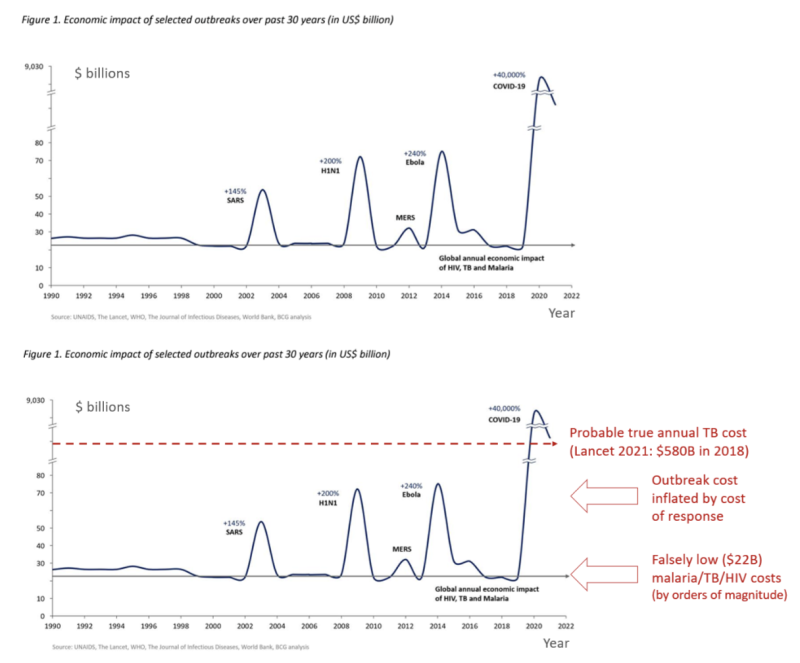
Figure 1 from Analysis of Pandemic Preparedness and Response (PPR) architecture, financing needs, gaps and mechanisms, prepared by WHO and the World Bank for the G20, March 2022. Lower chart modified by REPPARE, University of Leeds.
A virus like SARS-CoV-2 (causing Covid-19) that mostly targets the sick elderly with an overall infectious mortality rate of about 0.15% will not cost $9 trillion unless panicked or greedy people choose to close down the world’s supply lines, implement mass unemployment, and then print money for multi-trillion-dollar stimulus packages. In contrast, diseases that regularly kill more and much younger people, like tuberculosis, malaria, and HIV/AIDS, cost far more than $22 billion a year in contrast.
A 2021 Lancet article put tuberculosis losses alone at $580 billion/year in 2018. Malaria kills over 600,000 children annually, and HIV/AIDS results in similar numbers of deaths. These deaths of current and future productive workers, leaving orphaned children, cost countries. Once, they were the WHO’s main priority.
Trading on a Fading Reputation
In selling the package, the WHO seems to have abandoned any attempt at meaningful dialogue. They still justify the surveillance-lockdown-mass vaccinate model by the logic-free claim that over 14 million lives were saved by Covid vaccines in 2021 (so we all have to do that again). The WHO recorded a little over 3 million Covid-related deaths in the first (vaccine-free) year of the pandemic. For the 14 million ‘saved’ to be correct, another 17 million would somehow have been due to die in year two, despite most people having gained immunity and many of the most susceptible having already succumbed.
Such childish claims are meant to shock and confuse rather than educate. People are paid to model such numbers to create narratives, and others are paid to spin them on the WHO websites and elsewhere. An industry worth hundreds of billions of dollars depends on such messaging. Scientific integrity cannot survive in an organization paid to be a mouthpiece.
As an alternative, the WHO could advocate for investment in areas that promoted longevity in wealthy countries – sanitation, better diet and living conditions, and access to basic, good medical care.
This was once the WHO’s priority because it not only greatly reduces mortality from rare pandemic events (most Covid deaths were in people already very unwell), but it also reduces mortality from the big endemic killers such as malaria, tuberculosis, common childhood infections, and many chronic non-communicable diseases. It is, unequivocally, the main reason why mortality from major childhood infectious diseases like measles and Whooping cough plummeted long before mass vaccinations were introduced.
If we concentrated on strategies that improve general health and resilience, rather than the financial health of the pandemic industrial complex, we could then confidently decide not to wreck the lives of our children and elderly if a pandemic did arise.
Very few people would be at high risk. We could all expect to live longer and healthier lives. The WHO has elected to leave this path, instill mass and unfounded fear, and support a very different paradigm. While the Pandemic Agreement is not essential to it, it is an important part of diverting further funds to this agenda and cementing this corporatist approach into place.
The United States has done well by stepping out of this mess, but continues to push many of the same fallacies and was instrumental in sowing the mess we now reap. While a few other governments are questioning, it is hard for any politicians to stand with truth when a sponsored media stands squarely elsewhere.
Society is once more enslaving itself, at the behest of an entitled few, facilitated by international agencies that were set up specifically to guard against this. At the coming World Health Assembly, the pandemic fairytale will almost certainly prevail.
The hope is that a well-deserved erosion of trust will eventually catch up with the global health industry and too few countries will ratify this treaty for it ever to come into force. To fix the underlying problem though and derail the pandemic industry train, we will need to rethink the whole approach to cooperation in international health.
David Bell, Senior Scholar at Brownstone Institute, is a public health physician and biotech consultant in global health. David is a former medical officer and scientist at the World Health Organization (WHO), Programme Head for malaria and febrile diseases at the Foundation for Innovative New Diagnostics (FIND) in Geneva, Switzerland, and Director of Global Health Technologies at Intellectual Ventures Global Good Fund in Bellevue, WA, USA.
How USAID Assisted the Corporate Takeover of Ukrainian Agriculture
By John Klar | Brownstone Institute | February 19, 2025
A recent essay titled “The Real Purpose of Net Zero” by Jefferey Jaxon posited that Europe’s current war against farmers in the name of preventing climate change is ultimately designed to inflict famine. Jaxon is not speculating on globalist motives; he is warning humanity of a rapidly unfolding reality that is observable in the perverse lies against cows, denigration of European farmers as enemies of the Earth, and calls by the WHO, WEF, and UN for a plant-based diet dependent entirely on GMOs, synthetic fertilizers, and agrichemicals.
Revelations about the evil doings of the Orwellian-monikered “United States Agency of International Development” (USAID) reveal a roadmap to totalitarian control unwittingly funded by America’s taxpaying proles. USAID’s clandestine machinations have long focused on controlling local and global food supplies as “soft colonization” by multinational chemical, agricultural, and financial corporations. European farmers revolting against climate, wildlife, and animal rights policies are harbingers of this tightening globalist noose.
The roots of the current globalist plan to “save humanity from climate change” link directly to the infamous Kissinger Report, which called to control world food supplies and agriculture as part of a globalist collaboration between nation-states and NGOs to advance US national security interests and “save the world” from human overpopulation using “fertility reduction technologies.” Kissinger’s 1974 Report was created by USAID, the CIA, and various federal agencies, including the USDA.
Fast forward to the 2003 Iraq War, justified using fear-mongering propaganda about weapons of mass destruction and neo-conservative malarky about rescuing the Iraqi people. The US-led occupation of Iraq became a rapacious profiteering smorgasbord for colonizing corporations husbanded by USAID. Iraq is heir to the birthplace of human civilization, made possible by early Mesopotamian agriculture: many of the grains, fruits, and vegetables that now feed the world were developed there. Iraq’s farmers saved back 97% of their seed stocks from their own harvests before the US invasion. Under Paul Bremer, Rule 81 (never fully implemented) sought to institute GMO cropping and patented seed varieties, as Cargill, Monsanto, and other corporations descended upon the war-ravaged nation using American tax dollars and USAID.
That playbook was more quietly implemented during the Ukraine War, once again orchestrated by USAID. Before the Russian invasion on February 24, 2022, Ukraine was the breadbasket of Europe, prohibiting GMO technologies and restricting land ownership to Ukrainians. Within months of US intervention, USAID assisted in the dismantling of these protections in the name of “land reforms,” free markets, financial support, improved agricultural efficiency, and rescuing the Ukrainian people. In just two years, over half of Ukraine’s farmland became the property of foreign investors. GMO seeds and drone technology were “donated” by Bayer Corporation, and companies such as GMO seed-seller Syngenta and German chemical manufacturer BASF became the dominant agricultural “stakeholders” in war-torn Ukraine. Russia may withdraw, but Ukraine’s foreign debts, soil degradation, and soft colonization will remain.
The UN, WTO, WHO, and WEF all conspire to peddle a false narrative that cows and peasant farmers are destroying the planet, and that chemical-dependent GMO monocropping, synthetic fertilizers, and patented fake meats and bug burgers must be implemented post haste (by force if necessary) to rescue humanity. The argument that pesticides and synthetic fertilizers (manufactured from natural gas, aka methane) are salvific is patently false. They are, however, highly profitable for chemical companies like Bayer, Dow, and BASF.
Jefferey Jaxon is exactly correct. The Netherlands committed to robust agricultural development following a Nazi embargo that deliberately inflicted mass famine following their collaboration with Allied Forces in Operation Market Garden. France boasts the highest cow population in all of Europe. Ireland’s culture is tightly linked to farming as part of its trauma during the (British-assisted) Irish Potato Famine. The corporate/NGO cabal now uprooting and targeting farmers in these nations and across the EU in the name of staving off climate change and preserving wildlife is a direct outcropping of Kissinger’s grand dystopian scheme launched through USAID in 1974.
Americans watch European farmer protests from afar, largely oblivious that most all of US agriculture was absorbed by the Big Ag Borg generations ago. Currency control linked to a (political, environmental, and economic) social credit scorecard promises the fruition of Kissinger’s demonic plan: “Control the food, control the people.”
Modern humans suffer a double hubris that blinds them to the contemplation of the truth of Jaxon’s hypothesis: a cultish trust in technology, coupled with an irrational faith in their self-perceived moral superiority to past civilizations (Wendell Berry calls this “historical pride”). Yet, as long as mankind has had the capacity to harm another for personal gain, humans have devised ways to control food for power or profit. Siege warfare generally depended on starving defenders of castle walls into submission.
Even if globalist food control proposals are well-intentioned, a monolithic, monocultured, industrial-dependent worldwide food system is a lurking humanitarian disaster. Berry observed:
In a highly centralized and industrialized food-supply system there can be no small disaster. Whether it be a production “error” or a corn blight, the disaster is not foreseen until it exists; it is not recognized until it is widespread.
The current push to dominate global food production using industrial systems is the cornerstone of complete globalist dominion over all of humanity. The “Mark of the Beast” without which no American will buy or sell goods – including guns, bullets, or factory-grown hamburgers and cricket patties – is mere steps away. Mr. Jaxon is correct that these leaders “know these basic historical and current facts,” and that “[f]armers are becoming endangered because of government [climate] policy … and it’s being allowed to happen.” USAID has been actively seeding and watering this dystopia for decades.
Klaus Schwab and Bill Gates are as fully cognizant of this fundamental truth as Henry Kissinger was in 1974. USAID has aided all three. Having lost almost all of their small farms over the last century, Americans are well ahead of Europeans in their near-complete dependence on industrial food.
That’s the plan.
Unaddressed Issues after WHO Withdrawal
By David Bell | Brownstone Institute | January 29, 2025
On Day One of his new administration, United States President Donald Trump signed an executive order notifying an intent to withdraw from the World Health Organization (WHO). This has drawn celebration from some, dismay from others, and probably disinterest from the vast majority of the population more concerned with feeding families and paying off debt. The executive order also leaves much unaddressed, namely the substantive issues that have changed the WHO and international public health over the past decade.
Change is certainly needed, and it is good that the WHO’s largest direct funder is expressing real concern. The reactions to the notice of withdrawal also demonstrate the vast gulf between reality and the positions of those on both sides of the WHO debate.
The new administration is raising an opportunity for rational debate. If this can be grasped, there is still a chance that the WHO, or an organization more fit for purpose, could provide broad benefit to the world’s peoples. But the problems underlying the international public health agenda must first be acknowledged for this to become possible.
What Actually Is the WHO? What Does It Do?
Despite being the health arm of the United Nations (UN), the WHO is a self-governing body under the 194 countries of the World Health Assembly (WHA). Its 34-member executive board is elected from the WHA. The WHA also elects the Director-General (DG), based on one country – one vote. Its 1946 constitution restricts its governance to States (rather than private individuals and corporations), so in this way, it is unique among the major international health agencies. While private individuals and corporations can buy influence, they can be completely excluded should the WHA so wish.
With 8,000 staff, the WHO is split into six Regions and a Head Office in Geneva, Switzerland. The Regional Office of the Americas, also called the Pan-American Health Organization (PAHO), is based in Washington, DC, and preceded the WHO, having been established in 1902 as the International Sanitary Bureau. Like other Regional Offices, PAHO has its own Regional Assembly, obviously dominated by the US, and is largely self-governing under the wider WHO and UN system.
The WHO is funded by countries and non-State entities. While countries are required to provide ‘assessed’ or core funding, most of the budget is derived from voluntary funding provided by countries and private or corporate donors. Nearly all voluntary funding is ‘specified,’ comprising 75% of the total budget. Under specified funding, the WHO must do the funders’ bidding. Most of its activities are therefore specified by its funders, not the WHO itself, with a quarter of this being private people and corporations with strong Pharma interests.
Therefore the WHO, while governed by countries, has effectively become a tool of others – both State and non-State interests. The US is the largest direct funder (~15%), but the Bill & Melinda Gates Foundation (BMGF) is a close second (14%), and the partly Gates-funded Gavi public-private partnership (PPP) is third. Thus, Mr. Gates arguably has the largest influence in terms of specifying the WHO’s actual activities. The European Union and World Bank are also major funders, as is Germany and the United Kingdom (i.e. the remaining large Western Pharma countries).
In response to its funders, the WHO has shifted focus to areas where large Pharma profits can be accrued. Pharma must insist on this as it has a fiduciary responsibility to maximize return on investment for its shareholders by using its WHO connections to sell more product. The obvious way to make lots of money in Pharma is by spreading fear of vaccine-preventable diseases, and then making vaccines and selling them free from liability to as large a market as possible. This was highly effective during the Covid-19 response, and the WHO is now sponsored by these interests to implement the surveil-lockdown-mass vaccinate paradigm behind the recent amendments to the International Health Regulations and the draft pandemic agreement.
While a shamefully willing tool, the WHO is not driving this. The US started the IHR amendment process and heavily backed it until the recent change of administration. The new administration, while signaling an intent to withdraw from the WHO, has not signaled a withdrawal from the pandemic industrial complex the US helped develop.
Critical to understanding the US withdrawal is the fact that the Covid-19 outbreak, and the response, would have looked almost identical if the WHO did not exist. The WHO was not involved in the gain-of-function research, in vaccine development, or in vaccine mandates. It abrogated its own ethical principles and prior recommendations in pushing lockdowns and mass vaccination, and did huge harm in the process. However, it was countries that funded and conducted the virus modification that likely spawned Covid-19. It was countries, in concert with Pharma, that mandated lockdowns on their people and pushed vaccination most heavily (the WHO never recommended the Covid-19 vaccines for children).
This is not a defense of the WHO – the organization was both incompetent, dishonest, and negligent during Covid-19. They were a public health disgrace. They have continued to deliberately mislead countries regarding future pandemic risk, and inflated return-on-investment claims, in order to sell the policies that benefit their sponsors. But remove the WHO, and the World Bank (the main funder of the pandemic agenda), the PPPs looking to sell pandemic vaccines (Gavi and CEPI), the Gates Foundation, Germany, the UK, and EU, the US health ‘swamp’ itself, and Pharma with its compliance media, will still exist. They have other options to bring a veneer of legitimacy to their pillaging through public health.
The US Notice of Withdrawal
As President Trump’s 20th January order of withdrawal notes, it repeats an executive order from mid-2020 that was subsequently revoked by President Biden. In theory, it takes at least 12 months for a withdrawal to take effect, based on the Joint Resolution of Congress in 1948 through which the US joined WHO, subsequently agreed by the WHA. However, as the new executive order is intended to revoke the Biden revocation, the remaining time to run is unclear. The waiting period could also be shortened by a further Act of Congress.
The 2025 notice of withdrawal is interesting, as the reasons given for withdrawal are relatively benign. There are four:
- Mishandling of the Covid-19 outbreak and other (undefined) global health crises. The “mishandling” is undefined, but may include WHO support for China in obscuring Covid-19 origins as highlighted in the recent Covid-19 House of Representatives sub-committee report. There are few obvious candidates for other truly global health crises that the WHO mishandled, except perhaps the 2009 Swine flu outbreak, unless the executive order refers to any international (global) public health issue (in which case there are many).
- Failure to adopt urgently needed reforms. These are undefined. Of concern, the only reforms the US has been pushing on the WHO in the past few years (pre-Trump administration) were intended to increase the authority of the WHO over sovereign States and the authority of its work. The recent Republican-dominated House subcommittee report recommended the same.
- Inability to demonstrate independence from the inappropriate political influence of WHO member states. This is presumably aimed at China, but is also concerning, as the WHO is subject to its Member States through the WHA. It would be strange if the US was hoping to free the WHO from such constraints. There is no mention of private sector involvement, now about 25% of WHO funding, which many would claim is the core reason for the corruption and deterioration of the WHO’s work.
- Unfairly onerous payments by the US. The US provides 22% of the WHO’s assessed (core funding) but this is only a fraction of US payments. The vast majority of US payments have been entirely voluntary, and the US could presumably choose to stop these at any time, removing most of its funding but not its voting rights. With China listed by the WHO as paying less than Somalia and Nigeria in the current 2024-25 biennium (per mid-January 2025), the US has a reasonable gripe here, but a simple one to fix.
Missing from the executive order is any reference to the other promoters of the pandemic or emergency agenda. The World Bank’s Pandemic Fund is untouched by this executive order, as are the PPPs. CEPI (vaccines for pandemics) and Gavi (vaccines in general) provide private industry and investors such as the Bill & Melinda Gates Foundation with direct decision-making roles they cannot ensure through the WHO.
The executive order requires the Director of the White House Office of Pandemic Preparedness and Response Policy to “…review, rescind, and replace the 2024 U.S. Global Health Security Strategy.” It is hoped that this signals a recognition of the lack of an evidence base and financial rigor around the current policy. Indeed, the policy promoted by the US, the WHO, the World Bank, and PPPs is irrelevant, by design, to a laboratory-released pathogen such as that which probably caused Covid-19. The actual mortality from natural outbreaks that it is designed for has been declining for over a century.
Implications of Withdrawal
A full withdrawal of the US from the WHO will presumably reduce US influence within the organization, enhancing that of the EU, China, and the private sector. As it ignores the World Bank and the PPPs, it will not greatly affect the pandemic agenda’s momentum. Covid-19 would still have happened had the US been out of the WHO before 2020, and modRNA mass vaccination would still have been driven by countries and Pharma with the help of a compliant media. The WHO acted as a propagandist and helped waste billions, but never advocated for vaccine mandates or mass vaccination of children. Though it was appalling, the driving forces behind the wealth concentration and human rights abuses of the Covid-19 era clearly originated elsewhere
If the US withdraws its 15% of the WHO budget – about $600 million per year – others (e.g. EU, Gavi, Gates Foundation) could fill the gap. The executive order mentions withdrawing US contractors, but these are few. Nearly all WHO staff are directly employed, not seconded by governments. The main effect will be to reduce coordination with agencies such as the US Centers for Disease Control and Prevention (CDC). The US will have a continuing need to use WHO services, such as for prequalification (regulation) of hundreds of millions of dollars of commodities bought and distributed by USAID and related programs but not regulated through the FDA. This is not a problem – the WHO lists are public – but the US would simply continue to use WHO services without paying for or influencing them.
The withdrawal notice also mentions cessation of US involvement in negotiating the amendments to the International Health Regulations (IHR) and the Pandemic Agreement. The IHR negotiations concluded 8 months ago, and the US has 2 months to signal rejection. The IHR is separate from WHO membership. The pandemic agreement is subject to wide disagreement between countries, and it is not clear whether it will go forward. However, provisions in the FY23 US National Defense Authorization Act (pages 950 to 961) are already stronger than the US would be signing up to with these WHO agreements.
The history of US withdrawals from UN institutions is also one of subsequent re-entry after a change in administration. Leaving the WHO without influence will presumably make it even less like what the Trump administration would like, should history repeat itself and the next administration rejoin.
The hope is that the US withdrawal will force major reform within the WHO – one of the key reasons provided in the withdrawal notice. However, there is no hint in the executive order of the desired direction of change, or whether the US will adopt a more rational policy. If such an intent were made clear, other countries would follow and the WHO itself may actually reboot. However, withdrawing without addressing these fallacies underlying the pandemic agenda entrenches the vested interests who profited through Covid-19 and clearly aim to continue doing so.
Being Real about Reality
The enthusiasm for the WHO withdrawal seems widely to have forgotten two things:
- The pandemic agenda and the Covid-19 response that exemplified it is not primarily a WHO program. (WHO said essentially the opposite in 2019).
- The actual pandemic industrial complex of surveil-lockdown-mass vaccinate is already essentially in place and does not need the WHO for it to continue.
The WHO Bio-Hub in Germany is largely a German government and Pharma agency with a WHO stamp. The World Bank pandemic fund is the main funding current source for pandemic surveillance, the 100-day vaccine program (CEPI) is directly funded by hapless taxpayers, and the Medical Countermeasures Platform is a partnership with countries, Pharma, the G20, and others. These would probably continue irrespective of the WHO’s existence. The pandemic industrial complex made hundreds of billions of dollars through Covid-19 and has the capacity and incentive to continue.
The complexity of all this is being addressed on social media by statements such as “The WHO is rotten to the core,” “The WHO is unreformable,” or even “Pure evil” – all unhelpful labels for a complex organization of 8,000 staff, 6 fairly independent Regional offices, and dozens of country offices. The WHO’s work on reducing the distribution of counterfeit drugs saves perhaps hundreds of thousands of people each year, and these people matter. Its standards for tuberculosis and malaria management are followed globally, including by the US. In several countries, its technical expertise saves many lives – people who can be abandoned to cliches or taken seriously.
The organization desperately needs reform, as President Trump notes. Its current leadership, having spent the last few years blatantly misleading and lying to countries about Covid-19 and pandemic risk, seems an unlikely candidate to help. They have played the tune of private interests over the needs of the world’s people. However, the WHO’s structure makes it the only major international health institution that countries alone can actually force to reform. It simply needs sufficient Member States of the WHA to force exclusion of private interests, and to force the WHO back to diseases and programs that actually have a significant bearing on human well-being.
Should such reform prove impossible, then the coalition of countries built around the reform agenda can replace it. The massive bureaucracy that global health has become needs to be seen through the same lens as that in the US. The fantasy built around pandemic risk is not substantively different from many on the domestic agenda that the Trump administration is now targeting. It is similarly erosive of human rights, freedom, and human flourishing. Addressing this is an opportunity we would be foolish to miss.
David Bell, Senior Scholar at Brownstone Institute, is a public health physician and biotech consultant in global health. David is a former medical officer and scientist at the World Health Organization (WHO), Programme Head for malaria and febrile diseases at the Foundation for Innovative New Diagnostics (FIND) in Geneva, Switzerland, and Director of Global Health Technologies at Intellectual Ventures Global Good Fund in Bellevue, WA, USA.
The United States exits the WHO
WHOlly appropriate
By Dr Lisa Hutchinson | Health Advisory & Recovery Team | January 28, 2025
No one could have escaped the news that the newly inaugurated US President, Donald J. Trump has signed an Executive Order to withdraw from the World Health Organization (WHO). The key reasons cited for this decision include the WHO’s mishandling of decisions and policy during the Covid-19 pandemic, the failure to adopt reforms and, crucially, a lack of independence from the influence of member states or concerns relating to conflicts of interest. Trump has pledged that the US will pause the transfer of funds to the WHO as well as identify alternative partners to fulfil the necessary activities that this organization assumes. Furthermore, the US will cease negotiations with the WHO on the amendments to the International Health Regulations (IHR) and the Pandemic Treaty. At HART, we have followed the journey of the ongoing negotiations of the WHO Pandemic Agreement.
The US exit from the WHO also ends its financial contributions to the organization, which accounts for around 22% of the WHO’s mandatory contributions. This withdrawal means the WHO has now lost its largest financial contributor of $1.3 billion. Although the withdrawal process may take up to 1 year, during this transition period, the US will cease all negotiations of the Pandemic Treaty, the IHR amendments and any prior decisions will not be legally binding. On hearing this, millions in the US and around the world have celebrated and welcomed this exit from the WHO. Not least because it removes further financial funding and could save millions from untested, harmful vaccines while also being denied access to alternative beneficial therapies in instances of any future ‘health emergencies’. Could this milestone decision be the catalyst for other nations to withdraw from the WHO?
Several have commented that the largest loser of the US exit from the WHO is Bill Gates who has contributed 88% of the total philanthropic funding for the WHO. This move by the USA could not be in further contrast with the UK: Sir Keir Starmer wishes to extend the WHO’s control over the UK by agreeing to the IHR amendments in March 2025. Last April, over 100,000 members of the British public signed a petition to end our membership with the WHO. Unsurprisingly perhaps, the UK Government ignored the petition, despite the signature count exceeding the 100,000 threshold for debate in Parliament; instead, the UK government ploughed ahead without consideration for the valid, wider concerns raised.
Some might think that the US withdrawal from the WHO is tragic. But a closer examination of how monopolies can be created by organizations such as the WHO, together with other federal agencies and collaborators, including the CDC, NIH and FDA, reveals a far more disturbing reality. Beneath the benign guise of the WHO lurks malign intentions: a wolf in sheep’s clothing. The glaring lack of transparency, undisclosed conflicts of interests and power creep that these seemingly unaccountable centralized organizations possess, are a threat to democracy. Since all countries will have different socioeconomic challenges, and the response to any global health threat would be equally varied, surely the public health and biosecurity threats to any country is the responsibility of that country: there should be no submission to a one-size-fits-all diktat. National sovereignty should be respected and not trampled on by an unelected, unaccountable body with nonsensical policies. Yet despite these concerns, the outgoing President Biden has already approached African nations directly to strengthen ties towards a global government health and security strategy.
We emphasize that the WHO is not a democratically elected body and there are grave concerns over the power it wields over sovereign nations. Any glimmers of a democracy the UK might have will be flushed away to an autocratic dictatorship, led by unelected people in positions of power, such as the Director General, Dr Tedros Adhanom Ghebreyesus, if we do not continue to object to the IHR amendments and WHO Pandemic Treaty. As highlighted in earlier posts, the Pandemic Treaty and IRH amendments have little to do with nation states working together in circumstances where potentially harmful infectious diseases arise, but are a power grab by an authoritarian, unaccountable entity. If the Pandemic Treaty and IRH amendments succeed, the WHO would be able to declare a pandemic or international emergency even when no such emergency exists! The WHO could impose lockdowns, usher in mandatory vaccinations and other autocratic decisions, which would never be in the best interests of the public. Future furlough schemes in such ‘emergencies’ are unlikely, but the WHO would have carte blanche to decide the health decisions for every person in the UK. Incredibly, even the power to insist that every citizen carry a global health passport would be assumed by the WHO. The financial implications are grave because during the covid pandemic, WHO recommendations cost the UK £400 billion in national debt. We literally cannot afford to go down this route again! The shutting down of society and the economy for undefined, prolonged periods, as experienced in 2020 and 2021 spiralled the cost of living crisis to unprecedented levels, as well as terrorising the public and destroying the mental health of citizens, not to mention the untold devastation to our children’s education and wellbeing.
President Trump clearly concludes that the WHO is not capable or appropriately placed to make healthcare-based policy decisions that are justified for the American people. His decision to exit the WHO is a welcome sign of someone who is not intent on squandering individual and national sovereignty. In the UK, we should not sit back and allow our government to continue with the WHO IHR amendments, especially given the huge number of objections that have been willfully ignored.
There is an alternative way: we could for example support the refreshing approach of the World Council for Health (WCH), a coalition of independent health organizations and medical professionals advocating for a decentralized, holistic, and patient-centered approach to healthcare. Either way, we certainly need a more collaborative healthcare approach.
Featured Video

Bombing Hitler’s Hometown
or go to
Aletho News Archives – Video-Images
From the Archives
The Biggest Threat to Peace in Middle East
By Dr. Elias Akleh* | Sabbah Report | May 24, 2010
A build up of heightened tension in the Middle East is escalating in the last few weeks. American and Israeli postures towards Lebanon, Syria, and Iran have become more threatening. Listening to speeches of political leaders one hears talks only about war not peace. Iranians and Israelis are continuously training hard for a possible showdown. Both sides are conducting extensive war games every month. This led Syrians to claim that Israel is preparing for a soon-to-come another war. The Jordanians also are warning that current stalemate of the peace process is an indication of a war breaking out this summer. The Russian President and his army chief hinted, a few months ago, that the US and Israel were planning for an attack on Iran.
Indeed Iran is, as it has been for last few years, the target of most of the threats and accusations of supporting terrorism. Escalating incitement against Iran the American Defense Department sent last month (April) to Congress a report on Iran’s military claiming Iran could develop intercontinental ballistic missiles capable of reaching the US by 2015.
Ignoring the fact that N. Korea, India, Pakistan, and Israel are proven to have nuclear weapons while Iran does not, the US Secretary of State Hillary Clinton chose in her speech, to the nuclear Non-Proliferation Treaty review conference at the UN, to focus on Iran’s alleged nuclear ambitions putting the whole world at risk as she put it. According to Clinton Iran’s acquisition of nuclear weapons, rather than Israel’s more than 200 nuclear bombs, is destabilizing the Middle East. She called on the world’s nations to rally around US efforts to hold Iran, not other nuclear countries, to account.
The accusation that Usama Bin Laden is living comfortably in Iran had received a boost after the broadcast of a documentary called “Feathered Cocaine”. This echoed the June 2003 claims of the Italian newspaper Corre de la Sierra that Bin Laden was in Iran according to some intelligence report, and according to Richard Miniter’s book “Shadow War”. … continue
Blog Roll
 Aletho News
- Bombing Hitler’s Hometown
- German journalist threatened with homelessness as German court upholds EU sanctions in landmark free speech case
- US Tells Allies That Ukraine-Bound Arms Could be Sent to Middle East
- Organized terrorism: Iran condemns killing of its diplomats in Lebanon
- Why could Gaza enter the regional war?
- Hamas official rejects Mladenov Plan linking disarmament to Gaza reconstruction
- Two Primary Elections for the Soul of ‘America First’
- Japan Clings to US Vassalage Despite Energy Crunch Caused By Iran War
- US Seeks Control Over Global Energy Infrastructure – Kremlin
- US senators target Orban government for standing up to Zelensky
- If Americans Knew
- Researchers at Human Rights Watch Resign Over Blocked Report on Palestinian Refugee Return
- Jewish Groups Are Backing a War Americans Don’t Want
- Eric Fingerhut Thinks He’s the President of the Jews
- Top Jewish Philanthropists, Rabbis Urge Israeli President to Take Action Against ‘Jewish Extremists’
- Don’t Be Fooled. Zionist Leaders Have Always Wanted to Control Southern Lebanon
- Israel’s widespread use of torture is a core element of its genocide against the Palestinian people
- In Israel’s War on Iran, Many Middle East US Bases Rendered “All But Uninhabitable”
- ‘Burn the lawn’: Israel pursues ‘Rafah model’ in southern Lebanon
- A genocide here, an amputation there
- Reports: Iran mobilizing 1M fighters, Israel-US run low on ammo, Israeli army faces shortage – Not a ceasefire Day 168
- No Tricks Zone
- Devastating Assessment Of Comirnaty Vaccine By Former Senior Pfizer Europe Toxicologist
- New Study: CO2 Is ‘Effectively Negligible’ As An Explanatory Climate Change Factor Since 2000
- Former Pfizer Toxicologist Dr. Helmut Sterz Tells Bundestag Hearing Pfizer Vaccine Should Have Never Been Approved
- Energy Expert: Germany’s Nuclear Phaseout Was A “500 Billion Euro Mistake”
- New Research: South Australia’s Mid-Holocene Sea Surface Temperatures Were 4°C Warmer Than Today
- Storing Green Energy To Last Germany 10 Days Would Require A 60-Million Tonne Battery
- New Studies: UK Sea Levels Were 4 Meters Higher Than Today During The Mid-Holocene
- Destructive Green New Deal: German Energy And Metal Group Warns Of Drastic Crisis
- New Study Documents A 20-Year Pause In Arctic Sea Ice Decline – Driven By Internal Variability
- Wake-up Call: Survey Shows Majority Of Germans Now Favor Postponing Climate Targets!
 Aletho News