WHO Director General Complains About Online “Conspiracy Theories” About WHO Pandemic Treaty

By Didi Rankovic | Reclaim The Net | November 12, 2023
Given the fervor of Tedros Adhanom Ghebreyesus’ crusade against “disinformation,” if one didn’t know any better, one could hardly guess that he is at the helm of UN’s health agency, the World Health Organization (WHO), rather than some “ministry of truth.”
Then again, given his own, and WHO’s role in the disastrously mishandled pandemic – when those who were to blame at national and international level discovered “misinformation” as a way to discredit any criticism – this is not so surprising.
Now Tedros writes, “We find ourselves in a time where fake news, lies, conspiracy theories, misinformation and disinformation are rampant.” The reason this time is the UN’s push to get countries around the world to agree to “the pandemic accord.”

The document is designed to put in place the tools to handle “the next pandemic,” but is far from limited to health issues.
Opponents have been warning that the accord also aims to introduce surveillance tools, effectively facilitate censorship, and undermine a country’s sovereignty in the decision-making processes during a health crisis by transferring a number of powers to the UN.
This last serious concern seems to rub Tedros particularly the wrong way.
There are many more aspects to losing national sovereignty than overt ones such as direct imposition of vaccination or lockdowns, but in his post Tedros chose to focus on that, to then blast critics as making claims that are “completely unfounded, untrue, nonsense and have no basis in reality.”
The WHO director-general doth protest too much, some might conclude.
Such language doesn’t just come out of nowhere; it is usually a signal that not everything is going smoothly behind the scenes, and here Tedros seems to be trying to not only persuade countries about “fake news, lies, conspiracy theories…” around this issue, but also to get them to launch propaganda campaigns in favor of the accord, ASAP.
Tedros calls this, “actively countering false narratives.”
“It is important for them to communicate with their own citizens, assuring them that this agreement explicitly protects their country’s sovereignty. There should be no room for doubt or confusion in this matter,” he wrote on X.
A post – or a whole study – explaining how exactly the proposed treaty “explicitly protects” national sovereignty would be even better as a way to leave “no room for doubt or confusion.”
That’s lacking, but efforts to promote WHO’s narratives are only increasing. Thus, Spark Street Advisors is lobbying by proposing “soft (reputational) incentives such as technical and material resources to help countries (with compliance).
Most international agreements leave it to nations to “self-report” on implementation, but here the recommendation is for the accord to set up “an independent monitoring committee, tasked with producing regular assessments of state parties’ compliance with the pandemic agreement and the timeliness, completeness and accuracy of self-reporting.”
Not sovereignty-undermining, this. Not at all.
WHO Publishes Latest Draft of Pandemic Treaty To Combat “Misinformation”
By Didi Rankovic | Reclaim The Net | November 2, 2023
The United Nations World Health Organization (WHO) has published a new draft of its troubled pandemic agreement/accord/treaty – which the agency has complained is taking too long to finalize.
The latest draft of the negotiating text, released by the Bureau of the Intergovernmental Negotiating Body (INB) on Monday must be considered until the INB session scheduled for November 6-10, when it should be formalized.
Some of the commitments contained in this version of the document have to do with combating “false, misleading, misinformation or disinformation, including through effective international collaboration and cooperation” – which skeptics might easily dub, “cross-border censorship.”
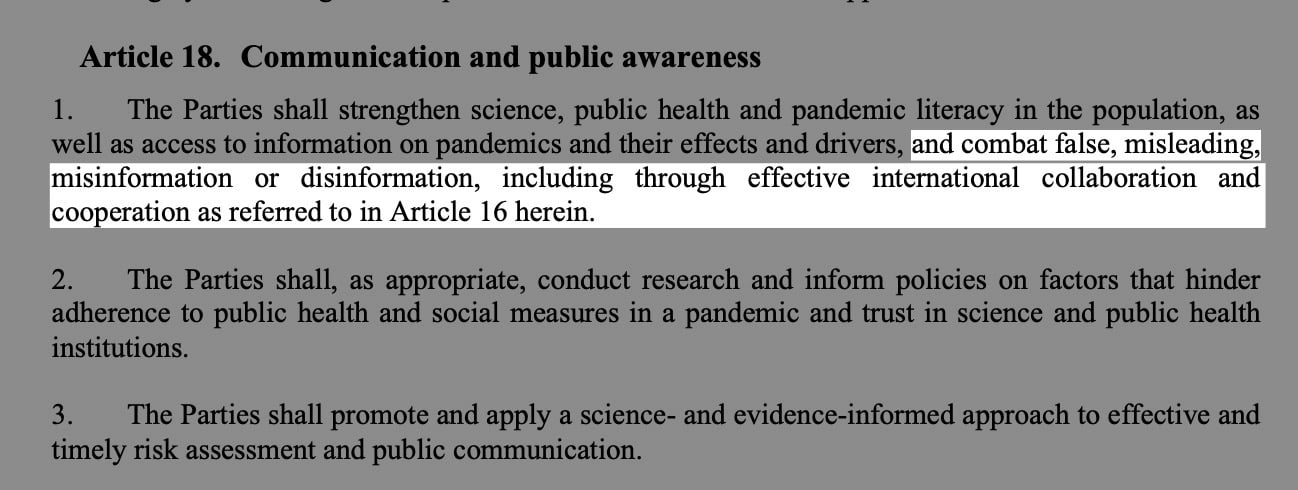
And then there’s surveillance, too: something called One Health approach for pandemic prevention, preparedness and response, which the draft wants to see promoted and implemented. Meanwhile, One Health is a surveillance tool that is supposed to create new methods of disease control.
Yet another point from the proposal is to “develop and strengthen pandemic prevention and public health surveillance capacities.”
Critics have many concerns and misgivings about all of this, including WHO setting up what’s known as a conference of the parties – an international convention’s top governing body – around the pandemic accord.
The fear here is that it would be one more instrument taking agency and consent away from national governments and people and transferring the decision-making processes, in this case related to health, to the world organization, specifically, WHO.
However, the draft’s chapter on institutional arrangements envisages establishing just such a conference of the parties as part of the accord’s scope.
A number of advocacy organizations from around the world have already expressed their dissatisfaction with the draft from different points of view, including how the treaty, if adopted, would impact less developed countries, while the draft itself is seen as “unbalanced.”
This last objection stems from the origin of the proposal – namely the discussions between INB Bureau and Secretariat, rather than drawing from the meetings of the INB itself.
Ignoring proposals from all countries that are supposed to implement the treaty, and allowing those with the most clout (in the Bureau) to set the tone is seen as one-sided in this sense as well.
Now Andrew Bridgen takes on the power-hungry World Health Organization
By Kathy Gyngell | TCW Defending Freedom | October 30, 2023
Hard on the heels of his excess deaths debate last Tuesday, the admirably energetic and purposeful Andrew Bridgen MP has been granted leave to bring in a Parliamentary Sovereignty (Referendums) Bill under the Ten Minute rule (which allows a backbench MP to make his or her case for a new Bill in a speech lasting up to ten minutes).
The purpose of this Bill is ‘to prohibit Ministers of the Crown from making or implementing any legal instrument which is not consistent with the sovereignty of the United Kingdom Parliament, unless it has been approved by a referendum; and for connected purposes’. It is directly relevant to the sweeping powers which the World Health Organization’s Pandemic Treaty threatens to grab from us.
(The second reading of this Bill, set for November 24th, is crucial. Supporters should put massive pressure on their MPs to attend, and include in their emails, the powers the Treaty will give the WHO over us).
You can watch Mr Bridgen delivering his succinct but detailed explanation for why we need such a Bill here:
Here is the full text from Hansard:
I beg to move,
That leave be given to bring in a Bill to prohibit Ministers of the Crown from making or implementing any legal instrument which is not consistent with the sovereignty of the United Kingdom Parliament, unless it has been approved by a referendum; and for connected purposes.
This Bill does what it says on the tin. The point of it is to uphold the integrity and sovereignty of this great House and this great nation. It would, for example, prevent a future Government from overturning the democratic will of the British people by taking us back into the European Union without consulting the public in a referendum. Indeed, it would stop the Government from taking us into any union without public consent, and it would move power closer to the people.
However, the Bill would also stop something that threatens the people of our great nation right now. It would stop the Government from blindly accepting the World Health Organization’s amendments to the International Health Regulations and the so-called Post-Pandemic Agreement, which they appear intent on doing without even consulting this House, never mind the public. The Government signed up to the WHO pandemic preparedness treaty negotiations without a single word being uttered in Government time. The only time we have even mentioned it in this Parliament was on 17 April this year in a Westminster Hall debate forced by over 156,000 members of the public signing a petition. A further petition to reject the amendments to the IHR has closed, having reached over 116,000 signatures, but no time has yet been allocated for a debate.
Those two instruments, if followed, will control how future Governments can prepare and respond to emergencies. In my view, that would amount to making this House redundant. If allowed to progress, that treaty and the amendments to the IHR will fundamentally change the relationship between citizen and state, moving away from a parliamentary democracy that has been the envy of the world for centuries to an autocratic dictatorship led by the unelected and unaccountable director general of the WHO. That same organisation has been accused of undue Chinese influence, as well as of severely mismanaging and covering up the spread and origin of covid-19. That same organisation is mostly funded by commercial and private interests and has diplomatic immunity for its employees and families. What could possibly go wrong?
My North West Leicestershire constituents voted to leave the European Union in 2016—indeed, I campaigned for it, too—but they did not vote in their tens of thousands to leave the EU only to be subjected to an even more autocratic and unaccountable body that takes sovereignty away from this House and from our people. We voted to leave the European Union to take back control, not to give it away to the WHO or anybody else. We are all elected by our constituents to represent them and speak on their behalf, so when it comes to the matter of their sovereignty and protecting their freedoms and rights, surely it is our responsibility to defend those rights and privileges. We are custodians of that power and sovereignty only for a brief period, after which it must be returned intact to the people at the next election, so that they can again decide who will represent them for the next parliamentary period.
When it comes to giving sovereignty away, that decision must always go back to the people, and it requires a referendum. The people should decide whether they wish to give their sovereignty away, and, in this case, whether they want the director general of the WHO controlling their life, rather than the Government of the day. To give those powers away would be nothing short of a dereliction of our duties.
The WHO would like to paint a picture of the treaty and the amendments being all about nation states working together in harmony to fight deadly pathogens, when they are in fact a power grab by an unaccountable elite. They do not want a debate on that; they would quite happily see it passed through the back door without a word being mentioned. That is not my idea of an open parliamentary democracy. The director general of the WHO will have the ability to call a public health emergency of international concern—the acronym is PHEIC, Madam Deputy Speaker—and take absolute powers to control the lives of all citizens of our sovereign nation. That is a power grab not just in this nation, but in all nations around the globe who sign up.
The new powers that the WHO will gain include the freedom to declare a pandemic—or even the potential for a pandemic—at which point all decision-making powers fall under the control of the WHO. The powers would also include the ability to call an emergency owing to human pathogens, animal pathogens, a perceived environmental threat or even the risk of any of the above; and the freedom to impose lockdown restrictions on all individuals in member states and make vaccinations or other medications mandatory, such as vaccines made in 100 days by skipping human trials and shaving safety and efficacy testing down to the bare bones. Furthermore, the WHO would seek power on the right to specify the use of certain medications in medical emergencies, and ban others—to decide healthcare for every person, with local doctors being forced to follow WHO edicts. The power to require a global health passport to be carried would also be given to those unelected bureaucrats in Geneva. Nations would be required to surveil and censor the press and social media so that no dissenting voices can be heard. The removal of the clause relating to human rights is unforgivable.
The recommendations that the WHO issued during the covid-19 pandemic were exactly that: recommendations. They were advisory, and it was up to sovereign Governments and sovereign Parliaments to implement or ignore them—Sweden bravely and successfully chose to ignore them. This treaty would make the WHO’s recommendations mandatory without a debate in this House or, indeed, any other elected Chamber of nations that sign up to these flawed agreements.
As George Santayana said, those who fail to learn the lessons of history are doomed to repeat them. I have some severe worries that the lessons of the last pandemic have not been learned by the WHO itself, as it will not even have a review of its recommendations during the pandemic, so sure is it that its advice was absolutely perfect—when, in fact, we know from independently conducted reviews that it was a litany of disasters, lockdowns, mandatory experimental vaccines and masks, all of which caused our population and economy huge harm. We are in danger of giving this organisation even more powers to overreach itself and repeat those catastrophic mistakes.
Do we really want a repeat of the measures recommended by the WHO that resulted in £400 billion on the national debt, which has caused ravaging inflation, not to mention the huge NHS waiting lists, one million young people in need of mental health support and the damage to our children’s education and development? That begs the question, why on earth would anyone be willing to give away our sovereignty without consulting this House or the people? That is something I am not content with, and I suspect many colleagues here today share my concerns—or perhaps some of them think, rather like those who were deciding the regulations at the last pandemic, that the rules would not apply to them. I can assure hon. and right hon. Members that they will.
The very democracy that we have taken for granted all our lives is now under threat, but it is not under threat from invading armies hailing from hostile nations. No, our democracy is under threat due to the apparent corruption and decay of our own Government institutions, which are allowing this power grab to happen. Members in this Chamber should never forget that we are the servants of the people, not their masters, and the servants should never sell out their masters.
In my opinion, anyone who supports either of these WHO instruments—I refuse to call one of them an agreement, because I have not agreed to it, and neither have the people of North West Leicestershire; indeed, I think the majority of my constituents would never agree to these instruments—and any Member of this Parliament who would hand over these powers to a such discredited organisation as the WHO does not deserve a seat in this Chamber or any elected Assembly around the world.
In conclusion, to even contemplate giving away these sorts of powers to this sort of body, which affect not just the democratic rights but the human rights of every single man, woman and child in our nation, without a referendum would be quite simply catastrophic. People have said that this would lead to one world government. In fact, it is rather worse; it will be a one world dictatorship. Signing up to this treaty and binding ourselves to the WHO without a single debate on it, a single vote on it or asking the general public what they think would make being a member of the European Union look like a democratic paradise by comparison. That is why we need this Bill. I am aware that, with the looming prospect of Prorogation, even if the House supports my motion today, the Bill will fall in a few days’ time. However, as the phrase goes, I will be back.
Question put and agreed to.
Ordered,
That Andrew Bridgen and Mr Philip Hollobone present the Bill.
Andrew Bridgen accordingly presented the Bill.
Bill read the First time; to be read a Second time on Friday 24 November, and to be printed (Bill 377).
Why are the globalists calling “Climate Change” a “Public Health Crisis”?
The answer is all to do with the pandemic treaty and climate lockdowns
By Kit Knightly | OffGuardian | October 30, 2023
The global elite plan to introduce a near-permanent “global state of emergency” by re-branding climate change as a “public health crisis” that is “worse than covid”.
This is not news. But the ongoing campaign has been accelerating in recent weeks.
I have written about this a lot over the last few years – see here and here and here. It started almost as soon as Covid started, and has been steadily progressing ever since, with some reports calling climate change “worse than covid”.
But if they keep talking about it, I’ll keep writing. And hopefully the awareness will spread.
Anyway, there’s a renewed push on the “climate = public health crisis” front. It started, as so many things do, with Bill Gates, stating in an interview with MSNBC in late September:
We have to put it all together; it’s not just climate’s over here and health is over here, the two are interacting
Since then there’s been a LOT of “climate change is a public health crisis” in the papers, likely part of the build-up to the UN’s COP28 summit later this year.
Following Gate’s lead, what was once a slow-burn propaganda drive has become a dash for the finish line, with that phrase repeated in articles all over the world as a feverish catechism.
It was an editorial in the October edition of the British Medical Journal that got the ball rolling, claiming to speak for over 200 medical journals, it declares it’s…
Time to treat the climate and nature crisis as one indivisible global health emergency”
Everyone from the Guardian to the CBC to the Weather Channel picked up this ball and ran with it.
Other publications get more specific, but the message is the same. Climate change is bad for the health of women, and children, and poor people, and Kenyans, and workers and…you get the idea.
And that’s all from just the last few days.
It’s not only the press, but governments and NGOs too. The “One Earth” non-profit reported, two days ago:
Why climate change is a public health issue
Again, based entirely on that letter to the BMJ. The UN’s “climate champions” are naturally all over it, alongside the UK’s “Health Alliance on Climate Change”, whoever they are.
Both the Red Cross and Doctors Without Borders have published (or updated) articles on their website in the last few days using variations on the phrase “The climate crisis is a health crisis.”
Local public health officials from as far apart as Western Australia and Arkansas are busy “discussing the health effects of climate change”
Tellingly, the Wikipedia article on “effects of climate change on human health” has received more edits in the last 3 weeks than the previous 3 months combined.
All of this is, of course, presided over by the World Health Organization.
On October 12th the WHO updated its climate change fact sheet, making it much longer than the previous version and including some telling new claims:
WHO data indicates 2 billion people lack safe drinking water and 600 million suffer from foodborne illnesses annually, with children under 5 bearing 30% of foodborne fatalities. Climate stressors heighten waterborne and foodborne disease risks. In 2020, 770 million faced hunger, predominantly in Africa and Asia. Climate change affects food availability, quality and diversity, exacerbating food and nutrition crises.
Temperature and precipitation changes enhance the spread of vector-borne diseases. Without preventive actions, deaths from such diseases, currently over 700,000 annually, may rise. Climate change induces both immediate mental health issues, like anxiety and post-traumatic stress, and long-term disorders due to factors like displacement and disrupted social cohesion.
They are tying “climate change” to anyone who is malnourished, has intestinal parasites or contaminated drinking water. As well as anyone who dies from heat, cold, fire or flood. Even mental health disorders.
We’ve already seen the world’s first “diagnosis of climate change”. With parameters set this wide, we will see more in no time.
Just as a “Covid death” was anybody who died “of any cause after testing positive for Covid”, they are putting language in place that can redefine almost any illness or accident as a “climate change-related health issue”.
Two days ago, the Director General of the World Health Organization, the UN’s Special Envoy for Climate Change and Health and COP28 President co-authored an opinion piece for the Telegraph, headlined:
Climate change is one of our biggest health threats – humanity faces a staggering toll unless we act
The WHO Director went on to repeat the claim almost word for word on Twitter yesterday:
At the same time, the Pandemic Treaty is busily working its way through the bureaucratic maze, destined to become law sometime in the next year or so.
We’ve written about that a lot too.
Consider, the WHO is the only body on Earth empowered to declare a “pandemic”.
Consider, the official term is not “pandemic”, but rather “Public Health Emergency of International Concern”.
Consider, a “public health emergency of international concern”, does not necessarily mean a disease.
It could mean, and I’m just spit-balling here, oh, I don’t know – maybe… climate change?
Consider, finally, that one clause in the proposed “Pandemic Treaty” would empower the WHO to declare a PHEIC on “precautionary principle” [my emphasis]:
Future declarations of a PHEIC by the WHO Director-General should be based on the precautionary principle where warranted
Essentially, once the new legislation is in place, the plan writes itself:
- Put new laws in place enabling global “emergency measures” in the event of a future “public health emergency”
- Declare climate change a public health emergency, or maybe a “potential public health emergency”
- Activate emergency measures – like climate lockdowns – until climate change is “fixed”
See the end game here? It’s just that simple.
Oh, and we won’t be able to complain, because “climate denial” is going to be illegal. At least, if prominent climate activists like this one get their way.
That’s only a whisper in the background right now, but it will get louder after COP28, just wait.
Until then, like I said, I’m stuck here writing forever.
Conservative MP Leslyn Lewis backs petition calling for Canada to exit UN, WHO

MP Leslyn Lewis (Haldimand-Norfolk) speaks at Save our Charities Rally on Parliament Hill, Ottawa, Nov. 24, 2021
By Anthony Murdoch | Life Site News | October 18, 2023
OTTAWA, Ontario –– Conservative Party of Canada MP Leslyn Lewis has endorsed an official House of Commons petition demanding the nation’s federal government “urgently” withdraw from the United Nations and its subgroup, the World Health Organization (WHO), due to the organizations’ undermining of national “sovereignty” and the “personal autonomy” of citizens.
“We, the undersigned, Citizens and Residents of Canada, call upon the House of Commons in Parliament assembled to Urgently implement Canada’s expeditious withdrawal from the U.N. and all of its subsidiary organizations, including WHO,” reads the petition, which was initiated by Doug Porter from Burnaby, British Columbia, and then endorsed by Lewis.
As of press time, the petition, which was opened on October 10, has just over 36,000 signatures. It will remain open for signing until February 7, 2024.
The petition states that Canada’s current membership in the UN along with the WHO has resulted in “negative consequences on the people of Canada,” which far outweigh “any benefits.”
Additionally, the petition reads that the UN’s “Agenda 2030″ undermines “national sovereignty and personal autonomy.”
Many of Prime Minister Justin Trudeau’s federal government goals, notably its environmental ones, are in lockstep with the United Nations’ “2030 Agenda for Sustainable Development.”
Agenda 2030 is a plan that was adopted by the UN General Assembly in 2015, and through its 17 Sustainable Development Goals (SDGs), seeks to “transform our world for the better,” by “taking urgent action on climate change,” as well as “support[ing] the research and development of vaccines and medicines.” Some of the 17 goals also seek to expand “reproductive” services, including contraception and abortion, across the world in the name of women’s rights.
According to the UN, “all” nations working on the program “will implement this plan.”
Part of the plan includes phasing out coal-fired power plants, reducing fertilizer usage, and curbing natural gas use over the coming decades. Canada is one of the world’s largest oil and gas producers, however, Trudeau has made it one of his goals to decimate the industry.
In a blow to the globalist UN agenda, however, Canada’s oil and gas sector recently scored a huge win after the Supreme Court of Canada declared Trudeau’s government’s Impact Assessment Act, dubbed the “no-more pipelines” bill, is mostly “unconstitutional.”
As for Lewis, she is pro-life and has consistently called out the Trudeau government for pushing a globalist, anti-life agenda on Canadians.
Early this year Lewis noted that the World Economic Forum (WEF) is “not our government” and that Canadians did not “sign up” to be attached to one of its charters. Lewis herself helped expose Canadians to the fact that Trudeau’s Liberal government signed onto the WEF charter in 2020.
Petitions to Canada’s House of Commons can be started by anyone but must have the support of five Canadian citizens or residents, along with the support of a sitting MP.
Once a petition has over 500 verified signatures, it is presented to the House of Commons, where it awaits an official government response.
Petition calls out UN’s sex-ed programs, saying Canadians did not vote for these to be pushed on kids
The Lewis-backed petition states that Canada should have nothing to do with the UN’s sexual education programs as they have been pushed on the populace without the “consent” of the people.
The petition reads that Agenda 2030’s SDGs, as well as its “Comprehensive Sexuality Education (CSE)” program, its UN Judicial Review, and its International Health Regulations (IHR) are being “rapidly implemented,” with the absent awareness and “consent of the People or their elected representatives.”
The petition reads that SDGs have “negative impacts on potentially every aspect of life,” in Canada, including “religious and cultural values, familial relations, education, nutrition, child development, property rights, economic and agricultural productivity, transportation, travel, health, informed consent, privacy and physical autonomy.”
When it comes to the UN’s CSE, the petition states that publicly funded educational institutions have been “damaging children while concealing information from parents.”
As a result, the CSE’s “normalization” of “sexual values and activities with regard to children are endorsed and enforced, beginning at birth.”
As for the WHO, it claims that the CSE gives kids “accurate, age-appropriate information,” however it then says sexual education should start at the age of 5 as per UN guidelines.
“Learning is incremental; what is taught at the earliest ages is very different from what is taught during puberty and adolescence,” reads the CSE.
A report which was published by the UN’s Educational, Scientific and Cultural Organization, in collaboration with the WHO, told kids aged 5 to 8 that “people can show love for other people through touching and intimacy.”
UN’s health regulations look to violate Canadians’ charter rights, says petition
The petition notes that when it comes to Agenda 2030, many amendments to the International Health Regulations (IHR) were “secretly negotiated,” which as a result means they could “impose unacceptable, intrusive universal surveillance, violating the rights and freedoms guaranteed in the Canadian Bill of Rights and the Charter of Rights and Freedoms.”
Lastly, the petition states that the UN’s goals intend to impose “sweeping impacts on public and private life,” and only “serve the interests of UN/WHO and unelected private entities (e.g. World Economic Forum, Bill and Melinda Gates Foundation, International Planned Parenthood Federation, etc.), while diminishing the health rights and freedom of Canadians.”
The WHO says that the IHR is a legally binding international body to which all UN members are committed to.
Lewis has before blasted Canada’s involvement with the IHR and insisted last year that the Canadian government “defend our healthcare sovereignty” and vote against proposed U.S. amendments to the the IHR.
The WHO’s IHR provides an “overarching legal framework that defines countries’ rights and obligations in handling public health events and emergencies that have the potential to cross borders.”
“The IHR are an instrument of international law that is legally-binding on 196 countries, including the 194 WHO Member States,” notes the WHO.
So far this year, there have been more than 300 proposed amendments to the IHR when it comes to the declaration of a Public Health Emergency of International Concern.
Lewis recently called out the proposed amendments, saying that if enacted it would negatively affect how Canada deals with any future health crisis.
On September 26, she presented to the House of Commons a petition specific to the IHR, which called for “urgent” debates on the amendments.
Critics have sounded the alarm over the Trudeau government’s involvement in the WEF and other globalist groups, pointing to the socialist nature of the “Great Reset” agenda and its similarities to Communist China’s totalitarian Social Credit System.
Lewis in June of this year had asked for a full disclosure of all “contracts, transfer payments, memoranda of understanding, letters of intent, charters, accords, projects and associations between the government and the WEF since November 4, 2015.”
The outcomes from the Order Paper resulted in a 127-page response that was tabled in the House of Commons on September 18.
Lewis has in the past blasted the WEF and its Known Traveller Digital Identification (KTDI) programs as “glitching failures.”
The WHO ignores its own rules, will refuse to make public the finalized IHR Amendments before the vote
By Meryl Nass | October 10, 2023
The WHO’s press release states what happened in very general terms, so only the already-initiated will understand it. Article 55 of the WHO Constitution requires that amendments to WHO documents be offered to the member states and public 4 months in advance of a vote. The Saudi co-chair said to the public that his Working Group on the IHR amendments may not complete their work by January needed to meet the timeline to be voted on in May 2024. In a choreographed move, he asked Principal Legal Officer Steven Solomon what to do about this. Solomon had already crafted a plan. His plan was to create a specious excuse to ignore the existing rules.
Nobody voted on ignoring them. Nobody said this was okay. It just became a done deal. And here is the WHO press release, saying very little, explaining nothing, just issuing a vague statement that the rules will be ignored and no amendments will be available till (probably) after the vote or consensus process takes place in May:
“We will continue work on a range of issues in the intersessional period before WGIHR6, as well as in early 2024. We are confident that we will be able to deliver on our mandate by the 77th World Health Assembly. The will is there,” said WGIHR Co-Chair Dr Abdullah Assiri of Saudi Arabia.
“We have a very strong shared focus on our mandate to deliver a package of targeted amendments to the IHR and ensure that equity is reflected in the IHR. It would be easy to make the IHR worse. It will be hard to make them better. We will focus on the hard task, making them better,” said WGIHR Co-Chair Dr Ashley Bloomfield of New Zealand.
The Co-Chairs noted that, in reference to Decision WHA75(9), it appeared unlikely that the package of amendments would be ready by January 2024. In this regard, the Working Group agreed to continue its work between January and May 2024. The Director-General will submit to the 77th Health Assembly the package of amendments agreed by the Working Group.
Below is the WHO lawyer (previously from US State Dept) who thought up the scheme to hide the amendments from the public instead of issuing the packet in January 2024 as required:

And here is the show where James Corbett, James Roguski and I discuss what is happening before our eyes, and tell you who really runs the WHO—its private donors. https://live.childrenshealthdefense.org/chd-tv/shows/good-morning-chd/whos-principal-legal-officer-tries-to-reinterpret-rules-pass-ihr-amendments-without-the-public-knowing-what-is-in-them/
House Cuts WHO Funding Through 2024, But Critics Push for Full Withdrawal to Protect U.S. Sovereignty
By Suzanne Burdick, Ph.D. | The Defender | October 6, 2023
The U.S. House of Representatives last week approved a bill that cuts U.S. funding to the World Health Organization (WHO) for the 2023-24 fiscal year.
The House approved H.R. 4665, the Fiscal Year 2024 Department of State, Foreign Operations, and Related Programs Appropriations Act, including the provision that, “None of the funds appropriated or otherwise made available by this Act may be made available for the World Health Organization.”
The bill’s passage comes as a sharp turnaround after the U.S. in 2022-23 was the WHO’s top contributor, surpassing the Bill & Melinda Gates Foundation, and over the past decade provided the WHO between $200 million to $600 million annually.
The bill, which passed by a 216-212 vote, is seen as a partial victory for critics of the WHO’s proposed pandemic treaty and amendments to the International Health Regulations (IHR), which would give the global health agency the power to dictate policies during health emergencies.
H.R. 4665 stipulates that the U.S. Senate must first ratify any WHO proposal, including a pandemic treaty, before the U.S. Department of State can use taxpayer dollars to implement it.
The bill also states the Constitution’s Senate treaty ratification requirement applies to “any international convention, agreement, protocol, legal instrument, or agreed outcome with legal force drafted by the intergovernmental negotiating body of the World Health Assembly or any other United Nations body.”
The bill goes next to the Senate, where it was placed on its legislative calendar.
Dr. David Bell, a public health physician and biotech consultant in global health, praised the bill, telling The Defender, “As WHO is obviously advocating for policies that are contrary to basic principles of democracy, human rights and ethical public health at present, defunding such work is necessary to protect society.”
Bell — who formerly worked as a medical officer and scientist at the WHO — said there are important aspects of cooperation in international health that the U.S. needs to support, but there are “other avenues for this that do not undermine human dignity” instead of working through the WHO.
The WHO’s response to COVID-19 demonstrated that it is “compromised by vested interests that are seeking to profit by imposing human rights restrictions based on false assertions, using fear and coercion,” Bell said. “It is irrational to use taxpayers’ money to support such approaches.”
‘A good start, but not quite good enough’
Francis Boyle, J.D., Ph.D., a professor of international law at the University of Illinois, told The Defender the House bill limits funding but said nothing about preventing the U.S. from signing or adopting documents like critics fear.
“This is a good start, but not quite good enough,” he said.
“The fiscal cut-off and the treaty ratification requirement will only be for the fiscal year,” Boyle said, “but the Globalists will keep coming after us to establish a worldwide totalitarian police state under the auspices and the guise of the WHO.”
In February, the WHO’s intergovernmental negotiating body convened to discuss its latest draft of a pandemic treaty, which the U.N. agency now calls the “WHO convention, agreement or other international instrument on pandemic prevention, preparedness and response” — or “WHO CA+” (sometimes also referred to as “PPPR”).
WHO CA+ seeks to create a global pandemic authority with the power to enforce universal vaccination and vaccine passports, lockdowns and other nonpharmaceutical interventions, establish early warning virus surveillance systems, and roll out “One Health” initiatives and censor “misinformation,” including anything that could induce “vaccine hesitancy.”
The estimated price tag is $30 billion annually.
The president of the WHO General Assembly in September approved a nonbinding pandemic declaration, without a vote of the full assembly and over the objections of 11 countries, aimed at mobilizing the national and global political will for completing the pandemic treaty negotiations by May 2024.
Proposed amendments to the IHR, currently numbering over 300, include recommendations such as:
- Changing the WHO “from an advisory organization … to a governing body whose proclamations would be legally binding” (Articles 1 and 42).
- Removing language preserving “respect for dignity, human rights and fundamental freedoms of people” (Article 3).
- Giving the WHO “authority to require medical examinations, proof of prophylaxis, proof of vaccine and to implement contact tracing, quarantine and treatment” (Article 18).
- Instituting “a system of global health certificates in digital or paper format” (multiple articles and annexes).
- Empowering the WHO’s Emergency Committee “to override decisions made by sovereign nations regarding health measures” (Article 43).
Pandemic treaty ‘a skillfully crafted decoy’
James Roguski, an author and researcher who has written extensively on stopping a global pandemic treaty and the IHR amendments, wrote that the Zero draft of the pandemic treaty “is a real thing” but also “a skillfully crafted decoy” designed to distract from the proposed IHR amendments, which he called “a clear and present danger.”
Together, the WHO CA+ and IHR amendments represent “a huge grab of power” by “unelected, unaccountable bureaucrats,” warned Andrew Bridgen, a U.K. member of Parliament in April.
Responding to these criticisms, U.N. officials and international public health experts claimed in a Sept. 25 letter appearing in the Lancet that the WHO CA+ does not threaten national sovereignty.
The letter stated as “categorically false” claims the WHO would “deploy troops to enforce the treaty,” dismissing rumors of vaccine mandates and digital passports and the WHO’s purported “authority to sanction countries,” which would cede authority to the WHO.
But Boyle said the WHO was attempting to conceal its true intentions.
In an earlier interview with The Defender, he said the WHO CA+ and IHR amendments — one or both — would set up a totalitarian medical and scientific police state beyond the control of national, state and local government authorities.
Boyle said:
“[Director-General] Tedros [Adhanom Ghebreyesus, Ph.D.] and the WHO … are basically a front organization for the Centers for Disease Control and Prevention, Tony Fauci, Bill Gates, Big Pharma, the biowarfare industry and the Chinese Communist government that pays a good chunk of their bills.”
Pandemic treaty drafted to ‘be brought into force upon signature’
Boyle explained that the WHO CA+ was intentionally drafted so that it could immediately be brought into force upon signature.
Boyle, author of several international law textbooks and a bioweapons expert who drafted the Biological Weapons Anti-Terrorism Act of 1989, said, “I don’t know, in any of my extensive studies of international treaties, let alone treaties setting up international organizations, of any that has a provision like that in it.”
“It’s completely insidious,” he added.
According to Boyle, “The only way to protect the Sovereignty of the United States of America and for other States to protect their own Sovereignty is to pull out of the WHO. The sooner the better!”
Roguski agreed, telling The Defender he believes defunding the WHO is not going to stop the WHO from moving its global agenda forward.
“I advocate that the United States and all other nations exit the WHO,” he said.
‘WHO Withdrawal Act is what we really need’
Both Boyle and Roguski said they support a bill called, the “WHO Withdrawal Act,” introduced on Jan. 9 by Rep. Andy Biggs (R-Ariz.), that would repeal the 1948 act establishing U.S. membership and participation in the WHO.
“The Biggs legislation is what we really need to solve all of the problems here,” Boyle said.
Should the Bigg’s legislation be passed, it will be the second time in the last three years that the U.S. has tried to extricate itself from the WHO.
In April 2020, the Trump administration stopped U.S. financial support to the WHO, arguing that the U.N. agency should be held accountable for mismanaging and covering up the spread of the COVID-19 virus after it emerged in China.
Then-President Donald Trump in July 2020 initiated a process to withdraw the U.S. from membership in the organization.
However, President Joe Biden, upon taking office in January 2021, reversed the decision and restored U.S. funding to the WHO.
U.S. taxpayer money still makes its way to WHO
Despite the passage of the appropriations bill, U.S. governmental funding is still making its way to the WHO, Roguski pointed out. He said:
“In the National Defense Authorization Act that was passed in December 2022, the federal government pledged to provide up to $1 billion per year to the World Bank-led Pandemic Fund.
“Earlier this year, several hundred million dollars were allocated from the Pandemic Fund and the WHO was the ‘implementing entity’ in the majority of those projects.”
Roguski said that humanity “survived quite well” for thousands of years before the WHO came on the scene.
“I think that we will do just fine after we permanently abolish the WHO,” he added.
Suzanne Burdick, Ph.D., is a reporter and researcher for The Defender based in Fairfield, Iowa. She holds a Ph.D. in Communication Studies from the University of Texas at Austin (2021), and a master’s degree in communication and leadership from Gonzaga University (2015). Her scholarship has been published in Health Communication. She has taught at various academic institutions in the United States and is fluent in Spanish.
This article was originally published by The Defender — Children’s Health Defense’s News & Views Website under Creative Commons license CC BY-NC-ND 4.0. Please consider subscribing to The Defender or donating to Children’s Health Defense.
United Nations faces power grab resistance from countries refusing to be bulldozed
By Shabnam Palesa Mohamed | Take Back Power | September 23, 2023
“Regardless, acting as the UN’s general assembly, its 78th president Dennis Francis tried to irregularly and unlawfully approve a ‘historic’ but currently non-binding political declaration on pandemics and other areas related to health, free speech and national sovereignty”. International renowned law professor Francis Boyle said “This is very dangerous. We cannot underestimate its significance. It’s like a stick of dynamite ready to be exploded.”
The United Nations is facing one of the worst scandals in its controversial history, caused by its brazen tendency to defy democratic principles and disrespect national sovereignty. This time, given significant socio-political developments, the world is paying attention.
During the latter part of this September, the UN held its SDG Summit and its 78th General Assembly. At the top of its agenda for the 19th and 20th, was, inter alia, the adoption of a high level political declaration on pandemic prevention, preparedness, and response.
The declaration was due to be adopted via ‘silence procedure’: If a country’s delegate did not object to the declaration, they would be deemed to accept it in full. This silent procedure was a Covid-era tool that outlived its utility and is clearly a dangerous practice.
The PPPR declaration is being strongly criticised as text that is political theatre, without real commitments, except for the promise to hold another high-level meeting in 2026. During the member state comments session, many heads of state were glaringly absent.
Eleven countries wrote a compelling letter detailing the discriminatory attitudes, unlawful procedures and veto threats forcing compulsion on critical agenda items in high level meetings at the 78th UN General Assembly. The meetings include the following:
1. High Level Political Forum on Sustainable Development, 18 and 19 September
2. High-level meeting on pandemic prevention, preparedness and response, 20 September
3. High-level meeting on universal health coverage, 21 September
4. High-level meeting on the fight against tuberculosis, 22 September
These countries, represented by delegates, include two from Africa: Belarus, Bolivia, Cuba, the Democratic People’s Republic of Korea, Eritrea, the Islamic Republic of Iran, Nicaragua, the Russian Federation, the Syrian Arab Republic, Venezuela, and Zimbabwe.
One of the key issues that lead to the revolt by these eleven countries is apparently that earlier drafts of the Agenda 2030 health and sustainable development declarations included language calling on countries to refrain “from promulgating and applying any unilateral, economic, financial or trade measures not in accordance with international law”. Unsurprisingly, this paragraph was summarily removed from the final drafts and opens up sanctions which have a devastating impact on health and sovereignty.
On the fundamental subject of consensual language in UN facilitations, the letter affirms support from the Group of the 77 and China, and from the Group of Friends in Defense of the UN Charter, consisting of 19 countries, among others. The Group of 77 is the largest intergovernmental organization of developing countries in the United Nations, comprising of 135 countries.
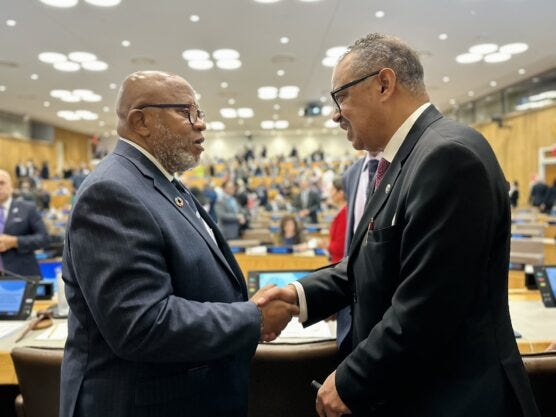
UN General Assembly 78 president Dennis Francis with WHO’s Adhenom Tedros Ghebreyseus
Dated 17 September 2023, the three page letter to the UN GA president Dennis Francis (Trinidad and Tobago) and UN secretary-general Antonio Guterres (Portugal), objected to unilateral coercive measures and other glaring issues in international law. The eleven countries stated (for readability, bold headers, italics emphasis, numbering and notes are mine):
No consent, lack of transparency and illegal unilateral coercive measures
1. It is regrettable that it has not been possible to find a political solution to the current stalemate, created, not only due to the lack of will of some developed countries to engage in true and meaningful negotiations to have balanced and acceptable outcomes for all, but also due to the lack of transparency and poor handling of your predecessor’s team of all these processes.
2. As you are aware, the issue of the negative impact of unilateral coercive measures (UCMs) is an existential one for our peoples. A third of the world’s population is affected by these illegal measures. There is ample evidence, including from UN sources, of the heavy toll caused by UCMs on targeted countries’ capacities to achieve sustainable development and to make further progress in protecting the right to health of their respective populations. Regardless of these facts, we have engaged in the negotiations of these draft outcomes in good faith, with a spirit of compromise and a constructive approach, in order to reach consensus.
3. Since the beginning of these processes, we have insisted on the need to include our concerns in these important political documents, on the basis of consensual language, as reflected in paragraph 30 of the 2030 Agenda for Sustainable Development. This request has been echoed by a large number of delegations, including from the Group of the 77 and China, and from the Group of Friends in Defense of the UN Charter, among others.
SPM note: The delegates’ critical concerns are completely ignored by the United Nations leadership, confirming that the multilateralism motto touted often by the United Nations is sloganeering on empty rhetoric. The letter continues to lay bare:
Unfair practices including veto, lack of inclusion, absence of balance, and neglect
4. The legitimate concerns of a large number of developing countries have been ignored. Hence, it is our duty to express our strong concerns on the unacceptable way in which this situation unfolded, running in clear contradiction with the spirit of multilateralism and the overall goal of “leaving no one behind”.
5. First, there has been no real willingness from a small group of developed countries to engage in meaningful negotiations to find compromises, forcing unfair practices which pretend to impose a kind of “veto” on certain issues, and pretending to even prevent their discussion within the framework of intergovernmental negotiations.
6. Second, in some cases, negotiations were not conducted in a truly inclusive, fair and balanced way. Our delegations had to witness how, in some cases, even single delegations were accommodated a great deal in their concerns, while others’ priorities, including ours, were bluntly neglected.
Objections includes forced consensus, bulldozing, and ignoring repeated breaking of silence
7. For example, the draft outcome of the High-Level Political Forum on Sustainable Development under the auspices of the General Assembly – SDGs Summit, was reopened with the purpose of exclusively accommodating the priorities of a few delegations from developed countries, while, in this very same process, and in the three (03) health-related negotiations, nothing was done to reflect and accommodate the legitimate concerns of delegations from developing countries that, in addition had broken silence repeatedly, including the Group of 77 and China.
8. Third, the attempt to ignore formal communications of delegations from developing countries, including from the Group of 77 and China, on behalf of its 134 Member States, indicating strong reservations and objections.
9. Fourth, the attempt to force consensus by your predecessor’s team, and now by your Office, when it is evident that no consensus has been reached on any of these processes; as well as the lack of transparency, inclusiveness and efficient use of the limited time available then to find compromises.
Developing countries take a stand against discrimination perpetrated through the United Nations
SPM: The clear, well-reasoned and articulate letter continues, setting a precedent in protecting national sovereignty:
10. Our delegations are convinced that this is no way to handle multilateral and intergovernmental negotiations on issues of great relevance for the international community, particularly for developing countries. Thus, we would like to put on record that we do not condone, nor accept, this practice, and that it does not set any precedent for the work of the United Nations and its General Assembly.
11. This is particularly relevant, as we look forward to future negotiation processes on fundamental matters, in which we will continue engaging with great determination, flexibility and constructiveness.
Delegations call for a recall of the nature and legal standing of UN meetings
12. Our delegations would also like to recall the nature and legal standing of the meetings in which the SDGs Summit, the High-Level Meeting on Pandemic Prevention, Preparedness and Response, the High-Level Meeting on Universal Health Coverage, and the High-Level Meeting on the Fight against Tuberculosis, will take place.
13. In relation to the High-Level Political Forum (HLPF) on Sustainable Development under the auspices of the General Assembly, SDGs Summit, and in accordance with General Assembly resolution 67/290, in its operative paragraph 9, “all meetings convened under the auspices of the General Assembly shall operate under the rules of procedure of the main committees of the Assembly, as applicable, unless otherwise provided in the present resolution”.
14. Also, operative paragraph 4 of that very same resolution clearly states that the Forum “shall result in a concise negotiated political declaration to be submitted for the consideration of the Assembly”.
15. Hence, we expect a process to take place at a later stage, where the General Assembly will formally consider the adoption of the draft Political Declaration, under Chapter XII of the Rules of Procedures of the General Assembly.
16. Similarly, General Assembly resolutions 75/315, 77/274 and 77/275, are clear in indicating that the political declarations of the three health-related High-Level Meetings should “be submitted by the President of the General Assembly for adoption by the Assembly”.
Opposition to any attempt that formally adopts draft outcome documents, and the right to take action
SPM: The ground breaking letter against illegitimate operations by the UN, continues:
17. In that sense, our delegations oppose any attempt to pretend to formally adopt any of the draft outcome documents in question, during the meetings scheduled for 18, 20, 21 and 22 September 2023, respectively.
18. In addition, we reserve the right to take appropriate action upon the formal consideration of these four (04) draft outcome documents in the coming weeks, after the conclusion of the High-Level Segment of the 78th Session of the General Assembly, when they must all be considered by the General Assembly in accordance with its rules of procedures.
19. In that spirit and in the interest of transparency, we respectfully request hereby your good offices for circulating as soon as possible this letter as an official document of the General Assembly, under agenda items 19 and 127, entitled “Sustainable development” and “Global health and foreign policy”, respectively.
SPM: The letter ends.
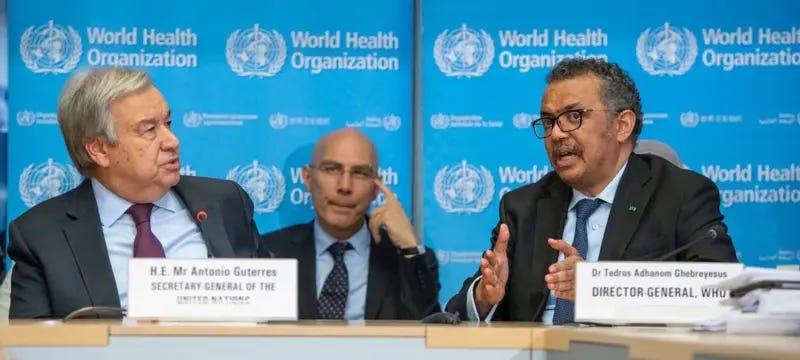
UN SG Guterres and WHO DG Tedros at a WHO meeting
• Blatantly ignoring the official letter to the UN, the WHO Director-General Adhenom Tedros Ghebreyesus incorrectly said “As you know, this morning, the 193 Member States of the United Nations approved the political declaration on pandemic prevention, preparedness and response. The declaration is a strong signal from countries that they are committed to learning the lessons of the COVID-19 pandemic, and to strengthening the world’s defences against pandemics.”
• He continued with almost delusional dishonesty “In the declaration approved today, Member States have demonstrated that even at this time of division and polarisation, it’s still possible for countries to come together to agree on a shared response to shared threats. It is that same spirit of collaboration that we urge countries to demonstrate as they continue their negotiations on the Pandemic Accord and the amendments to the International Health Regulations.”
• Displaying his complicity in violating international law, he said “The political declaration, approved by Mr Dennis Francis, President of the 78th United Nations General Assembly, and the result of negotiations under the able leadership of Ambassadors Gilad Erdan of Israel and Omar Hilale of Morocco, underscored the pivotal role played by WHO as the “directing and coordinating authority on international health,” and the need to “commit further to sustainable financing that provides adequate and predictable funding to the World Health Organization, which enables it to have the resources needed to fulfil its core functions.”
• Meanwhile, unperturbed by what member states delegates communicated days before, UN Secretary-General Antonio Guterres said, in a message delivered by Deputy Secretary-General Amina Mohamed (Britain-Nigeria): “By next year’s World Health Assembly in May, I urge all countries to deliver a strong, comprehensive pandemic accord, focused on equity; as well as amendments to strengthen the International Health Regulations. And I urge you to support the World Health Organization, including by honouring the commitment to increase assessed contributions to half of its budget, and supporting the proposed investment round.
• Unconcerned with the diplomatic fallout and failing in his duty to abide by international law, Guterres continued to outline three key priorities: First, Sustainable Development Goals Stimulus (read debt slavery). Next, countering what it defines as misinformation – which will lead to the suppression of critical thinking and free speech. Third, responding to complex global shocks via a UN emergency platform – that will make national governments and the will of the people they serve irrelevant.
On reading this article, Professor Boyle replied to me: “Right! This is a great Defeat for the Globalists. The International Court of Justice has ruled that some types of UN General Assembly Resolutions Adopted by Consensus can become Customary International Law, and the Globalists Lawyers know that. So from my perspective what happened was an Historic Defeat for the Globalists. Tedros and the WHO are trying to turn a pig’s ear into a silk purse. In fact, this was an historic failure. The Globalists tried and failed to get their Declaration adopted by Consensus by the UN General Assembly, thus preventing it from arguably becoming Customary International Law, which is what they intended to do in the first place. But they will try again.”
He continued “The danger here is that this is a Statement by Heads of State and Heads of Government, either one of whom can bind their states under international law and all of whom together could arguably create customary international law. That is what the Drafters of this Statement intended. This is very dangerous. We cannot underestimate its significance. It’s like a stick of dynamite ready to be exploded. This is all part of the Globalists Strategy to create a Worldwide Totalitarian Medical and Scientific Police State under the guise of the WHO. Thanks. Then if the 11 vote this way against it, then that will prevent this Declaration being adopted by Consensus and thus arguably becoming part of customary international law, which is what those behind the Declaration intend.”
Financing the supranationals’ ambitions – $500 billion per year, minimum
About $2 billion has already been collated for a new World Bank managed Pandemic Fund. It is said to be insufficient, compared to the amounts required, especially for debt-burdened countries, to comply with UN and WHO expectations and improve their health systems and prepare hospitals, data surveillance systems and laboratory facilities to meet potential pandemic needs.
A Sustainable Development Goals “stimulus” package in addition to “deep” reforms to the international financial architecture is required, according to UN Deputy Secretary-General Amina Mohammed. “Many developing countries are drowning in debt,” Mohammed told the high level meeting, echoing views expressed at the UN’s SDG Summit. She called for long-term financing of at least $500 billion annually as part of the Sustainable Development Goals (SDG) recovery plan.
Although Africa is not actually poor, “Today Africa spends more on debt service costs than on health care and education. We need a finance boost so that countries can invest in universal, resilient health care; their populations have a right to [access]. “We’re calling on countries to support the stimulus to scale up affordable long-term financing by at least $500 billion per year, and to support the development of an effective debt-relief mechanism that supports payments, suspensions, longer lending terms and lower rates for developing countries that are drowning in debt – and create the fiscal space to spend on the health that people have a right to [enjoy].”
Winnie Byanyima, Executive Director of UNAIDS agrees, saying that future pandemic responses need to be based on technology-sharing to facilitate more equitable access to pharmaceutical and other medical products. Byanyima also expressed that many countries were disempowered to invest adequately in health and pandemic preparedness as they were paying debts that were larger than their health budgets.
World Bank Senior Managing Director Axel Van Trotsenburg welcomed the first anniversary of the pandemic fund, which received pledges from 133 countries worth $2 billion. Despite this “very good starting point”, Mr. Trotsenburg warned that $10 billion should be allocated to pandemic preparedness and called on Member States to provide the necessary resources.
In my view, it is accurate to call what is going on under the rule of the United Nations diplomatic fraud and an act of aggression. It is also accurate to have predicted that the United Nations will be the real power driving the WHO’s ambitions, or substitute itself.
Global Threats Council – another One World Government Toolbox
“Critics have also expressed misgivings about the ability of WHO, representing politically weak health ministries, to oversee and enforce the kinds of tough, binding commitments that would be needed for effective pandemic response. Those concerns have been behind the push to make UN fora platforms for pandemic debate and decisions.
Advocates for more UN-centred action have proposed the creation of an independent pandemic governance mechanism in the office of the UN Secretary-General, and/or a UN Global Threats Council, to oversee the implementation of any pandemic accord approved by WHO member states.
“I continue to believe that action at the head of state and government level is so needed to help break the cycle of panic and neglect, which sets in around pandemics and to sustain political momentum around preparedness and response,” said Clark, who has called for the creation of a UN-hosted Global Threats Council. “And then on accountability, independent monitoring of country preparedness is needed to guarantee our mutual assurance, compliance and accountability with international agreements.”
Juan Manuel Santos, former President of Colombia and a member of The Elders, believes that the UN may be the better forum as “pandemic preparedness encompasses far more than health”. Santos told a UN side meeting on Tuesday hosted by the Pandemic Action Network (PAN) that if the pandemic accord negotiations are still “mired in confusion” by the time the WHO Intergovernmental Negotiating Body (INB) meets for the seventh time later this year, “someone has to say, enough, we need to shift it back to New York.”
“The world is inching closer to “a great fracture”, UN Secretary-General António Guterres warned as leaders converged in New York for #UNGA78. “It’s reform or rupture,” he said. I agree on the great fracture framing. The united front developed by these eleven countries – with a combined 154 other countries that also have objections about UN documents and processes – has cataclysmic implications for the United Nations – far too long a well oiled front for corporate colonialism and violent peace-making.
I am aptly reminded of the trailblazing stand that the 47 nation African bloc took at the World Health Organisation’s World Health Assembly 75 last year, where they raised objections to controversial International Health Regulation amendments, on the basis that they were rushed, and that they threaten national sovereignty – the WHO, unconvincingly, often denies any such threat.
At UN General Assembly 78, at least two presidents made compelling statements I find relevant to the seismic shift:
• Algeria’s president, Abdelmadjid Tebboune, called for reform and transparency in UN organs, particularly in reforming the Security Council. “Any effort to strengthen joint international action forces us to respond to the constant appeals to strengthen the multilateral system by reforming the main organs of our organisation in order to make them more transparent and ensure the necessary balance among the main organs and ensure equitable geographical distribution. This should be an absolute priority for the international community in order to find a consensus.”
• Paraguay’s President Santiago Peña, has called for reforms to strengthen the UN and bolster its ability to respond to global crises. “The lack of tangible results, inefficacy perceived in multilateral institutions and difficulties in addressing global problems in an effective manner have led to frustration and have led to an increase in the sense that national interests should prevail over multilateral cooperation,” he said from the podium.
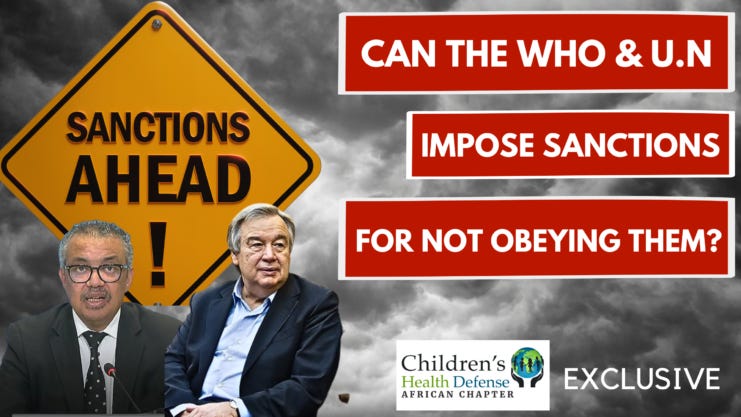
Exclusive article written in July 2023, which you can read and share here
Sanctions: inhumane unilateral coercive measures impacting health and sovereignty
Seismic shifts in geopolitics are leading to so-called LMICS (low to middle income countries) or EMDC’s (emerging and developing countries) to consider their cooperation options at a national, regional and inter-regional level. Emerging countries represent 80 percent of the world’s population, while billionaires own more wealth than the majority of their fellow citizens, and corporations can own more than the GDP of countries.
The threat of sanctions through the United Nations, influenced partly by the World Health Organisation as detailed in my July article, is one these countries have a lived experience of, and which seems to weighing in its overall fear factor, evidenced by multiple revolts.
The latest report of the Report of the Special Rapporteur on the negative impact of unilateral coercive measures on the enjoyment of human rights clearly says: “Unilateral sanctions and over-compliance have a detrimental impact on implementation of all aspects of the right to health of all people in the countries under sanctions, including access to adequate medicine, healthcare facilities, medical equipment, access to qualified medical assistance, prevention and control of deceases, scarcity of health professionals, access to health facilities, training and access to up-to-date scientific knowledge, technologies, research, exchange of good practices.”
The UN and WHO have gone too far in their diabolical attempts to engineer a one world government. In weeks and months ahead, I anticipate more countries joining this coalition and asking themselves why they should remain members of the United Nations and the World Health Organisation. They will have growing support from their peoples, desperate to avoid further indignity, discrimination, exclusion, sanctions, lockdowns, censorship, coerced vaccines, digital ID’s, CBDC’s, and the erasure of the sovereignty we value.
Call to Action:
1. Raise your voice against the UN – WHO power grab. CHD Africa will deliver names and countries (only) to UN and WHO leaders (1 minute)
2. Share this article with your family, community, organisations, and media on all sides of the fence (as often as you can)
3. Share this article with your country’s political and diplomatic representatives (with urgency and please follow up)
4. Sign up to CHD Africa’s newsletter for news, analysis, updates and calls to action (immediately for full access)
5. Follow CHD Africa on Telegram and X (Twitter) for information, updates and calls to action (beat censorship!)

Author: Shabnam Palesa Mohamed is an award-winning activist, journalist, lawyer, mediator and socio-political analyst with combined experience of over 20 years. She is based in South Africa and serves as the executive director of Children’s Health Defense Africa.
The UN’s New Political Declaration on Pandemics
By David Bell | Brownstone Institute | September 15, 2023
On September 20th our representatives meeting at the United Nations (UN) will sign off on a ‘Declaration’ titled: “Political Declaration of the United Nations General Assembly High-level Meeting on Pandemic Prevention, Preparedness and Response.”
This was announced as a ‘silence procedure,’ meaning that States not responding will be deemed supporters of the text. The document expresses a new policy pathway for managing populations when the World Health Organization (WHO), the health arm of the UN, declares a future viral variant to be a ‘public health emergency of international concern.’
The WHO noted in 2019 that pandemics are rare, and insignificant in terms of overall mortality over the last century. Since then, it decided that the 2019 old-normal population were simply oblivious to impending annihilation. The WHO and the entire UN system now consider pandemics an existential and imminent threat. This matters, because:
- They are asking for far more money than is spent on any other international health program (your money),
- This will deliver great wealth to some people who now work closely with the WHO and the UN,
- The powers being sought from your government will reimpose the very responses that have just caused the largest growth in poverty and disease in our lifetimes, and
- Logically, pandemics will only become more frequent if someone intends to make them so (so we should wonder what is going on).
Staff who drafted this Declaration did so because it is their job. They were paid to write a text that is clearly contradictory, sometimes fallacious, and often quite meaningless. They are part of a rapidly growing industry, and the Declaration is intended to justify this growth and the centralization of power that goes with it. The document will almost certainly be agreed by your governments because, frankly, this is where the momentum and money are.
Whilst the Declaration’s thirteen pages are all over the place in terms of reality and farce, they are not atypical of recent UN output. People are trained to use trigger words, slogans, and propaganda themes (e.g., “equity,” “empowerment of all women and girls,” “access to education,” “technology transfer hubs”) that no one could oppose without risking being labeled a denier, far-right, or colonialist.
The Declaration should be read in the context of what these institutions, and their staff, have just done. It is difficult to summarize such a compendium of right-speak intended to veil reality, but it is hoped this short summary will prompt some thought. Wickedness is not a mistake but an intended deception, so we need to distinguish these clearly.
Doing Darkness Behind a Veil of Light
Put together, the following two extracts summarize the internal contradiction of the Declaration’s agenda and its staggering shamelessness and lack of empathy:
“In this regard, we:
PP3: Recognize also the need to tackle health inequities and inequalities, within and among countries, …
PP5: “Recognize that the illness, death, socio-economic disruption and devastation caused by the COVID-19 pandemic, …”
‘Recognition’ of devastation is important. SARS-COV-2 was associated with mortality predominantly within wealthy countries, where the median age of Covid-associated death was between 75 and 85 years. Nearly all of these people had significant comorbidities such as obesity and diabetes, meaning their life expectancy was already restricted. People contributing significantly to economic health were at very low risk, a profile known in early 2020.
These three years of socio-economic devastation must, therefore, be overwhelmingly due to the response. The virus did not starve people, as the Declaration’s writers would like us to believe. Deteriorating disease control was predicted by the WHO and others in early 2020, increasing malaria, tuberculosis, HIV/AIDS, and malnutrition. Economic disruption in low-income countries specifically results in more infant and child deaths.
In Western countries, adult mortality has risen as expected when screening for cancer and heart disease are reduced and poverty and stress increase. Knowing this, the WHO advised in late 2019 to ”not under any circumstances” impose the lockdown-like measures for pandemic influenza. In early 2020, under the influence of their sponsors, they advocated for them for Covid-19. The Declaration, however, carries no note of contrition or repentance.
Undeterred by incongruity, the Declaration goes on to describe Covid-19 as “one of the greatest challenges” in UN history (PP6), noting that somehow this outbreak resulted in “exacerbation of poverty in all its forms and dimensions, including extreme poverty…”. In fact, it acknowledges that this caused:
“… (a) negative impact on equity, human and economic development across all spheres of society, as well as on global humanitarian needs, gender equality and the empowerment of all women and girls, the enjoyment of human rights, livelihoods, food security and nutrition, education, its disruption to economies, supply chains, trade, societies and the environment, within and among countries, which is reversing hard-won development gains and hampering progress…” (PP6)
To restate the obvious, this does not happen due to a virus targeting sick elderly people. It occurs when children and productive adults are barred from school, work, healthcare, and participation in markets for goods and services. Economic, social, and health catastrophe inevitably results, disproportionately harming poorer people and low-income countries, conveniently far indeed from the halls of Geneva and New York.
No, we were not all in this together.
Not all were negatively impacted by this catastrophe. People and corporations who sponsor much of the WHO’s health emergency work, and that of its sister organizations such as CEPI, Gavi, and Unitaid, did very well from the policies they advocated so strongly for. Software and Pharma companies made unprecedently high profits, while this mass impoverishment played out. The international agencies have also gained; construction and recruitment are strong in Geneva. Philanthro-capitalism is good for some.
The main aim of the Declaration is to back the proposed WHO international health regulation (IHR) amendments and treaty (PP26), key to ensuring that viral outbreaks that have such a small impact can remain highly profitable. An additional $10 billion per year in new financing is requested to support this (PP29). There is a reason why most countries have laws against scams. The UN and its agencies, fortunately for its staff, are outside of any national jurisdiction.
Based on their sponsors’ assessments, the staff of these agencies are doing their job well. For the rest of humanity, their work is an unmitigated disaster. In 2019 they said never lock down, then spent 2020 defending top-down lockdowns and mandates. For three years, they theatrically pretended that decades of knowledge on immunity, disease burden, and the association of poverty with mortality did not exist.
Now they write this UN Declaration to fund their industry further through taxpayers they so recently impoverished. Once tasked to serve the world’s vast populations, particularly the poor and vulnerable, the UN vision has been consumed by public-private partnerships, the allure of Davos, and a fascination with high-net-worth individuals.
When Words are Used to Obscure Actions
While the Declaration underlines the importance of educating children during pandemics (PP23), these same organizations backed school closures for hundreds of millions of children at minimal risk from Covid-19. Among them, several million more girls are now being farmed off to nightly rape as child brides, others in child labor. Women and girls were disproportionately removed from education and from employment. They weren’t asked if they supported these policies!
The girls are being raped because the people paid to implement these policies did so. They know the contradiction, and the harm. But this is a job like many others. The only unusual aspects, from a business standpoint, are the sheer amorality and lack of empathy that must be engaged to excel in it.
To justify wrecking African children’s lives, the UN claims that the continent has “over 100 major public health emergencies annually” (OP4). Africa has a rising burden of endemic diseases that dwarfs mortality from such outbreaks – over half a million children die every year from malaria (increased through the Covid-19 lockdowns) and similar burdens from tuberculosis and HIV. By contrast, total Covid-19 deaths recorded in Africa over the past 3 years are just 256,000. The 2015 West African Ebola outbreak, the largest such recent emergency pre-Covid, killed 11,300 people. MERS and SARS1 killed less than 1,000 each globally. However, induced poverty does cause famine, raises child mortality, and wrecks health systems – is this the health emergency that the UN is referring to? Or are they simply making things up?
Through the IHR amendments, these agencies will coordinate the locking down, border closures, mandated medical examinations, and vaccination of you and your family. Their Pharma sponsors reasonably expect to make several hundred billion more dollars from these actions, so we can be confident that emergencies will be declared. By claiming 100 such events annually in Africa alone, they are signaling how these new powers will be used. We are to believe the world is such that only the abandonment of our rights and sovereignty, for the enrichment of others, can save us.
The UN and the WHO do recognize that some will question this illogic. In PP35, they characterize such skepticism as:
“health-related misinformation, disinformation, hate speech and stigmatization.”
The WHO recently publicly characterized people who discuss adverse effects of Covid vaccines and question WHO policies as “far-right,” “anti-science aggressors,” and “a killing force.” This is unhinged. It is the denigration and hate speech that fascist regimes use. The reader must decide whether such an organization should control their freedom of expression and decide what constitutes truth.
It is not helpful here to give details of all 13 pages of right-speak, contradiction, and fallacy. You will find similar rhetoric in other UN and WHO documents, particularly on pandemic preparedness. Straight talk is contrary to business requirements. However, the first paragraph in the Declaration’s ‘Call to Action’ sets the tone:
“We therefore commit to scale up our efforts to strengthen pandemic prevention, preparedness and response and further implement the following actions and express our strong resolve to:
OP1. Strengthen regional and international cooperation, multilateralism, global solidarity, coordination and governance at the highest political levels and across all relevant sectors, with the determination to overcome inequities and ensure the sustainable, affordable, fair, equitable, effective, efficient and timely access to medical countermeasures including vaccines, diagnostics, therapeutics and other health products to ensure high-level attention through a multisectoral approach to prevent, prepare for and respond to pandemics and other health emergencies, particularly in developing countries;”
There are 48 more. You paid taxes so that someone could write that!
Those millions of girls suffering at night, the hundreds of millions of children who had their futures stolen, the mothers of those malaria-killed children, and all suffering under the increasing burden of poverty and inequality unleashed by this farce are watching. The Declaration, like the WHO IHR and treaty it supports, awaits the signatures of the governments that purport to represent us.
David Bell, Senior Scholar at Brownstone Institute, is a public health physician and biotech consultant in global health. He is a former medical officer and scientist at the World Health Organization (WHO), Programme Head for malaria and febrile diseases at the Foundation for Innovative New Diagnostics (FIND) in Geneva, Switzerland, and Director of Global Health Technologies at Intellectual Ventures Global Good Fund in Bellevue, WA, USA.
Tactics for shutting down debate: Pandemic Preparedness narratives in the UK Parliament
During the UK Parliamentary debate on the WHO Treaty there was a noticeable contrast between those supporting the petition and those opposing it. This article analyses the arguments made by those rejecting the petition, drawing on insights from Behavioural Science.
BY ALICE ASHWELL, SINEAD STRINGER, DR DAVID BELL | PANDA | AUGUST 25, 2023
On 17 April 2023, a petition [1] was debated in the UK Parliament calling for the Government “to commit to not signing any international treaty on pandemic prevention and preparedness established by the WHO, unless this is approved through a public referendum.” The petition had received 156,086 signatures. Of the thirteen Members of Parliament (MPs) who spoke during the debate [2] four strongly supported the motion, three took a more neutral stance, and six strongly opposed the petition or elements of the argument. Examples of arguments in support of the petition can be viewed in a collation of clips taken from the video of the debate [3].
There was a noticeable contrast between the arguments presented by MPs supporting the petition — who exhibited concern for the constituents who had signed the petition and approached them directly — and those opposing it. All those who, like the petitioners, were concerned about the growing power and influence of WHO and threats to national sovereignty were familiar with the contents of the so-called ‘pandemic treaty’ [4], since labelled the WHO CA+, as well as proposed amendments to the International Health Regulations (IHR) [5]. While some opposing the petition were also familiar with the document, others had not even read it, prompting Andrew Bridgen (MP for North West Leicestershire) to plead with members to do so.
Those concerned about these proposals presented well-reasoned arguments reflecting an understanding of the history of WHO [6], its many failures during Covid-19, and its current problematic relationships with non-state funders [7,8]. Those supporting WHO’s proposals uncritically supported WHO, focusing on its public health successes and ignoring obvious concerns. Perturbed by the lack of parliamentary scrutiny of the Covid response measures, some MPs worried that the UK government, having played a leadership role in drafting the treaty, might ratify it without parliamentary debate. This reservation was flatly denied by those opposing the petition, with some denying that WHO would in any way threaten UK sovereignty, that its role would remain advisory in nature, and that those opposing the treaty were in effect opposing international cooperation.
This article analyses the arguments made by those rejecting the petition, drawing on insights from Behavioural Science. During the debate, these MPs tended to rely on the following tactics:
- Using derogatory language or false claims to discredit speakers and their arguments
- Making inaccurate and unsubstantiated statements
- Using globalist slogans
- Patronising the petitioners
- Using the debate as an opportunity for party-political point-scoring
- Downplaying or normalising threats to sovereignty
- Promoting internationalism over sovereignty.
The debate was a sad reminder that it is not necessarily the quality of arguments, or even the sincerity of the individuals making them, that wins the day.
1. Using derogatory language and labels to discredit speakers and their arguments
A tactic used to shut down discussion and debate was to attach derogatory labels to those supporting the petition. In the debate, two such labels used in relation to the Covid event and the pandemic treaty were ‘conspiracy theory/theorist’ (ten references made by four speakers) and ‘anti-vax’ (one speaker). Some opposing the petition used these labels early in their presentations, their comments and tone indicating that these were untenable positions that no sane person could possibly subscribe to.
Using such labels at the beginning of the debate set the scene, immediately employing a behavioural science tactic to prime the participants and the wider audience. Priming is a ‘nudge’ [9] tactic; techniques that are used to modify people’s behaviours or emotions in a way that is unconscious and therefore difficult to identify or counter. Priming [10] occurs when the emotional attachment or views held about one issue are then used to influence the emotional attachment on a separate and unrelated issue; an emotional contagion if you like. This can be utilised to produce a positive or negative relationship. Over the past three years in particular, the phrase ‘conspiracy theorist’ has become strongly and negatively associated with an archetype of someone whose views are not based in fact and who are not community minded, and therefore not socially acceptable. By stating in his introductory comments that “I have no time for conspiracy theories”, leader of the debate Nick Fletcher (MP for Don Valley) activated this already negative mental construct and associated it with the question of the WHO pandemic treaty. Whether this was purposeful or not is debatable but concerns about conspiracies do seem strangely placed in a debate which should be about publicly documented proposals, and UK and international legislation.
Similarly, Sally-Ann Hart (MP for Hastings and Rye), who herself was committed to representing the concerns of constituents who had signed the petition, warned that, “We must be wary of … conspiracy theories distorting the facts and scaring people. Transparency of debate is therefore needed to squash those conspiracy theories.”
Some comments could only be described as invective. Language such as that used by John Spellar (MP for Warley) was entirely inappropriate in the context of a Parliamentary debate:
… the poisonous cesspit of the right-wing conspiracy theorist ecosystem in the United States … an appalling subculture of those who live by conspiracy theories … Unfortunately, we have some people — a very limited number … who wallow in the realm of conspiracy theories.
The ‘conspiracy theorist’ label has become a catch-all term used to discredit numerous perspectives that disagree with the dominant narrative. It has also taken on the power of a curse, which those who hope to remain accepted by their peers must protect themselves from by declaring their immunity.
Another such label is ‘anti-vax’, used by Mr Spellar who interjected early in Mr Fletcher’s introduction:
I thank the hon. Gentleman … for highlighting both smallpox and polio. Is the fact of the matter not that it has been a worldwide vaccination programme that has enabled us to achieve that? Does that not demonstrate the falseness of the anti-vax campaigns?
This is another example of priming, where an exceptionally negative construct (anti-vax), which was set up in mainstream and social media over the past few years, is associated with those who may have genuine concerns about the powers being delegated to a non-elected body. When attached to a person, the related term ‘anti-vaxxer’ is an example of an ad hominem attack [11], which is an example of a false argument. Instead of the argument being discussed on its own merit in terms of data or facts, the audience and other participants are misdirected toward a perceived ‘failing of character’ in those who might have a different view and legitimate questions.
Mr Spellar used this terminology to discredit those wary of vaccinations, in particular the Covid-19 genetic therapy. He continued his interruption of Mr Fletcher’s introductory remarks with the following tirade against academic gastroenterologist Dr Andrew Wakefield who, in 1998, co-authored a research study in The Lancet, linking inflammatory bowel symptoms in 12 autistic children to the Measles-Mumps-Rubella (MMR) vaccine:
Part of this argument has been about vaccination. We go back to Dr Wakefield and that appalling piece of chicanery that was the supposed impact of the measles, mumps and rubella vaccine, which has now been completely exposed and discredited. Indeed Mr Wakefield is now no longer a recognised doctor.
This argument is an example of ‘false equivalence’ [12], another propaganda tool that has the effect of misdirecting the audience away from the key facts of the debate. Those who doubt the safety and efficacy of the novel Covid ‘vaccine’ have not necessarily questioned the safety and efficacy of all other vaccines, and should therefore not be considered ‘anti-vaxxers’. By associating arguments against the Covid shot with the MMR vaccine debacle, the purpose is to tar objections to this entirely novel and inadequately tested therapy with the same brush as arguments levied against an earlier, unrelated, conventional vaccine.
Mr Spellar’s interjection also reflects another tactic of those who wish to quash debate, namely the use of threats to intimidate those who might be inclined to consider alternative narratives. The story of the suppression of harms caused by the MMR vaccine has much in common with the current censorship of reports of serious adverse events and deaths following the Covid injections. Raising the 25-year-old case of Dr Wakefield who is “no longer a recognised doctor” represents a threat, already a reality for many ethical doctors and scientists, that those who speak out against the harms caused by the Covid injections face being dismissed and deregistered.
2. Using inaccurate and unsubstantiated statements
Justin Madders (MP for Ellesmere Port and Neston) also used derogatory language in denying concerns about threats to national sovereignty posed by global organisations such as WHO:
On the absurd side, a narrative has been created that the World Health Organization is a body intent on world domination. Borrowing tropes from conspiracy theories, I found one website referring to the WHO as ‘globalists’ … That sentiment is clearly ludicrous, as is the reference to the WHO being owned by Bill Gates or the Chinese Government.
The treaty has nothing to do with Bill Gates, and it is not the first step in creating a world-dominating authoritarian state.
The first sentence in the quote above is an example of a behavioural science nudge tactic called ‘framing’. In framing, words, metaphors and perspectives are used in a way that makes the message more attractive and activates certain emotional reactions. The image created by the MP’s statements is quick to evoke a mental picture of a film-like villain plotting to take over the world. Being ‘absurd’ (untrue) and a ‘narrative’ (story), this should clearly be discounted.
Beyond the language used, Mr Madders’s claims are not substantiated and as such are simply opinions. Firstly, as the United Nations (UN) agency responsible for global public health, WHO can indeed be considered a ‘globalist’ organisation, along with numerous other international bodies such as other UN agencies, the World Bank and International Monetary Fund, the World Economic Forum (WEF), and international corporations and foundations. But, largely due to the growing influence exerted over national governments by WHO and other unelected supra-national bodies during Covid, the term ‘globalist’ has taken on more sinister connotations. Its use by those critical of the dominant narrative may account for Mr Madders treating the term as a ‘red flag’.
Secondly, Mr Madders may be unaware of the significant changes to WHO’s funding model that have taken place in recent years, with assessed contributions [13] from Member States having declined to less than 20% of WHO’s financing, and Bill Gates now being one of its major funders. WHO’s own website records that, as of Quarter 4 of 2021, the Bill and Melinda Gates Foundation (BMGF) was their second-largest donor (9.49%) after Germany [14]. While on this point, Steve Brine (MP for Winchester) asserted that “the UK is the second-largest contributor to the WHO”, which is incorrect; in fact, the UK is the sixth-largest contributor (5.99%). Gates is also a founding partner and second-largest contributor to Gavi, the Vaccine Alliance, which is the fifth-largest funder of WHO (6.43%). And with 56.14% of BMGF’s funding going to support WHO’s Headquarters [15], it is unlikely that “The treaty has nothing to do with Bill Gates”, as asserted by Mr Madders.
Many unsubstantiated statements regarding Covid ‘vaccine’ safety and effectiveness were also made during the debate. Anne-Marie Trevelyan (Minister of State, Foreign, Commonwealth and Development Office) asserted that “AstraZeneca saved lives worldwide”, despite the use of this adenovirus viral vector vaccine being restricted or suspended in numerous countries due to many reports of recipients suffering blood clots [16].
Similarly, Mr Spellar, referring to the Pfizer mRNA ‘vaccines’, stated that it “certainly was not unproven or unsafe, and it had a huge beneficial impact across the world.” There is, in fact, mounting evidence showing that the Covid injections, released under emergency use authorisation before adequate testing could be undertaken, have been neither safe nor very effective. All vaccine adverse events tracking systems, including the Medicines and Healthcare products Regulatory Agency (MHRA) Yellow Card system in the United Kingdom, the European Medicines Agency’s EudraVigilance system in the European Union, and the Vaccine Adverse Events Reporting System (VAERS) in the United States, have recorded unprecedented numbers of serious adverse reactions, including deaths. Furthermore, an increasing number of studies are reporting evidence of a broad range of serious adverse events [17]. An independent systematic review of serious harms of the Covid-19 vaccines, currently in pre-print, adds significant weight to these findings [18].
Furthermore, after a group of scientists and medical researchers successfully sued the United States Food and Drug Administration (FDA) under the Freedom of Information Act (FOIA) [19] to release many thousands of documents related to licensing of the Pfizer-BioNTech Covid-19 vaccine, it was revealed that early trials had resulted in hundreds of adverse reactions [20 (Appendix 1)]. This information had been withheld from the public by the authorities.
The injections have also been been unable to stop SARS-CoV-2 infection or transmission, with Dr Peter Marks of the FDA admitting in a letter responding to a citizens’ petition that proof of efficacy had not been required for authorisation [21]:
It is important to note that FDA’s authorization and licensure standards for vaccines do not require demonstration of the prevention of infection or transmission. (p.11)
Furthermore, the applicable statutory standards for licensure and authorization of vaccines do not require that the primary objective of efficacy trials be a demonstration of reduction in person-to-person transmission. (p.13)
In addition, there is growing concern that claims that the boosters prevent severe illness and deaths amount to a “wishful myth” [22].
Three years of pro-vaccine propaganda and ongoing efforts to censor reports of vaccine harms have effectively blinded many people to the possibility that the rollout of Covid injections may be related to the sharp rise in excess deaths now being experienced in many countries [23; 24]. This is despite the fact that many vulnerable people, such as the elderly and those with multiple comorbidities, had died previously as a result of Covid-19, lockdown measures and medical interventions.
Despite having had the opportunity to peruse the evidence presented by the petitioners, Mr Spellar was still sure that the vaccination campaign had been a huge success, stating:
… mobilisation of [the] intellectual power and production capacity [of the major pharmaceutical companies] in producing a vaccine in record time to stem the tide of covid was absolutely magnificent.
3. Using globalist slogans
Just as certain terms (conspiracy theorist, anti-vaxxer) have become modern-day curses causing those so labelled to be socially shunned, so have other terms and slogans become the mantras of those wishing to demonstrate their membership of the mainstream. These catchy but often meaningless slogans are building blocks of a collective reality, introduced and normalised through the presentations, publications and public relations communications of powerful individuals, and globalist organisations such as the UN, WHO, WEF and BMGF.
Mr Madders, for example, echoed Bill Gates [25] when he stated: “We need to be better prepared for the next pandemic.” This also represents an unsubstantiated claim, as it ignores the reality that pandemics are actually extremely rare. Since 1900, only five pandemics, each responsible for over one million deaths, have broken out, namely the Spanish flu (1918-1920), the 1957-1958 influenza pandemic, the Hong Kong flu (1968-1969), the AIDS pandemic (ongoing since 1981), and Covid-19 [26]. It also powerfully illustrates the effectiveness of presupposition, where the speaker inserts a statement or assumption as a fact agreed by all and therefore requiring no evidence of its own. The phrase “the next pandemic” provides a nudge by inserting itself unconsciously into the psyche of the listener and readily bypassing the conscious thought process [27].
The Covid event did, however, demonstrate that a pandemic can mean big gains for certain people. It can literally be used to “reset our world” [28], creating unprecedented numbers of billionaires while destroying the lives of billions or others, stripping citizens of their rights and freedoms, unleashing a tyrannical and repressive security apparatus, and creating a ‘polycrisis’ [29], in response to which governments and even citizens will beg for unprecedented levels of global control.
One of the most meaningless slogans, which appears to have been invented by the UN at the beginning of the Covid event, and which has become a mantra reiterated by countless organisations and individuals, is ‘nobody is safe until everyone is safe’. It is not clear what this unsubstantiated statement even means, but what is clear is that it is demonstrably untrue. Nonetheless, this mantra was recited in some form by four speakers, with Anne McLaughlin (MP for Glasgow North East) stating, “It is only when the world is safe from Covid-19 that any of us are truly safe.”
Not only does such an obvious fallacy, a propaganda trope, have no place in a parliamentary debate, its use as some type of rational fact by four MPs across the political spectrum does bring into question the quality and independence of any literature provided to them ahead of this event. It is worth considering this much-used slogan and its ramifications in terms of any safety incident. The ideology underpinning it is one of collectivism, even socialism, in that the individual and their relative safety is merely incidental compared to the safety of all. Some might argue that this contradicts the fundamental principles of the International Declaration of Human Rights, which puts the individual at its core. Certainly, it is not an idle statement and reflects the underlying changes being proposed by WHO, which is seeking under their ‘One Health’ initiative [30] a more far-reaching remit where ‘everyone’ will include not only all sovereign citizens of participating nations, but animals and the environment as well.
Slogans infuse documents produced by UN agencies such as WHO. In referring to the zero-draft of the Pandemic Treaty, Preet Kaur Gill (MP for Birmingham, Edgbaston) used a number of them, including: ‘leave no country behind’, ‘global health is local health’, ‘we are stronger together’, and ‘vaccine equity’. Trotting out vacuous statements like this might be appropriate at a protest rally but should have no place in a parliamentary debate. Slogans are rallying cries. They are right-sounding and apparently well-meaning, even moral, in nature. Their repetition is quite hypnotic and they seem to act as spells, potentially binding those who faithfully recite them to an outcome they may live to regret [31].
The repetitive nature of any phrase or slogan is a tool of both behavioural science and propaganda. Both the repetitive effect and the rhythmic phrasing allow such phrases to easily enter the unconscious. Over time we simply accept the statement as true, as it bypasses our conscious thought processes that might critically assess such a phrase and see it as false or simply nonsensical. The use of such tactics, particularly by people in positions of authority or trust, allow the effect to be amplified. This is known as the ‘messenger effect’. Simply put, we are more likely to trust the message because it was issued by someone representing expertise and trust [32].
One such case relates to the slogan ‘vaccine equity’. Referring to the “terrible divide in coverage between richer countries and the global south,” Ms Gill lamented that “just 27% of people in low-income countries have received a first dose of a Covid vaccine.” What she does not go on to say, disappointingly, is that there was no correlation between high vaccination rates and low death rates from Covid-19. Indeed, some low-income countries (especially in Africa) with young populations and low vaccination rates experienced very low death rates due to Covid-19, while the USA, one of the richest and most highly vaccinated countries in the world, had one of the highest Covid-19 death rates [33].
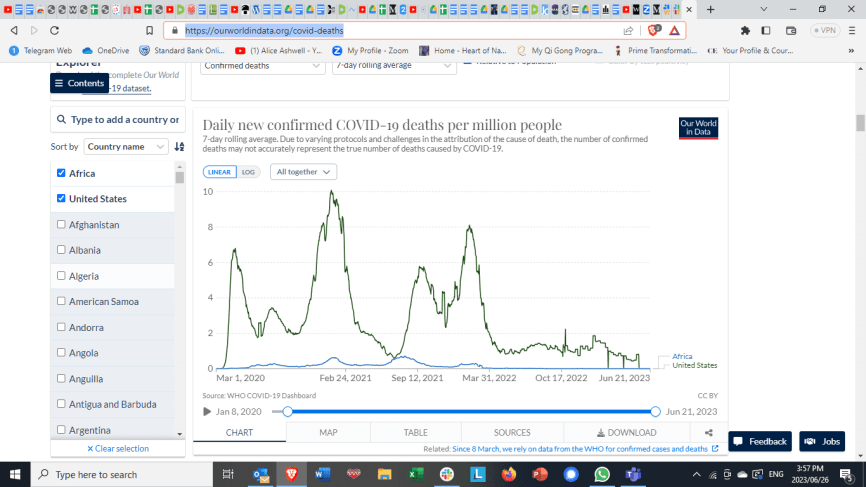
Figure 1: Comparing Covid-19 deaths in Africa and the USA [33]
4. Patronising the petitioners
Regarding the aim of the petition, which was to request that a referendum be held before the Government could agree to signing the pandemic treaty, Mr Fletcher declared:
Referendums are divisive; they polarise positions and leave a lasting legacy of division. Whether a referendum is appropriate is for the Government to decide, and if they think it is, they must make all the facts known. I suggest that petitioners, while playing their part in the education process, must do so in a sensible manner.
The patronising tone of this comment is ironic. While the referendum on Brexit did indeed sharpen the edge between ‘Leavers’ and ‘Remainers’, the UK Government’s Covid-19 response was possibly even more effective at dividing the populace into camps and pitting one side (those who complied with the mandates) against the other (those who chose not to comply). Furthermore, insisting that citizens should be “sensible” ignores the fact that constituents in favour of a referendum contacted their MPs to raise thoughtful, well-researched concerns, while some MPs arguing against the referendum tended to rely on slogans, unfounded generalities, and invective, rather than “sensible”, factual, reasoned arguments.
Mr Spellar not only used disparaging language to deny the request for a referendum, but also predicted that it would be rejected by the House:
We cannot be arguing to have [a referendum] for every bloomin’ issue, every policy and every treaty. … What we are seeing is overreaction and hysteria, and I would argue that we should give the petition a firm rejection, as I am sure we would do if it ever came to the Floor of the House of Commons.
Inasmuch as MPs in the UK are supposed to represent and take seriously the concerns of their constituencies, it is disturbing that an elected Member should respond with such contempt to a petition signed by more than 150,000 people.
5. Party-political point-scoring
Disappointingly, despite the importance of the debate and the number of citizens who had taken the time to express their concerns about the pandemic treaty, Ms McLaughlin and Ms Gill spent much of their time criticising the Conservative Government’s response to the Covid event. Instead of focusing on the debate, they chose to score party-political points by indicating the readiness of the Scottish National Party and Labour Party to implement WHO’s agenda, including enabling vaccine equity; sharing technology, knowledge, and skills; and strengthening global health systems using, ironically, the failing National Health Service as a model.
6. Downplaying or normalising threats to sovereignty
The Covid-19 event has been a classic case of the popular dialectic of ‘Problem-Reaction-Solution’. The engineered over-reaction to the problem of Covid-19 (whether or not there was an engineered virus), and the subsequent societal fall-out, have left traumatised people and their governments desperate to be better prepared for the much-anticipated ‘next one’, and ready to accept a ‘solution’ that few would have countenanced just four years ago.
In her presentation, Ms Gill expressed the need for an international approach to tackle transnational threats and improve global public health:
Negotiating an effective international treaty on pandemic preparedness is an historic task, but, if we can achieve it, it will save hundreds of thousands of lives.
If we can use the WHO to support basic universal healthcare around the world, infectious diseases are less likely to spread and fuel global pandemics.
It is through multilateral efforts, strengthened through international law, that we can ensure that the response to the next pandemic is faster and more effective, and does not leave other countries behind.
… the Opposition absolutely support the principle of a legally binding WHO treaty that sets the standard for all countries to contribute to global health security.
We need a binding, enforceable investment and trade agreement among all participating countries to govern the coordination of supplies and the financing of production, to prevent hoarding of materials and equipment, and to centrally manage the production and distribution process for maximum efficiency and output in the wake of a pandemic being declared.
The last few comments (underlined above) point to one of the most worrying issues for those concerned about sovereignty: if accepted, the pandemic treaty and amendments to the IHR would no longer be non-binding recommendations subject to government oversight but would become legally binding. WHO would be given legislative powers to mandate medical and non-pharmaceutical interventions; to commandeer intellectual property, production capability and resources; and to sanction those who refused to comply.
Some MPs downplayed concerns about these threats to national sovereignty. Mr Madders stated that “creating a global treaty [was] entirely reasonable and responsible” and that it was possible to “both protect our values of freedom and democracy and work more closely with other countries in the face of a global threat.”
Mr Spellar agreed, noting that they were “signatories to hundreds of treaties around the world” and that signing trade treaties was “part of engaging with the world.” He added that during Covid, “international scientific cooperation” had “enabled us to produce a vaccine within something like twelve months instead of the normal ten years … [thus] stabilising the situation.” What was not mentioned is that it was not primarily international collaboration among scientists that allowed the rapid deployment of these Covid-19 countermeasures, but the institution of emergency use authorisations, which allowed inadequately tested products to be dispensed worldwide. Far from “stabilising the situation”, these injectables continue to cause unprecedented numbers of adverse events and deaths, resulting in ongoing destabilisation of society post-Covid.
Steve Brine (MP for Winchester) observed that, “We cede sovereignty through membership of organisations. We cede the sovereignty to go to war by being a member of NATO.” It is true that all manner of treaties exist between countries and that these are essential for international cooperation; but cooperating as sovereign nations is entirely different to taking instructions from an unelected, supra-national body that is unaccountable to populations. Once in place, WHO’s pandemic treaty and the amendments to the IHR threaten to reduce national sovereignty, giving full power to WHO and its director-general to call pandemics and health emergencies and to regulate the responses of member states.
Those in favour of the pandemic treaty provided no evidence that a one-size-fits-all, legally mandated response to future pandemics would actually prove effective. In fact, Covid-19 was an object lesson in the foolishness of imposing the same public health ‘solutions’ on radically different nations and communities. In reality, mandating centralised protocols disrespects human rights, cultural diversity, national sovereignty, the scientific method, and innovation in healthcare. Instead of trusting human ingenuity to create a multitude of locally appropriate responses, it increases the risk of spectacular failure should the single global solution prove ineffective.
In an attempt to counter fears about a loss of sovereignty, Mr Madders stated that “We live in a liberal democracy and … are determined to keep it that way.” He denied people’s:
fears that the treaty will restrict freedom of speech to the extent that dissenters could be imprisoned, that it will impose instruments that impede on our daily life, and that it will institute widespread global surveillance without warning and without the consent of world leaders … [and that] Under this treaty, those things will apparently be done without our Government having a say.
He did, however, acknowledge that the measures mentioned above were “already in the power of the Government under the Public Health (Control of Disease) Act 1984.” Referring, without giving any details, to “fact checkers” and an unnamed “WHO spokesperson”, he reassured citizens that “WHO would have no capacity to force members to comply with public health measures.” The tyrannical actions during Covid of governments worldwide against their own citizens — many of whom assumed that they did, in fact, live in a “liberal democracy” — makes one wonder why these governments would behave any more independently in future, especially if legally required to follow WHO’s dictates. The repressive regulations and laws passed in various countries since 2020 suggest that this is unlikely, as governments seem to have become addicted to the sweeping emergency powers granted them by this convenient global ‘pandemic’.
Mr Madders and Ms Gill also attempted to allay citizens’ fears by pointing out that there was “over a year of negotiations to go” and that the treaty “would still have to be ratified by the United Kingdom”. Ms Gill also commented that:
The draft treaty is primarily about transparency, fostering international cooperation, and strengthening global health systems … the very first statement in the zero draft text reaffirms “the principle of sovereignty of States Parties” [and that] the implementation of the regulations “shall be with full respect for the dignity, human rights and fundamental freedoms of persons.”
Noting the dismissive attitude of the majority of MPs to the petitioners’ concerns, there is little chance that another year of negotiations will convince the UK Government to reject the treaty.
7. Promoting internationalism over sovereignty
The UK, as an erstwhile imperial and colonial power, continues to play a leadership role internationally. This may be why some MPs, such as Ms McLaughlin, could not believe that WHO might threaten UK’s sovereignty:
The treaty would have absolutely no effect whatsoever on the UK’s constitutional function and sovereignty … [Imagine a] terrible situation whereby the UK might be unable to make its own decisions if it is outvoted by other countries … the UK is a leading member of the WHO and a primary architect of the treaty, so that is not what is happening here.
Anne-Marie Trevelyan (Minister of State, Foreign, Commonwealth and Development Office) also stressed that the UK was:
a sovereign state in control of whether we enter into international agreements … with its voice, expertise and wisdom, and our trusted partner status with so many other member states in the UN family, [it] is respected and listened to.
Ms Trevelyan also referred to the UK’s role as “a global leader, working with CEPI, Gavi and the WHO,” stating that she was “proud to lead the fundraising for Gavi and COVAX.”
A deep chasm appears to have formed between the UK Government and its people. The discussions during this debate suggest that a minority of MPs [3] [link to PANDA video] view themselves as representatives whose duty it is to serve their constituents and respond to their concerns. Most, however, appear to have shifted their focus and allegiance to the international sphere, identifying as members of the “UN family”, playing a leading role in developing WHO’s pandemic instruments, and raising funds, which will ultimately benefit vaccine manufacturers and their investors, impoverishing the majority in the process. Under these circumstances, it is clear why Parliament is unwilling to risk a referendum on WHO’s Pandemic Treaty. There are just too many globalist interests at stake.
At home, increasing numbers of UK citizens are growing weary of a government that speaks glibly of ‘no country left behind’, while leaving its own nation in the dust. Where the people are concerned, trust is gone.
As Danny Kruger (MP for Devizes) warned:
At the moment, we do not have a commitment from the Government that they would bring the proposals to Parliament, which is very concerning. They say that in our interconnected world we need less sovereignty and more co-operation, which means more power for people who sit above the nation states. I say that in the modern world we need nation states more than ever, because only nation states can be accountable to the people, as the WHO is not.
Concluding comments
After two-and-a-quarter hours of deliberation, Mr Fletcher concluded the debate by thanking the Minister for assuring Members that UK sovereignty was not at risk, and then delivering the most inconclusive resolution:
That this House has considered e-petition 614335, relating to an international agreement on pandemic prevention, preparedness and response.
For the 156,086 citizens and their representatives who had made the effort to engage Parliament thoughtfully and actively using the relevant democratic process, this ‘resolution’ resolved nothing at all. The exercise amounted to all form and no substance; not only were requests for a referendum dismissed out of hand without adequate discussion, but there were indications that the matter might not even be discussed in the House of Commons.
Illustrating just how little impact was made by those representing the petitioners despite the strength of their arguments, subsequent to the debate and in response to this petition, the government’s official response published on their website [1] commenced with the words:
To protect lives, the economy and future generations from future pandemics, the UK government supports a new legally-binding instrument to strengthen pandemic prevention, preparedness and response.
This ominous response was followed by the now familiar slogan that would sit comfortably in the pages of Orwell’s 1984 but has no place in an official government statement: “Covid-19 has demonstrated that no-one is safe until we are all safe.” Its use further erodes the expectations that such debates will be carried out without bias, undue influence, or ignorance.
MPs have a duty of care to their constituents to ensure that they are as knowledgeable as possible about the issue being debated, and that they consider the facts rationally and honestly; and citizens deserve to have their concerns taken seriously. Yet two critical questions remain unanswered: firstly, having explicitly stated their support for WHO’s pandemic instruments, will the UK Government bring this matter to Parliament to be debated? And secondly, would agreement with these instruments, ‘in effect’ if not legally, mean the relinquishment of sovereignty? After all, if the only way the UK will be able to make a sovereign decision in future is by removing itself from membership of WHO, then why would the country wish to sign this treaty in the first place?
References
- UK Government and Parliament, Petition: ‘Do Not Sign Any WHO Pandemic Treaty Unless It is Approved Via Public Referendum’, (Debated 17 April 2023) <https://petition.parliament.uk/petitions/614335> [accessed 15 June 2023]
- parliamentlive.tv, ‘Video Recording of Westminster Hall Debate: e-petition 614335, Relating to an International Agreement on Pandemic Prevention, Preparedness and Response’, (17 April 2023) <https://parliamentlive.tv/Event/Index/d667d23f-1bd5-4c71-8237-3dd240de0651> [accessed 25 June 2023]
- PANDA Video
- World Health Organization, ‘Bureau’s text of the WHO convention, agreement or other international instrument on pandemic prevention, preparedness and response (WHO CA+)’, (2 June 2023) <https://apps.who.int/gb/inb/pdf_files/inb5/A_INB5_6-en.pdf> [accessed 25 June 2023]
- World Health Organization, ‘Article-by-Article Compilation of Proposed Amendments to the International Health Regulations (2005) submitted in accordance with decision WHA75(9)’, (2022), <https://apps.who.int/gb/wgihr/index.html> [accessed 25 June 2023]
- David Bell, ‘The World Health Organization and COVID-19: Re-establishing Colonialism in Public Health’ Panda, (5 July 2021) <https://pandata.org/who-and-covid-19-re-establishing-colonialism-in-public-health/> [accessed 29 June 2023]
- David Bell, ‘International Health Regulations and Pandemic Treaties – What is the Deal?’ Panda, (19 May 2022), <https://pandata.org/international-health-regulations-and-pandemic-treaties-what-is-the-deal/> [accessed 28 June 2023]
- David Bell, ‘The Myths of Pandemic Preparedness’, Panda, (29 November 2022), <https://pandata.org/the-myths-of-pandemic-preparedness/> [accessed 28 June 2023]
- Richard Thaler and Cass R. Sunstein, Nudge: Improving Decisions about Health, Wealth and Happiness (New Haven: Yale University Press, 2008)
- Psychology Today, ‘Priming’, <https://www.psychologytoday.com/us/basics/priming> [accessed 29 June 2023]
- Pierpaolo Goffredo, Shohreh Haddadan, Vorakit Vorakitphan, Elena Cabrio and Serena Villata, ‘Fallacious Argument Classification in Political Debates’, Proceedings of the Thirty-First International Joint Conference on Artificial Intelligence (IJCAI-22), (2022) 4143-4149 <https://www.ijcai.org/proceedings/2022/0575.pdf>
- Stephanie Sarkis, ‘This is Not Equal to That: How False Equivalence Clouds our Judgment’, Forbes, (19 May 2019) <https://www.forbes.com/sites/stephaniesarkis/2019/05/19/this-is-not-equal-to-that-how-false-equivalence-clouds-our-judgment/?sh=569a0b335c0f> [accessed 29 June 2023]
- World Health Organization, ‘Assessed Contributions’ <https://www.who.int/about/funding/assessed-contributions> [accessed 15 June 2023]
- World Health Organization, ‘Contributors’ <https://open.who.int/2020-21/contributors/contributor> [accessed 15 June 2023]
- World Health Organization, ‘Contributor: Bill & Melinda Gates Foundation’ <https://open.who.int/2020-21/contributors/contributor?name=Bill%20%26%20Melinda%20Gates%20Foundation> [accessed 15 June 2023]
- Reuters, ‘All the Countries That Restricted or Suspended Use of AstraZeneca and J&J Covid-19 Vaccines’, IOL, (24 April 2021), <https://www.iol.co.za/news/world/all-the-countries-that-restricted-or-suspended-use-of-astrazeneca-and-j-and-j-covid-19-vaccines-15e22cb0-3fef-4dab-9176-ebb7862fa6bb> [accessed 25 June 2023]
- Joseph Fraiman, Juan Erviti, Mark Jones, Sander Greenland, Patrick Whelan, Robert M Kaplan and Peter Doshi, ‘Serious Adverse Events of Special Interest Following mRNA COVID-19 Vaccination in Randomized Trials in Adults’, Vaccine 40 (2022), 5798-5805 <https://doi.org/10.1016/j.vaccine.2022.08.036>
- Peter Gøtzsche and Maryanne Demasi, ‘Serious Harms of the COVID-19 Vaccines: A Systematic Review’, Preprint with medRxiv, (2023) <https://doi.org/10.1101/2022.12.06.22283145>
- United States District Court for the Northern District of Texas Fort Worth Division, ‘Case 4:21-cv-01058-P Document 35’, (Filed 6 January 2022), <https://www.scribd.com/document/551589334/FDA-Foia-Request-010722#> [accessed 26 June 2023]
- Worldwide Safety Pfizer, ‘5.3.6 Cumulative Analysis of Post-Authorization Adverse Event Reports of PF-07302048 (BNT162B2)’, (Received 28 February 2021, Approved 30 April 2021), <https://phmpt.org/wp-content/uploads/2021/11/5.3.6-postmarketing-experience.pdf> (Appendix 1) [accessed 26 June 2023]
- Peter Marks (Director, Center for Biologics Evaluation and Research, FDA), Letter sent to Linda Wastila, Coalition Advocating for Adequately Labeled Medicines (CAALM), Re: Citizen Petition, Docket Number: FDA-2023-P-0360, (18 April 2023), <https://www.documentcloud.org/documents/23786932-fda-letter-on-covid-19-vaccine-labeling> [accessed 18 June 2023]
- Yaakov Ophir, Yaffa Shir-Raz, Shay Zakov and Peter A. McCullough, ‘The Efficacy of COVID-19 Vaccine Boosters against Severe Illness and Deaths: Scientific Fact or Wishful Myth?’ Journal of American Physicians and Surgeons, 28(1) (2023), 20-27 <https://jpands.org/vol28no1/ophir.pdf> [accessed 25 June 2023]
- Thomas Fazi and Toby Green, ‘Why Are Excess Deaths Still So High? We Can’t Just Blame a Failing NHS’, Unherd, (30 January 2023) <https://unherd.com/2023/01/why-are-excess-deaths-still-so-high/> [accessed 25 June 2023]
- Martin Neil and Norman Fenton, ‘The Devil’s Advocate: An Exploratory Analysis of 2022 Excess Mortality’, Where are the Numbers? (14 December 2022), <https://wherearethenumbers.substack.com/p/the-devils-advocate-an-exploratory> [accessed 27 June 2023]
- Bill Gates, Bill and Melinda Gates on Preparing for the Next Pandemic, online video recording, YouTube, 10 January 2013, <https://youtu.be/Wn0xzZH1dJA> [accessed 18 June 2023].
- David Bell, ‘The Myths of Pandemic Preparedness’, Panda, (29 November 2022) <https://pandata.org/the-myths-of-pandemic-preparedness/> [accessed 27 June 2023]
- Andrew Mullen, ‘The Propaganda Model after 20 Years: Interview with Edward S. Herman and Noam Chomsky’, Westminster Papers in Communication and Culture, 6(2) (2017), 12-22 <https://doi.org/10.16997/wpcc.121>
- Klaus Schwab, ‘Now is the Time For a “Great Reset”’, World Economic Forum, (3 June 2022) <https://www.weforum.org/agenda/2020/06/now-is-the-time-for-a-great-reset/> [accessed 26 June 2023]
- Simon Torkington, ‘We’re On the Brink of a “Polycrisis” – How Worried Should We Be?’ World Economic Forum, (23 June 2020) <https://www.weforum.org/agenda/2023/01/polycrisis-global-risks-report-cost-of-living/> [accessed 26 June 2023]
- World Health Organization, ‘One Health’, (21 September 2017) <https://www.who.int/news-room/questions-and-answers/item/one-health> [accessed 15 June 2023]
- John T. Cacioppo and Richard E. Petty, ‘Effects of Message Repetition and Negativity on Credibility Judgments and Political Attitudes’, Basic and Applied Social Psychology, 10(1) (1989), 3-12 <https://richardepetty.com/wp-content/uploads/2019/01/1989-basp-cacioppopetty.pdf>
- Christopher J. Anderson and Sara B. Hobolt, ‘Creating Compliance in Crisis: Messages, Messengers, and Masking up in Britain’, West European Politics, 46(2) (2023) 300-323 <https://doi.org/10.1080/01402382.2022.2091863> [accessed 29 June 2023]
- Edouard Mathieu, Hannah Ritchie, Lucas Rodés-Guirao, Cameron Appel, Charlie Giattino, Joe Hasell, Bobbie Macdonald, Saloni Dattani, Diana Beltekian, Esteban Ortiz-Ospina and Max Roser ‘Coronavirus Pandemic (COVID-19)’. Published online at OurWorldInData.org, (2020) <https://ourworldindata.org/covid-deaths> [accessed 25 June 2023]
UN Publishes Final Draft of Declaration That Targets “Misinformation,” Backs WHO Pandemic Treaty
By Tom Parker | Reclaim The Net | August 31, 2023
The United Nations (UN) is no fan of free speech and one of its plans to “address” so-called “misinformation, disinformation, hate speech and stigmatization” is on the verge of being finalized.
This unelected intergovernmental organization, which wields significant influence over its 193 member states, recently published the final draft of its Political Declaration of the United Nations General Assembly High-level Meeting on Pandemic Prevention, Preparedness and Response.
The final draft contains several agreements from heads of state and government to crack down on lawful speech. Additionally, it contains pledges from these heads of state and government to back two instruments that will give the UN’s World Health Organization (WHO) enhanced powers to target “misinformation” and build out its surveillance networks.
These instruments, the international pandemic treaty and amendments to the International Health Regulations (2005), have been in the works since 2021 and despite facing major pushback, are on track to be completed by May 2024.
The final draft of this political declaration is being developed for the UN’s High-Level Meeting on Pandemic Prevention, Preparedness and Response which will take place on September 20, 2023 in New York. The political declaration outlined in this draft will be finalized at this meeting.
While UN political declarations aren’t usually legally binding, they do wield significant legal influence. According to the UN, declarations “represent the dynamic development of international legal norms and reflect the commitment of states to move in certain directions, abiding by certain principles.”
The proposed speech crackdowns are outlined in several sections of the final draft of this political declaration.
In section OP35, the heads of state and government agree to “take measures to counter and address the negative impacts of health-related misinformation, disinformation, hate speech and stigmatization, especially on social media platforms” and counter “vaccine hesitancy in the context of pandemic prevention, preparedness and response.” Additionally, section OP42 includes an agreement to combat “misinformation.”
The UN member states back the pandemic treaty in section OP15 and agree to encourage the Intergovernmental Negotiating Body (the group that’s responsible for drafting and negotiating the pandemic treaty) to conclude their negotiations on the “WHO convention, agreement or other international instrument on pandemic prevention, preparedness, and response” (the full name of the WHO’s pandemic treaty).
Not only do UN member states give explicit backing to the pandemic treaty and push for it to be finalized but they also encourage the Intergovernmental Negotiating Body (INB) to prioritize the “need for equity.” Equity is framed by its proponents as something that encourages fairness but critics have warned that equity policies can lead to bias and the injection of “radical ideology.”
The support for the amendments to the International Health Regulations (IHR) is contained in section OP16 of the final draft. This section encourages the working group that’s focused on these amendments to continue its work with respect to the intended finalization date of May 2024.
This political declaration is one of the many ways the UN is tightening its grip on speech. This year alone, it has started building a “digital army” to fight against “deadly disinformation”, encouraged people to snitch on each other for “hate speech”, and claimed that censoring “disinformation” and “hate speech” will protect “free speech.”
The UN has also consulted with several governments and blocs on their censorship work. Specifically, it has attended multiple “disinformation sessions” with a UK government censorship agency and held discussions with the European Union on how to address “disinformation” on digital platforms.
Related:
Featured Video
Seyed M. Marandi: Negotiations Collapsed – Return to War
or go to
Aletho News Archives – Video-Images
From the Archives
The US-Iran Scenario That Most Scares Israel
By Ali Haydar | Al-Akhbar | October 9, 2013
Israeli Prime Minister Benjamin Netanyahu issued a series of threats toward Iran and its interlocutors in the West, including the US, as serious negotiations on Iran’s nuclear program seem more plausible.
As a possible rapprochement looms between the US and Iran, Netanyahu has attempted to impose impossible Israeli conditions on the negotiators, such as the full dismantling of Iran’s nuclear program, not to mention threatening military force.
Whatever the deal that could materialize between Iran and the West, Israel is going to find itself before an open-ended path. One can foresee three possible scenarios… continue
Blog Roll
 Aletho News
- Ukraine plans to attack Russian ships with Norwegian support
- US’s ‘Very Foolish’ Double Blockade of Hormuz Strait Makes Absolutely No Sense: Here’s Why
- China issues rules on countermeasures against foreign states’ unlawful extraterritorial jurisdiction
- Seyed M. Marandi: Negotiations Collapsed – Return to War
- Tomorrow’s naval blockade showdown
- ‘Israel’ attacks civilians to hide its embarrassing military failures & out of pure sadism
- Any Foreign Military Vessel Approaching Hormuz Under Any Pretext ‘Will Be Dealt With Severely’: IRGC
- Diplomats slam US negotiators’ performance in Iran talks
- Trump Refuses Exit Ramp, War with Iran will Continue
- Trump Says US Naval Blockade in Strait of Hormuz Will Begin Shortly
- If Americans Knew
- Critical shortages in Gaza, Lebanon in ruins, “piracy” in Iran – Daily Update
- US-Iran ceasefire negotiations make zero progress – Daily Update
- Pro-Israel ‘Thinktanks’ and Individuals who Influence U.S. Foreign Policy
- Mearsheimer reveals how Israel dictates US policies on Iran, Gaza – video
- After killing 350+, Israel still has a “score to settle” with Lebanon before ceasefire – Daily Update
- Military aid to Israel emerges as the latest political litmus test for Democrats
- The only Palestinian children’s rights organization closes following years-long Israeli campaign against it
- ‘I Can’t Forget the Smell’: Lebanese Reel After Israel Kills Over 300 in Single Day
- DNC Shoots Down Resolutions Calling Out AIPAC and Limiting Arms to Israel
- TCN: Is Israel Blackmailing President Trump?
- No Tricks Zone
- Cave Discovery Reveals Today’s Desert Climates Were Recently Far Warmer, Wetter, Teeming With Life
- German Expert: Heat Dome Led To Record Temps In Western USA…Warmer In 1934, 1936
- New Study: No Linear Warming Or Glacier Retreat Along Northern Antarctic Peninsula Since 1980s
- An Inconvenient Tree: Uncovered In Alps… Europe Much Warmer Than Today 6000 Years Ago
- New Study Reports A 60% Slowdown In Greenland’s Ice Loss Rate In The Last Decade
- Low Intensity Tornado Wrecks Major Solar Farm, Creating A Potential Toxic Dump
- New Study Finds Warming Saves Lives…Cold Temperatures 12 Times More Deadly Than Excess Heat
- German Science Blog Accuses PIK Climate Institute Of Hallucinating Climate Tipping Points
- Devastating Assessment Of Comirnaty Vaccine By Former Senior Pfizer Europe Toxicologist
- New Study: CO2 Is ‘Effectively Negligible’ As An Explanatory Climate Change Factor Since 2000
 Aletho News