A Cheat Sheet for Legislators Regarding the WHO and Health Emergencies
By David Bell | Brownstone Institute | MAY 30, 2023
We are told that, in a world of multiplying health emergencies, it has become necessary to give up some independence in return for safety. It is a tribute to those backing this agenda through the World Health Organization (WHO) that this message continues to gain credence. If humans are important, then we should also understand its flaws, and decide whether they matter.
1. The World Health Organization is not independent, and is significantly privately directed.
Early WHO funding was dominated by ‘assessed’ contributions from countries, based on national income, and the WHO decided how to use this core funding to achieve the greatest impact. Now, WHO funding is mainly ‘specified,’ meaning that the funder may decide how and where the work will be done. The WHO has become a conduit through which a funder can implement programs from which they stand to benefit. These funders are increasingly private entities; the second largest funder of the WHO is the foundation of a software entrepreneur and Big Pharma investor.
In ceding power to the WHO, a state will be ceding power to the funders of it. They can then profit by imposing the increasingly centralized and commodity-based approach that the WHO is taking.
2. People in democracies cannot be subject to dictatorships.
The WHO rightly represents all countries. This means that member states run by military dictatorships or other non-democratic regimes have an equal say at the World Health Assembly (WHA), the WHO’s governing body.
In ceding power to the WHO, democratic States are therefore sharing decision-making power over the health of their own citizens with these non-democratic states, some of whom will have geopolitical reasons to restrict a democratic state’s people and harm its economy. While equal say in policy may be appropriate for a purely advisory organization, ceding actual power over citizens to such an organization is obviously incompatible with democracy.
3. The WHO is not accountable to those it seeks to control.
Democratic states have systems through which those allowed to wield power over citizens wield it only at the citizens’ will, and are subject to independent courts for malfeasance or gross and harmful incompetence. This is necessary to address the corruption that always arises, as institutions are run by humans. Like other branches of the United Nations, the WHO is answerable to itself and the geopolitics of the WHA. Even the UN secretariat has limited influence as the WHO operates under its own constitution.
No one will be held accountable for the nearly quarter-million children that UNICEF estimates were killed by policies that the WHO promoted in South Asia. None of the up to 10 million girls forced into child marriage by WHO Covid policies will have any path for redress. Such lack of accountability may be acceptable if an institution is simply giving advice, but it is completely unacceptable for any institution that has powers to restrict, mandate or even censor a country’s citizens.
4. Centralization through the WHO is poor policy by incompetent people.
Before the influx of private money, the WHO’s focus was high burden endemic infectious disease, such as malaria, tuberculosis, and HIV/AIDS. These are strongly associated with poverty, as are those arising from malnutrition and poor sanitation. Public health experience tells us that addressing such preventable or treatable diseases is the best way to lengthen lives and promote sustainable good health. They are most effectively addressed by people on the ground, with local knowledge of behavior, culture and disease epidemiology. This involves empowering communities to manage their own health. The WHO once emphasized such decentralization, advocating for the strengthening of primary care. It was consistent with the fight against fascism and colonialism within which the WHO arose.
Centralized approaches to health, in contrast, require communities and individuals to comply with dictates that ignore local heterogeneity and community priorities. Malaria is not an issue to Icelandic people, but it absolutely dwarfs Covid in Uganda. Both human rights and effective interventions require local knowledge and direction. The WHO pushed mass Covid vaccination onto sub-Saharan Africa for nearly 2 years through their most expensive program to date, whilst knowing a large majority of the population were already immune, half were under 20 years, and deaths from each of malaria, tuberculosis and HIV/AIDs absolutely dwarfed Covid-19 mortality.
The WHO staff are rarely experts. Experience in the 2009 Swine flu and West African Ebola outbreaks demonstrated that. Many have spent decades sitting in an office with minimal experience in program implementation or practical disease management. Country quotas and the nepotism associated with large international organizations mean that most countries will have far greater expertise within their borders than exists in a closeted bureaucracy in Geneva.
5. Real pandemics are not common, and are not becoming more common.
Pandemics due to respiratory viruses, as the WHO pointed out in 2019, are rare events. They have occurred about once per generation over the past 120 years. Since the advent of antibiotics (for primary or secondary infections), mortality has dropped dramatically. An increase in mortality recorded during Covid-19 was complicated by definitions (‘with’ versus ‘of’), average age of death was over 75 years, and death was unusual in healthy people. The global infection mortality rate was not greatly different to influenza. Tuberculosis, malaria, HIV/AIDS and most other common infections kill at a much younger age, imparting a greater burden in life years lost.
In summary
It makes no sense to grant a foreign-based, poorly unaccountable institution powers that contradict democratic norms and good public health policy. More so when this institution has limited expertise and a poor track record, is directed by private interests and those of authoritarian governments. This is obviously counter to what a government in a democracy is supposed to do.
This is not a matter of domestic political rivalries. However, the public relations departments of the prospective beneficiaries of this perpetual health emergency project would like us to believe it is.
We are currently funding the dismantling of our own independence and ceding our human rights to a small group which stands to benefit from our impoverishment, financed from a war chest accrued through the pandemic just ended. We don’t have to. It is as straightforward to see through this as it should be to stop it. All that is needed is clarity, honesty and a little courage.
David Bell, Senior Scholar at Brownstone Institute, is a public health physician and biotech consultant in global health. He is a former medical officer and scientist at the World Health Organization (WHO), Programme Head for malaria and febrile diseases at the Foundation for Innovative New Diagnostics (FIND) in Geneva, Switzerland, and Director of Global Health Technologies at Intellectual Ventures Global Good Fund in Bellevue, WA, USA.
Congress To Investigate WHO Plans To Use “Listening Surveillance Systems” To Identify “Misinformation”
Rep. Chris Smith wants an investigation into the World Health Organizations plans to surveil speech and more
By Dan Frieth | Reclaim The Net | May 25, 2023
If you’ve been following our reporting on the issue, you’ll already know that the new World Health Organization (WHO) pandemic prevention initiative, the Preparedness and Resilience for Emerging Threats (PRET), recommends using “social listening surveillance systems” to identify “misinformation.” But as more people are learning about how unelected bodies are being used to suppress speech and potentially override sovereignty, it’s starting to get more pushback.
According to documents from the UN agency, PRET aims to “guide countries in pandemic planning” and work to “incorporate the latest tools and approaches for shared learning and collective action established during the COVID-19 pandemic.”
The PRET document describes misinformation as a “health threat,” and refers to it as an “infodemic.”
“Infodemic is the overabundance of information – accurate or not – which makes it difficult for individuals to adopt behaviors that will protect their health and the health of their families and communities. The infodemic can directly impact health, hamper the implementation of public health countermeasures and undermine trust and social cohesiveness,” the document states.
However, it continues to recommend invasive methods of countering the spread of misinformation.
“Establish and invest in resources for social listening surveillance systems and capacities to identify concerns as well as rumors and misinformation,” the WHO wrote in the PRET document.
“To build trust, it’s important to be responsive to needs and concerns, to relay timely information, and to train leaders and HCWs in risk communications principles and encourage their application.
Communication should be tailored to the community of interest, focusing on and prioritizing vulnerable groups.
“New tools and approaches for social listening have been developed using new technologies such as artificial intelligence to listen to population concerns on social media (such as the Platform EARS developed by WHO).”
The document also recommends testing these tactics during “acute respiratory events including seasonal influenza.”
“Develop and implement communication and behavior change strategies based on infodemic insights, and test them during acute respiratory events including seasonal influenza. This includes implementing infodemic management across sectors, and having a coordinated approach with other actors, including academia, civil society, and international agencies,” it explains.
Rep. Chris Smith (R-NJ) is holding a Congressional hearing on the WHO’s pandemic accord.
The Secretary of Health and Human Services, Xavier Becerra, recently met with Tedros Adhanom Ghebreyesus, the Director-General of the WHO, to discuss the accord and the “critical role” of the US “in global health security.”
In his opening remarks at the World Health Assembly, Ghebreyesus said: “I urge you to deliver the pandemic accord on time, as a generational commitment. The next pandemic will not wait for us. We must be ready.”
The Accord’s preliminary document, zero draft, was first published in February.
In March, the Biden administration’s envoy at the negotiations, Pamela Hamamoto, said that the administration is “committed to the Pandemic Accord, to form a major component of the global health architecture for generations to come.”
“The American people have a right to know exactly what the Biden Administration is negotiating at the WHO, especially as the President remains silent and fails to reassure us that he will protect our Constitution from bureaucrats at this troubled United Nations body,” Rep. Smith said.
Smith is particularly concerned that the Accord could undermine the sovereignty of the US over its healthcare infrastructure.
“The zero-draft WHO pandemic treaty starts off with very harsh criticism of the United States and the international community by calling it a ‘catastrophic failure of the international community in showing solidarity and equity in response to the coronavirus disease (COVID-19) pandemic,’” Rep. Smith noted. “Article 4 of the treaty pays lip service to sovereignty and then completely overcomes that lip service by saying, ‘provided that activities within their jurisdiction or control do not cause damage to their peoples and other countries,’ which empowers the WHO to step in and prescribe what each country would do.”
During the hearing, Smith plans to ask Secretary of State Antony Blinken about the contents of the accord’s zero draft.
“Under absolutely no circumstances should the Biden Administration surrender American sovereignty to the World Health Organization and allow the voice of the American people and consent of the governed to be subjugated to dictates of an agenda-driven global administrative bureaucracy,” Smith insisted.
Google Renews Its Partnership With The WHO
By Cindy Harper | Reclaim The Net | May 25, 2023
Google has renewed its partnership with the World Health Organization (WHO) to provide what it calls “factual” information about different diseases and conditions. The partnership is positioned as a way to combat what it says is the spread of medical “misinformation” observed during the pandemic.
On Google search, there are already Knowledge Panels at the top of results when users search for certain conditions and diseases.
Soon, the Knowledge Panels will include more conditions and illnesses like depressive disorder, Ebola, COPD, malaria, hypertension, diabetes, Mpox, and others, all using information verified by the WHO.
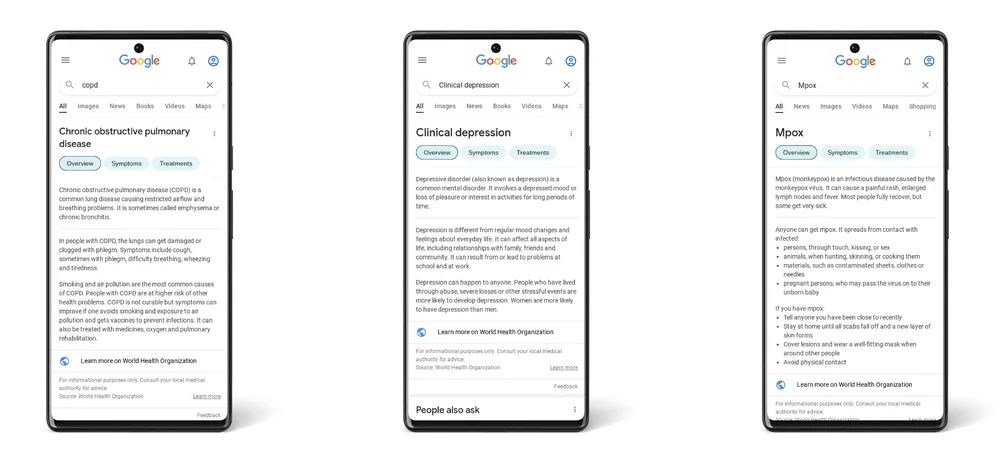
In a previous partnership, Google awarded more than $320 million to the WHO in Ad Grants to help spread its medical information. In the new partnership, Google awarded the global public health organization an additional $50 million to continue the efforts.
The WHO has been criticized more in frequent years for calling for censorship while itself putting out information during the pandemic that turned out to ultimately be untrue.
Google’s YouTube was criticized for censoring anything that went against the WHO during the pandemic, even if independent commentators ended up being correct.
One Health: A Plan to ‘Surveil and Control Every Aspect of Life on Earth’?
This is part two of a two-part series on the One Health initiative. Read part one here.
By Michael Nevradakis, Ph.D. | The Defender | May 8, 2023
The World Health Organization (WHO) defines “One Health,” as “an integrated, unifying approach that aims to sustainably balance and optimize the health of people, animals and ecosystems,” as they are “closely linked and interdependent” — a concept that on the surface appears to promote noble goals interlinking human and environmental health.
However, some scientists and medical experts are concerned about One Health’s vague goals. Arguing that the concept has been “hijacked,” they question the intent of those involved with the development and global rollout of the concept — including the WHO, the Centers for Disease Control and Prevention (CDC) and the World Bank.
Experts who spoke with The Defender also raised questions about other aspects of the One Health concept, including a biosecurity agenda, a global surveillance system, vaccine passports and restrictions on human behavior.
While these goals are underpinned by a vaguely defined “Theory of Change,” experts told The Defender that major financial interests are at the heart of the One Health agenda, which appears to be closely linked to climate change and sustainable development initiatives promoted by the same global organizations.
One Health objectives include a ‘global takeover of everything’
In a May 1 article, Dr. Joseph Mercola connected the One Health concept, as promoted by global organizations, to the policies and restrictions pursued in response to COVID-19, describing it as an attempted “global takeover of everything.”
Mercola tied the One Health concept to key entities that have supported gain-of-function research. According to Mercola:
“Interestingly, the term ‘One Health,’ which was formally adopted by the WHO and the G20 health ministers in 2017, was first coined by the executive vice president of the EcoHealth Alliance, the same firm that appears to have had a hand in the creation of SARS-CoV-2.”
During the 2019 lecture “Can One Health Help Prevent the Next Pandemic?” EcoHealth Alliance President Peter Daszak, Ph.D., commissioner in The Lancet’s One Health Commission, said “emerging infectious diseases” are “a growing global threat.”
He also argued that many of these emerging diseases are “zoonotic — spread from animals to humans.”
Francis Boyle, J.D., Ph.D., professor of international law at the University of Illinois and a bioweapons expert who drafted the Biological Weapons Anti-Terrorism Act of 1989, questioned this narrative, telling The Defender :
“All these ‘emerging infectious diseases’ are emerging out of their offensive biological warfare weapons programs conducted in their BSL4 [biosecurity level 4] and BSL3 laboratories.
“If you look at the people on the WHO advisory committee dealing with ‘emerging infectious diseases,’ that’s exactly what they are doing — ‘emerging’ them from their labs.”
One example is that of Marion Koopmans, DVM, Ph.D., director of the WHO Collaborating Centre for emerging infectious diseases at Erasmus Medical Centre in the Netherlands and member of the WHO’s One Health High-Level Expert Panel (OHHLEP).
According to Boyle, “Erasmus is where this offensive Nazi biowarfare gain-of-function death science dirty work first became notorious under Fouchier, [who] started the entire controversy over his gain-of-function work there.”
Boyle was referring to Ron Fouchier, Ph.D., who also is deputy head of Erasmus’ Viroscience Department and who, according to Science, “alarmed the world” in 2011, after he and other researchers “separately modified the deadly avian H5N1 influenza virus so that it spread between ferrets” — an early example of gain-of-function research.
Dr. Meryl Nass, an internist and biological warfare epidemiologist who is a member of the Children’s Health Defense scientific advisory committee, said such objectives are kept deliberately vague. She referred to a CDC document that stated:
“Successful public health interventions require the cooperation of human, animal, and environmental health partners … Other relevant players in a One Health approach could include law enforcement, policymakers, agriculture, communities, and even pet owners.
“By promoting collaboration across all sectors, a One Health approach can achieve the best health outcomes for people, animals, and plants in a shared environment.”
Nass wrote on her blog, “I anticipate that One Health will be used to impose changes in the way humans and animals interact … most likely based on the needs of the WEF [World Economic Forum]/elites and not the needs of the people or the animals that will be affected.”
Reggie Littlejohn, founder and president of Women’s Rights Without Frontiers and co-chair of the Stop Vaccine Passports Task Force, told The Defender, “It’s not clear that One Health is prioritizing human health.”
Highlighting the “vague” language employed by the global organizations promoting One Health, Littlejohn said that one goal may be to “govern farm animal health in addition to human health,” through which “they could do things like forcing vaccines on livestock.”
One Health means ‘surveilling everything’
The experts who spoke with The Defender expressed concerns over the biosecurity agenda that is associated with the stated objectives of One Health.
According to Nass, this reflects how the WHO “has been changing into a biosecurity agency,” adding that “the justification, apparently, for the WHO’s director-general to take over jurisdiction of healthcare during pandemics, but also potentially ecosystems, animals and plants, is through One Health.”
Nass noted that One Health “is mentioned several times in the National Defense [Authorization] Act for Fiscal Year 2023” (NDAA), which includes 18 pages on “pandemic preparedness” and a formal definition of the “One Health approach” on page 952 of the act.
Independent journalist and researcher James Roguski also highlighted the prominent placement of One Health in the NDAA and noted that, by formally defining the concept within the act, it is now part of the Code of Federal Regulations.
However, Roguski said the NDAA goes even further:
“The U.S. has pledged a billion dollars a year to the World Bank Pandemic Fund in support of the global health security agenda. The WHO is one of 14 intermediaries who will receive and redistribute some of that billion dollars.
“Basically, it’s capitalism, it’s corruption, it’s an abomination from a health perspective. Let’s just throw money at pharmaceutical companies, build out the infrastructure in these nations and, if you’re making tons of products locally, you’re going to be able to convince the local government to stick them in people’s arms or shove it down their throat.
“And none of it really has shown to be of any health benefit. It’s damage to people’s health.”
Associated with the promotion of a global biosecurity agenda is the development of a global surveillance infrastructure that would purportedly protect human and animal health and the environment. An Oct. 3, 2022, WHO document states:
“The emergence of the SARS-CoV-2 virus that caused COVID-19 has underlined the need to strengthen the One Health approach, with a greater emphasis on connections to animal health and the environment …
“… It uses the close, interdependent links among these fields to create new surveillance and disease control methods. …
“We now have an unprecedented opportunity to strengthen collaboration and policies across these many areas and reduce the risk of future pandemics and epidemics while also addressing the ongoing burden of endemic and non-communicable diseases
“Surveillance that monitors risks and helps identify patterns across these many areas is needed.”
Remarking on this, Littlejohn said One Health’s proponents talk about “interoperable, integrated surveillance systems.” She told The Defender :
“I believe … these surveillance systems of people, animals, plants, and the environment are going to be coordinated by some kind of a global surveillance system that is interoperable globally and integrated.
“Whoever’s running this show, the WHO, the Chinese Communist Party … the Bill and Melinda Gates Foundation, who are the people who really appear to be running the show at the WHO, are going to be able to tap into and see all of our private information. Not just us, but animals and plants.”
Dr. David Bell, a public health physician and biotech consultant and former director of global health technologies at Intellectual Ventures Global Good Fund, told The Defender that what global organizations intend is “surveilling everything.” He said:
“It means surveilling everything, surveilling the climate for possible threats, surveilling animal population, surveilling wildlife, surveilling the soil to see if there’s new traces of virus or bacteria in river systems, et cetera.
“This allows you to ‘discover’ what we already know is nature, and then turn nature into a potential threat or into a threat. The more surveillance you have and the wider it is, the more inevitable ‘threats’ you’ll find … because you can make an argument that almost any new variant virus is a ‘threat.’
“It will allow them to keep a constant kind of fear which then allows you to introduce authoritarian controls such as central bank digital currencies and digital passports … that allow them to monetize the human population more effectively.”
Nass noted that global actors such as the WHO “talk about sharing of specimens during a pandemic … so they can try to make vaccines too. However, they don’t talk about performing surveillance on human beings. But what they did say, which let the cat out of the bag, is that they would want to get informed consent from countries for sharing of genomic data, rather than from individuals.”
Part of this surveillance infrastructure also would include vaccine passports, which figure prominently in the pandemic treaty and amendments to the International Health Regulations (IHR) currently under negotiation at the WHO.
According to Littlejohn:
“I believe that they laid the infrastructure during the COVID-19 crisis, and we’re having a little bit of a ‘break’ here between pandemics, but that structure, that infrastructure is going to snap shut with the next pandemic if we don’t stop it. That structure has to do with vaccine passports.
“It could be called a ‘smart health card’ or ‘digital health ID,’ or even a mandatory digital driver’s license can serve as the platform for a China-style social credit system. And there’s a new bill in front of the Senate right now … the Improving Digital Identity Act of 2023 … It’s a mandatory national ID that’s going to be interoperable, coordinated, integrated and can serve as the same platform as China’s social credit system … to surveil us.”
Restrictions on human behavior could lower humans to the level of animals
The WHO’s Oct. 3, 2022, document also claimed that “Some 60% of emerging infectious diseases that are reported globally come from animals, both wild and domestic,” adding that “human activities and stressed ecosystems have created new opportunities for diseases to emerge and spread.”
Such stressors “include animal trade, agriculture, livestock farming, urbanization, extractive industries, climate change, habitat fragmentation and encroachment into wild areas,” according to the WHO.
“To the extent that carbon emissions due to transportation within cities would contribute to climate change, then the ‘15-minute city’ would be a way of addressing that,” Littlejohn said. “The danger is that they will enforce it by having surveillance cameras everywhere to make sure you don’t go outside of your district without permission.”
In a March 30 article, “Your Daughter for a Rat,” Bell cited a One Health editorial published in The Lancet stating that “all life is equal, and of equal concern.” In response, Bell suggested that One Health aims to lower humans to the level of animals.
The same Lancet article described One Health as “a call for ecological, not merely health, equity” and called for a “subtle but quite revolutionary shift of perspective” away from “anthropocentrism”: “All life is equal, and of equal concern.”
“It looks like this is going to be the justification for moving people down to the value of animals,” Nass said in response; a sentiment shared by Boyle, who said, “One Health relates the healthcare of human beings to the healthcare of animals and thus reduces healthcare for human beings to the level of healthcare for animals.”
According to Bell, “suggesting that we have a duty as a species on this planet to look after every species equally and treat them more equally [is] becoming sort of a religion or dogma. It defies what any rational society in the history of humanity” has practiced and is “a very unusual approach and potentially very scary.”
One Health: Follow the money
The WHO has attempted to give theoretical credence to the One Health concept by developing a so-called “Theory of Change” (ToC).
Although the WHO says the ToC is designed to provide “a conceptual framework” for “organisations, agencies and initiatives working towards similar One Health goals” and a “common narrative of coherence,” the theory itself does not appear to have a clear definition.
“They want to be able to do whatever they want,” Littlejohn said. “If you define it, then you can hold them to the definition … one of the tactics is just to be really obscure and incomprehensible.”
“This is a term that is used in these circles,” Bell added. “It’s stating the obvious, that if you do a certain act, you’ll have a certain outcome. It’s a fancy way of saying that.”
Bell also referred to the “fallacy that is being pushed that humans are having increasing contact with wildlife,” supposedly leading to “this threat of viruses jumping from wildlife to humans.”
Calling it a “ludicrous claim,” Bell said that “when humans move into wildlife habitats, the wildlife don’t start living with humans. They die out.”
Noting that “it used to be very common” for people to live with farm animals, Bell added that the claim that pandemics are becoming more common due to increased contact with animals is itself “not true,” but is “used to instill fear and to try to get people to buy into this One Health, constant health emergency agenda.”
Nass said One Health proponents “don’t actually have any evidence” to support their claims, offering the example of antimicrobial resistance in bacteria found in meat consumed by humans, as a result of antibiotics administered to livestock. “That’s been the hook that One Health has been hung on,” Nass said.
However, Nass said this problem “could be solved in a heartbeat if the U.S. Food and Drug Administration or the U.S. Department of Agriculture just told farmers they can’t put antibiotics into animal feed anymore, they can only use them when an animal gets sick.”
In his recent article, Mercola suggested following the money. “Private interests wield immense power over the WHO, and a majority of the funding is ‘specified,’ meaning it’s earmarked for particular programs. The WHO cannot allocate those funds wherever they’re needed most.”
As a result, this “massively influences what the WHO does and how it does it. So, the WHO is an organization that does whatever its funders tell it to do,” naming organizations such as the Gates Foundation as prime funders of the WHO.
Bell said that supporters of One Health include “those who have been pushing the COVID agenda … and enriching themselves from it,” including “private foundations who are on the bandwagon” and “corporations who stand to gain from controlling the food chain and controlling agriculture and pharmaceuticals, et cetera.”
“It’s corporate authoritarians that have benefited themselves from public health through COVID and the certainly inappropriate COVID response,” Bell added. “And it’s the same and it’s not disconnected with the climate emergency agenda.”
One prominent financial actor closely involved with the development of the One Health agenda is the World Bank, as WHO documents indicate.
At a November 2022 OHHLEP meeting, Franck Berthe, the World Bank’s senior livestock specialist, introduced the World Bank’s Financial Intermediary Fund, which would “allow countries to borrow funds to strengthen their health system and promote the OH [One Health] approach.”
According to Nass, “the WHO and the World Bank have helped form this financing operation for the biosecurity agenda,” while Boyle told The Defender, “There is nothing humanitarian about these backers and the WHO promoting the One Health agenda.”
Both Nass and Bell said the One Health agenda is closely tied to the UN’s Sustainable Development Goals and Agenda 2030. Bell said that the One Health agenda attempts to deal with a supposed “existential threat to human health” that “must be dealt with in a centralized way, rather than giving people a choice.”
One Health closely tied to WHO pandemic treaty, IHR amendments
Experts who spoke with The Defender also emphasized the connections between the One Health concept and the pandemic treaty and IHR amendments under negotiation.
Mercola wrote that through the One Health agenda, which recognizes “a very broad range of aspects of life and the environment [that] can impact health and therefore fall under the ‘potential’ to cause harm,” the WHO “will be able to declare climate change as a health emergency and subsequently require climate lockdowns.”
Roguski, who has extensively researched the pandemic treaty and IHR amendments, said that in amendments the EU recently proposed for the pandemic treaty, the term “One Health” appears 29 times, including calling upon countries to develop and regularly update pandemic prevention plans via the One Health approach.
Referring to the need to prevent potential “pandemic situations,” the proposals also call for strengthening global public health surveillance “using a One Health approach,” which will also “address the drivers of the emergence and re-emergence of disease at the human-animal-environment interface, including but not limited to climate change, land use change, wildlife trade, desertification and antimicrobial resistance.”
The proposals also suggest the One Health approach could be used “to produce science-based evidence, and support, facilitate and/or oversee the correct, evidence-based and risk-informed implementation of infection prevention and control,” and go as far as to suggest targets on “antimicrobial consumption/use.”
Roguski told The Defender that the latest draft of the pandemic treaty refers to One Health 13 times. Such language would “be used to take over complete control of our lives,” Roguski added.
For example, one proposal states, “Each Party shall, in accordance with national law, adopt policies and strategies, supported by implementation plans, across the public and private sectors and relevant agencies, consistent with relevant tools, including, but not limited to, the International Health Regulations, and strengthen and reinforce public health functions for: (c) surveillance (including using a One Health approach).”
Other proposals include:
“The Parties commit to strengthen multi-sectoral, coordinated, interoperable and integrated One Health surveillance systems … to identify and assess the risks and emergence of pathogens and variants with pandemic potential, in order to minimize spill-over events, mutations and the risks associated with zoonotic neglected tropical and vector-borne diseases, with a view to preventing small-scale outbreaks in wildlife or domesticated animals from becoming a pandemic.
“Each Party shall … develop and implement a national One Health action plan on antimicrobial resistance that strengthens antimicrobial stewardship in the human and animal sectors, optimizes antimicrobial consumption, increases investment in, and promotes equitable and affordable access to, new medicines, diagnostic tools, vaccines and other interventions, strengthens infection prevention and control in health care settings and sanitation and biosecurity in livestock farms, and provides technical support to developing countries.”
Roguski said the phrase “One Health” doesn’t directly appear in documents related to the proposed IHR amendments, but he added the WHO “is going to try to get them both to prevail,” referring to both the treaty and IHR amendments.
Littlejohn said, the One Health approach and the proposed language in the treaty “gives them the right to surveil and potentially control every aspect of life on earth.”
Noting that the proposed treaty also calls for a “commitment to counteract ‘misinformation,’ ‘disinformation,’ and ‘false news,’” Littlejohn added, “they’re going to surveil our social media … and if any of us steps out of line by contradicting what the WHO says, then we could be censored.”
“That’s what I think is in mind with this commitment to ‘coordinated, interoperable and integrated’ One Health surveillance systems,” Littlejohn added. “I think that’s how it could end up being deployed. Ultimately, globalist entities, such as the World Economic Forum and the UN are using the WHO as their way of establishing global control.”
“The reason that health is such a good pretext is that people can become terrified,” Littlejohn added. “To the extent that their minds are paralyzed if they think they could die or get really sick, they’re willing to give up freedoms that they would not be willing to give up in other contexts.”
Roguski told The Defender :
“They made a lot of bad decisions. They gave a lot of bad advice [and] they caused a lot of harm to a lot of people. You can’t just give those people more power, authority and control without looking at what they did and going, ‘no, you should not be in charge of any of this.’”
In turn, Mercola wrote that “The globalist takeover hinges on the successful creation of a feedback loop of surveillance for virus variants, declaration of potential risk followed by lockdowns and restrictions, followed by mass vaccinating populations to ‘end’ the pandemic restrictions, followed by more surveillance and so on.”
And according to Bell, One Health “is part of a much bigger picture of finding ways to pull apart the intrinsic ideas that most societies have been built on.”
“I think that this is part of a move to undo these sorts of ideas and to replace them with a sort of religion of fear of our surroundings and denigration of other humans that can then be used by very greedy people to increase their wealth and power,” Bell said. “It’s taken over public health to a large extent.”
Michael Nevradakis, Ph.D., based in Athens, Greece, is a senior reporter for The Defender and part of the rotation of hosts for CHD.TV’s “Good Morning CHD.”
This article was originally published by The Defender — Children’s Health Defense’s News & Views Website under Creative Commons license CC BY-NC-ND 4.0. Please consider subscribing to The Defender or donating to Children’s Health Defense.
WHO Denies Pandemic Treaty Will Reduce Sovereignty of States – But it’s Pure Propaganda
BY DR DAVID BELL | THE DAILY SCEPTIC | MAY 6, 2023
The Director General of the World Health Organisation (WHO) reassures us that the WHO’s ‘pandemic accord’ (or ‘treaty’) won’t reduce the sovereignty of Member States. The WHO trusts that these words will serve as a distraction from reality. Those driving the perpetual health emergency agenda are planning to give WHO more power, and states less. This will happen whenever WHO designates a ‘Public Health Emergency of International Concern’ (PHEIC), or considers we may be at risk of one.
The WHO’s proposed treaty, taken together with its ‘synergistic’ amendments to the International Health Regulations (IHR), aim to undo centuries of democratic reform that based sovereignty with individuals, and by extension their state. The discomfort of facing this truth and the complexities it raises is providing the cover needed to push these changes through. This is how democracy, and freedom, wither and die.
Why it’s hard to acknowledge reality
Our society in the West is built on trust and a feeling of superiority – we built the institutions that run the world and they, and we, are good. We consider ourselves humanitarians, the public health advocates, the unifiers, and anti-fascist freedom-lovers. We consider our system is better than the alternatives – we are ‘progressive’.
It takes quite a step for comfortable, middle-income, Left-leaning professionals to believe that the institutions and philanthropic organisations we have admired all our lives might now be pillaging us. Our society relies on having ‘trusted sources’, the WHO being one of them. Among others are our major media organisations. If our trusted sources told us we were being misled and pillaged, we would accept this. But they are telling us these claims are false, and that all is well. The WHO’s Director General himself assures us of this. Anyone who thinks rich corporate and private sponsors of WHO and other health institutions are self-interested, that they might mislead and exploit others for their own benefit, is a conspiracy theorist.
We are all capable of believing the rich and powerful of past ages would exploit the masses, but somehow this is hard to believe in the present. For proof of their benevolence, we rely on the word of their own publicity departments and the media they support. Somehow, malfeasance on a grand scale is always a figment of history, and now we are smarter and enlightened.
Over recent decades we have watched individuals accumulate wealth equivalent to medium-sized countries. They meet our elected leaders behind closed doors at Davos. We then applaud the largesse they bestow on the less fortunate, and pretend all this is fine. We watch as corporations expand across national borders, seemingly above the laws that apply to ordinary citizens. We allowed their ‘public-private partnerships’ to turn international institutions into purveyors of their commodities. We ignored this descent because their publicity departments told us to, becoming apologists for obvious authoritarians because we want to believe they are somehow doing a ‘greater good’.
Whilst a schoolchild might see through this facade to the conflicted greed beyond, it is much harder for those with years of political baggage, a peer network, reputation and career to admit they have been duped. The behavioural psychologists that our governments and institutions now employ understand this. Their job is to keep us believing the trusted sources they sponsor. Our challenge is to put reality above right-think.
The remaking of WHO
When the WHO was set up in 1946 to help coordinate responses to major health issues, the world was emerging from the last great bout of fascism and colonialism. Both these societal models were sold on the basis of centralising power for a greater good. Those who considered themselves superior would run the world for those less worthy. The WHO once claimed to follow a different line.
Since the early 2000s WHO’s activities have been increasingly dictated by ‘specified funding’. Its funders, increasingly including private and corporate interest, tell it how to use the money they give. Private direction is fine for private organisations promoting their investors’ wares, but it is obviously a non-starter for an organisation seeking to mandate medicines, close borders and confine people. Anyone with a basic understanding of history and human nature will recognise this. But these powers are exactly what the amendments to the International Health Regulations and the new treaty intend.
Rather than consider alternate approaches, WHO is seeking censorship of opinions not fitting its narrative, publicly denigrating and demeaning those who question its policies. These are not the actions of an organisation representing ‘we the people’, or confident in its ability to justify its actions. They are the trappings we have always associated with intellectual weakness and fascism.
WHO’s impact on population health
In its 2019 pandemic influenza recommendations, WHO stated that “not in any circumstances” should contact tracing, border closures, entry or exit screening or quarantine of exposed individuals be undertaken in an established pandemic. It wrote this because such measures would cause more harm than good, and disproportionately harm poorer people. In 2020, in conjunction with private and national sponsors, it supported the largest wealth shift in history from low to high income by promoting these same measures.
In abandoning its principles, WHO abandoned millions of girls to nightly rape through child marriage, increased teenage pregnancies and child mortality, reduced childhood education, and grew poverty and malnutrition. Despite most of these people being too young to be troubled by Covid and already having immunity, they promoted billions of dollars of mass vaccination whilst traditional priorities such as malaria, tuberculosis and HIV/AIDS deteriorate. Western media have met this with silence or empty rhetoric. Saving lives does not turn a profit, but selling commodities does. The WHO’s sponsors are doing what they need for their investors, whilst WHO is doing what it needs to keep their money flowing.
The new powers of WHO
The IHR amendments will reduce the sovereignty of any WHO Member State that fails to actively reject them, giving a single person (the Director General) direct influence over health policy and the freedom of its citizens is indisputable. It is what the document says. Countries are required to “undertake” to follow the WHO’s “recommendations”, which are no longer simply suggestions or advice. Whilst the WHO does not have a police force, the World Bank and IMF are on board, and control much of your money supply. The U.S. Congress passed a bill last year recognising that the U.S. Government should address countries that do not comply with the IHR. We are not witnessing toothless threats; most countries, and their people, will have little choice.
The real power of the WHO’s proposals is in their application for any health-related matter they proclaim to be a threat. The proposed amendments state this explicitly, whilst the ‘Treaty’ expands the scope to ‘One-Health‘, a hijacked public health concept that can mean anything perceived to be affecting human physical, mental or social well-being. Inclement weather, crop failures or the promulgation of ideas that cause people stress – everyday things that humans have always coped with, now become reasons to confine people and impose solutions dictated by others.
In essence, those sponsoring WHO are manufacturing crises of their own desiring, and are set to get wealthier from other’s misery, as they did during Covid. This under the guise of ‘keeping us safe’. As WHO implausibly insists, “no one is safe until all are safe”, so removal of human rights must be broad and prolonged. Behavioural psychology is there to ensure that we comply.
Facing the future
We are building a future in which compliance with authoritarian dictates will win the return of stolen freedoms, whilst censorship will suppress dissent. People who wish to see evidence, who remember history or insist on informed consent will be designated, in WHO parlance, far-Right mass killers. We have already entered this world. Public figures who claim otherwise are presumably not paying attention, or have other motivations.
We can meekly accept this new disease-obsessed world, some may even embrace the salaries and careers it bestows. Or we can join those fighting for the simple right of individuals to determine their own future. At the very least, we can acknowledge the reality around us.
Dr. David Bell is a clinical and public health physician with a PhD in population health and background in internal medicine, modelling and epidemiology of infectious disease. Previously, he was Programme Head for Malaria and Acute Febrile Disease at FIND in Geneva, and coordinating malaria diagnostics strategy with the World Health Organisation. He is a member of the Executive Committee of PANDA.
‘Huge Grab of Power’: MP Andrew Bridgen Warns Against WHO Pandemic Treaty, IHR Amendments
Pandemic Prevention, Preparedness and Response: International Agreement, 17 Apr 2023
By Suzanne Burdick, Ph.D. | The Defender | April 26, 2023
Andrew Bridgen, a U.K. member of Parliament this month warned his fellow parliamentarians that the World Health Organization’s (WHO) proposed new pandemic treaty and amendments to the International Health Regulations (IHR) represents “a huge grab of power” by “unelected, unaccountable bureaucrats.”
The WHO is promoting a pandemic treaty and IHR amendments to its existing members to increase the global health organization’s power during health emergencies.
In Bridgen’s 18-minute speech — since viewed by almost 100,000 people — delivered April 17 during a parliamentary debate, Bridgen called for a referendum, or public vote, on the WHO’s proposals.
People in the U.K. “do not want to be ruled” by an unelected group of people, Bridgen said. “We should have a referendum, because sovereignty belongs to the people. It’s not ours to give away.”
The debate was triggered after 156,086 U.K. constituents signed a petition calling for the U.K. government “to commit to not signing any international treaty on pandemic prevention and preparedness established by the WHO, unless this is approved through a public referendum.”
Bridgen pointed out that WHO employees are exempt from taxes and have diplomatic immunity — meaning they are protected from prosecution.
He said the WHO pandemic treaty and its IHR amendments seek to take “huge powers” away from “this Parliament and every other Parliament around the world.”
“These two instruments would fundamentally reset the relationship between citizens and sovereign state — not only in this country but also around the whole world,” he added.
The proposals would empower “unelected, unaccountable, top-down, supernational” officials to “impose sweeping, legally binding” orders on member states — including forcing companies to manufacture and export certain medical treatments or shutting companies down “regardless of what the local people think,” Bridgen said.
Bridgen said the WHO’s proposals are skewed toward aggregating power in the hands of WHO officials — rather than the hands of democratic governments — because they would grant the WHO’s director-general, Tedros Adhanom Ghebreyesus, Ph.D., the power to decide “when the pandemic or the emergency is over and when he’ll possibly give us the power back.”
Bridgen said he had “grave” concerns about who is “actually running and controlling” the WHO and its current initiatives.
The WHO consists of its 192 member states — “basically the whole of the U.N. membership, excluding Liechtenstein and the Holy See” — but it now receives 86% of its funding from non-member states, Bridgen said.
The WHO’s second-largest donor is the Bill & Melinda Gates Foundation and the fifth-largest donor is Gavi.
“You have to think: Why are they doing this?” Bridgen said, adding:
“They [the Gates Foundation and Gavi] are also the biggest donors — or biggest investors — in pharmaceuticals and the experimental mRNA technology which was so profitable for those who produced it during the last pandemic.”
Bridgen urged his fellow lawmakers to review the WHO proposals in great detail.
“They [the proposals] need to be considered very strongly. Sticking your head in the stand isn’t going to do it,” he said. “It won’t do for my constituents,” he added.
Suzanne Burdick, Ph.D., is a reporter and researcher for The Defender based in Fairfield, Iowa. She holds a Ph.D. in Communication Studies from the University of Texas at Austin (2021), and a master’s degree in communication and leadership from Gonzaga University (2015). Her scholarship has been published in Health Communication. She has taught at various academic institutions in the United States and is fluent in Spanish.
This article was originally published by The Defender — Children’s Health Defense’s News & Views Website under Creative Commons license CC BY-NC-ND 4.0. Please consider subscribing to The Defender or donating to Children’s Health Defense.
The Indoctrinators, Part 3: Bill Gates
This is the third in our series about four well-known men whose purposeful social engineering over the years has undermined national democracies and economies, and created fertile ground for the final realisation of their post democracy dream of a global socialist/fascist world, controlled by supranational organisations such as the United Nations (UN), the World Health Organisation (WHO) and of course, themselves. They are George Soros (you can read Tuesday’s article here), Klaus Schwab (yesterday’s article is here), Bill Gates (today) and David Attenborough.
By Karen Harradine | TCW Defending Freedom | April 13, 2023
BILL Gates has a messiah complex. His obsession with ‘climate change’, vaccines and people control is proving dangerous for the world. Only a few weeks ago he gave voice to his latest megalomaniac plan for a global pandemic prison state. And as the past proves, what Gates wants he usually gets.
Together with his fellow Indoctrinators, George Soros and Klaus Schwab, 67-year-old Gates has not missed the opportunity provided by the Covid-19 crisis (which he helped to engineer) to further his revolutionist ‘global development’ green agenda. Following their precedent, he too created a foundation through which to impose his ghastly visions on an unfortunate world.
Since its inception in 2000, the Bill & Melinda Gates Foundation (BMGF), under its philanthropic guise, has found plenty of useful idiots across world governments willing to fund and support it. Successive witless British Prime Ministers, up to and including Boris Johnson and Rishi Sunak, have fallen under his spell with Gates hugely benefiting from this priceless endorsement and publicity. Given his malign agenda, Western taxpayers have literally been paying for their own demise.
Gates is an enthusiastic partner of the World Economic Forum (WEF) and attendee at their gatherings in Davos, which he typically uses to announce his latest plans to drain the West of its resources to fund his vaccine and climate change lunacy. In 1999, he formed the Global Alliance for Vaccines and Immunization (GAVI), which he cleverly partnered with the United Nations (UN), BMGF, foreign aid agencies and pharmaceutical companies. It was to become, together with the BMGF, the second biggest source of funding to the World Health Organisation (WHO).
More than 80 per cent of the WHO’s budget comes from voluntary contributions by member states and donors. In 2021, the BMGF was the second largest contributor with $375million, and GAVI the fourth with $245million. Both have a long history of influencing the WHO (the BMGF’s first donation was in1998). Uniquely the BMGF became its official partner in 2017, further focusing the WHO’s public health priorities on to vaccines. An enabler of and publicist for the toxic Covid-19 vaccine, his close connection with the WHO has reaped him huge profits.
The WHO’s deeply disturbing proposed Pandemic Treaty effectively puts into action Gates’s planned grasp for global control as he detailed in his 2022 book, ‘How to Prevent the Next Pandemic’. It has been long in the planning.
In 2003, on a Davos panel called ‘Science for the Global Good’, Gates announced his foundation’s gift of $200million to the US National Institutes of Health to set up the Grand Challenges in Global Health, a vehicle for shifting US tax money into the developing world in pursuit of Gates’s own interests.
In 2010, Gates and his wife heralded a ‘decade of vaccines’ at Davos, pledging $10billion to fund vaccines in ‘poor countries’, a vaccine zealotry which has had some appalling outcomes for which Gates has expressed no remorse. In one example, nearly half a million children in India were paralysed after taking BMGF-funded polio vaccine. Despite such appalling consequences, Gates, with an honorary knighthood in the bag from the Queen, is still widely regarded as a benign philanthropist. There’s no doubt that money buys reputation.
Like Soros, Gates has a prominent platform on the WEF website to promote green investments worth billions of dollars. A devotee of the UN’s Agenda 2030, Gates is co-chair of the Global Commission on Adaptation.
Today, thanks to our unprincipled politicians, Gates has a hotline to Downing Street and Britain finds itself in the clutches of a megalomaniac. His tentacles reach far and wide, from shaping energy policies and dominating scientific organisations and academic research, to financing the mainstream media.
In 1997, Tony Blair invited him into Downing Street to sell his flawed computer system, going on to host him several times, implementing policies based on his dictates and in his financial interests. It was an association Blair was to prosper from, later getting $3.2million for his Global Africa initiative and more than $25.2million for his Institute of Global Change.
In 2010, Gates and his wife visited the Department for International Development (DFID) to hector ministers on supporting foreign aid while promoting his Living Proof project, funded also by Soros’s Open Society Foundations and the Rockefeller Foundation.
Billionaires persuading politicians to plunder public resources to fund their own megalomaniac ambitions is not just deeply distasteful but wrong. Yet between 2011 and 2019, Gates got DFID to give over £60million for BMGF development projects.
In 2016, George Osborne pledged £2.5billion to another BMGF association, the Ross Fund. Three years later, the BMGF and World Bank ‘partnered’ with DFID to shovel more taxpayers’ money to foreign despots in the name of ‘education systems’.
In November 2020, after Johnson played his part in the hysteria over Covid-19, Gates met him and pharmaceutical companies and plotted how to prevent ‘pandemics’. Johnson then gave £800million to the BMGF’s vaccine initiative, COVAX.
A year later, Johnson reunited with Gates and promised a further £400million to fund his green investments.
In Sunak Gates has a willing apprentice. In February, the pair met to discuss wasting more money on Gates’s terrifying ‘climate change’ goals.
The BMGF and its subsidiaries like the Global Fund, which promotes the ominous sounding ‘health security’, has, since its inception in 2002, managed to extract an astonishing £4.5billion from the UK government, with another £1billion earmarked for the next two years. When did British taxpayers vote for that?
Millions today in this country can no longer afford both food and energy costs, they are medically neglected and live in substandard housing. Questions must be asked why politicians are funding this Indoctrinator to dictate policies that are provenly detrimental to British citizens and are only to the benefit of one man. The multi- billionaire land owner, Bill Gates. If a vampire is invited into a home, best be prepared for a bloodbath.
The last in this series will focus on green evangelist Sir David Attenborough.
Australian senators refuse to investigate the WHO pandemic treaty
By Tom Parker | Reclaim The Net | March 29, 2023
An Australian senator’s motion to hold an inquiry into the World Health Organization‘s (WHO’s) controversial international pandemic treaty was blocked after Labor and Greens voted against it.
The treaty, which will be legally binding under international law, will expand the WHO’s surveillance powers, allow the unelected global health agency to target “misinformation,” and more. The next stage of discussions on the treaty will begin next week.
The motion, which was introduced by Senator Malcolm Roberts, called for the WHO’s international pandemic treaty to be referred to the Foreign Affairs Defense and Trade References Committee for an inquiry.
Numerous lawmakers supported the motion and blasted the pandemic treaty during a debate.
Senator Roberts accused WHO Director-General of “misleading the public about what the WHO is doing with the pandemic treaty.”
Senator Ralph Babet warned about the “ever-encroaching power of the WHO” and blasted those who had dismissed criticism of the pandemic treaty as a “conspiracy theory.”
Senator Geraard Rennick said that Australia risks being influenced by the “vibe” of the WHO if the treaty passes and pointed to the way where Australia would “religiously… follow the orders or the proclamations from the WHO without any questioning” during the Covid-19 pandemic.
Senator Alex Antic highlighted the mass censorship that occurred during the Covid-19 pandemic and criticized the way people were branded “conspiracy theorists” if they went against the establishment’s Covid narrative.
“Anyone who defied the WHO’s supposedly expert advice, including emminent medical professionals, were censored and vilified by the media and Big Tech at the behest of government and these organizations and… the only narrative that was allowed oxygen were those parroting the WHO,” Antic added. “Many Australian Health Care Providers were suspended for contradicting what was ultimately the WHO’s position on Covid-19 vaccines. Their predictions and observations have turned out to be correct and we’ll see how that narrative is slowly changing.”
Senator Matthew Canavan said Australia “should be getting out of the World Health Organization because of their negligent handling of the coronavirus” and pointed to several of the unelected health agency’s missteps during the pandemic.
However, several senators opposed the motion and praised the WHO.
“This is actually a good thing,” Senator Dorinda Cox said in reference to the treaty. “It’s important that we learn from the responses of governments right across the world so that we can do better next time.”
Senator David Shoebridge claimed that criticism of the WHO’s pandemic treaty was “disinformation” being pushed by a “conspiracy club.”
Despite strong support for the motion from several senators, it was ultimately defeated by two votes, with Labor and Greens voting against it.
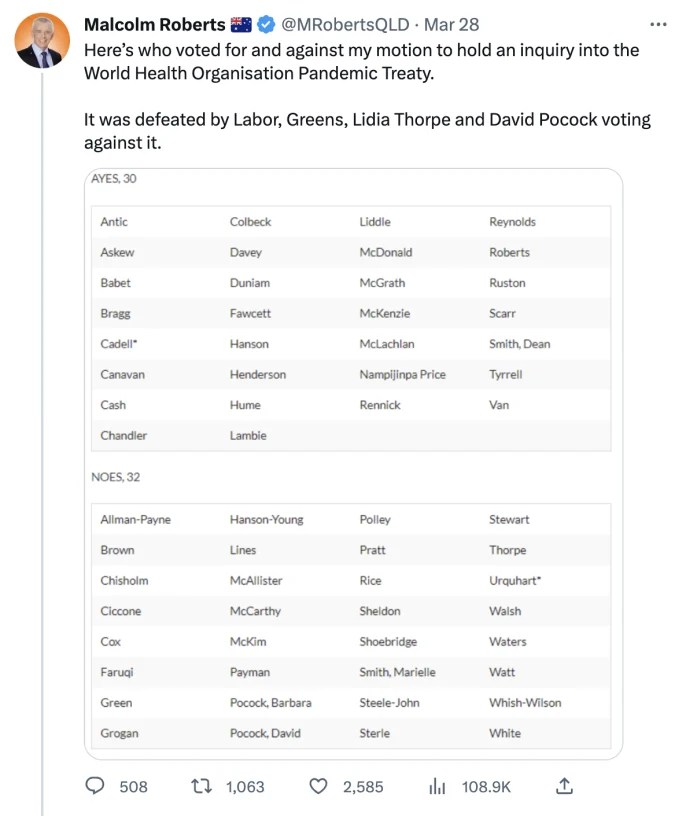
You can watch the full debate on this motion here.
This is one of several recent efforts to shine a light on the WHO’s far-reaching pandemic treaty. United States (US) Senator Ron Johnson recently introduced an amendment to require Senate ratification for any pandemic agreement with the WHO. However, Johnson’s attempt to scrutinize the treaty was also defeated.
It Was A ‘Vaccine Strategy’ From The Start
Ideological zealots wanted jabs in arms

Health Advisory & Recovery Team | March 11, 2023
Our recent “Null Hypothesis” article postulates and evidences a succinct summary of the happenings of the last three years: “The hypothesis that will likely stand the test of time goes like this: a nasty — if not particularly unusual — respiratory disease season was turned into a catastrophe by human misadventure, and this catastrophe was compounded by efforts to save face and justify the unjustifiable”.
In answering the question ‘what happened’, we did not attempt to tackle the obvious follow-up question (apart from a brief discussion about social contagion): ‘why did it happen’?
The sceptical community – living up to its decentralised worldview – is not short of opinions and theories, robustly debated. These are too numerous to cover in detail in this short piece: it suffices to say that they cover a wide spectrum ranging from calamitous ineptitude (and innumeracy) of politicians and civil servants, deceitful and underhand sales & marketing by nefarious global corporations, efforts by the elite to enrich themselves by impoverishing the middle classes and the digital enslavement of the masses, through to some more esoteric beliefs covering depopulation agendas, eugenics and long-in-the-planning Satanic plots… the list just goes on and on.
As many of the most ardent supporters of both pharmaceutical and non-pharmaceutical interventions (PIs and NPIs) begin to wake up to the collateral damage they helped bring about, it is instructive to stand back and observe tried-and-tested Biblical precedent being re-enacted. Few are not enjoying seeing the pantomime villain Matt Hancock being hoist by his own self-promoting petard via the Oakeshott WhatsApp trove. After all, who does not take some satisfaction from the fall of a petty tyrant? But much like the goat that gets bestowed with the sins of the community in Leviticus (“the goat will carry on itself all their iniquities” ) before being cast out into the wilderness (thus avoiding a full and frank ‘lessons learned’ exercise), the demonisation of this preening ’cock (or monkey) does not necessarily get us much further in terms of identifying whodunnit — who was the organ grinder? After all, a self-promoting chancer whose self-confessed epidemiological education is based on a studious viewing of the film ‘Contagion’ is demonstrably not an evil Blofeld mastermind. Indeed, some sceptics have attempted to use the Telegraph’s Lockdown Files to scotch any discussion of conspiracy and underscore their belief that the disastrous events of 2020-2022 were ‘merely’ a cock-up.
But that simplistic take assumes that the former Secretary of State for Health was more than just a bumbling low-grade chaos agent intent on filling his boots via fast-track procurement channels. Loathsome though he might be, Hancock and his cronies are a symptom – not a cause – of the pit we find ourselves in. Why did he – and the Prime Minister at the time, Boris Johnson – get themselves into such a pickle such that they were not able to navigate a more rational – and less damaging – course through the crisis?
The answer is probably to be found somewhere within what one might term the ‘pandemic preparedness industry’ as outlined a few months ago in the Daily Sceptic :
“The response to the COVID-19 pandemic represented the triumph of a pseudo-scientific biosecurity agenda that emerged in 2005 and has been pushed ever since by a well-organised, well-funded and well-embedded network of ideologues. These fanatics promote and perpetuate the ideas underpinning the draconian new approach by publishing them in leading journals, planting them in public policy and law, pushing them in the media and smearing those who dissent, however eminent or well-qualified.
This avenue of investigation is, we believe, more likely to lead to the source of our misadventure than attempting to rationalise ‘scorched earth’ attempts at containment, suppression and eradication of a killer virus. There was only ever a warped logic to these actions, unless – one way or the other (perhaps for the ‘greater good’ or simply for old-fashioned crony capitalist ends) – you wanted to create a favourable backdrop for a new set of medical interventions that might otherwise have met with limited take-up or even downright opposition. CMO Chris Whitty advised government ministers in February 2020 (!) that covid was not deadly enough to justify fast-tracking vaccines. Put another way, earth could not have been scorched in this way if seasonal respiratory disease had not been given a name such that scariants could be ‘deployed’ to ‘frighten the pants off’ the general populace.
Whether the driving force behind these fanatics is saintly goodwill, pure greed, corruption – or even a Luciferian conspiracy for that matter – is beside the point: what is essential to understand is how a nasty seasonal respiratory disease season was weaponised to drive one of the greatest policy failures of all time. There does not necessarily need to be a single cartoon villain masterminding events to avoid multiple parties conspiring (“breathing together”) to create a great evil.
With this backdrop one does not even need to ferret around in the weeds to find out more. Last summer’s detailed POLITICO/WELT Special Report sheds plentiful quanta of light on the matter:
Four [supra-national] health organizations, working closely together, spent almost $10 billion on responding to Covid across the world. But they lacked the scrutiny of governments… While nations were still debating the seriousness of the pandemic, the groups identified potential vaccine makers and targeted investments in the development of tests, treatments and shots.
The four organizations had worked together in the past, and three of them shared a common history. The largest and most powerful was the Bill & Melinda Gates Foundation, one of the largest philanthropies in the world. Then there was Gavi, the global vaccine organization that Gates helped to found to inoculate people in low-income nations, and the Wellcome Trust, a British research foundation with a multibillion dollar endowment that had worked with the Gates Foundation in previous years. Finally, there was the Coalition for Epidemic Preparedness Innovations, or CEPI, the international vaccine research and development group that Gates and Wellcome both helped to create in 2017.
… The World Health Organisation (WHO) was crucial to the groups’ rise to power. All had longstanding ties to the global health body. The boards of both CEPI and Gavi have a specially designated WHO representative. There is also a revolving door between employment in the groups and work for the WHO: Former WHO employees now work at the Gates Foundation and CEPI; some, such as Chris Wolff, the deputy director of country partnerships at the Gates Foundation, occupy important positions. Much of the groups’ clout with the WHO stems simply from money.
… “They’re funded by their own capabilities and or endowments and trusts. But when they step into multilateral affairs, then who keeps watch over them?” a former senior U.S. official said. “I don’t know the answer to that. That’s quite provocative”.
Consider this small early 2020 cameo featuring senior executives from one of these four organisations:
“When it first became clear that this disease was appearing, Richard [Hatchett] and I sat down and said, we know what happened with the last swine flu pandemic, where wealthy countries bought up all the doses [of Pandemrix] that were … available for the developing world, we have to try to do something different about that…”.
Most normal people draw entirely different conclusions from the swine flu saga, not least the absolutely devastating tale of Pandemrix, a giant swindle involving misuse of taxpayer funds to purchase these doses in the first place, the substantial human damage that they then caused, a subsequent cover-up and then further cost to the taxpayer compensating those affected.
Contrast this with CEPI’s ‘mission’: “Vaccines are one of our most powerful tools in the fight to outsmart epidemics. The development of vaccines can help save lives, protect societies and restabilise economies”.
There you have it: the ‘saviour vaccine’, a sacred cow extolled with messianic zeal. It seems that one of the world’s greatest policy failures happens to neatly coincide with the stated aims of the Fantabulous Four. Food for thought given that there is no example of a vaccine ever defeating a sudden onset viral epidemic, let alone a ‘pandemic’ (there is also the question of whether viral pandemics are in any way even a hypothetical threat to modern societies — unless, of course, one incorrectly pins the blame for iatrogenic collateral damage on said virus).
Following the money, therefore, it is not that much of a surprise what came next: while — as pointed out above — “nations were still debating the seriousness of the pandemic” (i.e. correctly monitoring the possibility of a slightly-more-serious-than-usual respiratory disease season), the Fantabulous Four were busy setting the scene with targeted investments to create fertile ground to fulfil their aims. Consider then:
- Who might have benefitted from a social media campaign showing those faked ‘deaths in the street’ in China?
- Who might have considered funding a social media ‘bot army’ to promote lockdowns, interventions that as per Neil Ferguson’s ‘seminal’ fear-mongering 16 March 2020 paper could only conceivably make any sort of logical sense if they were followed in short order by a ‘saviour vaccine’, as explicitly stated by Ferguson and co-authors in that paper (“these policies will need to be maintained until large stocks of vaccine are available” )?
- Who might have benefitted from squashing an early ‘lab leak’ theory that might have implicated some of the Fantabulous Four and the justification for a fast-track vaccine roll-out?
- Conversely, once said roll-out had been successfully funded and procured at eye-watering expense, who might have benefitted from re-floating the ‘lab leak’ theory to help justify future ‘pandemic preparedness’?
- Who might benefit from tightly controlling media output and censorship (after all, “true content … might promote vaccine hesitancy”)? Who was writing this script?
- WHO might wish to publish — in 2022 — detailed recommendations about how those in authority should respond to a ‘vaccine crisis’ (defined as any occurrence that ‘will most likely or has already eroded public trust in vaccines … and may create uncertainty’)?
- Why only the vaccine ‘pillar’ of the WHO’s wish list, the ACT-A (Access to Covid Tools Accelerator), received the funding that was sought? And why did all others on that ACT-A list — most notably cheap therapeutics that might have saved many lives (while of course competing with lucrative vaccines) — remain well short of their funding targets?
This congruency of the categorical trinity — means, motive and opportunity — is difficult to explain away. It is true that much that happened from March 2020 was anarchic, uncontrolled, panicked and unscripted. But there was method to the madness, an ultimate aim to the chaos, namely to make way for a ‘saviour vaccine’ that would only be accepted if the intended recipients had had ‘the pants frightened off them’, i.e. were sufficiently afraid of the alternatives to risk such an unproven medical intervention.
It may conceivably be that many people involved in the Fantabulous Four believe that this collective action was necessary. But collective action – however well meaning – that is dictated by a group and imposed on everyone else is tyranny, pure and simple. It gets worse if authorities are sufficiently captured by this tyranny such that they deploy subversive psychological weaponry on their citizens and suppress any dissent.
These are grave misdeeds that led to great harm, both in terms of bad outcomes and collateral damage from unnecessary non-pharmaceutical interventions, but also from the utterly unnecessary coercion used to foist pharmaceutical interventions on those that did not need them.
Even if we presuppose that there are no evil Blofeld-types standing behind all of this, it is beyond doubt that a fanatical ideology has inspired an evil tyranny. As per the Daily Sceptic :
“This ideology is the enemy, and seeing it for what it is is the first step to defeating it”.
This process has begun.
Featured Video
Seyed M. Marandi: Negotiations Collapsed – Return to War
or go to
Aletho News Archives – Video-Images
From the Archives
The US-Iran Scenario That Most Scares Israel
By Ali Haydar | Al-Akhbar | October 9, 2013
Israeli Prime Minister Benjamin Netanyahu issued a series of threats toward Iran and its interlocutors in the West, including the US, as serious negotiations on Iran’s nuclear program seem more plausible.
As a possible rapprochement looms between the US and Iran, Netanyahu has attempted to impose impossible Israeli conditions on the negotiators, such as the full dismantling of Iran’s nuclear program, not to mention threatening military force.
Whatever the deal that could materialize between Iran and the West, Israel is going to find itself before an open-ended path. One can foresee three possible scenarios… continue
Blog Roll
 Aletho News
- UK, Spain reject Trump’s new scheme to blockade Hormuz Strait
- Russian frigate ‘resurfaces’, chases off NATO pirates days after Kiev ‘sank’ it
- Ukraine Targets Russian Merchant Fleet With NATO Intel Support – Presidential Aide
- Russia’s ‘shadow fleet’ makes mockery of UK naval power
- Ukraine plans to attack Russian ships with Norwegian support
- US’s ‘Very Foolish’ Double Blockade of Hormuz Strait Makes Absolutely No Sense: Here’s Why
- China issues rules on countermeasures against foreign states’ unlawful extraterritorial jurisdiction
- Seyed M. Marandi: Negotiations Collapsed – Return to War
- Tomorrow’s naval blockade showdown
- ‘Israel’ attacks civilians to hide its embarrassing military failures & out of pure sadism
- If Americans Knew
- Critical shortages in Gaza, Lebanon in ruins, “piracy” in Iran – Daily Update
- US-Iran ceasefire negotiations make zero progress – Daily Update
- Pro-Israel ‘Thinktanks’ and Individuals who Influence U.S. Foreign Policy
- Mearsheimer reveals how Israel dictates US policies on Iran, Gaza – video
- After killing 350+, Israel still has a “score to settle” with Lebanon before ceasefire – Daily Update
- Military aid to Israel emerges as the latest political litmus test for Democrats
- The only Palestinian children’s rights organization closes following years-long Israeli campaign against it
- ‘I Can’t Forget the Smell’: Lebanese Reel After Israel Kills Over 300 in Single Day
- DNC Shoots Down Resolutions Calling Out AIPAC and Limiting Arms to Israel
- TCN: Is Israel Blackmailing President Trump?
- No Tricks Zone
- Cave Discovery Reveals Today’s Desert Climates Were Recently Far Warmer, Wetter, Teeming With Life
- German Expert: Heat Dome Led To Record Temps In Western USA…Warmer In 1934, 1936
- New Study: No Linear Warming Or Glacier Retreat Along Northern Antarctic Peninsula Since 1980s
- An Inconvenient Tree: Uncovered In Alps… Europe Much Warmer Than Today 6000 Years Ago
- New Study Reports A 60% Slowdown In Greenland’s Ice Loss Rate In The Last Decade
- Low Intensity Tornado Wrecks Major Solar Farm, Creating A Potential Toxic Dump
- New Study Finds Warming Saves Lives…Cold Temperatures 12 Times More Deadly Than Excess Heat
- German Science Blog Accuses PIK Climate Institute Of Hallucinating Climate Tipping Points
- Devastating Assessment Of Comirnaty Vaccine By Former Senior Pfizer Europe Toxicologist
- New Study: CO2 Is ‘Effectively Negligible’ As An Explanatory Climate Change Factor Since 2000
 Aletho News