Honduras: The Making of a Controlled Democracy

Zionist Organisation of America (ZOA) Praises Honduras’ Opening Diplomatic Mission In Jerusalem & Later Its Embassy. (Source: Zionist Organisation of America | ZOA)
21st Century Wire | December 22, 2025
Tegucigalpa — The streets of Honduras’ capital were tense as the results of the 2025 elections unfolded, a nation holding its breath amid suspicion, polarisation, and uncertainty. Beneath the visible turmoil lies a deeper story: for over a century, foreign powers have shaped Honduran politics, society, and culture, deliberately fracturing communities and weakening democratic institutions. Once a predominantly Catholic country with a cohesive social fabric, Honduras now grapples with divisions along religious, social, and racial lines, leaving its citizens vulnerable to manipulation and its democracy under strain.
Israel’s influence in Honduras extends far beyond diplomacy or military cooperation. Historical ties, dating back to the early 20th century with figures like Samuel Zemurray, established patterns of economic and political leverage to control Honduran leadership while advancing pro-Zionist objectives. In modern times, presidents, including Juan Orlando Hernández, have strengthened these ties through military cooperation, arms purchases, and symbolic gestures, such as relocating the Honduran embassy to Jerusalem in 2021. Israeli influence also penetrates civil society, promoting Zionist ideology, synagogue expansion, and religious conversion programs, including Protestant-to-Judaism conversions, that embed loyalty to Israeli interests within key segments of society. Four figures who held or effectively controlled the Honduran presidency, Juan Lindo, Ricardo Maduro, Juan Orlando Hernández, and Samuel Zemurray, have been Jewish or closely aligned with pro-Zionist interests, highlighting the deep historical roots of Israel’s influence in the country. These interventions reinforced a pro-Israel political bloc, cultivated an environment where dissent is socially penalised, and subtly shaped political allegiances, a dynamic clearly evident in the 2025 elections.
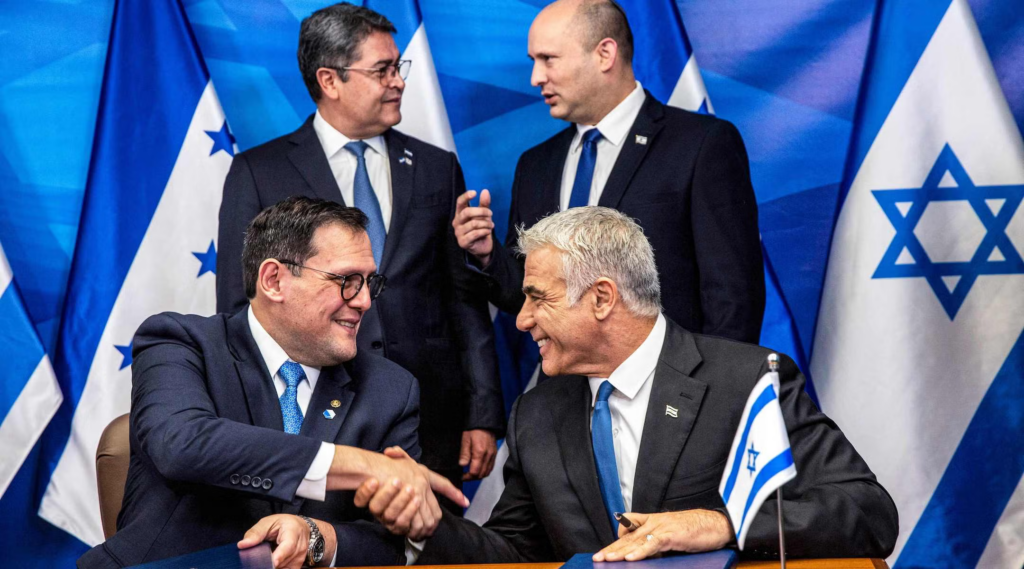
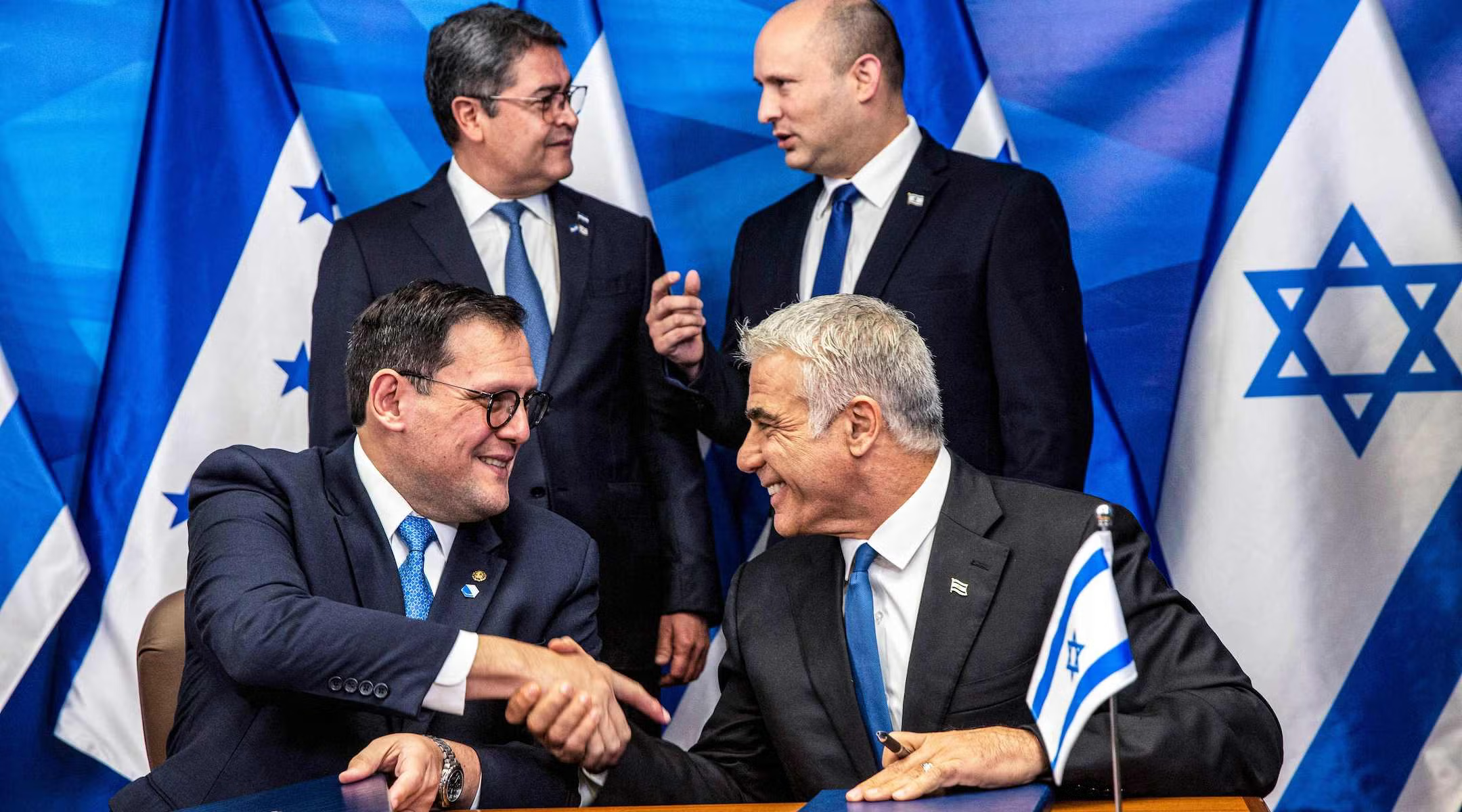
Israeli Foreign Minister Yair Lapid, right, shakes hands with his Honduran counterpart, Lisandro Rosales as Israeli Prime Minister Naftali Bennett, top right, speaks with Honduran President Juan Orlando Hernandez during the signing of bilateral agreements at the prime minister’s office in Jerusalem, June 24, 2021. (Source: Heidi Levine/AFP via Getty Images)
The CIA has complemented Israel’s long-term strategy by employing ostensibly humanitarian or religious NGOs, such as USAID, World Vision, and Church World Service (CWS), to fracture Honduran civil society. By promoting Protestantism over the historically cohesive Catholic majority and supporting programs that exploit divisions along religious, racial, and social lines, including tensions within the Garifuna community influenced by organisations such as OFRANEH, the CIA created fertile ground for ideological manipulation and elite control. Together, the actions of Israel and the CIA have destabilised Honduran society, skewed politics in favour of external interests, and amplified societal divisions. The 2025 elections starkly revealed these dynamics, exposing a democracy heavily shaped by decades of foreign intervention and manipulation.
While Honduras showed some symbolic independence, such as recalling its ambassador from Israel in November 2023, there is a strong case to argue that the deep structural influence of Israel and the U.S, reinforced over decades through military, economic, religious, and civil society channels, created a 2025 electoral landscape strongly favourable to a pro-Israel government, as confirmed by The Times of Israel. Nasry Asfura, promoted by President Trump, embodied this alignment, openly supporting Israeli interests and continuing policies that reinforced the country’s pro-Zionist orientation, making the elections less a contest of domestic politics and more a predictable outcome of long-term foreign influence.
Honduras is a nation under the shadow of powerful foreign influences, where politics, religion, and society have been quietly shaped for decades. The following article investigates how Israeli interests, CIA-backed NGOs, and elite manoeuvring have fractured communities, manipulated loyalties, and set the stage for the tensions that exploded during the 2025 elections…
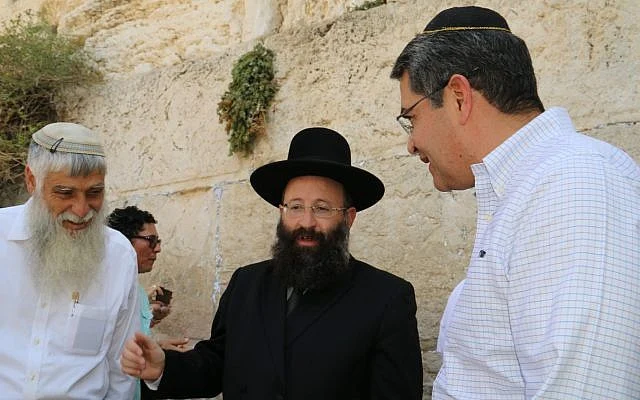
Honduran President Juan Orlando Hernandez visits the Western Wall in Jerusalem, September 1, 2019 (courtesy Western Wall Heritage Foundation)
Hondurans Curiously Ambivalent On Palestinian Genocide
Thomas Tomczyk writes for PÄYÄ Magazine…
Hondurans have been mostly silent regarding the reported genocide taking place in Gaza over the past two years. The question is: Why such silence? Are Hondurans unaware of the massacres and starvation used against Palestinians in the occupied territories? Do they not care, or are they perhaps afraid of something? “To learn who rules over you, simply find out whom you are not allowed to criticise,” the saying goes.
There was one example of Hondurans protesting Israeli crimes against Palestinians during the Gaza war after the Hamas attack and Israeli stand-down operation of October 7. On October 23, 2023, dozens of Honduran Palestinians demonstrated in front of the Israeli Embassy in Tegucigalpa. Since then, the long-established and influential Arab Palestinian community has been mostly silent about the plight of their Palestinian relatives amid Israel’s escalating atrocities in Gaza and the West Bank.
There is certainly a disconnect, as the 300,000 members of Honduras’ Christian Palestinian community are the third and fourth generations to be born outside of Palestine. Their ancestors began arriving in Honduras from Palestine in the 1890s, and today their connection to and knowledge of Palestine and Israel is mostly superficial. Most Honduran Palestinians don’t know the full scale or nature of the barbarism inflicted on their compatriots who stayed behind and continue to face Israeli oppression, violence, discrimination and now genocide. A Honduran Palestinian businessman told me that many in his community are afraid of being accused of anti-Semitism and facing potential consequences. Simply acknowledging that a systematic genocide may be occurring in Gaza is viewed by some as anti-Semitic.
It is hard not to notice. Since October 2023, Israeli military actions have resulted in the deaths of many Christian civilians in Gaza who have nothing to do with Hamas. In October 2023 Israeli military bombed a Christian orthodox church and murdered 18 Christians. In December 2023, Israeli snipers executed two Palestinian women on the Gaza Holy Family Catholic church property. In July 2025, Israeli soldiers fired a tank shell at a cross of the same church, killing three and wounding a catholic priest. While this all fell on deaf ears in Honduras, it does seem that the Israelis don’t like Christians very much.
One person who spoke with concern about the plight of Palestinians was President Xiomara Castro. In November 2023, the Honduran government recalled its ambassador to Israel for consultations due to escalating massacres of Palestinian civilians in Gaza. President Castro described Israel’s actions in Gaza as genocide during a U.N. speech in September 2024. Still, words have not turned into actions. Honduras is nowhere near recognising Palestine as an independent state or moving its embassy from Jerusalem back to Tel Aviv. In fact, Honduras remains firmly in the pro-Zionist camp as it continues to support Israel’s military by purchasing 15 Black Mamba military vehicles. Pro-Zionist sentiment is strong in Honduras. Israeli flags are flown throughout the country. Hondurans increasingly wear the Star of David around their necks, and taxi drivers display the Israeli emblem on their vehicles. Honduran roots of Zionism and Judeophilia run deep, well over a century.
The country now counts three of its presidents to be Jewish: Juan Lindo, Ricardo Maduro and Juan Orlando Hernández. In fact, you could argue that there was a fourth Jewish president of Honduras who ruled the country from 1911 well into the 1950s. Samuel Zemurray, the Banana King, was responsible for the 1911 Honduran presidential coup that secured land and concessions for his United Fruit banana company. American mercenaries hired by Zemurray deposed President Miguel Dávila and made Honduras his “banana republic.” Zemurray installed his puppet, Manuel Bonilla, as president and received 20,000 acres of land in return. After President Bonilla’s death in 1913, Zemurray continued to be a virtual puppet master of several other Honduran presidents.
In 1947, the World Zionist Organisation tasked Zemurray with delivering Honduras’ U.N. vote in support of the creation of the state of Israel. Reportedly, in a personal phone call, Zemurray tried to bribe then-Honduran President Tiburcio Carías Andino. Because of pressure from the Honduran Palestinian community, Honduras abstained from voting for Israel. Since then, and with plenty of CIA help, Christian Zionism has made many inroads in Honduras. CIA fronts such as World Vision, USAID and Protestant Church World Service for many decades worked to undermine the cohesiveness of Honduran society.
Since the 1950s, the CIA, which some critics considered an Israeli-captured agency, promoted the establishment and expansion of Protestant churches in Latin America. The excuse given was that Protestants were more anti communist and a good alternative to the Liberation Theology preached in many Catholic parishes.
The percentage of Catholics in the country fell from 97% in the 1960s to 47% today. Protestant denominations undermined the Catholic cohesion of Honduran society. Religiously divided Honduras is much easier to manipulate, with one denomination pitted against another. Sixty years later, those Catholic-to-Protestant converts have not only become Zionists, but they are also actually converting to Judaism. According to El Heraldo, 37 families converted to Judaism and, in 2022, established Honduras’ first synagogue. The San Pedro Sula Mishkan Shlomo synagogue members advertise their plans to Judaise and convert thousands of Hondurans.
“The plan is for the expanded synagogue to be a six-story, shaped like a Star of David building and be able to accommodate 456 people. This would make it the biggest synagogue in Latin America.”
Ex-President Juan Orlando Hernández was key in the expansion of Judeophilia and Zionism in Honduras. Just in terms of economy, according School of the Americas, between 2013 and 2019, Honduras purchased $342 million in military and surveillance equipment from Israel. Basically, Honduras has been supporting Israel to the tune of around $5 million a month for that period. Road to conversion of Juan Orlando Hernández began in the early 1990s when he completed a one-year Mashav leaders course in Israel. Israel’s investment in JOH obviously paid off as he learned Hebrew, moved Honduras’ embassy to Jerusalem in 2021, and converted to Judaism with his entire family in 2021. The last one, right before going to a US jail for 45 years, was convicted of decade’s long drug and arms smuggling operation.
Honduras is likely getting set up for a rough ride. Israel funded military dictatorships where even the CIA would not venture. Israel trained and supplied arms to many bad actors that destabilised the region: the genocidal regime in Guatemala in the 1980s, Colombian drug smuggling death squads, Los Zetas drug lord Heriberto Lazcano. “Israel has given its soldiers practical training in the art of oppression and in methods of collective punishment. Some of those officers choose to make use of their knowledge in the service of dictators,” said Israeli general Mattityahu Peled.
“Honduras will likely become an increasingly polarized and violent society.”
There is also a growing Israeli pressure on the Honduran public by co-opting its anti-Gaza genocide sentiment into nebulous movements. The normally restrained Honduran Ministry of Foreign Affairs complained that Israeli Ambassador Nadav Goren meddled in internal Honduran affairs by meeting with Protestant church leaders preparing for the August 16 March for Peace and Democracy. “We express to the Honduran people our deep discomfort at their participation in said public event. The involvement of a diplomat not only ignores his limitations,” stated the Honduran ministry. There are plenty of other players seeking discord. Until its recent defunding by the Trump administration, San Pedro Sula was also home to the Hebrew Immigrant Aid Society (HIAS). The worldwide HIAS organisation does not assist Palestinians, Arabs or Christians in moving to Israel, but uses U.S. tax dollars to help move undocumented migrants through Honduras to the United States.
For decades, certain interest groups have promoted racial resentment —particularly among Black communities— while fostering a sense of guilt among white, European and Christian populations. In Honduras, this strategy is reflected in the 23-year-old movement known as the Fraternal Organisation of Honduran Blacks (OFRANEH), which has received funding from organisations such as American Jewish World Service and the Open Society Foundations, founded by George Soros. These groups have been involved in fermenting revolutions, protests and underhanded political activism around the world. Just as with organisations such as Black Lives Matter and ANTIFA, which were recently designated by the U.S. as a terrorist organisation, OFRANEH fosters division, racial tension, grievances and expectations of compensation in the historically well-integrated Garifuna community. Honduras, in the second quarter of the 21st century, will likely become an increasingly polarised and violent society. Powerful interest groups are working hard to implement this, and Roatan is increasingly a party to those tensions. In September 2025, OFRANEH conducted demonstrations in Cayos Cochinos, and in March 2025, there were protests in Diamond Rock. Tensions on Roatan are just starting to heat up.
Attacks on international agencies and arrests of Palestinian aid workers part of systematic Israeli assault
By Charlotte Kates – Samidoun Palestinian Prisoner Solidarity Network – October 2, 2016

Two Palestinian UN and international NGO workers in Gaza, Mohammed al-Halabi and Waheed Bursh, have been targeted by the Israeli occupation for arrest and military prosecution in high-profile cases that seemingly aim to imprison not only these individual Palestinians, but also to pressure international agencies into a further separation and deeper division from the Palestinian people under occupation with whom they work, and towards control and authorization by Israeli occupation forces.
Mohammed al-Halabi, the operations manager for World Vision in Gaza, was arrested by Israeli occupation forces on 15 June as he crossed at the Beit Hanoun/Erez crossing (to which he had already been given a permit by the Israeli occupation.) After being held incommunicado and under interrogation, facing torture and abuse for over a month and a half, Al-Halabi was accused in a showy statement of allegedly “diverting” up to $50 million USD to the Palestinian resistance organization and political party Hamas – based on a “confession.” Despite the allegations, World Vision noted that its “cumulative operating budget in Gaza for the past 10 years was approximately $22.5 million,” making the alleged amounts of money involved materially impossible. World Vision also noted that “Mohammad El Halabi was the manager of our Gaza operations only since October 2014; before that time he managed only portions of the Gaza budget. World Vision’s accountability processes cap the amount individuals in management positions at his level to a signing authority of US$15,000.”
Nevertheless, Israeli prime minister Benjamin Netanyahu issued a video message alleging that the Israeli occupation project “cared more” about Palestinians than Palestinian leadership organizations, particularly Hamas in Gaza. While the Israeli occupation state controls access to Gaza and entirely occupies its sea and skies, it claims to not have control or occupying power over Gaza. Nevertheless, the Israeli occupation state is imprisoning Al-Halabi for matters that – even taking their tortured “confessions” at face value – is seemingly entirely internal to Palestinians in Gaza and international organizations working with them.
It should be noted that the allegations against Halabi appear to be based entirely upon confessions obtained through torture and potentially the word of a collaborator or a “disgruntled employee” who disappeared from Gaza to Egypt after his firing from World Vision by Halabi; this is reflected in the clearly inaccurate financial amounts reported in coverage of this case. Perhaps because of the very weakness of the allegations themselves, Halabi will allegedly be tried in a “secret court,” reported his lawyer, Lea Tsemel. Despite the origins of the allegations (confessions obtained through torture) and their seeming physical impossibility, both the Australian and German governments suspended aid to World Vision. While World Vision has announced its trust in its staff, the cut in funds – and an Israeli freeze on its bank account in Jerusalem for the international Christian charity – has meant that over 120 local Palestinian staff have been laid off in Gaza and operations are suspended, where unemployment already ranges near 40% and poverty forces Palestinians to rely on international aid.
This is not the first run-in between the Israeli state and World Vision. Israel and its supporters in NGO Monitor attacked the Christian charity in 2004 for supporting Palestinian rights, thus “support for terror.” World Vision’s programs came under attack previously by Mossad-linked law firm “Shurat Ha-Din,” known for its pursuit of dubious yet fiscally draining lawsuits against opponents and critics of Israel around the world, Shurat Ha-Din attacked World Vision and other charities for their support for the work of the Union of Agricultural Work Committees, a land and water defense organization operating in the West Bank and Gaza that has been honored with the UN’s Equator Prize and is a member of the global peasant movement, Via Campesina. Shurat Ha-Din demanded an end to Australian support of World Vision, claiming that UAWC was a “front” for Palestinian leftist political party, the Popular Front for the Liberation of Palestine. Shurat Ha-Din’s efforts were rejected in Australia and refuted both by the Australian government and World Vision itself. Still, the continuing focus on World Vision and its engagement with local Palestinian organiztions in Gaza appears to be a continuing thread in Israeli surveillance and repression.
While Halabi was arrested on 15 June, Waheed Bursh, a Palestinian engineer contracted by the UN Development Program (UNDP) was arrested one month later, also as he crossed the Beit Hanoun/Erez crossing, for which he had previously received a permit. The case of Bursh is particularly striking: over two weeks after his arrest, and several days after the public announcement of the allegations against Halabi, he was accused by the Israeli occupation of allegedly “diverting” rubble in Gaza created by the massive Israeli bombing of Gaza in 2014 for Palestinian use to shore up a port and jetty on Gaza’s north shore. The Israeli occupation accuses the rubble of being “diverted to Hamas,” but it is distinctly unclear if that simply means to the Palestinian Authority in Gaza, which is run by Hamas officials – and in any case, the UNDP itself reaffirmed that the rubble in question was directed as agreed to a civilian area and there “was no diversion.”
This case is, essentially, about whether Palestinians have the right to decide in any small way what to do with the massive rubble created when hundreds of thousands of Palestinians’ homes in Gaza were destroyed by Israeli bombs and warplanes – and that any individual Palestinian following Palestinian direction in such a case is subject to torture and imprisonment. Not only does Israel declare the right to bomb and destroy Gaza at will; it also declares the right and ongoing authority to determine the usage of the rubble created by its bombing and destruction.
The Bursh case highlights the insufficiency and the injustice of the UN “reconstruction program” for Gaza, which has seen both an extremely high level of inefficiency as only a small portion of the buildings destroyed in Gaza have been rebuilt, but also an extremely high level of utter disregard for Palestinian sovereignty and internationally-recognized rights, instead creating a program in which all access to funds and building materials is dependent on the approval of the Israeli occupation that destroyed those places to begin with.
The UN has argued that Bursh is immune from prosecution given his UN role, and that he acted according to the request of the Palestinian Authority. This case is not only about the imprisonment of one Palestinian engineer, but about who has the right to build with the rubble created by Israel’s bombs, and who decides: Palestinians, including their political forces? Or international organizations with the consent and oversight of the Israeli occupation? Or, perhaps more precisely, the Israeli occupation, with the work carried out by international organizations and highly subjugated Palestinian staff?
Both the Gaza reconstruction mechanism and the Halabi and Borsh cases highlight the severity of the ongoing Israeli occupation of Gaza as well as an apparent political priority of disempowering Palestinian non-governmental organizations and even staff of international organizations in any context in which they operate outside of complete Israeli control. While the Israeli occupation has generally supported the “NGOization” of Palestinian society as an alternative to Palestinian resistance organizations, these recent cases appear to indicate an intention for Israel to outsource not only the costs but also the repressive mechanisms of its occupation of Gaza to international organizations, thus requiring the dismissal and complete control of any local Palestinian staff empowered to make independent decisions.
Conditional aid that requires all staff at an organization not to be members of any organization on the US list of “foreign terrorist organizations,” such as that distributed by USAID, has commonly been discussed as a long-running problem in Palestinian civil society. The US FTO list includes major Palestinian political forces such as Hamas, the PFLP, Palestinian Islamic Jihad and even Fateh’s armed wing; similar lists are to be found in the European Union, Canada, Australia, the UK and elsewhere – although Hamas is currently fighting a legal case for removal from the EU’s list. Further, the overall impact of international donor funds in directing the priorities of Palestinian organizations away from Palestinian national liberation and towards “projects” and state-building amid ongoing occupation and oppression, and demobilizing the Palestinian national movement into “civil society” or “interest groups” has been the subject of intense discussion among Palestinian organizations and activists.
In Gaza in particular, the filing and heavy publicity surrounding the Halabi and Bursh cases seems to indicate that the Israeli state is pursuing an even heavier hand on all forms of Palestinian organization and even Palestinian roles in directing the work of international organizations. Palestinian organizations in 1948 Palestine have come under attack through new laws designed to block “foreign funding,” while the Balad/National Democratic Assembly political party, represented in the Knesset by Jamal Zahalka, Haneen Zoabi and Basil Ghattas, has been subject to a series of raids and arrests accusing them of undisclosed “foreign funds.” Of course, Palestinian organizations like Addameer Prisoner Support and Human Rights Association, the Palestinian Prisoners’ Center for Studies and other organizations in the West Bank continue to be subject to arrests, raids and other attacks by occupation forces, while Israel continues to threaten escalation against Palestinian civil society organizations supporting the growing boycott, divestment and sanctions (BDS) movement. Ben White in Al-Jazeera noted that “Israeli minister Gilad Erdan has claimed that the accusations against Halabi prove the government’s claim that ‘there are extensive ideological and monetary ties between terrorist organisations and delegitimisation organisations that work against Israel.’”
Ali Abunimah of the Electronic Intifada wrote, “But by spreading sensational allegations that a group as well-known as World Vision is ‘funding terrorism,’ Israel may seek to put other organizations and the Israel-friendly Western governments that fund them on notice that all their operations, especially in Gaza, are at its mercy. It may also be an effort to break growing solidarity for Palestinians in churches, where there has been a strong push to hold Israel accountable through boycott, divestment and sanctions.”
These allegations perhaps bear the closest resemblance to early-to-mid-2000s calls from the Israeli occupation and Western states regarding “corruption” in the Palestinian Authority under Yasser Arafat. Viewing the PA’s role in outsourcing the costs of occupation and suppressing Palestinian resistance as apparently insufficient, Israeli and Western charges of corruption and demands for higher levels of international and Israeli control led in part to the imposition of Mahmoud Abbas as a prime minister and the “Daytonization” of PA security forces under US command, removing Fateh loyalists and turning them into even more of a direct mechanism for security cooperation with the Israeli occupation.
Circumstances differ in that corruption in the PA was – and remains – a legitimate concern of Palestinians (although higher levels of Israeli and international control in fact exacerbated the problem and were opposite to the solutions demanded by Palestinians), while in these cases the arrests reflect entirely Israeli interests at the expense of Palestinians. However, the projected outcomes are similar in the re-orienting of international organizations as opponents and monitors of Palestinians and the escalation of international and Israeli control at the expense of even the most individual and basic levels of Palestinian control or self-determination.
The roots of the prosecution of Halabi and Bursh, the shuttering of World Vision’s programs and the threat of further raids and prosecutions against Palestinian staff of international organizations can also be found in the use of “foreign terrorist lists” by international states and bodies to criminalize Palestinian political life and resistance. While the United States, European Union, Canada, UK, Australia and other states are clearly not opponents of either state-sponsored or non-state violence when carried out by allies and agents, and while Palestinians are internationally recognized as an occupied people with rights to sovereignty and self-determination, Palestinian resistance organizations are routinely labeled as “terrorist.” In the post-Oslo era, the drive to redefine the Palestinian struggle from an anti-colonial national liberation movement into a “state-building project” and a “mediated conflict” with the Palestinian Authority as its reference has been used to criminalize and prosecute Palestinian organizing not only inside but also outside Palestine, while obscuring the nature of Palestinian reality today.
That governments such as those of Australia and Germany chose to cut funding to World Vision in response to these allegations rather than defend an occupied people under colonization and denounce the actions of a belligerent occupier abducting and accusing people under occupation of using funds and, indeed, the rubble created by the occupier’s bombing, in their own interest, indicates the enmeshment of these states with the Israeli state in a common support for settler colonialism, Zionism and racism in Palestine and internationally.
From the siege on Gaza – against which the Women’s Boat to Gaza today sails with the support of people’s movements and against the will of Western states and the Israeli occupation – to the imprisonment of over 7,000 Palestinian prisoners, it is nearly impossible to support fundamental Palestinian rights while labeling Palestinian resistance as “terrorist.” Attempts to do so are then only more vulnerable to attacks of this type – while local Palestinian staff attempting to serve their people within the context of international organizations are targeted for secret trials and persecution on the basis of torture-borne “confessions,” even if the charges themselves are materially incoherent or manifestly absurd. Thus, the international reconstruction mechanism in Gaza has only allowed a greater level of Israeli occupation and control of the Strip, while years after Israel’s bombing, Palestinians in Gaza are still living in shelters while their homes remain rubble.
International mobilization in defense of Halabi and Bursh is necessary. It is not enough to demand a “fair trial” when the charges and structure of prosecution exist only as a mechanism of colonialism. It is urgent to stand not only against the persecution of these Palestinian staff but against the entire framework that seeks to undermine Palestinian sovereignty, redefine resistance as “terror” and legitimize ongoing colonization and occupation.
Charlotte Kates is the international coordinator of Samidoun Palestinian Prisoner Solidarity Network. She coordinates the National Lawyers Guild’s International Committee and works with a number of organizations advocating for Palestinian rights.
Featured Video

Chinese jet fuel and the myth of energy independence
or go to
Aletho News Archives – Video-Images
Book Review
Former Insiders Criticize Iran Policy as U.S. Hegemony
By GARETH PORTER | CounterPunch | February 27, 2013
“Going to Tehran” arguably represents the most important work on the subject of U.S.-Iran relations to be published thus far.
Flynt Leverett and Hillary Mann Leverett tackle not only U.S. policy toward Iran but the broader context of Middle East policy with a systematic analytical perspective informed by personal experience, as well as very extensive documentation.
More importantly, however, their exposé required a degree of courage that may be unparalleled in the writing of former U.S. national security officials about issues on which they worked. They have chosen not just to criticise U.S. policy toward Iran but to analyse that policy as a problem of U.S. hegemony. … continue
Blog Roll
 Aletho News
- What is fueling unrest across the EU?
- Why no power can undermine Iran’s eternal dominance over the Strait of Hormuz
- Is The War Against Iran Over?
- Iran war will leave long-term ‘scar’ on Wall Street, investors warn
- How Iran decimated US power projection in West Asia: Military lessons of 40-day war
- Iran’s report details US-Israeli war crimes in targeting schools, hospitals, livelihoods
- NATO’s Slow Fracture: How Trump’s Iran War Exposed the Instrument of Hegemony
- Chinese jet fuel and the myth of energy independence
- Ukraine Sea Drone Fired From Libya Hit Russian Tanker in Mediterranean
- IRGC: Iranian forces launched no attacks during ceasefire hours
- If Americans Knew
- Military aid to Israel emerges as the latest political litmus test for Democrats
- The only Palestinian children’s rights organization closes following years-long Israeli campaign against it
- ‘I Can’t Forget the Smell’: Lebanese Reel After Israel Kills Over 300 in Single Day
- DNC Shoots Down Resolutions Calling Out AIPAC and Limiting Arms to Israel
- TCN: Is Israel Blackmailing President Trump?
- Israel killed at least 303 Lebanese yesterday – who were they? Daily Update
- Amnesty: Urgent – Protect Lebanese civilians from brutal escalation in Israeli attacks
- Is The War Against Iran Over?
- Inside the Israeli army’s propaganda wing
- Hundreds of Gaza Amputees Stranded in Legal Limbo
- No Tricks Zone
- New Study: No Linear Warming Or Glacier Retreat Along Northern Antarctic Peninsula Since 1980s
- An Inconvenient Tree: Uncovered In Alps… Europe Much Warmer Than Today 6000 Years Ago
- New Study Reports A 60% Slowdown In Greenland’s Ice Loss Rate In The Last Decade
- Low Intensity Tornado Wrecks Major Solar Farm, Creating A Potential Toxic Dump
- New Study Finds Warming Saves Lives…Cold Temperatures 12 Times More Deadly Than Excess Heat
- German Science Blog Accuses PIK Climate Institute Of Hallucinating Climate Tipping Points
- Devastating Assessment Of Comirnaty Vaccine By Former Senior Pfizer Europe Toxicologist
- New Study: CO2 Is ‘Effectively Negligible’ As An Explanatory Climate Change Factor Since 2000
- Former Pfizer Toxicologist Dr. Helmut Sterz Tells Bundestag Hearing Pfizer Vaccine Should Have Never Been Approved
- Energy Expert: Germany’s Nuclear Phaseout Was A “500 Billion Euro Mistake”
 Aletho News