Daesh, Nusra Fighters Begin Turning in Heavy Arms Outside Syrian Capital
Sputnik – 25.12.2015
DAMASCUS – Fighters from the Daesh and the al-Nusra Front have begun giving up heavy weapons to the Syrian army south of the Arab republic’s capital of Damascus, a military source said Friday.
The source said engineer troops arrived with UN representatives near the Yarmouk Camp in southern Damascus on Thursday to accept heavy weapons from the militants.
“The militants who have given up their weapons will be taken toward Beer al-Qasab, an eastern suburb of Damascus, with their families,” the military source told RIA Novosti.
A total of over 3,500 fighters and their family members have so far agreed to leave the suburb of Al Hajar Al Aswad where the camp is located, the source added.
News emerged on Thursday that 5,000 militants and their families would be relocated from Al-Hajar Al-Aswad, Al-Qadam and Al-Asali under an agreement brokered by an unnamed third party starting this weekend.
According to media reports, the militants permitted to carry personal weapons, would be taken to the Daesh stronghold of Raqqah as part of the agreement.
About 18,000 people are estimated to live in Yarmouk, a Palestinian refugee camp established in 1957.
Daesh militants overran major portions of Yarmouk in early April.
Who Are the Starving and Besieged Residents of Yarmouk and Why Are They There?
By Paul Larudee | Dissident Voice | April 21, 2015
There are many illusions about what is happening to the Yarmouk district of Damascus and its Palestinian refugee population. The district was originally set aside in 1957 for Palestinian refugees already living there, whom Israel had expelled from their homes in 1948, with periodic additional populations thereafter. Today it is home to around one million Syrians and Palestinians, of whom the Palestinians number roughly 170,000. Palestinians in Syria have all the rights of Syrian citizens except voting, and in Yarmouk their homes are indistinguishable from those of the Syrian residents.
Starting in 2012, armed elements trying to overthrow the Assad government gained a foothold in Yarmouk. Most Palestinians disapproved, since this violated the traditional exchange of Syrian hospitality for Palestinian neutrality. However, there was no consensus among Palestinians to forcibly expel the intruders.
By June, 2013, the Syrian Arab Army (SAA) had established a siege on the camp in order to prevent further encroachment toward the center of Damascus, which already receives a daily dose of random mortar attacks. (Three landed just outside my hotel in April, 2014, one killing three people.) Most of the population fled, until only 18,000 remained by October, 2013, according to Fateh leader Abbas Zaki, as reported to Ma’an News. Many thousands are now living outside the camp, in shelter provided by the Syrian government and Syrian humanitarian aid organizations.
In April, 2014 I visited a school that had been converted to living quarters for Yarmouk refugees. The accommodations were immensely crowded and by no means comfortable, a consequence of having to provide for nearly 8 million displaced people in government areas, doubling the normal population for those areas. Nevertheless, food is being provided, as well as education and health services.
Until Daesh (ISIS or the Islamic State) entered the camp on April 1, 2015, the figure of 18,000 residents continued to be reported consistently for the next year and a half despite a siege that cut off electricity and water and reduced the availability of essential food and medical supplies. More than a hundred civilians are reported to have died of starvation or lack of medical treatment during those eighteen months. Who are the remaining civilians and why are they refusing to evacuate to outside shelter like so many others?
Local humanitarian relief supervisors report (personal communication) that some of them are not from Yarmouk and some are not Palestinian. They include the families of Syrian and foreign fighters that are trying to overthrow the Syrian government by force of arms, and some of them came from districts adjacent to Yarmouk, such as the Daesh stronghold of Hajar al-Aswad. It is hard to know how many are being forcibly prevented from leaving by the armed groups in the camp and how many choose not to leave because they are afraid of the potential consequences.
Some might be considered “human shields”, used by the fighters to deter attacks against them. But they might equally be concerned about becoming “human hostages” if they leave, i.e. of being used to pressure fighters to surrender. The motivations can be complex, but no evidence has been presented to show that the Syrian government is preventing civilians from leaving the camp. In fact, 90% of the population has already left.
Is the Syrian government preventing the distribution of food and medicine in the camp?
Siege is one of the most common military strategies of the SAA. Typically, the army lays siege to an area and prevents food, medicine and of course arms from entering, to the extent possible. On the other hand it welcomes evacuation of civilians, and provides humanitarian aid to those who leave.
The objective is to remove the civilians from the area as much as possible and then attack the enemy or provoke surrender, sometimes with amnesty as an inducement. This is classic military strategy, though hard on the civilians, as usual.
In the case of Yarmouk, there is another dimension to the siege. The Syrian government has a long-standing agreement with the Palestinian governing council of the camp that it will not enter without their request. However, the council has never made such a request and the Syrian authorities have never asked for permission. This agreement still holds, although Palestinian forces defending the camp against Daesh have recently formed a joint command and are coordinating their efforts with the Syrian military, which has been providing artillery and aerial support. In addition, the army has been attacking areas adjacent to Yarmouk that are Daesh strongholds, in order to impede their access to Yarmouk and prevent resupply to Daesh forces in the camp.
There is no indication that the SAA is preventing humanitarian aid from being distributed in Yarmouk. Despite the siege, it has allowed the stockpiling of supplies on the edge of the camp and it has permitted civilians from inside to collect and distribute the aid. However, the government wants the civilians to leave, not to introduce additional persons into the camp, so it is reluctant to allow outsiders to enter, especially in consideration of the fact that they have no means of assuring their safety. Nevertheless, it has permitted humanitarian NGOs, including UNRWA, to distribute aid roughly half the time.
The result has been a modest but insufficient flow of aid to camp residents until Daesh captured much of the area. In the fighting to defend the camp and retake the Daesh-occuped areas, it has been much too dangerous for anyone to undertake aid distribution, with horrific consequences on the remaining civilians. As a result, the number of civilian residents has probably dropped to less than half of the 18,000 initial estimate, despite their qualms about evacuating.
Has the Syrian military been using barrel bombs on Yarmouk?
There is no recorded use of barrel bombs in Yarmouk before the entry of Daesh in late March, 2015. Their use in April, 2015 is confirmed, although the number of casualties due to such ordnance is astonishingly small. One or possibly two barrel bombs appear to have been dropped on the street outside the Palestine Hospital in the camp, but with no reported casualties. Higher numbers have been mentioned, but without evidence.
During the heaviest fighting, the Syrian Air Force (SAAF) has used both conventional bombs delivered by jet aircraft and “barrel” bombs in the Daesh stronghold of Hajar al-Aswad and the adjacent part of Yarmouk. Residents report hearing dozens of explosions, but it is unclear how many were in Yarmouk, how many casualties there may have been and how many were civilians. A total of 18 civilian casualties were counted in all of Yarmouk during a week of intensive fighting at the beginning of April, but none have been attributed to the barrel bombs and it is uncertain who is responsible for the killings.
Does the Syrian army massacre civilians?
One of the main complaints against barrel bombs and the tactics of the SAA is that they cause massive civilian casualties. There is no doubt that disproportionate numbers of civilian casualties have occurred on specific occasions. Overall, however, the number of civilians killed by government forces and loyalists is less than the number of casualties in the fighting forces themselves, possibly as low as two combatants for each civilian. Not since World War One has this been the case for US forces.
As for the “barrel bombs”, the claims of their use against civilians and their exaggerated savagery do not hold up. Like any bomb, they are made of high explosives, sometimes with projectiles added. In this respect they are no different from many types of explosive ordnance used in military forces throughout the world. They are designed for destruction, including destruction of life.
The complaints against them are that a) they are by nature indiscriminate and hit unintended targets and b) they are almost invariably used against civilians. The first is patently untrue. Conventional bombs are usually delivered by fighter-bombers at high speed and often in proximity to the target. In Syrian and other engagements, the speed of delivery offers protection from ground fire. Such speed also reduces accuracy, but the relative proximity to the target compensates substantially for this disadvantage.
Barrel bombs are usually deployed from relatively a greater height that is out of range of ground fire. However, they are dropped from stationary helicopters, which provides greater accuracy that compensates for the height disadvantage. There are few if any reports of barrel bombs failing to hit their intended target (although occasionally the selected target might be the result of poor intelligence).
It has been reported that thousands of barrel bombs have been used by the SAAF since 2012, when they were first deployed, and that there have been thousands of casualties from such weapons. Unfortunately, little more is known except for anecdotal cases. Although some bombs have resulted in only material destruction, others have caused two dozen or more casualties. The available data do not provide much statistical help, such as the average number of casualties per use. Is it more or less than for convention bombs or for US drone weapons, for example? How many of the casualties are civilians and how many combatants? We do not know, but the overall civilian casualty rate remains unusually low compared to most other conflicts in the past century.
What seems clear is that the western press, governments and NGOs have treated barrel bombs as the devil’s weapon. The reason seems to be that while conventional bombs are capable of inflicting just as much damage and loss of life (and are being used extensively by the Ukrainian government), western arsenals do not contain barrel bombs. If these weapons can be sufficiently vilified as a weapon type rather than by their manner of use, Syrian military forces can be blamed for inhumane weaponry without the taint falling upon nations that use different weapons, even ones that are equally or more destructive. Oddly enough, the inhumane DIME and white phosphorous weapons used in Gaza did not provoke equal condemnation, even though the ratio of Israeli military to civilian casualties has been as much as 100 times higher than for the Syrian military.
Why, then, are Amnesty International, Human Rights Watch, Chris Gunness of UNRWA, and most western press agencies condemning the Syrian government for the use of barrel bombs, for starving camp residents, and for preventing residents from leaving? Palestinians and their supporters are accustomed to false and biased reporting on the subject of Palestine. They know that the western media work overtime to protect Israel. That is their agenda. Do they think that these agencies are unbiased with respect to Syria?
The west, Israel, the Gulf monarchies, Turkey and many sycophants and puppets of western powers have made abundantly clear that they intend to overthrow the Syrian government, in violation of the UN Charter and other international law prohibiting wars of aggression, and against Syrian national sovereignty. AI, HRW, and other human rights imperialists have never once recognized these facts vis-à-vis Syria. In fact, they have supported the west’s illegal push for regime change.
Is it not also clear that western institutions and media are distorting their coverage of Syria in order to promote this goal? Apparently not, even to persons who should know better and are accustomed to seeing such distortions in the reporting on Palestine.
Paul Larudee is one of the founders of the Free Gaza and Free Palestine Movements and an organizer in the International Solidarity Movement.
There is no Palestinian issue for Syrian rebels
By Nadezhda Kevorkova | RT | November 10, 2013
The Palestinian issue has been uniting all Muslims for 65 years. Syrian rebels succeeded in their mission – they made the world forget about the Palestinian issue.
The militants pulled Palestinians out of refugee camps; they are killing them or using these people as human shields. And the media are silent about it, while the Syrian opposition keeps screaming about the “oppressive Assad regime.”
It’s been a year since Syrian rebels raided the largest Palestinian refugee camp in Syria – Yarmouk, near Damascus. Up until recently it was the duty of Israeli soldiers to persecute Palestinians, now this is done by Syrian rebels with their Muslim slogans. The media are not saying anything about it.
What is the life of Palestinians like, now that the Syrian conflict made them refugees again?
‘Nobody is helping us – neither Europe, nor the UN’
Abu-Badr, head of Beirut’s Bourj al-Barajneh refugee camp People’s Committee, gathered representatives of all Palestinian parties. They all keep regular contacts with camps in Syria.
A year after Palestinian camps and Palestinians were attacked, the heads of these organizations are saying that the Syrian war is a staged conflict, and its goal is to distract everybody from the Palestinian problem.
A total of 760,000 Palestinian refugees lived in Syria before the war, and about 550,000 in Lebanon. Palestinians had equal rights in Syria, and virtually no rights in Lebanon. For example, they were not allowed to work in 72 professional capacities.
Abu-Badr says, “There are over 1,000 Palestinian families from Syria in our camp. Nobody is helping us – not Europe, not the UN. The Red Cross came twice. The refugees are renting housing on their own.”
To rent a place to live is a big problem for a Palestinian, especially at the camp. And to pay rent, they have to find a job, which is extremely difficult in Lebanon.
He says that according to the authorities, there are about 120,000 Palestinian refugees from Syria living south of Tripoli. So every tenth refugee is a Palestinian.
Turkey and Jordan don’t accept Palestinians.
Kafar is a young mother of two. She used to live in Syria’s Yarmouk with her family. Now she is struggling to survive in Bourj al-Barajneh in Lebanon.
She fled Yarmouk at the end of 2012, when the rebels took over the camp and made it their foothold to carry out attacks on Damascus.
Yarmouk is one of the largest Palestinian camps in Syria. Before the war it had 150,000 residents, which was almost one-quarter of all Palestinian refugees in Syria. The camp is very close to the Damascus city limits, and there were subdivisions where regular Syrians lived.
Refugee camps are extraterritorial places. Police and army are not allowed there, the residents don’t have citizenship, they don’t vote and don’t serve in the army. Camps are self-governed by representatives of all Palestinian political parties. Unlike all other countries, Syria allowed refugees to leave camps and enjoy all rights and freedoms.
A Syrian family named Lakud brought the fighters to Yarmouk. Palestinians didn’t support the rebels then, and they are not supporting them now. Some parts of the camp are still controlled by the opposition.
A human shield for militants
Kafar recalls: “The entire camp left in a snap back then, when armed militants entered it. They were inside, shooting bullets into the air – they always act the same way. They ordered the residents to leave having placed their orders on different websites and having sent emails. Nobody stayed there.”
In December 2012, some started trying to come back. There are even a few families that decided to stay in the camp, hoping it would get better soon. Kafar says all the houses have been looted – they have taken everything, including electrical wires.
She says the militants were shooting those Palestinians who went out to take part in demonstrations. They wouldn’t let people return to their homes, but in case they did come back home, they couldn’t leave their houses again.
“If the militants went away, we would come back. Sometimes we can contact those inside the camp. They tell us about the blockade – they feel like they live in a cage, they lack food. There is no escape – they are kept as a human shield for the militants,” Kafar says.
She tells us about her relative who went to find her children, but ended up as a hostage in the camp.
“The militants won’t let you come in, but if one has entered – he would be kept there by force. They have established checkpoints. They deprive the people of food and beat the women who try to sneak inside, bringing something to their relatives to eat,” Kafar says.
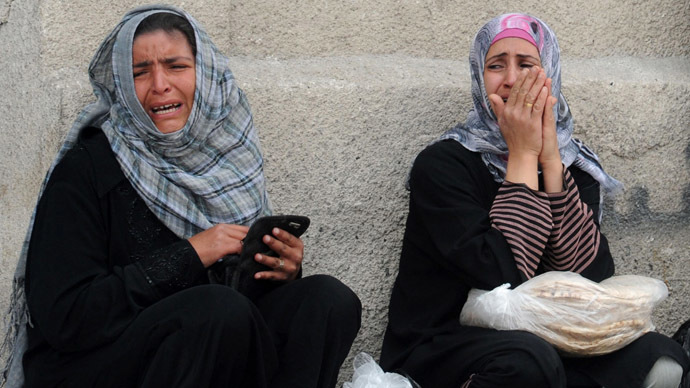
A handout picture released by the Syrian Arab News Agency (SANA) on May 15, 2013, shows protestors crying after unidentified armed groups opened fire on demonstrators as they marched in the Syrian capital Damascus in support of the right to return of Palestinian refugees who fled their homes or were expelled during various conflicts. (AFP/SANA)
Hitting a woman in public is considered absolutely unlawful among Muslims. But Kafar says that the militants in Yarmouk have their own vision of everything.
“We are not afraid of war, but they won’t even feed the people. The al-Nusra militants are tall, wear long beards and look like foreigners. Probably, there are Syrians among them but none of my relatives have ever seen one,” Kafar says.
One blanket for five
Palestinians from Syria in Lebanon are in even more dire straits.
“They humiliate us – we are constantly being insulted,” the woman tells us.
She is showing us around her tiny apartment with two rooms and a kitchen. The ceiling leaks when it rains.
“The rent is $300. If I don’t find money by Sunday, we’ll have to leave for Syria.”
Apart from the rent, they pay $70 for water.
Her father-in-law was killed. Her mother-in-law returned to Syria and now lives with their relatives there.
“I’ll go to Syria and wait there until I can come back home. Staying here is humiliating,” Kafar says.
Her husband takes up any job he can, be it a laborer, carrier or loader.
They have no warm clothes – all their belongings were stolen in Yarmouk. This family doesn’t belong to any group. They got help from different organizations such as Hamas, the Popular Front or some voluntary organizations. But it can hardly be called help – it is more like a mere pittance.
“They gave us one blanket for five people. But we are living creatures,” Kafar says, showing us a thin grey synthetic blanket. She thinks it looks like a cloth that is used to wrap a dead body when burying it.
The family has no money to buy food. They sometimes receive help from neighbors, who share their food with them. I saw them bring some bread and crisps.
‘In Syria, Palestinians are treated better than brothers’
Kafar complains about how the refugee work is organized.
“They distribute some humanitarian aid, but the process is humiliating to us every step of the way. There is fighting in Syria, but Palestinians are respected there. And here they call us Syrian dogs.”
“We had a good life under Assad, not lacking anything. We will go back and live in Syria, even if we have to live in tents. Syrians treat us as equal, they help us,” says Kafar.
In the last year they received help twice – from Hamas and from people from Qatar – about $300 per family, which is less than one dollar a day. But not everybody gets even these payments. There are lists of those who suffer the most in these camps.
She tells us how the process of distributing this aid works.
“A family gets a check for $150 from Qatar. But there wasn’t enough for everybody on the list. So people are humiliated even more. The place where these checks are given is near Beirut, you have to take a taxi to get there and spend half of the money on the ride. They give food stamps for certain food items, which can only be bought in one supermarket. And this store is also far away.”
“You can’t buy meat with these food stamps. Do they think children can go for a year without meat?” the woman asks.
“We are convinced that Syria will welcome us back. They loved us there, treated us like brothers, even better than brothers. We lived better than Syrians themselves,” Kafar says.
She knows that the Lebanese have closed the border for Palestinian refugees. So they can’t go anywhere.
“They accepted us in Syria. When we lost everything, they took care of us. They asked us what we needed. Six blankets? Food? They gave us everything. They didn’t blame us, even though life was difficult for everyone.”
She thinks her family made a mistake when it moved to Lebanon. “We were told life would be good here. Now we regret the decision.”
Her husband came six months earlier, he thought they would be safe here while there is fighting.
‘There is no Palestinian issue for Syrian rebels’
“We Palestinians have played no part in Syria’s distress. We didn’t participate in street protests, and our people did not join the rebels,” says Kafar. She admits to having heard that some Palestinians have, in fact, taken up arms against the Syrian government. But she is certain that is a rare exception.
“Those people must have been seduced by money, or befuddled with drugs, and with false promises. Only the poorest and the most destitute of the Palestinians have gone to fight for money, and it took them 18 months to get that desperate.
“Such people have nothing to eat, so they join the rebels hoping to make some money to sustain their families, and then desert at the first opportunity.”
“We cannot admit to supporting the regime, for fear of being killed on the spot. Those rebels do not consider the Palestinian issue to be of primary importance. There is no Palestinian issue for the rebels at all,” says Kafar.
Every night, the inhabitants of Bourj al-Barajneh go to sleep fearing that al-Nusra militants may descend on the Palestinian refugee camp and start asserting their rule, the way they did at Yarmouk. There is talk that al-Nusra men were spotted recently inside Nahr al-Barrid, another Palestinian camp. Since then, the People’s Committee instituted vigilante patrols across the entire camp.
“Our people control every in and out,” Kafar tells us. “They keep watch at night to make sure no strangers come upon us as we sleep. That’s how it happened in Yarmouk.”
The Syrian army has also set up checkpoints guarding the entrance to each camp.
‘They butchered a family to make the others serve as a human shield’
Yarmouk was not the only Palestinian camp captured and cleared of refugees by insurgents. Moreover, no one can assess the number of Palestinians killed in the process.
A Palestinian woman named Gusun was forced to flee camp Duma near Damascus on September 23, 2012, together with her husband, their three kids, and her husband’s brother.
“There were plenty of olive groves next to our camp. We lived in peace for a long time, until the fighting drew close to our camp. Then, rebels started taking shelter in our camp, hiding in our houses during firefights, and shooting through our windows. And we found ourselves between the hammer and the anvil. So one day, we slipped out at five in the morning and ran away through the olive grove,” Gursun tells me.
“The rebels had killed many people in our camp unflinchingly. They butchered a married couple who were my husband’s kin – they cut their throats, so that the other Palestinians would stay in the camp and serve as their human shield, while the government was commanding us to flee.”
Gusun went back to check on Duma some four months ago.
“I found my home thoroughly looted, its roof smashed,” she recalls. “And the FSA and al-Nusra are still entrenched in the camp.”
“Once their men spotted me at Duma, they came up and questioned me to make sure I was from that camp. They let me go, but they kept watching me. Later, when I went out to a grocery store, I noticed a car tailing me. Then I got scared and ran away from the camp,” says Gusun.
“The rebels I saw were tall and fair-skinned. There are some who don’t speak Arabic, and there are some who do. People have also told me there are black rebels, but I have never seen one. Some rebels wear black vests, some wear masks, some wear short pants, and others wear normal trousers. There are many fair-skinned men among them, those are foreigners.
“When we walked around the camp, we would try not to look them in the face, for fear that they might do us harm,” Gusun says.
‘Palestinians, get out of Syria’
The world’s mainstream media, who have closely followed the insurgency and its war on Assad, have proven squeamish when it comes to covering the way rebels treat Palestinians. In the spring of 2011, they would refute news reports that opposition activists wave Israeli flags and chant anti-Palestinian slogans at their rallies.
This stands to reason: two years ago, the Palestinian issue was still the No. 1 concern for the Muslim world, and an anti-Palestinian stance would have done serious harm to the rebels’ reputation. All the more so as Egyptian revolutionaries at Tahrir Square had been pronouncedly pro-Palestinian, despising Hosni Mubarak for his support for the Israeli blockade of the Gaza Strip.
The women at Bourj al-Barajneh are perplexed at the world’s ignorance of how Syrian insurgents really feel about Palestinians.
“At the onset of the revolution, slogans were like, ‘Carrots belong with carrots and cabbage with cabbage, and this is no land for Palestinians’,” says Gusun, who is shocked that no media have ever reported that the Syrian rebels had initially been against the Palestinians.
“Under these slogans, the armed rebels marched along the streets, angered by the local Palestinians’ reluctance to turn against the regime,” says Gusun.
“In about a year and a half, some Palestinians were in this way or another made to join the rebels. But that didn’t change much the rebels’ opinion of the Palestinians,” remarks Gusun, adding that even now the Palestinians on the side of the rebels are few and far between.
She can’t understand the reason why the Lebanese are treating Palestinians like that. After all, Syria did give shelter to 1 million Lebanese and Palestinian refugees after the 2006 Israeli attack.
“During the 2006 war we welcomed the Palestinians like family. But now we are being treated as outsiders.”
At that time, all the refugees from Lebanon found home, food and clothes straight on arrival.
Gusun was lucky to have found a job, and so was her husband. “I had to work as a cleaning lady. I’d never done anything like that before. But we had to survive somehow. The UN gives only $30 once every four months.’
It was crucial for the sponsors of the anti-Syrian campaign to shift the focus of one and a half billion Muslims from Palestine to the war against Assad. And their mission almost succeeded.
The issue of Palestine used to bring everyone together: Communists and atheists, the Sunni and the Shia, Christians and Muslims, left- and right-wingers, anti-globalists and nationalists. Now the war in Syria has torn them all apart.
Fast forward two years, there are no more rallies against the occupation of Jerusalem, no ships trying to break through the Gaza Strip and the West Bank blockade. In the meantime, this blockade has grown even tougher after the military coup in Egypt, with the abuse of Palestinians in the West Bank escalating into ethnic cleansing.
The sponsors of the war repeatedly tried to get Palestinians to back intervention into Syria. But their efforts failed: from Hamas to the Palestinian Islamic Jihad to the Popular Front to Fatah, not a single Palestinian organization has ever supported the campaign.
Nadezhda Kevorkova is a war correspondent who has covered the events of the Arab Spring, military and religious conflicts around the world, and the anti-globalization movement.
Militants fire at Syrian civilian plane in Aleppo airport
Press TV – December 21, 2012
Militants fighting against the Syrian government have fired at a civilian plane as it was preparing to take off from Aleppo airport.
A militant commander told Reuters on Friday that snipers from his brigade had hit the wheels of Syrian Airways flight RB201 a day before.
The commander, who gave his name only as Khaldoun, said the attack was a message to the government that all planes, either military or civilian, are within the militants’ reach.
It was the first direct attack on a civilian flight since fighting escalated between foreign-backed militants and government forces a few months ago.
Meanwhile, Palestinians are returning to their homes in Yarmouk refugee camp in Damascus after government forces managed to clear the camp of militants.
Syria has been experiencing unrest since March 2011. Many people, including large numbers of army and security personnel, have been killed in the turmoil.
A recent UN report has revealed that militants from 29 countries have so far filtered into Syria to fight against the government of President Bashar al-Assad, most of whom are extremist Salafists.
The Syrian government has repeatedly said that the chaos is being orchestrated from outside the country, and that a very large number of the militants operating in the country are foreign nationals.
Israel strikes Sudan military facility: minister
Al Akhbar | October 24, 2012
Sudan’s information minister has accused Israel of striking a Sudanese military factory Wednesday causing it to explode and burst into flames.
An AFP reporter several kilometres (miles) away saw two or three fires flaring across a wide area, with heavy smoke and intermittent flashes of white light bursting above the state-owned Yarmouk facility in southern Khartoum.
“I heard a sound like a plane in the sky, but I didn’t see any light from a plane. Then I heard two explosions, and fire erupted in the compound,” said an area resident who asked to be identified only as Faize.
Witnesses said the explosions started at about midnight on Tuesday.
A woman living south of the Yarmouk compound also reported two initial blasts.
“I saw a plane coming from east to west and I heard explosions and there was a short length of time between the first one and the second one,” she said, asking not to be named.
“Then I saw fire and our neighbour’s house was hit by shrapnel, causing minor damage. The windows of my own house rattled after the second explosion.” Abdul Rahman Al-Khider, the governor of Khartoum state, told official media that preliminary investigation found that the explosion happened in a store room.
He dismissed speculation that “other reasons” caused the incident.
Khider said some people were hospitalized because of smoke inhalation but he gave no numbers.
The blaze spread to a neighbouring area of grass and trees, he said, adding that an investigation was underway to find the cause.
In 1998 Human Rights Watch said that a coalition of Sudanese opposition groups had alleged that Sudan stored chemical weapons for Iraq at the Yarmouk facility but government officials strenuously denied the charges.
In August of that year United States cruise missiles struck the al-Shifa pharmaceutical factory in North Khartoum, which the US said was linked to chemical weapons production. Evidence for that claim later proved questionable.
The sprawling Yarmouk facility is surrounded by barbed wire and set back about two kilometers from the district’s main road, meaning signs of damage were not visible later Wednesday when an AFP reporter visited.
But at least three houses in the neighbourhood had been punctured by shrapnel which left walls and a fence with holes about 20-centimetres (eight inches) in diameter, the reporter said.
There was also slight damage to a Coca-Cola warehouse.
A source familiar with the Yarmouk factory said its main compound and storage area had not been damaged by the explosions or fire.
Hannan, a resident who gave only one name, said some people had fled the area on foot because of the early-morning explosions, while others put their children in cars ready to make a getaway.
The fires appeared to be extinguished by 0030 GMT, more than three hours after they began, an AFP reporter said.
There have been other mysterious blasts in Sudan.
On the country’s Red Sea coast in May one person was killed when a car exploded, about a year after Sudan blamed Israel for an air strike on a vehicle in the same area. Witnesses to the May incident said they heard a big blast that set the car ablaze and left two holes in the ground.
In January 2009, foreign aircraft struck a truck convoy reportedly laden with weapons in eastern Sudan.
A September report from the Small Arms Survey, a Swiss-based independent research project, said evidence from weapons packaging suggests that Chinese-origin arms and ammunition are exported to the Yarmouk facility.
From there they have subsequently moved to Sudan’s far-west Darfur region which has been plagued by conflict for almost a decade, the report said.
Small Arms Survey said it was not clear whether Yarmouk served simply as a recipient “or whether they repackage or even assemble the Chinese-made weapons.”
Khartoum is seeking the removal of United States sanctions imposed in 1997 over support for international terrorism, its human rights record and other concerns.
(AFP, Al-Akhbar)
Featured Video
Prof. Ted Postol: Iran Already Achieved Nuclear Deterrence Against Israel
or go to
Aletho News Archives – Video-Images
From the Archives
How the occupied mentality syndrome works
Saudi Arabia on the American chessboard – Part 3
By B. J. Sabri | American Herald Tribune | June 27, 2016
Read part 2: “The occupied mentality Syndrome“
Previously I argued whether Saudi Arabia’s repeated involvements in U.S. interventions and wars stem from free national will or in response to a specific condition. For starters, in Saudi Arabia there is no national will. In Saudi Arabia, the national will is the will of the Al Saud clan. Still, when a major Arab state allies itself with a superpower that committed unspeakable crimes against humanity in almost every Arab country, then something is wrong. This fact alone should compel us to examine the U.S.-Saudi relation for one exceptional reason. As a result of the U.S.-Saudi wars, hundreds of thousands of people in Afghanistan, Iraq, Iran, Libya, Syria, Yemen, and Somalia have lost their lives. Millions became displaced in their own homelands. And millions more rendered refugees.
Attributing the Saudi policies to the bonds of “partnership” with the U.S. is frivolous. There are no bonds between these two thugs except those of business, military deals, secret plots, and wars. Proving this point, bonds such as these have no space for the American and Saudi peoples to share significant cultural or societal exchanges. If partnership is not the reason for the Saudi contribution to the U.S. strategy of empire and imperialism, then another reason must exist.
This leads to three possibilities. … continue
Blog Roll
 Aletho News
- Al Mayadeen voices solidarity with Dr. Marandi amid death threats
- US dismantling international law in its war against Iran while claiming ‘false’ victory: Legal scholar
- One martyr, 5 injuries in US attack on Iraqi border crossing with Iran
- ‘This war is Israel’s war’: World facing ‘security breakdown’, says Qalibaf
- IRGC decries attack on US embassy in Riyadh, says executed by ‘Israel’
- Iran blasts EU hypocrisy as EU invokes international law over Hormuz
- There is no military solution to Strait of Hormuz
- NATO’s structural collapse – the outcome of deviation from reality
- Poll finds world views China better than US
- One Of America’s Leading Neo-Cons Has Turned Against The Iran War And Israel
- If Americans Knew
- US loses planes over Iran, Israel downgrades Lebanon war goals – Daily Update
- Israel Is Blocking Palestinians from Easter at Church Where Jesus Resurrected
- Plot to assassinate Palestinian activist follows harassment campaign promoted by Zionist groups and elected officials
- Prominent New York synagogue hosts presentation on why U.S. Jews should support the ethnic cleansing of Gaza
- Tapper vs. Piker: Is the CNN Anchor Auditioning for David Ellison?
- Shouldn’t Democrats Be Able to Condemn Genocide?
- Israel-US kill negotiators, destroy civilian structures, but Iran’s military capabilities still largely intact – Daily Update
- ‘War crime’: Global condemnation as Israeli ministers celebrate death penalty law targeting Palestinian prisoners
- 7 Ways Israel Is Turning Lebanon Into Gaza
- World’s Leading Football Bodies Under Fire Over Israel Policies
- No Tricks Zone
- An Inconvenient Tree: Uncovered In Alps… Europe Much Warmer Than Today 6000 Years Ago
- New Study Reports A 60% Slowdown In Greenland’s Ice Loss Rate In The Last Decade
- Low Intensity Tornado Wrecks Major Solar Farm, Creating A Potential Toxic Dump
- New Study Finds Warming Saves Lives…Cold Temperatures 12 Times More Deadly Than Excess Heat
- German Science Blog Accuses PIK Climate Institute Of Hallucinating Climate Tipping Points
- Devastating Assessment Of Comirnaty Vaccine By Former Senior Pfizer Europe Toxicologist
- New Study: CO2 Is ‘Effectively Negligible’ As An Explanatory Climate Change Factor Since 2000
- Former Pfizer Toxicologist Dr. Helmut Sterz Tells Bundestag Hearing Pfizer Vaccine Should Have Never Been Approved
- Energy Expert: Germany’s Nuclear Phaseout Was A “500 Billion Euro Mistake”
- New Research: South Australia’s Mid-Holocene Sea Surface Temperatures Were 4°C Warmer Than Today
 Aletho News