Why the US is failing in the Red Sea: Responsible Statecraft
Al Mayadeen | August 30, 2024
When Yemen’s Ansar Allah declared the Red Sea as part of the support fronts backing the Palestinian people and their Resistance, the United States announced that it would try to subvert its operations to protect Israeli ships and shipments, trapping itself in an indefinite and congressionally uncertified military conflict in the region.
Coined “the most intense running sea battle” the US has seen since World War II, Washington’s decision to enter the Red Sea rapidly transpired into “the epitome of strategic malpractice“, an op-ed published by Responsible Statecraft said.
According to authors Jonathan Hoffman and Benjamin Giltner, the US military conquest in the Red Sea is not only failing but also exposing US military personnel in the region to extreme danger to protect foreign vessels, as well as risking escalation and the destabilization of not only Yemen but the entire region.
Hoffman and Giltner expand on the reasons for the US failure in the Red Sea and explain that they stem primarily from Washington’s willful ignorance and refusal to acknowledge the main motive behind Ansar Allah’s operations [that being the Israeli genocide in Gaza], clearing all hopes it has for triumphing in the region.
A vain costly conquest
The United States deployed its forces in the Red Sea, firstly to counter the Yemeni ban on Israeli-affiliated or Israeli ships under Operation Prosperity Guardian, and secondly to launch its joint aggression with the United Kingdom against Yemen under Operation Poseidon Archer. The goal, allegedly, is to restore its deterrence in the region.
However, the US has now spent millions in American taxpayer funds and over a billion dollars to shoot down homegrown Yemeni drones, only to fail in deterring the Yemenis. In detail, the US has claimed that its forces shot down 150 Yemeni drones, each costing $2,000 at most, using missiles and weapon systems that cost more than one billion dollars.
The authors also note that Yemen escalated its operations only after the US and its partners launched their aggression to “restore deterrence”, further proving that their mission in the Red Sea failed.
This is due to the Yemeni military niche as a result of a decade-long conflict with Saudi Arabia and the United Arab Emirates, which enabled the country to develop its “shoot and scoot” guerrilla tactic. The Yemenis have proven to be skilled in producing highly versatile drones that carry out their attacks and retreat rapidly, at relatively extremely low costs.
Ironically, the US acknowledges the detachment between the US military campaign and its goals in the Red Sea, as well as its ineffectiveness in either deterring Yemen or restoring the maritime supply chain, but still expresses its determination to maintain its presence in the region and prolong the conflict further.
On the contrary, the US, according to the authors, has worsened the situation in the Red Sea.
US presence could destabilize Yemen
The second reason why the American strategy continues failing is because it risks destabilizing a war-torn Yemen following a decade of war against the Kingdom of Saudi Arabia.
The Saudi war against Yemen has not only left almost 400,000 casualties, but also created one of the worst modern-day humanitarian crises the world has seen. Despite the disastrous consequences of the war, Yemen’s Ansar Allah still emerged victorious.
The UN was able to mediate and establish a two-month ceasefire back in April 2022, which has extended to the current day. Saudi Arabia has been trying to pull out from the war it lost, while Ansar Allah maintained and fortified their positions in Yemen.
In the aftermath of October 7, Yemen emerged as a support front to back the Palestinian Resistance and the people of Gaza, further synthesizing Ansar Allah’s resistive front with the Yemeni government, in the face of any aggression that targets the country or its affiliations.
However, the escalating US-led aggression risks fracturing the UN-established ceasefire, further risking the destabilization of Yemen.
Risk of regional war
Lastly, the ongoing conflict between the United States and Ansar Allah risks escalating already mounting regional tensions, potentially pushing the Middle East closer to an all-out war. In the nearly 11 months since “Israel’s” war in Gaza began, military escalations have increased throughout the region, with the current clashes between Ansar Allah and the US military emerging as a result.
In a sequence of successes for the Axis of Resistance, the “deterrence” the US sought to impose against Yemen was further asserted as a failure when Ansar Allah successfully struck a site located near the US embassy in Tel Aviv.
“Israel”, backed by the United States, then bombed Hodeidah, killing six civilians and injuring dozens more.
With no resolution in sight for the war in Gaza and increasing concerns of a regional conflict, Yemen could become a key flashpoint, the authors wrote. If the US aims to prevent further Yemeni attacks and avoid being drawn into a larger regional war, military force is unlikely to accomplish these goals.
There are no critical US national interests in Yemen that warrant the current level of American military involvement or the waste of billions in taxpayer dollars. Rather than continuing its tit-for-tat conflict with Ansar Allah, Washington should acknowledge that its unwavering support for “Israel’s” war in Gaza is destabilizing the region and harming US interests.
The authors called for a ceasefire in Gaza, which would offer the most promising opportunity to halt, or at least significantly reduce Yemeni attacks, and ease growing tensions across the Middle East.
US embassy played intelligence role in Yemen: Source to Al Mayadeen
Al Mayadeen | August 17, 2024
Confessions made by the US-Israeli spy network revealed Washington’s strategic goal of fragmenting Yemen geographically, sowing divisions, and creating instability in the country, a Yemeni source told Al Mayadeen on Saturday.
In mid-June, the Yemeni Security Forces in Sanaa uncovered a large espionage network operated by American and Israeli intelligence agencies. Officials revealed that the network had been active within various institutions in Yemen since 2015.
The source said that the confessions revealed significant infiltration into the former state leadership and parliament with an aim to influence its decisions and operations.
The confessions exposed “American conspiracies on the political level through reproducing crises and escalating them in Yemen.”
US turned previous Yemeni government into “a puppet”
The spy network admitted that Washington turned the previous Yemeni government into “a puppet under its control.” It also exposed the reality of the US conspiratorial role against the 2011 revolution.
According to the source, the network admitted that the aim was for the Yemeni national dialogue to be merely superficial, allowing Washington to push through its dangerous projects regarding the state structure and constitution.
If it were not for the role of the Ansar Allah movement, Yemen would be in a much worse situation today, the source stressed.
The spy network’s confessions further revealed that all the wars waged on Saada and the assassinations carried out were orchestrated by the United States, with local collaborators serving merely as tools. These efforts aimed to pressure Ansar Allah into accepting regionalization and division.
Washington behind aggression on Yemen
The confessions emphasized that Washington is behind the aggression against Yemen and that all efforts it presents under the guise of political peace initiatives are nothing more than conspiracies and plots within the same context.
In the same vein, one of the network’s members revealed that the so-called “democracy sector” within the US embassy worked to control the Supreme Elections Committee to determine who governs Yemen.
The US embassy’s “election program” played an intelligence role by recruiting party leaders interested in election-related matters, the spy indicated, adding that the embassy and other US intelligence agencies sought to obtain the voter registry of Yemeni citizens.
Another member of the spy network admitted that USAID projects, UN initiatives, and others presented under the guise of providing aid to Yemen, contain hidden and dangerous elements related to intelligence activities.
As part of the US-Israeli spy network’s confessions, a security source told Al Mayadeen in late June that the Cultural Attaché at the US embassy in Yemen targeted all segments of Yemeni society, through which cells were lured and recruited to collect information.
The source pointed out that the spy network’s confessions revealed that the US embassy was nothing more than a den of espionage and a tool for sabotage and that the Cultural Attaché at the US embassy in Yemen was linked to the US intelligence agency, the CIA.
On June 22, the Yemeni security services published extensive confessions from members of the US-Israeli espionage network, revealing that their operations were aimed at undermining Yemen’s economic sector by collecting data to support US presence and advance its agendas.
Why The Zionist Entity Decided To Take The Risk Of Regional War?
By Robert Inlakesh | Al Mayadeen | August 8, 2024
Despite the Israeli-US alliance pulling off two high-profile assassinations within hours and posed as if they are ready for an all-out war, it is clear that they could only handle a regional conflagration which would quickly end in a stalemate. If this escalation goes the wrong way, however, there are only two options left for them, and both are terrible.
The Zionist Entity was faced with a choice, after failing to reach victory in Gaza: either end the war or escalate. It was clear from Israeli Prime Minister Benjamin Netanyahu’s address to the US Congress that the leader of the Entity was bent on escalation and that he would receive bipartisan support in the United States for carrying out actions designed to achieve the desired goal.
Finding their justification in the massacre of 12 Syrian-Druze children in the occupied Golan Heights, quickly jumping to accuse Hezbollah, the Israeli military launched their attack on a multi-story building in southern Beirut. While the Zionists attempted to use the blood of the indigenous people of the Golan, living in Majdal Shams, for their own propaganda purposes, the people refused to allow them and blamed the Zionists for the massacre in their village, as Hezbollah vehemently denied any involvement.
The timing of the massacre came at a convenient time for the Zionist Regime, as the Israeli PM was at the tail end of his trip to the United States. Shortly afterward, the Israelis murdered seven Lebanese and injured around 80 in their attack on the southern suburbs of Beirut. The primary target was Hezbollah military leader Fouad Shokor, who was martyred along with three children and two women on Tuesday, July 30. Then, just hours later, the Hamas political leader Ismail Haniyeh was assassinated in the Iranian capital, Tehran.
None of this is by accident and the suggestion that the United States was not involved is simply ludicrous.
What Is The US-Israeli Strategy?
An all-out regional war will result in the annihilation of the Zionist Entity, for even with direct US involvement, the Zionists still can’t win. Even if we assume that nuclear weapons might be used, the firepower of the Resistance is such that the Israelis would experience a similar blow from the sheer scale of missile power directed toward them.
Knowing that victory is not possible, it appears evident, therefore, that strategies are in place to prevent a war from reaching its inevitable conclusion. The Israelis and Americans are frustrated by their devastating failures since the Hamas-led October 7 attack, whether it be in the inability of the Zionist military to secure a victory against the Palestinian Resistance in Gaza, or the US’ embarrassing defeat at the hands of Yemen’s Ansar Allah. The blows dealt to the Zionist Entity, in the security, military, political, societal, and economic spheres, are so great that it is unclear how they can ever recover.
Faced with such a predicament, the US-Israeli alliance had two options, either accept the strategic defeat and pursue a diplomatic solution to the chaos they have wrought over the past 10 months, or, escalate. The assassinations in Beirut and Tehran indicate they chose escalation.
The Israelis themselves have conducted two major war games over the past years, testing the capabilities of the Zionist military to fight a multi-front war, losing both times. Keep in mind that these military exercises were also conducted while assuming that the full strength of the Israeli military would be intact. At this time, the Zionist army is stretched thin, it is undertrained, overworked, and suffers from a lack of motivation and discipline. Additionally, it has lost many of its tanks and armored personnel carriers, as thousands have been damaged and destroyed in Gaza.
It suffices to say that Israel does not possess the capacity to fight the war it is pursuing, which is why the assassinations came as such a shock to many. However, as I have previously written here for Al Mayadeen, the Israelis had one last option left to prolong the war and the strategy is as follows:
Open up a war with Lebanon, but attempt to keep it limited to trade off blows and close the conflict with a stalemate. A war with Hezbollah will bring great carnage to Israeli infrastructure and result in scores of dead Israelis, thereby distracting the population from the war in the Gaza Strip. This would create an environment that could enable the Israeli prime minister to close a ceasefire deal with Hamas in Gaza. From there, the Zionist regime could then pivot to the West Bank, annexing around 60% of its territory and launching a military operation – similar to “Operation Defensive Shield” in 2002 – to murder the majority of the Resistance fighters there.
Under such a scenario, Benjamin Netanyahu will use the assassinations of Resistance leaders as trophies to brag about a supposed victory, while presenting the argument that his regime confronted an existential threat from multiple foes and survived. He will then use the land grab in the West Bank as proof of conquest and the killing of Resistance fighters there as a “security” achievement. This situation is what both the US and their Israeli allies see as the best-case scenario.
However, the situation could quickly spiral out of control and the damage done to the Zionist Entity could prove so great that it remains only a shell of itself if it manages to survive at all. It is a dangerous strategy, to say the very least, and although they may see it as a bold attempt to restore US-Israeli hegemony in West Asia, it also projects weakness and a lack of options. Such a risk, which could result in the end of the Zionist Entity, would only be taken if their backs were against the wall.
If this goes sideways for the Zionists, then they will likely have two options left. The first will be the infamous Samson Option, to use their nuclear weapons. The second could involve the deployment of regional forces into occupied Palestine to prevent the fall of the Zionist Entity.
The first option needs no further explanation; it is pure terror. The second has not been publicly discussed as of now but could also be implemented if it looks like the Israeli regime is about to collapse on the ground and Palestinian territory is close to liberation. If such an event occurs, it is plausible that the Jordanian and Egyptian armies could be deployed into occupied Palestine, in order to prevent the land from being taken over by Resistance fighters who are less likely to engage regional armies, this would also likely involve the presence of the Turkish armed forces who could potentially be deployed as well. Although there is no evidence to support this theory, it might be seen as the only way to de-escalate the situation if the Zionist Entity is on the brink of disintegration.
Regardless, the Zionists have gambled, and only time will tell how this will turn out.
Resistance Axis: a calculated, simultaneous strike on Israel
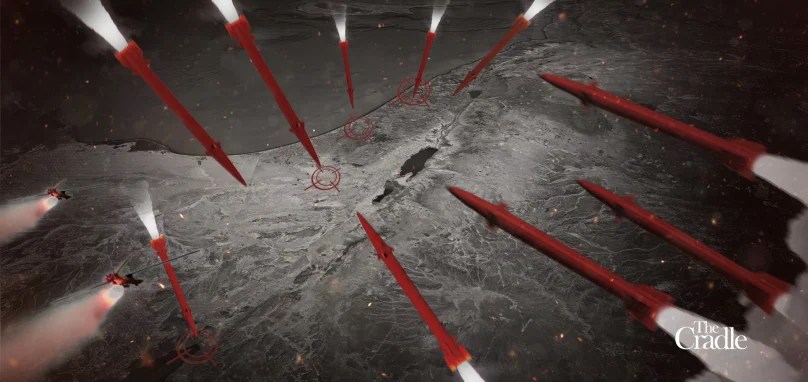
Hezbollah source: Iran, Lebanon, and Yemen will launch simultaneous retaliatory strikes against Israel, to overwhelm the Iron Dome.
By Ali Rizk | The Cradle | August 5, 2024
West Asia stands on a knife’s edge as the region’s Axis of Resistance prepares to retaliate against a series of recent Israeli assassinations and aggressions.
Iran, Hezbollah, and Yemen’s Ansarallah-aligned armed forces have vowed to make the occupation state pay a heavy price following the targeted killing of Hamas political bureau chief Ismail Haniyeh in Tehran and Hezbollah senior commander Fuad Shukr in southern Beirut.
Additionally, Israel bombed the Hodeidah port in Yemen following Sanaa’s successful ‘Yafa’ drone operation in Tel Aviv on 19 July.
An official from the Lebanese resistance has informed The Cradle that “The response will come at once from Iran, Hezbollah, and Yemen,” adding that the goal was to “inflict a painful blow to Israel which may not be achieved should separate retaliations be pursued.”
Executing the ‘Unity of Fronts’
Retaliation is all but certain and could happen within hours, according to senior US officials. A report yesterday by Axios claims that US Secretary of State Antony Blinken informed his G7 counterparts that the response could begin as early as within the next 24 hours.
Just yesterday, Ali al-Qahoum, a member of the political bureau of Ansarallah, emphasized that the response to Israel will not just come from Tehran:
We affirm our commitment to the battle, steadfastness, awareness, honor, and pride in standing with Palestine, the cause of the nation.
The critical question now is the scope and severity of the retaliation. Hezbollah Secretary General Hassan Nasrallah has promised a painful yet calculated blow to Tel Aviv. During Shukr’s funeral procession, Nasrallah warned that Israel had crossed the line, promising “a real and well-calculated response” – distinct from the cross-border operations Hezbollah has conducted against Israel since 8 October.
Flattening the Iron Dome
Other well-informed sources agree that the response could be coordinated, suggesting that retaliation from multiple fronts simultaneously is likely. They tell The Cradle that such an approach could take Israel’s primary air defense system, the Iron Dome, out of commission by preventing it from rapidly rearming. They believe this is achievable given Hezbollah’s capacity to launch a significant barrage of missiles and given Lebanon’s geographical proximity to potential Israeli targets.
These assessments appear to be consistent with those made by US officials who have warned that the Iron Dome could be overwhelmed by Hezbollah’s missile and drone arsenal should a full-scale war erupt.
Senior US military officials, meanwhile, have gone on the record cautioning that Washington would probably be unable to provide Tel Aviv with sufficient protection even in a single front, full-scale war with Hezbollah. US Joint Chief of Staff Charles Brown said as much in his remarks to the press in late June.
From our perspective, based on where our forces are, the short-range between Lebanon and Israel, it’s harder for us to be able to support them [Israel] in the same way we did in April [with Operation Truthful Promise].
Unwilling US support for Tel Aviv
Although much has been said about the US and its allies successfully thwarting Iran’s response to the Israeli attack on its consulate last April, it is noteworthy that all targeted Israeli military bases were hit during the Iranian retaliatory strikes. Operation Truthful Promise was intended more as a message, indicating that Tehran would no longer tolerate Israeli aggression against its interests.
US military reinforcements in the region may help intercept missiles and drones coming from Lebanon, while vassal state Jordan could also play a part as it did during Iran’s retaliatory strikes. However, this also makes US military assets and those of its partners legitimate targets for the Resistance Axis.
As former Pentagon analyst Michael Maloof explains to The Cradle:
Hezbollah would likely target US warships in the region that would take part in intercepting missiles directed at Israeli targets.
“As in 2006, I envision US involvement focused more on evacuating many of the 86,000 Americans now in Lebanon who would want to leave,” adds Maloof.
Washington’s top military officials also appear firmly opposed to being drawn into an active offensive role should a wider war erupt with Hezbollah, let alone a dreaded multi-front war. This stance is supported by statements from US Joint Chiefs of Staff Charles Brown, indicating the Pentagon’s limited willingness to protect the occupation state.
Note that Washington’s pledges to defend Israel have made no mention of potential offensive action, reflecting an American desire to avoid a wider war. Experts doubt the US will become heavily involved in any full-scale war, supported by public statements underscoring the importance of avoiding regional escalation – and voiced more privately, the desire to keep US military targets safe from retaliatory strikes.
Military risk and political calculations
As Brown said at the time, Washington’s main message is:
To think about the second order of effect of any type of operation into Lebanon, and how that might play out and how it impacts not just the region, but how it impacts our forces in regions as well.
The general – the most senior ranking US military official and the senior military advisor to the White House – was delivering a message that carries special significance amidst the recent developments.
By stating that an Israeli-initiated war on Lebanon put US troops at risk, Brown was essentially saying that a wider regional war was not seen as helping US interests by the Pentagon’s top brass.
Given these statements, it remains possible – though far from guaranteed – that the outgoing Biden administration may rein in Israel regardless of how painful a blow is delivered to it by the Axis of Resistance.
The upcoming US election in November is another factor that may prevent a regional conflagration. “The US getting more militarily involved with Israel,” warns Maloof, “would lead to riots in the streets of Chicago at the Democratic Convention later this month.”
These realities suggest a scenario where Washington might force Tel Aviv to absorb the Axis of Resistance’s retaliation, however severe it may be.
UAE, Israel expand spy bases in Yemen’s Socotra under US-sponsorship: Report
The Cradle | July 29, 2024
The UAE has, since 7 October, stepped up work on joint Emirati-Israeli military and intelligence infrastructure on the Socotra Archipelago off the coast of Yemen, Lebanese daily Al-Akhbar reported on 29 July.
The UAE has sought to establish control over the strategic archipelago, and has, over the past few years, begun constructing – in coordination with Tel Aviv – military and intelligence sites on the islands of the Socotra Archipelago, including the Island of Socotra itself.
According to the Al-Akhbar report, other Gulf Arab countries are involved in Emirati-Israeli plans for the archipelago, which comes as part of “an alliance being established … under an American umbrella.”
“The archipelago, in addition to other Yemeni islands and ports, is a central point in [this alliance] … the formation of the aforementioned alliance has become more urgent for all its parties,” Al-Akhbar writes, adding that since the start of Operation Al-Aqsa Flood on 7 October, “they accelerated the construction of its features, led by an Emirati-Israeli military base being built on Abd al-Kuri Island.”
Abd al-Kuri Island is the second largest island in the Archipelago after Socotra.
The “ultimate goal” of the project is “to link the armies and security services of Israel and the concerned Arab countries under the umbrella of US Central Command.”
The report adds that in late December last year, a UAE-flagged landing ship – designed for the deployment of military personnel and equipment – arrived at Socotra Island, remaining there until early January.
It then headed west towards Abd al-Kuri and anchored until 11 January, heading back to Socotra two days later. It then returned to the UAE on 18 January.
“It concealed its signal while stationed off the island’s shores, and remained this way until it reappeared again on 25 December in the Arabian Sea heading north, which suggested that it was carrying out suspicious activity at the time. Information indicates that the ship’s trips were intended to transport military supplies and specialized personnel supervising the development of an Emirati base.”
Following 7 October, a new pier and a helicopter landing pad were constructed on Abd al-Kuri, as well as an airstrip, which was revealed in satellite imagery released in March this year.
“This expansion allows for the accommodation of larger American military cargo aircraft and strategic bombers, such as the American C-5M Super Galaxy and B-1 bombers that were recently used in retaliatory attacks in Syria and Iraq. New housing and buildings were also built,” according to the report.
This is not the first report indicating Washington’s involvement in the militarization of the Socotra Archipelago. Sky News Arabia reported in March that Washington is looking to establish a presence in Socotra in response to Ansarallah and the Yemeni Armed Forces’ pro-Palestine operations.
An in-depth investigation released by The Cradle in March 2023 details the Emirati–Israeli presence on the Socotra archipelago.
The Al-Akhbar report comes as the forces of Yemen’s Sanaa government – which are aligned with Ansarallah – have been vowing a response to the recent Israeli strikes on the western Yemeni port of Hodeidah, which was carried out in response to a deadly Yemeni drone attack on Tel Aviv.
Sanaa has imposed a blockade on all shipping heading to Israeli ports in support of the people and resistance in Gaza, and has vowed not to stop until the genocidal war against Palestinians in the strip comes to an end.
It has also targeted the Israeli port city of Eilat with dozens of drones and missiles since the start of the war.
The Yemeni army has also been attacking US and UK warships in response to the violent bombing campaign that Washington and London began against Yemen in January. US-UK airstrikes have since failed to deter Yemen’s operations.
US Navy Drops Details on Pricey Missiles and Bombs It’s Using Against Yemen’s Warriors
By Ilya Tsukanov – Sputnik – 27.07.2024
The US and Britain have been bombing Houthi-controlled areas of Yemen since January, killing and maiming scores of civilians and targeting hundreds of militia sites but failing to “degrade” the Houthis missile and drone capabilities, or to stop their months-long partial blockade of the Red Sea in support of Palestine.
The US Navy has revealed new details about the weapons systems it has been using in the ongoing US-UK bombing campaign against the Houthis.
According to information shared with the Navy Times, F/A-18 Super Hornet fighter jets aboard the USS Dwight D. Eisenhower, which left the Middle East and steamed home last month after a nine-month long deployment in the Red Sea area, used the AIM-9X infrared-guided heat-seeking missile to target Houthi kamikaze drones.
The AIM-9X is a variant of Raytheon’s widely used AIM-9 Sidewinder short-range air-to-air missile. The weapon has a per unit price of between $430,800 and $472,000, making it between 215 and 236 times the cost of the estimated $2,000-each price of a Houthi attack drone.
The Navy also confirmed the deployment of its Advanced Anti-Radiation Guided Missile, or AARGM, also launched from Super Hornets aircraft, against Houthi air defenses. Produced by Northrup Grumman, these ground attack weapons have a per missile price of $874,000.
The Navy did not provide any details on the Houthi systems targeted by these weapons, The militia’s arsenal is thought to consist mostly of older Soviet-era SAMs and anti-aircraft guns, similarly dated radars, and Yemeni-built copies of Iranian missile and MANPADS designs.
Another weapon used by the Super Hornets in their campaign is the AGM-154 Joint Standoff Weapon – a glide bomb possessed by the US Navy and Air Force and by the air forces of more than half a dozen of Washington’s allies. The Navy said the Raytheon-made missiles being used against the Houthis are the latest, AGM-154C variant, which cost roughly $719,000 each. The Navy did not specify what kinds of targets the munition was used to attack, but the inertial and GPS-guided, terminal infrared homing-equipped weapons are designed for use against both stationary ground targets and moving targets at sea.
Apart from their machinegun-armed speedboats, the Houthis don’t have a navy to speak of, and their naval drones aren’t the fancy, $250,000 apiece, custom-built unmanned vehicles possessed by NATO countries. Instead, the militia has improvised by fitting ordinary speedboats with remote controls, packing them with explosives and launching them toward their enemies, with the total cost of such weapons not exceeding $30,000 (or about 24 times less than the US munitions deployed to dispatch them).
The imbalance in pricing between the Houthis’ guerilla warfare-purposed weapons and the US’s sleek, arms expo showroom-class air-launched missiles and bombs parallels the chasm between the surface-to-air missiles the US Navy has been using and the Yemeni militia’s drones.
In explosive testimony by US air and missile defense officials to Congress in May, Senate Armed Services Subcommittee on Strategic Forces Angus King lambasted the state of affairs in which the US military has been forced to use $4.3 million SM-6 interceptor missiles to take down $20,000 Houthi UAVs.
“In the Red Sea, the Houthis are sending $20,000 drones and we’re shooting them down with missiles that cost $4.3 million. The math doesn’t work on that, gentlemen. It just doesn’t work. What are we thinking?” King asked. The lawmaker urged the Pentagon to urgently ramp up the development of directed energy weapons instead.
US Navy expenditures on their policing mission in the Middle East beginning after October 7 and the start of the Israel-Gaza war have surpassed $1 billion, Navy Secretary Carlos Del Toro told the Senate Appropriations Committee in April.
The US-led operation against the Houthis shows no sign of slowing down, but neither does the militia’s resolve against Washington and its allies. US Central Command announced on Friday that American forces had destroyed six Houthi aerial drones, and three uncrewed surface vessels, off the Yemeni coast. Also Friday, hundreds of thousands Yemenis gathered in the streets of Sanaa and other cities in solidarity with the Houthis’ operations against the US and Israel.
France’s Le Monde newspaper wrote in a piece Friday that Western powers had proven “powerless to halt Houthi attacks,” with Western warships’ presence in the Red Sea and strikes on the militia said to have “failed to deter the rebel militia.”
The glum attitude comes in the wake of reports in US business media last week that CENTCOM chief General Michael Erik Kurilla had written a letter to his boss, Lloyd Austin, and urged Washington to ramp up its economic, diplomatic and military pressure on the Houthis, admitting that the Western coalition’s operations to date had “failed” to stop the militia.
The stunning audacity of Yemen’s drone strike on Tel Aviv
The Cradle | July 24, 2024
On 19 July, a low-altitude drone breached Tel Aviv’s airspace from the sea and detonated, causing one fatality and injuring ten others.
The incident sent shockwaves through the occupation state, with a panicked populace and bewildered policymakers grappling with the Israeli army’s “mega-failure” to intercept a single drone amid prolonged aggression against Gaza and the mounting tensions with Hezbollah in Lebanon.
The attack’s impact was magnified by its direct hit on Tel Aviv, the heart of Israel’s governmental and economic power, starkly exposing inadequacies in its defense strategies and further alarming a population that has for months been questioning the effectiveness of its military preparedness.
It wasn’t long before the de facto Yemeni authorities in Sanaa claimed responsibility for the attack, calling the strike a retaliation for Israeli massacres and threatening more to come.
But how did a Yemeni drone reach the heart of Israel’s most fortified region and strike a blow to Israeli military pride?
Tactical evolution of suicide drones
Suicide drones, as they are known, are a relatively modern weapon, posing significant challenges even for technologically advanced states like the US and Israel. These drones vary in range, warhead size, speed, and guidance methods.
Analysis of the wreckage revealed that the “Yaffa” drone, an enhanced version of Yemen’s Sammad drones, was employed in the operation. The name is deeply symbolic as it references the ancient port city of Jaffa, also known as Yaffa in Arabic, which now forms part of modern-day Tel Aviv.

Yaffa Drone
Its rectangular wing shape and V-shaped tail distinguish it, but it is notably the more powerful 275 cc (16 kW) engine that sets it apart. This engine enables the drone to cover distances exceeding 2000 kilometers – sufficient to reach Tel Aviv from Yemen.
Unlike with ballistic missiles, the difficulty in tracking drones lies in their ability to take unconventional paths, maneuver through winding routes, and hide behind terrain features, making them hard to detect by radar systems.
This detection challenge is a daily issue in northern occupied Palestine, where drones operated by Lebanese resistance groups often go unseen by the increasingly blinded occupation army.

Moreover, drones are typically constructed from lightweight materials such as fiberglass, carbon fiber, or various reinforced plastics that do not reflect radar waves effectively, which is crucial for detection and tracking.
Their low speeds reduce the need for the metallic compositions necessary in constructing conventional military hardware like missiles and fighter jets. Consequently, drones can be mistaken for birds by radar systems. This confusion has occurred regularly in northern occupied Palestine since the war’s onset, with Israel’s Iron Dome defense system spotted expending its limited supply of $50,000 projectiles shooting at birds during this conflict.
Yaffa’s route to Tel Aviv
The suicide drone likely took an unconventional path to evade detection. Previous Yemeni attempts have been intercepted in Egyptian Sinai airspace, with Israeli-allied Arab states such as Saudi Arabia, Jordan, and Egypt contributing to these detection and interception efforts.
On the night of the attack, however, no US aircraft carrier groups were in the Red Sea, and the nearest carrier, the USS Theodore Roosevelt, was positioned in the Indian Ocean. Israel’s air force has suggested that the drone may have taken a non-traditional route via Eritrea, Sudan, and Egypt, crossing near the Suez Canal before entering the Mediterranean and turning east toward Tel Aviv.

Possible path of Yaffa drone that targeted a building in Tel Aviv
Some aspects of that route seem unlikely: the Suez Canal area is heavily patrolled by Egyptian air defense, with its 8th Brigade stationed there, so the Israeli announcement may have been an attempt to pressure Egypt.
Israel’s response: Bombing Hodeidah
On 20 July, Israeli aircraft launched punishing airstrikes on the besieged Yemeni port of Hodeidah, specifically targeting areas designated for fuel and oil storage, as well as destroying port cranes used for loading and unloading cargo and a power station.
But these were civilian targets in a country already suffering from the effects of the Saudi-led coalition blockade, which has caused severe shortages of fuel and essential resources needed for power generation and transportation.
The strike at these particular target banks, which killed at least six and wounded dozens of others, appears to be primarily aimed at creating significant explosions and large fires to help Israeli Prime Minister Benjamin Netanyahu score points at home.
But the Israeli response against civilian targets also reveals that Tel Aviv suffers from a dearth of intelligence on potential Yemeni military targets. It was also evident that the selected targets were ones that Saudi Arabia and the US have refrained from striking due to fears of Yemeni retaliation, which could strike Saudi commercial ports or oil exports in one of the world’s most vital energy passages.
Indeed, Riyadh was quick to deny any involvement in the assault, fearing reprisals from Sanaa, although reports that Israeli jets used Saudi airspace for this attack suggest otherwise.
Video footage shows that Israel used F-35 and F-15 fighter jets, as well as Boeing 707 tanker aircraft, due to the distance involved – a range exceeding 4,000 kilometers round trip. Israeli-released footage suggests that the strikes were carried out using Spice guided missiles launched from outside the Yemeni air defense range.
Some of these missiles are equipped with boosters that extend their range up to 150 kilometers, which only showcased Israeli operational limitations against Yemen in a broader conflict, in which Sanaa’s air defenses will be surely activated against enemy aircraft, drones, and projectiles.
Yemen’s retaliation
Yemeni officials, led by Ansarallah leader Abdul Malik al-Houthi and Yemeni Armed Forces Spokesman Brigadier General Yahya Saree, quickly announced a decision to launch retaliatory strikes against Israel, in which they declared Tel Aviv to be an “unsafe zone” and warned of Yemen’s readiness for a “long war” against the occupation state.
Given the targeting of vital civilian infrastructure, this places several Israeli targets on the list of potential Yemeni target banks. These include fuel tanks in Haifa, clearly shown in video footage taken by a Hezbollah drone weeks ago, as well as fuel tanks in Ashkelon and the power stations adjacent to these tanks.
What concerns Israelis the most, however, is Yemen’s potential targeting of vital gas platforms in the Mediterranean Sea, stationary targets highly susceptible to significant ignition and explosion. While there are currently only three active Israeli gas fields – Karish, Tamar, and Leviathan – in operation, these fields have become essential to Israel’s energy independence.
Underestimating Sanaa’s resolve
The damaging Israeli strike on Hodeidah Port was based on an assumption by Tel Aviv that it would deter a Yemeni counterstrike. But Yemen’s Ansarallah Movement, which has endured years of punishing Saudi, Emirati – and now US and UK – military attacks, has shown no inclination whatsoever to halt its operations in support of Gaza.
While the Israelis may have felt an obligation for a quick military fix by striking Hodeidah – the port, incidentally, has already reopened for business – it comes at the expense of any logical assessments of losses and gains. Already facing strategic defeat in Gaza and unable to follow through with its threats against Lebanon, Tel Aviv has cracked open a new front with Yemen, the most fearless component of West Asia’s Axis of Resistance.
The Israelis are between a rock and a hard place, desperately trying to cleave to old narratives of regional military superiority to keep domestic faith in the Zionist project, yet unable to score victories anywhere.
Based on Yemen’s oft-declared resolve not to retreat from any escalation, it is expected that the outcome of the Hodeidah strike will lead to a compounded retaliatory operation against the occupation state. Israel, however, has limited operational freedom due to issues related to geographic distance – such as the airspace and uninterrupted refueling access required – which makes waging war against Yemen a nonstarter.
Harsher strikes on critical Israeli centers are likely to drive Israel into greater missteps and strategic errors, especially at a time when escalation and the further weakening of its deterrence are counterproductive to its interests.
By targeting the Yemenis directly, Israel has underestimated the resolve and capabilities of a formidable adversary, potentially choosing the worst possible opponents in this round of conflict.
‘Israel’ attacks Yemeni civilian facilities, Sanaa vows heavy price
Al Mayadeen | July 20, 2024
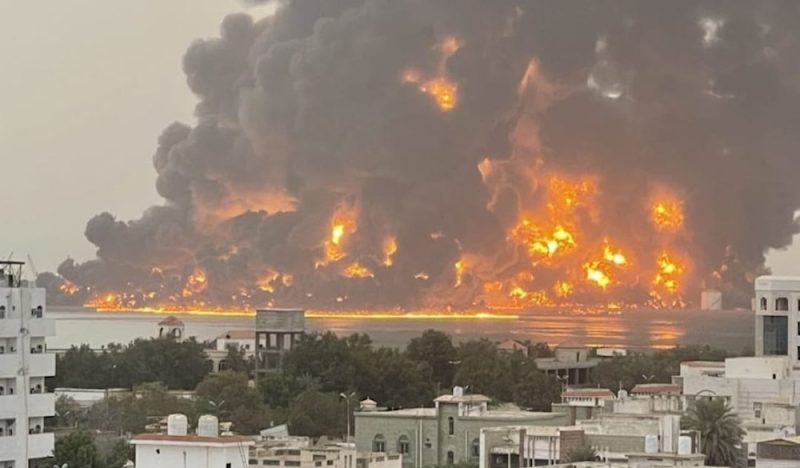
Israeli war jets launched a series of airstrikes on Saturday targeting Yemen’s province of Hodeidah on the Red Sea coast.
The aggression targeted an oil refinery, leading to a massive fire that can be seen kilometers away.
Al Mayadeen’s correspondent reported that the strikes targeted the Ras Kathib power station in Hodeidah, igniting the oil storage facilities.
The Yemeni Ministry of Health reported martyrs and wounded as a result of the aggression, confirming that civilians suffered severe burns due to the fires.
Israeli Kan 11 channel citing a US official reported that the Israelis conducted an attack in Yemen.
Civil defense teams are battling to extinguish the fires and flames engulfing the targeted zone, our correspondent added, noting that the size of the blaze is making the task extremely difficult.
Yemeni sources informed Al Mayadeen that these airstrikes were coordinated between US and Israeli forces, indicating that the nature of the targets hit by the aggression shows the blindness of the enemy.
They emphasized that there will be a response to the aggression.
Israeli media quoted official American sources stating that 25 F-35 fighters attacked multiple targets in Yemen in several attack waves.
Furthermore, an Israeli media platform mentioned that Italians assisted “Israel” with refueling aircraft in Yemeni airspace.
Following the Israeli aggression, the head of Yemen’s negotiating delegation, Mohammad Abdul-Salam, affirmed that pressuring Yemen to cease supporting Gaza is “a dream that will not come true for the Israeli enemy.”
“The brutal Israeli aggression will only increase the determination and the steadfastness of the Yemeni people and its brave armed forces in an escalating manner.”
Yemen has ‘very large stock’ of UAV used in unprecedented Tel Aviv attack
The Cradle | July 19, 2024
The Yemeni drone that successfully targeted Tel Aviv early on 19 July was locally produced, according to a source who spoke with Al Mayadeen.
The Yafa drone, named after the Palestinian city of Jaffa over which Tel Aviv was built, was “locally manufactured and developed [during the war], after Arab countries intercepted Yemeni [drones] that were targeting Umm al-Rashrash (Eilat), after 7 October,” the Yemeni source told Al Mayadeen on Friday.
The Armed Forces of Yemen’s Sanaa government has a “very large” stock of this type of drone, the source added.
“This is not the last weapon … [This drone] covers a distance of more than 2,000 km, and is equipped with modern jamming and infiltration systems … [The operation] coincides with ongoing naval operations, in accordance with the objectives announced by the Yemeni army. The operations will not stop,” the source went on to say.
“The target bank in Jaffa [Tel Aviv] is diverse … it will never be safe again … the operation is considered an advanced military success.”
The Israeli army identified the drone as an Iranian-made Samad-3, which was modified to have extended range, Israeli media reported.
The Yemeni Armed Forces – which are aligned with the Ansarallah resistance movement – announced the drone attack that struck Tel Aviv early on 19 July. At least one Israeli was killed and several others injured in the attack, which failed to trigger alarms.
In the statement, Yemeni army spokesman Yahya Saree declared Tel Aviv an “unsafe zone and a primary target within our weapon range.” He revealed that Sanaa holds “a bank of targets in occupied Palestine, including sensitive military and security targets, and will, with Allah’s help, continue to strike these targets in response to the enemy’s massacres and daily crimes against our brothers in Gaza.”
The Yafa drone did not set off any alarms as it entered Israeli airspace from the south before hitting a building near the US consulate in Tel Aviv.
According to Israeli media, the army has blamed its failure in intercepting the drone on a “human error.” The air force is also examining why the drone did not trigger sirens after entering Israeli air space from the south.
Israeli Army Radio reported on Friday morning that a preliminary investigation from the army showed that air defense systems detected the drone, but it was not classified as an aerial threat. Therefore, no alarm was activated, and the target was not shot down.
The successful drone attack “shouldn’t have happened,” the Israeli Air Force said. The Israeli army said fighter jets would increase patrols over Tel Aviv’s skies.
Collapsing Empire: Yemen Defeats US Navy
By Kit Klarenberg | Al Mayadeen | July 19, 2024
On July 12th, the Associated Press (AP) published an astonishing report, on the return of US Navy fighter pilots to Virginia after nine months of failing to thwart the righteous anti-genocide blockade of Red Sea shipping by Yemen’s Ansar Allah. The article was at pains to portray the pilots’ arrival Stateside as a heroic homecoming for courageous American flying aces. In reality, the Empire’s terminal weaknesses, and drastically ever-reducing power, were amply exposed.
AP described the pilots as “feeling relieved…after months of shooting down Houthi-launched missiles and drones off Yemen’s coast in the most intense running sea battle the Navy has faced since World War II.” Accompanying photos depicted them embracing their wives, and children waving the Star Spangled Banner. One pilot, “clearing the emotion from his voice,” boasted that he “couldn’t be prouder of his team” – the USS Dwight D. Eisenhower aircraft carrier strike group – and “everything that the last nine months have entailed.”
The pilot looked ahead to spending time with his family, and trying to “make up for nine months of lost time.” The wife of a Navy lieutenant commander and pilot lamented that she “initially thought this deployment would be relatively easy” – “it was going to be, if you could call it, a fun deployment where he’s going to get lots of ports to visit.” As it was, the USS Eisenhower became embroiled in a brutal, unwinnable quagmire, and “plans continued to change.”
The drastic prolongation of her husband’s deployment “was exacerbated” due to knowing “people” – in other words, Ansar Allah – “[wanted] to harm the ship.” She was forced to consult “counselors provided by the Navy,” and was not alone. AP records “months of fighting and extensions placed extra stress on roughly 7,000 sailors and their families.” Pentagon officials are now investigating how to care for pilots and sailors “when they return home, including counseling and treatment for possible post-traumatic stress.”
It’s been a hellacious nine months for the US Navy in the Red Sea, courtesy of God’s Partisans [literal translation of Ansar Allah]. AP notes the Eisenhower and its accompanying ships have been bombarded relentlessly by Ansar Allah drones, and ballistic and cruise missiles. Frequently, these attacks have penetrated multiple layers of on-ship defenses, which is totally unprecedented in modern history. AP reports many sailors “have seen incoming Houthi-launched missiles seconds before they are destroyed by their ship’s defensive systems.”
Battling an enemy that can actually fight back has been a deeply ravaging experience for the US Navy. One pilot remarked, “most of the sailors…weren’t used to being fired on given the nation’s previous military engagements in recent decades.” He described the experience as “incredibly different”, “traumatizing for the group”, and “something that we don’t think about a lot.” A new experience it may be – but it’s one the US military will need to promptly and permanently adapt to.
Given the pace with which events move in this epoch, many may have forgotten the tubthumping fanfare that accompanied Operation Prosperity Guardian’s launch in December 2023. This followed a flurry of ineffectual, flaccid British and US airstrikes on Yemen. Officials in Washington bombastically announced that a multi-country coalition led by the US, comprising Bahrain, Britain, Canada, France, Italy, the Netherlands, Norway, the Seychelles, and Spain would be dispatched to the Red Sea, to decisively end Ansar Allah’s blockade, and ensure “freedom of trade”.
Almost immediately though, the much-vaunted coalition came apart. France, Italy, and Spain all announced they wouldn’t actually be taking part. Despite this inauspicious debut, when footage emerged of a grand international naval flotilla dramatically slicing its way to the region, many prominent social media users shrieked that Yemenis were about to find out why Americans don’t enjoy universal healthcare. Fast forward to July this year, and the US Defense Intelligence Agency (DIA) published a forensic report on the impact of AnsarAllah’s “attacks on international trade.”
It found that container shipping through the Red Sea, which typically accounts for approximately 10-15% of international maritime trade, had declined by approximately 90% since Operation Prosperity Guardian began. Due to Ansar Allah’s inexorable onslaught against corporations and countries supporting the Gaza genocide, many ships were forced to take alternative routes around Africa, adding approximately 11,000 extra nautical miles, up to two weeks further transit time, and approximately $1 million in additional fuel costs for each voyage:
“For many shipping companies, the combined costs of crew bonuses, war risk insurance (roughly 1000% more than pre-war costs), and Suez transit fees make the additional time and financial costs traveling around Africa less expensive by comparison…Threats to Red Sea transits are compounding ongoing stress to global maritime shipping…Insurance premiums for Red Sea transits have risen to 0.7-1.0% of a ship’s total value, compared to less than 0.1% prior to December 2023.”
The DIA calculates that “at least 65 countries’ interests have been affected” by Ansar Allah’s actions, and “at least 29 major energy and shipping companies have altered their routes to avoid Houthi attacks.” And this is while their anti-shipping aerial strikes have been subject to relentless bombardment by US missiles and pilots.
On July 15th, mere days after Associated Press surveyed the smoldering wreckage of Operation Prosperity Guardian, AnsarAllah announced three separate operations in response to the Zionist entity’s massacre at the UN al-Mawasi Khan Yunis refugee camp. Undefeated and indefatigable, God’s Partisans are not backing down, and are going nowhere. The Resistance fights to win.
Houthi: US surprised by Yemen’s naval tactics, failed to stop retaliatory operations in Red Sea
Press TV – July 7, 2024
The leader of Yemen’s Ansarullah resistance movement says the Yemeni armed forces’ naval tactics in the Red Sea have taken the United States off guard, adding that Washington’s advanced military technology has failed to stop the Arab country’s retaliatory operations.
Abdul-Malik al-Houthi made the remarks during televised a speech on Sunday, where he praised Yemen’s advanced military and missile capabilities in confronting the coalition of the US, Britain, and Israel which he referred to as the “triangle of evil”.
Houthi went on to say that Yemen’s naval operations have frightened the enemies, noting that US aircraft carriers in the Red Sea are escaping rather than attacking and its MQ-9 Reaper drones are continuously shot down.
He also pointed out that many countries were not caught in the trap laid by the US-led coalition against Yemen and even had direct coordination with the Arab country instead.
“The biggest failure of the United States was that it could not include the countries neighboring the Red Sea in operations to support Israel. Washington also failed to force the Arab and neighboring countries to attack us from their soil,” he said.
The Ansarullah leader further said that the US is trying to use Saudi Arabia to exert pressure on Yemen, warning that any Saudi “hostile action” against Yemen will benefit Israel and the US.
“America intends to bring Saudi Arabia into an all-out war with us and return the situation to the peak of tension,” he said, while urging for Muslim unity and cooperation.
He also emphasized that Yemen will not remain idle in the face of aggression and will not watch the nation’s economy collapse.
Yemeni forces have repeatedly launched drones and missiles against Israeli and Israel-bound ships since mid-November last year, saying they are acting in solidarity with Palestinians against Israel’s war on the Gaza Strip.
Back in January, the United States and Britain began striking Yemen in order to dissuade the country from targeting Israeli ships which carry arms and logistics for the onslaught on the besieged enclave.
Despite months of US-led airstrikes, Yemeni forces have continued their operations, drawing from an arsenal of increasingly advanced weapons to attack Israeli, US and UK vessels in and around the Red Sea.
Featured Video

Chinese jet fuel and the myth of energy independence
or go to
Aletho News Archives – Video-Images
Book Review
Former Insiders Criticize Iran Policy as U.S. Hegemony
By GARETH PORTER | CounterPunch | February 27, 2013
“Going to Tehran” arguably represents the most important work on the subject of U.S.-Iran relations to be published thus far.
Flynt Leverett and Hillary Mann Leverett tackle not only U.S. policy toward Iran but the broader context of Middle East policy with a systematic analytical perspective informed by personal experience, as well as very extensive documentation.
More importantly, however, their exposé required a degree of courage that may be unparalleled in the writing of former U.S. national security officials about issues on which they worked. They have chosen not just to criticise U.S. policy toward Iran but to analyse that policy as a problem of U.S. hegemony. … continue
Blog Roll
 Aletho News
- NATO’s Slow Fracture: How Trump’s Iran War Exposed the Instrument of Hegemony
- Chinese jet fuel and the myth of energy independence
- Ukraine Sea Drone Fired From Libya Hit Russian Tanker in Mediterranean
- IRGC: Iranian forces launched no attacks during ceasefire hours
- Trump Administration Moves To Automate U.S. Military Draft Registration
- Spain orders reopening of Tehran embassy, condemns Israel’s carpet bombing of Lebanon
- Israel faces ‘unsustainable’ strategic crisis following 40-day war against Iran: Analyst
- Iran restricts Hormuz access to 15 vessels per day under ceasefire terms: Report
- The ‘Opposition Party’ Has Done Nothing to Stop the Iran War and Much to Goad Trump Into Continuing It
- Moscow backs Tehran on status of Lebanon in US-Iran deal
- If Americans Knew
- Amnesty: Urgent – Protect Lebanese civilians from brutal escalation in Israeli attacks
- Is The War Against Iran Over?
- Inside the Israeli army’s propaganda wing
- Hundreds of Gaza Amputees Stranded in Legal Limbo
- The gallows law: Israel moves toward executing Palestinian children
- Tucker Carlson: The Path to Peace requires ending ‘special alliance’ with Israel
- This is ceasefire? Israel’s biggest massacre yet in Lebanon, another journalist killed in Gaza – Daily Update
- Tucker Carlson on Israel: This Is the Behavior of an Ally? Really?
- Gazans face a triple crisis: severe shortages of water and bread, healthcare in tatters
- NY Times reports how Netanyahu took the US into Iran War
- No Tricks Zone
- An Inconvenient Tree: Uncovered In Alps… Europe Much Warmer Than Today 6000 Years Ago
- New Study Reports A 60% Slowdown In Greenland’s Ice Loss Rate In The Last Decade
- Low Intensity Tornado Wrecks Major Solar Farm, Creating A Potential Toxic Dump
- New Study Finds Warming Saves Lives…Cold Temperatures 12 Times More Deadly Than Excess Heat
- German Science Blog Accuses PIK Climate Institute Of Hallucinating Climate Tipping Points
- Devastating Assessment Of Comirnaty Vaccine By Former Senior Pfizer Europe Toxicologist
- New Study: CO2 Is ‘Effectively Negligible’ As An Explanatory Climate Change Factor Since 2000
- Former Pfizer Toxicologist Dr. Helmut Sterz Tells Bundestag Hearing Pfizer Vaccine Should Have Never Been Approved
- Energy Expert: Germany’s Nuclear Phaseout Was A “500 Billion Euro Mistake”
- New Research: South Australia’s Mid-Holocene Sea Surface Temperatures Were 4°C Warmer Than Today
 Aletho News