The White House’s latest pro-war scheme comes at a time when the Pentagon is expected to receive its highest annual budget ever, as defense spending in the US is on track to reach $1 trillion annually before the decade is out.
Eighteen civilians injured in Saudi shelling on Sanaa
The Cradle | January 2, 2023
Eighteen civilians were injured in Yemen on the evening of 1 January after Saudi-led coalition border troops launched several rounds of artillery fire into residential areas in the northwestern province of Saada, Yemeni media reported.
According to local sources, 10 people were wounded by coalition artillery fire in the province’s Monabbih district, while eight others sustained injuries in another attack on the district of Shadaa. There were reportedly two African migrants among the injured.
This latest bout of violence follows a significant escalation in tension last week between the Ansarallah resistance movement and UAE-backed coalition troops, which left around 32 people from both sides killed and injured on 29 December.
As Yemen enters its fourth month since the expiration of the UN-brokered humanitarian ceasefire agreement, the Saudi-led coalition has taken no steps to lift the severe economic blockade on the country, continues to loot its natural wealth, and has persistently withheld the salaries of Sanaa-affiliated government employees in blatant violation of the truce terms.
With the persistence of these violations, it seems less likely with each day that a ceasefire extension will be reached.
Just in the last two days, the Saudi-led coalition seized another four UN-inspected humanitarian fuel vessels and barred them from entering the country’s main port of Hodeidah, which has been under Saudi blockade since 2015.
Attempts at UN-sponsored negotiations and regional mediation efforts have – for the most part – failed, and Yemeni officials have repeatedly warned that no truce extension is possible until all demands have been met.
As the prospect of a renewed ceasefire fades, Ansarallah has also persisted with its warnings to the coalition that it is willing to take matters into its own hands.
On 29 December, senior Ansarallah official Ali al-Qahhoum said in a statement that Saudi Arabia and its regional allies in the coalition face “unprecedented retaliatory strikes” should they maintain their war and blockade against Yemen.
Ansarallah seeks ‘permanent ceasefire’ in Yemen
The Cradle | January 1, 2023
Yemen’s Ansarallah movement seeks a “permanent ceasefire,” according to a spokesperson of the resistance group.
Mohammed Abdel Salam, a spokesperson of the Ansarallah movement, said on 1 January that a permanent ceasefire would require the opening of all ports, airports, and roads, and that all government wages are paid from oil and gas revenues.
“We are working to reach a point of clarity in Yemen, in which we move into either a truce or permanent ceasefire, and we have presented our point of view to the Omani mediator,” he said to Almasirah TV station.
“Any solution to Yemen’s crisis must be based on the disbursement of [government] employees’ salaries from oil and gas revenues according to the 2014 budget,” he added.
Meanwhile, an official delegation from the Sultanate of Oman landed in the Yemeni capital Sanaa on 21 December as part of Muscat’s mediation efforts to reach a political solution to the Saudi-led war that has been raging for nearly eight years.
No further details were provided about the meeting, nearly three months after a UN-brokered ceasefire between Sanaa and Riyadh ended.
Since then, Oman has been mediating talks between Saudi and Yemeni officials seeking to end a war that has killed nearly 400,000 Yemenis and pushed the rest of the population into famine.
Since 2015, Yemen has suffered a brutal Saudi-led war and economic blockade that has killed and displaced millions, and destroyed the country’s infrastructure. On top of this, western NGOs have been accused of mishandling billions of dollars in humanitarian aid for Yemenis.
Yemeni officials have also cautioned that US and French troops deployed in provinces controlled by the Saudi-led coalition have arrived to coordinate the looting of Yemen’s natural resources, similar to Washington’s oil trafficking operations in Syria.
Yemen: Despite truce, Saudi-led coalition killed, injured 900 civilians since April
MEMO | December 29, 2022
More than 900 civilians have been killed and injured by the Saudi-led coalition’s missile strikes in Yemen’s border district of Shada, west of Saada governorate, since the signing of the UN armistice agreement in early April, Abdullah Musraa, the director of the hospital in Razih Al-Rifi said.
Musraa added that since the beginning of the truce Razih Hospital has received 111 dead civilians and 796 wounded, including African immigrants, Al-Mayadeen reported, citing the Houthi-controlled official news agency SABA.
He noted that nothing has changed in the behaviour of the Saudi regime since the signing of the UN humanitarian and military truce.
Musraa stressed that the border areas in Saada governorate are witnessing a continuous escalation by the Saudi-led coalition with the bombing of homes, farms and public and private property, according to Al-Mayadeen.
He added that many cases were transferred to other hospitals across the governorate and the capital, Sanaa, as Razih Hospital could not keep up with the demand or provide the necessary services for critical cases.
A truce was agreed on 2 April between the Saudi-led alliance and the Houthis. It was extended twice for two months, however, the second extension ended on 2 October.
Since then, fighting has resumed. The UN has failed to reach an agreement to reinstate the ceasefire.
Biden pledged to end the war in Yemen, but is doing the opposite

By Robert Inlakesh | RT | December 27, 2022
Two weeks into his term, US President Joe Biden claimed that he would seek a negotiated peace in Yemen, thus shunning Saudi Arabia. Now he is performing a 180-degree pivot. With such arbitrary foreign policy positions the US is causing instability and weakening its own hand.
On December 13, US Senator Bernie Sanders decided to withdraw a War Powers Resolution on ending US support for Saudi offensive efforts in the war in Yemen. Sanders was supposed to put the resolution to a vote, believing it would have passed. However, owing to pressure mounted against him from the White House, he decided to retreat. Instead, the progressive American senator claimed that he was informed that the Biden administration would “continue working” with his office on ending the conflict.
As revealed by The Intercept, which obtained the key talking points distributed by the White House against the resolution, the Biden administration communicated its position that such a resolution would be counterproductive and further exacerbate the crisis in Yemen. However, the ‘Quincy Institute for Responsible Statecraft’ says that Sanders’ decision to withdraw the resolution “may embolden the many members of Washington’s foreign policy elite who would like to ensure that the president’s capability to unilaterally wage war remains unchallenged by Congress’s constitutional prerogative over matters of war and peace.”
The biggest problem here for the US government is that the War Powers Resolution essentially aims to force Biden to implement most of the policies that he himself outlined in February of 2021. Despite Biden having announced that the US was halting all “relevant arms sales” to the Saudi-led coalition – which has been at war with Yemen’s Ansarallah, known commonly as the Houthis, since 2015 – this policy position has never been put into practice.
During his 2020 campaign, Biden claimed that he would make longtime American ally Saudi Arabia a global “pariah.” Yet, when it began to sink in that the powerful oil-producing state was a necessary partner in the Middle East, a realization that came months into the West’s sanctions campaign aimed at Russia, the Biden administration quickly decided to change its stance. In July, the president decided to go on a foreign visit to Saudi Arabia, while in the days prior he entered into discussions about beginning to supply the Saudis with offensive weapons again; the framing of this was a little disingenuous because the weapons sales freeze of February 2021 had effectively been ended by April of the same year anyway. Both of these moves came as a clear attempt to get Saudi Arabia to raise oil-production levels, a goal that failed as the Saudi Crown Prince, Mohammed Bin Salman, refused to pander to the US president.
Since then, the US government approved a potential multibillion-dollar deal with Saudi Arabia and the UAE, and in August the Biden administration granted the Saudi Crown Prince immunity from a civil lawsuit over his role in the murder of journalist Jamal Khashoggi. Biden was reportedly humiliated earlier this year after allegedly bringing up the Khashoggi killing to the Crown Prince, who fired back by citing the Israeli killing of Palestinian-American journalist Shireen Abu Akleh, asking why Jamal Khashoggi mattered more. Notably, the US head of state failed a number of times to even pronounce Shireen Abu Akleh’s name correctly when delivering a speech beside Palestinian Authority President Mahmoud Abbas just days earlier and did not bring the killing up to Israeli representatives.
The White House insinuated, in its opposition to Senator Bernie Sanders’ resolution on Yemen, that it had a hand in the six-month long ceasefire between the two primary opposing sides in the war. The reality was that it was the United Nations that brokered the ceasefire, which ended on October 2. In the eyes of Ansarallah, the US government is the primary obstacle to peace in Yemen; Abd al-Wahhab al-Mahbashi, a senior member of Ansarallah, recently warned that “the presence of US troops in the Bab al-Mandab and off the coast of Yemen poses a serious threat to maritime navigation.” In fact, Ansarallah views the conflict as a war on behalf of the US, with Saudi Arabia acting as its proxy, a view held by millions in the region.
The day following Sanders’ withdrawal of his War Powers Resolution, two fuel shipments, carrying tons of diesel, were seized by the Saudi-led coalition and prevented from reaching Yemen. The blockade of Yemen is one of the major factors contributing to the resurgence of tensions – Ansarallah accuses Riyadh and Abu Dhabi of stealing the nation’s oil resources and depriving native Yemenis. In addition to this, when the US is clearly attempting to cozy up to Saudi Arabia, this signals to the leadership of Ansarallah that the Biden administration is favoring Riyadh in the conflict.
The Biden administration has so far proven ineffective at bringing the Saudis under its wing in the way it had hoped, indicating that its foreign policy tactics have proven ineffective at best. The reason for this failure likely comes down to the way the current government has dealt not only with Saudi Arabia, but with all the states of the Arabian Peninsula in addition to Iran. The US has shown that it cannot be trusted to keep its word, as was proven by its Iran nuclear deal blunder. More importantly, Saudi Arabia understands that, when it comes to security, Washington is not the most important player anymore. Instead of following the Biden administration into a dangerous anti-Iran coalition, the Saudis would be a lot smarter to engage diplomatically with Tehran, a step that would be especially helpful when it comes to regional security.
For Washington, meanwhile, an escalation in Yemen at this point would prove advantageous, for it could end up pushing Saudi Arabia closer to it, as the latter needs US help to maintain its war effort, although there is a chance that large-scale ballistic and cruise missile strikes against Saudi Arabia’s vital infrastructure could cause the Kingdom to go straight to the negotiating table. Regardless of how things go, it is clear that US influence in the Arabian Peninsula is rapidly declining and part of its legacy will be this brutal war that has cost upwards of 400,000 lives and that the Biden administration has refused to end.
Robert Inlakesh is a political analyst, journalist and documentary filmmaker currently based in London, UK. He has reported from and lived in the Palestinian territories and currently works with Quds News.
Iran, Syria, Yemen: Twitter’s collaboration with the US military in information warfare
The damning exposure of collusion between the Pentagon and Twitter raises further suspicions about Washington’s ongoing online operations in West Asia

By Kit Klarenberg | The Cradle | December 27, 2022
The Cradle has previously deconstructed the Pentagon’s online bot and troll operations targeting Iran. These wide-ranging efforts, over many years, sought to destabilize the Iranian government by disseminating and inciting negative sentiment against it, on a variety of social media platforms.
Their exposure led to the White House demanding an internal audit of all Department of Defense (DoD) “psychological operations online.” Ostensibly, this was triggered by high-level concerns that Washington’s “moral high ground” was potentially compromised by the “manipulation of audiences overseas.”
The audit was revealed in a Washington Post article, the details of which pointed to a very different rationale. One passage noted that representatives of Facebook and Twitter directly informed the Pentagon, repeatedly, over several years, that its psychological warfare efforts on their platforms had been detected and identified as such.
Weaponizing social media
Frustratingly, the focus wasn’t even that these operations were being conducted in the first place, but that the Pentagon got busted doing so.
For example, Facebook’s Director of Global Threat Disruption, David Agranovich, who spent six years at the Pentagon before serving as the US National Security Council’s Director for Intelligence, reportedly reached out to the DoD in the summer of 2020, warning his former colleagues that “if Facebook could sniff them out, so could US adversaries.”
“His point was, ‘Guys, you got caught. That’s a problem,’” an individual “familiar with the conversation” told the Washington Post.
The obvious takeout from this excerpt – unnoticed by any mainstream journalist at the time – was that Facebook and Twitter staffers actively welcome their platforms being weaponized in information warfare campaigns, as long as it’s the US intelligence community doing it, and they don’t get caught in flagrante.
Moreover, in the event they are compromised, those same social network luminaries readily provide intimate insight on how US spooks can improve their operational security, and better conceal their activities from foreign enemies. Unmentioned is that these “foes” include tens of millions of ordinary people who are the ultimate target of such malign initiatives, of which residents of West Asia are preponderant victims.
‘Whitelisting’
Internal emails and documents from Twitter, published by journalist Lee Fang, have now confirmed that Twitter executives not only approved of the Pentagon’s network of troll and bot accounts, but also provided significant internal protection for them through “whitelisting.”
This practice allowed these ‘superpower accounts’ to operate with impunity, despite breaking numerous platform rules and behaving egregiously. The “whitelist” status also effectively granted these accounts the algorithmic and amplificatory privileges of Twitter verification without a “blue check.”
As The Cradle previously reported, these accounts over many years sought to influence perceptions and behavior across West Asia, in particular Iran, Iraq, Syria, and Yemen. In many cases, users had “deepfake” profile photos – mocked up pictures of realistic human faces generated by artificial intelligence.
Target: West Asia
In respect to Twitter-enabled activities against Tehran, multiple different personae were formed to attack the Iranian government from different ideological and political positions. These were not your standard ‘opposition’ accounts – the ops were more sophisticated. Some posed as ultra-conservative Shia Muslims critical of the administration’s “liberal” policies; others as progressive radicals condemning the extent of the Republic’s enforcement of Islamic code.
Many users amplified Washington’s disinformation, disseminated by US government-funded Voice of America’s Farsi-language service, among a myriad of other US funded and directed propaganda platforms. All along, Twitter higher-ups were aware of these accounts, but did not shut them down and even protected them.
The impact of the collaboration between Twitter and the Pentagon on the tweets that users around the world saw and did not see is unknown, but likely significant. Twitter staff were aware of what they were doing.
For example, in July 2017, an official from the Pentagon’s central command for West Asia and North Africa (CENTCOM) emailed the social media network to request the “blue check” verification of one account and the “whitelisting” of 52 accounts that “we use to amplify certain messages.”
The official was concerned that some of these accounts, “a few” of which “had built a real following,” were no longer “indexing on hashtags.” He moreover requested “priority service” for several accounts, including the since-deleted @YemenCurrent, which broadcast announcements about US drone strikes in Yemen. The account emphasized how “accurate” these attacks were; that they only killed dangerous terrorists, never civilians – a hallmark of US drone war propaganda.
Of course, US drone strikes are anything but precise. In fact, declassified Pentagon documents indicate there was “an institutional acceptance of an inevitable collateral toll,” and that innocent people were killed indiscriminately.
In 2014, it was calculated that, in attempting to slay 41 specific, named individuals, Washington had murdered 1,147 people, among them many children – a rate of 28 deaths for every person targeted.
‘Misleading, deceptive, and spammy’
In June 2020, Twitter spokesperson Nick Pickles testified to the US House Intelligence Committee on the company’s determined efforts to end any and all “coordinated platform manipulation efforts” on the part of hostile enemy states, stating these efforts were his employer’s “top priority.”
“Our goal is to remove bad faith actors and to advance public understanding of these critical topics. Twitter defines state-backed information operations as coordinated platform manipulation efforts that can be attributed with a high degree of confidence to state-affiliated actors,” he declared.
“State-backed information operations are typically associated with misleading, deceptive, and spammy behavior. These behaviors differentiate coordinated manipulative behavior from legitimate speech on behalf of individuals and political parties.”
The following month, however, Twitter executives were invited by the Pentagon to attend classified briefings in a sensitive compartmented information facility (SCIF) to discuss the defense of the Pentagon’s “coordinated and manipulative” social media activities.
Then-Twitter lawyer Stacia Cardille noted in an internal email the Pentagon may be seeking to retroactively classify its malign online activities “to obfuscate their activity in this space, and this may represent an overclassification to avoid embarrassment.”
Jim Baker, then-deputy general counsel of Twitter and an FBI veteran, subsequently noted that the DoD had employed “poor tradecraft” in setting up numerous Twitter accounts, and was now covering its tracks in order to prevent anyone finding out multiple users “are linked to each other” or to the US government, one way or another.
“DoD might want to give us a timetable for shutting them down in a more prolonged way that will not compromise any ongoing operations or reveal their connections to DoD,” he speculated.
Free speech absolutism
So it was the compromised accounts that were permitted to stay active, spreading disinformation and distorting the public mind all the while. Some even remain extant to this day.
To say the least, Twitter executives were well-aware that their eager and enthusiastic support of Pentagon psyops would not be received well if publicized. Shortly before the September Washington Post report on the DoD’s audit of these efforts, Twitter lawyers and lobbyists were alerted by a company communications executive about the forthcoming exposé.
After the Post story was published, Twitter staffers congratulated themselves and each other over how effectively the company concealed its role in covering up CENTCOM’s deeds, with one communications official thanking a welter of executives “for doing all that you could to manage this one,” noting with relief the story “didn’t seem to get too much traction.”
Were it not for the series of #TwitterFiles disclosures since Elon Musk controversially took over the company, these dark, shameful secrets would likely have remained buried forever. The full extent of the company’s mephitic collusion with US intelligence agencies, and the comparable, simultaneous collaboration of every major social network, must now be told in full.
Saudi Coalition forced to release detained Yemeni fuel ships
By Yusef Mawry – Press TV – December 25, 2022
Sana’a – Fuel prices have slightly dropped in Yemen after the release of two Yemeni fuel ships that were detained by the Saudi-led coalition earlier this week in the Red Sea.
The Yemeni army issued a stern warning to Saudi Arabia and the UAE that if the ships were not released soon, military action would follow.
Yemeni bus and motorbike drivers in the capital Sana’a who make a living from public transportation welcomed the lowering of fuel prices. They say this is going to help them cope with the fuel price hike caused by the blockade.
Yemeni political experts say the release of the fuel ships by the Saudi-led coalition isn’t enough, as Yemen will continue to struggle until Saudi Arabia and its allies completely lift the blockade and end their illegal involvement in Yemen.
Despite falling oil prices, tensions are rising on all active battlefronts in Yemen for what could soon be a resumption of war if a political solution is not reached soon, as Saudi Arabia and the UAE continue their militarization of strategic Yemeni Islands in the Red and Arabian sea.
The release of fuel ships detained by the Saudi-led coalition marks a big victory for the Yemeni government based in Sana’a and the people living in the areas controlled by Ansarullah. This also indicates that Saudi Arabia and the UAE simply cannot afford to have their oil industries targeted by Yemeni missiles and that’s why they decided to go with a safer option by releasing the fuel vessels.
US playing ‘dangerous game’ in Yemen, insists on aggression: Ansarullah
Press TV – December 14, 2022
Yemen’s popular resistance Ansarullah movement has warned against the United States’ military presence in the country, saying Washington is playing a “dangerous game” as it insists on pursuing a policy of aggression while impeding the national peace process.
Ali al-Qahoum, a member of Ansarullah’s Political Bureau, made the remarks during an exclusive interview with Lebanon’s al-Mayadeen television network on Tuesday night.
“The presence of US troops in the Bab al-Mandab and off the coast of Yemen poses a serious threat to maritime navigation,” he said, adding that it further proves Washington’s aggressive policy against the impoverished country.
He went on to say that Saudi Arabia’s war and blockade against Yemen over the past eight years has been fully coordinated by the US, noting that “Riyadh is nothing but a tool in the hands of Washington to execute its policy of aggression with the participation of Israel, the UK and France.”
The Ansarullah official further noted that “the US and UK’s tendencies to keep the conflict ongoing and impose more embargo on Yemen, demand the utmost national responsibility of enhancing steadfastness.”
“If the Americans insist on aggression and blockade, the response will be in a way that achieves the required effect and sufficient pressure on the aggressor, whoever it may be,” he added.
Al-Qahoum further stated that our message to the Saudi-led coalition is that “elusiveness, gaining time, changing tools, and all the aspects of aggression and conspiracies are unacceptable.”
“We tell the aggressor countries not to rely on time and not to count on the deceptiveness of the United Nations and the US envoys as the overall equation is changing and the reality is different,” he added.
He further pointed out that “the only guarantor for the return of the ceasefire is that the demands of the Yemeni people and their rights be respected, which will open the prospects for peace, and there is no way to achieve this through deception.”
The UN-brokered truce between the Saudi-led coalition and Yemen first came into effect in April and has been extended twice since.
In mid-October Yemeni Foreign Minister Hisham Sharaf said there would be no talks about the extension of the six-month truce which expired on October 2 unless the nation’s legitimate demands were fully met.
Saudi Arabia launched the devastating war on Yemen in March 2015. The objective was to reinstall the Riyadh-friendly regime of Abd Rabbuh Mansour Hadi and crush the popular Ansarullah resistance movement, which has been running state affairs in the absence of a functional government in Yemen.
While the Saudi-led coalition has failed to meet any of its objectives, the war has killed hundreds of thousands of Yemenis and spawned the world’s worst humanitarian crisis.
Washington and London have been providing the coalition with direct arms, logistical, and political support, including through outfitting it with precision-guided ammunition that the Saudi-led forces have been using amply against Yemen’s civilian population.
Washington obstructs peace in Yemen as it profits from war: Ansarallah
The Cradle | December 8, 2022
The leader of Yemen’s Ansarallah resistance movement, Abdul-Malik al-Houthi, accused the US of obstructing the path for a comprehensive peace process in Yemen, calling the western nation “the root of the problem.”
“[Ceasefire talks] are stalled because of the US, who are the root of the problem, as it benefits from the war and only wants a peace deal that benefits their interests, this type of peace means surrender to us,” Al-Houthi said during a televised speech on 7 December.
“The Americans, the Israelis, the British, and their regional puppets want Yemen to be occupied and submissive to them … The enemies want to set up their bases anywhere in Yemen, control its infrastructure and make the political field subject to their interests, to the extent that they choose who can be president or prime minister,” the resistance leader went on to add.
In April of this year, Riyadh strong-armed ousted Yemeni president Abdrabbuh Mansour Hadi to give up his powers to an unelected, Saudi-appointed presidential council, led by Rashad al-Alimi, who Ansarallah leaders christened “the man of America.”
During Wednesday’s speech, Al-Houthi also accused the US-backed coalition – headed by Saudi Arabia and the UAE – of plundering Yemen’s oil and gas resources in order to keep Yemenis living in misery, while “hundreds of billions go to US and European companies.”
Last year, Yemen’s Oil and Minerals Ministry estimated that the country’s oil and gas sector has lost around $45.5 billion in revenue since the start of the Saudi-led war. According to officials in Sanaa, the kingdom deprives Yemen of at least 75 percent of the state budget revenues.
Over the past year, a large number of Saudi and Emirati oil tankers have made their way to Yemeni ports in the provinces of Shabwa and Hadhramaut in order to seize millions of dollars worth of the country’s oil.
The Saudi-led coalition not only plunders Yemen’s oil and gas from the occupied regions – in coordination with US and French troops – but also often seizes UN-approved fuel shipments headed for the Ansarallah-controlled port of Hodeidah.
Moreover, thanks to the normalization agreement signed between Israel and the UAE, Tel Aviv has been deploying troops to the Arab world’s poorest nation.
“They do not want an army that protects the independence and sovereignty of Yemen, they only want groups of fighters under the command of Emirati and Saudi officers, who themselves are under the command of American, British, and Israeli officers,” Al-Houthi said about the increased presence of hegemonic powers in Yemen.
“We cannot accept for Yemen to be occupied, or for the Americans, British, Emiratis, and Saudis to come and set up bases wherever they want,” the resistance leader stressed, before adding that Yemen’s enemies want the country to join the group of Arab nations who have normalized ties with Israel at the expense of the Palestinian people and of several of Yemen’s allies in West Asia.
“Iran did not attack us. Rather, it declared solidarity with our people, a position distinct from all other countries … [The enemies] want us to be hostile to Hezbollah, which took a most honorable position with us. They want us to be hostile to the free people of Iraq who have done nothing against us,” Al-Houthi declared.
He went on to highlight that Sanaa will not be hostile to any Islamic country “for the sake of America and Israel … We are not like the Saudis, Emiratis, and Al-Khalifa in Bahrain, we do not receive directives from America.”
Al-Houthi finished his speech by hinting at the military response of Ansarallah and the Yemeni Armed Forces against any escalation, saying that “any next round of fighting will be greater than all previous ones.”
American “human rights” against the people of Yemen
By Viktor Mikhin – New Eastern Outlook – 07.12.2022
As US officials travel the world lecturing everyone on human rights, that same world has accused Washington of being the number one human rights violator. Saudi Arabia’s war against Yemen, instigated and widely supported by the West and the United States in particular, is a prime example of this.
On March 25, 2015, the then Saudi Arabian Ambassador to the United States, Adel al-Jubeir, under pressure from the American ruling circles, declared war on Yemen. This was done specifically from the American capital, Washington. He said that the military action would be “aimed at protecting the people of Yemen,” adding that “the operation will be limited in nature.”
The alleged “limited in nature” war has already turned into eight years of almost daily aerial bombardments in the provinces of the Saudi kingdom’s southern neighbor. Prior to the war, Yemeni officials argued that Riyadh controlled nearly every sector of Yemeni society, from the economy to culture, and that the time had come for independence, sovereignty and territorial integrity. This war still brings innumerable hardships and misfortunes to the Yemenis, from which the “democratic” United States shamelessly capitalizes.
The list of US support for the Saudi war in Yemen is so long that senior Yemeni officials say it was America that started the war against their country, using the Saudis and other Gulf kingdoms as its “proxies.” Human rights organizations accuse other Western countries of complicity in what they call war crimes against the defenseless Yemeni people. But the same “democratic” United States remains conspicuously silent about this, forbidding not only its own, but also the Western media to write about this massacre in negative terms.
In March 2015, a Bacchanalia of American politicians, economists and financiers emerged, who all together and individually simply pitted Riyadh against Yemen. Even the American media did not hide this interest in unleashing another war on the Arabian Peninsula. First, there were huge orders from the Saudis for the purchase of a wide variety of weapons, and the American military-industrial complex was loaded to capacity, with work conducted in three shifts. It is quite natural that the prices for these weapons were very high, and the Saudis did not even discuss them, buying weapons in bulk for a future war. Second, having got stuck in this difficult war against the fraternal Yemeni people, Riyadh could not take any independent steps on the world stage, obediently trailing in the wake of Washington’s policy. And besides, the Washington administration was pleased that the Yemenis had been “taught a lesson” by the Saudis, avenging the unsuccessful drone war against Yemen that the Pentagon had unleashed and pursued for a whole decade.
When war broke out in Yemen, the US Department of Defense immediately provided hundreds of billions of dollars worth of weapons to the Saudi-led coalition. Among the many other types of support the US provided to the Saudis during the war was intelligence products to be targeted by US-made Saudi warplanes. The Pentagon has also provided military advice and logistical support, such as air-to-air refueling of military aircraft, while Washington said it had authorized US contractors to service Saudi military aircraft.
But the war did not go quite as America had planned. Washington simply did not expect the brave resistance of the Yemeni people and their staunch support for the popular revolution led by the Houthi movement (officially called Ansar Allah). The Pentagon had to urgently intervene in hostilities, supplying not only modern weapons, but also air defense systems. And yet, the Yemenis delivered several sensitive strikes against Saudi forces, including successfully shelling an oil field and refinery on Saudi territory. These actions led to a surge in oil prices and sowed panic among the ruling circles in Saudi Arabia.
But the war has created an extremely difficult situation for civilians living in the poorest country in Western Asia. Especially for Yemeni children who are suffering from untold humanitarian conditions. Hundreds of thousands of people have died during the hostilities, due to American-made bombs. Saudi pilots, trained in the US and the UK, using American aircraft at the prompting of American military intelligence dropped American bombs on Yemeni houses, schools, hospitals, funeral parlors and foreign humanitarian organizations, forcing them to withdraw staff from the country.
Here is what the Yemeni monitoring group, Entesaf Organization for Women and Child Rights, recently published (compared to data from other groups and institutions, these are very conservative numbers):
– 8,116 children have been killed and wounded since the beginning of the US-Saudi war;
– 5,559 Yemeni children have become disabled as a result of hostilities since the beginning of the war;
– 632,000 children in Yemen are suffering from acute malnutrition that threatens their lives with death during the current year;
– 2,400,000 children do not attend school, forming a generation that has completely lost education.
Entesaf has documented that the number of Yemeni people with disabilities has increased from three million before the start of the US-backed war to 4.5 million today. This highlights the consequences of Yemen’s total blockade (in addition to the war being waged on it), which has placed its airspace, sea and land under unprecedented blockade by the West.
The organization also drew attention to the increase in child labor in Yemen due to the aggression and total blockade, pointing out that 1.4 million child laborers are deprived of their most basic rights, and that about 34.3% of child laborers are between the ages of 5 and 17. These new occurrences of child labor during the war are four times the rate of child labor than before the start of the war in Yemen.
In the healthcare sector, it is reported that public and private hospitals across the country are facing the threat of closure due to the blockade and detention by the US and Saudi Arabia of ships with petroleum derivatives.
Entesaf holds the coalition led by the US and Saudi Arabia responsible for all crimes and violations against civilians, especially children, in the last eight years of the war, calling on the international community, global organizations, human rights and humanitarian organizations to be held accountable for violations and heinous massacres that occurred against civilians. The organization also called on the international community to take effective and positive action to end the aggression and blockade against the civilian population and form an independent international commission to investigate all crimes committed against the Yemeni people and to bring to justice all those found complicit.
In August 2018, munitions experts reported that the bomb fired by Saudi warplanes that killed dozens of Yemeni children on a school bus was a 500-pound (227 kg) laser-guided MK 82 bomb made by Lockheed Martin, one of America’s largest arms manufacturers. Photos of the shrapnel taken immediately after the attack were sent to CNN, and a cameraman working for the company filmed the shrapnel footage. Munitions experts confirmed that the numbers on it identified Lockheed Martin as its manufacturer and that this particular MK 82 was a Paveway, which is a laser-guided bomb.
The CNN report said some of the bodies were so mutilated that identification was impossible, leaving behind scraps of school textbooks, mangled metal and one backpack. Of the 51 people who died in the attack, 40 were children. Another 79 people were injured, 56 of them also children.
Among the tens of thousands of Saudi airstrikes, another one was documented by CNN – a market strike by a US-supplied MK 84 precision bomb that killed 97 Yemenis. The bomb was very similar to the one that targeted a funeral parlor in October 2016, killing hundreds and injuring innumerable others.
These are just a few of the tens of thousands of similar attacks using American weapons to intimidate the Yemeni people into submission. However, the country’s armed forces, women and children have shown unprecedented resilience in their struggle.
Also during the war in Yemen, Washington’s complete disregard for human rights and its attempts to deprive children of their right to life was demonstrated. This applies not only to Yemen, but to US wars around the world that have resulted in unprecedented suffering for children, from Cuba and Vietnam to Western Asia and beyond. And it is the same United States that claims to be the flag-bearer of human rights and uses this pretext for its own political agenda in attacking numerous other countries.
Yemen and KSA inch forward with ceasefire talks despite ‘deliberate obstruction’ by US
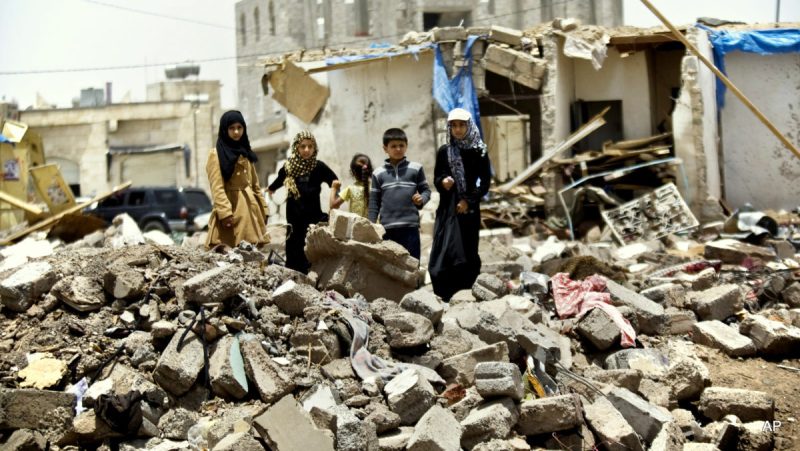
Photo Credit: AP Photo/Hani Mohammed
The Cradle | November 12, 2022
Talks between Yemeni and Saudi delegations in Oman have continued “uninterrupted” since the end of the UN-brokered ceasefire on 2 October, according to sources in the know that spoke with Lebanese daily Al Akhbar.
The report claims the Saudi delegation has shown “remarkable flexibility” in several of the outstanding issues, most notably offering to secure funding for the payment of state employees’ salaries.
They have also shown openness to lift road blockades and to allow flights from Sanaa International Airport to reach more destinations than the two currently allowed: Jordan and Egypt.
Nonetheless, issues still remain, as Riyadh reportedly wants to publicly label these measures as “helping the brothers in Yemen,” not as compensation for seven years of war.
Yemeni officials allegedly shot down this idea, as it would misrepresent Riyadh’s role in ravaging Yemen and pushing it to the brink of famine. Moreover, they have also rejected an offer for the head of Yemen’s Supreme Political Council, Mahdi al-Mashat, to lead an official delegation to the Saudi capital.
Earlier this month, The Washington Institute published a report based on a visit to the kingdom by Executive Director Robert Satloff and David Schenker, in which they assert that “Saudi Arabia clearly wants out of the [Yemen] conflict today.”
However, the behind-the-scenes progress to achieve this goal comes despite increased efforts by the Saudi-led coalition, Israel, the US, and the UK to consolidate their military presence in southern Yemen and on the country’s islands.
Earlier this week, Mashat warned that the US role in the ceasefire talks “is malicious and dangerous.”
“The armistice negotiations had previously reached a level of good understanding, but the US envoy, Tim Linderking, deliberately sabotaged them during his most recent tour of the region,” the head of Yemen’s Supreme Political Council said on 7 November.
“The US is trying to impede any sincere efforts to achieve sustainable peace in Yemen,” Yemen’s Ansarallah resistance group warned in a statement earlier this month.
According to the sources who spoke with Al Akhbar, the growing rift between Washington and Riyadh has spilled over onto their cooperation in Yemen, as the US now favors “interim solutions” rather than a comprehensive end to the war in order to maintain a “playing card” to use against Saudi leaders.
Featured Video

Chinese jet fuel and the myth of energy independence
or go to
Aletho News Archives – Video-Images
Book Review
Former Insiders Criticize Iran Policy as U.S. Hegemony
By GARETH PORTER | CounterPunch | February 27, 2013
“Going to Tehran” arguably represents the most important work on the subject of U.S.-Iran relations to be published thus far.
Flynt Leverett and Hillary Mann Leverett tackle not only U.S. policy toward Iran but the broader context of Middle East policy with a systematic analytical perspective informed by personal experience, as well as very extensive documentation.
More importantly, however, their exposé required a degree of courage that may be unparalleled in the writing of former U.S. national security officials about issues on which they worked. They have chosen not just to criticise U.S. policy toward Iran but to analyse that policy as a problem of U.S. hegemony. … continue
Blog Roll
 Aletho News
- What is fueling unrest across the EU?
- Why no power can undermine Iran’s eternal dominance over the Strait of Hormuz
- Is The War Against Iran Over?
- Iran war will leave long-term ‘scar’ on Wall Street, investors warn
- How Iran decimated US power projection in West Asia: Military lessons of 40-day war
- Iran’s report details US-Israeli war crimes in targeting schools, hospitals, livelihoods
- NATO’s Slow Fracture: How Trump’s Iran War Exposed the Instrument of Hegemony
- Chinese jet fuel and the myth of energy independence
- Ukraine Sea Drone Fired From Libya Hit Russian Tanker in Mediterranean
- IRGC: Iranian forces launched no attacks during ceasefire hours
- If Americans Knew
- Military aid to Israel emerges as the latest political litmus test for Democrats
- The only Palestinian children’s rights organization closes following years-long Israeli campaign against it
- ‘I Can’t Forget the Smell’: Lebanese Reel After Israel Kills Over 300 in Single Day
- DNC Shoots Down Resolutions Calling Out AIPAC and Limiting Arms to Israel
- TCN: Is Israel Blackmailing President Trump?
- Israel killed at least 303 Lebanese yesterday – who were they? Daily Update
- Amnesty: Urgent – Protect Lebanese civilians from brutal escalation in Israeli attacks
- Is The War Against Iran Over?
- Inside the Israeli army’s propaganda wing
- Hundreds of Gaza Amputees Stranded in Legal Limbo
- No Tricks Zone
- New Study: No Linear Warming Or Glacier Retreat Along Northern Antarctic Peninsula Since 1980s
- An Inconvenient Tree: Uncovered In Alps… Europe Much Warmer Than Today 6000 Years Ago
- New Study Reports A 60% Slowdown In Greenland’s Ice Loss Rate In The Last Decade
- Low Intensity Tornado Wrecks Major Solar Farm, Creating A Potential Toxic Dump
- New Study Finds Warming Saves Lives…Cold Temperatures 12 Times More Deadly Than Excess Heat
- German Science Blog Accuses PIK Climate Institute Of Hallucinating Climate Tipping Points
- Devastating Assessment Of Comirnaty Vaccine By Former Senior Pfizer Europe Toxicologist
- New Study: CO2 Is ‘Effectively Negligible’ As An Explanatory Climate Change Factor Since 2000
- Former Pfizer Toxicologist Dr. Helmut Sterz Tells Bundestag Hearing Pfizer Vaccine Should Have Never Been Approved
- Energy Expert: Germany’s Nuclear Phaseout Was A “500 Billion Euro Mistake”
 Aletho News