Riyadh realigns: Tehran over Tel Aviv
The Cradle | July 8, 2025
The recent confrontation between Iran and Israel marked a decisive shift in regional power equations, particularly in the Persian Gulf. Iran’s direct and calibrated military response – executed through the Islamic Revolutionary Guard Corps (IRGC) – exposed the strategic vulnerabilities of Tel Aviv and forced Gulf capitals, chiefly Riyadh, to reassess long-standing assumptions about regional security.
The Saudi-led recalibration did not emerge in isolation. Years of cumulative political, military, and diplomatic failures under the umbrella of US-Israeli tutelage have pushed Persian Gulf states to seek more viable, non-confrontational security arrangements. What we are witnessing is the slow dismantling of obsolete alliances and the opening of pragmatic, interest-driven channels with Tehran.
Iran’s war strategy resets Gulf expectations
Tehran’s handling of the latest military clash – with its reliance on precision strikes, regional alliances, and calibrated escalation – demonstrated a new level of deterrence. Using its regional networks, missile bases, and sophisticated drones, Tehran managed the confrontation very carefully, avoiding being drawn into all-out war, but at the same time sending clear messages to the enemy about its ability to deter and expand engagement if necessary.
The message to the Gulf was clear: Iran is neither isolated nor vulnerable. It is capable of shaping outcomes across multiple fronts without falling into full-scale war.
Speaking to The Cradle, a well-informed Arab diplomat says:
“This war was a turning point in the Saudi thinking. Riyadh now understands Iran is a mature military power, immune to coercion. Traditional pressure no longer works. Saudi security now depends on direct engagement with Iran – not on Israel, and certainly not under the receding American security umbrella.”
At the heart of Saudi discontent lies Tel Aviv’s escalating aggression against the Palestinians and its outright dismissal of Arab peace initiatives, including the Riyadh-led 2002 Arab Peace Initiative. Israeli Prime Minister Benjamin Netanyahu’s intransigence – particularly the aggressive expansion of settlements in Jerusalem and the occupied West Bank – has alarmed the Saudis.
These provocations not only sabotage diplomatic efforts but strike at the kingdom’s pan-Islamic legitimacy, forcing a reassessment of Israel’s utility as a strategic partner. As the diplomatic source notes:
“This Israeli political stalemate pushes Saudi Arabia to reconsider its regional bets and view Iran as a regional power factor that cannot be ignored.”
Riyadh turns to Tehran: containment over confrontation
Behind closed doors, Saudi Arabia is advancing a strategy of “positive containment” with Iran. This marks a clear departure from the era of proxy wars and ideological hostility. Riyadh is no longer seeking confrontation – it is seeking coordination, particularly on issues of regional security and energy.
Diplomatic sources inform The Cradle that the reopening of embassies and stepped-up security coordination are not mere side effects of Chinese mediation. They reflect a deeper Saudi conviction: that normalization with Israel yields no meaningful security dividends, especially after Tel Aviv’s exposed vulnerabilities in the last war.
Riyadh’s new path also signals its growing appetite for regional solutions away from Washington – a position increasingly shared by other Persian Gulf states.
For its part, the Islamic Republic is moving swiftly to convert military leverage into political capital. Beyond showcasing its missile and drone capabilities, Iran is now actively courting Arab states of the Persian Gulf with proposals for economic cooperation, regional integration, and the construction of an indigenous security architecture.
Informed sources reveal to The Cradle that Iran is pursuing comprehensive engagement with Saudi Arabia, the UAE, Qatar, and Oman. This includes economic partnerships and alignment on key regional files, from Yemen to Syria and Iraq.
Tehran’s position is consistent with its long-stated view: The Persian Gulf’s security must be decided by its littoral states and peoples – not by foreign agendas.
A new Gulf alliance is taking shape
This is no longer a Saudi story alone. The UAE is expanding economic cooperation with Tehran, while maintaining open security channels. Qatar sustains a solid diplomatic line with Iran, using its credibility to broker key regional talks. Oman remains the region’s trusted bridge and discreet mediator.
An Arab diplomat briefed on recent developments tells The Cradle :
“Upcoming Gulf–Iran meetings will address navigation in the Strait of Hormuz, energy coordination, and broader regional files. There is consensus building that understanding with Iran [will] open the door to a more stable phase in the Gulf.”
Amid these realignments, Israel finds itself regionally sidelined – its project to forge an anti-Iran axis has crumbled. The US-brokered Abraham Accords – once trumpeted as a strategic triumph – now elicit little more than polite disinterest across the Gulf, with even existing Arab signatories walking back their engagement.
Riyadh’s political elite now openly question the utility of normalization. As Tel Aviv continues its war on Gaza, Gulf populations grow more vocal and Saudi leaders more cautious.
The Saudi position is unspoken but unmistakable: Tel Aviv can no longer guarantee security, nor can it be viewed as the gatekeeper to regional stability any longer.
Pragmatism trumps ideology
This Saudi–Iranian thaw is not ideological – it is hard-nosed realpolitik. As another senior Arab diplomat tells The Cradle :
“Riyadh is discarding illusions. Dialogue with neighbors – not alliance with Washington and Tel Aviv – is now the route to safeguarding Saudi interests. This is now about facts, not old loyalties. Iran is now a fixed component of the Gulf’s security equation.”
The binary of “Gulf versus Iran” is fading. The last war accelerated a trend long in motion: the collapse of Pax Americana and the emergence of multipolar regionalism. The Gulf is charting a new course – one less beholden to US-Israeli diktats.
Today, Saudi Arabia sees Tehran not as a threat to be neutralized, but as a power to be engaged. Regional security frameworks are being built from within. Israel, meanwhile, despite its many pontifications about a Tel Aviv-led, Arab-aligned “Middle East,” is struggling to stay relevant.
If these dynamics hold, we are on the cusp of a historic transition – one that may finally allow the Persian Gulf to define its own security and sovereignty, on its own terms.
This is not an ideal future. But it is a strategic upgrade from decades of subservience. Saudi Arabia is turning toward Iran – not out of love, but out of logic.
Yemeni air defenses confront Israeli aggression on Hodeidah
Al Mayadeen | July 7, 2025
At least 20 Israeli airstrikes struck the city of Hodeidah in Yemen early Monday, Al Mayadeen’s correspondent reported, while Yemeni air defenses managed to repel a significant portion of the assault.
The attacks targeted key locations including the ports of Hodeidah, Salif, and Ras Issa, as well as the Ras Qatif power station. Israeli media confirmed that these infrastructures had been hit by Israeli occupation forces on three previous occasions.
Additionally, our correspondent noted that one of the strikes hit the Galaxy Leader vessel, linked to “Israel” and captured by the Yemeni Armed Forces on November 19, 2023.
In a related statement, Israeli Security Minister Israel Katz declared that Israeli forces are “vigorously attacking” targets at Yemeni ports, the Ras Qatif power plant, and the Galaxy Leader ship.
Yemeni air defenses repel major part of Israeli aggression
Israeli media outlets reported that 53 projectiles were used in the operation, while our correspondent revealed that the Yemeni Armed Forces worked to repel the aggression, thwarting a substantial part of it.
Yemeni military sources told Al Mayadeen that air defenses launched the first wave of surface-to-air missiles, forcing 10 Israeli aircraft out of Yemeni airspace before they could carry out their attacks.
Sources also revealed that Israeli warplanes had to turn back and were not able to execute planned strikes on other Yemeni governorates.
Previously, the spokesperson for the Yemeni Armed Forces, Brigadier General Yahya Saree, had announced that the Yemeni Air Force “is currently confronting the Zionist aggression against our country.”
“Our air defenses are ready and prepared to confront Israeli attacks on our country with full force and power,” Saree underlined.
Yemen vows continued support for Gaza, launching missile
At around 3:45 am (local time), two missiles were launched from Yemen toward Israeli targets in occupied Palestine. The missiles were reportedly intercepted by Israeli occupation forces, sounding sirens in several areas in the southern occupied West Bank and near the Dead Sea.
Chairman of the Board of Directors of the Yemeni News Agency (SABA), Nasruddin Amer, said that operations in support of Gaza “will not cease until the aggression stops and the blockade is lifted,” in a post on X.
“The Zionist aggression has not and will not be able to stop the Yemeni strikes deep inside its territory,” Amer explained.
“Not a single ship will pass through our armed forces’ area of operations,” he added.
Meanwhile, Brigadier General Saree stressed that the Yemeni Armed Forces are “fully prepared and capable” of confronting the Israeli aggressors.
He stressed that the Israeli attacks will not affect Yemeni military capabilities, emphasizing that the country’s support for Palestine “will continue at a high pace.”
Yemeni defence minister affirms maritime blockade of Israel to continue
MEMO | June 25, 2025
Advisor to the director of the Moral Guidance Department at the Yemeni Ministry of Defence, Brigadier General Abed Thawr stressed Tuesday that the maritime blockade imposed by the Houthis on Israeli and Israel-bound ships will continue, adding that the recent conflict between Iran and Israel and the subsequent ceasefire, will not affect the group’s support for the Palestinian cause.
“Gaza will remain our cause and our common destiny” he told Al-Resalah Net.
“From 7 October 2023, until now, Yemen has not stopped supporting Gaza politically, militarily, and popularly, because Palestine lives in our hearts, and the battle of Gaza is the battle of all free people,” he added. Thawr stressed that Yemen, under the leadership of its armed forces and revolutionary leadership, will continue to impose a naval and air blockade on the “Zionist entity” and will not allow any ship to pass into the occupied ports, regardless of its nationality or destination.
“The enemy has ignored humanitarian demands for the entry of food and medicine and the opening of the crossings, and therefore the Yemeni response will continue with our missiles and drones”.
Thawr explained that the weekly mass demonstrations in Yemen since the start of the aggression on Gaza in October 2023, are a clear manifestation of the depth of popular affiliation with the Palestinian cause.
“The people of Gaza are our people, their honour is our honour, and we will harness all our military and economic capabilities to support them until their suffering is alleviated and what the occupation has destroyed is rebuilt”.
He also criticised “shameful and humiliating” official Arab positions, stressing that the Yemeni people will not wait for action from subservient governments but will continue to stand with Gaza until its liberation.
“As long as Yemen exists, rest assured that Israel and America will remain besieged in the Red Sea, and that Gaza will never be left alone. Victory is near, God willing, and we will remain faithful to the covenant until the end,” he concluded.
Sic Transit Gloria Mundi
By William Schryver – imetatronink – May 22, 2025
The inexorable decline of the American Empire has arrived at an Imperial Paradox. It must either fight a war and die, or not fight a war and die.
Here are the options:
China
Neither South Korea nor Japan want anything to do with a war against China, leaving only the Philippines dumb enough to play along.
The US apparently pulled another brigade out of South Korea. They’ll pull out more in the future. They know damn well the North Koreans could easily conquer the entire peninsula if they chose to do so.
China and its local seas are a vast ocean away from America, and its capacity to defend its local seas is enormous and growing.
The Pentagon must understand it cannot sustain logistics in a war against China in the western Pacific. It simply cannot be done. Anyone who thinks otherwise must upgrade their proficiency in basic arithmetic.
Iran
In the context of a war against Iran, all the geography is against the US.
Iran is an exceedingly mountainous country that has, over the course of millennia, learned to use those mountains to defend itself against would-be conquerors.
They can field a satisfactorily well-equipped million-man army.
They have learned in the 21st century to burrow deep heavily fortified tunnels into their mountains.
Iran is also much more technologically advanced than most people understand. They have become impressively capable in terms of both offensive and defensive missiles. They pose a far greater challenge than the Yemeni have been over the past year and a half.
Indeed, they pose a “near-peer” challenge against US overseas power projection.
The US Navy could only operate at extreme risk in the southern Red Sea, the Gulf of Aden, the Gulf of Oman, the Strait of Hormuz, and the Persian Gulf.
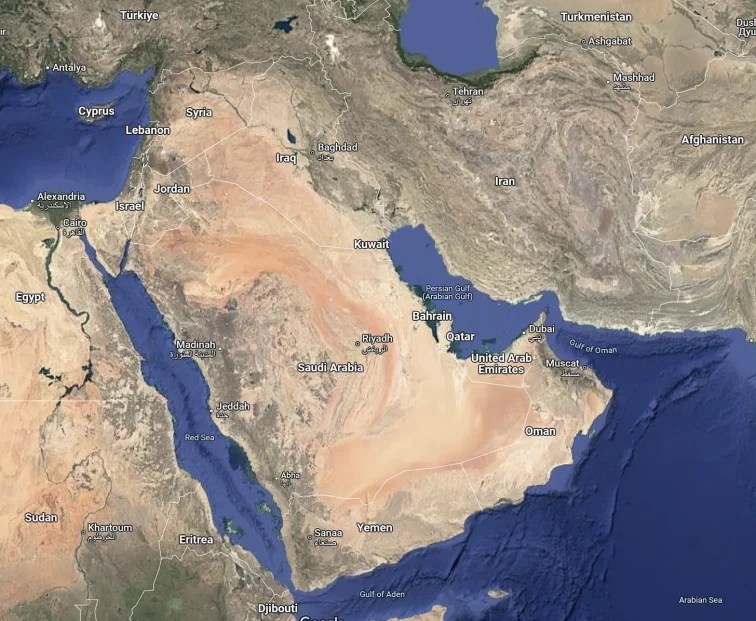
Iran’s sphere of influence
Every US base in the region is well within range of Iranian missile strikes.
The US Navy very demonstrably cannot secure seaborne logistics into the Persian Gulf. They lack both the sealift ships, and the ability to protect them.
They cannot even open the Bab-el-Mandeb!
Russia
From a geographic and logistical standpoint, the only remotely conceivable war is one in Ukraine against Russia.
The US at least has bases and forces already in place in the UK, Germany, Poland, Romania, Finland, and in Baltic chihuahua fantasy-land — and what has served until now as a reasonably secure logistics pathway into all those places.
Of course, whether or not such a condition persists long in a war scenario is another question altogether.
Because, you see, the Russians are now unquestionably the most formidable and battle-hardened military on the planet — at least in the context of a war fought on their doorstep.
So if you’re an empire that thinks it needs a war to reaffirm at least its short-term relevance and fading glory … well, these are your choices.
Red Sea debacle: How Yemeni resistance brought American war machine to a halt
By Kit Klarenberg | Press TV | May 18, 2025
On May 12, the New York Times published a forensic autopsy of the failure of the Trump administration’s renewed hostilities against the Ansarullah-led Yemeni military in the Red Sea.
The probe teemed with extraordinary disclosures, spelling out in stark detail how the combined air and naval effort – launched with enormous fanfare and much bombastic rhetoric from US officials – was an even greater debacle, and devastating defeat, for the Empire than hitherto thought.
The scale of the cataclysm may explain Washington’s sudden determination to reach a negotiated settlement with the Islamic Republic of Iran.
Perhaps the most striking revelation is that Trump’s blitzkrieg against Yemen was initially planned to be a long-term, large-scale engagement, culminating in a ground invasion using proxy forces.
General Michael Kurilla, Commander of the Pentagon’s Central Command, which covers Central, South and West Asia, had been in favor of all-out war with the Ansarullah resistance movement ever since its righteous anti-genocide Red Sea blockade began in late 2023.
Reportedly, though, Joe Biden was wary that a “forceful campaign” would elevate them “on the global stage.”
With Trump’s re-election, “Kurilla had a new commander in chief” and an opportunity to up the ante against Ansarullah significantly. He pitched an eight-to-10-month effort, starting with a saturation bombing of Yemen’s air defense systems, before a wave of targeted assassinations of movement leaders, directly inspired by Israel’s attacks on Hezbollah’s senior members in September 2024.
Kurilla’s grand operation was eagerly supported by elements of the Trump administration, including Defense Secretary Pete Hegseth and then-National Security Advisor Mike Waltz.
Saudi officials were also on board, providing Washington with a target list of 12 Ansarullah leaders “whose deaths, they said, would cripple the movement.”
However, the UAE, which had in concert with Riyadh relentlessly bombed Yemen 2015 – 2023 to no tangible result, “was not so sure.” Several members of Trump’s administration were also skeptical of the plan’s prospects and worried a protracted attack on Sana’a would drain valuable, finite resources, including the president himself.
Yet, after concerted lobbying, Trump “signed off on part of General Kurilla’s plan – airstrikes against Houthi air defense systems and strikes against the group’s leaders.”
So it was on March 15, US fighter jets began battering Yemen anew, while a carrier force led by the USS Harry S. Truman thrust into the Red Sea.
White House officials boasted the onslaught would continue “indefinitely”, while Trump bragged that Ansarillah would be “decimated” via “overwhelming lethal force until we have achieved our objective.”
Some degradation
In reality, The New York Times suggests Trump privately made clear he wanted Ansarullah bombed “into submission” within just 30 days, and failure in this objective would mean the operation’s termination.
By the 31st day of hostilities, the US president “demanded a progress report.” As the outlet records, “the results were not there,” which is quite an understatement. The US “had not even established air superiority” over Ansarullah, while the resistance group continued “shooting at vessels and drones, fortifying their bunkers and moving weapons stockpiles underground.”
Moreover, during those first 30 days, Yemeni military “shot down seven American MQ-9 drones” costing around $30 million each, “hampering Central Command’s ability to track and strike back. Meanwhile, several American F-16s and an F-35 stealth fighter jet “were nearly struck by Houthi air defenses, making real the possibility of American casualties.”
All along, too, the US burned through weapons and munitions at a rate of about $1 billion in the first month alone:
“The cost of the operation was staggering. The Pentagon had deployed two aircraft carriers, additional B-2 bombers and fighter jets, as well as Patriot and THAAD air defenses… So many precision munitions were being used, especially advanced long-range ones, that some Pentagon contingency planners were growing increasingly concerned about overall stocks and the implications for any situation in which the US might have to ward off an attempted invasion of Taiwan by China.”
Concerned, “the White House began pressing Central Command for metrics of success in the campaign.”
In a bitter irony, Pentagon officials “responded by providing data showing the number of munitions dropped” to prove they were achieving their goals. They also claimed, without evidence, to have hit over 1,000 military targets, while killing “more than a dozen senior Houthi leaders.”
US intelligence was unconvinced, acknowledging there was “some degradation” of the Ansarullah-led military, but “the group could easily reconstitute” regardless.
As a result, “senior national security officials” began investigating “pathways” for either withdrawing from the theatre with minimal embarrassment or keeping the fiasco going using local proxy forces.
One option was to “ramp up operations for up to another month and then conduct ‘freedom of navigation’ exercises in the Red Sea using two carrier groups, the Carl Vinson and the Truman.” If AnsarAllah did not fire on the ships, “the Trump administration would declare victory.”
Another option was to extend the campaign, giving forces under the control of the Riyadh-based Yemeni Presidential Leadership Council “time to restart a drive to push the Houthis out of the capital and key ports” in a ground assault.
The plan was hatched despite prior Saudi-led invasions of Yemen invariably ending in total disaster. This may account for why talks between Hegseth and Saudi and UAE officials in late April “to come up with a sustainable way forward… they could present to the President” came to nothing.
Great ability
As luck would have it, right when Hegseth’s last-ditch efforts to breathe life into the collapsing effort were floundering, Trump’s West Asia envoy Steve Witkoff was in Oman, engaged in nuclear talks with Iran.
Officials there separately suggested a “perfect offramp” for Washington in its war with Ansarullah. The US “would halt the bombing campaign and the militia would no longer target American ships in the Red Sea, but without any agreement to stop disrupting shipping that the group deemed helpful to Israel.”
Well-publicised fiascoes around this time, such as the loss overboard of an F/A-18 Super Hornet, costing $67 million, due to the USS Harry S. Truman conducting evasive maneuvers to avoid an Ansarullah drone and missile attack, further depleted White House enthusiasm for the operation.
According to The New York Times, “Trump had had enough”. He duly accepted the Omani proposal, and on May 5th, CentCom “received a sudden order… to ‘pause’ offensive operations” in the Red Sea.
That a ballistic missile fired by the Yemeni military evaded the Zionist entity’s air defenses and struck Tel Aviv’s Ben-Gurion International Airport the previous day likely provided further incentive to halt hostilities.
So it was on May 6, Trump declared victory against Ansarullah, claiming the resistance group had “capitulated”, and “don’t want to fight any more”. Nonetheless, the president expressed clear admiration for God’s Partisans, indicating he placed a high degree of trust in Ansarullah’s assurances that US ships would no longer be in their redoubtable crosshairs:
“We hit them very hard and they had a great ability to withstand punishment. You could say there was a lot of bravery there. They gave us their word that they wouldn’t be shooting at ships anymore, and we honor that.”
Per The New York Times, Trump’s “sudden declaration of victory… demonstrates how some members of the president’s national security team underestimated a group known for its resilience.”
But more deeply, it surely reflects how the bruising, costly experience was a blunt-force education in the glaring deficiencies of US military power, and the Empire’s fatal vulnerability in the event of all-out war against an adversary actually able to defend itself. This could account for the Trump administration’s sudden determination to finalize a nuclear deal with Tehran.
It must not be forgotten that before even taking office, Trump and his cabinet openly planned for a significant escalation of belligerence against the Islamic Republic.
Among other things, they boasted of drawing up plans to “bankrupt Iran” via “maximum pressure”. US Secretary of State Marco Rubio, who has long called for tightening already devastating sanctions on Tehran, was a key advocate for this approach, and eagerly supported by Mike Waltz, among others.
At an event convened by NATO adjunct the Atlantic Council in October 2024, Waltz bragged about how the president had previously almost destroyed the Islamic Republic’s currency, and looked ahead to inflicting even more severe damage on the country following Trump’s inauguration.
Fast forward to today, though, and such rhetoric has vanished from mainstream Western political discourse. It appears Trump and his team have not only jettisoned their previously stated ambitions towards Iran but are determined to avoid war.
Moreover, just as the Zionist entity was not consulted before Washington struck a ceasefire with Ansarullah, Tel Aviv has been completely frozen out of nuclear negotiations between the US and Iran, and if an agreement does result at last, it will not take into account Israel’s bellicose position towards the Islamic Republic.
Just as the Cuban Missile Crisis transformed Cold warrior John F. Kennedy into a dove, Trump’s experience in the Red Sea may well have precipitated a seismic shift in his administration’s foreign policy.
F-35 near-misses over Yemen signal new risks for ‘Israel’
Al Mayadeen | May 14, 2025
US F-16 and F-35 fighter jets encountered heavy close-range fire from Ansar Allah air defenses during Operation Rough Rider, the two-month US aggression against Ansar Allah that was launched by President Donald Trump in mid-March, according to Forbes.
According to a Monday report by The New York Times, unspecified Ansar Allah air defenses came dangerously close to striking US fourth-generation F-16s and fifth-generation F-35s during the initial 30 days of Operation Rough Rider, raising concerns about potential American casualties. During the same period, Ansar Allah forces successfully shot down seven MQ-9 Reaper drones.
The potential downing of a US fighter jet and the resulting capture of a pilot by Ansar Allah forces presented a scenario that the current administration was determined to avoid, Forbes stated.
The loss of one of America’s exclusively exported stealth fighters to Ansar Allah air defenses, which had previously been considered largely improvised and relatively rudimentary, would have dealt a severe blow to US fighter jet prestige while potentially jeopardizing future arms export agreements.
‘Israel’ faces similar risks
Forbes highlighted that the near-misses involving US F-35s during operations over Yemen carry significant consequences for “Israel” as well, particularly since the Israeli Air Force initiated its first long-range strikes against Ansar Allah in July 2024 following a successful drone attack by the group that reached Tel Aviv. In March, shortly after initiating Operation Rough Rider, the US advised “Israel” against carrying out further attacks.
Trump declared the Yemen ceasefire shortly after “Israel” conducted strikes following an Ansar Allah missile attack that had successfully hit its major airport near Tel Aviv.
While US Marine Corps F-35Bs conduct operations from amphibious assault ships and Navy F-35Cs launch from supercarriers positioned near Yemen’s coast, “Israel” lacks comparable forward deployment capabilities for its F-35Is, forcing them to rely on aerial refueling to cover the more than 1,000-mile flight distance and severely limiting their available loiter time over Yemeni airspace during missions.
Given that Ansar Allah’s air defenses have already posed risks to US F-35s, Israeli F-35Is conducting long-range missions could also face similar threats, and if one were to be shot down over Yemen, it would provide Ansar Allah with an unprecedented image of a victory, according to the US magazine.
Future Israeli F-35I sorties over Yemen will likely avoid operating at maximum combat capability to minimize risk exposure.
US War on Yemen Exposes Limits of American Military Might
By Brian Berletic – New Eastern Outlook – May 13, 2025
Despite years of devastating military and economic pressure, Yemen’s Ansar Allah movement continues to defy U.S. operations, exposing the growing limitations of American military power in the region.
Yemen, a nation of approximately 40 million people, is one of the poorest nations on Earth. It has suffered decades of political instability, including a US-engineered regime change operation in 2011 followed by a nearly 7 year long war with a US-armed and backed Saudi-led Persian Gulf coalition. The war included air strikes and a ground invasion, along with economic sanctions and a naval blockade. Subsequently, the UN has declared Yemen to be one of the world’s worst humanitarian crises, with up to 14% of the population displaced by conflict.
Since then, the US has carried out direct attacks on Yemen. Both the previous Biden administration and now the current Trump administration have carried out military campaigns in a bid to subdue Ansar Allah (often referred to as the “Houthis”) – the military and political organization administering Yemen’s capital and surrounding cities along the nation’s western coast.
The most recent military campaign has included strikes on civilian infrastructure, including a major port and reportedly a reservoir.
Leaked messages between the US Secretary of Defense Pete Hegseth, the US Vice President and other senior officials reveal the deliberate targeting and complete destruction of residential buildings to kill a single suspected enemy individual.
Despite the tremendous power of the US military and the protracted brutality the US has applied to Yemen, Ansar Allah remains a viable political and military organization. It continues to target and destroy US drones conducting surveillance and attacks in Yemeni airspace, as well as targeting US warships in the Red Sea, amid a much wider blockade Ansar Allah has placed on Israeli-bound vessels and now US oil shipments.
While Ansar Allah has regularly claimed to have targeted and forced US warships to flee, a recent CNN article appears to confirm that indeed drones and anti-shipping missiles targeting US ships have not only forced them to take evasive maneuvers, they have also caused material losses including a $60 million F-18 warplane.
The article admits:
A US official said initial reports from the scene indicated the Truman made a hard turn to evade Houthi fire, which contributed to the fighter jet falling overboard. Yemen’s Houthi rebels claimed on Monday to have launched a drone and missile attack on the aircraft carrier, which is in the Red Sea as part of the US military’s major operation against the Iran-backed group.
Other Western media outlets have admitted the loss of multiple $30 million drones over Yemen. An April 29, 2025 article by France 24 reported that the US had lost up to 7 MQ-9 Reaper drones over the previous 2 months.
The drones are used to identify and guide munitions to targets. They have a service ceiling comparable to modern manned warplanes like the US F-35 Lightning. The regular loss of MQ-9 drones over Yemen implies that Ansar Allah possesses air defense systems also capable of reaching altitudes manned US warplanes operate at. This is why the US has failed so far to establish air superiority over Yemeni airspace, forcing the US to instead carry out standoff strikes.
Standoff strikes involve the use of long-range precision guided missiles fired far beyond the reach of enemy air defenses. The missiles then travel into enemy airspace to strike their targets. While the obvious advantage of this strategy is avoiding enemy air defenses, there are many disadvantages, including the use of standoff munitions which are expensive and made in relatively small quantities. Enemy radar systems can detect stand-off weapons as they travel across their airspace, allowing them to potentially intercept the incoming missile. It also provides personnel and equipment time to take cover before the stand-off munitions reach their target.
Western media outlets have reported that Ansar Allah is believed to have surface-to-air missiles from Iran. This includes systems like the Barq-1 and Barq-2 air defense systems. These are comparable to the Russian-made Buk air defense system. While considered a “medium range” air defense system, it is capable of targeting modern warplanes at their maximum service ceiling.
Western media outlets have also noted the US’ use of electronic warfare aircraft against targets across Yemen, armed with anti-radiation guided missiles designed to detect and home in on radar signals. Such missiles are used as part of “suppression of enemy air defenses” (SEAD) missions to either force air defense operators to turn off their radar sets to prevent their destruction, or to target and destroy the radar set if they don’t. Whether switched off or destroyed, the radar systems are unable to target and destroy incoming warplanes, allowing airstrikes to be conducted.
Despite the simple premise, the detection and suppression of enemy air defense systems as part of SEAD missions is dangerous and complex. The fact that Ansar Allah is still regularly detecting and downing MQ-9 drones means US SEAD missions have fallen short of destroying Ansar Allah’s air defenses and establishing air superiority over Yemen.
The limitations of US military power have been steadily exposed in recent conflicts. The US proxy war in Syria and now its military operations against Yemen has required US warplanes to conduct standoff strikes because of an inability to either destroy or evade Russian and Iranian-designed air defense systems. The transfer of US weapons to Ukraine and their failure on the battlefield there have further exposed the limits of US military might.
Despite this, the US remains a dangerous threat to the nations it targets. In Syria, the US used asymmetric military power in the form of armed militants, economic warfare, and political interference to succeed where its airpower had failed. While the disparity between US military might and that of the nations it targets has narrowed significantly over recent years, its vast array of economic and political weapons remain potent alternatives.
Only time will tell whether the emerging multipolar world can close the gap in regard to these US advantages in the same way it has regarding America’s quickly shrinking military advantages.
Israel’s US-made THAAD fails again as Yemen targets key airport with hypersonic missile
Press TV – May 9, 2025
Yemen’s Armed Forces have again targeted the Israeli regime’s BenGurion airportnear the city of Tel Aviv, with a hypersonic ballistic missile.
The development took place on Friday, spreading chaos across the occupied Palestinian territories and forcing millions of the regime’s illegal settlers to run towards shelters, the forces said in a statement conveyed by spokesman Brigadier General Yahya Saree.
According to the official, the “qualitative military operation successfully achieved its goal.”
The projectile triggered sirens across Tel Aviv and “more than 200 other locations,” the Israeli regime’s media outlets reported.
The development had the Israeli military scramble to activate its missile systems, including the American-made THAAD air defense system, the regime’s Channel 14 reported.
According to the channel, the missile system, however, failed to intercept the projectile, marking the “second” time that the expensive apparatus was falling short in the face of incoming Yemeni fire.
Various Israeli outlets, meanwhile, reported explosions in eastern Tel Aviv and the holy occupied city of al-Quds, where the THAAD had been activated.
Yemen’s Armed Force have been enforcing a naval blockade on Israeli ships and vessels sailing towards the territories since October 2023. The blockade came in response to the regime’s launching an overwhelmingly deadly war of genocide on the Gaza Strip, and simultaneously escalating its already stringent siege of the Palestinian territory.
Earlier in May, the Yemeni servicemen began imposing a comprehensive aerial blockade on the regime too, warning international airlines to suspend flights to airports in the occupied territories to ensure passenger safety.
Saree said the Friday strike came “within the implementation of the no-fly zone imposed on the criminal Israeli enemy entity.”
“The interception systems failed to intercept it (the missile), halting airport operations for nearly an hour.”
Separately, “The UAV (unmanned aerial vehicle) force of the Yemeni Armed Forces carried out a military operation targeting a vital Israeli enemy target in the occupied area of Yaffa,” the official said, referring to an area lying near Tel Aviv.
‘Repeated warning to airlines’
The spokesman asserted that the Yemeni servicemen would not stop short of enforcing the aerial blockade.
“The Armed Forces reiterate their warning to airlines that have not yet complied with the ban, that they must immediately halt their flights to occupied Palestine, as others have done.”
Saree finally reasserted Sana’a’s stance that such operations targeting sensitive and strategic Israeli targets would last until the regime ceased its war on Gaza and ended the siege.
Defiant Trump advances US plans without Israeli approval: Report
The Cradle | May 8, 2025
US President Donald Trump has lost patience with Israeli Prime Minister Benjamin Netanyahu and will not wait any longer for Israel before advancing initiatives in West Asia, Israel Hayom reported on 8 May.
According to two senior sources in the US President’s entourage, Trump is interested in making decisions that he believes will advance US interests, particularly regarding Saudi Arabia and the Gulf states, without waiting for approval from Netanyahu.
Regarding a potential US–Israeli agreement with Saudi Arabia, Trump believes Netanyahu is delaying making the necessary decisions. The president is not willing to wait until Israel does what is expected of it and will move forward without it.
During the presidency of Joe Biden, the US and Israel were involved in talks with Saudi Arabia that would see Washington enter a defense pact with the kingdom, provide it with civilian nuclear technology, and sell it advanced weapons – all in exchange for normalization with Israel.
As part of any agreement to normalize relations with Israel, Saudi Arabia expects an end to the war in Gaza and an Israeli declaration of a “horizon for a Palestinian state.”
However, senior ministers in Israel’s current government have vowed to never allow a Palestinian state in the occupied West Bank, while promising to “destroy” Gaza, ethnically cleanse its population under the pretext of promoting “voluntary migration,” and to build Jewish settlements there.
The sources added that Trump was furious at what he saw as an attempt by Netanyahu to use US National Security Advisor Mike Waltz, who has since been dismissed from his position, to push for US military action in Iran.
Netanyahu claimed in response to the publication of the affair in the Washington Post that he had only spoken to Waltz once. However, Trump was not convinced.
The president’s anger likely explains why Trump did not involve Israel in the ceasefire he announced with the Ansarallah-led government of Yemen.
Even after Trump announced the agreement with Yemen, Israeli representatives handling relations with the US were reportedly unable to receive information from White House officials about what was happening for a day, Israel Hayom noted.
Additionally, Trump is not currently scheduled to visit Israel as part of his visit to the region next week.
The disconnect between Trump and Netanyahu likely explains why the Israeli prime minister and his Defense Minister, Israel Katz, announced on Wednesday that they are prepared for a situation in which Israel will be left alone in the campaign against Yemen.
Defense Minister Katz said that “Israel must be able to defend itself on its own against any threat and any enemy. This has been true in the face of many challenges in the past and will continue to be so in the future.”
Trump has faced criticism for escalating the war against Yemen since taking office in January, including for withholding information about US military casualties resulting from a military campaign that has never received authorization from Congress.
The operation has involved over 1,000 US airstrikes against the Ansarallah-led Yemeni Armed Forces (YAF) and killed hundreds of Yemenis, including many civilians.
Writing for Haaretz, Israeli journalist Aluf Benn notes that each time US presidents have been angered by Tel Aviv’s actions, “Israel stood its ground, deflected the pressure and over time got what it wanted.”
Benn stated that Trump is also pursuing a deal with Iran over its nuclear program that is contrary to Netanyahu’s position on the matter.
Trump pulled the US out of the Obama-era Joint Comprehensive Plan of Action (JCPOA) in 2018 amid encouragement from Netanyahu. However, the president has been trying to come to a diplomatic understanding with Iran to halt the development of its nuclear program during his second term.
Three rounds of talks have taken place, mediated by the government of Oman and involving Trump’s special envoy to the region, Steve Witkoff.
US ceasefire in Yemen: Retreat masquerading as restraint
The US ends its Red Sea campaign not by victory, but by necessity – under relentless pressure from an underestimated Yemeni resistance
By Mawadda Iskandar | The Cradle | May 8, 2025
In a major recalibration of its year-long Red Sea military campaign, the US has agreed to a ceasefire with Yemen’s Ansarallah-aligned armed forces, brokered by Oman. After months of escalating attacks under the guise of “protecting international shipping,” Washington now finds itself calling time on a conflict it launched – but failed to control.
While Yemen’s leaders stress that operations in support of Gaza will persist, the US pivot signals more than de-escalation: It is a tacit admission that its campaign has collapsed under pressure, unable to achieve even its most basic strategic goals.
With over a thousand airstrikes launched since March 2024, Washington’s failure to contain the Yemeni threat in the Red Sea, Bab al-Mandab Strait, and the Gulf of Aden stands as a stark indictment of its military planning. The war devolved into a costly, high-stakes exercise in attrition – one Yemen emerged from stronger, not weaker.
A flawed campaign from the start
From its inception, the US-led campaign ‘Prosperity Guardian’ lacked clarity. The mission to “protect shipping lanes” quickly became an open-ended confrontation with no political roadmap. American officials misread both the battlefield and Yemen’s resilience.
Despite the might of its airpower, Washington failed to dent Sanaa’s capacity or will to fight. Instead, the bombardment accelerated Yemen’s military innovation, forcing Washington into a deterrence game it could not win.
Yemen’s unconventional warfare style, grounded in its topography and culture, posed immense challenges. Leaders operated from mountainous terrain fortified by tunnel systems, well beyond the reach of satellite surveillance.
The US had little intelligence penetration into Yemen’s military hierarchy and no functioning target bank. Sanaa’s leadership, experienced from years of prior war against the Saudi and UAE-led coalition and its proxies, held the advantage.
Speaking to The Cradle, Colonel Rashad al-Wutayri lists five key reasons for the campaign’s failure. First, Yemen’s use of low-cost, high-impact weapons – ballistic missiles and drones – pierced even US carrier strike groups.
Second, the campaign failed to protect Israeli or allied shipping. Third, Ansarallah exposed Israeli-American spy networks and clung to its demands: Namely, an end to the war on Gaza. Fourth, apart from Bahrain, Washington’s Arab allies declined to join the US-led coalition. Fifth, the financial cost spiraled, with the US spending millions on interceptors to counter drones built for mere thousands.
No coalition, no ground game
Washington’s diplomatic push to build a regional anti-Yemen coalition fell flat. Persian Gulf states, still stung from their own failures in Yemen, wisely kept their distance. Saudi Arabia refused to be drawn back into a war it has been trying to exit since 2022. The UAE, meanwhile, limited its support to logistics. Egypt stayed silent, unwilling to be sucked into another regional escalation.
This reticence was not without reason. Ansarallah leader Abdul Malik al-Houthi issued direct warnings to neighboring countries: Any cooperation with the US – via bases or troops – would bring immediate retaliation.
The threat worked. When Washington explored the idea of a ground assault using US special forces and Persian Gulf-backed militias, the plan quickly collapsed. Yemen’s terrain, its entrenched resistance, and the bitter legacy of previous Saudi-Emirati attempts made such a venture untenable.
Political analyst Abdulaziz Abu Talib tells The Cradle that Riyadh and Abu Dhabi have internalized the cost of further escalation. While both continue to bankroll proxy militias, they are steering clear of overt military entanglement. Yemen’s ability to withstand this trilateral aggression – and to land blows on US and Israeli interests – further eroded faith in Washington’s protective umbrella.
Bombs, billions, and blunders
Between March 2024 and April 2025, the US launched over 1,000 airstrikes on Yemen. Yet, rather than break its adversary, the campaign emboldened it. In retaliation, Yemen escalated steadily – from targeting Israeli vessels in November 2023, to US and UK ships by January, the Indian Ocean by March, and the Mediterranean by May.
By July, Ansarallah struck Tel Aviv with hypersonic missiles. A direct hit on Ben Gurion Airport followed, redrawing the region’s military balance.
The costs piled up. In the first three weeks alone, the US burned through $1 billion. Weapons like Tomahawk and JASSM missiles – costing millions apiece – were deployed against drones worth a few thousand dollars. Yemen’s own achievements mounted: 17 MQ-9 Reaper drones shot down, a $60 million F-18 fighter jet destroyed, and a declared aerial blockade of Israel.
Wutayri highlights that Yemen developed its arsenal domestically, without foreign technical assistance. That included the hypersonic missiles that bypassed Israeli and US air defenses, and drones capable of striking both military and commercial ships. Even as Washington intensified its bombardment, Yemen’s operational tempo and range only grew.
Erosion from within
Back in Washington, the cracks were showing. The Pentagon quietly expanded military commanders’ autonomy to strike targets without White House clearance – an effort to shield the administration from political fallout. But the costs, both financial and reputational, were impossible to ignore.
US media outlets began questioning the purpose and direction of the campaign. Public patience waned. There were calls for countries benefiting from Red Sea trade – namely Persian Gulf monarchies – to shoulder the burden of maritime security.
Wutayri says the US suffered further humiliation: a destroyer and three supply ships were sunk, and both the USS Abraham Lincoln and Harry S. Truman aircraft carriers were targeted. Despite spending another $500 million on interceptors, the results were negligible. The image of US warplanes crashing into the sea, and of exhausted troops – some 7,000 deployed – unable to break Yemen’s resolve, dented American prestige.
More than just a response to Red Sea attacks, the campaign was part of Washington’s broader effort to counter China’s regional influence, particularly Yemen’s emerging Belt and Road links. But the military track backfired, hardening local resistance and undermining US credibility.
Abu Talib notes that even stealth aircraft and strategic bombers failed to achieve deterrence. The Trump administration faced two options: retreat under the weight of defeat, or engage in talks under Ansarallah’s terms – chief among them an end to the Gaza war.
A war without an aim
 From the outset, Washington struggled to manufacture a narrative of victory. The Pentagon released videos of jets launching from carriers – empty spectacle, absent substance. There were no “shock and awe” moments, no milestones to sell as success.
Yemen, meanwhile, delivered iconic images; among them, a father shielding his child during a bombing raid – a powerful symbol of national defiance. As civilian casualties mounted, so did public fury. Scenes of women and children pulled from rubble circulated widely, drawing uncomfortable parallels with past US wars in Iraq and Afghanistan.
According to Abu Talib, Yemen’s social cohesion and rugged geography undermined every attempt to break its lines. Far from fracturing under pressure, the public rallied behind Ansarallah. The more the US escalated, the more entrenched Yemeni resistance became – both militarily and socially.
Now, the Trump administration is shifting gears, seeking peace without admitting defeat. But Sanaa is not standing still. It promises continued operations, and with them, new strategic equations that could further upend the regional balance of power.
Collapsing Empire: AnsarAllah Defeats US Again
By Kit Klarenberg | Global Delinquents | May 8, 2025
On May 6th, Donald Trump made the shock announcement that the US was abandoning all hostilities against Yemen. A vast, multi-billion dollar naval and air campaign officials in Washington had pledged would last “indefinitely” has abruptly ended, in return for AnsarAllah pledging not to attack American shipping in the Red Sea. While the President has bragged the Resistance group “capitulated” to his administration’s renewed, much-intensified belligerence and “don’t want to fight any more”, the reality is that God’s Partisans have once again defeated the Empire.
As reported by the New York Times, it remains unclear whether the ceasefire will apply to other foreign shipping, “after a costly seven-week bombing campaign.” Meanwhile, AnsarAllah has “stopped short of declaring a full cease-fire, saying that they would continue to fight Israel,” while [portraying] the deal as a major victory for the militia and a failure for Mr. Trump, spreading a social media hashtag that read ‘Yemen defeats America’.” In other words, the Resistance campaign against the Zionist entity will endure, and could intensify.
Reinforcing the Empire’s trouncing, such was Washington’s desperation to extricate herself from the self-initiated conflict, Israeli officials apparently weren’t apprised of the deal, only learning the US was withdrawing from the Red Sea from TV news reports. Yet, the mainstream media has over recent weeks clearly been laying the foundations of the Empire’s surrender to AnsarAllah, for the second time in less than a year. A number of prominent Western news reports have been uncharacteristically critical of US performance in battling God’s Partisans anew.
For example, on April 28th, major media outlets became abuzz with news that the USS Harry S. Truman – which led the Trump administration’s effort to crush AnsarAllah’s anti-genocide Red Sea blockade – lost an F-18 fighter jet and tow tractor, while executing a hard turn to evade fire from the Resistance group. While a US Navy press release on the incident made no reference to Yemen’s assault, nameless American officials briefed several mainstream journalists that God’s Partisans were responsible.
Reporting on the disaster by dependably servile CIA and Pentagon propaganda megaphone CNN was extraordinarily candid. “US Navy loses $60 million jet at sea after it fell overboard from aircraft carrier”, its headline read. The outlet explicitly acknowledged this resulted from an AnsarAllah “drone and missile attack” on USS Harry S. Truman. CNN went on to note the aircraft carrier has “repeatedly been targeted in attacks” by Yemen, while suffering a series of shameful blunders since its deployment to the Red Sea in September 2024.
In December that year, a US fighter jet posted to USS Harry S. Truman was shot down while conducting a refueling mission over the Red Sea in a friendly fire incident. The USS Gettysburg, which was escorting the aircraft carrier, blasted the jet with a missile for reasons unclear. This gross misadventure remains subject to official investigation. Then, on February 12th this year, USS Harry S. Truman was extensively damaged after colliding with a commercial vessel near Egypt’s Port Said, at the Suez Canal’s northern end.
The aircraft carrier returned to service after a period spent in Greece’s Souda Bay for repairs. The US Navy refused to release details about the cost of these repairs, or the total damage USS Harry S. Truman sustained in the collision. Whether further repairs were required was also not clarified. However, the accident was apparently considered so catastrophic within the Pentagon, the carrier’s chief Dave Snowden was fired from his post on February 20th, “due to a loss of confidence in his ability to command”.
These humiliating developments were completely ignored by the media. Concurrently however, mainstream outlets were engaged in a concerted effort to rehabilitate Operation Prosperity Guardian, the embarrassingly failed Biden administration attempt to smash God’s Partisans and end the Resistance group’s righteous Red Sea blockade. Launched with much hype following the Gaza genocide’s eruption, a vast US flotilla led by USS Eisenhower spent nine months getting battered by a relentless barrage of AnsarAllah drones and missiles to no avail, before scurrying back home.
‘Defensive Systems’
Throughout Operation Prosperity Guardian, current and former US military and intelligence officials expressed disquiet at the enormous “cost offset” involved in battling God’s Partisans in the Red Sea. The US Navy squandered countless difficult-to-replace missiles costing hundreds of thousands of dollars – if not millions – daily to shoot down the Resistance group’s drones. As Mick Mulroy, a former DOD official and CIA officer, bitterly told Politico:
“[This] quickly becomes a problem because the most benefit, even if we do shoot down their incoming missiles and drones, is in [AnsarAllah’s] favor… We, the US, need to start looking at systems that can defeat these that are more in line with the costs they are expending to attack us.”
There were no indications of this “cost offset” having been remediated by the time Operation Prosperity Guardian fizzled out in July 2024. Official US Navy figures on the “unprecedented” engagement suggest the USS Eisenhower-led carrier group fired a total of 155 standard missiles and 135 Tomahawk Land Attack Missiles, while accompanying fighter jets and helicopters “expended nearly 60 air-to-air missiles and released 420 air-to-surface weapons” – 770 munitions in total – over the nine-month-long conflict.
Independent analysis suggests these figures are likely to be even higher. Moreover, the US Navy did not provide a breakdown of the costs involved in Operation Prosperity Guardian. Still, even if one accepts the official totals, a single Tomahawk alone costs around $1.89 million, meaning firing 135 cost a staggering $255,150,000. There is also the enduring question of whether this astonishingly expensive arsenal failed to protect USS Eisenhower from direct AnsarAllah attack.
In February 2024, a cruise missile fired from Yemen penetrated so many layers of the aircraft carrier’s defences it was seconds from impact, forcing USS Eisenhower to employ the Phalanx Close-In Weapon System – its “last line of defense”. It marked the System’s first ever recorded use in battle. Then in June that year, the USS Eisenhower inexplicably withdrew from its sphere of operations in the Red Sea at maximum speed, immediately after God’s Partisans announced they had successfully struck the carrier. The media was silent on this incident.
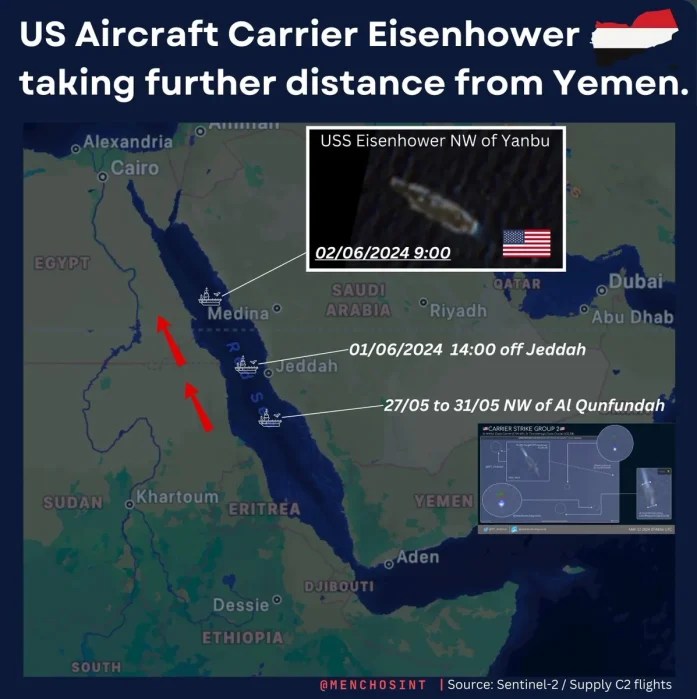
Still, as this journalist recorded at the time, multiple news reports painted a dire picture of Operation Prosperity Guardian in its aftermath. Associated Press revealed participating sailors and pilots had found the experience “traumatizing”, as they “weren’t used to being fired on.” Many had repeatedly come within seconds of being struck by “Houthi-launched missiles”, before they were destroyed “by their ship’s defensive systems.” The Pentagon was thus considering providing “counseling and treatment” to thousands of US Navy employees suffering from “post-traumatic stress”, and their families.
‘Supplemental Funds’
Fast forward to February 2025, and Business Insider published a curious article, claiming based on documents exclusively obtained by the outlet that in fact, the US Navy had successfully “fended off” AnsarAllah’s Red Sea blitzkrieg throughout Operation Prosperity Guardian, “without firing a shot”. Instead, “undefined” and “unspecified” methods and weapons of a “non-kinetic” variety were “successfully” employed to protect “Navy and coalition warships and commercial vessels.” This was of course at total odds with literally everything the mainstream media had hitherto reported on the debacle.
With hindsight though, the report’s propaganda utility seems clear. It served to rehabilitate the US Navy’s performance in its war on Yemen, at a time the Trump administration was preparing to kickstart hostilities against God’s Partisans again. So it was on March 15th, US airstrikes began raining down on Sanaa anew, while the USS Harry S. Truman-led carrier force thrust stridently into the Red Sea. US officials talked a big game about the fresh assault continuing “indefinitely”, while Trump bragged that AnsarAllah was being “decimated”.
The April 28th loss of an F-18 fighter jet due to Yemeni attacks amply demonstrated these boasts to be bogus. The anonymous briefings furthermore strongly suggest Pentagon apparatchiks wanted it publicly known AnsarAllah was responsible. In the meantime, on April 4th, the New York Times reported Pentagon officials were “privately” briefing Trump’s belligerence was failing to graze God’s Partisans, while costing in excess of $1 billion to date. This not only meant “supplemental funds” needed to be mustered from Congress, but doubts about continued ammunition availability gravely abounded:
“So many precision munitions are being used, especially advanced long-range ones, that some Pentagon contingency planners are growing concerned about overall Navy stocks and implications for any situation in which the United States would have to ward off an attempted invasion of Taiwan by China.”
We can surmise this report, and the subsequent flurry of critical mainstream reporting on the USS Harry S. Truman’s troubles, were indicative of the Pentagon’s determination to end Washington’s renewed malevolence against Yemen before AnsarAllah inflicted yet another historic defeat on the US Empire. In a larger than life, farcical full stop to this debacle, on the same day Trump announced the Empire had been crushed again in the Red Sea, the USS Harry S. Truman lost another F/A-18. You couldn’t make it up.
Shelter in your bunkers or leave our region: President of Yemen’s Supreme Political Council to Israelis
Al Mayadeen | May 6, 2025
President of Yemen’s Supreme Political Council, Mahdi al-Mashat, vowed on Tuesday that Sanaa’s response to Israeli and US aggression would be “devastating and painful,” and beyond what either party could withstand.
His remarks followed Israeli airstrikes targeting civilian infrastructure in Sanaa, including the airport, power stations, and factories.
“From now on, take shelter in your bunkers or leave our region immediately,” al-Mashat warned the Israeli occupation. “Your failed government can no longer protect you.”
He reaffirmed Yemen’s firm stance in supporting Gaza, stressing, “Our strikes are effective, and they will continue. We will not be deterred from our rightful stance in supporting our brothers in Palestine until the aggression ends and the siege on Gaza is lifted.”
Trump says aggression on Yemen suspended
The remarks came shortly after US President Donald Trump declared a halt to American airstrikes on Yemen, claiming Sanaa had promised to end Red Sea attacks on ships.
However, Ansar Allah leaders denied any formal commitment, with senior official Mohammed al-Bukhaiti stating that operations against US warships might pause if American strikes ceased, but vowed that military actions in support of Gaza and against the Israeli occupation would continue unabated.
Al-Mashat: Escalation will endanger Trump during his visits to the region
Later, al-Mashat said that authorities in Sanaa indirectly informed Washington that the continued escalation in the region will only affect the visits of “the criminal Trump” to the region. He said that Yemen did not inform the US of anything else.
“If the criminal Trump wants to stop his aggression and compensate [for the destruction] he left behind, that is up to him,” al-Mashat emphasized.
Oman’s Foreign Ministry confirmed it had brokered a ceasefire agreement aimed at de-escalation between the US and the authorities in Sanaa, with both parties agreeing not to target each other moving forward.
Yet the US State Department later clarified that the agreement applies strictly to maritime operations in the Red Sea. “If the Houthis [Ansar Allah] commit to not targeting ships, we will also reciprocate,” a spokesperson said.
‘Israel’ bewildered by Trump announcement
Meanwhile, the announcement from Trump sent shockwaves through the Israeli political establishment. According to Channel 14, the Israeli occupation leadership was blindsided by both Trump’s remarks on Yemen and his promise of a “major announcement” during his upcoming Middle East tour. The channel described the political mood as one of “confusion and disbelief.”
Amit Segal of Channel 12 described Trump’s message as a regional signal: “If I were Iranian, I would understand it as: hit ‘Israel’ and leave us alone.”
Tsvi Yehezkeli, Arab affairs analyst for Channel 13, speculated that the US may be pursuing a quiet agreement with Yemen. “I don’t see another explanation for this declaration,” he said, warning that the US disengagement puts “Israel” in a difficult position, effectively leaving it alone to face Yemeni retaliation. “This is no longer just about Red Sea shipping; it’s now about direct fire on Israel,” he added.
However, despite Trump’s claims of a breakthrough, Ansar Allah denied that any such concession had been made. In an interview with Bloomberg, Mohammed al-Bukhaiti, a member of the group’s Political Council, affirmed that military operations in the Red Sea and against “Israel” would continue until the aggression on Gaza ends and the siege on its people is lifted.
Featured Video
Laith Marouf: Hezbollah’s position on US-Iran ceasefire
or go to
Aletho News Archives – Video-Images
From the Archives
The Dirty Little Secret behind the “Global Terrorism Index”
The Omission of Israeli Terrorism in the Occupied Palestinian Territories
By Karin Brothers | Global Research | December 6, 2014
… The Israeli settlements — all of which are illegal – have been identified as a major impediment to peace. The refusal of a major “global” terrorism report to name the Israeli settlers as one of the groups most responsible for terrorism not only misrepresents a major source of regional violence but exposes the Global Terrorism Index as a propaganda tool that supports a U.S. agenda.
In recent years, governments have been attempting to thwart terrorism by blocking supportive fund-raising. When it comes to Israeli settlements, however, the US and Canada actually encourage fund-raising by giving organizations (such as Christian Friends of Israeli Communities (CFOIC) and the Jewish National Fund) financial support in the form of donor tax-deductions.
Charities which provide funds for the Israeli settlements should be regarded as terror-financing organizations. They should not only lose their tax-deductible status, but they should be banned because they support the violation of international humanitarian law. The terror-financing laws that are being strictly enforced for Muslim charities should be applied to Christian and Jewish charities as well. … Read full article
Blog Roll
 Aletho News
- The ‘Opposition Party’ Has Done Nothing to Stop the Iran War and Much to Goad Trump Into Continuing It
- Moscow backs Tehran on status of Lebanon in US-Iran deal
- How UK Regulator Ofcom Quietly Bypassed International Law to Police American Speech
- The Black Cube Files: How Former Mossad Operatives Flipped a Nation
- Laith Marouf: Hezbollah’s position on US-Iran ceasefire: What you’re not being told
- Israel’s priority lies in destroying chances of peace between Iran, US: Ex-UN nuclear chief
- Ceasefire for all or for none: Iran shuts Hormuz over Lebanon attacks
- Strait of Hormuz is Iran’s ‘nuclear weapon’ that forced US retreat: Medvedev
- Energy crisis will last for months – Kremlin envoy
- Europe’s quiet role in the war on Iran
- If Americans Knew
- This is ceasefire? Israel’s biggest massacre yet in Lebanon, another journalist killed in Gaza – Daily Update
- Tucker Carlson on Israel: This Is the Behavior of an Ally? Really?
- Gazans face a triple crisis: severe shortages of water and bread, healthcare in tatters
- NY Times reports how Netanyahu took the US into Iran War
- A sigh of relief over Iran, but Gaza and Lebanon in dire straits – Daily Update
- Thousands dead and neighborhoods razed to the ground: Aid agencies fear southern Lebanon is becoming the new Gaza
- The war the US is fighting for Israel could cost trillions
- ‘Cigarette Burns, Nail Wounds’: Toddler Tortured in Gaza to Coerce Father
- Trump Says US Sent ‘a Lot of Guns’ to Protesters in Iran
- Israeli forces destroy 17 UN peacekeeper cameras in south Lebanon
- No Tricks Zone
- An Inconvenient Tree: Uncovered In Alps… Europe Much Warmer Than Today 6000 Years Ago
- New Study Reports A 60% Slowdown In Greenland’s Ice Loss Rate In The Last Decade
- Low Intensity Tornado Wrecks Major Solar Farm, Creating A Potential Toxic Dump
- New Study Finds Warming Saves Lives…Cold Temperatures 12 Times More Deadly Than Excess Heat
- German Science Blog Accuses PIK Climate Institute Of Hallucinating Climate Tipping Points
- Devastating Assessment Of Comirnaty Vaccine By Former Senior Pfizer Europe Toxicologist
- New Study: CO2 Is ‘Effectively Negligible’ As An Explanatory Climate Change Factor Since 2000
- Former Pfizer Toxicologist Dr. Helmut Sterz Tells Bundestag Hearing Pfizer Vaccine Should Have Never Been Approved
- Energy Expert: Germany’s Nuclear Phaseout Was A “500 Billion Euro Mistake”
- New Research: South Australia’s Mid-Holocene Sea Surface Temperatures Were 4°C Warmer Than Today
 Aletho News