A group that campaigns for stricter arms sales controls said on Monday that Western powers were breaking international law by selling vast amounts of weapons to Saudi Arabia that are being used to hit civilians in Yemen.
The Control Arms Coalition said Britain, France and the United States were flouting the 2014 Arms Trade Treaty (ATT), which bans exports of conventional weapons that fuel human rights violations or war crimes.
“It is extremely concerning that many transfers are still continuing, in particular the governments of the United States, the UK and France have authorized and are continuing to export very large quantities of weapons, including explosive weapons, bombs which are being used daily against civilians in Yemen,” said Anna MacDonald, director of the Control Arms Coalition.
She was speaking to a news briefing as week-long U.N. negotiations began in Geneva aimed at putting teeth into the ATT which lacks a mandatory public reporting system for the $100 billion global arms trade.
France authorized arms licenses worth $18 billion to Saudi Arabia last year, followed by the United States at $5.9 billion and Britain’s $4 billion, the group said in its latest study.
Nigeria’s ambassador Emmanuel Imohe, who chairs the conference, said: “The allegation is quite grave and it should be of concern to everyone including the ATT secretariat itself.”
Medecins Sans Frontieres (MSF) said last week it was evacuating its staff from six hospitals in northern Yemen after a Saudi-led coalition air strike hit one of its hospitals, killing 18 people.
Outcry over civilian casualties has led some members of the US Congress to push for restrictions on arms transfers. The Obama administration this month approved a potential $1.15 billion arms package for Saudi Arabia.
Last week, US Senator Chris Murphy slammed his country’s administration over bombing civilians in Yemen, saying “there is an American Imprint on Every Civilian Life Lost in Yemen.”
In a statement on Friday, the Pentagon cautioned that its support for Saudi Arabia in its campaign was not “a blank check,” however, and said it has pressed the coalition on the “need to minimize civilian casualties.”
Campaigners said arms exports also drove fighting in South Sudan last month that killed hundreds, prompting fears of a return to civil war.
“We think that governments of other countries have fueled this violence by repeatedly authorizing arms transfers to South Sudan,” said Geoffrey Duke, head of South Sudan Action Network on Small Arms. He named China, Ukraine and South Africa as the main suppliers to the Juba government.
To date, 87 countries have ratified the ATT, while another 46 – including the United States – have signed it, leaving important gaps, Imohe said.
“For example, in the Arab world only Mauritania is listed amongst states parties, while Asia Pacific has only three states parties,” he said, referring to Japan, Samoa and Tuvalu.
August 23, 2016
Posted by aletho |
War Crimes | France, Human rights, Saudi Arabia, UK, United States, Yemen |
Leave a comment
Former U.S. ally and current ally of the Houthi rebels, Ali Abdullah Saleh, said his future government would be ready to open naval and air bases for Russia.
A newly-formed governing council in Yemen could work with Russia to “fight terrorism” by allowing Moscow use of the war-torn country’s military bases, Yemen’s former president said on Sunday.
Ali Abdullah Saleh, a former counterterrorism ally of the U.S. who was toppled by mass protests in 2011, told state-owned channel Russia 24 that Yemen was ready to grant Moscow access to air and naval bases.
“In the fight against terrorism we reach out and offer all facilities. Our airports, our ports… We are ready to provide this to the Russian Federation,” Saleh said in an interview in Sanaa.
The ex-strongman may lack the clout to implement such an offer. But officials from the party he heads now run a political council that controls much of the country along with the Houthi movement. For the first time last week Iran let Russian jets take off from its territory to bomb armed groups in Syria.
Russia is the only major country that maintains a diplomatic presence in Yemen where a 16-month war between a Saudi-led coalition and the Houthi rebels has killed over 6,500 people and raised the prospect of famine in the Arab World’s poorest country.
The war has allowed Islamist militants including al-Qaida and the Islamic State group to flourish, even though the United States has for years launched drone strikes against groups in Yemen.
Russia abstained from a United Nations Security Council resolution in 2015 that imposed an arms embargo on the Houthi rebels.
Moscow’s relations with Yemen date back decades and until the break-up of the USSR, thousands of Soviet military advisers and trainers worked in the formerly-independent south.
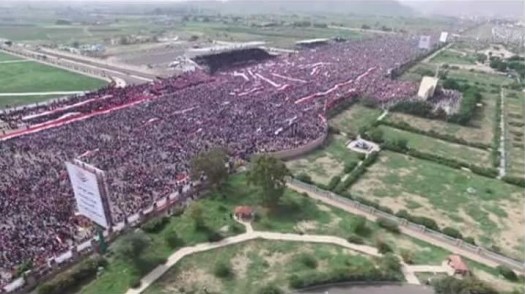
On Saturday tens of thousands of Yemenis rallied in the capital to show support for the Houthi-led bloc as the head of the group’s new governing council vowed to form a full government in the coming days.
Press TV – August 22, 2016
Yemen’s former President Ali Abdullah Saleh says the new government in the country is ready to cooperate with Russia against terrorism by allowing Russian access to Yemeni military bases.
“Russia is the closest to us and we extend our hand to Russia to cooperate in the field of combating terrorism,” Saleh said in an interview with state-run Russia 24 TV channel on Sunday.
He said Yemen was ready to open the country’s military bases to Russia.
“We provide all the facilities in our bases, airports and sea ports. We are ready to provide all facilities to the Russian Federation,” he said.
He said, however, that such cooperation would not mean Russia would be fighting alongside Yemeni forces against Saudi forces waging war on Yemen.
‘Iran has no presence in Yemen’
Saleh also rejected claims that Iran is interfering in Yemen’s internal affairs.
He said Saudi Arabia has launched the war on Yemen under the pretext of defending Saudi national security against Iran, emphasizing that the pretext is “baseless.”
“Iran has no presence in Yemen at all,” he said, adding that, “The international intelligence services know that Iran is not present in Yemen.”
“We are not against Iran; Iran is an Islamic brotherly country. We don’t have any agreement or coalition with her currently,” he said, referring to Iran.
Yemen has seen almost daily military attacks by Saudi Arabia since late March 2015, with internal sources putting the toll from the bloody aggression at about 10,000.
In late July, Yemen’s Houthi Ansarullah movement and Saleh’s General People’s Congress party decided to establish the Supreme Political Council to run the country. It was formally launched on August 6, when the Houthis and Saleh’s faction announced that they both had an equal share in the 10-member body.
August 22, 2016
Posted by aletho |
Aletho News | Russia, Saudi Arabia, United States, Yemen |
Leave a comment
Casuistry, which one dictionary defines as “specious, deceptive, or oversubtle reasoning, especially in questions of morality” is, rightly or wrongly, inextricably linked to the history of Jesuit order of the Catholic Church. And the rise of the Jesuit order is deeply enmeshed with the Counter-Reformation, a set of measures designed to roll back the spread of Protestantism in Europe during the late 16th and early 17th centuries. The control center of the movement was Spain, the world-striding superpower of that historical moment.
Rightfully fearful that Protestantism’s rejection of long-standing modes of clerical privilege and the Church’s “right” to collect vast sums of money from parishioners would undermine their ability to bully and bribe Italian, French, Dutch and German potentates into compliance with their political demands, the Spanish Monarchy undertook an endless series of military adventures against “heretics” across the Continent in the years between 1530 and 1648. This military thrust was accompanied by a well-organized propaganda campaign in which the highly educated Jesuits priests played a crucial role.
Appearing morally and intellectually reasonable while serving as a convinced advocate for the systematic subjugation of other people and their animating ideals is not a simple task. In the long run it is, in fact, an impossible one. No amount of argument can convince a person or group of persons who see them selves as suffering under the boot of another that their bondage is a good and necessary thing. What such a rhetorical posture can do, for a time at least, is convince the subjects of the hegemonic country of, if not the inherent nobility of their bloody mission, its generally benign nature.
A key, if generally unstated, goal of the 16th and 17th century Jesuits was to insure that the highly problematic matter of Rome’s corruption, and the brutal Imperial designs of the Spanish monarchy that lay behind it, never be allowed to occupy the center zone of what then passed for “public” discourse.
When confronted by the emergent Protestant movements about the clear violations of Christian morality practiced by the Church of Rome, they responded with complex disquisitions on the largely circumstantial nature of all moral reasoning. By constantly parsing the intricacies of how overarching moral rules should, or should not, be applied in each particular circumstance (and teaching others to do the same), they very effectively prevented the emergence within the Church, and by extension in the leadership class of the Spanish Empire, of a frank discussion of the quite real and deeply-felt grievances of their many enemies.
I am reminded of all this when I read or watch the news after every so-called “terrorist” attack against a US or European target. Within minutes of the violence, mainstream journalists, begin intense speculation about what particular ethnic group the assailant came from, how he or she became “radicalized” (as if the desire to kill was akin to some sort of contagious moral flu) and whether the “West’s” latest stand-in for PURE EVIL™ (e.g. Al-Qaeda, ISIS, ISIL) was behind the act.
What will almost never be talked about are the many very good reasons a person from the vast region stretching from Morrocco in the west, to Pakistan in the east, have to be very angry at, and to feel highly vengeful toward, the US, its strategic puppeteer Israel, and their slavishly loyal European compadres like France, Germany and Great Britain.
There is never any talk of that group of august “democracies” long-standing penchant for implanting, then staunchly supporting, ruthless and deeply corrupt regimes in that region.
No talk of the very long Algerian experience of French colonialism, nor the US and French- backed coup of that country’s government in 1992 which led to a civil war that left 200,000 people dead.
No talk of the coup against the legally elected president of Egypt in 2013, nor the cold-blooded massacres carried out by his US-backed successor upon hundreds of that same president’s followers.
No talk of the decision of the US to back elements of ISIS in order to cynically extend a Syrian Civil War that was on its way to peace—albeit an imperfect one—by means of a Syrian government victory by late 2013.
No talk of the planned destruction of Libya in 2011 and its enormous effects on the stability of life in that once wealthy country as well as all of northern Africa.
No talk of the US-Israeli nullification of the results of the Palestinian elections of 2006, Israel’s coldly planned siege of Gaza nor the “shoot-fish-in-a barrel” assaults on that benighted enclave by Israel in 2006, 2008, 2012 and 2014.
No talk of the ongoing Saudi—and therefore US-approved—war on Yemen, nor the ruthless Saudi march on Bahrain in 2011 in which several dozen people died and thousands of democracy activists were tortured and/or carted off to prison.
No talk of the 18-year Israeli—and therefore, US-backed—occupation of Southern Lebanon nor Israel’s 1993, 1996 and 2006 assaults upon that same country.
Oops, I almost forgot. There is no talk of the small matter the calculated US destruction of Iraq, pre-invasion Libya’s rival as the Arab world’s most wealthy and socially progressive state.
But hey, why talk about all that off-putting stuff when you can boil it all down to neat tales of personal ideological contamination, Svengali-like recruiters lurking in mosques, and that old standby, the development of an urgent need to bang virgins in the hereafter.
It seems the media believes that the delicate imperial mind must be left free from understanding the effects of the actions for which it regularly cheers and prays.
The best way to insure this? Casuistry, as the old saying goes, “Pure casuistry”.
Thomas S. Harrington is a professor of Iberian Studies at Trinity College in Hartford, Connecticut and the author of the recently released Livin’ la Vida Barroca: American Culture in a Time of Imperial Orthodoxies.
August 21, 2016
Posted by aletho |
Deception, Mainstream Media, Warmongering | Africa, France, Gaza, Iraq, ISIS, Israel, Lebanon, Libya, Middle East, Palestine, UK, United States, Yemen |
Leave a comment
The US military has withdrawn from Saudi Arabia its personnel who were coordinating with the Saudi-led air campaign in Yemen, and sharply reduced the number of staff elsewhere who were assisting in that planning, US officials told Reuters.
Fewer than five US service people are now assigned full-time to the “Joint Combined Planning Cell,” which was established last year to coordinate U.S. support, including air-to-air refueling of coalition jets and limited intelligence-sharing, Lieutenant Ian McConnaughey, a US Navy spokesman in Bahrain, told Reuters.
That is down from a peak of about 45 staff members who were dedicated to the effort full-time in Riyadh and elsewhere, he said.
The June staff withdrawal, which US officials say followed a lull in air strikes in Yemen earlier this year, reduces Washington’s day-to-day involvement in advising a campaign that has come under increasing scrutiny for causing civilian casualties.
A Pentagon statement issued after Reuters disclosed the withdrawal acknowledged that the JCPC, as originally conceived, had been “largely shelved” and that ongoing support was limited, despite renewed fighting this summer.
“The cooperation that we’ve extended to Saudi Arabia since the conflict escalated again is modest and it is not a blank check,” Pentagon spokesman Adam Stump said in a statement.
US officials, speaking on condition of anonymity, said the reduced staffing was not due to the growing international outcry over civilian casualties in the 16-month civil war that has killed more than 6,500 people in Yemen, about half of them civilians.
But the Pentagon, in some of its strongest language yet, also acknowledged concerns about the conflict, which has brought Yemen close to famine and cost more than $14 billion in damage to infrastructure and economic losses.
“Even as we assist the Saudis regarding their territorial integrity, it does not mean that we will refrain from expressing our concern about the war in Yemen and how it has been waged,” Stump said.
“In our discussions with the Saudi-led coalition, we have pressed the need to minimize civilian casualties.”
Riyadh Plays down Move
A spokesman for the Saudi-led coalition, Brigadier General Ahmed al-Asseri, declined to confirm details about the positioning of US military personnel, but played down such moves.
“The relationship between the kingdom and the US is a strategic one. If true, this move reflects something at a tactical level,” Asseri told Reuters.
“The US may move its assets, but that doesn’t have any impact on the bilateral relationship between the countries.”
Since the campaign began, the US military has conducted an average of two refueling sorties every day and provided limited intelligence support to the coalition. That assistance continues, Reuters cited officials as saying.
August 20, 2016
Posted by aletho |
Illegal Occupation, Militarism, War Crimes | United States, Yemen |
Leave a comment
A US Senator slammed his country’s administration over bombing civilians in Yemen, warning that Washington’s support for Riyadh’s war would have consequence for US national security.
The Saudis are the ones dropping the bombs, but “there’s an American imprint on every civilian life lost in Yemen,” Sen. Chris Murphy (D-Conn.) told CNN’s Jake Tapper on Tuesday.
“If you talk to Yemenis, they will tell you, this is not perceived to be a Saudi bombing campaign. This is perceived to be a US bombing campaign. What’s happening is that we are helping to radicalize the Yemeni population against the United States.” Murphy called that “terrible for us right now.”
A Saudi air strike on Tuesday hit a hospital in Yemen, killing 19 people. The US-supported Saudi air campaign against Yemen began in March 2015.
Rights groups and UN agencies say around 9,000 people have been killed in the conflict. The fighting has intensified since peace talks in Kuwait collapsed earlier this month.
Murphy said the Saudis couldn’t fight the war without US help: “It’s our munitions, sold to the Saudis; it’s our planes that are refueling the Saudi jets; and it’s our intelligence that is helping the Saudis (with) their targeting.”
“We have made a decision to go to war in Yemen against a Houthi rebel army that poses no existential threat to the United States,” Murphy said referring to Ansarullah revolutionaries who are known as Houthis.
“It’s really wild to me that we’re not talking more about this in the United States because of the very high level of US involvement in the civil war and the consequences to US national security.”
Murphy noted that the US Congress has not authorized President Obama to “conduct this operation in Yemen.”
He also noted that the target in Yemen is not al Qaeda, the group mentioned in the 2001 war authorization. He called it “another example of a war being conducted by this administration without prior approval by Congress and therefore by the American public.”
August 20, 2016
Posted by aletho |
Illegal Occupation, Militarism, War Crimes | Chris Murphy, Saudi Arabia, United States, Yemen |
Leave a comment
Doctors Without Borders (MSF) has announced that it is evacuating its staff from six hospitals in northern Yemen, saying it cannot get assurances that its hospitals will not be bombed again by Saudi warplanes.
The decision was “never taken lightly,” said the Paris-based relief agency in a statement on Thursday, condemning the Saudi “indiscriminate bombings and unreliable reassurances”.
“Given the intensity of the current offensive and our loss of confidence in the Saudi-led coalition to prevent such fatal attacks, MSF considers the hospitals in Sa’ada and Hajjah governorates unsafe for both patients and staff,” it added.
The MSF decision to pull its staff out of the war-torn country was made following a number of deadly Saudi airstrikes on MSF-run hospitals, the most recent of which was carried out on Monday on Abs Hospital in Hajjah province. The airstrike killed at least 19 hospital staff and patients and wounded 24 others.
In a report released on May, the international aid agency said at least 100 staff members, patients and caretakers had lost their lives and 130 others had sustained injures due to the Saudi aerial attacks on over 80 MSF-supported and run health structures in 2015 and early 2016.
The MSF said that it had held two meetings with high-ranking Saudi officials involved in the war on Yemen in the past eight months and had been assured that attacks on hospitals would end.
“Aerial bombings have however continued, despite the fact that MSF has systematically shared the GPS coordinates of hospitals in which the organization works with the parties involved in the conflict,” the statement further read.
Yemen has been under Saudi military strikes since late March 2015. The war was launched in a bid to undermine the Houthi Ansarullah movement and to reinstate Abd Rabbuh Mansur Hadi, who has stepped down as Yemen’s president but is now seeking to grab power by force.
The air campaign, carried out without any international mandate, has killed about 10,000 people, most of them civilians, according to local Yemeni sources.
August 18, 2016
Posted by aletho |
War Crimes | Saudi Arabia, Yemen |
Leave a comment
At least 25 people, including two children, have been killed in the latest Saudi military airstrikes against residential neighborhoods in Yemen.
Saudi fighter jets struck a vehicle on Tuesday morning as it was traveling along a road in the Abs district of the northern Yemeni province of Hajjah, leaving five people dead, Arabic-language Yemen al-Yawm television reported.
A clergyman, identified as Sheikh Matroud Saleh al-Soufi, was reportedly among the deceased.
The airstrike came less than a day after a Saudi airstrike hit a hospital run by Doctors Without Borders (MSF) in the same Yemeni district, killing at least 25 people.
The medical charity said another 20 people were also injured in the attack.
MSF spokeswoman Malak Shaher said the Geneva-based international humanitarian-aid organization has had a team at the Abs public hospital since 2015.
Yemen’s Houthi Ansarullah movement strongly condemned the aerial attack, saying it was carried out in flagrant violation of a ceasefire agreement, which took hold at midnight on April 10.
Also on Tuesday, Saudi jets pounded residential buildings in Bani al-Harith district north of the Yemeni capital, Sana’a, leaving two women and two children dead.
Some 17 people were also injured in the Saudi airstrikes against Bani al-Harith.
Sixteen other Yemeni civilians were killed in attacks on a village near the capital, where some nine others were also wounded.
International concerns are rising over the intensification of the Saudi war on Yemen ever since United Nations (UN)-brokered peace talks in Kuwait between representatives of the former government and the Houthi Ansarullah movement failed to make a breakthrough and were suspended on August 6.
Yemen has been under Saudi military strikes since late March 2015. The war was launched in a bid to undermine the Ansarullah movement and to reinstate Abd Rabbuh Mansur Hadi, who has stepped down as Yemen’s president but is now seeking to grab power by force.
August 16, 2016
Posted by aletho |
Militarism, War Crimes | Saudi Arabia, Yemen |
Leave a comment

While it is impossible to know all the dirty deeds of America’s sprawling global empire, news that US ground forces are now fighting in Libya means that US troops are involved in at least four active wars:
Afghanistan: A planned draw-down of troops in 2015 was curtailed by President Obama to leave more troops for combat and advisory missions. This week, US forces were forced to abandon military equipment that then fell into the hands of ISIS.
Iraq: After a removal of major combat forces in 2011, Iraq has become a battleground once again. President Obama has sent roughly 4,600 troops in for combat and advisory roles and built a new base in northern Iraq called “Firebase Bell.”
Syria: Though the US had been supporting Syrian rebel groups, including jihadists, since 2013, US troops have entered the fighting in the country. In January of this year, US special forces took control of a military base in northern Syria.
Libya: In 2011, the US assisted in the overthrow of the Gaddafi government in Libya. In the aftermath, Libya has fallen into total chaos, making it ripe for ISIS to establish a significant presence. Now, according to the Pentagon, US forces are fighting on the ground to drive ISIS out.
This excludes all of the off-the-books special operations in over 100 countries, and the major role the US is playing in supplying weapons for Saudi Arabia’s war on Yemen. Among those weapons are controversial cluster bombs, which are banned by many countries for their impact on civilians.
Preceding the Yemen civil war, the US had an active drone assassination program in the country, which included the targeted killing of American citizens. The drone assassination program continues throughout the greater Middle East.
According to the Obama Administration, these military operations are legally justified by the 2001 Authorization for Use of Military Force [PDF], which stated “the President is authorized to use all necessary and appropriate force against those nations, organizations, or persons he determines planned, authorized, committed, or aided the terrorist attacks that occurred on September 11, 2001, or harbored such organizations or persons, in order to prevent any future acts of international terrorism against the United States by such nations, organizations or persons.”
The bland, vague language apparently justifies any war in any part of the world. So, maybe the US will soon have troops in five active wars. Hell, make it six.
August 11, 2016
Posted by aletho |
Illegal Occupation, Militarism, Progressive Hypocrite, Timeless or most popular | Iraq, Libya, Middle East, Obama, Syria, United States, Yemen |
Leave a comment
The United States has approved the sale of more than 130 Abrams tanks, 20 armored recovery vehicles and other equipment worth about $1.15 billion to Saudi Arabia.
The Defense Security Cooperation Agency, which is part of the Pentagon and facilitates foreign arms sales, informed lawmakers on Tuesday that the State Department has approved the deal.
The potential sale to Saudi Arabia still faces approval by Congress, which could block it.
The agency said the sale would contribute to US national security by improving the security of a regional ally.
It added that General Dynamics, an American aerospace and defense corporation, would be the principal contractor.
“This sale will increase the Royal Saudi Land Force’s (RSLF) interoperability with US forces and conveys US commitment to Saudi Arabia’s security and armed forces modernization,” the agency said on its website.
The US government is expected to authorize more than $40 billion worth of foreign military sales this year, the Pentagon has confirmed.
The potential sale by Washington comes as Saudi Arabia and its Persian Gulf Arab allies launched a military aggression against Yemen in March 2015 in a bid to bring the country’s former president Abd Rabbuh Mansur Hadi, a staunch ally of Riyadh, back to power and undermine the Ansarullah movement.
Yemenis say most of the victims in the Saudi airstrikes are civilians.
A UN report leaked to the Guardian in January found “widespread and systematic” targeting of civilians in the Saudi-led strikes.
The report found 119 strikes which violated international humanitarian law, including attacks on health facilities, schools, wedding parties and camps for internally displaced people and refugees.
August 9, 2016
Posted by aletho |
Militarism, War Crimes | General Dynamics, Saudi Arabia, United States, Yemen |
Leave a comment
The US military plans to increase the presence in Yemen. «As we continue on the mission, I think there will be some additional troops that we will ask to bring in», US Army General Joseph Votel, who heads the US Central Command, said in an interview in Baghdad on July 14, without disclosing the number.
According to him, a variety of locations could be suitable for American forces. He did not disclose potential sites.
The Saudi Arabia-led coalition of Arab states, supported by the US and the UK, has been involved in the Yemeni conflict since March 2015. So far, it has not gained much ground. The Yemeni capital Sana’a is still in the hands of the Houthis group (Ansar Allah – «Supporters of God»).
The fighting has resulted in more than 3,200 civilian deaths, over 60 percent of them from coalition airstrikes, according to the United Nations.
Around 6,000 civilians have been wounded in the conflict. Airstrikes have damaged or destroyed numerous civilian objects including homes, markets, hospitals, and schools, as well as commercial enterprises.
On 30 June an HRW report stated that US-made bombs were being used in attacks indiscriminately targeting civilians and violating the laws of war.
The report photographed «the remnants of an MK-83 air-dropped 1,000-pound bomb made in the US».
On 1 July, the UN announced that Yemen was at the highest level of humanitarian disaster with over 80% of the population needing help.
United Nations agencies agreed to classify Yemen as a level 3 emergency as the UN envoy for Yemen stated that the country is one step away from famine.
The announcement of the US plans to bring in more forces came amid the reports that the Saudi-led coalition may be preparing to attack Sana’a, the Houthi-held Yemen’s capital, following the breakdown of the UN-led peace process in Kuwait. The UN-led peace process in Kuwait was suspended after 77 days of negotiations that achieved no significant progress.
The US mission in Yemen is just the latest in a growing number of small US deployments across the world. US special operations forces (SOF) have been deployed to 135 nations – around 70% of the countries in the world.
Every day, they carry out missions in 80 to 90 nations. Approximately 11,000 special operators are deployed or stationed outside the United States with many more on standby, ready to respond in the event of an overseas crisis.
The US military is also looking to further beef up its presence in Iraq. The administration has recently announced that additional 560 troops will be sent to Iraq to strengthen the Iraqi offensive to retake Mosul, the Iraqi second biggest city, that is now an Islamic State (IS) stronghold.
General Votel said, the request for more troops will be on top of the 560 already announced. His remarks came just three days after Obama’s administration announced a 560 troop increase as part of an effort to facilitate an Iraqi offensive to retake Mosul. The General cautioned that Americans should not expect a rapid, wholesale withdrawal from the country. He emphasized that the forces will stay even after the US military accomplishes the mission of driving out IS forces from Mosul in Iraq and from the Syrian city of al-Raqqa. According to Votel, once their objectives are met in the areas, it will be imperative that they ensure the militants do not shift base and begin operating from other locations outside those cities. He said the goal was to achieve a «lasting defeat».
It’s not the US only. French President Francois Hollande has said that France will send heavy artillery to Iraq to support the fight against the Islamic State. Hollande announced the plan on July 22, saying the artillery equipment «will be in place next month». The president also reiterated that the French aircraft carrier Charles De Gaulle will be deployed in the region in late September to help in ongoing operations against the IS. Elsewhere, protests erupted in Libya on July 21 after the president confirmed for the first time that French special forces were operating in the country. Libya’s UN-backed government in Tripoli also condemned France’s military action.
It starts with clandestine operations of limited scale conducted by special operations forces to be followed by reinforcements sent to beef up the presence, and then artillery units deployed to support them on the ground. Step by step the West is expanding its military intervention on the ground in Yemen, Iraq and elsewhere in the Middle East. There deployments are described as ‘small-scale’ operations conducted without putting troops on the frontlines fighting firefights. This way the leading Western nations may be trending towards another war in the Middle East without the public realizing it. In Yemen, Iraq and other places, the deployments will gradually lead to full commitment to a ground war and it will be too late to turn back the clock.
July 29, 2016
Posted by aletho |
Illegal Occupation, Militarism | France, Middle East, Saudi Arabia, United States, Yemen |
Leave a comment
Ramzan Kadyrov has accused the US authorities of instigating the civil war in Afghanistan and other Muslim countries, and called on senior politicians in these states to set aside their differences and unite in the face of what he sees as a common enemy.
“During the 37 years of the war in Afghanistan peace has not become closer, not even by a single step. The United States used the excuse of fighting their own Bin Laden to unleash a decades-long civil war there. America and NATO could have solved the Afghan problem in just two years, but they need this eternal bloody cauldron in Afghanistan that takes the lives of many thousands of young Muslims,” the acting head of the Chechen Republic stated in comments on the latest terrorist attack in Kabul.
Kadyrov expressed his position in a post on Instagram – a medium he normally uses for communication with the public.
In the message, he emphasized that the United States and its NATO allies have artificially created the instability in the region. “Step by step they start wars in Muslim countries. Iraq, Syria, Libya, Egypt, Yemen are now facing the threat of losing their sovereignty,” Kadyrov wrote.
The Chechen leader also called on all Afghanistan’s leaders to set aside personal ambitions and ethnic and religious differences to unite in the face of the common threat. “Once Pashtu, Uzbeks, Tajiks, Sunnis, Shia all join their ranks, no one would ever be able to impose some external will on you,” he wrote.
At least 80 people were killed and 231 injured as a result of a bomb blast at a mass rally in Afghanistan capital Kabul on July 23. The Islamic State terrorist group (IS, formerly ISIS/ISIL) has claimed responsibility for the attack.
Kadyrov has repeatedly accused the United States and other Western nations of deliberate policies aimed at destroying Muslim countries and the Muslim faith. In February last year he said IS had been “spawned” by the West to incite hatred towards Muslims all over the world. Kadyrov also suggested the West was backing the terrorist group in order to distract public attention from numerous problems in the Middle East, in the hope of destroying Islamic nations from within. In November he accused the Turkish authorities of aiding Western nations’ plot to weaken and destroy Islam by assisting Islamic State and its allies in Syria.
Kadyrov also previously claimed that he possessed information that the Islamic State leader, Abu Bakr al-Baghdadi, had been personally recruited to work for the US by General David Petraeus, the former director of the CIA and former commander of coalition forces in Iraq and Afghanistan. At that time, Kadyrov claimed IS “was acting on orders from the West and Europe.”
Read more:
Chechen leader blames US for bloodshed in Afghanistan & other Muslim nations
July 25, 2016
Posted by aletho |
Deception, False Flag Terrorism | Afghanistan, Iraq, ISIL, ISIS, Libya, NATO, Syria, United States, Yemen |
Leave a comment
A senior Iranian commander strongly criticizes France and Saudi Arabia over their cooperation with the anti-Iran terrorists, including the Mujahedin-e Khalq Organization (MKO), saying any act of terror in the Islamic Republic would be blamed on Riyadh and Paris.
“Incriminating finger would be pointed at Riyadh and Paris over potential acts of terror in Iran,” Deputy Chief of Staff of Iran’s Armed Forces, Brigadier General Massoud Jazayeri, said on Sunday.
Paris on July 9 hosted an annual meeting organized by the MKO terrorist group which was attended by former Saudi intelligence chief, Prince Turki al-Faisal. The former Saudi spy chief gave a 30-minute-long address to the gathering.
The MKO is the most hated terrorist group among the Iranians because of its dark history of assassinations and bombings and for siding with Saddam Hussein in his eight-year war against Iran in the 1980s.
Jazayeri said the Paris meeting in the presence of some Western political officials and the former Saudi intelligence chief further cast light on the link between Wahhabism and the MKO terrorists and marked a stain on the French government’s record and constituted a blatant act of intervention in the internal affairs of the Islamic Republic.
“Hosting the MKO terrorist group as one of the most dangerous and criminal terrorist groups in the world and the presence of Arab and Western political figures show these countries’ support for terrorism,” he said.
“Although the evil hands of the MKO traitors have been cut off thanks to the resolve of the Iranian nation as well as the vigilance and readiness of the Armed Forces and security and intelligence organizations, the network of founders and promoters of global terrorism jumps at every opportunity to revive this deceased and hated current and present it as an active and influential element against [Iran’s] Islamic revolution and establishment,” the Iranian commander added.
Jazayeri said terrorism is an ominous phenomenon that takes many forms and shapes, including Takfiri-Salafi groups like Daesh, counter-revolutionary groups supported by Zionists, the US and their allies, atrocities committed in the Israeli-occupied Palestinian territories, Saudi war crimes against Yemen and MKO terrorism in the past but they all share a “single evil spirit.”
He added that hegemonic powers “see terrorism as a tool for achieving their ominous objectives” and devise their policies accordingly.
Jazayeri expressed regret that the Saudi regime and other “reactionary regimes in the region” are conspiring with the US and the Zionists in spreading acts of terror in Muslim states, saying, “The Muslim world is today the main target of the international terrorism.”
He said France’s double-standard polices regarding terrorism and its classification of terrorist groups into good and bad as well as its blatant discriminatory policies have contributed to the rise of international terrorism.
“The role of the French in supporting and directing the phenomenon of terrorism is undeniable,” the commander said, adding, “The advocates of combating terrorism, especially Western governments, better set aside their dual policies and genuinely step into the arena of fighting the ominous phenomenon of terrorism.”
July 25, 2016
Posted by aletho |
False Flag Terrorism, Timeless or most popular, War Crimes, Wars for Israel | Da’esh, France, Iran, Middle East, MKO, Saudi Arabia, United States, Yemen, Zionism |
Leave a comment


 Aletho News