Turkish jets have reportedly not taken part in the Euphrates Shield operation in neighboring Syria for a week now over the fears of being shot down by local air defenses after Damascus promised to prevent any aerial incursions.
Ankara halted air support for its ground incursion into Syria on October 22, after Damascus vowed to shoot down Turkish Air Force planes over Syrian skies, a Turkish official told the Hürriyet Daily News on condition of anonymity. The official added that the coalition forces have also decreased the number of flights in northern Syria.
Syria’s air defense capabilities have been widely boosted after Russia deployed its mobile S-400 and S-300 missile batteries earlier this year to protect its personnel on the ground. Russian hardware has the ability to shoot down planes and cruise missiles over at least 250 miles (402km) in all directions from western Syria.
Two days before Turkey halted its military flights over Syria, Damascus, which called the Turkish invasion a violation of national sovereignty, warned that it would shoot down any Turkish warplanes.
“Any attempt to once again breach Syrian airspace by Turkish warplanes will be dealt with and they will be brought down by all means available,” warned Damascus on October 20. The presence of Turkish troops in Syria is a “dangerous escalation and flagrant breach of Syria’s sovereignty”
The response from Damascus came after Turkish planes targeted Syrian Kurdish People’s Protection Units (YPG), the fighting wing of the Democratic Union Party (PYD), near al-Bab in northern Aleppo the day before.
Turkish forces crossed into Syria on August 24, under the pretext of targeting Islamic State (IS, formerly ISIS/ISIL) positions along the border. Turkey has been supporting the so-called Free Syrian Army (FSA) on the ground.
In addition to jihadist fighters, the Turkish troops involved in Operation Euphrates Shield also engaged the YPG militia, part of the US-backed Syrian Democratic Forces (SDF). One of Turkey’s primary objectives in the operation is to block the path of Kurdish forces trying to form a link between their Afrin and Kobani cantons. Syrian rebels, with the help of the Turkish military, are slowly making their way across northern Aleppo province.
The source told the Turkish daily that the pace of the offensive has been largely impacted by the lack of air support. The FSA’s advance toward Al-Bab has faltered due to the lack of Turkish airstrikes, he said, pointing out that Turkish offensive only secured 5km in the last three days.
Earlier in the week Turkey’s military accused the Syrian government forces of attacking FSA fighters in the city of Marea in northern Aleppo province. Despite the attack which allegedly killed two rebels, Ankara promised to proceed with the operation.
“We will not stop fighting against the Daesh [Arabic pejorative term for IS] terrorist group due to the regime forces’ attacks. The Euphrates Shield operation will be continued until retaking of the city of al-Bab in order to create a security zone for the return of refugees,” Turkish Foreign Minister Mevlut Cavusoglu said Wednesday.
On Friday, Turkish General Staff said in a statement that the FSA had managed to capture around 164 residential districts since the beginning of the operation, which on Saturday entered its 67th day.
At the beginning of October, the Turkish parliament extended cross-border military operations into Syria and Iraq against Kurdish and IS forces for another year.
Read more:
Syria warns it will ‘down Turkish planes next time,’ calls bombing of Kurds ‘flagrant aggression’
‘S-300, S-400 air defenses in place’: Russian MoD warns US-led coalition not to strike Syrian army
Turkey seeks to expand border ‘safe zone’ 45km into Syria
October 29, 2016
Posted by aletho |
Illegal Occupation | Da’esh, Syria, Turkey, YPG |
Leave a comment
Since the collapse of the USSR, and the inception of the unipolar world order with the United States at its center, the term ‘benevolent hegemony’ has entered the lexicon of international relations and geopolitics. The full fleshing out of this idea was revealed in the 1996 essay by American neoconservatives Bill Kristol and Robert Kagan, ‘Toward a Neo-Reaganite Foreign Policy’. Its essence is an excuse for the United States to pursue whichever diplomatic and military means are believed to forward the goals of an American Empire, on the basis that unlike past empires, this one is not based on the prestige of the American people, or indeed any given leader, but instead on a set of ‘universal values and principles’ which are supposedly positive for all who live under them. One need only look at the neoconservatives themselves and come to the conclusion that they certainly do not represent the interests of the American people, as their international operations rarely have any positive impact for working men and women, and in fact very often engender negative consequences for them. Nor could it be said that neoconservatives aid the prestige of a given leader, as their legacy of wars in Iraq and Afghanistan destroyed the presidential legacy of George W. Bush, and notably his British ally Tony Blair.
This is excusable of course, because it has never been claimed by the neoconservative establishment that their policies are crafted with these people in mind. They are in aid of an ideology, and because most Westerners suffer under the delusion that this ideology is itself benevolent, then the means that America uses to propagate and expand its influence must also be benevolent. Slowly however, this facade is beginning to peel away.
Tom Rogan, a foreign policy analyst for the neoconservative publication National Review recently penned an article describing ‘Three Ways the US Can Save Syria‘. Obviously this is in response to the fact that America is being defeated in the country, the Syrian Army’s gradual recapture of Aleppo being just the latest blow to the terrorist rebel groups agitating against the legitimate government. If President Assad ends the insurgency of terrorists, then the American Empire loses not only in terms of its original geopolitical goals which spurred its meddling, but in terms of international prestige, especially among the nations of the Middle East. In light of this, Rogan’s urgent recommendations make sense, but in his zeal he gives the world a very clear picture of what ‘benevolent hegemony’ looks like.
The first recommendation concerns the oil market. Russia, the key counter-force to the United States in Syria, has been economically harmed by a dramatic dip in global oil prices, Russia is presently in talks with OPEC members about capping oil production, which would raise the price back up to reasonable levels. Rogan proposes diplomatic interference with this effort (mainly involving Saudi Arabia) in order to do as much economic damage to Russia as possible. The carrot he wishes to lead the Saudis with is the proposal for surface-to-air missiles given to allied rebel groups in Syria, but could just as easily be more rockets for Saudi aircraft to target funerals in Yemen.
Consider how benevolent this is; the stated aim being to wound a sovereign nation’s economy and by extension its people, the means being to arm dangerous groups within a sovereign nation in order that they can kill more civilian and government targets.
The second recommendation is perhaps the most alarming, as it can be perceived to be a direct terror threat against the nation of Turkey and its president, Tayyip Erdogan. Rogan acknowledges that after the failed July coup orchestrated against America’s own supposed NATO ally, the country does not trust the US, and is seeking to mend relations with Russia. For a long time, the relationship between Syria and Turkey was decidedly negative, but as the war has dragged on and millions of the displaced have flooded across borders with no checks on their movement, Ankara knows that stability in Syria is in fact vital to its own national security interests, and has thus moved away from its previous position on the conflict. In response to this setback, Rogan has the following proposition:
“Here America’s golden ticket is the Kurds — specifically, U.S. armament support to Kurdish militias such as the Syrian-based YPG. At present, the U.S. carefully qualifies its support to the YPG to mollify the Turks. Erdogan fears U.S. support will enable the YPG and other Kurdish forces to destabilize Turkey’s southern frontier. And to some degree he is right. But if Erdogan wants to play us, we should play him.”
In case the severity of this is not clear, the insinuation is that if Turkey does not end rapprochement with Russia and pursue an aggressively anti-Assad agenda, the American military should arm groups it knows may conduct violent attacks against the Turkish state. Is there any way this cannot be taken as blackmail via terror, and if so how benevolent is such a proposal?
The third recommendation is to supply “humanitarian airlifts” to rebel-held areas of Syria. Rogan recollects the Bush-era airlifts to Georgia during the 2008 crisis, but there is a key difference between the two scenarios. In 2008, Georgia was a sovereign nation undergoing an incredibly complex regional dispute with breakaway provinces, but nevertheless the government there invited American assistance. This is not the case in Syria, where the government has expressed no permission for America to even enter its airspace, an international norm which the American Air Force has been violating for over a year now. In fact, in the wake of the brutal air assault on Deir el-Zour which killed 62 Syrian soldiers, President Assad has been even more strident in making its long-held case that Western powers are working hand-in-glove with ISIS. This proposal more than the other two brings the world dangerously close to a conflict that nobody wants to even entertain, as Rogan recommends escorting these “humanitarian airlifts” with “fighter patrols” who would challenge Russian air superiority. Is laying the groundwork for WWIII benevolent?
Rogan finishes his essay by explaining that the goal of these dangerous pieces of foreign policy advice is to express “that America is unwilling to cede Syria to Russia”, apparently indulging in a fantasy that America ever possessed Syria, and indeed with a staggering sense of authority that the entire nation of Syria is something which can and should be possessed by America.
This is the not the first example of this kind of rhetoric coming from mainstream Western think-tanks and foreign policy journals which are intricately tied into the workings of the US State Department, however it is one of the less varnished ones. There is not even the mask of benevolence present in these proposals; they are dangerous, lawless, and cynical. If Hillary Clinton wins the presidency, she has made clear that this is the course she will take.
In a secret speech to Goldman Sachs which was revealed by Wikileaks, Clinton admitted the following regarding a no-fly zone in Syria:
“They’re getting more sophisticated thanks to Russian imports. To have a no-fly zone you have to take out all of the air defense, many of which are located in populated areas. So our missiles, even if they are standoff missiles so we’re not putting our pilots at risk—you’re going to kill a lot of Syrians”
And yet, even with this understanding, Hillary Clinton maintains support for the institution of a no-fly zone. Donald Trump of course represents the antithesis of such a hazardous foreign policy, abandoning the commitments of neoconservatives and their ideology, in order to focus on the various internal problems that his country faces. Even so we cannot rely on a Trump victory, for by now we are all aware of the Clinton campaign’s ability to martial all of her friends and colleagues in the Orwellian media, as well as stoop to even more subversive means to steal an election result. We must assume the worst, and thus we must assume and anticipate President Clinton and her craven approach to geopolitics. De-constructing the myth of ‘benevolent hegemony’ is an important part of this anticipation, and writers like Rogan help with this effort in their bungling inability to bejewel the ugly reality of the Atlanticist designs upon the Middle East and indeed the wider world.
Dropping the pretense of benevolence, this is just hegemony, and when we look at its consequences not just for the suffering people of Syria, but also Yemen, Afghanistan, Iraq, Libya, Ukraine, etc. then perhaps these outlets ought to be more accurate and deem such projects ‘malevolent hegemony’ instead.
October 23, 2016
Posted by aletho |
Mainstream Media, Warmongering, Militarism, Timeless or most popular, War Crimes | Hillary Clinton, ISIS, Middle East, National Review, Saudi Arabia, Syria, Tom Rogan, Turkey, United States, YPG |
Leave a comment
The US has pitted the Syrian Kurds against Damascus-led forces in the northeastern city of Hasakah in a bid not to lose regional influence should Turkey, Russia and Iran create an alliance to resolve the Syrian conflict, analyst and journalist Hüsnü Mahalli told Sputnik, adding that recent clashes are part of the West’s “geopolitical games.”
“Up until now Russia and Iran have helped to maintain cordial relations between the Syrian Kurds from the Democratic Union Party (PYD) and Damascus. The PYD made a mistake when it opted to cooperate with the US,” he said.
Kurdish militias, assisted by the US, have been trying to push radical groups, including Daesh and al-Nusra Front from northern Syria and secure the porous border with Turkey. At the same time, the Kurds have established a de-facto autonomy in the areas under their control.
Mahalli emphasized that any efforts on the part of the PYD and the People’s Protection Units (YPG) to create an independent state will be a mistake that could not be undone.
“The Americans have repeatedly said that they have a Plan B for Syria. Perhaps, this is what they meant. I’m afraid that the US has decided to drag the Kurds into a large-scale bloodbath,” he added.
The standoff in Hasakah was sparked last week when the Kurdish forces tried to take the entire city under control, violating the ceasefire regime. The Kurds are reported to have captured large parts of government-held areas in Hasaka on Tuesday. The same day the YPG and Damascus-led forces agreed to halt fighting. The ceasefire came into force at 11:00 GMT.
The political analyst maintained that these events are part of a larger US plan for the region. “If the West is serious about its large-scale geopolitical games – and judging from what is happening in Hasakah, it is – then the situation is disturbing,” he said.
The clashes between the Kurdish militias and the Syrian Arab Army (SAA) took place at a time when a major stakeholder, Turkey, made a U-turn in its foreign policy.
Turkey recently improved relations with Russia and Iran. The two countries were swift in providing support to the Turkish authorities when a group of military officers tried to overthrow the government on July 15 despite the fact that they were on the opposing sides of the Syrian conflict. Ankara sponsored radical groups trying to overthrow President Bashar al-Assad, while Moscow and Tehran have tried to prevent Islamist from destroying the Arab country.
Turkish authorities are currently intent on repairing relations with Damascus.
The regional balance of power, according to Mahalli, will alter even further if the three nations decide to join their efforts to bring an end to the five years of violence in Syria. This will lead to what the analyst described as Washington’s “inevitable weakening.”
Mahalli further said that Turkey has found itself in the hot water. On the one hand, approximately 15-20 million Kurds live in Turkey. On the other hand, Ankara has become the target of Islamist terrorism even though the country supported radical groups fighting in Syria.
“The only right choice Turkey could make is to admit its mistakes and act decisively to overcome the deadlock. The Turkish leadership needs to act decisively. Should it wait for the outcome of the presidential election in the US, the implications could be hard to predict. My main concern is that Turkey will ultimately be shattered,” he noted.
August 24, 2016
Posted by aletho |
Militarism | PYD, Syria, Turkey, YPG |
Leave a comment
Just when you thought US foreign policy could not get more absurd. Lt. Gen. Stephen Townsend, who is listed as “commander of US forces in Iraq and Syria,” has issued a warning to the Syrian military that if its counter-insurgency operations on Syrian soil leave US troops on Syrian soil “feeling threatened,” the US military would “defend itself.”
That needs to be broken down to even be believed.
The Syrian military is fighting an armed uprising on its own soil. The US government is training and equipping several factions of that armed insurgency, in this case the Kurdish YPG militia. The US military is also operating on Syrian soil alongside and in support of the YPG militia. Members of the YPG militia have, over the past several days, been firing on Syrian government forces. The Syrian air force returns fire on its own soil and the US military that is illegally operating on Syrian soil issues a warning to the Syrian government to stop firing on insurgents on Syrian soil!
The US government has a military “commander” commanding US forces operating illegally — according to US and international law — on a foreign country’s soil.
Logic might suggest that if the US military does not want its Special Forces to feel threatened by Syrian government counter-insurgency activities, perhaps it should remove them from that foreign territory in which they are illegally operating.
But the empire creates its own logic and it is not for we mere mortals to understand it. If the Pentagon and the military-industrial complex want to threaten war in Syria (which will be de facto war with Russia) it is not our place to question it. We just plug in to our television screens and feel that soothing sound of state propaganda telling us it’s all being done to keep us safe. There, that feels better…
August 22, 2016
Posted by aletho |
Illegal Occupation, War Crimes | Syria, United States, YPG |
Leave a comment
Russian Foreign Minister Sergei Lavrov says Moscow has evidence that Turkish forces are on Syrian territory despite Ankara’s denial of troops’ entry to the war-torn Arab country.
Lavrov made the remarks in an interview with Ren-TV that was broadcasted on Sunday.
Last December, Moscow also said it has evidence Turkey is involved in the smuggling of oil from areas held by Daesh in Iraq and Syria. Ankara has strongly rejected the claim.
Russian Defense Ministry officials showed satellite images at a briefing in Moscow, revealing that tanker trucks loaded oil at installations controlled by Daesh in Syria and Iraq, before entering neighboring Turkey.
Turkish Defense Minister Ismet Yilmaz has rejected that Turkish forces have entered Syrian territory to help foreign-backed militants fighting against the Syrian government. Last month, Turkish Foreign Minister Mevlut Cavusoglu, however, said Saudi Arabia and his country could launch a ground operation in Syria.
Also on Sunday, Lavrov referred to Turkey’s shelling of Kurdish positions in Syria and called Ankara’s actions on the border with Syria “creeping expansion.”
The Russian foreign minister further noted that despite Ankara’s opposition, Moscow will call on the United Nations to invite Kurdish groups to a new round of talks between the Syrian government and opposition groups which is scheduled for Monday in Geneva, Switzerland.
Turkey’s tanks have shelled positions of Kurdish People’s Protection Units, also known as YPG, over the past few months, accusing them of having links to the Kurdistan Workers’ Party (PKK) militant group that has been fighting for an autonomous Kurdish region inside Turkey since the 1980s.
The YPG, which is nearly in control of Syria’s entire northern border with Turkey, has been fighting against Daesh.
Lavrov also said in the Sunday interview that Moscow was ready to coordinate its operations in Syria with the US so that the northern city of Raqqah could be freed from Takfiri militants.
Daesh has seized parts of Iraq and Syria, where it has been engaged in bloody acts of terrorism against people of all communities.
March 13, 2016
Posted by aletho |
Illegal Occupation, Militarism | Russia, Syria, Turkey, YPG |
Leave a comment
Mounting evidence appears to indicate that Turkey is providing extensive support to Daesh and al-Nusra Front, the two key terrorist organizations that have turned Syria into ruins and wreak chaos elsewhere.
“Taking publicly available information into account, we’ve come to the conclusion that Turkey has directly or indirectly served as Daesh’s mediator and ally by helping the radical group to prepare and commit terrorist acts, acquire necessary resources and recruit new fighters,” Ertuğrul Kürkçü, the current Honorary President of the pro-Kurdish Peoples’ Democratic Party (HDP), told Sputnik.
Despite its tough anti-Daesh rhetoric, the Turkish leadership has done nothing to dismantle the existing terrorist network in the country. “After so many horrible terrorist acts, not a single real participant or mastermind has been arrested,” the Turkish politician observed.
Kürkçü also mentioned that some in the Turkish military and law enforcement agencies are in direct contact with the terrorist group. He was referring to a recent report, released by the Cumhuriyet newspaper.
The opposition daily published transcripts of several phone conversations between unnamed Turkish officers and a key Daesh operative in the region bordering Syria. The documents appear to show that Turkish officers not only frequently communicated, but worked with the militants.
It follows then that “at the moment Daesh receives support and recruits with the tacit approval of the Turkish government, as well as the country’s president and prime minister,” Kürkçü concluded.
Meanwhile, RT has published footage shot on the outskirts of the Syrian town of Azaz, which is controlled by al-Nusra Front militants. The Kurdish People’s Protection Units (YPG) have been unable to liberate Azaz because Turkish forces shelled the area.
The YPG told RT’s Lizzie Phelan that al-Nusra Front fighters receive regular supplies of weapons from Turkey.
“We can actually see here the important border town of Azaz, that Turkey is determined to prevent YPG from taking. Just a little beyond that you can see the Bab al-Salam border crossing and a heavy flow of vehicles coming from Turkey into Azaz,” the RT correspondent narrated.
March 4, 2016
Posted by aletho |
Illegal Occupation, Militarism, War Crimes | al-Nusra Front, Da’esh, Syria, Turkey, YPG |
Leave a comment
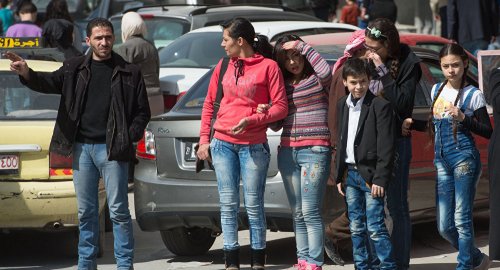
Some 30 towns and villages in the Syrian province of Hama have joined the national reconciliation process in the war-torn country through the mediation of the Russian center for reconciliation, the head of the center says.
“The work is very meticulous and delicate, everything here is based on religious and national matters, but overall about 30 communities have signed an application form to join the peace process and negotiations,” Lt. Col. German Rudenko told reporters on Thursday.
Rudenko noted that the agreement signed by representatives of local communities includes points banning the use of weapons against government forces, facilitating the peace process and return of state power to the region.
On Monday, a large number of militants from Syria’s southern province of Dara’a put down their weapons in exchange for amnesty from the government.
The militants filed their personal information and wrote a letter vowing not to engage in any anti-government activities. The government will provide them with certificates in the future to get back to normal life.
Under the national reconciliation, devised by the Syrian government, citizens who have been involved in the five-year-old militancy in the Arab country could become part of a rehabilitation program if they promise to lay down weapons and accept government investigation. The Syrian Ministry for National Reconciliation Affairs was established in 2012.
On Wednesday, Russian Foreign Ministry spokeswoman Maria Zakharova said that the ceasefire agreement in Syria, which was brokered by Russia and the United States and entered into force on February 27, has been violated 31 times over the past three days.
Zakharova did not specify which side of the conflict had broken the truce.
When asked about the presence of the Kurds in the upcoming peace talks in Geneva on March 9, Zakharova said the participants are invited by the United Nations, but Russia believes that peace talks without the participation of the Kurds will be imperfect.
“The talks without the participation of the Kurds will be incomplete, and it will affect the process, because the Kurds have a large population, they are a faction and they have participated in the ground counter-terrorism operations. It is not correct to ignore or take no account of these factors only because some delegates don’t want the Kurds to participate in it,” she said.
Turkey has already announced opposition to the presence of the Kurds in the peace talks. Ankara regards the Kurdish People’s Protection Units (YPG) and its umbrella group the Kurdish Democratic Union Party (PYD) as an ally of the Kurdistan Workers’ Party (PKK) militant group, which has been fighting for an autonomous Kurdish region inside Turkey since the 1980s.
Turkey has been heavily shelling the positions of Syrian Kurdish fighters who are battling Takfiri groups near the two countries’ border.
The Syrian government has said it accepts the terms of the deal on condition that military efforts against Daesh and the al-Qaeda-linked al-Nusra Front continue.
Photo – © Sputnik/ Iliya Pitalev
March 3, 2016
Posted by aletho |
Militarism, Timeless or most popular | Russia, Syria, Turkey, YPG |
Leave a comment
Turkey has the right to carry out military operations not only in Syria, but in any other country, which is hosting terror groups that threaten the Turkish state, Turkey’s President Recep Tayyip Erdogan said.
“Turkey has every right to conduct operations in Syria and the places where terror organizations are nested with regards to the struggle against the threats that Turkey faces,” Erdogan was cited as saying by the Hurriyet newspaper Sunday.
Ankara’s stance has “absolutely nothing to do with the sovereignty rights of the states that can’t take control of their territorial integrity,” the president insisted.
“On the contrary, this has to do with the will Turkey shows to protect its sovereignty rights,” he added.
The Turkish president used an unexpected platform to make his hawkish remarks as he visited an event celebrating the inclusion of Turkey’s southeastern province of Gaziantep on the list of UNESCO’s Creative Cities Network in the gastronomy category.
Erdogan warned that his government will treat “attitudes to prevent our country’s right [to self-defense] directly as an initiative against Turkey’s entity – no matter where it comes from.”
“No one can restrict Turkey’s right to self-defense in the face of terror acts that have targeted Turkey; they cannot prevent [Turkey] from using it,” he added.
The Turkish forces have been shelling Kurdish People’s Protection Units (YPG) forces, which Ankara views as a terrorist organization, as well as government troops on Syrian territory since mid-February.
The bombings of YPG targets, the military wing of the Democratic Union Party (PYD), continue despite Turkey’s ally, the US, considering the Kurdish fighters an important partner in fighting Islamic State (IS, Daesh, formerly ISIS/ISIL) .
There were also reports of dozens of Turkish military vehicles crossing into Kurdish northern Syria, with servicemen digging tranches in the area.
In December, Ankara also deployed 150 soldiers backed by artillery and around 25 tanks to northern Iraq, without consent from the government in Baghdad.
“Turkey will use its right to expand its rules of engagement beyond [responding to] actual attacks against it and to encompass all terror threats, including PYD and Daesh, in particular,” Erdogan said Sunday as cited by Anadolu news agency.
28 people, mainly Turkish military, were killed and 61 other injured in a suicide bombing Ankara on Wednesday.
Despite the Kurdistan Freedom Hawks (TAK) militants group claiming responsibility for the attack, Turkey claims that YPG was also involved.
In an attempt to protect itself, Turkey will treat anyone, who opposes it as a “terrorist and treat them accordingly,” the President said.
“I especially want this to be known this way,” he added.
Erdogan also slammed the countries, who criticized Ankara for their incursion into Iraq and Syria, calling them “disingenuous” due to “preaching only patience and resoluteness” to Turkey, but acting in a completely different manner when attacked themselves.
February 21, 2016
Posted by aletho |
Illegal Occupation, Militarism, Timeless or most popular, War Crimes | Syria, Turkey, YPG |
Leave a comment
As Ankara has again been hit by deadly terrorism, Turkey’s Prime Minister, Ahmet Davutoğlu, has been very quick to assign blame for Wednesday evening’s car bomb in Ankara that killed 28 people.
All the evidence, he said, suggested that the Syrian Kurdish People’s Protection Units (YPG) were responsible.
Davutoğlu’s declarations should be viewed with suspicion for a number of reasons, particularly the speed with which he announced that Turkey’s security services had uncovered the identity, birthplace, personal history and affiliations of the alleged bomber – literally within hours of the attack. Verdicts that are reached and announced that quickly are often tell-tale indicators of a pre-planned narrative and false-flag operation.
For one thing, we should wonder why Salih Necer, the 24-year-old Syrian national blamed for the explosion, was someone the authorities had so much information on that they were able to declare him the perpetrator so immediately. If there was that much information on him, how was he able to carry out the attack in the first place?
Furthermore, both the Kurdish YPG and the PKK have denied any involvement in the attack. The PYD leader has also said his group was not involved.
That’s always a problem with these narratives; the first rule of terrorism is to claim responsibility. That’s the whole POINT of a terrorist attack – to claim responsibility. But all of the Kurdish groups – who may or may not be ‘terrorists’, depending on where you stand – have entirely denied involvement.
What this attack smells of is deep-state, false-flag terrorism to further an obvious agenda. Aside from the fact that the Turkish state has conducted false-flag terror attacks in the country before (including the nonsensical business of blaming Kurdish groups for attacks on Kurdish rallies), the Turkish government is currently trying to re-establish justifications for its attacks on Syrian Kurds across the border. It is also quite possibly trying to establish justifications for an invasion into Syria. Therefore a deadly terror attack by Syrian Kurds comes at the perfect time to both justify Turkey’s existing activities and to justify further activities that are likely imminent (see more on that here).
Turkish violations of Syria’s sovereignty have become so frequent and brazen that it has prompted Damascus to petition the UN to investigate the Turkish state’s actions. Further to Turkish military shelling of both Syrian Kurdish fighters and Syrian regime targets in recent days, Reuters reported that “the Syrian government says Turkish forces were believed to be among 100 gunmen it said entered Syria on Saturday accompanied by 12 pick-up trucks mounted with heavy machine guns, in an ongoing supply operation to insurgents fighting Damascus.”
And subsequent to that, it is reported that at least 500 more ‘rebels’ crossed the Turkish border into Syria on Wednesday – the same day as the Ankara bombing. They included rebels as well as Islamist fighters.
In its harsh campaign against both Syrian Kurds and the Kurds in southern Turkey, as well as against the government of Bashar Assad, the Turkish state needs ongoing justifications like this latest attack in Ankara – this is mostly in order to validate its behaviour, not so much domestically as to its international allies and critics.
Official talk also currently indicates Turkey wants to establish a “humanitarian zone” inside northern Syria. The stated reason for this is to protect refugees and prevent them from continuing the mass exodus; but it’s also worth noting that the desired establishment of these zones is entirely in keeping with the buffer zones or “safe zones” envisioned in the Brookings Insitution policy plan for Syria, the primary purpose of which is to create safe zones for armed rebels and anti-government fighters in Syria; which is perhaps all the more urgent now, as rebel groups in northern Syria are crumbling under the assaults from the Syrian Army and its Russian allies.
But the Turkish state’s problem, like that of Saudi Arabia, is that it appears to be hardheadedly committed to a singular outcome that it is unwilling to waver from or compromise on.
Warnings that Turkey, like its neighbour Syria, is in danger of sliding into its own civil war – one that could destabilise Europe even more than Syria has – should be of serious concern to the international community, the EU and Turkey’s allies.
As Turkish journalist Metin Munir correctly forecast back in August 2012, ‘Whichever way Syria goes, Turkey is in big trouble. Turkey’s active engagement in trying to depose Bashar al-Assad has been the country’s worst foreign-policy blunder since its independence’.
February 19, 2016
Posted by aletho |
Deception, False Flag Terrorism | PKK, Syria, Turkey, YPG |
Leave a comment
Turkish Prime Minister Ahmet Davutoglu has accused forces linked with the Syrian Kurdish YPG militia of the terrorist attack in Ankara on Wednesday. Ankara promised to continue to shell the YPG, with the Syrian Kurds denying all allegations and saying Islamic State is behind the attack.
In a live television speech, Prime Minister Davutoglu said Turkey has identified the perpetrator of the Ankara bombing attack as Salih Necer, born in northern Syria’s Amuda province in 1992. He added the suspect has links to the Syrian Kurdish YPG militia. Davutoglu added the alleged attacker received assistance from the Kurdistan Workers Party (PKK), which is outlawed by Ankara.
Davutoglu said the attack showed the Syrian Kurdish YPG is a terrorist organization and that Turkey expects cooperation from its allies against the group.
“In light of information we have obtained, it has been clearly identified that this attack was carried out by the members of a terrorist organization inside Turkey, together with a YPG member individual who had crossed from Syria,” Davutoglu said, according to Reuters.
“Of the 28 people who lost their lives, 27 are members of the Turkish Armed Forces and one is a civilian,” the PM said, referring to Wednesday attack.
He added that nine people have been detained following the attack in Ankara.
Kurdish self-defense forces did not organize the attack in Ankara, Kurdish Democratic Union (PYD) chief Salih Muslim Muhammad told RIA Novosti.
“This is absolutely not true. Kurds have nothing to do with what happened in Ankara. What happened there is related to Turkey’s fight with Islamic State [IS formerly ISIS/ISIL], whose members live in Turkey.”
He also denied claims that the armed YPG wing was firing into Turkey.
“I can assure you that not even one bullet is fired by the YPG into Turkey,” Salih Muslim told Reuters. “They don’t consider Turkey as an enemy.”
Turkey has pledged to continue to shell positions of the Syrian Kurdish YPG militia, Prime Minister Ahmet Davutoglu stated on Thursday.
Davutoglu claimed Ankara had evidence revealing where the militants came from and how they organized themselves, and that this information would be soon shared with other countries.
He also warned other nations against throwing their weight behind “an enemy of Turkey,” saying that this would risk those countries’ status as allies.
“Just like Al-Qaeda or Daesh [Arabic pejorative for IS] do not have seats at the table, the YPG, which is a terrorist organization, cannot have one,” he reportedly noted.
He also mentioned that senior members of the Kurdistan Workers Party (PKK) had been killed overnight in Turkish airstrikes on their camps in northern Iraq. … Full article
February 18, 2016
Posted by aletho |
False Flag Terrorism | Syria, Turkey, YPG |
Leave a comment
The Turkish Armed Forces have again shelled the positions of the Kurdish forces of self-Defense in northern Syria, Turkish Foreign Ministry press secretary Tanju Bilgic said Monday.
On Saturday, Turkish forces began shelling the positions of Kurdish People’s Protection Units (YPG) in Syria’s Aleppo region.
Turkish forces bombed a village and an airbase that were recently captured by Kurds, Al Mayadeen TV reported Saturday. Prior to being captured by the YPG, the village and the airbase belonged to al-Nusra Front terrorist organization.
On Sunday, NTV channel reported citing a military source that Turkish forces have continued to shell YPG positions in Syria killing two Kurdish fighters.
“This morning there was an attack on our border point in the province of Hatay. According to operative information, the shelling came from the [the Syrian Kurdish Democratic Union Party’s] positions. We opened return fire,” Bilgic said at a briefing.
Later, Turkish Prime Minister Ahmet Davutoglu claimed that Turkish forces had shelled Kurds’ positions in northern Syria as a “retaliatory measure.”
On Sunday, the Syrian Foreign Ministry sent a letter to UN chief Ban Ki-moon slamming Ankara over the shelling. Syrian authorities have called on the UN to take measures to ensure security and “put an end to the crimes of the Turkish regime.”
Turkish Prime Minister Ahmet Davutoglu has again put forward an ultimatum against the self-defense forces of Syrian Kurds, demanding they abandon the Minneh Airport in northern Syria near the Turkish border or it would destroy the facilities.
“We will not allow the city of Azaz to fall… [The Syrian Kurdish Democratic Union Party] must leave the airport, and if they don’t then it will be brought to complete ruin,” Davutoglu told journalists on a flight to Ukraine.
Turkey’s actions on the border with Syria are completely unacceptable, Russian Foreign Ministry spokeswoman Maria Zakharova said Monday.
“We have directed these issues several times to the [UN] Security Council, as well as during our talks with our American colleagues and during the Vienna group meetings. It is completely unacceptable what is now occurring on the Turkish-Syrian border,” Zakharova told RT television channel.
February 15, 2016
Posted by aletho |
Illegal Occupation, Militarism, War Crimes | al-Nusra Front, Russia, Syria, Turkey, YPG |
Leave a comment

 Aletho News